


ISO/IEC 8825:1990
(Main)Information technology — Open Systems Interconnection — Specification of Basic Encoding Rules for Abstract Syntax Notation One (ASN.1)
Information technology — Open Systems Interconnection — Specification of Basic Encoding Rules for Abstract Syntax Notation One (ASN.1)
Specifies a set of basic encoding rules that may be used to derive the specification of a transfer syntax for values of types defined using the notation specified in ISO/IEC 8824. These basic encoding rules are used at the time of communication (by the presentation service provider when required by a presentation context). Annex A gives an example of encodings, Annex B indicates the assignment of object identifier values.
Technologies de l'information — Interconnexion de systèmes ouverts — Spécification de règles de base pour coder la notation de syntaxe abstraite numéro UNE (ASN.1)
General Information
- Status
- Withdrawn
- Publication Date
- 19-Dec-1990
- Withdrawal Date
- 19-Dec-1990
- Current Stage
- 9599 - Withdrawal of International Standard
- Start Date
- 30-Jun-2003
- Completion Date
- 14-Feb-2026
Relations
- Effective Date
- 15-Apr-2008
Get Certified
Connect with accredited certification bodies for this standard

BSI Group
BSI (British Standards Institution) is the business standards company that helps organizations make excellence a habit.

NYCE
Mexican standards and certification body.
Sponsored listings
Frequently Asked Questions
ISO/IEC 8825:1990 is a standard published by the International Organization for Standardization (ISO). Its full title is "Information technology — Open Systems Interconnection — Specification of Basic Encoding Rules for Abstract Syntax Notation One (ASN.1)". This standard covers: Specifies a set of basic encoding rules that may be used to derive the specification of a transfer syntax for values of types defined using the notation specified in ISO/IEC 8824. These basic encoding rules are used at the time of communication (by the presentation service provider when required by a presentation context). Annex A gives an example of encodings, Annex B indicates the assignment of object identifier values.
Specifies a set of basic encoding rules that may be used to derive the specification of a transfer syntax for values of types defined using the notation specified in ISO/IEC 8824. These basic encoding rules are used at the time of communication (by the presentation service provider when required by a presentation context). Annex A gives an example of encodings, Annex B indicates the assignment of object identifier values.
ISO/IEC 8825:1990 is classified under the following ICS (International Classification for Standards) categories: 35.100.60 - Presentation layer. The ICS classification helps identify the subject area and facilitates finding related standards.
ISO/IEC 8825:1990 has the following relationships with other standards: It is inter standard links to ISO 8825:1987. Understanding these relationships helps ensure you are using the most current and applicable version of the standard.
ISO/IEC 8825:1990 is available in PDF format for immediate download after purchase. The document can be added to your cart and obtained through the secure checkout process. Digital delivery ensures instant access to the complete standard document.
Standards Content (Sample)
INTERNATIONAL
ISO/IEC
STANDARD
Second edition
Information technology - Open Systems
Interconnection
- Specification of Basic
Encoding Rules for Abstract Syntax Notation
One (ASN.l)
Technologies de /‘Information
- lnterconnexion de syst&mes ouverts -
Spkcification de rkgles de base pour coder Ia notation de syntaxe abstraite numtko
UNE (ASN. 7)
Reference number
ISO/IEC 8825 : 1990 (E)
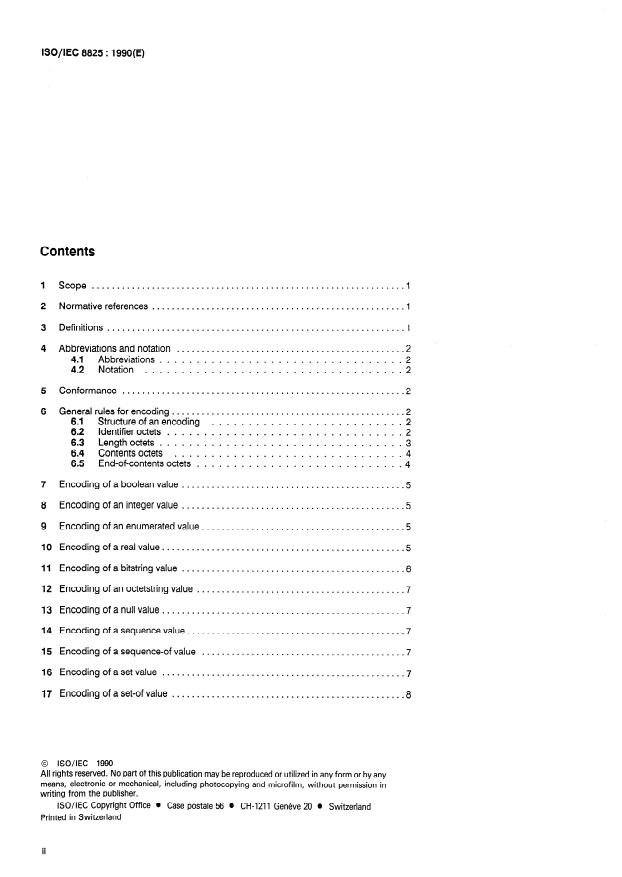
Contents
.
Scope .
Normative references 1
...................................................
.
Definitions .
.2
Abbreviations and notation .
4.1 Abbreviations .
4.2 Notation .
.
5 Conformance .
.2
6 General rules for encoding .
6.1 Structure of an encoding .
6.2 Identifier octets . 2
6.3 Lengthoctets 3
.................................
6.4 Contents octets . . 4
6.5 End-of-contents octets : : : : : : : : : : : : . 4
7 Encoding of a boolean value . .5
Encoding of an integer value . .5
Encoding of an enumerated value . .5
Encoding of a real value .
10 .5
.6
Encoding of a bitstring value .
12 Encoding of an octetstring value . .7
13 Encoding of a null value . .7
14 Encoding of a sequence value . .7
15 Encoding of a sequence-of value . 7
16 Encoding of a set value .
.7
17 Encoding of a set-of value .8
..............................................
0 ISO/IEC 1990
All rights reserved. NO part of this publication may be reproduced or utilized in any form or by any
means, electronie or mechanical, including photocopying and microfilm, without Permission in
writing from the publisher.
ISO/IEC Copyright Office l Case postale 56 l CH-1211 Geneve 20 l Switzerland
Printed in Switzerland
ii
ISO/IEC 8825 : 1990(E)
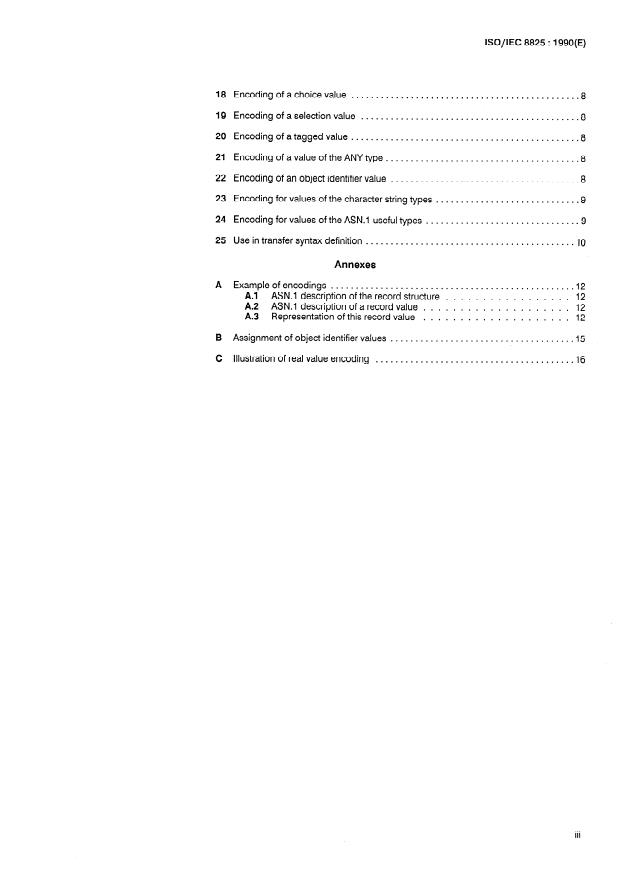
18 Encoding of a choice value
............................................. .8
19 Encoding of a selection value
........................................... .8
20 Encoding of a tagged value
............................................. .8
21 EncodingofavalueoftheANYtype. .8
....................................
22 Encoding of an Object identifier value
..................................... .8
23 Encoding for values of the Character string types .9
............................
24 Encoding for values of the ASN.1 useful types
.............................. .9
25 Use in transfer Syntax definition
.......................................... 10
Annexes
A Exampleofencodings .12
...............................................
A.l ASN.l description of the record structure 12
.................
A.2 ASN.l description of a record value 12
....................
A.3 Representation of this record value 12
....................
B Assignment of Object identifier values . . . . . . . . . . . . . . . . . . . . . . . . . . . . . . . . . . . . .15
c Illustration of real value encoding . . . . . . . . . . . . . . . . . . . . . . . . . . . . . . . . . . . . . . . .16
ISO/IEC 8825 : 1990(E)
Foreword
ISO (the International Organization for Standardization) and IEC (the International
Electrotechnical Commission) form the specialized System for worldwide standardiz-
ation. National bodies that are members of ISO or IEC participate in the development
of International Standards through technical committees established by the respective
organization to deal with particular fields of technical activity. ISO and IEC technical
committees collaborate in fields of mutual interest. Other international organizations,
governmental and non-governmental, in liaison with ISO and IEC, also take part in the
work.
In the field of information technology, ISO and IEC have established a joint technical
committee, ISO/IEC JTC 1. Draft International Standards adopted by the joint
technical committee are circulated to national bodies for voting. Publication as an
International Standard requires approval by at least 75 % of the national bodies casting
a vote.
International Standard ISO/IEC 8825 was prepared by Joint Technical Committee
ISO/IEC JTC 1, Information technology.
This second edition cancels and replaces the first edition (ISO 8825 : 1987), which has
been technically revised.
Annexes A, B and C are for information only.
iv
ISO/IEC 8825 : 1990(E)
Introduction
ISO/IEC 8824 (Specification of Abstract Syntax Notation One) specifies a notation for
the definition of abstract syntaxes, enabling application layer Standards to define the
types of information they need to transfer using the presentation Service. lt also
specifies a notation for the specification of values of a defined type.
This International Standard defines a set of encoding rules that may be applied to
values of types defined using the notation specified in ISO/IEC 8824. Application of
these encoding rules produces a transfer Syntax for such values. lt is implicit in the
specification of these encoding rules that they are also to be used for decoding.
There may be more than one set of encoding rules that tan be applied to values of
types that are defined using the notation of ISO/IEC 8824. This International Standard
defines one set of encoding rules, called basic encoding rules.
This International Standard is technically aligned with CCITT Recommendation
X.209(1988).
Annex A gives examples of the application of the encoding rules. lt is not part of this
International Standard.
Annex B summarizes th e assignment of Object identif ier * values made in this lnter-
national Standard and is not part of th is International Sta ndard.
Annex C gives examples of applying the rules encoding reals. lt is not part of this
for
International Standard.
This page intentionally left blank
INTERNATIONAL STANDARD lSO/IEC 8825 : 1990 (E)
Information technology - Open Systems
lnterconnection - Specification of Basic Encoding
Rules for Abstract Syntax Notation One (ASN.1)
1 Scope 3 Definitions
This International Standard specifies a set of basic encoding For the purposes of this International Standard the definitions
rules that may be used to derive the specification of a transfer of ISO 7498, of ISOAEC 8824 and the following definitions
Syntax for values of types defined using the notation specified
aPPlYm
in ISO/IEC 8824. These basic encoding rules are also to be
applied for decoding such a transfer Syntax in Order to identify 3.1 dynamic conformance: A Statement of the require-
the data values being transferred. ment for an implementation to adhere to the behaviour pres-
cribed by this International Standard in an instance of
These basic encoding rules are used at the time of communi- communication.
cation (by the presentation Service provider when required
by a presentation context). 3.2 static conformance: A Statement of the requirement
for support by an implementation of a valid set of features
from among those defined by this International Standard.
2 Normative references
3.3 data value: Information specified as the value of a
type; the type and the value are defined using ASN.1.
The following Standards contain provisions which, through
reference in this text, constitute provisions of this Interna-
3.4. encoding (of a data value): The complete sequence
tional Standard. At the time of publication, the editions indi-
of octets used to represent the data value.
cated were valid. All Standards are subject to revision, and
Parties to agreements based on this International Standard
NOTE - Some CCITT Recommendations use the term “data ele-
are encouraged to investigate the possibility of applying the
ment” for this sequence of octets, but the term is not used in this
most recent editions of the Standards indicated below. Mem-
International Standard, as other International Standards use it to
bers of IEC and ISO maintain registers of currently valid In-
mean “data value”.
ternational Standards
3.5 identifier octets: Part of a data value encoding
ISO 2022: 1986, Information processing - ISO 7-bit and 8-
bit coded Character sets - Code extension techniques.
which is used to identify the type of the value.
ISO 2375: 1985, Data processing - Procedure for registra- Part of a data value encoding follow-
3.6 length octets:
tion of escape sequences.
ing the identifier octets which is used to determine the end
of the encoding.
ISO 6093: 1985, Information processing - Representation
of numerical values in Character strings for information inter-
3.7 end-of-contents octets: Part of a data value encod-
Change.
ing, occurring at its end, which is used to determine the end
of the encoding.
ISO 7498:1984, Information processing Systems - Open
Systems lnterconnection - Basic Reference Model. NOTE - Not all encodings require end-of-contentsoctets.
Information processing Systems - Open 3.8 contents octets: That part of a data value encoding
ISO 8823: 1988,
Systems lnterconection - Connection-oriented presentation which represents a particular value, to distinguish it from
other values of the same type.
protocol specification.
3.9 primitive encoding: A data value encoding in which
ISO/IEC 8824:1990, Information technology - Open
the contents octets directly represent the value.
Systems In terconnec tion - Specifica tion of Abstrac t Syntax
Notation One (ASN. 7).
3.10 constructed encoding: A data value encoding in
which the contents octets are the complete encoding of one
CCITT X.209 (1988), Specification of Basic Encoding
or more other data values.
Rufes for Abstract Syntax Notation One (ASN. 1).
ISO/IEC 8825 : 1990(E)
IDENTIFIER
LENGTH OCTETS CONTENTS OCTETS
OCTETS
i
I
The number of octets
in the contents octets
(see 6.3.2)
Figure 1 - Structure of an encoding
IDENTIFIER END OF
LENGTH OCTETS CONTENTS OCTETS
OCTETS CONTENTS OCTETS
Indicates that the Indicates that there
contents octets are
are no further
terminated by end of
encodings in the
contents octets
contents octet
(see 6.3.4)
Figure 2 - An alternative constructed encoding
6.3 Length octets
Table 1 - Encoding of class of tag
6.3.1 Two forms of length octets are specified. These are
a) the definite form (see 6.3.3); and
Class
b) the indefinite form (see 6.3.4).
6.3.2 A sender shall Universal 0 0
Application 0 1
use the definite form (6.3.3) if the encoding is primi-
a)
tive;
1 0
b) use either the definite form (6.3.3) or the indefinite
1 1
form (6.3.4), a sender’s Option, if the encoding is con-
structed and all immediately available;
6.3.3.1 In the short form, the length octets shall consist of
c) use the indefinite form (6.3.4) if the encoding is con-
a Single octet in which bit 8 is zero and bits 7 to 1 encode the
structed and is not all immediately available.
number of octets in the contents octets (which may be Zero),
as an unsigned binary integer with bit 7 as the most signifi-
6.3.3 For the definite form, the length octets shall consist
cant bit.
of one or more octets, and shall represent the number of oc-
tets in the contents octets using either the short form (6.3.3.1)
EXAMPLE
or the long form (6.3.3.2) as a sender’s Option.
L
= 38 tan be encoded as 001001102
NOTE - The shortform tan only be used if the number of octets in
the contents octets is less than or equal to 127.
ISO/IEC 8825 : 1990(E)
Identifier Octet
BITS 8 7 6 5 4 3 2 1
NUMBER OF TAG
CIASS P/C
t
0 = PRIMITIVE
1 = CONSTRUCTED
Figure 3 - Identifier octet (low tag number)
+-, subsequent octets ,-b
leading octet 2nd octet last octet
1 -
CIASS P/C 11111
+
= number of tag
Figure 4 - Identifier octets (high tag number)
6.3.3.2 In the long form, the length octets shall consist of 6.3.4 For the indefinite form, the length octets indicate that
an initial octet and one or more subsequent octets. The in- the contents octets are terminated by end-of-contents octets
itial octet shall be encoded as follows: (see 6.5), and shall consist of a Single octet.
a) bit 8 shall be one; 6.3.4.1 The Single octet shall have bit 8 set to one, and bits
7 to 1 set to Zero.
b) bits 7 to 1 shall encode the number of subsequent
octets in the length octets, as an unsigned binary integer 6.3.4.2 If this form of length is used, then end-of-contents
with bit 7 as the most significant bit; octets (see 6.5) shall be present in the encoding following
the contents octets.
c) thevalue11111111~shallnotbeused
6.4 Contents octets
NOTE - This restriction is introduced for possiblefuture exten-
sion.
The contents octets shall consist of Zero, one or more octets,
and shall encode the data value as specified in subsequent
Bits 8 to 1 of the first subsequent octet, followed by bits 8 to
clauses.
1 of the second subsequent octet, followed in turn by bits 8
to 1 of each further octet up to and including the last sub-
NOTE - The contents octets depend on the type of the data value;
sequent octet, shall be the encoding of an unsigned binary
subsequent clauses follow the same sequence as the definition of
integer equal to the number of octets in the contents octets,
types in ASN.l.
with bit 8 of the first subsequent octet as the most significant
bit.
6.5 End-of-contents octets
EXAMPLE
The end-of-contents octets shall be present if the length is
encoded as specified in 6.3.4, otherwise they shall not be
L=201 tan be encoded as:
present.
The end-of-contents octets shall consist of two zero octets.
NOTE - In the long form, it is asender’s Option whether to use more
NOTE - The end-of-contents octets tan be considered as the en-
length octets than the minimum necessary.
coding of avalue whose tag is universal class, whose form is primi-
ISO/IEC 8825 : 1990(E)
contents is ab-
tive, whose number of the tag is Zero, and whose
10 Encoding of a real value
sent, thus:
10.1 The encoding of a real value shall be primitive.
End-of-contents Length - Contents
Absent
0016 0016
10.2 If the real valu e is the value Zero, there shall be no
contents octets in the encoding.
7 Encoding of a boolean value
10.3 If the real value is non-Zero, then the base used for
the encoding shall be B’, Chosen by the sender. If B’ is 2, 8
7.1 The encoding of a boolean value shall be primitive. or 16, a binary encoding, specified in 10.5, shall be used. If
The contents octets shall consist of a Single octet. B’ is IO, a Character encoding, specified in 10.6, shall be
used.
7.2 If the boolean value is
NOTE - The form of storage, generation, or processing by Senders
and receivers, and the form used in the ASN.l value notation are
FALSE
all independent of the base used for transfer.
the octet shall be Zero.
10.4 Bit 8 of the first contents octet shall be set as follows:
If the boolean value is
a) if bit 8 = 1, then the binary encoding specified in
10.5 applies;
TRUE
= 0 and bit 7 = 0, then the decimal encod-
b) if bit 8
the octet shall have any non-Zero value, as a sender’s Option.
ing specified in 10.6 applies;
EXAMPLE - If of type BOOLEAN, the value TRUE tan be en-
1, then a “SpecialRealValue”
c) if bit 8 = 0 and bit 7 =
coded as:
(see ISO 8824) is encoded as specified in 10.7.
Boolean Length Contents
10.5 When binary encoding is used (bit 8 = l), then if the
0116 0116 FF16 mantissa, M is non-Zero, it shall be represented by a sign S,
a non- negative integer value N and a binary scaling factor
F, such that
8 Encoding of an integer value
M= S x N x zF,
8.1 The encoding of an integer value shall be primitive.
The contents octets shall consist of one or more octets. 0 s F <4,
8.2 If the contents octets of an integer value encoding con-
= +l or -1
S
sist of more than one octet, then the bits of the first octet and
bit 8 of the second octet
NOTE - ThisfreedomtochooseFisprovidedtoenableeasiergener-
ation of the transfer format by eliminating the need to align the im-
shall not all be ones; and
plied decimal Point of the mantissa with an octet boundary (see
a)
annex C). The existente of F does not noticeably complicate the
task of receivers.
b) shall not all be Zero.
10.51 Bit 7 of the first contents octets shall be 1 if S is -1
NOTE - These rules ensure that an integer value is always encoded
in the smallest possible number of octets.
and 0 otherwise.
8.3 The contents octets shall be a two’s complement bi- Bits 6 to 5 of the first contents octets shall encode
10.5.2
nary number equal to the integer value, and consisting of bits the value of the base B’ as follows:
8 to 1 of the first octet, followed by bits 8 to 1 of the second
octet, followed by bits 8 to 1 of each octet in turn up to and Bits 6 to 5 Base
including the last octet of the contents octets. 00 base 2
01 base 8
NOTE - The value of a two’s complement binary number is derived
IO base 16
by numbering the bits in the contents octets, starting with bit 1 of
Reserved for further
the last octet as bit zero and ending the numbering with bit 8 of the
editions of this
first octet. Esch bit is assigned a numerical value of 2N, where N
International Standard.
is its Position in the above numbering sequence. The value of the
two’s complement binary number is obtained by summing the nu-
10.5.3 Bits 4 to 3 of the first contents octet shall encode the
merical values assigned to each bit for those bits which are set to
value of the binary scaling factor F as an unsigned binary in-
one, excluding bit 8 of the first octet, and then reducing this value
teger.
by the numerical value assigned to bit 8 of the first octet if that bit
is set to one.
10.5.4 Bits 2 to 1 of the first contents octet shall encode the
format of the exponent as follows:
9 Encoding of an enumerated value
if bits 2 to 1 are 00, then the second contents octet
a)
encodes the value of the exponent as a two’s comple-
enumerated value shall be that of the in-
The encoding of an
ment binary number;
teger value with whi ch it is associated.
NOTE - lt is primitive.
ISO/IEC 8825 : 1990(E)
b) if bits 2 to 1 are 01, then the second and third con-
11 Encoding of a bitstring value
tents octets encode the value of the exponent as a two’s
complement binary number;
11.1 The encoding of a bitstring value shall be either primi-
tive or constructed at the Option of the Sender.
c) if bits 2 to 1 are 10, then the second, third and fourth
contents octets encode the value of the exponent as a
NOTE - Where it is necessary to transfer patt of a bit strin g before
two’s complement binary number; the entire bitstring is available, the constructed encoding is used.
d) if bits 2 to 1 are 11, then the second contents octet
11.2 The contents octets for the primitive encoding shall
encodes the number of octets, X say, (as an unsigned
contain an initial octet followed by Zero, one or more sub-
binary number) used to encode the value of the expo-
sequent octets.
nent, and the third up to the (X plus 3)th (inclusive) con-
tents octets encode the value of the exponent as a two’s
11.2.1 The bits in the bitstring, commencing with the fit-st
complement binary number; the value of X shall be at
bit and proceeding to the trailing bit, shall be placed in bits
least one; the first nine bits of the transmitted exponent
8 to 1 of the first subsequent octet, followed by bits 8 to 1 of
shall not be all zeros or all ones.
the second subsequent octet, followed by bits 8 to 1 of each
octet in turn, followed by as many bits as are needed of the
10.55 Jhe remaining contents octets encode the value of
final subsequent octet, commencing with bit 8.
the integer N (see 10.5) as an unsigned binary number.
NOTE - The notation “first bit” and “trailing bit” is specified in ISO
NOTES
8824.
1 This encoding does not specify a “normalized” representation,
11.2.2 The initial octet shall encode, as an unsigned binary
there being a number of possible representations of each value
integer with bit 1 as the least significant bit, the number of un-
(except Zero). This Variation is a sender’s Option, and tan be used
used bits in the final subsequent octet. The number shall be
as a broad indication of precision.
in the range zero to seven.
the
11.2.3 If the bitstring is empty, there shall benos ubsequ ent
de-
octets, and the initial octet shall be Zero.
nex
11.3 The contents octets for the constructed encoding
10.6 When decimal encoding is used (bits 8 to 7 = 00), all shall consist of the complete encoding of Zero, one or more
the contents octets following the first contents octet form a
data values.
field, as the term is used in ISO 6093, of a length Chosen by
the Sender, and encoded according to ISO 6093. The choice NOTE - Esch such encoding includes identifier, length, and con-
tents octets, and may include end-of-contents octets if it is con-
of ISO 6093 number representation is specified by bits 6 to
structed.
1 of the first contents octet as follows:
11.3.1 Esch data value encoding in the contents octets
Bits 6 to 1 Number representation
shall be the encoding of a value of type BITSTRING.
00 0001 ISO 6093 NR1 form
00 0010 ISO 6093 NR2 form
NOTE - In particular, the tags in the contents octets are always
00 0011 ISO 6093 NR3 form
universal class, number 3.
The remaining values of bits 6 to 1 are reserved for to this In-
11.3.2 The bits in the bitstring value being encoded, com-
ternational Standard.
mencing with the first bit and proceeding to the trailing bit,
shall be placed in the first bit up to the trailing bit of the first
There shall be no use of scaling factors specified in accom-
data value encoded in the contents octets, followed by the
panying documentation (see ISO 6093).
first bit up to the trailing bit of the second data value encoded
in the contents octets, followed by the first bit up to the trail-
NOTES
ing bit of each data value in turn, followed by the first bit up
to the trailing bit of the last data value encoded in the con-
1 The recommendations in ISO 6093 concerning the use of at
least one digit to the left of the decimal mark are also recom- tents octets.
mended in this International Standard, but are not mandatory.
11.3.3 Esch data value encoded in the contents octets,
form (see ISO is a sender’s Option,
2 Use of the normalised 6093)
with the exception of the last, shall consist of a number of
and has no significance.
bits which is a multiple of eight.
10.7 When “SpecialRealValues” are to be encoded (bits 8
- Adatavalue encoded in the contents octets may be a zero-
NOTE
to 7
...
Questions, Comments and Discussion
Ask us and Technical Secretary will try to provide an answer. You can facilitate discussion about the standard in here.
Loading comments...