


ISO 10471:2025
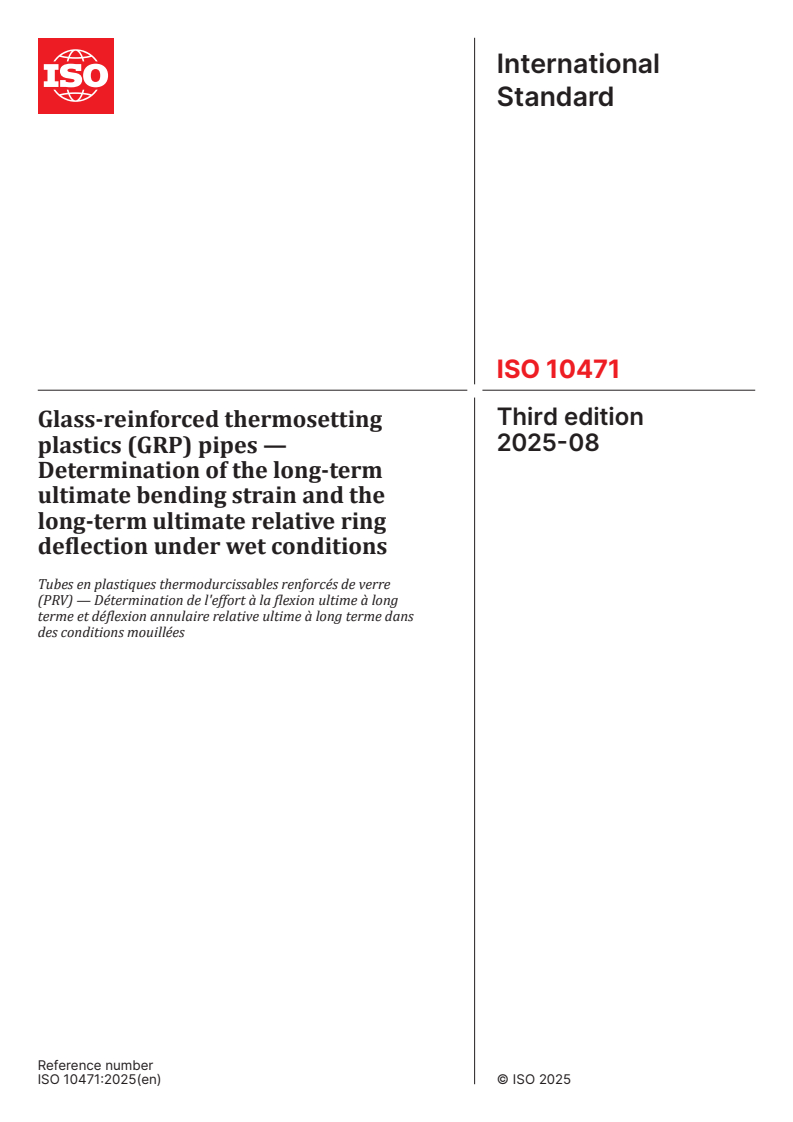
(Main)Glass-reinforced thermosetting plastics (GRP) pipes — Determination of the long-term ultimate bending strain and the long-term ultimate relative ring deflection under wet conditions
Glass-reinforced thermosetting plastics (GRP) pipes — Determination of the long-term ultimate bending strain and the long-term ultimate relative ring deflection under wet conditions
This document specifies a method for determining by extrapolation the long-term ultimate ring bending strain and for the calculation of the long-term ultimate relative ring deflection of glass-reinforced thermosetting plastics (GRP) pipes, under wet conditions. Two methods of loading are given, one using plates the other using beam bars.
Tubes en plastiques thermodurcissables renforcés de verre (PRV) — Détermination de l'effort à la flexion ultime à long terme et déflexion annulaire relative ultime à long terme dans des conditions mouillées
General Information
- Status
- Published
- Publication Date
- 26-Aug-2025
- Drafting Committee
- ISO/TC 138/SC 6/WG 1 - Methods of test
- Current Stage
- 6060 - International Standard published
- Start Date
- 27-Aug-2025
- Due Date
- 23-Oct-2025
- Completion Date
- 27-Aug-2025
Relations
- Effective Date
- 28-Oct-2023
Overview
ISO 10471:2025 specifies a laboratory method for determining, by extrapolation, the long‑term ultimate bending strain and the long‑term ultimate relative ring deflection of glass‑reinforced thermosetting plastics (GRP) pipes under wet conditions. The standard covers test arrangement, apparatus, specimen preparation and conditioning, measurement procedures and the use of regression/extrapolation to predict long‑term performance. Two loading approaches are provided: loading with bearing plates or with beam bars.
Key topics and technical requirements
- Scope: Measurement of ring bending strain and relative ring deflection of GRP pipes immersed in water and loaded diametrically under a constant vertical compressive force until failure.
- Loading methods: Two accepted force application surfaces - plates or beam bars - with a requirement to use at least one beam bar when relative deflection is expected to exceed 28%.
- Apparatus: Compressive loading machine, force application surfaces (plates/beam bars), water container, and measuring devices (automatic recorders recommended for fast failures).
- Specimen details: Requirements for specimen length, wall thickness and mean diameter; number of test pieces and conditioning (Clause 9 aligned with ISO 23856).
- Environment: Test water temperature and pH shall be set by the referring standard; if unspecified, default is (23 ± 5) °C and pH 7 ± 2.
- Measurement and conversion: Vertical deflection (y) is recorded; ultimate relative deflection y/dm is converted to ultimate bending strain εu,wet using the standard’s formulas or waterproof strain gauges. Neutral axis location must be considered where wall construction alters it.
- Extrapolation: Time‑to‑failure data and corresponding strains are analyzed per ISO 10928 regression methods to derive long‑term (x‑year) values εu,wet,x.
- Reporting: Test method choices (plates vs bars), test conditions, specimen geometry, and extrapolation parameters must be recorded in the test report.
Applications and who uses it
ISO 10471:2025 is intended for:
- Manufacturers of GRP pipes for product development, quality control and lifetime assessment.
- Independent test laboratories performing standardized durability testing.
- Design engineers and specifiers who need validated long‑term bending strain and ring deflection data for GRP pipe selection and structural assessments.
- Standards bodies and certification authorities requiring consistent methods for comparing GRP pipe performance.
Practical uses include verifying pipe resistance to long‑term diametral loading in wet environments and producing data for service life prediction and compliance with product specifications.
Related standards
- ISO 10928 - regression analysis and use for extrapolation
- ISO 7685 - initial ring stiffness of GRP pipes
- ISO 3126 - determination of dimensions for plastic piping components
- ISO 23856 - conditioning procedures referenced for specimen preparation
Keywords: ISO 10471:2025, GRP pipes, glass‑reinforced thermosetting plastics, long‑term bending strain, ring deflection, wet conditions, test method, extrapolation, ISO 10928.
Buy Documents

ISO 10471:2025 - Glass-reinforced thermosetting plastics (GRP) pipes — Determination of the long-term ultimate bending strain and the long-term ultimate relative ring deflection under wet conditions Released:27. 08. 2025
Get Certified
Connect with accredited certification bodies for this standard

Institut za varilstvo d.o.o. (Welding Institute)
Slovenia's leading welding institute since 1952. ISO 3834, EN 1090, pressure equipment certification, NDT personnel, welder qualification. Only IIW Au
Sponsored listings
Frequently Asked Questions
ISO 10471:2025 is a standard published by the International Organization for Standardization (ISO). Its full title is "Glass-reinforced thermosetting plastics (GRP) pipes — Determination of the long-term ultimate bending strain and the long-term ultimate relative ring deflection under wet conditions". This standard covers: This document specifies a method for determining by extrapolation the long-term ultimate ring bending strain and for the calculation of the long-term ultimate relative ring deflection of glass-reinforced thermosetting plastics (GRP) pipes, under wet conditions. Two methods of loading are given, one using plates the other using beam bars.
This document specifies a method for determining by extrapolation the long-term ultimate ring bending strain and for the calculation of the long-term ultimate relative ring deflection of glass-reinforced thermosetting plastics (GRP) pipes, under wet conditions. Two methods of loading are given, one using plates the other using beam bars.
ISO 10471:2025 is classified under the following ICS (International Classification for Standards) categories: 23.040.20 - Plastics pipes. The ICS classification helps identify the subject area and facilitates finding related standards.
ISO 10471:2025 has the following relationships with other standards: It is inter standard links to ISO 10471:2018. Understanding these relationships helps ensure you are using the most current and applicable version of the standard.
ISO 10471:2025 is available in PDF format for immediate download after purchase. The document can be added to your cart and obtained through the secure checkout process. Digital delivery ensures instant access to the complete standard document.
Standards Content (Sample)
International
Standard
ISO 10471
Third edition
Glass-reinforced thermosetting
2025-08
plastics (GRP) pipes —
Determination of the long-term
ultimate bending strain and the
long-term ultimate relative ring
deflection under wet conditions
Tubes en plastiques thermodurcissables renforcés de verre
(PRV) — Détermination de l'effort à la flexion ultime à long
terme et déflexion annulaire relative ultime à long terme dans
des conditions mouillées
Reference number
© ISO 2025
All rights reserved. Unless otherwise specified, or required in the context of its implementation, no part of this publication may
be reproduced or utilized otherwise in any form or by any means, electronic or mechanical, including photocopying, or posting on
the internet or an intranet, without prior written permission. Permission can be requested from either ISO at the address below
or ISO’s member body in the country of the requester.
ISO copyright office
CP 401 • Ch. de Blandonnet 8
CH-1214 Vernier, Geneva
Phone: +41 22 749 01 11
Email: copyright@iso.org
Website: www.iso.org
Published in Switzerland
ii
Contents Page
Foreword .iv
1 Scope . 1
2 Normative references . 1
3 Terms and definitions . 1
4 Principle . 3
5 Apparatus . 4
5.1 Compressive loading machine .4
5.2 Force application surfaces.5
5.2.1 General arrangement.5
5.2.2 Plates .5
5.2.3 Beam bars .5
5.3 Water container .5
5.4 Measuring devices .5
6 Test piece . 6
7 Number of test pieces . 6
8 Determination of the dimensions of the test pieces . 7
8.1 Length .7
8.2 Wall thickness .7
8.3 Mean diameter .7
9 Conditioning . 7
10 Procedure . 7
11 Calculation . 8
11.1 Extrapolation of the strain data to obtain thex-year value,ε .8
x,wet
11.2 Calculation of the long-term ultimate relative ring deflection under wet conditions,
y /d .8
u,wet,x m
12 Test report . 8
Annex A (informative) Equal increments of lg (time in h) .10
iii
Foreword
ISO (the International Organization for Standardization) is a worldwide federation of national standards
bodies (ISO member bodies). The work of preparing International Standards is normally carried out through
ISO technical committees. Each member body interested in a subject for which a technical committee
has been established has the right to be represented on that committee. International organizations,
governmental and non-governmental, in liaison with ISO, also take part in the work. ISO collaborates closely
with the International Electrotechnical Commission (IEC) on all matters of electrotechnical standardization.
The procedures used to develop this document and those intended for its further maintenance are described
in the ISO/IEC Directives, Part 1. In particular, the different approval criteria needed for the different types
of ISO documents should be noted. This document was drafted in accordance with the editorial rules of the
ISO/IEC Directives, Part 2 (see www.iso.org/directives).
ISO draws attention to the possibility that the implementation of this document may involve the use of (a)
patent(s). ISO takes no position concerning the evidence, validity or applicability of any claimed patent
rights in respect thereof. As of the date of publication of this document, ISO had not received notice of (a)
patent(s) which may be required to implement this document. However, implementers are cautioned that
this may not represent the latest information, which may be obtained from the patent database available at
www.iso.org/patents. ISO shall not be held responsible for identifying any or all such patent rights.
Any trade name used in this document is information given for the convenience of users and does not
constitute an endorsement.
For an explanation of the voluntary nature of standards, the meaning of ISO specific terms and expressions
related to conformity assessment, as well as information about ISO's adherence to the World Trade
Organization (WTO) principles in the Technical Barriers to Trade (TBT), see www.iso.org/iso/foreword.html.
This document was prepared by Technical Committee ISO/TC 138, Plastics pipes, fittings and valves for the
transport of fluids, Subcommittee SC 6, Reinforced plastics pipes and fittings for all applications.
This third edition cancels and replaces the second edition (ISO 10471:2018), which has been technically
revised.
The main changes are as follows:
— certain terms and definitions have been clarified and units have been changed from m to mm;
— a requirement on test temperature and pH of test water has been added in Clause 4;
— Figure 1 has been corrected concerning the level of water in the water container;
— the number of test lines in 8.1 has been corrected;
— an incorrect reference in 8.3 has been corrected;
— Clause 9 "Conditioning" has been aligned with ISO 23856.
Any feedback or questions on this document should be directed to the user’s national standards body. A
complete listing of these bodies can be found at www.iso.org/members.html.
iv
International Standard ISO 10471:2025(en)
Glass-reinforced thermosetting plastics (GRP) pipes —
Determination of the long-term ultimate bending strain and
the long-term ultimate relative ring deflection under wet
conditions
1 Scope
This document specifies a method for determining by extrapolation the long-term ultimate ring bending
strain and for the calculation of the long-term ultimate relative ring deflection of glass-reinforced
thermosetting plastics (GRP) pipes, under wet conditions.
Two methods of loading are given, one using plates the other using beam bars.
2 Normative references
The following documents are referred to in the text in such a way that some or all of their content constitutes
requirements of this document. For dated references, only the edition cited applies. For undated references,
the latest edition of the referenced document (including any amendments) applies.
ISO 3126, Plastics piping systems — Plastics components — Determination of dimensions
ISO 7685, Glass-reinforced thermosetting plastics (GRP) pipes — Determination of initial ring stiffness
ISO 10928, Plastics piping systems — Glass-reinforced thermosetting plastics (GRP) pipes and fittings —
Methods for regression analysis and their use
3 Terms and definitions
For the purposes of this document, the following terms and definitions apply.
ISO and IEC maintain terminology databases for use in standardization at the following addresses:
— ISO Online browsing platform: available at https:// www .iso .org/ obp
— IEC Electropedia: available at https:// www .electropedia .org/
3.1
vertical compressive force
F
vertical force, applied to a horizontal pipe to cause a vertical deflection
Note 1 to entry: Vertical compressive force is expressed in newtons.
3.2
mean diameter
d
m
diameter of the circle corresponding to the middle of the pipe wall cross-section and given by either of the
following formulae:
dd=+e
mi
or
dd=−e
me
where
d is the internal diameter, in millimetres (mm);
i
d is the external diameter, in millimetres (mm);
e
e is the wall thickness of the pipe, in millimetres (mm)
Note 1 to entry: Mean diameter is expressed in millimetres.
3.3
vertical deflection
y
vertical change in diameter of a pipe in a horizontal position in response to a vertical compressive force (3.1)
Note 1 to entry: Vertical deflection is expressed in millimetres.
3.4
relative vertical deflection
y/d
m
ratio of the vertical deflection, y (3.3), to the mean diameter (3.2) of the pipe, d
m
3.5
ultimate vertical deflection under wet conditions
y
u,wet
vertical deflection (3.3) of the pipe, y, when failure occurs under wet conditions
Note 1 to entry: Ultimate vertical deflection under wet conditions is expressed in millimetres.
3.6
ultimate relative vertical deflection under wet conditions
y /d
u,wet m
ratio of the ultimate vertical deflection under wet conditions, y (3.5), to the mean diameter (3.2) of the
u,wet
pipe, d
m
3.7
long-term ultimate ring deflection under wet conditions
y
u,wet,x
extrapolated value of the ultimate vertical deflection under wet conditions (3.5) of the pipe, y , when failure
u,wet
is expected to occur at a time, x, specified in the referring standard
Note 1 to entry: Long-term ultimate ring deflection under wet conditions is expressed in millimetres.
3.8
long-term ultimate relative ring deflection under wet conditions
y /d
u,wet,x m
ratio of the long-term ultimate ring deflection under wet conditions (3.7) of the pipe, y , to the mean
u,wet,x
diameter (3.2) of the pipe, d
m
3.9
failure
loss of the structural integrity of a test piece as evidenced by the inability of the test piece to carry the load
or by significant, abrupt increase in deflection
3.10
time to failure
t
u
time elapsed until failure (3.9) occurs
Note 1 to entry: Time to failure is expressed in hours.
3.11
ring stiffness
S
physical characteristic of a pipe, that is a measure of the resistance to ring deflection per metre length under
external load and is defined by the following formula
EI×
S =
d
m
where
E is the apparent modulus of elasticity, in newtons per square metre (N/m ), determined by
testing in accordance with ISO 7685;
I is the second moment of area in the longitudinal direction per metre length, in millimetres to
the fourth power per millimetre (mm /mm), i.e.
e
I=
where
e is the wall thickness of the pipe, in millimetres (mm);
d is the mean diameter of the pipe, in millimetres (mm) (see 3.2)
m
Note 1 to entry: Ring stiffness is expressed in newtons per square metre.
3.12
initial ring stiffness
S
value of ring stiffness S (3.11), determined by testing in accordance with ISO 7685
Note 1 to entry: Initial ring stiffness is expressed in newtons per square metre.
3.13
strain factor
D
g
dimensionless factor used to transform a deflection value into a strain value
4 Principle
Each of several cut lengths of pipe is supported horizontally and loaded throughout its length to compress it
diametrically to achieve a desired level of strain. The force application surfaces are either bearing plates or
beam bars.
The pipe is immersed in water at a given temperature for a period of time during which the force remains
constant and the increasing vertical deflection is measured at intervals until failure (see 3.9) occurs. The
relative vertical deflection at failure [ultimate relative vertical deflection, y /d (see 3.6)] is converted
u,wet m
into a bending strain at failure (ultimate bending strain, ε , in percent), either calculated using Formula (1)
u,wet
or determined from a strain-deflection calibration curve (see 10.3).
The strain may also be measured directly by the use of waterproofed strain gauges.
The following strain calculations assume that the neutral axis is at the pipe wall midpoint. For pipe wall
constructions that produce an altered neutral axis position, it is necessary to evaluate results by substituting
2ȳ for the wall thickness e where ȳ is the distance from the appropriate pipe surface to the neutral axis.
ISO 1
...
Questions, Comments and Discussion
Ask us and Technical Secretary will try to provide an answer. You can facilitate discussion about the standard in here.
Loading comments...