


ISO/TS 12869:2019
(Main)Water quality — Detection and quantification of Legionella spp. and/or Legionella pneumophila by concentration and genic amplification by quantitative polymerase chain reaction (qPCR)
Water quality — Detection and quantification of Legionella spp. and/or Legionella pneumophila by concentration and genic amplification by quantitative polymerase chain reaction (qPCR)
This document specifies a method for the detection and quantification of Legionella spp. and L. pneumophila using a quantitative polymerase chain reaction (qPCR). It specifies general methodological requirements, performance evaluation requirements, and quality control requirements. Technical details specified in this document are given for information only. Any other technical solutions complying with the performance requirements are suitable. NOTE 1 For performance requirements, see Clause 9. This document is intended to be applied in the bacteriological investigation of all types of water (hot or cold water, cooling tower water, etc.), unless the nature and/or content of suspended matter and/or accompanying flora interfere with the determination. This interference can result in an adverse effect on both the detection limit and the quantification limit. NOTE 2 For validation requirements, see 9.7. The results are expressed as the number of genome units of Legionella spp. and/or L. pneumophila per litre of sample. The method described in this document is applicable to all types of water. However, some additives, such as chemicals used for water treatment, can interfere with and/or affect the sensitivity of the method. The qPCR methods do not give any information about the physiological state of the Legionella.
Qualité de l'eau — Détection et quantification de Legionella spp. et/ou Legionella pneumophila par concentration et amplification génique par réaction de polymérisation en chaîne quantitative (qPCR)
Kakovost vode - Ugotavljanje prisotnosti in števila Legionella spp. in/ali Legionella pneumophila s koncentriranjem in pomnoževanjem genov s kvantitativno verižno reakcijo s polimerazo (qPCR)
Ta dokument podaja metodo za ugotavljanje prisotnosti in števila Legionella spp. in Legionella pneumophila s kvantitativno verižno reakcijo s polimerazo (qPCR). Določa splošne metodološke zahteve, zahteve za ocenjevanje delovanja in zahteve za nadzor kakovosti.
Tehnične podrobnosti, navedene v tem dokumentu, so izključno informativne. Vse druge tehnične rešitve, ki so skladne z zahtevami za delovanje, so ustrezne.
OPOMBA 1: Za zahteve glede zmogljivosti glej točko 9.
Ta dokument je predviden za uporabo v bakterioloških preiskavah vseh vrst vod (vroča ali hladna voda, voda v hladilnih stolpih itn.), razen če narava in/ali vsebnost lebdeče snovi in/ali spremljevalna flora moti določevanje. Ta motnja lahko negativno vpliva na mejo zaznavanja in tudi mejo kvantifikacije.
OPOMBA 2: Za zahteve za validacijo glej točko 9.7.
Rezultati so izraženi kot število enot genoma Legionella spp. in/ali L. pneumophila na
liter vzorca.
V tem dokumentu opisana metoda se uporablja za vse vrste vod. Nekateri aditivi, na primer kemikalije, ki se uporabljajo za pripravo vode, lahko povzročajo motnje in/ali vplivajo na občutljivost metode. Metode s kvantitativno verižno reakcijo s polimerazo (qPCR) ne podajajo nobenih informacij o fiziološkem stanju legionele.
General Information
- Status
- Published
- Publication Date
- 31-Mar-2019
- Technical Committee
- ISO/TC 147/SC 4 - Microbiological methods
- Drafting Committee
- ISO/TC 147/SC 4/WG 17 - Legionella by PCR
- Current Stage
- 9060 - Close of review
- Completion Date
- 04-Mar-2029
Relations
- Effective Date
- 06-Feb-2016
Overview
ISO/TS 12869:2019 specifies a standardized qPCR‑based method for the detection and quantification of Legionella spp. and Legionella pneumophila in water. The technical specification covers sample concentration, DNA extraction, quantitative PCR (qPCR) amplification and data expression. Results are reported as genome units per litre. The document defines methodological requirements, performance evaluation (see Clause 9), validation (see 9.7) and quality‑control practices, while allowing alternative technical solutions that meet the stated performance criteria.
Key topics and requirements
- Scope and applicability: Applicable to all types of water (hot/cold water, cooling tower water, etc.), provided suspended matter or flora do not interfere with detection or quantification. Some water‑treatment additives may affect assay sensitivity.
- Analytical phases: Concentration of samples, DNA extraction, qPCR amplification and quantitative analysis.
- Performance evaluation: Requirements for calibration curve verification, limits of detection (LDqPCR) and limits of quantification (LQ), recovery assessment and measurement uncertainty (Clause 9).
- Quality control: Mandatory controls such as no‑template controls (NTC), positive controls, inhibition controls (either target or exogenous controls), monitoring of calibration and limit‑of‑quantification performance.
- Operational requirements: Staffing competence, premises, apparatus/consumables, decontamination, waste handling and reagent management.
- Reporting: Expression of results as genome units per litre and documentation of method conditions; informative annexes provide examples for standards, Ct determination, calibration studies, recovery and uncertainty.
- Limitation: qPCR detects genomic material only and does not indicate viability or physiological state of Legionella.
Applications
- Rapid monitoring of Legionella contamination in building water systems, cooling towers, hot tubs, and potable water supplies.
- Routine surveillance, outbreak investigation support, and risk management where faster results than culture methods are required.
- Validation and performance verification of commercial qPCR kits and laboratory-developed tests intended for environmental Legionella testing.
Who should use this standard
- Environmental and public‑health laboratories implementing molecular Legionella testing
- Water utilities, building maintenance teams and facility managers responsible for water safety plans
- Regulatory bodies, occupational health services and contractors monitoring cooling towers or HVAC systems
- Manufacturers of qPCR assays and third‑party kit validators
Related standards
ISO/TS 12869:2019 complements culture‑based and other ISO water‑quality microbiological methods and aligns with ISO/TC 147 (Water quality) guidance. Laboratories should consider this specification alongside relevant national regulations and existing ISO water‑quality standards when designing monitoring programs.
Keywords: ISO/TS 12869:2019, Legionella detection, qPCR, water quality, quantification, genome units per litre, limit of detection, validation, quality control.
Buy Documents





ISO/TS 12869:2019 - Water quality -- Detection and quantification of Legionella spp. and/or Legionella pneumophila by concentration and genic amplification by quantitative polymerase chain reaction (qPCR)

ISO/TS 12869:2019 - Water quality — Detection and quantification of Legionella spp. and/or Legionella pneumophila by concentration and genic amplification by quantitative polymerase chain reaction (qPCR) Released:4/1/2019
Frequently Asked Questions
ISO/TS 12869:2019 is a technical specification published by the International Organization for Standardization (ISO). Its full title is "Water quality — Detection and quantification of Legionella spp. and/or Legionella pneumophila by concentration and genic amplification by quantitative polymerase chain reaction (qPCR)". This standard covers: This document specifies a method for the detection and quantification of Legionella spp. and L. pneumophila using a quantitative polymerase chain reaction (qPCR). It specifies general methodological requirements, performance evaluation requirements, and quality control requirements. Technical details specified in this document are given for information only. Any other technical solutions complying with the performance requirements are suitable. NOTE 1 For performance requirements, see Clause 9. This document is intended to be applied in the bacteriological investigation of all types of water (hot or cold water, cooling tower water, etc.), unless the nature and/or content of suspended matter and/or accompanying flora interfere with the determination. This interference can result in an adverse effect on both the detection limit and the quantification limit. NOTE 2 For validation requirements, see 9.7. The results are expressed as the number of genome units of Legionella spp. and/or L. pneumophila per litre of sample. The method described in this document is applicable to all types of water. However, some additives, such as chemicals used for water treatment, can interfere with and/or affect the sensitivity of the method. The qPCR methods do not give any information about the physiological state of the Legionella.
This document specifies a method for the detection and quantification of Legionella spp. and L. pneumophila using a quantitative polymerase chain reaction (qPCR). It specifies general methodological requirements, performance evaluation requirements, and quality control requirements. Technical details specified in this document are given for information only. Any other technical solutions complying with the performance requirements are suitable. NOTE 1 For performance requirements, see Clause 9. This document is intended to be applied in the bacteriological investigation of all types of water (hot or cold water, cooling tower water, etc.), unless the nature and/or content of suspended matter and/or accompanying flora interfere with the determination. This interference can result in an adverse effect on both the detection limit and the quantification limit. NOTE 2 For validation requirements, see 9.7. The results are expressed as the number of genome units of Legionella spp. and/or L. pneumophila per litre of sample. The method described in this document is applicable to all types of water. However, some additives, such as chemicals used for water treatment, can interfere with and/or affect the sensitivity of the method. The qPCR methods do not give any information about the physiological state of the Legionella.
ISO/TS 12869:2019 is classified under the following ICS (International Classification for Standards) categories: 07.100.20 - Microbiology of water. The ICS classification helps identify the subject area and facilitates finding related standards.
ISO/TS 12869:2019 has the following relationships with other standards: It is inter standard links to ISO/TS 12869:2012. Understanding these relationships helps ensure you are using the most current and applicable version of the standard.
ISO/TS 12869:2019 is available in PDF format for immediate download after purchase. The document can be added to your cart and obtained through the secure checkout process. Digital delivery ensures instant access to the complete standard document.
Standards Content (Sample)
SLOVENSKI STANDARD
01-oktober-2019
Nadomešča:
SIST-TS ISO/TS 12869:2013
Kakovost vode - Ugotavljanje prisotnosti in števila Legionella spp. in/ali Legionella
pneumophila s koncentriranjem in pomnoževanjem genov s kvantitativno verižno
reakcijo s polimerazo (qPCR)
Water quality - Detection and quantification of Legionella spp. and/or Legionella
pneumophila by concentration and genic amplification by quantitative polymerase chain
reaction (qPCR)
Qualité de l'eau - Détection et quantification de Legionella spp. et/ou Legionella
pneumophila par concentration et amplification génique par réaction de polymérisation
en chaîne quantitative (qPCR)
Ta slovenski standard je istoveten z: ISO/TS 12869:2019
ICS:
07.100.20 Mikrobiologija vode Microbiology of water
13.060.70 Preiskava bioloških lastnosti Examination of biological
vode properties of water
2003-01.Slovenski inštitut za standardizacijo. Razmnoževanje celote ali delov tega standarda ni dovoljeno.
TECHNICAL ISO/TS
SPECIFICATION 12869
Second edition
2019-04
Water quality — Detection and
quantification of Legionella spp.
and/or Legionella pneumophila by
concentration and genic amplification
by quantitative polymerase chain
reaction (qPCR)
Qualité de l'eau — Détection et quantification de Legionella spp.
et/ou Legionella pneumophila par concentration et amplification
génique par réaction de polymérisation en chaîne quantitative (qPCR)
Reference number
©
ISO 2019
© ISO 2019
All rights reserved. Unless otherwise specified, or required in the context of its implementation, no part of this publication may
be reproduced or utilized otherwise in any form or by any means, electronic or mechanical, including photocopying, or posting
on the internet or an intranet, without prior written permission. Permission can be requested from either ISO at the address
below or ISO’s member body in the country of the requester.
ISO copyright office
CP 401 • Ch. de Blandonnet 8
CH-1214 Vernier, Geneva
Phone: +41 22 749 01 11
Fax: +41 22 749 09 47
Email: copyright@iso.org
Website: www.iso.org
Published in Switzerland
ii © ISO 2019 – All rights reserved
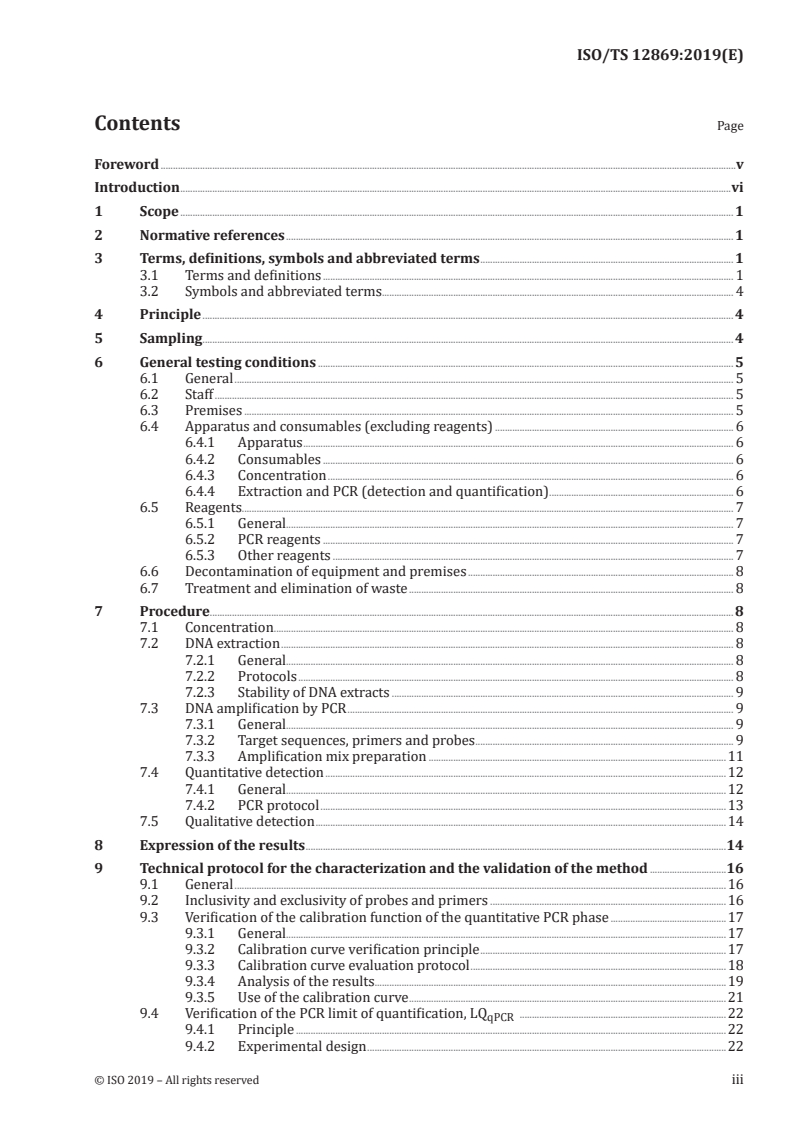
Contents Page
Foreword .v
Introduction .vi
1 Scope . 1
2 Normative references . 1
3 Terms, definitions, symbols and abbreviated terms . 1
3.1 Terms and definitions . 1
3.2 Symbols and abbreviated terms. 4
4 Principle . 4
5 Sampling . 4
6 General testing conditions . 5
6.1 General . 5
6.2 Staff . 5
6.3 Premises . 5
6.4 Apparatus and consumables (excluding reagents) . 6
6.4.1 Apparatus . 6
6.4.2 Consumables . 6
6.4.3 Concentration . 6
6.4.4 Extraction and PCR (detection and quantification) . 6
6.5 Reagents. 7
6.5.1 General. 7
6.5.2 PCR reagents . 7
6.5.3 Other reagents . 7
6.6 Decontamination of equipment and premises . 8
6.7 Treatment and elimination of waste . 8
7 Procedure. 8
7.1 Concentration. 8
7.2 DNA extraction . 8
7.2.1 General. 8
7.2.2 Protocols . 8
7.2.3 Stability of DNA extracts . 9
7.3 DNA amplification by PCR . 9
7.3.1 General. 9
7.3.2 Target sequences, primers and probes . 9
7.3.3 Amplification mix preparation .11
7.4 Quantitative detection .12
7.4.1 General.12
7.4.2 PCR protocol .13
7.5 Qualitative detection .14
8 Expression of the results .14
9 Technical protocol for the characterization and the validation of the method .16
9.1 General .16
9.2 Inclusivity and exclusivity of probes and primers .16
9.3 Verification of the calibration function of the quantitative PCR phase .17
9.3.1 General.17
9.3.2 Calibration curve verification principle .17
9.3.3 Calibration curve evaluation protocol .18
9.3.4 Analysis of the results . .19
9.3.5 Use of the calibration curve .21
9.4 Verification of the PCR limit of quantification, LQ .22
qPCR
9.4.1 Principle .22
9.4.2 Experimental design .22
9.4.3 Analysis of results .22
9.4.4 Theoretical limit of quantification of the whole method .23
9.5 Verification of the PCR limit of detection (LDqPCR) .24
9.6 Recovery method .24
9.6.1 Principle .24
9.6.2 Protocol .24
9.6.3 Calculations .25
9.7 Robustness .25
9.8 Measurement uncertainty of the whole method .26
10 Quality controls .26
10.1 General .26
10.2 Connecting the calibration solution and the reference material to the primary standard 27
10.2.1 Principle .27
10.2.2 Protocol .27
10.2.3 Data analysis .27
10.3 Monitoring of the performances .28
10.3.1 Calibration performances .28
10.3.2 Monitoring of the performances at the limit of quantification .29
10.4 Positive and negative controls of the method .29
10.5 No template control (NTC) .29
10.6 Inhibition control .29
10.6.1 General.29
10.6.2 The inhibition control is the target .29
10.6.3 The inhibition control is either a plasmid or an oligonucleotide .30
11 Test report .31
Annex A (informative) Example of protocol for producing a quantitative standard DNA solution .32
Annex B (informative) Example of method for determining the cycle threshold .33
Annex C (informative) Example of a study of the quantitative PCR phase calibration function .35
Annex D (informative) Specific Student distribution .39
Annex E (informative) Example of recovery evaluation .40
Annex F (informative) Example of overall uncertainty evaluation .42
Annex G (normative) Evaluation of the performances of a third party validated method .43
Annex H (informative) Interlaboratory studies .44
Bibliography .47
iv © ISO 2019 – All rights reserved
Foreword
ISO (the International Organization for Standardization) is a worldwide federation of national standards
bodies (ISO member bodies). The work of preparing International Standards is normally carried out
through ISO technical committees. Each member body interested in a subject for which a technical
committee has been established has the right to be represented on that committee. International
organizations, governmental and non-governmental, in liaison with ISO, also take part in the work.
ISO collaborates closely with the International Electrotechnical Commission (IEC) on all matters of
electrotechnical standardization.
The procedures used to develop this document and those intended for its further maintenance are
described in the ISO/IEC Directives, Part 1. In particular, the different approval criteria needed for the
different types of ISO documents should be noted. This document was drafted in accordance with the
editorial rules of the ISO/IEC Directives, Part 2 (see www .iso .org/directives).
Attention is drawn to the possibility that some of the elements of this document may be the subject of
patent rights. ISO shall not be held responsible for identifying any or all such patent rights. Details of
any patent rights identified during the development of the document will be in the Introduction and/or
on the ISO list of patent declarations received (see www .iso .org/patents).
Any trade name used in this document is information given for the convenience of users and does not
constitute an endorsement.
For an explanation of the voluntary nature of standards, the meaning of ISO specific terms and
expressions related to conformity assessment, as well as information about ISO's adherence to the
World Trade Organization (WTO) principles in the Technical Barriers to Trade (TBT) see www .iso
.org/iso/foreword .html.
This document was prepared by Technical Committee ISO/TC 147, Water quality, Subcommittee SC 4,
Microbiological methods.
This second edition cancels and replaces the first edition (ISO/TS 12869:2012), which has been
technically revised. The main changes compared to the previous edition are as follows:
— meet expectations from customers and governments faced with Legionella risk;
— information on management, especially needing a fast result, has been updated;
— the use of new technologies while overseeing the development work of various actors in the sector
has been allowed;
— the return of experiences from the laboratories using this method since 2006 has been taken into
account;
— in Annex G, information on evolution of the requirements for the use of third party validated
commercial kits has been added.
Any feedback or questions on this document should be directed to the user’s national standards body. A
complete listing of these bodies can be found at www .iso .org/members .html.
Introduction
The presence of L. pneumophila or Legionella spp. in water samples is demonstrated and quantified by
amplifying DNA sequences (PCR) with specific oligonucleotides. Specificity of the detection is ensured
by using a target sequence specific fluorescent-labelled probe. The increase in the amount of the DNA
amplicon can be measured and visualized in real time by a quantitative PCR device with fluorophore
specific filters.
A calibration curve is used for quantification purposes. The guidelines, minimum requirements and
performance characteristics are intended to guarantee that the results are reliable and reproducible
between different laboratories.
This document specifies a determination of the recovery of the DNA extraction. The performance of the
extraction procedure is not fully covered (lysis efficiency is not estimated).
vi © ISO 2019 – All rights reserved
TECHNICAL SPECIFICATION ISO/TS 12869:2019(E)
Water quality — Detection and quantification of Legionella
spp. and/or Legionella pneumophila by concentration
and genic amplification by quantitative polymerase chain
reaction (qPCR)
WARNING — Legionella spp. shall be handled safely by experienced microbiologists on the open
bench in a conventional microbiology laboratory conforming to containment level 2. Infection
by Legionella spp. is caused by inhalation of the organism; hence it is advisable to assess all
techniques for their ability to produce aerosols. In case of doubt, carry out the work in a safety
cabinet.
1 Scope
This document specifies a method for the detection and quantification of Legionella spp. and
L. pneumophila using a quantitative polymerase chain reaction (qPCR). It specifies general
methodological requirements, performance evaluation requirements, and quality control requirements.
Technical details specified in this document are given for information only. Any other technical
solutions complying with the performance requirements are suitable.
NOTE 1 For performance requirements, see Clause 9.
This document is intended to be applied in the bacteriological investigation of all types of water (hot
or cold water, cooling tower water, etc.), unless the nature and/or content of suspended matter and/or
accompanying flora interfere with the determination. This interference can result in an adverse effect
on both the detection limit and the quantification limit.
NOTE 2 For validation requirements, see 9.7.
The results are expressed as the number of genome units of Legionella spp. and/or L. pneumophila per
litre of sample.
The method described in this document is applicable to all types of water. However, some additives, such
as chemicals used for water treatment, can interfere with and/or affect the sensitivity of the method.
The qPCR methods do not give any information about the physiological state of the Legionella.
2 Normative references
The following documents are referred to in the text in such a way that some or all of their content
constitutes requirements of this document. For dated references, only the edition cited applies. For
undated references, the latest edition of the referenced document (including any amendments) applies.
ISO 19458, Water quality — Sampling for microbiological analysis
3 Terms, definitions, symbols and abbreviated terms
3.1 Terms and definitions
For the purposes of this document, the following terms and definitions apply.
ISO and IEC maintain terminological databases for use in standardization at the following addresses:
— ISO Online browsing platform: available at https: //www .iso .org/obp
— IEC Electropedia: available at http: //www .electropedia .org/
3.1.1
Legionella
bacterial genus which can be defined by DNA sequences of genes encoding its
specific 16S rRNA
Note 1 to entry: rRNA is the abbreviation of ribosomal ribonucleic acid.
3.1.2
Legionella pneumophila
species belonging to the Legionella (3.1.1) genus which can be defined by its
specific DNA sequences
Note 1 to entry: The distinction between Legionella spp. and L. pneumophila can be made on the basis of the
difference between the nucleotide sequence in the macrophage infectivity potentiator (mip) gene.
3.1.3
reverse primer
forward primer
single-strand DNA fragment (oligonucleotide) that serves as a template for specific DNA replication
Note 1 to entry: The choice of the DNA sequences of both the forward and reverse primers determines which
DNA fragment is replicated. The length of the primer usually varies from 15 to 30 nucleotides.
3.1.4
probe
single-stranded DNA fragment, targeting a specific sequence, labelled with a fluorophore reporter and
a fluorophore quencher
Note 1 to entry: While the probe is unattached or attached to the template DNA and before the polymerase acts,
the quencher reduces the fluorescence from the reporter.
3.1.5
quantitative PCR
qPCR
formation of specific DNA fragments which is highlighted by a labelled fluorescent probe and monitored
in real time
Note 1 to entry: The intensity of the fluorescence is a measure of the amount of amplicons. By comparison with a
calibration curve, the initial concentration of the DNA target can be determined.
3.1.6
C value
t
threshold cycle
number of PCR cycles (denaturation and amplification) required to replicate the DNA copies originally
present in the sample, so that the concentration of DNA exceeds the detection limit
Note 1 to entry: The C value is the intercept of the line that represents the DNA concentration of a sample with
t
fluorescent base line. C value is equivalent to Cq value depending on the software used.
t
3.1.7
Legionella spp. genome unit
GU
unit representing a single copy of the Legionella spp. bacterial genomic DNA
2 © ISO 2019 – All rights reserved
3.1.8
macrophage infectivity potentiator gene
mip gene
gene present in Legionella spp. which is essential for the infection of the host (protozoa) and
macrophages (humans)
Note 1 to entry: The unique base sequence of the mip gene of L. pneumophila can be used for the design of the
primer and probe sequences for the specific qPCR detection of L. pneumophila.
3.1.9
PCR inhibition control
calibrated DNA that is required to be co-amplified with the sample DNA extract using the primers
needed for Legionella spp. or L. pneumophila detection
Note 1 to entry: The PCR inhibition control should reveal any inhibitor presence in the sample DNA extract.
Note 2 to entry: The control can be a plasmid, an oligonucleotide or the L. pneumophila genomic DNA. A specific
probe shall be used to detect the inhibition control.
3.1.10
recovery
efficiency of the DNA extraction method
3.1.11
Legionella pneumophila DNA primary standard
calibrated DNA solution of L. pneumophila (WDCM 00107) with a known quantity of genome units and
an associated uncertainty
Note 1 to entry: The standard is used to adjust the working calibration DNA solutions.
Note 2 to entry: For the WDCM catalogue, see Reference [3].
3.1.12
reference material
ready-to-use calibrated DNA solution connected to the L. pneumophila DNA primary standard (3.1.13)
Note 1 to entry: The reference material shall be processed in each PCR run to check the accuracy of the qPCR.
3.1.13
amplification series
set of PCR amplification runs while using the same PCR reagent batches, same materials, and same
instruments
3.1.14
working calibration solutions
L. pneumophila (WDCM 00107) DNA calibrated solutions, compared to the L. pneumophila DNA primary
standard, used to establish the calibration curve
Note 1 to entry: The procedure is specified in 7.4.
3.1.15
Taq DNA polymerase
enzyme from Thermophilus aquaticus used for in vitro DNA polymerase reaction
3.1.16
negative control
control for monitoring the whole process in this method (from filtration to extraction to qPCR)
3.1.17
MgCl2
magnesium in its divalent cationic form is an essential co-factor of DNA polymerase activity
Note 1 to entry: It forms a complex that is soluble with the dNTP.
3.1.18
dNTP
deoxyribonucleotide triphosphates used in synthesizing DNA by polymerase DNA:
— dATP: 2'-deoxyadenosine 5'-triphosphate;
— dTTP: 2'-deoxythymidine 5'-triphosphate;
— dCTP: 2'-deoxycytidine 5'-triphosphate;
— dGTP: 2'-deoxyguanosine 5'-triphosphate
3.2 Symbols and abbreviated terms
LD (detection limit of the qPCR) lowest number of genome units that give a positive result in
qPCR
the qPCR with 90 % confidence
LD (detection limit of the qPCR) lowest number of genome units that might be detected in the
meth
volume of sample filtrated
LQ (quantification limit of the qPCR) lowest number of genome units that can be quantified
qPCR
with an accuracy less than or equal to 0,15log unit
LQ (quantification limit of the qPCR) lowest number of genome units that might be quanti-
meth
fied in the volume of sample filtrated
BSA bovine serum albumine
DMSO dimethyl sulfoxide
4 Principle
The detection and quantification of Legionella spp. or L. pneumophila by PCR are carried out in
three phases:
— concentration of water samples by filtration;
— DNA extraction from the filter;
— amplification, detection and quantification of one or more specific DNA sequences belonging to the
Legionella genus and/or L. pneumophila species by real-time qPCR.
5 Sampling
The samples shall be taken in sterile containers using all the necessary precautions. The sampling
conditions shall be indicated on the test report if they are known. Carry out sampling, transport and
storage of the samples in accordance with ISO 19458. Take care not to expose the samples to adverse
temperature conditions (e.g. freezing or overheating).
NOTE The use of insulated containers is helpful in this regard.
Preferably, start the investigation after the sampling as soon as possible. If samples are delivered to the
laboratory 24 h after sampling, they can be shipped at (5 ± 3) °C or at ambient temperature (20 ± 5) °C.
In case the conservation period is more than 24 h, the shipment shall be performed at (5 ± 3) °C.
4 © ISO 2019 – All rights reserved
Validate the storage of the filter membrane or the sample for a longer time or at another temperature.
In addition, for samples derived from oxidizing biocide-treated water a sterile container, which contains
a sufficient quantity of sterile sodium thiosulfate, shall be used for neutralizing the oxidizer.
Other biocides (bactericides or bacteriostatics) are sometimes used, in particular in cooling tower
circuits. Their presence, which can lead to underestimation, shall thus be declared and indicated on the
test report if it is known. However, it is not always possible to neutralize these products.
6 General testing conditions
6.1 General
PCR is a sensitive detection method. Aerosols, dust, and other particles are carriers of contaminating DNA.
It is therefore essential to separate in space and/or time the different stages of the analysis. In particular,
provide separate dedicated areas, materials, and equipment for pre- and post-amplification stages.
The principles to be applied are as follows:
— use of disposables compatible with PCR methods is preferred;
— procedures for eliminating DNA traces and amplicons shall be implemented in event of accidental
contamination of the premises or apparatus;
— regular quality controls shall be used to demonstrate the effectiveness of maintenance procedures
with the objective of ensuring that there is no contaminating Legionella DNA or PCR products/
amplicons (see 10.4).
6.2 Staff
All personnel who perform this method shall be trained for working with PCR and microbiological
aspects.
The staff shall wear separate laboratory coats for microbiology activities involving cultures and
molecular biology activities. Any gloves that are used for this purpose shall be talc-free.
Laboratory coats shall be changed between the areas of low DNA concentration (pre-amplification) and
the areas of high DNA concentration (post-amplification). When laboratory coats are not disposable,
then they shall be periodically cleaned and replaced. Only duly equipped staff shall access the specific
rooms where these tests are run.
More information about this subject is available in the “Quality Assurance/Quality Control Guidance for
Laboratories Performing PCR analyses on Environmental Samples” from EPA (see Reference [4]).
6.3 Premises
The laboratory shall contain at least two physically separated areas (e.g. PCR cabinet), the area including
pre-PCR [a) and b) below] and PCR [c) below] activities. Ideally, there should be three physically
separated areas a), b), and c) available:
a) an area for the concentration of samples and DNA extraction;
b) an area for the preparation of PCR reagents (reaction mixtures);
c) an area for PCR amplification.
If automated machines are used, then certain activities can be grouped together in the same area. In all
cases, check on contaminations by using a negative control (see 10.4).
Regardless of the amplicon detection and amplification system used, no tube shall be opened after
amplification in areas a), b), and c).
6.4 Apparatus and consumables (excluding reagents)
6.4.1 Apparatus
Usual laboratory equipment, and in particular the following.
6.4.1.1 Biological safety cabinet (BSC II).
6.4.1.2 Centrifuge.
6.4.1.3 Heating block module.
6.4.1.4 Real-time thermocycler.
Device used for amplification by PCR which, after each cycle of polymerization, detects and records a
fluorescent signal which is proportional to the amount of amplification product (genome units).
6.4.2 Consumables
All used consumables shall be free of DNA and DNAse.
EXAMPLE Filter funnels can be:
— delivered sterile;
— sterilized in an autoclave or oven;
— if made of metal, flamed prior to use.
6.4.3 Concentration
Membrane filters shall be made of polycarbonate or any other compound with a low capacity for
adsorption of protein or DNA, with a nominal porosity of 0,45 µm or less. Do not use membrane filters
containing cellulose or glass fibre.
6.4.4 Extraction and PCR (detection and quantification)
6.4.4.1 General
Apart from the concentration phase, it is important to avoid the apparatus coming into contact with
the water sample to prevent cross-contamination. Avoid cross-contamination by using single-use
disposables.
The quality control shall be used to confirm the effectiveness of the decontamination protocols.
Wherever possible, use consumables which are suitable for molecular diagnostics.
Careful consideration should be given to the apparatus and consumables specified in 6.4.1 and 6.4.2.
6.4.3.2 Micropipette
To avoid cross-contamination by aerosols, use tips with hydrophobic filters and/or positive displacement
micropipettes. Use a separate set of micropipettes for each area of activity.
6.4.3.3 Heating blocks, recommended, to prevent contamination by aerosols.
6 © ISO 2019 – All rights reserved
6.4.3.4 BSC II, ideally equipped with UV lamps to ensure decontamination of equipment used.
6.5 Reagents
6.5.1 General
All reagents used shall be sterile, free from nucleases and PCR inhibitors. Ideally, they should be DNA free.
Whenever possible, all reagents shall be dispensed in appropriate volumes so as to avoid reusing the
aliquots. This improves the repeatability of the method. Suitable procedures shall be used to ensure
traceability of all reagents.
Follow suppliers’ recommendations for storage and handling of reagents.
Perform initial non-contamination control of the batch of reagents which are used for the DNA isolation
and qPCR (as described in 10.4).
6.5.2 PCR reagents
An example of a PCR reaction mix components is indicated in Table 1. Ready-to-use PCR master mix
products including the different components, except primers and probe, are available.
The reaction volumes handled during PCR tests are usually between 1 µl and 100 µl.
To increase PCR repeatability while decreasing the uncertainty associated with small volumes,
sufficient volumes of reaction mixtures shall be prepared to enable at least 10 PCRs to be carried out.
Table 1 — Example of a typical PCR reaction mix
a
Component Comments
Dilution water Diluent
PCR buffer solution The composition varies greatly according to the supplier and various additives [bovine
serum albumin, dimethyl sulfoxide (DMSO), surface active agents, etc.] appropriate for
the activity or stability of the thermostable DNA polymerase used, can be added.
MgCl2 The final concentration MgCl2 depends on the dNTP, primers, probe, and target DNA
concentrations. This shall be optimized:
dNTP — dATP: 2'-deoxyadenosine 5'-triphosphate;
— dTTP: 2'-deoxythymidine 5'-triphosphate;
— dCTP: 2'-deoxycytidine 5'-triphosphate;
— dGTP: 2'-deoxyguanosine 5'-triphosphate.
A dTTP + dUTP (2'-deoxyuridine 5'-triphosphate) mix and a uracil-DNA N-glyco-
sylase (UNG) enzyme can be used. This system is not mandatory for methods using
a real-time detection system not requiring opening of tubes after amplification. Any
equivalent system able to specifically destroy the amplicons from previous PCR, in the
reaction mix, can be used.
Primers See 7.3.2.2, 7.3.2.3, 7.3.2.5, 7.3.2.6.
Thermostable DNA Use of hot-start Taq DNA polymerase is possible to avoid false-positive results.
polymerase
Probes See 7.3.2.4 and 7.3.2.7.
a
Depending on their source, some of these components may previously be mixed in the PCR buffer solution.
6.5.3 Other reagents
6.5.3.1 DNA co-precipitants, used to improve precipitation yield during DNA extraction, shall not
contain any nuclease activity or sequence homologous to the target sequences of the PCR tests.
6.5.3.2 TE buffer, pH 8,0.
Tris(hydroxymethyl)aminomethane (C H NO ) Tris 10 mmol/l
4 11 3
Ethylenediaminetetraacetic acid (C H N ) EDTA 1 mmol/l
10 16 2
DNAse- and RNAse-free water
Dissolve the tris and EDTA in DNAse- and RNAse-free water and adjust with HCl to pH 8,0. For a 10-fold
diluted TE buffer, dilute the solution with DNAse- and RNAse-free water.
6.6 Decontamination of equipment and premises
After accidental or non-accidental contamination, any recyclable equipment or material shall be treated
by immersing in or soaking with, for example, a solution of bleach with 1,7 % volume fraction active
chlorine or 1 % volume fraction hydrochloric acid or detergent.
Ultraviolet radiation can also be used to decontaminate small equipment or materials, counter tops or
even an entire room in addition to decontamination solutions.
6.7 Treatment and elimination of waste
Toxic and infectious waste shall be stored, used, and eliminated according to local regulations.
It is recommended that consumables contaminated by amplification products be discarded immediately.
7 Procedure
7.1 Concentration
Filter as large a volume of the sample as practicable (at least 50 ml) to concentrate the bacteria. Record
the volume (V) of sample filtered. This is required to calculate the results (see Clause 8). The limit
of detection, LD (see 9.5) and limit of quantification, LQ (see 9.4.4), are adversely affected by
meth meth
small sample volumes and increase proportionally.
7.2 DNA extraction
7.2.1 General
Extraction involves freeing the DNA by lysing the microorganisms, then (or at the same time) purifying
the DNA while eliminating the other components as much as possible, particularly the PCR inhibitors.
Check the recovery of the extract DNA (see 9.6).
7.2.2 Protocols
The DNA can be directly extracted from the filter. It is recommended to process the whole concentrate.
To extract the DNA, several suitable methods can be used such as physical (e.g. cycles of freezing
and thawing, beads beating), chemical (e.g. guanidine thiocyanate buffer) or biological (e.g. enzyme
digestion).
Purification step can be performed after or simultaneous of the DNA extraction step. This purification
step can be performed, for example, using chloroform and/or by fractional precipitation, with solvents
such as ethanol, isopropanol, and/or adsorption on solid matrices (e.g. resin, silica, glass, membrane,
magnetic beads).
8 © ISO 2019 – All rights reserved
The purified DNA shall be put back into suspension in a solution that guarantees the stability of the
DNA and the quality of the PCR, for example, a buffer containing a magnesium-chelating agent (EDTA)
or proteins (bovine serum albumin).
PCR quantification of Legionella spp. and L. pneumophila genome units shall be performed with the
same DNA extract.
7.2.3 Stability of DNA extracts
After the DNA extraction, the DNA extract can be used for PCR. Although it is recommended to perform
the PCR directly after the extraction it is possible to store the DNA extract for 24 h at (5 ± 3) °C. Any
longer storage at this temperature requires validation.
In case the DNA extract is stored for longer than 24 h, store the DNA extract at (-18 ± 2) °C; these storage
conditions shall be validated.
7.3 DNA amplification by PCR
7.3.1 General
This involves amplification of a limited target sequence in the 5’-to-3’ direction on each of the DNA
strands initiated by two primers (reverse primer and forward primer).
During the development of the PCR test, the amplification parameters (number of cycles, hybridization
temperature) and the reaction mix composition (dNTP, magnesium, primers, and buffer) shall be
defined and optimized. Once these parameters have been established, the performance of the method
shall be evaluated (see Clause 9).
The PCR amplification shall include controls described in Clause 10 (negative and positive controls, PCR
inhibition control, and reference material).
7.3.2 Target sequences, primers and probes
7.3.2.1 General. One or more sequences can be amplified to detect and differentiate the DNA from
bacteria belonging to Legionella spp. and L. pneumophila.
The specificity of the primers and probes shall be checked:
a) theoretically by homology research using appropriate software in the main databases such as NCBI
Genbank (see Reference [1]) or EMBL Nucleotide sequence database (see Reference [2]);
b) by testing on strains of Legionella, L. pneumophila and strains of microorganisms likely to be found
in the same ecological niches as Legionella.
Regarding b), a list of the minimum number of strains to be tested is given in 9.2. For strains not belonging
to the genus Legionella, no amplification product shall be detected by the real-time PCR. The specificity
of the probes and primers shall be evaluated on each new strain of legionella For L. pneumophila the
sequences described below are compatible with the list of strains to be tested for specificity. Other
sequences may be used as long as they match the exclusivity and inclusivity
...
TECHNICAL ISO/TS
SPECIFICATION 12869
Second edition
2019-04
Water quality — Detection and
quantification of Legionella spp.
and/or Legionella pneumophila by
concentration and genic amplification
by quantitative polymerase chain
reaction (qPCR)
Qualité de l'eau — Détection et quantification de Legionella spp.
et/ou Legionella pneumophila par concentration et amplification
génique par réaction de polymérisation en chaîne quantitative (qPCR)
Reference number
©
ISO 2019
© ISO 2019
All rights reserved. Unless otherwise specified, or required in the context of its implementation, no part of this publication may
be reproduced or utilized otherwise in any form or by any means, electronic or mechanical, including photocopying, or posting
on the internet or an intranet, without prior written permission. Permission can be requested from either ISO at the address
below or ISO’s member body in the country of the requester.
ISO copyright office
CP 401 • Ch. de Blandonnet 8
CH-1214 Vernier, Geneva
Phone: +41 22 749 01 11
Fax: +41 22 749 09 47
Email: copyright@iso.org
Website: www.iso.org
Published in Switzerland
ii © ISO 2019 – All rights reserved
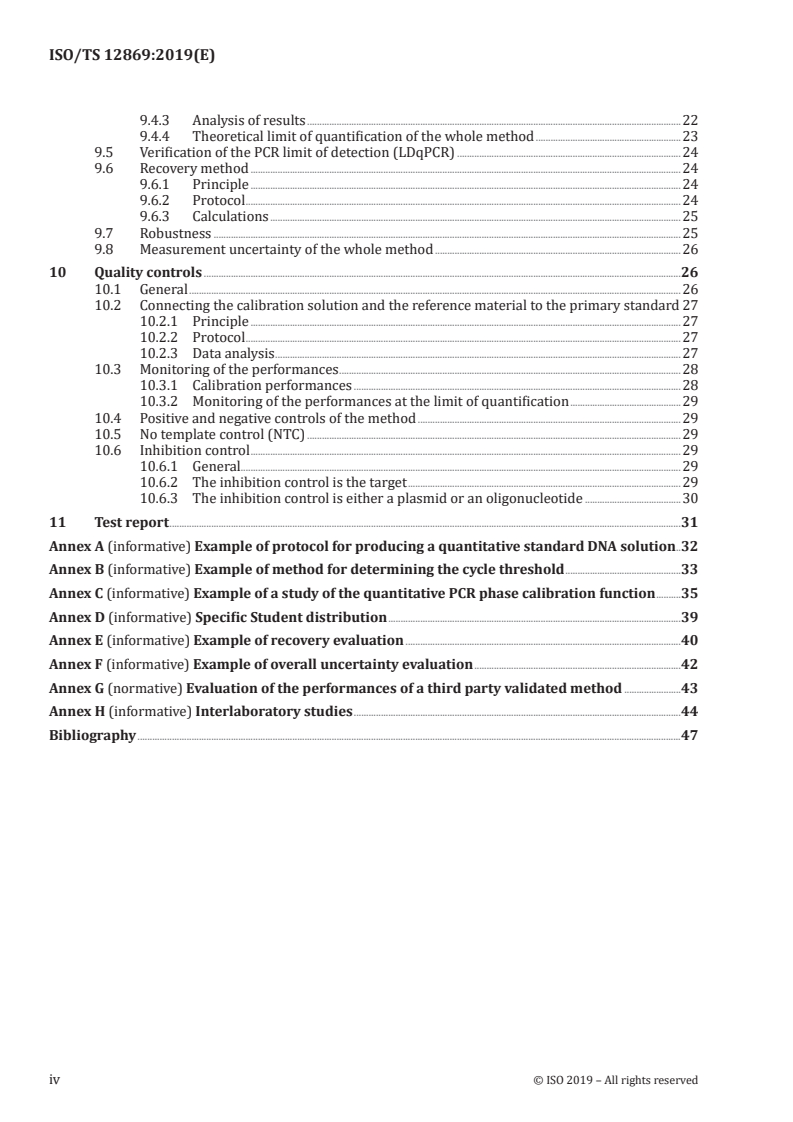
Contents Page
Foreword .v
Introduction .vi
1 Scope . 1
2 Normative references . 1
3 Terms, definitions, symbols and abbreviated terms . 1
3.1 Terms and definitions . 1
3.2 Symbols and abbreviated terms. 4
4 Principle . 4
5 Sampling . 4
6 General testing conditions . 5
6.1 General . 5
6.2 Staff . 5
6.3 Premises . 5
6.4 Apparatus and consumables (excluding reagents) . 6
6.4.1 Apparatus . 6
6.4.2 Consumables . 6
6.4.3 Concentration . 6
6.4.4 Extraction and PCR (detection and quantification) . 6
6.5 Reagents. 7
6.5.1 General. 7
6.5.2 PCR reagents . 7
6.5.3 Other reagents . 7
6.6 Decontamination of equipment and premises . 8
6.7 Treatment and elimination of waste . 8
7 Procedure. 8
7.1 Concentration. 8
7.2 DNA extraction . 8
7.2.1 General. 8
7.2.2 Protocols . 8
7.2.3 Stability of DNA extracts . 9
7.3 DNA amplification by PCR . 9
7.3.1 General. 9
7.3.2 Target sequences, primers and probes . 9
7.3.3 Amplification mix preparation .11
7.4 Quantitative detection .12
7.4.1 General.12
7.4.2 PCR protocol .13
7.5 Qualitative detection .14
8 Expression of the results .14
9 Technical protocol for the characterization and the validation of the method .16
9.1 General .16
9.2 Inclusivity and exclusivity of probes and primers .16
9.3 Verification of the calibration function of the quantitative PCR phase .17
9.3.1 General.17
9.3.2 Calibration curve verification principle .17
9.3.3 Calibration curve evaluation protocol .18
9.3.4 Analysis of the results . .19
9.3.5 Use of the calibration curve .21
9.4 Verification of the PCR limit of quantification, LQ .22
qPCR
9.4.1 Principle .22
9.4.2 Experimental design .22
9.4.3 Analysis of results .22
9.4.4 Theoretical limit of quantification of the whole method .23
9.5 Verification of the PCR limit of detection (LDqPCR) .24
9.6 Recovery method .24
9.6.1 Principle .24
9.6.2 Protocol .24
9.6.3 Calculations .25
9.7 Robustness .25
9.8 Measurement uncertainty of the whole method .26
10 Quality controls .26
10.1 General .26
10.2 Connecting the calibration solution and the reference material to the primary standard 27
10.2.1 Principle .27
10.2.2 Protocol .27
10.2.3 Data analysis .27
10.3 Monitoring of the performances .28
10.3.1 Calibration performances .28
10.3.2 Monitoring of the performances at the limit of quantification .29
10.4 Positive and negative controls of the method .29
10.5 No template control (NTC) .29
10.6 Inhibition control .29
10.6.1 General.29
10.6.2 The inhibition control is the target .29
10.6.3 The inhibition control is either a plasmid or an oligonucleotide .30
11 Test report .31
Annex A (informative) Example of protocol for producing a quantitative standard DNA solution .32
Annex B (informative) Example of method for determining the cycle threshold .33
Annex C (informative) Example of a study of the quantitative PCR phase calibration function .35
Annex D (informative) Specific Student distribution .39
Annex E (informative) Example of recovery evaluation .40
Annex F (informative) Example of overall uncertainty evaluation .42
Annex G (normative) Evaluation of the performances of a third party validated method .43
Annex H (informative) Interlaboratory studies .44
Bibliography .47
iv © ISO 2019 – All rights reserved
Foreword
ISO (the International Organization for Standardization) is a worldwide federation of national standards
bodies (ISO member bodies). The work of preparing International Standards is normally carried out
through ISO technical committees. Each member body interested in a subject for which a technical
committee has been established has the right to be represented on that committee. International
organizations, governmental and non-governmental, in liaison with ISO, also take part in the work.
ISO collaborates closely with the International Electrotechnical Commission (IEC) on all matters of
electrotechnical standardization.
The procedures used to develop this document and those intended for its further maintenance are
described in the ISO/IEC Directives, Part 1. In particular, the different approval criteria needed for the
different types of ISO documents should be noted. This document was drafted in accordance with the
editorial rules of the ISO/IEC Directives, Part 2 (see www .iso .org/directives).
Attention is drawn to the possibility that some of the elements of this document may be the subject of
patent rights. ISO shall not be held responsible for identifying any or all such patent rights. Details of
any patent rights identified during the development of the document will be in the Introduction and/or
on the ISO list of patent declarations received (see www .iso .org/patents).
Any trade name used in this document is information given for the convenience of users and does not
constitute an endorsement.
For an explanation of the voluntary nature of standards, the meaning of ISO specific terms and
expressions related to conformity assessment, as well as information about ISO's adherence to the
World Trade Organization (WTO) principles in the Technical Barriers to Trade (TBT) see www .iso
.org/iso/foreword .html.
This document was prepared by Technical Committee ISO/TC 147, Water quality, Subcommittee SC 4,
Microbiological methods.
This second edition cancels and replaces the first edition (ISO/TS 12869:2012), which has been
technically revised. The main changes compared to the previous edition are as follows:
— meet expectations from customers and governments faced with Legionella risk;
— information on management, especially needing a fast result, has been updated;
— the use of new technologies while overseeing the development work of various actors in the sector
has been allowed;
— the return of experiences from the laboratories using this method since 2006 has been taken into
account;
— in Annex G, information on evolution of the requirements for the use of third party validated
commercial kits has been added.
Any feedback or questions on this document should be directed to the user’s national standards body. A
complete listing of these bodies can be found at www .iso .org/members .html.
Introduction
The presence of L. pneumophila or Legionella spp. in water samples is demonstrated and quantified by
amplifying DNA sequences (PCR) with specific oligonucleotides. Specificity of the detection is ensured
by using a target sequence specific fluorescent-labelled probe. The increase in the amount of the DNA
amplicon can be measured and visualized in real time by a quantitative PCR device with fluorophore
specific filters.
A calibration curve is used for quantification purposes. The guidelines, minimum requirements and
performance characteristics are intended to guarantee that the results are reliable and reproducible
between different laboratories.
This document specifies a determination of the recovery of the DNA extraction. The performance of the
extraction procedure is not fully covered (lysis efficiency is not estimated).
vi © ISO 2019 – All rights reserved
TECHNICAL SPECIFICATION ISO/TS 12869:2019(E)
Water quality — Detection and quantification of Legionella
spp. and/or Legionella pneumophila by concentration
and genic amplification by quantitative polymerase chain
reaction (qPCR)
WARNING — Legionella spp. shall be handled safely by experienced microbiologists on the open
bench in a conventional microbiology laboratory conforming to containment level 2. Infection
by Legionella spp. is caused by inhalation of the organism; hence it is advisable to assess all
techniques for their ability to produce aerosols. In case of doubt, carry out the work in a safety
cabinet.
1 Scope
This document specifies a method for the detection and quantification of Legionella spp. and
L. pneumophila using a quantitative polymerase chain reaction (qPCR). It specifies general
methodological requirements, performance evaluation requirements, and quality control requirements.
Technical details specified in this document are given for information only. Any other technical
solutions complying with the performance requirements are suitable.
NOTE 1 For performance requirements, see Clause 9.
This document is intended to be applied in the bacteriological investigation of all types of water (hot
or cold water, cooling tower water, etc.), unless the nature and/or content of suspended matter and/or
accompanying flora interfere with the determination. This interference can result in an adverse effect
on both the detection limit and the quantification limit.
NOTE 2 For validation requirements, see 9.7.
The results are expressed as the number of genome units of Legionella spp. and/or L. pneumophila per
litre of sample.
The method described in this document is applicable to all types of water. However, some additives, such
as chemicals used for water treatment, can interfere with and/or affect the sensitivity of the method.
The qPCR methods do not give any information about the physiological state of the Legionella.
2 Normative references
The following documents are referred to in the text in such a way that some or all of their content
constitutes requirements of this document. For dated references, only the edition cited applies. For
undated references, the latest edition of the referenced document (including any amendments) applies.
ISO 19458, Water quality — Sampling for microbiological analysis
3 Terms, definitions, symbols and abbreviated terms
3.1 Terms and definitions
For the purposes of this document, the following terms and definitions apply.
ISO and IEC maintain terminological databases for use in standardization at the following addresses:
— ISO Online browsing platform: available at https: //www .iso .org/obp
— IEC Electropedia: available at http: //www .electropedia .org/
3.1.1
Legionella
bacterial genus which can be defined by DNA sequences of genes encoding its
specific 16S rRNA
Note 1 to entry: rRNA is the abbreviation of ribosomal ribonucleic acid.
3.1.2
Legionella pneumophila
species belonging to the Legionella (3.1.1) genus which can be defined by its
specific DNA sequences
Note 1 to entry: The distinction between Legionella spp. and L. pneumophila can be made on the basis of the
difference between the nucleotide sequence in the macrophage infectivity potentiator (mip) gene.
3.1.3
reverse primer
forward primer
single-strand DNA fragment (oligonucleotide) that serves as a template for specific DNA replication
Note 1 to entry: The choice of the DNA sequences of both the forward and reverse primers determines which
DNA fragment is replicated. The length of the primer usually varies from 15 to 30 nucleotides.
3.1.4
probe
single-stranded DNA fragment, targeting a specific sequence, labelled with a fluorophore reporter and
a fluorophore quencher
Note 1 to entry: While the probe is unattached or attached to the template DNA and before the polymerase acts,
the quencher reduces the fluorescence from the reporter.
3.1.5
quantitative PCR
qPCR
formation of specific DNA fragments which is highlighted by a labelled fluorescent probe and monitored
in real time
Note 1 to entry: The intensity of the fluorescence is a measure of the amount of amplicons. By comparison with a
calibration curve, the initial concentration of the DNA target can be determined.
3.1.6
C value
t
threshold cycle
number of PCR cycles (denaturation and amplification) required to replicate the DNA copies originally
present in the sample, so that the concentration of DNA exceeds the detection limit
Note 1 to entry: The C value is the intercept of the line that represents the DNA concentration of a sample with
t
fluorescent base line. C value is equivalent to Cq value depending on the software used.
t
3.1.7
Legionella spp. genome unit
GU
unit representing a single copy of the Legionella spp. bacterial genomic DNA
2 © ISO 2019 – All rights reserved
3.1.8
macrophage infectivity potentiator gene
mip gene
gene present in Legionella spp. which is essential for the infection of the host (protozoa) and
macrophages (humans)
Note 1 to entry: The unique base sequence of the mip gene of L. pneumophila can be used for the design of the
primer and probe sequences for the specific qPCR detection of L. pneumophila.
3.1.9
PCR inhibition control
calibrated DNA that is required to be co-amplified with the sample DNA extract using the primers
needed for Legionella spp. or L. pneumophila detection
Note 1 to entry: The PCR inhibition control should reveal any inhibitor presence in the sample DNA extract.
Note 2 to entry: The control can be a plasmid, an oligonucleotide or the L. pneumophila genomic DNA. A specific
probe shall be used to detect the inhibition control.
3.1.10
recovery
efficiency of the DNA extraction method
3.1.11
Legionella pneumophila DNA primary standard
calibrated DNA solution of L. pneumophila (WDCM 00107) with a known quantity of genome units and
an associated uncertainty
Note 1 to entry: The standard is used to adjust the working calibration DNA solutions.
Note 2 to entry: For the WDCM catalogue, see Reference [3].
3.1.12
reference material
ready-to-use calibrated DNA solution connected to the L. pneumophila DNA primary standard (3.1.13)
Note 1 to entry: The reference material shall be processed in each PCR run to check the accuracy of the qPCR.
3.1.13
amplification series
set of PCR amplification runs while using the same PCR reagent batches, same materials, and same
instruments
3.1.14
working calibration solutions
L. pneumophila (WDCM 00107) DNA calibrated solutions, compared to the L. pneumophila DNA primary
standard, used to establish the calibration curve
Note 1 to entry: The procedure is specified in 7.4.
3.1.15
Taq DNA polymerase
enzyme from Thermophilus aquaticus used for in vitro DNA polymerase reaction
3.1.16
negative control
control for monitoring the whole process in this method (from filtration to extraction to qPCR)
3.1.17
MgCl2
magnesium in its divalent cationic form is an essential co-factor of DNA polymerase activity
Note 1 to entry: It forms a complex that is soluble with the dNTP.
3.1.18
dNTP
deoxyribonucleotide triphosphates used in synthesizing DNA by polymerase DNA:
— dATP: 2'-deoxyadenosine 5'-triphosphate;
— dTTP: 2'-deoxythymidine 5'-triphosphate;
— dCTP: 2'-deoxycytidine 5'-triphosphate;
— dGTP: 2'-deoxyguanosine 5'-triphosphate
3.2 Symbols and abbreviated terms
LD (detection limit of the qPCR) lowest number of genome units that give a positive result in
qPCR
the qPCR with 90 % confidence
LD (detection limit of the qPCR) lowest number of genome units that might be detected in the
meth
volume of sample filtrated
LQ (quantification limit of the qPCR) lowest number of genome units that can be quantified
qPCR
with an accuracy less than or equal to 0,15log unit
LQ (quantification limit of the qPCR) lowest number of genome units that might be quanti-
meth
fied in the volume of sample filtrated
BSA bovine serum albumine
DMSO dimethyl sulfoxide
4 Principle
The detection and quantification of Legionella spp. or L. pneumophila by PCR are carried out in
three phases:
— concentration of water samples by filtration;
— DNA extraction from the filter;
— amplification, detection and quantification of one or more specific DNA sequences belonging to the
Legionella genus and/or L. pneumophila species by real-time qPCR.
5 Sampling
The samples shall be taken in sterile containers using all the necessary precautions. The sampling
conditions shall be indicated on the test report if they are known. Carry out sampling, transport and
storage of the samples in accordance with ISO 19458. Take care not to expose the samples to adverse
temperature conditions (e.g. freezing or overheating).
NOTE The use of insulated containers is helpful in this regard.
Preferably, start the investigation after the sampling as soon as possible. If samples are delivered to the
laboratory 24 h after sampling, they can be shipped at (5 ± 3) °C or at ambient temperature (20 ± 5) °C.
In case the conservation period is more than 24 h, the shipment shall be performed at (5 ± 3) °C.
4 © ISO 2019 – All rights reserved
Validate the storage of the filter membrane or the sample for a longer time or at another temperature.
In addition, for samples derived from oxidizing biocide-treated water a sterile container, which contains
a sufficient quantity of sterile sodium thiosulfate, shall be used for neutralizing the oxidizer.
Other biocides (bactericides or bacteriostatics) are sometimes used, in particular in cooling tower
circuits. Their presence, which can lead to underestimation, shall thus be declared and indicated on the
test report if it is known. However, it is not always possible to neutralize these products.
6 General testing conditions
6.1 General
PCR is a sensitive detection method. Aerosols, dust, and other particles are carriers of contaminating DNA.
It is therefore essential to separate in space and/or time the different stages of the analysis. In particular,
provide separate dedicated areas, materials, and equipment for pre- and post-amplification stages.
The principles to be applied are as follows:
— use of disposables compatible with PCR methods is preferred;
— procedures for eliminating DNA traces and amplicons shall be implemented in event of accidental
contamination of the premises or apparatus;
— regular quality controls shall be used to demonstrate the effectiveness of maintenance procedures
with the objective of ensuring that there is no contaminating Legionella DNA or PCR products/
amplicons (see 10.4).
6.2 Staff
All personnel who perform this method shall be trained for working with PCR and microbiological
aspects.
The staff shall wear separate laboratory coats for microbiology activities involving cultures and
molecular biology activities. Any gloves that are used for this purpose shall be talc-free.
Laboratory coats shall be changed between the areas of low DNA concentration (pre-amplification) and
the areas of high DNA concentration (post-amplification). When laboratory coats are not disposable,
then they shall be periodically cleaned and replaced. Only duly equipped staff shall access the specific
rooms where these tests are run.
More information about this subject is available in the “Quality Assurance/Quality Control Guidance for
Laboratories Performing PCR analyses on Environmental Samples” from EPA (see Reference [4]).
6.3 Premises
The laboratory shall contain at least two physically separated areas (e.g. PCR cabinet), the area including
pre-PCR [a) and b) below] and PCR [c) below] activities. Ideally, there should be three physically
separated areas a), b), and c) available:
a) an area for the concentration of samples and DNA extraction;
b) an area for the preparation of PCR reagents (reaction mixtures);
c) an area for PCR amplification.
If automated machines are used, then certain activities can be grouped together in the same area. In all
cases, check on contaminations by using a negative control (see 10.4).
Regardless of the amplicon detection and amplification system used, no tube shall be opened after
amplification in areas a), b), and c).
6.4 Apparatus and consumables (excluding reagents)
6.4.1 Apparatus
Usual laboratory equipment, and in particular the following.
6.4.1.1 Biological safety cabinet (BSC II).
6.4.1.2 Centrifuge.
6.4.1.3 Heating block module.
6.4.1.4 Real-time thermocycler.
Device used for amplification by PCR which, after each cycle of polymerization, detects and records a
fluorescent signal which is proportional to the amount of amplification product (genome units).
6.4.2 Consumables
All used consumables shall be free of DNA and DNAse.
EXAMPLE Filter funnels can be:
— delivered sterile;
— sterilized in an autoclave or oven;
— if made of metal, flamed prior to use.
6.4.3 Concentration
Membrane filters shall be made of polycarbonate or any other compound with a low capacity for
adsorption of protein or DNA, with a nominal porosity of 0,45 µm or less. Do not use membrane filters
containing cellulose or glass fibre.
6.4.4 Extraction and PCR (detection and quantification)
6.4.4.1 General
Apart from the concentration phase, it is important to avoid the apparatus coming into contact with
the water sample to prevent cross-contamination. Avoid cross-contamination by using single-use
disposables.
The quality control shall be used to confirm the effectiveness of the decontamination protocols.
Wherever possible, use consumables which are suitable for molecular diagnostics.
Careful consideration should be given to the apparatus and consumables specified in 6.4.1 and 6.4.2.
6.4.3.2 Micropipette
To avoid cross-contamination by aerosols, use tips with hydrophobic filters and/or positive displacement
micropipettes. Use a separate set of micropipettes for each area of activity.
6.4.3.3 Heating blocks, recommended, to prevent contamination by aerosols.
6 © ISO 2019 – All rights reserved
6.4.3.4 BSC II, ideally equipped with UV lamps to ensure decontamination of equipment used.
6.5 Reagents
6.5.1 General
All reagents used shall be sterile, free from nucleases and PCR inhibitors. Ideally, they should be DNA free.
Whenever possible, all reagents shall be dispensed in appropriate volumes so as to avoid reusing the
aliquots. This improves the repeatability of the method. Suitable procedures shall be used to ensure
traceability of all reagents.
Follow suppliers’ recommendations for storage and handling of reagents.
Perform initial non-contamination control of the batch of reagents which are used for the DNA isolation
and qPCR (as described in 10.4).
6.5.2 PCR reagents
An example of a PCR reaction mix components is indicated in Table 1. Ready-to-use PCR master mix
products including the different components, except primers and probe, are available.
The reaction volumes handled during PCR tests are usually between 1 µl and 100 µl.
To increase PCR repeatability while decreasing the uncertainty associated with small volumes,
sufficient volumes of reaction mixtures shall be prepared to enable at least 10 PCRs to be carried out.
Table 1 — Example of a typical PCR reaction mix
a
Component Comments
Dilution water Diluent
PCR buffer solution The composition varies greatly according to the supplier and various additives [bovine
serum albumin, dimethyl sulfoxide (DMSO), surface active agents, etc.] appropriate for
the activity or stability of the thermostable DNA polymerase used, can be added.
MgCl2 The final concentration MgCl2 depends on the dNTP, primers, probe, and target DNA
concentrations. This shall be optimized:
dNTP — dATP: 2'-deoxyadenosine 5'-triphosphate;
— dTTP: 2'-deoxythymidine 5'-triphosphate;
— dCTP: 2'-deoxycytidine 5'-triphosphate;
— dGTP: 2'-deoxyguanosine 5'-triphosphate.
A dTTP + dUTP (2'-deoxyuridine 5'-triphosphate) mix and a uracil-DNA N-glyco-
sylase (UNG) enzyme can be used. This system is not mandatory for methods using
a real-time detection system not requiring opening of tubes after amplification. Any
equivalent system able to specifically destroy the amplicons from previous PCR, in the
reaction mix, can be used.
Primers See 7.3.2.2, 7.3.2.3, 7.3.2.5, 7.3.2.6.
Thermostable DNA Use of hot-start Taq DNA polymerase is possible to avoid false-positive results.
polymerase
Probes See 7.3.2.4 and 7.3.2.7.
a
Depending on their source, some of these components may previously be mixed in the PCR buffer solution.
6.5.3 Other reagents
6.5.3.1 DNA co-precipitants, used to improve precipitation yield during DNA extraction, shall not
contain any nuclease activity or sequence homologous to the target sequences of the PCR tests.
6.5.3.2 TE buffer, pH 8,0.
Tris(hydroxymethyl)aminomethane (C H NO ) Tris 10 mmol/l
4 11 3
Ethylenediaminetetraacetic acid (C H N ) EDTA 1 mmol/l
10 16 2
DNAse- and RNAse-free water
Dissolve the tris and EDTA in DNAse- and RNAse-free water and adjust with HCl to pH 8,0. For a 10-fold
diluted TE buffer, dilute the solution with DNAse- and RNAse-free water.
6.6 Decontamination of equipment and premises
After accidental or non-accidental contamination, any recyclable equipment or material shall be treated
by immersing in or soaking with, for example, a solution of bleach with 1,7 % volume fraction active
chlorine or 1 % volume fraction hydrochloric acid or detergent.
Ultraviolet radiation can also be used to decontaminate small equipment or materials, counter tops or
even an entire room in addition to decontamination solutions.
6.7 Treatment and elimination of waste
Toxic and infectious waste shall be stored, used, and eliminated according to local regulations.
It is recommended that consumables contaminated by amplification products be discarded immediately.
7 Procedure
7.1 Concentration
Filter as large a volume of the sample as practicable (at least 50 ml) to concentrate the bacteria. Record
the volume (V) of sample filtered. This is required to calculate the results (see Clause 8). The limit
of detection, LD (see 9.5) and limit of quantification, LQ (see 9.4.4), are adversely affected by
meth meth
small sample volumes and increase proportionally.
7.2 DNA extraction
7.2.1 General
Extraction involves freeing the DNA by lysing the microorganisms, then (or at the same time) purifying
the DNA while eliminating the other components as much as possible, particularly the PCR inhibitors.
Check the recovery of the extract DNA (see 9.6).
7.2.2 Protocols
The DNA can be directly extracted from the filter. It is recommended to process the whole concentrate.
To extract the DNA, several suitable methods can be used such as physical (e.g. cycles of freezing
and thawing, beads beating), chemical (e.g. guanidine thiocyanate buffer) or biological (e.g. enzyme
digestion).
Purification step can be performed after or simultaneous of the DNA extraction step. This purification
step can be performed, for example, using chloroform and/or by fractional precipitation, with solvents
such as ethanol, isopropanol, and/or adsorption on solid matrices (e.g. resin, silica, glass, membrane,
magnetic beads).
8 © ISO 2019 – All rights reserved
The purified DNA shall be put back into suspension in a solution that guarantees the stability of the
DNA and the quality of the PCR, for example, a buffer containing a magnesium-chelating agent (EDTA)
or proteins (bovine serum albumin).
PCR quantification of Legionella spp. and L. pneumophila genome units shall be performed with the
same DNA extract.
7.2.3 Stability of DNA extracts
After the DNA extraction, the DNA extract can be used for PCR. Although it is recommended to perform
the PCR directly after the extraction it is possible to store the DNA extract for 24 h at (5 ± 3) °C. Any
longer storage at this temperature requires validation.
In case the DNA extract is stored for longer than 24 h, store the DNA extract at (-18 ± 2) °C; these storage
conditions shall be validated.
7.3 DNA amplification by PCR
7.3.1 General
This involves amplification of a limited target sequence in the 5’-to-3’ direction on each of the DNA
strands initiated by two primers (reverse primer and forward primer).
During the development of the PCR test, the amplification parameters (number of cycles, hybridization
temperature) and the reaction mix composition (dNTP, magnesium, primers, and buffer) shall be
defined and optimized. Once these parameters have been established, the performance of the method
shall be evaluated (see Clause 9).
The PCR amplification shall include controls described in Clause 10 (negative and positive controls, PCR
inhibition control, and reference material).
7.3.2 Target sequences, primers and probes
7.3.2.1 General. One or more sequences can be amplified to detect and differentiate the DNA from
bacteria belonging to Legionella spp. and L. pneumophila.
The specificity of the primers and probes shall be checked:
a) theoretically by homology research using appropriate software in the main databases such as NCBI
Genbank (see Reference [1]) or EMBL Nucleotide sequence database (see Reference [2]);
b) by testing on strains of Legionella, L. pneumophila and strains of microorganisms likely to be found
in the same ecological niches as Legionella.
Regarding b), a list of the minimum number of strains to be tested is given in 9.2. For strains not belonging
to the genus Legionella, no amplification product shall be detected by the real-time PCR. The specificity
of the probes and primers shall be evaluated on each new strain of legionella For L. pneumophila the
sequences described below are compatible with the list of strains to be tested for specificity. Other
sequences may be used as long as they match the exclusivity and inclusivity requirements (see the list
in 9.2).
There follow examples of primers (7.3.2.2 and 7.3.2.3) and probes (7.3.2.4) designed to amplify and
quantify the L. pneumophila specific fragment of mip (7.3.2.5). Sequences and fluorofors are given for
exemple.
These preparations are given as examples and shall be validated according to Clause 9.
7.3.2.2 Example of Forward primer L. pneumophila: LpneuF, with the following composition.
[6]
Sequence: 5’-CCGATGCCACATCATTAGC-3’ ;
TE buffer (6.5.3.2): diluted 10 times.
LpneuF is prepared, for example, as follows. Prepare a stock solution of primers in 10 times diluted TE
buffer at a final concentration of 100 μmol/l. Store this stock solution below –18 °C. Dilute the stock
solution to a working solution of 10 μmol/l. For the preparation of both the stock solution and the
working solution, use a 10 times diluted TE buffer. Store this working solution for up to six months
below –18 °C.
7.3.2.3 Example of Reverse primer L. pneumophila: LpneuR, with the following composition.
[6]
Sequence: 5’-CCAATTGAGCGCCACTCATAG-3’ ;
TE buffer (6.5.3.2): diluted 10 times.
NOTE LpneuR is prepared, for example, as in a similar fashion to LpneuF (7.3.2.2).
7.3.2.4 Example of Probe L. pneumophila: LpneuP, with the following composition.
[6]
Sequence: 5’-TGCCTTTAGCCATTGCTTCCG-3’ ;
Label 5’: Fluorophore (carboxyfluorescein, FAM);
Label 3’: Quencher (black hole quencher 1, BHQ1);
TE buffer (6.5.3.2).
NOTE L
...
TECHNICAL ISO/TS
SPECIFICATION 12869
Second edition
2019-04
Water quality — Detection and
quantification of Legionella spp.
and/or Legionella pneumophila by
concentration and genic amplification
by quantitative polymerase chain
reaction (qPCR)
Qualité de l'eau — Détection et quantification de Legionella spp.
et/ou Legionella pneumophila par concentration et amplification
génique par réaction de polymérisation en chaîne quantitative (qPCR)
Reference number
©
ISO 2019
© ISO 2019
All rights reserved. Unless otherwise specified, or required in the context of its implementation, no part of this publication may
be reproduced or utilized otherwise in any form or by any means, electronic or mechanical, including photocopying, or posting
on the internet or an intranet, without prior written permission. Permission can be requested from either ISO at the address
below or ISO’s member body in the country of the requester.
ISO copyright office
CP 401 • Ch. de Blandonnet 8
CH-1214 Vernier, Geneva
Phone: +41 22 749 01 11
Fax: +41 22 749 09 47
Email: copyright@iso.org
Website: www.iso.org
Published in Switzerland
ii © ISO 2019 – All rights reserved
Contents Page
Foreword .v
Introduction .vi
1 Scope . 1
2 Normative references . 1
3 Terms, definitions, symbols and abbreviated terms . 1
3.1 Terms and definitions . 1
3.2 Symbols and abbreviated terms. 4
4 Principle . 4
5 Sampling . 4
6 General testing conditions . 5
6.1 General . 5
6.2 Staff . 5
6.3 Premises . 5
6.4 Apparatus and consumables (excluding reagents) . 6
6.4.1 Apparatus . 6
6.4.2 Consumables . 6
6.4.3 Concentration . 6
6.4.4 Extraction and PCR (detection and quantification) . 6
6.5 Reagents. 7
6.5.1 General. 7
6.5.2 PCR reagents . 7
6.5.3 Other reagents . 7
6.6 Decontamination of equipment and premises . 8
6.7 Treatment and elimination of waste . 8
7 Procedure. 8
7.1 Concentration. 8
7.2 DNA extraction . 8
7.2.1 General. 8
7.2.2 Protocols . 8
7.2.3 Stability of DNA extracts . 9
7.3 DNA amplification by PCR . 9
7.3.1 General. 9
7.3.2 Target sequences, primers and probes . 9
7.3.3 Amplification mix preparation .11
7.4 Quantitative detection .12
7.4.1 General.12
7.4.2 PCR protocol .13
7.5 Qualitative detection .14
8 Expression of the results .14
9 Technical protocol for the characterization and the validation of the method .16
9.1 General .16
9.2 Inclusivity and exclusivity of probes and primers .16
9.3 Verification of the calibration function of the quantitative PCR phase .17
9.3.1 General.17
9.3.2 Calibration curve verification principle .17
9.3.3 Calibration curve evaluation protocol .18
9.3.4 Analysis of the results . .19
9.3.5 Use of the calibration curve .21
9.4 Verification of the PCR limit of quantification, LQ .22
qPCR
9.4.1 Principle .22
9.4.2 Experimental design .22
9.4.3 Analysis of results .22
9.4.4 Theoretical limit of quantification of the whole method .23
9.5 Verification of the PCR limit of detection (LDqPCR) .24
9.6 Recovery method .24
9.6.1 Principle .24
9.6.2 Protocol .24
9.6.3 Calculations .25
9.7 Robustness .25
9.8 Measurement uncertainty of the whole method .26
10 Quality controls .26
10.1 General .26
10.2 Connecting the calibration solution and the reference material to the primary standard 27
10.2.1 Principle .27
10.2.2 Protocol .27
10.2.3 Data analysis .27
10.3 Monitoring of the performances .28
10.3.1 Calibration performances .28
10.3.2 Monitoring of the performances at the limit of quantification .29
10.4 Positive and negative controls of the method .29
10.5 No template control (NTC) .29
10.6 Inhibition control .29
10.6.1 General.29
10.6.2 The inhibition control is the target .29
10.6.3 The inhibition control is either a plasmid or an oligonucleotide .30
11 Test report .31
Annex A (informative) Example of protocol for producing a quantitative standard DNA solution .32
Annex B (informative) Example of method for determining the cycle threshold .33
Annex C (informative) Example of a study of the quantitative PCR phase calibration function .35
Annex D (informative) Specific Student distribution .39
Annex E (informative) Example of recovery evaluation .40
Annex F (informative) Example of overall uncertainty evaluation .42
Annex G (normative) Evaluation of the performances of a third party validated method .43
Annex H (informative) Interlaboratory studies .44
Bibliography .47
iv © ISO 2019 – All rights reserved
Foreword
ISO (the International Organization for Standardization) is a worldwide federation of national standards
bodies (ISO member bodies). The work of preparing International Standards is normally carried out
through ISO technical committees. Each member body interested in a subject for which a technical
committee has been established has the right to be represented on that committee. International
organizations, governmental and non-governmental, in liaison with ISO, also take part in the work.
ISO collaborates closely with the International Electrotechnical Commission (IEC) on all matters of
electrotechnical standardization.
The procedures used to develop this document and those intended for its further maintenance are
described in the ISO/IEC Directives, Part 1. In particular, the different approval criteria needed for the
different types of ISO documents should be noted. This document was drafted in accordance with the
editorial rules of the ISO/IEC Directives, Part 2 (see www .iso .org/directives).
Attention is drawn to the possibility that some of the elements of this document may be the subject of
patent rights. ISO shall not be held responsible for identifying any or all such patent rights. Details of
any patent rights identified during the development of the document will be in the Introduction and/or
on the ISO list of patent declarations received (see www .iso .org/patents).
Any trade name used in this document is information given for the convenience of users and does not
constitute an endorsement.
For an explanation of the voluntary nature of standards, the meaning of ISO specific terms and
expressions related to conformity assessment, as well as information about ISO's adherence to the
World Trade Organization (WTO) principles in the Technical Barriers to Trade (TBT) see www .iso
.org/iso/foreword .html.
This document was prepared by Technical Committee ISO/TC 147, Water quality, Subcommittee SC 4,
Microbiological methods.
This second edition cancels and replaces the first edition (ISO/TS 12869:2012), which has been
technically revised. The main changes compared to the previous edition are as follows:
— meet expectations from customers and governments faced with Legionella risk;
— information on management, especially needing a fast result, has been updated;
— the use of new technologies while overseeing the development work of various actors in the sector
has been allowed;
— the return of experiences from the laboratories using this method since 2006 has been taken into
account;
— in Annex G, information on evolution of the requirements for the use of third party validated
commercial kits has been added.
Any feedback or questions on this document should be directed to the user’s national standards body. A
complete listing of these bodies can be found at www .iso .org/members .html.
Introduction
The presence of L. pneumophila or Legionella spp. in water samples is demonstrated and quantified by
amplifying DNA sequences (PCR) with specific oligonucleotides. Specificity of the detection is ensured
by using a target sequence specific fluorescent-labelled probe. The increase in the amount of the DNA
amplicon can be measured and visualized in real time by a quantitative PCR device with fluorophore
specific filters.
A calibration curve is used for quantification purposes. The guidelines, minimum requirements and
performance characteristics are intended to guarantee that the results are reliable and reproducible
between different laboratories.
This document specifies a determination of the recovery of the DNA extraction. The performance of the
extraction procedure is not fully covered (lysis efficiency is not estimated).
vi © ISO 2019 – All rights reserved
TECHNICAL SPECIFICATION ISO/TS 12869:2019(E)
Water quality — Detection and quantification of Legionella
spp. and/or Legionella pneumophila by concentration
and genic amplification by quantitative polymerase chain
reaction (qPCR)
WARNING — Legionella spp. shall be handled safely by experienced microbiologists on the open
bench in a conventional microbiology laboratory conforming to containment level 2. Infection
by Legionella spp. is caused by inhalation of the organism; hence it is advisable to assess all
techniques for their ability to produce aerosols. In case of doubt, carry out the work in a safety
cabinet.
1 Scope
This document specifies a method for the detection and quantification of Legionella spp. and
L. pneumophila using a quantitative polymerase chain reaction (qPCR). It specifies general
methodological requirements, performance evaluation requirements, and quality control requirements.
Technical details specified in this document are given for information only. Any other technical
solutions complying with the performance requirements are suitable.
NOTE 1 For performance requirements, see Clause 9.
This document is intended to be applied in the bacteriological investigation of all types of water (hot
or cold water, cooling tower water, etc.), unless the nature and/or content of suspended matter and/or
accompanying flora interfere with the determination. This interference can result in an adverse effect
on both the detection limit and the quantification limit.
NOTE 2 For validation requirements, see 9.7.
The results are expressed as the number of genome units of Legionella spp. and/or L. pneumophila per
litre of sample.
The method described in this document is applicable to all types of water. However, some additives, such
as chemicals used for water treatment, can interfere with and/or affect the sensitivity of the method.
The qPCR methods do not give any information about the physiological state of the Legionella.
2 Normative references
The following documents are referred to in the text in such a way that some or all of their content
constitutes requirements of this document. For dated references, only the edition cited applies. For
undated references, the latest edition of the referenced document (including any amendments) applies.
ISO 19458, Water quality — Sampling for microbiological analysis
3 Terms, definitions, symbols and abbreviated terms
3.1 Terms and definitions
For the purposes of this document, the following terms and definitions apply.
ISO and IEC maintain terminological databases for use in standardization at the following addresses:
— ISO Online browsing platform: available at https: //www .iso .org/obp
— IEC Electropedia: available at http: //www .electropedia .org/
3.1.1
Legionella
bacterial genus which can be defined by DNA sequences of genes encoding its
specific 16S rRNA
Note 1 to entry: rRNA is the abbreviation of ribosomal ribonucleic acid.
3.1.2
Legionella pneumophila
species belonging to the Legionella (3.1.1) genus which can be defined by its
specific DNA sequences
Note 1 to entry: The distinction between Legionella spp. and L. pneumophila can be made on the basis of the
difference between the nucleotide sequence in the macrophage infectivity potentiator (mip) gene.
3.1.3
reverse primer
forward primer
single-strand DNA fragment (oligonucleotide) that serves as a template for specific DNA replication
Note 1 to entry: The choice of the DNA sequences of both the forward and reverse primers determines which
DNA fragment is replicated. The length of the primer usually varies from 15 to 30 nucleotides.
3.1.4
probe
single-stranded DNA fragment, targeting a specific sequence, labelled with a fluorophore reporter and
a fluorophore quencher
Note 1 to entry: While the probe is unattached or attached to the template DNA and before the polymerase acts,
the quencher reduces the fluorescence from the reporter.
3.1.5
quantitative PCR
qPCR
formation of specific DNA fragments which is highlighted by a labelled fluorescent probe and monitored
in real time
Note 1 to entry: The intensity of the fluorescence is a measure of the amount of amplicons. By comparison with a
calibration curve, the initial concentration of the DNA target can be determined.
3.1.6
C value
t
threshold cycle
number of PCR cycles (denaturation and amplification) required to replicate the DNA copies originally
present in the sample, so that the concentration of DNA exceeds the detection limit
Note 1 to entry: The C value is the intercept of the line that represents the DNA concentration of a sample with
t
fluorescent base line. C value is equivalent to Cq value depending on the software used.
t
3.1.7
Legionella spp. genome unit
GU
unit representing a single copy of the Legionella spp. bacterial genomic DNA
2 © ISO 2019 – All rights reserved
3.1.8
macrophage infectivity potentiator gene
mip gene
gene present in Legionella spp. which is essential for the infection of the host (protozoa) and
macrophages (humans)
Note 1 to entry: The unique base sequence of the mip gene of L. pneumophila can be used for the design of the
primer and probe sequences for the specific qPCR detection of L. pneumophila.
3.1.9
PCR inhibition control
calibrated DNA that is required to be co-amplified with the sample DNA extract using the primers
needed for Legionella spp. or L. pneumophila detection
Note 1 to entry: The PCR inhibition control should reveal any inhibitor presence in the sample DNA extract.
Note 2 to entry: The control can be a plasmid, an oligonucleotide or the L. pneumophila genomic DNA. A specific
probe shall be used to detect the inhibition control.
3.1.10
recovery
efficiency of the DNA extraction method
3.1.11
Legionella pneumophila DNA primary standard
calibrated DNA solution of L. pneumophila (WDCM 00107) with a known quantity of genome units and
an associated uncertainty
Note 1 to entry: The standard is used to adjust the working calibration DNA solutions.
Note 2 to entry: For the WDCM catalogue, see Reference [3].
3.1.12
reference material
ready-to-use calibrated DNA solution connected to the L. pneumophila DNA primary standard (3.1.13)
Note 1 to entry: The reference material shall be processed in each PCR run to check the accuracy of the qPCR.
3.1.13
amplification series
set of PCR amplification runs while using the same PCR reagent batches, same materials, and same
instruments
3.1.14
working calibration solutions
L. pneumophila (WDCM 00107) DNA calibrated solutions, compared to the L. pneumophila DNA primary
standard, used to establish the calibration curve
Note 1 to entry: The procedure is specified in 7.4.
3.1.15
Taq DNA polymerase
enzyme from Thermophilus aquaticus used for in vitro DNA polymerase reaction
3.1.16
negative control
control for monitoring the whole process in this method (from filtration to extraction to qPCR)
3.1.17
MgCl2
magnesium in its divalent cationic form is an essential co-factor of DNA polymerase activity
Note 1 to entry: It forms a complex that is soluble with the dNTP.
3.1.18
dNTP
deoxyribonucleotide triphosphates used in synthesizing DNA by polymerase DNA:
— dATP: 2'-deoxyadenosine 5'-triphosphate;
— dTTP: 2'-deoxythymidine 5'-triphosphate;
— dCTP: 2'-deoxycytidine 5'-triphosphate;
— dGTP: 2'-deoxyguanosine 5'-triphosphate
3.2 Symbols and abbreviated terms
LD (detection limit of the qPCR) lowest number of genome units that give a positive result in
qPCR
the qPCR with 90 % confidence
LD (detection limit of the qPCR) lowest number of genome units that might be detected in the
meth
volume of sample filtrated
LQ (quantification limit of the qPCR) lowest number of genome units that can be quantified
qPCR
with an accuracy less than or equal to 0,15log unit
LQ (quantification limit of the qPCR) lowest number of genome units that might be quanti-
meth
fied in the volume of sample filtrated
BSA bovine serum albumine
DMSO dimethyl sulfoxide
4 Principle
The detection and quantification of Legionella spp. or L. pneumophila by PCR are carried out in
three phases:
— concentration of water samples by filtration;
— DNA extraction from the filter;
— amplification, detection and quantification of one or more specific DNA sequences belonging to the
Legionella genus and/or L. pneumophila species by real-time qPCR.
5 Sampling
The samples shall be taken in sterile containers using all the necessary precautions. The sampling
conditions shall be indicated on the test report if they are known. Carry out sampling, transport and
storage of the samples in accordance with ISO 19458. Take care not to expose the samples to adverse
temperature conditions (e.g. freezing or overheating).
NOTE The use of insulated containers is helpful in this regard.
Preferably, start the investigation after the sampling as soon as possible. If samples are delivered to the
laboratory 24 h after sampling, they can be shipped at (5 ± 3) °C or at ambient temperature (20 ± 5) °C.
In case the conservation period is more than 24 h, the shipment shall be performed at (5 ± 3) °C.
4 © ISO 2019 – All rights reserved
Validate the storage of the filter membrane or the sample for a longer time or at another temperature.
In addition, for samples derived from oxidizing biocide-treated water a sterile container, which contains
a sufficient quantity of sterile sodium thiosulfate, shall be used for neutralizing the oxidizer.
Other biocides (bactericides or bacteriostatics) are sometimes used, in particular in cooling tower
circuits. Their presence, which can lead to underestimation, shall thus be declared and indicated on the
test report if it is known. However, it is not always possible to neutralize these products.
6 General testing conditions
6.1 General
PCR is a sensitive detection method. Aerosols, dust, and other particles are carriers of contaminating DNA.
It is therefore essential to separate in space and/or time the different stages of the analysis. In particular,
provide separate dedicated areas, materials, and equipment for pre- and post-amplification stages.
The principles to be applied are as follows:
— use of disposables compatible with PCR methods is preferred;
— procedures for eliminating DNA traces and amplicons shall be implemented in event of accidental
contamination of the premises or apparatus;
— regular quality controls shall be used to demonstrate the effectiveness of maintenance procedures
with the objective of ensuring that there is no contaminating Legionella DNA or PCR products/
amplicons (see 10.4).
6.2 Staff
All personnel who perform this method shall be trained for working with PCR and microbiological
aspects.
The staff shall wear separate laboratory coats for microbiology activities involving cultures and
molecular biology activities. Any gloves that are used for this purpose shall be talc-free.
Laboratory coats shall be changed between the areas of low DNA concentration (pre-amplification) and
the areas of high DNA concentration (post-amplification). When laboratory coats are not disposable,
then they shall be periodically cleaned and replaced. Only duly equipped staff shall access the specific
rooms where these tests are run.
More information about this subject is available in the “Quality Assurance/Quality Control Guidance for
Laboratories Performing PCR analyses on Environmental Samples” from EPA (see Reference [4]).
6.3 Premises
The laboratory shall contain at least two physically separated areas (e.g. PCR cabinet), the area including
pre-PCR [a) and b) below] and PCR [c) below] activities. Ideally, there should be three physically
separated areas a), b), and c) available:
a) an area for the concentration of samples and DNA extraction;
b) an area for the preparation of PCR reagents (reaction mixtures);
c) an area for PCR amplification.
If automated machines are used, then certain activities can be grouped together in the same area. In all
cases, check on contaminations by using a negative control (see 10.4).
Regardless of the amplicon detection and amplification system used, no tube shall be opened after
amplification in areas a), b), and c).
6.4 Apparatus and consumables (excluding reagents)
6.4.1 Apparatus
Usual laboratory equipment, and in particular the following.
6.4.1.1 Biological safety cabinet (BSC II).
6.4.1.2 Centrifuge.
6.4.1.3 Heating block module.
6.4.1.4 Real-time thermocycler.
Device used for amplification by PCR which, after each cycle of polymerization, detects and records a
fluorescent signal which is proportional to the amount of amplification product (genome units).
6.4.2 Consumables
All used consumables shall be free of DNA and DNAse.
EXAMPLE Filter funnels can be:
— delivered sterile;
— sterilized in an autoclave or oven;
— if made of metal, flamed prior to use.
6.4.3 Concentration
Membrane filters shall be made of polycarbonate or any other compound with a low capacity for
adsorption of protein or DNA, with a nominal porosity of 0,45 µm or less. Do not use membrane filters
containing cellulose or glass fibre.
6.4.4 Extraction and PCR (detection and quantification)
6.4.4.1 General
Apart from the concentration phase, it is important to avoid the apparatus coming into contact with
the water sample to prevent cross-contamination. Avoid cross-contamination by using single-use
disposables.
The quality control shall be used to confirm the effectiveness of the decontamination protocols.
Wherever possible, use consumables which are suitable for molecular diagnostics.
Careful consideration should be given to the apparatus and consumables specified in 6.4.1 and 6.4.2.
6.4.3.2 Micropipette
To avoid cross-contamination by aerosols, use tips with hydrophobic filters and/or positive displacement
micropipettes. Use a separate set of micropipettes for each area of activity.
6.4.3.3 Heating blocks, recommended, to prevent contamination by aerosols.
6 © ISO 2019 – All rights reserved
6.4.3.4 BSC II, ideally equipped with UV lamps to ensure decontamination of equipment used.
6.5 Reagents
6.5.1 General
All reagents used shall be sterile, free from nucleases and PCR inhibitors. Ideally, they should be DNA free.
Whenever possible, all reagents shall be dispensed in appropriate volumes so as to avoid reusing the
aliquots. This improves the repeatability of the method. Suitable procedures shall be used to ensure
traceability of all reagents.
Follow suppliers’ recommendations for storage and handling of reagents.
Perform initial non-contamination control of the batch of reagents which are used for the DNA isolation
and qPCR (as described in 10.4).
6.5.2 PCR reagents
An example of a PCR reaction mix components is indicated in Table 1. Ready-to-use PCR master mix
products including the different components, except primers and probe, are available.
The reaction volumes handled during PCR tests are usually between 1 µl and 100 µl.
To increase PCR repeatability while decreasing the uncertainty associated with small volumes,
sufficient volumes of reaction mixtures shall be prepared to enable at least 10 PCRs to be carried out.
Table 1 — Example of a typical PCR reaction mix
a
Component Comments
Dilution water Diluent
PCR buffer solution The composition varies greatly according to the supplier and various additives [bovine
serum albumin, dimethyl sulfoxide (DMSO), surface active agents, etc.] appropriate for
the activity or stability of the thermostable DNA polymerase used, can be added.
MgCl2 The final concentration MgCl2 depends on the dNTP, primers, probe, and target DNA
concentrations. This shall be optimized:
dNTP — dATP: 2'-deoxyadenosine 5'-triphosphate;
— dTTP: 2'-deoxythymidine 5'-triphosphate;
— dCTP: 2'-deoxycytidine 5'-triphosphate;
— dGTP: 2'-deoxyguanosine 5'-triphosphate.
A dTTP + dUTP (2'-deoxyuridine 5'-triphosphate) mix and a uracil-DNA N-glyco-
sylase (UNG) enzyme can be used. This system is not mandatory for methods using
a real-time detection system not requiring opening of tubes after amplification. Any
equivalent system able to specifically destroy the amplicons from previous PCR, in the
reaction mix, can be used.
Primers See 7.3.2.2, 7.3.2.3, 7.3.2.5, 7.3.2.6.
Thermostable DNA Use of hot-start Taq DNA polymerase is possible to avoid false-positive results.
polymerase
Probes See 7.3.2.4 and 7.3.2.7.
a
Depending on their source, some of these components may previously be mixed in the PCR buffer solution.
6.5.3 Other reagents
6.5.3.1 DNA co-precipitants, used to improve precipitation yield during DNA extraction, shall not
contain any nuclease activity or sequence homologous to the target sequences of the PCR tests.
6.5.3.2 TE buffer, pH 8,0.
Tris(hydroxymethyl)aminomethane (C H NO ) Tris 10 mmol/l
4 11 3
Ethylenediaminetetraacetic acid (C H N ) EDTA 1 mmol/l
10 16 2
DNAse- and RNAse-free water
Dissolve the tris and EDTA in DNAse- and RNAse-free water and adjust with HCl to pH 8,0. For a 10-fold
diluted TE buffer, dilute the solution with DNAse- and RNAse-free water.
6.6 Decontamination of equipment and premises
After accidental or non-accidental contamination, any recyclable equipment or material shall be treated
by immersing in or soaking with, for example, a solution of bleach with 1,7 % volume fraction active
chlorine or 1 % volume fraction hydrochloric acid or detergent.
Ultraviolet radiation can also be used to decontaminate small equipment or materials, counter tops or
even an entire room in addition to decontamination solutions.
6.7 Treatment and elimination of waste
Toxic and infectious waste shall be stored, used, and eliminated according to local regulations.
It is recommended that consumables contaminated by amplification products be discarded immediately.
7 Procedure
7.1 Concentration
Filter as large a volume of the sample as practicable (at least 50 ml) to concentrate the bacteria. Record
the volume (V) of sample filtered. This is required to calculate the results (see Clause 8). The limit
of detection, LD (see 9.5) and limit of quantification, LQ (see 9.4.4), are adversely affected by
meth meth
small sample volumes and increase proportionally.
7.2 DNA extraction
7.2.1 General
Extraction involves freeing the DNA by lysing the microorganisms, then (or at the same time) purifying
the DNA while eliminating the other components as much as possible, particularly the PCR inhibitors.
Check the recovery of the extract DNA (see 9.6).
7.2.2 Protocols
The DNA can be directly extracted from the filter. It is recommended to process the whole concentrate.
To extract the DNA, several suitable methods can be used such as physical (e.g. cycles of freezing
and thawing, beads beating), chemical (e.g. guanidine thiocyanate buffer) or biological (e.g. enzyme
digestion).
Purification step can be performed after or simultaneous of the DNA extraction step. This purification
step can be performed, for example, using chloroform and/or by fractional precipitation, with solvents
such as ethanol, isopropanol, and/or adsorption on solid matrices (e.g. resin, silica, glass, membrane,
magnetic beads).
8 © ISO 2019 – All rights reserved
The purified DNA shall be put back into suspension in a solution that guarantees the stability of the
DNA and the quality of the PCR, for example, a buffer containing a magnesium-chelating agent (EDTA)
or proteins (bovine serum albumin).
PCR quantification of Legionella spp. and L. pneumophila genome units shall be performed with the
same DNA extract.
7.2.3 Stability of DNA extracts
After the DNA extraction, the DNA extract can be used for PCR. Although it is recommended to perform
the PCR directly after the extraction it is possible to store the DNA extract for 24 h at (5 ± 3) °C. Any
longer storage at this temperature requires validation.
In case the DNA extract is stored for longer than 24 h, store the DNA extract at (-18 ± 2) °C; these storage
conditions shall be validated.
7.3 DNA amplification by PCR
7.3.1 General
This involves amplification of a limited target sequence in the 5’-to-3’ direction on each of the DNA
strands initiated by two primers (reverse primer and forward primer).
During the development of the PCR test, the amplification parameters (number of cycles, hybridization
temperature) and the reaction mix composition (dNTP, magnesium, primers, and buffer) shall be
defined and optimized. Once these parameters have been established, the performance of the method
shall be evaluated (see Clause 9).
The PCR amplification shall include controls described in Clause 10 (negative and positive controls, PCR
inhibition control, and reference material).
7.3.2 Target sequences, primers and probes
7.3.2.1 General. One or more sequences can be amplified to detect and differentiate the DNA from
bacteria belonging to Legionella spp. and L. pneumophila.
The specificity of the primers and probes shall be checked:
a) theoretically by homology research using appropriate software in the main databases such as NCBI
Genbank (see Reference [1]) or EMBL Nucleotide sequence database (see Reference [2]);
b) by testing on strains of Legionella, L. pneumophila and strains of microorganisms likely to be found
in the same ecological niches as Legionella.
Regarding b), a list of the minimum number of strains to be tested is given in 9.2. For strains not belonging
to the genus Legionella, no amplification product shall be detected by the real-time PCR. The specificity
of the probes and primers shall be evaluated on each new strain of legionella For L. pneumophila the
sequences described below are compatible with the list of strains to be tested for specificity. Other
sequences may be used as long as they match the exclusivity and inclusivity requirements (see the list
in 9.2).
There follow examples of primers (7.3.2.2 and 7.3.2.3) and probes (7.3.2.4) designed to amplify and
quantify the L. pneumophila specific fragment of mip (7.3.2.5). Sequences and fluorofors are given for
exemple.
These preparations are given as examples and shall be validated according to Clause 9.
7.3.2.2 Example of Forward primer L. pneumophila: LpneuF, with the following composition.
[6]
Sequence: 5’-CCGATGCCACATCATTAGC-3’ ;
TE buffer (6.5.3.2): diluted 10 times.
LpneuF is prepared, for example, as follows. Prepare a stock solution of primers in 10 times diluted TE
buffer at a final concentration of 100 μmol/l. Store this stock solution below –18 °C. Dilute the stock
solution to a working solution of 10 μmol/l. For the preparation of both the stock solution and the
working solution, use a 10 times diluted TE buffer. Store this working solution for up to six months
below –18 °C.
7.3.2.3 Example of Reverse primer L. pneumophila: LpneuR, with the following composition.
[6]
Sequence: 5’-CCAATTGAGCGCCACTCATAG-3’ ;
TE buffer (6.5.3.2): diluted 10 times.
NOTE LpneuR is prepared, for example, as in a similar fashion to LpneuF (7.3.2.2).
7.3.2.4 Example of Probe L. pneumophila: LpneuP, with the following composition.
[6]
Sequence: 5’-TGCCTTTAGCCATTGCTTCCG-3’ ;
Label 5’: Fluorophore (carboxyfluorescein, FAM);
Label 3’: Quencher (black hole quencher 1, BHQ1);
TE buffer (6.5.3.2).
NOTE L
...
Questions, Comments and Discussion
Ask us and Technical Secretary will try to provide an answer. You can facilitate discussion about the standard in here.
Loading comments...