


ISO 15779:2026
(Main)Condensed aerosol fire extinguishing systems — Requirements and test methods for components and system design, installation and maintenance — General requirements
General Information
- Abstract
This document specifies the requirements and test methods for components of condensed aerosol firefighting systems. It gives recommendations for the design, installation, testing, maintenance and safety of these systems, as well as their application in buildings, plants or other structures. The characteristics of the extinguishants in the condensed aerosol firefighting systems are also specified, as well as the types of fire for which they are a suitable extinguishing medium. This document covers total flooding systems primarily related to buildings, plants and other specific applications, utilizing electrically non-conducting condensed aerosol fire extinguishants for which there are sufficient data currently available to enable validation of performance characteristics by an appropriate independent authority. Local applications of condensed aerosol extinguishing systems are not covered by this document. Any local applications require a pre-engineered and pre-designed system which has been tested and approved for a specific application by a relevant authority.
- Status
- Published
- Publication Date
- 24-Aug-2026
- Technical Committee
- ISO/TC 21/SC 8 - Gaseous media and firefighting systems using gas
- Drafting Committee
- ISO/TC 21/SC 8 - Gaseous media and firefighting systems using gas
- Current Stage
- 6060 - International Standard published
- Start Date
- 25-Aug-2026
- Due Date
- 28-Jul-2026
- Completion Date
- 25-Aug-2026
Overview
ISO 15779:2026 sets the international requirements and test methods for condensed aerosol fire extinguishing systems. This standard provides comprehensive guidelines on the design, installation, testing, maintenance, and safety aspects of these fire protection systems in buildings, plants, and other structures. It focuses on total flooding systems employing electrically non-conducting condensed aerosol extinguishants, outlining the critical criteria for their components, system integration, and operational performance.
Condensed aerosol fire extinguishing systems are widely recognized for their effectiveness against a range of fire types and their ability to be deployed in enclosed environments where traditional water or gas-based systems may not be suitable. ISO 15779:2026 aims to ensure that such systems perform reliably and safely, offering clear criteria for validation by independent authorities.
Key Topics
ISO 15779:2026 covers several essential aspects of condensed aerosol fire extinguishing systems, including:
- Component requirements: Specifies standards for all system parts to ensure durability, effectiveness, and compatibility.
- System design: Recommends approaches for total flooding applications, considering enclosure size, venting, and extinguishant concentration.
- Installation practices: Guidance on proper placement, mounting, and safety clearances for aerosol generators and associated devices.
- Testing and commissioning: Describes procedures for verifying system integrity, functional tests, and performance validation.
- Maintenance and inspection: Outlines inspection intervals, maintenance routines, and system upkeep to ensure ongoing protection.
- Safety considerations: Addresses toxicity, visibility, thermal hazards, electrical safety, and precautions in explosive atmospheres.
- Extinguishant characteristics: Details physical and chemical properties of condensed aerosols, including application suitability for different classes of fire (e.g., Class A, Class B).
- Documentation and compliance: Requirements for technical documentation, conformity testing, and certification by relevant authorities.
Applications
Condensed aerosol fire extinguishing systems standardized by ISO 15779:2026 are widely used in a variety of critical environments, including:
- Commercial and residential buildings: Providing total flooding fire suppression for rooms, data centers, and equipment spaces.
- Industrial plants: Offering reliable fire protection in manufacturing and processing facilities, especially where water damage must be minimized.
- Telecommunications and electronic facilities: Protecting sensitive equipment with non-conductive extinguishing agents.
- Energy facilities: Utilized in power generation or distribution sites where rapid, comprehensive fire suppression is required.
- Storage and archive areas: Preserving irreplaceable records, artworks, or documents from fire damage without residue.
The standard is particularly valuable where water- or gas-based systems are not feasible or could cause collateral damage. Note that ISO 15779:2026 specifically addresses total flooding systems; local application systems require tailored, pre-engineered solutions validated for the intended environment.
Related Standards
For optimal system design, integration, and compliance, ISO 15779:2026 should be considered alongside the following related international standards:
- ISO 14520 series: Gaseous fire-extinguishing systems - general and design requirements.
- ISO 6183: Fire protection equipment - CO₂ systems - design and installation.
- NFPA 2010: Standard for Fixed Aerosol Fire-Extinguishing Systems.
- EN 15004: Fixed firefighting systems - gas extinguishing systems.
- ISO 7240-1: Fire detection and alarm systems - general requirements.
Adhering to ISO 15779:2026 helps ensure that condensed aerosol fire extinguishing systems provide safe, reliable fire suppression for critical assets, meeting international expectations for performance and regulatory compliance.
Relations
- Effective Date
- 29-Oct-2022
Get Certified
Connect with accredited certification bodies for this standard

CIS Institut d.o.o.
Personal Protective Equipment (PPE) certification body. Notified Body NB-2890 for EU Regulation 2016/425 PPE.

Kiwa BDA Testing
Building and construction product certification.
Kmetijski inštitut Slovenije
Agricultural Institute of Slovenia. Soil testing, plant health, agricultural product analysis.
Sponsored listings
Frequently Asked Questions
ISO 15779:2026 is a standard published by the International Organization for Standardization (ISO). Its full title is "Condensed aerosol fire extinguishing systems — Requirements and test methods for components and system design, installation and maintenance — General requirements". This standard covers: This document specifies the requirements and test methods for components of condensed aerosol firefighting systems. It gives recommendations for the design, installation, testing, maintenance and safety of these systems, as well as their application in buildings, plants or other structures. The characteristics of the extinguishants in the condensed aerosol firefighting systems are also specified, as well as the types of fire for which they are a suitable extinguishing medium. This document covers total flooding systems primarily related to buildings, plants and other specific applications, utilizing electrically non-conducting condensed aerosol fire extinguishants for which there are sufficient data currently available to enable validation of performance characteristics by an appropriate independent authority. Local applications of condensed aerosol extinguishing systems are not covered by this document. Any local applications require a pre-engineered and pre-designed system which has been tested and approved for a specific application by a relevant authority.
This document specifies the requirements and test methods for components of condensed aerosol firefighting systems. It gives recommendations for the design, installation, testing, maintenance and safety of these systems, as well as their application in buildings, plants or other structures. The characteristics of the extinguishants in the condensed aerosol firefighting systems are also specified, as well as the types of fire for which they are a suitable extinguishing medium. This document covers total flooding systems primarily related to buildings, plants and other specific applications, utilizing electrically non-conducting condensed aerosol fire extinguishants for which there are sufficient data currently available to enable validation of performance characteristics by an appropriate independent authority. Local applications of condensed aerosol extinguishing systems are not covered by this document. Any local applications require a pre-engineered and pre-designed system which has been tested and approved for a specific application by a relevant authority.
ISO 15779:2026 is classified under the following ICS (International Classification for Standards) categories: 13.220.10 - Fire-fighting. The ICS classification helps identify the subject area and facilitates finding related standards.
ISO 15779:2026 has the following relationships with other standards: It is inter standard links to ISO 15779:2011. Understanding these relationships helps ensure you are using the most current and applicable version of the standard.
ISO 15779:2026 is available in PDF format for immediate download after purchase. The document can be added to your cart and obtained through the secure checkout process. Digital delivery ensures instant access to the complete standard document.
Standards Content (Sample)
International
Standard
ISO 15779
Second edition
Condensed aerosol fire
2026-08
extinguishing systems —
Requirements and test methods
for components and system design,
installation and maintenance —
General requirements
Systèmes d'extinction d'incendie utilisant des aérosols —
Exigences et méthodes d'essai pour la conception des composants
et des systèmes, l'installation et l'entretien — Exigences générales
Reference number
© ISO 2026
All rights reserved. Unless otherwise specified, or required in the context of its implementation, no part of this publication may
be reproduced or utilized otherwise in any form or by any means, electronic or mechanical, including photocopying, or posting on
the internet or an intranet, without prior written permission. Permission can be requested from either ISO at the address below
or ISO’s member body in the country of the requester.
ISO copyright office
CP 401 • Ch. de Blandonnet 8
CH-1214 Vernier, Geneva
Phone: +41 22 749 01 11
Email: copyright@iso.org
Website: www.iso.org
Published in Switzerland
ii
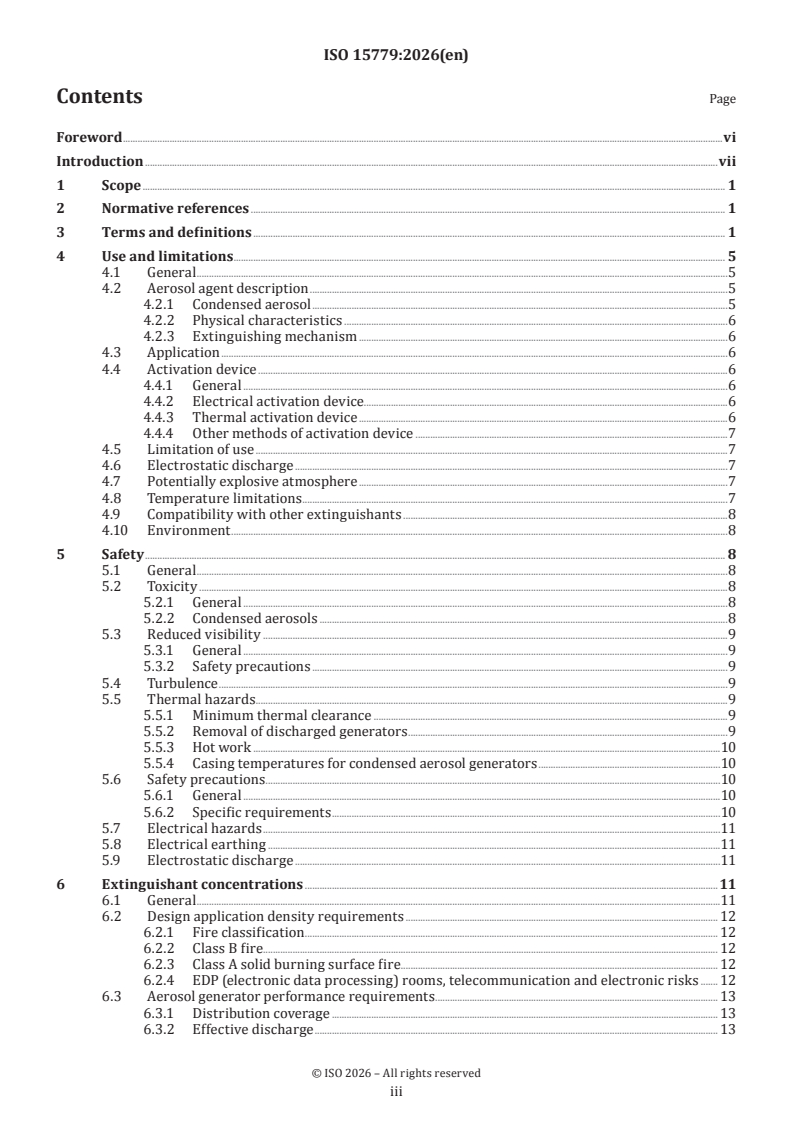
Contents Page
Foreword .vi
Introduction .vii
1 Scope . 1
2 Normative references . 1
3 Terms and definitions . 1
4 Use and limitations . 5
4.1 General .5
4.2 Aerosol agent description .5
4.2.1 Condensed aerosol .5
4.2.2 Physical characteristics .6
4.2.3 Extinguishing mechanism .6
4.3 Application .6
4.4 Activation device .6
4.4.1 General .6
4.4.2 Electrical activation device.6
4.4.3 Thermal activation device .6
4.4.4 Other methods of activation device .7
4.5 Limitation of use .7
4.6 Electrostatic discharge .7
4.7 Potentially explosive atmosphere .7
4.8 Temperature limitations .7
4.9 Compatibility with other extinguishants .8
4.10 Environment .8
5 Safety . 8
5.1 General .8
5.2 Toxicity .8
5.2.1 General .8
5.2.2 Condensed aerosols .8
5.3 Reduced visibility .9
5.3.1 General .9
5.3.2 Safety precautions .9
5.4 Turbulence .9
5.5 Thermal hazards . .9
5.5.1 Minimum thermal clearance .9
5.5.2 Removal of discharged generators .9
5.5.3 Hot work .10
5.5.4 Casing temperatures for condensed aerosol generators .10
5.6 Safety precautions .10
5.6.1 General .10
5.6.2 Specific requirements .10
5.7 Electrical hazards .11
5.8 Electrical earthing .11
5.9 Electrostatic discharge .11
6 Extinguishant concentrations .11
6.1 General .11
6.2 Design application density requirements . 12
6.2.1 Fire classification . 12
6.2.2 Class B fire. 12
6.2.3 Class A solid burning surface fire. 12
6.2.4 EDP (electronic data processing) rooms, telecommunication and electronic risks . 12
6.3 Aerosol generator performance requirements . 13
6.3.1 Distribution coverage . 13
6.3.2 Effective discharge . 13
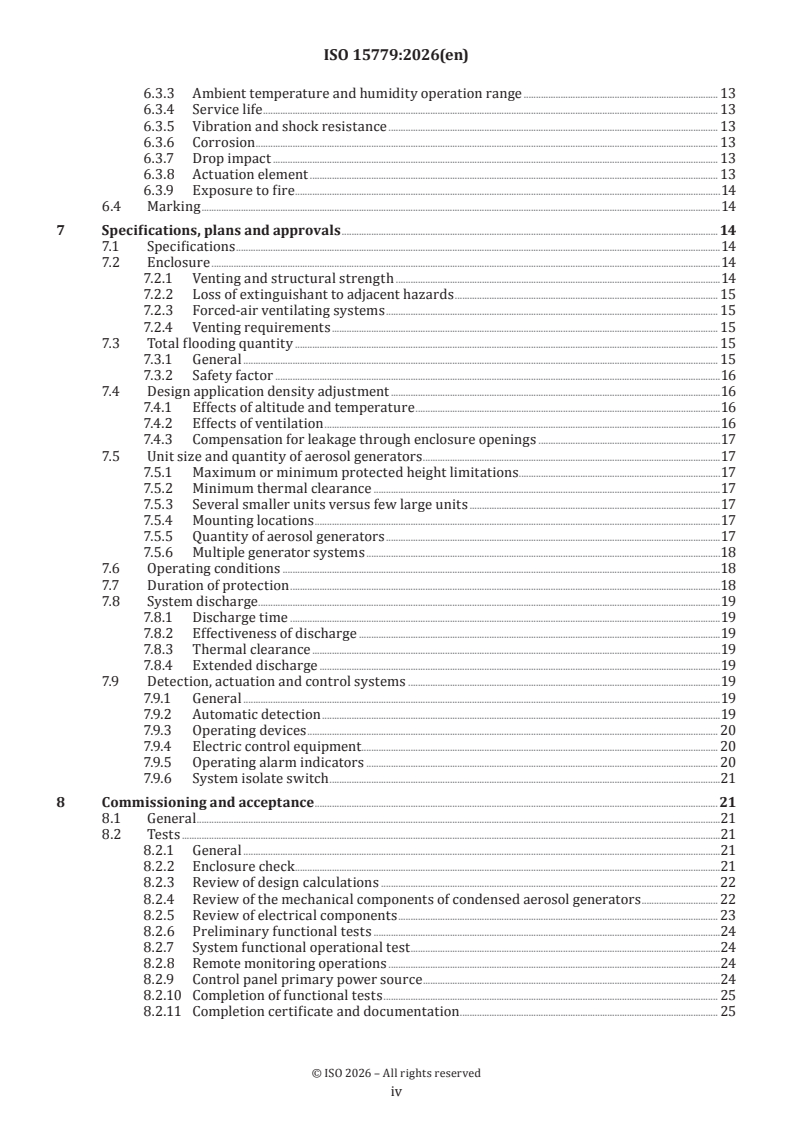
iii
6.3.3 Ambient temperature and humidity operation range . 13
6.3.4 Service life . 13
6.3.5 Vibration and shock resistance . 13
6.3.6 Corrosion . 13
6.3.7 Drop impact . 13
6.3.8 Actuation element . 13
6.3.9 Exposure to fire . .14
6.4 Marking .14
7 Specifications, plans and approvals . 14
7.1 Specifications .14
7.2 Enclosure .14
7.2.1 Venting and structural strength .14
7.2.2 Loss of extinguishant to adjacent hazards . 15
7.2.3 Forced-air ventilating systems . 15
7.2.4 Venting requirements . 15
7.3 Total flooding quantity . 15
7.3.1 General . 15
7.3.2 Safety factor .16
7.4 Design application density adjustment .16
7.4.1 Effects of altitude and temperature .16
7.4.2 Effects of ventilation .16
7.4.3 Compensation for leakage through enclosure openings .17
7.5 Unit size and quantity of aerosol generators .17
7.5.1 Maximum or minimum protected height limitations.17
7.5.2 Minimum thermal clearance .17
7.5.3 Several smaller units versus few large units .17
7.5.4 Mounting locations .17
7.5.5 Quantity of aerosol generators .17
7.5.6 Multiple generator systems .18
7.6 Operating conditions .18
7.7 Duration of protection .18
7.8 System discharge .19
7.8.1 Discharge time .19
7.8.2 Effectiveness of discharge .19
7.8.3 Thermal clearance .19
7.8.4 Extended discharge .19
7.9 Detection, actuation and control systems .19
7.9.1 General .19
7.9.2 Automatic detection .19
7.9.3 Operating devices . 20
7.9.4 Electric control equipment . . 20
7.9.5 Operating alarm indicators . 20
7.9.6 System isolate switch .21
8 Commissioning and acceptance .21
8.1 General .21
8.2 Tests .21
8.2.1 General .21
8.2.2 Enclosure check .21
8.2.3 Review of design calculations . 22
8.2.4 Review of the mechanical components of condensed aerosol generators . 22
8.2.5 Review of electrical components . 23
8.2.6 Preliminary functional tests .24
8.2.7 System functional operational test .24
8.2.8 Remote monitoring operations .24
8.2.9 Control panel primary power source .24
8.2.10 Completion of functional tests . 25
8.2.11 Completion certificate and documentation . 25
iv
9 Inspection, maintenance, testing and training .25
9.1 General . 25
9.2 Inspection . 25
9.2.1 General . 25
9.2.2 Enclosures . 26
9.3 Maintenance . 26
9.3.1 General . 26
9.3.2 User's programme of inspection . 26
9.3.3 Service schedule .27
9.4 Training .27
Annex A (normative) Documentation requirements .28
Annex B (informative) Toxicity and visibility testing .29
Annex C (normative) Test methods.35
Annex D (normative) Extinguishing density/Coverage test procedure .44
Bibliography .71
v
Foreword
ISO (the International Organization for Standardization) is a worldwide federation of national standards
bodies (ISO member bodies). The work of preparing International Standards is normally carried out through
ISO technical committees. Each member body interested in a subject for which a technical committee
has been established has the right to be represented on that committee. International organizations,
governmental and non-governmental, in liaison with ISO, also take part in the work. ISO collaborates closely
with the International Electrotechnical Commission (IEC) on all matters of electrotechnical standardization.
The procedures used to develop this document and those intended for its further maintenance are described
in the ISO/IEC Directives, Part 1. In particular, the different approval criteria needed for the different types
of ISO document should be noted. This document was drafted in accordance with the editorial rules of the
ISO/IEC Directives, Part 2 (see www.iso.org/directives).
ISO draws attention to the possibility that the implementation of this document may involve the use of (a)
patent(s). ISO takes no position concerning the evidence, validity or applicability of any claimed patent
rights in respect thereof. As of the date of publication of this document, ISO had not received notice of (a)
patent(s) which may be required to implement this document. However, implementers are cautioned that
this may not represent the latest information, which may be obtained from the patent database available at
www.iso.org/patents. ISO shall not be held responsible for identifying any or all such patent rights.
Any trade name used in this document is information given for the convenience of users and does not
constitute an endorsement.
For an explanation of the voluntary nature of standards, the meaning of ISO specific terms and expressions
related to conformity assessment, as well as information about ISO's adherence to the World Trade
Organization (WTO) principles in the Technical Barriers to Trade (TBT), see www.iso.org/iso/foreword.html.
This document was prepared by Technical Committee ISO/TC 21, Equipment for fire protection and fire
fighting, Subcommittee SC 8, Gaseous media and firefighting systems using gas.
This second edition cancels and replaces the first edition (ISO 15779:2011), which has been technically
revised.
The main changes are as follows:
— in 6.2.2 and 7.8.1, a requirement concerning the time taken to reach minimum design density from the
beginning of discharge has been added for Class B fires;
— Clause C.12, Impact test, has been removed;
— in D.6.1.3.2, Wood crib test, the total preburn time has been changed from 6 min to 2 min;
— figures have been updated to improve clarity;
— in the Bibliography, the reference to ISO 14520-1 has been removed and a reference to ATEX Directive
has been added.
Any feedback or questions on this document should be directed to the user’s national standards body. A
complete listing of these bodies can be found at www.iso.org/members.html.
vi
Introduction
The firefighting systems covered in this document are designed to provide a supply of condensed aerosol
extinguishing medium for the extinction of fire.
Several different methods for supplying condensed aerosol extinguishant to, and applying it at, the
required point of discharge for fire extinction have been developed in recent years, and there is a need for
dissemination of information on established systems and methods. This document has been prepared to
meet this need.
The requirements of this document are made in the light of the best technical data known to the working
group at the time of writing but, since a wide field is covered, it has been impracticable to consider every
possible factor or circumstance that can potentially affect implementation of the recommendations.
It has been assumed in the preparation of this document that the execution of its provisions is entrusted to
people appropriately qualified and experienced in the specification, design, installation, testing, approval,
inspection, operation and maintenance of systems and equipment, for whose guidance it has been prepared,
and who can be expected to exercise a duty of care to avoid unnecessary release of extinguishant.
It is important that the fire protection of a building or plant be considered as a whole. Condensed aerosol
extinguishing systems form only a part, albeit an important part, of the available facilities. Their adoption
does not remove the need to consider supplementary measures, such as the provision of portable fire
extinguishers or other mobile appliances for first aid or emergency use, or to deal with special hazards.
For many years, condensed aerosol extinguishants have been a recognized effective medium for the
extinction of flammable liquid fires and fires in the presence of electrical and ordinary Class A hazards.
However, it is important to note in the planning of comprehensive schemes that there can be hazards for
which these mediums are not suitable, and in certain circumstances or situations there can be dangers in
their use requiring special precautions.
Advice on these matters can be obtained from the appropriate manufacturer of either the extinguishant
or the extinguishing system, or both. Information can also be sought from the appropriate fire authority,
the health and safety authorities and insurers. In addition, reference should be made as necessary to other
national standards and statutory regulations of the particular country.
vii
International Standard ISO 15779:2026(en)
Condensed aerosol fire extinguishing systems —
Requirements and test methods for components and
system design, installation and maintenance — General
requirements
1 Scope
This document specifies the requirements and test methods for components of condensed aerosol
firefighting systems. It gives recommendations for the design, installation, testing, maintenance and safety
of these systems, as well as their application in buildings, plants or other structures. The characteristics
of the extinguishants in the condensed aerosol firefighting systems are also specified, as well as the types
of fire for which they are a suitable extinguishing medium. This document covers total flooding systems
primarily related to buildings, plants and other specific applications, utilizing electrically non-conducting
condensed aerosol fire extinguishants for which there are sufficient data currently available to enable
validation of performance characteristics by an appropriate independent authority.
Local applications of condensed aerosol extinguishing systems are not covered by this document. Any local
applications require a pre-engineered and pre-designed system which has been tested and approved for a
specific application by a relevant authority.
2 Normative references
The following documents are referred to in the text in such a way that some or all of their content constitutes
requirements of this document. For dated references, only the edition cited applies. For undated references,
the latest edition of the referenced document (including any amendments) applies.
ISO 3941, Classification of fires
EN 60068-2-6, Environmental testing — Part 2-6: Tests — Test Fc: Vibration (sinusoidal)
EN 60068-2-30, Environmental testing — Part 2-30: Tests — Test Db and guidance: Damp heat, cyclic (12 h +
12 h cycle)
3 Terms and definitions
For the purposes of this document, the following terms and definitions apply.
ISO and IEC maintain terminology databases for use in standardization at the following addresses:
— ISO Online browsing platform: available at https:// www .iso .org/ obp
— IEC Electropedia: available at https:// www .electropedia .org/
3.1
aerosol generator
non-pressurized container that, when activated, generates a condensed aerosol (3.7) extinguishing agent
3.2
aerosol generator assembly
aerosol generator (3.1) with its mounting bracket
3.3
approved
acceptable to a relevant authority (3.4)
Note 1 to entry: In determining the acceptability of installations or procedures, equipment or materials, the authority
can base acceptance on conformance to the appropriate standards.
3.4
authority
organization, office or individual responsible for approving equipment, installations or procedures
3.5
automatic
performing a function without the necessity of intentional human intervention
3.6
competent person
person who is suitably trained, qualified by knowledge and practical experience, and with the necessary
instructions to enable the required system design, installation and maintenance
3.7
condensed aerosol
aerosol extinguishing agent
extinguishant
extinguishing medium consisting of finely divided solid particles, generally in the order of magnitude of
microns in diameter suspended in gas which is generated and distributed by a combustion process of a solid
aerosol-forming compound
3.8
coolant
heat-absorbing medium or process
3.9
design application density
extinguishing density multiplied by the safety factor, required for system design purposes
Note 1 to entry: Extinguishing density is the actual concentration of aerosol in the test room.
Note 2 to entry: The extinguishing density and the design application density are expressed in g/m .
3.10
discharge time
time from the generator activation until the end of its discharge
Note 1 to entry: Measured in s.
Note 2 to entry: The end of discharge is determined by the drop of the temperature (primary), sound (secondary) and
visual indication if possible.
3.11
effective mass
mass of discharged extinguishant required to achieve the design application density within the protected
volume within the specified system discharge time
3.12
electrical activation device
device which automatically operates via an electrical input and is arranged to initiate the aerosol-forming
compound (3.34).
3.13
electrical clearance
unobstructed air distance between the aerosol generator (3.1) components and unenclosed or uninsulated
live electrical components not at ground potential
3.14
emergency hold device
device that prevents the electrical actuation (3.12) of aerosol generators (3.1)
3.15
extinguishing density
effective minimum mass of discharged extinguishant per unit of enclosure volume required to extinguish
fire involving a specific fuel under defined experimental conditions, using a specific aerosol generator (3.1)
type and size, excluding any safety factor
Note 1 to entry: Measured in g/m .
3.16
family of condensed aerosol generators
range of aerosol generators (3.1) designed with the same solid compound, the same kind of cooling device,
discharge outlet, ignition device, layout and internal/external architecture, with variation in the mass of the
solid compound
3.17
hold time
period of time during which an extinguishant is required to maintain at least the extinguishing density to
ensure even distribution throughout the protected volume
3.18
hot work
grinding, welding, thermal cutting, oxygen cutting, thermal heating, oxygen heating and other related heat-
producing or spark-producing operations
3.19
ignition device
device that is able to ignite the solid aerosol-forming compound (3.34)
3.20
inspection
visual examination to give reasonable assurance that the extinguishing system is fully operable and has
not been activated or tampered with, and that there is no obvious physical damage or condition to prevent
operation
3.21
listed
systems or components that are included in a list published by a listing organization
3.22
listing organization
internationally recognized fire protection system or components test and certification organization
3.23
location drawing
layout diagram of protected volume clearly indicating the as-installed location of all aerosol generator
assemblies (3.2), controls, system isolate switch (3.36), emergency hold device (3.14), and associated
components of the firefighting system
3.24
maintenance
thorough check to give maximum assurance that the extinguishing system will operate as intended
Note 1 to entry: Maintenance includes a thorough examination and any necessary repair or replacement of system
components.
3.25
manual
requiring intentional intervention to accomplish a function
3.26
manufacturer
entity that manufactures a product or has a product designed or manufactured, and markets that product
under its name or trademark
3.27
mass median aerodynamic diameter
MMAD
particle size and distribution of any aerosol statistically, based on the weight and size of the particle, along
with the geometric standard deviation
3.28
monitoring
supervision of the operating integrity of an electrical, mechanical, pneumatic or hydraulic control feature of
a system
3.29
normally occupied area
area that is occupied by persons, under normal circumstances
3.30
normally unoccupied area
area not normally occupied by people, but which may be entered occasionally for brief periods
3.31
particulate concentration
concentration of the solid fraction of the aerosol in the protected space after system discharge at the design
application density
Note 1 to entry: Measured in g/m .
Note 2 to entry: This information is necessary to assess the potential health effects of accidental exposure to the agent
and the potential degree of visibility obscuration.
3.32
release
physical discharge or emission of extinguishant as a consequence of the aerosol generator’s actuation
3.33
safety factor
multiplier of the extinguishing density to determine the aerosol design application density
3.34
solid aerosol-forming compound
mixture of oxidant, combustible component and technical admixtures producing fire-extinguishing aerosol
upon ignition
3.35
system discharge time
time from the first generator activation until the end of the last generator discharge time to achieve the
design application density within the protected volume
Note 1 to entry: This time measurement is relevant to an extinguishing system of interconnected aerosol generators
(3.1) intended to protect the same hazard.
3.36
system isolate switch
key-operated or dual mode switch manual device that prevents the electrical actuation (3.12) of aerosol
generators by electrically isolating them from the released circuit
Note 1 to entry: The actuation of this device provides an indication of system isolation and shall result in an audible
and visual alarm of system impairment at the control panel.
Note 2 to entry: The intention is to prevent the discharge of agent into the hazard area when the system isolation
switch device is activated.
3.37
thermal activation device
device which automatically operates at a rated temperature and is arranged for the activation of the solid
aerosol-forming compound (3.34)
3.38
thermal clearance
minimum air distance between both a condensed aerosol (3.1) generator surface and its discharge ports and
either personnel, any structure or components sensitive to the temperature developed by the generator
during and following discharge
3.39
total flooding system
firefighting system arranged to discharge extinguishant into an enclosed space to achieve the appropriate
design application density
3.40
unoccupiable area
area which cannot be occupied due to dimensional or other physical constrains
EXAMPLE Shallow voids or cabinets.
3.41
user
entity for whom the system is designed, and who is responsible for operation and for ensuring the consistency
of performance as described by the manufacturer and for following the legal regulation
4 Use and limitations
4.1 General
The design, installation, testing and maintenance of aerosol fire-extinguishing systems shall be performed
by persons competent in this fire extinguishing system technology.
4.2 Aerosol agent description
4.2.1 Condensed aerosol
Condensed aerosol is an extinguishant consisting of finely divided solid particles, typically based on alkali
metal salts, and gases mainly comprised of nitrogen, carbon dioxide, carbon monoxide and water vapour.
Condensed aerosol is self-generated by a combustion process of a solid aerosol-forming compound contained
in a non-pressurized can, an aerosol generator. Aerosol generators also contain one or more actuation
device(s) designed to ignite the aerosol-forming compound and can have various cooling arrangements to
cool the aerosol prior to its release into a protected volume. The aerosol generating combustion process
provides sufficient energy for a rapid discharge rate and efficient distribution of the aerosol. No stored
propelling gas is required for the aerosol delivery. An aerosol generator has one or more discharge outlets
and is normally placed inside the protected risk area. No piping is required.
4.2.2 Physical characteristics
Aerosols are electrically non-conductive media, which are suspended in the air in the protected volume.
Being a suspension of fine solid particles in a gaseous medium, the aerosol is not a clean agent. Following
the actuation of an aerosol generator, there is a period of time during which the aerosol remains suspended
within the enclosure; if the enclosure is not ventilated, the aerosol suspension will eventually settle down,
forming a dust-like residue.
4.2.3 Extinguishing mechanism
Condensed aerosols extinguish fires chemically, interfering with the flame chain reaction by chemically
bonding to the reactive free radicals and physically, by cooling the seat of the fire. Both actions take place
mainly on the surface of the aerosol particles, and as such, the finer the particles the more efficient the
extinguishment.
4.3 Application
Aerosol extinguishants have been recognized as an effective media for the extinguishing of surface type
Class A fires and Class B fires, as specified in ISO 3941. The hazards against which these systems offer
protection, and any limitations on their use, shall be contained in the system manufacturer’s design manual.
Total flooding fire-extinguishing systems are used primarily for protection against hazards located in
enclosures or hazards with equipment that in
...