


ISO/TR 16214:2025
(Main)Review of geospatial and building information modelling (BIM) terminological entries
Review of geospatial and building information modelling (BIM) terminological entries
This document provides an overview of terminological entries relating to building information modelling (BIM) as well as those relating to geographic information or geomatics. This document identifies terminological entries which are identical, equivalent (i.e. synonyms), homonymous, and entries which are unique to their respective domains. This document does not provide recommendations to resolve terminology homonyms.
Revue des articles terminologiques sur la modélisation des informations de la construction (BIM) et les information géospatiales
General Information
- Status
- Published
- Publication Date
- 18-May-2025
- Current Stage
- 6060 - International Standard published
- Start Date
- 19-May-2025
- Completion Date
- 19-May-2025
Overview
ISO/TR 16214:2025 - "Review of geospatial and building information modelling (BIM) terminological entries" is a Technical Report from ISO/TC 59/SC 13 that systematically reviews and compares terminology used in BIM and GIS standards. The report maps terminological entries from the BIM Working Terminology Document (≈180+ entries) and the ISO/TC 211 Multi‑Lingual Glossary of Terms (MLGT, ≈2000+ entries) to identify identical, equivalent (synonymous), homonymous, and domain‑unique entries. It is a terminological review intended to clarify conceptual overlaps and differences; it does not propose resolutions for homonyms.
Key topics and structure
ISO/TR 16214 organizes its analysis around five technical sub‑domains:
- Data structures and architectures - comparison of schema, ontologies, classes, datasets and constraints (e.g., application schema, conceptual model).
- Digital representations - graphical and non‑graphical modelling vocabulary.
- Digital documentation - metadata, records and documentation terms.
- Uses, functions and services - domain functions, services and business uses of data.
- Data acquisition, processing techniques and technologies - sensors, acquisition workflows and processing terminology.
Other notable aspects:
- Methodology: a systematic review of terminological entries drawn from ISO BIM and GIS standardization sources.
- Classification outcomes: entries are classified as identical, equivalent, homonymous, or unique to a domain.
- Scope limits: unique entries not relevant to both domains and ancillary components (examples, notes) are excluded for clarity.
Practical applications and users
ISO/TR 16214 is useful for:
- Standards developers and technical committees working on BIM/GIS integration and harmonization.
- BIM/GIS integrators and software vendors designing data exchange, APIs and interoperability tools.
- Project managers, asset owners and engineers who coordinate cross‑discipline data workflows.
- Mapping, geomatics and digital twin practitioners who need consistent terminology for contracts, specifications and metadata.
- Researchers and educators studying semantic alignment between building and geospatial domains.
Practical benefits include improved clarity in procurement/specifications, reduced misinterpretation across disciplines, and a foundation for future harmonization work (note: the report itself does not resolve contradictory homonyms).
Related standards
- ISO 29481‑1:2016 (BIM definition source, modified in the report)
- ISO 19101‑1:2014 and other ISO/TC 211 GIS standards (MLGT)
- ISO/TR 23262 (context on BIM–GIS conceptual/technological barriers)
Keywords: ISO TR 16214, BIM terminology, GIS terminology, BIM‑GIS interoperability, geospatial terminology, building information modelling standard.


Get Certified
Connect with accredited certification bodies for this standard

BSI Group
BSI (British Standards Institution) is the business standards company that helps organizations make excellence a habit.

NYCE
Mexican standards and certification body.
Sponsored listings
Frequently Asked Questions
ISO/TR 16214:2025 is a technical report published by the International Organization for Standardization (ISO). Its full title is "Review of geospatial and building information modelling (BIM) terminological entries". This standard covers: This document provides an overview of terminological entries relating to building information modelling (BIM) as well as those relating to geographic information or geomatics. This document identifies terminological entries which are identical, equivalent (i.e. synonyms), homonymous, and entries which are unique to their respective domains. This document does not provide recommendations to resolve terminology homonyms.
This document provides an overview of terminological entries relating to building information modelling (BIM) as well as those relating to geographic information or geomatics. This document identifies terminological entries which are identical, equivalent (i.e. synonyms), homonymous, and entries which are unique to their respective domains. This document does not provide recommendations to resolve terminology homonyms.
ISO/TR 16214:2025 is classified under the following ICS (International Classification for Standards) categories: 01.040.35 - Information technology (Vocabularies); 01.040.91 - Construction materials and building (Vocabularies); 35.240.67 - IT applications in building and construction industry; 35.240.70 - IT applications in science. The ICS classification helps identify the subject area and facilitates finding related standards.
ISO/TR 16214:2025 is available in PDF format for immediate download after purchase. The document can be added to your cart and obtained through the secure checkout process. Digital delivery ensures instant access to the complete standard document.
Standards Content (Sample)
Technical
Report
ISO/TR 16214
First edition
Review of geospatial and building
2025-05
information modelling (BIM)
terminological entries
Revue des articles terminologiques sur la modélisation des
informations de la construction (BIM) et les information
géospatiales
Reference number
© ISO 2025
All rights reserved. Unless otherwise specified, or required in the context of its implementation, no part of this publication may
be reproduced or utilized otherwise in any form or by any means, electronic or mechanical, including photocopying, or posting on
the internet or an intranet, without prior written permission. Permission can be requested from either ISO at the address below
or ISO’s member body in the country of the requester.
ISO copyright office
CP 401 • Ch. de Blandonnet 8
CH-1214 Vernier, Geneva
Phone: +41 22 749 01 11
Email: copyright@iso.org
Website: www.iso.org
Published in Switzerland
ii
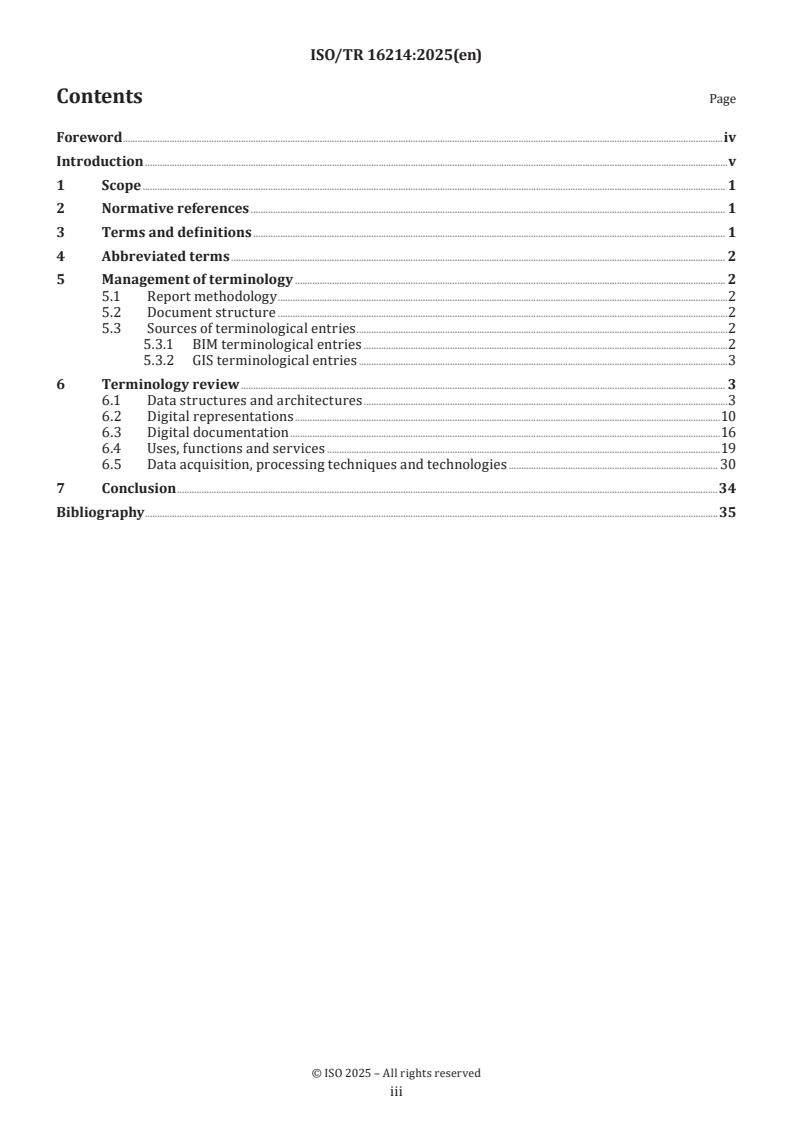
Contents Page
Foreword .iv
Introduction .v
1 Scope . 1
2 Normative references . 1
3 Terms and definitions . 1
4 Abbreviated terms . 2
5 Management of terminology . 2
5.1 Report methodology .2
5.2 Document structure .2
5.3 Sources of terminological entries .2
5.3.1 BIM terminological entries .2
5.3.2 GIS terminological entries .3
6 Terminology review . 3
6.1 Data structures and architectures .3
6.2 Digital representations .10
6.3 Digital documentation .16
6.4 Uses, functions and services .19
6.5 Data acquisition, processing techniques and technologies . 30
7 Conclusion .34
Bibliography .35
iii
Foreword
ISO (the International Organization for Standardization) is a worldwide federation of national standards
bodies (ISO member bodies). The work of preparing International Standards is normally carried out through
ISO technical committees. Each member body interested in a subject for which a technical committee
has been established has the right to be represented on that committee. International organizations,
governmental and non-governmental, in liaison with ISO, also take part in the work. ISO collaborates closely
with the International Electrotechnical Commission (IEC) on all matters of electrotechnical standardization.
The procedures used to develop this document and those intended for its further maintenance are described
in the ISO/IEC Directives, Part 1. In particular, the different approval criteria needed for the different types
of ISO document should be noted. This document was drafted in accordance with the editorial rules of the
ISO/IEC Directives, Part 2 (see www.iso.org/directives).
ISO draws attention to the possibility that the implementation of this document may involve the use of (a)
patent(s). ISO takes no position concerning the evidence, validity or applicability of any claimed patent
rights in respect thereof. As of the date of publication of this document, ISO had not received notice of (a)
patent(s) which may be required to implement this document. However, implementers are cautioned that
this may not represent the latest information, which may be obtained from the patent database available at
www.iso.org/patents. ISO shall not be held responsible for identifying any or all such patent rights.
Any trade name used in this document is information given for the convenience of users and does not
constitute an endorsement.
For an explanation of the voluntary nature of standards, the meaning of ISO specific terms and expressions
related to conformity assessment, as well as information about ISO's adherence to the World Trade
Organization (WTO) principles in the Technical Barriers to Trade (TBT), see www.iso.org/iso/foreword.html.
This document was prepared by Technical Committee ISO/TC 59, Buildings and civil engineering works,
Subcommittee SC 13, Organization and digitization of information about buildings and civil engineering works,
including building information modelling (BIM).
Any feedback or questions on this document should be directed to the user’s national standards body. A
complete listing of these bodies can be found at www.iso.org/members.html.
iv
Introduction
Several developments aim to leverage structured information to support decision-making within the built
environment. The two most prevalent are:
— building information modelling (BIM): focused on the organization and structuring of information
relating to assets such as buildings and infrastructure; and
— geographic information systems (GIS): focused on the organization and structuring of information
relating to geospatial information and geomatics.
ISO/TR 23262 investigates the conceptual and technological barriers between BIM and GIS. This document
further develops this work by summarizing the key conceptual and terminological equivalents and
homonyms.
v
Technical Report ISO/TR 16214:2025(en)
Review of geospatial and building information modelling
(BIM) terminological entries
1 Scope
This document provides an overview of terminological entries relating to building information modelling
(BIM) as well as those relating to geographic information or geomatics. This document identifies
terminological entries which are identical, equivalent (i.e. synonyms), homonymous, and entries which are
unique to their respective domains.
This document does not provide recommendations to resolve terminology homonyms.
2 Normative references
There are no normative references in this document.
3 Terms and definitions
For the purposes of this document, the following terms and definitions apply.
ISO and IEC maintain terminology databases for use in standardization at the following addresses:
— ISO Online browsing platform: available at https:// www .iso .org/ obp
— IEC Electropedia: available at https:// www .electropedia .org/
3.1
building information modelling
BIM
use of a shared digital representation of an asset to facilitate design, construction and operation processes
to form a reliable basis for decisions
[SOURCE: ISO 29481-1:2016, 3.2, modified — The words “built object” have been replaced with “asset”; the
words “including buildings, bridges, roads, process plants, etc.” have been removed; note 1 to entry has been
removed.]
3.2
geographic information system
information system dealing with information concerning phenomena associated with location relative to
the Earth
[SOURCE: ISO 19101-1:2014, 4.1.20]
3.3
terminological entry
collection of terminological data related to only one concept
Note 1 to entry: A terminological entry prepared in accordance with the principles and methods given in ISO 704
follows the same structural principles whether it is monolingual or multilingual.
[SOURCE: ISO 1087:2019, 3.6.2]
4 Abbreviated terms
BIM building information modelling
GIS geographic information system
MLGT multi-lingual glossary of terms
UML unified modelling language
5 Management of terminology
5.1 Report methodology
A systematic review of terminological entries used within the standards on GIS developed by ISO/TC 211
(see 5.3.2) and those on BIM developed by ISO/TC 59/SC 13 (see 5.3.1) was undertaken.
This review evaluated the definitions of these terminological entries to establish:
— identical entries: terminological entries which use the same definition;
— equivalent entries: terminological entries whose definitions capture the same concepts;
— homonymous entries: terminological entries whose definitions capture different concepts;
— unique entries: terminological entries not found within either the BIM or GIS which may resolve a gap in
its lexis.
NOTE 1 Unique entries which are not relevant to both BIM and GIS have been excluded from this document for
clarity.
NOTE 2 Other terminological entry components, such as examples and notes to entry, have been excluded from this
document for clarity.
5.2 Document structure
For ease of comparison and organization, terminological entries have been grouped in this document under
the following sub-domains of analysis:
— data structures and architectures;
— digital representation (graphical and non-graphical);
— digital documentation;
— uses, functions and services;
— data acquisition and processing techniques and technologies.
5.3 Sources of terminological entries
5.3.1 BIM terminological entries
Terminological entries used throughout the standardization of BIM are stored and maintained in the
[73]
Working Terminology Document, which includes over 180 terminological entries.
For the purposes of this document, a terminological entry is considered part of BIM if it is included within
[73]
the Working Terminology Document .
5.3.2 GIS terminological entries
Terminological entries used throughout the standardization of GIS are stored and maintained within the
[74]
ISO/TC 211 Multi-Lingual Glossary of Terms (MLGT). ISO TC/211 MLGT includes over 2000 terminological
entries, many of which have multiple translations.
For the purposes of this document, a terminological entry is considered part of GIS if it is included within
ISO/TC 211 MLGT or its proposed update as of March 2024.
6 Terminology review
6.1 Data structures and architectures
Table 1 shows terminological entries related to data structure and architectures.
Table 1 — Terminological entries related to data structures and architectures
BIM GIS Comments
Term Definition Source Term Definition Source
application conceptual schema ISO 19101-1:2014, application conceptual schema ISO 19101-1:2014, Identical.
schema for data required by 4.1.2 schema for data required by 4.1.2
one or more applica- one or more applica-
tions tions
concept unit of knowledge ISO 1087:2019, 3.2.7: concept unit of knowledge ISO 1087:2019, 3.2.7 Identical.
created by a unique created by a unique
combination of char- combination of char-
acteristics acteristics
conceptual formal description ISO 19101-1:2014, conceptual formal description ISO 19101-1:2014, Identical.
schema of a conceptual 4.1.6 schema of a conceptual 4.1.6
model model
conceptual formal language ISO 19101-1:2014, conceptual formal language ISO 19101-1:2014, Identical.
schema based on a conceptu- 4.1.7 schema based on a conceptu- 4.1.7
language al formalism for the language al formalism for the
purpose of repre- purpose of repre-
senting conceptual senting conceptual
schemas schemas
namespace collection of names, ISO/TS 19139- namespace collection of names, ISO/TS 19139- Identical.
identified by a URI 1:2019, 3.1 identified by a URI 1:2019, 3.1
reference, which are reference, which are
used in XML docu- used in XML docu-
ments as element ments as element
names and attribute names and attribute
names names
schema formal description ISO 19101-1:2014, schema formal description ISO 19101-1:2014, Identical.
of a model 4.1.34 of a model 4.1.34
individual instance of a class ISO 19150-2:2015, individual instance of a class ISO 19150-2:2015, Identical.
4.1.20 4.1.20
constraint adaptation of a data ISO/IEC 2382:2015, constraint condition or restric- ISO 19103:2024, Equivalent: Both entries relate
type that restricts 2122397 tion expressed in 3.25 to the restriction of objects.
its range or opera- natural language
tions text or in a machine
readable language
for the purpose of
declaring some of
the semantics of an
element or set of
elements
Table 1 (continued)
BIM GIS Comments
Term Definition Source Term Definition Source
class description of a set ISO 22274:2013, 3.4 legend class class resultant from ISO 19144-1:2009, Equivalent: Both entries re-
of objects that share the application 4.1.16 late to an object classifier of a
the same character- of a classification classification process.
istics process
class ISO 19144-2:2023,
result of a classifi- 3.1.6
cation process as
part of a classifica-
tion system which
subdivides concepts
within a given topic
area
class classifier of a ISO 19103:2024, 3.14 It is noted that the GIS entry
set of objects is provided to avoid confusion
with the term “class” as used
in UML modelling.
classification systematic col- ISO 5127:2017, 3.6 classification system for assigning ISO 19144-1:2009, Equivalent: Both entries relate
system lection of classes system objects to classes 4.1.5 to a system for organizing or
organized according assigning objects to classes.
to a known set of
rules, and into which
objects may be
grouped
conceptual data data model that rep- ISO/IEC 11179- conceptual model that defines ISO 19101-1:2014, Equivalent: Both entries relate
model resents an abstract 1:2023, 3.2.25 model concepts of a uni- 4.1.5 to representations of reality.
view of the real verse of discourse
world
information meaningful data ISO 9000:2015, 3.8.2 information knowledge concern- ISO/IEC 2382:2015, Equivalent: Both entries relate
ing objects, such as 2121271 to a meaningful collection of
facts, events, things, data.
processes, or ideas,
including concepts,
that within a certain
context has a par-
ticular meaning
Table 1 (continued)
BIM GIS Comments
Term Definition Source Term Definition Source
data format predetermined ISO 5127:2017, format language construct ISO/IEC 2382:2015, Equivalent: Both entries relate
arrangement of data 3.1.13.12 that specifies the 2122408 to a structure or arrangement
on a data medium representation, in of data.
character form, of
data objects in a
record, file, message,
storage device, or
transmission chan-
nel
dataset named collection of N/A dataset identifiable collec- ISO 19115-1:2014, Equivalent: Both entries relate
data tion of data 4.3 to a distinguishable collection
of data.
collection of data ISO 19168-1:2020,
3.1.1
information unit single piece of infor- ISO 6707-2:2017, data element unit of data that, in ISO 19118:2005, 4.9 Equivalent: Both entries relate
mation 3.2.1 a certain context, is to a single or indivisible item.
considered indivis-
ible
ontology formal, explicit spec- ISO 5127:2017, ontology formal representa- ISO 19101-1:2014, Equivalent: Both entries relate
ification of a shared 3.1.2.03 tion of phenomena 4.1.26 to how a concept is realized
conceptualization of a universe of dis- formally.
course with an un-
derlying vocabulary
including definitions
and axioms
semantic relation between ISO 5127:2017, relation set of entity occur- ISO/IEC 2382:2015, Equivalent: Both entries relate
relation concepts and be- 3.1.7.01 rences that have 2121466 to the connection between
tween class symbols the same attributes, concepts.
and their meanings together with these
attributes
relationship connection between ISO 19103:2024,
elements 3.63
classification process of assigning ISO 22274:2013, 3.5 classification abstract representa- ISO 19144-1:2009, Homonymous: The BIM entry
objects to classes tion of real world 4.1.4 relates to classifying an
according to criteria phenomena using object, whilst the GIS entry
classifiers relates to the result of being
classified.
Table 1 (continued)
BIM GIS Comments
Term Definition Source Term Definition Source
link directed relation- ISO 5127:2017, link directed topological ISO 19133:2005, 4.8 Homonymous: The GIS entry
ship between two 3.1.12.30 connection between relates to a more specific
digital entities two nodes subject.
feature relationship that ISO 19110:2016, 3.3
association links instances of
one feature type
with instances of the
same or a different
feature type
metadata data about data or ISO/IEC 2382:2015, metadata information about a ISO 19115-1:2014, Homonymous: The BIM entry
data elements 212150 resource 4.10 focuses on data, whilst the
GIS entry includes broader
concepts.
It is noted that information
about a person, within the
BIM domain would be cap-
tured within a "property", not
within "metadata".
class code notation represent- ISO 5127:2017, N/A N/A N/A Unique to BIM: Related GIS
ing a concept or 3.8.3.24 entries include "classifier" and
class in a structured "classification process".
vocabulary
constituent properties which N/A N/A N/A N/A Unique to BIM: Related GIS
properties define a parent entries include "properties",
property as well as some "parent/child"
concepts, in specific do-
mains, that use an equivalent
relationship between their
respective concepts.
data model description of the ISO 5127:2017, N/A N/A N/A Unique to BIM: Related GIS
organization of data 3.1.13.33 entries include “metamodel”
in a manner that and “schema”.
reflects an informa-
tion structure
link dataset dataset containing N/A N/A N/A N/A Unique to BIM: Related GIS en-
links tries include "Place Identifier
(PI) link", "linked geodata",
and "dataset".
Table 1 (continued)
BIM GIS Comments
Term Definition Source Term Definition Source
link dataset ontology in relation N/A N/A N/A N/A Unique to BIM: Related GIS
ontology to link datasets entries include "ontology".
meronomy hierarchy related to ISO/IEC 11179- part-whole relation relation between ISO 19103:2024, Equivalent: Both entries relate
part-whole (decom- 3:2013, 3.2.73 two concepts where 3.58 to a relationship between the
partitive relation
position) relations one of the concepts whole and part of the whole.
constitutes the
whole and the other
concept constitutes
a part of that whole
Note 1 to entry: A
part-whole relation
exists between the
concepts “week” and
“day”, “molecule”
and “atom”.
semantic interoperability N/A N/A N/A N/A Unique to BIM: Related GIS
interoperability that also conveys entries include “interoperabil-
meaning ity” and “semantic web”.
sensitive information that ISO/IEC 2382:2015, N/A N/A N/A Unique to BIM: Related GIS
information must be protected 2126273 entries include “accessibili-
because its disclo- ty information” and “access
sure, modification, control”.
destruction, or loss
will cause perceiva-
ble damage
taxonomy hierarchy related to ISO/IEC 11179- N/A N/A N/A Unique to BIM: Related GIS
generalization/spe- 3:2013, 3.2.135 entries include “class” and
cialization relations “classification”.
typology hierarchy related N/A N/A N/A N/A Unique to BIM: Related GIS
to classification rela- entries include “class” and
tions “classification”.
triple statement in the ISO 21597-1:2020, N/A N/A N/A Unique to BIM: It is noted that
form subject-pred- 3.1.20 while there is no GIS entry for
icate-object that “triple”, the GIS domain does
expresses a relation include "predicate expres-
sion" within ISO 19143:2010,
6.3.3.1.5, which also uses the
term "triple".
Table 1 (continued)
BIM GIS Comments
Term Definition Source Term Definition Source
N/A N/A N/A application ontology represent- ISO 19150-2:2015, Unique to GIS: Related BIM
ontology ing the concepts and 4.1.4 entries include "Application
relationships in an schema" and "Ontology".
application schema
N/A N/A N/A classifier definition used to ISO 19144-1:2009, Unique to GIS: Related BIM
assign objects to 4.1.6 entries include "classification"
legend classes and "class code".
N/A N/A N/A content model information view ISO/TS 19129:2009, Unique to GIS: Related BIM
of an application 4.1.2 entries include "application
schema schema" and "model".
N/A N/A N/A dataset series collection of data- ISO 19115-1:2014, Unique to GIS: Related BIM
sets sharing com- 4.4 entries include "datasets".
mon characteristics
N/A N/A N/A instance model representation ISO 19118:2011, 4.23 Unique to GIS: Related BIM
model for storing entries include "application
data according to an schema" and "ontology".
application schema
6.2 Digital representations
Table 2 shows terminological entries related to digital representations.
Table 2 — Terminological entries related to digital representations
BIM GIS Comments
Term Definition Source Term Definition Source
object seman- ISO 19150- object seman- ISO 19150- Identical.
property tic association 2:2015, 4.1.28 property tic association 2:2015, 4.1.28
between a pair between a pair
of individuals of individuals
graphical visually ISO symbol portrayal ISO Equivalent: Both entries relate to symbols.
symbol perceptible 22727:2007, primitive that 19117:2012,
It is noted that the BIM entry focuses on graphical symbols
figure with 3.1 can be graphic, 4.31
while the GIS entry includes other types like audible and tactile.
a particular audible, or tac-
meaning used tile in nature,
to transmit or a combina-
information tion of these
independently
of language
library object set of library N/A feature concept that ISO Equivalent: Both entries refer to aggregate object types or
class objects with concept can be speci- 19126:2021, feature types.
common prop- fied in detail 3.11
erties as one or more
feature types
model representation ISO 29481- model abstraction of ISO Equivalent: Both entries refer to simplified views or rep-
of a system 1:2016, 3.15 some aspects 19109:2015, resentations of systems or reality.
that allows for of reality 4.15
investigation
of the prop-
erties of the
system
object type representation N/A feature type class of fea- ISO Equivalent: Both entries refer to groups of objects or features
of objects that tures having 19156:2023, sharing common characteristics.
share common common char- 3.9
attributes acteristics
object specific oc- N/A feature individual of a ISO 19101- Equivalent: Both entries refer to specific occurrences or in-
occurrence currence of a instance given feature 1:2014, 4.1.14 stances of objects or features.
given object type having
type specified fea-
ture attribute
values
occurrence entity that N/A instance individual ISO Equivalent: Both entries refer to identifiable unique entities.
has a unique entity 19103:2024
identity 3.42
Table 2 (continued)
BIM GIS Comments
Term Definition Source Term Definition Source
property defined char- ISO property facet or attrib- ISO Equivalent: Both entries refer to characteristics of objects or
acteristic suit- 22274:2013, ute of an object 19143:2010, features, though with slight variations in the use of “attribute”.
able for the de- 3.25 referenced by a 4.21
scription and name
differentiation
of an object in
a class
attribute data element ISO attribute named proper- ISO/IEC Homonymous: The subject the BIM entry is a "property", “rela-
for the com- 22274:2013, ty of an entity 2382:2015, tion” or a “class”, whilst the subject of the GIS entry is a “proper-
puter-sensible 3.2 2121440 ty” or “characteristic”.
description of
feature characteristic ISO 19101-
a property, a
attribute of a feature 1:2014, 4.1.12
relation or a
class
metamodel model that ISO/IEC 11179- metamodel model that ISO Homonymous: The BIM entry relates to a specification, whilst
specifies one 3:2013, 3.8.20 defines a mod- 19103:2024, the GIS entry relates to a language for models.
or more other elling language 3.47
models
entity ISO/IEC entity something that ISO Homonymous: The BIM entity relates specifically to databases,
any concrete or 2382:2015, has separate 19119:2016, whilst the GIS entry relates to something that exists.
abstract thing 2121433 and distinct 4.1.6
that exists, did existence and
exist, or might objective or
exist, including conceptual
associations reality
among these
things
object any part of the ISO 12006- It is noted that the BIM entry for "object", is equivalent to the
perceivable or 2:2015, 3.1.1 GIS entry for "entity".
conceivable
object individual with ISO Homonymous: The GIS entry uses “object” more specifically as
world
a state and re- 19103:2024, an instance with relationships.
lationships to 3.54
other individ-
uals
feature abstraction ISO 19101- It is noted that the BIM entry for "object", is equivalent to the
of real world 1:2014, 4.1.11 GIS entry for "feature".
phenomena
Table 2 (continued)
BIM GIS Comments
Term Definition Source Term Definition Source
zero- N/A N/A N/A N/A Unique to BIM: ISO 19107: 0-dimensional objects (points and
dimensional having or locations in a well-defined coordinate system) embedded in a
seeming to 2D or 3D Euclidean space. BIM: ISO 16739-1 (IFC) uses the Enu-
have no dimen- meration "RepresentationIdentifier" in IfcShapeRepresentation
sion to express the dimension if a product or product component.
ISO16739-1 (IFC) uses IfcGeometricRepresentationContext.
CoordinateSpaceDimension to express the dimension of the
embedded space.
one- N/A N/A N/A N/A Unique to BIM: ISO 19107: 0-dimensional and 1-dimensional
dimensional having or objects (adding curves of various types) embedded in a 2D or
seeming to 3D Euclideanspace. BIM: ISO 16739-1 (IFC) uses the enumera-
have one di- tion IfcShapeRepresentation.RepresentationIdentifier to express
mension the dimension of a product or product component. ISO16739-
1 (IFC) uses IfcGeometricRepresentationContext.Coordi-
nateSpaceDimension to express the dimension of the embedded
space.
two- ISO 6707- N/A N/A N/A Unique to BIM: ISO 19107: 0-, 1-, and 2-dimensional objects
dimensional having or 2:2017, 3.2.10 (adding surfaces or areas of various types) embedded in a
seeming to 2D or 3D Euclidean space. BIM: ISO 16739-1 (IFC) uses the
have two di- enumeration IfcShapeRepresentation.RepresentationIdentifi-
mensions er to express the dimension of a product or product compo-
nent. ISO16739-1 (IFC) uses IfcGeometricRepresentationCon-
text.CoordinateSpaceDimension to express the dimension of
the embedded space.
three- ISO 6707- N/A N/A N/A Unique to BIM: ISO 19107: 0-, 1-, 2- and 3-dimensional objects
dimensional having or 2:2017, 3.2.11 (adding solids) embedded in a 3D space. BIM: ISO 16739-1
seeming to (IFC) uses the enumeration IfcShapeRepresentation.Rep-
have three resentationIdentifier to express the dimension of a product or
dimensions product component. ISO16739-1 (IFC) uses IfcGeometricRep-
resentationContext.CoordinateSpaceDimension to express the
dimension of the embedded space.
alphanumeric information N/A N/A N/A N/A Unique to BIM: Related GIS entries include "properties" and
information expressed "attributes".
using char-
acters, digits,
symbols, or
tokens
dimension measurable N/A N/A N/A N/A Unique to BIM: Related GIS entries include "coordinate dimen-
extent sion" and "geometric dimension.
Table 2 (continued)
BIM GIS Comments
Term Definition Source Term Definition Source
geometrical information N/A N/A N/A N/A Unique to BIM: Related GIS entries include "geometric objects"
information expressed and "geolocation information".
using geom-
etry
geometry shape, size, ISO/IEC N/A N/A N/A Unique to BIM: Related GIS entries include "computational
and location of 13249-3:2016, geometry" and "coverage geometry".
an object 3.1.2.27
group of named collec- N/A N/A N/A N/A Unique to BIM: Related GIS entries include "property".
properties tion of proper-
ties
level of framework ISO 19650- N/A N/A N/A Unique to BIM: Related GIS entries include "information", "ac-
information which defines 1:2018, 3.3.16: ceptance testing".
need the extent and
granularity of
information
level of description N/A N/A N/A N/A
geometry of detail and
extent of ge-
ometry
level of description N/A N/A N/A N/A
information of detail and
extent of infor-
mation
N/A N/A N/A geographic longitude, ISO/TS 19130- Unique to GIS: Related BIM entries include “geographic infor-
coordinates latitude and 2:2014, 4.26 mation”.
height of a
ground or ele-
vated point
N/A N/A N/A geographic Data with ISO
data implicit or ex- 19109:2015,
plicit reference 4.13
to a location
relative to the
Earth
Table 2 (continued)
BIM GIS Comments
Term Definition Source Term Definition Source
N/A N/A N/A point 0-dimension- ISO 19136- Unique to GIS: Related BIM entries include “dimension” and
al geometric 1:2020, 3.1.47 “zero-dimensional”.
primitive,
representing a
position
N/A N/A N/A item anything ISO 19160- Unique to GIS: Related BIM entries include “entity” and “object”.
that can be 3:2020, 3.19
described and
considered
separately
6.3 Digital documentation
Table 3 shows terminological entries related to digital documentation.
Table 3 — Terminological entries related to digital documentation
BIM GIS Comments
Term Definition Source Term Definition Source
information named persistent ISO 19650-1:2018, information logical contain- ISO 14721:2012, Equivalent: Both refer to containers
container set of information 3.3.12 package er composed of 1.7.2 holding information, although with
retrievable from optional content slightly different contexts.
within a file, sys- information and
tem or application optional associated
storage hierarchy preservation de-
scription informa-
tion
specification document stating ISO 9000:2015, specification document contain- ISO 19105:2022, Equivalent: Both refer to documents
requirements 3.8.7 ing requirements 3.22 stating requirements, with GIS add-
and abstract test ing abstract test cases.
cases for those
requirements
document fixed and struc- IEC 82045-1:2001, document well-formed ISO/TS 19157- Homonymous: BIM defines “doc-
tured amount of 3.2.3 data object 2:2016, 3.1 ument” as a structured unit of
information that information, while GIS focuses on
can be managed well-formed data objects.
and interchanged
as a unit between
users and systems
acceptance evidence required ISO 22263:2008, N/A N/A N/A Unique to BIM. Related GIS entries
criteria for considering that 2.1 include “acceptance testing” and
requirements have "conformance testing".
been fulfilled
asset information information model ISO 19650-1:2018, N/A N/A N/A Unique to BIM. Related GIS entries
model relating to the op- 3.3.9 include “feature attributes” as well
erational phase as any feature related "source docu-
ments".
data template data structure used N/A N/A N/A N/A Unique to BIM. Related GIS entries
to describe the include "template".
characteristics of
objects
data sheet populated data N/A N/A N/A N/A
template
documentation collection of docu- IEC 82045-1:2001, N/A N/A N/A Unique to BIM. Related GIS entries
ments related to a 3.2.4 include “document”.
given subject
Table 3 (continued)
BIM GIS Comments
Term Definition Source Term Definition Source
information set of structured ISO 19650-1:2018, N/A N/A N/A Unique to BIM. Related GIS entries
model and unstructured 3.3.8 include “information package”.
information con-
tainers
responsibility chart that de- ISO 37500:2014, N/A N/A N/A Unique to BIM. Related GIS entries
matrix scribes the 3.16 include “responsibility”.
participation by
various functions
in completing tasks
or deliverables
use case description of a use ISO 37500:2014, N/A N/A N/A Unique to BIM. Related GIS entries
as a sequence of ac- 3.16 include "user", "system", and "actor".
tions performed by
one or more actors
and by the system
itself
N/A N/A N/A register set of files con- ISO 19135-1:2015, Unique to GIS. Related BIM entries
taining identifiers 4.1.9 include “task information delivery
assigned to items plan" and "master information deliv-
with descriptions ery plan".
of the associated
items
N/A N/A N/A source document that ISO 19150-2:2015, Unique to GIS. Related BIM entries
document contains the orig- 4.1.34 include "document" and "documen-
inal definition of a tation".
resource
6.4 Uses, functions and services
Table 4 shows terminological entries related to uses, functions and services.
Table 4 — Terminological entries related to uses, functions and services
BIM GIS Comments
Term Definition Source Term Definition Source
implementation realization of a spec- ISO 19105:2022, 3.14 implementation realization of a spec- ISO 19105:2022, 3.14 Identical.
ification ification
quantity property of a phe- ISO 80000-1:2009, quantity property of a phe- ISO/IEC Guide Identical.
nomenon, body, or 3.1 nomenon, body, or 99:2007, 1.1
substance, where substance, where
the property has a the property has
magnitude that can a magnitude that
be expressed by can be expressed
means of a number as a number and a
and a reference reference
service distinct part of the ISO 19119:2016, service distinct part of the ISO 19119:2016, Identical.
functionality that 4.1.12 functionality that 4.1.12
is provided by an is provided by an
entity through inter- entity through inter-
faces faces
requirement need or expecta- ISO 9000:2015, 3.6.4 requirement need or expecta- ISO 9000:2015, 3.6.4 Identical.
tion that is stated, tion that is stated,
generally implied or generally implied or
obligatory obligatory
complex aggregate of one or ISO 12006-2:2015, complex feature feature composed of ISO 19109:2015, 4.3 Equivalent: Both entries
more entities 3.4.1 other features relate to collections of inde-
pendent parts.
facility physical structure or ISO/TS 12911:2012, facility physical installation ISO 19147:2015, 3.5 Equivalent: Both entries
installation, includ- 3.9 or physical area that relate to physical structures
ing the related site, may be accessed and or installations that can be
serving one or more used accessed and used.
main purpose
metric
agement> limiting ed to measurements relate to measuring or
measure
value or boundary operations associated with
condition that may measurements.
be applied to or
tested against a de-
scriptive resource
Table 4 (continued)
BIM GIS Comments
Term Definition Source Term Definition Source
process set of interrelated or ISO 9000:2015, 3.4.1 process set of interrelated or ISO 9000:2005, 3.4.1 Equivalent: Both entries re-
interacting activities interacting activities late to interrelated activities
that use inputs to which transforms transforming inputs into
deliver an intended inputs into outputs outputs.
result
product tangible outcome of ISO 6707-3:2022, product result of a process ISO 9000:2005, 3.4.2 Equivalent: Both entries re-
a process 3.3.1 late to the result of a process.
resource object made use of in ISO 12006-2:2015, resource identifiable asset or ISO 19115-1:2014, Equivalent: Both entries re-
a process 3.2.5 means that fulfils a 4.17 late to resources as objects or
requirement means used in a process.
risk combination of the ISO/IEC Guide risk value of what can be ISO 19153:2014, 4.45 Equivalent: Both entries
probability of occur- 51:2014, 3.9 lost if infringement relate to risk.
rence of harm and occurs
It is noted that “value” within
the severity of that
the GIS entry can be derived
harm
from probability and severity.
verification confirmation, ISO 9000:2015, verification provision of objec- ISO/IEC Guide Equivalent: Both entries
through the provi- 3.8.12 tive evidence that 99:2007, 2.44 relate to requirements which
sion of objective evi- a given item fulfils are met through objective
dence, that specified specified require- evidence.
requirements have ments
been fulfilled
unit of measure- real scalar quantity, ISO 80000-1:2009, unit of measure reference quantity ISO 19116:2019, 3.29 Equivalent: Both entries
ment defined and adopted 3.9 chosen from a unit relate to ways of expressing
by convention, with equivalence group quantities for comparison.
which any other
quantity of the same
kind can be com-
pared to express the
ratio of the second
quantity to the first
one as a number
actor person, organization ISO 29481-1:2016 actor coherent set of roles ISO/IEC 19501:2005 Homonymous: The BIM entry
or organizational that users of use relates to a human or organ-
unit involved in a cases play when in- ization, whilst the GIS entry
construction process teracting with these relates to a more generic role;
use cases potentially played by non-hu-
man entities like systems or
machines.
Table 4 (continued)
BIM GIS Comments
Term Definition Source Term Definition Source
capability measure of abili- ISO 19650-1:2018, capability real-world effect Reference Architec- Homonymous: The BIM
ty to perform and 3.3.18 that a service ture Foundation for entry relates to the ability to
function provider is able to Service Oriented perform a function, whilst the
provide to a service Architecture (SOA- GIS entry relates to an effect a
consumer RAF) service provider offers.
client actor responsible for ISO 19650-1:2018, client software component ISO 19128:2005, 4.1 Homonymous: The BIM entry
initiating a project 3.2.5 that can invoke an relates to a project actor,
and approving the operation from a whilst the GIS entry relates to
brief server a software component.
domain distinct area of ISO 5127:2017, domain well-defined set ISO 19109:2015, 4.8 Homonymous: The BIM entry
human knowledge 3.1.2.08 relates to an area of human
knowledge, whilst the GIS
entry relates to a well-de-
fined set.
element constituent of an ISO 12006-2:2015 element basic information ISO 19136-1:2020, Homonymous: The BIM entry
entity with a stated item of an XML 3.1.23 relates to the concept of a
function, form or document contain- “construction entity”, whilst
position ing child elements, the GIS entry relates to XML
attributes and char- documents.
acter data
framework structure of process- ISO/IEEE 11073- framework relationship be- ISO/TS 19129:2009, Homonymous: The BIM
es and specifications 10201:2020, 3.1 tween the elements 4.1.17 entry relates to a structure
designed to support of the content model of processes, whilst the GIS
the accomplishment and the separate en- entry relates to relationships
of a specific task coding and portrayal within data models.
mechanisms
framework logical structure ISO/TS 27790:2009,
for classifying and 3.27
organizing complex
information
Table 4 (continued)
BIM GIS Comments
Term Definition Source Term Definition Source
function group of activities ISO 30300:2020, function
aimed at achieving 3.1.12 gramming> rule that relates to organizational
one or more goals of associates each ele- activities, whist the GIS entry
an organization ment from a domain refers to a mathematical or
("source domain", programming rule.
or "domain" of the
function) to a unique
element in another
domain ("target do-
main", "co-domain",
or "range" of the
function)
objective
agement> constraint receives l
...
Questions, Comments and Discussion
Ask us and Technical Secretary will try to provide an answer. You can facilitate discussion about the standard in here.
Loading comments...