


ISO 4254-7:2017
(Main)Agricultural machinery — Safety — Part 7: Combine harvesters, forage harvesters, cotton harvesters and sugar cane harvesters
Agricultural machinery — Safety — Part 7: Combine harvesters, forage harvesters, cotton harvesters and sugar cane harvesters
ISO 4254-7:2017, when used together with ISO 4254‑1, specifies the safety requirements and their verification for the design and construction of combine harvesters, forage harvesters, cotton harvesters and sugar cane harvesters. It describes methods for the elimination or reduction of hazards arising from the intended use of these machines by one person (the operator) in the course of normal operation and service. In addition, it specifies the type of information on safe working practices to be provided by the manufacturer. When provisions of ISO 4254-7:2017 are different from those which are stated in ISO 4254‑1, the provisions of ISO 4254-7:2017 take precedence over the provisions of ISO 4254‑1 for machines that have been designed and built according to the provisions of ISO 4254-7:2017. ISO 4254-7:2017, taken together with ISO 4254‑1, deals with all the significant hazards (as listed in Table A.1), hazardous situations and events relevant to combine harvesters, forage harvesters, cotton harvesters and sugar cane harvesters, when they are used as intended and under the conditions of misuse that are reasonably foreseeable by the manufacturer (see Annex A). It is not applicable to hazards arising from the presence of persons other than the operator, cleaning of the grain tank, and hazards related to vibrations and moving parts for power transmission, except for strength requirements for guards and barriers. In respect of braking and steering, it is applicable only to the ergonomic aspects (e.g. location of brake pedal and steering wheel); no other aspects related to braking and steering are covered. In the case of trailed harvesters, it is applicable only to hazards related to the working process. Design requirements for roll-over protective structures (if applicable) are not specified in ISO 4254-7:2017. Performance levels (or categories) for safety-related parts of control systems in accordance with ISO 25119 or ISO 13849 are not given in ISO 4254-7:2017. NOTE Specific requirements related to road traffic regulations are not taken into account in ISO 4254-7:2017. ISO 4254-7:2017 is not applicable to machines manufactured before the date of its publication.
Matériel agricole — Sécurité — Partie 7: Moissonneuses-batteuses, récolteuses-hacheuses-chargeuses de fourrage, récolteuses de coton et récolteuses de cannes à sucre
L'ISO 4254-7 :2017 utilisé conjointement avec l'ISO 4254‑1, spécifie les exigences de sécurité et les vérifications s'appliquant à la conception et à la construction des moissonneuses-batteuses, récolteuses‑hacheuses‑chargeuses de fourrage, récolteuses de coton et récolteuses de cannes à sucre. Elle décrit les méthodes pour l'élimination ou la réduction des phénomènes dangereux provenant de l'utilisation normale de ces machines par une personne (opérateur) durant leur fonctionnement normal et leur entretien. En outre, elle spécifie le type d'informations que le fabricant doit fournir sur les pratiques d'utilisation sûre. Lorsque les exigences du présent document diffèrent de celles de l'ISO 4254‑1, elles prévalent sur celles de l'ISO 4254‑1 pour les machines conçues et fabriquées conformément aux dispositions du présent document. L'ISO 4254-7 :2017 conjointement avec l'ISO 4254‑1, traite de tous les phénomènes dangereux applicables (tels que listés dans le Tableau A.1), situations dangereuses et événements dangereux propres aux moissonneuses-batteuses, récolteuses-hacheuses-chargeuses de fourrage, récolteuses de coton et récolteuses de cannes à sucre, lorsque ces dernières sont utilisées normalement et dans les conditions de mauvaises utilisations raisonnablement prévisibles par le fabricant (voir l'Annexe A). Elle n'est pas applicable aux dangers engendrés par la présence de personnes autres que l'opérateur et par le nettoyage de la trémie à grains, ni aux dangers associés aux vibrations et aux éléments mobiles de transmission de puissance, exception faite des exigences de résistance des protecteurs et des barres d'éloignement. En ce qui concerne le freinage et la direction, seuls les aspects ergonomiques (par exemple, emplacement des pédales de frein et du volant) sont couverts; tous les autres aspects relatifs au freinage et à la direction n'étant pas traités. Dans le cas des récolteuses-hacheuses-chargeuses de fourrage tractées, seuls les aspects liés aux procédés de travail sont couverts. Les exigences de conception pour les structures de protection contre le retournement (le cas échéant) ne sont pas spécifiées dans l'ISO 4254-7 :2017. Les niveaux de performance (ou catégories) des parties relatives à la sécurité des systèmes de commande conformes à l'ISO 25119 ou l'ISO 13849 ne sont pas données dans l'ISO 4254-7 :2017. NOTE Les exigences techniques spécifiques aux réglementations de la circulation routière ne sont pas prises en compte dans l'ISO 4254-7 :2017. L'ISO 4254-7 :2017 n'est pas applicable aux machines fabriquées avant la date de sa publication.
General Information
- Status
- Published
- Publication Date
- 30-Oct-2017
- Technical Committee
- ISO/TC 23/SC 7 - Equipment for harvesting and conservation
- Drafting Committee
- ISO/TC 23/SC 7 - Equipment for harvesting and conservation
- Current Stage
- 9093 - International Standard confirmed
- Start Date
- 30-Mar-2023
- Completion Date
- 14-Feb-2026
Relations
- Effective Date
- 12-Feb-2026
- Effective Date
- 25-Apr-2020
- Effective Date
- 19-Jan-2013
Overview
ISO 4254-7:2017 - Agricultural machinery - Safety - Part 7 specifies safety requirements and verification methods for the design and construction of combine harvesters, forage harvesters, cotton harvesters and sugar cane harvesters. Used together with ISO 4254‑1, it addresses significant hazards related to intended use and reasonably foreseeable misuse by the operator. The standard focuses on machine safety features, operator protection, serviceability and the information manufacturers must provide (operator’s manual, markings, warnings). Where ISO 4254‑7 differs from ISO 4254‑1, its provisions take precedence for machines designed to this part.
Key topics and technical requirements
The standard covers a broad range of safety topics specific to harvesting machinery, including:
- Operator’s workstation: seat, controls layout, control identification and clearances, visibility and access to operator’s seat, cabins and ergonomic aspects (e.g. brake and steering location).
- Controls and guarding: safe starting/stopping procedures, automatic header disengagement, guards and barriers (strength requirements) for moving parts in harvest flow.
- Harvesting components: cutting mechanisms, infeed systems, headers, grain tanks, distribution and discharge augers, maize and cotton-specific attachments, straw/chaff spreaders and stone traps.
- Service, maintenance and access: safe access, boarding means, handrails, platforms, service supports, greasing points, battery and operating fluids handling.
- Hazard reduction measures: protection against hot surfaces, fire hazards, overhead power lines, folding elements, detachable harvesting devices and run-down of rotating elements.
- Verification and documentation: tests and verification methods (see Table 1 in the standard), plus mandatory information for use - operator manuals and marking requirements.
Notable exclusions: hazards from persons other than the operator, grain-tank cleaning hazards, vibration and power-transmission moving-part hazards (except strength of guards), roll-over protective structure design, and road-traffic specific regulatory requirements. Performance levels for safety-related control systems (ISO 25119/ISO 13849) are not specified.
Practical applications - who uses ISO 4254-7:2017
- Manufacturers and design engineers developing combine, forage, cotton and sugar-cane harvesters to ensure compliant machine design and build.
- Safety engineers and conformity assessors performing risk assessment, verification testing and technical documentation.
- Test laboratories and certification bodies validating that machines meet the specified safety requirements.
- Fleet managers, maintenance teams and distributors using the standard to inform safe operation, servicing procedures and operator training.
- Procurement and regulatory advisors referencing ISO 4254‑7 for purchase specifications and safety expectations.
Related standards
- ISO 4254‑1 (general safety requirements for agricultural machinery) - to be used together with ISO 4254‑7.
- ISO 25119 and ISO 13849 - referenced regarding safety-related control systems (note: ISO 4254‑7 does not define required performance levels).
Keywords: ISO 4254-7:2017, agricultural machinery safety, combine harvesters, forage harvesters, cotton harvesters, sugar cane harvesters, operator safety, safety requirements, machine verification, operator’s manual.
Buy Documents

ISO 4254-7:2017 - Agricultural machinery -- Safety
ISO 4254-7:2017 - Agricultural machinery — Safety — Part 7: Combine harvesters, forage harvesters, cotton harvesters and sugar cane harvesters Released:3/15/2019
ISO 4254-7:2017 - Matériel agricole -- Sécurité
ISO 4254-7:2017 - Matériel agricole — Sécurité — Partie 7: Moissonneuses-batteuses, récolteuses-hacheuses-chargeuses de fourrage, récolteuses de coton et récolteuses de cannes à sucre Released:3/15/2019
Get Certified
Connect with accredited certification bodies for this standard

Control Union Certifications
Global certification for agriculture and sustainability.

ECOCERT
Organic and sustainability certification.

Rainforest Alliance Certification
Sustainable agriculture and forestry certification.
Sponsored listings
Frequently Asked Questions
ISO 4254-7:2017 is a standard published by the International Organization for Standardization (ISO). Its full title is "Agricultural machinery — Safety — Part 7: Combine harvesters, forage harvesters, cotton harvesters and sugar cane harvesters". This standard covers: ISO 4254-7:2017, when used together with ISO 4254‑1, specifies the safety requirements and their verification for the design and construction of combine harvesters, forage harvesters, cotton harvesters and sugar cane harvesters. It describes methods for the elimination or reduction of hazards arising from the intended use of these machines by one person (the operator) in the course of normal operation and service. In addition, it specifies the type of information on safe working practices to be provided by the manufacturer. When provisions of ISO 4254-7:2017 are different from those which are stated in ISO 4254‑1, the provisions of ISO 4254-7:2017 take precedence over the provisions of ISO 4254‑1 for machines that have been designed and built according to the provisions of ISO 4254-7:2017. ISO 4254-7:2017, taken together with ISO 4254‑1, deals with all the significant hazards (as listed in Table A.1), hazardous situations and events relevant to combine harvesters, forage harvesters, cotton harvesters and sugar cane harvesters, when they are used as intended and under the conditions of misuse that are reasonably foreseeable by the manufacturer (see Annex A). It is not applicable to hazards arising from the presence of persons other than the operator, cleaning of the grain tank, and hazards related to vibrations and moving parts for power transmission, except for strength requirements for guards and barriers. In respect of braking and steering, it is applicable only to the ergonomic aspects (e.g. location of brake pedal and steering wheel); no other aspects related to braking and steering are covered. In the case of trailed harvesters, it is applicable only to hazards related to the working process. Design requirements for roll-over protective structures (if applicable) are not specified in ISO 4254-7:2017. Performance levels (or categories) for safety-related parts of control systems in accordance with ISO 25119 or ISO 13849 are not given in ISO 4254-7:2017. NOTE Specific requirements related to road traffic regulations are not taken into account in ISO 4254-7:2017. ISO 4254-7:2017 is not applicable to machines manufactured before the date of its publication.
ISO 4254-7:2017, when used together with ISO 4254‑1, specifies the safety requirements and their verification for the design and construction of combine harvesters, forage harvesters, cotton harvesters and sugar cane harvesters. It describes methods for the elimination or reduction of hazards arising from the intended use of these machines by one person (the operator) in the course of normal operation and service. In addition, it specifies the type of information on safe working practices to be provided by the manufacturer. When provisions of ISO 4254-7:2017 are different from those which are stated in ISO 4254‑1, the provisions of ISO 4254-7:2017 take precedence over the provisions of ISO 4254‑1 for machines that have been designed and built according to the provisions of ISO 4254-7:2017. ISO 4254-7:2017, taken together with ISO 4254‑1, deals with all the significant hazards (as listed in Table A.1), hazardous situations and events relevant to combine harvesters, forage harvesters, cotton harvesters and sugar cane harvesters, when they are used as intended and under the conditions of misuse that are reasonably foreseeable by the manufacturer (see Annex A). It is not applicable to hazards arising from the presence of persons other than the operator, cleaning of the grain tank, and hazards related to vibrations and moving parts for power transmission, except for strength requirements for guards and barriers. In respect of braking and steering, it is applicable only to the ergonomic aspects (e.g. location of brake pedal and steering wheel); no other aspects related to braking and steering are covered. In the case of trailed harvesters, it is applicable only to hazards related to the working process. Design requirements for roll-over protective structures (if applicable) are not specified in ISO 4254-7:2017. Performance levels (or categories) for safety-related parts of control systems in accordance with ISO 25119 or ISO 13849 are not given in ISO 4254-7:2017. NOTE Specific requirements related to road traffic regulations are not taken into account in ISO 4254-7:2017. ISO 4254-7:2017 is not applicable to machines manufactured before the date of its publication.
ISO 4254-7:2017 is classified under the following ICS (International Classification for Standards) categories: 65.060.50 - Harvesting equipment. The ICS classification helps identify the subject area and facilitates finding related standards.
ISO 4254-7:2017 has the following relationships with other standards: It is inter standard links to EN ISO 4254-7:2017, ISO 4254-7:2017/Amd 1:2025, ISO 4254-7:2008. Understanding these relationships helps ensure you are using the most current and applicable version of the standard.
ISO 4254-7:2017 is available in PDF format for immediate download after purchase. The document can be added to your cart and obtained through the secure checkout process. Digital delivery ensures instant access to the complete standard document.
Standards Content (Sample)
INTERNATIONAL ISO
STANDARD 4254-7
Third edition
2017-10
Corrected version
2019-03
Agricultural machinery — Safety —
Part 7:
Combine harvesters, forage
harvesters, cotton harvesters and
sugar cane harvesters
Matériel agricole — Sécurité —
Partie 7: Moissonneuses-batteuses, récolteuses-hacheuses-chargeuses
de fourrage, récolteuses de coton et récolteuses de cannes à sucre
Reference number
©
ISO 2017
© ISO 2017
All rights reserved. Unless otherwise specified, or required in the context of its implementation, no part of this publication may
be reproduced or utilized otherwise in any form or by any means, electronic or mechanical, including photocopying, or posting
on the internet or an intranet, without prior written permission. Permission can be requested from either ISO at the address
below or ISO’s member body in the country of the requester.
ISO copyright office
CP 401 • Ch. de Blandonnet 8
CH-1214 Vernier, Geneva
Phone: +41 22 749 01 11
Fax: +41 22 749 09 47
Email: copyright@iso.org
Website: www.iso.org
Published in Switzerland
ii © ISO 2017 – All rights reserved
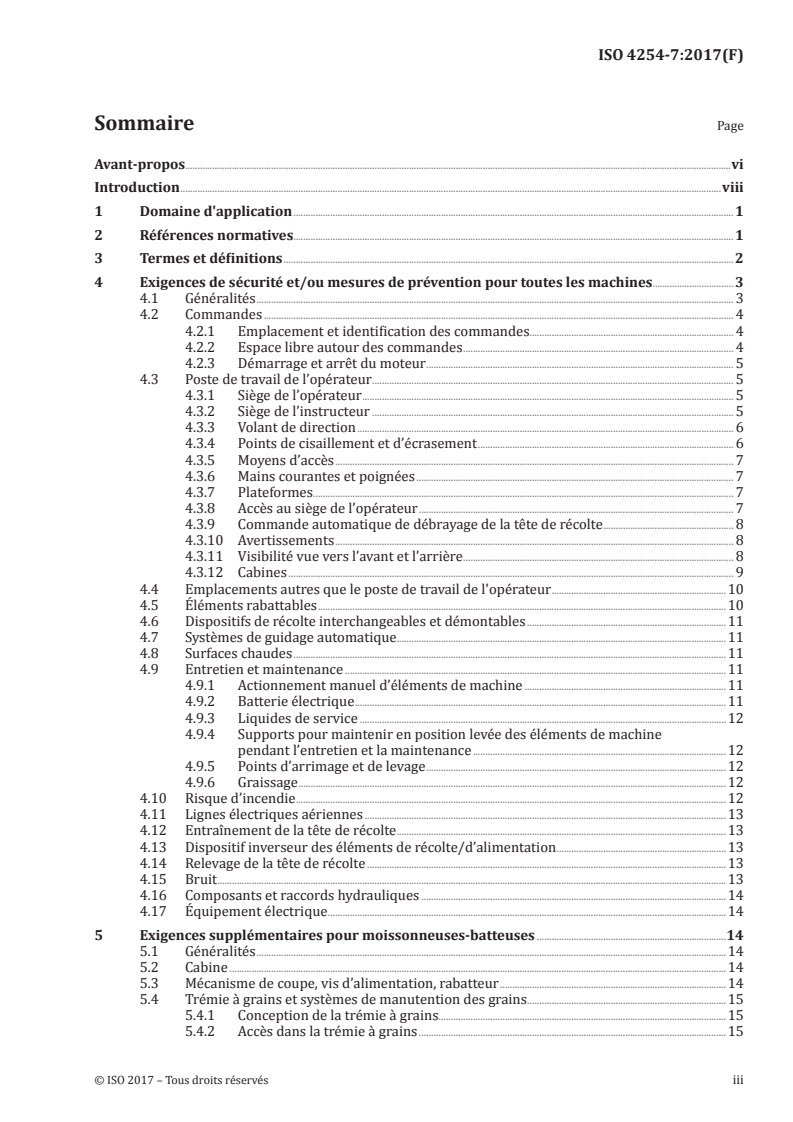
Contents Page
Foreword .vi
Introduction .viii
1 Scope . 1
2 Normative references . 1
3 Terms and definitions . 2
4 Safety requirements and/or protective/risk reduction measures for all machines .3
4.1 General . 3
4.2 Controls . 3
4.2.1 Location and identification of controls . 3
4.2.2 Control clearances . 4
4.2.3 Starting and stopping the engine . 4
4.3 Operator’s work station . 4
4.3.1 Operator’s seat . 4
4.3.2 Instructional seat . . 4
4.3.3 Steering wheel . 5
4.3.4 Shearing and pinching points . 5
4.3.5 Boarding means . 6
4.3.6 Handrails and handholds. 6
4.3.7 Platforms . 6
4.3.8 Access to operator’s seat . 7
4.3.9 Automatic header disengagement control . 7
4.3.10 Warnings . 7
4.3.11 Visibility — View to front and rear . 7
4.3.12 Cabins . 8
4.4 Other than operator’s work station . 9
4.5 Folding elements . 9
4.6 Interchangeable and detachable harvesting devices .10
4.7 Automatic guidance systems .10
4.8 Hot surfaces .10
4.9 Service and maintenance .10
4.9.1 Manual operation of individual assemblies .10
4.9.2 Electric — Battery .10
4.9.3 Operating fluids .11
4.9.4 Supports for service and maintenance of raised machine parts .11
4.9.5 Tie-down and jacking points .11
4.9.6 Greasing .11
4.10 Fire hazard .11
4.11 Overhead power lines .12
4.12 Header drive .12
4.13 Header/feeding elements drive reverser .12
4.14 Header hold-up .12
4.15 Noise .12
4.16 Hydraulic components and fittings .13
4.17 Electric equipment .13
5 Additional requirements for combine harvesters .13
5.1 General .13
5.2 Cabin .13
5.3 Cutting mechanism, feed augers, reel.13
5.4 Grain tank and grain handling systems .14
5.4.1 Grain tank design . .14
5.4.2 Access into the grain tank .14
5.4.3 Distribution auger .14
5.4.4 Filling auger .15
5.4.5 Discharge auger .15
5.4.6 Clean grain and returns handling systems .16
5.5 Maize harvesting attachment .16
5.5.1 Maize picker head .16
5.5.2 Mid-mounted choppers.16
5.6 Rear straw chopper, straw spreader and chaff spreader .18
5.6.1 General.18
5.6.2 Straw chopper with discharge chute .19
5.6.3 Straw chopper with driven spreader .20
5.6.4 Chaff spreader .20
5.6.5 Straw spreader .20
5.7 Stone trap .21
5.8 Storage of sickle bars .21
6 Additional requirements for forage harvesters .21
6.1 Operator's work station .21
6.2 Infeed mechanism .21
6.3 Cutterhead drive .22
6.4 Run-down of rotating functional elements in the crop flow system .23
6.5 Knife sharpening device .23
7 Additional requirements for cotton harvesters .23
7.1 Harvest mechanism, feed augers, reel .23
7.1.1 Cotton stripper and cotton picker .23
7.1.2 Cotton picker only .24
7.2 Basket (cotton stripper and cotton picker) .24
7.2.1 Lowering basket .24
7.2.2 Compactor auger .24
7.2.3 Basket safety signs .24
7.2.4 Basket handrail .25
7.3 Operating fluids .25
8 Additional requirements for sugar cane harvesters .25
8.1 General .25
8.2 Clearing of blockages or obstructions .25
8.3 Cabin .25
8.4 Service and maintenance .25
8.5 Base cutting system .25
8.6 Billet loading conveyor system .26
9 Verification of the safety requirements and/or protective/risk reduction measures
(see Table 1) .26
10 Information for use .28
10.1 Operator’s manual.28
10.1.1 General.28
10.1.2 All machines .28
10.1.3 Combine harvesters .29
10.1.4 Forage harvesters .29
10.1.5 Cotton harvesters .29
10.1.6 Sugar cane harvesters .30
10.2 Marking .30
10.2.1 General.30
10.2.2 Instructional signs .30
10.2.3 Safety signs .30
Annex A (informative) List of significant hazards.32
Annex B (normative) Identification of hand controls by colour coding .41
Annex C (normative) Noise measurement .43
iv © ISO 2017 – All rights reserved
Bibliography .45
Foreword
ISO (the International Organization for Standardization) is a worldwide federation of national standards
bodies (ISO member bodies). The work of preparing International Standards is normally carried out
through ISO technical committees. Each member body interested in a subject for which a technical
committee has been established has the right to be represented on that committee. International
organizations, governmental and non-governmental, in liaison with ISO, also take part in the work.
ISO collaborates closely with the International Electrotechnical Commission (IEC) on all matters of
electrotechnical standardization.
The procedures used to develop this document and those intended for its further maintenance are
described in the ISO/IEC Directives, Part 1. In particular the different approval criteria needed for the
different types of ISO documents should be noted. This document was drafted in accordance with the
editorial rules of the ISO/IEC Directives, Part 2 (see www .iso .org/directives).
Attention is drawn to the possibility that some of the elements of this document may be the subject of
patent rights. ISO shall not be held responsible for identifying any or all such patent rights. Details of
any patent rights identified during the development of the document will be in the Introduction and/or
on the ISO list of patent declarations received (see www .iso .org/patents).
Any trade name used in this document is information given for the convenience of users and does not
constitute an endorsement.
For an explanation on the voluntary nature of standards, the meaning of ISO specific terms and
expressions related to conformity assessment, as well as information about ISO's adherence to the
World Trade Organization (WTO) principles in the Technical Barriers to Trade (TBT) see the following
URL: www .iso .org/iso/foreword .html.
This document was prepared by Technical Committee ISO/TC 23, Tractors and machinery for agriculture
and forestry, Subcommittee SC 7, Equipment for harvesting and conservation.
This third edition cancels and replaces the second edition (ISO 4254-7:2008), which has been technically
revised.
The main changes compared to the previous edition are as follows:
— additions to the Scope and of requirements for sugar cane harvesters;
— replacement of the reference to ISO 4254-1:2008 by ISO 4254-1:2013;
— addition of references to ISO 3776-3 and ISO 10975;
— deletion of the references to ISO 12100-1:2003 and ISO 12100-2:2003 and replacement with
ISO 12100:2010;
— list of significant hazards (Clause 4) as new informative Annex A;
— in Clause 4, for all machines, replacement of requirements by reference to ISO 4254-1:2013 for the
following:
— operator's seat and addition of a references to ISO 3776-3;
— handrails and handholds with a modification;
— operator platform;
— other boarding means;
vi © ISO 2017 – All rights reserved
— supports for service and maintenance;
— modification of the requirements for the following:
— visibility — view to front and rear;
— disconnection of the battery;
— greasing;
— boarding means;
— addition of requirements for the following:
— forward and rearward facing work lights;
— cleaning the machine;
— header hold-up;
— instructional seat: deletion of the requirement that anchorage points for a restraint system have to
be provided and addition for a requirement that a restraint system has to be provided in the event
of a rollover;
— replacement of the requirements for automatic guidance systems by a reference to ISO 10975;
— in Clause 5, for combine harvesters:
— clean grain and returns handling systems: addition of information for explanation for better
understanding of the requirements;
— straw choppers: addition of requirement for replacing blades;
— in Clause 6, for forage harvesters:
— modification of the requirements for run-down of rotating functional elements in the crop
flow system.
A list of all parts in the ISO 4254 series can be found on the ISO website.
This corrected version of ISO 4254-7:2017 incorporates the following corrections:
— Figure 2 has been replaced to show the correct dimensions.
Introduction
This document is a type-C standard as stated in ISO 12100.
This document is of relevance, in particular, for the following stakeholder groups representing the
market players with regard to machinery safety:
— machine manufacturers (small, medium and large enterprises);
— health and safety bodies (regulators, accident prevention organizations, market surveillance, etc.).
Others can be affected by the level of machinery safety achieved with the means of the document by the
above-mentioned stakeholder groups:
— machine users/employers (small, medium and large enterprises);
— machine users/employees (e.g. trade unions, organizations for people with special needs);
— service providers, e.g. for maintenance (small, medium and large enterprises);
— consumers (in the case of machinery intended for use by consumers).
The above-mentioned stakeholder groups have been given the possibility to participate at the drafting
process of this document.
The machinery and systems concerned and the extent to which hazards, hazardous situations or
hazardous events are covered are indicated in the Scope of this document.
When requirements of this type-C standard are different from those which are stated in type-A or B
standards, the requirements of this type-C standard take precedence over the requirements of the
other standards for machines that have been designed and built according to the requirements of this
type-C standard.
The machinery concerned and the extent to which hazards, hazardous situations and events are
covered are indicated in the Scope of this document. These hazards are specific to combine harvesters,
forage harvesters, cotton harvesters and sugar cane harvesters.
Significant hazards that are common to all the agricultural machines (self-propelled ride-on, mounted,
semi-mounted and trailed) are dealt with in ISO 4254-1.
viii © ISO 2017 – All rights reserved
INTERNATIONAL STANDARD ISO 4254-7:2017(E)
Agricultural machinery — Safety —
Part 7:
Combine harvesters, forage harvesters, cotton harvesters
and sugar cane harvesters
1 Scope
This document, when used together with ISO 4254-1, specifies the safety requirements and their
verification for the design and construction of combine harvesters, forage harvesters, cotton harvesters
and sugar cane harvesters. It describes methods for the elimination or reduction of hazards arising
from the intended use of these machines by one person (the operator) in the course of normal operation
and service. In addition, it specifies the type of information on safe working practices to be provided by
the manufacturer.
When provisions of this document are different from those which are stated in ISO 4254-1, the
provisions of this document take precedence over the provisions of ISO 4254-1 for machines that have
been designed and built according to the provisions of this document.
This document, taken together with ISO 4254-1, deals with all the significant hazards (as listed in
Table A.1), hazardous situations and events relevant to combine harvesters, forage harvesters, cotton
harvesters and sugar cane harvesters, when they are used as intended and under the conditions of
misuse that are reasonably foreseeable by the manufacturer (see Annex A). It is not applicable to hazards
arising from the presence of persons other than the operator, cleaning of the grain tank, and hazards
related to vibrations and moving parts for power transmission, except for strength requirements for
guards and barriers. In respect of braking and steering, it is applicable only to the ergonomic aspects
(e.g. location of brake pedal and steering wheel); no other aspects related to braking and steering are
covered. In the case of trailed harvesters, it is applicable only to hazards related to the working process.
Design requirements for roll-over protective structures (if applicable) are not specified in this
document.
Performance levels (or categories) for safety-related parts of control systems in accordance with
ISO 25119 or ISO 13849 are not given in this document.
NOTE Specific requirements related to road traffic regulations are not taken into account in this document.
This document is not applicable to machines manufactured before the date of its publication.
2 Normative references
The following documents are referred to in the text in such a way that some or all of their content
constitutes requirements of this document. For dated references, only the edition cited applies. For
undated references, the latest edition of the referenced document (including any amendments) applies.
ISO 3600, Tractors, machinery for agriculture and forestry, powered lawn and garden equipment —
Operator's manuals — Content and format
ISO 3767-1, Tractors, machinery for agriculture and forestry, powered lawn and garden equipment —
Symbols for operator controls and other displays — Part 1: Common symbols
ISO 3767-2, Tractors, machinery for agriculture and forestry, powered lawn and garden equipment —
Symbols for operator controls and other displays — Part 2: Symbols for agricultural tractors and machinery
ISO 3776-1, Tractors and machinery for agriculture — Seat belts — Part 1: Anchorage location requirements
ISO 3776-2, Tractors and machinery for agriculture — Seat belts — Part 2: Anchorage strength
requirements
ISO 3776-3, Tractors and machinery for agriculture — Seat belts — Part 3: Requirements for assemblies
ISO 4254-1:2013, Agricultural machinery — Safety — Part 1: General requirements
ISO 5131:2015, Tractors for agriculture and forestry — Measurement of noise at the operator's position —
Survey method
ISO 5353, Earth-moving machinery, and tractors and machinery for agriculture and forestry — Seat
index point
ISO 5687, Equipment for harvesting — Combine harvesters — Determination and designation of grain tank
capacity and unloading device performance (under revision)
ISO 9533, Earth-moving machinery — Machine-mounted audible travel alarms and forward horns — Test
methods and performance criteria
ISO 10975, Tractors and machinery for agriculture — Auto-guidance systems for operator-controlled
tractors and self-propelled machines — Safety requirements
ISO 11684, Tractors, machinery for agriculture and forestry, powered lawn and garden equipment — Safety
signs and hazard pictorials — General principles
ISO 12100:2010, Safety of machinery — General principles for design — Risk assessment and risk reduction
ISO 15077, Tractors and self-propelled machinery for agriculture — Operator controls — Actuating forces,
displacement, location and method of operation
3 Terms and definitions
For the purposes of this document, the terms and definitions given in ISO 4254-1, ISO 12100 and the
following apply.
3.1
basket
container used to receive, hold, compact and unload harvested cotton crop material
3.2
clean grain and returns handling systems
systems for conveying of clean grain and returns within the machine by augers and/or elevators to the
grain tank or threshing/re-threshing system
3.3
combine harvester
mobile grain-harvesting machine for cutting, stripping or picking up crops, threshing, separating,
cleaning and conveying grain into a grain tank and depositing harvest residue onto the ground
3.4
cotton harvester
mobile cotton seed harvesting machine for cleaning, as required, handling and conveying seed cotton
into a basket (3.1) and depositing harvest residue onto the ground
3.5
forage harvester
mobile agricultural machine used to harvest or gather the crop, cut the crop into short parallel lengths
and deliver the chopped crop into containers or separate vehicles
Note 1 to entry: ISO 8909-1 gives detailed definitions of terms related to forage harvesters.
2 © ISO 2017 – All rights reserved
3.6
guidance system
automatic system to control machine steering during the harvesting operation
3.7
header
portion of the harvester comprising the mechanism for gathering, cutting, stripping or picking up the crop
3.8
instructional seat
integral or separate seat to allow a trainer or trainee to be seated
3.9
operator’s work station
location on the self-propelled machine from which the operator controls the travel and work functions
3.10
sugar cane harvester
mobile agricultural machine used to harvest or gather sugar cane crop, cut the crop and deliver the
chopped crop into containers or separate vehicles
4 Safety requirements and/or protective/risk reduction measures for all
machines
4.1 General
4.1.1 Machinery shall comply with the safety requirements and/or protective/risk reduction measures
of this clause.
4.1.2 In addition, the machine shall be designed according to the principles of ISO 12100 for relevant
but not significant hazards which are not dealt with by this document.
4.1.3 Except where otherwise specified in this document, the machine shall be in accordance with
ISO 4254-1.
4.2 Controls
4.2.1 Location and identification of controls
4.2.1.1 Controls such as steering wheels or steering levers, gear levers, control levers, cranks, pedals
and switches shall be chosen, designed, constructed and arranged according to the following:
a) their locations and method of operation shall be in accordance with ISO 15077;
b) unless otherwise specified in this document, the controls referred to in B.3.1, B.3.2 and B.3.3 shall
be located within hand and foot reach of the operator in the operator’s work station. The locations
for all other controls shall be in accordance with ISO 15077;
c) the controls and their different positions shall be identified [see 10.2.2 a)]. These identities shall be
explained in the operator’s manual [see 10.1.2 a)]. If symbols are used, they shall be in accordance
with ISO 3767-1 and ISO 3767-2. If different colours for identification of controls are used, they shall
be in accordance with the provisions of Annex B.
4.2.1.2 Additional requirements for specific controls are given in 4.3.3, 4.3.8, 4.3.9, 4.12, 4.13.3, 5.4.5.2,
6.2.5, 7.1.2.1, 7.2.2.1 and 8.5.
4.2.1.3 The controls, excluding the operator presence control, if fitted, shall be arranged such that in
any of their positions, they do not hinder access to the operator’s position and shall be located so that
they cannot be used as handholds during boarding or exiting the machine excluding the steering wheel
(see also 4.3.8).
4.2.1.4 For normal operation, the controls used to activate the ground propulsion system shall be
located such that they can only be actuated when being in the operator’s work station. Pedals shall have
an appropriate size, shape and be adequately spaced. The pedals shall have a slip-resistant surface and
be easy to clean.
4.2.1.5 Where clutch, brake and accelerator pedals have the exact same function as those of passenger
vehicles, the order of location shall be the same as in the passenger vehicles.
4.2.2 Control clearances
Controls requiring an actuating force ≥100 N measured at the grip shall have a minimum clearance,
a, of 50 mm between their outer contours and adjacent parts. Controls requiring an actuating force
of <100 N shall have a minimum clearance, a, of 25 mm (see Figure 1). Fingertip controls are excluded
from these requirements providing there is no risk of inadvertent operation of adjacent controls.
Dimensions in millimetres
a
a
Key
a minimum clearance
1 manual control
2 adjacent part
Figure 1 — Control clearances
4.2.3 Starting and stopping the engine
The provisions of ISO 4254-1:2013, 5.1.8 apply.
4.3 Operator’s work station
4.3.1 Operator’s seat
4.3.1.1 For operator's seats, the provisions of ISO 4254-1:2013, 5.1.2.1 and 5.1.2.2 apply.
4.3.1.2 If the design of the machine provides protection in the event of a rollover, a restraint system in
accordance with ISO 3776-1, ISO 3776-2 and ISO 3776-3 shall be provided.
4.3.2 Instructional seat
The instructional seat, if provided, shall meet the following requirements.
a) The instructional seat shall be located as shown in Figure 2. The instructional seat shall be placed
such that the trainer or trainee seated in it creates minimal potential impact on operation and
4 © ISO 2017 – All rights reserved
visibility under the usage conditions specified in Clause 1, consistent with machine function and
other design considerations;
b) The instructional seat shall have the minimum dimensions shown in Figure 2. The seat shall also
have a backrest of the minimum dimensions shown in Figure 2. A non-glazing component at the
rear of the enclosed cabin may be used as a backrest;
c) At least one handgrip or handrail shall be provided in a conveniently located position for the trainer
or trainee while seated in the instructional seat;
d) A suitable area, which does not interfere with the operator, shall be provided for the lower
extremities of the trainer or trainee seated in the instructional seat;
e) If the design of the machine provides protection in the event of a rollover, a restraint system in
accordance with ISO 3776-1, ISO 3776-2 and ISO 3776-3 shall be provided;
f) The instructional seat and the trainer or trainee seated in the instructional seat shall be inside the
enclosed cabin structure, if a cabin is provided;
g) The operator’s manual shall include an appropriate notice regarding the intended use of the
instructional seat [see 10.1.2 c)].
Dimensions in millimetres
≥200
≥0
≥175
Key
1 SIP
2 front view
3 side view
4 foot rest
5 clearance zone
Figure 2 — Instructional seat dimensions
4.3.3 Steering wheel
The centre of the steering wheel shall be on the longitudinal centreline of the seat within a maximum
lateral offset (either side) of 50 mm. The clearance between the fixed parts and the steering wheel shall
be in accordance with 4.3.12.3 (see Figure 5).
4.3.4 Shearing and pinching points
4.3.4.1 In the operator’s work station, there shall be no shearing or pinching points within hand or
foot reach of the operator or occupant of the instructional seat when seated in the seat provided.
R ≤ 300
R ≤ 300
≥450
≥930
≤600
≥110
4.3.4.2 A clearance of at least 25 mm shall be maintained between a moving seat and adjacent
components.
4.3.4.3 For machines not equipped with a cabin, hand reach is defined by a sphere of 1 000 mm radius,
centred on the seat centreline, 60 mm in front of, and 580 mm above, the SIP as defined in ISO 5353. Foot
reach is defined by a hemisphere of 800 mm radius centred on the seat centreline at the front edge of the
cushion and extending downwards, with the seat in its central position (see Figure 3).
4.3.4.4 For machines equipped with a cabin, hand and foot reach are defined by the portions of the
sphere and hemisphere described above, which are within the cabin.
Dimensions in millimetres
Key
1 SIP
NOTE For cabin-equipped machines, the cabin limits the space defined in Figure 3.
Figure 3 — Arm and foot reach
4.3.5 Boarding means
For boarding means, the provisions of ISO 4254-1:2013, 4.7.1.1 and 4.7.1.2 apply with the following
modifications:
— the height of the first step shall not exceed 550 mm with the specified tyres and with the maximum
diameter at specified inflation pressure or specified tracks;
— for boarding means capable of pivoting for transport, lateral stops are not required on the uppermost
surface (step) of the movable ladder.
4.3.6 Handrails and handholds
For handrails and handholds, the provisions of ISO 4254-1:2013, 4.7.1.3 apply with the following
modification: the lower end of the handrail/handhold shall be located not higher than 1 600 mm from
the ground surface.
4.3.7 Platforms
For operator platforms, the provisions of ISO 4254-1:2013, 4.7.2 shall apply.
6 © ISO 2017 – All rights reserved
4.3.8 Access to operator’s seat
Access to the operator’s seat shall be possible by the alternate use of each foot. For this purpose, the
floor area shall have a minimum width of 300 mm. Devices, including controls in any of their positions,
shall be arranged such that they do not hinder access to the operator’s position, except for any devices
intended to restrict the operator from encountering hazards during operation.
4.3.9 Automatic header disengagement control
4.3.9.1 Self-propelled machines which have an electrically activated header engagement mechanism
shall have a system that:
— prevents engagement of the header mechanism if the operator is not in the operator’s work
station, and
— automatically disengages the header mechanism when the operator leaves the operator’s work
station.
The maximum delay time for triggering the disengagement shall be 7 s. Header starting shall require
intentional reactivation by means other than the automatic header disengagement control after
stopping.
4.3.9.2 In case of self-propelled machines with mechanically activated header engagement, the control
lever for engagement shall act as an impediment for egress from the operator’s seat when in the engaged
position.
4.3.10 Warnings
If audible or visual means are provided to inform the operator about malfunctions or a special status of
the machine, for example
— grain tank extensions raised above 4 m,
— cotton basket raised,
— sugar cane harvester discharge chute raised above 4 m,
— guidance systems activated,
— the body levelling system in its maximum position,
— unloading auger swung out, and
— knife sharpening in process,
then the information given shall be unambiguous and easily understood. The operator’s manual shall
provide detailed information about such means [see 10.1.2 d)].
4.3.11 Visibility — View to front and rear
4.3.11.1 For the view to the front and to the rear, the provisions of ISO 4254-1:2013, 5.1.7 apply.
4.3.11.2 Machines shall be equipped with at least two rear-view mirrors, one on each side of the
machine.
4.3.11.3 Mirrors shall be adjustable manually while at the same time maintaining three-point contact, or
by remote control. Cleaning of these mirrors shall be possible while at the same time maintaining three-
point contact. Alternatively, other provisions shall be made for cleaning and adjusting of the mirrors from
the ground, including the following:
— adjusting and cleaning tool provided with and stored on the machine;
— tool shall be easily accessible.
4.3.11.4 Instructions on how to clean the windscreen and to adjust and clean the rear-view mirrors
shall be provided in the operator’s manual [see 10.1.2 e) and 10.1.2 f)].
4.3.11.5 If it is not possible to see the area just behind the machine from the operator’s seat position, an
audible reverse warning alarm, which shall be automatically engaged and in accordance with ISO 9533,
shall be provided.
4.3.11.6 If a cabin is provided, provisions to install devices for defrosting an
...
INTERNATIONAL ISO
STANDARD 4254-7
Third edition
2017-10
Corrected version
2019-03
Agricultural machinery — Safety —
Part 7:
Combine harvesters, forage
harvesters, cotton harvesters and
sugar cane harvesters
Matériel agricole — Sécurité —
Partie 7: Moissonneuses-batteuses, récolteuses-hacheuses-chargeuses
de fourrage, récolteuses de coton et récolteuses de cannes à sucre
Reference number
©
ISO 2017
© ISO 2017
All rights reserved. Unless otherwise specified, or required in the context of its implementation, no part of this publication may
be reproduced or utilized otherwise in any form or by any means, electronic or mechanical, including photocopying, or posting
on the internet or an intranet, without prior written permission. Permission can be requested from either ISO at the address
below or ISO’s member body in the country of the requester.
ISO copyright office
CP 401 • Ch. de Blandonnet 8
CH-1214 Vernier, Geneva
Phone: +41 22 749 01 11
Fax: +41 22 749 09 47
Email: copyright@iso.org
Website: www.iso.org
Published in Switzerland
ii © ISO 2017 – All rights reserved
Contents Page
Foreword .vi
Introduction .viii
1 Scope . 1
2 Normative references . 1
3 Terms and definitions . 2
4 Safety requirements and/or protective/risk reduction measures for all machines .3
4.1 General . 3
4.2 Controls . 3
4.2.1 Location and identification of controls . 3
4.2.2 Control clearances . 4
4.2.3 Starting and stopping the engine . 4
4.3 Operator’s work station . 4
4.3.1 Operator’s seat . 4
4.3.2 Instructional seat . . 4
4.3.3 Steering wheel . 5
4.3.4 Shearing and pinching points . 5
4.3.5 Boarding means . 6
4.3.6 Handrails and handholds. 6
4.3.7 Platforms . 6
4.3.8 Access to operator’s seat . 7
4.3.9 Automatic header disengagement control . 7
4.3.10 Warnings . 7
4.3.11 Visibility — View to front and rear . 7
4.3.12 Cabins . 8
4.4 Other than operator’s work station . 9
4.5 Folding elements . 9
4.6 Interchangeable and detachable harvesting devices .10
4.7 Automatic guidance systems .10
4.8 Hot surfaces .10
4.9 Service and maintenance .10
4.9.1 Manual operation of individual assemblies .10
4.9.2 Electric — Battery .10
4.9.3 Operating fluids .11
4.9.4 Supports for service and maintenance of raised machine parts .11
4.9.5 Tie-down and jacking points .11
4.9.6 Greasing .11
4.10 Fire hazard .11
4.11 Overhead power lines .12
4.12 Header drive .12
4.13 Header/feeding elements drive reverser .12
4.14 Header hold-up .12
4.15 Noise .12
4.16 Hydraulic components and fittings .13
4.17 Electric equipment .13
5 Additional requirements for combine harvesters .13
5.1 General .13
5.2 Cabin .13
5.3 Cutting mechanism, feed augers, reel.13
5.4 Grain tank and grain handling systems .14
5.4.1 Grain tank design . .14
5.4.2 Access into the grain tank .14
5.4.3 Distribution auger .14
5.4.4 Filling auger .15
5.4.5 Discharge auger .15
5.4.6 Clean grain and returns handling systems .16
5.5 Maize harvesting attachment .16
5.5.1 Maize picker head .16
5.5.2 Mid-mounted choppers.16
5.6 Rear straw chopper, straw spreader and chaff spreader .18
5.6.1 General.18
5.6.2 Straw chopper with discharge chute .19
5.6.3 Straw chopper with driven spreader .20
5.6.4 Chaff spreader .20
5.6.5 Straw spreader .20
5.7 Stone trap .21
5.8 Storage of sickle bars .21
6 Additional requirements for forage harvesters .21
6.1 Operator's work station .21
6.2 Infeed mechanism .21
6.3 Cutterhead drive .22
6.4 Run-down of rotating functional elements in the crop flow system .23
6.5 Knife sharpening device .23
7 Additional requirements for cotton harvesters .23
7.1 Harvest mechanism, feed augers, reel .23
7.1.1 Cotton stripper and cotton picker .23
7.1.2 Cotton picker only .24
7.2 Basket (cotton stripper and cotton picker) .24
7.2.1 Lowering basket .24
7.2.2 Compactor auger .24
7.2.3 Basket safety signs .24
7.2.4 Basket handrail .25
7.3 Operating fluids .25
8 Additional requirements for sugar cane harvesters .25
8.1 General .25
8.2 Clearing of blockages or obstructions .25
8.3 Cabin .25
8.4 Service and maintenance .25
8.5 Base cutting system .25
8.6 Billet loading conveyor system .26
9 Verification of the safety requirements and/or protective/risk reduction measures
(see Table 1) .26
10 Information for use .28
10.1 Operator’s manual.28
10.1.1 General.28
10.1.2 All machines .28
10.1.3 Combine harvesters .29
10.1.4 Forage harvesters .29
10.1.5 Cotton harvesters .29
10.1.6 Sugar cane harvesters .30
10.2 Marking .30
10.2.1 General.30
10.2.2 Instructional signs .30
10.2.3 Safety signs .30
Annex A (informative) List of significant hazards.32
Annex B (normative) Identification of hand controls by colour coding .41
Annex C (normative) Noise measurement .43
iv © ISO 2017 – All rights reserved
Bibliography .45
Foreword
ISO (the International Organization for Standardization) is a worldwide federation of national standards
bodies (ISO member bodies). The work of preparing International Standards is normally carried out
through ISO technical committees. Each member body interested in a subject for which a technical
committee has been established has the right to be represented on that committee. International
organizations, governmental and non-governmental, in liaison with ISO, also take part in the work.
ISO collaborates closely with the International Electrotechnical Commission (IEC) on all matters of
electrotechnical standardization.
The procedures used to develop this document and those intended for its further maintenance are
described in the ISO/IEC Directives, Part 1. In particular the different approval criteria needed for the
different types of ISO documents should be noted. This document was drafted in accordance with the
editorial rules of the ISO/IEC Directives, Part 2 (see www .iso .org/directives).
Attention is drawn to the possibility that some of the elements of this document may be the subject of
patent rights. ISO shall not be held responsible for identifying any or all such patent rights. Details of
any patent rights identified during the development of the document will be in the Introduction and/or
on the ISO list of patent declarations received (see www .iso .org/patents).
Any trade name used in this document is information given for the convenience of users and does not
constitute an endorsement.
For an explanation on the voluntary nature of standards, the meaning of ISO specific terms and
expressions related to conformity assessment, as well as information about ISO's adherence to the
World Trade Organization (WTO) principles in the Technical Barriers to Trade (TBT) see the following
URL: www .iso .org/iso/foreword .html.
This document was prepared by Technical Committee ISO/TC 23, Tractors and machinery for agriculture
and forestry, Subcommittee SC 7, Equipment for harvesting and conservation.
This third edition cancels and replaces the second edition (ISO 4254-7:2008), which has been technically
revised.
The main changes compared to the previous edition are as follows:
— additions to the Scope and of requirements for sugar cane harvesters;
— replacement of the reference to ISO 4254-1:2008 by ISO 4254-1:2013;
— addition of references to ISO 3776-3 and ISO 10975;
— deletion of the references to ISO 12100-1:2003 and ISO 12100-2:2003 and replacement with
ISO 12100:2010;
— list of significant hazards (Clause 4) as new informative Annex A;
— in Clause 4, for all machines, replacement of requirements by reference to ISO 4254-1:2013 for the
following:
— operator's seat and addition of a references to ISO 3776-3;
— handrails and handholds with a modification;
— operator platform;
— other boarding means;
vi © ISO 2017 – All rights reserved
— supports for service and maintenance;
— modification of the requirements for the following:
— visibility — view to front and rear;
— disconnection of the battery;
— greasing;
— boarding means;
— addition of requirements for the following:
— forward and rearward facing work lights;
— cleaning the machine;
— header hold-up;
— instructional seat: deletion of the requirement that anchorage points for a restraint system have to
be provided and addition for a requirement that a restraint system has to be provided in the event
of a rollover;
— replacement of the requirements for automatic guidance systems by a reference to ISO 10975;
— in Clause 5, for combine harvesters:
— clean grain and returns handling systems: addition of information for explanation for better
understanding of the requirements;
— straw choppers: addition of requirement for replacing blades;
— in Clause 6, for forage harvesters:
— modification of the requirements for run-down of rotating functional elements in the crop
flow system.
A list of all parts in the ISO 4254 series can be found on the ISO website.
This corrected version of ISO 4254-7:2017 incorporates the following corrections:
— Figure 2 has been replaced to show the correct dimensions.
Introduction
This document is a type-C standard as stated in ISO 12100.
This document is of relevance, in particular, for the following stakeholder groups representing the
market players with regard to machinery safety:
— machine manufacturers (small, medium and large enterprises);
— health and safety bodies (regulators, accident prevention organizations, market surveillance, etc.).
Others can be affected by the level of machinery safety achieved with the means of the document by the
above-mentioned stakeholder groups:
— machine users/employers (small, medium and large enterprises);
— machine users/employees (e.g. trade unions, organizations for people with special needs);
— service providers, e.g. for maintenance (small, medium and large enterprises);
— consumers (in the case of machinery intended for use by consumers).
The above-mentioned stakeholder groups have been given the possibility to participate at the drafting
process of this document.
The machinery and systems concerned and the extent to which hazards, hazardous situations or
hazardous events are covered are indicated in the Scope of this document.
When requirements of this type-C standard are different from those which are stated in type-A or B
standards, the requirements of this type-C standard take precedence over the requirements of the
other standards for machines that have been designed and built according to the requirements of this
type-C standard.
The machinery concerned and the extent to which hazards, hazardous situations and events are
covered are indicated in the Scope of this document. These hazards are specific to combine harvesters,
forage harvesters, cotton harvesters and sugar cane harvesters.
Significant hazards that are common to all the agricultural machines (self-propelled ride-on, mounted,
semi-mounted and trailed) are dealt with in ISO 4254-1.
viii © ISO 2017 – All rights reserved
INTERNATIONAL STANDARD ISO 4254-7:2017(E)
Agricultural machinery — Safety —
Part 7:
Combine harvesters, forage harvesters, cotton harvesters
and sugar cane harvesters
1 Scope
This document, when used together with ISO 4254-1, specifies the safety requirements and their
verification for the design and construction of combine harvesters, forage harvesters, cotton harvesters
and sugar cane harvesters. It describes methods for the elimination or reduction of hazards arising
from the intended use of these machines by one person (the operator) in the course of normal operation
and service. In addition, it specifies the type of information on safe working practices to be provided by
the manufacturer.
When provisions of this document are different from those which are stated in ISO 4254-1, the
provisions of this document take precedence over the provisions of ISO 4254-1 for machines that have
been designed and built according to the provisions of this document.
This document, taken together with ISO 4254-1, deals with all the significant hazards (as listed in
Table A.1), hazardous situations and events relevant to combine harvesters, forage harvesters, cotton
harvesters and sugar cane harvesters, when they are used as intended and under the conditions of
misuse that are reasonably foreseeable by the manufacturer (see Annex A). It is not applicable to hazards
arising from the presence of persons other than the operator, cleaning of the grain tank, and hazards
related to vibrations and moving parts for power transmission, except for strength requirements for
guards and barriers. In respect of braking and steering, it is applicable only to the ergonomic aspects
(e.g. location of brake pedal and steering wheel); no other aspects related to braking and steering are
covered. In the case of trailed harvesters, it is applicable only to hazards related to the working process.
Design requirements for roll-over protective structures (if applicable) are not specified in this
document.
Performance levels (or categories) for safety-related parts of control systems in accordance with
ISO 25119 or ISO 13849 are not given in this document.
NOTE Specific requirements related to road traffic regulations are not taken into account in this document.
This document is not applicable to machines manufactured before the date of its publication.
2 Normative references
The following documents are referred to in the text in such a way that some or all of their content
constitutes requirements of this document. For dated references, only the edition cited applies. For
undated references, the latest edition of the referenced document (including any amendments) applies.
ISO 3600, Tractors, machinery for agriculture and forestry, powered lawn and garden equipment —
Operator's manuals — Content and format
ISO 3767-1, Tractors, machinery for agriculture and forestry, powered lawn and garden equipment —
Symbols for operator controls and other displays — Part 1: Common symbols
ISO 3767-2, Tractors, machinery for agriculture and forestry, powered lawn and garden equipment —
Symbols for operator controls and other displays — Part 2: Symbols for agricultural tractors and machinery
ISO 3776-1, Tractors and machinery for agriculture — Seat belts — Part 1: Anchorage location requirements
ISO 3776-2, Tractors and machinery for agriculture — Seat belts — Part 2: Anchorage strength
requirements
ISO 3776-3, Tractors and machinery for agriculture — Seat belts — Part 3: Requirements for assemblies
ISO 4254-1:2013, Agricultural machinery — Safety — Part 1: General requirements
ISO 5131:2015, Tractors for agriculture and forestry — Measurement of noise at the operator's position —
Survey method
ISO 5353, Earth-moving machinery, and tractors and machinery for agriculture and forestry — Seat
index point
ISO 5687, Equipment for harvesting — Combine harvesters — Determination and designation of grain tank
capacity and unloading device performance (under revision)
ISO 9533, Earth-moving machinery — Machine-mounted audible travel alarms and forward horns — Test
methods and performance criteria
ISO 10975, Tractors and machinery for agriculture — Auto-guidance systems for operator-controlled
tractors and self-propelled machines — Safety requirements
ISO 11684, Tractors, machinery for agriculture and forestry, powered lawn and garden equipment — Safety
signs and hazard pictorials — General principles
ISO 12100:2010, Safety of machinery — General principles for design — Risk assessment and risk reduction
ISO 15077, Tractors and self-propelled machinery for agriculture — Operator controls — Actuating forces,
displacement, location and method of operation
3 Terms and definitions
For the purposes of this document, the terms and definitions given in ISO 4254-1, ISO 12100 and the
following apply.
3.1
basket
container used to receive, hold, compact and unload harvested cotton crop material
3.2
clean grain and returns handling systems
systems for conveying of clean grain and returns within the machine by augers and/or elevators to the
grain tank or threshing/re-threshing system
3.3
combine harvester
mobile grain-harvesting machine for cutting, stripping or picking up crops, threshing, separating,
cleaning and conveying grain into a grain tank and depositing harvest residue onto the ground
3.4
cotton harvester
mobile cotton seed harvesting machine for cleaning, as required, handling and conveying seed cotton
into a basket (3.1) and depositing harvest residue onto the ground
3.5
forage harvester
mobile agricultural machine used to harvest or gather the crop, cut the crop into short parallel lengths
and deliver the chopped crop into containers or separate vehicles
Note 1 to entry: ISO 8909-1 gives detailed definitions of terms related to forage harvesters.
2 © ISO 2017 – All rights reserved
3.6
guidance system
automatic system to control machine steering during the harvesting operation
3.7
header
portion of the harvester comprising the mechanism for gathering, cutting, stripping or picking up the crop
3.8
instructional seat
integral or separate seat to allow a trainer or trainee to be seated
3.9
operator’s work station
location on the self-propelled machine from which the operator controls the travel and work functions
3.10
sugar cane harvester
mobile agricultural machine used to harvest or gather sugar cane crop, cut the crop and deliver the
chopped crop into containers or separate vehicles
4 Safety requirements and/or protective/risk reduction measures for all
machines
4.1 General
4.1.1 Machinery shall comply with the safety requirements and/or protective/risk reduction measures
of this clause.
4.1.2 In addition, the machine shall be designed according to the principles of ISO 12100 for relevant
but not significant hazards which are not dealt with by this document.
4.1.3 Except where otherwise specified in this document, the machine shall be in accordance with
ISO 4254-1.
4.2 Controls
4.2.1 Location and identification of controls
4.2.1.1 Controls such as steering wheels or steering levers, gear levers, control levers, cranks, pedals
and switches shall be chosen, designed, constructed and arranged according to the following:
a) their locations and method of operation shall be in accordance with ISO 15077;
b) unless otherwise specified in this document, the controls referred to in B.3.1, B.3.2 and B.3.3 shall
be located within hand and foot reach of the operator in the operator’s work station. The locations
for all other controls shall be in accordance with ISO 15077;
c) the controls and their different positions shall be identified [see 10.2.2 a)]. These identities shall be
explained in the operator’s manual [see 10.1.2 a)]. If symbols are used, they shall be in accordance
with ISO 3767-1 and ISO 3767-2. If different colours for identification of controls are used, they shall
be in accordance with the provisions of Annex B.
4.2.1.2 Additional requirements for specific controls are given in 4.3.3, 4.3.8, 4.3.9, 4.12, 4.13.3, 5.4.5.2,
6.2.5, 7.1.2.1, 7.2.2.1 and 8.5.
4.2.1.3 The controls, excluding the operator presence control, if fitted, shall be arranged such that in
any of their positions, they do not hinder access to the operator’s position and shall be located so that
they cannot be used as handholds during boarding or exiting the machine excluding the steering wheel
(see also 4.3.8).
4.2.1.4 For normal operation, the controls used to activate the ground propulsion system shall be
located such that they can only be actuated when being in the operator’s work station. Pedals shall have
an appropriate size, shape and be adequately spaced. The pedals shall have a slip-resistant surface and
be easy to clean.
4.2.1.5 Where clutch, brake and accelerator pedals have the exact same function as those of passenger
vehicles, the order of location shall be the same as in the passenger vehicles.
4.2.2 Control clearances
Controls requiring an actuating force ≥100 N measured at the grip shall have a minimum clearance,
a, of 50 mm between their outer contours and adjacent parts. Controls requiring an actuating force
of <100 N shall have a minimum clearance, a, of 25 mm (see Figure 1). Fingertip controls are excluded
from these requirements providing there is no risk of inadvertent operation of adjacent controls.
Dimensions in millimetres
a
a
Key
a minimum clearance
1 manual control
2 adjacent part
Figure 1 — Control clearances
4.2.3 Starting and stopping the engine
The provisions of ISO 4254-1:2013, 5.1.8 apply.
4.3 Operator’s work station
4.3.1 Operator’s seat
4.3.1.1 For operator's seats, the provisions of ISO 4254-1:2013, 5.1.2.1 and 5.1.2.2 apply.
4.3.1.2 If the design of the machine provides protection in the event of a rollover, a restraint system in
accordance with ISO 3776-1, ISO 3776-2 and ISO 3776-3 shall be provided.
4.3.2 Instructional seat
The instructional seat, if provided, shall meet the following requirements.
a) The instructional seat shall be located as shown in Figure 2. The instructional seat shall be placed
such that the trainer or trainee seated in it creates minimal potential impact on operation and
4 © ISO 2017 – All rights reserved
visibility under the usage conditions specified in Clause 1, consistent with machine function and
other design considerations;
b) The instructional seat shall have the minimum dimensions shown in Figure 2. The seat shall also
have a backrest of the minimum dimensions shown in Figure 2. A non-glazing component at the
rear of the enclosed cabin may be used as a backrest;
c) At least one handgrip or handrail shall be provided in a conveniently located position for the trainer
or trainee while seated in the instructional seat;
d) A suitable area, which does not interfere with the operator, shall be provided for the lower
extremities of the trainer or trainee seated in the instructional seat;
e) If the design of the machine provides protection in the event of a rollover, a restraint system in
accordance with ISO 3776-1, ISO 3776-2 and ISO 3776-3 shall be provided;
f) The instructional seat and the trainer or trainee seated in the instructional seat shall be inside the
enclosed cabin structure, if a cabin is provided;
g) The operator’s manual shall include an appropriate notice regarding the intended use of the
instructional seat [see 10.1.2 c)].
Dimensions in millimetres
≥200
≥0
≥175
Key
1 SIP
2 front view
3 side view
4 foot rest
5 clearance zone
Figure 2 — Instructional seat dimensions
4.3.3 Steering wheel
The centre of the steering wheel shall be on the longitudinal centreline of the seat within a maximum
lateral offset (either side) of 50 mm. The clearance between the fixed parts and the steering wheel shall
be in accordance with 4.3.12.3 (see Figure 5).
4.3.4 Shearing and pinching points
4.3.4.1 In the operator’s work station, there shall be no shearing or pinching points within hand or
foot reach of the operator or occupant of the instructional seat when seated in the seat provided.
R ≤ 300
R ≤ 300
≥450
≥930
≤600
≥110
4.3.4.2 A clearance of at least 25 mm shall be maintained between a moving seat and adjacent
components.
4.3.4.3 For machines not equipped with a cabin, hand reach is defined by a sphere of 1 000 mm radius,
centred on the seat centreline, 60 mm in front of, and 580 mm above, the SIP as defined in ISO 5353. Foot
reach is defined by a hemisphere of 800 mm radius centred on the seat centreline at the front edge of the
cushion and extending downwards, with the seat in its central position (see Figure 3).
4.3.4.4 For machines equipped with a cabin, hand and foot reach are defined by the portions of the
sphere and hemisphere described above, which are within the cabin.
Dimensions in millimetres
Key
1 SIP
NOTE For cabin-equipped machines, the cabin limits the space defined in Figure 3.
Figure 3 — Arm and foot reach
4.3.5 Boarding means
For boarding means, the provisions of ISO 4254-1:2013, 4.7.1.1 and 4.7.1.2 apply with the following
modifications:
— the height of the first step shall not exceed 550 mm with the specified tyres and with the maximum
diameter at specified inflation pressure or specified tracks;
— for boarding means capable of pivoting for transport, lateral stops are not required on the uppermost
surface (step) of the movable ladder.
4.3.6 Handrails and handholds
For handrails and handholds, the provisions of ISO 4254-1:2013, 4.7.1.3 apply with the following
modification: the lower end of the handrail/handhold shall be located not higher than 1 600 mm from
the ground surface.
4.3.7 Platforms
For operator platforms, the provisions of ISO 4254-1:2013, 4.7.2 shall apply.
6 © ISO 2017 – All rights reserved
4.3.8 Access to operator’s seat
Access to the operator’s seat shall be possible by the alternate use of each foot. For this purpose, the
floor area shall have a minimum width of 300 mm. Devices, including controls in any of their positions,
shall be arranged such that they do not hinder access to the operator’s position, except for any devices
intended to restrict the operator from encountering hazards during operation.
4.3.9 Automatic header disengagement control
4.3.9.1 Self-propelled machines which have an electrically activated header engagement mechanism
shall have a system that:
— prevents engagement of the header mechanism if the operator is not in the operator’s work
station, and
— automatically disengages the header mechanism when the operator leaves the operator’s work
station.
The maximum delay time for triggering the disengagement shall be 7 s. Header starting shall require
intentional reactivation by means other than the automatic header disengagement control after
stopping.
4.3.9.2 In case of self-propelled machines with mechanically activated header engagement, the control
lever for engagement shall act as an impediment for egress from the operator’s seat when in the engaged
position.
4.3.10 Warnings
If audible or visual means are provided to inform the operator about malfunctions or a special status of
the machine, for example
— grain tank extensions raised above 4 m,
— cotton basket raised,
— sugar cane harvester discharge chute raised above 4 m,
— guidance systems activated,
— the body levelling system in its maximum position,
— unloading auger swung out, and
— knife sharpening in process,
then the information given shall be unambiguous and easily understood. The operator’s manual shall
provide detailed information about such means [see 10.1.2 d)].
4.3.11 Visibility — View to front and rear
4.3.11.1 For the view to the front and to the rear, the provisions of ISO 4254-1:2013, 5.1.7 apply.
4.3.11.2 Machines shall be equipped with at least two rear-view mirrors, one on each side of the
machine.
4.3.11.3 Mirrors shall be adjustable manually while at the same time maintaining three-point contact, or
by remote control. Cleaning of these mirrors shall be possible while at the same time maintaining three-
point contact. Alternatively, other provisions shall be made for cleaning and adjusting of the mirrors from
the ground, including the following:
— adjusting and cleaning tool provided with and stored on the machine;
— tool shall be easily accessible.
4.3.11.4 Instructions on how to clean the windscreen and to adjust and clean the rear-view mirrors
shall be provided in the operator’s manual [see 10.1.2 e) and 10.1.2 f)].
4.3.11.5 If it is not possible to see the area just behind the machine from the operator’s seat position, an
audible reverse warning alarm, which shall be automatically engaged and in accordance with ISO 9533,
shall be provided.
4.3.11.6 If a cabin is provided, provisions to install devices for defrosting an
...
NORME ISO
INTERNATIONALE 4254-7
Troisième édition
2017-10
Version corrigée
2019-03
Matériel agricole — Sécurité —
Partie 7:
Moissonneuses-batteuses,
récolteuses-hacheuses-chargeuses
de fourrage, récolteuses de coton et
récolteuses de cannes à sucre
Agricultural machinery — Safety —
Part 7: Combine harvesters, forage harvesters, cotton harvesters and
sugar cane harvesters
Numéro de référence
©
ISO 2017
DOCUMENT PROTÉGÉ PAR COPYRIGHT
© ISO 2017
Tous droits réservés. Sauf prescription différente ou nécessité dans le contexte de sa mise en œuvre, aucune partie de cette
publication ne peut être reproduite ni utilisée sous quelque forme que ce soit et par aucun procédé, électronique ou mécanique,
y compris la photocopie, ou la diffusion sur l’internet ou sur un intranet, sans autorisation écrite préalable. Une autorisation peut
être demandée à l’ISO à l’adresse ci-après ou au comité membre de l’ISO dans le pays du demandeur.
ISO copyright office
Case postale 401 • Ch. de Blandonnet 8
CH-1214 Vernier, Genève
Tél.: +41 22 749 01 11
Fax: +41 22 749 09 47
E-mail: copyright@iso.org
Web: www.iso.org
Publié en Suisse
ii © ISO 2017 – Tous droits réservés
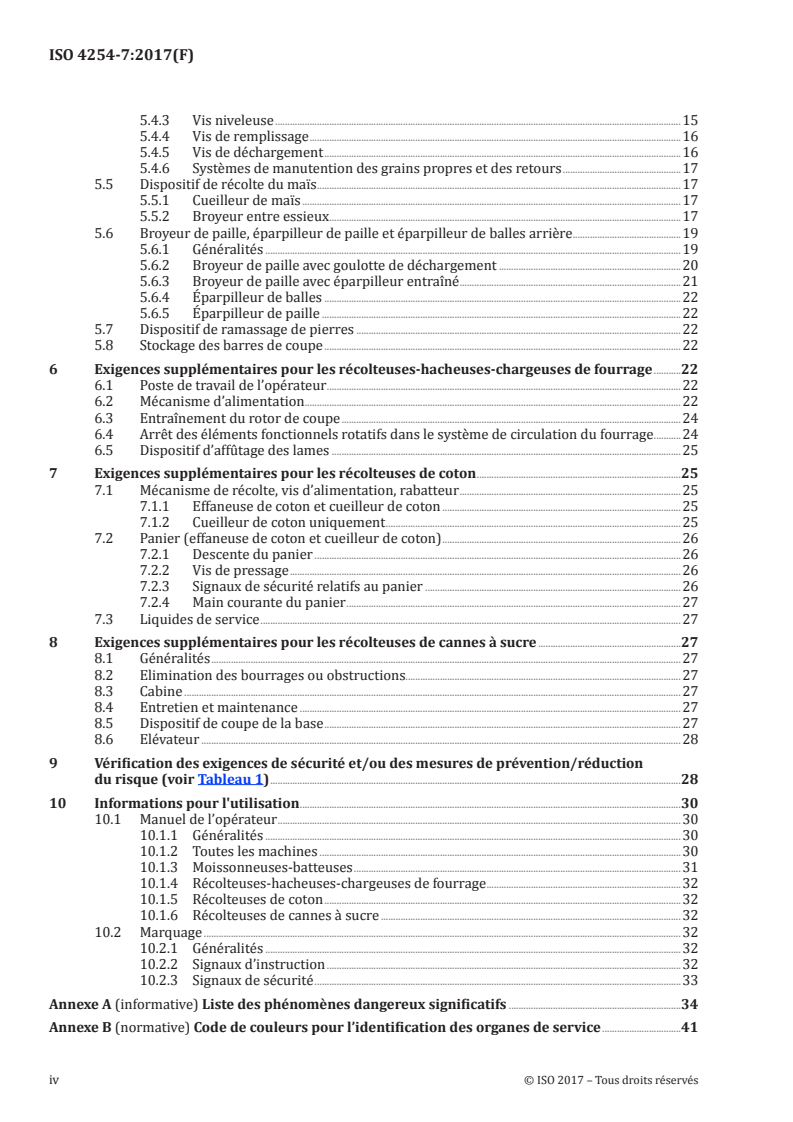
Sommaire Page
Avant-propos .vi
Introduction .viii
1 Domaine d'application . 1
2 Références normatives . 1
3 Termes et définitions . 2
4 Exigences de sécurité et/ou mesures de prévention pour toutes les machines.3
4.1 Généralités . 3
4.2 Commandes . 4
4.2.1 Emplacement et identification des commandes. 4
4.2.2 Espace libre autour des commandes . 4
4.2.3 Démarrage et arrêt du moteur . 5
4.3 Poste de travail de l’opérateur . 5
4.3.1 Siège de l’opérateur . 5
4.3.2 Siège de l’instructeur . 5
4.3.3 Volant de direction . 6
4.3.4 Points de cisaillement et d’écrasement . 6
4.3.5 Moyens d’accès . 7
4.3.6 Mains courantes et poignées . 7
4.3.7 Plateformes . 7
4.3.8 Accès au siège de l’opérateur . 7
4.3.9 Commande automatique de débrayage de la tête de récolte . 8
4.3.10 Avertissements . 8
4.3.11 Visibilité vue vers l’avant et l’arrière . 8
4.3.12 Cabines . 9
4.4 Emplacements autres que le poste de travail de l'opérateur .10
4.5 Éléments rabattables .10
4.6 Dispositifs de récolte interchangeables et démontables .11
4.7 Systèmes de guidage automatique .11
4.8 Surfaces chaudes .11
4.9 Entretien et maintenance .11
4.9.1 Actionnement manuel d’éléments de machine .11
4.9.2 Batterie électrique .11
4.9.3 Liquides de service .12
4.9.4 Supports pour maintenir en position levée des éléments de machine
pendant l’entretien et la maintenance .12
4.9.5 Points d’arrimage et de levage .12
4.9.6 Graissage .12
4.10 Risque d’incendie .12
4.11 Lignes électriques aériennes .13
4.12 Entraînement de la tête de récolte .13
4.13 Dispositif inverseur des éléments de récolte/d’alimentation .13
4.14 Relevage de la tête de récolte .13
4.15 Bruit .13
4.16 Composants et raccords hydrauliques .14
4.17 Équipement électrique .14
5 Exigences supplémentaires pour moissonneuses-batteuses .14
5.1 Généralités .14
5.2 Cabine .14
5.3 Mécanisme de coupe, vis d’alimentation, rabatteur .14
5.4 Trémie à grains et systèmes de manutention des grains . .15
5.4.1 Conception de la trémie à grains.15
5.4.2 Accès dans la trémie à grains .15
5.4.3 Vis niveleuse .15
5.4.4 Vis de remplissage .16
5.4.5 Vis de déchargement .16
5.4.6 Systèmes de manutention des grains propres et des retours .17
5.5 Dispositif de récolte du maïs .17
5.5.1 Cueilleur de maïs .17
5.5.2 Broyeur entre essieux . .17
5.6 Broyeur de paille, éparpilleur de paille et éparpilleur de balles arrière .19
5.6.1 Généralités .19
5.6.2 Broyeur de paille avec goulotte de déchargement .20
5.6.3 Broyeur de paille avec éparpilleur entraîné .21
5.6.4 Éparpilleur de balles .22
5.6.5 Éparpilleur de paille .22
5.7 Dispositif de ramassage de pierres .22
5.8 Stockage des barres de coupe .22
6 Exigences supplémentaires pour les récolteuses-hacheuses-chargeuses de fourrage .22
6.1 Poste de travail de l’opérateur .22
6.2 Mécanisme d’alimentation .22
6.3 Entraînement du rotor de coupe .24
6.4 Arrêt des éléments fonctionnels rotatifs dans le système de circulation du fourrage .24
6.5 Dispositif d’affûtage des lames .25
7 Exigences supplémentaires pour les récolteuses de coton .25
7.1 Mécanisme de récolte, vis d’alimentation, rabatteur .25
7.1.1 Effaneuse de coton et cueilleur de coton .25
7.1.2 Cueilleur de coton uniquement .25
7.2 Panier (effaneuse de coton et cueilleur de coton) .26
7.2.1 Descente du panier .26
7.2.2 Vis de pressage .26
7.2.3 Signaux de sécurité relatifs au panier .26
7.2.4 Main courante du panier .27
7.3 Liquides de service .27
8 Exigences supplémentaires pour les récolteuses de cannes à sucre .27
8.1 Généralités .27
8.2 Elimination des bourrages ou obstructions.27
8.3 Cabine .27
8.4 Entretien et maintenance .27
8.5 Dispositif de coupe de la base .27
8.6 Elévateur .28
9 Vérification des exigences de sécurité et/ou des mesures de prévention/réduction
du risque (voir Tableau 1) .28
10 Informations pour l'utilisation .30
10.1 Manuel de l’opérateur .30
10.1.1 Généralités .30
10.1.2 Toutes les machines .30
10.1.3 Moissonneuses-batteuses .31
10.1.4 Récolteuses-hacheuses-chargeuses de fourrage .32
10.1.5 Récolteuses de coton .32
10.1.6 Récolteuses de cannes à sucre .32
10.2 Marquage .32
10.2.1 Généralités .32
10.2.2 Signaux d’instruction .32
10.2.3 Signaux de sécurité .33
Annexe A (informative) Liste des phénomènes dangereux significatifs .34
Annexe B (normative) Code de couleurs pour l’identification des organes de service .41
iv © ISO 2017 – Tous droits réservés
Annexe C (normative) Mesurage du bruit .43
Bibliographie .45
Avant-propos
L'ISO (Organisation internationale de normalisation) est une fédération mondiale d'organismes
nationaux de normalisation (comités membres de l'ISO). L'élaboration des Normes internationales est
en général confiée aux comités techniques de l'ISO. Chaque comité membre intéressé par une étude
a le droit de faire partie du comité technique créé à cet effet. Les organisations internationales,
gouvernementales et non gouvernementales, en liaison avec l'ISO participent également aux travaux.
L'ISO collabore étroitement avec la Commission électrotechnique internationale (IEC) en ce qui
concerne la normalisation électrotechnique.
Les procédures utilisées pour élaborer le présent document et celles destinées à sa mise à jour sont
décrites dans les Directives ISO/IEC, Partie 1. Il convient, en particulier de prendre note des différents
critères d'approbation requis pour les différents types de documents ISO. Le présent document a été
rédigé conformément aux règles de rédaction données dans les Directives ISO/IEC, Partie 2 (voir www
.iso .org/directives).
L'attention est attirée sur le fait que certains des éléments du présent document peuvent faire l'objet de
droits de propriété intellectuelle ou de droits analogues. L'ISO ne saurait être tenue pour responsable
de ne pas avoir identifié de tels droits de propriété et averti de leur existence. Les détails concernant
les références aux droits de propriété intellectuelle ou autres droits analogues identifiés lors de
l'élaboration du document sont indiqués dans l'Introduction et/ou dans la liste des déclarations de
brevets reçues par l'ISO (voir www .iso .org/brevets).
Les appellations commerciales éventuellement mentionnées dans le présent document sont données
pour information, par souci de commodité, à l’intention des utilisateurs et ne sauraient constituer un
engagement.
Pour une explication de la nature volontaire des normes, la signification des termes et expressions
spécifiques de l'ISO liés à l'évaluation de la conformité, ou pour toute information au sujet de l'adhésion
de l'ISO aux principes de l’Organisation mondiale du commerce (OMC) concernant les obstacles
techniques au commerce (OTC), voir le lien suivant: www .iso .org/avant -propos.
Le présent document a été élaboré par le comité technique l'ISO/TC 23, Tracteurs et matériels agricoles
et forestiers, sous-comité SC 7, Matériel de récolte et de conservation.
Cette troisième édition annule et remplace la deuxième édition (ISO 4254-7:2008), qui a fait l'objet
d'une révision technique.
Les modifications principales par rapport à la précédente édition sont les suivantes :
— ajout dans le Domaine d’application et les exigences des récolteuses de canne à sucre;
— emplacement de la référence à l’ISO 4254-1:2008 par l’ISO 4254-1:2013;
— ajout des références à l’ISO 3776-3 et à l’ISO 10975;
— suppression des références à l’ISO 12100-1:2003 et l’ISO 12100-2:2003 et remplecement par
l’ISO 12100:2010;
— déplacement de la liste des phénomènes dangereux significatifs (Article 4) dans une nouvelle
Annexe A, informative;
— dans l’Article 4, pour toutes les machines, remplacement des exigences par une référence à
l’ISO 4254-1:2013 pour ce qui suit:
— siège de l’opérateur et ajout de références à l’ISO 3776-3;
— mains courantes et poignées avec une modification;
— plateformes de l’opérateur;
vi © ISO 2017 – Tous droits réservés
— emplacements autres que le poste de travail de l'opérateur;
— supports pour maintenir en position levée des éléments de machine pendant l’entretien et la
maintenance;
— modification d’exigences pour ce qui suit:
— visibilité — visibilité vers l’avant et vers l’arrière;
— déconnexion de la batterie;
— graissage;
— moyens d’accès;
— ajout d’exigences pour ce qui suit:
— projecteurs avant et arrière;
— nettoyage de la machine;
— relevage de la tête de récolte;
— siège de l’instructeur: suppression de l’exigence pour la fourniture de points d’ancrage pour
le système de retenue et ajout d’une exigence pour que le système de retenue soit fourni dans
l’éventualité d’un retournement;
— remplacement des exigences pour des systèmes de guidage automatiques par une référence à
l’ISO 10975;
— dans l’Article 5 pour les moissonneuses batteuses:
— systèmes de manutention des grains propres et des retours: ajout d’une information pour
expliquer afin de mieux comprendre les exigences;
— broyeurs de paille: ajout d’une exigence pour le remplacement des lames;
— dans l’Article 6 pour les récolteuses-hacheuses-chargeuses de fourrage:
— modification des exigences pour l’arrêt de la rotation des éléments de travail du broyeur de paille.
Une liste de toutes les parties de la série ISO 4254 se trouve sur le site Web de l'ISO.
La présente version corrigée de l'ISO 4254-7:2017 inclut les corrections suivantes.
— la Figure 2 a été remplacée pour indiquer les dimensions correctes.
Introduction
Le présent document est une norme de type C tel que mentionné dans l’ISO 12100.
Le contenu du présent document concerne, en particulier, les groupes de parties prenantes suivants
représentant les acteurs du marché en ce qui concerne la sécurité des machines:
— fabricants de machines (petites, moyennes et grandes entreprises);
— organismes de santé et de sécurité (autorités réglementaires, organismes de prévention des risques
professionnels, surveillance du marché, etc.).
D’autres groupes peuvent être concernés par le niveau de sécurité des machines atteint à l’aide du
document par les parties prenantes mentionnées ci-dessus:
— utilisateurs de machines/employeurs (petites, moyennes et grandes entreprises);
— utilisateurs de machines/salariés (par exemple, syndicats de salariés, organisations représentant
des personnes ayant des besoins particuliers);
— prestataires de services, par exemple sociétés de maintenance (petites, moyennes et grandes
entreprises);
— consommateurs (dans le cas de machines destinées à être utilisées par des consommateurs).
Les groupes de parties prenantes mentionnés ci-dessus ont eu la possibilité de participer à l’élaboration
du présent document.
Lorsque des exigences de la présente norme de type C sont différentes de celles énoncées dans des
normes de type A ou les normes de type B, les exigences de la présente norme de type C prévalent
sur celles des autres normes pour les machines ayant été conçues et fabriquées conformément aux
exigences de la présente norme de type C.
Les machines concernées et l’étendue des phénomènes dangereux, des situations dangereuses et des
événements dangereux couverts sont indiqués dans le Domaine d’application du présent document.
Ces phénomènes dangereux sont spécifiques aux moissonneuses-batteuses, récolteuses-hacheuses-
chargeuses de fourrage, récolteuses de coton et récolteuses de cannes à sucre.
Les phénomènes dangereux significatifs communs à toutes les machines agricoles (automotrices à
conducteur porté, portées, semi-portées et traînées) font l’objet de l’ISO 4254-1.
viii © ISO 2017 – Tous droits réservés
NORME INTERNATIONALE ISO 4254-7:2017(F)
Matériel agricole — Sécurité —
Partie 7:
Moissonneuses-batteuses, récolteuses-hacheuses-
chargeuses de fourrage, récolteuses de coton et récolteuses
de cannes à sucre
1 Domaine d'application
Le présent document utilisé conjointement avec l’ISO 4254-1, spécifie les exigences de sécurité et les
vérifications s'appliquant à la conception et à la construction des moissonneuses-batteuses, récolteuse
s-hacheuses-chargeuses de fourrage, récolteuses de coton et récolteuses de cannes à sucre. Elle décrit
les méthodes pour l’élimination ou la réduction des phénomènes dangereux provenant de l’utilisation
normale de ces machines par une personne (opérateur) durant leur fonctionnement normal et leur
entretien. En outre, elle spécifie le type d'informations que le fabricant doit fournir sur les pratiques
d'utilisation sûre.
Lorsque les exigences du présent document diffèrent de celles de l’ISO 4254-1, elles prévalent sur celles
de l'ISO 4254-1 pour les machines conçues et fabriquées conformément aux dispositions du présent
document.
Le présent document conjointement avec l’ISO 4254-1, traite de tous les phénomènes dangereux
applicables (tels que listés dans le Tableau A.1), situations dangereuses et événements dangereux
propres aux moissonneuses-batteuses, récolteuses-hacheuses-chargeuses de fourrage, récolteuses de
coton et récolteuses de cannes à sucre, lorsque ces dernières sont utilisées normalement et dans les
conditions de mauvaises utilisations raisonnablement prévisibles par le fabricant (voir l’Annexe A). Elle
n’est pas applicable aux dangers engendrés par la présence de personnes autres que l’opérateur et par
le nettoyage de la trémie à grains, ni aux dangers associés aux vibrations et aux éléments mobiles de
transmission de puissance, exception faite des exigences de résistance des protecteurs et des barres
d’éloignement. En ce qui concerne le freinage et la direction, seuls les aspects ergonomiques (par
exemple, emplacement des pédales de frein et du volant) sont couverts; tous les autres aspects relatifs
au freinage et à la direction n’étant pas traités. Dans le cas des récolteuses-hacheuses-chargeuses de
fourrage tractées, seuls les aspects liés aux procédés de travail sont couverts.
Les exigences de conception pour les structures de protection contre le retournement (le cas échéant)
ne sont pas spécifiées dans le présent document.
Les niveaux de performance (ou catégories) des parties relatives à la sécurité des systèmes de
commande conformes à l’ISO 25119 ou l’ISO 13849 ne sont pas données dans le présent document.
NOTE Les exigences techniques spécifiques aux réglementations de la circulation routière ne sont pas prises
en compte dans le présent document.
Le présent document n’est pas applicable aux machines fabriquées avant la date de sa publication.
2 Références normatives
Les documents suivants cités dans le texte constituent, pour tout ou partie de leur contenu, des
exigences du présent document. Pour les références datées, seule l'édition citée s'applique. Pour les
références non datées, la dernière édition du document de référence s'applique (y compris les éventuels
amendements).
ISO 3600, Tracteurs, matériels agricoles et forestiers, matériel à moteur pour jardins et pelouses — Manuels
d'utilisation — Contenu et présentation
ISO 3767-1, Tracteurs, matériels agricoles et forestiers, matériel à moteur pour jardins et pelouses —
Symboles pour les commandes de l'opérateur et autres indications — Partie 1: Symboles communs
ISO 3767-2, Tracteurs, matériels agricoles et forestiers, matériel à moteur pour jardins et pelouses —
Symboles pour les commandes de l'opérateur et autres indications — Partie 2: Symboles pour tracteurs et
matériels agricoles
ISO 3776-1, Tracteurs et matériels agricoles — Ceintures de sécurité — Partie 1: Exigences relatives à
l'emplacement des ancrages
ISO 3776-2, Tracteurs et matériels agricoles — Ceintures de sécurité — Partie 2: Exigences relatives à la
résistance des ancrages
ISO 3776-3, Tracteurs et matériels agricoles — Ceintures de sécurité — Partie 3: Exigences relatives aux
assemblages
ISO 4254-1:2013, Matériel agricole — Sécurité — Partie 1: Exigences générales
ISO 5131:2015, Tracteurs agricoles et forestiers — Mesurage du bruit au poste de conduite de l'opérateur —
Méthode de contrôle
ISO 5353, Engins de terrassement, et tracteurs et matériels agricoles et forestiers — Point repère du siège
ISO 5687, Matériel de récolte — Moissonneuses-batteuses — Détermination et désignation de la capacité et
des performances du dispositif de déchargement des trémies à grain (en révision)
ISO 9533, Engins de terrassement — Avertisseurs sonores de déplacement et de recul montés sur engins —
Méthodes d'essai et critères de performance
ISO 10975, Tracteurs et matériels agricoles — Systèmes d'autoguidage pour tracteurs commandés par
opérateur et pour machines automotrices — Exigences de sécurité
ISO 11684, Tracteurs et matériels agricoles et forestiers, matériels à moteur pour jardins et pelouses —
Signaux de sécurité et de danger — Principes généraux
ISO 12100:2010, Sécurité des machines — Principes généraux de conception — Appréciation du risque et
réduction du risque
ISO 15077, Tracteurs et machines agricoles automotrices — Commandes de l'opérateur — Forces de
manoeuvre, déplacements, emplacements et modes de fonctionnement
3 Termes et définitions
Pour les besoins du présent document, les termes et définitions donnés dans l’ISO 4254-1, l’ISO 12100
ainsi que les suivants s'appliquent.
3.1
panier
conteneur destiné à recevoir, contenir, presser et décharger les plantes de coton récoltées
3.2
systèmes de manutention des grains propres et des retours
systèmes de manutention des grains propres et des retours à l’intérieur de la machine au moyen de vis
sans fin et/ou d’élévateurs vers la trémie à grains ou le système de battage/rebattage
2 © ISO 2017 – Tous droits réservés
3.3
moissonneuse-batteuse
matériel mobile de récolte de grains destiné à couper, effaner ou ramasser des plantes, à battre, séparer,
nettoyer et transporter les grains dans une trémie à grains et à déposer le résidu sur le sol
3.4
récolteuse de coton
récolteuse de coton-graine mobile destinée, le cas échéant, au nettoyage, à la manutention et au
transport du coton-graine vers un panier (3.1) et au dépôt des résidus sur le sol
3.5
récolteuse-hacheuse-chargeuse de fourrage
machine agricole mobile servant à récolter ou à rassembler les plantes, à couper les plantes en courtes
longueurs parallèles et à acheminer les plantes hachées vers des conteneurs ou des véhicules séparés
Note 1 à l'article: L'ISO 8909-1 fournit des définitions détaillées de termes relatifs aux récolteuses-hacheuses-
chargeuses de fourrage.
3.6
système de guidage
système automatique destiné à commander la direction de la machine pendant les opérations de récolte
3.7
tête de récolte
partie de la moissonneuse-batteuse, récolteuse-hacheuse-chargeuse de fourrage ou récolteuse de coton
qui comprend les mécanismes destinés à rassembler et couper, effaner ou cueillir la récolte
3.8
siège de l’instructeur
siège intégré ou séparé permettant à un instructeur ou un stagiaire de s'asseoir
3.9
poste de travail de l'opérateur
emplacement sur la machine qui comprend le poste de conduite
3.10
récolteuse de cannes à sucre
machine agricole mobile servant à récolter ou à rassembler les tiges de cannes à sucre, à couper les tiges
de cannes à sucre et à acheminer les tiges hachées vers des conteneurs ou des véhicules séparés
4 Exigences de sécurité et/ou mesures de prévention pour toutes les machines
4.1 Généralités
4.1.1 Les machines doivent satisfaire les exigences de sécurité et/ou mesures de prévention du présent
article.
4.1.2 En outre, la machine doit être conçue conformément aux principes établis dans l'ISO 12100,
pour les phénomènes dangereux pertinents mais non significatifs qui ne sont pas couverts par le présent
document.
4.1.3 Sauf spécification contraire dans le présent document la machine doit se conformer aux exigences
de l'ISO 4254-1.
4.2 Commandes
4.2.1 Emplacement et identification des commandes
4.2.1.1 Les commandes telles que les volants ou les leviers de direction, les leviers de vitesse, les
leviers de commande, les manivelles, les pédales et les interrupteurs doivent être sélectionnées, conçues,
construites et disposées de sorte que:
a) leurs emplacements et mode de fonctionnement soient conformes à l’ISO 15077;
b) sauf spécification contraire dans le présent document, les commandes référencées en B.3.1, B.3.2
et B.3.3 doivent être situées dans la zone que l'opérateur peut atteindre avec la main ou le pied
lorsqu'il est à son poste. Les emplacements des autres commandes doivent répondre à l’ISO 15077;
c) les commandes et leurs différentes positions doivent être identifiées [voir 10.2.2 a)]. Ces
identifications doivent être expliquées dans le manuel de l’opérateur [voir 10.1.2 a)]. Lorsque des
symboles sont utilisés, ils doivent être choisis conformément à l’ISO 3767-1 et l’ISO 3767-2. Si des
couleurs différentes sont utilisées pour identifier les commandes, elles doivent respecter un code
de couleurs conforme aux dispositions de l’Annexe B.
4.2.1.2 Des exigences supplémentaires pour les commandes spécifiques sont incluses en 4.3.3, 4.3.8,
4.3.9, 4.12, 4.13.3, 5.4.5.2, 6.2.5, 7.1.2.1, 7.2.2.1 et 8.5.
4.2.1.3 A l’exception de la commande de présence de l’opérateur, si elle existe, les commandes doivent
être positionnées de sorte qu’elles n’entravent pas l’accès des personnes au poste de l’opérateur, et
doivent être disposées de sorte qu’elles ne puissent pas, à l’exception du volant de direction, servir de
poignées d’appui (voir 4.3.8).
4.2.1.4 Pour le fonctionnement normal, les commandes d’activation du système de propulsion au sol
doivent être disposées de manière à ne pouvoir être actionnées qu'à partir du poste de l’opérateur. Les
pédales doivent être dimensionnées de manière appropriée, avoir une forme appropriée et être espacées
de manière adéquate. Les pédales doivent être équipées d’une surface antidérapante et être faciles à
nettoyer.
4.2.1.5 En cas d’utilisation de pédales d’embrayage, de frein et d’accélérateur ayant exactement les
mêmes fonctions que sur une voiture particulière, l’ordre des pédales doit être le même que sur une
voiture particulière.
4.2.2 Espace libre autour des commandes
Les commandes nécessitant pour les actionner une force ≥ 100 N, mesurée au niveau de la poignée,
doivent être placées de telle façon qu’un espace libre, a, entre les contours extérieurs et jusqu’aux
parties adjacentes de la machine soit au minimum égal à 50 mm. Pour les commandes nécessitant pour
les actionner une force < 100 N, l’espace libre, a, doit être au minimum égal à 25 mm (voir Figure 1). Les
sélecteurs à manipulation au doigt sont exclus des exigences ci-dessus sous réserve qu’il n’existe aucun
risque d’actionnement involontaire des commandes adjacentes.
4 © ISO 2017 – Tous droits réservés
Dimensions en millimètres
a
a
Légende
a espace libre minimal
1 organe de service
2 partie adjacente
Figure 1 — Espace libre autour des commandes
4.2.3 Démarrage et arrêt du moteur
Les dispositions de l'ISO 4254-1:2013, 5.1.8, s'appliquent.
4.3 Poste de travail de l’opérateur
4.3.1 Siège de l’opérateur
4.3.1.1 Pour les sièges de l’opérateur, les dispositions de l’ISO 4254-1:2013, 5.1.2.1 et 5.1.2.2
s’appliquent.
4.3.1.2 Si la conception de la machine fournit une protection en cas de retournement, un système de
d’un dispositif de retenue satisfaisant aux exigences de l’ISO 3776-1, l’ISO 3776-2 et l’ISO 3776-3 doit
être fourni.
4.3.2 Siège de l’instructeur
Le siège de l’instructeur, s'il est prévu, doit satisfaire aux exigences suivantes.
a) Le siège de l’instructeur doit être disposé conformément à la Figure 2. Le siège de l’instructeur
doit être placé de sorte que le moniteur ou le stagiaire assis sur le siège de l’instructeur ait une
incidence potentielle minimale sur le fonctionnement et la visibilité dans les conditions d’utilisation
spécifiées dans l'Article 1, en tenant compte de la fonction de la machine et d’autres considérations
de conception.
b) Le siège de l’instructeur doit satisfaire aux dimensions minimales illustrées à la Figure 2. Le siège
doit également être équipé d’un dossier aux dimensions minimales spécifiées à la Figure 2. Un
composant non vitré à l’arrière de la cabine fermée peut servir de dossier.
c) Au moins une poignée ou main courante doit être prévue à un emplacement approprié pour le
moniteur ou le stagiaire installé sur le siège de l’instructeur.
d) Un espace approprié, ne dérangeant pas l’opérateur, doit être prévu pour les membres inférieurs du
moniteur ou du stagiaire installé sur le siège de l’instructeur.
e) Un système d’un dispositif de retenue satisfaisant aux exigences de l’ISO 3776-1, l’ISO 3776-2 et
l’ISO 3776-3 doit être fourni.
f) Le siège de l’instructeur et le moniteur ou le stagiaire installé sur le siège de l’instructeur doivent
être à l’intérieur de la structure de la cabine fermée, si une cabine est fournie.
g) Le manuel de l’opérateur doit inclure une notice appropriée relative à l’utilisation prévue du siège
de l’instructeur [voir 10.1.2 c)].
Dimensions en millimètres
≥200
≥0
≥175
Légende
1 point de repère du siège (SIP)
2 vue de face
3 vue de côté
4 repose-pied
5 zone de dégagement
Figure 2 — Dimensions du siège de l’instructeur
4.3.3 Volant de direction
Le centre du volant de direction doit se trouver dans le plan longitudinal du siège avec un écart latéral
maximal (des deux côtés) de 50 mm. L’espace libre entre les parties fixes et le volant doit être conforme
à 4.3.12.3 (voir Figure 5).
4.3.4 Points de cisaillement et d’écrasement
4.3.4.1 Au poste de travail, il ne doit exister aucun point de cisaillement ou d’écrasement à l’intérieur
de la zone d’atteinte des mains et des pieds de l’opérateur ou de l’occupant du siège de l’instructeur
lorsqu’il est installé dans le siège fourni.
4.3.4.2 Un espace libre d’au moins 25 mm doit être maintenu entre un siège mobile et les composants
adjacents.
4.3.4.3 Pour les machines qui ne sont pas équipées d’une cabine, la zone d’atteinte des mains est
définie par une sphère d’un rayon de 1 000 mm, centrée sur la ligne médiane du siège, 60 mm en avant
et 580 mm au-dessus du SIP tel que défini par l’ISO 5353. La zone d’atteinte des pieds est définie par un
hémisphère d’un rayon de 800 mm centrée sur la ligne médiane du siège à l’extrémité avant du coussin et
se prolongeant vers le bas lorsque le siège est en position moyenne (voir Figure 3).
4.3.4.4 Pour les machines équipées d’une cabine, les zones d’atteinte des mains et des pieds sont
définies par les portions de la sphère et de l’hémisphère décrites ci-dessus qui se trouve à l’intérieur de
la cabine.
6 © ISO 2017 – Tous droits réservés
R ≤ 300
R ≤ 300
≥450
≥930
≤600
≥110
Dimensions en millimètres
Légende
1 point de repère du siège (SIP)
NOTE Pour les machines équipées d’une cabine, la cabine limite l’espace défini à la Figure 3.
Figure 3 — Atteinte des mains et des pieds
4.3.5 Moyens d’accès
Pour les moyens d'accès, les dispositions de l'ISO 4254-1:2013, 4.7.1.1 et 4.7.1.2 s’appliquent avec les
modifications suivantes:
— la hauteur de la première marche ne doit pas dépasser 550 mm avec les pneumatiques spécifiés et le
diamètre maximum à la pression de gonflage spécifiée ou les chenilles spécifiées;
— pour les moyens d’accès capables de pivoter pour le transport, des butées latérales ne sont pas
requises sur la surface la plus haute (marche) de l’échelle mobile.
4.3.6 Mains courantes et poignées
Pour les mains courantes et les poignées, les dispositions de l’ISO 4254-1:2013, 4.7.1.3 s’appliquent avec
la modification suivante: l’extrémité inférieure des mains courantes/poignées ne doit pas se situer à
plus de 1 600 mm au-dessus du sol.
4.3.7 Plateformes
Pour les plateformes de l’opérateur, les dispositions de l’ISO 4254-1:2013, 4.7.2 doivent être appliquées.
4.3.8 Accès au siège de l’opérateur
L’accès au siège de l’opérateur doit permettre l’usage alterné des deux pieds. Á cet effet, le plancher
doit avoir une largeur d’au moins 300 mm. Les dispositifs, y compris les commandes, quelle que soit
leur position, ne doivent pas entraver l’accès au poste de l’opérateur, à l’exception d’éventuels dispositifs
destinés à limiter l’exposition de l’opérateur à des phénomènes dangereux pendant l’utilisation.
4.3.9 Commande automatique de débrayage de la tête de récolte
4.3.9.1 Les machines automotrices équipées d’un mécanisme d’embrayage de la tête de récolte à
actionnement électrique doivent être équipées d’
...
NORME ISO
INTERNATIONALE 4254-7
Troisième édition
2017-10
Version corrigée
2019-03
Matériel agricole — Sécurité —
Partie 7:
Moissonneuses-batteuses,
récolteuses-hacheuses-chargeuses
de fourrage, récolteuses de coton et
récolteuses de cannes à sucre
Agricultural machinery — Safety —
Part 7: Combine harvesters, forage harvesters, cotton harvesters and
sugar cane harvesters
Numéro de référence
©
ISO 2017
DOCUMENT PROTÉGÉ PAR COPYRIGHT
© ISO 2017
Tous droits réservés. Sauf prescription différente ou nécessité dans le contexte de sa mise en œuvre, aucune partie de cette
publication ne peut être reproduite ni utilisée sous quelque forme que ce soit et par aucun procédé, électronique ou mécanique,
y compris la photocopie, ou la diffusion sur l’internet ou sur un intranet, sans autorisation écrite préalable. Une autorisation peut
être demandée à l’ISO à l’adresse ci-après ou au comité membre de l’ISO dans le pays du demandeur.
ISO copyright office
Case postale 401 • Ch. de Blandonnet 8
CH-1214 Vernier, Genève
Tél.: +41 22 749 01 11
Fax: +41 22 749 09 47
E-mail: copyright@iso.org
Web: www.iso.org
Publié en Suisse
ii © ISO 2017 – Tous droits réservés
Sommaire Page
Avant-propos .vi
Introduction .viii
1 Domaine d'application . 1
2 Références normatives . 1
3 Termes et définitions . 2
4 Exigences de sécurité et/ou mesures de prévention pour toutes les machines.3
4.1 Généralités . 3
4.2 Commandes . 4
4.2.1 Emplacement et identification des commandes. 4
4.2.2 Espace libre autour des commandes . 4
4.2.3 Démarrage et arrêt du moteur . 5
4.3 Poste de travail de l’opérateur . 5
4.3.1 Siège de l’opérateur . 5
4.3.2 Siège de l’instructeur . 5
4.3.3 Volant de direction . 6
4.3.4 Points de cisaillement et d’écrasement . 6
4.3.5 Moyens d’accès . 7
4.3.6 Mains courantes et poignées . 7
4.3.7 Plateformes . 7
4.3.8 Accès au siège de l’opérateur . 7
4.3.9 Commande automatique de débrayage de la tête de récolte . 8
4.3.10 Avertissements . 8
4.3.11 Visibilité vue vers l’avant et l’arrière . 8
4.3.12 Cabines . 9
4.4 Emplacements autres que le poste de travail de l'opérateur .10
4.5 Éléments rabattables .10
4.6 Dispositifs de récolte interchangeables et démontables .11
4.7 Systèmes de guidage automatique .11
4.8 Surfaces chaudes .11
4.9 Entretien et maintenance .11
4.9.1 Actionnement manuel d’éléments de machine .11
4.9.2 Batterie électrique .11
4.9.3 Liquides de service .12
4.9.4 Supports pour maintenir en position levée des éléments de machine
pendant l’entretien et la maintenance .12
4.9.5 Points d’arrimage et de levage .12
4.9.6 Graissage .12
4.10 Risque d’incendie .12
4.11 Lignes électriques aériennes .13
4.12 Entraînement de la tête de récolte .13
4.13 Dispositif inverseur des éléments de récolte/d’alimentation .13
4.14 Relevage de la tête de récolte .13
4.15 Bruit .13
4.16 Composants et raccords hydrauliques .14
4.17 Équipement électrique .14
5 Exigences supplémentaires pour moissonneuses-batteuses .14
5.1 Généralités .14
5.2 Cabine .14
5.3 Mécanisme de coupe, vis d’alimentation, rabatteur .14
5.4 Trémie à grains et systèmes de manutention des grains . .15
5.4.1 Conception de la trémie à grains.15
5.4.2 Accès dans la trémie à grains .15
5.4.3 Vis niveleuse .15
5.4.4 Vis de remplissage .16
5.4.5 Vis de déchargement .16
5.4.6 Systèmes de manutention des grains propres et des retours .17
5.5 Dispositif de récolte du maïs .17
5.5.1 Cueilleur de maïs .17
5.5.2 Broyeur entre essieux . .17
5.6 Broyeur de paille, éparpilleur de paille et éparpilleur de balles arrière .19
5.6.1 Généralités .19
5.6.2 Broyeur de paille avec goulotte de déchargement .20
5.6.3 Broyeur de paille avec éparpilleur entraîné .21
5.6.4 Éparpilleur de balles .22
5.6.5 Éparpilleur de paille .22
5.7 Dispositif de ramassage de pierres .22
5.8 Stockage des barres de coupe .22
6 Exigences supplémentaires pour les récolteuses-hacheuses-chargeuses de fourrage .22
6.1 Poste de travail de l’opérateur .22
6.2 Mécanisme d’alimentation .22
6.3 Entraînement du rotor de coupe .24
6.4 Arrêt des éléments fonctionnels rotatifs dans le système de circulation du fourrage .24
6.5 Dispositif d’affûtage des lames .25
7 Exigences supplémentaires pour les récolteuses de coton .25
7.1 Mécanisme de récolte, vis d’alimentation, rabatteur .25
7.1.1 Effaneuse de coton et cueilleur de coton .25
7.1.2 Cueilleur de coton uniquement .25
7.2 Panier (effaneuse de coton et cueilleur de coton) .26
7.2.1 Descente du panier .26
7.2.2 Vis de pressage .26
7.2.3 Signaux de sécurité relatifs au panier .26
7.2.4 Main courante du panier .27
7.3 Liquides de service .27
8 Exigences supplémentaires pour les récolteuses de cannes à sucre .27
8.1 Généralités .27
8.2 Elimination des bourrages ou obstructions.27
8.3 Cabine .27
8.4 Entretien et maintenance .27
8.5 Dispositif de coupe de la base .27
8.6 Elévateur .28
9 Vérification des exigences de sécurité et/ou des mesures de prévention/réduction
du risque (voir Tableau 1) .28
10 Informations pour l'utilisation .30
10.1 Manuel de l’opérateur .30
10.1.1 Généralités .30
10.1.2 Toutes les machines .30
10.1.3 Moissonneuses-batteuses .31
10.1.4 Récolteuses-hacheuses-chargeuses de fourrage .32
10.1.5 Récolteuses de coton .32
10.1.6 Récolteuses de cannes à sucre .32
10.2 Marquage .32
10.2.1 Généralités .32
10.2.2 Signaux d’instruction .32
10.2.3 Signaux de sécurité .33
Annexe A (informative) Liste des phénomènes dangereux significatifs .34
Annexe B (normative) Code de couleurs pour l’identification des organes de service .41
iv © ISO 2017 – Tous droits réservés
Annexe C (normative) Mesurage du bruit .43
Bibliographie .45
Avant-propos
L'ISO (Organisation internationale de normalisation) est une fédération mondiale d'organismes
nationaux de normalisation (comités membres de l'ISO). L'élaboration des Normes internationales est
en général confiée aux comités techniques de l'ISO. Chaque comité membre intéressé par une étude
a le droit de faire partie du comité technique créé à cet effet. Les organisations internationales,
gouvernementales et non gouvernementales, en liaison avec l'ISO participent également aux travaux.
L'ISO collabore étroitement avec la Commission électrotechnique internationale (IEC) en ce qui
concerne la normalisation électrotechnique.
Les procédures utilisées pour élaborer le présent document et celles destinées à sa mise à jour sont
décrites dans les Directives ISO/IEC, Partie 1. Il convient, en particulier de prendre note des différents
critères d'approbation requis pour les différents types de documents ISO. Le présent document a été
rédigé conformément aux règles de rédaction données dans les Directives ISO/IEC, Partie 2 (voir www
.iso .org/directives).
L'attention est attirée sur le fait que certains des éléments du présent document peuvent faire l'objet de
droits de propriété intellectuelle ou de droits analogues. L'ISO ne saurait être tenue pour responsable
de ne pas avoir identifié de tels droits de propriété et averti de leur existence. Les détails concernant
les références aux droits de propriété intellectuelle ou autres droits analogues identifiés lors de
l'élaboration du document sont indiqués dans l'Introduction et/ou dans la liste des déclarations de
brevets reçues par l'ISO (voir www .iso .org/brevets).
Les appellations commerciales éventuellement mentionnées dans le présent document sont données
pour information, par souci de commodité, à l’intention des utilisateurs et ne sauraient constituer un
engagement.
Pour une explication de la nature volontaire des normes, la signification des termes et expressions
spécifiques de l'ISO liés à l'évaluation de la conformité, ou pour toute information au sujet de l'adhésion
de l'ISO aux principes de l’Organisation mondiale du commerce (OMC) concernant les obstacles
techniques au commerce (OTC), voir le lien suivant: www .iso .org/avant -propos.
Le présent document a été élaboré par le comité technique l'ISO/TC 23, Tracteurs et matériels agricoles
et forestiers, sous-comité SC 7, Matériel de récolte et de conservation.
Cette troisième édition annule et remplace la deuxième édition (ISO 4254-7:2008), qui a fait l'objet
d'une révision technique.
Les modifications principales par rapport à la précédente édition sont les suivantes :
— ajout dans le Domaine d’application et les exigences des récolteuses de canne à sucre;
— emplacement de la référence à l’ISO 4254-1:2008 par l’ISO 4254-1:2013;
— ajout des références à l’ISO 3776-3 et à l’ISO 10975;
— suppression des références à l’ISO 12100-1:2003 et l’ISO 12100-2:2003 et remplecement par
l’ISO 12100:2010;
— déplacement de la liste des phénomènes dangereux significatifs (Article 4) dans une nouvelle
Annexe A, informative;
— dans l’Article 4, pour toutes les machines, remplacement des exigences par une référence à
l’ISO 4254-1:2013 pour ce qui suit:
— siège de l’opérateur et ajout de références à l’ISO 3776-3;
— mains courantes et poignées avec une modification;
— plateformes de l’opérateur;
vi © ISO 2017 – Tous droits réservés
— emplacements autres que le poste de travail de l'opérateur;
— supports pour maintenir en position levée des éléments de machine pendant l’entretien et la
maintenance;
— modification d’exigences pour ce qui suit:
— visibilité — visibilité vers l’avant et vers l’arrière;
— déconnexion de la batterie;
— graissage;
— moyens d’accès;
— ajout d’exigences pour ce qui suit:
— projecteurs avant et arrière;
— nettoyage de la machine;
— relevage de la tête de récolte;
— siège de l’instructeur: suppression de l’exigence pour la fourniture de points d’ancrage pour
le système de retenue et ajout d’une exigence pour que le système de retenue soit fourni dans
l’éventualité d’un retournement;
— remplacement des exigences pour des systèmes de guidage automatiques par une référence à
l’ISO 10975;
— dans l’Article 5 pour les moissonneuses batteuses:
— systèmes de manutention des grains propres et des retours: ajout d’une information pour
expliquer afin de mieux comprendre les exigences;
— broyeurs de paille: ajout d’une exigence pour le remplacement des lames;
— dans l’Article 6 pour les récolteuses-hacheuses-chargeuses de fourrage:
— modification des exigences pour l’arrêt de la rotation des éléments de travail du broyeur de paille.
Une liste de toutes les parties de la série ISO 4254 se trouve sur le site Web de l'ISO.
La présente version corrigée de l'ISO 4254-7:2017 inclut les corrections suivantes.
— la Figure 2 a été remplacée pour indiquer les dimensions correctes.
Introduction
Le présent document est une norme de type C tel que mentionné dans l’ISO 12100.
Le contenu du présent document concerne, en particulier, les groupes de parties prenantes suivants
représentant les acteurs du marché en ce qui concerne la sécurité des machines:
— fabricants de machines (petites, moyennes et grandes entreprises);
— organismes de santé et de sécurité (autorités réglementaires, organismes de prévention des risques
professionnels, surveillance du marché, etc.).
D’autres groupes peuvent être concernés par le niveau de sécurité des machines atteint à l’aide du
document par les parties prenantes mentionnées ci-dessus:
— utilisateurs de machines/employeurs (petites, moyennes et grandes entreprises);
— utilisateurs de machines/salariés (par exemple, syndicats de salariés, organisations représentant
des personnes ayant des besoins particuliers);
— prestataires de services, par exemple sociétés de maintenance (petites, moyennes et grandes
entreprises);
— consommateurs (dans le cas de machines destinées à être utilisées par des consommateurs).
Les groupes de parties prenantes mentionnés ci-dessus ont eu la possibilité de participer à l’élaboration
du présent document.
Lorsque des exigences de la présente norme de type C sont différentes de celles énoncées dans des
normes de type A ou les normes de type B, les exigences de la présente norme de type C prévalent
sur celles des autres normes pour les machines ayant été conçues et fabriquées conformément aux
exigences de la présente norme de type C.
Les machines concernées et l’étendue des phénomènes dangereux, des situations dangereuses et des
événements dangereux couverts sont indiqués dans le Domaine d’application du présent document.
Ces phénomènes dangereux sont spécifiques aux moissonneuses-batteuses, récolteuses-hacheuses-
chargeuses de fourrage, récolteuses de coton et récolteuses de cannes à sucre.
Les phénomènes dangereux significatifs communs à toutes les machines agricoles (automotrices à
conducteur porté, portées, semi-portées et traînées) font l’objet de l’ISO 4254-1.
viii © ISO 2017 – Tous droits réservés
NORME INTERNATIONALE ISO 4254-7:2017(F)
Matériel agricole — Sécurité —
Partie 7:
Moissonneuses-batteuses, récolteuses-hacheuses-
chargeuses de fourrage, récolteuses de coton et récolteuses
de cannes à sucre
1 Domaine d'application
Le présent document utilisé conjointement avec l’ISO 4254-1, spécifie les exigences de sécurité et les
vérifications s'appliquant à la conception et à la construction des moissonneuses-batteuses, récolteuse
s-hacheuses-chargeuses de fourrage, récolteuses de coton et récolteuses de cannes à sucre. Elle décrit
les méthodes pour l’élimination ou la réduction des phénomènes dangereux provenant de l’utilisation
normale de ces machines par une personne (opérateur) durant leur fonctionnement normal et leur
entretien. En outre, elle spécifie le type d'informations que le fabricant doit fournir sur les pratiques
d'utilisation sûre.
Lorsque les exigences du présent document diffèrent de celles de l’ISO 4254-1, elles prévalent sur celles
de l'ISO 4254-1 pour les machines conçues et fabriquées conformément aux dispositions du présent
document.
Le présent document conjointement avec l’ISO 4254-1, traite de tous les phénomènes dangereux
applicables (tels que listés dans le Tableau A.1), situations dangereuses et événements dangereux
propres aux moissonneuses-batteuses, récolteuses-hacheuses-chargeuses de fourrage, récolteuses de
coton et récolteuses de cannes à sucre, lorsque ces dernières sont utilisées normalement et dans les
conditions de mauvaises utilisations raisonnablement prévisibles par le fabricant (voir l’Annexe A). Elle
n’est pas applicable aux dangers engendrés par la présence de personnes autres que l’opérateur et par
le nettoyage de la trémie à grains, ni aux dangers associés aux vibrations et aux éléments mobiles de
transmission de puissance, exception faite des exigences de résistance des protecteurs et des barres
d’éloignement. En ce qui concerne le freinage et la direction, seuls les aspects ergonomiques (par
exemple, emplacement des pédales de frein et du volant) sont couverts; tous les autres aspects relatifs
au freinage et à la direction n’étant pas traités. Dans le cas des récolteuses-hacheuses-chargeuses de
fourrage tractées, seuls les aspects liés aux procédés de travail sont couverts.
Les exigences de conception pour les structures de protection contre le retournement (le cas échéant)
ne sont pas spécifiées dans le présent document.
Les niveaux de performance (ou catégories) des parties relatives à la sécurité des systèmes de
commande conformes à l’ISO 25119 ou l’ISO 13849 ne sont pas données dans le présent document.
NOTE Les exigences techniques spécifiques aux réglementations de la circulation routière ne sont pas prises
en compte dans le présent document.
Le présent document n’est pas applicable aux machines fabriquées avant la date de sa publication.
2 Références normatives
Les documents suivants cités dans le texte constituent, pour tout ou partie de leur contenu, des
exigences du présent document. Pour les références datées, seule l'édition citée s'applique. Pour les
références non datées, la dernière édition du document de référence s'applique (y compris les éventuels
amendements).
ISO 3600, Tracteurs, matériels agricoles et forestiers, matériel à moteur pour jardins et pelouses — Manuels
d'utilisation — Contenu et présentation
ISO 3767-1, Tracteurs, matériels agricoles et forestiers, matériel à moteur pour jardins et pelouses —
Symboles pour les commandes de l'opérateur et autres indications — Partie 1: Symboles communs
ISO 3767-2, Tracteurs, matériels agricoles et forestiers, matériel à moteur pour jardins et pelouses —
Symboles pour les commandes de l'opérateur et autres indications — Partie 2: Symboles pour tracteurs et
matériels agricoles
ISO 3776-1, Tracteurs et matériels agricoles — Ceintures de sécurité — Partie 1: Exigences relatives à
l'emplacement des ancrages
ISO 3776-2, Tracteurs et matériels agricoles — Ceintures de sécurité — Partie 2: Exigences relatives à la
résistance des ancrages
ISO 3776-3, Tracteurs et matériels agricoles — Ceintures de sécurité — Partie 3: Exigences relatives aux
assemblages
ISO 4254-1:2013, Matériel agricole — Sécurité — Partie 1: Exigences générales
ISO 5131:2015, Tracteurs agricoles et forestiers — Mesurage du bruit au poste de conduite de l'opérateur —
Méthode de contrôle
ISO 5353, Engins de terrassement, et tracteurs et matériels agricoles et forestiers — Point repère du siège
ISO 5687, Matériel de récolte — Moissonneuses-batteuses — Détermination et désignation de la capacité et
des performances du dispositif de déchargement des trémies à grain (en révision)
ISO 9533, Engins de terrassement — Avertisseurs sonores de déplacement et de recul montés sur engins —
Méthodes d'essai et critères de performance
ISO 10975, Tracteurs et matériels agricoles — Systèmes d'autoguidage pour tracteurs commandés par
opérateur et pour machines automotrices — Exigences de sécurité
ISO 11684, Tracteurs et matériels agricoles et forestiers, matériels à moteur pour jardins et pelouses —
Signaux de sécurité et de danger — Principes généraux
ISO 12100:2010, Sécurité des machines — Principes généraux de conception — Appréciation du risque et
réduction du risque
ISO 15077, Tracteurs et machines agricoles automotrices — Commandes de l'opérateur — Forces de
manoeuvre, déplacements, emplacements et modes de fonctionnement
3 Termes et définitions
Pour les besoins du présent document, les termes et définitions donnés dans l’ISO 4254-1, l’ISO 12100
ainsi que les suivants s'appliquent.
3.1
panier
conteneur destiné à recevoir, contenir, presser et décharger les plantes de coton récoltées
3.2
systèmes de manutention des grains propres et des retours
systèmes de manutention des grains propres et des retours à l’intérieur de la machine au moyen de vis
sans fin et/ou d’élévateurs vers la trémie à grains ou le système de battage/rebattage
2 © ISO 2017 – Tous droits réservés
3.3
moissonneuse-batteuse
matériel mobile de récolte de grains destiné à couper, effaner ou ramasser des plantes, à battre, séparer,
nettoyer et transporter les grains dans une trémie à grains et à déposer le résidu sur le sol
3.4
récolteuse de coton
récolteuse de coton-graine mobile destinée, le cas échéant, au nettoyage, à la manutention et au
transport du coton-graine vers un panier (3.1) et au dépôt des résidus sur le sol
3.5
récolteuse-hacheuse-chargeuse de fourrage
machine agricole mobile servant à récolter ou à rassembler les plantes, à couper les plantes en courtes
longueurs parallèles et à acheminer les plantes hachées vers des conteneurs ou des véhicules séparés
Note 1 à l'article: L'ISO 8909-1 fournit des définitions détaillées de termes relatifs aux récolteuses-hacheuses-
chargeuses de fourrage.
3.6
système de guidage
système automatique destiné à commander la direction de la machine pendant les opérations de récolte
3.7
tête de récolte
partie de la moissonneuse-batteuse, récolteuse-hacheuse-chargeuse de fourrage ou récolteuse de coton
qui comprend les mécanismes destinés à rassembler et couper, effaner ou cueillir la récolte
3.8
siège de l’instructeur
siège intégré ou séparé permettant à un instructeur ou un stagiaire de s'asseoir
3.9
poste de travail de l'opérateur
emplacement sur la machine qui comprend le poste de conduite
3.10
récolteuse de cannes à sucre
machine agricole mobile servant à récolter ou à rassembler les tiges de cannes à sucre, à couper les tiges
de cannes à sucre et à acheminer les tiges hachées vers des conteneurs ou des véhicules séparés
4 Exigences de sécurité et/ou mesures de prévention pour toutes les machines
4.1 Généralités
4.1.1 Les machines doivent satisfaire les exigences de sécurité et/ou mesures de prévention du présent
article.
4.1.2 En outre, la machine doit être conçue conformément aux principes établis dans l'ISO 12100,
pour les phénomènes dangereux pertinents mais non significatifs qui ne sont pas couverts par le présent
document.
4.1.3 Sauf spécification contraire dans le présent document la machine doit se conformer aux exigences
de l'ISO 4254-1.
4.2 Commandes
4.2.1 Emplacement et identification des commandes
4.2.1.1 Les commandes telles que les volants ou les leviers de direction, les leviers de vitesse, les
leviers de commande, les manivelles, les pédales et les interrupteurs doivent être sélectionnées, conçues,
construites et disposées de sorte que:
a) leurs emplacements et mode de fonctionnement soient conformes à l’ISO 15077;
b) sauf spécification contraire dans le présent document, les commandes référencées en B.3.1, B.3.2
et B.3.3 doivent être situées dans la zone que l'opérateur peut atteindre avec la main ou le pied
lorsqu'il est à son poste. Les emplacements des autres commandes doivent répondre à l’ISO 15077;
c) les commandes et leurs différentes positions doivent être identifiées [voir 10.2.2 a)]. Ces
identifications doivent être expliquées dans le manuel de l’opérateur [voir 10.1.2 a)]. Lorsque des
symboles sont utilisés, ils doivent être choisis conformément à l’ISO 3767-1 et l’ISO 3767-2. Si des
couleurs différentes sont utilisées pour identifier les commandes, elles doivent respecter un code
de couleurs conforme aux dispositions de l’Annexe B.
4.2.1.2 Des exigences supplémentaires pour les commandes spécifiques sont incluses en 4.3.3, 4.3.8,
4.3.9, 4.12, 4.13.3, 5.4.5.2, 6.2.5, 7.1.2.1, 7.2.2.1 et 8.5.
4.2.1.3 A l’exception de la commande de présence de l’opérateur, si elle existe, les commandes doivent
être positionnées de sorte qu’elles n’entravent pas l’accès des personnes au poste de l’opérateur, et
doivent être disposées de sorte qu’elles ne puissent pas, à l’exception du volant de direction, servir de
poignées d’appui (voir 4.3.8).
4.2.1.4 Pour le fonctionnement normal, les commandes d’activation du système de propulsion au sol
doivent être disposées de manière à ne pouvoir être actionnées qu'à partir du poste de l’opérateur. Les
pédales doivent être dimensionnées de manière appropriée, avoir une forme appropriée et être espacées
de manière adéquate. Les pédales doivent être équipées d’une surface antidérapante et être faciles à
nettoyer.
4.2.1.5 En cas d’utilisation de pédales d’embrayage, de frein et d’accélérateur ayant exactement les
mêmes fonctions que sur une voiture particulière, l’ordre des pédales doit être le même que sur une
voiture particulière.
4.2.2 Espace libre autour des commandes
Les commandes nécessitant pour les actionner une force ≥ 100 N, mesurée au niveau de la poignée,
doivent être placées de telle façon qu’un espace libre, a, entre les contours extérieurs et jusqu’aux
parties adjacentes de la machine soit au minimum égal à 50 mm. Pour les commandes nécessitant pour
les actionner une force < 100 N, l’espace libre, a, doit être au minimum égal à 25 mm (voir Figure 1). Les
sélecteurs à manipulation au doigt sont exclus des exigences ci-dessus sous réserve qu’il n’existe aucun
risque d’actionnement involontaire des commandes adjacentes.
4 © ISO 2017 – Tous droits réservés
Dimensions en millimètres
a
a
Légende
a espace libre minimal
1 organe de service
2 partie adjacente
Figure 1 — Espace libre autour des commandes
4.2.3 Démarrage et arrêt du moteur
Les dispositions de l'ISO 4254-1:2013, 5.1.8, s'appliquent.
4.3 Poste de travail de l’opérateur
4.3.1 Siège de l’opérateur
4.3.1.1 Pour les sièges de l’opérateur, les dispositions de l’ISO 4254-1:2013, 5.1.2.1 et 5.1.2.2
s’appliquent.
4.3.1.2 Si la conception de la machine fournit une protection en cas de retournement, un système de
d’un dispositif de retenue satisfaisant aux exigences de l’ISO 3776-1, l’ISO 3776-2 et l’ISO 3776-3 doit
être fourni.
4.3.2 Siège de l’instructeur
Le siège de l’instructeur, s'il est prévu, doit satisfaire aux exigences suivantes.
a) Le siège de l’instructeur doit être disposé conformément à la Figure 2. Le siège de l’instructeur
doit être placé de sorte que le moniteur ou le stagiaire assis sur le siège de l’instructeur ait une
incidence potentielle minimale sur le fonctionnement et la visibilité dans les conditions d’utilisation
spécifiées dans l'Article 1, en tenant compte de la fonction de la machine et d’autres considérations
de conception.
b) Le siège de l’instructeur doit satisfaire aux dimensions minimales illustrées à la Figure 2. Le siège
doit également être équipé d’un dossier aux dimensions minimales spécifiées à la Figure 2. Un
composant non vitré à l’arrière de la cabine fermée peut servir de dossier.
c) Au moins une poignée ou main courante doit être prévue à un emplacement approprié pour le
moniteur ou le stagiaire installé sur le siège de l’instructeur.
d) Un espace approprié, ne dérangeant pas l’opérateur, doit être prévu pour les membres inférieurs du
moniteur ou du stagiaire installé sur le siège de l’instructeur.
e) Un système d’un dispositif de retenue satisfaisant aux exigences de l’ISO 3776-1, l’ISO 3776-2 et
l’ISO 3776-3 doit être fourni.
f) Le siège de l’instructeur et le moniteur ou le stagiaire installé sur le siège de l’instructeur doivent
être à l’intérieur de la structure de la cabine fermée, si une cabine est fournie.
g) Le manuel de l’opérateur doit inclure une notice appropriée relative à l’utilisation prévue du siège
de l’instructeur [voir 10.1.2 c)].
Dimensions en millimètres
≥200
≥0
≥175
Légende
1 point de repère du siège (SIP)
2 vue de face
3 vue de côté
4 repose-pied
5 zone de dégagement
Figure 2 — Dimensions du siège de l’instructeur
4.3.3 Volant de direction
Le centre du volant de direction doit se trouver dans le plan longitudinal du siège avec un écart latéral
maximal (des deux côtés) de 50 mm. L’espace libre entre les parties fixes et le volant doit être conforme
à 4.3.12.3 (voir Figure 5).
4.3.4 Points de cisaillement et d’écrasement
4.3.4.1 Au poste de travail, il ne doit exister aucun point de cisaillement ou d’écrasement à l’intérieur
de la zone d’atteinte des mains et des pieds de l’opérateur ou de l’occupant du siège de l’instructeur
lorsqu’il est installé dans le siège fourni.
4.3.4.2 Un espace libre d’au moins 25 mm doit être maintenu entre un siège mobile et les composants
adjacents.
4.3.4.3 Pour les machines qui ne sont pas équipées d’une cabine, la zone d’atteinte des mains est
définie par une sphère d’un rayon de 1 000 mm, centrée sur la ligne médiane du siège, 60 mm en avant
et 580 mm au-dessus du SIP tel que défini par l’ISO 5353. La zone d’atteinte des pieds est définie par un
hémisphère d’un rayon de 800 mm centrée sur la ligne médiane du siège à l’extrémité avant du coussin et
se prolongeant vers le bas lorsque le siège est en position moyenne (voir Figure 3).
4.3.4.4 Pour les machines équipées d’une cabine, les zones d’atteinte des mains et des pieds sont
définies par les portions de la sphère et de l’hémisphère décrites ci-dessus qui se trouve à l’intérieur de
la cabine.
6 © ISO 2017 – Tous droits réservés
R ≤ 300
R ≤ 300
≥450
≥930
≤600
≥110
Dimensions en millimètres
Légende
1 point de repère du siège (SIP)
NOTE Pour les machines équipées d’une cabine, la cabine limite l’espace défini à la Figure 3.
Figure 3 — Atteinte des mains et des pieds
4.3.5 Moyens d’accès
Pour les moyens d'accès, les dispositions de l'ISO 4254-1:2013, 4.7.1.1 et 4.7.1.2 s’appliquent avec les
modifications suivantes:
— la hauteur de la première marche ne doit pas dépasser 550 mm avec les pneumatiques spécifiés et le
diamètre maximum à la pression de gonflage spécifiée ou les chenilles spécifiées;
— pour les moyens d’accès capables de pivoter pour le transport, des butées latérales ne sont pas
requises sur la surface la plus haute (marche) de l’échelle mobile.
4.3.6 Mains courantes et poignées
Pour les mains courantes et les poignées, les dispositions de l’ISO 4254-1:2013, 4.7.1.3 s’appliquent avec
la modification suivante: l’extrémité inférieure des mains courantes/poignées ne doit pas se situer à
plus de 1 600 mm au-dessus du sol.
4.3.7 Plateformes
Pour les plateformes de l’opérateur, les dispositions de l’ISO 4254-1:2013, 4.7.2 doivent être appliquées.
4.3.8 Accès au siège de l’opérateur
L’accès au siège de l’opérateur doit permettre l’usage alterné des deux pieds. Á cet effet, le plancher
doit avoir une largeur d’au moins 300 mm. Les dispositifs, y compris les commandes, quelle que soit
leur position, ne doivent pas entraver l’accès au poste de l’opérateur, à l’exception d’éventuels dispositifs
destinés à limiter l’exposition de l’opérateur à des phénomènes dangereux pendant l’utilisation.
4.3.9 Commande automatique de débrayage de la tête de récolte
4.3.9.1 Les machines automotrices équipées d’un mécanisme d’embrayage de la tête de récolte à
actionnement électrique doivent être équipées d’
...
Questions, Comments and Discussion
Ask us and Technical Secretary will try to provide an answer. You can facilitate discussion about the standard in here.
Loading comments...