


ISO/IEC 18000-64:2012
(Main)Information technology — Radio frequency identification for item management — Part 64: Parameters for air interface communications at 860 MHz to 960 MHz Type D
Information technology — Radio frequency identification for item management — Part 64: Parameters for air interface communications at 860 MHz to 960 MHz Type D
ISO/IEC 18000-64:2012 defines the air interface for radio frequency identification (RFID) devices operating in the 860 MHz to 960 MHz Industrial, Scientific, and Medical (ISM) band used in item management applications. It provides a common technical specification for RFID devices that can be used by ISO committees developing RFID application standards. It is intended to allow for compatibility and to encourage inter-operability of products for the growing RFID market in the international marketplace. It defines the forward and return link parameters for technical attributes including, but not limited to, operating frequency, operating channel accuracy, occupied channel bandwidth, maximum effective isotropic radiated power (EIRP), spurious emissions, modulation, duty cycle, data coding, bit rate, bit rate accuracy, bit transmission order, and, where appropriate, operating channels, frequency hop rate, hop sequence, spreading sequence, and chip rate. It further defines the communications protocol used in the air interface. ISO/IEC 18000-64:2012 specifies the physical and logical requirements for a passive-backscatter, Tag Only Talks After Listening (TOTAL) RFID system. The system comprises Interrogators, also known as readers, and tags, also known as labels. An Interrogator receives information from a tag by transmitting a continuous-wave (CW) RF signal to the tag; the tag responds by modulating the reflection coefficient of its antenna, thereby backscattering an information signal to the Interrogator. The system is TOTAL, meaning that a tag modulates its antenna reflection coefficient with an information signal upon entering an Interrogator's field after first listening for Interrogator modulation in order to determine if the system is ITF or not. ISO/IEC 18000-64:2012 contains Type D. Type D is TOTAL based on Pulse Position Encoding or Miller M=2 encoded subcarrier. ISO/IEC 18000-64:2012 specifies physical interactions (the signalling layer of the communication link) between Interrogators and tags, Interrogator and tag operating procedures, the collision arbitration scheme used to identify a specific tag in a multiple-tag environment.
Technologies de l'information — Identification par radiofréquence (RFID) pour la gestion d'objets — Partie 64: Paramètres de communications d'une interface radio entre 860 MHz et 960 MHz, Type D
General Information
- Status
- Published
- Publication Date
- 12-Jul-2012
- Technical Committee
- ISO/IEC JTC 1/SC 31 - Automatic identification and data capture techniques
- Drafting Committee
- ISO/IEC JTC 1/SC 31/WG 4 - Radio communications
- Current Stage
- 9093 - International Standard confirmed
- Start Date
- 30-Sep-2023
- Completion Date
- 14-Feb-2026
Overview
ISO/IEC 18000-64:2012 specifies the air interface for RFID systems operating in the 860 MHz to 960 MHz ISM band (Type D). It defines the physical and logical layer requirements for passive backscatter RFID systems - a reader (Interrogator) transmits a continuous-wave (CW) carrier and a tag responds by modulating its antenna reflection. The standard is TOTAL (Tag Only Talks After Listening) and supports Type D encoding (Pulse Position Encoding or Miller M=2 encoded subcarrier) to promote interoperability for item management, inventory, logistics and sensor-enabled tag applications.
Key topics and technical requirements
- Air interface parameters: operating frequency, channel accuracy, occupied channel bandwidth, channelization and (where applicable) hopping/spreading sequences.
- RF limits and emissions: definitions for maximum EIRP and spurious emissions to meet regulatory and coexistence needs.
- Modulation and coding: symbol modulation schemes, data coding, bit rates and bit rate accuracy; Type D uses Pulse Position or Miller M=2 subcarrier encoding.
- Physical signalling layer: Interrogator power-up/power-down waveforms, carrier rise/fall times, CW control and page modulation behaviors.
- Protocol and procedures: forward and return link protocol, tag operating procedures, message encoding and CRC/error detection rules.
- Collision arbitration: anti-collision and tag identification methods for reliable multi-tag reads.
- Passive backscatter mechanics: Tag response by changing antenna reflection coefficient; TOTAL behavior requires tags to listen before transmitting.
- Sensor support: structured data for simple sensor types, data blocks and timing/accuracy considerations.
- Conformance: rules for claiming conformance and obligations for both Interrogator and tag suppliers to support interoperability.
Practical applications and users
ISO/IEC 18000-64:2012 is intended for:
- RFID hardware manufacturers (tags, readers) implementing Type D air interfaces.
- System integrators building inventory, warehouse, retail and logistics solutions requiring 860–960 MHz tag interoperability.
- Standards bodies and working groups using a common technical baseline for higher-layer application standards.
- Compliance and test labs validating conformance, RF emissions and protocol behavior.
- Product teams developing sensor-enabled tags for cold-chain monitoring, asset tracking, and environmental sensing using the standard’s sensor support blocks.
Related standards
- ISO/IEC 18000 (family) - general RFID for item management
- Part 6: General parameters for 860–960 MHz
- Part 61: Type A (860–960 MHz)
- Part 62: Type B (860–960 MHz)
- Part 63: Type C (860–960 MHz)
- Other frequency parts (e.g., Part 2, Part 3, Part 4)
ISO/IEC 18000-64:2012 is a practical, interoperable specification for deploying passive UHF RFID Type D systems in global item-management and sensor-aware IoT applications.

Get Certified
Connect with accredited certification bodies for this standard

BSI Group
BSI (British Standards Institution) is the business standards company that helps organizations make excellence a habit.

NYCE
Mexican standards and certification body.
Sponsored listings
Frequently Asked Questions
ISO/IEC 18000-64:2012 is a standard published by the International Organization for Standardization (ISO). Its full title is "Information technology — Radio frequency identification for item management — Part 64: Parameters for air interface communications at 860 MHz to 960 MHz Type D". This standard covers: ISO/IEC 18000-64:2012 defines the air interface for radio frequency identification (RFID) devices operating in the 860 MHz to 960 MHz Industrial, Scientific, and Medical (ISM) band used in item management applications. It provides a common technical specification for RFID devices that can be used by ISO committees developing RFID application standards. It is intended to allow for compatibility and to encourage inter-operability of products for the growing RFID market in the international marketplace. It defines the forward and return link parameters for technical attributes including, but not limited to, operating frequency, operating channel accuracy, occupied channel bandwidth, maximum effective isotropic radiated power (EIRP), spurious emissions, modulation, duty cycle, data coding, bit rate, bit rate accuracy, bit transmission order, and, where appropriate, operating channels, frequency hop rate, hop sequence, spreading sequence, and chip rate. It further defines the communications protocol used in the air interface. ISO/IEC 18000-64:2012 specifies the physical and logical requirements for a passive-backscatter, Tag Only Talks After Listening (TOTAL) RFID system. The system comprises Interrogators, also known as readers, and tags, also known as labels. An Interrogator receives information from a tag by transmitting a continuous-wave (CW) RF signal to the tag; the tag responds by modulating the reflection coefficient of its antenna, thereby backscattering an information signal to the Interrogator. The system is TOTAL, meaning that a tag modulates its antenna reflection coefficient with an information signal upon entering an Interrogator's field after first listening for Interrogator modulation in order to determine if the system is ITF or not. ISO/IEC 18000-64:2012 contains Type D. Type D is TOTAL based on Pulse Position Encoding or Miller M=2 encoded subcarrier. ISO/IEC 18000-64:2012 specifies physical interactions (the signalling layer of the communication link) between Interrogators and tags, Interrogator and tag operating procedures, the collision arbitration scheme used to identify a specific tag in a multiple-tag environment.
ISO/IEC 18000-64:2012 defines the air interface for radio frequency identification (RFID) devices operating in the 860 MHz to 960 MHz Industrial, Scientific, and Medical (ISM) band used in item management applications. It provides a common technical specification for RFID devices that can be used by ISO committees developing RFID application standards. It is intended to allow for compatibility and to encourage inter-operability of products for the growing RFID market in the international marketplace. It defines the forward and return link parameters for technical attributes including, but not limited to, operating frequency, operating channel accuracy, occupied channel bandwidth, maximum effective isotropic radiated power (EIRP), spurious emissions, modulation, duty cycle, data coding, bit rate, bit rate accuracy, bit transmission order, and, where appropriate, operating channels, frequency hop rate, hop sequence, spreading sequence, and chip rate. It further defines the communications protocol used in the air interface. ISO/IEC 18000-64:2012 specifies the physical and logical requirements for a passive-backscatter, Tag Only Talks After Listening (TOTAL) RFID system. The system comprises Interrogators, also known as readers, and tags, also known as labels. An Interrogator receives information from a tag by transmitting a continuous-wave (CW) RF signal to the tag; the tag responds by modulating the reflection coefficient of its antenna, thereby backscattering an information signal to the Interrogator. The system is TOTAL, meaning that a tag modulates its antenna reflection coefficient with an information signal upon entering an Interrogator's field after first listening for Interrogator modulation in order to determine if the system is ITF or not. ISO/IEC 18000-64:2012 contains Type D. Type D is TOTAL based on Pulse Position Encoding or Miller M=2 encoded subcarrier. ISO/IEC 18000-64:2012 specifies physical interactions (the signalling layer of the communication link) between Interrogators and tags, Interrogator and tag operating procedures, the collision arbitration scheme used to identify a specific tag in a multiple-tag environment.
ISO/IEC 18000-64:2012 is classified under the following ICS (International Classification for Standards) categories: 35.040 - Information coding; 35.040.50 - Automatic identification and data capture techniques. The ICS classification helps identify the subject area and facilitates finding related standards.
ISO/IEC 18000-64:2012 is available in PDF format for immediate download after purchase. The document can be added to your cart and obtained through the secure checkout process. Digital delivery ensures instant access to the complete standard document.
Standards Content (Sample)
INTERNATIONAL ISO/IEC
STANDARD 18000-64
First edition
2012-07-15
Information technology — Radio
frequency identification for item
management —
Part 64:
Parameters for air interface
communications at 860 MHz to 960 MHz
Type D
Technologies de l'information — Identification par radiofréquence
(RFID) pour la gestion d'objets —
Partie 64: Paramètres de communications d'une interface radio entre
860 MHz et 960 MHz, Type D
Reference number
©
ISO/IEC 2012
© ISO/IEC 2012
All rights reserved. Unless otherwise specified, no part of this publication may be reproduced or utilized in any form or by any means,
electronic or mechanical, including photocopying and microfilm, without permission in writing from either ISO at the address below or
ISO's member body in the country of the requester.
ISO copyright office
Case postale 56 CH-1211 Geneva 20
Tel. + 41 22 749 01 11
Fax + 41 22 749 09 47
E-mail copyright@iso.org
Web www.iso.org
Published in Switzerland
ii © ISO/IEC 2012 – All rights reserved
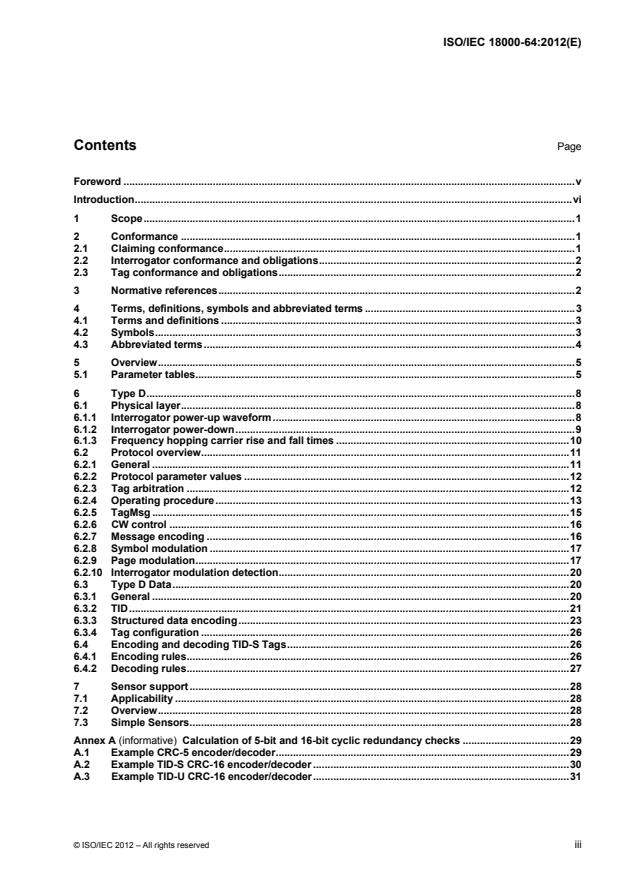
Contents Page
Foreword . v
Introduction . vi
1 Scope . 1
2 Conformance . 1
2.1 Claiming conformance . 1
2.2 Interrogator conformance and obligations . 2
2.3 Tag conformance and obligations . 2
3 Normative references . 2
4 Terms, definitions, symbols and abbreviated terms . 3
4.1 Terms and definitions . 3
4.2 Symbols . 3
4.3 Abbreviated terms . 4
5 Overview . 5
5.1 Parameter tables . 5
6 Type D . 8
6.1 Physical layer . 8
6.1.1 Interrogator power-up waveform . 8
6.1.2 Interrogator power-down . 9
6.1.3 Frequency hopping carrier rise and fall times . 10
6.2 Protocol overview . 11
6.2.1 General . 11
6.2.2 Protocol parameter values . 12
6.2.3 Tag arbitration . 12
6.2.4 Operating procedure . 13
6.2.5 TagMsg . 15
6.2.6 CW control . 16
6.2.7 Message encoding . 16
6.2.8 Symbol modulation . 17
6.2.9 Page modulation . 17
6.2.10 Interrogator modulation detection . 20
6.3 Type D Data . 20
6.3.1 General . 20
6.3.2 TID . 21
6.3.3 Structured data encoding . 23
6.3.4 Tag configuration . 26
6.4 Encoding and decoding TID-S Tags . 26
6.4.1 Encoding rules . 26
6.4.2 Decoding rules . 27
7 Sensor support . 28
7.1 Applicability . 28
7.2 Overview . 28
7.3 Simple Sensors . 28
Annex A (informative) Calculation of 5-bit and 16-bit cyclic redundancy checks . 29
A.1 Example CRC-5 encoder/decoder . 29
A.2 Example TID-S CRC-16 encoder/decoder . 30
A.3 Example TID-U CRC-16 encoder/decoder . 31
© ISO/IEC 2012 – All rights reserved iii
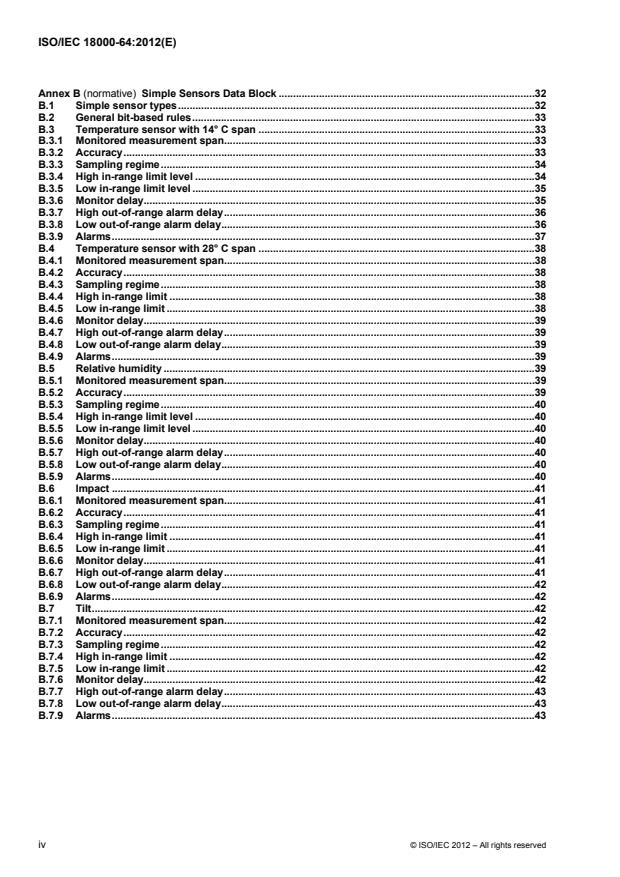
Annex B (normative) Simple Sensors Data Block .32
B.1 Simple sensor types .32
B.2 General bit-based rules .33
B.3 Temperature sensor with 14° C span .33
B.3.1 Monitored measurement span .33
B.3.2 Accuracy .33
B.3.3 Sampling regime .34
B.3.4 High in-range limit level .34
B.3.5 Low in-range limit level .35
B.3.6 Monitor delay .35
B.3.7 High out-of-range alarm delay .36
B.3.8 Low out-of-range alarm delay .36
B.3.9 Alarms .37
B.4 Temperature sensor with 28° C span .38
B.4.1 Monitored measurement span .38
B.4.2 Accuracy .38
B.4.3 Sampling regime .38
B.4.4 High in-range limit .38
B.4.5 Low in-range limit .38
B.4.6 Monitor delay .39
B.4.7 High out-of-range alarm delay .39
B.4.8 Low out-of-range alarm delay .39
B.4.9 Alarms .39
B.5 Relative humidity .39
B.5.1 Monitored measurement span .39
B.5.2 Accuracy .39
B.5.3 Sampling regime .40
B.5.4 High in-range limit level .40
B.5.5 Low in-range limit level .40
B.5.6 Monitor delay .40
B.5.7 High out-of-range alarm delay .40
B.5.8 Low out-of-range alarm delay .40
B.5.9 Alarms .40
B.6 Impact .41
B.6.1 Monitored measurement span .41
B.6.2 Accuracy .41
B.6.3 Sampling regime .41
B.6.4 High in-range limit .41
B.6.5 Low in-range limit .41
B.6.6 Monitor delay .41
B.6.7 High out-of-range alarm delay .41
B.6.8 Low out-of-range alarm delay .42
B.6.9 Alarms .42
B.7 Tilt .42
B.7.1 Monitored measurement span .42
B.7.2 Accuracy .42
B.7.3 Sampling regime .42
B.7.4 High in-range limit .42
B.7.5 Low in-range limit .42
B.7.6 Monitor delay .42
B.7.7 High out-of-range alarm delay .43
B.7.8 Low out-of-range alarm delay .43
B.7.9 Alarms .43
iv © ISO/IEC 2012 – All rights reserved
Foreword
ISO (the International Organization for Standardization) and IEC (the International Electrotechnical
Commission) form the specialized system for worldwide standardization. National bodies that are members of
ISO or IEC participate in the development of International Standards through technical committees
established by the respective organization to deal with particular fields of technical activity. ISO and IEC
technical committees collaborate in fields of mutual interest. Other international organizations, governmental
and non-governmental, in liaison with ISO and IEC, also take part in the work. In the field of information
technology, ISO and IEC have established a joint technical committee, ISO/IEC JTC 1.
International Standards are drafted in accordance with the rules given in the ISO/IEC Directives, Part 2.
The main task of the joint technical committee is to prepare International Standards. Draft International
Standards adopted by the joint technical committee are circulated to national bodies for voting. Publication as
an International Standard requires approval by at least 75 % of the national bodies casting a vote.
ISO/IEC 18000-64 was prepared by Joint Technical Committee ISO/IEC JTC 1, Information technology,
Subcommittee SC 31, Automatic identification and data capture techniques.
ISO/IEC 18000 consists of the following parts, under the general title Information technology — Radio
frequency identification for item management:
Part 1: Reference architecture and definition of parameters to be standardized
Part 2: Parameters for air interface communications below 135 kHz
Part 3: Parameters for air interface communications at 13,56 MHz
Part 4: Parameters for air interface communications at 2,45 GHz
Part 6: Parameters for air interface communications at 860 MHz to 960 MHz General
Part 61: Parameters for air interface communications at 860 MHz to 960 MHz Type A
Part 62: Parameters for air interface communications at 860 MHz to 960 MHz Type B
Part 63: Parameters for air interface communications at 860 MHz to 960 MHz Type C
Part 64: Parameters for air interface communications at 860 MHz to 960 MHz Type D
Part 7: Parameters for active air interface communications at 433 MHz
© ISO/IEC 2012 – All rights reserved v
Introduction
This part of ISO/IEC 18000 describes a passive backscatter radio frequency identification (RFID) system that
supports the following system capabilities:
identification and communication with multiple tags in the field;
reading from individual tags;
data integrity protection;
tag-to-Interrogator communications link with error detection;
support for both passive back-scatter tags with or without batteries.
This part of ISO/IEC 18000 specifies the physical and logical requirements for a passive-backscatter, RFID
system operating in the 860 MHz to 960 MHz frequency range. The system comprises Interrogators, also
known as readers, and tags, also known as labels.
An Interrogator transmits a continuous-wave (CW) RF signal in the 860 MHz to 960 MHz frequency range.
The tag receives operating energy from this RF signal and responds by modulating the reflection coefficient of
its antenna, thereby backscattering an information signal to the Interrogator. Passive tags are those which
receive all of their operating energy from the Interrogator's RF waveform. If tags maintain a battery then they
may operate using some passive principles; however, they do not necessarily get all their operating energy
from the Interrogator's RF waveform.
This part of ISO/IEC 18000 contains an optional Tag Only Talks After Listening (TOTAL), an enhanced Tag
Talks Only (TTO) technique. A Type D tag shall announce itself when it detects CW emitted by an Interrogator,
only after it has detected the absence of ITF modulation as defined in ISO/IEC 18000 part 6. Type D uses
Pulse-Position Encoding (PPE) or Miller encoding in the return link and does not define a dedicated forward
link. Tags may implement a forward link of one of the types defined in ISO/IEC 18000 part 6 in order to allow
enhanced tag access techniques.
The International Organization for Standardization (ISO) and International Electrotechnical Commission (IEC)
draw attention to the fact that it is claimed that compliance with this document may involve the use of patents
concerning radio frequency identification technology.
ISO and IEC take no position concerning the evidence, validity and scope of these patent rights.
The holders of these patent rights have assured ISO and IEC that they are willing to negotiate licences under
reasonable and non-discriminatory terms and conditions with applicants throughout the world. In this respect,
the statements of the holders of these patent rights are registered with ISO and IEC.
vi © ISO/IEC 2012 – All rights reserved
Information on the declared patents may be obtained from:
Contact details
Patent Holder Contact for license application
Legal Name: CISC Semiconductor Name & Department: Dr. Markus Pistauer,
Design+Consulting GmbH CEO
Address: Lakeside B07, 9020 Klagenfurt,
Austria
Tel.: +43 463 508 808
Fax: +43 463 508 808
E-mail: m.pistauer@cisc.at
URL (optional): www.cisc.at
Patent Holder Contact for license application
Legal Name: Impinj, Inc. Name & Department: Chris Diorio, CTO
Address: 701 N 34th St Suite 300, Seattle,
WA 98103, USA
Tel.: +1 206 834 1115
Fax: +1 206 517 5262
E-mail: diorio@impinj.com
URL (optional): www.impinj.com
Patent Holder Contact for license application
Legal Name: IPICO South Africa (Pty) Ltd. Name & Department: Marius van Dyk,
Technical Director, CTO
Address: Scientia Techno Park, Building C,
Unit 20
Tel.: +27 (12) 349 7620 x 212
Fax: +27 (12) 349 1118
E-mail: marius.van.dyk@ipico.com
URL (optional): www.ipico.com
Attention is drawn to the possibility that some of the elements of this document may be the subject of patent
rights other than those identified above. ISO and IEC shall not be held responsible for identifying any or all
such patent rights.
© ISO/IEC 2012 – All rights reserved vii
The latest information on IP that may be applicable to this part of ISO/IEC 18000 can be found at
www.iso.org/patents
viii © ISO/IEC 2012 – All rights reserved
INTERNATIONAL STANDARD ISO/IEC 18000-64:2012(E)
Information technology — Radio frequency identification for
item management —
Part 64:
Parameters for air interface communications at 860 MHz to
960 MHz Type D
1 Scope
This part of ISO/IEC 18000 defines the air interface for radio frequency identification (RFID) devices operating
in the 860 MHz to 960 MHz Industrial, Scientific, and Medical (ISM) band used in item management
applications. It provides a common technical specification for RFID devices that can be used by ISO
committees developing RFID application standards. This part of ISO/IEC 18000 is intended to allow for
compatibility and to encourage inter-operability of products for the growing RFID market in the international
marketplace. It defines the forward and return link parameters for technical attributes including, but not limited
to, operating frequency, operating channel accuracy, occupied channel bandwidth, maximum effective
isotropic radiated power (EIRP), spurious emissions, modulation, duty cycle, data coding, bit rate, bit rate
accuracy, bit transmission order, and, where appropriate, operating channels, frequency hop rate, hop
sequence, spreading sequence, and chip rate. It further defines the communications protocol used in the air
interface.
This part of ISO/IEC 18000 specifies the physical and logical requirements for a passive-backscatter, Tag
Only Talks After Listening (TOTAL) RFID system. The system comprises Interrogators, also known as readers,
and tags, also known as labels. An Interrogator receives information from a tag by transmitting a continuous-
wave (CW) RF signal to the tag; the tag responds by modulating the reflection coefficient of its antenna,
thereby backscattering an information signal to the Interrogator. The system is TOTAL, meaning that a tag
modulates its antenna reflection coefficient with an information signal upon entering an Interrogator's field
after first listening for Interrogator modulation in order to determine if the system is ITF or not.
In detail, this part of ISO/IEC 18000 contains Type D.
Type D is TOTAL based on Pulse Position Encoding or Miller M=2 encoded subcarrier.
This part of ISO/IEC 18000 specifies
physical interactions (the signalling layer of the communication link) between Interrogators and tags,
Interrogator and tag operating procedures,
the collision arbitration scheme used to identify a specific tag in a multiple-tag environment.
2 Conformance
2.1 Claiming conformance
To claim conformance with this part of ISO/IEC 18000, an Interrogator or tag shall comply with all relevant
clauses of this part of ISO/IEC 18000, except those marked as “optional”. The Interrogator or tag shall also
operate within local radio regulations, which can further restrict operation.
© ISO/IEC 2012 – All rights reserved 1
Relevant conformance test methods are provided in ISO/IEC TR 18047-6.
Conformance can also require a license from the owner of any intellectual property utilized by said device.
2.2 Interrogator conformance and obligations
To conform to this part of ISO/IEC 18000, an Interrogator shall
support Type D;
receive/demodulate a sufficient set of the electrical signals defined in the signalling layer of this part of
ISO/IEC 18000 to communicate with conformant tags; and
operate within the applicable local regulations.
To conform to this part of ISO/IEC 18000, an Interrogator may
implement one of the types defined in ISO/IEC 18000 part 6 or proprietary commands in order to allow
enhanced tag access techniques.
2.3 Tag conformance and obligations
To conform to this part of ISO/IEC 18000, a tag shall:
support Type D;
operate over the frequency range from 860 MHz to 960 MHz, inclusive;
modulate a backscatter signal only after listening for the absence of ITF modulation; and
conform to local radio regulations.
To conform to this part of ISO/IEC 18000, a tag may
implement one of the types defined ISO/IEC 18000 part 6 or proprietary commands in order to allow
enhanced tag access techniques.
To conform to this part of ISO/IEC 18000, a tag shall not:
modulate a backscatter signal before listening for the absence of ITF modulation as defined in ISO/IEC
18000 part 6.
3 Normative references
The following referenced documents are indispensable for the application of this document. For dated
references, only the edition cited applies. For undated references, the latest edition of the referenced
document (including any amendments) applies.
ISO/IEC 7816-6, ldentification cards — lntegrated circuit cards — Part 6: Interindustry data elements for
interchange
ISO/IEC 15961, Information technology — Radio frequency identification (RFID) for item management — Data
protocol: application interface
ISO/IEC 15962, Information technology — Radio frequency identification (RFID) for item management — Data
protocol: data encoding rules and logical memory functions
2 © ISO/IEC 2012 – All rights reserved
ISO/IEC 15963, Information technology — Radio frequency identification for item management — Unique
identification for RF tags
ISO/IEC 18000-1, Information technology — Radio frequency identification for item management — Part 1:
Reference architecture and definition of parameters to be standardized
ISO/IEC 19762 (all parts), Information technology — Automatic identification and data capture (AIDC)
techniques — Harmonized vocabulary
EPCglobal Tag Data Standards version 1.5 and above, EPCglobal Inc.
4 Terms, definitions, symbols and abbreviated terms
4.1 Terms and definitions
For the purposes of this document, the terms and definitions given in ISO/IEC 19762 (all parts) and the
following apply.
4.1.1
collision arbitration
algorithm used to prepare for and handle a dialogue between an Interrogator and a tag
4.1.2
physical layer
data coding and modulation waveforms used in Interrogator-to-tag and tag-to-Interrogator signalling
4.1.3
battery assistance
battery support for radio frequency communication
4.1.4
battery assisted mode
working mode of battery-assisted tags with non-empty battery
4.1.5
passive mode
working mode of passive tags or battery assisted tags with battery drained below a manufacturer-specific
threshold
4.1.6
Simple Sensors
sensors that are factory programmed and not user configurable, producing a single output observation such
as a fail/pass condition or simple measurement of a particular sensor activity
4.1.7
Simple Sensor functionality
functionality whereby sensors provide a valid Simple Sensor data address and transmit Simple Sensor data
subsequent to the UII as part of the reply to the ACK command (Type C) or as part of the TagMsg (Type D)
4.2 Symbols
BAP battery assisted passive
BLF backscatter-link frequency
Cht carrier high-level tolerance
© ISO/IEC 2012 – All rights reserved 3
Clt carrier low-level tolerance
Tcf carrier fall time
Tcr carrier rise time
Tfhf carrier FHSS fall time
Tfhr carrier FHSS rise time
Tfhs carrier FHSS steady time
UII unique item identifier
xxxx binary notation
xxxx hexadecimal notation
h
4.3 Abbreviated terms
AFI application family identifier
BAP battery assisted passive
CRC cyclic redundancy check
CRC-16 sixteen bit CRC
CRC-5 five bit CRC
CW continuous wave
DSFID data storage format identifier
DSSS direct sequence spread spectrum
EPC™ electronic product code
FCC Federal Communications Commission
FHSS frequency hopping spread spectrum
ITF Interrogator-talks-first
NOTE The common usage is RTF (Reader-talks-first) but the more precise term is ITF, which is
used throughout this part of ISO/IEC 18000.
LSB least significant bit
MSB most significant bit
PPE pulse position encoding
RFU reserved for future use
SDT symbol detect time
SS Simple Sensor
SSD simple sensor data
TID tag-identification or tag identifier, depending on context
TOTAL tag only talks after listening
TTF tag talks first
TTO tag talks only
Word 16 bits
4 © ISO/IEC 2012 – All rights reserved
5 Overview
5.1 Parameter tables
Table 1, Table 2, Table 3 and Table 4 contain the parameters for Type D in accordance with ISO/IEC 18000-1.
Detailed description of the operating modes and parameters are specified in the subsequent clauses.
Table 1 — Interrogator to tag link parameters
Ref. Parameter Name Description
860 MHz – 960 MHz, as required by the local
Int:1 Operating Frequency Range
regulations
In accordance with the local radio regulations.
Int:1a Default Operating Frequency
Operating Channels
In accordance with the local radio regulations.
Int:1b
(spread-spectrum systems)
Int:1c Operating Frequency Accuracy In accordance with the local radio regulations.
Frequency Hop Rate
In accordance with the local radio regulations.
Int:1d
(frequency-hopping [FHSS] systems)
Frequency Hop Sequence
Int:1e In accordance with the local radio regulations.
(frequency-hopping [FHSS] systems)
Int:2 Occupied Channel Bandwidth In accordance with the local regulations
Int:2a Minimum Receiver Bandwidth In accordance with the local regulations
Interrogator Transmit Maximum
Int:3 In accordance with the local regulations
EIRP
Interrogator Transmit Spurious
Int:4 In accordance with the local radio regulations.
Emissions
Interrogator Transmit Spurious
Int:4a Emissions, In-Band (spread- Not applicable.
spectrum systems)
Interrogator Transmit Spurious
In accordance with the local radio regulations.
Int:4b
Emissions, Out-of-Band
Interrogator Transmitter Spectrum
Int:5 Not applicable.
Mask
Int:6 Timing Not applicable.
Transmit-to-Receive Turn-Around
Int:6a Not applicable.
Time
Receive-to-Transmit Turn-Around
Int:6b Not applicable.
Time
Dwell Time or Interrogator Transmit
Int:6c 1500 µs, maximum settling time
Power-On Ramp
Decay Time or Interrogator Transmit
Int:6d Not applicable.
Power-Down Ramp
Int:7 Modulation Not applicable.
Spreading Sequence
Int:7a Not applicable.
(direct-sequence [DSSS] systems)
Chip Rate
Int:7b Not applicable.
(spread-spectrum systems)
Chip Rate Accuracy
Int:7c Not applicable.
(spread-spectrum systems)
Int:7d Modulation Depth Not applicable.
© ISO/IEC 2012 – All rights reserved 5
Ref. Parameter Name Description
Int:7e Duty Cycle Not applicable.
Int:7f FM Deviation Not applicable.
Int:8 Data Coding Not applicable.
Int:9 Bit Rate Not applicable.
Int:9a Bit Rate Accuracy Not applicable.
Interrogator Transmit Modulation
Int:10 Not applicable.
Accuracy
Int:11 Preamble Not applicable.
Int:11a Preamble Length Not applicable.
Int:11b Preamble Waveform(s) Not applicable.
Int:11c Bit Sync Sequence Not applicable.
Int:11d Frame Sync Sequence Not applicable.
Scrambling (spread-spectrum
Int:12 Not applicable.
systems)
Int:13 Bit Transmission Order Not applicable.
Int:14 Wake-up process Not applicable.
Int:15 Polarization Not applicable.
Table 2 — Tag to Interrogator link parameters
Ref. Parameter Name Description
Tag:1 Operating Frequency Range 860 MHz – 960 MHz, inclusive
The tag shall respond to an Interrogator signal
Tag:1a Default Operating Frequency
within the frequency range specified in Tag: 1.
Operating Channels The tag shall respond to an Interrogator signal
Tag:1b
within the frequency range specified in Tag: 1.
(spread-spectrum systems)
The tag shall respond to an Interrogator signal
Tag:1c Operating Frequency Accuracy
within the frequency range specified in Tag: 1.
Frequency Hop Rate
Tag:1d Not applicable.
(frequency-hopping [FHSS] systems)
Frequency Hop Sequence
Tag:1e Not applicable.
(frequency-hopping [FHSS] systems)
Tag:2 Occupied Channel Bandwidth In accordance with the local regulations
Tag:3 Transmit Maximum EIRP In accordance with the local regulations
Tag:4 Transmit Spurious Emissions In accordance with the local regulations
Transmit Spurious Emissions, In-
Tag:4a Band In accordance with the local regulations
(spread spectrum systems)
Transmit Spurious Emissions, Out-
Tag:4b In accordance with the local regulations
of-Band
Tag:5 Transmit Spectrum Mask In accordance with the local regulations
Transmit-to-Receive Turn-Around
Not applicable.
Tag:6a
Time
Receive-to-Transmit Turn-Around
Not applicable.
Tag:6b
Time
6 © ISO/IEC 2012 – All rights reserved
Ref. Parameter Name Description
Dwell Time or Transmit Power-On
Tag:6c Not applicable.
Ramp
Decay Time or Transmit Power-
Tag:6d Not applicable.
Down Ramp
Tag:7 Modulation ASK
Spreading Sequence
Tag:7a Not applicable.
(direct sequence [DSSS] systems)
Chip Rate
Tag:7b Not applicable.
(spread spectrum systems)
Chip Rate Accuracy
Tag:7c Not applicable.
(spread spectrum systems)
Tag:7d On-Off Ratio Not specified.
Tag:7e Subcarrier Frequency 512 kHz
Tag:7f Subcarrier Frequency Accuracy +/- 20%
Tag:7g Subcarrier Modulation Miller, at the data rate
Tag:7h Duty Cycle Random hold-off as specified
Tag:7i FM Deviation Not applicable.
Tag:8 Data Coding PPE or Miller (M=2)
Tag:9 Bit Rate 256 kbit/s
Tag:9a Bit Rate Accuracy +/- 20%
Tag Transmit Modulation Accuracy
Tag:10 Not applicable.
(frequency-hopping [FHSS] systems
Tag:11 Preamble Required
Tag:11a Preamble Length As specified
Tag:11b Preamble Waveform As specified
Tag:11c Bit-Sync Sequence None
Not applicable.
Tag:11d Frame-Sync Sequence
Scrambling
Tag:12 Not applicable.
(spread-spectrum systems)
Tag:13 Bit Transmission Order MSB is transmitted first
Tag:14 Reserved Deliberately left blank.
Tag:15 Polarization Tag dependent; not specified by this document
Tag:16 Minimum Tag Receiver Bandwidth Tag dependent; not specified by this document.
© ISO/IEC 2012 – All rights reserved 7
Table 3 — Protocol parameters
Ref. Parameter Name Description
P:1 Who talks first Tag after listening
P:2 Tag addressing capability As specified
P:3 Tag ID Contained in tag memory
Tag ID Length
P:3a 64 bits
P:3b Tag ID Format See clause 6.3.2
Not Applicable.
P:4 Read size
P:5 Write Size Not Applicable.
Not Applicable.
P:6 Read Transaction Time
P:7 Write Transaction Time Not Applicable.
Tag to Interrogator :
CRC-16 on TID
P:8 Error detection
Structured data uses 5 bit CRC with page
down counter.
P:9 Error correction None
P:10 Memory size Unlimited 64 bit pages
P:11 Command structure and extensibility Not Applicable.
Table 4 — Anti-collision parameters
Ref. Parameter Name Description
A:1 Type (Probabilistic or Deterministic) Probabilistic
Nearly linear up to 500 tags depending on
Linearity
A:2
anti-collision parameter.
Unlimited depending on anti-collision
A:3 Tag inventory capacity
parameter.
6 Type D
6.1 Physical layer
6.1.1 Interrogator power-up waveform
The Interrogator power-up waveform shall comply with the mask specified in Figure 1 and Table 5.
8 © ISO/IEC 2012 – All rights reserved
Figure 1 — Interrogator power-up waveform
Table 5 — Interrogator power-up waveform parameter values
Parameter Min Max
Tcs 1500µs
Tcr 1 µs 500 µs
Cht 10%
Clt 1%
6.1.2 Interrogator power-down
Once the carrier level has dropped below the ripple limit Cht, power down shall be monotonic and of duration
Tcf, as specified in Figure 2 and Table 6.
© ISO/IEC 2012 – All rights reserved 9
Figure 2 — Interrogator power-down waveform
Table 6 — Interrogator power-down timings
Parameter Min Max
Tcf 1 µs 500 µs
Cht 5% of steady state
(100 %) level
Clt 1 %
6.1.3 Frequency hopping carrier rise and fall times
When the Interrogator operates in the frequency operating hopping spread spectrum mode (FHSS), the carrier
rise and fall times shall conform to the characteristics specified in Figure 3 and Table 7. The Interrogator shall
complete a frequency hop in a time not exceeding 30 µs (to ensure that the tag is not reset by the frequency
hop). The frequency hop is measured from the beginning of Tfhf to the end of Tfhr.
NOTE Ripple is 5 % of 100 % of steady state level
Figure 3 — FHSS carrier rise and fall characteristics
10 © ISO/IEC 2012 – All rights reserved
Table 7 — FHSS carrier rise and fall parameters
Parameter Min Max
Tfhr 30 µs
Tfhs 400 µs
Tfhf 30 µs
6.2 Protocol overview
6.2.1 General
Type D uses a TOTAL air interface. TOTAL is a TTF air interface for RFID Tags and Interrogators which uses
propagating wave backscatter for Tag to Interrogator transmission. The system uses “random hold-off and
repeat” Tag transmissions for collision arbitration. A Tag only transmits after listening for Interrogator
modulation. A Tag shall always listen for Interrogator modulation when it is not transmitting. The Tag
suspends transmissions when it detects Interrogator modulation until or after a specified time not detecting
Interrogator modulation, unless it is able to decode and execute the Interrogator modulation. The normal use
of Type D is TTO. The Interrogator used in a Type D system is thus not required to transmit commands to one
or more Tags. There is no requirement for the Interrogator to modulate its carrier. Hence, Type D does not
specify a forward link. In order to write to or program a Tag, the Tag may implement a command decoder from
another type defined in ISO/IEC 18000 part 6. If implemented, it shall follow the command types and
command structure specified in the respective standard. Type D may be implemented with any combination of
Protocol Types as defined in ISO/IEC 18000 part 6 or proprietary commands.
A Tag may derive its operating power by one of two methods. Either as a passive Tag using a portion of the
incident energy which is rectified and smoothed to power the circuits or alternatively as a battery assisted
passive (BAP) Tag using an on board battery. In both cases the Tag shall use modulated backscatter to
transmit its message.
When a Tag enters the energizing field of an Interrogator and when the field is of adequate strength, the Tag
shall initiate a power-on routine internally and shall begin the TOTAL sequence.
When the energizing carrier is pure CW, then the Tag shall wait for a random hold-off time between
minimum_listen_time and maximum_hold-off_time and then at the end of the random hold-off time the Tag
shall backscatter its message. This sequence is repeated until the Tag detects modulations or the energizing
signal falls below an adequate field strength. A low duty cycle of random distributed Tag transmission allows
for the Interrogator to detect multiple Tags.
When the Tag is not backscattering a message and for as long as it is powered up, it shall listen continuously
for modulation on the energizing carrier. If at any time the energised Tag detects modulation during listening,
then it shall suspend the transmission sequence and perform the following action:
If the Tag is able to process the transmission, it shall do so and return to its random backoff and
repeat sequence while listening.
If the Interrogator transmission is not directed at the specific Tag; the Tag shall remain suspended till
it leaves the energizing field or after not detecting further modulation for a specified period of time.
A Tag message (TagMsg) shall consist of the TID, optional data pages and an optional Simple Sensor data
page.
The TagMsg shall be transmitted in pages of fixed size of page_data_bits. The number of user data
pages and the sensor page to be transmitted in the Tag message shall be configured in the Tag.
The TID shall be permanently programmed at the time of manufacture of the chip.
© ISO/IEC 2012 – All rights reserved 11
User memory may be written and optionally locked by a user. An Interrogator usually writes to a Tag over the
air; however there is nothing to preclude the writing of Tags by contact means.
6.2.2 Protocol parameter values
Table 8 provides a summary of the Type D protocol parameters.
Table 8 — Type D protocol parameters
Parameter Value Description
st
minimum_listen_time 5 ms for 1 hold-off (Rt ) Minimum time to detect ITF modulation
symbol_detect_time for
subsequent hold-offs (Rt )
n
symbol_detect_time 125 µs
maximum_hold-off_time ≥ 30 ms This value controls the arbitration time for a Type D Tag. This
time may be configured in the Tag, but shall never be less than
30ms.
TOTAL_data_rate 256 kbit/s sub_carrier_freq/2 kb/s
sub_carrier_freq 512 kHz For both PPE and Miller M=2
freq_tolerance ± 20% freq_tolerance applies to all timing parameters, i.e.
minimum_listen_time, symbol_detect_time, maximum_hold-
off_time, TOTAL_data_rate, sub_carrier_freq,
TOTAL_Wakeup_timeout
page_separation 8 symbols between pages
page_data_bits 64 bits The amount of data bits in a page
TOTAL_Wa
...
Questions, Comments and Discussion
Ask us and Technical Secretary will try to provide an answer. You can facilitate discussion about the standard in here.
Loading comments...