


ISO 9556:2025
(Main)Steel and iron — Determination of total carbon content — Infrared absorption method after combustion in an induction furnace
Steel and iron — Determination of total carbon content — Infrared absorption method after combustion in an induction furnace
This document specifies an infrared absorption method after combustion in an induction furnace for the determination of the total carbon content in steel and iron. The method is applicable to carbon contents between 0,003 % (mass fraction) and 4,5 % (mass fraction).
Aciers et fontes — Détermination du carbone total — Méthode par absorption dans l'infrarouge après combustion dans un four à induction
Le présent document spécifie une méthode par absorption dans l'infrarouge après combustion dans un four à induction pour la détermination du carbone total dans les aciers et les fontes. La méthode est applicable aux teneurs en carbone comprises entre 0,003 % (en masse) et 4,5 % (en masse).
General Information
- Status
- Published
- Publication Date
- 07-Jul-2025
- Technical Committee
- ISO/TC 17/SC 1 - Methods of determination of chemical composition
- Drafting Committee
- ISO/TC 17/SC 1 - Methods of determination of chemical composition
- Current Stage
- 6060 - International Standard published
- Start Date
- 08-Jul-2025
- Due Date
- 19-Oct-2025
- Completion Date
- 08-Jul-2025
Relations
- Effective Date
- 12-Feb-2026
- Effective Date
- 28-Oct-2023
- Effective Date
- 21-Oct-2023
Overview
ISO 9556:2025 specifies an infrared absorption method after combustion in a high‑frequency induction furnace for the determination of the total carbon content in steel and iron. The method covers carbon contents from 0.003 % to 4.5 % (mass fraction). It replaces the 1989 edition and updates normative references, adds a mandatory terms clause and recalculates precision data. The standard is produced by ISO/TC 17 in cooperation with CEN.
Key topics and technical requirements
- Principle: Combustion of a weighed test portion in pure oxygen in an induction furnace; carbon converted to CO and/or CO2 and quantified by infrared (IR) absorption.
- Scope of measurement: 0.003 % to 4.5 % total carbon.
- Calibration: Establishment of calibration curves for defined carbon ranges (clauses 8.5.1–8.5.4) to ensure accuracy across low to high carbon contents.
- Sampling & sample preparation: Follow ISO 14284 or applicable national standards; degreasing and drying of test portions.
- Test portion mass: Approximately 1 g for carbon < 1.0 % and ≈0.5 g for carbon > 1.0 % (instrument-dependent).
- Blank tests: Performed in duplicate; blank mean and difference shall not exceed 0.01 mg of carbon (clause 8.3).
- Reagents & gases: Use analytical‑grade reagents and oxygen ≥ 99.5 % (vol.); specified standard solutions (sucrose or sodium carbonate) for calibration.
- Apparatus: High‑frequency induction furnace combined with an IR carbon analyser; volumetric glassware per ISO 648/ISO 1042. See Annex C for commercial instrument features.
- Safety: Warnings about burn hazards, oxygen handling, and apparatus stabilization/cleaning procedures.
Applications and users
ISO 9556:2025 is intended for:
- Metallurgical and materials testing laboratories performing carbon analysis of steels and irons.
- Quality control and production laboratories in steel mills, foundries and heat‑treating facilities.
- R&D and failure‑analysis groups needing reliable total carbon measurement by combustion/IR.
- Instrument manufacturers and calibration laboratories that supply or validate induction furnace–IR carbon analysers. Practical uses include process control, material certification, compliance testing and verification of alloy composition.
Related standards
- ISO 14284 - Sampling and preparation of samples for chemical composition analysis.
- ISO 648 / ISO 1042 - Laboratory glassware requirements.
- Annexes in ISO 9556:2025 provide precision data (A, B) and equipment features (C).
Keywords: ISO 9556:2025, total carbon content, infrared absorption method, induction furnace, steel and iron, carbon analysis, combustion analysis, calibration curve, precision data.
Buy Documents


ISO 9556:2025 - Steel and iron — Determination of total carbon content — Infrared absorption method after combustion in an induction furnace Released:8. 07. 2025

ISO 9556:2025 - Aciers et fontes — Détermination du carbone total — Méthode par absorption dans l'infrarouge apres combustion dans un four a induction Released:8. 07. 2025
Get Certified
Connect with accredited certification bodies for this standard

Element Materials Technology
Materials testing and product certification.

Inštitut za kovinske materiale in tehnologije
Institute of Metals and Technology. Materials testing, metallurgical analysis, NDT.
Sponsored listings
Frequently Asked Questions
ISO 9556:2025 is a standard published by the International Organization for Standardization (ISO). Its full title is "Steel and iron — Determination of total carbon content — Infrared absorption method after combustion in an induction furnace". This standard covers: This document specifies an infrared absorption method after combustion in an induction furnace for the determination of the total carbon content in steel and iron. The method is applicable to carbon contents between 0,003 % (mass fraction) and 4,5 % (mass fraction).
This document specifies an infrared absorption method after combustion in an induction furnace for the determination of the total carbon content in steel and iron. The method is applicable to carbon contents between 0,003 % (mass fraction) and 4,5 % (mass fraction).
ISO 9556:2025 is classified under the following ICS (International Classification for Standards) categories: 77.080.01 - Ferrous metals in general. The ICS classification helps identify the subject area and facilitates finding related standards.
ISO 9556:2025 has the following relationships with other standards: It is inter standard links to EN ISO 9556:2025, ISO 8611-1:2021, ISO 9556:1989. Understanding these relationships helps ensure you are using the most current and applicable version of the standard.
ISO 9556:2025 is available in PDF format for immediate download after purchase. The document can be added to your cart and obtained through the secure checkout process. Digital delivery ensures instant access to the complete standard document.
Standards Content (Sample)
International
Standard
ISO 9556
Second edition
Steel and iron — Determination
2025-07
of total carbon content —
Infrared absorption method after
combustion in an induction furnace
Aciers et fontes — Détermination du carbone total — Méthode
par absorption dans l'infrarouge après combustion dans un four
à induction
Reference number
© ISO 2025
All rights reserved. Unless otherwise specified, or required in the context of its implementation, no part of this publication may
be reproduced or utilized otherwise in any form or by any means, electronic or mechanical, including photocopying, or posting on
the internet or an intranet, without prior written permission. Permission can be requested from either ISO at the address below
or ISO’s member body in the country of the requester.
ISO copyright office
CP 401 • Ch. de Blandonnet 8
CH-1214 Vernier, Geneva
Phone: +41 22 749 01 11
Email: copyright@iso.org
Website: www.iso.org
Published in Switzerland
ii
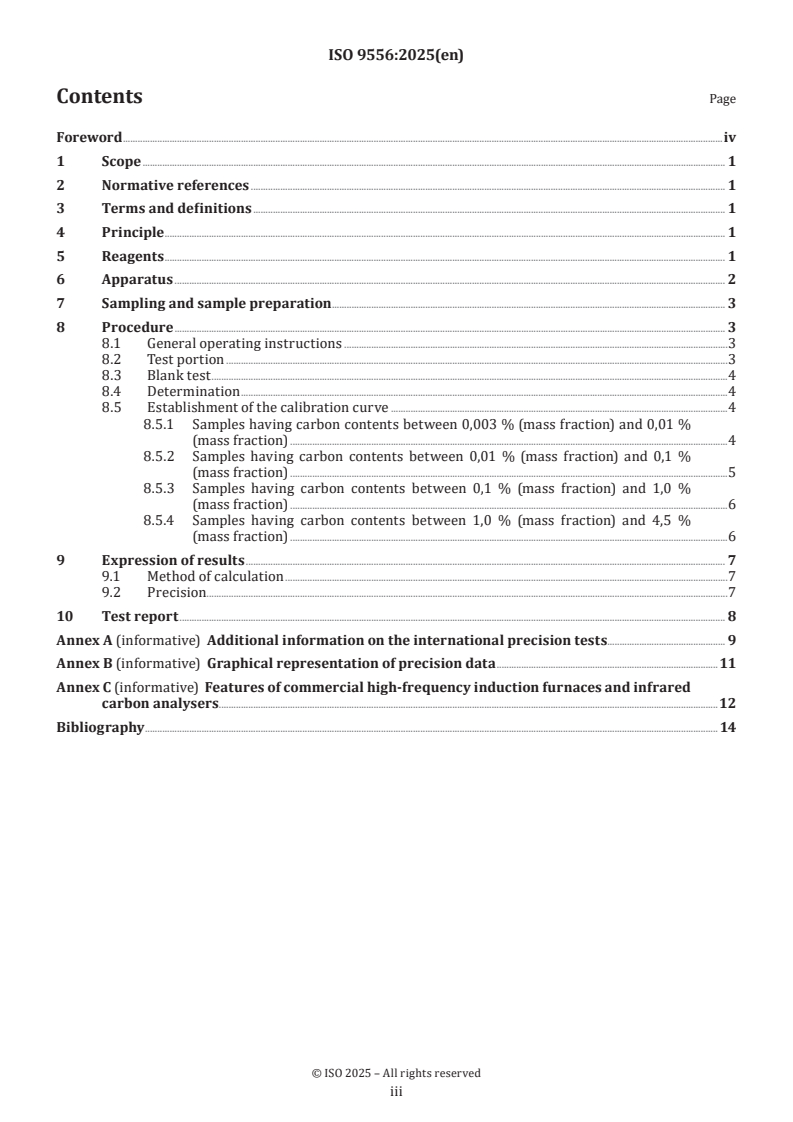
Contents Page
Foreword .iv
1 Scope . 1
2 Normative references . 1
3 Terms and definitions . 1
4 Principle . 1
5 Reagents . 1
6 Apparatus . 2
7 Sampling and sample preparation . 3
8 Procedure . 3
8.1 General operating instructions .3
8.2 Test portion .3
8.3 Blank test .4
8.4 Determination .4
8.5 Establishment of the calibration curve .4
8.5.1 Samples having carbon contents between 0,003 % (mass fraction) and 0,01 %
(mass fraction) .4
8.5.2 Samples having carbon contents between 0,01 % (mass fraction) and 0,1 %
(mass fraction) .5
8.5.3 Samples having carbon contents between 0,1 % (mass fraction) and 1,0 %
(mass fraction) .6
8.5.4 Samples having carbon contents between 1,0 % (mass fraction) and 4,5 %
(mass fraction) .6
9 Expression of results . 7
9.1 Method of calculation .7
9.2 Precision . . .7
10 Test report . 8
Annex A (informative) Additional information on the international precision tests. 9
Annex B (informative) Graphical representation of precision data .11
Annex C (informative) Features of commercial high-frequency induction furnaces and infrared
carbon analysers . . .12
Bibliography . 14
iii
Foreword
ISO (the International Organization for Standardization) is a worldwide federation of national standards
bodies (ISO member bodies). The work of preparing International Standards is normally carried out through
ISO technical committees. Each member body interested in a subject for which a technical committee
has been established has the right to be represented on that committee. International organizations,
governmental and non-governmental, in liaison with ISO, also take part in the work. ISO collaborates closely
with the International Electrotechnical Commission (IEC) on all matters of electrotechnical standardization.
The procedures used to develop this document and those intended for its further maintenance are described
in the ISO/IEC Directives, Part 1. In particular, the different approval criteria needed for the different types
of ISO document should be noted. This document was drafted in accordance with the editorial rules of the
ISO/IEC Directives, Part 2 (see www.iso.org/directives).
ISO draws attention to the possibility that the implementation of this document may involve the use of (a)
patent(s). ISO takes no position concerning the evidence, validity or applicability of any claimed patent
rights in respect thereof. As of the date of publication of this document, ISO had not received notice of (a)
patent(s) which may be required to implement this document. However, implementers are cautioned that
this may not represent the latest information, which may be obtained from the patent database available at
www.iso.org/patents. ISO shall not be held responsible for identifying any or all such patent rights.
Any trade name used in this document is information given for the convenience of users and does not
constitute an endorsement.
For an explanation of the voluntary nature of standards, the meaning of ISO specific terms and expressions
related to conformity assessment, as well as information about ISO's adherence to the World Trade
Organization (WTO) principles in the Technical Barriers to Trade (TBT), see www.iso.org/iso/foreword.html.
This document was prepared by Technical Committee ISO/TC 17, Steel, Subcommittee SC 1, Methods of
determination of chemical composition, in collaboration with the European Committee for Standardization
(CEN) Technical Committee CEN/TC 459/SC 2, Methods of chemical analysis for iron and steel, in accordance
with the Agreement on technical cooperation between ISO and CEN (Vienna Agreement).
This second edition cancels and replaces the first edition (ISO 9556:1989), which has been technically
revised.
The main changes are as follows:
— the normative references (Clause 2) has been revised;
— the mandatory terms and definitions clause (Clause 3) has been added, and subsequent clauses have
been renumbered;
— precision data have been recalculated.
Any feedback or questions on this document should be directed to the user’s national standards body. A
complete listing of these bodies can be found at www.iso.org/members.html.
iv
International Standard ISO 9556:2025(en)
Steel and iron — Determination of total carbon content
— Infrared absorption method after combustion in an
induction furnace
1 Scope
This document specifies an infrared absorption method after combustion in an induction furnace for the
determination of the total carbon content in steel and iron.
The method is applicable to carbon contents between 0,003 % (mass fraction) and 4,5 % (mass fraction).
2 Normative references
The following documents are referred to in the text in such a way that some or all of their content constitutes
requirements of this document. For dated references, only the edition cited applies. For undated references,
the latest edition of the referenced document (including any amendments) applies.
ISO 648, Laboratory glassware — Single-volume pipettes
ISO 1042, Laboratory glassware — One-mark volumetric flasks
ISO 14284, Steel and iron — Sampling and preparation of samples for the determination of chemical composition
3 Terms and definitions
No terms and definitions are listed in this document.
ISO and IEC maintain terminology databases for use in standardization at the following addresses:
— ISO Online browsing platform: available at https:// www .iso .org/ obp
— IEC Electropedia: available at https:// www .electropedia .org/
4 Principle
Combustion of a test portion in presence of an accelerator at a high temperature in a high-frequency
induction furnace in a current of pure oxygen. Transformation of carbon into carbon dioxide and/or carbon
monoxide.
Measurement by infrared absorption of the carbon dioxide and/or carbon monoxide carried by a current
of oxygen.
5 Reagents
During the analysis, unless otherwise stated, use only reagents of recognized analytical grade and only
distilled water or water of equivalent purity.
5.1 Water, free from carbon dioxide.
Boil water for 30 min, cool to room temperature and bubble with oxygen (5.2) for 15 min. Prepare just before use.
5.2 Oxygen, 99,5 % (volume fraction) minimum.
An oxidation catalyst [copper(II) oxide or platinum] tube heated to a temperature above 450 °C shall be used
prior to a purifying unit (see Annex C), when the presence of organic contaminants is suspected in the oxygen.
5.3 Pure iron, of known low carbon content less than 0,001 0 % (mass fraction).
5.4 Solvent, appropriate for cleaning greasy or dirty test samples, for example, acetone.
5.5 Magnesium perchlorate [Mg(ClO ) ], particle size: from 0,7 mm to 1,2 mm.
4 2
5.6 Barium carbonate
Dry barium carbonate (minimum purity: 99,5 %) at 105 °C to 110 °C for 3 h and cool in a desiccator before use.
5.7 Sodium carbonate
Dry anhydrous sodium carbonate (minimum purity: 99,9 %) at 285 °C for 2 h and cool in a desiccator before use.
5.8 Accelerator: copper, tungsten-tin mixture or tungsten of known low carbon content less than
0,001 0 % (mass fraction).
5.9 Sucrose, standard solution, corresponding to 25 g of carbon per litre.
Weigh, to the nearest 1 mg, 14,843 g of sucrose (C H O ) previously dried at 100 °C to 105 °C for 2,5 h and
12 22 11
cooled in a desiccator.
Dissolve in about 100 ml of water (5.1), transfer quantitatively into a 250 ml one-mark volumetric flask,
dilute to the mark with water (5.1) and mix.
1 ml of this standard solution contains 25 mg of carbon.
5.10 Sodium carbonate, standard solution, corresponding to 25 g of carbon per litre.
Weigh, to the nearest 1 mg, 55,152 g of sodium carbonate (5.7), dissolve in about 200 ml of water (5.1),
transfer quantitatively into a 250 ml one-mark volumetric flask, dilute to the mark with water (5.1) and mix.
1 ml of this standard solution contains 25 mg of carbon.
5.11 Inert ceramic (attapulgus clay) impregnated with sodium hydroxide, particle size: from 0,7 mm
to 1,2 mm.
6 Apparatus
During the analysis, unless otherwise stated, use only ordinary laboratory apparatus.
All volumetric glassware shall be class A, in accordance with ISO 648 or ISO 1042, as appropriate.
The apparatus required for combustion in a high-frequency induction furnace and the subsequent
infrared absorption measurement of the evolved carbon dioxide and/or carbon monoxide may be obtained
commercially from a number of manufacturers. Follow the manufacturer’s instructions for the operation of
the instrument.
Features of commercial instruments are given in Annex C.
6.1 Micropipette, 100 μl, limit of error shall be less than 1 μl.
6.2 Tin capsule, about 6 mm in diameter, 18 mm in height, 0,3 g in mass and approximately 0,4 ml in
volume, of known low carbon content less than 0,001 0 % (mass fraction).
6.3 Ceramic crucible, capable of withstanding combustion in an induction furnace.
Ignite crucibles in an electric furnace in air or in a current of oxygen for not less than 2 h at 1 100 °C and
store in a desiccator before use.
For the determination of low carbon contents, it is advisable to ignite crucibles at 1 350 °C in a current of oxygen.
7 Sampling and sample preparation
The sampling and the sample preparation shall be carried out in accordance with ISO 14284 or appropriate
national standards for steel and iron.
8 Procedure
WARNING — The risks related to combustion analysis are mainly burns in pre-igniting the ceramic
crucibles and in the fusions. Use crucible tongs at all times and suitable containers for the used
crucibles. Normal precautions for handling oxygen cylinders shall be taken. Oxygen from the
combustion process shall be removed effectively from the apparatus since a high concentration of
oxygen in a confined space can present a fire hazard.
8.1 General operating instructions
Purify the oxygen supply using tubes packed with the inert ceramic (attapulgus clay) impregnated with
sodium hydroxide (5.11) and magnesium perchlorate (5.5), and maintain a quiescent flow rate whilst on
standby. Maintain a glass wool filter or a stainless steel net as a dust collector. Clean and change as necessary.
The furnace chamber, pedestal post and filter trap shall be cleaned frequently to remove oxide build-up.
Allow each item of the equipment to stabilize for the time recommended by the manufacturers of the
equipment when the main supply is switched on after being out of action for any length of time.
After cleaning the furnace chamber and/or changing filters or after the equipment has been inoperative for
a period, stabilize the apparatus by burning several samples of similar type to the samples to be analysed
prior to setting up for analysis.
Flush oxygen through the apparatus and adjust the instrument controls to give a zero reading.
If the instrument used provides a direct reading in percentage of carbon, adjust the instrument reading for
each calibration range as follows.
Select a certified reference material with a carbon content close to the maximum carbon content in the
calibration range, measure the carbon content of the certified reference material in the manner specified in 8.4.
Adjust the reading of the instrument to the certified value. This adjustment shall be carried out before the
calibration specified in 8.5. It cannot replace or correct the calibration.
8.2 Test portion
Degrease the test sample by cleaning in an appropriate solvent (5.4). Evaporate the last traces of the solvent
by heating.
Weigh, to the nearest 1 mg, approximately 1 g of the test sample for carbon contents less than 1,0 % (mass
fraction) and approximately 0,5 g for carbon contents higher than 1,0 % (mass fraction).
NOTE The mass of the test portion can depend on the type of instrument used.
8.3 Blank test
8.3.1 Prior to the determination, carry out the following blank tests in duplicate.
8.3.2 Transfer a tin capsule (6.2) into a ceramic crucible (6.3). In cas
...
Norme
internationale
ISO 9556
Deuxième édition
Aciers et fontes — Détermination
2025-07
du carbone total — Méthode par
absorption dans l'infrarouge
après combustion dans un four à
induction
Steel and iron — Determination of total carbon content —
Infrared absorption method after combustion in an induction
furnace
Numéro de référence
DOCUMENT PROTÉGÉ PAR COPYRIGHT
© ISO 2025
Tous droits réservés. Sauf prescription différente ou nécessité dans le contexte de sa mise en œuvre, aucune partie de cette
publication ne peut être reproduite ni utilisée sous quelque forme que ce soit et par aucun procédé, électronique ou mécanique,
y compris la photocopie, ou la diffusion sur l’internet ou sur un intranet, sans autorisation écrite préalable. Une autorisation peut
être demandée à l’ISO à l’adresse ci-après ou au comité membre de l’ISO dans le pays du demandeur.
ISO copyright office
Case postale 401 • Ch. de Blandonnet 8
CH-1214 Vernier, Genève
Tél.: +41 22 749 01 11
E-mail: copyright@iso.org
Web: www.iso.org
Publié en Suisse
ii
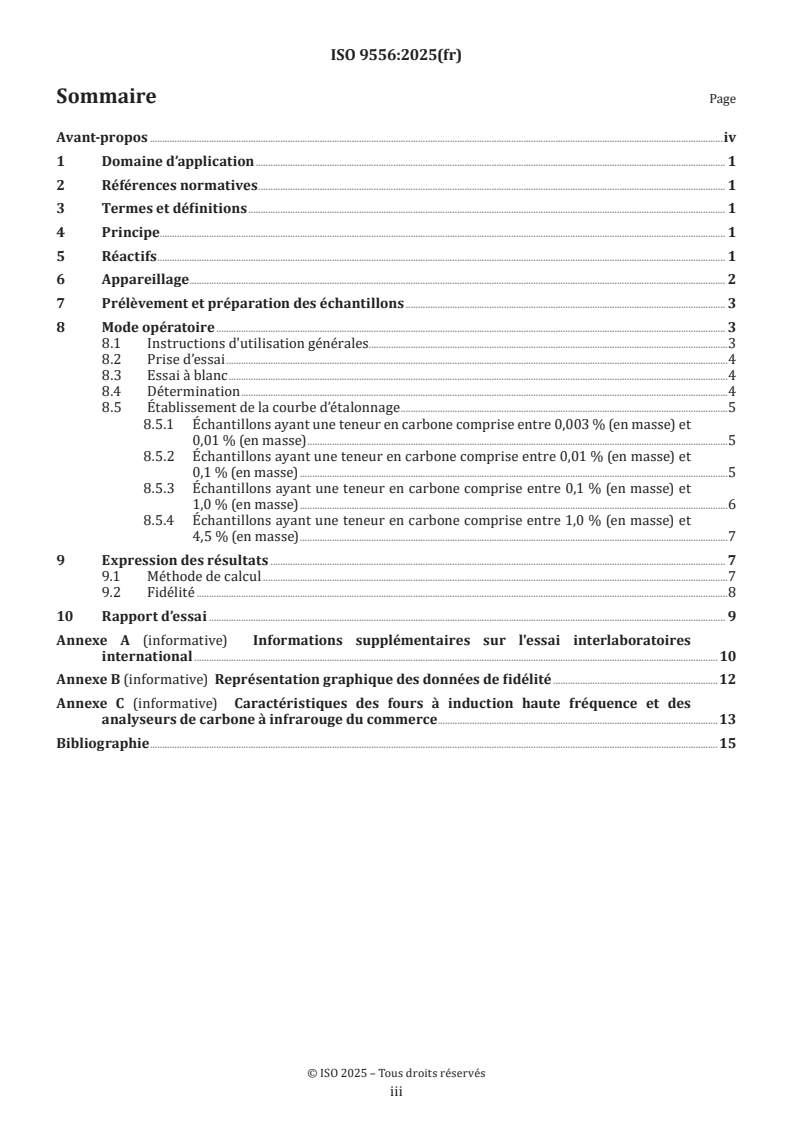
Sommaire Page
Avant-propos .iv
1 Domaine d’application . 1
2 Références normatives . 1
3 Termes et définitions . 1
4 Principe. 1
5 Réactifs . 1
6 Appareillage . 2
7 Prélèvement et préparation des échantillons . 3
8 Mode opératoire . 3
8.1 Instructions d'utilisation générales.3
8.2 Prise d’essai .4
8.3 Essai à blanc .4
8.4 Détermination .4
8.5 Établissement de la courbe d’étalonnage .5
8.5.1 Échantillons ayant une teneur en carbone comprise entre 0,003 % (en masse) et
0,01 % (en masse) .5
8.5.2 Échantillons ayant une teneur en carbone comprise entre 0,01 % (en masse) et
0,1 % (en masse) .5
8.5.3 Échantillons ayant une teneur en carbone comprise entre 0,1 % (en masse) et
1,0 % (en masse) .6
8.5.4 Échantillons ayant une teneur en carbone comprise entre 1,0 % (en masse) et
4,5 % (en masse) .7
9 Expression des résultats . 7
9.1 Méthode de calcul .7
9.2 Fidélité .8
10 Rapport d’essai . 9
Annexe A (informative) Informations supplémentaires sur l'essai interlaboratoires
international . 10
Annexe B (informative) Représentation graphique des données de fidélité .12
Annexe C (informative) Caractéristiques des fours à induction haute fréquence et des
analyseurs de carbone à infrarouge du commerce .13
Bibliographie .15
iii
Avant-propos
L'ISO (Organisation internationale de normalisation) est une fédération mondiale d'organismes nationaux
de normalisation (comités membres de l'ISO). L'élaboration des Normes internationales est en général
confiée aux comités techniques de l'ISO. Chaque comité membre intéressé par une étude a le droit de faire
partie du comité technique créé à cet effet. Les organisations internationales, gouvernementales et non
gouvernementales, en liaison avec l'ISO participent également aux travaux. L'ISO collabore étroitement avec
la Commission électrotechnique internationale (IEC) en ce qui concerne la normalisation électrotechnique.
Les procédures utilisées pour élaborer le présent document et celles destinées à sa mise à jour sont
décrites dans les Directives ISO/IEC, Partie 1. Il convient, en particulier, de prendre note des différents
critères d'approbation requis pour les différents types de documents ISO. Le présent document a
été rédigé conformément aux règles de rédaction données dans les Directives ISO/IEC, Partie 2 (voir
www.iso.org/directives).
L’ISO attire l’attention sur le fait que la mise en application du présent document peut entraîner l’utilisation
d’un ou de plusieurs brevets. L’ISO ne prend pas position quant à la preuve, à la validité et à l’applicabilité de
tout droit de propriété revendiqué à cet égard. À la date de publication du présent document, l’ISO n'avait pas
reçu notification qu’un ou plusieurs brevets pouvaient être nécessaires à sa mise en application. Toutefois,
il y a lieu d’avertir les responsables de la mise en application du présent document que des informations
plus récentes sont susceptibles de figurer dans la base de données de brevets, disponible à l'adresse
www.iso.org/brevets. L’ISO ne saurait être tenue pour responsable de ne pas avoir identifié tout ou partie de
tels droits de propriété.
Les appellations commerciales éventuellement mentionnées dans le présent document sont données pour
information, par souci de commodité, à l’intention des utilisateurs et ne sauraient constituer un engagement.
Pour une explication de la nature volontaire des normes, la signification des termes et expressions
spécifiques de l'ISO liés à l'évaluation de la conformité, ou pour toute information au sujet de l'adhésion de
l'ISO aux principes de l’Organisation mondiale du commerce (OMC) concernant les obstacles techniques au
commerce (OTC), voir www.iso.org/avant-propos.
Le présent document a été élaboré par le comité technique ISO/TC 17, Acier, sous-comité SC 1, Méthodes
de détermination de la composition chimique, en collaboration avec le Comité technique CEN/TC 459/SC 2,
Méthodes d'analyses chimiques pour le fer et l'acier, du Comité européen de normalisation (CEN) conformément
à l'Accord de coopération technique entre l'ISO et le CEN (Accord de Vienne).
Cette deuxième édition annule et remplace la première édition (ISO 9556:1989), qui a fait l’objet d’une
révision technique.
Les principales modifications par rapport à l’édition précédente sont les suivantes:
— révision des références normatives (Article 2);
— ajout de l’article “Termes et définitions” (Article 3), et rénumérotation des articles suivants;
— réévaluation des données de fidélité.
Il convient que l’utilisateur adresse tout retour d’information ou toute question concernant le présent
document à l’organisme national de normalisation de son pays. Une liste exhaustive desdits organismes se
trouve à l’adresse www.iso.org/members.html.
iv
Norme internationale ISO 9556:2025(fr)
Aciers et fontes — Détermination du carbone total —
Méthode par absorption dans l'infrarouge après combustion
dans un four à induction
1 Domaine d’application
Le présent document spécifie une méthode par absorption dans l'infrarouge après combustion dans un four
à induction pour la détermination du carbone total dans les aciers et les fontes.
La méthode est applicable aux teneurs en carbone comprises entre 0,003 % (en masse) et 4,5 % (en masse).
2 Références normatives
Les documents suivants sont cités dans le texte de sorte qu’ils constituent, pour tout ou partie de leur
contenu, des exigences du présent document. Pour les références datées, seule l’édition citée s’applique. Pour
les références non datées, la dernière édition du document de référence s'applique (y compris les éventuels
amendements.
ISO 648, Verrerie de laboratoire — Pipettes à un volume
ISO 1042, Verrerie de laboratoire — Fioles jaugées à un trait
ISO 14284, Aciers et fontes — Prélèvement et préparation des échantillons pour la détermination de la
composition chimique
3 Termes et définitions
Le présent document ne contient pas de liste de termes et définitions.
L'ISO et l'IEC tiennent à jour des bases de données terminologiques destinées à être utilisées en normalisation,
consultables aux adresses suivantes:
— ISO Online browsing platform: disponible à l'adresse https:// www .iso .org/ obp
— IEC Electropedia: disponible à l'adresse https:// www .electropedia .org/
4 Principe
Combustion d'une prise d'essai, en présence d'un accélérateur, sous un courant d'oxygène pur dans un four à
induction haute fréquence porté à haute température. Transformation du carbone en dioxyde de carbone et/
ou monoxyde de carbone.
Mesurage par absorption dans l'infrarouge du dioxyde de carbone et/ou monoxyde de carbone transporté(s)
par un courant d'oxygène.
5 Réactifs
Au cours de l'analyse, sauf indication contraire, utiliser uniquement des réactifs de qualité analytique
reconnue et de l'eau distillée ou de pureté équivalente.
5.1 Eau, exempte de dioxyde de carbone.
Faire bouillir de l'eau pendant 30 min, refroidir à température ambiante et faire barboter de l'oxygène (5.2)
pendant 15 min. Préparer juste avant l'emploi.
5.2 Oxygène, 99,5 % (volume) minimum.
Si l'on soupçonne l'oxygène de contenir des polluants organiques, on peut, avant de l'envoyer dans le
dispositif de purification (voir Annexe C), le faire passer dans un tube à catalyseur d'oxydation [oxyde de
cuivre(ll) ou platine] chauffé à une température supérieure à 450 °C.
5.3 Fer pur, à teneur en carbone faible et connue, inférieure à 0,001 0 % (en masse).
5.4 Solvant, approprié pour nettoyer les échantillons pour essai gras ou sales, par exemple, l'acétone.
5.5 Perchlorate de magnésium [Mg(ClO ) ], granulométrie comprise entre 0,7 mm et 1,2 mm.
4 2
5.6 Carbonate de baryum
Sécher le carbonate de baryum (pureté minimale: 99,5 %) à une température comprise entre 105 °C et
110 °C pendant 3 h et refroidir dans un dessiccateur avant l'emploi.
5.7 Carbonate de sodium
Sécher le carbonate de sodium anhydre (pureté minimale: 99,9 %) à 285 °C pendant 2 h et refroidir dans un
dessiccateur avant l'emploi.
5.8 Accélérateur: cuivre, mélange tungstène-étain ou tungstène à faible teneur en carbone connue,
inférieure à 0,001 0 % (en masse).
5.9 Saccharose, solution étalon, correspondant à 25 g de carbone par litre.
Peser, à 1 mg près, 14,843 g de saccharose (C H O ) préalablement séché à une température comprise
12 22 11
entre 100 °C et 105 °C pendant 2,5 h et refroidir dans un dessiccateur.
Dissoudre dans 100 ml d'eau environ (5.1), transvaser quantitativement dans une fiole jaugée de 250 ml,
diluer au volume avec de l'eau (5.1) et homogénéiser.
1 ml de cette solution étalon contient 25 mg de carbone.
5.10 Carbonate de sodium, solution étalon, correspondant à 25 g de carbone par litre.
Peser, à 1 mg près, 55,152 g de carbonate de sodium (5.7), dissoudre dans 200 ml d'eau environ (5.1),
transvaser quantitativement dans une fiole jaugée de 250 ml, diluer au volume avec de l'eau (5.1) et
homogénéiser.
1 ml de cette solution étalon contient 25 mg de carbone.
5.11 Céramique inerte (attapulgite), imprégnée d'hydroxyde de sodium, granulométrie comprise entre
0,7 mm et 1,2 mm.
6 Appareillage
Au cours de l'analyse, sauf indication contraire, utiliser du matériel courant de laboratoire.
Toute la verrerie jaugée doit être de classe A, conformément à l'ISO 648 ou l'ISO 1042, selon le cas.
L'appareillage requis pour la combustion est un four à induction haute fréquence, et le dispositif de
mesurage de l'absorption dans l'infrarouge du dioxyde de carbone et/ou du monoxyde de carbone peut être
commercialisé par un certain nombre de fabricants. Pour les instructions d'utilisation, suivre les directives
du fabricant.
Les caractéristiques des appareils commercialisés sont données dans l’Annexe C.
6.1 Micropipette, 100 μl, la limite d'erreur doit être inférieure à 1 μl.
6.2 Capsule en étain, diamètre 6 mm environ, hauteur 18 mm, masse 0,3 g et volume 0,4 ml environ, à
faible teneur en carbone connue, inférieure à 0,001 0 % (en masse).
6.3 Creuset en céramique, pouvant être soumis à la combustion dans un four à induction.
Calciner les creusets dans un four électrique, dans l'air ou sous un courant d'oxygène pendant au moins 2 h à
1 100 °C et conserver dans un dessiccateur avant l'emploi.
Pour déterminer les faibles teneurs en carbone, il est conseillé de calciner les creusets à 1 350 °C sous un
courant d'oxygène.
7 Prélèvement et préparation des échantillons
Le prélèvement et la préparation des échantillons doivent être effectués conformément à l’ISO 14284 ou
conformément aux normes nationales applicables pour les aciers et les fontes.
8 Mode opératoire
AVERTISSEMENT — Les risques relatifs aux analyses avec combustion sont principalement des
risques de brûlure lors de la pré-calcination des creusets en céramique et lors des fusions. Utiliser
toujours des pinces à creuset et des récipients appropriés pour les creusets usagés. Prendre
les précautions normales pour manipuler les bouteilles à oxygène. L'oxygène utilisé lors de la
combustion doit être éliminé efficacement de l'appareillage, car une concentration élevée d'oxygène
dans un espace confiné peut présenter des risques d'incendie.
8.1 Instructions d'utilisation générales
Purifier l'alimentation en oxygène en faisant circuler ce gaz dans deux tubes garnis, l'un d'attapulgite
imprégnée d'hydroxyde de sodium (5.11) et l'autre de perchlorate de magnésium (5.5), et maintenir un débit
suffisant entre deux analyses. Maintenir propre un filtre en laine de verre ou une grille en acier inoxydable
comme collecteur de poussières. Le nettoyer et le changer, si nécessaire. L'enceinte du four, la colonne
support et le piège du filtre doivent être nettoyés fréquemment pour empêcher les accumulations d'oxyde.
Après une coupure prolongée de l'alimentation électrique, laisser chaque pièce de l'appareil se stabiliser
pendant le temps recommandé par le fabricant.
Après un nettoyage du four et/ou un changement des filtres, ou lorsque l'appareil n'a pas fonctionné pendant
un certain temps, stabiliser l'appareillage en faisant brûler plusieurs échantillons analogues aux échantillons
à analyser avant de procéder aux déterminations.
Balayer l'appareillage par un courant d'oxygène et effectuer les réglages nécessaires à l'obtention du zéro.
Si l'appareil utilisé donne une lecture directe en pourcentage de la teneur en carbone, régler comme suit les
lectures de l'appareil pour chaque domaine d'étalonnage.
Choisir un matériau de référence certifié dont la teneur en carbone est proche de la teneur maximale en
carbone du domaine d'étalonnage; mesurer la teneur en carbone du matériau de référence certifié de la
manière spécifiée en 8.4.
Régler la lecture relevée sur l'instrument sur la valeur certifiée. Ce réglage doit être effectué avant
l'étalonnage spécifié en 8.5. Il ne peut pas remplacer ou corriger l'étalonnage.
8.2 Prise d’essai
Dégraisser les échantillons pour essai par nettoyage dans un solvant approprié (5.4). Évaporer en chauffant
pour éliminer les dernières traces du solvant.
Peser, à 1 mg près, environ 1 g d'échantillon pour essai pour les teneurs en carbone inférieures à 1,0 % (en
masse) et environ 0,5 g pour les teneurs en carbone supérieures à 1,0 % (en masse).
NOTE La masse de la prise d'essai peut dépendre du type d'appareil utilisé.
8.3 Essai à blanc
8.3.1 Avant la détermination, effectuer les essais à blanc suivants en double.
8.3.2 Placer une capsule en étain (6.2) dans un creuset en céramique (6.3). Dans le cas où les courbes
d'étalonnage 8.5.1 ou 8.5.2 s'appliquent, préparer la capsule en étain comme suit: à l'aide de la micropipette
(6.1), introduire 100 μl d’eau (5.1) dans la capsule en étain (6.2) et sécher à 90 °C pendant 2 h.
8.3.3 Presser légère
...
Questions, Comments and Discussion
Ask us and Technical Secretary will try to provide an answer. You can facilitate discussion about the standard in here.
Loading comments...