


ISO/IEC 17960:2015
(Main)Information technology — Programming languages, their environments and system software interfaces — Code signing for source code
Information technology — Programming languages, their environments and system software interfaces — Code signing for source code
This International Standard specifies a language-neutral and environment-neutral description to define the methodology needed to support the signing of software source code, to enable it to be uniquely identified, and to enable roll-back to signed previous versions. It is intended to be used by originators of software source code and the recipients of their signed source code. This International Standard is designed for transfers of source code among disparate entities. The following areas are outside the scope of this International Standard: - Determination of the trust level of a certification authority; - Format used to track revisions of source code files; - Digital signing of object or binary code; - System configuration and resource availability; - Metadata - This is partially addressed by ISO/IEC 19770‑2; - Transmission and representation issues - Though this could be an issue in implementation, there are techniques such as Portable Document Format (PDF)[1] that can be used to mitigate these issues. This applies in particular to the transmission of digital signatures. [1] ISO 32000-1:2008 Document management ? Portable document format ? Part 1: PDF 1 specifies a digital form for representing electronic documents to enable users to exchange and view electronic documents independent of the environment in which they were created or the environment in which they are viewed or printed.
Technologies de l'information — Langages de programmation, leur environnement et interfaces des logiciels de systèmes — Signature numérique pour le code source
General Information
- Status
- Published
- Publication Date
- 16-Sep-2015
- Current Stage
- 9093 - International Standard confirmed
- Start Date
- 06-Mar-2026
- Completion Date
- 07-Mar-2026
Relations
- Consolidated By
ISO 13857:2019 - Safety of machinery — Safety distances to prevent hazard zones being reached by upper and lower limbs - Effective Date
- 06-Jun-2022
Overview
ISO/IEC 17960:2015 defines a language‑neutral, environment‑neutral methodology for signing software source code. The standard specifies how to apply digital signatures to source files (not binaries) so code can be uniquely identified, its integrity and origin verified, and rollback to signed previous versions enabled. It is aimed at originators of source code and recipients involved in transfers among disparate entities across the software supply chain.
Keywords: code signing, source code signing, digital signature, software supply chain, code integrity, rollback.
Key topics and technical requirements
- Purpose: provide integrity, authentication, accountability and non‑repudiation for source code through digital code signing.
- Scope limits: excludes determination of CA trust levels, revision‑format prescription, binary/object signing, system configuration, and most transmission/representation issues.
- Cryptographic building blocks:
- Use of hash functions (ISO/IEC 10118‑3 referenced) to produce hash codes for source content.
- Use of X.509 public key certificates (ISO/IEC 9594‑8) to bind public keys to originators.
- Digital signatures and non‑repudiation concepts (ISO/IEC 13888‑1).
- Required API capabilities (language/platform independent):
- Create hash code for source code.
- Generate a digital signature over snapshots or changesets.
- Initial signing of snapshots (complete copy).
- Signing of changesets (incremental changes).
- Record sufficient information in signed versions to recreate at least the immediate signed ancestor.
- Retrieve signed ancestor versions to enable roll‑back and provenance tracing.
- Features enabled:
- Multiple signatures per artifact to create an audit trail.
- Versioning information and metadata storage to identify responsible parties for code segments.
- Support for identifying what changed and who changed it (accountability for portions of code).
Applications and who uses it
ISO/IEC 17960 is practical for:
- Software authors, OEMs and open‑source maintainers wanting to protect source integrity.
- Security teams and supply‑chain managers implementing provenance and tamper detection.
- Auditors and compliance officers who need verifiable audit trails for source revisions.
- Tool and platform vendors building signing APIs, version control integrations, or repository services that must support signed source artifacts.
Benefits include stronger assurance in code provenance, reduced risk of supply‑chain tampering, and clearer accountability across distributed development teams.
Related standards
- ISO/IEC 9594‑8 (X.509 public‑key certificates)
- ISO/IEC 10118‑3 (hash functions)
- ISO/IEC 13888‑1 (non‑repudiation)
- ISO/IEC 19770‑2 (metadata for software identification - partial overlap)
- ISO 32000‑1 (PDF) - noted as a transmission/representation technique for signatures
This standard is a practical reference for organizations that need a standardized, interoperable approach to source code signing and provenance.
Buy Documents



ISO/IEC 17960:2015 - Information technology -- Programming languages, their environments and system software interfaces -- Code signing for source code
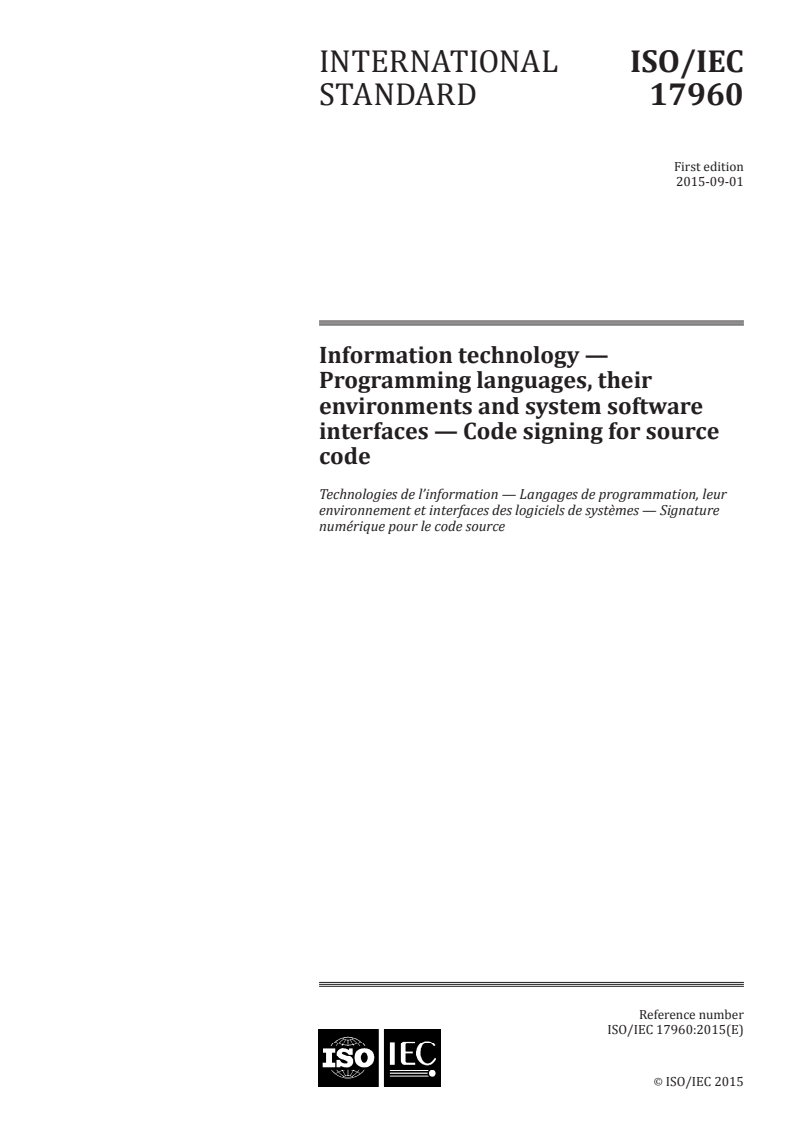

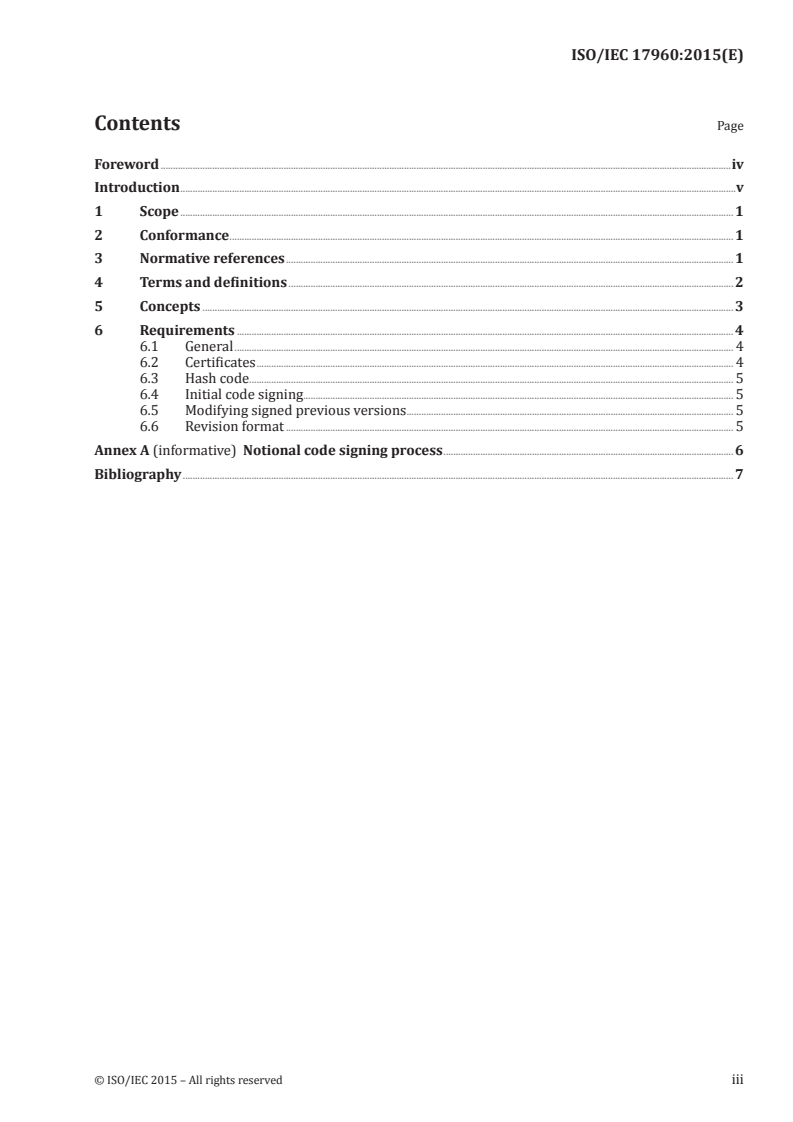
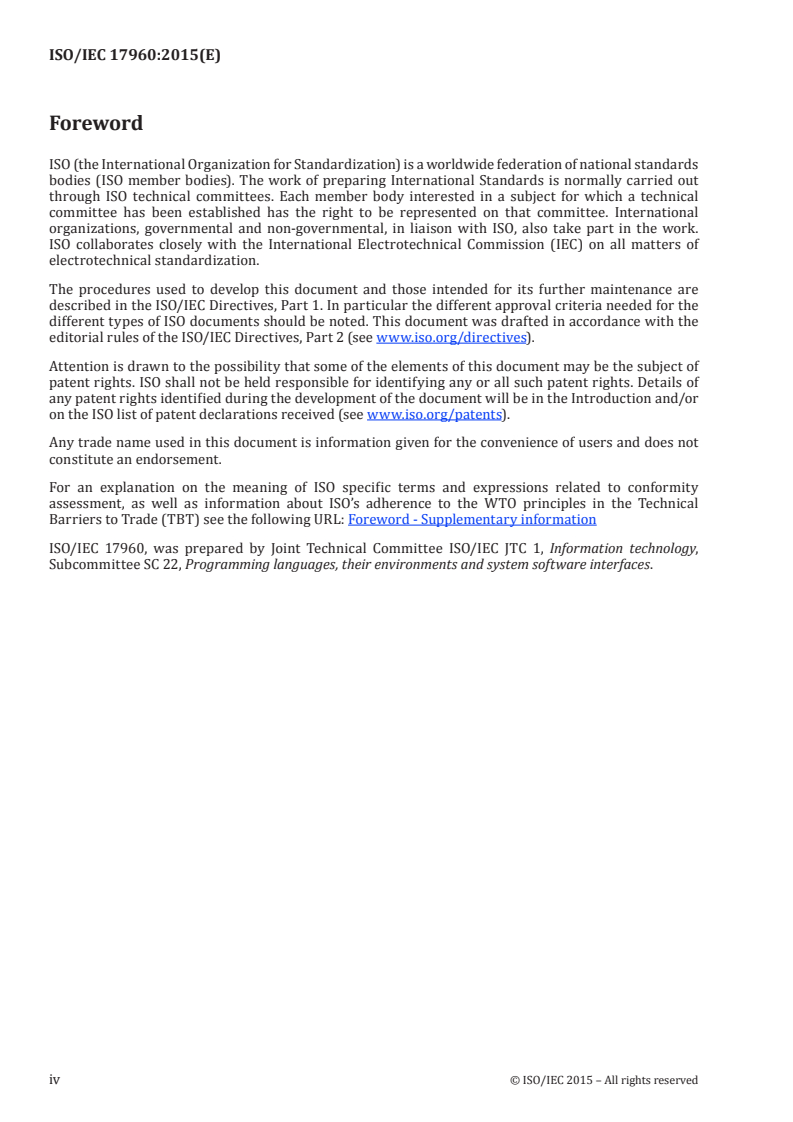
ISO/IEC 17960:2015 - Information technology — Programming languages, their environments and system software interfaces — Code signing for source code/17/2015
Get Certified
Connect with accredited certification bodies for this standard

BSI Group
BSI (British Standards Institution) is the business standards company that helps organizations make excellence a habit.

NYCE
Mexican standards and certification body.
Sponsored listings
Frequently Asked Questions
ISO/IEC 17960:2015 is a standard published by the International Organization for Standardization (ISO). Its full title is "Information technology — Programming languages, their environments and system software interfaces — Code signing for source code". This standard covers: This International Standard specifies a language-neutral and environment-neutral description to define the methodology needed to support the signing of software source code, to enable it to be uniquely identified, and to enable roll-back to signed previous versions. It is intended to be used by originators of software source code and the recipients of their signed source code. This International Standard is designed for transfers of source code among disparate entities. The following areas are outside the scope of this International Standard: - Determination of the trust level of a certification authority; - Format used to track revisions of source code files; - Digital signing of object or binary code; - System configuration and resource availability; - Metadata - This is partially addressed by ISO/IEC 19770‑2; - Transmission and representation issues - Though this could be an issue in implementation, there are techniques such as Portable Document Format (PDF)[1] that can be used to mitigate these issues. This applies in particular to the transmission of digital signatures. [1] ISO 32000-1:2008 Document management ? Portable document format ? Part 1: PDF 1 specifies a digital form for representing electronic documents to enable users to exchange and view electronic documents independent of the environment in which they were created or the environment in which they are viewed or printed.
This International Standard specifies a language-neutral and environment-neutral description to define the methodology needed to support the signing of software source code, to enable it to be uniquely identified, and to enable roll-back to signed previous versions. It is intended to be used by originators of software source code and the recipients of their signed source code. This International Standard is designed for transfers of source code among disparate entities. The following areas are outside the scope of this International Standard: - Determination of the trust level of a certification authority; - Format used to track revisions of source code files; - Digital signing of object or binary code; - System configuration and resource availability; - Metadata - This is partially addressed by ISO/IEC 19770‑2; - Transmission and representation issues - Though this could be an issue in implementation, there are techniques such as Portable Document Format (PDF)[1] that can be used to mitigate these issues. This applies in particular to the transmission of digital signatures. [1] ISO 32000-1:2008 Document management ? Portable document format ? Part 1: PDF 1 specifies a digital form for representing electronic documents to enable users to exchange and view electronic documents independent of the environment in which they were created or the environment in which they are viewed or printed.
ISO/IEC 17960:2015 is classified under the following ICS (International Classification for Standards) categories: 35.060 - Languages used in information technology. The ICS classification helps identify the subject area and facilitates finding related standards.
ISO/IEC 17960:2015 has the following relationships with other standards: It is inter standard links to ISO 13857:2019. Understanding these relationships helps ensure you are using the most current and applicable version of the standard.
ISO/IEC 17960:2015 is available in PDF format for immediate download after purchase. The document can be added to your cart and obtained through the secure checkout process. Digital delivery ensures instant access to the complete standard document.
Standards Content (Sample)
INTERNATIONAL ISO/IEC
STANDARD 17960
First edition
2015-09-01
Information technology —
Programming languages, their
environments and system software
interfaces — Code signing for source
code
Technologies de l’information — Langages de programmation, leur
environnement et interfaces des logiciels de systèmes — Signature
numérique pour le code source
Reference number
©
ISO/IEC 2015
© ISO/IEC 2015, Published in Switzerland
All rights reserved. Unless otherwise specified, no part of this publication may be reproduced or utilized otherwise in any form
or by any means, electronic or mechanical, including photocopying, or posting on the internet or an intranet, without prior
written permission. Permission can be requested from either ISO at the address below or ISO’s member body in the country of
the requester.
ISO copyright office
Ch. de Blandonnet 8 • CP 401
CH-1214 Vernier, Geneva, Switzerland
Tel. +41 22 749 01 11
Fax +41 22 749 09 47
copyright@iso.org
www.iso.org
ii © ISO/IEC 2015 – All rights reserved
Contents Page
Foreword .iv
Introduction .v
1 Scope . 1
2 Conformance . 1
3 Normative references . 1
4 Terms and definitions . 2
5 Concepts . 3
6 Requirements . 4
6.1 General . 4
6.2 Certificates . 4
6.3 Hash code. 5
6.4 Initial code signing. 5
6.5 Modifying signed previous versions . 5
6.6 Revision format . 5
Annex A (informative) Notional code signing process . 6
Bibliography . 7
© ISO/IEC 2015 – All rights reserved iii
Foreword
ISO (the International Organization for Standardization) is a worldwide federation of national standards
bodies (ISO member bodies). The work of preparing International Standards is normally carried out
through ISO technical committees. Each member body interested in a subject for which a technical
committee has been established has the right to be represented on that committee. International
organizations, governmental and non-governmental, in liaison with ISO, also take part in the work.
ISO collaborates closely with the International Electrotechnical Commission (IEC) on all matters of
electrotechnical standardization.
The procedures used to develop this document and those intended for its further maintenance are
described in the ISO/IEC Directives, Part 1. In particular the different approval criteria needed for the
different types of ISO documents should be noted. This document was drafted in accordance with the
editorial rules of the ISO/IEC Directives, Part 2 (see www.iso.org/directives).
Attention is drawn to the possibility that some of the elements of this document may be the subject of
patent rights. ISO shall not be held responsible for identifying any or all such patent rights. Details of
any patent rights identified during the development of the document will be in the Introduction and/or
on the ISO list of patent declarations received (see www.iso.org/patents).
Any trade name used in this document is information given for the convenience of users and does not
constitute an endorsement.
For an explanation on the meaning of ISO specific terms and expressions related to conformity
assessment, as well as information about ISO’s adherence to the WTO principles in the Technical
Barriers to Trade (TBT) see the following URL: Foreword - Supplementary information
ISO/IEC 17960, was prepared by Joint Technical Committee ISO/IEC JTC 1, Information technology,
Subcommittee SC 22, Programming languages, their environments and system software interfaces.
iv © ISO/IEC 2015 – All rights reserved
Introduction
Source code is written and is used in many critical applications. Knowing that the source code being
relied upon is the same as that which was used in testing is vital to ensuring the safety and security
of a particular application. Given the ease with which source code can be modified, some method of
protecting the integrity and authenticity of the source code is necessary. Sequestration of the source
code throughout the supply chain is one possible method, but ensuring protection in that way is
impractical and unreliable. Virtual protection through the use of a digital signature offers a practical
solution and provides integrity and authentication even though the source code may traverse an
insecure supply chain.
Source code may be modified for legitimate reasons as it moves through the supply chain or over time.
Modifications to source code may be made to correct the software or to adapt it for other purposes.
Modifications may only involve changes to a few lines of code and in most cases is not made by the
original author or team of authors. Revision control software facilitates tracking of the software
changes, but such tracking can easily be spoofed. The use of a digital signature provides a means to
restrict the ability to spoof. Digital code signing assigns a responsible party to each revision of the
source code and thus can demonstrate the authenticity of the responsible party, the source code and
the software changes that have been made between revisions. By doing this, an electronic pedigree for
the source code can be established.
This standard specifies the process for signing source code in order to ensure the integrity and
authenticity of the source code and a means for rolling back the source code to signed previous versions.
Clause 5 provides an overview of the concepts of code signing. Conformance requirements for this
standard are specified in Clause 6. Annex A is informative and provides a step by step description of a
typical application for the standard specified in Clause 6 to assist in understanding code signing. The
bibliography lists documents that were referenced during preparation of this standard.
© ISO/IEC 2015 – All rights reserved v
INTERNATIONAL STANDARD ISO/IEC 17960:2015(E)
Information technology — Programming languages, their
environments and system software interfaces — Code
signing for source code
1 Scope
This International Standard specifies a language-neutral and environment-neutral description to define
the methodology needed to support the signing of software source code, to enable it to be uniquely
identified, and to enable roll-back to signed previous versions. It is intended to be used by originators
of software source code and the recipients of their signed source code. This International Standard is
designed for transfers of source code among disparate entities.
The following areas are outside the scope of this International Standard:
— Determination of the trust level of a certification authority;
— Format used to track revisions of source code files;
— Digital signing of object or binary code;
— System configuration and resource availability;
— Metadata
— This is partially addressed by ISO/IEC 19770-2;
— Transmission and representation issues
— Though this could be an issue in implementation, there are techniques such as Portable
1)
Document Format (PDF) that can be used to mitigate these issues. This applies in particular
to the transmission of digital signatures.
2 Conformance
An implementation of code signing conforms to this International Standard if it meets the requirements
specified in Clause 6.
3 Normative references
The following documents, in whole or in part, are normatively referenced in this standard and are
indispensable for its application. For dated references, only the edition cited applies. For undated
references, the latest edition of the referenced document (including any amendments) applies.
ISO/IEC 9594-8:2014, Information technology — Open Systems Interconnection — The Directory — Part
2)
8: Public-key and attribute certificate frameworks
ISO/IEC 10118-3:2004, Information technology — Security techniques — Hash-functions — Part 3:
Dedicated hash functions
1) ISO 32000-1:2008 Document management — Portable document format — Part 1: PDF 1 specifies a digital form
for representing electronic documents to enable users to exchange and view electronic documents independent of
the environment in which they were created or the environment in which they are viewed or printed.
2) This is equivalent to ITU-T Recommendation X.509: 2005, “Information Technology —Open Systems
Interconnection — The Directory: Public-Key and attribute certificate frameworks”
© ISO/IEC 2015 – All rights reserved 1
ISO/IEC 13888-1:2009, Information technology — Security techniques — Non-repudiation — Part 1:
General
4 Terms and definitions
For the purposes of this document, the following terms and definitions apply.
4.1
certificate
entity’s data rendered unforgeable with the private or secret key of a certification authority
[SOURCE: ISO/IEC 13888-1:2009]
4.2
certification authority
authority trusted by one or more users to create and assign certificates
[SOURCE: ISO/IEC 13888-1:2009]
4.3
changeset
set of all changes that are applied to a configuration to derive a new configuration
4.4
digital signature
data appended to, or a cryptographic transformation of, a data unit that allows the recipient of the data
unit to prove the source and integrity of the data unit and protect against forgery, e.g. by the recipient
[SOURCE: ISO/IEC 13888-1:2009]
4.5
hash code
string of bits that is the output of a hash-function
[SOURCE: ISO/IEC 13888-1:2009]
4.6
hash-function
function which maps strings of bits to fixed-length strings of bits, satisfying the following two
properties: 1) it is computationally infeasible to find for a given output an input which maps to this
output; 2) it is computationally infeasible to find for a given input a second input which maps to the
same output
...
INTERNATIONAL ISO/IEC
STANDARD 17960
First edition
2015-09-01
Information technology —
Programming languages, their
environments and system software
interfaces — Code signing for source
code
Technologies de l’information — Langages de programmation, leur
environnement et interfaces des logiciels de systèmes — Signature
numérique pour le code source
Reference number
©
ISO/IEC 2015
© ISO/IEC 2015, Published in Switzerland
All rights reserved. Unless otherwise specified, no part of this publication may be reproduced or utilized otherwise in any form
or by any means, electronic or mechanical, including photocopying, or posting on the internet or an intranet, without prior
written permission. Permission can be requested from either ISO at the address below or ISO’s member body in the country of
the requester.
ISO copyright office
Ch. de Blandonnet 8 • CP 401
CH-1214 Vernier, Geneva, Switzerland
Tel. +41 22 749 01 11
Fax +41 22 749 09 47
copyright@iso.org
www.iso.org
ii © ISO/IEC 2015 – All rights reserved
Contents Page
Foreword .iv
Introduction .v
1 Scope . 1
2 Conformance . 1
3 Normative references . 1
4 Terms and definitions . 2
5 Concepts . 3
6 Requirements . 4
6.1 General . 4
6.2 Certificates . 4
6.3 Hash code. 5
6.4 Initial code signing. 5
6.5 Modifying signed previous versions . 5
6.6 Revision format . 5
Annex A (informative) Notional code signing process . 6
Bibliography . 7
© ISO/IEC 2015 – All rights reserved iii
Foreword
ISO (the International Organization for Standardization) is a worldwide federation of national standards
bodies (ISO member bodies). The work of preparing International Standards is normally carried out
through ISO technical committees. Each member body interested in a subject for which a technical
committee has been established has the right to be represented on that committee. International
organizations, governmental and non-governmental, in liaison with ISO, also take part in the work.
ISO collaborates closely with the International Electrotechnical Commission (IEC) on all matters of
electrotechnical standardization.
The procedures used to develop this document and those intended for its further maintenance are
described in the ISO/IEC Directives, Part 1. In particular the different approval criteria needed for the
different types of ISO documents should be noted. This document was drafted in accordance with the
editorial rules of the ISO/IEC Directives, Part 2 (see www.iso.org/directives).
Attention is drawn to the possibility that some of the elements of this document may be the subject of
patent rights. ISO shall not be held responsible for identifying any or all such patent rights. Details of
any patent rights identified during the development of the document will be in the Introduction and/or
on the ISO list of patent declarations received (see www.iso.org/patents).
Any trade name used in this document is information given for the convenience of users and does not
constitute an endorsement.
For an explanation on the meaning of ISO specific terms and expressions related to conformity
assessment, as well as information about ISO’s adherence to the WTO principles in the Technical
Barriers to Trade (TBT) see the following URL: Foreword - Supplementary information
ISO/IEC 17960, was prepared by Joint Technical Committee ISO/IEC JTC 1, Information technology,
Subcommittee SC 22, Programming languages, their environments and system software interfaces.
iv © ISO/IEC 2015 – All rights reserved
Introduction
Source code is written and is used in many critical applications. Knowing that the source code being
relied upon is the same as that which was used in testing is vital to ensuring the safety and security
of a particular application. Given the ease with which source code can be modified, some method of
protecting the integrity and authenticity of the source code is necessary. Sequestration of the source
code throughout the supply chain is one possible method, but ensuring protection in that way is
impractical and unreliable. Virtual protection through the use of a digital signature offers a practical
solution and provides integrity and authentication even though the source code may traverse an
insecure supply chain.
Source code may be modified for legitimate reasons as it moves through the supply chain or over time.
Modifications to source code may be made to correct the software or to adapt it for other purposes.
Modifications may only involve changes to a few lines of code and in most cases is not made by the
original author or team of authors. Revision control software facilitates tracking of the software
changes, but such tracking can easily be spoofed. The use of a digital signature provides a means to
restrict the ability to spoof. Digital code signing assigns a responsible party to each revision of the
source code and thus can demonstrate the authenticity of the responsible party, the source code and
the software changes that have been made between revisions. By doing this, an electronic pedigree for
the source code can be established.
This standard specifies the process for signing source code in order to ensure the integrity and
authenticity of the source code and a means for rolling back the source code to signed previous versions.
Clause 5 provides an overview of the concepts of code signing. Conformance requirements for this
standard are specified in Clause 6. Annex A is informative and provides a step by step description of a
typical application for the standard specified in Clause 6 to assist in understanding code signing. The
bibliography lists documents that were referenced during preparation of this standard.
© ISO/IEC 2015 – All rights reserved v
INTERNATIONAL STANDARD ISO/IEC 17960:2015(E)
Information technology — Programming languages, their
environments and system software interfaces — Code
signing for source code
1 Scope
This International Standard specifies a language-neutral and environment-neutral description to define
the methodology needed to support the signing of software source code, to enable it to be uniquely
identified, and to enable roll-back to signed previous versions. It is intended to be used by originators
of software source code and the recipients of their signed source code. This International Standard is
designed for transfers of source code among disparate entities.
The following areas are outside the scope of this International Standard:
— Determination of the trust level of a certification authority;
— Format used to track revisions of source code files;
— Digital signing of object or binary code;
— System configuration and resource availability;
— Metadata
— This is partially addressed by ISO/IEC 19770-2;
— Transmission and representation issues
— Though this could be an issue in implementation, there are techniques such as Portable
1)
Document Format (PDF) that can be used to mitigate these issues. This applies in particular
to the transmission of digital signatures.
2 Conformance
An implementation of code signing conforms to this International Standard if it meets the requirements
specified in Clause 6.
3 Normative references
The following documents, in whole or in part, are normatively referenced in this standard and are
indispensable for its application. For dated references, only the edition cited applies. For undated
references, the latest edition of the referenced document (including any amendments) applies.
ISO/IEC 9594-8:2014, Information technology — Open Systems Interconnection — The Directory — Part
2)
8: Public-key and attribute certificate frameworks
ISO/IEC 10118-3:2004, Information technology — Security techniques — Hash-functions — Part 3:
Dedicated hash functions
1) ISO 32000-1:2008 Document management — Portable document format — Part 1: PDF 1 specifies a digital form
for representing electronic documents to enable users to exchange and view electronic documents independent of
the environment in which they were created or the environment in which they are viewed or printed.
2) This is equivalent to ITU-T Recommendation X.509: 2005, “Information Technology —Open Systems
Interconnection — The Directory: Public-Key and attribute certificate frameworks”
© ISO/IEC 2015 – All rights reserved 1
ISO/IEC 13888-1:2009, Information technology — Security techniques — Non-repudiation — Part 1:
General
4 Terms and definitions
For the purposes of this document, the following terms and definitions apply.
4.1
certificate
entity’s data rendered unforgeable with the private or secret key of a certification authority
[SOURCE: ISO/IEC 13888-1:2009]
4.2
certification authority
authority trusted by one or more users to create and assign certificates
[SOURCE: ISO/IEC 13888-1:2009]
4.3
changeset
set of all changes that are applied to a configuration to derive a new configuration
4.4
digital signature
data appended to, or a cryptographic transformation of, a data unit that allows the recipient of the data
unit to prove the source and integrity of the data unit and protect against forgery, e.g. by the recipient
[SOURCE: ISO/IEC 13888-1:2009]
4.5
hash code
string of bits that is the output of a hash-function
[SOURCE: ISO/IEC 13888-1:2009]
4.6
hash-function
function which maps strings of bits to fixed-length strings of bits, satisfying the following two
properties: 1) it is computationally infeasible to find for a given output an input which maps to this
output; 2) it is computationally infeasible to find for a given input a second input which maps to the
same output
...
Questions, Comments and Discussion
Ask us and Technical Secretary will try to provide an answer. You can facilitate discussion about the standard in here.
Loading comments...