

ISO 8502-16:2026
(Main)Preparation of steel substrates before application of paints and related products — Tests for the assessment of surface cleanliness — Part 16: Extraction of water soluble contaminants for analysis, the saturated filter paper method
- Abstract
This document specifies a method of extracting and analysing water-soluble contaminants from a surface by use of filter paper which can be attached to any surface, regardless of its shape (flat or curved) and its orientation (facing in any direction, including downwards). The method described in this document is suitable for use in the field to determine the presence of water-soluble contaminants before painting or a similar treatment. NOTE The extraction method can give a false conductivity result or not take all the water-soluble material off the surface because of: (1) soluble materials hiding in the crevices or under folds of metal; (2) soluble materials under corrosion layers, passivation layers produced by corrosion inhibitors, oil, grease, or other non-visible thin films.
- Status
- Published
- Publication Date
- 03-Nov-2026
- Current Stage
- 6060 - International Standard published
- Start Date
- 04-Nov-2026
- Completion Date
- 04-Nov-2026
Buy Documents
ISO 8502-16:2026 - Preparation of steel substrates before application of paints and related products — Tests for the assessment of surface cleanliness — Part 16: Extraction of water soluble contaminants for analysis, the saturated filter paper method
ISO 8502-16:2026 is an International Standard from ISO for preparation of steel substrates before paints and related products. It specifies a saturated filter paper method for extracting and analysing water-soluble contaminants from steel surfaces before painting or a similar treatment. The method is intended for field use on flat or curved surfaces, in any orientation, including downward-facing surfaces.
What does ISO 8502-16:2026 specify?
ISO 8502-16:2026 specifies how to collect water-soluble contaminants from a steel surface with saturated filter paper and how to measure the extract by conductivity. It also sets out the apparatus, blank test, calculation of salt density, and the test report items that need to be recorded.
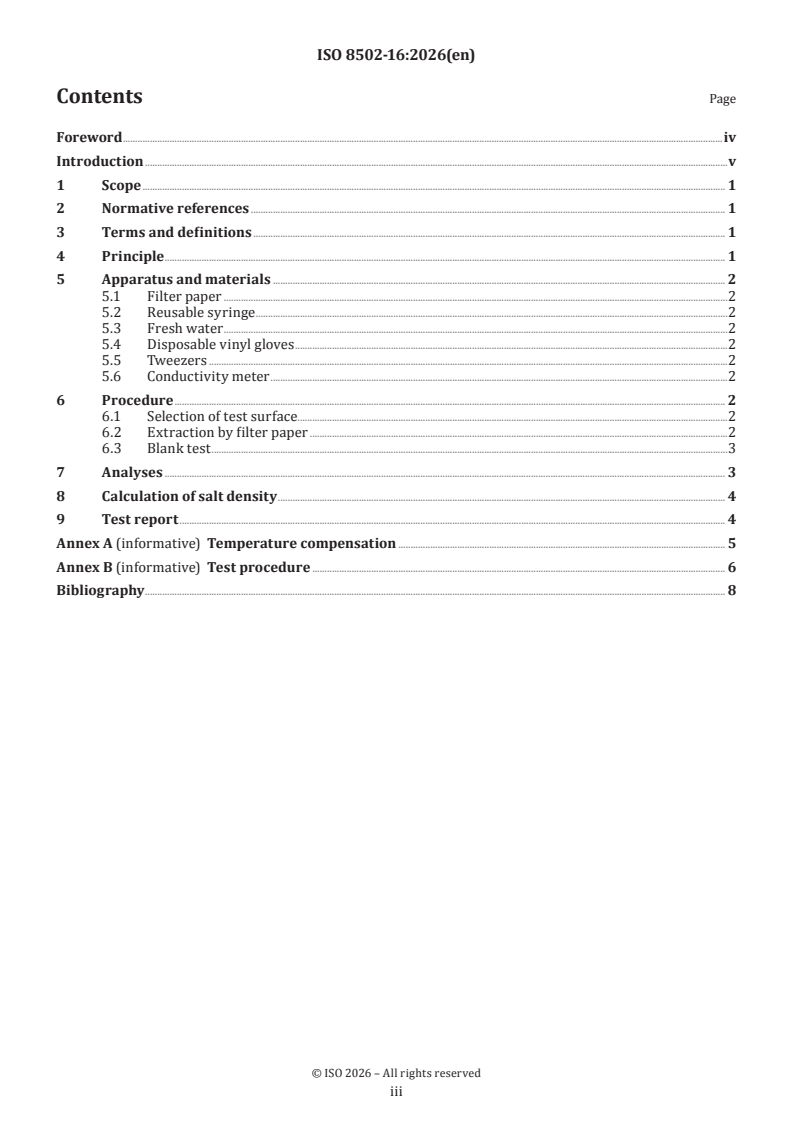
The document is organized into nine clauses and two informative annexes.
| Annex | What it covers |
|---|---|
| Annex A | Temperature compensation and conversion of measured conductivity to 25 °C |
| Annex B | Test procedure illustrations for saturating the paper, applying it to the surface, and transferring it to the meter |
Clauses 1 to 9 cover scope, normative references, terms and definitions, principle, apparatus and materials, procedure, analyses, calculation of salt density, and test report. This structure matters in practice because it separates sampling, measurement, and reporting so that the method can be followed and audited step by step.
What are the key requirements of ISO 8502-16:2026?
ISO 8502-16:2026 focuses on representative surface selection, clean handling, controlled water use, conductivity measurement, and traceable reporting. These points matter because the method can be affected by contamination, water loss, temperature, and incomplete extraction.
Surface selection and contamination control
- Clause 6.1 requires the test area to be representative of the whole surface. In practice, the result should reflect the condition of the surface being prepared, not just a convenient spot.
- Clause 6.2.1 requires precautions against cross contamination and thorough cleaning of equipment before use or reuse. This matters because traces from earlier tests can distort the conductivity result.
Apparatus and materials
- Clause 5 specifies low-ash filter paper, fresh water complying with ISO 3696 grade 3, disposable vinyl gloves, tweezers, and a conductivity meter suited to saturated filter paper. These items are chosen to reduce contamination and support reliable readings.
- The filter paper is specified as nominally 80 g/m², 110 mm diameter, with low ash content. That helps keep the paper itself from adding measurable residue to the sample.
Extraction and blank testing
- Clause 6.2 requires the filter paper to be evenly saturated, pressed firmly onto the surface, and held for the time stated by the meter manufacturer. The note in the document indicates that 2 min is commonly effective, which helps users set a repeatable field procedure.
- Clause 6.3 requires a blank test before each series of tests and for each new batch of paper or water. The blank value is deducted from the surface result, so the reported contamination reflects the surface rather than the water or paper.
Analysis, calculation, and reporting
- Clause 7 requires a suitable conductivity meter, clean electrodes, and temperature recording when the meter does not compensate automatically. The result is reported at 25 °C, which makes readings comparable across tests.
- Clause 8 calculates salt density from the conductivity difference, the water volume, the test area, and a conductivity constant based on the Bresle relationship. In practice, this converts the electrical reading into a surface contamination value that can be used for acceptance decisions.
- Clause 9 lists the report items, including the meter type, water type, blank values, contact time, temperature or temperature compensation, conductivity normalized to 25 °C, any converted salt density, paper batch number, unusual features, and test date. That documentation supports traceability in coating preparation work.
What terms does ISO 8502-16:2026 define?
ISO 8502-16:2026 includes key operating terms in its procedure, even though it does not list formal term entries in a separate definitions list.
- Blank test - A check on the paper and water before testing the surface, used to correct the final result.
- Conductivity - The measured electrical property of the solution in the saturated filter paper, used here as the basis for contamination assessment.
- Conductivity meter - The instrument used to measure the conductivity of the solution held in the paper.
- Salt density - The calculated surface amount of soluble salts, reported from conductivity, water volume, and test area.
- Temperature compensation - The correction used to express conductivity as if measured at 25 °C.
- Test surface - The selected area of steel being examined for water-soluble contaminants.
Who uses ISO 8502-16:2026?
ISO 8502-16:2026 is used by inspectors, coating applicators, quality managers, corrosion engineers, and buyers who need to check steel surface cleanliness before painting or a similar treatment. It is especially useful in field work where surfaces may be flat, curved, or difficult to access. The method supports decisions on whether the surface is ready for coating and whether further cleaning is needed.
What changed in ISO 8502-16:2026 from the previous edition?
ISO 8502-16:2026 is the first edition.
Which standards are used with ISO 8502-16:2026?
ISO 8502-16:2026 cites ISO 3696 as a normative reference, and it uses fresh water of grade 3 from that standard for the test. The introduction also places this part within the ISO 8501, ISO 8502, ISO 8503, and ISO 8504 series, which together cover visual cleanliness, surface cleanliness tests, roughness characteristics, and surface preparation methods.
What does the ISO 8502-16:2026 document contain?
ISO 8502-16:2026 contains a principle section, a list of apparatus and materials, a detailed field procedure, an analysis section for conductivity measurement, a salt-density calculation, and a test report clause. Annex A explains temperature compensation, including how meters may convert readings to 25 °C. Annex B gives figures for saturating the paper, placing it on the surface for the test period, and transferring the sample to the measuring device. These parts support practical use for field testing, verification, and reporting.
Buy Documents
ISO 8502-16:2026 - Preparation of steel substrates before application of paints and related products — Tests for the assessment of surface cleanliness — Part 16: Extraction of water soluble contaminants for analysis, the saturated filter paper method
Get Certified
Connect with accredited certification bodies for this standard

DVS-ZERT GmbH
German welding certification society.

CARES (UK Certification Authority for Reinforcing Steels)
UK certification for reinforcing steels and construction.

EWF/IIW (European/International Welding Federation)
International welding personnel certification.
Sponsored listings
Frequently Asked Questions
ISO 8502-16:2026 is a standard published by the International Organization for Standardization (ISO). Its full title is "Preparation of steel substrates before application of paints and related products — Tests for the assessment of surface cleanliness — Part 16: Extraction of water soluble contaminants for analysis, the saturated filter paper method". This standard covers: This document specifies a method of extracting and analysing water-soluble contaminants from a surface by use of filter paper which can be attached to any surface, regardless of its shape (flat or curved) and its orientation (facing in any direction, including downwards). The method described in this document is suitable for use in the field to determine the presence of water-soluble contaminants before painting or a similar treatment. NOTE The extraction method can give a false conductivity result or not take all the water-soluble material off the surface because of: (1) soluble materials hiding in the crevices or under folds of metal; (2) soluble materials under corrosion layers, passivation layers produced by corrosion inhibitors, oil, grease, or other non-visible thin films.
This document specifies a method of extracting and analysing water-soluble contaminants from a surface by use of filter paper which can be attached to any surface, regardless of its shape (flat or curved) and its orientation (facing in any direction, including downwards). The method described in this document is suitable for use in the field to determine the presence of water-soluble contaminants before painting or a similar treatment. NOTE The extraction method can give a false conductivity result or not take all the water-soluble material off the surface because of: (1) soluble materials hiding in the crevices or under folds of metal; (2) soluble materials under corrosion layers, passivation layers produced by corrosion inhibitors, oil, grease, or other non-visible thin films.
ISO 8502-16:2026 is classified under the following ICS (International Classification for Standards) categories: 25.220.10 - Surface preparation. The ICS classification helps identify the subject area and facilitates finding related standards.
ISO 8502-16:2026 is available in PDF format for immediate download after purchase. The document can be added to your cart and obtained through the secure checkout process. Digital delivery ensures instant access to the complete standard document.
Standards Content (Sample)
International
Standard
ISO 8502-16
First edition
Preparation of steel substrates
2026-11
before application of paints and
related products — Tests for the
assessment of surface cleanliness —
Part 16:
Extraction of water soluble
contaminants for analysis, the
saturated filter paper method
Préparation des subjectiles d'acier avant application de peintures
et de produits assimilés — Essais pour apprécier la propreté
d'une surface —
Partie 16: Extraction des contaminants solubles dans l’eau pour
analyse, méthode du papier filtre saturé
Reference number
© ISO 2026
All rights reserved.
This ISO publication is protected by copyright and is owned by ISO and/or its licensors.
The content of this ISO publication is provided under licence, not sold. Use is subject to the applicable licence terms issued by ISO,
an ISO member body, or an authorized third-party distributor.
Except as required for implementation or expressly permitted by a separate licence, no part of this ISO publication may be
reproduced, distributed, modified, used, or made available in any form or by any means – electronic or mechanical, including
photocopying, scanning, recording, or posting on internal or external digital platforms.
Any use beyond the scope of the granted rights is prohibited and may result in legal action.
ISO copyright office
CP 401 • CH-1214 Vernier, Geneva
Phone: +41 22 749 01 11
Email: copyright@iso.org
Website: www.iso.org
Published in Switzerland
ii
Contents Page
Foreword .iv
Introduction .v
1 Scope . 1
2 Normative references . 1
3 Terms and definitions . 1
4 Principle . 1
5 Apparatus and materials . 2
5.1 Filter paper .2
5.2 Reusable syringe .2
5.3 Fresh water .2
5.4 Disposable vinyl gloves .2
5.5 Tweezers .2
5.6 Conductivity meter .2
6 Procedure . 2
6.1 Selection of test surface .2
6.2 Extraction by filter paper .2
6.3 Blank test .3
7 Analyses . 3
8 Calculation of salt density . 4
9 Test report . 4
Annex A (informative) Temperature compensation . 5
Annex B (informative) Test procedure . 6
Bibliography . 8
iii
Foreword
ISO (the International Organization for Standardization) is a worldwide federation of national standards
bodies (ISO member bodies). The work of preparing International Standards is normally carried out through
ISO technical committees. Each member body interested in a subject for which a technical committee
has been established has the right to be represented on that committee. International organizations,
governmental and non-governmental, in liaison with ISO, also take part in the work. ISO collaborates closely
with the International Electrotechnical Commission (IEC) on all matters of electrotechnical standardization.
The procedures used to develop this document and those intended for its further maintenance are described
in the ISO/IEC Directives, Part 1. In particular, the different approval criteria needed for the different types
of ISO document should be noted. This document was drafted in accordance with the editorial rules of the
ISO/IEC Directives, Part 2 (see www.iso.org/directives).
ISO draws attention to the possibility that the implementation of this document may involve the use of (a)
patent(s). ISO takes no position concerning the evidence, validity or applicability of any claimed patent
rights in respect thereof. As of the date of publication of this document, ISO had not received notice of (a)
patent(s) which may be required to implement this document. However, implementers are cautioned that
this may not represent the latest information, which may be obtained from the patent database available at
www.iso.org/patents. ISO shall not be held responsible for identifying any or all such patent rights.
Any trade name used in this document is information given for the convenience of users and does not
constitute an endorsement. For an explanation of the voluntary nature of standards, the meaning of ISO
specific terms and expressions related to conformity assessment, as well as information about ISO's
adherence to the World Trade Organization (WTO) principles in the Technical Barriers to Trade (TBT), see
www.iso.org/iso/foreword.html.
This document was prepared by Technical Committee ISO/TC 35, Paint and varnishes, Subcommittee SC 12,
Preparation of steel substrates before application of paints and related products.
[1]
A list of all parts in ISO 8502 (all parts) can be found on the ISO website.
Any feedback or questions on this document should be directed to the user’s national standards body. A
complete listing of these bodies can be found atwww.iso.org/members.html.
iv
Introduction
The performance of protective coatings of paint and related products applied to steel is significantly
affected by the state of the steel surface immediately prior to painting. The principal factors that are known
to influence this performance are:
a) the presence of rust and mill scale;
b) the presence of surface contaminants, including salts, dust, oils and greases;
c) the surface profile.
[2] [1]
The series of International Standards ISO 8501 (all parts) , ISO 8502 (all parts) and ISO 8503 (all parts)
[3] [4]
have been prepared to provide methods of assessing these factors, while ISO 8504 (all parts) provides
guidance on the preparation methods that are available for cleaning steel substrates, indicating the
capabilities of each method in attaining specified levels of cleanliness. These International Standards do not
contain recommendations for the protective coating systems to be applied to the steel surface. Nor do they
contain recommendations for the surface quality requirements for specific situations, even though surface
quality can have a direct influence on the choice of protective coating to be applied and on its performance.
Such recommendations are found in other documents such as national standards and codes of practice.
Users of these International Standards are expected to ensure that the qualities specified are:
— compatible and appropriate both for the environmental conditions to which the steel will be exposed
and for the protective coating system to be used;
— within the capability of the cleaning procedure specified.
These series of International Standards referred to above deal with the following aspects of preparation of
steel substrates:
[2]
ISO 8501 (all parts) — Visual assessment of surface cleanliness;
[1]
ISO 8502 (all parts) — Tests for the assessment of surface cleanliness;
[3]
ISO 8503 (all parts) — Surface roughness characteristics of blast-cleaned steel substrates;
[4]
ISO 8504 (all parts) — Surface preparation methods.
[1]
This is one of many parts of ISO 8502 (all parts) that specify tests for the assessment of surface cleanliness.
Relating to such tests, there are several methods for extracting soluble contaminants on surfaces to be
painted, which are then used for subsequent analysis. One of these methods is based on the swabbing of
comparatively large test surfaces. This technique provides average values of the contamination present, but
it can conceal localized concentrations of contaminants. Also, it is possible that swabbing does not ensure
sufficient penetration to dissolve all the deep-seated contamination such as ferrous salts.
There are other methods which use small cells for the liquid used to remove and collect the surface
contaminants. The cells are attached to test surfaces where soluble contaminants can be expected. This
closed cell technique usually provides more accurate, point values of the contamination present than the
swabbing method.
This document describes a further, inexpensive field test using saturated filter paper to extract the soluble
salts from the surface. This method combines the benefits of testing a large area with the benefit of greater
accuracy and point measurements
...