


ISO 21436:2020
(Main)Pulps — Determination of lignin content — Acid hydrolysis method
Pulps — Determination of lignin content — Acid hydrolysis method
The method is applicable to unbleached, bleached and semi-bleached wood pulp with a lignin content above 1 %. It is not generally intended for fully bleached chemical pulp, because the lignin content in these pulps is too low to be determined accurately.
Pâtes — Détermination de la teneur en lignine — Méthode d’hydrolyse acide
General Information
- Status
- Published
- Publication Date
- 07-Dec-2020
- Technical Committee
- ISO/TC 6 - Paper, board and pulps
- Drafting Committee
- ISO/TC 6/WG 4 - Chemical analysis
- Current Stage
- 9060 - Close of review
- Completion Date
- 04-Jun-2031
Relations
- Consolidated By
ISO 6721-3:2021 - Plastics — Determination of dynamic mechanical properties — Part 3: Flexural vibration — Resonance-curve method - Effective Date
- 06-Jun-2022
Overview
ISO 21436:2020 - "Pulps - Determination of lignin content - Acid hydrolysis method" specifies a laboratory procedure to measure total lignin in wood pulps using a two‑step sulfuric acid hydrolysis. The method is applicable to unbleached, bleached and semi‑bleached wood pulp with lignin content above 1% and is not generally intended for fully bleached chemical pulps (lignin too low for accurate determination). The standard defines sample preparation, hydrolysis procedures, filtration, gravimetric determination of acid‑insoluble (Klason) lignin, and spectrophotometric measurement of acid‑soluble lignin (UV absorbance at 205 nm).
Key Topics
- Principle: Two‑step sulfuric acid hydrolysis dissolves carbohydrates; the insoluble residue (Klason lignin) is filtered, dried and weighed. Soluble lignin is measured spectrophotometrically and summed with the insoluble fraction to give total lignin.
- Hydrolysis procedures:
- Procedure A (preferred): Primary hydrolysis with 72% H2SO4 at 30 °C for 1 h, dilute to ~4% and secondary hydrolysis in an autoclave at 120 °C for 1 h - faster and suitable when carbohydrate analysis is also required.
- Procedure B: Primary hydrolysis at 15–20 °C for 2 h, secondary hydrolysis in 3% H2SO4 at 100 °C for 4 h.
- Apparatus & reagents: filtration crucibles (fritted glass), autoclave (Procedure A), water bath (Procedure B), drying oven (105 °C), analytical balance (0.1 mg), UV‑Vis spectrophotometer with quartz cuvettes, 72% sulfuric acid and distilled water.
- Sampling & sample prep: Representative sampling per ISO 7213; grind/disintegrate to pass 0.85 mm; extract resins with acetone (ISO 14453) where required; determine moisture by ISO 638.
- Quality & reporting: Tests run in duplicate; calculate total lignin = acid‑insoluble + acid‑soluble lignin; precision and detailed test report requirements are included in the standard.
- Safety: Use caution - hazardous chemicals (concentrated sulfuric acid, acetone) and high temperatures are involved.
Applications
ISO 21436:2020 is used by:
- Quality control and process laboratories in pulp and paper mills for monitoring delignification and bleach demand.
- R&D and academic researchers studying pulping, bleaching and lignin chemistry.
- Contract testing laboratories providing standardized lignin content results for specifications, acceptance testing and process optimization. Practical uses include assessing pulping efficiency, estimating bleaching chemical requirements, comparing processing routes, and supporting product specification and compliance.
Related Standards
- ISO 638 - Determination of dry matter (oven‑drying)
- ISO 7213 - Pulps - Sampling for testing
- ISO 14453 - Pulps - Acetone‑soluble matter (resin extraction)
- ISO 1762 - Determination of ash content
Keywords: ISO 21436:2020, lignin content, pulps, acid hydrolysis method, Klason lignin, acid‑insoluble lignin, acid‑soluble lignin, sulfuric acid hydrolysis, pulp testing, Procedure A, Procedure B.
Buy Documents

ISO 21436:2020 - Pulps -- Determination of lignin content -- Acid hydrolysis method

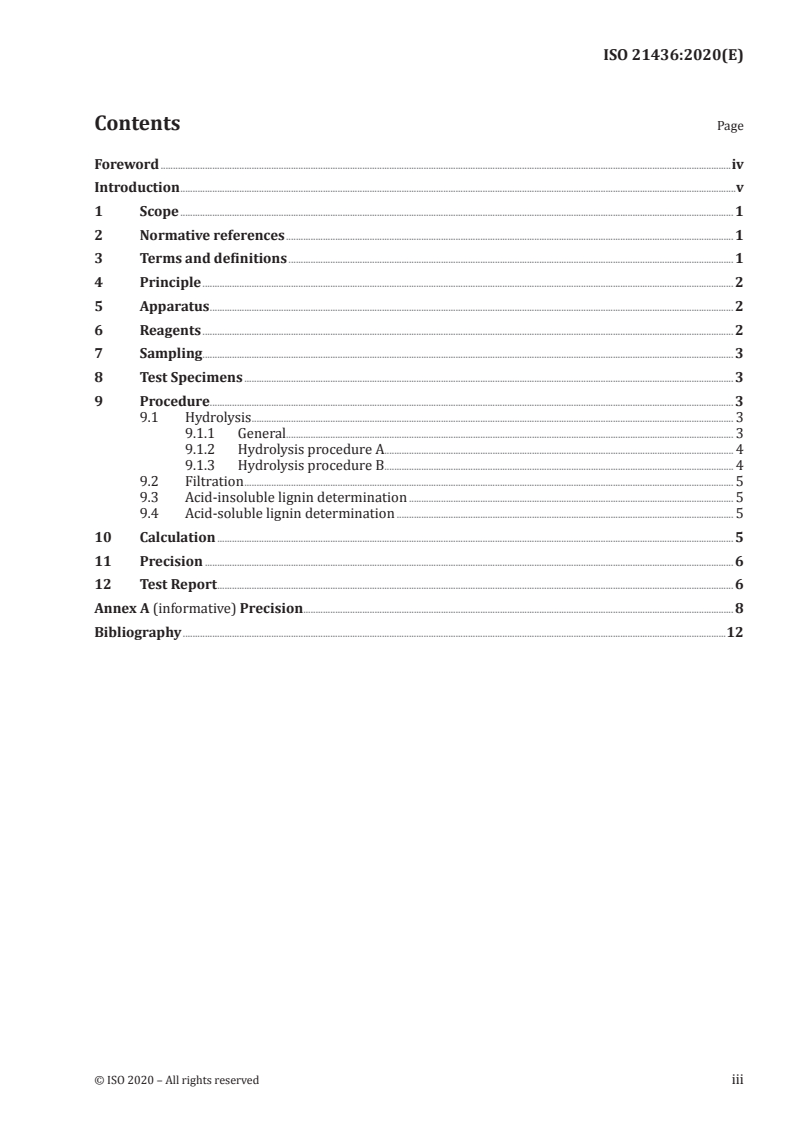
ISO 21436:2020 - Pulps — Determination of lignin content — Acid hydrolysis method/8/2020
Get Certified
Connect with accredited certification bodies for this standard

Control Union Certifications
Global certification for agriculture and sustainability.

Gozdarski inštitut Slovenije
Slovenian Forestry Institute. Forest management certification support, timber testing.
Sponsored listings
Frequently Asked Questions
ISO 21436:2020 is a standard published by the International Organization for Standardization (ISO). Its full title is "Pulps — Determination of lignin content — Acid hydrolysis method". This standard covers: The method is applicable to unbleached, bleached and semi-bleached wood pulp with a lignin content above 1 %. It is not generally intended for fully bleached chemical pulp, because the lignin content in these pulps is too low to be determined accurately.
The method is applicable to unbleached, bleached and semi-bleached wood pulp with a lignin content above 1 %. It is not generally intended for fully bleached chemical pulp, because the lignin content in these pulps is too low to be determined accurately.
ISO 21436:2020 is classified under the following ICS (International Classification for Standards) categories: 85.040 - Pulps. The ICS classification helps identify the subject area and facilitates finding related standards.
ISO 21436:2020 has the following relationships with other standards: It is inter standard links to ISO 6721-3:2021. Understanding these relationships helps ensure you are using the most current and applicable version of the standard.
ISO 21436:2020 is available in PDF format for immediate download after purchase. The document can be added to your cart and obtained through the secure checkout process. Digital delivery ensures instant access to the complete standard document.
Standards Content (Sample)
INTERNATIONAL ISO
STANDARD 21436
First edition
2020-12
Pulps — Determination of lignin
content — Acid hydrolysis method
Pâtes — Détermination de la teneur en lignine — Méthode
d’hydrolyse acide
Reference number
©
ISO 2020
© ISO 2020
All rights reserved. Unless otherwise specified, or required in the context of its implementation, no part of this publication may
be reproduced or utilized otherwise in any form or by any means, electronic or mechanical, including photocopying, or posting
on the internet or an intranet, without prior written permission. Permission can be requested from either ISO at the address
below or ISO’s member body in the country of the requester.
ISO copyright office
CP 401 • Ch. de Blandonnet 8
CH-1214 Vernier, Geneva
Phone: +41 22 749 01 11
Email: copyright@iso.org
Website: www.iso.org
Published in Switzerland
ii © ISO 2020 – All rights reserved
Contents Page
Foreword .iv
Introduction .v
1 Scope . 1
2 Normative references . 1
3 Terms and definitions . 1
4 Principle . 2
5 Apparatus . 2
6 Reagents . 2
7 Sampling . 3
8 Test Specimens . 3
9 Procedure. 3
9.1 Hydrolysis . 3
9.1.1 General. 3
9.1.2 Hydrolysis procedure A. 4
9.1.3 Hydrolysis procedure B . . 4
9.2 Filtration . 5
9.3 Acid-insoluble lignin determination . 5
9.4 Acid-soluble lignin determination . 5
10 Calculation . 5
11 Precision . 6
12 Test Report . 6
Annex A (informative) Precision . 8
Bibliography .12
Foreword
ISO (the International Organization for Standardization) is a worldwide federation of national standards
bodies (ISO member bodies). The work of preparing International Standards is normally carried out
through ISO technical committees. Each member body interested in a subject for which a technical
committee has been established has the right to be represented on that committee. International
organizations, governmental and non-governmental, in liaison with ISO, also take part in the work.
ISO collaborates closely with the International Electrotechnical Commission (IEC) on all matters of
electrotechnical standardization.
The procedures used to develop this document and those intended for its further maintenance are
described in the ISO/IEC Directives, Part 1. In particular, the different approval criteria needed for the
different types of ISO documents should be noted. This document was drafted in accordance with the
editorial rules of the ISO/IEC Directives, Part 2 (see www .iso .org/ directives).
Attention is drawn to the possibility that some of the elements of this document may be the subject of
patent rights. ISO shall not be held responsible for identifying any or all such patent rights. Details of
any patent rights identified during the development of the document will be in the Introduction and/or
on the ISO list of patent declarations received (see www .iso .org/ patents).
Any trade name used in this document is information given for the convenience of users and does not
constitute an endorsement.
For an explanation of the voluntary nature of standards, the meaning of ISO specific terms and
expressions related to conformity assessment, as well as information about ISO's adherence to
the World Trade Organization (WTO) principles in the Technical Barriers to Trade (TBT), see
www .iso .org/ iso/ foreword .html.
This document was prepared by Technical Committee ISO/TC 6, Paper, board and pulps.
Any feedback or questions on this document should be directed to the user’s national standards body. A
complete listing of these bodies can be found at www .iso .org/ members .html.
iv © ISO 2020 – All rights reserved
Introduction
The main objective of measuring lignin in pulp is to assess the effect of a particular pulping or bleaching
process on the degree of delignification. In chemical pulping, the goal is to remove lignin from wood
with minimum degradation of the carbohydrates. The higher the level of residual lignin in any type of
unbleached pulp, the greater the amount of bleaching chemicals that is applied in order to achieve a
target brightness.
[1]-[3]
Comprehensive textbooks and reviews have been written on methods of lignin determination .
This document specifies one such method, commonly used for the determination of the total lignin
content of pulp. In this method, a pulp sample is treated with sulfuric acid, in a two-step (primary and
secondary) hydrolysis process, to solubilize the carbohydrates. Most of the lignin remains insoluble at
the end of the treatment and is filtered off, dried and weighed. This acid-insoluble lignin is also referred
to as “Klason lignin”.
A small portion of lignin is dissolved during acid hydrolysis of the pulp. This so-called acid-soluble
lignin is determined spectrophotometrically, from the UV absorbance at 205 nm of the filtrate from the
[4]-[6]
acid-insoluble lignin determination . The total lignin content is determined as the sum of the acid-
insoluble and acid-soluble lignin.
[7]-[9]
Two hydrolysis procedures are described in this document. In procedure A , the primary hydrolysis
is performed with 72 % sulfuric acid at 30 °C for one hour, followed by dilution with water to 4 %
[10][11]
sulfuric acid, and secondary hydrolysis in an autoclave at 120 °C for one hour. In procedure B , the
primary hydrolysis is done at 15-20 °C for two hours, followed by secondary hydrolysis at 3 % sulfuric
acid in a water bath at 100 °C for four hours. In procedure A, the use of 4 % sulfuric acid, instead of 3 %,
for secondary hydrolysis has no impact on the lignin analysis and is accepted when both lignin and
carbohydrates need to be analysed in the same sample.
Both procedures have been shown to give the same results; thus, either one can be used for determining
acid-insoluble lignin. However, procedure A is considerably more rapid, and the use of an autoclave
allows multiple samples to be hydrolysed simultaneously with minimum supervision. As such, it is now
more commonly used in laboratories equipped with an autoclave. It is therefore the preferred method
and should be used when analysis of carbohydrates is required in addition to the determination of lignin.
INTERNATIONAL STANDARD ISO 21436:2020(E)
Pulps — Determination of lignin content — Acid
hydrolysis method
WARNING — This method involves the use of hazardous chemicals. Care should be taken to
ensure that the relevant precautions are taken.
1 Scope
The method is applicable to unbleached, bleached and semi-bleached wood pulp with a lignin content
above 1 %. It is not generally intended for fully bleached chemical pulp, because the lignin content in
these pulps is too low to be determined accurately.
2 Normative references
The following documents are referred to in the text in such a way that some or all of their content
constitutes requirements of this document. For dated references, only the edition cited applies. For
undated references, the latest edition of the referenced document (including any amendments) applies.
ISO 638, Paper, board and pulps — Determination of dry matter content — Oven-drying method
ISO 1762, Paper, board, pulps and cellulose nanomaterials — Determination of residue (ash content) on
ignition at 525 °C
ISO 7213, Pulps — Sampling for testing
ISO 14453, Pulps — Determination of acetone-soluble matter
3 Terms and definitions
For the purposes of this document, the following terms and definitions apply.
ISO and IEC maintain terminological databases for use in standardization at the following addresses:
— ISO Online browsing platform: available at https:// www .iso .org/ obp
— IEC Electropedia: available at http:// www .electropedia .org/
3.1
lignins
class of complex, organic macromolecules, containing aromatic sub-units, that play a key role in the
formation of cell walls in wood and bark, conferring mechanical strength and rigidity to cell walls and
to plants as a whole
Note 1 to entry: Lignin is the main non-carbohydrate constitutent of wood.
3.2
acid-insoluble (Klason) lignin
residue after treating wood or pulp with sulfuric acid in a two-step hydrolysis procedure to solubilize
the carbohydrates into monosaccharides
3.3
acid-soluble lignin
portion of lignin (3.1) which is soluble during the acid-insoluble lignin determination
3.4
acetone-soluble matter
amount of material that can be extracted with acetone from a sample of pulp by the method specified
in ISO 14453
4 Principle
A pulp sample is treated with sulfuric acid in a two-step (primary and secondary) hydrolysis process to
dissolve the carbohydrates. The residue after hydrolysis is filtered off, dried, and weighed, and referred
to as acid-insoluble or Klason lignin. A small amount of lignin is dissolved during acid hydrolysis. This
so-called acid-soluble lignin is determined by measuring the absorbance at 205 nm of the filtrate from
the acid-insoluble lignin determination. The total lignin content is determined as the sum of the acid-
insoluble lignin and acid-soluble lignin.
5 Apparatus
5.1 Filtration equipment: filtering flask; filtering crucible, fritted glass, medium or fine porosity,
30 ml; adapter for the filtering crucible, siphon tube (optional).
NOTE The choice of fritted glass porosity depends on the rate of filtration of the particular type of sample.
For slow filtering samples, the use of medium (M) porosity is preferable. In low-yield sulfite pulps especially,
lignin forms a fine dispersion and clogs the pores of the filter. Filtration can be facilitated by using a medium
porosity crucible with a disc of fine porosity glass-fibre filter paper fitted over the sintered glass in the crucible.
Other types of filtering crucibles, such as alundum or porous porcelain crucibles lined with a mat of
glass fibres can also be used.
5.2 Constant temperature water bath, capable of maintaining a temperature of 30 ± 1 °C
(Procedure A); or 20 ± 1 °C (Procedure B).
5.3 Flask, Erlenmeyer, 1 000 ml, or smaller depending on the size of the pulp specimen.
5.4 Procedure A only: Autoclave, capable of maintaining a temperature of 120 ± 3 °C.
5.5 Drying oven, convection type, maintained at 105 ± 2 °C.
5.6 Analytical balance, accurate to 0,1 mg.
5.7 Spectrophotometer, UV-visible, diode array or simple wavelength, with high purity quartz
cuvettes of pathlength 1 cm.
6 Reagents
6.1 Water, distilled or deionized.
6.2 Sulfuric acid, 72 % w/w (specific gravity 1,633 8 at 20 °C). 72 % sulfuric acid is available
commercially. It can also be prepared from concentrated sulfuric acid as follows:
Slowly add 650 ml of concentrated sulfuric acid (H SO sp gr 1,84) to 400 ml of water, while cooling
2 4
under a cold water trap. When the temperature has reached equilibrium with the ambient temperature,
adjust the specific gravity of the sulfuric acid solution to 1,633 8, with the use of a hydrometer, by
careful addition of concentrated sulfuric acid or water.
6.3 Acetone, only if extraction of the sample is required prior to hydrolysis with sulfuric acid.
2 © ISO 2020 – All rights reserved
7 Sampling
If the analysis is being made to evaluate a lot of a consignment of pulp, the sample shall be taken in
accordance with ISO 7213. If the analysis is made on another type of sample, report the origin of the
sample, and if possible the sampling procedure.
Obtain a representative sample of pulp equivalent to about 10 g moisture-free pulp. Air dry the pulp
and disintegrate in a household blender, or grind in a Wiley mill to pass a No. 20 (0,85 mm) screen.
Groundwood and high yield pulps containing a significant amount of resins shall be extracted with
acetone (6.3) according to ISO 14453 before testing.
NOTE Resins, if not extracted from the pulp prior to analysis, would remain insoluble in acid and be weighed
as lignin.
NOTE Acetone is considered an effective solvent for extracting resin from pulp. Dichloromethane and
ethanol/benzene (1:2), as specified in other methods, are not recommended due to health hazards. In particular,
benzene is a confirmed carcinogen.
Determine the moisture content of the pulp according to ISO 638 by drying a 2-3 g specimen in an
oven at 105 ± 3 °C to constant weight. If the pulp shall be pre-extracted, the moisture content shall be
determined on the extracted pulp.
8 Test Specimens
Weigh (5.6) a test specimen, equivalent to 300 mg to 1,0 g of oven-dried mass of pulp to the nearest
0,1 mg (see NOTE) and transfer to a 200 ml beaker. Make sure that the test specimens taken are
representative of the sample received.
The mass of the test specimen is such as to provide a minimum of 20 mg of lignin in the residue
remaining after acid hydrolysis, for accurate weighing. The following can be used as a guide to the
amount of pulp that should be selected for analysis, based on the lignin content:
— >10 % lignin: 300 mg pulp
— 5-10 % lignin: 500 mg pulp
— <5 % lignin: 1,0 g pulp
NOTE The amount of pulp selected for analysis also depends on whether hydrolysis procedure A or
hydrolysis procedure B is used.
9 Procedure
Run the entire procedure in duplicate.
9.1 Hydrolysis
9.1.1 General
[7]-[9]
Two hydrolysis procedures are described in this Standard. In procedure A , the primary hydrolysis
is performed at 30 °C for 1 h, followed by secondary hydrolysis in an autoclave at 120 °C for 1 h. In
[10][11]
procedure
...
INTERNATIONAL ISO
STANDARD 21436
First edition
2020-12
Pulps — Determination of lignin
content — Acid hydrolysis method
Pâtes — Détermination de la teneur en lignine — Méthode
d’hydrolyse acide
Reference number
©
ISO 2020
© ISO 2020
All rights reserved. Unless otherwise specified, or required in the context of its implementation, no part of this publication may
be reproduced or utilized otherwise in any form or by any means, electronic or mechanical, including photocopying, or posting
on the internet or an intranet, without prior written permission. Permission can be requested from either ISO at the address
below or ISO’s member body in the country of the requester.
ISO copyright office
CP 401 • Ch. de Blandonnet 8
CH-1214 Vernier, Geneva
Phone: +41 22 749 01 11
Email: copyright@iso.org
Website: www.iso.org
Published in Switzerland
ii © ISO 2020 – All rights reserved
Contents Page
Foreword .iv
Introduction .v
1 Scope . 1
2 Normative references . 1
3 Terms and definitions . 1
4 Principle . 2
5 Apparatus . 2
6 Reagents . 2
7 Sampling . 3
8 Test Specimens . 3
9 Procedure. 3
9.1 Hydrolysis . 3
9.1.1 General. 3
9.1.2 Hydrolysis procedure A. 4
9.1.3 Hydrolysis procedure B . . 4
9.2 Filtration . 5
9.3 Acid-insoluble lignin determination . 5
9.4 Acid-soluble lignin determination . 5
10 Calculation . 5
11 Precision . 6
12 Test Report . 6
Annex A (informative) Precision . 8
Bibliography .12
Foreword
ISO (the International Organization for Standardization) is a worldwide federation of national standards
bodies (ISO member bodies). The work of preparing International Standards is normally carried out
through ISO technical committees. Each member body interested in a subject for which a technical
committee has been established has the right to be represented on that committee. International
organizations, governmental and non-governmental, in liaison with ISO, also take part in the work.
ISO collaborates closely with the International Electrotechnical Commission (IEC) on all matters of
electrotechnical standardization.
The procedures used to develop this document and those intended for its further maintenance are
described in the ISO/IEC Directives, Part 1. In particular, the different approval criteria needed for the
different types of ISO documents should be noted. This document was drafted in accordance with the
editorial rules of the ISO/IEC Directives, Part 2 (see www .iso .org/ directives).
Attention is drawn to the possibility that some of the elements of this document may be the subject of
patent rights. ISO shall not be held responsible for identifying any or all such patent rights. Details of
any patent rights identified during the development of the document will be in the Introduction and/or
on the ISO list of patent declarations received (see www .iso .org/ patents).
Any trade name used in this document is information given for the convenience of users and does not
constitute an endorsement.
For an explanation of the voluntary nature of standards, the meaning of ISO specific terms and
expressions related to conformity assessment, as well as information about ISO's adherence to
the World Trade Organization (WTO) principles in the Technical Barriers to Trade (TBT), see
www .iso .org/ iso/ foreword .html.
This document was prepared by Technical Committee ISO/TC 6, Paper, board and pulps.
Any feedback or questions on this document should be directed to the user’s national standards body. A
complete listing of these bodies can be found at www .iso .org/ members .html.
iv © ISO 2020 – All rights reserved
Introduction
The main objective of measuring lignin in pulp is to assess the effect of a particular pulping or bleaching
process on the degree of delignification. In chemical pulping, the goal is to remove lignin from wood
with minimum degradation of the carbohydrates. The higher the level of residual lignin in any type of
unbleached pulp, the greater the amount of bleaching chemicals that is applied in order to achieve a
target brightness.
[1]-[3]
Comprehensive textbooks and reviews have been written on methods of lignin determination .
This document specifies one such method, commonly used for the determination of the total lignin
content of pulp. In this method, a pulp sample is treated with sulfuric acid, in a two-step (primary and
secondary) hydrolysis process, to solubilize the carbohydrates. Most of the lignin remains insoluble at
the end of the treatment and is filtered off, dried and weighed. This acid-insoluble lignin is also referred
to as “Klason lignin”.
A small portion of lignin is dissolved during acid hydrolysis of the pulp. This so-called acid-soluble
lignin is determined spectrophotometrically, from the UV absorbance at 205 nm of the filtrate from the
[4]-[6]
acid-insoluble lignin determination . The total lignin content is determined as the sum of the acid-
insoluble and acid-soluble lignin.
[7]-[9]
Two hydrolysis procedures are described in this document. In procedure A , the primary hydrolysis
is performed with 72 % sulfuric acid at 30 °C for one hour, followed by dilution with water to 4 %
[10][11]
sulfuric acid, and secondary hydrolysis in an autoclave at 120 °C for one hour. In procedure B , the
primary hydrolysis is done at 15-20 °C for two hours, followed by secondary hydrolysis at 3 % sulfuric
acid in a water bath at 100 °C for four hours. In procedure A, the use of 4 % sulfuric acid, instead of 3 %,
for secondary hydrolysis has no impact on the lignin analysis and is accepted when both lignin and
carbohydrates need to be analysed in the same sample.
Both procedures have been shown to give the same results; thus, either one can be used for determining
acid-insoluble lignin. However, procedure A is considerably more rapid, and the use of an autoclave
allows multiple samples to be hydrolysed simultaneously with minimum supervision. As such, it is now
more commonly used in laboratories equipped with an autoclave. It is therefore the preferred method
and should be used when analysis of carbohydrates is required in addition to the determination of lignin.
INTERNATIONAL STANDARD ISO 21436:2020(E)
Pulps — Determination of lignin content — Acid
hydrolysis method
WARNING — This method involves the use of hazardous chemicals. Care should be taken to
ensure that the relevant precautions are taken.
1 Scope
The method is applicable to unbleached, bleached and semi-bleached wood pulp with a lignin content
above 1 %. It is not generally intended for fully bleached chemical pulp, because the lignin content in
these pulps is too low to be determined accurately.
2 Normative references
The following documents are referred to in the text in such a way that some or all of their content
constitutes requirements of this document. For dated references, only the edition cited applies. For
undated references, the latest edition of the referenced document (including any amendments) applies.
ISO 638, Paper, board and pulps — Determination of dry matter content — Oven-drying method
ISO 1762, Paper, board, pulps and cellulose nanomaterials — Determination of residue (ash content) on
ignition at 525 °C
ISO 7213, Pulps — Sampling for testing
ISO 14453, Pulps — Determination of acetone-soluble matter
3 Terms and definitions
For the purposes of this document, the following terms and definitions apply.
ISO and IEC maintain terminological databases for use in standardization at the following addresses:
— ISO Online browsing platform: available at https:// www .iso .org/ obp
— IEC Electropedia: available at http:// www .electropedia .org/
3.1
lignins
class of complex, organic macromolecules, containing aromatic sub-units, that play a key role in the
formation of cell walls in wood and bark, conferring mechanical strength and rigidity to cell walls and
to plants as a whole
Note 1 to entry: Lignin is the main non-carbohydrate constitutent of wood.
3.2
acid-insoluble (Klason) lignin
residue after treating wood or pulp with sulfuric acid in a two-step hydrolysis procedure to solubilize
the carbohydrates into monosaccharides
3.3
acid-soluble lignin
portion of lignin (3.1) which is soluble during the acid-insoluble lignin determination
3.4
acetone-soluble matter
amount of material that can be extracted with acetone from a sample of pulp by the method specified
in ISO 14453
4 Principle
A pulp sample is treated with sulfuric acid in a two-step (primary and secondary) hydrolysis process to
dissolve the carbohydrates. The residue after hydrolysis is filtered off, dried, and weighed, and referred
to as acid-insoluble or Klason lignin. A small amount of lignin is dissolved during acid hydrolysis. This
so-called acid-soluble lignin is determined by measuring the absorbance at 205 nm of the filtrate from
the acid-insoluble lignin determination. The total lignin content is determined as the sum of the acid-
insoluble lignin and acid-soluble lignin.
5 Apparatus
5.1 Filtration equipment: filtering flask; filtering crucible, fritted glass, medium or fine porosity,
30 ml; adapter for the filtering crucible, siphon tube (optional).
NOTE The choice of fritted glass porosity depends on the rate of filtration of the particular type of sample.
For slow filtering samples, the use of medium (M) porosity is preferable. In low-yield sulfite pulps especially,
lignin forms a fine dispersion and clogs the pores of the filter. Filtration can be facilitated by using a medium
porosity crucible with a disc of fine porosity glass-fibre filter paper fitted over the sintered glass in the crucible.
Other types of filtering crucibles, such as alundum or porous porcelain crucibles lined with a mat of
glass fibres can also be used.
5.2 Constant temperature water bath, capable of maintaining a temperature of 30 ± 1 °C
(Procedure A); or 20 ± 1 °C (Procedure B).
5.3 Flask, Erlenmeyer, 1 000 ml, or smaller depending on the size of the pulp specimen.
5.4 Procedure A only: Autoclave, capable of maintaining a temperature of 120 ± 3 °C.
5.5 Drying oven, convection type, maintained at 105 ± 2 °C.
5.6 Analytical balance, accurate to 0,1 mg.
5.7 Spectrophotometer, UV-visible, diode array or simple wavelength, with high purity quartz
cuvettes of pathlength 1 cm.
6 Reagents
6.1 Water, distilled or deionized.
6.2 Sulfuric acid, 72 % w/w (specific gravity 1,633 8 at 20 °C). 72 % sulfuric acid is available
commercially. It can also be prepared from concentrated sulfuric acid as follows:
Slowly add 650 ml of concentrated sulfuric acid (H SO sp gr 1,84) to 400 ml of water, while cooling
2 4
under a cold water trap. When the temperature has reached equilibrium with the ambient temperature,
adjust the specific gravity of the sulfuric acid solution to 1,633 8, with the use of a hydrometer, by
careful addition of concentrated sulfuric acid or water.
6.3 Acetone, only if extraction of the sample is required prior to hydrolysis with sulfuric acid.
2 © ISO 2020 – All rights reserved
7 Sampling
If the analysis is being made to evaluate a lot of a consignment of pulp, the sample shall be taken in
accordance with ISO 7213. If the analysis is made on another type of sample, report the origin of the
sample, and if possible the sampling procedure.
Obtain a representative sample of pulp equivalent to about 10 g moisture-free pulp. Air dry the pulp
and disintegrate in a household blender, or grind in a Wiley mill to pass a No. 20 (0,85 mm) screen.
Groundwood and high yield pulps containing a significant amount of resins shall be extracted with
acetone (6.3) according to ISO 14453 before testing.
NOTE Resins, if not extracted from the pulp prior to analysis, would remain insoluble in acid and be weighed
as lignin.
NOTE Acetone is considered an effective solvent for extracting resin from pulp. Dichloromethane and
ethanol/benzene (1:2), as specified in other methods, are not recommended due to health hazards. In particular,
benzene is a confirmed carcinogen.
Determine the moisture content of the pulp according to ISO 638 by drying a 2-3 g specimen in an
oven at 105 ± 3 °C to constant weight. If the pulp shall be pre-extracted, the moisture content shall be
determined on the extracted pulp.
8 Test Specimens
Weigh (5.6) a test specimen, equivalent to 300 mg to 1,0 g of oven-dried mass of pulp to the nearest
0,1 mg (see NOTE) and transfer to a 200 ml beaker. Make sure that the test specimens taken are
representative of the sample received.
The mass of the test specimen is such as to provide a minimum of 20 mg of lignin in the residue
remaining after acid hydrolysis, for accurate weighing. The following can be used as a guide to the
amount of pulp that should be selected for analysis, based on the lignin content:
— >10 % lignin: 300 mg pulp
— 5-10 % lignin: 500 mg pulp
— <5 % lignin: 1,0 g pulp
NOTE The amount of pulp selected for analysis also depends on whether hydrolysis procedure A or
hydrolysis procedure B is used.
9 Procedure
Run the entire procedure in duplicate.
9.1 Hydrolysis
9.1.1 General
[7]-[9]
Two hydrolysis procedures are described in this Standard. In procedure A , the primary hydrolysis
is performed at 30 °C for 1 h, followed by secondary hydrolysis in an autoclave at 120 °C for 1 h. In
[10][11]
procedure
...
Questions, Comments and Discussion
Ask us and Technical Secretary will try to provide an answer. You can facilitate discussion about the standard in here.
Loading comments...