


ISO/IEC TS 23532-2:2021
(Main)Information security, cybersecurity and privacy protection — Requirements for the competence of IT security testing and evaluation laboratories — Part 2: Testing for ISO/IEC 19790
Information security, cybersecurity and privacy protection — Requirements for the competence of IT security testing and evaluation laboratories — Part 2: Testing for ISO/IEC 19790
This document complements and supplements the procedures and general requirements found in ISO/IEC 17025:2017 for laboratories performing testing based on ISO/IEC 19790 and ISO/IEC 24759.
Sécurité de l'information, cybersécurité et protection de la vie privée — Exigences relatives aux compétences des laboratoires d'essais et d'évaluation de la sécurité TI — Partie 2: Essais pour l'ISO/IEC 19790
General Information
- Status
- Published
- Publication Date
- 11-Nov-2021
- Current Stage
- 9093 - International Standard confirmed
- Start Date
- 27-Mar-2025
- Completion Date
- 12-Feb-2026
Overview
ISO/IEC TS 23532-2:2021 is a technical specification that supplements ISO/IEC 17025:2017 for laboratories performing testing based on ISO/IEC 19790 (security requirements for cryptographic modules) and ISO/IEC 24759. It defines additional, domain‑specific competence and procedural requirements for cryptographic security testing laboratories to ensure valid, impartial and reproducible results when testing cryptographic modules and implementations under test (IUT).
Key topics and requirements
This document builds on ISO/IEC 17025 and adds crypto‑specific detail in areas including:
Impartiality and conflict of interest
- Policies to prevent labs from testing products for which they provided consulting, design, implementation, or hold financial/ownership interests.
- Labs may clarify standards to vendors but must avoid activities that create a conflict of interest.
Confidentiality and integrity
- Requirements to protect sensitive test data and vendor information throughout testing and reporting.
Structural and resource requirements
- Personnel competence, facility and environmental controls, equipment needs and metrological traceability pertinent to cryptographic testing.
- References to personnel competence standards (ISO/IEC 19896 series).
Process requirements
- Review of requests, selection/verification/validation of test methods, sampling, handling of test items (IUT), technical records, measurement uncertainty, and ensuring validity of results.
Reporting and records
- Specific requirements for test reports, calibration certificates, statements of conformity, and amendments.
Quality and management system options
- Management system requirements aligned with ISO/IEC 17025 including option A/B approaches; corrective actions, internal audits, and management review.
Informative annexes
- Guidance on metrological traceability, management system options and relationships between standards used in cryptographic module testing.
Applications and who uses it
ISO/IEC TS 23532-2 is intended for:
- Cryptographic security testing laboratories seeking accreditation or demonstrating competence for ISO/IEC 19790 testing.
- Accreditation bodies and assessors evaluating lab conformity to crypto testing best practices.
- Vendors and product owners preparing modules for conformance testing and wanting to understand lab expectations.
- Laboratory managers, technical leads and auditors implementing or reviewing test processes, personnel competence and impartiality safeguards.
Related standards
- ISO/IEC 17025:2017 - General requirements for testing and calibration laboratories
- ISO/IEC 19790 - Security requirements for cryptographic modules
- ISO/IEC 24759 - Test requirements for cryptographic modules
- ISO/IEC 19896-1 / 19896-2 - Competence for information security testers and evaluators
- ISO/IEC 17000 - Conformity assessment vocabulary
By integrating ISO/IEC TS 23532-2:2021 into laboratory practice, organizations can strengthen the credibility, repeatability and accreditation readiness of cryptographic module testing.

ISO/IEC TS 23532-2:2021 - Information security, cybersecurity and privacy protection — Requirements for the competence of IT security testing and evaluation laboratories — Part 2: Testing for ISO/IEC 19790 Released:11/12/2021

ISO/IEC TS 23532-2:2021 - Information security, cybersecurity and privacy protection — Requirements for the competence of IT security testing and evaluation laboratories — Part 2: Testing for ISO/IEC 19790 Released:11/12/2021
Get Certified
Connect with accredited certification bodies for this standard

BSI Group
BSI (British Standards Institution) is the business standards company that helps organizations make excellence a habit.

Bureau Veritas
Bureau Veritas is a world leader in laboratory testing, inspection and certification services.

DNV
DNV is an independent assurance and risk management provider.
Sponsored listings
Frequently Asked Questions
ISO/IEC TS 23532-2:2021 is a technical specification published by the International Organization for Standardization (ISO). Its full title is "Information security, cybersecurity and privacy protection — Requirements for the competence of IT security testing and evaluation laboratories — Part 2: Testing for ISO/IEC 19790". This standard covers: This document complements and supplements the procedures and general requirements found in ISO/IEC 17025:2017 for laboratories performing testing based on ISO/IEC 19790 and ISO/IEC 24759.
This document complements and supplements the procedures and general requirements found in ISO/IEC 17025:2017 for laboratories performing testing based on ISO/IEC 19790 and ISO/IEC 24759.
ISO/IEC TS 23532-2:2021 is classified under the following ICS (International Classification for Standards) categories: 35.030 - IT Security. The ICS classification helps identify the subject area and facilitates finding related standards.
ISO/IEC TS 23532-2:2021 is available in PDF format for immediate download after purchase. The document can be added to your cart and obtained through the secure checkout process. Digital delivery ensures instant access to the complete standard document.
Standards Content (Sample)
TECHNICAL ISO/IEC TS
SPECIFICATION 23532-2
First edition
2021-11
Information security, cybersecurity
and privacy protection —
Requirements for the competence
of IT security testing and evaluation
laboratories —
Part 2:
Testing for ISO/IEC 19790
Sécurité de l'information, cybersécurité et protection de la vie
privée — Exigences relatives aux compétences des laboratoires
d'essais et d'évaluation de la sécurité TI —
Partie 2: Essais pour l'ISO/IEC 19790
Reference number
© ISO/IEC 2021
© ISO/IEC 2021
All rights reserved. Unless otherwise specified, or required in the context of its implementation, no part of this publication may
be reproduced or utilized otherwise in any form or by any means, electronic or mechanical, including photocopying, or posting on
the internet or an intranet, without prior written permission. Permission can be requested from either ISO at the address below
or ISO’s member body in the country of the requester.
ISO copyright office
CP 401 • Ch. de Blandonnet 8
CH-1214 Vernier, Geneva
Phone: +41 22 749 01 11
Email: copyright@iso.org
Website: www.iso.org
Published in Switzerland
ii
© ISO/IEC 2021 – All rights reserved
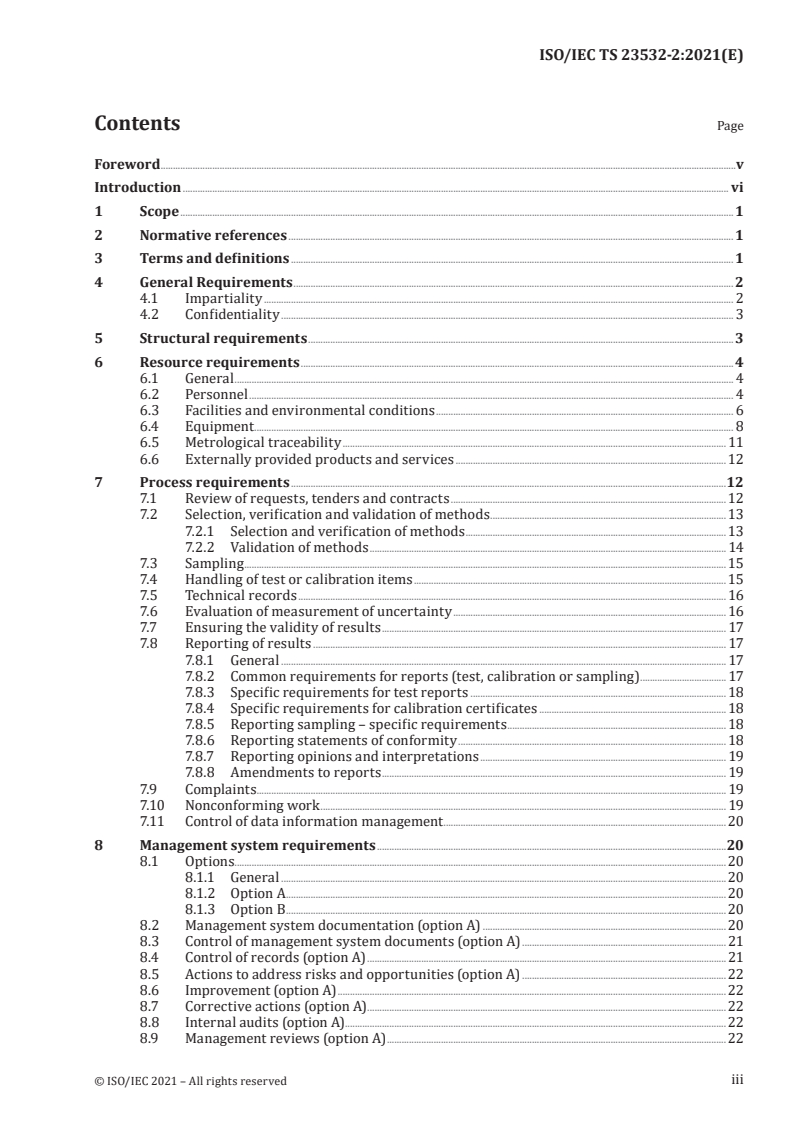
Contents Page
Foreword .v
Introduction . vi
1 Scope . 1
2 Normative references . 1
3 Terms and definitions . 1
4 General Requirements . 2
4.1 Impartiality . 2
4.2 Confidentiality . 3
5 Structural requirements .3
6 Resource requirements .4
6.1 General . 4
6.2 Personnel . 4
6.3 Facilities and environmental conditions . 6
6.4 Equipment . 8
6.5 Metrological traceability . 11
6.6 Externally provided products and services .12
7 Process requirements .12
7.1 Review of requests, tenders and contracts .12
7.2 Selection, verification and validation of methods . 13
7.2.1 Selection and verification of methods . 13
7.2.2 Validation of methods . 14
7.3 Sampling . 15
7.4 Handling of test or calibration items . 15
7.5 Technical records . 16
7.6 Evaluation of measurement of uncertainty . 16
7.7 Ensuring the validity of results . 17
7.8 Reporting of results . 17
7.8.1 General . 17
7.8.2 Common requirements for reports (test, calibration or sampling) . 17
7.8.3 Specific requirements for test reports . 18
7.8.4 Specific requirements for calibration certificates . 18
7.8.5 Reporting sampling – specific requirements . 18
7.8.6 Reporting statements of conformity . 18
7.8.7 Reporting opinions and interpretations . 19
7.8.8 Amendments to reports . 19
7.9 Complaints. 19
7.10 Nonconforming work . 19
7.11 Control of data information management . 20
8 Management system requirements .20
8.1 Options. 20
8.1.1 General .20
8.1.2 Option A . 20
8.1.3 Option B . 20
8.2 Management system documentation (option A) . 20
8.3 Control of management system documents (option A) . 21
8.4 Control of records (option A) . 21
8.5 Actions to address risks and opportunities (option A) . 22
8.6 Improvement (option A) . 22
8.7 Corrective actions (option A) . 22
8.8 Internal audits (option A). 22
8.9 Management reviews (option A) . 22
iii
© ISO/IEC 2021 – All rights reserved
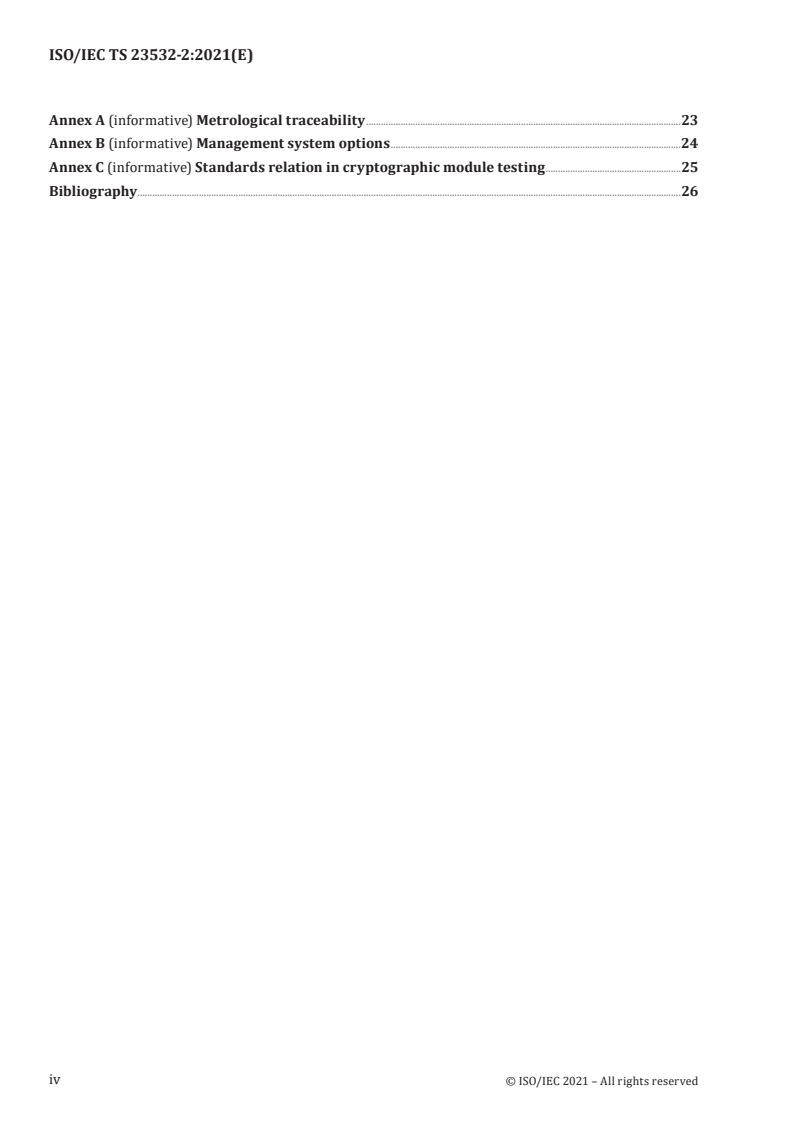
Annex A (informative) Metrological traceability .23
Annex B (informative) Management system options .24
Annex C (informative) Standards relation in cryptographic module testing .25
Bibliography .26
iv
© ISO/IEC 2021 – All rights reserved
Foreword
ISO (the International Organization for Standardization) and IEC (the International Electrotechnical
Commission) form the specialized system for worldwide standardization. National bodies that are
members of ISO or IEC participate in the development of International Standards through technical
committees established by the respective organization to deal with particular fields of technical
activity. ISO and IEC technical committees collaborate in fields of mutual interest. Other international
organizations, governmental and non-governmental, in liaison with ISO and IEC, also take part in the
work.
The procedures used to develop this document and those intended for its further maintenance
are described in the ISO/IEC Directives, Part 1. In particular, the different approval criteria
needed for the different types of document should be noted. This document was drafted in
accordance with the editorial rules of the ISO/IEC Directives, Part 2 (see www.iso.org/directives or
www.iec.ch/members_experts/refdocs).
Attention is drawn to the possibility that some of the elements of this document may be the subject
of patent rights. ISO and IEC shall not be held responsible for identifying any or all such patent
rights. Details of any patent rights identified during the development of the document will be in the
Introduction and/or on the ISO list of patent declarations received (see www.iso.org/patents) or the IEC
list of patent declarations received (see https://patents.iec.ch).
Any trade name used in this document is information given for the convenience of users and does not
constitute an endorsement.
For an explanation of the voluntary nature of standards, the meaning of ISO specific terms and
expressions related to conformity assessment, as well as information about ISO's adherence to
the World Trade Organization (WTO) principles in the Technical Barriers to Trade (TBT) see
www.iso.org/iso/foreword.html. In the IEC, see www.iec.ch/understanding-standards.
This document was prepared by Joint Technical Committee ISO/IEC JTC 1, Information technology,
Subcommittee SC 27, Information security, cybersecurity and privacy protection.
A list of all parts in the ISO/IEC 23532 series can be found on the ISO and IEC websites.
Any feedback or questions on this document should be directed to the user’s national standards
body. A complete listing of these bodies can be found at www.iso.org/members.html and
www.iec.ch/national-committees.
v
© ISO/IEC 2021 – All rights reserved
Introduction
Laboratories performing testing for conformance to ISO/IEC 19790 and the test requirements in
ISO/IEC 24759 may utilize and require conformance to ISO/IEC 17025:2017. ISO/IEC 17025:2017 gives
generalized requirements for a broad range of testing and calibration laboratories to enable them to
demonstrate that they operate competently and are able to generate valid results.
Laboratories that perform such validations have specific requirements for competence to ISO/IEC 19790
that will enable them to generate valid results.
By providing additional details and supplementary requirements to ISO/IEC 17025:2017 that are specific
to information security testing and evaluation laboratories, this document will facilitate cooperation
and better conformity and harmonization between laboratories and other bodies. This document
may be used by countries and accreditation bodies as a set of requirements for lab assessments and
accreditations.
To help implementers, this document is numbered identically to ISO/IEC 17025:2017. Supplementary
requirements are presented as subclauses additional to ISO/IEC 17025:2017.
vi
© ISO/IEC 2021 – All rights reserved
TECHNICAL SPECIFICATION ISO/IEC TS 23532-2:2021(E)
Information security, cybersecurity and privacy
protection — Requirements for the competence of IT
security testing and evaluation laboratories —
Part 2:
Testing for ISO/IEC 19790
1 Scope
This document complements and supplements the procedures and general requirements found in
ISO/IEC 17025:2017 for laboratories performing testing based on ISO/IEC 19790 and ISO/IEC 24759.
2 Normative references
The following documents are referred to in the text in such a way that some or all of their content
constitutes requirements of this document. For dated references, only the edition cited applies. For
undated references, the latest edition of the referenced document (including any amendments) applies.
ISO/IEC 17000, Conformity assessment — Vocabulary and general principles
ISO/IEC 17025:2017, General requirements for the competence of testing and calibration laboratories
ISO/IEC 19790, Information technology — Security techniques — Security requirements for cryptographic
modules
ISO/IEC 19896-1, IT security techniques — Competence requirements for information security testers and
evaluators — Part 1: Introduction, concepts and general requirements
ISO/IEC 19896-2, IT security techniques — Competence requirements for information security testers and
evaluators — Part 2: Knowledge, skills and effectiveness requirements for ISO/IEC 19790 testers
3 Terms and definitions
For the purposes of this document, the terms and definitions given in in ISO/IEC 17000,
ISO/IEC 17025:2017, ISO/IEC 19790, ISO/IEC 19896-1, ISO/IEC 19896-2 and the following apply.
ISO and IEC maintain terminology databases for use in standardization at the following addresses:
— ISO Online browsing platform: available at https:// www .iso .org/ obp
— IEC Electropedia: available at https:// www .electropedia .org/
3.1
cryptographic security testing laboratory
testing laboratory
laboratory performing cryptographic module security testing and/or cryptographic algorithms
conformance testing
Note 1 to entry: See ISO/IEC 24759 for cryptographic module security testing.
Note 2 to entry: See ISO/IEC 18367 for cryptographic algorithms conformance testing.
© ISO/IEC 2021 – All rights reserved
3.2
implementation under test
IUT
implementation which is tested based on methods specified in this document
[SOURCE: ISO/IEC 17825:2016, 3.9, modified — "International Standard" changed to "document".]
4 General Requirements
4.1 Impartiality
4.1.1 ISO/IEC 17025:2017, 4.1.1 applies.
4.1.1.1 ISO/IEC 17025:2017, 4.1.1 applies with the following additions.
The laboratory shall establish and maintain policies and procedures for maintaining laboratory
impartiality and integrity in the conduct of cryptographic testing. To avoid any conflict of interest,
laboratory policies and procedures shall ensure that the laboratory cannot perform conformance
testing if it is currently providing, or has previously provided consulting services, to the vendor for the
implementation under test (IUT) (e.g. develop testing evidence, design advice).
NOTE A laboratory can provide clarification of the standards, the test requirements, and other associated
documents at any time during the life cycle of the IUT which is not deemed a conflict of interest.
4.1.2 ISO/IEC 17025:2017, 4.1.2 applies.
4.1.2.1 ISO/IEC 17025:2017, 4.1.2 applies with the following additions.
The laboratory shall have no financial interest for the work performed other than its conformance
testing and/or validation fees.
4.1.3 ISO/IEC 17025:2017, 4.1.3 applies.
4.1.3.1 ISO/IEC 17025:2017, 4.1.3 applies with the following additions.
The laboratory shall not perform conformance testing on a module for which the laboratory has:
a) designed any part of the IUT;
b) developed original documentation for any part of the IUT;
c) built, coded or implemented any part of the IUT;
d) had any ownership or vested interest in the IUT; or
e) provided consulting for any part of the IUT.
NOTE The laboratory can perform conformance testing on an IUT produced by a company when:
— the laboratory has no ownership in the company;
— the laboratory has a separate management from the company; and
— business between the cryptographic security testing laboratory and the company is performed under
contractual agreements, as done with other clients.
© ISO/IEC 2021 – All rights reserved
4.1.4 ISO/IEC 17025:2017, 4.1.4 applies.
4.1.4.1 ISO/IEC 17025:2017, 4.1.4 applies with the following additions.
A laboratory may take existing vendor documentation for an IUT (post-design and post-development)
and consolidate or reformat the information (from multiple sources) into a set format.
4.1.5 ISO/IEC 17025:2017, 4.1.5 applies.
4.2 Confidentiality
4.2.1 ISO/IEC 17025:2017, 4.2.1 applies.
4.2.2 ISO/IEC 17025:2017, 4.2.2 applies.
4.2.3 ISO/IEC 17025:2017, 4.2.3 applies.
4.2.4 ISO/IEC 17025:2017, 4.2.4 applies.
5 Structural requirements
5.1 ISO/IEC 17025:2017, 5.1 applies.
5.1.1 ISO/IEC 17025:2017, 5.1 applies with the following additions.
Laboratories shall ensure separation between laboratory testers and the company’s resources who
may have an interest in or may influence testing outcome.
5.1.2 ISO/IEC 17025:2017, 5.1 applies with the following additions.
For any other services of the laboratory’s parent corporation not listed in 5.1, the laboratory shall
have an explicit policy and a set of procedures for maintaining a strict separation, both physical and
electronic, between the laboratory testers and company’s consultant teams, product developers, system
integrators, and others who may have an interest in and/or may unduly influence the testing outcome.
5.2 ISO/IEC 17025:2017, 5.2 applies.
5.3 ISO/IEC 17025:2017, 5.3 applies.
5.3.1 ISO/IEC 17025:2017, 5.3 applies with the following additions.
The laboratory shall define and state the scope of laboratory activities including the following:
a) selected standard(s);
EXAMPLE 1 Such as ISO/IEC 19790 and ISO/IEC 24759 which address cryptographic module requirements
and testing.
1) security level(s) and area(s);
EXAMPLE 2 Such as up to overall security rating 2 and physical security level 3.
2) physical embodiment(s);
EXAMPLE 3 Such as multi-chip embedded cryptographic modules and multi-chip standalone
cryptographic modules.
© ISO/IEC 2021 – All rights reserved
3) type(s) of cryptographic modules;
EXAMPLE 4 Such as a software (cryptographic) module.
b) laboratory's permanent facility.
5.3.2 ISO/IEC 17025:2017, 5.3 applies with the following optional additions.
The laboratory should define and state the scope of laboratory activities including the following:
a) categories of cryptographic algorithms and protocols which the laboratory is competent to test;
EXAMPLE 1 Such as symmetric key cryptographic algorithms and dedicated hash functions.
EXAMPLE 2 Such as various cryptographic algorithms employed in Transport Layer Security (TLS)
protocol.
b) product technology types which the laboratory is competent to test.
EXAMPLE 3 Such as USB flash drives.
EXAMPLE 4 Such as Self-Encrypting Drives with SATA interface.
EXAMPLE 5 Such as network encryption devices with IPsec protocol.
5.4 ISO/IEC 17025:2017, 5.4 applies.
5.5 ISO/IEC 17025:2017, 5.5 applies.
5.6 ISO/IEC 17025:2017, 5.6 applies.
5.7 ISO/IEC 17025:2017, 5.7 applies.
6 Resource requirements
6.1 General
ISO/IEC 17025:2017, 6.1 applies.
6.1.1 ISO/IEC 17025:2017, 6.1 applies with the following additions.
The management system documentation shall contain all documentation that describes and
details the laboratory’s implementation of procedures covering all the technical requirements in
ISO/IEC 17025:2017 and this document.
6.2 Personnel
6.2.1 ISO/IEC 17025:2017, 6.2.1 applies.
6.2.1.1 ISO/IEC 17025:2017, 6.2.1 applies with the following additions.
The laboratory shall maintain responsible supervisory personnel and competent technical staff that
are:
a) knowledgeable of all scheme-specific test methods, test metrics and implementation guidance;
b) knowledgeable of all relevant international standards, and references in this document;
© ISO/IEC 2021 – All rights reserved
c) familiar with cryptographic terminology and families of cryptographic algorithms and security
functions; and
d) familiar with the cryptographic testing tools.
6.2.1.2 ISO/IEC 17025:2017, 6.2.1 applies with the following additions.
The laboratory shall continuously maintain competent testers.
NOTE See ISO/IEC 19896-2 for a definition of areas that constitute required proficiency.
6.2.2 ISO/IEC 17025:2017, 6.2.2 applies.
NOTE 1 The "technical knowledge" in ISO/IEC 17025:2017, 6.2.2 is described in ISO/IEC 19896-2:2018,
Clause 6.
NOTE 2 The "skills" in ISO/IEC 17025:2017, 6.2.2 are described in ISO/IEC 19896-2:2018, Clause 7.
6.2.2.1 ISO/IEC 17025:2017, 6.2.2 applies with the following additions.
The laboratory shall maintain a list of the key personnel, including their assigned roles and a summary
of their latest training qualifications. The list shall include, but shall not be limited to:
a) laboratory director;
b) laboratory manager(s);
c) staff members(s) responsible for maintaining management system;
d) authorized representative;
e) approved signatories; and
f) other key technical persons in the laboratory (e.g. testers).
NOTE 1 Significant change in a laboratory’s key technical personnel or facilities can result in a laboratory no
longer being deemed proficient by relevant scheme owner(s).
NOTE 2 In order to perform objective and meaningful reviews of reported results in ISO/IEC 17025:2017, 7.7.1,
item i), the laboratory can employ multiple testers to ensure that another qualified and competent tester is in
charge of the review, who is not involved in testing the IUT subject to review.
6.2.2.2 ISO/IEC 17025:2017, 6.2.2 applies with the following additions.
Laboratories shall document the required qualifications for each staff position.
NOTE Staff information can be kept in the official personnel folders.
6.2.2.3 ISO/IEC 17025:2017, 6.2.2 applies with the following additions.
The number of qualified testers within the laboratory shall be greater than or equal to the scheme-
specific minimum required number of testers.
EXAMPLE Such as a minimum of two qualified testers.
6.2.3 ISO/IEC 17025:2017, 6.2.3 applies.
6.2.3.1 ISO/IEC 17025:2017, 6.2.3 applies with the following additions.
If the mechanism by which the laboratory employs staff members is through contracting of personnel,
any key personnel who are contractors shall be identified and listed.
© ISO/IEC 2021 – All rights reserved
6.2.4 ISO/IEC 17025:2017, 6.2.4 applies.
6.2.4.1 ISO/IEC 17025:2017, 6.2.4 applies with the following additions.
An individual may be assigned or appointed to serve in more than one position provided it does not
create a conflict of interest and maintains impartiality. To the extent possible, the laboratory director
and the person responsible for implementing and maintaining the management system should be
independently staffed.
6.2.5 ISO/IEC 17025:2017, 6.2.5 applies.
6.2.5.1 ISO/IEC 17025:2017, 6.2.5 applies with the following additions.
The laboratory person(s) responsible for implementing and maintaining the management system shall
receive management system training preferably in ISO/IEC 17025:2017. If training is not available in
ISO/IEC 17025:2017, minimum training shall be acquired in the ISO 9000 family of standards, especially
ISO 9001, or equivalent with emphasis for internal auditing.
6.2.5.2 ISO/IEC 17025:2017, 6.2.5 applies with the following additions.
The laboratory shall have a competency review program and procedures for the evaluation and
maintenance of the competency of each staff member for each test method the staff member is
authorized to conduct. An evaluation and an observation of performance shall be conducted annually
for each staff member by the immediate supervisor or a designee appointed by the laboratory director.
A record of the annual evaluation of each staff member shall be dated and signed by the supervisor and
the employee.
6.2.5.3 ISO/IEC 17025:2017, 6.2.5 applies with the following additions.
The laboratory management shall ensure adequate training for the laboratory staff as directed in
6.2.5.1. The personnel shall possess knowledge of or be trained in ISO/IEC 19896-2.
6.2.6 ISO/IEC 17025:2017, 6.2.6 applies.
6.3 Facilities and environmental conditions
6.3.1 ISO/IEC 17025:2017, 6.3.1 applies.
6.3.1.1 ISO/IEC 17025:2017, 6.3.1 applies with the following additions.
The laboratory shall have its internal networks protected from unauthorized access by external
entities, as well as protection against malicious software.
6.3.1.2 ISO/IEC 17025:2017, 6.3.1 applies with the following additions.
Within the internal networks, information/data shall be protected commensurate with their
classification and/or sensitivity, and access to them shall be given only to authorized personnel.
6.3.1.3 ISO/IEC 17025:2017, 6.3.1 applies with the following additions.
NOTE In considering a test setup of an IUT, the test harness and supporting/surrounding test apparatus can
impose constraints such as performance and availability. Such equipment is appropriately selected.
EXAMPLE Network throughput may affect the determination of pass/fail of assertion [04.50] (the strength
of the authentication objective), because the number of authentication requests can be limited by the network
throughput.
© ISO/IEC 2021 – All rights reserved
6.3.1.4 ISO/IEC 17025:2017, 6.3.1 applies with the following additions.
The laboratory shall have Internet access for obtaining the most current documentation and test tools
and secure communication capabilities.
6.3.2 ISO/IEC 17025:2017, 6.3.2 applies.
6.3.3 ISO/IEC 17025:2017, 6.3.3 applies.
6.3.4 ISO/IEC 17025:2017, 6.3.4 applies.
6.3.4.1 ISO/IEC 17025:2017, 6.3.4 applies with the following additions.
The laboratory shall have appropriate areas, including ventilation and safety, for the use of test methods
using chemical solvents and heating/cooling apparatus.
6.3.5 ISO/IEC 17025:2017, 6.3.5 applies.
6.3.5.1 ISO/IEC 17025:2017, 6.3.5 applies with the following additions.
Temporary off-site locations may be used for performing physical testing (e.g. vendor sites or specialized
physical testing facility such as a university lab).
6.3.5.2 ISO/IEC 17025:2017, 6.3.5 applies with the following additions.
If a laboratory conducts conformance testing at a location outside the laboratory facility, the
environment shall conform, as appropriate, to the requirements of this document.
6.3.5.3 ISO/IEC 17025:2017, 6.3.5 applies with the following additions.
Testing activities may also be conducted at the vendor site. When testing is performed at a vendor site,
all requirements in this document pertaining to equipment and environment as they apply to the tests
scheduled outside the laboratory’s permanent location, shall apply. Only the personnel of the laboratory
shall perform all actions necessary to conduct the tests and record the results, including the loading,
compiling, configuring, and execution of any of the mandated testing tools.
6.3.5.4 ISO/IEC 17025:2017, 6.3.5 applies with the following additions.
IUT specific documentation, specific test jigs, harnesses, supporting test apparatus or test results,
shall be protected (e.g. from physical, logical, or visual access) from persons outside the laboratory,
from visitors to the laboratory, from laboratory personnel without a need to know, and from other
unauthorized persons.
a) The laboratory manager shall identify and document for each specific IUT the laboratory personnel
who either have a need to know or have authorized access of the IUT, documentation and testing
related apparatus including rationale for such access.
b) An audit log shall be maintained documenting personnel who have had access to each IUT during
the contracted timeframe and all supporting documentation and testing related apparatus.
Authorized vendor personnel for the IUT under contract may be granted access by the laboratory
per the contract.
6.3.5.5 ISO/IEC 17025:2017, 6.3.5 applies with the following additions.
If a vendor’s system on which testing is conducted is potentially open to access by third parties, the
laboratory shall ensure that the testing environment is controlled so that the third parties do not gain
access to that system during testing.
© ISO/IEC 2021 – All rights reserved
6.4 Equipment
6.4.1 ISO/IEC 17025:2017, 6.4.1 applies.
NOTE 1 Special equipment can be necessary for particular test methods. For more information regarding
types of equipment and information required for conducting the conformance tests, see ISO/IEC 24759 and
ISO/IEC 19896-2.
NOTE 2 Test equipment refers to software and hardware products and/or other assessment mechanisms used
by the laboratory to support the cryptographic testing of the IUT.
6.4.1.1 ISO/IEC 17025:2017, 6.4.1 applies with the following additions.
The laboratory shall ensure that, when applicable, the correct version of testing tools is used and that
the tools have not been altered in any way that might lead to incorrect results.
6.4.1.2 ISO/IEC 17025:2017, 6.4.1 applies with the following additions.
The laboratory shall have appropriate hardware, software, test tools and computer facilities to conduct
cryptographic testing. This includes, but is not limited to:
a) required software test suites;
b) testing equipment for physical tests; and
c) all special equipment necessary to perform all tests derived from the most current version of the
standard.
6.4.1.2.1 The laboratory shall own at least one designated workstation and shall have Internet access
and e-mail capability. Workstations shall have interfaces for loading images from a digital camera and
acquiring scanned document images and/or hard copy printouts. Workstations shall have sufficient
storage capability, performance and features as specified by the tool provider.
EXAMPLE In case that maintenance of workstations is required, it is recommended to select "keep your
HDD" service option in purchasing the workstations so that maintenance service operators do not access the
HDD containing sensitive data.
6.4.1.2.2 The laboratory shall also meet the following minimum requirements for hardware, software
and firmware components:
a) hardware components: security levels 1 to 4:
1) tools to conduct testing of tamper evidence on coatings;
2) tools to conduct enclosure removal/penetration test;
3) tools to conduct physical and thermal coating/potting removal/penetration tests;
4) tools to conduct opacity and probing tests;
5) tools to conduct tests on locks;
6) tools to conduct mechanical/thermal/chemical tests on tamper evidence label removability;
7) tools to test tamper detection mechanisms/switches on doors and removable covers;
8) digital camera with flash and macro (near focus) features (phones are not acceptable);
9) tools to conduct tests on fasteners (e.g. drills);
10) tools to monitor/capture/exercise the data input/output of cryptographic module interfaces, at
logical level (procured, rented, or leased, as needed).
© ISO/IEC 2021 – All rights reserved
EXAMPLE 1 Such as network analyser, packet analyser, USB protocol analyser/exerciser, SATA
protocol analyser/exerciser, PCI express protocol analyser.
NOTE 1 This is also related to ISO/IEC 17025:2017, 6.4.5.
NOTE 2 The cryptographic module interfaces would be specified from a high-level layer, e.g.
application layer ultimately down to physical layer for hardware modules. Cryptographic module
security requirements about cryptographic module interfaces are applicable several layers, therefore
it is possible that this is not enough just to test only at very high-level layer from cryptographic module
validation perspective.
EXAMPLE 2 Such as testing cryptographic modules of layer 3 encryptor by using layer 7 (i.e.
application layer) commands.
b) hardware components: additional requirements for security levels 3 to 4:
1) variable power supply;
2) temperature chamber (procured, rented, or leased, as needed);
3) digital storage oscilloscope or logic analyser (procured, rented, or leased, as needed);
4) non-invasive security:
i) digital oscilloscope with enough band width (procured, rented, or leased, as needed);
NOTE 3 Here the band width will be at least greater than or equal to the clock frequency of the
IUT. It is said that digital oscilloscopes with band width of 2,5 GHz or higher have built-in preamplifiers
superior to those of narrower band width. Also, high resolution (i.e. A/D conversion bits with more
than 8-bit) can be used to discriminate subtle difference in information leakage, which would affect the
number of waveforms required to perform side-channel analysis.
ii) tools to acquire voltage drop, or electromagnetic emanation (e.g. differential probe, pick-
up coil) for side-channel analysis;
NOTE 4 Near-field microprobes can be characterised by their diameter and gain characteristic
curve. It can be required to select which microprobes are to be used depending on the characteristic of
an IUT.
c) hardware components: additional requirements for security level 4:
1) tools to conduct enclosure testing (e.g. grilling, milling);
2) tools to test tamper detection envelope;
3) solvents to conduct chemical coating removal tests;
d) software components (security levels 1 to 2) and firmware components (security levels 1 to 4):
1) tools to conduct software testing - appropriate compilers, debuggers, and binary editors;
e) reporting tools:
1) ISO/IEC 19790 and ISO/IEC 24759 tools (latest version).
6.4.1.2.3 Chemical solvents and adhesive remover will likely have their own expiry date for their
quality. Such consumables shall be checked periodically for validity, or newly purchased on-demand for
IUT testing.
6.4.1.2.4 If non-invasive security area with security level 3 or 4 is included in the scope of laboratory
activity, a Faraday cage or EMI shield box shall be required with temperature control.
6.4.2 ISO/IEC 17025:2017, 6.4.2 applies.
© ISO/IEC 2021 – All rights reserved
EXAMPLE Digital oscilloscopes shipped to a calibration service, or equipment taken out from the laboratory
but still inside the company to be used for other purpose or used by an intern.
6.4.3 ISO/IEC 17025:2017, 6.4.3 applies.
6.4.3.1 ISO/IEC 17025:2017, 6.4.3 applies with the following additions.
Confirmation of the use of the most current version of testing tools shall be assured before conducting a
test. Records of these confirmations shall be maintained.
6.4.3.2 ISO/IEC 17025:2017, 6.4.3 applies with the following additions.
The equipment used for conducting cryptographic testing shall be maintained in accordance with
the manufacturer’s recommendations and in accordance with internally documented laboratory
procedures, as applicable.
6.4.3.3 ISO/IEC 17025:2017, 6.4.3 applies with the following additions.
Whenever major or minor changes are made to any testing tool, a laboratory shall have procedures to
assure the accurate execution and correct performance of the test tool. The procedures shall include,
at a minimum, the complete set of regression testing of the test tool. This is necessary to ensure that
consistency is maintained, as appropriate, with other laboratories and that correctness is maintained
with respect to the relevant standard(s) or specification(s).
6.4.3.4 ISO/IEC 17025:2017, 6.4.3 applies with the following additions.
If applicable, the equipment used for conducting the conformance tests shall be maintained and
calibrated in accordance with the manufacturer’s recommendation, as specified in the test method, or
as specified in the annex associated with the specific test method(s).
6.4.4 ISO/IEC 17025:2017, 6.4.4 applies.
6.4.4.1 ISO/IEC 17025:2017, 6.4.4 applies with the following additions.
The laboratory shall ensure that any test tool used to conduct cryptographic testing is performing
properly according to specifications. The laboratory shall also ensure that the tool does not interfere
with the conduct of the test and does not modify or impact the IUT.
6.4.5 ISO/IEC 17025:2017, 6.4.5 applies.
6.4.6 ISO/IEC 17025:2017, 6.4.6 applies.
6.4.7 ISO/IEC 17025:2017, 6.4.7 applies.
6.4.7.1 ISO/IEC 17025:2017, 6.4.7 applies with the following additions.
For calibrations performed in-house, the reference standards used and the environmental conditions at
the time of calibration shall be documented for all calibrations. Calibration records and evidence of the
traceability of the reference standards used shall be readily available.
6.4.8 ISO/IEC 17025:2017, 6.4.8 applies.
© ISO/IEC 2021 – All rights reserved
6.4.9 ISO/IEC 17025:2017, 6.4.9 applies.
6.4.9.1 ISO/IEC 17025:2017, 6.4.9 applies with the following additions.
The laboratory shall document and follow appropriate procedures whenever a test tool suspected or
found to contain errors that make the tool defective or unfit for use. These procedures shall include
establishing that there is a genuine error, reporting the error to the appropriate maintenance authority.
If the conformance testing results change for an IUT after correcting the test tool, then the information
shall be clearly identified.
6.4.10 ISO/IEC 17025:2017, 6.4.10 applies.
6.4.11 ISO/IEC 17025:2017, 6.4.11 applies.
6.4.12 ISO/IEC 17025:2017, 6.4.12 applies.
6.4.13 ISO/IEC 17025:2017, 6.4.13 applies.
6.4.13.1 ISO/IEC 17025:2017, 6.4.13 applies with the following additions.
The laboratory shall maintain a record of the tools used for each test report involving physical testing.
6.4.13.2 ISO/IEC 17025:2017, 6.4.13 applies with the following additions.
Laboratories shall maintain records of the configuration of test equipment (hardware and software)
and all analyses to ensure the suitability of test equipment to perform the desired testing.
6.4.13.3 ISO/IEC 17025:2017, 6.4.13 applies with the following additions.
Records shall be kept of the date, extent of all hardware and software upgrades and updates, and
periods of use.
6.5 Metrological traceability
6.5.1 ISO/IEC 17025:2017, 6.5.1 applies.
NOTE See Annex A for additional information on metrological traceability.
6.5.1.1 ISO/IEC 17025:2017, 6.5.1 applies with the following additions.
For cryptographic testing, “traceability” is interpreted to mean that the test tools shall be traceable
back to the underlying requirements in ISO/IEC 19790 and ISO/IEC 24759. This means that each
abstract test case and the associated testing methodology are traceable to a specific cryptographic
requirement listed in the governing documentary standard. Test results produced by the laboratory
shall be traceable to standard test suites when appropriate, or otherwise to the applicable authoritative
test suite.
NOTE Traceability to the International Standards requirements is achieved via the assertions, the associated
test requirement documents and provided validation authorities test reporting tools. ISO/IEC 24759 is divided
into two sets of requirements: one levied on the vendor and one levied on the tester of the cryptographic module.
6.5.2 ISO/IEC 17025:2017, 6.5.2 applies.
6.5.3 ISO/IEC 17025:2017, 6.5.3 applies.
© ISO/IEC 2021 – All rights reserved
6.5.4 ISO/IEC 17025:2017, 6.5 applies with the following additions.
6.5.4.1 Test vectors and results for cryptographic algorithm testing shall be generated and checked
using a validation authorities' tool if provided.
NOTE 1 Tools for cryptographic algorithm testing can be purposely designed to detect well-known or foreseen
nonconforming implementations of cryptographic algorithms selected. However, there can be a limit in the
capability of detecting such nonconforming implementations, e.g. due to limited number of test vectors provided
to each IUT, and/or due to the limited test coverage of requirements in the cryptographic algorithm standards
selected.
NOTE 2 There can be tools for estimating entropy for the raw output of non-deterministic random bit
generators. Specifications of non-deterministic random bit generators are diverse, and therefore there would
be no "standard" to which designs of non-deterministic random bit generators trace back. From the viewpoint
of cryptographic module security requirements, only the value of entropy is essential for non-deterministic
random b
...
TECHNICAL ISO/IEC TS
SPECIFICATION 23532-2
First edition
2021-11
Information security, cybersecurity
and privacy protection —
Requirements for the competence
of IT security testing and evaluation
laboratories —
Part 2:
Testing for ISO/IEC 19790
Sécurité de l'information, cybersécurité et protection de la vie
privée — Exigences relatives aux compétences des laboratoires
d'essais et d'évaluation de la sécurité TI —
Partie 2: Essais pour l'ISO/IEC 19790
Reference number
© ISO/IEC 2021
© ISO/IEC 2021
All rights reserved. Unless otherwise specified, or required in the context of its implementation, no part of this publication may
be reproduced or utilized otherwise in any form or by any means, electronic or mechanical, including photocopying, or posting on
the internet or an intranet, without prior written permission. Permission can be requested from either ISO at the address below
or ISO’s member body in the country of the requester.
ISO copyright office
CP 401 • Ch. de Blandonnet 8
CH-1214 Vernier, Geneva
Phone: +41 22 749 01 11
Email: copyright@iso.org
Website: www.iso.org
Published in Switzerland
ii
© ISO/IEC 2021 – All rights reserved
Contents Page
Foreword .v
Introduction . vi
1 Scope . 1
2 Normative references . 1
3 Terms and definitions . 1
4 General Requirements . 2
4.1 Impartiality . 2
4.2 Confidentiality . 3
5 Structural requirements .3
6 Resource requirements .4
6.1 General . 4
6.2 Personnel . 4
6.3 Facilities and environmental conditions . 6
6.4 Equipment . 8
6.5 Metrological traceability . 11
6.6 Externally provided products and services .12
7 Process requirements .12
7.1 Review of requests, tenders and contracts .12
7.2 Selection, verification and validation of methods . 13
7.2.1 Selection and verification of methods . 13
7.2.2 Validation of methods . 14
7.3 Sampling . 15
7.4 Handling of test or calibration items . 15
7.5 Technical records . 16
7.6 Evaluation of measurement of uncertainty . 16
7.7 Ensuring the validity of results . 17
7.8 Reporting of results . 17
7.8.1 General . 17
7.8.2 Common requirements for reports (test, calibration or sampling) . 17
7.8.3 Specific requirements for test reports . 18
7.8.4 Specific requirements for calibration certificates . 18
7.8.5 Reporting sampling – specific requirements . 18
7.8.6 Reporting statements of conformity . 18
7.8.7 Reporting opinions and interpretations . 19
7.8.8 Amendments to reports . 19
7.9 Complaints. 19
7.10 Nonconforming work . 19
7.11 Control of data information management . 20
8 Management system requirements .20
8.1 Options. 20
8.1.1 General .20
8.1.2 Option A . 20
8.1.3 Option B . 20
8.2 Management system documentation (option A) . 20
8.3 Control of management system documents (option A) . 21
8.4 Control of records (option A) . 21
8.5 Actions to address risks and opportunities (option A) . 22
8.6 Improvement (option A) . 22
8.7 Corrective actions (option A) . 22
8.8 Internal audits (option A). 22
8.9 Management reviews (option A) . 22
iii
© ISO/IEC 2021 – All rights reserved
Annex A (informative) Metrological traceability .23
Annex B (informative) Management system options .24
Annex C (informative) Standards relation in cryptographic module testing .25
Bibliography .26
iv
© ISO/IEC 2021 – All rights reserved
Foreword
ISO (the International Organization for Standardization) and IEC (the International Electrotechnical
Commission) form the specialized system for worldwide standardization. National bodies that are
members of ISO or IEC participate in the development of International Standards through technical
committees established by the respective organization to deal with particular fields of technical
activity. ISO and IEC technical committees collaborate in fields of mutual interest. Other international
organizations, governmental and non-governmental, in liaison with ISO and IEC, also take part in the
work.
The procedures used to develop this document and those intended for its further maintenance
are described in the ISO/IEC Directives, Part 1. In particular, the different approval criteria
needed for the different types of document should be noted. This document was drafted in
accordance with the editorial rules of the ISO/IEC Directives, Part 2 (see www.iso.org/directives or
www.iec.ch/members_experts/refdocs).
Attention is drawn to the possibility that some of the elements of this document may be the subject
of patent rights. ISO and IEC shall not be held responsible for identifying any or all such patent
rights. Details of any patent rights identified during the development of the document will be in the
Introduction and/or on the ISO list of patent declarations received (see www.iso.org/patents) or the IEC
list of patent declarations received (see https://patents.iec.ch).
Any trade name used in this document is information given for the convenience of users and does not
constitute an endorsement.
For an explanation of the voluntary nature of standards, the meaning of ISO specific terms and
expressions related to conformity assessment, as well as information about ISO's adherence to
the World Trade Organization (WTO) principles in the Technical Barriers to Trade (TBT) see
www.iso.org/iso/foreword.html. In the IEC, see www.iec.ch/understanding-standards.
This document was prepared by Joint Technical Committee ISO/IEC JTC 1, Information technology,
Subcommittee SC 27, Information security, cybersecurity and privacy protection.
A list of all parts in the ISO/IEC 23532 series can be found on the ISO and IEC websites.
Any feedback or questions on this document should be directed to the user’s national standards
body. A complete listing of these bodies can be found at www.iso.org/members.html and
www.iec.ch/national-committees.
v
© ISO/IEC 2021 – All rights reserved
Introduction
Laboratories performing testing for conformance to ISO/IEC 19790 and the test requirements in
ISO/IEC 24759 may utilize and require conformance to ISO/IEC 17025:2017. ISO/IEC 17025:2017 gives
generalized requirements for a broad range of testing and calibration laboratories to enable them to
demonstrate that they operate competently and are able to generate valid results.
Laboratories that perform such validations have specific requirements for competence to ISO/IEC 19790
that will enable them to generate valid results.
By providing additional details and supplementary requirements to ISO/IEC 17025:2017 that are specific
to information security testing and evaluation laboratories, this document will facilitate cooperation
and better conformity and harmonization between laboratories and other bodies. This document
may be used by countries and accreditation bodies as a set of requirements for lab assessments and
accreditations.
To help implementers, this document is numbered identically to ISO/IEC 17025:2017. Supplementary
requirements are presented as subclauses additional to ISO/IEC 17025:2017.
vi
© ISO/IEC 2021 – All rights reserved
TECHNICAL SPECIFICATION ISO/IEC TS 23532-2:2021(E)
Information security, cybersecurity and privacy
protection — Requirements for the competence of IT
security testing and evaluation laboratories —
Part 2:
Testing for ISO/IEC 19790
1 Scope
This document complements and supplements the procedures and general requirements found in
ISO/IEC 17025:2017 for laboratories performing testing based on ISO/IEC 19790 and ISO/IEC 24759.
2 Normative references
The following documents are referred to in the text in such a way that some or all of their content
constitutes requirements of this document. For dated references, only the edition cited applies. For
undated references, the latest edition of the referenced document (including any amendments) applies.
ISO/IEC 17000, Conformity assessment — Vocabulary and general principles
ISO/IEC 17025:2017, General requirements for the competence of testing and calibration laboratories
ISO/IEC 19790, Information technology — Security techniques — Security requirements for cryptographic
modules
ISO/IEC 19896-1, IT security techniques — Competence requirements for information security testers and
evaluators — Part 1: Introduction, concepts and general requirements
ISO/IEC 19896-2, IT security techniques — Competence requirements for information security testers and
evaluators — Part 2: Knowledge, skills and effectiveness requirements for ISO/IEC 19790 testers
3 Terms and definitions
For the purposes of this document, the terms and definitions given in in ISO/IEC 17000,
ISO/IEC 17025:2017, ISO/IEC 19790, ISO/IEC 19896-1, ISO/IEC 19896-2 and the following apply.
ISO and IEC maintain terminology databases for use in standardization at the following addresses:
— ISO Online browsing platform: available at https:// www .iso .org/ obp
— IEC Electropedia: available at https:// www .electropedia .org/
3.1
cryptographic security testing laboratory
testing laboratory
laboratory performing cryptographic module security testing and/or cryptographic algorithms
conformance testing
Note 1 to entry: See ISO/IEC 24759 for cryptographic module security testing.
Note 2 to entry: See ISO/IEC 18367 for cryptographic algorithms conformance testing.
© ISO/IEC 2021 – All rights reserved
3.2
implementation under test
IUT
implementation which is tested based on methods specified in this document
[SOURCE: ISO/IEC 17825:2016, 3.9, modified — "International Standard" changed to "document".]
4 General Requirements
4.1 Impartiality
4.1.1 ISO/IEC 17025:2017, 4.1.1 applies.
4.1.1.1 ISO/IEC 17025:2017, 4.1.1 applies with the following additions.
The laboratory shall establish and maintain policies and procedures for maintaining laboratory
impartiality and integrity in the conduct of cryptographic testing. To avoid any conflict of interest,
laboratory policies and procedures shall ensure that the laboratory cannot perform conformance
testing if it is currently providing, or has previously provided consulting services, to the vendor for the
implementation under test (IUT) (e.g. develop testing evidence, design advice).
NOTE A laboratory can provide clarification of the standards, the test requirements, and other associated
documents at any time during the life cycle of the IUT which is not deemed a conflict of interest.
4.1.2 ISO/IEC 17025:2017, 4.1.2 applies.
4.1.2.1 ISO/IEC 17025:2017, 4.1.2 applies with the following additions.
The laboratory shall have no financial interest for the work performed other than its conformance
testing and/or validation fees.
4.1.3 ISO/IEC 17025:2017, 4.1.3 applies.
4.1.3.1 ISO/IEC 17025:2017, 4.1.3 applies with the following additions.
The laboratory shall not perform conformance testing on a module for which the laboratory has:
a) designed any part of the IUT;
b) developed original documentation for any part of the IUT;
c) built, coded or implemented any part of the IUT;
d) had any ownership or vested interest in the IUT; or
e) provided consulting for any part of the IUT.
NOTE The laboratory can perform conformance testing on an IUT produced by a company when:
— the laboratory has no ownership in the company;
— the laboratory has a separate management from the company; and
— business between the cryptographic security testing laboratory and the company is performed under
contractual agreements, as done with other clients.
© ISO/IEC 2021 – All rights reserved
4.1.4 ISO/IEC 17025:2017, 4.1.4 applies.
4.1.4.1 ISO/IEC 17025:2017, 4.1.4 applies with the following additions.
A laboratory may take existing vendor documentation for an IUT (post-design and post-development)
and consolidate or reformat the information (from multiple sources) into a set format.
4.1.5 ISO/IEC 17025:2017, 4.1.5 applies.
4.2 Confidentiality
4.2.1 ISO/IEC 17025:2017, 4.2.1 applies.
4.2.2 ISO/IEC 17025:2017, 4.2.2 applies.
4.2.3 ISO/IEC 17025:2017, 4.2.3 applies.
4.2.4 ISO/IEC 17025:2017, 4.2.4 applies.
5 Structural requirements
5.1 ISO/IEC 17025:2017, 5.1 applies.
5.1.1 ISO/IEC 17025:2017, 5.1 applies with the following additions.
Laboratories shall ensure separation between laboratory testers and the company’s resources who
may have an interest in or may influence testing outcome.
5.1.2 ISO/IEC 17025:2017, 5.1 applies with the following additions.
For any other services of the laboratory’s parent corporation not listed in 5.1, the laboratory shall
have an explicit policy and a set of procedures for maintaining a strict separation, both physical and
electronic, between the laboratory testers and company’s consultant teams, product developers, system
integrators, and others who may have an interest in and/or may unduly influence the testing outcome.
5.2 ISO/IEC 17025:2017, 5.2 applies.
5.3 ISO/IEC 17025:2017, 5.3 applies.
5.3.1 ISO/IEC 17025:2017, 5.3 applies with the following additions.
The laboratory shall define and state the scope of laboratory activities including the following:
a) selected standard(s);
EXAMPLE 1 Such as ISO/IEC 19790 and ISO/IEC 24759 which address cryptographic module requirements
and testing.
1) security level(s) and area(s);
EXAMPLE 2 Such as up to overall security rating 2 and physical security level 3.
2) physical embodiment(s);
EXAMPLE 3 Such as multi-chip embedded cryptographic modules and multi-chip standalone
cryptographic modules.
© ISO/IEC 2021 – All rights reserved
3) type(s) of cryptographic modules;
EXAMPLE 4 Such as a software (cryptographic) module.
b) laboratory's permanent facility.
5.3.2 ISO/IEC 17025:2017, 5.3 applies with the following optional additions.
The laboratory should define and state the scope of laboratory activities including the following:
a) categories of cryptographic algorithms and protocols which the laboratory is competent to test;
EXAMPLE 1 Such as symmetric key cryptographic algorithms and dedicated hash functions.
EXAMPLE 2 Such as various cryptographic algorithms employed in Transport Layer Security (TLS)
protocol.
b) product technology types which the laboratory is competent to test.
EXAMPLE 3 Such as USB flash drives.
EXAMPLE 4 Such as Self-Encrypting Drives with SATA interface.
EXAMPLE 5 Such as network encryption devices with IPsec protocol.
5.4 ISO/IEC 17025:2017, 5.4 applies.
5.5 ISO/IEC 17025:2017, 5.5 applies.
5.6 ISO/IEC 17025:2017, 5.6 applies.
5.7 ISO/IEC 17025:2017, 5.7 applies.
6 Resource requirements
6.1 General
ISO/IEC 17025:2017, 6.1 applies.
6.1.1 ISO/IEC 17025:2017, 6.1 applies with the following additions.
The management system documentation shall contain all documentation that describes and
details the laboratory’s implementation of procedures covering all the technical requirements in
ISO/IEC 17025:2017 and this document.
6.2 Personnel
6.2.1 ISO/IEC 17025:2017, 6.2.1 applies.
6.2.1.1 ISO/IEC 17025:2017, 6.2.1 applies with the following additions.
The laboratory shall maintain responsible supervisory personnel and competent technical staff that
are:
a) knowledgeable of all scheme-specific test methods, test metrics and implementation guidance;
b) knowledgeable of all relevant international standards, and references in this document;
© ISO/IEC 2021 – All rights reserved
c) familiar with cryptographic terminology and families of cryptographic algorithms and security
functions; and
d) familiar with the cryptographic testing tools.
6.2.1.2 ISO/IEC 17025:2017, 6.2.1 applies with the following additions.
The laboratory shall continuously maintain competent testers.
NOTE See ISO/IEC 19896-2 for a definition of areas that constitute required proficiency.
6.2.2 ISO/IEC 17025:2017, 6.2.2 applies.
NOTE 1 The "technical knowledge" in ISO/IEC 17025:2017, 6.2.2 is described in ISO/IEC 19896-2:2018,
Clause 6.
NOTE 2 The "skills" in ISO/IEC 17025:2017, 6.2.2 are described in ISO/IEC 19896-2:2018, Clause 7.
6.2.2.1 ISO/IEC 17025:2017, 6.2.2 applies with the following additions.
The laboratory shall maintain a list of the key personnel, including their assigned roles and a summary
of their latest training qualifications. The list shall include, but shall not be limited to:
a) laboratory director;
b) laboratory manager(s);
c) staff members(s) responsible for maintaining management system;
d) authorized representative;
e) approved signatories; and
f) other key technical persons in the laboratory (e.g. testers).
NOTE 1 Significant change in a laboratory’s key technical personnel or facilities can result in a laboratory no
longer being deemed proficient by relevant scheme owner(s).
NOTE 2 In order to perform objective and meaningful reviews of reported results in ISO/IEC 17025:2017, 7.7.1,
item i), the laboratory can employ multiple testers to ensure that another qualified and competent tester is in
charge of the review, who is not involved in testing the IUT subject to review.
6.2.2.2 ISO/IEC 17025:2017, 6.2.2 applies with the following additions.
Laboratories shall document the required qualifications for each staff position.
NOTE Staff information can be kept in the official personnel folders.
6.2.2.3 ISO/IEC 17025:2017, 6.2.2 applies with the following additions.
The number of qualified testers within the laboratory shall be greater than or equal to the scheme-
specific minimum required number of testers.
EXAMPLE Such as a minimum of two qualified testers.
6.2.3 ISO/IEC 17025:2017, 6.2.3 applies.
6.2.3.1 ISO/IEC 17025:2017, 6.2.3 applies with the following additions.
If the mechanism by which the laboratory employs staff members is through contracting of personnel,
any key personnel who are contractors shall be identified and listed.
© ISO/IEC 2021 – All rights reserved
6.2.4 ISO/IEC 17025:2017, 6.2.4 applies.
6.2.4.1 ISO/IEC 17025:2017, 6.2.4 applies with the following additions.
An individual may be assigned or appointed to serve in more than one position provided it does not
create a conflict of interest and maintains impartiality. To the extent possible, the laboratory director
and the person responsible for implementing and maintaining the management system should be
independently staffed.
6.2.5 ISO/IEC 17025:2017, 6.2.5 applies.
6.2.5.1 ISO/IEC 17025:2017, 6.2.5 applies with the following additions.
The laboratory person(s) responsible for implementing and maintaining the management system shall
receive management system training preferably in ISO/IEC 17025:2017. If training is not available in
ISO/IEC 17025:2017, minimum training shall be acquired in the ISO 9000 family of standards, especially
ISO 9001, or equivalent with emphasis for internal auditing.
6.2.5.2 ISO/IEC 17025:2017, 6.2.5 applies with the following additions.
The laboratory shall have a competency review program and procedures for the evaluation and
maintenance of the competency of each staff member for each test method the staff member is
authorized to conduct. An evaluation and an observation of performance shall be conducted annually
for each staff member by the immediate supervisor or a designee appointed by the laboratory director.
A record of the annual evaluation of each staff member shall be dated and signed by the supervisor and
the employee.
6.2.5.3 ISO/IEC 17025:2017, 6.2.5 applies with the following additions.
The laboratory management shall ensure adequate training for the laboratory staff as directed in
6.2.5.1. The personnel shall possess knowledge of or be trained in ISO/IEC 19896-2.
6.2.6 ISO/IEC 17025:2017, 6.2.6 applies.
6.3 Facilities and environmental conditions
6.3.1 ISO/IEC 17025:2017, 6.3.1 applies.
6.3.1.1 ISO/IEC 17025:2017, 6.3.1 applies with the following additions.
The laboratory shall have its internal networks protected from unauthorized access by external
entities, as well as protection against malicious software.
6.3.1.2 ISO/IEC 17025:2017, 6.3.1 applies with the following additions.
Within the internal networks, information/data shall be protected commensurate with their
classification and/or sensitivity, and access to them shall be given only to authorized personnel.
6.3.1.3 ISO/IEC 17025:2017, 6.3.1 applies with the following additions.
NOTE In considering a test setup of an IUT, the test harness and supporting/surrounding test apparatus can
impose constraints such as performance and availability. Such equipment is appropriately selected.
EXAMPLE Network throughput may affect the determination of pass/fail of assertion [04.50] (the strength
of the authentication objective), because the number of authentication requests can be limited by the network
throughput.
© ISO/IEC 2021 – All rights reserved
6.3.1.4 ISO/IEC 17025:2017, 6.3.1 applies with the following additions.
The laboratory shall have Internet access for obtaining the most current documentation and test tools
and secure communication capabilities.
6.3.2 ISO/IEC 17025:2017, 6.3.2 applies.
6.3.3 ISO/IEC 17025:2017, 6.3.3 applies.
6.3.4 ISO/IEC 17025:2017, 6.3.4 applies.
6.3.4.1 ISO/IEC 17025:2017, 6.3.4 applies with the following additions.
The laboratory shall have appropriate areas, including ventilation and safety, for the use of test methods
using chemical solvents and heating/cooling apparatus.
6.3.5 ISO/IEC 17025:2017, 6.3.5 applies.
6.3.5.1 ISO/IEC 17025:2017, 6.3.5 applies with the following additions.
Temporary off-site locations may be used for performing physical testing (e.g. vendor sites or specialized
physical testing facility such as a university lab).
6.3.5.2 ISO/IEC 17025:2017, 6.3.5 applies with the following additions.
If a laboratory conducts conformance testing at a location outside the laboratory facility, the
environment shall conform, as appropriate, to the requirements of this document.
6.3.5.3 ISO/IEC 17025:2017, 6.3.5 applies with the following additions.
Testing activities may also be conducted at the vendor site. When testing is performed at a vendor site,
all requirements in this document pertaining to equipment and environment as they apply to the tests
scheduled outside the laboratory’s permanent location, shall apply. Only the personnel of the laboratory
shall perform all actions necessary to conduct the tests and record the results, including the loading,
compiling, configuring, and execution of any of the mandated testing tools.
6.3.5.4 ISO/IEC 17025:2017, 6.3.5 applies with the following additions.
IUT specific documentation, specific test jigs, harnesses, supporting test apparatus or test results,
shall be protected (e.g. from physical, logical, or visual access) from persons outside the laboratory,
from visitors to the laboratory, from laboratory personnel without a need to know, and from other
unauthorized persons.
a) The laboratory manager shall identify and document for each specific IUT the laboratory personnel
who either have a need to know or have authorized access of the IUT, documentation and testing
related apparatus including rationale for such access.
b) An audit log shall be maintained documenting personnel who have had access to each IUT during
the contracted timeframe and all supporting documentation and testing related apparatus.
Authorized vendor personnel for the IUT under contract may be granted access by the laboratory
per the contract.
6.3.5.5 ISO/IEC 17025:2017, 6.3.5 applies with the following additions.
If a vendor’s system on which testing is conducted is potentially open to access by third parties, the
laboratory shall ensure that the testing environment is controlled so that the third parties do not gain
access to that system during testing.
© ISO/IEC 2021 – All rights reserved
6.4 Equipment
6.4.1 ISO/IEC 17025:2017, 6.4.1 applies.
NOTE 1 Special equipment can be necessary for particular test methods. For more information regarding
types of equipment and information required for conducting the conformance tests, see ISO/IEC 24759 and
ISO/IEC 19896-2.
NOTE 2 Test equipment refers to software and hardware products and/or other assessment mechanisms used
by the laboratory to support the cryptographic testing of the IUT.
6.4.1.1 ISO/IEC 17025:2017, 6.4.1 applies with the following additions.
The laboratory shall ensure that, when applicable, the correct version of testing tools is used and that
the tools have not been altered in any way that might lead to incorrect results.
6.4.1.2 ISO/IEC 17025:2017, 6.4.1 applies with the following additions.
The laboratory shall have appropriate hardware, software, test tools and computer facilities to conduct
cryptographic testing. This includes, but is not limited to:
a) required software test suites;
b) testing equipment for physical tests; and
c) all special equipment necessary to perform all tests derived from the most current version of the
standard.
6.4.1.2.1 The laboratory shall own at least one designated workstation and shall have Internet access
and e-mail capability. Workstations shall have interfaces for loading images from a digital camera and
acquiring scanned document images and/or hard copy printouts. Workstations shall have sufficient
storage capability, performance and features as specified by the tool provider.
EXAMPLE In case that maintenance of workstations is required, it is recommended to select "keep your
HDD" service option in purchasing the workstations so that maintenance service operators do not access the
HDD containing sensitive data.
6.4.1.2.2 The laboratory shall also meet the following minimum requirements for hardware, software
and firmware components:
a) hardware components: security levels 1 to 4:
1) tools to conduct testing of tamper evidence on coatings;
2) tools to conduct enclosure removal/penetration test;
3) tools to conduct physical and thermal coating/potting removal/penetration tests;
4) tools to conduct opacity and probing tests;
5) tools to conduct tests on locks;
6) tools to conduct mechanical/thermal/chemical tests on tamper evidence label removability;
7) tools to test tamper detection mechanisms/switches on doors and removable covers;
8) digital camera with flash and macro (near focus) features (phones are not acceptable);
9) tools to conduct tests on fasteners (e.g. drills);
10) tools to monitor/capture/exercise the data input/output of cryptographic module interfaces, at
logical level (procured, rented, or leased, as needed).
© ISO/IEC 2021 – All rights reserved
EXAMPLE 1 Such as network analyser, packet analyser, USB protocol analyser/exerciser, SATA
protocol analyser/exerciser, PCI express protocol analyser.
NOTE 1 This is also related to ISO/IEC 17025:2017, 6.4.5.
NOTE 2 The cryptographic module interfaces would be specified from a high-level layer, e.g.
application layer ultimately down to physical layer for hardware modules. Cryptographic module
security requirements about cryptographic module interfaces are applicable several layers, therefore
it is possible that this is not enough just to test only at very high-level layer from cryptographic module
validation perspective.
EXAMPLE 2 Such as testing cryptographic modules of layer 3 encryptor by using layer 7 (i.e.
application layer) commands.
b) hardware components: additional requirements for security levels 3 to 4:
1) variable power supply;
2) temperature chamber (procured, rented, or leased, as needed);
3) digital storage oscilloscope or logic analyser (procured, rented, or leased, as needed);
4) non-invasive security:
i) digital oscilloscope with enough band width (procured, rented, or leased, as needed);
NOTE 3 Here the band width will be at least greater than or equal to the clock frequency of the
IUT. It is said that digital oscilloscopes with band width of 2,5 GHz or higher have built-in preamplifiers
superior to those of narrower band width. Also, high resolution (i.e. A/D conversion bits with more
than 8-bit) can be used to discriminate subtle difference in information leakage, which would affect the
number of waveforms required to perform side-channel analysis.
ii) tools to acquire voltage drop, or electromagnetic emanation (e.g. differential probe, pick-
up coil) for side-channel analysis;
NOTE 4 Near-field microprobes can be characterised by their diameter and gain characteristic
curve. It can be required to select which microprobes are to be used depending on the characteristic of
an IUT.
c) hardware components: additional requirements for security level 4:
1) tools to conduct enclosure testing (e.g. grilling, milling);
2) tools to test tamper detection envelope;
3) solvents to conduct chemical coating removal tests;
d) software components (security levels 1 to 2) and firmware components (security levels 1 to 4):
1) tools to conduct software testing - appropriate compilers, debuggers, and binary editors;
e) reporting tools:
1) ISO/IEC 19790 and ISO/IEC 24759 tools (latest version).
6.4.1.2.3 Chemical solvents and adhesive remover will likely have their own expiry date for their
quality. Such consumables shall be checked periodically for validity, or newly purchased on-demand for
IUT testing.
6.4.1.2.4 If non-invasive security area with security level 3 or 4 is included in the scope of laboratory
activity, a Faraday cage or EMI shield box shall be required with temperature control.
6.4.2 ISO/IEC 17025:2017, 6.4.2 applies.
© ISO/IEC 2021 – All rights reserved
EXAMPLE Digital oscilloscopes shipped to a calibration service, or equipment taken out from the laboratory
but still inside the company to be used for other purpose or used by an intern.
6.4.3 ISO/IEC 17025:2017, 6.4.3 applies.
6.4.3.1 ISO/IEC 17025:2017, 6.4.3 applies with the following additions.
Confirmation of the use of the most current version of testing tools shall be assured before conducting a
test. Records of these confirmations shall be maintained.
6.4.3.2 ISO/IEC 17025:2017, 6.4.3 applies with the following additions.
The equipment used for conducting cryptographic testing shall be maintained in accordance with
the manufacturer’s recommendations and in accordance with internally documented laboratory
procedures, as applicable.
6.4.3.3 ISO/IEC 17025:2017, 6.4.3 applies with the following additions.
Whenever major or minor changes are made to any testing tool, a laboratory shall have procedures to
assure the accurate execution and correct performance of the test tool. The procedures shall include,
at a minimum, the complete set of regression testing of the test tool. This is necessary to ensure that
consistency is maintained, as appropriate, with other laboratories and that correctness is maintained
with respect to the relevant standard(s) or specification(s).
6.4.3.4 ISO/IEC 17025:2017, 6.4.3 applies with the following additions.
If applicable, the equipment used for conducting the conformance tests shall be maintained and
calibrated in accordance with the manufacturer’s recommendation, as specified in the test method, or
as specified in the annex associated with the specific test method(s).
6.4.4 ISO/IEC 17025:2017, 6.4.4 applies.
6.4.4.1 ISO/IEC 17025:2017, 6.4.4 applies with the following additions.
The laboratory shall ensure that any test tool used to conduct cryptographic testing is performing
properly according to specifications. The laboratory shall also ensure that the tool does not interfere
with the conduct of the test and does not modify or impact the IUT.
6.4.5 ISO/IEC 17025:2017, 6.4.5 applies.
6.4.6 ISO/IEC 17025:2017, 6.4.6 applies.
6.4.7 ISO/IEC 17025:2017, 6.4.7 applies.
6.4.7.1 ISO/IEC 17025:2017, 6.4.7 applies with the following additions.
For calibrations performed in-house, the reference standards used and the environmental conditions at
the time of calibration shall be documented for all calibrations. Calibration records and evidence of the
traceability of the reference standards used shall be readily available.
6.4.8 ISO/IEC 17025:2017, 6.4.8 applies.
© ISO/IEC 2021 – All rights reserved
6.4.9 ISO/IEC 17025:2017, 6.4.9 applies.
6.4.9.1 ISO/IEC 17025:2017, 6.4.9 applies with the following additions.
The laboratory shall document and follow appropriate procedures whenever a test tool suspected or
found to contain errors that make the tool defective or unfit for use. These procedures shall include
establishing that there is a genuine error, reporting the error to the appropriate maintenance authority.
If the conformance testing results change for an IUT after correcting the test tool, then the information
shall be clearly identified.
6.4.10 ISO/IEC 17025:2017, 6.4.10 applies.
6.4.11 ISO/IEC 17025:2017, 6.4.11 applies.
6.4.12 ISO/IEC 17025:2017, 6.4.12 applies.
6.4.13 ISO/IEC 17025:2017, 6.4.13 applies.
6.4.13.1 ISO/IEC 17025:2017, 6.4.13 applies with the following additions.
The laboratory shall maintain a record of the tools used for each test report involving physical testing.
6.4.13.2 ISO/IEC 17025:2017, 6.4.13 applies with the following additions.
Laboratories shall maintain records of the configuration of test equipment (hardware and software)
and all analyses to ensure the suitability of test equipment to perform the desired testing.
6.4.13.3 ISO/IEC 17025:2017, 6.4.13 applies with the following additions.
Records shall be kept of the date, extent of all hardware and software upgrades and updates, and
periods of use.
6.5 Metrological traceability
6.5.1 ISO/IEC 17025:2017, 6.5.1 applies.
NOTE See Annex A for additional information on metrological traceability.
6.5.1.1 ISO/IEC 17025:2017, 6.5.1 applies with the following additions.
For cryptographic testing, “traceability” is interpreted to mean that the test tools shall be traceable
back to the underlying requirements in ISO/IEC 19790 and ISO/IEC 24759. This means that each
abstract test case and the associated testing methodology are traceable to a specific cryptographic
requirement listed in the governing documentary standard. Test results produced by the laboratory
shall be traceable to standard test suites when appropriate, or otherwise to the applicable authoritative
test suite.
NOTE Traceability to the International Standards requirements is achieved via the assertions, the associated
test requirement documents and provided validation authorities test reporting tools. ISO/IEC 24759 is divided
into two sets of requirements: one levied on the vendor and one levied on the tester of the cryptographic module.
6.5.2 ISO/IEC 17025:2017, 6.5.2 applies.
6.5.3 ISO/IEC 17025:2017, 6.5.3 applies.
© ISO/IEC 2021 – All rights reserved
6.5.4 ISO/IEC 17025:2017, 6.5 applies with the following additions.
6.5.4.1 Test vectors and results for cryptographic algorithm testing shall be generated and checked
using a validation authorities' tool if provided.
NOTE 1 Tools for cryptographic algorithm testing can be purposely designed to detect well-known or foreseen
nonconforming implementations of cryptographic algorithms selected. However, there can be a limit in the
capability of detecting such nonconforming implementations, e.g. due to limited number of test vectors provided
to each IUT, and/or due to the limited test coverage of requirements in the cryptographic algorithm standards
selected.
NOTE 2 There can be tools for estimating entropy for the raw output of non-deterministic random bit
generators. Specifications of non-deterministic random bit generators are diverse, and therefore there would
be no "standard" to which designs of non-deterministic random bit generators trace back. From the viewpoint
of cryptographic module security requirements, only the value of entropy is essential for non-deterministic
random b
...
Questions, Comments and Discussion
Ask us and Technical Secretary will try to provide an answer. You can facilitate discussion about the standard in here.
Loading comments...