


ISO 13680:2020
(Main)Petroleum and natural gas industries — Corrosion-resistant alloy seamless tubular products for use as casing, tubing, coupling stock and accessory material — Technical delivery conditions
Petroleum and natural gas industries — Corrosion-resistant alloy seamless tubular products for use as casing, tubing, coupling stock and accessory material — Technical delivery conditions
This document specifies the technical delivery conditions for corrosion-resistant alloy seamless tubular products for casing, tubing, coupling stock and accessory material (including coupling stock and accessory material from bar) for two product specification levels: — PSL-1, which is the basis of this document; — PSL-2, which provides additional requirements for a product that is intended to be both corrosion and cracking resistant for the environments and qualification method specified in Annex G and in the ISO 15156 series. At the option of the manufacturer, PSL-2 products can be provided in lieu of PSL-1. NOTE 1 The corrosion-resistant alloys included in this document are special alloys in accordance with ISO 4948-1 and ISO 4948-2. NOTE 2 For the purpose of this document, NACE MR0175 is equivalent to the ISO 15156 series. NOTE 3 Accessory products can be manufactured from coupling stock and tubular material, or from solid bar stock or from bored and heat heat-treated bar stock as covered in Annex F. This document contains no provisions relating to the connection of individual lengths of pipe. This document contains provisions relating to marking of tubing and casing after threading. This document is applicable to the following five groups of products: a) group 1, which is composed of stainless alloys with a martensitic or martensitic/ferritic structure; b) group 2, which is composed of stainless alloys with a ferritic-austenitic structure, such as duplex and super-duplex stainless alloy; c) group 3, which is composed of stainless alloys with an austenitic structure (iron base); d) group 4, which is composed of nickel-based alloys with an austenitic structure (nickel base); e) group 5, which is composed of bar only (Annex F) in age-hardened (AH) nickel-based alloys with austenitic structure. NOTE 4 Not all PSL-1 categories and grades can be made cracking resistant in accordance with the ISO 15156 series and are, therefore, not included in PSL-2.
Industries du pétrole et du gaz naturel — Produits tubulaires sans soudure en acier allié résistant à la corrosion utilisés comme tubes de cuvelage, tubes de production, tubes-ébauches pour manchons et matériau pour accessoires — Conditions techniques de livraison
General Information
- Status
- Withdrawn
- Publication Date
- 18-May-2020
- Technical Committee
- ISO/TC 67/SC 5 - Casing, tubing and drill pipe
- Current Stage
- 9599 - Withdrawal of International Standard
- Start Date
- 17-May-2024
- Completion Date
- 12-Feb-2026
Relations
- Effective Date
- 12-Feb-2026
- Effective Date
- 06-Jun-2022
- Consolidated By
ISO 19168-1:2025 - Geographic information — Geospatial API for features — Part 1: Core - Effective Date
- 18-Feb-2023
- Effective Date
- 09-Sep-2023
- Effective Date
- 23-Apr-2020


Get Certified
Connect with accredited certification bodies for this standard

Element Materials Technology
Materials testing and product certification.

ABS Quality Evaluations Inc.
American Bureau of Shipping quality certification.

ABS Group Brazil
ABS Group certification services in Brazil.
Sponsored listings
Frequently Asked Questions
ISO 13680:2020 is a standard published by the International Organization for Standardization (ISO). Its full title is "Petroleum and natural gas industries — Corrosion-resistant alloy seamless tubular products for use as casing, tubing, coupling stock and accessory material — Technical delivery conditions". This standard covers: This document specifies the technical delivery conditions for corrosion-resistant alloy seamless tubular products for casing, tubing, coupling stock and accessory material (including coupling stock and accessory material from bar) for two product specification levels: — PSL-1, which is the basis of this document; — PSL-2, which provides additional requirements for a product that is intended to be both corrosion and cracking resistant for the environments and qualification method specified in Annex G and in the ISO 15156 series. At the option of the manufacturer, PSL-2 products can be provided in lieu of PSL-1. NOTE 1 The corrosion-resistant alloys included in this document are special alloys in accordance with ISO 4948-1 and ISO 4948-2. NOTE 2 For the purpose of this document, NACE MR0175 is equivalent to the ISO 15156 series. NOTE 3 Accessory products can be manufactured from coupling stock and tubular material, or from solid bar stock or from bored and heat heat-treated bar stock as covered in Annex F. This document contains no provisions relating to the connection of individual lengths of pipe. This document contains provisions relating to marking of tubing and casing after threading. This document is applicable to the following five groups of products: a) group 1, which is composed of stainless alloys with a martensitic or martensitic/ferritic structure; b) group 2, which is composed of stainless alloys with a ferritic-austenitic structure, such as duplex and super-duplex stainless alloy; c) group 3, which is composed of stainless alloys with an austenitic structure (iron base); d) group 4, which is composed of nickel-based alloys with an austenitic structure (nickel base); e) group 5, which is composed of bar only (Annex F) in age-hardened (AH) nickel-based alloys with austenitic structure. NOTE 4 Not all PSL-1 categories and grades can be made cracking resistant in accordance with the ISO 15156 series and are, therefore, not included in PSL-2.
This document specifies the technical delivery conditions for corrosion-resistant alloy seamless tubular products for casing, tubing, coupling stock and accessory material (including coupling stock and accessory material from bar) for two product specification levels: — PSL-1, which is the basis of this document; — PSL-2, which provides additional requirements for a product that is intended to be both corrosion and cracking resistant for the environments and qualification method specified in Annex G and in the ISO 15156 series. At the option of the manufacturer, PSL-2 products can be provided in lieu of PSL-1. NOTE 1 The corrosion-resistant alloys included in this document are special alloys in accordance with ISO 4948-1 and ISO 4948-2. NOTE 2 For the purpose of this document, NACE MR0175 is equivalent to the ISO 15156 series. NOTE 3 Accessory products can be manufactured from coupling stock and tubular material, or from solid bar stock or from bored and heat heat-treated bar stock as covered in Annex F. This document contains no provisions relating to the connection of individual lengths of pipe. This document contains provisions relating to marking of tubing and casing after threading. This document is applicable to the following five groups of products: a) group 1, which is composed of stainless alloys with a martensitic or martensitic/ferritic structure; b) group 2, which is composed of stainless alloys with a ferritic-austenitic structure, such as duplex and super-duplex stainless alloy; c) group 3, which is composed of stainless alloys with an austenitic structure (iron base); d) group 4, which is composed of nickel-based alloys with an austenitic structure (nickel base); e) group 5, which is composed of bar only (Annex F) in age-hardened (AH) nickel-based alloys with austenitic structure. NOTE 4 Not all PSL-1 categories and grades can be made cracking resistant in accordance with the ISO 15156 series and are, therefore, not included in PSL-2.
ISO 13680:2020 is classified under the following ICS (International Classification for Standards) categories: 75.180.10 - Exploratory, drilling and extraction equipment; 77.140.75 - Steel pipes and tubes for specific use. The ICS classification helps identify the subject area and facilitates finding related standards.
ISO 13680:2020 has the following relationships with other standards: It is inter standard links to EN ISO 13680:2020, ISO 10537:2010/Amd 1:2015, ISO 19168-1:2025, ISO 13680:2024, ISO 13680:2010. Understanding these relationships helps ensure you are using the most current and applicable version of the standard.
ISO 13680:2020 is available in PDF format for immediate download after purchase. The document can be added to your cart and obtained through the secure checkout process. Digital delivery ensures instant access to the complete standard document.
Standards Content (Sample)
INTERNATIONAL ISO
STANDARD 13680
Fourth edition
2020-05
Petroleum and natural gas
industries — Corrosion-resistant
alloy seamless tubular products for
use as casing, tubing, coupling stock
and accessory material — Technical
delivery conditions
Industries du pétrole et du gaz naturel — Produits tubulaires sans
soudure en acier allié résistant à la corrosion utilisés comme tubes
de cuvelage, tubes de production, tubes-ébauches pour manchons et
matériau pour accessoires — Conditions techniques de livraison
Reference number
©
ISO 2020
© ISO 2020
All rights reserved. Unless otherwise specified, or required in the context of its implementation, no part of this publication may
be reproduced or utilized otherwise in any form or by any means, electronic or mechanical, including photocopying, or posting
on the internet or an intranet, without prior written permission. Permission can be requested from either ISO at the address
below or ISO’s member body in the country of the requester.
ISO copyright office
CP 401 • Ch. de Blandonnet 8
CH-1214 Vernier, Geneva
Phone: +41 22 749 01 11
Fax: +41 22 749 09 47
Email: copyright@iso.org
Website: www.iso.org
Published in Switzerland
ii © ISO 2020 – All rights reserved
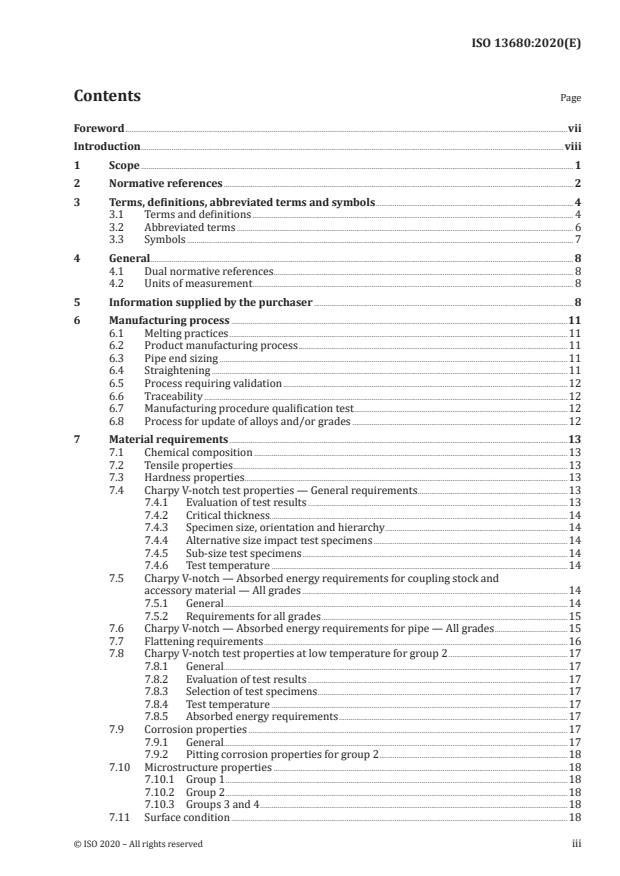
Contents Page
Foreword .vii
Introduction .viii
1 Scope . 1
2 Normative references . 2
3 Terms, definitions, abbreviated terms and symbols . 4
3.1 Terms and definitions . 4
3.2 Abbreviated terms . 6
3.3 Symbols . 7
4 General . 8
4.1 Dual normative references. 8
4.2 Units of measurement . . 8
5 Information supplied by the purchaser . 8
6 Manufacturing process .11
6.1 Melting practices .11
6.2 Product manufacturing process .11
6.3 Pipe end sizing .11
6.4 Straightening .11
6.5 Process requiring validation .12
6.6 Traceability .12
6.7 Manufacturing procedure qualification test .12
6.8 Process for update of alloys and/or grades .12
7 Material requirements .13
7.1 Chemical composition .13
7.2 Tensile properties .13
7.3 Hardness properties .13
7.4 Charpy V-notch test properties — General requirements .13
7.4.1 Evaluation of test results .13
7.4.2 Critical thickness.14
7.4.3 Specimen size, orientation and hierarchy .14
7.4.4 Alternative size impact test specimens .14
7.4.5 Sub-size test specimens .14
7.4.6 Test temperature .14
7.5 Charpy V-notch — Absorbed energy requirements for coupling stock and
accessory material — All grades .14
7.5.1 General.14
7.5.2 Requirements for all grades .15
7.6 Charpy V-notch — Absorbed energy requirements for pipe — All grades .15
7.7 Flattening requirements .16
7.8 Charpy V-notch test properties at low temperature for group 2 .17
7.8.1 General.17
7.8.2 Evaluation of test results .17
7.8.3 Selection of test specimens .17
7.8.4 Test temperature .17
7.8.5 Absorbed energy requirements .17
7.9 Corrosion properties .17
7.9.1 General.17
7.9.2 Pitting corrosion properties for group 2 .18
7.10 Microstructure properties .18
7.10.1 Group 1 .18
7.10.2 Group 2 .18
7.10.3 Groups 3 and 4 .18
7.11 Surface condition .18
7.12 Defects .19
7.12.1 Pipe .19
7.12.2 Coupling stock and accessory material .19
7.12.3 Process control plan.19
8 Dimensions, masses and tolerances.19
8.1 Outside diameter, wall thickness and mass.19
8.2 Length .20
8.3 Tolerances .20
8.3.1 Tolerance on outside diameter, wall thickness and mass .20
8.3.2 Inside diameter, d .20
8.3.3 Straightness .20
8.3.4 Drift requirements .20
8.4 Product ends .20
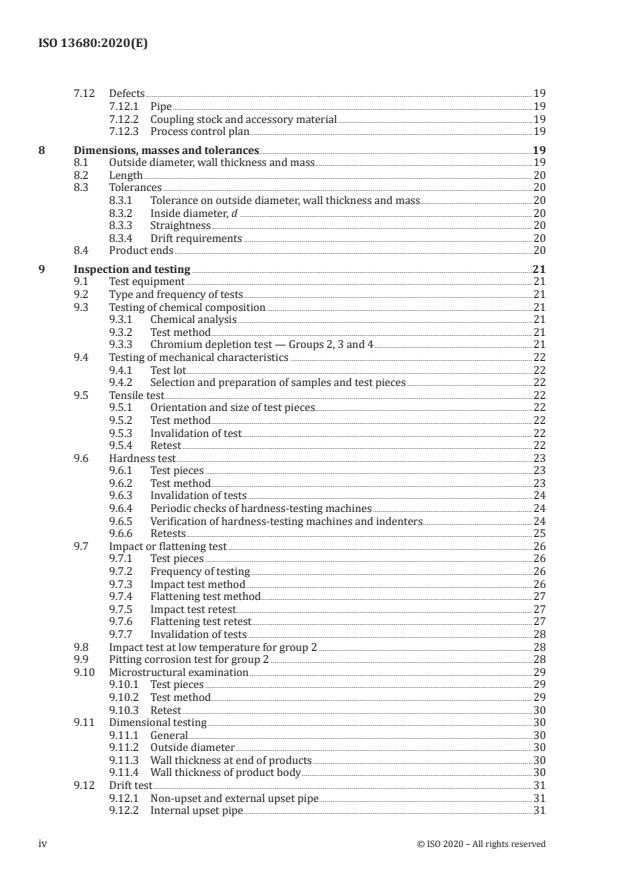
9 Inspection and testing .21
9.1 Test equipment .21
9.2 Type and frequency of tests .21
9.3 Testing of chemical composition .21
9.3.1 Chemical analysis .21
9.3.2 Test method .21
9.3.3 Chromium depletion test — Groups 2, 3 and 4 .21
9.4 Testing of mechanical characteristics .22
9.4.1 Test lot.22
9.4.2 Selection and preparation of samples and test pieces .22
9.5 Tensile test .22
9.5.1 Orientation and size of test pieces.22
9.5.2 Test method .22
9.5.3 Invalidation of test . .22
9.5.4 Retest .22
9.6 Hardness test .23
9.6.1 Test pieces .23
9.6.2 Test method .23
9.6.3 Invalidation of tests .24
9.6.4 Periodic checks of hardness-testing machines .24
9.6.5 Verification of hardness-testing machines and indenters.24
9.6.6 Retests .25
9.7 Impact or flattening test .26
9.7.1 Test pieces .26
9.7.2 Frequency of testing .26
9.7.3 Impact test method .26
9.7.4 Flattening test method . .27
9.7.5 Impact test retest .27
9.7.6 Flattening test retest.27
9.7.7 Invalidation of tests .28
9.8 Impact test at low temperature for group 2 .28
9.9 Pitting corrosion test for group 2 .28
9.10 Microstructural examination .29
9.10.1 Test pieces .29
9.10.2 Test method .29
9.10.3 Retest .30
9.11 Dimensional testing .30
9.11.1 General.30
9.11.2 Outside diameter .30
9.11.3 Wall thickness at end of products .30
9.11.4 Wall thickness of product body .30
9.12 Drift test .31
9.12.1 Non-upset and external upset pipe .31
9.12.2 Internal upset pipe .31
iv © ISO 2020 – All rights reserved
9.12.3 Drift mandrel coating . .31
9.13 Length .31
9.14 Straightness .31
9.15 Mass determination .31
9.16 Visual inspection .31
9.16.1 General.31
9.16.2 Pipe body, coupling stock and accessory material .32
9.16.3 Pipe ends.32
9.16.4 Disposition .32
9.17 Non-destructive examination .32
9.17.1 General.32
9.17.2 NDE personnel .33
9.17.3 Products .33
9.17.4 Pup joints . .33
9.17.5 Untested ends .33
9.17.6 Upset ends .33
9.17.7 Reference standards .34
9.17.8 NDE system capability records .34
9.17.9 All product group 1 .35
9.17.10 Full-body NDE of product — Groups 2, 3 and 4 .35
9.17.11 Pipe, coupling stock and accessory material requiring further evaluation .35
9.17.12 Evaluation of indications (prove-up) .35
9.17.13 Disposition of pipe containing defects .36
9.17.14 Disposition of coupling stock and accessory material containing defects .37
9.18 Positive material identification .37
10 Surface treatment .38
10.1 Group 1 .38
10.2 Groups 2, 3 and 4 .38
11 Marking .39
11.1 General .39
11.2 Colour-code identification .39
11.3 Marking content and sequence .39
11.4 Marking informative for couplings, pup joints and accessories after threading .40
12 Surface protection — Group 1 .40
13 Documents .41
13.1 Electronic media .41
13.2 Retention of records .41
13.3 Test certificates .41
14 Handling, packaging and storage .42
14.1 General .42
14.2 Handling.42
14.3 Packaging .42
14.3.1 General.42
14.3.2 Identification .42
14.4 Storage .43
Annex A (normative) Tables in SI units .44
Annex B (normative) Figures in SI (USC) units .68
Annex C (normative) Tables in USC units .73
Annex D (normative) Purchaser inspection .97
Annex E (normative) Cleanliness requirements .98
Annex F (normative) Coupling blanks and accessory material from bar .100
Annex G (normative) Product specification level 2 (PSL-2) .115
Annex H (normative) Standardized manufacturing procedure qualification test.117
Annex I (informative) Photographic examples of microstructures, groups 2, 3 and 4 .121
Bibliography .125
vi © ISO 2020 – All rights reserved
Foreword
ISO (the International Organization for Standardization) is a worldwide federation of national standards
bodies (ISO member bodies). The work of preparing International Standards is normally carried out
through ISO technical committees. Each member body interested in a subject for which a technical
committee has been established has the right to be represented on that committee. International
organizations, governmental and non-governmental, in liaison with ISO, also take part in the work.
ISO collaborates closely with the International Electrotechnical Commission (IEC) on all matters of
electrotechnical standardization.
The procedures used to develop this document and those intended for its further maintenance are
described in the ISO/IEC Directives, Part 1. In particular, the different approval criteria needed for the
different types of ISO documents should be noted. This document was drafted in accordance with the
editorial rules of the ISO/IEC Directives, Part 2 (see www .iso .org/ directives).
Attention is drawn to the possibility that some of the elements of this document may be the subject of
patent rights. ISO shall not be held responsible for identifying any or all such patent rights. Details of
any patent rights identified during the development of the document will be in the Introduction and/or
on the ISO list of patent declarations received (see www .iso .org/ patents).
Any trade name used in this document is information given for the convenience of users and does not
constitute an endorsement.
For an explanation of the voluntary nature of standards, the meaning of ISO specific terms and
expressions related to conformity assessment, as well as information about ISO's adherence to the
World Trade Organization (WTO) principles in the Technical Barriers to Trade (TBT) see www .iso .org/
iso/ foreword .html.
This document was prepared by Technical Committee ISO/TC 67, Materials, equipment and offshore
structures for petroleum, petrochemical and natural gas industries, Subcommittee SC 5, Casing, tubing
and drill pipe, in collaboration with the European Committee for Standardization (CEN) Technical
Committee CEN/TC 12, Materials, equipment and offshore structures for petroleum, petrochemical and
natural gas industries, in accordance with the Agreement on technical cooperation between ISO and
CEN (Vienna Agreement).
This fourth edition cancels and replaces the third edition (ISO 13680:2010), which has been technically
revised. The main changes compared to the previous edition are as follows:
— change of title and scope so that it includes accessory material and group 5;
— deletion of Annex F;
— addition of new Annex F, Annex H and Annex I;
— update of warning statement;
— complete revision of the technical content.
Any feedback or questions on this document should be directed to the user’s national standards body. A
complete listing of these bodies can be found at www .iso .org/ members .html.
Introduction
Users of this document should be aware that further or differing requirements can be needed for
individual applications. This document is not intended to inhibit a vendor from offering, or the purchaser
from accepting, alternative equipment or engineering solutions for the individual application. This is
particularly relevant to innovative or developing technology. Where an alternative is offered, it is the
responsibility of the vendor to identify any variations from this document and provide details.
In this document, the following verbal forms are used:
a) “shall” indicates a requirement;
b) “should” indicates a recommendation;
c) “may” indicates a permission;
d) “can” indicates a possibility or a capability.
Information marked as “NOTE” is for guidance in understanding or clarifying the associated
requirement. “Notes to entry” used in Clause 3 provide additional information that supplements the
terminological data and can contain provisions relating to the use of a term.
viii © ISO 2020 – All rights reserved
INTERNATIONAL STANDARD ISO 13680:2020(E)
Petroleum and natural gas industries — Corrosion-
resistant alloy seamless tubular products for use as casing,
tubing, coupling stock and accessory material — Technical
delivery conditions
WARNING — It is the purchaser's responsibility to specify the product specification level (PSL),
corrosion-resistant alloy (CRA) group, category, grade, delivery conditions and any other
requirement in addition to those specified herewith to ensure that the product is adequate for
the intended service environment. The ISO 15156 series should be considered when making
specific requirements for H S-containing environment; see Annex G. Other variables which can
contribute to hydrogen embrittlement should be considered. There are other sources of hydrogen
besides H S containing environments, which are not addressed by the ISO 15156 series.
1 Scope
This document specifies the technical delivery conditions for corrosion-resistant alloy seamless
tubular products for casing, tubing, coupling stock and accessory material (including coupling stock
and accessory material from bar) for two product specification levels:
— PSL-1, which is the basis of this document;
— PSL-2, which provides additional requirements for a product that is intended to be both corrosion
and cracking resistant for the environments and qualification method specified in Annex G and in
the ISO 15156 series.
At the option of the manufacturer, PSL-2 products can be provided in lieu of PSL-1.
NOTE 1 The corrosion-resistant alloys included in this document are special alloys in accordance with
ISO 4948-1 and ISO 4948-2.
NOTE 2 For the purpose of this document, NACE MR0175 is equivalent to the ISO 15156 series.
NOTE 3 Accessory products can be manufactured from coupling stock and tubular material, or from solid bar
stock or from bored and heat heat-treated bar stock as covered in Annex F.
This document contains no provisions relating to the connection of individual lengths of pipe.
This document contains provisions relating to marking of tubing and casing after threading.
This document is applicable to the following five groups of products:
a) group 1, which is composed of stainless alloys with a martensitic or martensitic/ferritic structure;
b) group 2, which is composed of stainless alloys with a ferritic-austenitic structure, such as duplex
and super-duplex stainless alloy;
c) group 3, which is composed of stainless alloys with an austenitic structure (iron base);
d) group 4, which is composed of nickel-based alloys with an austenitic structure (nickel base);
e) group 5, which is composed of bar only (Annex F) in age-hardened (AH) nickel-based alloys with
austenitic structure.
NOTE 4 Not all PSL-1 categories and grades can be made cracking resistant in accordance with the
ISO 15156 series and are, therefore, not included in PSL-2.
2 Normative references
The following documents are referred to in the text in such a way that some or all of their content
constitutes requirements of this document. For dated references, only the edition cited applies. For
undated references, the latest edition of the referenced document (including any amendments) applies.
ISO 377, Steel and steel products — Location and preparation of samples and test pieces for mechanical testing
ISO 404, Steel and steel products — General technical delivery requirements
ISO 525, Bonded abrasive products — General requirements
ISO 643, Steels– Micrographic determination of the apparent grain size
ISO 3452-1, Non-destructive testing — Penetrant testing — Part 1: General principles
ISO 4287, Geometrical Product Specifications (GPS) — Surface texture: Profile method — Terms, definitions
and surface texture parameters
ISO 4885, Ferrous materials — Heat treatments — Vocabulary
ISO 4948-1, Steels — Classification — Part 1: Classification of steels into unalloyed and alloy steels based
on chemical composition
ISO 4948-2, Steels — Classification — Part 2: Classification of unalloyed and alloy steels according to main
quality classes and main property or application characteristics
ISO 6508-1, Metallic materials — Rockwell hardness test — Part 1: Test method
ISO 6508-2, Metallic materials — Rockwell hardness test — Part 2: Verification and calibration of testing
machines and indenters
ISO 6892-1, Metallic materials — Tensile testing — Part 1: Method of test at room temperature
ISO 6892-2, Metallic materials — Tensile testing — Part 2: Method of test at elevated temperature
ISO 6929, Steel products — Vocabulary
ISO 8501-1, Preparation of steel substrates before application of paints and related products — Visual
assessment of surface cleanliness — Part 1: Rust grades and preparation grades of uncoated steel substrates
and of steel substrates after overall removal of previous coatings
ISO 9712, Non-destructive testing — Qualification and certification of NDT personnel
ISO 9934-1, Non-destructive testing — Magnetic particle testing — Part 1: General principles
ISO 10423, Petroleum and natural gas industries — Drilling and production equipment — Wellhead and
christmas tree equipment
ISO 10474, Steel and steel products — Inspection documents
ISO 10893-2, Non-destructive testing of steel tubes — Part 2: Automated eddy current testing of seamless
and welded (except submerged arc-welded) steel tubes for the detection of imperfections
ISO 10893-3, Non-destructive testing of steel tubes — Part 3: Automated full peripheral flux leakage
testing of seamless and welded (except submerged arc-welded) ferromagnetic steel tubes for the detection
of longitudinal and/or transverse imperfections
ISO 10893-4, Non-destructive testing of steel tubes — Part 4: Liquid penetrant inspection of seamless and
welded steel tubes for the detection of surface imperfections
ISO 10893-5, Non-destructive testing of steel tubes — Part 5: Magnetic particle inspection of seamless and
welded ferromagnetic steel tubes for the detection of surface imperfections
2 © ISO 2020 – All rights reserved
ISO 10893-8, Non-destructive testing of steel tubes — Part 8: Automated ultrasonic testing of seamless and
welded steel tubes for the detection of laminar imperfections
ISO 10893-10, Non-destructive testing of steel tubes — Part 10: Automated full peripheral ultrasonic
testing of seamless and welded (except submerged arc-welded) steel tubes for the detection of longitudinal
and/or transverse imperfections
ISO 10893-12, Non-destructive testing of steel tubes — Part 12: Automated full peripheral ultrasonic
thickness testing of seamless and welded (except submerged arc-welded) steel tubes
ISO 11484, Steel products — Employer's qualification system for non-destructive testing (NDT) personnel
ISO 14284, Steel and iron — Sampling and preparation of samples for the determination of chemical
composition
ISO 15156 (all parts), Petroleum and natural gas industries — Materials for use in H2S-containing
environments in oil and gas production
ISO 15156-3:2015, Petroleum and natural gas industries — Materials for use in H2S-containing
environments in oil and gas production — Part 3: Cracking-resistant CRAs (corrosion-resistant alloys) and
other alloys
ISO 80000-1, Quantities and units — Part 1: General
API RP 578, Guidelines for a Material Verification Program (MVP) for New and Existing Assets
Spec API, 6A, Specification for Wellhead and Christmas Tree Equipment
API Standard 6ACRA, Age-hardened Nickel-based Alloys for Oil and Gas Drilling and Production Equipment
ASNT SNT-TC-1A, Recommended Practice — Non-Destructive Testing
ASTM A370, Standard Test Methods and Definitions for Mechanical Testing of Steel Products
ASTM A604/A604M, Standard Practice for Macroetch Testing of Consumable Electrode Remelted Steel
Bars and Billets
ASTM A941, Standard Terminology Relating to Steel, Stainless Steel, Related Alloys and Ferroalloys
ASTM E10, Standard Test Method for Brinell Hardness of Metallic Materials
ASTM E18, Standard Test Methods for Rockwell Hardness of Metallic Materials
ASTM E21, Standard Test Methods for Elevated Temperature Tension Tests of Metallic Materials
ASTM E23, Standard Test Methods for Notched Bar Impact Testing of Metallic Materials
ASTM E29, Standard Practice for Using Significant Digits in Test Data to Determine Conformance with
Specifications
ASTM E45, Standard Test Methods for Determining the Inclusion Content of Steel
ASTM E110, Standard Test Method for Rockwell and Brinell Hardness of Metallic Materials by Portable
Hardness Testers
ASTM E112, Standard Test Methods for determining the average Grain Size
ASTM E165, Standard Practice for Liquid Penetrant Examination for General Industry
ASTM E213, Standard Practice for Ultrasonic Testing of Metal Pipe and Tubing
A
...
Questions, Comments and Discussion
Ask us and Technical Secretary will try to provide an answer. You can facilitate discussion about the standard in here.
Loading comments...