


ISO 21041:2018
(Main)Guidance on unit pricing
Guidance on unit pricing
This document gives principles and best practice guidelines for unit pricing displayed by written, printed or electronic means. It includes guidance on — the provision of unit price, — units of measure used to express unit price including: weight, length, volume, count, area and other forms of measure, — the display of unit price, and — implementation, communication and education of consumers. This document is applicable to any retailer, including supermarkets, hardware stores, pharmacies, convenience stores, automotive parts suppliers and pet product suppliers. It is applicable to packaged and non-packaged food and consumer products where the price is displayed, including — at point of sale, including in-store and online, and — when relevant communications about the product are released (including advertising by electronic and printed formats). This document excludes services and merchandise, such as clothing and electronic goods sold as a single item.
Préconisations concernant l'indication des prix à l'unité
General Information
Standards Content (Sample)
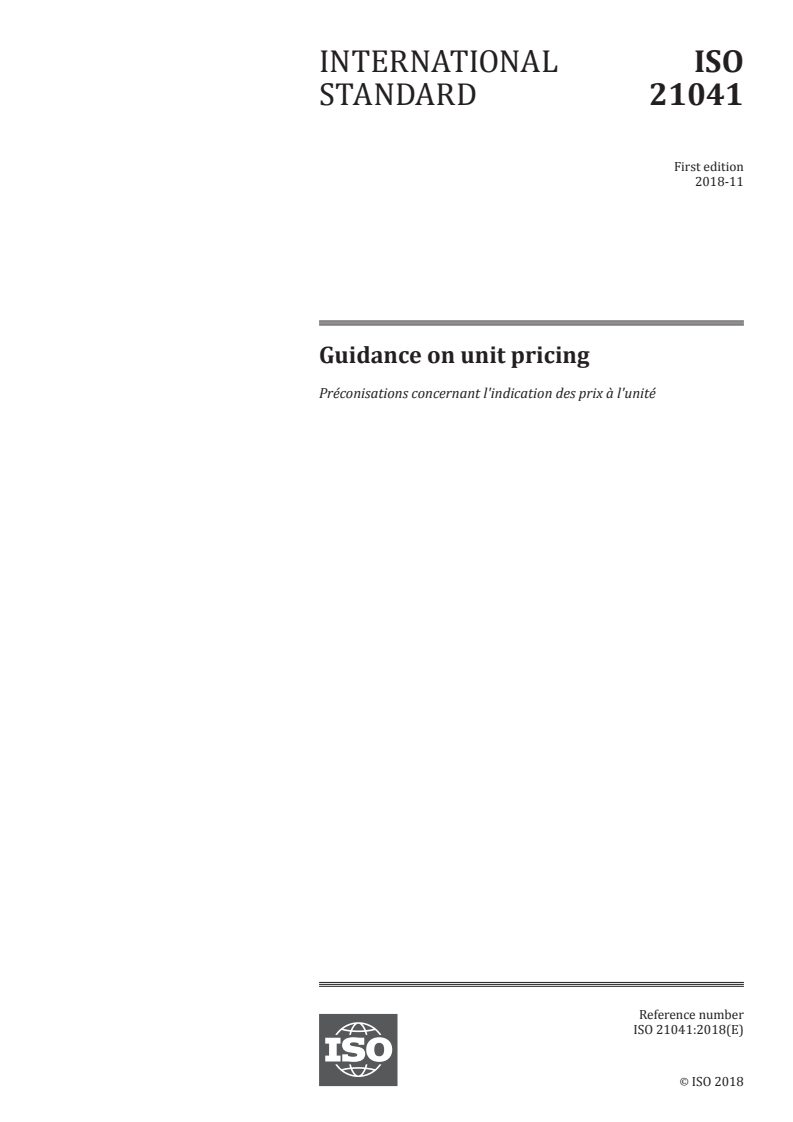
INTERNATIONAL ISO
STANDARD 21041
First edition
2018-11
Guidance on unit pricing
Préconisations concernant l'indication des prix à l'unité
Reference number
©
ISO 2018
© ISO 2018
All rights reserved. Unless otherwise specified, or required in the context of its implementation, no part of this publication may
be reproduced or utilized otherwise in any form or by any means, electronic or mechanical, including photocopying, or posting
on the internet or an intranet, without prior written permission. Permission can be requested from either ISO at the address
below or ISO’s member body in the country of the requester.
ISO copyright office
CP 401 • Ch. de Blandonnet 8
CH-1214 Vernier, Geneva
Phone: +41 22 749 01 11
Fax: +41 22 749 09 47
Email: copyright@iso.org
Website: www.iso.org
Published in Switzerland
ii © ISO 2018 – All rights reserved
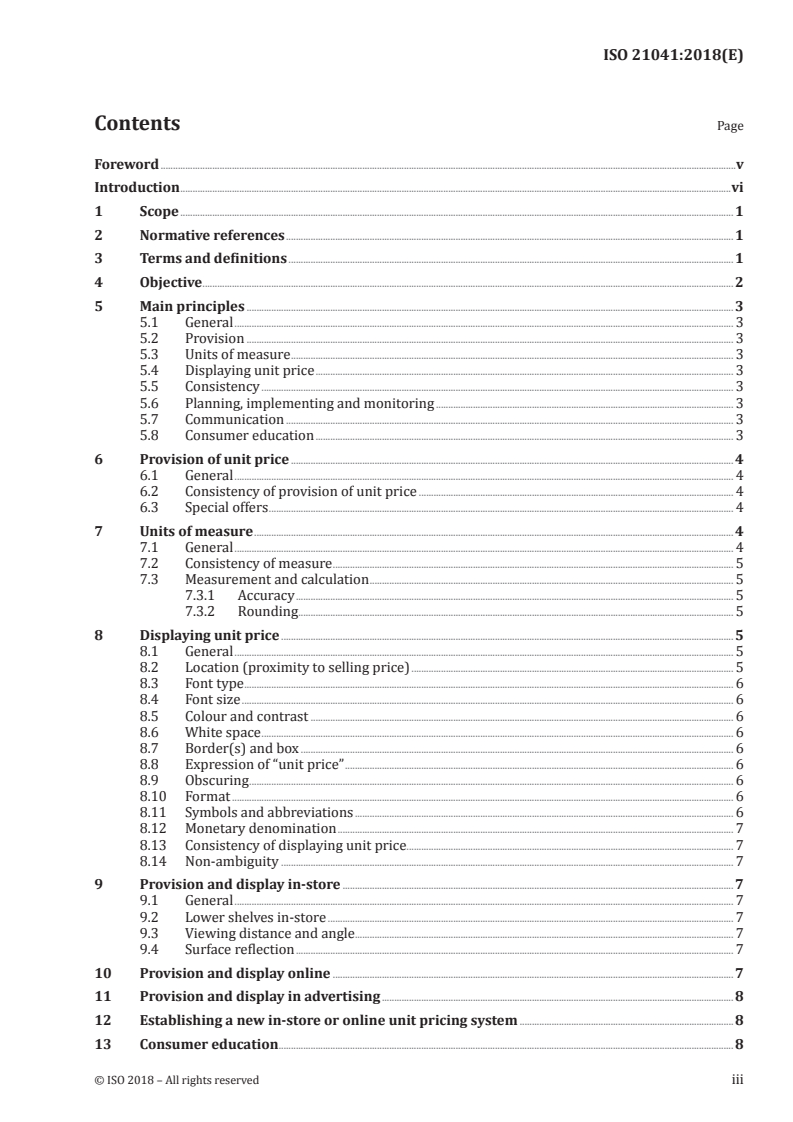
Contents Page
Foreword .v
Introduction .vi
1 Scope . 1
2 Normative references . 1
3 Terms and definitions . 1
4 Objective . 2
5 Main principles . 3
5.1 General . 3
5.2 Provision . 3
5.3 Units of measure . 3
5.4 Displaying unit price . 3
5.5 Consistency . 3
5.6 Planning, implementing and monitoring . 3
5.7 Communication . 3
5.8 Consumer education . 3
6 Provision of unit price . 4
6.1 General . 4
6.2 Consistency of provision of unit price . 4
6.3 Special offers . 4
7 Units of measure . 4
7.1 General . 4
7.2 Consistency of measure . 5
7.3 Measurement and calculation . 5
7.3.1 Accuracy . 5
7.3.2 Rounding . . 5
8 Displaying unit price . 5
8.1 General . 5
8.2 Location (proximity to selling price) . 5
8.3 Font type . 6
8.4 Font size . 6
8.5 Colour and contrast . 6
8.6 White space . 6
8.7 Border(s) and box . 6
8.8 Expression of “unit price” . 6
8.9 Obscuring . 6
8.10 Format . 6
8.11 Symbols and abbreviations . 6
8.12 Monetary denomination . 7
8.13 Consistency of displaying unit price . 7
8.14 Non-ambiguity . 7
9 Provision and display in-store . 7
9.1 General . 7
9.2 Lower shelves in-store . 7
9.3 Viewing distance and angle. 7
9.4 Surface reflection . 7
10 Provision and display online . 7
11 Provision and display in advertising . 8
12 Establishing a new in-store or online unit pricing system . 8
13 Consumer education . 8
Annex A (informative) Examples of the potential benefits of unit price provision.10
Annex B (informative) Guidance for depicting unit price information on labels .11
Annex C (informative) International system of units of measure and abbreviations .14
Annex D (informative) Example of establishing a new in-store or online unit pricing system .16
Bibliography .18
iv © ISO 2018 – All rights reserved
Foreword
ISO (the International Organization for Standardization) is a worldwide federation of national standards
bodies (ISO member bodies). The work of preparing International Standards is normally carried out
through ISO technical committees. Each member body interested in a subject for which a technical
committee has been established has the right to be represented on that committee. International
organizations, governmental and non-governmental, in liaison with ISO, also take part in the work.
ISO collaborates closely with the International Electrotechnical Commission (IEC) on all matters of
electrotechnical standardization.
The procedures used to develop this document and those intended for its further maintenance are
described in the ISO/IEC Directives, Part 1. In particular, the different approval criteria needed for the
different types of ISO documents should be noted. This document was drafted in accordance with the
editorial rules of the ISO/IEC Directives, Part 2 (see www .iso .org/directives).
Attention is drawn to the possibility that some of the elements of this document may be the subject of
patent rights. ISO shall not be held responsible for identifying any or all such patent rights. Details of
any patent rights identified during the development of the document will be in the Introduction and/or
on the ISO list of patent declarations received (see www .iso .org/patents).
Any trade name used in this document is information given for the convenience of users and does not
constitute an endorsement.
For an explanation of the voluntary nature of standards, the meaning of ISO specific terms and
expressions related to conformity assessment, as well as information about ISO’s adherence to the
World Trade Organization (WTO) principles in the Technical Barriers to Trade (TBT) see www .iso
.org/iso/foreword .html.
This document was prepared by Project Committee ISO/PC 294, Guidance on unit pricing.
Any feedback or questions on this document should be directed to the user’s national standards body. A
complete listing of these bodies can be found at www .iso .org/members .html.
Introduction
Unit pricing is the display of the price of a product per standard unit of measure. For example, a 500 g
bag of rice offered at $2,00 would display a unit price of $4,00 per kg. A 2 kg bag of rice offered at
$7,00 would display a unit price of $3,50 per kg. It may be provided for packaged products (containing
constant or variable quantities) or non-packaged products. Unit pricing provides consumers with a base
price with which to compare like items of different sizes and brands. It can greatly reduce confusion
and help consumers make better informed choices, especially when there are a multitude of products,
brands and package sizes.
This document is intended to improve the accuracy and usability of unit pricing for consumers. It offers
retailers, policy makers and other stakeholders guidance for establishing best practice for providing
and displaying the unit price of products, including what unit prices are and how they are to be used, by
— defining unit pricing systems and the types of labels and promotions to which they may apply,
— assisting improvements to current unit pricing, and
— enhancing transparency of pricing information to consumers.
Consumers use unit pricing when it is made available. It is useful as a price comparison tool as a way
of identifying products that offer the best value for money. Sustained usage across time is supported
when there is periodic education or reminder communications.
There are other benefits for consumers, retailers and manufacturers.
— Providing consumers with better tools to compare prices is especially helpful where package sizes
change and retail prices remain the same. Consumers are also better able to consistently determine
actual price savings when “sale” items are effectively marked with unit pricing.
— Increased consumer satisfaction, improved pricing accuracy, increased sales of retailer branded
products and, depending on the jurisdiction, removal of the need to display the selling price on each
item of packaged product.
NOTE Retailer branded products refers to products marketed and sold under a retailer’s brand name or a
brand name not associated with any proprietary manufacturer, e.g. private label, house brand, retailer brand.
— One strategy governments have used to help consumers compare prices is to introduce standardized
container size regulations for selected common food and consumer products such as cosmetics and
processed food products. Unit pricing is a much less complex and onerous method for manufacturers
and retailers to implement; its introduction has led some jurisdictions to reject, reduce or eliminate
standard package size regulations as a policy solution.
This document was developed to provide guidance on best practices for retailers or governments
wishing to introduce voluntary or mandatory unit pricing systems and to help improve existing
voluntary or mandatory unit pricing systems to ensure that consumers are provided with information
that is easy to notice, read, understand and use.
The guidance provided here is intended to be adaptable depending on the size and level of maturity of
an organization’s management system and on the context, nature and complexity of the organization’s
activities, including its compliance policy and objectives.
vi © ISO 2018 – All rights reserved
INTERNATIONAL STANDARD ISO 21041:2018(E)
Guidance on unit pricing
1 Scope
This document gives principles and best practice guidelines for unit pricing displayed by written,
printed or electronic means.
It includes guidance on
— the provision of unit price,
— units of measure used to express unit price including: weight, length, volume, count, area and other
forms of measure,
— the display of unit price, and
— implementation, communication and education of consumers.
This document is applicable to any retailer, including supermarkets, hardware stores, pharmacies,
convenience stores, automotive parts suppliers and pet product suppliers.
It is applicable to packaged and non-packaged food and consumer products where the price is displayed,
including
— at point of sale, including in-store and online, and
— when relevant communications about the product are released (including advertising by electronic
and printed formats).
This document excludes services and merchandise, such as clothing and electronic goods sold as a
single item.
2 Normative references
There are no normative references in this document.
3 Terms and definitions
For the purposes of this document, the following terms and definitions apply.
ISO and IEC maintain terminological databases for use in standardization at the following addresses:
— ISO Online browsing platform: available at https: //www .iso .org/obp
— IEC Electropedia: available at http: //www .electropedia .org/
3.1
constant measure package
products that are packaged items of a particular type containing the same quantity
EXAMPLE One litre packs of milk.
3.2
consumer
individual member of the general public purchasing food and products for private purposes
3.3
label
information attached or adjacent to the product
EXAMPLE Sign, sticker, stamp, tag.
3.4
non-packaged product
product that has not been packed prior to being offered for sale and where the price paid is dependent
on the quantity chosen
3.5
packaged product
product that has been packed prior to being offered for sale
3.6
organization
company, corporation, firm, enterprise, authority or institution, person or persons or part or
combination thereof, whether incorporated or not, public or private, that has its own functions and
administration with responsibilities, authorities and relationships to achieve its objectives
Note 1 to entry: This definition includes retailers, manufacturers, sole-traders, partnership, charities, etc.
3.7
selling price
price per item or, in the case of non-packaged products (3.4), the price per unit of measure at which the
products are offered for sale
Note 1 to entry: In some countries, taxes are not included in the indicated price but are added at the time of
purchase.
3.8
special offer
offer of products that vary from the regular offer, including, but not limited to, bundles of like or
unlike products and sizes, temporary price reductions, free gifts or extra quantities, and offered and
perishable products close to their use-by date
3.9
unit price
price of a defined/specified unit of measure of a product, including weight (e.g. price per 100 g), volume
(e.g. price per 100 ml), length, area and number, and the unit of measure used
Note 1 to entry: Also known as comparison price and base price.
3.10
unit pricing
system used to provide the unit price (3.9) of a product per unit of measure
4 Objective
The objective of this document is to encourage and facilitate the effective provision by retailers of the
unit price of products and the effective use of this information by consumers to make informed decisions.
It is intended to improve the accessibility, accuracy and usability of unit pricing for consumers.
2 © ISO 2018 – All rights reserved
5 Main principles
5.1 General
Effective unit pricing is most likely to be achieved by applying several key principles to the design,
introduction and operation of unit pricing systems. These principles should be used whenever a relevant
product is offered for sale or advertised at a price, which is displayed by written, printed or electronic
means, and a suitable measurement is available to indicate the unit price.
5.2 Provision
The unit price should be provided whenever a relevant product is offered for sale or advertised at a
price, which is displayed by written, printed or electronic means, and a suitable measurement is
available to indicate the unit price.
The unit price should be provided in a manner to meet the needs of all consumers, including those with
special needs or vulnerable groups. For example, shelf labels that are angled or designed for greater
ease of reading.
5.3 Units of measure
The unit of measure used to indicate the unit price should be appropriate for the product and easy for
consumers to use. Whenever possible, only one unit of measure should be used for a product type.
5.4 Displaying unit price
The unit price should be displayed to ensure the greatest possible noticeability and legibility for all
potential consumers, including those with special needs or vulnerable groups. This can be achieved
by taking into account display characteristics, such as print density, font size, font type, colour and
contrast, and white space.
5.5 Consistency
There should be the highest possible level of consistency, within and between retailers and across all
retail formats, in the provision and display of unit pricing and in the units of measure used.
5.6 Planning, implementing and monitoring
Planning and implementing unit pricing should involve an adequate process of promotion, development,
monitoring, maintenance and improvement. An organization’s unit pricing system should operate in a
manner that aligns with the guidance included in this document.
5.7 Communication
Information about unit pricing should be communicated to all stakeholders (e.g. consumers, consumer
organizations, retailers, manufacturers, wholesalers, IT vendors, governments) via targeted
communi
...
Questions, Comments and Discussion
Ask us and Technical Secretary will try to provide an answer. You can facilitate discussion about the standard in here.