

ISO/FDIS 8442-1
(Main)Materials and articles in contact with foodstuffs — Cutlery and table holloware — Part 1: Requirements for cutlery for the preparation of food
- Status
- Not Published
- Technical Committee
- ISO/TC 186 - Cutlery and table and decorative metal hollow-ware
- Drafting Committee
- ISO/TC 186/WG 2 - Cutlery - Requirements and Specification
- Current Stage
- 5020 - FDIS ballot initiated: 2 months. Proof sent to secretariat
- Start Date
- 27-Oct-2026
- Completion Date
- 27-Oct-2026
Buy Documents
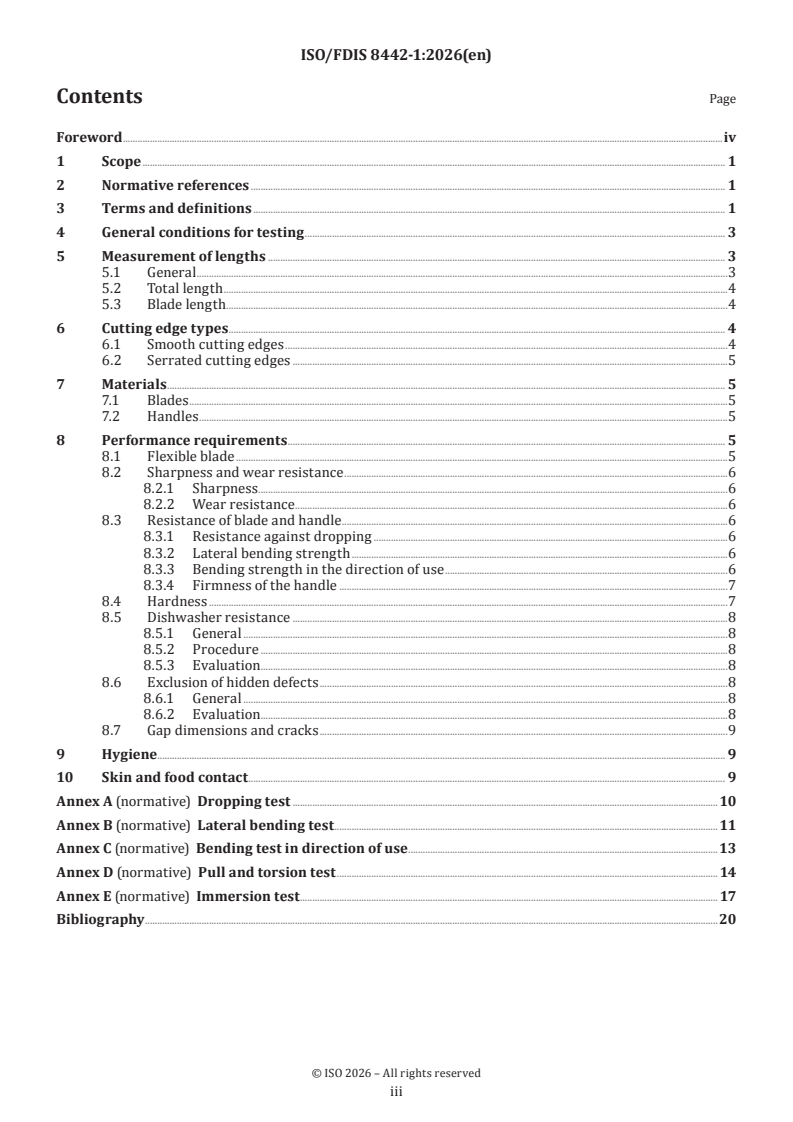
ISO/FDIS 8442-1 - Materials and articles in contact with foodstuffs — Cutlery and table holloware — Part 1: Requirements for cutlery for the preparation of food
REDLINE ISO/FDIS 8442-1 - Materials and articles in contact with foodstuffs — Cutlery and table holloware — Part 1: Requirements for cutlery for the preparation of food
ISO/FDIS 8442-1 - Matériaux et objets en contact avec les denrées alimentaires — Coutellerie et orfèvrerie de table — Partie 1: Exigences relatives à la coutellerie utilisée pour la préparation des denrées alimentaires
ISO/FDIS 8442-1 is an ISO standard for handheld knives with metal blades used in the preparation of food. It specifies material requirements, performance requirements and test methods for knives used in household and commercial kitchens and in facilities. The document is aimed at manufacturers, test laboratories, buyers and quality teams that need to define or verify food-preparation knives.
What does ISO/FDIS 8442-1 specify?
ISO/FDIS 8442-1 covers cutlery for food preparation, with a focus on knives rather than general table cutlery. It sets out how to identify the knife parts, how to measure key dimensions, which cutting edge types are covered, and how the knives are tested for durability, corrosion, hardness and hygiene.
The scope applies to handheld knives with metal blades. It excludes hunting knives, pocket knives, razors, utility or tool knives with trapezoidal blades for cutting carpets, and ceramic knives, which are covered by ISO 8442-9:2018.
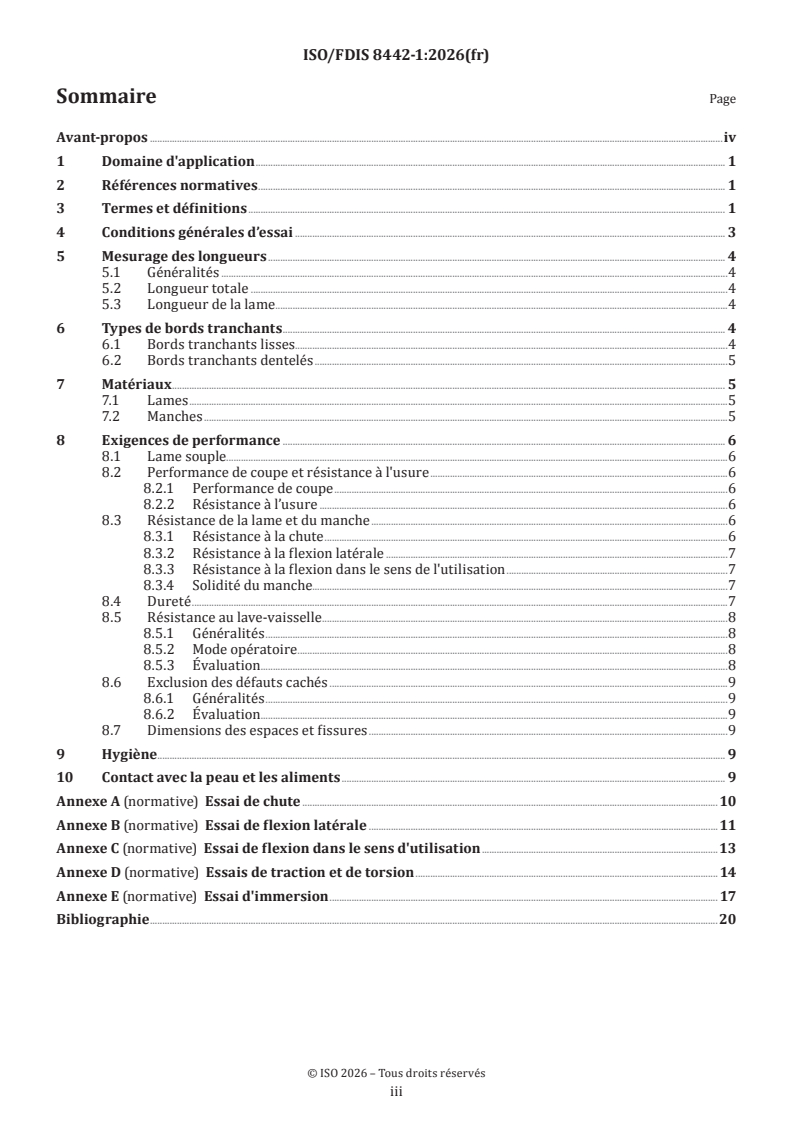
The document is organized into Clauses 1 to 10 and Annexes A to E.
| Annex | What it covers |
|---|---|
| Annex A | Dropping test |
| Annex B | Lateral bending test |
| Annex C | Bending test in direction of use |
| Annex D | Pull and torsion test |
| Annex E | Immersion test |
What are the key requirements of ISO/FDIS 8442-1?
ISO/FDIS 8442-1 combines dimensional checks, material expectations and performance testing so that a knife can be assessed in a repeatable way. The most important points are below.
- Clause 4 sets the general test temperature at ambient conditions unless a test method says otherwise. In practice, this gives laboratories a common starting point for comparable results.
- Clause 5 defines two lengths for knives: total length and blade length, and applies tolerance class c from ISO 2768-1. This matters when a supplier claims a size or when a buyer compares products from different sources.
- Clause 6 distinguishes smooth cutting edges from serrated cutting edges, including concave and convex serrations. This matters because the edge type affects cutting performance and which test expectations are relevant.
- Clause 7 states that blades are made from metallic materials that support function and durability, while the handle is the skin contact area and the blade is the food contact area. This helps manufacturers separate food-contact and skin-contact responsibilities and check national rules for each part.
- Clause 8.1 allows a blade to be claimed as a flexible blade only if it bends in both directions under the stated conditions and returns without harmful damage or excess permanent deformation. In practice, this is used for knives such as filleting knives and tells a buyer whether the blade is meant to flex.
- Clause 8.2 links sharpness and wear resistance to ISO 8442-5. For smooth cutting edges, the standard gives minimum wear-resistance performance, and for serrated edges the acceptance criteria are agreed between trade partners. This matters because cutting performance is specified through a recognized test method rather than by appearance alone.
- Clause 8.3 requires the knife and handle assembly to survive drop, lateral bending, bending in the direction of use, and handle pull-and-torsion testing. The practical point is that the knife must stay safe and usable after mechanical stress, with no cracks, breakage or harmful looseness.
- Clause 8.4 sets minimum blade hardness by material class and requires hardness testing by Vickers or Rockwell methods, with Vickers used in case of doubt and conversion by ISO 18265. This matters because hardness is one of the main indicators of cutting-edge durability.
- Clause 8.5 requires dishwasher-resistant knives to pass a dishwasher test with multiple samples tested and evaluated using EN 12875-1 and EN 12875-2. This is important for products sold as dishwasher resistant, especially for professional users.
- Clause 8.6 requires knives described as stainless, rustproof or corrosion-resistant, or made from such material, to pass the alternating immersion test in Annex E. The test is used to expose hidden defects such as cracks, overlaps and corrosion-related edge damage.
- Clause 8.7 limits visible gaps and cracks at delivery, with a stricter allowance for wooden handles. This matters because gaps can trap soil, weaken the assembly or create hygiene issues.
- Clauses 9 and 10 require cleanability with normal cleaning agents and compliance with national rules for food contact and skin contact. In practice, a manufacturer has to check the blade and handle against the rules of the market where the knife will be sold.
What terms does ISO/FDIS 8442-1 define?
ISO/FDIS 8442-1 defines the main knife parts and the performance terms used in testing.
- Knife - a manually guided cutlery item for preparing food, made up mainly of a blade and a handle.
- Blade - the thinner part used for cutting and intended to contact food.
- Handle - the thicker part used for safe holding and not intended to contact food.
- Wooden handle - a handle made completely from real wood, which the document treats separately because it is not suitable for dishwasher cleaning.
- Cutting edge - the sharpened part of the blade used for cutting.
- Sharpness - a parameter describing the force needed to cut into a defined test material with a defined cutting movement.
- Wear resistance - the ability of the cutting edge to resist wear during cutting of an abrasive test material.
- Professional use - knife use by a professional in an economic activity, such as in slaughterhouses, bakeries, commercial kitchens and food shops.
Who uses ISO/FDIS 8442-1?
ISO/FDIS 8442-1 is used by manufacturers of food-preparation knives, suppliers of blade and handle materials, and test laboratories that verify performance and durability. It is also used by purchasing teams and quality managers who need to specify product requirements for household or commercial use.
The document is relevant to professional kitchens, hotels, restaurants, meat and fish slaughterhouses, butchers, bakeries and food shops. It is also useful for compliance teams that have to check food-contact and skin-contact rules in the target market.
What changed in ISO/FDIS 8442-1 from the previous edition?
ISO/FDIS 8442-1 is the second edition and it cancels and replaces ISO 8442-1:1997. The document states these main changes:
- new dimensions for total length and blade length were defined in Clause 5;
- the former table on metals for cutlery blades was deleted;
- the tang and bolster corrosion test was deleted;
- the general corrosion test was revised in Annex E;
- the bending test was revised in Annex B;
- the bending test in direction of use was introduced in Annex C;
- minimum hardness values for blades by material class were introduced in Table 1;
- Clauses 6.5, 6.6 and 6.7 and the previous marking and labelling clause were deleted.
Which standards are used with ISO/FDIS 8442-1?
ISO/FDIS 8442-1 relies on several referenced standards for testing and evaluation.
- ISO 2768-1 - provides the general tolerances used for the length measurements in Clause 5.
- ISO 6507-1 - gives the Vickers hardness test method used for blade hardness.
- ISO 6508-1 - gives the Rockwell hardness test method used for blade hardness.
- ISO 6769:2022 - provides the Mohs-scale scratch hardness method used for the dropping test tile.
- ISO 8442-5 - provides the sharpness and edge-retention test method used for cutting performance.
- ISO 18265 - provides hardness conversion between scales when needed.
- EN 12875-1 - gives the reference method for mechanical dishwashing resistance of domestic articles.
- EN 12875-2 - gives the inspection method for non-metallic articles after dishwasher testing.
What does the ISO/FDIS 8442-1 document contain?
ISO/FDIS 8442-1 contains illustrated definitions of knife parts, length measurement rules, descriptions of smooth and serrated cutting edges, material guidance, and a set of mechanical and corrosion-related performance tests. It also includes a hardness table for blade material classes and a figure showing where hardness measurements are taken on blades of different lengths.
Annexes A to E provide the test set-ups and procedures for dropping, lateral bending, bending in the direction of use, pull and torsion, and alternating immersion in salt solution. The figures support practical work by showing knife part identification, length determination, edge types, test fixtures and hardness sampling areas.
This structure makes the document useful for design checks, product qualification, routine testing and documentation of knife claims such as flexible blade, dishwasher resistant or corrosion-resistant.
Relations
- Effective Date
- 12-Feb-2026
- Effective Date
- 15-Feb-2025
- Effective Date
- 15-Feb-2025
Buy Documents
ISO/FDIS 8442-1 - Materials and articles in contact with foodstuffs — Cutlery and table holloware — Part 1: Requirements for cutlery for the preparation of food
REDLINE ISO/FDIS 8442-1 - Materials and articles in contact with foodstuffs — Cutlery and table holloware — Part 1: Requirements for cutlery for the preparation of food
ISO/FDIS 8442-1 - Matériaux et objets en contact avec les denrées alimentaires — Coutellerie et orfèvrerie de table — Partie 1: Exigences relatives à la coutellerie utilisée pour la préparation des denrées alimentaires
Get Certified
Connect with accredited certification bodies for this standard

BSI Group
BSI (British Standards Institution) is the business standards company that helps organizations make excellence a habit.

Bureau Veritas
Bureau Veritas is a world leader in laboratory testing, inspection and certification services.

DNV
DNV is an independent assurance and risk management provider.
Sponsored listings
Frequently Asked Questions
ISO/FDIS 8442-1 is a draft published by the International Organization for Standardization (ISO). Its full title is "Materials and articles in contact with foodstuffs — Cutlery and table holloware — Part 1: Requirements for cutlery for the preparation of food". This standard covers: La présente partie de cette norme prescrit les exigences afférentes aux matériaux constitutifs et aux performances de la coutellerie en métal et des ustensiles connexes destinés à être utilisés lors de la préparation des denrées alimentaires ainsi que des méthodes d'essai. Deux qualités d'articles de coutellerie sont spécifiées : une qualité normale d'articles comprenant des lames ou des dents résistant à la corrosion, pouvant résister à des lavages en lave-vaisselle ; une qualité spéciale d'articles comprenant des lames résistant à la corrosion, pouvant résister à des lavages en lave-vaisselle et à des processus de stérilisation.
La présente partie de cette norme prescrit les exigences afférentes aux matériaux constitutifs et aux performances de la coutellerie en métal et des ustensiles connexes destinés à être utilisés lors de la préparation des denrées alimentaires ainsi que des méthodes d'essai. Deux qualités d'articles de coutellerie sont spécifiées : une qualité normale d'articles comprenant des lames ou des dents résistant à la corrosion, pouvant résister à des lavages en lave-vaisselle ; une qualité spéciale d'articles comprenant des lames résistant à la corrosion, pouvant résister à des lavages en lave-vaisselle et à des processus de stérilisation.
ISO/FDIS 8442-1 is classified under the following ICS (International Classification for Standards) categories: 67.250 - Materials and articles in contact with foodstuffs; 97.040.60 - Cookware, cutlery and flatware. The ICS classification helps identify the subject area and facilitates finding related standards.
ISO/FDIS 8442-1 has the following relationships with other standards: It is inter standard links to FprEN ISO 8442-1, ISO 20567-4:2023, ISO 8442-1:1997. Understanding these relationships helps ensure you are using the most current and applicable version of the standard.
ISO/FDIS 8442-1 is available in PDF format for immediate download after purchase. The document can be added to your cart and obtained through the secure checkout process. Digital delivery ensures instant access to the complete standard document.
Standards Content (Sample)
FINAL DRAFT
International
Standard
ISO/TC 186
Materials and articles in contact
Secretariat: SAC
with foodstuffs — Cutlery and table
Voting begins on:
holloware —
2026-10-27
Part 1:
Voting terminates on:
2026-12-08
Requirements for cutlery for the
preparation of food
Matériaux et objets en contact avec les denrées alimentaires —
Coutellerie et orfèvrerie de table —
Partie 1: Exigences relatives à la coutellerie utilisée pour la
préparation des denrées alimentaires
RECIPIENTS OF THIS DRAFT ARE INVITED TO SUBMIT,
WITH THEIR COMMENTS, NOTIFICATION OF ANY
RELEVANT PATENT RIGHTS OF WHICH THEY ARE AWARE
AND TO PROVIDE SUPPOR TING DOCUMENTATION.
IN ADDITION TO THEIR EVALUATION AS
BEING ACCEPTABLE FOR INDUSTRIAL, TECHNO-
ISO/CEN PARALLEL PROCESSING LOGICAL, COMMERCIAL AND USER PURPOSES, DRAFT
INTERNATIONAL STANDARDS MAY ON OCCASION HAVE
TO BE CONSIDERED IN THE LIGHT OF THEIR POTENTIAL
TO BECOME STAN DARDS TO WHICH REFERENCE MAY BE
MADE IN NATIONAL REGULATIONS.
Reference number
FINAL DRAFT
International
Standard
ISO/TC 186
Materials and articles in contact
Secretariat: SAC
with foodstuffs — Cutlery and table
Voting begins on:
holloware —
Part 1:
Voting terminates on:
Requirements for cutlery for the
preparation of food
Matériaux et objets en contact avec les denrées alimentaires —
Coutellerie et orfèvrerie de table —
Partie 1: Exigences relatives à la coutellerie utilisée pour la
préparation des denrées alimentaires
© ISO 2026
All rights reserved.
RECIPIENTS OF THIS DRAFT ARE INVITED TO SUBMIT,
WITH THEIR COMMENTS, NOTIFICATION OF ANY
This ISO publication is protected by copyright and is owned by ISO and/or its licensors.
RELEVANT PATENT RIGHTS OF WHICH THEY ARE AWARE
The content of this ISO publication is provided under licence, not sold. Use is subject to the applicable licence terms issued by ISO,
AND TO PROVIDE SUPPOR TING DOCUMENTATION.
an ISO member body, or an authorized third-party distributor.
IN ADDITION TO THEIR EVALUATION AS
BEING ACCEPTABLE FOR INDUSTRIAL, TECHNO-
Except as required for implementation or expressly permitted by a separate licence, no part of this ISO publication may be
ISO/CEN PARALLEL PROCESSING
LOGICAL, COMMERCIAL AND USER PURPOSES, DRAFT
reproduced, distributed, modified, used, or made available in any form or by any means – electronic or mechanical, including
INTERNATIONAL STANDARDS MAY ON OCCASION HAVE
photocopying, scanning, recording, or posting on internal or external digital platforms. TO BE CONSIDERED IN THE LIGHT OF THEIR POTENTIAL
TO BECOME STAN DARDS TO WHICH REFERENCE MAY BE
Any use beyond the scope of the granted rights is prohibited and may result in legal action.
MADE IN NATIONAL REGULATIONS.
ISO copyright office
CP 401 • CH-1214 Vernier, Geneva
Phone: +41 22 749 01 11
Email: copyright@iso.org
Website: www.iso.org
Published in Switzerland
Reference number
ii
Contents Page
Foreword .iv
1 Scope . 1
2 Normative references . 1
3 Terms and definitions . 1
4 General conditions for testing . 3
5 Measurement of lengths . 3
5.1 General .3
5.2 Total length .4
5.3 Blade length . .4
6 Cutting edge types . 4
6.1 Smooth cutting edges .4
6.2 Serrated cutting edges .5
7 Materials . 5
7.1 Blades .5
7.2 Handles .5
8 Performance requirements . . 5
8.1 Flexible blade .5
8.2 Sharpness and wear resistance .6
8.2.1 Sharpness . . .6
8.2.2 Wear resistance .6
8.3 Resistance of blade and handle .6
8.3.1 Resistance against dropping .6
8.3.2 Lateral bending strength .6
8.3.3 Bending strength in the direction of use .6
8.3.4 Firmness of the handle .7
8.4 Hardness .7
8.5 Dishwasher resistance .8
8.5.1 General .8
8.5.2 Procedure .8
8.5.3 Evaluation . .8
8.6 Exclusion of hidden defects .8
8.6.1 General .8
8.6.2 Evaluation .8
8.7 Gap dimensions and cracks .9
9 Hygiene . . 9
10 Skin and food contact . 9
Annex A (normative) Dropping test .10
Annex B (normative) Lateral bending test .11
Annex C (normative) Bending test in direction of use .13
Annex D (normative) Pull and torsion test . 14
Annex E (normative) Immersion test . . 17
Bibliography .20
iii
Foreword
ISO (the International Organization for Standardization) is a worldwide federation of national standards
bodies (ISO member bodies). The work of preparing International Standards is normally carried out through
ISO technical committees. Each member body interested in a subject for which a technical committee
has been established has the right to be represented on that committee. International organizations,
governmental and non-governmental, in liaison with ISO, also take part in the work. ISO collaborates closely
with the International Electrotechnical Commission (IEC) on all matters of electrotechnical standardization.
The procedures used to develop this document and those intended for its further maintenance are described
in the ISO/IEC Directives, Part 1. In particular, the different approval criteria needed for the different types
of ISO documents should be noted. This document was drafted in accordance with the editorial rules of the
ISO/IEC Directives, Part 2 (see www.iso.org/directives).
ISO draws attention to the possibility that the implementation of this document may involve the use of (a)
patent(s). ISO takes no position concerning the evidence, validity or applicability of any claimed patent
rights in respect thereof. As of the date of publication of this document, ISO had not received notice of (a)
patent(s) which may be required to implement this document. However, implementers are cautioned that
this may not represent the latest information, which may be obtained from the patent database available at
www.iso.org/patents. ISO shall not be held responsible for identifying any or all such patent rights.
Any trade name used in this document is information given for the convenience of users and does not
constitute an endorsement.
For an explanation of the voluntary nature of standards, the meaning of ISO specific terms and expressions
related to conformity assessment, as well as information about ISO's adherence to the World Trade
Organization (WTO) principles in the Technical Barriers to Trade (TBT), see www.iso.org/iso/foreword.html.
This document was prepared by Technical Committee ISO/TC 186, Cutlery and table and decorative metal
hollow-ware, in collaboration with the European Committee for Standardization (CEN) Technical Committee
CEN/TC 194, Utensils in contact with food, in accordance with the Agreement on technical cooperation
between ISO and CEN (Vienna Agreement).
This second edition cancels and replaces the first edition (ISO 8442-1:1997), which has been technically
revised.
The main changes are as follows:
— new dimensions (total length, blade length) have been defined (see Clause 5);
— previous Table 1 "Metals for cutlery blades, composition limits" has been deleted;
— the tang and bolster corrosion test have been deleted;
— the general corrosion test has been revised (see Annex E);
— the bending test has been revised (see Annex B);
— the bending test in direction of use has been introduced (see Annex C);
— minimum hardness values for blades by material classes have been introduced (see Table 1);
— 6.5, 6.6, 6.7 and previous Clause 7 "Marking and labelling" have been deleted.
A list of all parts in the ISO 8442 series can be found on the ISO website.
Any feedback or questions on this document should be directed to the user’s national standards body. A
complete listing of these bodies can be found at www.iso.org/members.html.
iv
FINAL DRAFT International Standard ISO/FDIS 8442-1:2026(en)
Materials and articles in contact with foodstuffs — Cutlery
and table holloware —
Part 1:
Requirements for cutlery for the preparation of food
1 Scope
This document specifies material and performance requirements and test methods for handheld knives
with metal blades intended for use in the preparation of food in household and commercial kitchens as well
as in facilities.
This document does not apply for hunting knives, pocket knives, razors, utility or tool knives (with
trapezoidal blade for cutting carpets).
[1]
This document does not apply for ceramic knives, which are covered by ISO 8442-9 .
2 Normative references
The following documents are referred to in the text in such a way that some or all of their content constitutes
requirements of this document. For dated references, only the edition cited applies. For undated references,
the latest edition of the referenced document (including any amendments) applies.
ISO 2768-1, General tolerances — Part 1: Tolerances for linear and angular dimensions without individual
tolerance indications
ISO 6507-1, Metallic materials — Vickers hardness test — Part 1: Test method
ISO 6508-1, Metallic materials — Rockwell hardness test — Part 1: Test method (scales A, B, C, D, E, F, G, H, K, N,
T)
ISO 6769:2022, Vitreous and porcelain enamels — Determination of surface scratch hardness according to the
Mohs scale
ISO 8442-5, Materials and articles in contact with foodstuffs — Cutlery and table holloware — Part 5:
Specification for sharpness and edge retention test of cutlery
ISO 18265, Metallic materials — Conversion of hardness values
EN 12875-1, Mechanical dishwashing resistance of utensils - Part 1: Reference test method for domestic articles
EN 12875-2, Mechanical dishwashing resistance of utensils - Part 2: Inspection of non-metallic articles
3 Terms and definitions
For the purposes of this document, the following terms and definitions apply.
ISO and IEC maintain terminology databases for use in standardization at the following addresses:
— IEC Electropedia: available at http:// www .electropedia .org/
— ISO Online browsing platform: available at http:// www .iso .org/ obp
3.1
knife
cutlery used for the preparation of food, manually guided and in general having a cutting edge (3.2.4)
Note 1 to entry: The two major components of a knife are the blade (3.2.1) and the handle (3.2.2).
Note 2 to entry: See Figure 1 for examples of a complex and a simple knife (3.1).
b) Simple knife
a) Complex knife
Key
1 tip of the blade
2 cutting edge
3 back of the blade
4 choil
5 bolster
6 tang
7 rivet
8 blade
9 handle
Figure 1 — Examples for knives with designation of knife parts
3.2
Design structure
3.2.1
blade
thinner part of the knife (3.1) used for cutting and intended to come into contact with food
Note 1 to entry: Characteristics of a flexible blade are given in 8.1.
3.2.2
handle
thicker part of the knife (3.1) used for holding the knife (3.1) safely and not intended to come into contact
with food
Note 1 to entry: The bolster is considered as part of the handle (3.2.2).
Note 2 to entry: Whether the handle needs to comply with regulations for food contact materials depends on local
regulations.
3.2.3
wooden handle
handle completely made from real wood and thus not suitable for dishwasher cleaning
Note 1 to entry: Handles made from wood parts or textiles, which are included in a resin (in general called ‘micarta’)
or wooden handles, which are completely covered by a lacquer are not included in this definition.
3.2.4
cutting edge
sharpened part of the blade (3.2.1) intended for cutting
Note 1 to entry: The cutting edge (3.2.4) starts at the bottom of the blade (3.2.1) and ends at the tip of the blade (3.2.1).
The back of the blade (3.2.1) is located on the opposite side of the cutting edge (3.2.4).
3.3
sharpness
parameter, which reflects the force needed to cut into a defined test material with a defined cutting
movement
3.4
wear resistance
resistance of the cutting edge (3.2.4) against wear, tested by cutting into an abrasive test material
3.5
professional use
use of a knife (3.1) done by a professional in an economic activity
Note 1 to entry: In contrast to the domestic or private use, professional use of knives occurs mainly in the industry
(meat and fish slaughterhouses, butchers, bakeries, etc.) but also includes commercial kitchens (e.g. hotels and
restaurants) and food shops.
Note 2 to entry: Professional use in the context of this document focuses in a normal situation for the knife (3.1), where
a sterilization is applied on a regular basis. The sterilization is often performed with boiling water or hot steam. It
cannot be excluded that the knives are used with appropriate gloves immediately after sterilization.
4 General conditions for testing
Unless otherwise specified, the tests shall be carried out at an ambient temperature of 23 °C ± 5 °C.
5 Measurement of lengths
5.1 General
Two dimensions for knives are defined in this document. Tolerance class c (coarse) specified in ISO 2768-1
shall apply to all lengths determined below. Examples for length determination are shown in Figure 2.
b)
a)
c)
d)
Key
1 total length
2 sharpened part of blade
3 blade length
Figure 2 — Examples for determining lengths
NOTE 1 The sum of the blade length and handle length can differ from the total length.
NOTE 2 If dimensions are specified the definitions in this document apply.
5.2 Total length
The total length (see Figure 2, key 1) is the largest straight connection of the two most distant points of the
knife.
5.3 Blade length
The blade length (Figure 2, key 3) starts from the closest point to the handle which is already sharp to the
tip or to the furthest point of the radius if there is no tip. The shortest connection between the two points is
measured.
NOTE The sharpened part of the blade (see Figure 2) can be shorter than the blade length.
6 Cutting edge types
6.1 Smooth cutting edges
Cutting edges with smoot
...
ISO/TC 186
Secretariat: SAC
Date: 2026-09-29xx
Materials and articles in contact with foodstuffs — Cutlery and table
holloware —
Part 1:
Requirements for cutlery for the preparation of food
Matériaux et objets en contact avec les denrées alimentaires — Coutellerie et orfèvrerie de table —
Partie 1: Exigences relatives à la coutellerie utilisée pour la préparation des denrées alimentaires
FDIS stage
TTTTTTTTThhhhhhhhhiiiiiiiiis drs drs drs drs drs drs drs drs draaaaaaaaafffffffffttttttttt i i i i i i i i is s s s s s s s s sususususususususubbbbbbbbbmmmmmmmmmiiiiiiiiitttttttttttttttttteeeeeeeeed d d d d d d d d tttttttttooooooooo aaaaaaaaa pppppppppaaaaaaaaarrrrrrrrraaaaaaaaallellellellellellellellellel l l l l l l l l vvvvvvvvvooooooooottttttttteeeeeeeee i i i i i i i i innnnnnnnn IIIIIIIIISSSSSSSSSOOOOOOOOO,,,,,,,,, CCCCCCCCCEEEEEEEEEN.N.N.N.N.N.N.N.N.
All rights reserved.
This ISO publication is protected by copyright and is owned by ISO and/or its licensors.
The content of this ISO publication is provided under licence, not sold. Use is subject to the applicable licence terms issued
by ISO, an ISO member body, or an authorized third-party distributor.
Except as required for implementation or expressly permitted by a separate licence, no part of this ISO publication may
be reproduced, distributed, modified, used, or made available in any form or by any means – electronic or mechanical,
including photocopying, scanning, recording, or posting on internal or external digital platforms.
Any use beyond the scope of the granted rights is prohibited and may result in legal action.
ISO copyright office
CP 401 • CH-1214 Vernier, Geneva
Phone: + 41 22 749 01 11
Email: copyright@iso.org
Website: www.iso.org
Published in Switzerland
ii
Contents
Foreword . iv
1 Scope . 1
2 Normative references . 1
3 Terms and definitions . 1
4 General conditions for testing . 3
5 Measurement of lengths . 4
5.1 General . 4
5.2 Total length . 4
5.3 Blade length . 4
6 Cutting edge types . 5
6.1 Smooth cutting edges . 5
6.2 Serrated cutting edges . 5
7 Materials . 5
7.1 Blades . 5
7.2 Handles . 5
8 Performance requirements . 6
8.1 Flexible blade . 6
8.2 Sharpness and wear resistance . 6
8.3 Resistance of blade and handle . 6
8.4 Hardness . 7
8.5 Dishwasher resistance . 8
8.6 Exclusion of hidden defects . 9
8.7 Gap dimensions and cracks . 9
9 Hygiene . 9
10 Skin and food contact . 9
Annex A (normative) Dropping test . 10
Annex B (normative) Lateral bending test. 11
Annex C (normative) Bending test in direction of use . 13
Annex D (normative) Pull and torsion test . 14
Annex E (normative) Immersion test . 17
Bibliography . 20
iii
Foreword
ISO (the International Organization for Standardization) is a worldwide federation of national standards
bodies (ISO member bodies). The work of preparing International Standards is normally carried out through
ISO technical committees. Each member body interested in a subject for which a technical committee has been
established has the right to be represented on that committee. International organizations, governmental and
non-governmental, in liaison with ISO, also take part in the work. ISO collaborates closely with the
International Electrotechnical Commission (IEC) on all matters of electrotechnical standardization.
The procedures used to develop this document and those intended for its further maintenance are described
in the ISO/IEC Directives, Part 1. In particular, the different approval criteria needed for the different types of
ISO documents should be noted. This document was drafted in accordance with the editorial rules of the
ISO/IEC Directives, Part 2 (see www.iso.org/directives).
ISO draws attention to the possibility that the implementation of this document may involve the use of (a)
patent(s). ISO takes no position concerning the evidence, validity or applicability of any claimed patent rights
in respect thereof. As of the date of publication of this document, ISO had not received notice of (a) patent(s)
which may be required to implement this document. However, implementers are cautioned that this may not
represent the latest information, which may be obtained from the patent database available at
www.iso.org/patents. ISO shall not be held responsible for identifying any or all such patent rights.
Any trade name used in this document is information given for the convenience of users and does not
constitute an endorsement.
For an explanation of the voluntary nature of standards, the meaning of ISO specific terms and expressions
related to conformity assessment, as well as information about ISO's adherence to the World Trade
Organization (WTO) principles in the Technical Barriers to Trade (TBT), see www.iso.org/iso/foreword.html.
This document was prepared by Technical Committee ISO/TC 186, Cutlery and table and decorative metal
hollow-ware, in collaboration with the European Committee for Standardization (CEN) Technical Committee
CEN/TC 194, Utensils in contact with food, in accordance with the Agreement on technical cooperation
between ISO and CEN (Vienna Agreement).
This second edition cancels and replaces the first edition (ISO 8442-1:1997), which has been technically
revised.
The main changes are as follows:
— new dimensions (total length, blade length) have been defined (see Clause 5);
— the tableprevious Table 1 "Metals for cutlery blades, composition limits" has been deleted;
— the tang and bolster corrosion test have been deleted;
— the general corrosion test has been revised (see Annex E);
— the bending test has been revised (see Annex B);
— the bending test in direction of use has been introduced (see Annex C);
— minimum hardness values for blades by material classes have been introduced (see Table 1);
— 6.5, 6.6, 6.7, and previous Clause 7 "Marking and labelling" have been deleted.
A list of all parts in the ISO 8442 series can be found on the ISO website.
iv
Any feedback or questions on this document should be directed to the user’s national standards body. A
complete listing of these bodies can be found at www.iso.org/members.html.
v
Materials and articles in contact with foodstuffs — Cutlery and table
holloware —
Part 1:
Requirements for cutlery for the preparation of food
1 Scope
This document specifies material and performance requirements and test methods for handheld knives with
metal blades intended for use in the preparation of food in household and commercial kitchens as well as in
facilities.
This document does not apply for hunting knives, pocket knives, razors, utility or tool knives (with trapezoidal
blade for cutting carpets).
[1]
This document does not apply for ceramic knives, which are covered by ISO 8442-9:2018 .
2 Normative references
The following documents are referred to in the text in such a way that some or all of their content constitutes
requirements of this document. For dated references, only the edition cited applies. For undated references,
the latest edition of the referenced document (including any amendments) applies.
ISO 2768-1, General tolerances — Part 1: Tolerances for linear and angular dimensions without individual
tolerance indications
ISO 6507-1, Metallic materials — Vickers hardness test — Part 1: Test method
ISO 6508-1, Metallic materials — Rockwell hardness test — Part 1: Test method (scales A, B, C, D, E, F, G, H, K, N,
T)
ISO 6769:2022, Vitreous and porcelain enamels — Determination of surface scratch hardness according to the
Mohs scale
ISO 8442-5, Materials and articles in contact with foodstuffs — Cutlery and table holloware — Part 5:
Specification for sharpness and edge retention test of cutlery
ISO 18265, Metallic materials — Conversion of hardness values
EN 12875-1, Mechanical dishwashing resistance of utensils - Part 1: Reference test method for domestic articles
EN 12875-2, Mechanical dishwashing resistance of utensils - Part 2: Inspection of non-metallic articles
3 Terms and definitions
For the purposes of this document, the following terms and definitions apply.
ISO and IEC maintain terminology databases for use in standardization at the following addresses:
— IEC Electropedia: available at http://www.electropedia.org/
— ISO Online browsing platform: available at http://www.iso.org/obp
3.1
knife
cutlery used for the preparation of food, manually guided and in general having a cutting edge (3.2.4); the two
major components of a knife are blade () and handle ()
Note 1 to entry: The two major components of a knife are the blade (3.2.1bolster is considered as part of) and the handle
(3.2.2).
Note 2 to entry: See Figure 1 for examples of a complex and a simple knife (3.1) .).
b) Simple knife
a) Complex knife
Key
1 tip of the blade
2 cutting edge
3 back of the blade
4 choil
5 bolster
6 tang
7 rivet
8 blade
9 handle
Figure 1 — Examples for knives with designation of knife parts
3.2
designDesign structure
3.2.1
blade
thinner part of the knife (3.1) used for cutting and intended to come into contact with food
Note 1 to entry: Characteristics of a flexible blade are given in 8.1.
3.2.2
handle
thicker part of the knife (3.1) used for holding the knife (3.1) safely and not intended to come into contact with
food
Note 1 to entry: The bolster is considered as part of the handle (3.2.2).
Note 2 to entry: Whether the handle needs to comply with regulations for food contact materials depends on local
regulations.
3.2.3
wooden handle
handle, which is made completely made from real wood and thus not suitable for dishwasher cleaning
Note 1 to entry: Handles made from wood parts or textiles, which are included in a resin (in general called ‘micarta’) or
wooden handles, which are completely covered by a lacquer are not included in this definition.
3.2.4
cutting edge
sharpened part of the blade (3.2.1) intended for cutting
Note 1 to entry: The cutting edge (3.2.4) starts at the bottom of the blade (3.2.1) and ends at the tip of the blade (3.2.1).
The back of the blade (3.2.1) is located on the opposite side of the cutting edge (3.2.4).
3.3
sharpness
parameter, which reflects the force needed to cut into a defined test material with a defined cutting movement
3.4
wear resistance
resistance of the cutting edge (3.2.4) against wear, tested by cutting into an abrasive test material
3.5
professional use
use of a knife (3.1) done by a professional in an economic activity
Note 1 to entry: In contrast to the domestic or private use, professional use of knives occurs mainly in the industry (meat
and fish slaughterhouses, butchers, bakeries, etc.) but also includes commercial kitchens (e.g. hotels, and restaurants),)
and food shops.
Note 2 to entry: Professional use in the context of this document focuses in a normal situation for the knife (3.1), where
a sterilization is applied on a regular basis. The sterilization is often performed with boiling water or hot steam. It cannot
be excluded that the knives are used with appropriate gloves immediately after sterilization.
4 General conditions for testing
Unless otherwise specified, the tests shall be carried out at an ambient temperature of 23 °C ± 5 °C.
5 Measurement of lengths
5.1 General
Two dimensions for knives are defined in this document. Tolerance class c (coarse) specified in ISO 2768-1
appliesshall apply to all lengths determined below. Examples for length determination are shown in Figure 2.
b)
a)
c)
d)
Key
1 total length
2 sharpened part of blade
3 blade length
Figure 2 — Examples for determining lengths
NOTE 1 The sum of the blade length and handle length can differ from the total length.
NOTE 2 If dimensions are claimedspecified the definitions in this document apply.
5.2 Total length
The total length (see Figure 2, key 1) is the largest straight connection of the two most distant points of the
knife.
5.3 Blade length
The blade length (Figure 2, key 3) starts from the closest point to the handle which is already sharp to the tip
or to the furthest point of the radius if there is no tip. The shortest connection between the two points is
measured.
NOTE The sharpened part of the blade (see Figure 2) can be shorter than the blade length.
6 Cutting edge types
6.1 Smooth cutting edges
Cutting edges with smooth grinding (see Figure 3) can have different shapes:; they can be double-sided, single-
sided, with several chamfers as well as convex and hollow.
Figure 3 — Knife blade with smooth grinding
6.2 Serrated cutting edges
Cutting edges with serrated grinding have a periodically shaped cutting edge which can be single- or double-
sided grinded. Depending on the type of grinding, two different serrations are defined:
a) for cutting edges with concave serrations (see Figure 4) the curvature of the serration is oriented inwards;
b) for cutting edges with convex serrations (see Figure 5) the curvature of the serration is oriented outwards.
There can also be combinations of concave and convex sections. This document does not make a
differentiation with regard to the spaces in between the serrations.
Figure 4 — Knife blade with concave serrated cutting edge
Figure 5 — Knife blade with convex serrated cutting edge
7 Materials
7.1 Blades
Blades shall be made from metallic materials which ensure the function and durability of knives.
At the current state of the art various low alloyed steels, alloyed steels, corrosion-resistant steels, composite
steels (damascus steels) and coated steels (with organic or inorganic coating) are used as blade materials.
The blade is food contact area.
NOTE Attention is drawn to the requirements of national legislation on food contact for the blade material.
7.2 Handles
The handle is skin contact area.
NOTE Attention is drawn to the requirements of national legislation on skin contact for the handle material.
8 Performance requirements
8.1 Flexible blade
A blade, e.g. of a filleting knife, can be claimed as ‘flexible blade’, if the blade can be successively bent in both
directions at an angle of 45° ± 3° on a plane of at least 50 % of its length during 10 s ± 3 s and remains
undamaged and shows no permanent deformation of more than 3°, when measured in accordance with Clause
B.2, see Figure 6.
Key
c/2 50 % of the blade length
Figure 6 — Bending test
8.2 Sharpness and wear resistance
8.2.1 Sharpness
The sharpness test is still under study and shall be as defined in ISO 8442-5.
8.2.2 Wear resistance
The minimum requirements for knives with smooth cutting edge, when tested according to ISO 8442-5
method ‘wear resistance’ are Initial Cu
...
PROJET FINAL
Norme
internationale
ISO/TC 186
Matériaux et objets en contact
Secrétariat: SAC
avec les denrées alimentaires —
Début de vote:
Coutellerie et orfèvrerie de table —
2026-10-27
Partie 1:
Vote clos le:
2026-12-08
Exigences relatives à la coutellerie
utilisée pour la préparation des
denrées alimentaires
Materials and articles in contact with foodstuffs — Cutlery and
table holloware —
Part 1: Requirements for cutlery for the preparation of food
LES DESTINATAIRES DU PRÉSENT PROJET SONT
INVITÉS À PRÉSENTER, AVEC LEURS OBSERVATIONS,
NOTIFICATION DES DROITS DE PROPRIÉTÉ DONT ILS
AURAIENT ÉVENTUELLEMENT CONNAISSANCE ET À
FOURNIR UNE DOCUMENTATION EXPLICATIVE.
OUTRE LE FAIT D’ÊTRE EXAMINÉS POUR
ÉTABLIR S’ILS SONT ACCEPTABLES À DES FINS
INDUSTRIELLES, TECHNOLOGIQUES ET COM-MERCIALES,
AINSI QUE DU POINT DE VUE DES UTILISATEURS, LES
PROJETS DE NORMES
TRAITEMENT PARALLÈLE ISO/CEN
INTERNATIONALES DOIVENT PARFOIS ÊTRE CONSIDÉRÉS
DU POINT DE VUE DE LEUR POSSI BILITÉ DE DEVENIR DES
NORMES POUVANT
SERVIR DE RÉFÉRENCE DANS LA RÉGLEMENTATION
NATIONALE.
Numéro de référence
PROJET FINAL
Norme
internationale
ISO/TC 186
Matériaux et objets en contact
Secrétariat: SAC
avec les denrées alimentaires —
Début de vote:
Coutellerie et orfèvrerie de table —
2026-10-27
Partie 1:
Vote clos le:
2026-12-08
Exigences relatives à la coutellerie
utilisée pour la préparation des
denrées alimentaires
Materials and articles in contact with foodstuffs — Cutlery and
table holloware —
Part 1: Requirements for cutlery for the preparation of food
DOCUMENT PROTÉGÉ PAR COPYRIGHT
© ISO 2026
LES DESTINATAIRES DU PRÉSENT PROJET SONT
Tous droits réservés.
INVITÉS À PRÉSENTER, AVEC LEURS OBSERVATIONS,
NOTIFICATION DES DROITS DE PROPRIÉTÉ DONT ILS
La présente publication de l’ISO est protégée par le droit d’auteur et demeure la propriété de l’ISO et/ou de ses concédants de
AURAIENT ÉVENTUELLEMENT CONNAISSANCE ET À
licence.
FOURNIR UNE DOCUMENTATION EXPLICATIVE.
Le contenu de la présente publication de l’ISO est fourni sous licence, et n’est pas vendu. Son utilisation est soumise aux conditions
OUTRE LE FAIT D’ÊTRE EXAMINÉS POUR
ÉTABLIR S’ILS SONT ACCEPTABLES À DES FINS
de licence applicables définies par l’ISO, un organisme membre de l’ISO, ou un distributeur tiers agréé.
INDUSTRIELLES, TECHNOLOGIQUES ET COM-MERCIALES,
Sous réserve des besoins liés à sa mise en œuvre ou d’une autorisation expresse prévue aux termes d’une licence distincte, aucune
AINSI QUE DU POINT DE VUE DES UTILISATEURS, LES
partie de la présente publication de l’ISO ne peut être reproduite, distribuée, modifiée, utilisée ou mise à disposition sous quelque PROJETS DE NORMES
TRAITEMENT PARALLÈLE ISO/CEN
INTERNATIONALES DOIVENT PARFOIS ÊTRE CONSIDÉRÉS
forme ou par quelque moyen que ce soit – électronique ou mécanique, y compris la photocopie, la numérisation, l’enregistrement
DU POINT DE VUE DE LEUR POSSI BILITÉ DE DEVENIR DES
ou la publication sur des plateformes numériques internes ou externes.
NORMES POUVANT
SERVIR DE RÉFÉRENCE DANS LA RÉGLEMENTATION
Toute utilisation hors du champ d’application des droits accordés est interdite et peut donner lieu à des poursuites judiciaires.
NATIONALE.
ISO copyright office
Case postale 401 • CH-1214 Vernier, Genève
Tél.: +41 22 749 01 11
E-mail: copyright@iso.org
Web: www.iso.org
Publié en Suisse
Numéro de référence
ii
Sommaire Page
Avant-propos .iv
1 Domaine d'application . 1
2 Références normatives . 1
3 Termes et définitions . 1
4 Conditions générales d’essai . 3
5 Mesurage des longueurs . 4
5.1 Généralités .4
5.2 Longueur totale .4
5.3 Longueur de la lame .4
6 Types de bords tranchants . 4
6.1 Bords tranchants lisses.4
6.2 Bords tranchants dentelés .5
7 Matériaux . 5
7.1 Lames .5
7.2 Manches .5
8 Exigences de performance . 6
8.1 Lame souple.6
8.2 Performance de coupe et résistance à l'usure .6
8.2.1 Performance de coupe .6
8.2.2 Résistance à l’usure .6
8.3 Résistance de la lame et du manche .6
8.3.1 Résistance à la chute .6
8.3.2 Résistance à la flexion latérale .7
8.3.3 Résistance à la flexion dans le sens de l'utilisation .7
8.3.4 Solidité du manche.7
8.4 Dureté .7
8.5 Résistance au lave-vaisselle .8
8.5.1 Généralités .8
8.5.2 Mode opératoire . .8
8.5.3 Évaluation . .8
8.6 Exclusion des défauts cachés .9
8.6.1 Généralités .9
8.6.2 Évaluation .9
8.7 Dimensions des espaces et fissures .9
9 Hygiène . . 9
10 Contact avec la peau et les aliments . 9
Annexe A (normative) Essai de chute . 10
Annexe B (normative) Essai de flexion latérale .11
Annexe C (normative) Essai de flexion dans le sens d'utilisation .13
Annexe D (normative) Essais de traction et de torsion . 14
Annexe E (normative) Essai d'immersion . 17
Bibliographie .20
iii
Avant-propos
L'ISO (Organisation internationale de normalisation) est une fédération mondiale d'organismes nationaux
de normalisation (comités membres de l'ISO). L'élaboration des Normes internationales est en général
confiée aux comités techniques de l'ISO. Chaque comité membre intéressé par une étude a le droit de faire
partie du comité technique créé à cet effet. Les organisations internationales, gouvernementales et non
gouvernementales, en liaison avec l'ISO participent également aux travaux. L'ISO collabore étroitement avec
la Commission électrotechnique internationale (IEC) en ce qui concerne la normalisation électrotechnique.
Les procédures utilisées pour élaborer le présent document et celles destinées à sa mise à jour sont
décrites dans les directives ISO/IEC, Partie 1. Il convient, en particulier, de prendre note des différents
critères d’approbation requis pour les différents types de documents ISO. Le présent document
a été rédigé conformément aux règles de rédaction données dans les directives ISO/IEC, Partie 2
(voir www.iso.org/directives).
L'ISO attire l'attention sur le fait que la mise en application du présent document peut entraîner l'utilisation
d'un ou de plusieurs brevets. L'ISO ne prend pas position quant à la preuve, à la validité et à l'applicabilité
de tout droit de brevet revendiqué à cet égard. À la date de publication du présent document, l'ISO n’avait
pas reçu notification qu'un ou plusieurs brevets pouvaient être nécessaires à sa mise en application.
Toutefois, il y a lieu d'avertir les responsables de la mise en application du présent document que des
informations plus récentes sont susceptibles de figurer dans la base de données de brevets, disponible à
l'adresse www.iso.org/brevets. L’ISO ne saurait être tenue pour responsable de ne pas avoir identifié tout ou
partie de tels droits de brevet.
Les appellations commerciales éventuellement mentionnées dans le présent document sont données pour
information, par souci de commodité, à l'intention des utilisateurs et ne sauraient constituer un engagement.
Pour une explication de la nature volontaire des normes, la signification des termes et expressions
spécifiques de l'ISO liés à l'évaluation de la conformité, ou pour toute information au sujet de l'adhésion de
l'ISO aux principes de l'Organisation mondiale du commerce (OMC) concernant les obstacles techniques au
commerce (OTC), voir www.iso.org/iso/fr/avant-propos.html.
Le présent document a été élaboré par le comité technique ISO/TC 186, Coutellerie, couverts et orfèvrerie
métallique décorative et de table,, en collaboration avec le comité technique CEN/TC 194, Ustensiles en contact
avec les denrées alimentaires, du Comité européen de normalisation (CEN) conformément à l’Accord de
coopération technique entre l’ISO et le CEN (Accord de Vienne).
Cette seconde édition annule et remplace la première édition (ISO 8442-1:1997), qui a fait l’objet d’une
révision technique.
Les principales modifications sont les suivantes:
— de nouvelles dimensions (longueur totale, longueur de la lame) ont été définies (voir Article 5);
— l'ancien Tableau 1 précédent “Métaux pour lames d'articles de coutellerie, teneurs limites” a été supprimé;
— l'essai de résistance de la soie et de la mitre à la corrosion a été supprimé;
— l'essai général de corrosion a été révisé (voir Annexe E);
— l'essai de flexion a été révisé (voir Annexe B);
— l'essai de flexion dans le sens de l'utilisation a été introduit (voir Annexe C);
— des valeurs minimales de dureté pour les lames par classes de matériaux ont été introduites
(voir Tableau 1);
— les paragraphes 6.5, 6.6, 6.7 et l'ancien Article 7 “Marquage et étiquetage” ont été supprimés.
Une liste de toutes les parties de la série ISO 8442 peut être consultée sur le site de l'ISO.
iv
Il convient que l'utilisateur adresse tout retour d'information ou toute question concernant le présent
document à l'organisme national de normalisation de son pays. Une liste exhaustive desdits organismes se
trouve à l'adresse www.iso.org/iso/fr/avant-propos.html.
v
PROJET FINAL Norme internationale ISO/FDIS 8442-1:2026(fr)
Matériaux et objets en contact avec les denrées
alimentaires — Coutellerie et orfèvrerie de table —
Partie 1:
Exigences relatives à la coutellerie utilisée pour la
préparation des denrées alimentaires
1 Domaine d'application
Le présent document spécifie les exigences relatives aux matériaux et aux performances ainsi que les
méthodes d'essai pour les couteaux à main à lame métallique destinés à être utilisés lors de préparation des
aliments dans les cuisines domestiques et commerciales ainsi que dans d'autres installations.
Le présent document ne s'applique pas aux couteaux de chasse, aux couteaux de poche, aux rasoirs, aux
couteaux utilitaires ou à outils (avec lame trapézoïdale pour couper les tapis).
[1]
Le présent document ne s'applique pas aux couteaux en céramique, qui sont couverts par l'ISO 8442-9 .
2 Références normatives
Les documents suivants sont cités dans le texte de sorte qu’ils constituent, pour tout ou partie de leur
contenu, des exigences du présent document. Pour les références datées, seule l’édition citée s’applique. Pour
les références non datées, la dernière édition du document de référence s'applique (y compris les éventuels
amendements).
ISO 2768-1, Tolérances générales — Partie 1: Tolérances pour dimensions linéaires et angulaires non affectées
de tolérances individuelles
ISO 65071, Matériaux métalliques — Essai de dureté Vickers — Partie 1: Méthode d’essai
ISO 6508-1, Matériaux métalliques — Essai de dureté Rockwell — Partie 1: Méthode d'essai
ISO 6769:2022, Émaux vitrifiés — Détermination de la dureté superficielle suivant l'échelle de Mohs
ISO 8442-5, Matériaux et objets en contact avec les denrées alimentaires — Coutellerie et orfèvrerie de table —
Partie 5: Spécification du tranchant et essai de conservation du tranchant
ISO 18265, Matériaux métalliques — Conversion des valeurs de dureté
EN 12875-1, Résistance mécanique au lave-vaisselle des utensiles — Partie 1: Méthode d’essai de référence pour
articles à usage domestique
EN 12875-2, Résistance mécanique au lave-vaisselle des ustensiles — Partie 2: Inspection des articles non-
métalliques
3 Termes et définitions
Pour les besoins du présent document, les termes et définitions suivants s'appliquent.
L'ISO et l'IEC tiennent à jour des bases de données terminologiques destinées à être utilisées en normalisation,
consultables aux adresses suivantes:
— IEC Electropedia: disponible à l'adresse https:// www .electropedia .org/
— ISO Online browsing platform: disponible à l'adresse https:// www .iso .org/ obp
3.1
couteau
article de coutellerie utilisé pour la préparation des aliments, guidé manuellement et possédant en général
un bord tranchant (3.2.4)
Note 1 à l'article: Les deux principaux éléments qui composent un couteau sont la lame (3.2.1) et le manche (3.2.2).
Note 2 à l'article: Voir la Figure 1 pour un exemple de couteau (3.1) complexe et un exemple de couteau (3.1) simple.
a) Couteau complexe b) Couteau simple
Légende
1 pointe de la lame
2 bord tranchant
3 dos de la lame
4 entablure
5 mitre
6 soie
7 rivet
8 lame
9 manche
Figure 1 — Exemples de couteaux avec désignation des parties du couteau
3.2
structure de conception
3.2.1
lame
partie plus fine du couteau (3.1) utilisée pour la coupe et destinée à entrer en contact avec les aliments
Note 1 à l'article: Les caractéristiques d'une lame souple sont données au 8.1.
3.2.2
manche
partie plus épaisse du couteau (3.1) utilisée pour tenir le couteau en toute sécurité et qui n'est pas destinée à
entrer en contact avec les aliments
Note 1 à l'article: La mitre est considérée comme faisant partie du manche (3.2.2).
Note 2 à l'article: La conformité du manche aux réglementations relatives aux matériaux en contact avec les denrées
alimentaires dépend des réglementations locales.
3.2.3
manche en bois
manche entièrement fabriqué en bois véritable et donc non adapté au nettoyage au lave-vaisselle
Note 1 à l'article: Les manches constitués de parties en bois ou de textiles, qui sont incluses dans une résine (en
général appelée “micarta”) ou les manches en bois entièrement recouverts par un vernis, ne sont pas inclus dans cette
définition.
3.2.4
bord tranchant
partie affûtée de la lame (3.2.1) destinée à la coupe
Note 1 à l'article: Le bord tranchant (3.2.4) commence au bas de la lame (3.2.1) et se termine à la pointe de la lame
(3.2.1). Le dos de la lame (3.2.1) est situé du côté opposé au bord tranchant (3.2.4).
3.3
performance de coupe
paramètre qui reflète la force nécessaire pour découper un matériau d'essai défini avec un mouvement de
coupe défini
3.4
résistance à l’usure
résistance du bord tranchant (3.2.4) à l'usure, soumise à essai en coupant dans un matériau d'essai abrasif
3.5
usage professionnel
utilisation d'un couteau (3.1) par un professionnel dans le cadre d'une activité économique
Note 1 à l'article: Contrairement à l'usage domestique ou privé, l'usage professionnel des couteaux intervient
principalement dans l'industrie (abattoirs et poissonneries, boucheries, boulangeries, etc.), mais aussi dans les
cuisines commerciales (par exemple dans les hôtels et les restaurants) et les commerces alimentaires.
Note 2 à l'article: Dans le contexte du présent document, l'usage professionnel correspond à une situation normale
pour le couteau (3.1), dans laquelle une stérilisation est effectuée régulièrement. La stérilisation est souvent effectuée
avec de l'eau bouillante ou de la vapeur chaude. Il ne peut pas être exclu que les couteaux soient utilisés avec des gants
appropriés immédiatement après la stérilisation.
4 Conditions générales d’essai
Sauf spécification contraire, les essais doivent être effectués à une température ambiante de 23 °C ± 5 °C.
5 Mesurage des longueurs
5.1 Généralités
Deux dimensions pour les couteaux sont définies dans le présent document. La classe de tolérance c
(grossière) spécifiée dans l'ISO 2768-1 doit s'appliquer à toutes les longueurs déterminées ci-dessous. Des
exemples de détermination de la longueur sont présentés à la Figure 2.
a) b)
c) d)
Légende
1 longueur totale
2 partie affûtée de la lame
3 longueur de la lame
Figure 2 — Exemples de détermination des longueurs
NOTE 1 La somme de la longueur de la lame et de la longueur du manche peut être différente de la longueur totale.
NOTE 2 Si les dimensions sont spécifiées, les définitions du présent document s'appliquent.
5.2 Longueur totale
La longueur totale (voir Figure 2, légende 1) correspond à la plus grande liaison droite des deux points les
plus éloignés du couteau.
5.3 Longueur de la lame
La longueur de la lame (Figure 2, légende 3) démarre du point le plus proche du manche déjà aiguisé jusqu'à
la pointe ou jusqu'au point le plus éloigné du rayon s'il n'y a pas de pointe. La liaison la plus courte entre les
deux points est mesurée.
NOTE La partie affûtée de la lame (voir Figure 2) peut être plus courte que la longueur de la lame.
6 Types de bords tranchants
6.1 Bords tranchants lisses
Les bords tranchants à affûtage lisse (voir Figure 3) peuvent avoir différentes formes: ils peuvent être
bifaces, monofaces, avec plusieurs chanfreins ainsi que convexes et creux.
Figure 3 — Lame de couteau à affûtage lisse
6.2 Bords tranchants dentelés
Les bords tranchants à affûtage dentelé ont une forme régulière qui peut être affûtée d'un seul côté ou des
deux côtés. En fonction du type d'affûtage, deux dentelures différentes sont définies:
a) p
...