


ISO/TS 22239-2:2018
(Main)Road vehicles — Child seat presence and orientation detection system (CPOD) — Part 2: Resonator specification
Road vehicles — Child seat presence and orientation detection system (CPOD) — Part 2: Resonator specification
This document specifies the child seat presence and orientation detection (CPOD) resonator as part of the CPOD system. It defines the electrical and environmental requirements to be met by the resonators as a condition for CPOD compatibility.
Véhicules routiers — Système de détection de la présence d'un siège enfant et de son orientation (CPOD) — Partie 2: Spécifications relatives aux résonateurs
General Information
- Status
- Published
- Publication Date
- 22-May-2018
- Technical Committee
- ISO/TC 22/SC 36 - Safety and impact testing
- Drafting Committee
- ISO/TC 22/SC 36/WG 2 - Child restraint systems
- Current Stage
- 9093 - International Standard confirmed
- Start Date
- 23-Dec-2025
- Completion Date
- 12-Feb-2026
Relations
- Effective Date
- 29-Jun-2013
Overview
ISO/TS 22239-2:2018 - "Road vehicles - Child seat presence and orientation detection system (CPOD) - Part 2: Resonator specification" defines the technical requirements for the CPOD resonator element used in automotive child‑seat detection systems. The document specifies the electrical, timing and environmental requirements that resonators must meet to be compatible with CPOD systems, and provides test and qualification procedures to validate performance and durability.
Key topics and technical requirements
- Resonator components and coil requirements: geometry and coil parameters required for CPOD compatibility (updated in the second edition).
- Electrical properties: detailed digital resonator protocol, subcarrier bitstream and modulation schemes, useful signal definitions, signal‑to‑noise considerations and spectral content.
- Timing: power‑up, reset and resonator timing behaviour to ensure reliable detection and interoperability.
- Environmental and electrical limits: absolute maximum ratings, operating ranges and storage conditions.
- Qualification and testing: comprehensive environmental qualification including temperature cycles, thermal shock, humidity, vibration, mechanical shock, fall tests, intrusion (IP) and fluid resistance, corrosion and chemical resistance.
- EMC and ESD: electromagnetic compatibility (EMC) testing protocols and electrostatic discharge (ESD) tests (updated), including functional acceptance criteria.
- Magnetic stress and continuous parameter checks: procedures for magnetic field testing and ongoing parameter monitoring during tests.
- Annexes: normative annexes provide compatibility test setups, test parameters, continuous parameter check procedures and a CPOD reference resonator.
Practical applications
- Ensures interoperability between vehicle CPOD transmitters and child‑seat resonators from different suppliers.
- Guides design and specification of CPOD resonators for child seats and vehicle seat modules.
- Provides test labs and OEM validation teams with standardized qualification procedures for environmental, EMC and ESD resilience.
- Supports regulatory compliance, supplier quality control and component acceptance criteria during product development and production.
Who should use this standard
- Automotive OEM engineering teams (safety & seat systems)
- Tier‑1 and Tier‑2 suppliers of child seats, seat electronics and CPOD resonators
- Independent test laboratories and certification bodies
- Product managers and compliance engineers responsible for vehicle occupant safety systems
Related standards
- ISO/TS 22239 (CPOD series) - system‑level documents
- ISO 10605 (ESD test methods for road vehicles)
- ISO 11452 series (component test methods for radiated electromagnetic energy)
- ISO 20653 (IP code for vehicle electrical equipment protection)
Keywords: ISO/TS 22239-2:2018, CPOD resonator, child seat presence detection, automotive safety standard, resonator specification, EMC testing, ESD, qualification tests.


Get Certified
Connect with accredited certification bodies for this standard

TÜV Rheinland
TÜV Rheinland is a leading international provider of technical services.

TÜV SÜD
TÜV SÜD is a trusted partner of choice for safety, security and sustainability solutions.

AIAG (Automotive Industry Action Group)
American automotive industry standards and training.
Sponsored listings
Frequently Asked Questions
ISO/TS 22239-2:2018 is a technical specification published by the International Organization for Standardization (ISO). Its full title is "Road vehicles — Child seat presence and orientation detection system (CPOD) — Part 2: Resonator specification". This standard covers: This document specifies the child seat presence and orientation detection (CPOD) resonator as part of the CPOD system. It defines the electrical and environmental requirements to be met by the resonators as a condition for CPOD compatibility.
This document specifies the child seat presence and orientation detection (CPOD) resonator as part of the CPOD system. It defines the electrical and environmental requirements to be met by the resonators as a condition for CPOD compatibility.
ISO/TS 22239-2:2018 is classified under the following ICS (International Classification for Standards) categories: 43.040.80 - Crash protection and restraint systems. The ICS classification helps identify the subject area and facilitates finding related standards.
ISO/TS 22239-2:2018 has the following relationships with other standards: It is inter standard links to ISO/TS 22239-2:2009. Understanding these relationships helps ensure you are using the most current and applicable version of the standard.
ISO/TS 22239-2:2018 is available in PDF format for immediate download after purchase. The document can be added to your cart and obtained through the secure checkout process. Digital delivery ensures instant access to the complete standard document.
Standards Content (Sample)
TECHNICAL ISO/TS
SPECIFICATION 22239-2
Second edition
2018-05
Road vehicles — Child seat presence
and orientation detection system
(CPOD) —
Part 2:
Resonator specification
Véhicules routiers — Système de détection de la présence d'un siège
enfant et de son orientation (CPOD) —
Partie 2: Spécifications relatives aux résonateurs
Reference number
©
ISO 2018
© ISO 2018
All rights reserved. Unless otherwise specified, or required in the context of its implementation, no part of this publication may
be reproduced or utilized otherwise in any form or by any means, electronic or mechanical, including photocopying, or posting
on the internet or an intranet, without prior written permission. Permission can be requested from either ISO at the address
below or ISO’s member body in the country of the requester.
ISO copyright office
CP 401 • Ch. de Blandonnet 8
CH-1214 Vernier, Geneva
Phone: +41 22 749 01 11
Fax: +41 22 749 09 47
Email: copyright@iso.org
Website: www.iso.org
Published in Switzerland
ii © ISO 2018 – All rights reserved
Contents Page
Foreword .v
1 Scope . 1
2 Normative references . 1
3 Terms and definitions . 1
4 CPOD resonator components . 2
5 Coil requirements . 2
6 Electrical properties . 3
6.1 Digital resonator protocol . 3
6.2 Subcarrier bitstream . 5
6.3 Modulation . 7
6.3.1 General. 7
6.3.2 Useful resonator signal, Ф (t) . 8
RESO,NORM
6.3.3 Lowpass filtering .11
6.3.4 Spectral contents of Ф (t) .11
RESO,NORM
6.3.5 The useful signal, Θ (f ,H ) .13
TX TX
6.3.6 The useful signal power, P (f ,H ).13
Θ TX TX
6.3.7 Noise power, P (f ,H ) .13
NOISE TX TX
6.3.8 The signal-to-noise ratio (SNR) .15
6.3.9 Definition of W(H ) .15
TX
6.3.10 Definition of N(H ) .16
TX
6.4 Modulation parameters .17
7 Resonator timing .19
7.1 General .19
7.2 Power-up .20
7.3 Reset .20
7.4 Relevant timing and reset parameters .21
8 Electrical and environmental parameters .22
8.1 Absolute maximum ratings .22
8.2 Operating ranges .23
8.3 Storage conditions .23
9 CPOD resonator compatibility test .23
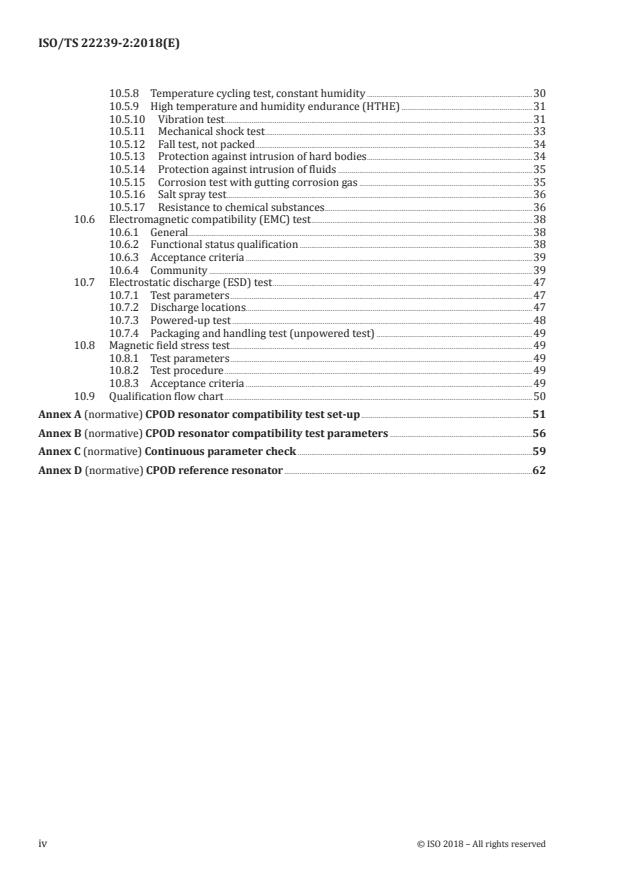
10 Resonator environmental qualification .23
10.1 Application profile .23
10.2 Common test parameters .25
10.3 Operating states .25
10.3.1 General.25
10.3.2 Operating state A (transport and storage) .25
10.3.3 Operating state B (non-functional state) .25
10.3.4 Operating state C (functional state) .25
10.3.5 Operating state D (intermitting functional state) .26
10.4 Parametrical test and parameter checking .26
10.4.1 Parametrical test before/after every single test .26
10.4.2 Continuous parameter check .26
10.5 Qualification tests .26
10.5.1 General.26
10.5.2 Acceptance criteria .26
10.5.3 Temperature storage (transport and storage) .26
10.5.4 Low temperature durability test .27
10.5.5 High temperature operating endurance test .27
10.5.6 Power thermal cycle endurance (PTCE) .28
10.5.7 Thermal shock test .29
10.5.8 Temperature cycling test, constant humidity .30
10.5.9 High temperature and humidity endurance (HTHE) .31
10.5.10 Vibration test.31
10.5.11 Mechanical shock test .33
10.5.12 Fall test, not packed .34
10.5.13 Protection against intrusion of hard bodies .34
10.5.14 Protection against intrusion of fluids .35
10.5.15 Corrosion test with gutting corrosion gas .35
10.5.16 Salt spray test .36
10.5.17 Resistance to chemical substances.36
10.6 Electromagnetic compatibility (EMC) test .38
10.6.1 General.38
10.6.2 Functional status qualification .38
10.6.3 Acceptance criteria .39
10.6.4 Community .39
10.7 Electrostatic discharge (ESD) test .47
10.7.1 Test parameters .47
10.7.2 Discharge locations . .47
10.7.3 Powered-up test .48
10.7.4 Packaging and handling test (unpowered test) .49
10.8 Magnetic field stress test .49
10.8.1 Test parameters .49
10.8.2 Test procedure .49
10.8.3 Acceptance criteria .49
10.9 Qualification flow chart .50
Annex A (normative) CPOD resonator compatibility test set-up .51
Annex B (normative) CPOD resonator compatibility test parameters .56
Annex C (normative) Continuous parameter check .59
Annex D (normative) CPOD reference resonator .62
iv © ISO 2018 – All rights reserved
Foreword
ISO (the International Organization for Standardization) is a worldwide federation of national standards
bodies (ISO member bodies). The work of preparing International Standards is normally carried out
through ISO technical committees. Each member body interested in a subject for which a technical
committee has been established has the right to be represented on that committee. International
organizations, governmental and non-governmental, in liaison with ISO, also take part in the work.
ISO collaborates closely with the International Electrotechnical Commission (IEC) on all matters of
electrotechnical standardization.
The procedures used to develop this document and those intended for its further maintenance are
described in the ISO/IEC Directives, Part 1. In particular the different approval criteria needed for the
different types of ISO documents should be noted. This document was drafted in accordance with the
editorial rules of the ISO/IEC Directives, Part 2 (see www .iso .org/directives).
Attention is drawn to the possibility that some of the elements of this document may be the subject of
patent rights. ISO shall not be held responsible for identifying any or all such patent rights. Details of
any patent rights identified during the development of the document will be in the Introduction and/or
on the ISO list of patent declarations received (see www .iso .org/patents).
Any trade name used in this document is information given for the convenience of users and does not
constitute an endorsement.
For an explanation on the voluntary nature of standards, the meaning of ISO specific terms and
expressions related to conformity assessment, as well as information about ISO's adherence to the
World Trade Organization (WTO) principles in the Technical Barriers to Trade (TBT) see the following
URL: www .iso .org/iso/foreword .html.
This document was prepared by Technical Committee ISO/TC 22, Road vehicles, Subcommittee SC 36,
Safety and impact testing.
This second edition cancels and replaces the first edition (ISO 22239-2:2009), which has been technically
revised to take account of the development in technology since the first edition was published. The
main changes compared to the previous edition are as follows:
— coil geometry parameters have changed;
— CPOD resonator protocol has changed;
— modulation parameters have been updated;
— the temperature storage test has been redefined;
— the CPOD resonator test parameters have been updated; and
— the ESD test has been updated.
A list of all parts in the ISO/TS 22239 series can be found on the ISO website.
TECHNICAL SPECIFICATION ISO/TS 22239-2:2018(E)
Road vehicles — Child seat presence and orientation
detection system (CPOD) —
Part 2:
Resonator specification
1 Scope
This document specifies the child seat presence and orientation detection (CPOD) resonator as part of
the CPOD system. It defines the electrical and environmental requirements to be met by the resonators
as a condition for CPOD compatibility.
2 Normative references
The following documents are referred to in the text in such a way that some or all of their content
constitutes requirements of this document. For dated references, only the edition cited applies. For
undated references, the latest edition of the referenced document (including any amendments) applies.
ISO 10605:2008, Road vehicles — Test methods for electrical disturbances from electrostatic discharge
ISO 11452-1, Road vehicles — Component test methods for electrical disturbances from narrowband
radiated electromagnetic energy — Part 1: General principles and terminology
ISO 11452-2, Road vehicles — Component test methods for electrical disturbances from narrowband
radiated electromagnetic energy — Part 2: Absorber-lined shielded enclosure
ISO 11452-3, Road vehicles — Component test methods for electrical disturbances from narrowband
radiated electromagnetic energy — Part 3: Transverse electromagnetic (TEM) cell
ISO 20653, Road vehicles — Degrees of protection (IP code) — Protection of electrical equipment against
foreign objects, water and access
ISO/TS 22239-1:2018, Road vehicles — Child seat presence and orientation detection system (CPOD) —
Part 1: Specifications and test methods
ISO 22241-1, Diesel engines — NOx reduction agent AUS 32 — Part 1: Quality requirements
IEC 60068-2-11, Environmental testing — Part 2: Tests. Test Ka: Salt mist
IEC 60068-2-38, Environmental testing — Part 2: Tests. Test Z/AD: Composite temperature/humidity
cyclic test
IEC 60068-2-60, Environmental testing — Part 2: Tests — Test Ke: Flowing mixed gas corrosion test
3 Terms and definitions
For the purposes of this document, the terms and definitions given in ISO/TS 22239-1 apply.
ISO and IEC maintain terminological databases for use in standardization at the following addresses:
— IEC Electropedia: available at https: //www .electropedia .org/
— ISO Online browsing platform: available at https: //www .iso .org/obp
4 CPOD resonator components
The CPOD resonator shall consist of a coil and of electronics. It might be encapsulated by a housing
as indicated in Figure 1. In order to pass the resonator compatibility test successfully, the different
components shall meet the requirements defined. The transponders shall be passive, i.e. they shall take
their energy out of the magnetic field produced by the CPOD sensor.
Key
1 encapsulation/housing
2 electronics
3 coil
Figure 1 — CPOD resonator components
5 Coil requirements
The CPOD resonator coil shall be an air coil with an elliptical shape. The geometry of the resonator
probe coil is defined as indicated in Figure 2.
2 © ISO 2018 – All rights reserved
Key
P , P position vectors determined by Formula (1)
1(x,y) 2(x,y)
Figure 2 — Resonator coil geometry
The position vectors of the inner and outer shape of the coil are described by Formula (1) with
parameters as specified in Table 1:
x y
P = + =1 (1)
(,xy)
x y
mm
Table 1 — Coil geometry parameters
Dimensions in millimetres, measured at 25 °C
Parameter min. max.
x — 57,4
m,outer
y — 32,8
m,outer
x 53,4 —
m,inner
y 28,6 —
m,inner
d — 1,5
6 Electrical properties
6.1 Digital resonator protocol
By generating a modulated magnetic field that is detected in the receiving antennae of the CPOD sensor
in the seat, the resonator shall transmit a digital data protocol which is built up as indicated in Figure 3.
a
Header: Sequence of 12 bits with logical bit value = 1.
b
Synchronization Sequence of three logical 0/1 transitions.
sequence:
c
Parity bit: Odd parity for T4-, T1-bit.
d
Divider bit: Subcarrier divider bit:
1 → divider by 40;
0 → divider by 56, right resonator.
e
Child seat type: T4 . T1.
Figure 3 — CPOD resonator protocol
Additional information about the child seat is provided via the child seat type bits as defined in Table 2.
Table 2 — Child seat type classification
Type T4 T3 T2 T1 Description
0 0 0 0 0 Not allowed
1 0 0 0 1 Rear-facing child seat
2 0 0 1 0 Forward-facing child seat
Convertible child seat, resonators
3 0 0 1 1
in stiff connection with child seat
Convertible child seat, resonators
4 0 1 0 0
not connected with child seat
5 0 1 0 1 Booster cushion
6 0 1 1 0 Carry-cots
7 0 1 1 1 Not yet defined
8 1 0 0 0 Not yet defined
9 1 0 0 1 Not yet defined
10 1 0 1 0 Not yet defined
11 1 0 1 1 Not yet defined
12 1 1 0 0 Not yet defined
13 1 1 0 1 Not yet defined
14 1 1 1 0 Not yet defined
15 1 1 1 1 Not yet defined
The protocol shall be repeated cyclically if the exiting magnetic field is still present. Thus, after the T4-
bit, the next bit shall again be the first bit of the header part of the data protocol (see Figure 4).
4 © ISO 2018 – All rights reserved
Key
1 resonator protocol
Figure 4 — Cyclical sending of the resonator protocol
Depending on whether it is a left or a right resonator, the bit frequency of the data protocol varies as
shown in Table 3.
Table 3 — Data protocol bit frequency
Resonator type Parameter Data protocol frequency
left f f /40/8 = f /320
data,left TX TX
right f f /56/8 = f /448
data,right TX TX
6.2 Subcarrier bitstream
Every resonator protocol bit value in accordance with Figure 3 logically summarizes eight consecutive
bits of the same logical value (hereafter defined as subcarrier bits) with another, higher bit frequency
(hereafter defined as subcarrier frequency). The relation between data protocol bits and subcarrier
bits is indicated in Figure 5.
Key
1 resonator data protocol
2 subcarrier bitstream
Figure 5 — Difference between original and resonator Manchester coding
In order to prepare the subcarrier bits for transmission, every subcarrier bit value shall be Manchester
coded, as indicated in Figure 6.
Key
1 subcarrier bit values
2 resulting Manchester code
Figure 6 — Manchester coding of subcarrier bit values
A subcarrier bit value of 1 shall cause a LOW to HIGH transition in the Manchester code pattern. A
subcarrier bit value of 0 shall cause a HIGH to LOW transition on the Manchester pattern.
Table 4 — Subcarrier bit frequency, f
subcarrier
Resonator type Parameter Data protocol frequency
left f f /40
subcarrier TX
right f f /56
subcarrier TX
If there is a 0 to 1 transition or a 1 to 0 transition in the resonator data protocol, the resulting Manchester
code shows a ±180° phase shift (phase shift keying, PSK).
The frequency of the subcarrier bitstream, as well as the phase angle of the concerned Manchester code,
shall be used to modulate the magnetic field generated by the resonator, e.g. Figure 7 shows the main
structure of the analogue front end of a resonator. The impedance of the LC oscillator is controlled by
the Manchester code derived by the subcarrier bitstream, e.g. a HIGH level in the Manchester code leads
to state one of the oscillators impedance (HIGH state); a low level in the Manchester code leads to state
two (LOW state) of the oscillator’s impedance.
6 © ISO 2018 – All rights reserved
Key
1 magnetic field
2 resonator
3 resonator oil
4 control logic
5 impedance variation of LC oscillator
Figure 7 — Exemplified electrical structure of resonator analogue front end
6.3 Modulation
6.3.1 General
The resonators shall produce a phase modulation in the receiving antenna which is demodulated by
the CPOD electronic control unit (ECU). Depending on the magnetic field supplying the resonators with
energy, these shall produce a corresponding magnetic field that assures compatibility with all CPOD-
compatible systems. The Manchester code of the bitstream specified in 6.2 shall be used to control
physically the state of modulation.
The ability of a CPOD resonator to generate a phase modulation in the receiving antenna, which can be
evaluated by the CPOD sensor, is characterized by two parameters: the parameter W determines the
ability of the resonator to produce sufficient receiving amplitude in a CPOD-compatible sensor after
demodulation; the parameter N specifies a maximum noise power at the demodulator’s output.
Both parameters are derived using the following procedure, whose blocks are explained in 6.3.2 to 6.3.10.
Figure 8 — Procedure to derive W(H ) and N(H ) for magnetic field strength, H
TX TX TX
6.3.2 Useful resonator signal, Ф (t)
RESO,NORM
Since CPOD sensors usually have a high magnetic coupling between transmitting and receiving
antennae, the useful resonator signal in the resonator magnetic field reduces to the component being
perpendicular to the exiting magnetic transmitter field, which is also flooding the receiving antennae.
The amplitude phase diagram in Figure 9 shows the relation between exciting magnetic field and
resulting resonator magnetic flux.
8 © ISO 2018 – All rights reserved
Key
Φ transmitter magnetic flux component supplying resonator
TX→RESO
Φ phase angle between resonator field and resonator magnetic flux, high state of modulation
H
Φ amplitude of resonator magnetic flux, high state of modulation
H
φ phase angle between transmitter field and resonator magnetic flux, low state of modulation
L
Φ amplitude of resonator magnetic flux, low state of modulation
L
Figure 9 — Resonator amplitude phase diagram
The magnetic flux generated by the resonator, which is flooding the receiving antenna, superposes to
the part of the magnetic flux generated by the transmitting antenna, which also floods the receiving
antenna. The resulting magnetic flux, Φ , in the receiving antenna is indicated in Figure 10.
RX
Key
φ (t) phase angle modulation in receiving antenna
RX
Φ transmitter field component flooding receiving antenna
TX→RX
φ phase angle between transmitter field and transponder magnetic flux, high state of modulation
H
Φ amplitude of resonator magnetic flux flooding receiving antenna high state of modulation
H
φ phase angle between transmitter field and transponder magnetic flux, low state of modulation
L
Φ amplitude of resonator magnetic flux flooding receiving antenna, low state of modulation
L
Figure 10 — Resulting magnetic flux in receiving antenna
Only the quadrature part of the magnetic flux generated by the resonator underlies CPOD compatibility
requirements (depending on the physical realization of the resonator, the part of the magnetic flux
being in phase with the supplying transmitter field may vary drastically).
10 © ISO 2018 – All rights reserved
The useful signal Φ (t) is defined by Formula (2):
RESO,NORM
ΦΦ()tt=×absa[( )] sinarg[(ΦΦtt)] = bs[ ( ))]×sin[ϕ()t ] (2)
{}
RESO,NORM
RESO RESO RESO
where
is the complex amplitude of Ф over time;
RESO
Φ ()t
RESO
arg[Φ ()t ] is the phase difference between Ф andΦ ()t (see Figure 10).
TX
RESO RESO
6.3.3 Lowpass filtering
Before performing the Fast Fourier transform (FFT) on Φ (t), the signal shall be filtered by a
RESO,NORM
third order lowpass filter since, usually, the influence of the harmonics on the demodulator output of
the CPOD sensor can be neglected for frequency components above the 9th harmonic. Table 5 specifies
the lowpass filter to be used.
Table 5 — Definition of lowpass filter
Parameter min. max.
End of pass band
W 20 20
p_low
kHz
Beginning of stop band
W 100 100
s_low
kHz
Attenuation in pass band
R 0 1
p_low
dB
Attenuation in stop band
R 60 —
s_low
dB
6.3.4 Spectral contents of Ф (t)
RESO,NORM
Although Manchester coded bitstream explained in 6.2 contains only two discrete states (HIGH and
LOW), the transition in the magnetic flux generated by the resonator takes a certain transition time,
as indicated by the dotted lines in Figure 10. Figure 11 shows an example for the Ф (t) as a
RESO,NORM
function of time.
Key
X1 time (ms)
X2 Φ (t) vs time
RESO,NORM
Y resonator magnetic flux (V⋅s)
Figure 11 — Transitions during modulation (exemplified)
Obviously, the spectral content of the magnetic flux contains the fundamental with subcarrier bitstream
frequency, several harmonics, as shown in Figure 12.
Key
X1 f (kHz)
X2 spectral contents of Φ (t)
RESO,NORM
Y magnetic flux amplitude (V⋅s)
a
Fundamental.
Figure 12 — Spectral contents of Ф (t) (exemplified)
RESO,NORM
The spectral contents of Ф (t) depends on the frequency, f , and the magnetic field strength,
RESO,NORM TX
H , supplying the resonator.
TX
12 © ISO 2018 – All rights reserved
6.3.5 The useful signal, Θ (f ,H )
TX TX
The spectral contents of Ф (t) (see Figure 12 for example) shows the subcarrier bit frequency
RX
(fundamental) of the phase modulation, Ф (t). The even harmonics (2nd, 4th, 6th, etc.) usually do not
RX
have any influence on the performance. Therefore, they are not addressed in this document and may
have, as well as their phase angle relation with respect to the fundamental, arbitrary values.
Only the odd harmonics (fundamental, 3rd, 5th, etc.) are taken to define and to calculate the useful
signal Θ ( f ,H ), as follows:
TX TX
Θ ( f H ) = fundamental − 1/3 × 3rd harmonic − 1/5 × 5th harmonic − 1/7 × 7th harmonic − 1/9 × 9th
TX, TX
harmonic, etc.
Getting the values for Θ ( f ,H ) over the complete f frequency range qualitatively leads to the curve
TX TX TX
shown in Figure 13.
Figure 13 — Qualitative curve of Θ ( f ,H ) for H = const
TX TX TX
6.3.6 The useful signal power, P (f ,H )
Θ TX TX
The useful signal power, P ( f ,H ), is defined as P ( f ,H ) = Θ ( f ,H ) .
Θ TX TX Θ TX TX TX TX
6.3.7 Noise power, P (f ,H )
NOISE TX TX
In order to derive the power, P ( f ,H ), the spectral contents of Φ (t) (see Figure 12)
NOISE TX TX RESO,NORM
shall be taken into account without the DC part, fundamental (odd and even) and its harmonics (set to
0). The remaining part shall be weighted over frequency. The weighting is performed by multiplying the
resulting spectrum with the weighting function (see Figure 14). The resulting noise spectral content is
shown in Figure 15.
Key
Y weighting function
Figure 14 — Weighting function and resulting noise spectral contents of φ (t)
RX
14 © ISO 2018 – All rights reserved
Key
Y noise amplitude (V)
Figure 15 — Resulting noise spectral contents of φ (t)
NORM
The noise power is defined by Formula (3):
Pf(,H )= noise_spectrum (3)
NOISETXTX
∫
f
The noise power depends on the frequency, f , and the magnetic field strength, H , supplying the
TX TX
resonator.
6.3.8 The signal-to-noise ratio (SNR)
In order to generate the signal-to-noise ratio (SNR), the useful signal’s power as well as the noise power
shall be calculated. The SNR is defined by Formula (4):
Pf(,H )
Θ TX TX
SNRf(,H )= (4)
TX TX
Pf(,H )
NOISETXTX
In order to characterize the performance of the resonator, SNR shall be recorded over frequency and
magnetic field strength.
6.3.9 Definition of W(H )
TX
Due to the fact that there are only discrete frequency settings that the CPOD transmitter can use, the
function Θ( f ,H ) (see 6.3.5) shall be evaluated within a frequency window whose centre frequency
TX TX
is variable and which has a defined width of Δf (see Figure 16). This is because the transmitting
BAND
frequency may vary between CPOD sensors.
Figure 16 — Evaluation of W(H ) at a given transmitter field strength
TX
W(H ) is defined by Formula (5):
TX
WH =−maxmin Θ ffεΔff/22. +ΔfH/, (5)
() ()
{})
TX ( TX CBANDC BAND TX
with ffε . f .
()
CTX,minTX,max
When shifting the frequency window over Θ( f ,H ) with ff= . f , Formula (6) shall be
TX TX
CTX,minTX,max
recorded:
WH =Hf=−maxmin Θ εΔff /22.ff+Δ /,H (6)
() ()
{}
TX ( CC BAND CBANDTX )
This shall be done for all HHε .H .
()
TX OP,min OP,max
6.3.10 Definition of N(H )
TX
N(H ) specifies the minimum SNR in the f frequency range where Θ( f ,H ) ≥ W(H ) (see
TX TX TX TX TX
Figure 17 for explanation). In mathematical terms, it is defined by Formula (7):
NH =min SNR ffε .fH, (7)
() ()
{}
TX TX 12 TX
16 © ISO 2018 – All rights reserved
Figure 17 — Example for interpretation of W(H )
TX
6.4 Modulation parameters
W(H ) and N(H ) shall meet the requirements specified in Table 6.
TX TX
Table 6 — W(H ), N(H ) specification
TX TX
Parameter Definition min. max.
a
W
synch
Δ f = 2 185 kHz, measured in accordance with 6.3.9; As defined in
BAND
—
measurement starts T after reset field gap Figure 18
STARTUP
Vspk
a
N
synch
Δ f = 2 185 kHz, measured in accordance with 6.3.10; As defined in
BAND
—
measurement starts T after reset field gap Figure 19
STARTUP
dB
b
W
asynch
Δ f = 2 185 kHz, measured in accordance with 6.3.9; As defined in
BAND
—
measurement starts after T , no reset field gap generated Figure 18
DELAY
Vspk
b
N
asynch
Δ f = 2 185 kHz, measured in accordance with 6.3.10; As defined in
BAND
—
measurement starts after T , no reset field gap generated Figure 19
DELAY
dB
NOTE 1 pk = peak value.
NOTE 2 N[dB] = 10 × log [N(H )].
10 TX
NOTE 3 For the definition of T and T , see Table 7.
STARTUP DELAY
a
Resonator protocol generation timing is synchronized with reader timing, since resonator was reset before.
b
Resonator protocol generation timing is asynchronous with reader timing, since resonator was not reset before.
a) Left resonator
b) Right resonator
Key
X H (Apk/m)
TX
Y W (Vspk)
synch,asynch
1 max
2 min
Figure 18 — W versus magnetic field strength, H
synch,asynch TX
18 © ISO 2018 – All rights reserved
a) Left resonator
b) Right resonator
Key
X H (Apk/m)
TX
Y W (dB)
synch,asynch
1 min
Figure 19 — N versus magnetic field strength, H
synch,asynch TX
7 Resonator timing
7.1 General
The resonator shall meet the timing requirements in order to be CPOD compliant. Figure 20 shows the
relevant parameters.
Key
1 start of modulation
2 start of modulation after reset field gap
3 reset field gap (H < H )
TX RESET
Figure 20 — Resonator timing and reset field strength, H
RESET
7.2 Power-up
For the duration of resonator power-up, T , the transmitter is switched on to enable the
POWER-UP
resonator to charge its energy storages, in order to pass a possible following reset gap in a biased state
(see Figure 20). During T , at the latest after T , the resonator shall begin to transmit its
POWERUP DELAY
digital protocol, starting with bit one.
7.3 Reset
In order to reset the protocol transmission, the transmitter switches off the transmitting field for a
duration of T . Once the transmitting field is up from reset and within its operating range again,
RESET
the resonator, after T , shall resume the transmission from the beginning of its digital data
STARTUP
protocol (bit one).
20 © ISO 2018 – All rights reserved
7.4 Relevant timing and reset parameters
Table 7 — Relevant timing and reset parameters
Parameter Definition min. max.
T
POWER-UP
Duration for resonator power-up, H within operating range 10 —
TX
ms
T
RESET
Duration of reset field gap, H ≤ H 2,5 3,5
TX RESET
ms
T
START-UP
Time between end of reset field gap (H ≥ H ) and start
TX OP,MIN
0 1
of resonator modulation
ms
T
DELAY
Time between H ≥ H and start of resonator protocol
TX OP,MIN
— See Figure 22
transmission, except after reset field gap
ms
Magnetic field strength to cause resonator reset at the lat-
H
RESET
est after T , f = f , measured in accordance with ISO/ See Figure 21 —
RESET TX
mApk/m
TS 22239-1:—, Annex G
NOTE For the definition of H , H , T , and T , see Figure 20. For the definition of H , see Table 9.
TX RESET DELAY RESET OP,MIN
Key
Y H (mApk/m)
RESET
Figure 21 — H versus magnetic field strength, H
RESET TX
Key
Y T (ms)
DELAY
Figure 22 — T versus magnetic field strength, H
DELAY TX
8 Electrical and environmental parameters
8.1 Absolute maximum ratings
Correct functionality of the transponder is not required when it is exposed to the absolute maximum
ratings mentioned in this clause, but the transponder shall not be damaged during and after exposure
to these conditions. When it is back in operating condition, it shall work again in accordance with this
document.
Table 8 — Absolute maximum ratings
Parameter Definition min. max.
Maximum magnetic field strength at f = f , for transmitting se-
TX
H — 30 A/m rms
MAX,SEQ
a
quence , measured in accordance with ISO/TS 22239-1:—, Annex G
Maximum magnetic field strength at f = f , stressed unlimited,
TX
H — 20 A/m rms
MAX,CONT
measured in accordance with ISO/TS 22239-1:—, Annex G
T Temperature range to which to be exposed −40 °C +95 °C
ABS
a
There is a worst case timing given for the maximum magnetic field stress (see Figure 23).
22 © ISO 2018 – All rights reserved
Figure 23 — Timing for maximum magnetic field stress
8.2 Operating ranges
When exposed to the conditions specified in Table 9, the resonator shall feature its full functionality.
Table 9 — Operating ranges
Parameter Definition min. max.
f Magnetic field frequency 124 kHz 133 kHz
TX
Operating magnetic field strength, measured in accordance with
H 0,3 Apk/m 5 Apk/m
OP
ISO/TS 22239-1:—, Annex G
T Ambient temperature −40 °C +85 °C
AMB
NOTE pk = peak value.
8.3 Storage conditions
The storage conditions are specified in Table 10.
Table 10 — Storage conditions
Parameter min. max.
Storage temperature
T −40 +95
STOR
°C
9 CPOD resonator compatibility test
In order to be CPOD compliant, a resonator shall pass the CPOD compatibility test. The CPOD resonator
compatibility test set-up in accordance with Annex A shall be used. The test parameters and the testing
procedure are described in Annex B. In addition, the resonator shall pass successfully the environmental
qualification programme described in Clause 10.
10 Resonator environmental qualification
10.1 Application profile
The application profile defined in Tables 11 to 14 summarizes the mechanical, climatic and chemical
influences on the CPOD resonator during its lifetime.
Table 11 — Lifetime and operating time
Parameter Requirement
Resonator lifetime 15 years
Active operating time (resonator supplied by magnetic field) 6 000 h
Passive operating time (resonator not supplied by magnetic field) 119 000 h
Table 12 — Mechanical exposure
Parameter Requirement
Periodic excitation
Vibration Passenger compartment vibration profile
Static excitation
Mechanical shock Acceleration up to 500 m/s
Acceleration
Free fall 1 m fall height, concrete floor
Table 13 — Chemical exposure
Parameter Requirement
Protection class IP5K4
Environmental influences Salt fog atmosphere
Purifying agents Chemicals in accordance with Table 31
Corrosive gases Industrial climate (H S, NO , Cl , SO )
2 2 2 2
Table 14 — Climatic exposure (temperature/humidity)
Operating state Parameter Requirement
Temperature Distribution
°C %
−40 6
Temperature profile
+23 65
+60 20
During operation in child
+80 8
seat/car
+85 1
Passenger compartment, maximum temperature
Temperature class
85 °C
Relative humidity up to 100 %
Humidity
condensation and freezing
Minimum temperature: −40 °C
Temperature maximum temperature: +85 °C
typical temperature: +23 °C
In child seat/car,
Relative humidity up to 100 %
non-operating
condensation and freezing
Humidity
60 % relative humidity on average
Minimum temperature: −40 °C
Temperature
maximum temperature: +95 °C
Transport
Max. 24 h continuously at minimum temperature
Transport duration
max. 48 h continuously at maximum temperature
Minimum temperature: −10 °C
Temperature
maximum temperature: +55 °C
Storage
Storage duration 5 years
Humidity Max. 85 % relative humidity
24 © ISO 2018 – All rights reserved
Table 14 (continued)
Operating state Parameter Requirement
Minimum temperature: +10 °C
Temperature
maximum temperature: +40 °C
Long term storage
(spare part supply) Storage duration 15 years
Humidity Max. 80 % relative humidity
Temperature cycles Quantity 5 500 over 15 years
Temperature swing Average: 34 °C
10.2 Common test parameters
Table 15 specifies the common test parameters.
Table 15 — Common test parameters
Parameter Definition Requirement
Minimum ambient temperature possible at the place of insta
...
Questions, Comments and Discussion
Ask us and Technical Secretary will try to provide an answer. You can facilitate discussion about the standard in here.
Loading comments...