


ISO/TS 24519:2022
(Main)Service activities relating to drinking water supply, wastewater and stormwater systems — Water and wastewater services for temporary settlements for displaced persons
Service activities relating to drinking water supply, wastewater and stormwater systems — Water and wastewater services for temporary settlements for displaced persons
This document provides guidelines for alternative water services (AWS) and alternative wastewater services (AWWS) to temporary settlements for displaced persons e.g. refugee/internally displaced persons (IDP) camps, for drinking, sanitation and hygiene purposes. It addresses AWS and AWWS principles and methods, operational planning and implementation. This document provides guidelines for drinking water supply to temporary settlements, and the disposal of wastewater, by implementation of different methods; it does not deal with the ways of using water inside the temporary settlements. This document deals with drinking water quantity but does not provide methods for quality testing. Water quality test methods are included in the scope of ISO TC 147. The document does make recommendations regarding public safety with respect to the location of distribution and collection points. On-site treatments are not discussed in this document but, depending on circumstances, they can be suitable. In such case, helpful technical guidelines are provided in the bibliography of this document. This document complements ISO 24527, whose scope excludes drinking water supplied to temporary settlements. It also complements other ISO TC 224's documents such as ISO 24518 and ISO/TS 24520. This document is intended to be used by the responsible body for the provision of the water service. It can be used by interested parties such as water utilities, governments and governmental organizations, security bodies, international refugee agencies, related NGOs and relevant industry stakeholders.
Activités de service relatives aux systèmes d'alimentation en eau potable, aux systèmes d'assainissement et aux systèmes de gestion des eaux pluviales — Services d’eau et d’assainissement pour les installations provisoires pour les personnes déplacées
General Information
- Status
- Published
- Publication Date
- 18-Aug-2022
- Technical Committee
- ISO/TC 224 - Drinking water, wastewater and stormwater systems and services
- Drafting Committee
- ISO/TC 224/WG 7 - Crisis management of water utilities
- Current Stage
- 9093 - International Standard confirmed
- Start Date
- 03-Dec-2025
- Completion Date
- 12-Feb-2026
Overview
ISO/TS 24519:2022 - Service activities relating to drinking water supply, wastewater and stormwater systems - provides international guidance for delivering alternative water services (AWS) and alternative wastewater services (AWWS) to temporary settlements for displaced persons (e.g., refugee and IDP camps). The technical specification focuses on planning and implementing drinking water supply and wastewater disposal methods for drinking, sanitation and hygiene (WASH) purposes. It addresses water quantity and service delivery approaches but does not include water quality test methods (see ISO TC 147) or internal household water use practices.
Key topics
- Principles and responsibility
- Roles of the responsible body for water service provision and stakeholder coordination.
- Temporary settlement categorization
- Differentiation of emergency, transition and planned settlements to inform service choices.
- AWS and AWWS approaches
- Using existing networks (full or limited capacity), transported water (tankers, static tanks, containerized supply), using non-potable or natural sources, and creating new sources.
- Planning and operational guidance
- Establishing scenarios, decision-making, securing resources and mobilization planning.
- Implementation considerations
- Connection options, distribution and collection point siting (public safety), wastewater conveyance (pipelines or tankers) and options when infrastructure is lacking.
- Communications
- Internal and external messaging to users and stakeholders, tailored information, and tools for awareness and safety.
- Scope limits
- Guidance on drinking water quantity and site safety; excludes laboratory water quality testing and on-site treatment design (bibliography lists helpful technical references).
Applications
ISO/TS 24519:2022 is practical for organizations involved in emergency water and sanitation response:
- Humanitarian agencies and NGOs designing WASH services in refugee/IDP camps.
- Government authorities and water utilities planning contingency or temporary supply extensions.
- International organizations and security bodies coordinating multi-stakeholder responses.
- Consultants and industry suppliers preparing equipment (tankers, containers, temporary piping) and operational plans. Use cases include emergency response planning, rapid deployment of drinking water by tanker or containerized systems, wastewater removal strategies where treatment infrastructure is unavailable, and stakeholder communication frameworks for temporary settlements.
Related standards
- Complements ISO 24527, ISO 24518, and ISO/TS 24520.
- Water quality testing methods are covered under ISO TC 147 (not in this document).
Keywords: ISO/TS 24519:2022, temporary settlements, displaced persons, AWS, AWWS, drinking water supply, wastewater disposal, WASH, refugee camps, IDP camps, operational planning.

Get Certified
Connect with accredited certification bodies for this standard

BSI Group
BSI (British Standards Institution) is the business standards company that helps organizations make excellence a habit.

Bureau Veritas
Bureau Veritas is a world leader in laboratory testing, inspection and certification services.

DNV
DNV is an independent assurance and risk management provider.
Sponsored listings
Frequently Asked Questions
ISO/TS 24519:2022 is a technical specification published by the International Organization for Standardization (ISO). Its full title is "Service activities relating to drinking water supply, wastewater and stormwater systems — Water and wastewater services for temporary settlements for displaced persons". This standard covers: This document provides guidelines for alternative water services (AWS) and alternative wastewater services (AWWS) to temporary settlements for displaced persons e.g. refugee/internally displaced persons (IDP) camps, for drinking, sanitation and hygiene purposes. It addresses AWS and AWWS principles and methods, operational planning and implementation. This document provides guidelines for drinking water supply to temporary settlements, and the disposal of wastewater, by implementation of different methods; it does not deal with the ways of using water inside the temporary settlements. This document deals with drinking water quantity but does not provide methods for quality testing. Water quality test methods are included in the scope of ISO TC 147. The document does make recommendations regarding public safety with respect to the location of distribution and collection points. On-site treatments are not discussed in this document but, depending on circumstances, they can be suitable. In such case, helpful technical guidelines are provided in the bibliography of this document. This document complements ISO 24527, whose scope excludes drinking water supplied to temporary settlements. It also complements other ISO TC 224's documents such as ISO 24518 and ISO/TS 24520. This document is intended to be used by the responsible body for the provision of the water service. It can be used by interested parties such as water utilities, governments and governmental organizations, security bodies, international refugee agencies, related NGOs and relevant industry stakeholders.
This document provides guidelines for alternative water services (AWS) and alternative wastewater services (AWWS) to temporary settlements for displaced persons e.g. refugee/internally displaced persons (IDP) camps, for drinking, sanitation and hygiene purposes. It addresses AWS and AWWS principles and methods, operational planning and implementation. This document provides guidelines for drinking water supply to temporary settlements, and the disposal of wastewater, by implementation of different methods; it does not deal with the ways of using water inside the temporary settlements. This document deals with drinking water quantity but does not provide methods for quality testing. Water quality test methods are included in the scope of ISO TC 147. The document does make recommendations regarding public safety with respect to the location of distribution and collection points. On-site treatments are not discussed in this document but, depending on circumstances, they can be suitable. In such case, helpful technical guidelines are provided in the bibliography of this document. This document complements ISO 24527, whose scope excludes drinking water supplied to temporary settlements. It also complements other ISO TC 224's documents such as ISO 24518 and ISO/TS 24520. This document is intended to be used by the responsible body for the provision of the water service. It can be used by interested parties such as water utilities, governments and governmental organizations, security bodies, international refugee agencies, related NGOs and relevant industry stakeholders.
ISO/TS 24519:2022 is classified under the following ICS (International Classification for Standards) categories: 03.080.30 - Services for consumers; 03.100.01 - Company organization and management in general; 13.060.01 - Water quality in general. The ICS classification helps identify the subject area and facilitates finding related standards.
ISO/TS 24519:2022 is available in PDF format for immediate download after purchase. The document can be added to your cart and obtained through the secure checkout process. Digital delivery ensures instant access to the complete standard document.
Standards Content (Sample)
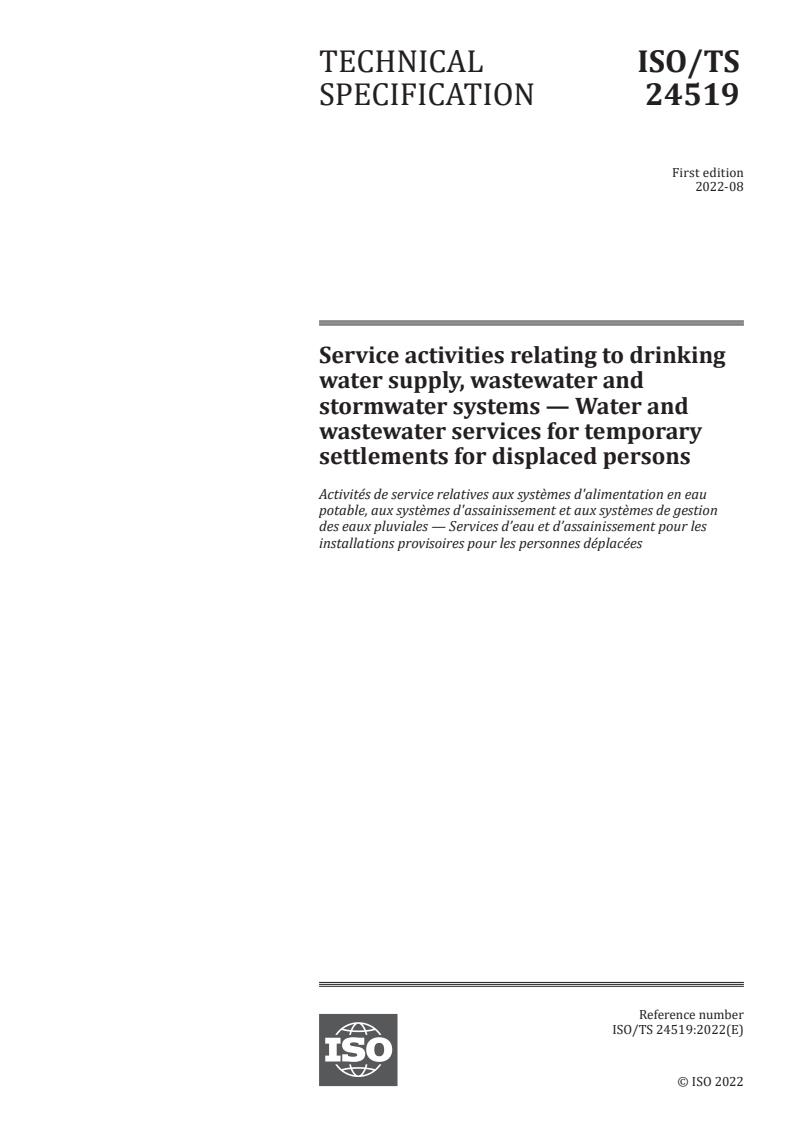
TECHNICAL ISO/TS
SPECIFICATION 24519
First edition
2022-08
Service activities relating to drinking
water supply, wastewater and
stormwater systems — Water and
wastewater services for temporary
settlements for displaced persons
Activités de service relatives aux systèmes d'alimentation en eau
potable, aux systèmes d'assainissement et aux systèmes de gestion
des eaux pluviales — Services d’eau et d’assainissement pour les
installations provisoires pour les personnes déplacées
Reference number
© ISO 2022
All rights reserved. Unless otherwise specified, or required in the context of its implementation, no part of this publication may
be reproduced or utilized otherwise in any form or by any means, electronic or mechanical, including photocopying, or posting on
the internet or an intranet, without prior written permission. Permission can be requested from either ISO at the address below
or ISO’s member body in the country of the requester.
ISO copyright office
CP 401 • Ch. de Blandonnet 8
CH-1214 Vernier, Geneva
Phone: +41 22 749 01 11
Email: copyright@iso.org
Website: www.iso.org
Published in Switzerland
ii
Contents Page
Foreword .v
Introduction . vi
1 Scope . 1
2 Normative references . 1
3 Terms and definitions . 1
4 Principles for AWS and AWWS provision for temporary settlements .2
4.1 Responsibility . 2
4.2 Main purposes of the operation . 2
4.3 Temporary settlements categorization . 2
4.4 AWS and AWWS provision to temporary settlements approaches . 3
4.4.1 Using existing drinking water and wastewater networks . 3
4.4.2 Using existing drinking water and wastewater networks but with limited
capacity . 3
4.4.3 Providing drinking water by means of transport . 3
4.4.4 Only drinking water infrastructure available . 4
4.4.5 Water source not adequate for drinking is available . 4
4.4.6 A Natural water source is available . 4
4.4.7 Creating a new water source . 4
4.4.8 Water allocation . 5
4.4.9 Water quality . 5
4.4.10 Grey water . 5
5 Planning for AWS and AWWS provision for temporary settlements .5
5.1 General . 5
5.2 Planning . 6
5.2.1 Establishing scenario for individual temporary settlement . 6
5.2.2 Decisions and actions to be taken . 6
5.2.3 Securing resources and planning for their mobilization . 6
6 Implementation of AWS and AWWS provision for temporary settlements .7
6.1 General . 7
6.2 Using the existing drinking water and wastewater networks . 7
6.2.1 General . 7
6.2.2 Distribution of drinking water by connecting to an existing drinking water
supply system. 7
6.2.3 Connecting to the wastewater infrastructure . 8
6.3 Providing drinking water by means of transport . 8
6.3.1 General . 8
6.3.2 Drinking water source(s) and transporting . 8
6.3.3 Static water tanks connected to multi drinking water taps . 8
6.3.4 Static assets (water tankers, towed bowsers or tanks) . 9
6.3.5 Containerized drinking water . 9
6.3.6 Reservoir . 9
6.3.7 AWWS. 9
6.4 Wastewater infrastructure not available . 9
6.5 Drinking water and wastewater networks are available but with limited capacity . 10
6.6 Water source not for drinking is available . 10
6.7 Natural water source is available . 10
6.8 Creating a water source . 10
7 Internal and external communications .11
7.1 General . 11
7.2 What to communicate . 11
7.2.1 Information to users . 11
7.2.2 Information to other stakeholders . 11
iii
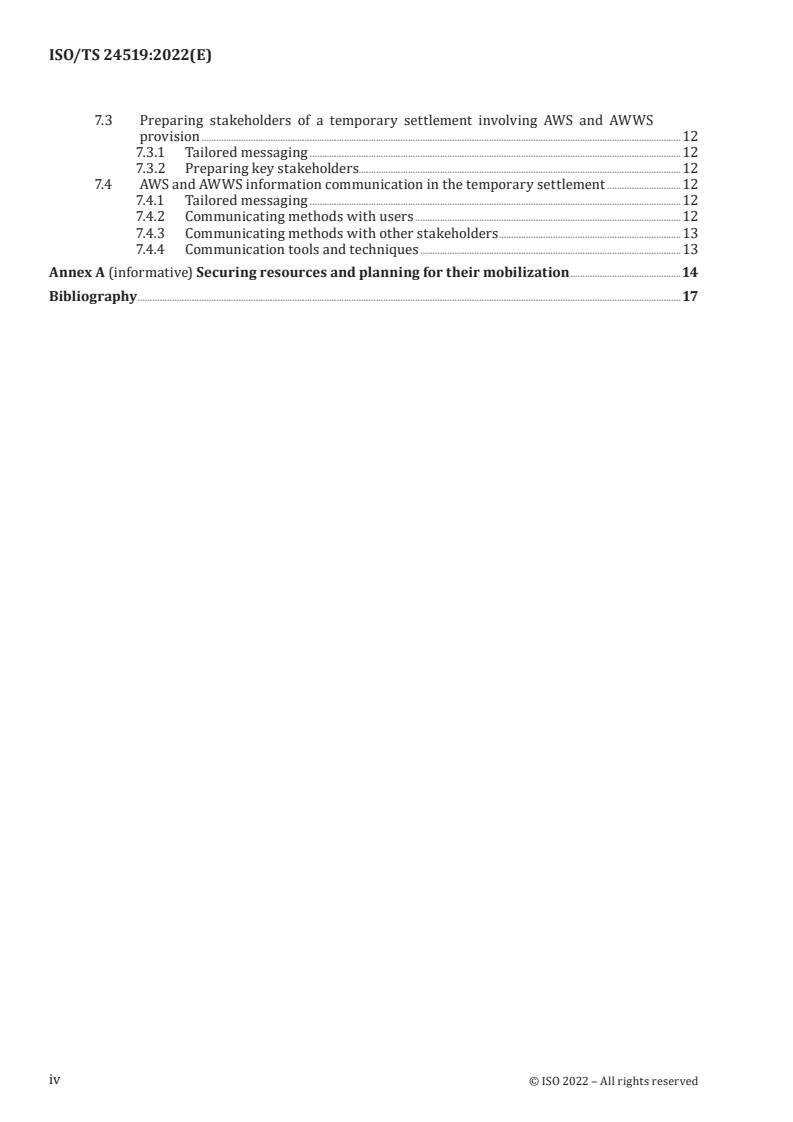
7.3 Preparing stakeholders of a temporary settlement involving AWS and AWWS
provision . 12
7.3.1 Tailored messaging .12
7.3.2 Preparing key stakeholders.12
7.4 AWS and AWWS information communication in the temporary settlement .12
7.4.1 Tailored messaging .12
7.4.2 Communicating methods with users .12
7.4.3 Communicating methods with other stakeholders .13
7.4.4 Communication tools and techniques . 13
Annex A (informative) Securing resources and planning for their mobilization .14
Bibliography .17
iv
Foreword
ISO (the International Organization for Standardization) is a worldwide federation of national standards
bodies (ISO member bodies). The work of preparing International Standards is normally carried out
through ISO technical committees. Each member body interested in a subject for which a technical
committee has been established has the right to be represented on that committee. International
organizations, governmental and non-governmental, in liaison with ISO, also take part in the work.
ISO collaborates closely with the International Electrotechnical Commission (IEC) on all matters of
electrotechnical standardization.
The procedures used to develop this document and those intended for its further maintenance are
described in the ISO/IEC Directives, Part 1. In particular, the different approval criteria needed for the
different types of ISO documents should be noted. This document was drafted in accordance with the
editorial rules of the ISO/IEC Directives, Part 2 (see www.iso.org/directives).
Attention is drawn to the possibility that some of the elements of this document may be the subject of
patent rights. ISO shall not be held responsible for identifying any or all such patent rights. Details of
any patent rights identified during the development of the document will be in the Introduction and/or
on the ISO list of patent declarations received (see www.iso.org/patents).
Any trade name used in this document is information given for the convenience of users and does not
constitute an endorsement.
For an explanation of the voluntary nature of standards, the meaning of ISO specific terms and
expressions related to conformity assessment, as well as information about ISO's adherence to
the World Trade Organization (WTO) principles in the Technical Barriers to Trade (TBT), see
www.iso.org/iso/foreword.html.
This document was prepared by Technical Committee ISO/TC 224, Drinking water, wastewater and
stormwater systems and services.
Any feedback or questions on this document should be directed to the user’s national standards body. A
complete listing of these bodies can be found at www.iso.org/members.html.
v
Introduction
Natural disasters, climate change and wars resulting in the mass migration of populations fleeing
their homes to temporary settlements such as refugee/internally displaced persons (IDP) camps has
become a reality in many parts of the world. Temporary settlements are planned or spontaneous places
where refugees or IDPs can reside and benefit from welfare provision, safety and protection, and other
assistance from host governments and humanitarian actors. Reliable and good quality water supply
for purposes such as drinking, sanitation, hygiene, e.g., WASH (water, sanitation and hygiene) is critical
for the survival of the population in temporary settlements. Risks due to natural disasters also require
consideration. For instance, earthquakes can cause damage to electricity and/or transportation
infrastructure, which are relied on for the construction and operation of the drinking water supply
network and wastewater treatment system.
In order to establish a reliable drinking water supply to temporary settlements, it is desirable to have a
regular drinking water supply system based on a water source connection through fixed or temporary
piping. If this is not possible, water tankers can be used to supply the required quantity of drinking
water to the temporary settlement on a regular basis. The water sources used for this purpose should
be suitable for drinking purposes. Where water sources that are suitable for drinking purposes are
limited, water sources of lower quality can be used for sanitation and other non-potable use purposes
only, and cannot be used as drinking water.
Dealing with the adequate disposal of wastewater produced in a temporary settlement is also of
critical importance. Neglecting proper disposal of wastewater can seriously harm public health and
the environment. It is desirable that the wastewater from temporary settlements will be conveyed
by means of fixed or temporary pipeline infrastructure that will enable its removal from the area of
the temporary settlement and treated by adequate installations outside the settlement. If this is not
possible, portable wastewater tankers can be used to transfer the wastewater to another location
outside the temporary settlement for proper treatment.
There are different types of temporary settlements e.g. emergency and/or transition camps. In most
cases, drinking water and wastewater provisions can differ or need to evolve according to spatial and
temporal factors.
An international guideline can provide information on the different possibilities for providing
alternative water services (AWS) and alternative wastewater services (AWWS) to temporary
settlements of displaced persons, the methods that can be used to implement such possibilities and
the technical aspects that have to be accounted for when considering the implementation of different
solutions to resolve the problems of AWS and AWWS that arise in such settlements.
The purpose of this document is to serve as a guideline for planning and setting up appropriate water
and wastewater services for temporary settlements.
A guideline for drinking water service provision to temporary settlements can also facilitate
communication between relevant parties, coordinate activities and contribute to cost saving. It can be
used by relevant industry and stakeholders wishing to be prepared to cope with the issues of drinking
water supply and wastewater disposal in temporary settlements.
vi
TECHNICAL SPECIFICATION ISO/TS 24519:2022(E)
Service activities relating to drinking water supply,
wastewater and stormwater systems — Water and
wastewater services for temporary settlements for
displaced persons
1 Scope
This document provides guidelines for alternative water services (AWS) and alternative wastewater
services (AWWS) to temporary settlements for displaced persons e.g. refugee/internally displaced
persons (IDP) camps, for drinking, sanitation and hygiene purposes. It addresses AWS and AWWS
principles and methods, operational planning and implementation.
This document provides guidelines for drinking water supply to temporary settlements, and the
disposal of wastewater, by implementation of different methods; it does not deal with the ways of using
water inside the temporary settlements. This document deals with drinking water quantity but does
not provide methods for quality testing. Water quality test methods are included in the scope of ISO TC
147.
The document does make recommendations regarding public safety with respect to the location of
distribution and collection points. On-site treatments are not discussed in this document but, depending
on circumstances, they can be suitable. In such case, helpful technical guidelines are provided in the
bibliography of this document.
This document complements ISO 24527, whose scope excludes drinking water supplied to temporary
settlements. It also complements other ISO TC 224's documents such as ISO 24518 and ISO/TS 24520.
This document is intended to be used by the responsible body for the provision of the water service. It
can be used by interested parties such as water utilities, governments and governmental organizations,
security bodies, international refugee agencies, related NGOs and relevant industry stakeholders.
2 Normative references
The following documents are referred to in the text in such a way that some or all of their content
constitutes requirements of this document. For dated references, only the edition cited applies. For
undated references, the latest edition of the referenced document (including any amendments) applies.
ISO 24513:2019, Service activities relating to drinking water supply, wastewater and stormwater systems
— Vocabulary
3 Terms and definitions
For the purposes of this document, the terms and definitions given in ISO 24513:2019 and the following
apply.
ISO and IEC maintain terminology databases for use in standardization at the following addresses:
— ISO Online browsing platform: available at https:// www .iso .org/ obp
— IEC Electropedia: available at https:// www .electropedia .org/
3.1
displaced person
a person who is forced to leave without their will their home or country
3.2
wastewater
water arising from any combination of domestic, institutional, commercial or industrial activities,
surface runoff and any accidental sewer inflow/infiltration water and which can include collected
stormwater, discharged to the environment or sewer
Note 1 to entry: Wastewater can flow in separate or combined sewer systems.
3.3
grey water
greywater
wastewater (3.2) from bathtubs and showers, hand basins, kitchen sinks, clothes washing and laundry
tubes but excluding excreta and trade effluent
Note 1 to entry: It excludes used water from urinals or toilet bowls.
Note 2 to entry: Wastewater from kitchen sinks, food waste grinders or dishwashers can be excluded, subject to
local requirements.
4 Principles for AWS and AWWS provision for temporary settlements
4.1 Responsibility
The authority which authorized the establishment of the temporary settlement should ensure that a
consultation process is initiated among the entities concerned by the water services. This should allow
for the designation of the responsible body to be in charge of the operation.
The first task of the responsible body in charge of the operation should be to establish an operational
team.
The following are possible examples of responsible bodies: a local water utility, municipal authority,
governmental bodies, military units, international bodies (e.g. UN WASH), NGO's, private companies
(e.g. transport companies, containerized water companies).
A planning and operational team should be appointed of representatives of these relevant bodies, to
allow a coordinated operation and determine the necessary decisions. The inclusion of representatives
of the displaced persons in the temporary settlement should also be considered.
4.2 Main purposes of the operation
The main purposes of the operation should include the following.
a) Bring to the temporary settlement enough water, in accordance with the AWS and AWWS plans
which determine water allocation per capita per day, drinking water, and water for sanitation and
hygiene purposes, considering the need for personal and public safety.
b) Dispose of wastewater from the temporary settlement area to a dedicated site.
4.3 Temporary settlements categorization
For the purpose of this guideline, temporary settlements should be categorized as follows.
a) Temporary settlements that can be connected to existing drinking water and wastewater
infrastructure.
b) Temporary settlements that can be connected to existing drinking water and wastewater
infrastructure, but with limited capacity.
c) Temporary settlements that cannot be connected to existing drinking water and wastewater
infrastructure.
These three types of temporary settlements require different AWS and AWWS approaches.
The categorization of the temporary settlements may include a combination between these three types,
e.g. drinking water infrastructure is available, but no wastewater infrastructure is available, or vice
versa.
Temporary settlements may also be categorized by the availability of a water source which may not be
adequate for drinking purposes but can be used for sanitation purposes, e.g. on-site treated wastewater,
grey water.
In such case of a combination of the three types of settlements, AWS and AWWS provision should be
based on a combination between the approaches described in 4.4.
4.4 AWS and AWWS provision to temporary settlements approaches
4.4.1 Using existing drinking water and wastewater networks
The use of existing drinking water and wastewater networks is based on the condition that drinking
water and wastewater infrastructure is available, i.e., water or wastewater infrastructure that is:
— physically present;
— has the capacity to supply additional population;
— has political and administrative approval to be used for the additional population.
To be able to use existing drinking water and wastewater networks, the planning and operational
team should connect the temporary settlement to the existing infrastructure by erecting temporary
standpipes connected to the networks. Inside the temporary settlement, the planning and operational
team should connect the temporary standpipes to users (e.g. multi drinking water taps, toilets, showers,
etc.) and connect the toilets and showers to the wastewater infrastructure.
The use of existing drinking water and wastewater networks is the preferred approach as it provides
users with the most reliable AWS and AWWS services, as well as the highest level of WASH.
See more on the operational aspects of this approach in Clause 6.
4.4.2 Using existing drinking water and wastewater networks but with limited capacity
When existing drinking water and wastewater networks are available but with limited capacity, the
largest available quantity of water should be supplied from the infrastructure, while the rest of the
water should be supplied as described in 4.4.3.
The largest possible quantity of wastewater should be disposed of through the infrastructure, while
the rest of the wastewater should be disposed of by means of transportation, or by on-site wastewater
treatment (for more information about on-site wastewater treatment, see ISO 23056 and ISO 24521).
4.4.3 Providing drinking water by means of transport
This approach of provision of drinking water by means of transport assumes that limited or no drinking
water and wastewater infrastructure are available. To implement this approach the planning and
operational team should use various means of transport for the drinking water (e.g., mobile tankers,
trains, air crafts) in order to provide it to the temporary settlement and to dispose of its wastewater.
While using these various means of transport, the quality of the distributed water should always be
clear / well marked for everyone in the supply chain.
Inside the temporary settlement, temporary points of distribution (TPDs) should be established. Such
TPDs should be the interface for users to receive drinking water and water for hygiene purposes.
Containerized drinking water may also be used in this approach.
In this approach, sanitation should not be based on water. The planning and operational team should
use different types of toilets (e.g. chemical toilets, latrines) and make the necessary arrangements to
dispose of the wastewater by means of transport (e.g. mobile wastewater tanker) out of the temporary
settlement to a dedicated site.
The planning and operational team should communicate to users instructions:
— about the establishment of TPDs to supply drinking water according to a determined water
allocation;
— about the use of provisional toilets/latrines;
— regarding hygiene practices;
— about the quality of the distributed water.
See more on the operational aspects in Clause 6.
4.4.4 Only drinking water infrastructure available
If only drinking water infrastructure is available, drinking water should be supplied as described in
4.4.1.
In the absence of wastewater network, an assessment should be completed to decide the best approach
to wastewater. The planning and operational team can build a provisional wastewater lagoon for the
temporary settlement, to dispose of – or disinfect – the wastewater according to the requirements of
the responsible body, as described in 4.4.3.
4.4.5 Water source not adequate for drinking is available
When a water source that is not adequate for drinking is available, if it can be connected to the
temporary settlements by temporary standpipes, it should be connected only to toilets and showers.
Drinking water should be supplied as described in 4.4.2. If wastewater infrastructure is available, it
should be connected as described in 4.4.1. If not, wastewater should be addressed as described in 4.4.4.
This approach, of using a water source that is not adequate for drinking, can be difficult to manage and
lead to health issues so it should only be selected when other solutions cannot be implemented.
If a water source not adequate for drinking is available and used, the responsible body should
communicate to the camp management that the water cannot be used for drinking purposes, so that the
camp management can communicate this to the users.
4.4.6 A Natural water source is available
Where a natural water source such as a river or a lake is available near the temporary settlement, it
may be used for hygiene purposes (e.g., shower, laundry), pending approval by the relevant authority
for this use.
AWS and AWWS should be supplied according the circumstances, as described in 4.4.1 to 4.4.5.
The planning and operational team should inform users about the permitted uses (e.g. washing,
laundry) and uses that are not permitted (e.g. drinking) and why they are not permitted, see also 6.7.
4.4.7 Creating a new water source
If there is no water source available near the temporary settlement, the planning and operational team
should consider, according to geological conditions, the drilling of a new well(s), seawater desalination,
mobile membrane filtration of stormwater / grey water etc., if the relevant means are available. See
also 6.7, 6.8 and Annex A g).
Wastewater can also be treated within the temporary settlement for various uses. See further guidance
on ISO 24521; ISO 23056.
4.4.8 Water allocation
The planning and operational team should determine a water allocation per capita per day. The amount
of water allocation can vary between approaches (for example: the water allocation when using the
approach described in 4.4.1 can be larger than the water allocation when using other approaches).
The planning and operational team should take into consideration that water allocation needs to be
enough for WASH.
4.4.9 Water quality
The planning and operational team should take all practical actions to ensure the quality of the water
is fit for purpose.
4.4.10 Grey water
For the purpose of saving drinking water, especially when the availability of drinking water is limited,
grey water may be used for sanitation. In this case, appropriate infrastructure should be installed. The
source of grey water is preferred to be within the camp but may also be outside, with the use of means
of transport.
See more on ISO 23056 and in the WHO Guidelines for drinking water quality.
5 Planning for AWS and AWWS provision for temporary settlements
5.1 General
AWS and AWWS provision for temporary settlements should be dealt with by the designated planning
and operational team. This team should be assembled according to the specific circumstances and
location of the event. The planning and operational team should include representatives of relevant
bodies (e.g. a local water utility, municipal authority, governmental bodies, military units, UN, NGOs).
The inclusion of representatives of the displaced persons in the temporary settlement can be considered.
The planning and operational team for AWS and AWWS for temporary settlements can be supervised
by the temporary settlement management team.
The planning and operational team should evaluate the temporary settlement's situation and needs
such as location, water sources, water and wastewater infrastructure, number of people, etc., including
the provision of services to users with special needs.
According to this evaluation, the planning and operational team should decide on the adoption of one of
the approaches of AWS and AWWS provision and, in accordance, plan the actions needed to implement
and operate the chosen approach. Cooperation with other stakeholders should be considered in the
selection of the chosen approach.
Stakeholder engagement and consultation is fundamental to select and develop an appropriate water
and wastewater solution. Each group of users, including vulnerable groups and minorities that will face
different challenges like children, elders, women and different ethnic groups, should be represented in
planning and operational teams. Users’ opinions and views should inform the design process and be
incorporated into the project during the entire lifecycle. Users should be consulted before any change is
implemented.
Consideration should also be given to the requirements related to the dismantling and removal of
temporary structures after the need for them has passed.
See more information on The Global Wash Cluster website: https:// washcluster .net/
5.2 Planning
5.2.1 Establishing scenario for individual temporary settlement
The planning and operational team should take the following into consideration.
a) The size of the temporary settlement area, the current or anticipated number of people; and any
likely future changes to the population.
b) The availability of drinking water and wastewater infrastructure in the temporary settlement's
area and the possibility of connecting the temporary settlement to this infrastructure, considering
the system's relevant characteristics such as the drinking water supply system's gravity/pressure;
pumping stations; pressure zones; drinking water quality, system constraints etc. The possibility
of establishing grey water infrastructure for sanitation purposes should also be considered.
c) The characteristics of the temporary settlement area, such as topographical features that provide
access or act as barriers (e.g. highways, rivers, railways).
d) Public health risks,
e) The availability of natural water sources such as rivers, lakes, springs, wells, etc.,
f) The characteristics of the temporary settlement users, including their demographic and socio-
cultural requirements.
g) The available resources (including personnel).
h) The host population and level of tolerance to the temporary population.
i) Political barriers, e.g., approvals needed to connect into existing networks.
5.2.2 Decisions and actions to be taken
Based on the established scenario, the planning and operational team should undertake the following
steps.
a) Decide which approach of AWS and AWWS to adopt, see 4.3 a) to 4.3 c);
b) Decide on the type and quantity of AWS and AWWS resources to be deployed (e.g. containerized
drinking water, water tankers, standpipes) and the timescale for their provision.
c) Prepare the logistics and engineering plans to implement the chosen approach for the required
quantity and quality of AWS and AWWS provision. If the adopted AWS and AWWS approach relies
on existing infrastructure (as described in 4.4.1) – preparing an engineering plan to connect to the
infrastructure, including the necessary resources.
d) Identify the necessary personnel and its functions to implement the AWS and AWWS services
supply plan.
e) Identify the most appropriate means of securing assets.
f) Define the strategy to consult on, and communicate the provisions to users.
5.2.3 Securing resources and planning for their mobilization
Planning to secure and mobilize resources for AWS and AWWS provision should include the following:
a) consideration of environmental factors;
b) demographic and cultural characteristics of the users;
c) engineering plans and operational schemes;
d) per capita drinking water allocation(s) per day;
e) resources for the TPDs' operation;
f) alternative water sources;
g) alternative wastewater services;
h) internal and external communications;
i) users with special needs.
See detailed information on planning to secure and mobilize resources for AWS and AWWS provision in
Annex A.
6 Implementation of AWS and AWWS provision for temporary settlements
6.1 General
The planning and operational team should determine during the planning stage (Clause 5) which AWS
and AWWS provision approach, outlined in 4.4, is to be implemented.
6.2 Using the existing drinking water and wastewater networks
6.2.1 General
In this approach, according to an evaluation by the planning and operational teams, there is water
and wastewater infrastructure in the temporary settlement's area and it is possible to connect the
temporary settlement to this infrastructure.
The first step to this approach should be to engage with the network service provider, for both water
and wastewater. The planning and operational team should, along with the service provider, assess the
capacity of the network and agree the support required to ensure that the system remains functional
while meet the requirements for both host and temporary populations.
6.2.2 Distribution of drinking water by connecting to an existing drinking water supply system
The implementation of and connections to drinking water infrastructure should be carried out by
persons authorized by the water utility.
The steps for the implementation of this approach should include the following.
— Analyse drinking water quality according to drinking water quality requirements. If the water in
the drinking water distribution system does not have the quality needed for drinking, it may only
be used for sanitation and hygiene. In such a case, the planning and operational team should supply
drinking water following one of the other approaches described in 4.4.
— Make sure that the water infrastructure can supply the amount of water needed to the temporary
settlement.
— Make the necessary preparations in the water infrastructure before the connection (e.g. installing
hydrant(s), pumps).
— Supply pipes of the desired length and diameter, to be installed and connected to the drinking water
supply system.
— Install water equipment (e.g. pumps, pressure reducers).
— Connection to user facilities (taps, toilets, showers).
— Backflow preventers should be placed at the point of connection of the temporary settlement's
distribution system to the point of supplied drinking water.
6.2.3 Connecting to the wastewater infrastructure
The implementation of and connections to wastewater infrastructure should be carried out by persons
authorized by the water utility.
The steps for the implementation of this approach should include:
— making sure that the wastewater infrastructure can collect and treat the required amount of
wastewater from the temporary settlement;
— making preparations in the wastewater infrastructure before the connection;
— bringing pipes of the desired length and diameter, installing them and connecting to the existing
wastewater network;
— connecting to user facilities (toilets, showers etc.).
Grey water can also be reused. In such case appropriate infrastructure should be installed.
6.3 Providing drinking water by means of transport
6.3.1 General
In this approach, TPDs should be established across the temporary settlement. The planning and
operational team should advise users to independently approach a TPD to get drinking water according
to the determined drinking water allocation. The planning and operational team should place the TPDs
according to the number of users in the temporary settlement and deploy them so that all users can
easily access a TPD. A member(s) of the planning and operational team should be present to guide and
assist users.
Safety and security measures should be taken in order to prevent accidents and harm to users and
personnel.
The TPD should include equipment for the adequate dispensing of drinking water such as water tanks,
containerized drinking water and access points. Other accessories can be made available for use by the
planning and operational team representative(s), such as: radio communication equipment, night-time
lighting, flashlights, basic tools, first aid kit, megaphones, etc.
6.3.2 Drinking water source(s) and transporting
In this approach the planning and operational team should locate at least one drinking water source
from which it is possible to supply the required amount of drinking water to the temporary settlement.
The drinking water source(s) should be as close as possible to the temporary settlement. It is highly
desirable to have more than one source of drinking water to increase the reliability and efficiency of the
drinking water supply.
Drinking water should be transported from the source(s) to TPDs in the temporary settlement. It
should be transported by mobile tankers or towed bowsers (trailer with tank) in cycles throughout the
temporary settlement. These vehicles should be equipped with pumps to deliver the drinking water
to the static assets in the TPDs efficiently and quickly. The number of mobile tankers and/or towed
bowsers should be determined according to the number of users in the temporary settlement and the
intended water allocation.
6.3.3 Static water tanks connected to multi drinking water taps
Static water tanks should be connected to multi drinking water taps, from which users can draw
drinking water. The static water tanks should be placed in the TPDs. Each static water tank should be
replenished by mobile tankers periodically (typically several times a day) with fresh drinking water
from an exterior resource configured for rapid refilling from mobile tankers. The efficiency of this
method depends on the reliability of the replenishment cycles and minimization of AWS overuse by
users. The overall number of static water tanks in the temporary settlement and the number of them in
each TPD should be determined according to the number of users and the water allocation.
6.3.4 Static assets (water tankers, towed bowsers or tanks)
Distribution of drinking water to static AWS assets (e.g. mobile water tankers, towed bowsers or static
tanks) can be undertaken as described in 6.3.2. In this method, the replenishment may be done by
another mobile water tanker, or by the rotation of full mobile tankers or towed bowsers for depleted
ones. In this method, the planning and operational team should strive to provide water continuously,
unless interrupted briefly by the rotation of the mobile tankers or towed bowsers.
6.3.5 Containerized drinking water
To supply containerized water to a temporary settlement, prior arrangements with containerized
drinking water producers or suppliers should be made, and stock is likely to be delivered in bulk (e.g.
palletized and packaged in plastic wrapping for stability/security).
For TPDs utilizing a spacious location, the layout of the TPDs should allow for the safe unloading and
breaking down of bulk deliveries under the control of personnel. Users should be prevented from
undertaking this task.
Arrangements for the storage, separation and recycling of bulk delivery waste materials should be
considered. Arrangements for environmentally acceptable methods of collection and disposable of
empty drinking water containers should be implemented.
The planning and operational team can decide, according to circumstances, to use water tanks (6.3.3)
in combination with containerized drinking water.
6.3.6 Reservoir
The planning and operational team can decide, according to circumstances, to use a reservoir inside
or near the temporary settlement. The use of a reservoir can contribute to the reliability of the AWS,
as mobile tankers will be filled up by the reservoir rather than static assets in the TPD. In such cases,
drinking water from the reservoir should be delivered to the TPDs by standpipes if possible or by small
mobile tankers.
The planning and operational team should periodically check the water quality in the reservoir and
according to water quality requirements and should take all required measures to keep this quality.
6.3.7 AWWS
In this approach, wastewater disposal
...
Questions, Comments and Discussion
Ask us and Technical Secretary will try to provide an answer. You can facilitate discussion about the standard in here.
Loading comments...