


ISO 10752:2019
(Main)Coal sizing equipment — Performance evaluation
Coal sizing equipment — Performance evaluation
This document describes the principles and methods for the expression of results of performance tests on sizing equipment used in coal preparation, and includes methods for the evaluation of performance parameters. Performance test procedures and size measurement techniques are recommended. This document applies to all types of sizing equipment, categorized as follows: — screens; — classifiers; — others. The procedure described in this document applies to two-product separations. Performance assessment of multiproduct separations can be achieved by consideration of a series of two-product separations.
Équipement pour la granulométrie du charbon — Évaluation de l'aptitude à l'emploi
General Information
- Status
- Withdrawn
- Publication Date
- 11-Jun-2019
- Technical Committee
- ISO/TC 27/SC 1 - Coal preparation: Terminology and performance
- Drafting Committee
- ISO/TC 27/SC 1 - Coal preparation: Terminology and performance
- Current Stage
- 9599 - Withdrawal of International Standard
- Start Date
- 03-Dec-2025
- Completion Date
- 12-Feb-2026
Relations
- Consolidated By
ISO 9519:2023 - Ships and marine technology — Single rungs and rungs for dog-step ladders - Effective Date
- 06-Jun-2022
- Effective Date
- 21-Sep-2024
- Effective Date
- 26-May-2018
Overview
ISO 10752:2019 - "Coal sizing equipment - Performance evaluation" defines standardized principles and methods for expressing the results of performance tests on coal sizing equipment. The document covers performance parameters, test procedures, size-measurement techniques and recommended presentation formats for devices used in coal preparation, including screens, classifiers, and other sizing equipment. The standard is written for two‑product separations; multiproduct separations can be assessed as a series of two‑product tests.
Key technical topics and requirements
- Scope and equipment categories: Applies to all sizing equipment types (screens, classifiers, others) and focuses on two‑product separations.
- Performance criteria to determine:
- Feed rate (mass/volume)
- Reference size of separation (partition size and/or equal errors size)
- Sharpness of separation (expressed as probable error)
- Misplaced material and its distribution by size
- Material placement efficiencies (coarser Ef, finer Ec) and overall separation index
- Degree of difficulty (near‑size material) and other feed characteristics
- Performance parameters and metrics: The standard defines theoretical yield, partition curve, partition size, equal‑errors size, misplaced‑material curves, material placement efficiency, and near‑size material-all used for consistent performance expression.
- Test procedures and sampling:
- No single test procedure fits all equipment; the standard gives general recommendations on feed/product flow measurement (weighing, belt weighers, timed increments) and representative sampling.
- Sampling and size analyses should follow compatible methods with the equipment principle (e.g., sieving for screens, cyclone series for cyclones). Sieving guidance refers to ISO 1953.
- Yield determination can be by direct mass measurement or, where necessary, by size analyses (Annex A).
- Analytical and presentation methods: Reconstituted feed size distribution, partition curve, misplaced material curves, tabular and graphical presentation requirements and worked examples (vibrating screen, cyclone, deduster) are included.
Practical applications and users
ISO 10752:2019 is intended for:
- Coal preparation and mineral processing engineers conducting performance tests
- Equipment manufacturers validating and comparing screens, cyclones, and classifiers
- Test laboratories and quality assurance teams reporting separation performance
- Plant operators and procurement teams evaluating equipment selection and predicting separation results
Use cases include objective comparison of different sizing devices, design validation, commissioning tests, and producing standardized test reports to support procurement and process optimization.
Related standards
- ISO 1213-1 (vocabulary: coal preparation)
- ISO 13909 series, ISO 18283 (sampling)
- ISO 1170 (dry‑basis reporting)
- ISO 1953 (sieving / size analysis)
Keywords: ISO 10752:2019, coal sizing equipment, performance evaluation, partition size, sharpness of separation, material placement efficiency, screens, classifiers, size analysis, sieving, cyclone.


Get Certified
Connect with accredited certification bodies for this standard

Bureau Veritas Chile
Bureau Veritas certification services in Chile.
Bureau Veritas Peru
Bureau Veritas certification services in Peru.
BVQI Peru
Bureau Veritas certification in Peru.
Sponsored listings
Frequently Asked Questions
ISO 10752:2019 is a standard published by the International Organization for Standardization (ISO). Its full title is "Coal sizing equipment — Performance evaluation". This standard covers: This document describes the principles and methods for the expression of results of performance tests on sizing equipment used in coal preparation, and includes methods for the evaluation of performance parameters. Performance test procedures and size measurement techniques are recommended. This document applies to all types of sizing equipment, categorized as follows: — screens; — classifiers; — others. The procedure described in this document applies to two-product separations. Performance assessment of multiproduct separations can be achieved by consideration of a series of two-product separations.
This document describes the principles and methods for the expression of results of performance tests on sizing equipment used in coal preparation, and includes methods for the evaluation of performance parameters. Performance test procedures and size measurement techniques are recommended. This document applies to all types of sizing equipment, categorized as follows: — screens; — classifiers; — others. The procedure described in this document applies to two-product separations. Performance assessment of multiproduct separations can be achieved by consideration of a series of two-product separations.
ISO 10752:2019 is classified under the following ICS (International Classification for Standards) categories: 73.120 - Equipment for processing of minerals. The ICS classification helps identify the subject area and facilitates finding related standards.
ISO 10752:2019 has the following relationships with other standards: It is inter standard links to ISO 9519:2023, ISO 10752:2025, ISO 10752:1994. Understanding these relationships helps ensure you are using the most current and applicable version of the standard.
ISO 10752:2019 is available in PDF format for immediate download after purchase. The document can be added to your cart and obtained through the secure checkout process. Digital delivery ensures instant access to the complete standard document.
Standards Content (Sample)
INTERNATIONAL ISO
STANDARD 10752
Second edition
2019-06
Coal sizing equipment — Performance
evaluation
Équipement pour la granulométrie du charbon — Évaluation de
l'aptitude à l'emploi
Reference number
©
ISO 2019
© ISO 2019
All rights reserved. Unless otherwise specified, or required in the context of its implementation, no part of this publication may
be reproduced or utilized otherwise in any form or by any means, electronic or mechanical, including photocopying, or posting
on the internet or an intranet, without prior written permission. Permission can be requested from either ISO at the address
below or ISO’s member body in the country of the requester.
ISO copyright office
CP 401 • Ch. de Blandonnet 8
CH-1214 Vernier, Geneva
Phone: +41 22 749 01 11
Fax: +41 22 749 09 47
Email: copyright@iso.org
Website: www.iso.org
Published in Switzerland
ii © ISO 2019 – All rights reserved
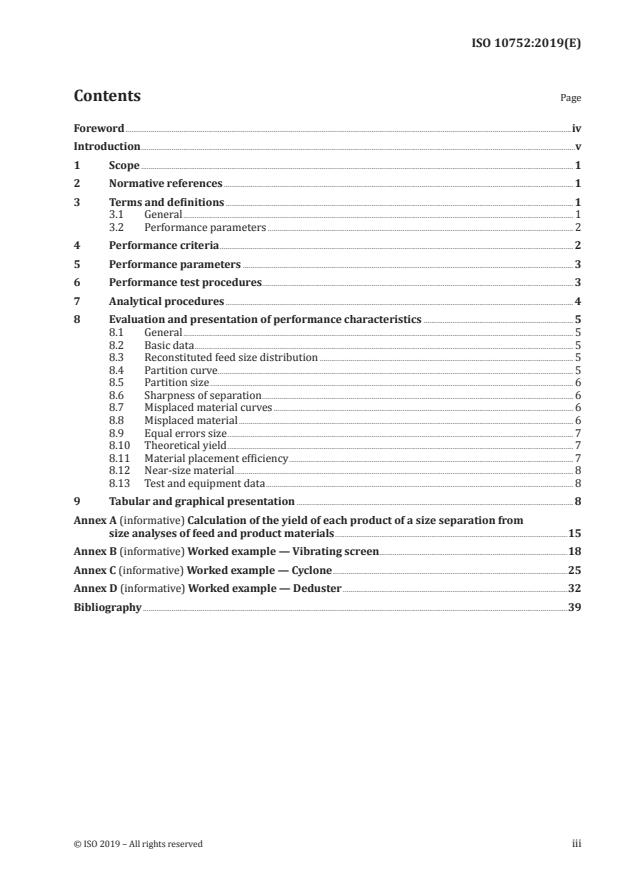
Contents Page
Foreword .iv
Introduction .v
1 Scope . 1
2 Normative references . 1
3 Terms and definitions . 1
3.1 General . 1
3.2 Performance parameters . 2
4 Performance criteria . 2
5 Performance parameters . 3
6 Performance test procedures . 3
7 Analytical procedures . 4
8 Evaluation and presentation of performance characteristics . 5
8.1 General . 5
8.2 Basic data . 5
8.3 Reconstituted feed size distribution . 5
8.4 Partition curve . 5
8.5 Partition size . 6
8.6 Sharpness of separation . 6
8.7 Misplaced material curves . 6
8.8 Misplaced material . 6
8.9 Equal errors size . 7
8.10 Theoretical yield . 7
8.11 Material placement efficiency . 7
8.12 Near-size material . 8
8.13 Test and equipment data . 8
9 Tabular and graphical presentation . 8
Annex A (informative) Calculation of the yield of each product of a size separation from
size analyses of feed and product materials .15
Annex B (informative) Worked example — Vibrating screen .18
Annex C (informative) Worked example — Cyclone .25
Annex D (informative) Worked example — Deduster .32
Bibliography .39
Foreword
ISO (the International Organization for Standardization) is a worldwide federation of national standards
bodies (ISO member bodies). The work of preparing documents is normally carried out through
ISO technical committees. Each member body interested in a subject for which a technical committee
has been established has the right to be represented on that committee. International organizations,
governmental and non-governmental, in liaison with ISO, also take part in the work. ISO collaborates
closely with the International Electrotechnical Commission (IEC) on all matters of electrotechnical
standardization.
The procedures used to develop this document and those intended for its further maintenance are
described in the ISO/IEC Directives, Part 1. In particular, the different approval criteria needed for the
different types of ISO documents should be noted. This document was drafted in accordance with the
editorial rules of the ISO/IEC Directives, Part 2 (see www .iso .org/directives).
Attention is drawn to the possibility that some of the elements of this document may be the subject of
patent rights. ISO shall not be held responsible for identifying any or all such patent rights. Details of
any patent rights identified during the development of the document will be in the Introduction and/or
on the ISO list of patent declarations received (see www .iso .org/patents).
Any trade name used in this document is information given for the convenience of users and does not
constitute an endorsement.
For an explanation of the voluntary nature of standards, the meaning of ISO specific terms and
expressions related to conformity assessment, as well as information about ISO's adherence to the
World Trade Organization (WTO) principles in the Technical Barriers to Trade (TBT), see www .iso
.org/iso/foreword .html.
This document was prepared by Technical Committee ISO/TC 27 Solid mineral fuels, Subcommittee SC 1,
Coal preparation. Terminology and performance.
This second edition cancels and replaces the first edition (ISO 10752:1994), of which it constitutes a
minor revision.
The main changes compared to the previous edition are as follows:
— editorial corrections throughout the document.
Any feedback or questions on this document should be directed to the user’s national standards body. A
complete listing of these bodies can be found at www .iso .org/members .html.
iv © ISO 2019 – All rights reserved
Introduction
A standard expression of performance is required to define the accuracy of separation of a particular
item, to assist in the comparison of the performance of different items of coal sizing equipment and in
the prediction of separation results.
INTERNATIONAL STANDARD ISO 10752:2019(E)
Coal sizing equipment — Performance evaluation
1 Scope
This document describes the principles and methods for the expression of results of performance tests
on sizing equipment used in coal preparation, and includes methods for the evaluation of performance
parameters. Performance test procedures and size measurement techniques are recommended.
This document applies to all types of sizing equipment, categorized as follows:
a) screens;
b) classifiers;
c) others.
The procedure described in this document applies to two-product separations. Performance assessment
of multiproduct separations can be achieved by consideration of a series of two-product separations.
2 Normative references
The following documents are referred to in the text in such a way that some or all of their content
constitutes requirements of this document. For dated references, only the edition cited applies. For
undated references, the latest edition of the referenced document (including any amendments) applies.
ISO 1213-1, Solid mineral fuels — Vocabulary — Part 1: Terms relating to coal preparation
ISO 13909, Hard coal and coke — Mechanical sampling
ISO 18283, Hard coal and coke — Manual sampling
3 Terms and definitions
For the purposes of this document, the terms and definitions given in ISO 1213-1 and the following apply.
ISO and IEC maintain terminological databases for use in standardization at the following addresses:
— ISO Online browsing platform: available at https: //www .iso .org/obp
— IEC Electropedia: available at http: //www .electropedia .org/
3.1 General
3.1.1
actual feed
F
material fed to the sizing equipment during the test period and including any recirculated material
3.1.2
coarser material
material that is coarser than the reference size
3.1.3
finer material
material that is finer than the reference size
3.1.4
product
material discharged from the sizing equipment prior to any further treatment or recirculation
3.1.5
coarser product
c
product of size separation that contains a greater proportion of coarser material than does the feed
3.1.6
finer product
f
product of size separation that contains a greater proportion of finer material than does the feed
3.1.7
sharpness of separation
E
pm
assessment of the deviation from a perfect separation, usually expressed in terms of mean probable error
3.2 Performance parameters
3.2.1
theoretical yield (sizing)
maximum yield of a product at a reference size, as determined from the size distribution curve for the
reconstituted feed
3.2.2
coarser material placement efficiency
E
c
percentage of coarser material in the reconstituted feed that reports to the coarser product
3.2.3
finer material placement efficiency
E
f
percentage of finer material in the reconstituted feed that reports to the finer product
3.2.4
overall separation index
sum of the coarser material placement efficiency and the finer material placement efficiency minus 100
4 Performance criteria
The following criteria should be determined where applicable:
a) feed rate;
b) reference size of separation;
c) sharpness of separation;
d) misplaced material;
e) material placement efficiencies;
f) the degree of difficulty of separation;
g) material characteristics.
NOTE 1 The above criteria will be influenced by test conditions which should therefore be fully reported.
NOTE 2 It is essential that prediction of separation results takes into account the influence of test conditions.
2 © ISO 2019 – All rights reserved
NOTE 3 It is essential that test conditions are made compatible to ensure valid comparisons.
NOTE 4 Conditions should be kept uniform during a test.
5 Performance parameters
For the standard expression of performance of a separation, the criteria given in Clause 4 should be
determined by the following parameters:
a) the feed rate, expressed on mass and/or volume bases;
b) the reference size, preferably expressed as both partition size and equal errors size;
NOTE It is recognized that partition size is not always obtainable from the results of a size separation
and that an alternative reference size therefore has to be employed. To allow comprehensive comparison of
performance, it is recommended that parameters based on equal errors size as the reference be included, in
addition to those based on partition size.
c) the sharpness of separation, expressed in terms of probable error;
d) the distribution of misplaced material in each product, presented graphically with respect to size,
and the particular values of misplaced material in each product on both feed and product bases,
each determined at the reference size of separation;
e) the material placement efficiencies expressed as:
1) coarser material placement efficiency, E ;
c
2) finer material placement efficiency, E ;
f
3) overall separation index derived from 1) and 2);
f) the degree of difficulty of separation, expressed in terms of near-size material;
g) other relevant characteristics of the feed material.
6 Performance test procedures
The equipment to be tested, the actual feed composition, and the means of handling the feed
and products vary widely. A single standard procedure is not applicable. The following general
recommendations are made.
a) The average feed rate and/or product flow rates should be determined by the most accurate method
possible in the particular circumstances. Typical procedures that may be used are:
1) direct assessment of the mass and/or volume of the whole of the feed or product during the test;
2) continuous assessment by means of a calibrated belt weigher or flowmeter and integration
during the test;
3) weighing timed increments taken at regular intervals during the test.
b) Samples should be taken from the actual feed and from each of the products. Sampling techniques,
initial number of increments and minimum mass of each increment should be chosen so that all
samples taken are representative. Sampling techniques, initial number of increments and minimum
mass of increment for solids being conveyed by a fluid should comply with existing document, if
available; for solids under other conditions, ISO 13909-1 to ISO 13909-4 and ISO 18283 shall apply
as appropriate.
NOTE Representative samples should be taken from all relevant streams to and from the equipment to
be tested, to facilitate checking of results and assessment of the effects of degradation.
c) It is essential to determine the feed rate and the actual yield of each product on a dry basis in
accordance with ISO 1170. This should be achieved in accordance with one of the following
procedures.
1) The mass of each product should be determined by one or more of the following methods:
i) direct weighing of the whole of each product collected over the duration of the test or
through continuous weighing and integration over the duration of the test;
ii) taking regular timed increments over the duration of the test;
iii) weighing each product collected simultaneously over a selected timed period during the test.
NOTE 1 The methods given in 1) are listed in order of reliability.
NOTE 2 If it is feasible to measure both the mass of the feed (by belt weigher, weigh hopper,
flowmeter, etc.) and the mass of the products, this provides a check.
NOTE 3 If the mass of one of the products cannot be measured, it can be obtained from a mass
balance between the feed and products.
NOTE 4 Where the solids are conveyed by a fluid, it can be more convenient to make volumetric
measurements.
Representative samples should be taken from relevant streams to determine moisture contents
or concentrations of solids as appropriate, so that the results can be reported on a dry basis.
2) In circumstances that prevent the weighing of sufficient streams, size analyses of feed and
products can be used to determine the percentage yield of each product, as described in
Annex A.
In all circumstances, the method used to determine the actual yield of each product should be
reported with each respective value in Table 3.
7 Analytical procedures
The method and procedure of size analysis should be selected, as far as possible, to be in agreement
with the principle of the equipment under test, to produce results in compatible terms. For example,
the results of size analysis by sieving would be compatible with vibrating screens, and the results of
size analysis by a series of small cyclones would be compatible with cyclone separators. Size analysis
by sieving should be carried out in accordance with ISO 1953. The method and apparatus used, and the
basis of the percentages (by mass or volume), shall be stated in the data sheet and in Table 1.
The feed sample and each of the product samples should be subjected to size analyses in which the ratio
of the upper and lower size limits does not exceed 2:1 for each size fraction. It is recommended that this
ratio for size limits be reduced to 21: for a minimum of two fractions, both above and below the
reference size.
NOTE 1 In some circumstances, a ratio of size limits closer than 21: may be necessary in the region of the
reference size, to ensure that each of the size fractions contains not more than 10 % of the sample.
NOTE 2 Size distribution curves for the products can be used for:
a) providing data for additional partition coefficients;
b) averaging analytically determined values to improve the derived partition curve.
4 © ISO 2019 – All rights reserved
8 Evaluation and presentation of performance characteristics
8.1 General
All data shall be evaluated and presented in one data sheet, three tables and three figures as follows:
a) data sheet — test and equipment data;
b) Table 1 — size distribution of feed and products;
c) Table 2 — partition coefficients and misplaced material data;
d) Table 3 — statement of sizing equipment performance;
e) Figure 1 — partition curve;
f) Figure 2 — size distribution curve for the reconstituted feed;
g) Figure 3 — misplaced material curves.
The presentation of the test data may be accomplished by the procedure described below. The specified
tabular and graphical formats are given in Clause 9. Specific worked examples are included in Annexes B,
C and D.
NOTE 1 Primary calculation procedures are shown in tables 1 and 2. A column number in parentheses denotes
a respective value taken from that column.
NOTE 2 The origins of plotted values are shown in Figures 1 and 2 by reference to table and column numbers.
NOTE 3 Reference to definitions of performance parameters in Clause 3 supports the brief explanation of their
derivation given in relevant subclauses and in Tables 1 and 2.
8.2 Basic data
The data obtained from a performance test comprise the size analyses of the actual feed and the
coarser and finer products and the proportion of material reporting to each product. These basic data
are compiled in table 1, columns 1 to 8, and calculated on a reconstituted feed basis in columns 9 to 12.
8.3 Reconstituted feed size distribution
The size distribution curve for the reconstituted feed is constructed as shown in Figure 2, by plotting
the cumulative percent less than the upper size limit (column 12 of Table 1) against the upper size limit
(column 1 of Table 1).
NOTE It is convenient to use a logarithmic scale for particle size when plotting size distribution curves, to
cover a wide range of sizes and to cater for size limits that are in geometric progression.
8.4 Partition curve
The partition curve is constructed as shown in Figure 1, by plotting the value of each partition coefficient
against the corresponding mean size. It is recommended that each size fraction be represented by its
geometric mean size. Geometric mean sizes and partition coefficients are calculated in Table 2, columns
13 and 14. The recommended scales are:
— size: log 1 cycle = 50 mm;
— partition coefficient: 1 % = 2 mm.
NOTE 1 As an alternative to geometric mean size, each size fraction may be represented by its mid-mass
particle size, derived from a known functional relationship or estimated from the reconstituted feed curve.
NOTE 2 As an alternative method of construction, partition coefficients can be plotted as a histogram on
a reconstituted feed base, producing an area representative of mass. An intermediate curve is then drawn by
equalizing areas within each size fraction. Performance parameters are derived by applying values obtained
from the intermediate curve to the size distribution curve for the reconstituted feed.
8.5 Partition size
The partition size, S , is obtained directly from the partition curve and is entered as a performance
parameter in the statement of sizing equipment performance in Table 3.
NOTE The partition size can be determined from the misplaced material curves (see Figure 3) at the
minimum value of total misplaced material.
8.6 Sharpness of separation
The 25 %, S , and 75 %, S , intercepts are each read from the partition curve (see Figure 1) and
25 75
are entered as primary parameters in the statement of sizing equipment performance in table 3. For
symmetrical partition curves, the sharpness of separation may be expressed in terms of the mean
probable error (E ) as follows:
pm
SS−
75 25
E = (1)
pm
In the more common case of skewed partition curves, the sharpness of separation may be expressed in
terms of the upper and lower probable errors as follows.
— Upper probable error = S −S
75 50
— Lower probable error = S − S
50 25
The upper probable error and lower probable error parameters may be used separately if one of the
intercepts is undefined.
8.7 Misplaced material curves
The misplaced materials in the coarser and finer products are calculated, as a percentage of the
reconstituted feed, in Table 2, columns 15 and 16. Corresponding values are summed to give total
misplaced material tabulated in column 17 of Table 2. The misplaced material curves are constructed, as
shown in Figure 3, by plotting values for coarser products (column 15 of Table 2), finer products (column
16 of Table 2) and total misplaced materials (column 17 of Table 2), each against the corresponding
upper size limit S1 (column 1 of Table 1). The recommended scales are:
— size: log 1 cycle = 50 mm;
— misplaced material: 1 % = 5 mm.
If it is necessary to use an alternative scale, this should be a simple multiple of the recommended scale;
for an example see Figure C.3.
8.8 Misplaced material
The misplaced material is read from each respective curve at the reference size, or sizes (see NOTE 1),
and the values are inserted into the statement of sizing equipment performance in Table 3. The value
of misplaced material for each respective product is converted to a percentage of that product (see
NOTE 2), and the converted values are inserted into the statement in Table 3.
NOTE 1 It is convenient to construct an ordinate on the curves, at the reference size, or sizes, being considered
(e.g. S , S , S ), to assist in reading the three intercepting misplaced values.
d 50 e
6 © ISO 2019 – All rights reserved
NOTE 2 All values of misplaced material obtained from the curves are in terms of percentages of the
reconstituted feed. Conversion to percentage of the respective product can be obtained by multiplying the
corresponding curve by 100 and dividing by the yield value of the product under consideration (i.e. Y or Y ).
c f
NOTE 3 The procedure can be repeated for any other reference size.
8.9 Equal errors size
The equal errors size, S , is determined by reading the size that corresponds to the point of intersection
e
of the misplaced material curves for coarser and finer products. Alternatively, the equal errors size can
be determined from the size distribution curve for the reconstituted feed, as the size corresponding to
the yield of the finer product. The equal errors size is inserted into the statement of sizing equipment
performance in Table 3.
8.10 Theoretical yield
The theoretical yield value at the reference size, or sizes, is determined, for each of the products, from
the size distribution curve for the reconstituted feed. Alternatively, each respective theoretical yield
value can be determined by subtracting the misplaced material in the product under consideration
from the actual yield (Y or Y ) and adding the misplaced material in the complementary product.
c f
EXAMPLE
YY=−MM+ (2)
c,tc cf
where
Y is the theoretical yield of the coarser product;
c,t
Y is the yield value of the coarser product;
c
M is the misplaced material in the coarser product;
c
M is the misplaced material in the finer product.
f
Theoretical yield values are inserted into the statement of sizing equipment performance in Table 3.
NOTE 1 Misplaced material values are in terms of percentages of reconstituted feed.
NOTE 2 The theoretical yield of the complementary product can be obtained by difference from 100 %.
8.11 Material placement efficiency
Material placement efficiencies are evaluated and inserted into the statement of sizing equipment
performance in Table 3. The calculations are as follows.
a) Coarser material placement efficiency, E :
c
YM−
cc
E = ×100 (3)
c
Y
c,t
where Y , M and Y are as defined in 8.10.
c c c,t
b) Finer material placement efficiency, E :
f
YM−
ff
E = ×100 (4)
f
Y
f,t
where
Y is the yield value of the finer product;
f
Y is the theoretical yield of the finer product;
f,t
M is defined in 8.10.
f
c) Overall separation index (S )
i
SE=+E −100 (5)
if c
NOTE 1 Misplaced material values are in terms of percentage of reconstituted feed.
NOTE 2 Alternative methods are available for the evaluation of the material placement efficiencies.
8.12 Near-size material
The near-size material, i.e. material within ±25 % of the reference size or sizes, is determined from the
size distribution curve for the reconstituted feed in Figure 2 and is inserted into the statement of sizing
equipment performance in Table 3.
Other relevant characteristics of the feed material that influence the degree of difficulty of separation
are inserted into the test and equipment data sheet, which varies according to the type of equipment
under consideration. Examples of data sheets are given in Annexes B, C and D.
8.13 Test and equipment data
The presentation
...
Questions, Comments and Discussion
Ask us and Technical Secretary will try to provide an answer. You can facilitate discussion about the standard in here.
Loading comments...