


ISO 6955:1982
(Main)Analytical spectroscopic methods — Flame emission, atomic absorption, and atomic fluorescence — Vocabulary
Analytical spectroscopic methods — Flame emission, atomic absorption, and atomic fluorescence — Vocabulary
Defines specific terms for the concerning analytical methods, with a view to facilitating understanding between anlysts. Takes maximum account of the existing terminology, in both French and English, in order to achieve the greatest possible harmonization. In particular, it takes account of IUPAC (International Union of Pure and Applied Chemistry) nomenclature.
Méthodes d'analyse par spectroscopie — Émission de flamme, absorption atomique et fluorescence atomique — Vocabulaire
La présente Norme internationale définit certains termes spécifiques pour les méthodes d'analyse par spectroscopie d'émission de flamme, d'absorption atomique et de fluorescence atomique, dans le but de faciliter la compréhension entre analystes. Elle tient le plus grand compte des termes existants, aussi bien en français qu'en anglais, afin d'aboutir à la meilleure harmonisation possible. En particulier, elle tient compte de la nomenclature de l'UICPA (Union internationale de chimie pure et appliquée).
Analitske spektroskopske metode - Plamenska emisija, atomska absorpcija in atomska fluorescenca - Slovar
General Information
- Status
- Withdrawn
- Publication Date
- 30-Jun-1982
- Withdrawal Date
- 30-Jun-1982
- Technical Committee
- ISO/TC 47 - Chemistry
- Drafting Committee
- ISO/TC 47 - Chemistry
- Current Stage
- 9599 - Withdrawal of International Standard
- Start Date
- 03-Oct-2016
- Completion Date
- 12-Feb-2026


Get Certified
Connect with accredited certification bodies for this standard

ECOCERT
Organic and sustainability certification.

Eurofins Food Testing Global
Global leader in food, environment, and pharmaceutical product testing.

Intertek Bangladesh
Intertek certification and testing services in Bangladesh.
Sponsored listings
Frequently Asked Questions
ISO 6955:1982 is a standard published by the International Organization for Standardization (ISO). Its full title is "Analytical spectroscopic methods — Flame emission, atomic absorption, and atomic fluorescence — Vocabulary". This standard covers: Defines specific terms for the concerning analytical methods, with a view to facilitating understanding between anlysts. Takes maximum account of the existing terminology, in both French and English, in order to achieve the greatest possible harmonization. In particular, it takes account of IUPAC (International Union of Pure and Applied Chemistry) nomenclature.
Defines specific terms for the concerning analytical methods, with a view to facilitating understanding between anlysts. Takes maximum account of the existing terminology, in both French and English, in order to achieve the greatest possible harmonization. In particular, it takes account of IUPAC (International Union of Pure and Applied Chemistry) nomenclature.
ISO 6955:1982 is classified under the following ICS (International Classification for Standards) categories: 01.040.71 - Chemical technology (Vocabularies); 71.040.50 - Physicochemical methods of analysis. The ICS classification helps identify the subject area and facilitates finding related standards.
ISO 6955:1982 is available in PDF format for immediate download after purchase. The document can be added to your cart and obtained through the secure checkout process. Digital delivery ensures instant access to the complete standard document.
Standards Content (Sample)
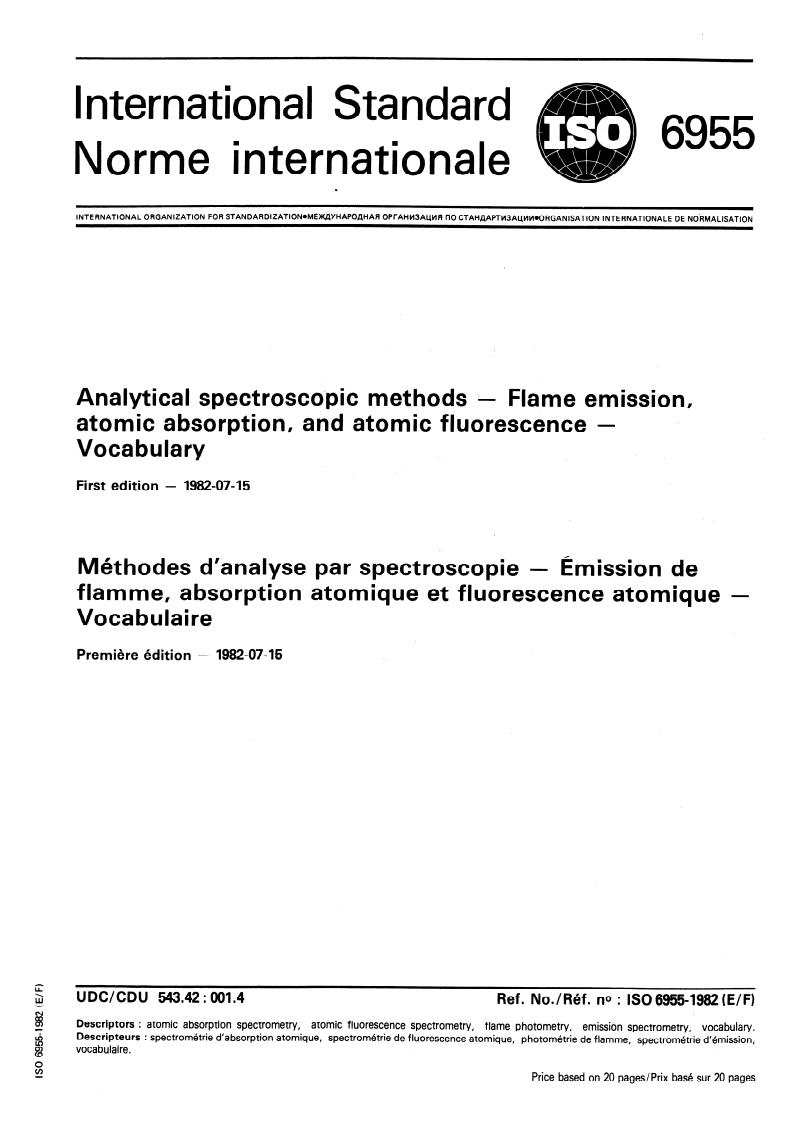
6g55
International Standard
Norme internationale
I
INTERNATIONAL ORGANIZATION FOR STANDARDIZATIONWlEWYHAPOAHAR OPrAHbl3AL&lR fl0 CTAHAAPTM3A~ltWWORGANISATION INTERNATIONALE DE NO ’RMALISATION
Analytical spectroscovpic methods - Flame emission,
atomic absorption, and atomic fluorescence -
Vocabulary
First edition - 1982-07-15
Methodes d ’analyse par spectroscopie - Emission de
flamme, absorption atomique et fluorescence atomique -
Vocabulaire
Premiere Edition - 1982-07-15
UDWCDU 543.42 : 001.4
Ref. No./Mf. no :
ISO 6955-1982 (E/F)
Descriptors : atomic absorption spectrometry, atomic fluorescence spectrometry, flame photometry, emission spectrometry, vocabulary.
Descripteurs : spectromktrie d ’absorption atomique, spectrometrie de fluorescence atomique, photometrie de flamme, spectrom&rie d ’emission,
vocabulaire.
Price based on 20 pages/Prix bas6 sur 20 pages
Foreword
ISO (the International. Organization for Standardization) is a worldwide federation of
national Standards institutes (ISO member bedies). The work of developing Inter-
national Standards is carried out through ISO technical committees. Every member
body interested in a subject for which a technical committee has been set up has the
right to be represented on that committee. International organizations, governmental
and non-governmental, in liaison with ISO, also take patt in the work.
Draft International Standards adopted by the technical committees are circulated to
the member bodies for approval before their acceptance as International Standards by
the ISO Council.
International Standard ISO 6955 was developed by Technical Committee ISO/TC 47,
Chemistry, and was circulated to the member bodies in March 1981.
lt has been approved by the member bodies of the following countries :
Australia Germany, F. R. Poland
Portugal
Austria Hungary
India Romania
Belgium
Brazil Italy South Africa, Rep. of
Korea, Rep. of Switzerland
China
Czechoslovakia Mexico Thailand
USSR
Egypt, Arab Rep. of Netherlands
Philippines
France
No member body expressed disapproval of the document.
0 International Organkation for Standardkation, 1982
Printed in Switzerland
Avant-propos
L ’ISO (Organisation internationale de normalisation) est une federation mondiale
d ’organismes nationaux de normalisation (comites membres de I ’ISO). L ’elaboration
des Normes internationales est confiee aux comites techniques de I ’ISO. Chaque
comite membre interesse par une etude a Ie droit de faire Partie du comite technique
correspondant. Les organisations internationales, gouvernementales et non gouverne-
mentales, en liaison avec I ’ISO, participent egalement aux travaux.
Les projets de Normes internationales adoptes par les comites techniques sont soumis
aux comites membres pour approbation, avant leur acceptation comme Normes inter-
nationales par Ie Conseil de I ’ISO.
La Norme internationale ISO 6955 a etc elaboree par Ie comite technique ISO/TC 47,
Chimie, et a 6th soumise aux comites membres en mars 1981.
Les comites membres des pays suivants I ’ont approuvee :
Afrique du Sud, Rep. d’ Egypte, Rep. arabe d’ Pologne
Allemagne, R. F. France Portugal
Australie Hongrie Roumanie
Autriche Inde Suisse
Belgique Italie Tchecoslovaquie
Bresil
Mexique Thailande
Chine Pays-Bas URSS
Corde, Rep. de Philippines
Aucun comite membre ne I ’a desapprouvee.
0 Organisation internationale de normalisation, 1982
Imprimh en Suisse
This page intentionally lefl blank
INTERNATIONAL STANDARD
ISO 69554982 (E/F)
NORME INTERNATIONALE
Mkhodes d ’analyse par
Analytical spectroscopic
spectroscopie - Emission de .
Flame emission,
methods -
flamme, absorption atomique et
atomic absorption, and
fluorescence atomique -
atomic fluorescence -
Vocabulaire
Vocabulary _
Objet et domaine d ’application
Scope and field of application
La presente Norme internationale definit certains termes speci-
This International Standard defines specific terms for flame
fiques pour les methodes d ’analyse par spectroscopie d ’emis-
emission, atomic absorption and atomic fluorescence spec-
sion de flamme, d ’absorption atomique et de fluorescence ato-
troscopic analytical methods, with a view to facilitating
mique, dans Ie but de faciliter Ia comprehension entre analys-
understanding between analysts.
tes.
lt takes maximum account of the existing terminology, in both
Elle tient Ie plus grand campte des termes existants, aussi bien
French and English, in Order to achieve the greatest possible
en francais qu ’en anglais, afin d ’aboutir a la.meilleure harmoni-
harmonization. In particular, it takes account of the IUPAC
(International Union of Pure and Applied Chemistry) sation possible. En particulier, elle tient campte de Ia nomencla-
ture de I ’UICPA (Union internationale de chimie pure et appli-
nomenclature.
quee).
Reference
Reference
ISO 6286, Spectrometrie d ’absorption mokkulaire - Vocabu-
ISO 6286, Molecular absorption spectrometry - Vocabulary -
laire - G&&alit& - Appareiflage.
General - Apparatus.
Termes et definitions
Terms and definitions
1 General terms 1 Termes ghhraux
- The term “spectroscopy ”, as recommended NOTE PRELIMINAIRE - Le terme «spectroscopie» designe, comme Ie
PRELIMINARY NOTE
by IUPAC, means the general study of spectra, irrespective of the preconise I ’UICPA, I ’etude generale des spectres, quelle que soit Ia
methode d ’observation; Ie terme «spectrometrie» implique Ie mesurage
method of Observation; the term “spectrometry” implies the measure-
ment of the intensity of the radiation. de I ’intensite des radiations.
spectrometrie d ’hmission de flamme (SEF) : Methode
1.1 flame emission spectrometry (FES) : A method of 1.1
de dosage d ’elements chimiques fondee sur Ie mesurage de
determining Chemical elements based on the measurement of
the intensity of characteristic electromagnetic radiation emitted I ’intensite de I ’emission de radiations photoniques specifiques
by atoms or molecules in a flame. par des atomes ou des molecules dans une flamme.
atomic absorption spectrometry (AAS) : A method of 1.2 spectrometrie d ’absorption atomique (SAA) :
1.2
determining Chemical elements based on the measurement of Methode de dosage d ’elements chimiques fondee sur Ie mesu-
the absorption of characteristic electromagnetic radiation by rage de I ’absorption de radiations photoniques specifiques par
des atomes en Phase vapeur.
atoms in the vapour Phase.
1.3 atomic fluorescence spectrometry (AFS) : A method 1.3 spectrometrie de fluorescence atomique (SFA) :
Methode de dosage d ’elements chimiques fondee sur Ie mesu-
of determining Chemical elements based on the measurement
of the re-emission of characteristic electromagnetic radiation by rage de Ia reemission de radiations photoniques specifiques par
atoms, following the absorption of radiation in the vapour des atomes, consecutive a I ’absorption de radiations en Phase
Phase. The wavelengths of the absorbed and re-emitted radia- vapeur. La longueur d ’onde de Ia radiation absorbee et celle de
tion may be identical (atomic resonance fluorescence spec- Ia radiation reemise peuvent etre identiques (spectrometrie de
trometry) or different. fluorescence de resonance atomique) ou differentes.
A vapour containing free atoms of the
1.4 atomic vapour : 1.4 vapeur atomique : Vapeur contenant des atomes libres
element to be determined (the analyte). de I ’element a doser (analyte).
ISO 6966-1962 EIFI
: A stationary quantum state (of a free 1.5 niveau d ’hergie : Etat quantique stationnaire (d ’un
1.5 energy leve
atome libre, d ’un ion ou d ’une moleeule), Äquivalent a une
atom, ion or molecule) equal in value to a particular internal
energie interne particuliere. Cette energie s ’exprime souvent en
energy. This energy is often expressed in electron Volts, but
electronvolts mais, de preference, en kilojoules par mole.
should preferably be expressed in kilojoules per mole.
1.6 niveau fondamental : Niveau d ’energie minimale
1.6 ground state : The Ievel of minimum internal energy (of
interne (d ’un atome libre, d ’un ion ou d ’une molecule). Par con-
a free atom, ion or molecule). lt is conventional to assign the
vention, Ia Valeur zero de I ’energie est attribuee a ce niveau.
energy value of zero to this level.
1.7 niveau de resonancel) : Niveau d ’energie (d ’un atome
1.7 resonance levell) : An energy level (of an excited atom,
excite, d ’un ion ou d ’une molecule) pouvant revenir par une
ion or molecule) capable of reversion to the ground state by a
transition photonique (voir 1.11) directe au niveau fondamen-
direct electromagnetic transition (see 1.11).
tal.
1.8 hergie d ’excitation (d ’un atome) : Energie qu ’il faut
1.8 excitation energy : The energy that must be supplied to
fournir a un atome pour l’amener du niveau fondamental a un
an atom to transfer it from the ground state to a given energy
etat energetique donne superieur au niveau fondamental.
level above the ground state.
1.9 hergie de resonance2) : Energie necessaire pour ame-
1.9 resonance energy 2) : The energy required to promote
ner I ’atome du niveau fondamental a un niveau de resonance
the transfer the atom from the ground state to a resonance
par absorption d ’un Photon.
level by absorption of one Photon.
1.10 hergie d ’ionisation : Energie minimale qu ’il faut four-
1.10 ionization energy : The minimum energy that must be
nir a un atome au niveau fondamental pour en extraire un elec-
supplied to remove an electron from an atom in the ground
tron.
state.
1 .ll modification blectronique; transition blectronique :
1.11 electronie transition : The passage of an electron of an
Passage d ’un electron, d ’un atome, d ’un ion ou d ’une molecule
atom, ion or molecule from an energy level EI to another
d ’un niveau d ’energie EI a un autre niveau d ’energie E2.
energy level E2.
An electronie transition may be accompanied by the emission Une modification electronique ‘peut etre accompagnee de
I ’emission ou de I ’absorption d ’un Photon hv tel que
or absorption of a Photon hv such that hv = 1 E2 - EI 1; it is
then called “an electromagnetic transition ”; in general, it obeys hv = [E2 - El 1; elle est alors dite «transition photonique));
certain rules called “electromagnetic selection rules ”. elle obeit en general a certaines regles dites &gles de selection
photonique)).
NOTE - In the formula, h is the Planck constant and v is the fre-
Photon.
quency of emitted or absorbed
NOTE - Dans Ia formuie, h est Ia constante de Planck et v est Ia fre-
quence d u Photon emis ou abso rbe.
1.12 raie spectrale (d ’un atome)3) : Intervalle tres etroit de
1.12 spectral line (of an atom)3) : A very narrow band of fre-
frequences de radiations photoniques emises ou absorbees par
quencies of electromagnetic radiation emitted or absorbed by
des atomes qui subissent une transition photonique unique.
atoms which undergo a Single electromagnetic transition.
Ces radiations sont groupees autour d ’une radiation centrale
This radiation is centred on a peak whose wavelength
characterizes the line and which corresponds to the emission or dont Ia longueur d ’onde caracterise Ia raie et qui correspond au
absorption maximum. maximum d ’emission ou d ’absorption.
A distinction is made between lines corresponding to transition On distingue des raies correspondant a Ia transition d ’atomes
of neutral atoma (e.g. Ba I 553,5 and 577,8 nm) and ions (e.g.
neutres (par exemple Ba I 553,5 et 577,8 nm) et des raies d ’ions
Ba- II 455,4 nm). (par exemple Ba II 455,4 nm).
definition plus res-
atome unique :
par une transition
2) Qans cer-tains travaux scientifiques, on utilise Ia definition plus res-
2) Some authors use the following, more restricted definition of
resohance energy : The energy required to transfer the atom from trictive suivante de I ’hergie de rbsonance : Energie amenant
I ’atome du niveau fondamental au niveau de resonance defini restricti-
the ground state to the resonance level defined as in the note to 1.7.
vement dans Ia note 1).
3) The term “line” has its origin in the appearance of an atomic spec- 3) Le terme «raie» a son origine dans I ’aspect d ’un spectre atomique
observe avec un spectroscope, dans lequel les differentes longueurs
trum observed with aspectroscope, in which different wavelengths ap-
pear monochromatically as images of the (linear) slit. d ’onde apparaissent comme les images monochromatiques de Ia fente
lineaire.
ISO 69551982 (E/F)
The curve representing the Variation of 1.13 Profil d ’une raie : Courbe ’representative de Ia Variation
1.13 line Profile :
emitted radiation intensity as a function of wavelength (emis- de I ’intensite de Ia radiation emise en fonction de Ia longueur
sion line) or the Variation of the absorption factor as a function d ’onde (raie d ’emission) ou de Ia Variation du coefficient
d ’absorption en fonction de Ia longueur d ’onde (raie d ’absorp-
of wavelength (absorption line).
tion).
1.14 half-intensity width : The wavelength interval between
1.14 largeur d ’une raie :
Intervalle separant les longueurs
the two Points on the line Profile where the intensity is equal to
d ’onde des deux radiations correspondant aux deux Points du
half the maximum intensity of the Profile.
Profil dont les intensites sont egales a Ia moitie de I ’intensite
maximale de ce Profil.
a transition
1.15 resonance line : A line corresponding to 1.15 raie de resonance : Raie correspondant a une transi-
and the ground state. tion entre un n iveau de resonance et Ie niveau fondamental.
between a resonance level
1.16 characteristic line : A Iine used for the measurement of 1.16 raie caracteristique : Raie utilisee pour Ie mesurage de
analyte concentration by flame atomic emission, absorption or Ia concentration en I ’element a doser (analyte) par emission de
fluorescence in the vapour Phase. flamme, absorption atomique ou fluorescence atomique en
Phase vapeur.
Characteristic lines include resonance and other lines.
Les raies caracteristiques comportent les raies de resonance et
d ’autres raies.
1.17 self-absorption : A phenomenon occurring in an emis- 1.17 auto-absorption :
Phenomene qui se produit dans une
sion Source when the radiation emitted by the excited atoms in Source d ’emission lorsque Ia radiation emise par les atomes
the interior of the Source is partly absorbed by atoms of the excites a I ’interieur de Ia Source est partiellement absorbee par
same kind present in this Source.
des atomes de meme espece presents dans cette Source.
As a result, the observed intensity of a spectral line may be less En consequence, I ’intensite observee d ’une raie spectrale peut
and its width greater than would be the case for a Source hav-
etre plus faible et sa largeur plus grande que ce ne serait Ie cas
ing a very small optical path and the same concentration of pour une Source ou Ie Parcours optique est tres faible, et qui a
emitting atoms per unit volume. Ia meme concentration en atomes emetteurs par unite de
volume.
Self-absorption may occur in all emitting sources, whether they
are homogeneous or not, thermal or non-thermal. L ’auto-absorption peut se produire dans toutes les sources
emettrices, qu ’elles soient homogenes ou non,. thermiques ou
non thermiques.
1.18 self-reversal : A phenomenon occurring in an emission 1.18 renversement d ’une raie : Phenomene qui se produit
Source and revealed when the intensity measured at the centre dans une Source d ’emission et mis en evidente lorsque I ’inten-
site mesuree au centre de Ia raie est plus faible que I ’intensite
of the line is lower than the intensity measured on either side of
the centre. This phenomenon is due to the absorption of radia- mesuree de part et d ’autre de ce centre. Ce phenomene est du
tion from the core by the outer layers of the emitting vapour, a I ’absorption des radiations des couches internes par les cou-
which are cooler than the core. ches externes du milieu emetteur qui sont plus froides que les
couches internes.
In extreme cases, the intensity at the centre of the line is so
weak that only the wings remain, giving the appearance of two Dans les cas extremes, I ’intensite au centre de Ia raie est si fai-
fuzzy lines. ble que seules les extremites restent pour donner I ’apparence
de deux raies floues.
1.19 line-broadening : An increase in the theoretical width 1.19 elargissement d ’une raie : Accroissement de Ia largeur
of the spectral line owing to thermal motion of the emitting theorique de Ia raie spectrale du au mouvement thermique des
atoms (Doppler effect), to electric field (Stark effect), to self- atomes emetteurs (effet Dopple& au champ electrique (effet
absorption and to pressure (Lorentz effect). This phenomenon
Stark), a I ’auto-absorption et a Ia Pression (effet Lorentz). Ce
leads to a loss of sensitivity of the determination. phenomene conduit a une perte de sensibilite du dosage.
1.20 band (molecular) : A group of narrowly spaced lines 1.20 bande (moleculaire) : Groupe de raies etroitement espa-
emitted or absorbed by a molecule that undergoes a Single elec- cees emises ou absorbees par une molecule qui subit une tran-
tromagnetic transition between levels having different rota- sition photonique unique entre niveaux differents d ’energie
tional and/or vibrational energies. rotationnelle et/ou vibrationnelle.
ISO 69554982 (E/F)
2 Parties d ’appareillage spkifiques de I ’Rmission
2 Specific components of flame emission,
atomic absorption and atomic fluorescence de flamme, de I ’absorption atomique et de Ia
equipment, and their functions fluorescence atomique, et leurs fonctions
Line sources 2.1 Sources de raies
2.1
2.1.1 discharge lamp : A lamp containing a vapour or gas 2.1.1 lampe a dkharge : Lampe contenant une vapeur ou
un gaz excit6 par Ie passage d ’un courant saus haute tension et
excited by the passage of a current under high potential and
producing the characteristic lines of the elemehts it contains. produisant les raies caractkistiques des 6kments contenus.
2.1.2 lampe a cathode creuse : Lampe a decharge dans
2.1.2 hollow-cathode lamp : A discharge lamp in which the
cathode is a hollow body containing one or more elements, and laquelle Ia cathode est un Corps creux contenant un ou plu-
which operates under conditions such that the vapour of the sieurs Mments et qui fonctionne dans des conditions telles que
elements, produced by cathodic sputtering, emits particularly Ia vapeur des Mments produite par pulverisation cathodique
narrow characteristic Enes. ernette des raies caractkistiques particuli&rement fines.
2.1.3 lampe a! excitation haute frequence : Lampe dans
2.1.3 (high-frequency excited) electrodeless-discharge
laquelle les Mments sont excitks par un champ &ectromagn&i-
lamp : A lamp in which the elements are excited by a high-
frequency electromagnetic field (it has no internal electrodes). ques ti haute frequence (eile ne camporte pas d ’klectrodes
internes).
2.1.4 continuum lamp : A lamp which, over a given spectral 2.1.4 lampe a fond continu : Lampe produisant une emis-
sion continue (non dkcomposable en raies) dans un domaine
range, gives continuous emission, i.e., emission that cannot be
resolved into lines. spectral d&ermin&
2.2 2.2 Termes CO Immuns
Terms common to all atomizers SI toutes sources
d ’atomisation
of the solvent, giving rise to 2.2.1
2.2.1 desolvation : Removal dbso llvatation : Elimination du solvant donnant nais-
particles of the solute. sance 3 des particules du solutk.
2.2.2 volatilisation : Conversion des particules de solute
2.2.2 volatilization : Conversion of the solute particles con-
taining the analyte from the solid and/or liquid Phase to the contenant IWment a doser de I ’6tat solide et/ou liquide & I ’ktat
vapour Phase. de vapeur.
2.2.3 atomization : Conversion of a compound of the 2.2.3 atomisation : Conversion d ’un compos6 de ent &
analyte to an atomic vapour. doser en vapeur atomique.
2.2.4 2.2.4 Source d ’ato misation; atomiseur Dispositif permet-
atomizer : A device producing atomization.
tant I ’atomisation.
2.2.5 Overall efficiency of atomization : The ratio of the 2.2.5 rendement global d ’atomisation : Rapport du dkbit
mass of analyte converted into free atoms in the atomizer to the massique dW6ment 3 doser transforme en atomes libres dans Ia
mass of analyte entering the dispersion device.
Source d ’atomisation au debit massique d ’Mment & doser
entrant dans Ie dispositif de dispersion.
2.2.6 (local) fraction atomized : The ratio of the number of 2.2.6 rendement local d ’atomisation : Rapport du nombre
free atoms to the total number of atoms of the analyte present d ’atomes libres au nombre total d ’atomes de I ’Mment a doser
prksents dans Ia Phase gazeuse en fonction du volume observk
in the gaseous Phase in the Observation volume.
intended to
2.2.7 (atomic) excitation Source : An atomizer 2.2.7 Source d ’excitation : Source d ’atomisation destinke a
convert free atoms to an excited state. amen er des atomes libres 3 un niveau excit6.
2.2.8 dispersion (of the Sample) : Conversion of the whole or 2.2.8 dispersion (de I%chantillon) : Conversion de tout ou
part of the liquid or solid Sample into a physical form sufficiently Partie de I ’khantillon liquide ou solide en un 6tat physique suf-
finely divided to allow it to be atomized upon introduction into fisamment divis6 pour permettre son atomisation dans Ia
t he atomizer. Source d ’atomisation.
ISO 69554982 (E/F)
2.2.9 rendement de dispersion (de I ’echantillon) : Rapport
2.2.9 efficiency of dispersion (of the Sample) : The ratio of
du debit massique d ’element a doser entrant dans Ia Source
the mass of analyte entering the atomizer to the mass of analyte
d ’atomisation au debit massique d ’element a doser entrant
entering the dispersion device.
dans Ie dispositif de dispersion.
Flame atomkerl) 2.3 Source d ’atomisation ti flammel)
2.3
2.3.1 flamme : Debit continu de melange de gaz chauds,
2.3.1 flame : A continuously flowing mixture of hot gases
avec une geometrie fixe, dont Ia chaleur provient d ’une reaction
with a stationary Position that derives its heat content from a
strongly exothermit, irreversible Chemical reaction between a chimique irreversible fortement exothermique entre un com-
bustible et un comburant. La flamme comprend en general une
fuel and an oxidant. The flame in general consists of a primary-
zone de combustion primaire (dard), une zone de combustion
combustion Zone, a secondary-combustion zone and an inter-
secondaire (pansche) et une zone intermediaire.
tonal Zone.
the oxidant
2.3.2 fuel : A reducing agent which reacts with 2.3.2 combustible : Corps reducteur dont Ia combinaison
excitation.
provides the energy necessary for atomization and avec Ie comburant fournit I ’energie necessaire a I ’atomisation et
a l ’excitation.
2.3.3 oxidant : An oxidizing agent which reacts with the fuel 2.3.3 comburant : Corps oxydant dont Ia combinaison avec
provides the energy necessary for atomization and excitation. Ie combustible fournit I ’energie necessaire a I ’atomisation et a
I ’excitation.
2.3.4 additional gases : Gases added to the combustion 2.3.4 gaz additionnels : Gaz ajoutes au melange de com-
mixture. An inert diluent is non-reactive, an auxiliary gas is bustion. Le gaz inerte diluant est non reactif, Ie gaz auxiliaire
reactive. est reactif.
2.3.5 oxidizing flame; fu flame : A flame obtained 2.3.5 flamme oxydante; flamme
pauvre Flamme obte-
using an excess of oxidant. nue avec un ex& de comburant.
2.3.6 reducing flame; fuel-rich flame : A flame obtained 2.3.6
flamm e reductrice; flamm e riche : Flamme obtenue
using an excess of fuel. avec un ex& de combustible.
A flame in which the secondary-
2.3.7 separated flame : 2.3.7 flamme separee : Flamme dans laquelle Ia zone de
combustion zone is separated from the primary-combustion combustion secondaire est separee de Ia zone de combustion
Zone. primaire.
2.3.8 lang-tube device (in atomic absorption) : A device in 2.3.8 flamme soufflee (en absorption atomique) : Flamme
which the flame is artificially extended to make the direction of artificiellement allongee pour faire coincider Ia direction de
the burnt-gas flow coincide with the direction of the incident I ’ecoulement des gaz brules qui Ia constituent et Ia direction du
beam of radiation. faisceau incident.
2.3.9 laminar flame : A flame in which the burnt-gas flow is 2.3.9 flamme laminaire : Flamme dans laquelle I ’ecoule-
approximately parallel; the Cross-section of the flame tan have
ment des gaz brules s ’effectue par filets fluides sensiblement
any shape. paralleles; Ia section de Ia flamme peut avoir une forme quel-
conque.
2.3.10 turbu : A flame in which the burnt-gas flow
lent flame 2.3.10 flamme turbulente : Flamme dans laquelle I ’ecoule-
takes place in an irregular Pattern. ment des gaz brules s ’effectue par filets fluides dans toutes les
directions.
2.3.11 premix burner : A burner in which the fuel, the oxi- 2.3.11 bruleur a premelange : Bruleur dans lequel Ie gaz
dant and the aerosol are mixed before reaching the flame. This combustible, Ie gaz comburant et I ’aerosol sont melanges avant
burner generally produces a laminar flame. Ie front de flamme. Ce bruleur produit generalement une
flamme laminaire.
1) The flame atomizer serves as the excitation Source in flame emis- 1) La Source a flamme sert de Source d ’excitation en emission de
sion or as the atomizer in atomic absorption or fluorescence.
flamme ou de Source d ’atomisation en absorption ou fluorescence ato-
mique.
ISO 69554962 (E/F)
2.3.12 bruleur a injection directe; bruleur a combustion
2.3.12 direct-injection burner : A burner in which the fuel,
totale : Bruleur dans lequel Ie gaz combustible, Ie gaz combu-
the oxidant and the liquid are injected into the flame. This
rant et Ie liquide sont injectes dans Ia flamme. Ce bruleur pro-
burner generally produces a turbulent flame.
duit generalement une flamme turbulente.
: The vertical distance between 2.3.13 hauteur d ’observation : Distance verticale entre
2.3.13 Observation height
I ’axe optique d ’observation et Ie plan horizontal superieur du
the Optical axis of Observation and the horizontal plane of the
bruleur.
top of the burner.
2.3.14 nebulisation : Transformation d ’un liquide en brouil-
2.3.14 nebulization : The conversion of a liquid into a mist.
lard.
: Procedures whereby an aerosol 2.3.15 dispersion thermique : Procedes par lesquels un
2.3.15 thermal dispersion
aerosol est produit a temperature elevee, par exemple par etin-
is produced at a high temperature, for example by Sparks, arcs,
furnaces, lasers, cathodic sputtering or electron-beam. celles, arcs, fours, lasers, pulverisation cathodique ou bombar-
dement electronique.
2.3.16 nebuliseur : Dispositif de nebulisation.
2.3.16 nebulizer : A device for producing nebulization.
: A chamber of a nebulizer in which 2.3.1 7 chamb Ire de nebulisation : Enceinte d ’un nebu liseur
2.3.17 Spray chamber
the sprayed liquid is converted to mist. Some of the droplets of dans laquelle Ie liquid e pulverise est transforme en brouil lard =
this mist may evaporate, coalesce, or deposit in the chamber
Certaines gouttelettes de ce brouillard peuvent s ’evaporer, se
and subsequently drain away as waste.
rassembler ou se deposer a I ’interieur de I ’enceinte et ulterieure-
ment etre entrainees comme residu.
2.3.18 flow spoiler : A device for creating turbulente in the 2.3.18 dispositif de triage : Dispositif Provoquant des tur-
stream of mist in the Spray chamber and removing the largest bulences dans I ’ecoulement du brouillard dans Ia chambre de
nebulisation et eliminant les gouttelettes les plus grosses par
droplets from this mist by deposition.
precipitation.
2.3.19 rate of aspiration : The rate at which liquid is 2.3.19 debit d ’aspiration : Debit du liquide aspire par Ie
aspirated by the nebulizer. nebuliseur.
2.3.20 efficiency of aerosol production : The ratio of the 2.3.20 rendement en aerosol : Rapport du debit d ’aerosol
debit d ’aspiration
rate at which aerosol emerges from the flow spoiler to the rate sortant de Ia chambre de triage au
of aspiration.
2.3.21 efficiency of nebulization : The ratio of the quantity 2.3.21 efficacite de nebulisation : Rapport du debit massi-
que d ’element a doser entrant dans Ia flamme au debit massi-
of analyte entering the flame to the quantity of analyte
aspirated. que d ’element a doser aspire.
2.4 Plasma atomizer 2.4 Source d ’atomisation a Plasma
2.4.1 Plasma : Matter brought into the gaseous state, largely 2.4.1 Plasma : Matiere portee 3 I ’etat gazeux, en majeure
ionized, and emitting and absorbing radiation. In practice, this Partie ionisee, emettant et absorbant des radiations. Dans Ia
term is restricted to cases where the temperature is greater than pratique, ce terme est reserve aux cas ou Ia temperature est
7OOOK. superieure a 7 000 K.
2.4.2 Plasma arc : A term usually meaning the Plasma 2.4.2 Plasma-arc : Terme designant usuellement Ie Plasma
formed by an arc-discharge. This discharge is blown through a
forme par une decharge d ’arc. Cette decharge est soufflee a
suitable orifice to form a Plasma jet, The high-temperature, travers une ouverture appropriee pour former un jet de Plasma.
electric field-free gaseous region is designed as the region of La zone de gaz a haute temperature sans champ electrique est
Observation.
Prise comme zone d ’observation.
2.4.3 inductively coupled Plasma : A Plasma produced by 2.4.3 Plasma inductif : Plasma forme par induction a I ’aide
induction by means of a high-frequency (about 2 500 Hz) elec- d ’un champ electromagnetique a haute frequence (2 500 Hz
tromagnetic field. The region of gas at high temperature and environ). La zone de gaz a haute temperature sans champ elec-
free from an electric field is taken as the region of Observation. trique est Prise comme zone d ’observation.
ISO 69554982 (EM)
2.5 resistance-heated atomizer; electrothermal 2.5 Source d ’atomisation electrothermique : Source
d ’atomisation constituee par un tube, une baguette, un ruban,
atomizer : An atomizer consisting of a tube, rod, Strip, fila-
ment, etc., made of refractory material and heated by a device un filament, etc. en materiau refractaire, chauffe par un dispo-
giving an electric current at low voltage and at high intensity, sitif donnant un courant electrique a basse tension et a haute
intensite permettant d ’obtenir des temperatures variables selon
providing a means of obtaining variable temperatures accor-
ding to the analyte being analysed. I ’element a doser considere.
similar in
2.6 hollow-cathode atomizer : An atomizer 2.6 Source d ’atomisation a cathode creuse : Source
Operation to the hollow-cathode lamp defined in 2. 1 .2. d ’atomisation de fonctionnement semblable a celui de Ia lampe
5 cathode creuse definie en 2.1.2.
2.7 Radiation-heated atomizers 2.7 Sources d ’atomisation a chauffage par rayonnement
electromagnetique ou corpusculaire
2.7.1 Source a laser : Source utilisant un faisceau de laser
laser atomizer : An atomizer using a laser beam fo-
2.7.1
focalise sur I ’echantillon solide & analyser.
cused on the solid Sample to be analysed.
2.7.2 Source a bombardement electronique : Source utili-
2.7.2 electron-beam atomizer : An atomizer using a beam
sant un faisceau d ’electrons focalise sur l ’echantillon solide a
of electrons focused on the solid Sample to be analysed.
analyser.
2.8 detecteur a resonance : Detecteur dans lequel Ie fais-
2.8 resonance spectrometer : A detector in which a beam
ceau de radiations recu excite les atomes d ’une vapeur atomi-
of radiation excites the atoms of an atomic vapour by absorp-
que par I ’absorption d ’une ou plusieurs des raies caracteristi-
tion of one or more characteristic lines. The resulting
ques. La radiation de fluorescence qui en resulte est convertie
fluorescence radiation is converted to an electrical Signal by
en Signal electrique au moyen d ’un recepteur photoelectrique.
means of a photodetector. The resonance spectrometer is
Le detecteur a resonance est specifique de I ’element a doser
specific for the individual analyte.
considere.
3 Dbfinitions d ’optique et de spectrombtriel)
3 Optical and spectrometric definitionsl)
absorption path length : The distance traversed by the 3.1 Parcours optique (d ’absorption) : Distance parcourue
3.1
par Ie faisceau de radiations dans Ie milieu absorbant (Source
beam of radiation in the absorbing medium (atomizer).
d ’atomisation).
3.2 incident flux, GO (A + AA) : The radiant flux of the beam 3.2 flux incident, QiO (A + AA) : Flux energetique du faisceau
entering the absorbing medium for one characteristic line. entrant dans Ie milieu absörbant pour une raie caracteristique.
3.3 transmitted flux, Qi,, (A + A 1) : The radiant flux of the 3.3 flux transmis, @,r (A + A A) : FkJX energetique du fais-
beam leaving the absorbing medium for one characteristic line. ceau sortant du milieu absorbant pour une raie caracteristique.
3.4 transmittance, z( ratio of the transmitted 3.4 facteur de transmission, Z(A + AA) : Rapport du flux
1 rt AU : The -
.
flux to the incident flux . transmis au flux incident :
@tr @tr
Tz-
t
=g
@O
flux 3.5 facteur d ’absorption, ~Y(A f AA) : du flux
3.5 absorptance, ratio of the absorbed Rapport
a(A 31 AA) : The
absorbe au flux incident :
to the incident flux
Qio - @tr @o - Qstr
= =
=
a 1 -t a= 1 -z
@O
@O
1) Voir ISO 6286.
1) See ISO 6286.
ISO 69554982 (E/F)
3.6 absorbance, A(* + AA) : Logarithme decimal de I ’inverse
3.6 absorbance, Al1 + Al) : The logarithm, to the base 10,
-
du facteur de transmission :
of the reciprocal of the transmittance :
@O @O
= lg - = lg-
= lg - = lg -
A
A
T
t
@tr @tr
3.7 flux de tarage, QT (A Flux transmis par Ia Source
3.7 solvent blank flux, QiT (A + AA) : The flux transmitted by
21 AU :
d ’atomisation alimentee en Solution de tarage.
the atomizer when the latter is supplied with the solvent blank.
3.8 flux de reference, @, (A + AA) : Flux transmis par Ie
3.8 reference flux, @,. (A + AA) : The flux transmitted by the
-
-
milieu de reference dans un spectrometre a double faisceau.
reference medium in a double-beam spectrometer.
: The flux transmitted by the 3.9 flux de mesure, GS (A + AA) : Flux transmis par Ia Source
3.9 Sample flux, @s (A f AA)
atomizer when the latter is supplied with the Sample Solution or d ’atomisation alimentee en Solution de dosage ou d ’etalon-
nage.
a reference Solution.
3.10 pourcentage de transmission (pour I ’echantillon) :
3.10 percentage transmission (for Sample) : The ratio ex-
pressed as a percentage, of the Sample flux to the solvent blank Rapport, exprime en pourcentage, du flux de mesure au flux de
flux, measured under the same conditions : tarage, mesures dans les memes conditions :
@
@
WO--s
100A
@T
@T
3.11 absorbance caracteristique, AclA f AA) : Logarithme
3.11 characteristic absorbance, Acil + AA) : The loga-
decimal du rapport du flux de tarage au flux de mesure, mesu-
rithm, to the base 10, of the ratio of the solvent blank flux to
the Sample flux, measured under the same conditions : res dans les memes conditions :
@T
@T
A, = Ig -
A, = lg -
@s
@s
4 Definitions relating to characteristics and 4 Definitions
se rappo rtant caract6ristiques
properties of the equipment et qualites de I ’appareil lage
4.1 Characteristics and general properties 4.1 Caracteristiques et qualites generales
4.1 .l spectral range : The wavelength range for which the 4.1.1 domaine spectral : Domaine des longueurs d ’onde
poui lesquelles un appareil peut etre utilise. Ce domaine
equipment tan be used. This range depends essentially on the
light Source, the Optical components of the wavelength selec- depend essentiellement de Ia Source de radiations, des compo-
tor, and the detector. sants optiques, du selecteur de radiations et du detecteur.
4.1.2 working range : The range of absorbance or intensity 4.1.2 domaine de mesure : Domaine des absorbances ou
which the equipment tan measure with prescribed accuracy des intensites qu ’un appareil permet de mesurer avec les quali-
tes de justesse et de fidelite definies. Le domaine de mesure est
and precision. The working range varies in different Parts of the
spectral range. variable dans Ie domaine spectral.
4.1.3 freedom from bias of the equipment : The property 4.1.3 justesse de I ’appareil : Qualite correspondant a I ’apti-
corresponding to the ability of the equipment to give a reading tude d ’un appareil a donner des indications egales a Ia Valeur
equal to the true value of the quantity measured, not taking in- vraie de Ia grandeur mesuree, les erreurs de fidelite n ’etant pas
to account errors of repeatability. prises en consideration.
The freedom from bias thus characterizes the ability of the La justesse caracterise donc l ’aptitude d ’un appareil a donner
equipment to give results that are not vitiated by systematic er- des indications qui ne soient pas entachees d ’erreurs systemati-
rors. lt is characterized by the bias error, i.e., the differente ques; elle est caracterisee par l ’erreur de justesse, c ’est-a-dire
between the arithmetic mean of the readings given by the in- par Ia differente entre Ia moyenne arithmetique des indications
strument in the course of a series of consecutive measurements donnees par I ’instrument au cours d ’une Serie de mesurages
of a Single quantity and the true, or accepted, value of the consecutifs d ’une meme grandeur et Ia Valeur vraie, ou conven-
quantity measured. tionnellement vraie, de Ia grandeur mesuree.
4.2.7 justesse de I ’affichage en longueur d ’onde : QuaIite
4.27 freedom from bias of wavelength setting : The
correspondant a I ’aptitude d ’un appareil a fournir des radiations
property corresponding to the ability of the equipment to pro-
vide radiation of wavelength equal to the nominal wavelength de longueurs d ’onde egales a Ia Valeur affichee. Elle peut etre
fonction de Ia longueur d ’onde.
setting. lt may vary with the wavelength.
4.2.8 fidelite de I ’affichage en longueur d ’onde : QuaIite
4.2.8 repeatability of wavelength setting : The property
correspondant a I ’aptitude d ’un appareil a fournir des radiations
corresponding to the ability of the equipment to provide, for
dont, pour une meme Valeur d ’affichage, les longueurs d ’onde
repeated settings at a given wavelength, radiation at a
concordent entre elles, abstraction faite des erreurs de justesse
reproducible wavelength, not taking into account the bias er-
de I ’aff ichage.
rors of the wavelength setting.
5 ckments des mbhodes
5 Terms relating ’to analytical methods
5.1 Influence des conditions de Source
5.1 Influence of atomizer conditions
51.1 spectral background of the atomizer or excitation 51.1 fond spectral de Ia Source d ’atomisation ou d ’exci-
Source : The radiation, within the bandpass used, emitted by,
tation : Dans Ia bande passante utilisee, ensemble des radia-
or in the case of atomic absorption, absorbed in, the atomizer tions emises par Ia Source d ’excitation en emission ou ensemble
when nothing is supplied to the atomizer but the gases involved des effets d ’absorption des raies de Ia Source de raies, par Ia
in its Operation.
Source d ’atomisation, en I ’absence d ’apport autre, pour Ia
flammne, que Ie melange gazeux Ia constituant et, pour les
In the case of the flame, the term “flame background” is used. autres sources, que Ie gaz ambiant.
Dans Ie cas de Ia flamme, on utilise Ie terme «fand de flamme».
5.1.2 solvent : The diluent, either pure or with the addition 5.1.2 milieu de dilution : Diluant, soit pur, soit additionne
of spectrochemical buffers and possibly reagents necessary for de tampons spectrochimiques et eventuellement de reactifs
the pre-treatment of the Sample. necessaires au pretraitement de I ’echantillon.
5.1.3 spectral background of solvent .: The radiation, 5.1.3 fond spectral du milieu de dilution : Dans Ia bande
within the bandpass used, emitted by, or absorption effects passante utilisee, ensemble des radiations emises ou des effets
caused by, atoms, molecules and radicals contributed to the d ’absorption, par des atomes, molecules et radicaux (ou des
atomizer by the solvent. This includes stattering or absorption effets de diffusion ou d ’absorption par des particules solides)
effects by solid particles. apport& a Ia Source d ’atomisation par Ie milieu de dilution.
5.1.4 emission or absorption by concomitants : The 5.1.4 emission ou absorption par les tiers constituants :
Dans Ia bande passante utilisee, ensemble des radiations emi-
radiation, within the bandpass used, emitted by, or absorption
ses ou des effets d ’absorption par des atomes, molecules et
effects caused by, atoms, molecules and radicals contributed
to the atomizer by the Sample constituents other than the radicaux (ou des effets de diffusion ou d ’absorption par des
particules solides) apport& a Ia Source d ’atomisation par
analyte. This includes stattering or absorption effects by solid
particles. I ’echantillon a analyser, a I ’exception de I ’element a doser.
5.1.5 emission ou absorption non specifique : Dans Ia
5.1.5 non-specific emission or attenuation : The radia-
tion, within the bandpass used, emitted by, or absorption caus- bande passante utilisee, ensemble des radiations emises ou des
effets d ’absorption, par des atomes, molecules et radicaux (ou
ed by, atoms, molecules and radicals contributed to the
atomizer by all the constituents, apart from the analyte, that are des effets de diffusion ou d ’absorption par des particules soli-
present there at the moment of measurement. This includes des) apport& a Ia Source d ’atomisation par les constituants qui
stattering or absorption effects by solid particles. s ’y trouvent au moment du dosage, a I ’exception de I ’element a
doser .
Effect 5.1.5 is the sum of effects 5.1.1, 5.1.3 and 5.1.4.
L ’ensemble 5.1.5 est Ia reunion des ensembles 5.1.1, 5.1.3 et
5.1.4.
ISO 69554982 (E/F)
5.2 lnterferencesl) 5.2 Perturbationsl)
An effect that Causes a Change in the 5.2.1 perturbation : Effet qui Cause une modification de
5.2.1 interference :
measured absorbance, or of the intensity for a given concentra- I ’absorbance, ou de I ’intensite mesuree relative a une concen-
tration determinee, par Suite de Ia presence d ’un ou plusieurs
tion, due to the presence of one or more constituents accom-
panying the analyte in the material submitted for analysis?) constituants accompagnant I ’element a doser dans Ie milieu
soumis 6 I ’analyse.2)
where the absorbance or 5.2.2 affaiblissement; depression : Perturbation ou
5.2.2 depression : An interference
intensity is reduced. I ’absorbance ou I ’intensite est diminuee.
An inte rference where the absorbance 5.2.3 exaltation Perturbation ou I ’absorbance ou I ’intensite
5.2.3 enhancement :
or intensity is increased est augmentee.
5.2.4 matrix effect : lnterferences d ue to the presence of 5.2.4 effet de matrice : Perturbations dues Zr Ia presence
the analyte in the sam-
one or more constituents accompanying d ’un ou plusieurs constituants accompagnant I ’element a doser
dans I ’echantillon.
ple.
5.2.5 spectral interference : An interference caused by 5.2.5 Superposition : Petturbation due a Ia Separation spec-
incomplete spectral Separation of the radiation emitted or ab- trale incomplete des radiations emises ou absorbees par I ’ele-
sorbed by the analyte from other radiation due to, or affected ment a doser des autres radiations produites ou modifiees par
un element perturbant.
by, the interfering material.
5.2.6 absorption par diffusion; effet de diffusion : Pertur-
5.2.6 stattering effect : An interference occuring as a non-
specific attenuation, due to the stattering of the incident radia- bation se presentant comme une absorption
...
SLOVENSKI STANDARD
01-avgust-1995
Analitske spektroskopske metode - Plamenska emisija, atomska absorpcija in
atomska fluorescenca - Slovar
Analytical spectroscopic methods -- Flame emission, atomic absorption, and atomic
fluorescence -- Vocabulary
Méthodes d'analyse par spectroscopie -- Émission de flamme, absorption atomique et
fluorescence atomique -- Vocabulaire
Ta slovenski standard je istoveten z: ISO 6955:1982
ICS:
01.040.71 Kemijska tehnologija Chemical technology
(Slovarji) (Vocabularies)
71.040.50 Fizikalnokemijske analitske Physicochemical methods of
metode analysis
2003-01.Slovenski inštitut za standardizacijo. Razmnoževanje celote ali delov tega standarda ni dovoljeno.
SI
...
Questions, Comments and Discussion
Ask us and Technical Secretary will try to provide an answer. You can facilitate discussion about the standard in here.
Loading comments...