


ISO/TS 13399-307:2016
(Main)Cutting tool data representation and exchange — Part 307: Creation and exchange of 3D models — End mills for indexable inserts
Cutting tool data representation and exchange — Part 307: Creation and exchange of 3D models — End mills for indexable inserts
ISO/TS 13399-307:2016 specifies a concept for the design of tool items, limited to any kind end mills for indexable inserts, together with the usage of the related properties and domains of values. ISO/TS 13399-307:2016 specifies a common way of design simplified models that contain the following: - definitions and identifications of the design features of end mills for indexable inserts, with an association to the used properties; - definitions and identifications of the internal structure of the 3D model that represents the features and the properties of end mills for indexable inserts. The following are outside the scope of this part of ISO/TS 13399: - applications where these standard data may be stored or referenced; - concept of 3D models for cutting tools; - concept of 3D models for cutting items; - concept of 3D models for other tool items not being described in the scope of this International Standard; - concept of 3D models for adaptive items; - concept of 3D models for assembly items and auxiliary items.
Représentation et échange des données relatives aux outils coupants — Partie 307: Création et échange des modèles 3D — Fraises cylindriques deux tailles pour plaquettes amovibles
La présente partie de l'ISO/TS 13399 spécifie un concept pour la conception des éléments relatifs aux outils, limité à tous les types de fraises cylindriques deux tailles pour plaquettes amovibles, utilisant les propriétés et domaines de valeurs associés. La présente partie de l'ISO/TS 13399 spécifie une façon commune de concevoir les exigences de modèles simplifiés contenant les éléments suivants: — des définitions et identifications des caractéristiques de conception des fraises cylindriques deux tailles pour plaquettes amovibles, avec un lien vers les propriétés utilisées; — des définitions et identifications de la structure interne du modèle 3D qui représente les caractéristiques et les propriétés des fraises cylindriques deux tailles pour plaquettes amovibles. Les éléments suivants n'entrent pas dans le domaine d'application de la présente partie de l'ISO/TS 13399: — les applications où les données standards peuvent être stockées ou référencées; — le concept de modèles 3D pour outils coupants; — le concept de modèles 3D pour des éléments coupants; — le concept de modèles 3D pour d'autres éléments relatifs aux outils, non décrits dans le domaine d'application de la présente Norme internationale; — le concept de modèles 3D pour les éléments relatifs aux attachements; — le concept de modèles 3D pour les éléments relatifs aux assemblages et éléments auxiliaires.
General Information
- Status
- Published
- Publication Date
- 08-Feb-2016
- Technical Committee
- ISO/TC 29 - Small tools
- Drafting Committee
- ISO/TC 29/WG 34 - Cutting tool data representation and exchange
- Current Stage
- 9060 - Close of review
- Completion Date
- 04-Mar-2029
Overview
ISO/TS 13399-307:2016 - Cutting tool data representation and exchange - Part 307 defines a standardized concept for designing and exchanging simplified 3D models of end mills for indexable inserts. The technical specification specifies how to represent design features, properties and internal model structure for these specific tool items so that tool geometry and mounting information can be consistently authored, shared and consumed across CAD/CAM, tool management and PLM systems.
The standard is limited to end mills with indexable inserts and focuses on the creation and exchange of simplified 3D models and associated properties. It explicitly excludes higher-level storage/application mechanisms, general 3D model concepts for other tool types, adaptive and assembly items.
Key topics and technical requirements
- Design features and identification: Defined sets of features for end mills with indexable inserts and the association between features and standardized properties.
- Model internal structure: Rules for structuring simplified 3D models so they represent both geometric features and the related property values.
- Coordinate systems and planes: Specification of reference and cutting-part coordinate systems, planes, and the cutting reference point (CRP) for consistent orientation and positioning.
- Pocket seat and insert mounting: Definitions for pocket seat geometry, mounting coordinate systems and parameters required for insert connection interfaces.
- Insert properties: Required property sets for different insert shapes (equilateral, non-equilateral, equiangular, non-equiangular) and how to represent them in the model.
- Component-specific sections: Detailed guidance for many end mill types (single/multiple row, V‑groove, dovetail, T‑slot, rounded, threading, centre/ non‑centre cutting, ball‑nosed, spot‑facing), covering necessary properties, basic geometry, mounting coordinate determination, chip flute and pocket-seat modeling, and assembly composition.
Applications
- Create standardized tool libraries for CAD/CAM and simulation systems that consume 3D models and parametric properties.
- Enable reliable tool data exchange between tooling manufacturers, CAM vendors and subcontractors to speed up NC programming and reduce setup errors.
- Support digital workflows in manufacturing: tool selection, collision checking, tool presetting, ERP/PLM integration and process planning.
- Improve interoperability for tooling datasets used in tool management systems and digital twin implementations.
Who should use it
- Tool manufacturers and designers creating digital catalogs for end mills with indexable inserts.
- CAM/CAD developers and integrators building import/export or tool library features.
- Manufacturing engineers, process planners, and tool‑management/PLM teams aiming for consistent tool data exchange.
Related standards
- Part of the ISO 13399 series (cutting tool data representation). Refer to other ISO 13399 parts for different tool types, full 3D model concepts and data storage/exchange mechanisms.

ISO/TS 13399-307:2016 - Cutting tool data representation and exchange

ISO/TS 13399-307:2016 - Représentation et échange des données relatives aux outils coupants
Get Certified
Connect with accredited certification bodies for this standard

BSI Group
BSI (British Standards Institution) is the business standards company that helps organizations make excellence a habit.

National Aerospace and Defense Contractors Accreditation Program (NADCAP)
Global cooperative program for special process quality in aerospace.
CARES (UK Certification Authority for Reinforcing Steels)
UK certification for reinforcing steels and construction.
Sponsored listings
Frequently Asked Questions
ISO/TS 13399-307:2016 is a technical specification published by the International Organization for Standardization (ISO). Its full title is "Cutting tool data representation and exchange — Part 307: Creation and exchange of 3D models — End mills for indexable inserts". This standard covers: ISO/TS 13399-307:2016 specifies a concept for the design of tool items, limited to any kind end mills for indexable inserts, together with the usage of the related properties and domains of values. ISO/TS 13399-307:2016 specifies a common way of design simplified models that contain the following: - definitions and identifications of the design features of end mills for indexable inserts, with an association to the used properties; - definitions and identifications of the internal structure of the 3D model that represents the features and the properties of end mills for indexable inserts. The following are outside the scope of this part of ISO/TS 13399: - applications where these standard data may be stored or referenced; - concept of 3D models for cutting tools; - concept of 3D models for cutting items; - concept of 3D models for other tool items not being described in the scope of this International Standard; - concept of 3D models for adaptive items; - concept of 3D models for assembly items and auxiliary items.
ISO/TS 13399-307:2016 specifies a concept for the design of tool items, limited to any kind end mills for indexable inserts, together with the usage of the related properties and domains of values. ISO/TS 13399-307:2016 specifies a common way of design simplified models that contain the following: - definitions and identifications of the design features of end mills for indexable inserts, with an association to the used properties; - definitions and identifications of the internal structure of the 3D model that represents the features and the properties of end mills for indexable inserts. The following are outside the scope of this part of ISO/TS 13399: - applications where these standard data may be stored or referenced; - concept of 3D models for cutting tools; - concept of 3D models for cutting items; - concept of 3D models for other tool items not being described in the scope of this International Standard; - concept of 3D models for adaptive items; - concept of 3D models for assembly items and auxiliary items.
ISO/TS 13399-307:2016 is classified under the following ICS (International Classification for Standards) categories: 25.100.01 - Cutting tools in general; 35.240.50 - IT applications in industry. The ICS classification helps identify the subject area and facilitates finding related standards.
ISO/TS 13399-307:2016 is available in PDF format for immediate download after purchase. The document can be added to your cart and obtained through the secure checkout process. Digital delivery ensures instant access to the complete standard document.
Standards Content (Sample)
TECHNICAL ISO/TS
SPECIFICATION 13399-307
First edition
2016-02-15
Cutting tool data representation and
exchange —
Part 307:
Creation and exchange of 3D models
— End mills for indexable inserts
Représentation et échange des données relatives aux outils coupants —
Partie 307: Création et échange des modèles 3D — Fraises à
plaquettes amovibles
Reference number
©
ISO 2016
© ISO 2016, Published in Switzerland
All rights reserved. Unless otherwise specified, no part of this publication may be reproduced or utilized otherwise in any form
or by any means, electronic or mechanical, including photocopying, or posting on the internet or an intranet, without prior
written permission. Permission can be requested from either ISO at the address below or ISO’s member body in the country of
the requester.
ISO copyright office
Ch. de Blandonnet 8 • CP 401
CH-1214 Vernier, Geneva, Switzerland
Tel. +41 22 749 01 11
Fax +41 22 749 09 47
copyright@iso.org
www.iso.org
ii © ISO 2016 – All rights reserved
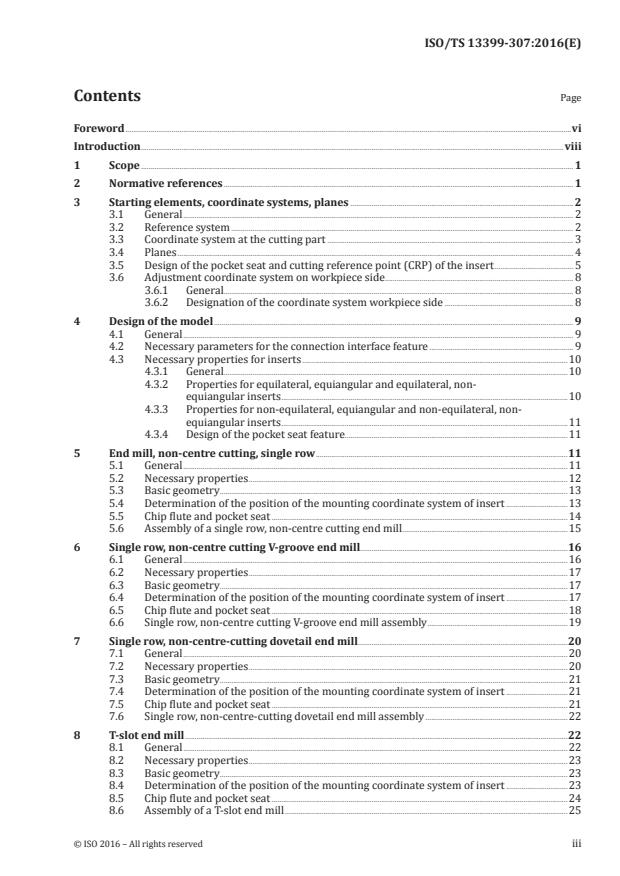
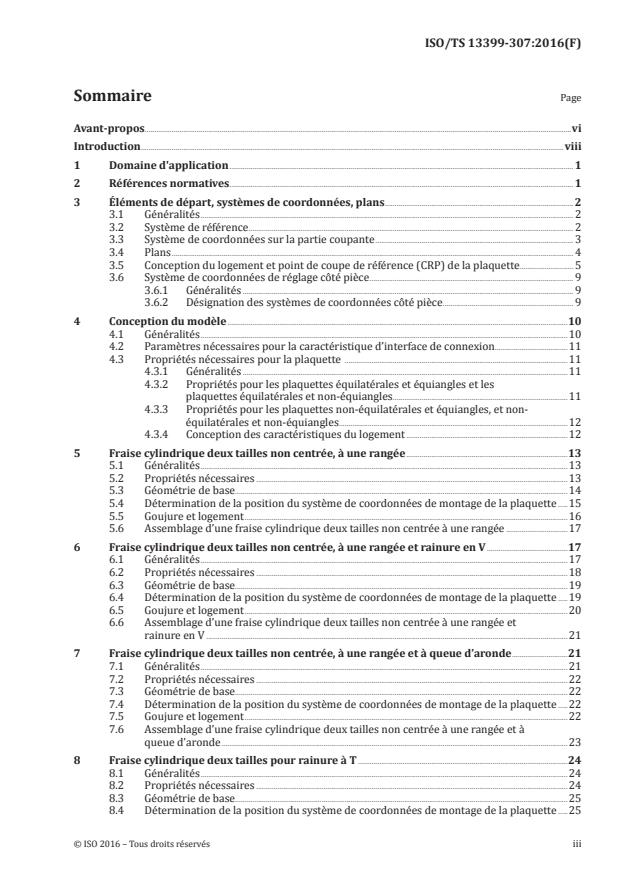
Contents Page
Foreword .vi
Introduction .viii
1 Scope . 1
2 Normative references . 1
3 Starting elements, coordinate systems, planes . 2
3.1 General . 2
3.2 Reference system . 2
3.3 Coordinate system at the cutting part . 3
3.4 Planes . 4
3.5 Design of the pocket seat and cutting reference point (CRP) of the insert . 5
3.6 Adjustment coordinate system on workpiece side . 8
3.6.1 General. 8
3.6.2 Designation of the coordinate system workpiece side . 8
4 Design of the model . 9
4.1 General . 9
4.2 Necessary parameters for the connection interface feature . 9
4.3 Necessary properties for inserts .10
4.3.1 General.10
4.3.2 Properties for equilateral, equiangular and equilateral, non-
equiangular inserts .10
4.3.3 Properties for non-equilateral, equiangular and non-equilateral, non-
equiangular inserts .11
4.3.4 Design of the pocket seat feature.11
5 End mill, non-centre cutting, single row .11
5.1 General .11
5.2 Necessary properties .12
5.3 Basic geometry .13
5.4 Determination of the position of the mounting coordinate system of insert .13
5.5 Chip flute and pocket seat .14
5.6 Assembly of a single row, non-centre cutting end mill .15
6 Single row, non-centre cutting V-groove end mill .16
6.1 General .16
6.2 Necessary properties .17
6.3 Basic geometry .17
6.4 Determination of the position of the mounting coordinate system of insert .17
6.5 Chip flute and pocket seat .18
6.6 Single row, non-centre cutting V-groove end mill assembly .19
7 Single row, non-centre-cutting dovetail end mill .20
7.1 General .20
7.2 Necessary properties .20
7.3 Basic geometry .21
7.4 Determination of the position of the mounting coordinate system of insert .21
7.5 Chip flute and pocket seat .21
7.6 Single row, non-centre-cutting dovetail end mill assembly .22
8 T-slot end mill .22
8.1 General .22
8.2 Necessary properties .23
8.3 Basic geometry .23
8.4 Determination of the position of the mounting coordinate system of insert .23
8.5 Chip flute and pocket seat .24
8.6 Assembly of a T-slot end mill .25
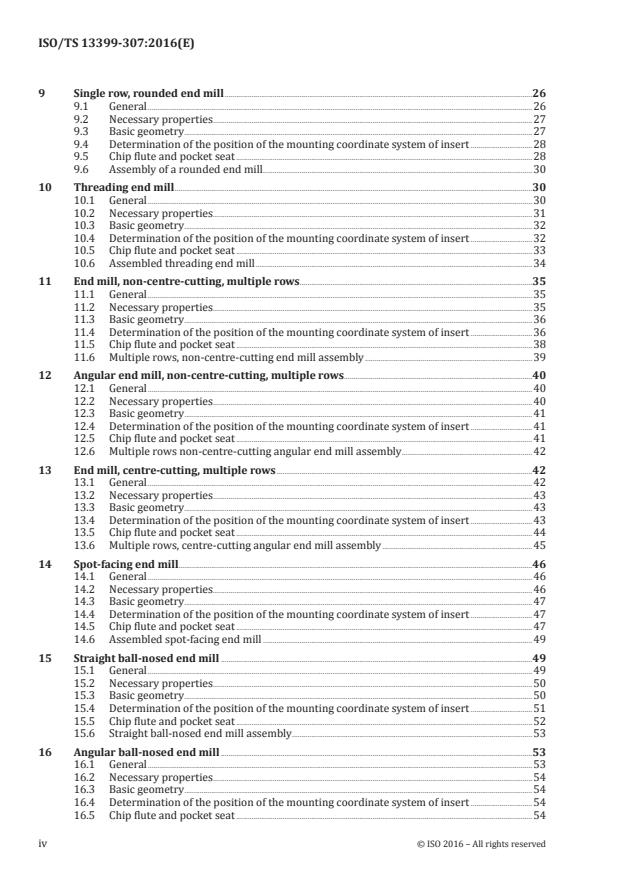
9 Single row, rounded end mill .26
9.1 General .26
9.2 Necessary properties .27
9.3 Basic geometry .27
9.4 Determination of the position of the mounting coordinate system of insert .28
9.5 Chip flute and pocket seat .28
9.6 Assembly of a rounded end mill .30
10 Threading end mill .30
10.1 General .30
10.2 Necessary properties .31
10.3 Basic geometry .32
10.4 Determination of the position of the mounting coordinate system of insert .32
10.5 Chip flute and pocket seat .33
10.6 Assembled threading end mill .34
11 End mill, non-centre-cutting, multiple rows.35
11.1 General .35
11.2 Necessary properties .35
11.3 Basic geometry .36
11.4 Determination of the position of the mounting coordinate system of insert .36
11.5 Chip flute and pocket seat .38
11.6 Multiple rows, non-centre-cutting end mill assembly .39
12 Angular end mill, non-centre-cutting, multiple rows .40
12.1 General .40
12.2 Necessary properties .40
12.3 Basic geometry .41
12.4 Determination of the position of the mounting coordinate system of insert .41
12.5 Chip flute and pocket seat .41
12.6 Multiple rows non-centre-cutting angular end mill assembly .42
13 End mill, centre-cutting, multiple rows .42
13.1 General .42
13.2 Necessary properties .43
13.3 Basic geometry .43
13.4 Determination of the position of the mounting coordinate system of insert .43
13.5 Chip flute and pocket seat .44
13.6 Multiple rows, centre-cutting angular end mill assembly .45
14 Spot-facing end mill .46
14.1 General .46
14.2 Necessary properties .46
14.3 Basic geometry .47
14.4 Determination of the position of the mounting coordinate system of insert .47
14.5 Chip flute and pocket seat .47
14.6 Assembled spot-facing end mill .49
15 Straight ball-nosed end mill .49
15.1 General .49
15.2 Necessary properties .50
15.3 Basic geometry .50
15.4 Determination of the position of the mounting coordinate system of insert .51
15.5 Chip flute and pocket seat .52
15.6 Straight ball-nosed end mill assembly .53
16 Angular ball-nosed end mill .53
16.1 General .53
16.2 Necessary properties .54
16.3 Basic geometry .54
16.4 Determination of the position of the mounting coordinate system of insert .54
16.5 Chip flute and pocket seat .54
iv © ISO 2016 – All rights reserved
16.6 Angular ball-nosed end mill assembly .54
17 Die and mould end mill .54
17.1 General .54
17.2 Necessary properties .55
17.3 Basic geometry .56
17.4 Determination of the position of the mounting coordinate system of insert .56
17.5 Chip flute and pocket seat .56
17.6 Die end mill assembly .58
18 Bell-style end mill .58
18.1 General .58
18.2 Necessary properties .59
18.3 Basic geometry .60
18.4 Determination of the position of the mounting coordinate system of insert .60
18.5 Chip flute and pocket seat .61
18.6 Bell-style end mill assembly .61
19 Design of details .61
19.1 Basis for modelling .61
19.2 Fixing threads for inserts .62
19.3 Contact/clamping surfaces — Orientation .62
19.4 Chamfers and roundings .62
20 Attributes of surfaces — Visualization of the model features .62
21 Structure of the design elements (tree of model) .62
22 Data exchange model .63
Annex A (informative) Information about nominal dimensions .65
Bibliography .66
Foreword
ISO (the International Organization for Standardization) is a worldwide federation of national standards
bodies (ISO member bodies). The work of preparing International Standards is normally carried out
through ISO technical committees. Each member body interested in a subject for which a technical
committee has been established has the right to be represented on that committee. International
organizations, governmental and non-governmental, in liaison with ISO, also take part in the work.
ISO collaborates closely with the International Electrotechnical Commission (IEC) on all matters of
electrotechnical standardization.
The procedures used to develop this document and those intended for its further maintenance are
described in the ISO/IEC Directives, Part 1. In particular the different approval criteria needed for the
different types of ISO documents should be noted. This document was drafted in accordance with the
editorial rules of the ISO/IEC Directives, Part 2 (see www.iso.org/directives).
Attention is drawn to the possibility that some of the elements of this document may be the subject of
patent rights. ISO shall not be held responsible for identifying any or all such patent rights. Details of
any patent rights identified during the development of the document will be in the Introduction and/or
on the ISO list of patent declarations received (see www.iso.org/patents).
Any trade name used in this document is information given for the convenience of users and does not
constitute an endorsement.
For an explanation on the meaning of ISO specific terms and expressions related to conformity
assessment, as well as information about ISO’s adherence to the WTO principles in the Technical
Barriers to Trade (TBT), see the following URL: Foreword — Supplementary information.
The committee responsible for this document is ISO/TC 29, Small tools.
ISO/TS 13399 consists of the following parts, under the general title Cutting tool data representation
and exchange:
— Part 1: Overview, fundamental principles and general information model
— Part 2: Reference dictionary for the cutting items [Technical Specification]
— Part 3: Reference dictionary for tool items [Technical Specification]
— Part 4: Reference dictionary for adaptive items [Technical Specification]
— Part 5: Reference dictionary for assembly items [Technical Specification]
— Part 50: Reference dictionary for reference systems and common concepts [Technical Specification]
— Part 60: Reference dictionary for connection systems [Technical Specification]
— Part 80: Creation and exchange of 3D models — Overview and principles [Technical Specification]
— Part 100: Definitions, principles and methods for reference dictionaries [Technical Specification]
— Part 150: Usage guidelines [Technical Specification]
— Part 201: Creation and exchange of 3D models — Regular inserts [Technical Specification]
— Part 202: Creation and exchange of 3D models — Irregular inserts [Technical Specification]
— Part 203: Creation and exchange of 3D models — Replaceable inserts for drilling [Technical Specification]
— Part 204: Creation and exchange of 3D models — Inserts for reaming [Technical Specification]
— Part 301: Concept for the design of 3D models based on properties according to ISO/TS 13399‑3: Modelling
of thread‑cutting taps, thread‑forming taps and thread‑cutting dies [Technical Specification]
vi © ISO 2016 – All rights reserved
— Part 302: Concept for the design of 3D models based on properties according to ISO/TS 13399‑3:
Modelling of solid drills and countersinking tools [Technical Specification]
— Part 303: Concept for the design of 3D models based on properties according to ISO/TS 13399‑3:
Modelling of end mills with solid cutting edges [Technical Specification]
— Part 304: Concept for the design of 3D models based on properties according to ISO/TS 13399‑3:
Modelling of milling cutters with arbor hole and solid cutting edges [Technical Specification]
— Part 307: Creation and exchange of 3D models — End mills for indexable inserts [Technical Specification]
— Part 308: Creation and exchange of 3D models — Milling cutters with arbor hole for indexable inserts
[Technical Specification]
— Part 309: Creation and exchange of 3D models — Tool holders for indexable inserts [Technical
Specification]
— Part 311: Creation and exchange of 3D models — Solid reamers [Technical Specification]
— Part 312: Creation and exchange of 3D models — Reamers for indexable inserts [Technical Specification]
— Part 401: Creation and exchange of 3D models — Converting, extending and reducing adaptive items
[Technical Specification]
— Part 405: Creation and exchange of 3D models — Collets [Technical Specification]
The following parts are under preparation:
— Part 70: Graphical data layout — Layer settings for tool designs [Technical Specification]
— Part 71: Graphical data layout — Creation of documents for the standardized data exchange — Graphical
product information [Technical Specification]
— Part 72: Creation of documents for the standardized data exchange — Definition of properties for
drawing header and their XML‑data exchange [Technical Specification]
— Part 305: Creation and exchange of 3D models — Modular tooling systems with adjustable cartridges
for boring [Technical Specification]
— Part 310: Creation and exchange of 3D models — Turning tools with carbide tips [Technical Specification]
Introduction
This part of ISO/TS 13399 defines the concept, the terms and the definitions on how to design simplified
3D models of end mills for indexable inserts that can be used for NC-programming, simulation of the
manufacturing processes and the determination of collision within machining processes. It is not
intended to standardize the design of the cutting tool itself.
A cutting tool is used in a machine to remove material from a workpiece by a shearing action at the
cutting edges of the tool. Cutting tool data that can be described by ISO/TS 13399 (all parts) include, but
are not limited to, everything between the workpiece and the machine tool. Information about inserts,
solid tools, assembled tools, adaptors, components and their relationships can be represented by ISO/
TS 13399 (all parts). The increasing demand providing the end-user with 3D models for the purposes
defined above is the basis for the development of this series of International Standards.
The objective of ISO/TS 13399 (all parts) is to provide the means to represent the information that
describes cutting tools in a computer sensible form that is independent from any particular computer
system. The representation will facilitate the processing and exchange of cutting tool data within and
between different software systems and computer platforms and support the application of this data in
manufacturing planning, cutting operations and the supply of tools. The nature of this description
makes it suitable not only for neutral file exchange, but also as a basis for implementing and sharing
product databases and for archiving. The methods that are used for these representations are those
developed by ISO/TC 184/SC 4 for the representation of product data by using standardized information
models and reference dictionaries.
Definitions and identifications of dictionary entries are defined by means of standard data that consist
of instances of the EXPRESS entity data types defined in the common dictionary schema, resulting
from a joint effort between ISO/TC 184/SC 4 and IEC/TC 3/SC 3D, and in its extensions defined in
ISO 13584-24 and ISO 13584-25.
viii © ISO 2016 – All rights reserved
TECHNICAL SPECIFICATION ISO/TS 13399-307:2016(E)
Cutting tool data representation and exchange —
Part 307:
Creation and exchange of 3D models — End mills for
indexable inserts
1 Scope
This part of ISO/TS 13399 specifies a concept for the design of tool items, limited to any kind end mills
for indexable inserts, together with the usage of the related properties and domains of values.
This part of ISO/TS 13399 specifies a common way of design simplified models that contain the following:
— definitions and identifications of the design features of end mills for indexable inserts, with an
association to the used properties;
— definitions and identifications of the internal structure of the 3D model that represents the features
and the properties of end mills for indexable inserts.
The following are outside the scope of this part of ISO/TS 13399:
— applications where these standard data may be stored or referenced;
— concept of 3D models for cutting tools;
— concept of 3D models for cutting items;
— concept of 3D models for other tool items not being described in the scope of this International
Standard;
— concept of 3D models for adaptive items;
— concept of 3D models for assembly items and auxiliary items.
2 Normative references
The following referenced documents, in whole or in part, are indispensable for the application of this
document. For dated references, only the edition cited applies. For undated references, the latest edition
of the referenced document (including any amendments) applies.
ISO 5610 (all parts), Tool holders with rectangular shank for indexable inserts
ISO/TS 13399-3, Cutting tool data representation and exchange — Part 3: Reference dictionary for tool items
ISO/TS 13399-4, Cutting tool data representation and exchange — Part 4: Reference dictionary for
adaptive items
ISO/TS 13399-50, Cutting tool data representation and exchange — Part 50: Reference dictionary for
reference systems and common concepts
ISO/TS 13399-60, Cutting tool data representation and exchange — Part 60: Reference dictionary for
connection systems
ISO/TS 13399-80, Cutting tool data representation and exchange — Part 80: Creation and exchange of 3D
models — Overview and principles
ISO/TS 13399-201, Cutting tool data representation and exchange — Part 201: Creation and exchange of
3D models — Regular inserts
3 Starting elements, coordinate systems, planes
3.1 General
The modelling of the 3D models shall be done by means of nominal dimensions.
WARNING — There is no guarantee that the 3D model, created according to the methods described
in this part of ISO/TS 13399, is a true representation of the physical tool supplied by the tool
manufacturer. If the models are used for simulation purposes, e.g. CAM simulation, it shall be taken
into consideration that the real product dimensions can differ from those nominal dimensions.
NOTE Some definitions are taken from ISO/TS 13399-50.
3.2 Reference system
The reference system consists of the following standard elements as shown in Figure 1:
— standard coordinate system — right-handed, rectangular Cartesian system in three-dimensional
space, called “primary coordinate system” (PCS);
— three orthogonal planes — planes in the coordinate system that contain the axis of the system,
named “xy-plane” (XYP), “xz-plane” (XZP) and “yz-plane” (YZP);
— three orthogonal axes — axes built as intersections of the three orthogonal plane lines ,respectively,
named “x-axis” (XA), “y-axis” (YA) and “z-axis” (ZA).
Figure 1 — Reference system
For virtually mounting end mills on to an adaptive item, an additional reference system shall be defined.
This reference system shall be called “mounting coordinate system” (MCS). It is located at the starting
point of the protruding length of a tool item. The orientation is shown in Figure 2.
2 © ISO 2016 – All rights reserved
Figure 2 — Orientation of “PCS” and “MCS” reference system (example)
3.3 Coordinate system at the cutting part
The coordinate system at the cutting part, named “coordinate system in process” (CIP), with a defined
distance to the PCS shall be oriented as follows:
— the origin is on a plane that is parallel to the xy-plane of PCS and is located on the most front
cutting point;
— z-axis of CIP points to the PCS;
— z-axis of CIP is collinear to the z-axis of PCS;
— y-axis of CIP is parallel to the y-axis of PCS.
Figure 3 — Orientation of CIP
If the 3D modelling software gives the possibility to include interfaces for components to, for example,
mount a front-cutting disk onto a complete cutting tool, it shall be advised to use the coordinate
system “CIP”.
If necessary, another designation should be given to the interface of the component (dependent on the
software). The name is “CSIF” (“coordinate system interface”) and includes the coordinate system “CIP”.
3.4 Planes
The modelling takes place based on planes according to Figure 4 and shall be used as reference, if
applicable. Therefore, it shall be ensured that the model is able to vary or single features of independent
design features shall be suppressed by means of changing the value of one or more parameter of the
model design. Furthermore, the identification of the different areas shall be simplified in using the
plane concept, even if they contact each other with the same size, e.g. chip flute, shank, and so on.
For the 3D visualization of end mills for indexable inserts, the general planes shall be determined as
follows and as in Figure 4:
— “TEP” — the tool end plane is located at that end of the connection that points away from the
workpiece; if the tool does not have a contact surface and/or a gauge line, the TEP is coplanar with
the xy-plane of the PCS; the overall length (OAL) is the distance between CIP and TEP;
— “CLP” — (cutting length plane) plane for the cutting depth maximum (APMX), based on “CIP”;
— “HEP” — (head end plane) plane that determines the most front of the end mill, based on “CIP” and
is coplanar to the xy-plane of CIP;
— “LHP” — plane for the head length (LH), based on “CIP”;
— “LPRP” — plane for the protruding length (LPR), based on “MCS”;
— “LSP” — plane for the shank length (LS), based on “PCS”;
— “LUP” — plane for the maximum usable length (LUX), based on “CIP”.
Other planes, if necessary, are defined in the appropriate Clauses.
Figure 4 — Planes for design
4 © ISO 2016 – All rights reserved
3.5 Design of the pocket seat and cutting reference point (CRP) of the insert
NOTE If regular inserts have a specific design and are not interchangeable between vendors, the location of
the MCS is at the manufacturer’s discretion, either on the top face or on the bottom face. The orientation of the
axis has to follow the definitions in this part of ISO/TS 13399.
The final position of the pocket seat shall be designed by means of designing an insert. This feature shall
be used for subtraction from the tool body. To give the possibility to use inserts with different corner
radii, only that corner defining the functional dimensions shall carry the corner radius. The remaining
corners shall be designed without a corner radius.
The size of the corner radius shall meet the determination of a master radius. Table 1 shows the size of
the corner radii, dependent from the inscribed circle as given in ISO 5610.
Table 1 — Dependency of inscribed circle and corner radius
Dimensions in millimetres
Inscribed circle Corner radius
3,970 0,4
4,760 0,4
5,560 0,4
6,350 0.4
9,525 0,8
12,700 0,8
15,875 1,2
19,050 1,2
22,250 2,4
25,400 2,4
31,750 2,4
NOTE At rectangular (style L) and parallelogram-shaped (styles A, B, K) inserts, the longer side that is equal
to the inscribed circle determines the size of the corner radius.
MCS-coordinate system of the insert (MCS_INSERT) and the PCS-coordinate system of the insert
(PCS_INSRT) are oriented differently to the primary coordinate system of the tool (PCS_TOOL). The
orientation is shown in Figures 5 and 7.
The neutral position of an insert is determined as follows.
a) The origin of the MCS_INSERT shall be positioned onto the centre of the inscribed circle; at
rectangular and parallelogram-shaped inserts the point of origin shall be determined through the
intersection of the two diagonal lines.
b) The x-axis of MCS_INSERT shall be parallel to the x-axis of PCS_INSERT.
c) The y-axis of MCS_INSERT shall be parallel to the y-axis of PCS_INSERT.
d) The z-axis of MCS_INSERT shall be parallel to the z-axis of PCS_INSERT.
e) The x-axis of PCS_INSERT shall be collinear to the x-axis of PCS_TOOL.
f) The y-axis of PCS_INSERT shall be collinear to the z-axis of PCS_TOOL.
g) The Z–axis of PCS_INSERT shall be collinear to the y-axis of PCS_TOOL.
Positioning of the insert into the functional location shall be done as follows.
a) Design with end-cutting edge angle on a right-handed tool, commonly used on the face of the end
mill, typically for spot-facing cutters.
1) Only inserts located in the second quadrant of the primary coordinate system of the insert,
also called “left handed” inserts, shall be used.
2) The insert shall be rotated by 90-KAPR degrees in mathematic positive direction (counter-
clockwise) about the y-axis of the PCS_TOOL.
Figure 5 — Orientation of PCS_INSERT, MCS_INSERT and PCS_TOOL on end cutting edge angle
3) The cutting reference point (CRP), defined in ISO/TS 13399-50, is the point where the functional
dimensions are based.
4) The coordinate system of CRP (CS_CRP) is defined as follows:
i) the x-axis of CS_CRP is collinear to the x-axis of PCS_INSERT;
ii) the y-axis of CS_CRP is parallel to the y-axis of PCS_INSERT;
iii) the z-axis of CS_CRP is parallel to the z-axis of PCS_INSERT.
5) If the tool is defined with an axial rake and a radial rake angle that are unequal 0 degree, the
insert have to be rotated about its CRP. The orientation is shown in Figure 6. Therefore, two
axes shall be added:
i) GAMP-axis positioned on CRP with its vector that is parallel to x-axis of PCS_TOOL —
defines the rotation of axial rake angle;
ii) GAMF-axis positioned on CRP with its vector that is parallel to z-axis of PCS_TOOL —
defines the rotation of radial rake angle.
6 © ISO 2016 – All rights reserved
Figure 6 — Axial and radial rake angle on insert
b) Design with side-cutting edge angle on a right-handed tool, commonly used on the periphery of the
end mill, typically for all kinds of side-cutting end mills.
1) Only inserts located in the first quadrant of the primary coordinate system of the insert, also
called “right handed” or “neutral” inserts, shall be used.
2) The insert shall be rotated by KAPR degrees in mathematic positive direction (counter-
clockwise) about the y-axis of PCS_TOOL.
Figure 7 — Orientation of PCS_INSERT, MCS_INSERT and PCS_TOOL on side-cutting edge angle
3) The cutting reference point (CRP), defined in ISO/TS 13399-50, is the point where the functional
dimensions are based.
The position of the C_CRP is defined with the properties DC/2 and LF.
3.6 Adjustment c
...
SPÉCIFICATION ISO/TS
TECHNIQUE 13399-307
Première édition
2016-02-15
Représentation et échange des
données relatives aux outils
coupants —
Partie 307:
Création et échange des modèles 3D —
Fraises cylindriques deux tailles pour
plaquettes amovibles
Cutting tool data representation and exchange —
Part 307: Creation and exchange of 3D models — End mills for
indexable inserts
Numéro de référence
©
ISO 2016
DOCUMENT PROTÉGÉ PAR COPYRIGHT
© ISO 2016
Tous droits réservés. Sauf prescription différente ou nécessité dans le contexte de sa mise en œuvre, aucune partie de cette
publication ne peut être reproduite ni utilisée sous quelque forme que ce soit et par aucun procédé, électronique ou mécanique,
y compris la photocopie, ou la diffusion sur l’internet ou sur un intranet, sans autorisation écrite préalable. Une autorisation peut
être demandée à l’ISO à l’adresse ci-après ou au comité membre de l’ISO dans le pays du demandeur.
ISO copyright office
Case postale 401 • Ch. de Blandonnet 8
CH-1214 Vernier, Genève
Tél.: +41 22 749 01 11
Fax: +41 22 749 09 47
E-mail: copyright@iso.org
Web: www.iso.org
Publié en Suisse
ii © ISO 2016 – Tous droits réservés
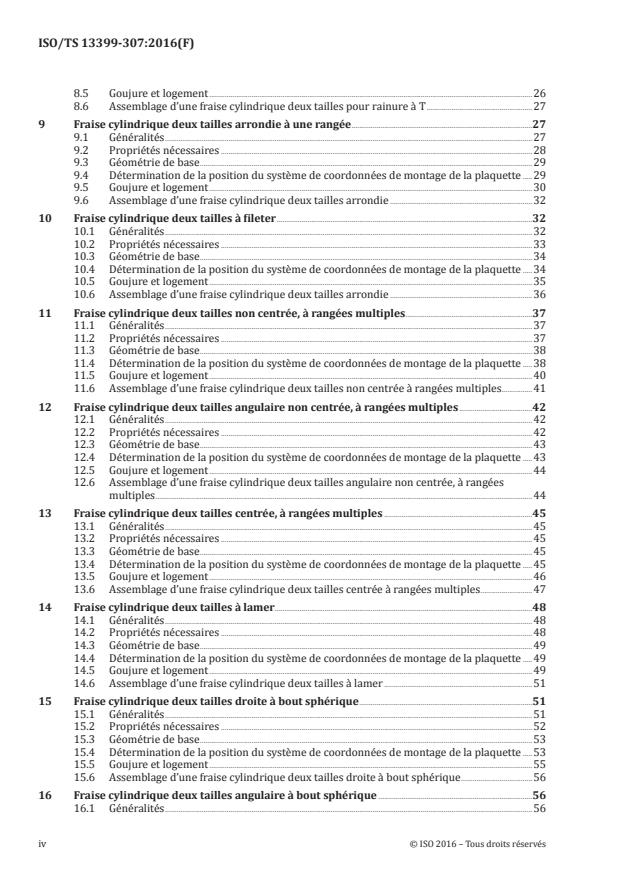
Sommaire Page
Avant-propos .vi
Introduction .viii
1 Domaine d'application . 1
2 Références normatives . 1
3 Éléments de départ, systèmes de coordonnées, plans . 2
3.1 Généralités . 2
3.2 Système de référence . 2
3.3 Système de coordonnées sur la partie coupante . 3
3.4 Plans . 4
3.5 Conception du logement et point de coupe de référence (CRP) de la plaquette. 5
3.6 Système de coordonnées de réglage côté pièce . 9
3.6.1 Généralités . 9
3.6.2 Désignation des systèmes de coordonnées côté pièce . 9
4 Conception du modèle .10
4.1 Généralités .10
4.2 Paramètres nécessaires pour la caractéristique d’interface de connexion.11
4.3 Propriétés nécessaires pour la plaquette .11
4.3.1 Généralités .11
4.3.2 Propriétés pour les plaquettes équilatérales et équiangles et les
plaquettes équilatérales et non-équiangles .11
4.3.3 Propriétés pour les plaquettes non-équilatérales et équiangles, et non-
équilatérales et non-équiangles .12
4.3.4 Conception des caractéristiques du logement .12
5 Fraise cylindrique deux tailles non centrée, à une rangée .13
5.1 Généralités .13
5.2 Propriétés nécessaires .13
5.3 Géométrie de base .14
5.4 Détermination de la position du système de coordonnées de montage de la plaquette .15
5.5 Goujure et logement .16
5.6 Assemblage d’une fraise cylindrique deux tailles non centrée à une rangée .17
6 Fraise cylindrique deux tailles non centrée, à une rangée et rainure en V .17
6.1 Généralités .17
6.2 Propriétés nécessaires .18
6.3 Géométrie de base .19
6.4 Détermination de la position du système de coordonnées de montage de la plaquette .19
6.5 Goujure et logement .20
6.6 Assemblage d’une fraise cylindrique deux tailles non centrée à une rangée et
rainure en V .21
7 Fraise cylindrique deux tailles non centrée, à une rangée et à queue d’aronde .21
7.1 Généralités .21
7.2 Propriétés nécessaires .22
7.3 Géométrie de base .22
7.4 Détermination de la position du système de coordonnées de montage de la plaquette .22
7.5 Goujure et logement .22
7.6 Assemblage d’une fraise cylindrique deux tailles non centrée à une rangée et à
queue d’aronde .23
8 Fraise cylindrique deux tailles pour rainure à T .24
8.1 Généralités .24
8.2 Propriétés nécessaires .24
8.3 Géométrie de base .25
8.4 Détermination de la position du système de coordonnées de montage de la plaquette .25
8.5 Goujure et logement .26
8.6 Assemblage d’une fraise cylindrique deux tailles pour rainure à T .27
9 Fraise cylindrique deux tailles arrondie à une rangée .27
9.1 Généralités .27
9.2 Propriétés nécessaires .28
9.3 Géométrie de base .29
9.4 Détermination de la position du système de coordonnées de montage de la plaquette .29
9.5 Goujure et logement .30
9.6 Assemblage d’une fraise cylindrique deux tailles arrondie .32
10 Fraise cylindrique deux tailles à fileter .32
10.1 Généralités .32
10.2 Propriétés nécessaires .33
10.3 Géométrie de base .34
10.4 Détermination de la position du système de coordonnées de montage de la plaquette .34
10.5 Goujure et logement .35
10.6 Assemblage d’une fraise cylindrique deux tailles arrondie .36
11 Fraise cylindrique deux tailles non centrée, à rangées multiples .37
11.1 Généralités .37
11.2 Propriétés nécessaires .37
11.3 Géométrie de base .38
11.4 Détermination de la position du système de coordonnées de montage de la plaquette .38
11.5 Goujure et logement .40
11.6 Assemblage d’une fraise cylindrique deux tailles non centrée à rangées multiples.41
12 Fraise cylindrique deux tailles angulaire non centrée, à rangées multiples .42
12.1 Généralités .42
12.2 Propriétés nécessaires .42
12.3 Géométrie de base .43
12.4 Détermination de la position du système de coordonnées de montage de la plaquette .43
12.5 Goujure et logement .44
12.6 Assemblage d’une fraise cylindrique deux tailles angulaire non centrée, à rangées
multiples .44
13 Fraise cylindrique deux tailles centrée, à rangées multiples .45
13.1 Généralités .45
13.2 Propriétés nécessaires .45
13.3 Géométrie de base .45
13.4 Détermination de la position du système de coordonnées de montage de la plaquette .45
13.5 Goujure et logement .46
13.6 Assemblage d’une fraise cylindrique deux tailles centrée à rangées multiples .47
14 Fraise cylindrique deux tailles à lamer.48
14.1 Généralités .48
14.2 Propriétés nécessaires .48
14.3 Géométrie de base .49
14.4 Détermination de la position du système de coordonnées de montage de la plaquette .49
14.5 Goujure et logement .49
14.6 Assemblage d’une fraise cylindrique deux tailles à lamer .51
15 Fraise cylindrique deux tailles droite à bout sphérique .51
15.1 Généralités .51
15.2 Propriétés nécessaires .52
15.3 Géométrie de base .53
15.4 Détermination de la position du système de coordonnées de montage de la plaquette .53
15.5 Goujure et logement .55
15.6 Assemblage d’une fraise cylindrique deux tailles droite à bout sphérique .56
16 Fraise cylindrique deux tailles angulaire à bout sphérique .56
16.1 Généralités .56
iv © ISO 2016 – Tous droits réservés
16.2 Propriétés nécessaires .57
16.3 Géométrie de base .57
16.4 Détermination de la position du système de coordonnées de montage de la plaquette .57
16.5 Goujure et logement .57
16.6 Assemblage d’une fraise cylindrique deux tailles angulaire à bout sphérique .57
17 Fraise cylindrique deux tailles pour moule et matrice .58
17.1 Généralités .58
17.2 Propriétés nécessaires .58
17.3 Géométrie de base .59
17.4 Détermination de la position du système de coordonnées de montage de la plaquette .59
17.5 Goujure et logement .60
17.6 Assemblage d’une fraise cylindrique deux tailles pour moule et matrice .61
18 Fraise cylindrique deux tailles en forme de cloche .61
18.1 Généralités .61
18.2 Propriétés nécessaires .62
18.3 Géométrie de base .63
18.4 Détermination de la position du système de coordonnées de montage de la plaquette .63
18.5 Goujure et logement .64
18.6 Assemblage d’une fraise cylindrique deux tailles en forme de cloche .64
19 Conception des détails .64
19.1 Bases pour la modélisation .64
19.2 Filetages de fixation pour les plaquettes .65
19.3 Surfaces de contact/serrage — Orientation .65
19.4 Chanfreins et arrondis .65
20 Attributs des surfaces — Visualisation des caractéristiques du modèle .65
21 Structure des éléments de conception (arborescence du modèle) .65
22 Modèle d’échanges de données .66
Annexe A (informative) Informations sur les dimensions nominales .68
Bibliographie .69
Avant-propos
L'ISO (Organisation internationale de normalisation) est une fédération mondiale d'organismes
nationaux de normalisation (comités membres de l'ISO). L'élaboration des Normes internationales est
en général confiée aux comités techniques de l'ISO. Chaque comité membre intéressé par une étude
a le droit de faire partie du comité technique créé à cet effet. Les organisations internationales,
gouvernementales et non gouvernementales, en liaison avec l'ISO participent également aux travaux.
L'ISO collabore étroitement avec la Commission électrotechnique internationale (IEC) en ce qui
concerne la normalisation électrotechnique.
Les procédures utilisées pour élaborer le présent document et celles destinées à sa mise à jour sont
décrites dans les Directives ISO/IEC, Partie 1. Il convient, en particulier de prendre note des différents
critères d'approbation requis pour les différents types de documents ISO. Le présent document a été
rédigé conformément aux règles de rédaction données dans les Directives ISO/IEC, Partie 2 (voir www
.iso .org/directives).
L'attention est appelée sur le fait que certains des éléments du présent document peuvent faire l'objet de
droits de propriété intellectuelle ou de droits analogues. L'ISO ne saurait être tenue pour responsable
de ne pas avoir identifié de tels droits de propriété et averti de leur existence. Les détails concernant
les références aux droits de propriété intellectuelle ou autres droits analogues identifiés lors de
l'élaboration du document sont indiqués dans l'Introduction et/ou dans la liste des déclarations de
brevets reçues par l’ISO (voir www .iso .org/brevets).
Les appellations commerciales éventuellement mentionnées dans le présent document sont données
pour information, par souci de commodité à l'intention des utilisateurs et ne sauraient constituer un
engagement.
Pour une explication de la signification des termes et expressions spécifiques de l'ISO liés à l'évaluation
de la conformité, ou pour toute information au sujet de l'adhésion de l'ISO aux principes de l'Organisation
mondiale du commerce (OMC) concernant les obstacles techniques au commerce (OTC) voir le lien
suivant: www .iso .org/iso/fr/foreword .html.
Le comité chargé de l'élaboration du présent document est l'ISO/TC 29, Petit outillage.
L'ISO 13399 comprend les parties suivantes, présentées sous le titre général Représentation et échange
des données relatives aux outils coupants:
— Partie 1: Vue d'ensemble, principes fondamentaux et modèle général d'informations
— Partie 2: Dictionnaire de référence pour les éléments coupants [Spécification technique]
— Partie 3: Dictionnaire de référence pour les éléments relatifs aux outils [Spécification technique]
— Partie 4: Dictionnaire de référence pour les éléments relatifs aux attachements [Spécification technique]
— Partie 5: Dictionnaire de référence pour les éléments d'assemblage [Spécification technique]
— Partie 50: Dictionnaire de référence pour les systèmes de référence et les concepts communs [Spécification
technique]
— Partie 60: Dictionnaire de référence pour les systèmes de connexion [Spécification technique]
— Partie 80: Création et échange des modèles 3D — Vue d'ensemble et principes [Spécification technique]
— Partie 100: Définitions, principes et méthodes pour les dictionnaires de référence [Spécification
technique]
— Partie 150: Lignes directrices d'utilisation [Spécification technique]
— Partie 201: Création et échange des modèles 3D — Plaquettes régulières [Spécification technique]
— Partie 202: Création et échange des modèles 3D — Plaquettes irrégulières [Spécification technique]
vi © ISO 2016 – Tous droits réservés
— Partie 203: Création et échange des modèles 3D — Plaquettes de perçage échangeables [Spécification
technique]
— Partie 204: Création et échange des modèles 3D — Plaquettes d'alésage [Spécification technique]
— Partie 301: Description des modèles 3D basés sur les propriétés de l'ISO/TS 13399-3: Modélisation des
tarauds, tarauds à refouler et filières de filetage [Spécification technique]
— Partie 302: Description des modèles 3D basés sur les propriétés de l'ISO/TS 13399-3: Modélisation des
forets monoblocs et des outils de lamage [Spécification technique]
— Partie 303: Description des modèles 3D basés sur les propriétés de l'ISO/TS 13399-3: Modélisation des
fraises cylindriques à arêtes de coupe non amovibles [Spécification technique]
— Partie 304: Description des modèles 3D basés sur les propriétés de l'ISO/TS 13399-3: Modélisation des
fraises à alésage et arêtes de coupe non amovibles [Spécification technique]
— Partie 307: Création et échange des modèles 3D — Fraises cylindriques pour plaquettes amovibles
[Spécification technique]
— Partie 308: Création et échange des modèles 3D — Fraises à alésage pour plaquettes amovibles
[Spécification technique]
— Partie 309: Création et échange des modèles 3D — Porte-outils pour plaquettes amovibles [Spécification
technique]
— Partie 311: Création et échange des modèles 3D — Alésoirs monoblocs [Spécification technique]
— Partie 312: Création et échange des modèles 3D — Alésoirs pour plaquettes amovibles [Spécification
technique]
— Partie 401: Création et échange des modèles 3D — Attachements de conversion, de rallonge et de
réduction [Spécification technique]
— Partie 405: Création et échange des modèles 3D — Pinces [Spécification technique]
Les parties suivantes sont en cours d'élaboration:
— Partie 70: Format des données graphiques — Réglage des calques pour la représentation de l'outil
[Spécification technique]
— Partie 71: Format des données graphiques — Création de documents pour l'échange de données
normalisées: Informations graphiques des produits [Spécification technique]
— Partie 72: Création de documents pour l'échange de données normalisées — Définition des propriétés
pour les dessins d'en-tête et leur échange de données en XML [Spécification technique]
— Partie 305: Création et échange des modèles 3D — Systèmes d'outils modulables avec cartouches
réglables pour alésage [Spécification technique]
— Partie 310: Création et échange de modèles 3D — Outils de tour à plaquettes en carbures métalliques
[Spécification technique]
Introduction
Le présent document définit le concept pour concevoir des modèles 3D simplifiés de fraises cylindriques
deux tailles pour plaquettes amovibles, pouvant être utilisées pour la programmation CN, la simulation
des processus de fabrication et la détermination des collisions dans les processus d'usinage. Il n'est pas
prévu de normaliser la conception de la plaquette d'alésage elle-même, ni l'outil coupant.
Un outil coupant est utilisé dans une machine pour enlever la matière d'une pièce par une action de
cisaillement sur les arêtes de coupe de l'outil. Les données de l'outil coupant qui peuvent être décrites
par l'ISO/TS 13399 (toutes les parties) comprennent, sans s' y limiter, tout ce qui se trouve entre la
pièce et la machine-outil. Les informations relatives aux plaquettes, outils solides, outils assemblés,
adaptateurs, composants et leurs relations peuvent être représentées par la présente partie de l'ISO/
TS 13399 (toutes les parties). La demande croissante de fournir à l'utilisateur final des modèles 3D pour
les besoins définis ci-dessus est à la base de l'élaboration de la série de Normes internationales.
L'objectif de la série ISO/TS 13399 (toutes les parties) est de fournir les moyens de représenter les
informations décrivant les outils coupants sous une forme informatisable indépendante d'un système
informatique particulier. Cette représentation facilitera le traitement et les échanges de données
relatives aux outils coupants par et entre les différents logiciels et plates-formes informatiques, et
permettra l'application de ces données dans la planification de la production, les opérations de coupe
et l'approvisionnement en outils. La nature de cette description la rend adaptée, non seulement pour
l'échange de fichiers neutres mais également en tant que base pour la mise en œuvre et le partage de
bases de données produits et pour l'archivage. Les méthodes utilisées pour ces représentations sont
celles développées par l'ISO/TC 184/SC 4 pour la représentation de données produits en utilisant des
modèles d'informations normalisés et des dictionnaires de référence.
Les définitions et identifications des entrées du dictionnaire sont définies par des données standards
qui consistent en des instances de types de données d'entité EXPRESS définis dans le schéma commun
du dictionnaire, qui résulte des efforts conjoints entre l'ISO/TC 184/SC 4 et l'IEC/TC 3/SC 3D, et de ses
extensions définies dans l’ISO 13584-24 et l'ISO 13584-25.
viii © ISO 2016 – Tous droits réservés
SPÉCIFICATION TECHNIQUE ISO/TS 13399-307:2016(F)
Représentation et échange des données relatives aux outils
coupants —
Partie 307:
Création et échange des modèles 3D — Fraises
cylindriques deux tailles pour plaquettes amovibles
1 Domaine d'application
La présente partie de l’ISO/TS 13399 spécifie un concept pour la conception des éléments relatifs aux
outils, limité à tous les types de fraises cylindriques deux tailles pour plaquettes amovibles, utilisant les
propriétés et domaines de valeurs associés.
La présente partie de l’ISO/TS 13399 spécifie une façon commune de concevoir les exigences de modèles
simplifiés contenant les éléments suivants:
— des définitions et identifications des caractéristiques de conception des fraises cylindriques deux
tailles pour plaquettes amovibles, avec un lien vers les propriétés utilisées;
— des définitions et identifications de la structure interne du modèle 3D qui représente les
caractéristiques et les propriétés des fraises cylindriques deux tailles pour plaquettes amovibles.
Les éléments suivants n'entrent pas dans le domaine d'application de la présente partie de l’ISO/
TS 13399:
— les applications où les données standards peuvent être stockées ou référencées;
— le concept de modèles 3D pour outils coupants;
— le concept de modèles 3D pour des éléments coupants;
— le concept de modèles 3D pour d'autres éléments relatifs aux outils, non décrits dans le domaine
d’application de la présente Norme internationale;
— le concept de modèles 3D pour les éléments relatifs aux attachements;
— le concept de modèles 3D pour les éléments relatifs aux assemblages et éléments auxiliaires.
2 Références normatives
Les documents suivants, en tout ou partie, sont référencés de façon normative dans le présent document
et sont indispensables à son application. Pour les références datées, seule l'édition citée s'applique.
Pour les références non datées, la dernière édition du document de référence s'applique (y compris les
éventuels amendements).
ISO 5610 (toutes les parties), Porte-plaquette à queue rectangulaire pour plaquettes amovibles
ISO/TS 13399-3, Représentation et échange des données relatives aux outils coupants — Partie 3:
Dictionnaire de référence pour les éléments relatifs aux outils
ISO/TS 13399-4, Représentation et échange des données relatives aux outils coupants — Partie 4:
Dictionnaire de référence pour les éléments relatifs aux attachements
ISO/TS 13399-50, Représentation et échange des données relatives aux outils coupants — Partie 50:
Dictionnaire de référence pour les systèmes de coordonnées et les concepts communs
ISO/TS 13399-60, Représentation et échange des données relatives aux outils coupants — Partie 60:
Dictionnaire de référence pour les systèmes de connexion
ISO/TS 13399-80, Représentation et échange des données relatives aux outils coupants — Partie 80:
Création et échange de modèles 3D — Vue d'ensemble et principes
ISO/TS 13999-201, Représentation et échange des données relatives aux outils coupants — Partie 201:
Création et échange de modèles 3D — Plaquettes régulières
3 Éléments de départ, systèmes de coordonnées, plans
3.1 Généralités
La création de modèles 3D doit être réalisée à l'aide de dimensions nominales.
AVERTISSEMENT — Il n'est pas garanti que le modèle 3D, créé selon les méthodes décrites dans
le présent document, soit une représentation fidèle de l'outil physique fourni par le fabricant.
Si les modèles sont utilisés à des fins de simulation, par exemple, simulation FAO, il doit être
tenu compte du fait que les dimensions réelles du produit peuvent différer de ces dimensions
nominales.
NOTE Certaines définitions proviennent de l'ISO/TS 13399-50.
3.2 Système de référence
Le système de référence se compose des éléments standard suivants, comme indiqué à la Figure 1:
— système de coordonnées standard: système de coordonnées cartésiennes rectangulaires dans un
espace tridimensionnel, appelé «système de coordonnées principal» (PCS);
— trois plans orthogonaux: plans situés dans le système de coordonnées contenant les axes du
système, appelés «plan xy» (XYP), «plan xz» (XZP) et «plan yz» (YZP);
— trois axes orthogonaux: axes construits comme intersections des 3 lignes de plan orthogonal,
respectivement nommés «axe x» (XA), «axe y» (YA) et «axe z» (ZA).
2 © ISO 2016 – Tous droits réservés
Figure 1 — Système de référence
Un système de référence supplémentaire doit être défini pour le montage virtuel de fraises cylindriques
deux tailles sur un élément relatif aux attachements. Ce système de référence, appelé «système de
coordonnées de montage» (MCS) est situé au point de départ de la longueur de dépassement d'un
élément relatif à l'outil. L’orientation est indiquée à la Figure 2.
Figure 2 — Orientation du «PCS» et du «MCS» du système de référence
3.3 Système de coordonnées sur la partie coupante
Le système de coordonnées sur la partie coupante, nommé «système de coordonnées en cours» (CIP),
avec une distance définie par rapport au PCS, doit être orienté comme suit:
— l’origine se trouve sur un plan parallèle au plan xy du PCS et se trouve sur le point de coupe le plus
en avant;
— l’axe z du CIP pointe vers le PCS;
— l’axe z du CIP est colinéaire à l'axe z du PCS;
— l’axe y du CIP est parallèle à l'axe y du PCS.
Figure 3 — Orientation du CIP
Si le logiciel de modélisation 3D offre la possibilité d'inclure des interfaces pour les composants, par
exemple, pour monter un disque de coupe avant sur un outil coupant complet, il doit être conseillé
d'utiliser le système de coordonnées «CIP».
Si nécessaire, une autre désignation peut être donnée à l'interface du composant (selon le logiciel). Ce nom
est «CSIF» (pour «interface du système de coordonnées») et comprend le système de coordonnées «CIP».
3.4 Plans
La modélisation doit être effectuée sur la base des plans de la Figure 4, et doit être utilisée comme
référence, le cas échéant. Par conséquent, il doit être possible de faire varier le modèle ou de supprimer
des caractéristiques individuelles d'éléments de conception indépendants en changeant la valeur d'un
ou de plusieurs paramètres du modèle. De plus, l'identification des différentes zones doit être simplifiée
par l'utilisation du concept de plan, même s'ils entrent en contact avec les autres de même taille, par
exemple, goujure, queue, etc.
Pour la visualisation 3D des fraises cylindriques deux tailles pour plaquettes amovibles, les plans
généraux doivent être déterminés comme suit, et comme indiqué à la Figure 4:
— «TEP» — le plan d’extrémité de l’outil est situé à l’extrémité de la connexion qui pointe à l’opposé de
la pièce; si l’outil n’a pas de surface de contact et/ou de ligne de mesure le TEP est coplanaire avec le
plan xy du PCS; la longueur totale (OAL) est la distance entre le CIP et le TEP;
— «CLP» — (plan de longueur de coupe) plan pour la profondeur de coupe maximale (APMX), basé sur
le «CIP»;
— «HEP» — (plan d’extrémité de la tête) plan qui détermine le point le plus avant de la fraise cylindrique
deux tailles, basé sur le «CIP» et coplanaire au plan xy du CIP;
— «LHP» — plan pour la longueur de tête (LH), basé sur le «CIP»;
— «LPRP» — plan pour la longueur de dépassement (LPR), basé sur le «MCS»;
— «LSP» — plan pour la longueur de queue (LS°, basé sur le «PCS»;
— «LUP» — plan pour la longueur maximale utilisable (LUX), basée sur le «CIP».
Si nécessaire, d’autres plans doivent être définis dans les articles appropriés.
4 © ISO 2016 – Tous droits réservés
Figure 4 — Plans pour la conception
3.5 Conception du logement et point de coupe de référence (CRP) de la plaquette
NOTE Si des plaquettes régulières ont une conception spécifique et ne sont pas interchangeables entre
vendeurs, la position du MCS est à la discrétion du fabricant, soit sur la face supérieure ou sur la face inférieure.
L'orientation de l'axe doit suivre les définitions de la présente partie de l'ISO/TS 13399.
La position finale du logement doit être déterminée au moment de la conception de la plaquette. Cette
caractéristique doit être utilisée pour la soustraction du corps de l'outil. Pour donner la possibilité
d'utiliser des plaquettes avec des rayons de pointe différents, seule la pointe définissant les dimensions
fonctionnelles doit comporter le rayon de pointe. Les autres pointes sont conçues sans rayon de pointe.
La dimension du rayon de pointe doit correspondre à la détermination d'un rayon principal. Le Tableau 1
indique la dimension des rayons de pointe, en fonction du cercle inscrit tel qu'indiqué dans l’ISO 5610.
Tableau 1 — Corrélation entre le cercle inscrit et le rayon de pointe
Dimensions en millimètres
Cercle inscrit Rayon de pointe
3,970 0,4
4,760 0,4
5,560 0,4
6,350 0.4
9,525 0,8
12,700 0,8
15,875 1,2
19,050 1,2
Tableau 1 (suite)
Cercle inscrit Rayon de pointe
22,250 2,4
25,400 2,4
31,750 2,4
NOTE Pour les plaquettes rectangulaires (style L) et en forme de parallélogramme (styles A, B, K), le côté le
plus long qui est égal au cercle inscrit détermine la taille du rayon de pointe.
Le système de coordonnées MCS de la plaquette (MCS_INSERT) et le système de coordonnées PCS de
la plaquette (PCS_INSERT) sont orientés différemment du système de coordonnées principal de l'outil
(PCS_TOOL). L'orientation est indiquée aux Figures 5 et 7.
La position neutre d'une plaquette doit être déterminée comme suit:
a) l'origine du MCS_INSERT doit être positionnée au centre du cercle inscrit; pour les plaquettes
rectangulaires et en forme de parallélogramme, le point d'origine doit être déterminé par
l'intersection des deux lignes diagonales;
b) l'axe x du MCS_INSERT parallèle à l'axe x du PCS_INSERT;
c) l'axe y du MCS_INSERT parallèle à l'axe y du PCS_INSERT;
d) l'axe z du MCS_INSERT parallèle à l'axe z du PCS_INSERT;
e) l'axe x du PCS_INSERT colinéaire à l'axe x du PCS_TOOL;
f) l'axe y du PCS_INSERT colinéaire à l'axe z du PCS_TOOL;
g) l'axe z du PCS_INSERT colinéaire à l'axe y du PCS_TOOL.
Le positionnement de la plaquette sur la position fonctionnelle doit être effectué comme suit.
a) Conception avec l’angle de direction d’arête en bout sur un outil à droite, couramment utilisé sur la
face frontale de la fraise cylindrique deux tailles, généralement pour les fraises à lamer.
1) Seules les plaquettes situées dans le deuxième quadrant du système de coordonnées principal
de la plaquette, également appelés plaquettes «à gauche», doivent être utilisées.
2) La plaquette doit être tournée de 90 degrés KAPR dans le sens mathématique positif (inverse
des aiguilles d’une montre) autour de l'axe y du PCS_TOOL.
6 © ISO 2016 – Tous droits réservés
Figure 5 — Orientation du PCS_INSERT, du MCS_INSERT et du PCS_TOOL sur l’angle de direction
d’arête en bout
3) Le point de référence de coupe (CRP), défini dans l'ISO/TS 13399-50, est le point de base des
dimensions fonctionnelles.
4) Le système de coordonnées du CRP (CS_CRP) doit être défini comme suit:
i) l'axe x du CS_CRP colinéaire à l'axe x du PCS_INSERT;
ii) l'axe y du CS_CRP parallèle à l'axe y du PCS_INSERT;
iii) l'axe z du CS_CRP parallèle à l'axe z du PCS_INSERT.
5) Si l'outil est défini avec un angle de coupe axial et un angle de coupe radial qui n
...
Questions, Comments and Discussion
Ask us and Technical Secretary will try to provide an answer. You can facilitate discussion about the standard in here.
Loading comments...