


ISO/IEC 13818-4:2004
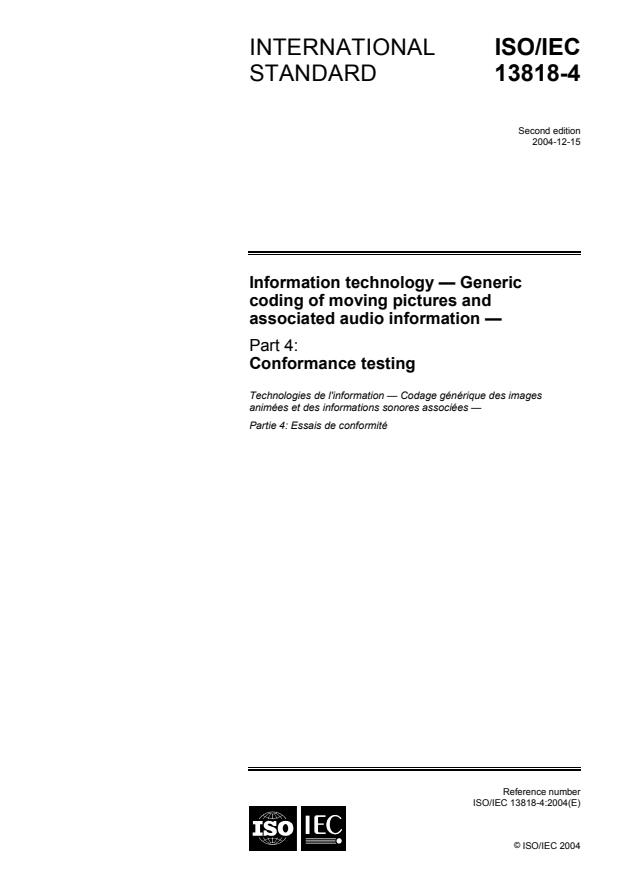
(Main)Information technology — Generic coding of moving pictures and associated audio information — Part 4: Conformance testing
Information technology — Generic coding of moving pictures and associated audio information — Part 4: Conformance testing
ISO/IEC 13818-4:2004 specifies how tests can be designed to verify whether coded data and decoders meet requirements specified in parts 1, 2, 3 and 7 of ISO/IEC 13818. Characteristics of coded data and decoders are defined for parts 1, 2, 3 and 7 of ISO/IEC 13818. The capabilities of a decoder specify which coded data the decoder can decode and reconstruct, by defining the subset of the standard that may be exploited in the coded data. Coded data can be decoded by a decoder if the characteristics of the coded data are within the subset of the standard specified by the decoder capabilities. Procedures are described for testing conformance of coded data and decoders to the requirements defined in parts 1, 2, 3 and 7 of ISO/IEC 13818. Given the set of characteristics claimed, the requirements that must be met are fully determined by parts 1, 2, 3 and 7 of ISO/IEC 13818. ISO/IEC 13818-4:2004 summarizes the requirements, cross references them to characteristics, and defines how conformance with them can be tested. A set of conformance test sequences implemented according to those guidelines are provided as an electronic annex to ISO/IEC 13818-4:2004.
Technologies de l'information — Codage générique des images animées et des informations sonores associées — Partie 4: Essais de conformité
General Information
Relations
Standards Content (Sample)
INTERNATIONAL ISO/IEC
STANDARD 13818-4
Second edition
2004-12-15
Information technology — Generic
coding of moving pictures and
associated audio information —
Part 4:
Conformance testing
Technologies de l'information — Codage générique des images
animées et des informations sonores associées —
Partie 4: Essais de conformité
Reference number
©
ISO/IEC 2004
PDF disclaimer
This PDF file may contain embedded typefaces. In accordance with Adobe's licensing policy, this file may be printed or viewed but
shall not be edited unless the typefaces which are embedded are licensed to and installed on the computer performing the editing. In
downloading this file, parties accept therein the responsibility of not infringing Adobe's licensing policy. The ISO Central Secretariat
accepts no liability in this area.
Adobe is a trademark of Adobe Systems Incorporated.
Details of the software products used to create this PDF file can be found in the General Info relative to the file; the PDF-creation
parameters were optimized for printing. Every care has been taken to ensure that the file is suitable for use by ISO member bodies. In
the unlikely event that a problem relating to it is found, please inform the Central Secretariat at the address given below.
© ISO/IEC 2004
All rights reserved. Unless otherwise specified, no part of this publication may be reproduced or utilized in any form or by any means,
electronic or mechanical, including photocopying and microfilm, without permission in writing from either ISO at the address below or
ISO's member body in the country of the requester.
ISO copyright office
Case postale 56 • CH-1211 Geneva 20
Tel. + 41 22 749 01 11
Fax + 41 22 749 09 47
E-mail copyright@iso.org
Web www.iso.org
Published in Switzerland
ii © ISO/IEC 2004 – All rights reserved
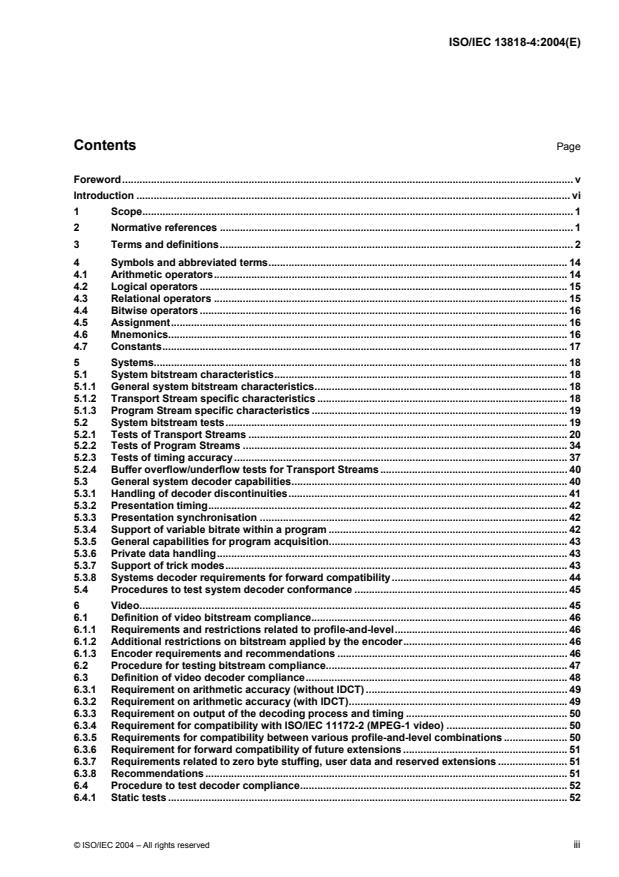
Contents Page
Foreword. v
Introduction . vi
1 Scope. 1
2 Normative references. 1
3 Terms and definitions. 2
4 Symbols and abbreviated terms. 14
4.1 Arithmetic operators. 14
4.2 Logical operators. 15
4.3 Relational operators. 15
4.4 Bitwise operators. 16
4.5 Assignment. 16
4.6 Mnemonics. 16
4.7 Constants. 17
5 Systems. 18
5.1 System bitstream characteristics. 18
5.1.1 General system bitstream characteristics. 18
5.1.2 Transport Stream specific characteristics . 18
5.1.3 Program Stream specific characteristics . 19
5.2 System bitstream tests. 19
5.2.1 Tests of Transport Streams . 20
5.2.2 Tests of Program Streams . 34
5.2.3 Tests of timing accuracy. 37
5.2.4 Buffer overflow/underflow tests for Transport Streams . 40
5.3 General system decoder capabilities. 40
5.3.1 Handling of decoder discontinuities. 41
5.3.2 Presentation timing. 42
5.3.3 Presentation synchronisation. 42
5.3.4 Support of variable bitrate within a program . 42
5.3.5 General capabilities for program acquisition. 43
5.3.6 Private data handling. 43
5.3.7 Support of trick modes. 43
5.3.8 Systems decoder requirements for forward compatibility. 44
5.4 Procedures to test system decoder conformance . 45
6 Video. 45
6.1 Definition of video bitstream compliance. 46
6.1.1 Requirements and restrictions related to profile-and-level. 46
6.1.2 Additional restrictions on bitstream applied by the encoder. 46
6.1.3 Encoder requirements and recommendations . 46
6.2 Procedure for testing bitstream compliance. 47
6.3 Definition of video decoder compliance. 48
6.3.1 Requirement on arithmetic accuracy (without IDCT) . 49
6.3.2 Requirement on arithmetic accuracy (with IDCT).49
6.3.3 Requirement on output of the decoding process and timing . 50
6.3.4 Requirement for compatibility with ISO/IEC 11172-2 (MPEG-1 video) . 50
6.3.5 Requirements for compatibility between various profile-and-level combinations . 50
6.3.6 Requirement for forward compatibility of future extensions . 51
6.3.7 Requirements related to zero byte stuffing, user data and reserved extensions . 51
6.3.8 Recommendations. 51
6.4 Procedure to test decoder compliance. 52
6.4.1 Static tests. 52
© ISO/IEC 2004 – All rights reserved iii
6.4.2 Dynamic tests.52
6.4.3 Specification of the test bitstreams.52
6.4.4 Implementation of the static test .60
6.4.5 Implementation of the dynamic test.61
6.4.6 Decoder conformance.61
6.5 Conformance of scalable bitstreams and decoders.64
6.5.1 Definition of scalable video bitstream hierarchy compliance .65
6.5.2 Procedure for testing bitstream compliance.65
6.5.3 Definition of video decoder compliance .65
6.5.4 Procedure to test decoder compliance.66
7 Audio.67
7.1 Audio bitstreams.67
7.1.1 Extension of ISO/IEC 11172-3 audio coding to lower sampling frequencies.67
7.1.2 Low bit rate coding of Multichannel Audio.67
7.2 Audio bitstream tests.68
7.2.1 Extension of ISO/IEC 11172-3 audio coding to lower sampling frequencies.68
7.2.2 Low bit rate coding of Multichannel Audio.69
7.3 Audio decoder characteristics.71
7.3.1 Extension of ISO/IEC 11172-3 audio coding to lower sampling frequencies.71
7.3.2 Low bit rate coding of Multichannel Audio.71
7.4 Audio decoder tests.73
7.4.1 Calculation for RMS .74
7.4.2 Descriptions of the audio test bitstreams .75
8 Advanced Audio Coding (AAC) .78
8.1 Introduction.78
8.2 Scope.78
8.3 AAC bitstream characteristics .78
8.4 Decoder characteristics.79
8.4.1 Profile specification.79
8.4.2 Decoder modifications.80
8.4.3 Decoder buffer requirements.80
8.5 Procedure to test bitstream conformance.81
8.5.1 Profile specification.81
8.5.2 ADIF and ADTS.81
8.5.3 Bitstream payload.82
8.5.4 ics_info().82
8.5.5 tns_data().84
8.5.6 extension_payload().87
8.5.7 dynamic_range_info().87
8.5.8 excluded_channels().87
8.6 Procedure to test decoder conformance .87
8.6.1 Calculation of RMS.88
8.6.2 Test bitstream properties .89
8.6.3 Descriptions of the ISO/IEC 13818-7 (AAC) audio test bitstreams.90
Annex A (informative) Systems test bitstreams .95
Annex B (informative) Systems decoder characteristics beyond coformance.96
B.1 Number of PIDs that can be processed .96
B.2 Error handling.96
B.3 Program acquisition.97
B.4 Input processing capabilities.97
B.5 Presentation timing.97
Annex C (informative) Video test bitstreams .98
Annex D (informative) Audio test bitstreams.99
Annex E (informative) Patent statements.100
Annex F (informative) Description of bitstream al10.102
Bibliography.105
iv © ISO/IEC 2004 – All rights reserved
Foreword
ISO (the International Organization for Standardization) and IEC (the International Electrotechnical
Commission) form the specialized system for worldwide standardization. National bodies that are members of
ISO or IEC participate in the development of International Standards through technical committees
established by the respective organization to deal with particular fields of technical activity. ISO and IEC
technical committees collaborate in fields of mutual interest. Other international organizations, governmental
and non-governmental, in liaison with ISO and IEC, also take part in the work. In the field of information
technology, ISO and IEC have established a joint technical committee, ISO/IEC JTC 1.
International Standards are drafted in accordance with the rules given in the ISO/IEC Directives, Part 2.
The main task of the joint technical committee is to prepare International Standards. Draft International
Standards adopted by the joint technical committee are circulated to national bodies for voting. Publication as
an International Standard requires approval by at least 75 % of the national bodies casting a vote.
ISO/IEC 13818-4 was prepared by Joint Technical Committee ISO/IEC JTC 1, Information technology,
Subcommittee SC 29, Coding of audio, picture, multimedia and hypermedia information.
This second edition cancels and replaces the first edition, of which it constitutes a minor revision. It also
incorporates the Amendments ISO 13818-4/Amd.1:1999, ISO 13818-4/Amd.2:2000 and ISO 13818-
4/Amd.3:2000 and the Technical Corrigenda ISO 13818-4/Cor.2:1998, ISO 13818-4/Amd.1:1999/Cor.1:2003
and ISO 13818-4/Amd.3:2000/Cor.1:2003.
ISO/IEC 13818 consists of the following parts, under the general title Information technology — Generic
coding of moving pictures and associated audio information:
Part 1: Systems
Part 2: Video
Part 3: Audio
Part 4: Conformance testing
Part 5: Software simulation [Technical Report]
Part 6: Extensions for DSM-CC
Part 7: Advanced Audio Coding (AAC)
Part 9: Extension for real time interface for systems decoders
Part 10: Conformance extensions for Digital Storage Media Command and Control (DSM-CC)
Part 11: IPMP on MPEG-2 systems
© ISO/IEC 2004 – All rights reserved v
Introduction
Parts 1, 2, 3 and 7 of ISO/IEC 13818 specify a multiplex structure and coded representations of audio-visual
information. Parts 1, 2, 3 and 7 of ISO/IEC 13818 allow for large flexibility, achieving suitability of ISO/IEC
13818 for many different applications. The flexibility is obtained by including parameters in the bitstream that
define the characteristics of coded bitstreams. Examples are the audio sampling frequency, picture size,
picture rate and bitrate parameters.
This part of ISO/IEC 13818 specifies how tests can be designed to verify whether bitstreams and decoders
meet the requirements as specified in parts 1, 2, 3 and 7 of ISO/IEC 13818. These tests can be used for
various purposes such as:
- Manufacturers of encoders, and their customers, can use the tests to verify whether the encoder
produces valid bitstreams.
- Manufacturers of decoders and their customers can use the tests to verify whether the decoder meets the
requirements specified in parts 1, 2, 3 and 7 of ISO/IEC 13818 for the claimed decoder capabilities.
The International Organization for Standardization and the International Electrotechnical Commission (IEC)
draw attention to the fact that it is claimed that compliance with this part of ISO/IEC 13818 may involve the
use of patents.
ISO and IEC take no position concerning the evidence, validity and scope of these patent rights.
The holders of these patent rights have assured the ISO and IEC that they are willing to negotiate licences
under reasonable and non-discriminatory terms and conditions with applicants throughout the world. In this
respect, the statements of the holders of these patents right are registered with ISO and IEC. Information may
be obtained from the companies listed in Annex E.
Attention is drawn to the possibility that some of the elements of this part of ISO/IEC 13818 may be the
subject of patent rights other than those identified in Annex E. ISO and IEC shall not be held responsible for
identifying any or all such patent rights.
vi © ISO/IEC 2004 – All rights reserved
INTERNATIONAL STANDARD ISO/IEC 13818-4:2004(E)
Information technology — Generic coding of moving pictures
and associated audio information —
Part 4:
Conformance testing
1 Scope
This part of ISO/IEC 13818 specifies how tests can be designed to verify whether bitstreams and decoders
meet requirements specified in parts 1, 2, 3 and 7 of ISO/IEC 13818. In this part of ISO/IEC 13818, encoders
are not addressed specifically. An encoder may be said to be an ISO/IEC 13818 encoder if it generates
bitstreams compliant with the syntactic and semantic bitstream requirements specified in parts 1, 2, 3 and 7 of
ISO/IEC 13818.
Characteristics of coded bitstreams and decoders are defined for parts 1, 2, 3 and 7 of ISO/IEC 13818. The
characteristics of a bitstream define the subset of the standard that is exploited in the bitstream. Examples
are the applied values or range of the picture size and bitrate parameters. Decoder characteristics define the
properties and capabilities of the applied decoding process. An example of a property is the applied
arithmetic accuracy. The capabilities of a decoder specify which coded bitstreams the decoder can decode
and reconstruct, by defining the subset of the standard that may be exploited in decodable bitstreams. A
bitstream can be decoded by a decoder if the characteristics of the coded bitstream are within the subset of
the standard specified by the decoder capabilities.
Procedures are described for testing conformance of bitstreams and decoders to the requirements defined in
parts 1, 2, 3 and 7 of ISO/IEC 13818. Given the set of characteristics claimed, the requirements that must be
met are fully determined by parts 1, 2, 3 and 7 of ISO/IEC 13818. This part of ISO/IEC 13818 summarises the
requirements, cross references them to characteristics, and defines how conformance with them can be
tested. Guidelines are given on constructing tests to verify bitstream and decoder conformance. This
document gives guidelines on how to construct bitstream test suites to check or verify decoder conformance.
In addition, some test bitstreams implemented according to those guidelines are provided as an electronic
annex to this document.
2 Normative references
The following referenced documents are indispensable for the application of this document. For dated
references, only the edition cited applies. For undated references, the latest edition of the referenced
document (including any amendments) applies.
ISO 639 (all parts), Codes for the representation of names of languages
ISO 8859-1, Information processing — 8-bit single-byte coded graphic character sets — Part 1: Latin alphabet
No. 1
ISO/IEC 11172-1, Information technology — Coding of moving pictures and associated audio for digital
storage media at up to about 1,5 Mbit/s — Part 1: Systems
ISO/IEC 11172-2:1993, Information technology — Coding of moving pictures and associated audio for digital
storage media at up to about 1,5 Mbit/s — Part 2: Video
© ISO/IEC 2004 – All rights reserved 1
ISO/IEC 11172-3:1993, Information technology — Coding of moving pictures and associated audio for digital
storage media at up to about 1,5 Mbit/s — Part 3: Audio
ISO/IEC 11172-4, Information technology — Coding of moving pictures and associated audio for digital
storage media at up to about 1,5 Mbit/s — Part 4: Compliance testing
ISO/IEC 13818-1:2000, Information technology — Generic coding of moving pictures and associated audio
information: Systems
ISO/IEC 13818-2:2000, Information technology — Generic coding of moving pictures and associated audio
information: Video
ISO/IEC 13818-3:1998, Information technology — Generic coding of moving pictures and associated audio
information — Part 3: Audio
ISO/IEC 13818-7:2004, Information technology — Generic coding of moving pictures and associated audio
information — Part 7: Advanced Audio Coding (AAC)
IEEE Std 1180-1990, IEEE Standard Specifications for the Implementations of 8 by 8 Inverse Discrete Cosine
Transform, December 6, 1990
3 Terms and definitions
For the purposes of this document, the following definitions apply.
3.1 16x8 prediction [video]: A prediction mode similar to field-based prediction but where the predicted
block size is 16x8 luminance samples.
3.2 AC coefficient [video]: Any DCT coefficient for which the frequency in one or both dimensions is
non-zero.
3.3 access unit [systems]: A coded representation of a presentation unit. In the case of audio, an
access unit is the coded representation of an audio frame.
In the case of video, an access unit includes all the coded data for a picture, and any stuffing that follows it,
up to but not including the start of the next access unit. If a picture is not preceded by a group_start_code or
a sequence_header_code, the access unit begins with the picture start code. If a picture is preceded by a
group_start_code and/or a sequence_header_code, the access unit begins with the first byte of the first of
these start codes. If it is the last picture preceding a sequence_end_code in the bitstream all bytes between
the last byte of the coded picture and the sequence_end_code (including the sequence_end_code) belong
to the access unit.
3.4 adaptive bit allocation [audio]: The assignment of bits to subbands in a time and frequency varying
fashion according to a psychoacoustic model.
3.5 adaptive multichannel prediction [audio]: A method of multichannel data reduction exploiting
statistical inter-channel dependencies.
3.6 adaptive noise allocation [audio]: The assignment of coding noise to frequency bands in a time
and frequency varying fashion according to a psychoacoustic model.
3.7 adaptive segmentation [audio]: A subdivision of the digital representation of an audio signal in
variable segments of time.
3.8 alias [audio]: Mirrored signal component resulting from sub-Nyquist sampling.
3.9 analysis filterbank [audio]: Filterbank in the encoder that transforms a broadband PCM audio signal
into a set of subsampled subband samples.
3.10 ancillary data [audio]: part of the bitstream that might be used for transmission of ancillary data.
3.11 audio access unit [audio]: For Layers I and II, an audio access unit is defined as the smallest part
of the encoded bitstream which can be decoded by itself, where decoded means "fully reconstructed
sound". For Layer III, an audio access unit is part of the bitstream that is decodable with the use of
previously acquired main information.
2 © ISO/IEC 2004 – All rights reserved
3.12 audio buffer [audio]: A buffer in the system target decoder for storage of compressed audio data.
3.13 audio sequence [audio]: A non-interrupted series of audio frames (base frames plus optional
extension frames) in which the following parameters are not changed:
- ID
- Layer
- Sampling Frequency
For Layer I and II, a decoder is not required to support a continuously variable bitrate (change in the bitrate
index) of the base stream. Such a relaxation of requirements does not apply to the extension stream.
3.14 B-field picture [video]: A field structure B-Picture.
3.15 B-frame picture [video]: A frame structure B-Picture.
3.16 B-picture; bidirectionally predictive-coded picture [video]: A picture that is coded using motion
compensated prediction from past and/or future reference fields or frames.
3.17 backward compatibility: A newer coding standard is backward compatible with an older coding
standard if decoders designed to operate with the older coding standard are able to continue to operate by
decoding all or part of a bitstream produced according to the newer coding standard.
3.18 backward motion vector [video]: A motion vector that is used for motion compensation from a
reference frame or reference field at a later time in display order.
3.19 backward prediction [video]: Prediction from the future reference frame (field).
3.20 Bark [audio]: Unit of critical band rate. The Bark scale is a non-linear mapping of the frequency scale
over the audio range closely corresponding with the frequency selectivity of the human ear across the band.
3.21 base layer [video]: First, independently decodable layer of a scalable hierarchy.
3.22 big picture [video]: A coded picture that would cause VBV buffer underflow as defined in C.7 of
ISO/IEC 13818-2:2000. Big pictures can only occur in sequences where low_delay is equal to 1. “Skipped
picture” is a term that is sometimes used to describe the same concept.
3.23 bitrate [audio]: The rate at which the compressed bitstream is delivered to the input of a decoder.
3.24 bitstream; stream: An ordered series of bits that forms the coded representation of the data.
3.25 bitstream verifier [video]: A process by which it is possible to test and verify that all the
requirements specified in ISO/IEC 13818-2 are met by the bitstream.
3.26 block [video]: An 8-row by 8-column matrix of samples, or 64 DCT coefficients (source, quantised
or dequantised).
3.27 block companding [audio]: Normalising of the digital representation of an audio signal within a
certain time period.
3.28 bottom field [video]: One of two fields that comprise a frame. Each line of a bottom field is spatially
located immediately below the corresponding line of the top field.
3.29 bound [audio]: The lowest subband in which intensity stereo coding is used.
3.30 byte aligned: A bit in a coded bitstream is byte-aligned if its position is a multiple of 8-bits from the
first bit in the stream.
3.31 byte: Sequence of 8-bits.
3.32 centre channel [audio]: An audio presentation channel used to stabilise the central component of
the frontal stereo image.
3.33 channel [audio]: A sequence of data representing an audio signal being transported.
3.34 chroma simulcast [video]: A type of scalability (which is a subset of SNR scalability) where the
enhancement layer (s) contain only coded refinement data for the DC coefficients, and all the data for the
AC coefficients, of the chrominance components.
3.35 chrominance format [video]: Defines the number of chrominance blocks in a macroblock.
© ISO/IEC 2004 – All rights reserved 3
3.36 chrominance component [video]: A matrix, block or single sample representing one of the two
colour difference signals related to the primary colours in the manner defined in the bitstream. The symbols
used for the chrominance signals are Cr and Cb.
3.37 coded audio bitstream [audio]: A coded representation of an audio signal as specified in part 3 of
ISO/IEC 13818.
3.38 coded B-frame [video]: A B-frame picture or a pair of B-field pictures.
3.39 coded frame [video]: A coded frame is a coded I-frame, a coded P-frame or a coded B-frame.
3.40 coded I-frame [video]: An I-frame picture or a pair of field pictures, where the first field picture is an
I-picture and the second field picture is an I-picture or a P-picture.
3.41 coded order [video]: The order in which the pictures are transmitted and decoded. This order is not
necessarily the same as the display order.
3.42 coded P-frame [video]: A P-frame picture or a pair of P-field pictures.
3.43 coded picture [video]: A coded picture is made of a picture header, the optional extensions
immediately following it, and the following picture data. A coded picture may be a coded frame or a coded
field.
3.44 coded representation: A data element as represented in its encoded form.
3.45 coded video bitstream [video]: A coded representation of a series of one or more pictures as
defined in ISO/IEC 13818-2.
3.46 coding parameters [video]: The set of user-definable parameters that characterise a coded
bitstream. Bitstreams are characterised by coding parameters. Decoders are characterised by the
bitstreams that they are capable of decoding.
3.47 component [video]: A matrix, block or single sample from one of the three matrices (luminance and
two chrominance) that make up a picture.
3.48 compression: Reduction in the number of bits used to represent an item of data.
3.49 constant bitrate: Operation where the bitrate is constant from start to finish of the coded bitstream.
3.50 constrained parameters [video]: The values of the set of coding parameters defined in 2.4.3.2 of
ISO/IEC 11172-2:1993.
3.51 constrained system parameter stream; CSPS [systems]: A Program Stream for which the
constraints defined in subclause 2.7.9 of ISO/IEC 13818-1:2000 apply.
3.52 CRC: The Cyclic Redundancy Check to verify the correctness of data.
3.53 critical band [audio]: Psychoacoustic measure in the spectral domain which corresponds to the
frequency selectivity of the human ear. This selectivity is expressed in Bark.
3.54 critical band rate [audio]: Psychoacoustic function of frequency. At a given audible frequency, it is
proportional to the number of critical bands below that frequency. The units of the critical band rate scale
are Barks.
3.55 data element: An item of data as represented before encoding and after decoding.
3.56 data partitioning [video]: A method for dividing a bitstream into two separate bitstreams for error
resilience purposes. The two bitstreams have to be recombined before decoding.
3.57 DC coefficient [video]: The DCT coefficient for which the frequency is zero in both dimensions.
3.58 DCT coefficient [video]: The amplitude of a specific cosine basis function.
3.59 de-emphasis [audio]: Filtering applied to an audio signal after storage or transmission to undo a
linear distortion due to emphasis.
3.60 decoded stream: The decoded reconstruction of a compressed bitstream.
3.61 decoder input buffer [video]: The first-in first-out (FIFO) buffer specified in the video buffering
verifier.
3.62 decoder: An embodiment of a decoding process.
4 © ISO/IEC 2004 – All rights reserved
3.63 decoder sub-loop [video]: Stages within encoder which produce numerically identical results to the
decode process described in ISO/IEC 13818-2:2000, clause 7. Encoders capable of producing more than
just I-pictures embed a decoder sub-loop to create temporal predictions and to model the behaviour of
downstream decoders.
3.64 decoding (process): The process defined in ISO/IEC 13818 parts 1, 2, 3 and 7 that reads an input
coded bitstream and outputs decoded pictures or audio samples.
3.65 decoding time-stamp; DTS [systems]: A field that may be present in a PES packet header that
indicates the time that an access unit is decoded in the system target decoder.
3.66 dequantisation: The process of rescaling the quantised DCT coefficients after their representation in
the bitstream has been decoded and before they are presented to the inverse DCT.
3.67 digital storage media; DSM: A digital storage or transmission device or system.
3.68 discrete cosine transform; DCT: Either the forward discrete cosine transform or the inverse
discrete cosine transform. The DCT is an invertible, discrete orthogonal transformation.
3.69 display aspect ratio [video]: The ratio height/width (in SI units) of the intended display.
3.70 display order [video]: The order in which the decoded pictures are displayed. Normally this is the
same order in which they were presented at the input of the encoder.
3.71 display process [video]: The (non-normative) process by which reconstructed frames are displayed.
3.72 downmix [audio]: A matrixing of n channels to obtain less than n channels.
3.73 drift [video]: Accumulation of mismatch between the reconstructed output produced by the
hypothetical decoder sub-loop embedded within an encoder (see definition of "decoder sub-loop") and the
reconstructed outputs produced by a (downstream) decoder.
3.74 DSM-CC: digital storage media command and control.
3.75 dual channel mode [audio]: A mode, where two audio channels with independent programme
contents (e.g. bilingual) are encoded within one bitstream. The coding process is the same as for the stereo
mode.
3.76 dual-prime prediction [video]: A prediction mode in which two forward field-based predictions are
averaged. The predicted block size is 16x16 luminance samples. Dual-prime prediction is only used in
interlaced P-pictures.
3.77 dynamic crosstalk [audio]: A method of multichannel data reduction in which stereo-irrelevant
signal components are copied to another channel.
3.78 dynamic transmission channel switching [audio]: A method of multichannel data reduction by
allocating the most orthogonal signal components to the transmission channels.
3.79 editing: The process by which one or more coded bitstreams are manipulated to produce a new
coded bitstream. Conforming edited bitstreams must meet the requirements defined in parts 1, 2, and 3 of
ISO/IEC 13818.
3.80 Elementary Stream Clock Reference; ESCR [systems]: A time stamp in the PES Stream from
which decoders of PES streams may derive timing.
3.81 elementary stream; ES [systems]: A generic term for one of the coded video, coded audio or other
coded bitstreams in PES packets. One elementary stream is carried in a sequence of PES packets with one
and only one stream_id.
3.82 emphasis [audio]: Filtering applied to an audio signal before storage or transmission to improve the
signal-to-noise ratio at high frequencies.
3.83 encoder: An embodiment of an encoding process.
3.84 encoding (process): A process, not specified in ISO/IEC 13818, that reads a stream of input
pictures or audio samples and produces a valid coded bitstream as defined in parts 1, 2, and 3 of
ISO/IEC 13818.
© ISO/IEC 2004 – All rights reserved 5
3.85 enhancement layer [video]: A relative reference to a layer (above the base layer) in a scalable
hierarchy. For all forms of scalability, its decoding process can be described by reference to the lower layer
decoding process and the appropriate additional decoding process for the enhancement layer itself.
3.86 entitlement control message; ECM [systems]: Entitlement Control Messages are private
conditional access information which specify control words and possibly other, typically stream-specific,
scrambling and/or control parameters.
3.87 entitlement management message; EMM [systems]: Entitlement Management Messages are
private conditional access information which specify the authorisation levels or the services of specific
decoders. They may be addressed to single decoders or groups of decoders.
3.88 entropy coding: Variable length lossless coding of the digital representation of a signal to reduce
redundancy.
3.89 event [systems]: An event is defined as a collection of elementary streams with a common time
base, an associated start time, and an associated end time.
3.90 evil bitstreams: Bitstreams orthogonal to reality.
3.91 extension bitstream [audio]: Information contained in an optional additional bit stream related to the
audio base bit stream at the system level, to support bit rates beyond those defined in ISO/IEC 11172-3.
The optional extension bit stream contains the remainder of the multichannel and multilingual data.
3.92 fast reverse playback [video]: The process of displaying the picture sequence in the reverse of
display order faster than real-time.
3.93 fast forward playback [video]: The process of displaying a sequence, or parts of a sequence, of
pictures in display-order faster than real-time.
3.94 FFT: Fast Fourier Transformation. A fast algorithm for performing a discrete Fourier transform (an
orthogonal transform).
3.95 field [video]: For an interlaced video signal, a “field” is the assembly of alternate lines of a frame.
Therefore an interlaced frame is composed of two fields, a top field and a bottom field.
3.96 field period [video]: The reciprocal of twice the frame rate.
3.97 field picture; field structure picture [video]: A field structure picture is a coded picture with
picture_structure is equal to "Top field" or "Bottom field".
3.98 field-based prediction [video]: A prediction mode using only one field of the reference frame. The
predicted block size is 16x16 luminance samples. Field-based prediction is not used in progressive frames.
3.99 filterbank [audio]: A set of band-pass filters covering the entire audio frequency range.
3.100 fixed segmentation [audio]: A subdivision of the digital representation of an audio signal into fixed
segments of time.
3.101 flag: A variable which can take one of only the two values defined in this specification.
3.102 FLC: Fixed Length Code.
3.103 forbidden: The term "forbidden", when used in the clauses defining the coded bitstream, indicates
that the value shall never be used. This is usually to avoid emulation of start codes.
3.104 forced updating [video]: The process by which macroblocks are intra-coded from time-to-time to
ensure that mismatch errors between the inverse DCT processes in encoders and decoders cannot build up
excessively.
3.105 forward compatibility: A newer coding standard is forward compatible with an older coding standard
if decoders designed to operate with the newer coding standard are able to decode bitstreams of the older
coding standard.
3.106 forward motion vector [video]: A motion vector that is used for motion compensation from a
reference frame or reference field at an earlier time in display order.
3.107 forward prediction [video]: Prediction from the past reference frame (field).
3.108 frame [audio]: A part of the audio bit stream that corresponds to audio PCM samples from an Audio
Access Unit.
6 © ISO/IEC 2004 – All rights reserved
3.109 frame [video]: A frame contains lines of spatial information of a video signal. For progressive video,
these lines contain samples starting from one time instant and continuing through successive lines to the
bottom of the frame. For interlaced video a frame consists of two fields, a top field and a bottom field. One
of these fields may be temporally located one field period later than the other.
3.110 frame period [video]: The reciprocal of the frame rate.
3.111 frame picture; frame structure picture [video]: A frame structure picture is a coded picture with
picture_structure is equal to "Frame".
3.112 frame rate [video]: The rate at which frames are be output from the decoding process.
3.113 frame reordering [video]: The process o
...
Questions, Comments and Discussion
Ask us and Technical Secretary will try to provide an answer. You can facilitate discussion about the standard in here.
Loading comments...