


ISO 32000-2:2020
(Main)Document management — Portable document format — Part 2: PDF 2.0
Document management — Portable document format — Part 2: PDF 2.0
This document specifies a digital form for representing electronic documents to enable users to exchange and view electronic documents independent of the environment in which they were created or the environment in which they are viewed or printed. It is intended for developers of software that creates PDF files (PDF writers), software that reads existing PDF files and (usually) interprets their contents for display (PDF readers), software that reads and displays PDF content and interacts with the computer users to possibly modify and save the PDF file (interactive PDF processors) and PDF products that read and/or write PDF files for a variety of other purposes (PDF processors). (PDF writers and PDF readers are more specialised classifications of interactive PDF processors and all are PDF processors). This document does not specify the following: ? specific processes for converting paper or electronic documents to the PDF file format; ? specific technical design, user interface implementation, or operational details of rendering; ? specific physical methods of storing these documents such as media and storage conditions; ? methods for validating the conformance of PDF files or PDF processors; ? required computer hardware and/or operating system.
Gestion de documents — Format de document portable — Partie 2: PDF 2.0
General Information
- Status
- Published
- Publication Date
- 10-Dec-2020
- Technical Committee
- ISO/TC 171/SC 2 - Document file formats, EDMS systems and authenticity of information
- Drafting Committee
- ISO/TC 171/SC 2/WG 8 - PDF specification
- Current Stage
- 9093 - International Standard confirmed
- Start Date
- 05-Mar-2026
- Completion Date
- 07-Mar-2026
Relations
- Effective Date
- 19-May-2018
Overview
ISO 32000-2:2020 - PDF 2.0 specifies the Portable Document Format (PDF) as a standardized digital form for representing electronic documents. The standard defines how PDF files are structured so users can exchange, view and print documents reliably and independently of the creation or viewing environment. It targets developers of PDF writers, PDF readers and interactive PDF processors, and establishes requirements for PDF documents and PDF-processing products.
The standard does not dictate conversion workflows, rendering UI details, physical storage methods, validation procedures, or required hardware/operating systems.
Key topics and requirements
ISO 32000-2 organizes the PDF 2.0 specification into comprehensive technical areas. Important topics covered include:
- File syntax and structure: lexical rules, object models, filters, file layout and encryption.
- Graphics and imaging: coordinate systems, drawing operators, colour spaces, patterns, images and Form XObjects.
- Text and fonts: font data structures, simple and composite fonts, embedded font programs, and text extraction.
- Rendering and transparency: rendering model, colour conversion, transfer functions, halftones, transparency compositing and soft masks.
- Interactive features: annotations, actions, forms, viewer preferences, navigation and document-level interactivity.
- Security and signatures: encryption mechanisms and digital signature support.
- Multimedia & 3D: integration of sound, movies, 3D artwork and rich media.
- Document interchange & accessibility: metadata, tagged PDF, logical structure, repurposing, accessibility features and web capture.
- Conformance: definitions for conforming PDF documents and PDF processors, and version/compatibility guidance.
- Annexes: guidance and normative material (extensions, linearized PDF, example files, best practices).
Practical applications
ISO 32000-2:2020 is used to:
- Build and test PDF creation tools (PDF writers) that produce conforming PDF 2.0 files.
- Implement PDF readers and interactive processors that correctly render, edit or validate PDFs.
- Ensure accessibility and tagged PDF compliance for assistive technologies.
- Support prepress and printing workflows with predictable rendering and separations.
- Integrate digital signatures, secure document exchange and archival workflows in enterprise content management.
- Enable advanced content use cases such as geospatial data, measurement properties, 3D models and multimedia.
Who benefits: software developers, QA and interoperability engineers, document managers, archives and libraries, print service providers, accessibility specialists and systems integrators.
Related standards
- ISO 32000-1 (earlier PDF specification) and other ISO document-management standards provide historical and complementary context for PDF implementations.
Buy Documents


ISO 32000-2:2020 - Document management -- Portable document format
ISO 32000-2:2020 - Document management — Portable document format — Part 2: PDF 2.0/11/2020
Get Certified
Connect with accredited certification bodies for this standard

BSI Group
BSI (British Standards Institution) is the business standards company that helps organizations make excellence a habit.

NYCE
Mexican standards and certification body.
Sponsored listings
Frequently Asked Questions
ISO 32000-2:2020 is a standard published by the International Organization for Standardization (ISO). Its full title is "Document management — Portable document format — Part 2: PDF 2.0". This standard covers: This document specifies a digital form for representing electronic documents to enable users to exchange and view electronic documents independent of the environment in which they were created or the environment in which they are viewed or printed. It is intended for developers of software that creates PDF files (PDF writers), software that reads existing PDF files and (usually) interprets their contents for display (PDF readers), software that reads and displays PDF content and interacts with the computer users to possibly modify and save the PDF file (interactive PDF processors) and PDF products that read and/or write PDF files for a variety of other purposes (PDF processors). (PDF writers and PDF readers are more specialised classifications of interactive PDF processors and all are PDF processors). This document does not specify the following: ? specific processes for converting paper or electronic documents to the PDF file format; ? specific technical design, user interface implementation, or operational details of rendering; ? specific physical methods of storing these documents such as media and storage conditions; ? methods for validating the conformance of PDF files or PDF processors; ? required computer hardware and/or operating system.
This document specifies a digital form for representing electronic documents to enable users to exchange and view electronic documents independent of the environment in which they were created or the environment in which they are viewed or printed. It is intended for developers of software that creates PDF files (PDF writers), software that reads existing PDF files and (usually) interprets their contents for display (PDF readers), software that reads and displays PDF content and interacts with the computer users to possibly modify and save the PDF file (interactive PDF processors) and PDF products that read and/or write PDF files for a variety of other purposes (PDF processors). (PDF writers and PDF readers are more specialised classifications of interactive PDF processors and all are PDF processors). This document does not specify the following: ? specific processes for converting paper or electronic documents to the PDF file format; ? specific technical design, user interface implementation, or operational details of rendering; ? specific physical methods of storing these documents such as media and storage conditions; ? methods for validating the conformance of PDF files or PDF processors; ? required computer hardware and/or operating system.
ISO 32000-2:2020 is classified under the following ICS (International Classification for Standards) categories: 35.240.30 - IT applications in information, documentation and publishing; 37.100.99 - Other standards related to graphic technology. The ICS classification helps identify the subject area and facilitates finding related standards.
ISO 32000-2:2020 has the following relationships with other standards: It is inter standard links to ISO 32000-2:2017. Understanding these relationships helps ensure you are using the most current and applicable version of the standard.
ISO 32000-2:2020 is available in PDF format for immediate download after purchase. The document can be added to your cart and obtained through the secure checkout process. Digital delivery ensures instant access to the complete standard document.
Standards Content (Sample)
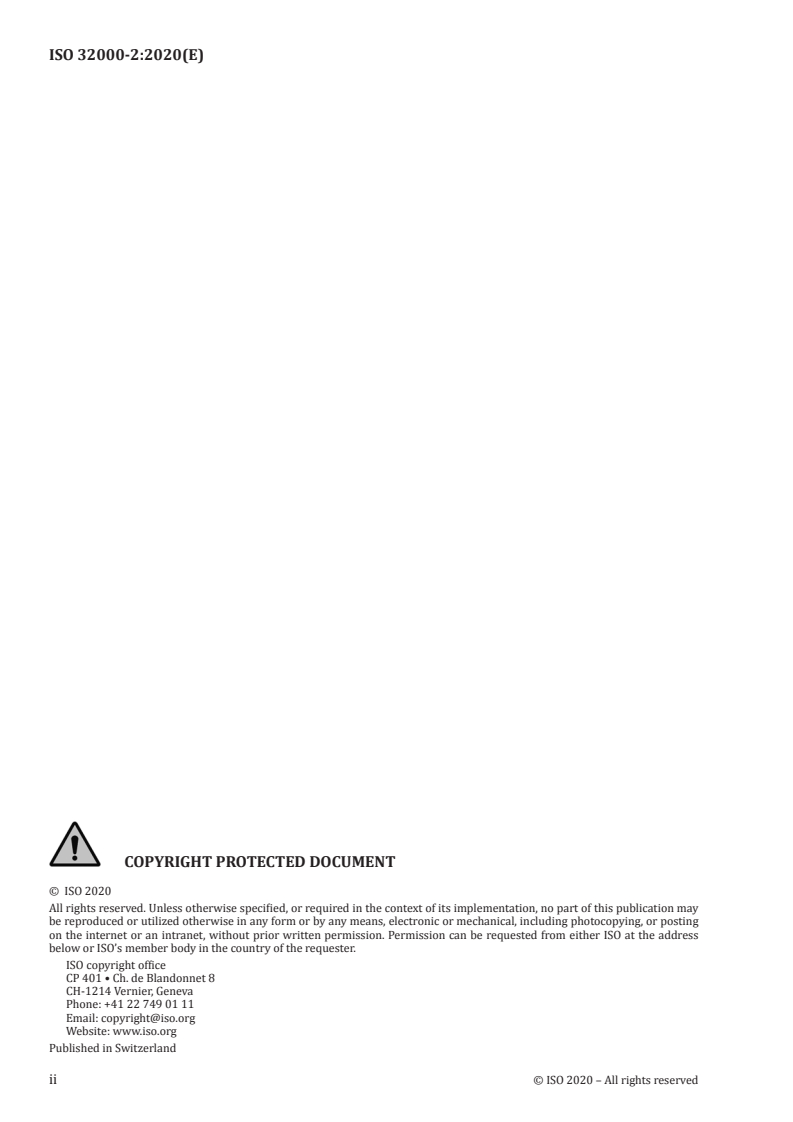
INTERNATIONAL ISO
STANDARD 32000-2
Second edition
2020-12
Document management — Portable
document format —
Part 2:
PDF 2.0
Gestion de documents — Format de document portable —
Partie 2: PDF 2.0
Reference number
©
ISO 2020
© ISO 2020
All rights reserved. Unless otherwise specified, or required in the context of its implementation, no part of this publication may
be reproduced or utilized otherwise in any form or by any means, electronic or mechanical, including photocopying, or posting
on the internet or an intranet, without prior written permission. Permission can be requested from either ISO at the address
below or ISO’s member body in the country of the requester.
ISO copyright office
CP 401 • Ch. de Blandonnet 8
CH-1214 Vernier, Geneva
Phone: +41 22 749 01 11
Email: copyright@iso.org
Website: www.iso.org
Published in Switzerland
ii © ISO 2020 – All rights reserved
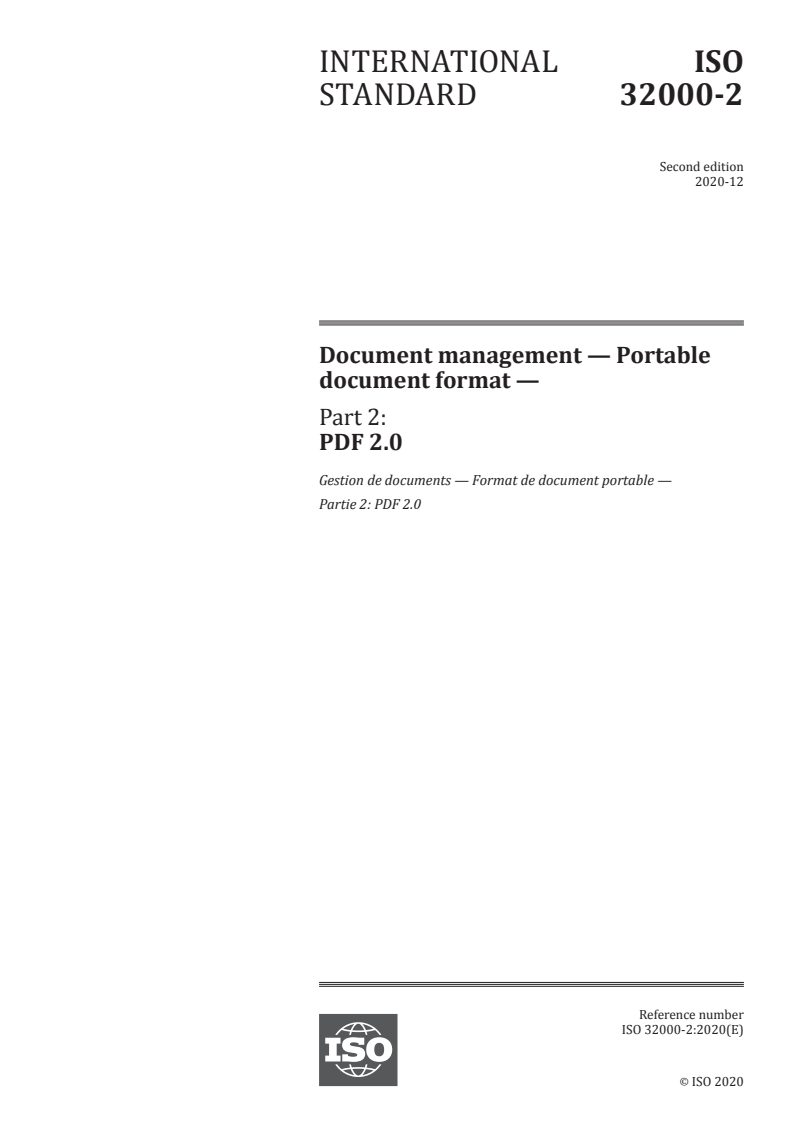
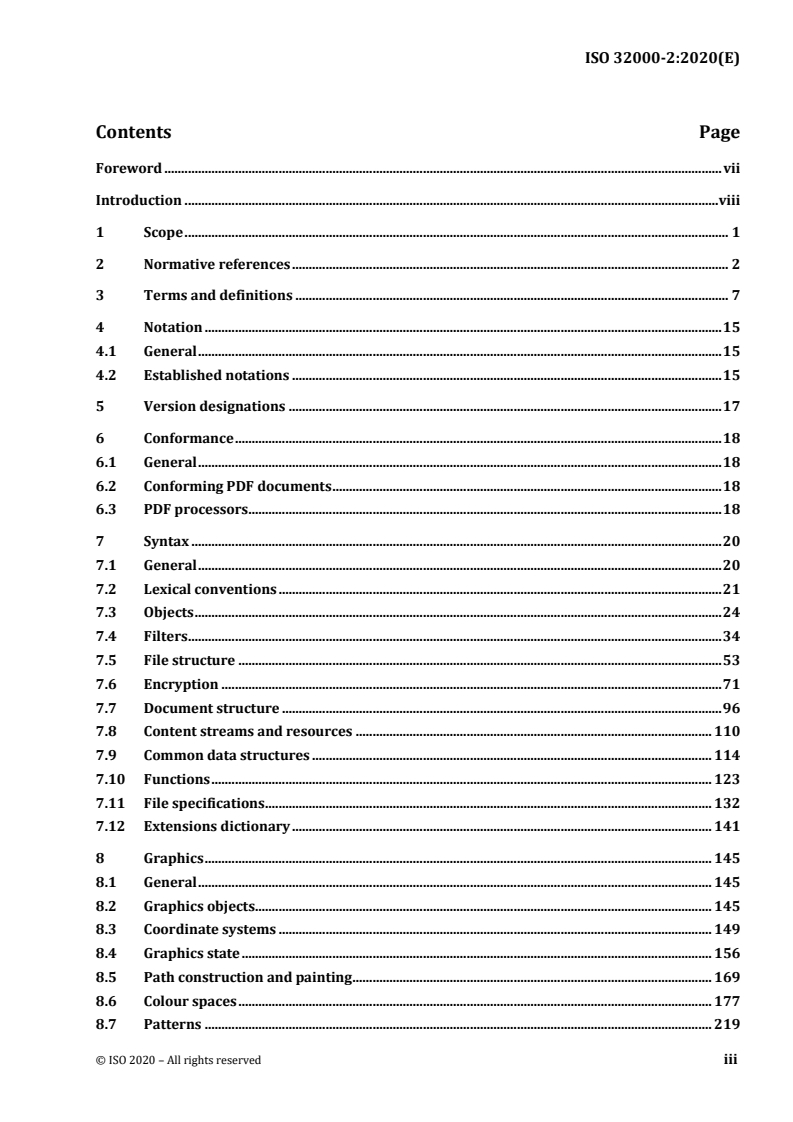
Contents Page
Foreword . vii
Introduction . viii
1 Scope . 1
2 Normative references . 2
3 Terms and definitions . 7
4 Notation . 15
4.1 General . 15
4.2 Established notations . 15
5 Version designations . 17
6 Conformance . 18
6.1 General . 18
6.2 Conforming PDF documents . 18
6.3 PDF processors . 18
7 Syntax . 20
7.1 General . 20
7.2 Lexical conventions . 21
7.3 Objects . 24
7.4 Filters . 34
7.5 File structure . 53
7.6 Encryption . 71
7.7 Document structure . 96
7.8 Content streams and resources . 110
7.9 Common data structures . 114
7.10 Functions . 123
7.11 File specifications . 132
7.12 Extensions dictionary . 141
8 Graphics . 145
8.1 General . 145
8.2 Graphics objects . 145
8.3 Coordinate systems . 149
8.4 Graphics state . 156
8.5 Path construction and painting . 169
8.6 Colour spaces . 177
8.7 Patterns . 219
8.8 External objects . 253
8.9 Images . 254
8.10 Form XObjects . 270
8.11 Optional content . 276
9 Text. 293
9.1 General . 293
9.2 Organisation and use of fonts . 293
9.3 Text state parameters and operators . 300
9.4 Text objects . 306
9.5 Introduction to font data structures . 311
9.6 Simple fonts . 313
9.7 Composite fonts . 327
9.8 Font descriptors . 343
9.9 Embedded font programs . 351
9.10 Extraction of text content . 355
10 Rendering . 360
10.1 General . 360
10.2 Raster output device native colour. 361
10.3 CIE-Based colour to device colour . 361
10.4 Conversions among device colour spaces . 361
10.5 Transfer functions . 364
10.6 Halftones . 366
10.7 Scan conversion details . 382
10.8 Rendering for separations . 385
11 Transparency . 387
11.1 General . 387
11.2 Overview of transparency . 387
11.3 Basic compositing computations . 389
11.4 Transparency groups. 402
11.5 Soft masks . 414
11.6 Specifying transparency in PDF . 415
11.7 Colour space and rendering issues . 425
12 Interactive features . 437
12.1 General . 437
12.2 Viewer preferences . 437
12.3 Document-level navigation . 441
12.4 Page-level navigation . 458
12.5 Annotations . 465
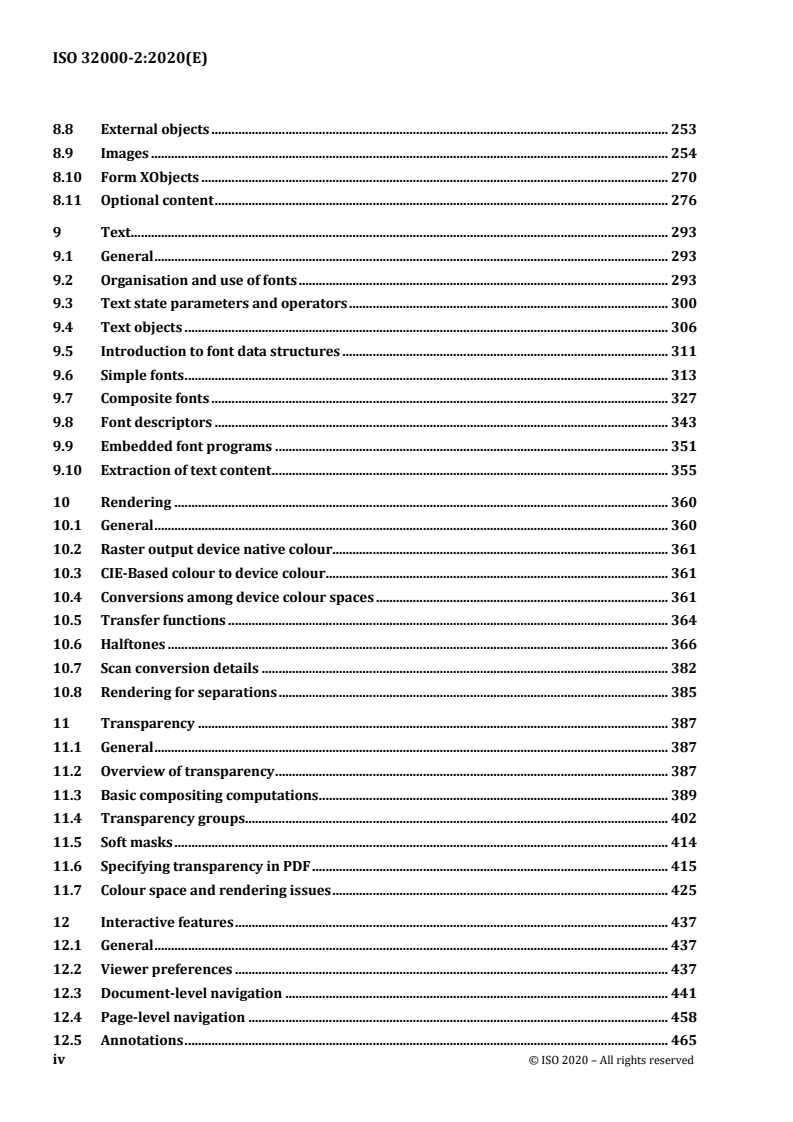
iv © ISO 2020 – All rights reserved
12.6 Actions . 506
12.7 Forms . 528
12.8 Digital signatures . 567
12.9 Measurement properties . 595
12.10 Geospatial features . 601
12.11 Document requirements . 606
13 Multimedia features . 614
13.1 General . 614
13.2 Multimedia. 614
13.3 Sounds . 637
13.4 Movies . 638
13.5 Alternate presentations . 640
13.6 3D Artwork . 642
13.7 Rich media . 700
14 Document interchange . 713
14.1 General . 713
14.2 Procedure sets . 713
14.3 Metadata . 714
14.4 File identifiers . 719
14.5 Page-piece dictionaries . 719
14.6 Marked content . 720
14.7 Logical structure . 722
14.8 Tagged PDF . 745
14.9 Repurposing and accessibility support . 796
14.10 Web capture . 802
14.11 Prepress support . 814
14.12 Document parts. 834
14.13 Associated files . 838
Annex A (informative) Operator Summary . 844
Annex B (informative) Operators in Type 4 Functions. 848
Annex C (informative) Advice on maximising portability . 850
Annex D (normative) Character sets and encodings . 853
Annex E (normative) Extending PDF . 877
Annex F (normative) Linearized PDF . 879
Annex G (informative) Linearized PDF access strategies . 901
Annex H (informative) Example PDF files . 905
Annex I (normative) PDF versions and compatibility . 936
Annex J (informative) XObject comparison . 938
Annex K (normative) XFA forms . 944
Annex L (normative) Parent-child relationships between the standard structure elements in the
standard structure namespace for PDF 2.0 . 947
Annex M (informative) Differences between the standard structure namespaces . 973
Annex N (informative) Best practice for halftones . 974
Annex O (normative) Fragment identifiers . 977
Annex P (informative) An algorithm to determine the actual blending colour space of a
transparency group . 980
Annex Q (normative) Method for determining transparency on a page . 982
Bibliography . 984
vi © ISO 2020 – All rights reserved
Foreword
ISO (the International Organization for Standardization) is a worldwide federation of national
standards bodies (ISO member bodies). The work of preparing International Standards is normally
carried out through ISO technical committees. Each member body interested in a subject for which a
technical committee has been established has the right to be represented on that committee.
International organizations, governmental and non-governmental, in liaison with ISO, also take part in
the work. ISO collaborates closely with the International Electrotechnical Commission (IEC) on all
matters of electrotechnical standardization.
The procedures used to develop this document and those intended for its further maintenance are
described in the ISO/IEC Directives, Part 1. In particular the different approval criteria needed for the
different types of ISO documents should be noted. This document was drafted in accordance with the
editorial rules of the ISO/IEC Directives, Part 2 (see www.iso.org/directives).
Attention is drawn to the possibility that some of the elements of this document may be the subject of
patent rights. ISO shall not be held responsible for identifying any or all such patent rights. Details of
any patent rights identified during the development of the document will be in the Introduction and/or
on the ISO list of patent declarations received (see www.iso.org/patents).
Any trade name used in this document is information given for the convenience of users and does not
constitute an endorsement.
For an explanation on the voluntary nature of standards, the meaning of ISO specific terms and
expressions related to conformity assessment, as well as information about ISO's adherence to the
World Trade Organization (WTO) principles in the Technical Barriers to Trade (TBT) see the following
URL: www.iso.org/iso/foreword.html.
This document was prepared by Technical Committee ISO/TC 171, Document management
applications, Subcommittee SC 2, Application issues, in collaboration with Technical Committee ISO/TC
130, Graphic technology.
This second edition cancels and replaces the first edition (ISO 32000-2:2017), which has been
technically revised.
A list of all the parts of ISO 32000 can be found on the ISO website. Changes from previous parts and
editions are listed in the Introduction (clauses 0.3 and 0.4).
Any feedback or questions on this document should be directed to the user’s national standards body.
A complete listing of these bodies can be found at www.iso.org/members.html.
Introduction
0.1 PDF
PDF enables users to exchange and view electronic documents easily and reliably, independent of the
environment in which they were created or the environment in which they are viewed or printed.
At the core of PDF is an advanced imaging model derived from the PostScript® page description
language. This PDF Imaging Model enables the description of text and graphics in a device-independent
and resolution-independent manner at a complete, precise and professional level. Unlike PostScript,
which is a programming language, PDF is based on a structured binary file format that is optimised for
high performance in interactive viewing.
PDF includes objects such as annotations and hypertext links that are not part of the page content itself
but are useful for interactive viewing and document interchange. PDF also includes data structures
such as tagged PDF, XMP and an associated files mechanism, that are useful for document management
and content reuse.
PDF files can be created natively in PDF form, converted from other electronic formats. Since PDF
supports a wide range of image and compression technologies, it is a suitable format for documents
digitised from paper, microform, or other hard copy formats. Businesses, governments, libraries,
archives and other institutions and individuals around the world use PDF to represent considerable
bodies of important information. Since its introduction in 1993, aided by the explosive growth of the
Internet, PDF has become widely used for the electronic exchange of documents.
There are several specific applications of PDF that have evolved in which limiting the use of some
features of PDF while requiring the use of others, enhances the usefulness of PDF. The following
International Standards address specialised uses of PDF:
• PDF/X (ISO 15930) is the industry standard for the intermediate representation of printed
material in electronic prepress systems for conventional printing applications.
• PDF/A (ISO 19005) is the industry standard for the archiving of digital documents.
• PDF/UA (ISO 14289) is the industry standard for accessible PDF documents and processors.
• PDF/E (ISO 24517) provides a mechanism for representing engineering documents and
exchanging engineering data.
• PDF/VT (ISO 16612-2 and ISO 16612-3) is for high volume printing of personalised
documents including variable data.
• ISO 19593 describes a method for storing data in a PDF file that correspond to the processing
steps of printed products (such as cutting, folding, glueing, Braille, printed white, and printed
varnish).
• ISO 21812 describes how document part metadata in a PDF file can be used to communicate
the intended appearance of print products and their components.
As corporations, government agencies, and educational institutions streamline their operations by
PostScript® is a trademark of Adobe Systems Incorporated. This information is given for the convenience of users of this document and
does not constitute an endorsement by ISO of the product named.
viii © ISO 2020 – All rights reserved
replacing paper-based workflows with electronic exchange of information, the impact and opportunity
for the application of PDF will continue to grow at a rapid pace.
PDF, together with software for creating, viewing, printing and processing PDF files in a variety of
ways, fulfils a set of requirements for electronic documents including:
• preservation of document fidelity independent of the device, platform, and software,
• merging of content from diverse sources — Web sites, word processing and spreadsheet
programs, scanned documents, photos, and graphics — into one self-contained document
while maintaining the integrity of all original source documents,
• an extensible metadata model at the document and object level,
• collaborative editing of documents from multiple locations or platforms,
• digital signatures to certify authenticity,
• security and permissions to allow the creator to retain control of the document and associated
rights,
• accessibility of content to those with disabilities,
• extraction and reuse of content for use with other file formats and applications, and
• electronic forms to gather and/or represent data within business systems.
0.2 ISO 32000 and PDF
PDF was developed and specified by Adobe Systems Incorporated beginning in 1993 and continuing
until 2007 when ISO 32000-1 was first prepared. The Adobe Systems version PDF 1.7 was the basis for
ISO 32000-1. The ISO 32000 series has been created as a multi-part document, of which this is Part 2.
This allows future parts to be created without rendering ISO 32000, or applications based on it,
obsolete. See clause 5, "Version designations" for how the version numbers of PDF (1.0, 1.1, 1.2, […]
2.0) relate to one another.
The primary purpose of this document is to define well-formed PDF documents (conforming PDF files).
In carefully specifying what constitutes a well-defined PDF document, it is natural to describe why a
particular feature is to be included in the PDF file and what effect it is designed to have on PDF
processing software. So, although the primary objective of this document is to describe the content of
conforming PDF files, it also serves secondary purposes of defining exactly how a PDF component is
constructed, suggesting why a producer might choose to use the various PDF constructs, as well as
what behaviour is elicited from software consuming that PDF file. The choice of which specific set of
features a particular PDF processor supports is not specified.
PDF files represent electronic documents. Over time, it was natural to add features that take advantage
of PDF’s nature, and the power of computer viewing devices. The size of the PDF documentation has
more than quadrupled since its first introduction, and the number of features that a PDF processor is
expected to support has grown to be large.
0.3 Changes introduced in ISO 32000-2:2017
Starting with ISO 32000-2:2017 (PDF 2.0) the term "conforming reader" is no longer used. The terms
"interactive PDF processor", "PDF reader" and "PDF writer" are used instead, and have a conditional
conformance definition. See 6, "Conformance" for further discussion of this change.
This document includes many changes from ISO 32000-1:2008, however only significant new features
are marked as being new in PDF 2.0.
PDF 2.0 includes the following new features:
• 7.6.7, "Unencrypted wrapper document"
• 8.6.5.9, "Use of black point compensation";
• 12.5.6.24, "Projection annotations";
• 12.8.3.4, "CAdES signatures as used in PDF";
• 12.8.4, "Long term validation of signatures";
• 12.8.4.3, "Document Security Store (DSS)" and 12.8.5, "Document timestamp (DTS)
dictionary";
• 12.10, "Geospatial features";
• 13.7, "Rich media" annotations;
• 14.7.4, "Namespaces" for tagged PDF;
• 14.9.6, "Pronunciation hints";
• 14.12, "Document parts";
• 14.13, "Associated files";
• Support for PRC (see 13.6, "3D Artwork");
• Support for UTF-8.
PDF 2.0 adds many new capabilities to existing features in PDF, including:
• Transparency and blend mode attributes for annotations;
• Stamp Annot intent;
• Polygon/Polyline real paths;
• 256-bit AES encryption;
• ECC-based certificates;
• Unicode-based passwords;
• Document requirement extensions;
• New value for tab order of fields and annotations;
• Page-level OutputIntents;
• Referenced (external) OutputIntents;
• Thumbnails for embedded files;
• Halftone Origin (HTO);
• Measurement & Point Data for image & form XObjects;
• L (length) key for inline image data;
• Viewer preferences enforcement (of print scaling);
x © ISO 2020 – All rights reserved
• 3D measurements;
• GoToDp action;
• RichMediaExecute action;
• Extension to GoTo and GoToR to support linking to a specific structure element;
• Extension to Signature Field Locks and Signature Seed Values;
• Extensions to 3D viewing conditions, incl. transparency;
• Ref (reference) structure element property;
• PageNum and Bates artifact types;
• New list types for structured lists;
• “Short” (short name) attribute for table header cells
• Extensions to OutputIntents (MixingHints and SpectralData).
The following clauses have been substantially rewritten for PDF 2.0:
• 7.4.7, "JBIG2Decode filter";
• 10.1 – 10.3, "Rendering";
• 11, "Transparency";
• 12.8, "Digital signatures";
• 14.3, "Metadata";
• 14.8, "Tagged PDF";
• 14.9, "Repurposing and accessibility support".
PDF 2.0 includes many important corrections, extensions and clarifications for existing features,
including:
• Corrections for many typing errors including bad symbols and truncated formulae.
• Updates and changes in normative references and the bibliography.
• Improved cross referencing for clauses, tables and figures within this document.
• Clarification for processing dashed and degenerate lines, clarification for processing text
objects and blending colour spaces within the transparency framework, clarifications and
enhancements for annotation appearances, stamp annotations extension and polyline
annotation enhancement.
• Strengthened encryption including introduction of elliptic curve cryptography, more control
over forms tab ordering, enforced viewer preferences, rich text, improvements to digital
signatures for long term signatures, 3D viewing improvements including 3D projections,
revised blend formulae for ColorBurn and ColorDodge, additional structure tags to improve
accessibility, requirement for metadata streams to be XMP and support for hyperlinks in rich
text.
• Clarification for PDF version numbering, resource inheritance, required and optional
signature dictionary SubFilter keys, artifacts, developer-defined extensions, word breaking
and page sizes, which file to show when first opening a collection, scope of header attributes,
precedence of CID font widths, when a CIDToGIDMap is used with Type 2 CID fonts,
deprecate sound and movie actions and annotations in favour of newer methods, rendering
intent and ImageMask, precedence of Type 1 encoding methods, the wording used to define
delimiters with respect to << and >>, Identity CMaps and CIDFonts, a special case when
closing and filling a path, that clipping follows filling rules and that operating on an undefined
path generates an error.
• Clarification and terminology improvements among Type 1, TrueType, CFF and OpenType
fonts; thumbnails for embedded files.
• Specification of XFA used for rich text in annotations.
• The rewrite of 14.8, "Tagged PDF" includes clarification of the parent/child relationships
between tags, simplifies and extends the standard tag set, and adds the use of namespaces for
custom tag sets (see also 14.7.4, "Namespaces" for new namespace functionality).
Some features present in earlier versions of PDF have been deprecated in PDF 2.0, including:
• XFA (incl. NeedsRendering);
• Movie, Sound and TrapNet annotations;
• Movie and Sound actions;
• Info dictionary;
• Assistive technology restrictions via DRM;
• ProcSet;
• OS-specific file specifications;
• OS-specific additions to Launch actions;
• Names for XObjects;
• Names for Fonts;
• Arrays of Blend Modes;
• Alternate Presentations;
• Open prepress interface (OPI);
• CharSet (For Type 1 fonts);
• CIDSet (for CID fonts);
• Prepress viewer preferences (ViewArea, ViewClip, etc.);
• NeedAppearances;
• adbe.pkcs7.sha1;
• adbe.x509.rsa_sha1;
• Encryption of FDF files;
• Suspects flag in MarkInfo dictionary;
• UR signatures;
• Transfer functions in the graphics state.
0.4 Changes introduced in ISO 32000-2:2020
locations of key changes are also indicated by the text string “(2020)”. In addition, F.3 "Linearized PDF
xii © ISO 2020 – All rights reserved
document structure" and Annex L "Parent-child relationships between the standard structure elements
in the standard structure namespace for PDF 2.0" have been significantly updated. PDF character
collections were also updated as follows:
• Adobe-Japan1-6 becomes Adobe-Japan1-7;
• Adobe-CNS1-6 becomes Adobe-CNS1-7;
• Adobe-KR-9 is introduced;
• Adobe-Korea1-2 & Adobe-Japan2-0 were deprecated;
• Adobe-GB1-5 remains unchanged.
documents being withdrawn or obsoleted. Additionally some previous Normative References have
been moved to the Bibliography:
• ISO 3166-1 is now an undated reference – see 7.9.2.2.2, "Text string language escape
sequences";
• The ISO/IEC 14492 dated reference for JBIG2 was updated to the 2019 edition – see 7.4.7,
"JBIG2Decode filter";
• The ISO/IEC 14496-22 dated reference for the Open Font format was updated to the 2019
edition – see 9.6.3, "TrueType fonts";
• ISO 15076-1:2010 dated reference for ICC.1 can be supplemented by the Errata list and
approved revisions available from the ICC website (http://color.org/icc_specs2.xalter) – see
8.6.5.5, "ICCBased colour spaces";
• The ISO/IEC 15444-1 dated reference for JPEG 2000 was updated to the 2019 edition – see
7.4.9, "JPXDecode filter";
• The ISO/IEC 19444-1 dated reference for XFDF was updated to the 2019 edition;
• This document requires that RFC 3454 (“stringprep”) and RFC 4013 (“SASLprep”) continue to
be used to maintain backward compatibility even though these RFCs are marked as obsolete
by IETF;
• RFC 6234 (US Secure Hash Algorithms) is replaced by FIPS PUB 180-4;RFC 2083 (Portable
Network Graphics) is replaced by ISO/IEC 15948:2004 for PNG predictors – see 7.4.4.4, "LZW
and Flate predictor functions";
• ISO/DIS 21757-1 replaces several Adobe, ECMA and ISO publications related to ECMAScript in
PDF 2.0 – see 12.6.4.17, "ECMAScript actions";
rd
• This document makes explicit reference to ECMA-363 U3D 3 edition and not the latest U3D
th
4 edition;
• PDF character collections are now all referenced to GitHub repositories;
• The TrueType Reference is now undated.
An attempt is being made to keep copies of all references without copyright restrictions available for
free download on the following website: https://www.pdfa.org/iso-32000-normative-references/.
INTERNATIONAL STANDARD ISO 32000-2:2020(E)
Document management — Portable document format —
Part 2:
PDF 2.0
IMPORTANT — The electronic file of this document contains colours which are considered to be
useful for the correct understanding of the document. Users who need a paper copy of this
document will therefore benefit from using a colour printer.
1 Scope
This document specifies a digital form for representing electronic documents to enable users to
exchange and view electronic documents independent of the environment in which they were created
or the environment in which they are viewed or printed. It is intended for developers of software that
creates PDF files (PDF writers), software that reads existing PDF files and (usually) interprets their
contents for display (PDF readers), software that reads and displays PDF content and interacts with
the computer users to possibly modify and save the PDF file (interactive PDF processors) and PDF
products that read and/or write PDF files for a variety of other purposes (PDF processors). (PDF
writers and PDF readers are more specialised classifications of interactive PDF processors and all are
PDF processors).
This document does not specify the following:
• specific processes for converting paper or electronic documents to the PDF file format;
• specific technical design, user interface implementation, or operational details of rendering;
• specific physical methods of storing these documents such as media and storage conditions;
• methods for validating the conformance of PDF files or PDF processors;
• required computer hardware and/or operating system.
2 Normative references
The following documents are referred to in the text in such a way that some or all of their content
constitutes requirements of this document. For dated references, only the edition cited applies. For
undated references, the latest edition of the referenced document (including any amendments or
corrigenda) applies.
ISO 3166-1, Codes for the representation of names of countries and their subdivisions – Part 1: Country
codes.
ISO/IEC 8824-1, Information technology – Abstract Syntax Notation One (ASN.1): Specification of basic
notation
ISO/IEC 10646, Information technology – Universal Coded Character Set (UCS)
ISO/IEC 10918 (all parts), Information Technology – Digital Compression and Coding of Continuous-Tone
Still Images: Requirements and guidelines (informally known as the JPEG standard, for the Joint
Photographic Experts Group, the ISO group that developed the standard)
ISO/IEC 14492:2019, Information technology – Lossy/lossless coding of bi-level images
ISO/IEC 14496-22:2019, Information technology – Coding of audio-visual objects — Part 22: Open Font
Format
ISO 14739-1, Document management – 3D use of Product Representation Compact (PRC) format — Part
1: PRC 10001
ISO 15076-1:2010, Image technology colour management – Architecture, profile format and data
structure — Part 1: Based on ICC.1:2010
ISO/IEC 15444-1:2019, Information technology — JPEG 2000 image coding system: Core coding system
ISO/IEC 15444-2:2004, Information technology — JPEG 2000 image coding system: Extensions
ISO/IEC 15948:2004, Information technology — Computer graphics and image processing — Portable
Network Graphics (PNG): Functional specification
ISO 16684-1, Extensible metadata platform (XMP) specification — Part 1: Data model, serialization and
core properties
ISO 17972-4, Graphic technology — Colour data exchange format (CxF/X) — Part 4: Spot colour
characterisation data (CxF/X-4)
ISO 18619, Image technology colour management – Black point compensation
ISO 19162, Geographic information – Well known text representation of coordinate reference systems
ISO 19444-1:2019, Document management – XML Forms Data Format – Part 1: Use of ISO 32000-2
(XFDF 3.0)
ISO/DIS 21757-1, Document management — ECMAScript for PDF — Part 1: Use of ISO 32000-2 (PDF
2.0)
IEC 61966-2-1 ed1.0 (1999-10), Multimedia systems and equipment — Colour measurement and
2 © ISO 2020 – All rights reserved
management — Part 2-1: Colour management — Default RGB colour space — sRGB (with Amendment 1
IEC 61966-2-1-am1 ed1.0 (2003-01))
ANSI X9.62-2005, Public Key Cryptography For The Financial Services Industry: The Elliptic Curve Digital
Signature Algorithm (ECDSA), American National Standards Institute
INCITS 4-1986 (R2017), Information Systems - Coded Character Sets - 7-Bit Standard Code for
Information Interchange (7-Bit ASCII)”
PostScript Language Third Edition, (February, 1999), Adobe Systems Incorporated
Adobe Glyph List, Adobe Systems Incorporated
Adobe Glyph List for New Fonts, Adobe Systems Incorporated
Adobe PDF Signature Build Dictionary Specification v.1.4, (March 2008), Adobe Systems Incorporated
Adobe TIFF Revision 6.0, Final, (June 1992), Adobe Systems Incorporated
Adobe Type 1 Font Format, Version 1.1, (February 1993), Addison-Wesley, ISBN 0-201-57044-0
Adobe XML Architecture, XML Forms Architecture (XFA) Specification, version 3.3, (January 2012), Adobe
Systems Incorporated
Adobe-Japan1-7 Character Collection for CID-Keyed Fonts, https://github.com/adobe-type-tools/cmap-
resources
Adobe-GB1-5 Character Collection for CID-Keyed Fonts, https://github.com/adobe-type-tools/cmap-
resources
Adobe-CNS1-7 Character Collection for CID-Keyed Fonts, https://github.com/adobe-type-tools/cmap-
resources
Adobe-Korea1-2 Character Collection for CID-Keyed Fonts, https://github.com/adobe-type-tools/cmap-
resources
Adobe-Japan2-0 Character Collection for CID-Keyed Fonts, https://github.com/adobe-type-tools/cmap-
resources
Adobe-KR-9 Character Collection for CID-Keyed Fonts, https://github.com/adobe-type-tools/cmap-
resources
Adobe Technical Note #5014, Adobe CMap and CID Font Files Specification, Version 1.0, (8 October
1996), Adobe Systems Incorporated
Adobe Technical Note #5015, Type 1 Font Format Supplement, (May 1994) , Adobe Systems
Incorporated
Adobe Technical Note #5116, Supporting the DCT Filters in PostScript Level 2, (November 1992), Adobe
These documents can be found at the PDF Association at https://www.pdfa.org/iso-32000-normative-references/ as well as via the Adobe
Systems Incorporated Web site http://www.adobe.com/.
These documents can be found at https://github.com/adobe-type-tools/agl-aglfn.
Systems Incorporated
Adobe Technical Note #5176, The Compact Font Format Specification, version 1.0, (December 2003),
Adobe Systems Incorporated
Adobe Technical Note #5177, The Type 2 Charstring Format, (March 2000), Adobe Systems
Incorporated
Adobe Technical Note #5620, Portable Job Ticket Format, V
...
INTERNATIONAL ISO
STANDARD 32000-2
Second edition
2020-12
Document management — Portable
document format —
Part 2:
PDF 2.0
Gestion de documents — Format de document portable —
Partie 2: PDF 2.0
Reference number
©
ISO 2020
© ISO 2020
All rights reserved. Unless otherwise specified, or required in the context of its implementation, no part of this publication may
be reproduced or utilized otherwise in any form or by any means, electronic or mechanical, including photocopying, or posting
on the internet or an intranet, without prior written permission. Permission can be requested from either ISO at the address
below or ISO’s member body in the country of the requester.
ISO copyright office
CP 401 • Ch. de Blandonnet 8
CH-1214 Vernier, Geneva
Phone: +41 22 749 01 11
Email: copyright@iso.org
Website: www.iso.org
Published in Switzerland
ii © ISO 2020 – All rights reserved
Contents Page
Foreword . vii
Introduction . viii
1 Scope . 1
2 Normative references . 2
3 Terms and definitions . 7
4 Notation . 15
4.1 General . 15
4.2 Established notations . 15
5 Version designations . 17
6 Conformance . 18
6.1 General . 18
6.2 Conforming PDF documents . 18
6.3 PDF processors . 18
7 Syntax . 20
7.1 General . 20
7.2 Lexical conventions . 21
7.3 Objects . 24
7.4 Filters . 34
7.5 File structure . 53
7.6 Encryption . 71
7.7 Document structure . 96
7.8 Content streams and resources . 110
7.9 Common data structures . 114
7.10 Functions . 123
7.11 File specifications . 132
7.12 Extensions dictionary . 141
8 Graphics . 145
8.1 General . 145
8.2 Graphics objects . 145
8.3 Coordinate systems . 149
8.4 Graphics state . 156
8.5 Path construction and painting . 169
8.6 Colour spaces . 177
8.7 Patterns . 219
8.8 External objects . 253
8.9 Images . 254
8.10 Form XObjects . 270
8.11 Optional content . 276
9 Text. 293
9.1 General . 293
9.2 Organisation and use of fonts . 293
9.3 Text state parameters and operators . 300
9.4 Text objects . 306
9.5 Introduction to font data structures . 311
9.6 Simple fonts . 313
9.7 Composite fonts . 327
9.8 Font descriptors . 343
9.9 Embedded font programs . 351
9.10 Extraction of text content . 355
10 Rendering . 360
10.1 General . 360
10.2 Raster output device native colour. 361
10.3 CIE-Based colour to device colour . 361
10.4 Conversions among device colour spaces . 361
10.5 Transfer functions . 364
10.6 Halftones . 366
10.7 Scan conversion details . 382
10.8 Rendering for separations . 385
11 Transparency . 387
11.1 General . 387
11.2 Overview of transparency . 387
11.3 Basic compositing computations . 389
11.4 Transparency groups. 402
11.5 Soft masks . 414
11.6 Specifying transparency in PDF . 415
11.7 Colour space and rendering issues . 425
12 Interactive features . 437
12.1 General . 437
12.2 Viewer preferences . 437
12.3 Document-level navigation . 441
12.4 Page-level navigation . 458
12.5 Annotations . 465
iv © ISO 2020 – All rights reserved
12.6 Actions . 506
12.7 Forms . 528
12.8 Digital signatures . 567
12.9 Measurement properties . 595
12.10 Geospatial features . 601
12.11 Document requirements . 606
13 Multimedia features . 614
13.1 General . 614
13.2 Multimedia. 614
13.3 Sounds . 637
13.4 Movies . 638
13.5 Alternate presentations . 640
13.6 3D Artwork . 642
13.7 Rich media . 700
14 Document interchange . 713
14.1 General . 713
14.2 Procedure sets . 713
14.3 Metadata . 714
14.4 File identifiers . 719
14.5 Page-piece dictionaries . 719
14.6 Marked content . 720
14.7 Logical structure . 722
14.8 Tagged PDF . 745
14.9 Repurposing and accessibility support . 796
14.10 Web capture . 802
14.11 Prepress support . 814
14.12 Document parts. 834
14.13 Associated files . 838
Annex A (informative) Operator Summary . 844
Annex B (informative) Operators in Type 4 Functions. 848
Annex C (informative) Advice on maximising portability . 850
Annex D (normative) Character sets and encodings . 853
Annex E (normative) Extending PDF . 877
Annex F (normative) Linearized PDF . 879
Annex G (informative) Linearized PDF access strategies . 901
Annex H (informative) Example PDF files . 905
Annex I (normative) PDF versions and compatibility . 936
Annex J (informative) XObject comparison . 938
Annex K (normative) XFA forms . 944
Annex L (normative) Parent-child relationships between the standard structure elements in the
standard structure namespace for PDF 2.0 . 947
Annex M (informative) Differences between the standard structure namespaces . 973
Annex N (informative) Best practice for halftones . 974
Annex O (normative) Fragment identifiers . 977
Annex P (informative) An algorithm to determine the actual blending colour space of a
transparency group . 980
Annex Q (normative) Method for determining transparency on a page . 982
Bibliography . 984
vi © ISO 2020 – All rights reserved
Foreword
ISO (the International Organization for Standardization) is a worldwide federation of national
standards bodies (ISO member bodies). The work of preparing International Standards is normally
carried out through ISO technical committees. Each member body interested in a subject for which a
technical committee has been established has the right to be represented on that committee.
International organizations, governmental and non-governmental, in liaison with ISO, also take part in
the work. ISO collaborates closely with the International Electrotechnical Commission (IEC) on all
matters of electrotechnical standardization.
The procedures used to develop this document and those intended for its further maintenance are
described in the ISO/IEC Directives, Part 1. In particular the different approval criteria needed for the
different types of ISO documents should be noted. This document was drafted in accordance with the
editorial rules of the ISO/IEC Directives, Part 2 (see www.iso.org/directives).
Attention is drawn to the possibility that some of the elements of this document may be the subject of
patent rights. ISO shall not be held responsible for identifying any or all such patent rights. Details of
any patent rights identified during the development of the document will be in the Introduction and/or
on the ISO list of patent declarations received (see www.iso.org/patents).
Any trade name used in this document is information given for the convenience of users and does not
constitute an endorsement.
For an explanation on the voluntary nature of standards, the meaning of ISO specific terms and
expressions related to conformity assessment, as well as information about ISO's adherence to the
World Trade Organization (WTO) principles in the Technical Barriers to Trade (TBT) see the following
URL: www.iso.org/iso/foreword.html.
This document was prepared by Technical Committee ISO/TC 171, Document management
applications, Subcommittee SC 2, Application issues, in collaboration with Technical Committee ISO/TC
130, Graphic technology.
This second edition cancels and replaces the first edition (ISO 32000-2:2017), which has been
technically revised.
A list of all the parts of ISO 32000 can be found on the ISO website. Changes from previous parts and
editions are listed in the Introduction (clauses 0.3 and 0.4).
Any feedback or questions on this document should be directed to the user’s national standards body.
A complete listing of these bodies can be found at www.iso.org/members.html.
Introduction
0.1 PDF
PDF enables users to exchange and view electronic documents easily and reliably, independent of the
environment in which they were created or the environment in which they are viewed or printed.
At the core of PDF is an advanced imaging model derived from the PostScript® page description
language. This PDF Imaging Model enables the description of text and graphics in a device-independent
and resolution-independent manner at a complete, precise and professional level. Unlike PostScript,
which is a programming language, PDF is based on a structured binary file format that is optimised for
high performance in interactive viewing.
PDF includes objects such as annotations and hypertext links that are not part of the page content itself
but are useful for interactive viewing and document interchange. PDF also includes data structures
such as tagged PDF, XMP and an associated files mechanism, that are useful for document management
and content reuse.
PDF files can be created natively in PDF form, converted from other electronic formats. Since PDF
supports a wide range of image and compression technologies, it is a suitable format for documents
digitised from paper, microform, or other hard copy formats. Businesses, governments, libraries,
archives and other institutions and individuals around the world use PDF to represent considerable
bodies of important information. Since its introduction in 1993, aided by the explosive growth of the
Internet, PDF has become widely used for the electronic exchange of documents.
There are several specific applications of PDF that have evolved in which limiting the use of some
features of PDF while requiring the use of others, enhances the usefulness of PDF. The following
International Standards address specialised uses of PDF:
• PDF/X (ISO 15930) is the industry standard for the intermediate representation of printed
material in electronic prepress systems for conventional printing applications.
• PDF/A (ISO 19005) is the industry standard for the archiving of digital documents.
• PDF/UA (ISO 14289) is the industry standard for accessible PDF documents and processors.
• PDF/E (ISO 24517) provides a mechanism for representing engineering documents and
exchanging engineering data.
• PDF/VT (ISO 16612-2 and ISO 16612-3) is for high volume printing of personalised
documents including variable data.
• ISO 19593 describes a method for storing data in a PDF file that correspond to the processing
steps of printed products (such as cutting, folding, glueing, Braille, printed white, and printed
varnish).
• ISO 21812 describes how document part metadata in a PDF file can be used to communicate
the intended appearance of print products and their components.
As corporations, government agencies, and educational institutions streamline their operations by
PostScript® is a trademark of Adobe Systems Incorporated. This information is given for the convenience of users of this document and
does not constitute an endorsement by ISO of the product named.
viii © ISO 2020 – All rights reserved
replacing paper-based workflows with electronic exchange of information, the impact and opportunity
for the application of PDF will continue to grow at a rapid pace.
PDF, together with software for creating, viewing, printing and processing PDF files in a variety of
ways, fulfils a set of requirements for electronic documents including:
• preservation of document fidelity independent of the device, platform, and software,
• merging of content from diverse sources — Web sites, word processing and spreadsheet
programs, scanned documents, photos, and graphics — into one self-contained document
while maintaining the integrity of all original source documents,
• an extensible metadata model at the document and object level,
• collaborative editing of documents from multiple locations or platforms,
• digital signatures to certify authenticity,
• security and permissions to allow the creator to retain control of the document and associated
rights,
• accessibility of content to those with disabilities,
• extraction and reuse of content for use with other file formats and applications, and
• electronic forms to gather and/or represent data within business systems.
0.2 ISO 32000 and PDF
PDF was developed and specified by Adobe Systems Incorporated beginning in 1993 and continuing
until 2007 when ISO 32000-1 was first prepared. The Adobe Systems version PDF 1.7 was the basis for
ISO 32000-1. The ISO 32000 series has been created as a multi-part document, of which this is Part 2.
This allows future parts to be created without rendering ISO 32000, or applications based on it,
obsolete. See clause 5, "Version designations" for how the version numbers of PDF (1.0, 1.1, 1.2, […]
2.0) relate to one another.
The primary purpose of this document is to define well-formed PDF documents (conforming PDF files).
In carefully specifying what constitutes a well-defined PDF document, it is natural to describe why a
particular feature is to be included in the PDF file and what effect it is designed to have on PDF
processing software. So, although the primary objective of this document is to describe the content of
conforming PDF files, it also serves secondary purposes of defining exactly how a PDF component is
constructed, suggesting why a producer might choose to use the various PDF constructs, as well as
what behaviour is elicited from software consuming that PDF file. The choice of which specific set of
features a particular PDF processor supports is not specified.
PDF files represent electronic documents. Over time, it was natural to add features that take advantage
of PDF’s nature, and the power of computer viewing devices. The size of the PDF documentation has
more than quadrupled since its first introduction, and the number of features that a PDF processor is
expected to support has grown to be large.
0.3 Changes introduced in ISO 32000-2:2017
Starting with ISO 32000-2:2017 (PDF 2.0) the term "conforming reader" is no longer used. The terms
"interactive PDF processor", "PDF reader" and "PDF writer" are used instead, and have a conditional
conformance definition. See 6, "Conformance" for further discussion of this change.
This document includes many changes from ISO 32000-1:2008, however only significant new features
are marked as being new in PDF 2.0.
PDF 2.0 includes the following new features:
• 7.6.7, "Unencrypted wrapper document"
• 8.6.5.9, "Use of black point compensation";
• 12.5.6.24, "Projection annotations";
• 12.8.3.4, "CAdES signatures as used in PDF";
• 12.8.4, "Long term validation of signatures";
• 12.8.4.3, "Document Security Store (DSS)" and 12.8.5, "Document timestamp (DTS)
dictionary";
• 12.10, "Geospatial features";
• 13.7, "Rich media" annotations;
• 14.7.4, "Namespaces" for tagged PDF;
• 14.9.6, "Pronunciation hints";
• 14.12, "Document parts";
• 14.13, "Associated files";
• Support for PRC (see 13.6, "3D Artwork");
• Support for UTF-8.
PDF 2.0 adds many new capabilities to existing features in PDF, including:
• Transparency and blend mode attributes for annotations;
• Stamp Annot intent;
• Polygon/Polyline real paths;
• 256-bit AES encryption;
• ECC-based certificates;
• Unicode-based passwords;
• Document requirement extensions;
• New value for tab order of fields and annotations;
• Page-level OutputIntents;
• Referenced (external) OutputIntents;
• Thumbnails for embedded files;
• Halftone Origin (HTO);
• Measurement & Point Data for image & form XObjects;
• L (length) key for inline image data;
• Viewer preferences enforcement (of print scaling);
x © ISO 2020 – All rights reserved
• 3D measurements;
• GoToDp action;
• RichMediaExecute action;
• Extension to GoTo and GoToR to support linking to a specific structure element;
• Extension to Signature Field Locks and Signature Seed Values;
• Extensions to 3D viewing conditions, incl. transparency;
• Ref (reference) structure element property;
• PageNum and Bates artifact types;
• New list types for structured lists;
• “Short” (short name) attribute for table header cells
• Extensions to OutputIntents (MixingHints and SpectralData).
The following clauses have been substantially rewritten for PDF 2.0:
• 7.4.7, "JBIG2Decode filter";
• 10.1 – 10.3, "Rendering";
• 11, "Transparency";
• 12.8, "Digital signatures";
• 14.3, "Metadata";
• 14.8, "Tagged PDF";
• 14.9, "Repurposing and accessibility support".
PDF 2.0 includes many important corrections, extensions and clarifications for existing features,
including:
• Corrections for many typing errors including bad symbols and truncated formulae.
• Updates and changes in normative references and the bibliography.
• Improved cross referencing for clauses, tables and figures within this document.
• Clarification for processing dashed and degenerate lines, clarification for processing text
objects and blending colour spaces within the transparency framework, clarifications and
enhancements for annotation appearances, stamp annotations extension and polyline
annotation enhancement.
• Strengthened encryption including introduction of elliptic curve cryptography, more control
over forms tab ordering, enforced viewer preferences, rich text, improvements to digital
signatures for long term signatures, 3D viewing improvements including 3D projections,
revised blend formulae for ColorBurn and ColorDodge, additional structure tags to improve
accessibility, requirement for metadata streams to be XMP and support for hyperlinks in rich
text.
• Clarification for PDF version numbering, resource inheritance, required and optional
signature dictionary SubFilter keys, artifacts, developer-defined extensions, word breaking
and page sizes, which file to show when first opening a collection, scope of header attributes,
precedence of CID font widths, when a CIDToGIDMap is used with Type 2 CID fonts,
deprecate sound and movie actions and annotations in favour of newer methods, rendering
intent and ImageMask, precedence of Type 1 encoding methods, the wording used to define
delimiters with respect to << and >>, Identity CMaps and CIDFonts, a special case when
closing and filling a path, that clipping follows filling rules and that operating on an undefined
path generates an error.
• Clarification and terminology improvements among Type 1, TrueType, CFF and OpenType
fonts; thumbnails for embedded files.
• Specification of XFA used for rich text in annotations.
• The rewrite of 14.8, "Tagged PDF" includes clarification of the parent/child relationships
between tags, simplifies and extends the standard tag set, and adds the use of namespaces for
custom tag sets (see also 14.7.4, "Namespaces" for new namespace functionality).
Some features present in earlier versions of PDF have been deprecated in PDF 2.0, including:
• XFA (incl. NeedsRendering);
• Movie, Sound and TrapNet annotations;
• Movie and Sound actions;
• Info dictionary;
• Assistive technology restrictions via DRM;
• ProcSet;
• OS-specific file specifications;
• OS-specific additions to Launch actions;
• Names for XObjects;
• Names for Fonts;
• Arrays of Blend Modes;
• Alternate Presentations;
• Open prepress interface (OPI);
• CharSet (For Type 1 fonts);
• CIDSet (for CID fonts);
• Prepress viewer preferences (ViewArea, ViewClip, etc.);
• NeedAppearances;
• adbe.pkcs7.sha1;
• adbe.x509.rsa_sha1;
• Encryption of FDF files;
• Suspects flag in MarkInfo dictionary;
• UR signatures;
• Transfer functions in the graphics state.
0.4 Changes introduced in ISO 32000-2:2020
locations of key changes are also indicated by the text string “(2020)”. In addition, F.3 "Linearized PDF
xii © ISO 2020 – All rights reserved
document structure" and Annex L "Parent-child relationships between the standard structure elements
in the standard structure namespace for PDF 2.0" have been significantly updated. PDF character
collections were also updated as follows:
• Adobe-Japan1-6 becomes Adobe-Japan1-7;
• Adobe-CNS1-6 becomes Adobe-CNS1-7;
• Adobe-KR-9 is introduced;
• Adobe-Korea1-2 & Adobe-Japan2-0 were deprecated;
• Adobe-GB1-5 remains unchanged.
documents being withdrawn or obsoleted. Additionally some previous Normative References have
been moved to the Bibliography:
• ISO 3166-1 is now an undated reference – see 7.9.2.2.2, "Text string language escape
sequences";
• The ISO/IEC 14492 dated reference for JBIG2 was updated to the 2019 edition – see 7.4.7,
"JBIG2Decode filter";
• The ISO/IEC 14496-22 dated reference for the Open Font format was updated to the 2019
edition – see 9.6.3, "TrueType fonts";
• ISO 15076-1:2010 dated reference for ICC.1 can be supplemented by the Errata list and
approved revisions available from the ICC website (http://color.org/icc_specs2.xalter) – see
8.6.5.5, "ICCBased colour spaces";
• The ISO/IEC 15444-1 dated reference for JPEG 2000 was updated to the 2019 edition – see
7.4.9, "JPXDecode filter";
• The ISO/IEC 19444-1 dated reference for XFDF was updated to the 2019 edition;
• This document requires that RFC 3454 (“stringprep”) and RFC 4013 (“SASLprep”) continue to
be used to maintain backward compatibility even though these RFCs are marked as obsolete
by IETF;
• RFC 6234 (US Secure Hash Algorithms) is replaced by FIPS PUB 180-4;RFC 2083 (Portable
Network Graphics) is replaced by ISO/IEC 15948:2004 for PNG predictors – see 7.4.4.4, "LZW
and Flate predictor functions";
• ISO/DIS 21757-1 replaces several Adobe, ECMA and ISO publications related to ECMAScript in
PDF 2.0 – see 12.6.4.17, "ECMAScript actions";
rd
• This document makes explicit reference to ECMA-363 U3D 3 edition and not the latest U3D
th
4 edition;
• PDF character collections are now all referenced to GitHub repositories;
• The TrueType Reference is now undated.
An attempt is being made to keep copies of all references without copyright restrictions available for
free download on the following website: https://www.pdfa.org/iso-32000-normative-references/.
INTERNATIONAL STANDARD ISO 32000-2:2020(E)
Document management — Portable document format —
Part 2:
PDF 2.0
IMPORTANT — The electronic file of this document contains colours which are considered to be
useful for the correct understanding of the document. Users who need a paper copy of this
document will therefore benefit from using a colour printer.
1 Scope
This document specifies a digital form for representing electronic documents to enable users to
exchange and view electronic documents independent of the environment in which they were created
or the environment in which they are viewed or printed. It is intended for developers of software that
creates PDF files (PDF writers), software that reads existing PDF files and (usually) interprets their
contents for display (PDF readers), software that reads and displays PDF content and interacts with
the computer users to possibly modify and save the PDF file (interactive PDF processors) and PDF
products that read and/or write PDF files for a variety of other purposes (PDF processors). (PDF
writers and PDF readers are more specialised classifications of interactive PDF processors and all are
PDF processors).
This document does not specify the following:
• specific processes for converting paper or electronic documents to the PDF file format;
• specific technical design, user interface implementation, or operational details of rendering;
• specific physical methods of storing these documents such as media and storage conditions;
• methods for validating the conformance of PDF files or PDF processors;
• required computer hardware and/or operating system.
2 Normative references
The following documents are referred to in the text in such a way that some or all of their content
constitutes requirements of this document. For dated references, only the edition cited applies. For
undated references, the latest edition of the referenced document (including any amendments or
corrigenda) applies.
ISO 3166-1, Codes for the representation of names of countries and their subdivisions – Part 1: Country
codes.
ISO/IEC 8824-1, Information technology – Abstract Syntax Notation One (ASN.1): Specification of basic
notation
ISO/IEC 10646, Information technology – Universal Coded Character Set (UCS)
ISO/IEC 10918 (all parts), Information Technology – Digital Compression and Coding of Continuous-Tone
Still Images: Requirements and guidelines (informally known as the JPEG standard, for the Joint
Photographic Experts Group, the ISO group that developed the standard)
ISO/IEC 14492:2019, Information technology – Lossy/lossless coding of bi-level images
ISO/IEC 14496-22:2019, Information technology – Coding of audio-visual objects — Part 22: Open Font
Format
ISO 14739-1, Document management – 3D use of Product Representation Compact (PRC) format — Part
1: PRC 10001
ISO 15076-1:2010, Image technology colour management – Architecture, profile format and data
structure — Part 1: Based on ICC.1:2010
ISO/IEC 15444-1:2019, Information technology — JPEG 2000 image coding system: Core coding system
ISO/IEC 15444-2:2004, Information technology — JPEG 2000 image coding system: Extensions
ISO/IEC 15948:2004, Information technology — Computer graphics and image processing — Portable
Network Graphics (PNG): Functional specification
ISO 16684-1, Extensible metadata platform (XMP) specification — Part 1: Data model, serialization and
core properties
ISO 17972-4, Graphic technology — Colour data exchange format (CxF/X) — Part 4: Spot colour
characterisation data (CxF/X-4)
ISO 18619, Image technology colour management – Black point compensation
ISO 19162, Geographic information – Well known text representation of coordinate reference systems
ISO 19444-1:2019, Document management – XML Forms Data Format – Part 1: Use of ISO 32000-2
(XFDF 3.0)
ISO/DIS 21757-1, Document management — ECMAScript for PDF — Part 1: Use of ISO 32000-2 (PDF
2.0)
IEC 61966-2-1 ed1.0 (1999-10), Multimedia systems and equipment — Colour measurement and
2 © ISO 2020 – All rights reserved
management — Part 2-1: Colour management — Default RGB colour space — sRGB (with Amendment 1
IEC 61966-2-1-am1 ed1.0 (2003-01))
ANSI X9.62-2005, Public Key Cryptography For The Financial Services Industry: The Elliptic Curve Digital
Signature Algorithm (ECDSA), American National Standards Institute
INCITS 4-1986 (R2017), Information Systems - Coded Character Sets - 7-Bit Standard Code for
Information Interchange (7-Bit ASCII)”
PostScript Language Third Edition, (February, 1999), Adobe Systems Incorporated
Adobe Glyph List, Adobe Systems Incorporated
Adobe Glyph List for New Fonts, Adobe Systems Incorporated
Adobe PDF Signature Build Dictionary Specification v.1.4, (March 2008), Adobe Systems Incorporated
Adobe TIFF Revision 6.0, Final, (June 1992), Adobe Systems Incorporated
Adobe Type 1 Font Format, Version 1.1, (February 1993), Addison-Wesley, ISBN 0-201-57044-0
Adobe XML Architecture, XML Forms Architecture (XFA) Specification, version 3.3, (January 2012), Adobe
Systems Incorporated
Adobe-Japan1-7 Character Collection for CID-Keyed Fonts, https://github.com/adobe-type-tools/cmap-
resources
Adobe-GB1-5 Character Collection for CID-Keyed Fonts, https://github.com/adobe-type-tools/cmap-
resources
Adobe-CNS1-7 Character Collection for CID-Keyed Fonts, https://github.com/adobe-type-tools/cmap-
resources
Adobe-Korea1-2 Character Collection for CID-Keyed Fonts, https://github.com/adobe-type-tools/cmap-
resources
Adobe-Japan2-0 Character Collection for CID-Keyed Fonts, https://github.com/adobe-type-tools/cmap-
resources
Adobe-KR-9 Character Collection for CID-Keyed Fonts, https://github.com/adobe-type-tools/cmap-
resources
Adobe Technical Note #5014, Adobe CMap and CID Font Files Specification, Version 1.0, (8 October
1996), Adobe Systems Incorporated
Adobe Technical Note #5015, Type 1 Font Format Supplement, (May 1994) , Adobe Systems
Incorporated
Adobe Technical Note #5116, Supporting the DCT Filters in PostScript Level 2, (November 1992), Adobe
These documents can be found at the PDF Association at https://www.pdfa.org/iso-32000-normative-references/ as well as via the Adobe
Systems Incorporated Web site http://www.adobe.com/.
These documents can be found at https://github.com/adobe-type-tools/agl-aglfn.
Systems Incorporated
Adobe Technical Note #5176, The Compact Font Format Specification, version 1.0, (December 2003),
Adobe Systems Incorporated
Adobe Technical Note #5177, The Type 2 Charstring Format, (March 2000), Adobe Systems
Incorporated
Adobe Technical Note #5620, Portable Job Ticket Format, V
...
Questions, Comments and Discussion
Ask us and Technical Secretary will try to provide an answer. You can facilitate discussion about the standard in here.
Loading comments...