


ISO/IEC TR 29196:2018
(Main)Information technology — Guidance for biometric enrolment
Information technology — Guidance for biometric enrolment
This document consolidates information relating to successful, secure and usable implementation of biometric enrolment processes, while indicating risk factors that organisations proposing to use biometric technologies will should address during procurement, design, deployment and operation. Much of the information is generic to many types of application, e.g. from national scale commercial and government applications, to closed systems for in-house operations, and to consumer applications. However, the intended application and its purpose often have influence on the necessary enrolment data quality and are intended to be taken into account when specifying an enrolment system and process. The document points out the differences in operation relating to specific types of application, e.g. where self-enrolment is more appropriate than attended operation. This document focuses on mandatory, attended enrolment at fixed locations. In summary, this document consolidates information relating to better practice implementation of biometric enrolment capability in various business contexts including considerations of process, function (system), and technology, as well as legal/privacy and policy aspects. The document provides guidance on collection and storage of biometric enrolment data and the impact on dependent processes of verification and identification. This document does not include material specific to forensic and law enforcement applications. This document does not contain any mandatory requirements. The following terms are used in this document to provide guidance. The terms "should" and "should not" indicate that among several possibilities one is recommended as particularly suitable, without mentioning or excluding others, or that a certain course of action is preferred but not necessarily required, or that (in the negative form) a certain possibility or course of action is discouraged but not prohibited. The term "may" indicates a course of action permissible within the limits of the publication. The terms "can" and "cannot" indicate a possibility and capability, whether material, physical or causal.
Technologies de l'information — Directives pour l'inscription biométrique
General Information
Relations
Standards Content (Sample)
TECHNICAL ISO/IEC TR
REPORT 29196
Second edition
2018-05
Information technology — Guidance
for biometric enrolment
Technologies de l'information — Directives pour l'inscription
biométrique
Reference number
©
ISO/IEC 2018
© ISO/IEC 2018
All rights reserved. Unless otherwise specified, or required in the context of its implementation, no part of this publication may
be reproduced or utilized otherwise in any form or by any means, electronic or mechanical, including photocopying, or posting
on the internet or an intranet, without prior written permission. Permission can be requested from either ISO at the address
below or ISO’s member body in the country of the requester.
ISO copyright office
CP 401 • Ch. de Blandonnet 8
CH-1214 Vernier, Geneva
Phone: +41 22 749 01 11
Fax: +41 22 749 09 47
Email: copyright@iso.org
Website: www.iso.org
Published in Switzerland
ii © ISO/IEC 2018 – All rights reserved
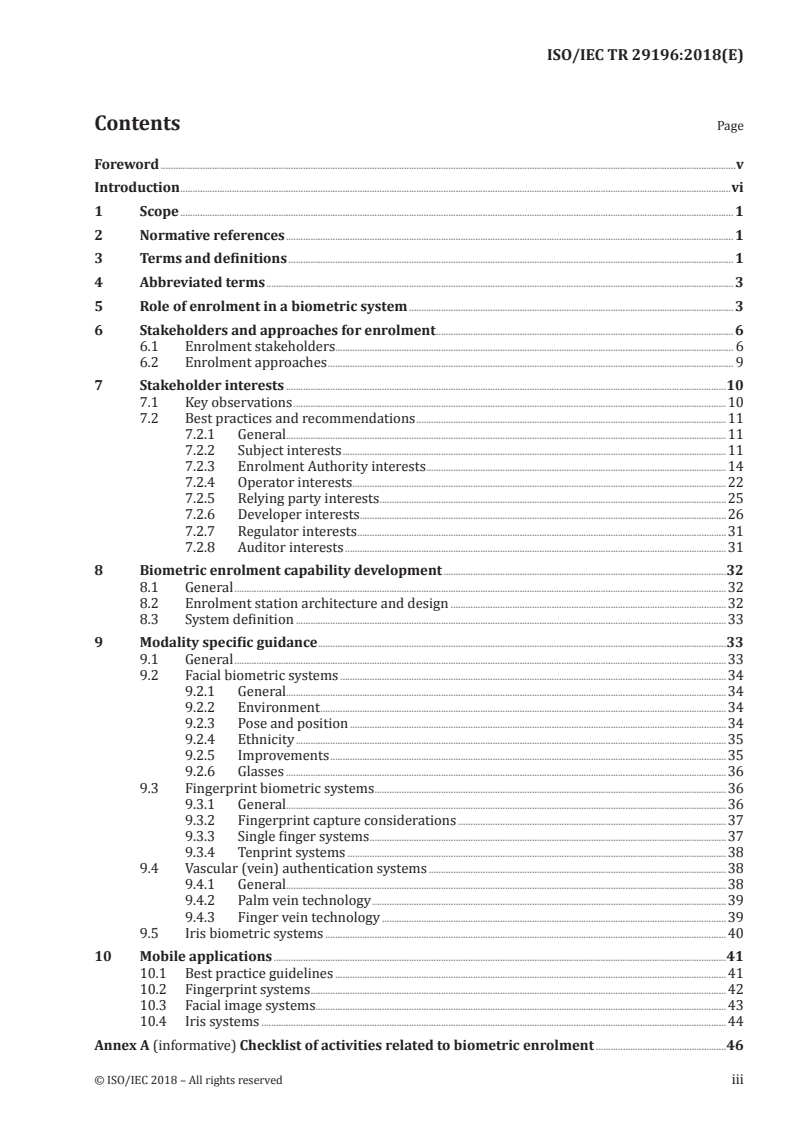
Contents Page
Foreword .v
Introduction .vi
1 Scope . 1
2 Normative references . 1
3 Terms and definitions . 1
4 Abbreviated terms . 3
5 Role of enrolment in a biometric system . 3
6 Stakeholders and approaches for enrolment . 6
6.1 Enrolment stakeholders. 6
6.2 Enrolment approaches . 9
7 Stakeholder interests .10
7.1 Key observations .10
7.2 Best practices and recommendations .11
7.2.1 General.11
7.2.2 Subject interests .11
7.2.3 Enrolment Authority interests .14
7.2.4 Operator interests .22
7.2.5 Relying party interests .25
7.2.6 Developer interests.26
7.2.7 Regulator interests .31
7.2.8 Auditor interests .31
8 Biometric enrolment capability development .32
8.1 General .32
8.2 Enrolment station architecture and design .32
8.3 System definition .33
9 Modality specific guidance .33
9.1 General .33
9.2 Facial biometric systems .34
9.2.1 General.34
9.2.2 Environment .34
9.2.3 Pose and position .34
9.2.4 Ethnicity .35
9.2.5 Improvements .35
9.2.6 Glasses .36
9.3 Fingerprint biometric systems .36
9.3.1 General.36
9.3.2 Fingerprint capture considerations .37
9.3.3 Single finger systems .37
9.3.4 Tenprint systems .38
9.4 Vascular (vein) authentication systems .38
9.4.1 General.38
9.4.2 Palm vein technology .39
9.4.3 Finger vein technology .39
9.5 Iris biometric systems .40
10 Mobile applications .41
10.1 Best practice guidelines .41
10.2 Fingerprint systems .42
10.3 Facial image systems .43
10.4 Iris systems .44
Annex A (informative) Checklist of activities related to biometric enrolment .46
© ISO/IEC 2018 – All rights reserved iii
Annex B (informative) Examples of good and bad face enrolment pictures .50
Bibliography .54
iv © ISO/IEC 2018 – All rights reserved
Foreword
ISO (the International Organization for Standardization) and IEC (the International Electrotechnical
Commission) form the specialized system for worldwide standardization. National bodies that are
members of ISO or IEC participate in the development of International Standards through technical
committees established by the respective organization to deal with particular fields of technical
activity. ISO and IEC technical committees collaborate in fields of mutual interest. Other international
organizations, governmental and non-governmental, in liaison with ISO and IEC, also take part in the
work. In the field of information technology, ISO and IEC have established a joint technical committee,
ISO/IEC JTC 1.
The procedures used to develop this document and those intended for its further maintenance are
described in the ISO/IEC Directives, Part 1. In particular the different approval criteria needed for
the different types of document should be noted. This document was drafted in accordance with the
editorial rules of the ISO/IEC Directives, Part 2 (see www .iso .org/directives).
Attention is drawn to the possibility that some of the elements of this document may be the subject
of patent rights. ISO and IEC shall not be held responsible for identifying any or all such patent
rights. Details of any patent rights identified during the development of the document will be in the
Introduction and/or on the ISO list of patent declarations received (see www .iso .org/patents).
Any trade name used in this document is information given for the convenience of users and does not
constitute an endorsement.
For an explanation on the voluntary nature of standards, the meaning of ISO specific terms and
expressions related to conformity assessment, as well as information about ISO's adherence to the
World Trade Organization (WTO) principles in the Technical Barriers to Trade (TBT) see the following
URL: www .iso .org/iso/foreword .html.
This document was prepared by ISO/IEC JTC 1, Information technology, SC 37, Biometrics.
This second edition cancels and replaces the first edition (ISO/IEC TR 29196:2015), which has been
technically revised.
© ISO/IEC 2018 – All rights reserved v
Introduction
One of the most important contributions to a successful biometric-based recognition system is a
consistent enrolment service that generates the biometric data required for subsequent recognition
of individuals. Subsequent verifications or identifications will be compared with the biometric
data collected at enrolment. If the quality of capture at enrolment is not maintained consistently,
the operators of a recognition system which depends on a good enrolment are likely to experience
unreliable performance. For those who are enrolled in a verification system, a poor quality enrolment
will result in inconvenience should they fail to be recognized. (Readers of this document should note
that quality has a specific meaning when applied to biometric systems; a high quality capture is one
that results in biometric data that provides good comparison scores when compared with other high
quality images from the same biometric feature.)
By analysing the requirements for a good enrolment from the perspectives of a range of stakeholders,
it is possible to derive a set of principles to guide the development of a biometric enrolment policy and
the deployment of a service. Where enrolment is outsourced to a third party, it is extremely important
to be able to measure quality metrics rather than quantity metrics, since the technical and business
objectives of the two organisations (the relying party and the Enrolment Authority as defined in this
document) may, in general, not be aligned.
Although the recommendations and guidelines in this document are directed primarily to the parties
responsible for the enrolment itself and for management of the enrolment service (noting that these
two entities may be one and the same), they will also be of value to the designers and developers of
enrolment systems.
vi © ISO/IEC 2018 – All rights reserved
TECHNICAL REPORT ISO/IEC TR 29196:2018(E)
Information technology — Guidance for biometric
enrolment
1 Scope
This document consolidates information relating to successful, secure and usable implementation
of biometric enrolment processes, while indicating risk factors that organisations proposing to use
biometric technologies will should address during procurement, design, deployment and operation.
Much of the information is generic to many types of application, e.g. from national scale commercial
and government applications, to closed systems for in-house operations, and to consumer applications.
However, the intended application and its purpose often have influence on the necessary enrolment data
quality and are intended to be taken into account when specifying an enrolment system and process.
The document points out the differences in operation relating to specific types of application, e.g. where
self-enrolment is more appropriate than attended operation. This document focuses on mandatory,
attended enrolment at fixed locations. In summary, this document consolidates information relating
to better practice implementation of biometric enrolment capability in various business contexts
including considerations of process, function (system), and technology, as well as legal/privacy and
policy aspects.
The document provides guidance on collection and storage of biometric enrolment data and the impact
on dependent processes of verification and identification. This document does not include material
specific to forensic and law enforcement applications.
This document does not contain any mandatory requirements. The following terms are used in this
document to provide guidance.
The terms “should” and “should not” indicate that among several possibilities one is recommended
as particularly suitable, without mentioning or excluding others, or that a certain course of action is
preferred but not necessarily required, or that (in the negative form) a certain possibility or course of
action is discouraged but not prohibited.
The term “may” indicates a course of action permissible within the limits of the publication.
The terms “can” and “cannot” indicate a possibility and capability, whether material, physical or causal.
2 Normative references
The following documents are referred to in the text in such a way that some or all of their content
constitutes requirements of this document. For dated references, only the edition cited applies. For
undated references, the latest edition of the referenced document (including any amendments) applies.
ISO/IEC 2382-37, Information technology — Vocabulary — Part 37: Biometrics
3 Terms and definitions
For the purposes of this document, the terms and definitions given in ISO/IEC 2382-37 and the
following apply.
ISO and IEC maintain terminological databases for use in standardization at the following addresses:
— IEC Electropedia: available at http: //www .electropedia .org/
— ISO Online browsing platform: available at https: //www .iso .org/obp
© ISO/IEC 2018 – All rights reserved 1
3.1
biometric subject
individual seeking to be enrolled in a biometric enrolment database
3.2
designers and developers
organization or individuals responsible for the design, development, (and deployment, if applicable) of
the enrolment system
3.3
duty officer
individual acting on behalf of either the Enrolment Authority or operator either present in the vicinity
of one or more enrolment stations, or available on line or by telephone, trained to provide advice and
guidance to an enrolment officer in case of difficulty
Note 1 to entry: The duty officer may also have a role in determining exception handling routines.
3.4
Enrolment Authority
organisation (or other entity) with legal and contractual responsibilities for the completion of enrolment
processes
3.5
enrolment officer
agent of the operator responsible for the secure and effective enrolment service at one or more
enrolment points
3.6
Identity Provider
entity storing and managing the biometric data obtained directly or indirectly from the biometric
enrolment
3.7
operator
organization (or other entity) responsible for delivering the enrolment service on behalf of the
Enrolment Authority
3.8
performance manager
person responsible for managing the enrolment service to ensure it meets its specified enrolment
performance criteria
Note 1 to entry: This will typically include actions such as monitoring enrolment performance (quality as well
as quantity metrics), applying corrective measures where necessary and reporting enrolment performance
achievement to the Enrolment Authority.
3.9
personal assistant
individual accompanying the biometric subject at the enrolment session for one or more purposes
Note 1 to entry: Such purposes might include: translation of instructions from the enrolment officer into the
native language of the subject; support for a disabled subject to enable the subject to undertake an enrolment
successfully; to fulfil a legal requirement such as a parent present at the enrolment of a child.
3.10
relying party
entity operating a biometrically-enabled application for which the enrolment process provides
biometric references
2 © ISO/IEC 2018 – All rights reserved
3.11
specialist support staff
trained attendant(s) present at the enrolment session on behalf of the Enrolment Authority or operator
to assist with the enrolment of subjects with disabilities, or to fulfil service or legal requirements in
respect of gender, religious observance, or age of the subject
3.12
vendor
entity providing hardware and/or software biometric functionality
4 Abbreviated terms
KPI Key Performance Indicator. A metric quantifying one or more aspects of the suc-
cessful operation of a process
NFIQ NIST Fingerprint Image Quality
SLA Service Level Agreement. An agreement between a service provider and a customer
defining a target level of service, mutual responsibilities of service provider and
customer, together with other requirements for the delivery of a service
5 Role of enrolment in a biometric system
Given the variety of applications and technologies, it might seem difficult to draw any generalizations
about biometric systems. All such systems, however, have many elements in common. Captured
biometric samples are acquired from a subject by a sensor. The sensor output is sent to a processor
that extracts the distinctive but repeatable measures of the sample (the biometric features), discarding
all other components. The resulting features can be stored in the biometric enrolment database as a
biometric reference or (in this case) a biometric template. In other cases the sample itself (without
feature extraction) may be stored as the reference. A subsequent probe biometric sample can be
compared to a specific reference, to many references, or to all references already in the database
to determine if there is a match. A decision regarding the biometric claim is made based upon the
similarities or dissimilarities between the features of the biometric probe and those of the reference or
references compared.
© ISO/IEC 2018 – All rights reserved 3
Figure 1 — Components of general biometric system
Figure 1 (which is functional in nature and has no implications for physical location) illustrates the
information flow within a general biometric system consisting of data capture, signal processing,
data storage, comparison, and decision subsystems. This diagram illustrates both enrolment, and the
operation of verification and identification systems. The following sub-clauses describe each of these
subsystems in more detail. However, it should be noted that in any implemented system, some of these
conceptual components may be absent, or may not have a direct correspondence with a physical or
software entity.
The data capture subsystem collects an image or signal of a subject’s biometric characteristics that they
have presented to the biometric sensor, and outputs this image/signal as a captured biometric sample.
The transmission subsystem (not portrayed in the diagram and not always present or visibly present in a
biometric system) will transmit samples, features, probes and references between different subsystems.
The captured biometric sample may be compressed and/or encrypted before transmission, and
expanded and/or decrypted before use. A captured biometric sample may be altered in transmission
due to noise in the transmission channel as well as losses in the compression/expansion process. Data
may be transmitted using standard biometric data interchange formats, and cryptographic techniques
may be used to protect the authenticity, integrity, and confidentiality of stored and transmitted
biometric data.
Signal processing may include processes such as
— Enhancement, i.e. improving the quality and clarity of the captured biometric sample,
— Segmentation, i.e. locating the signal of the subject’s biometric characteristics within the captured
biometric sample,
— Feature extraction, i.e. deriving the subject’s repeatable and distinctive measures from the captured
biometric sample, and
4 © ISO/IEC 2018 – All rights reserved
— Quality control, i.e. assessing the suitability of samples, features, and references, and possibly
affecting other processes, such as returning control to the data capture subsystem to collect further
samples; or modifying parameters for segmentation, feature extraction, or comparison.
In the case of enrolment, the signal processing subsystem creates a biometric reference. Sometimes
the enrolment process requires features from several presentations of the individual’s biometric
characteristics. Sometimes the reference comprises just the features, in this case the reference may be
called a “template”. Sometimes the reference comprises just the sample, in which case feature extraction
from the reference occurs immediately before comparison.
In the case of verification and identification, the signal processing subsystem creates a biometric probe.
Sequencing and iteration of the above-mentioned processes are determined by the specifics of each
system.
References are stored within an enrolment database held in the data storage subsystem. Each reference
might be associated with some details of the enrolled subject or the enrolment process. It should
be noted that prior to being stored in the enrolment database, references may be reformatted into a
biometric data interchange format. References may be stored within a biometric capture device, on
a portable medium such as a smart card, locally on a personal computer or local server, or a central
database.
In the comparison subsystem, probes are compared against one or more references and comparison scores
are passed to the decision subsystem. The comparison scores indicate the similarities or dissimilarities
between the features and reference/s compared. In some cases, the features may take the same form
as the stored reference. For verification, a single specific claim of subject enrolment would lead to a
single comparison score. For identification, many or all references may be compared with the features,
and output a comparison score for each comparison.
The decision subsystem uses the comparison scores generated from one or more attempts to provide the
decision outcome for a verification or identification transaction.
In the case of verification, the features are considered to match a compared reference when (assuming
that higher scores correspond to greater similarity) the comparison score exceeds a specified threshold.
A biometric claim can then be verified on the basis of the decision policy, which may allow or require
multiple attempts.
In the case of identification, the enrolee reference is a potential candidate for the subject when (assuming
that higher scores correspond to greater similarity) the comparison score exceeds a specified threshold,
and/or when the comparison score is among the highest ranked values generated during comparisons
across the entire database. The decision policy may allow or require multiple attempts before making
an identification decision.
NOTE Conceptually, it is possible to treat multi-biometric systems in the same manner as uni-biometric
systems, by treating the combined captured biometric samples/references/scores as if they were a single
sample/reference/score and allowing the decision subsystem to operate score fusion or decision fusion as and if
appropriate. (See also ISO/IEC TR 24722:2015.)
The administration subsystem (not portrayed in the diagram) governs the overall policy, implementation
and usage of the biometric system, in accordance with the relevant legal, jurisdictional and societal
constraints and requirements. Illustrative examples include
— Providing feedback to the subject during and/or after data capture,
— Requesting additional information from the subject,
— Storing and formatting of the biometric references and/or biometric interchange data,
— Providing final arbitration on output from decision and/or scores,
— Setting threshold values,
© ISO/IEC 2018 – All rights reserved 5
— Setting biometric system acquisition settings,
— Controlling the operational environment and non-biometric data storage,
— Providing appropriate safeguards for subject privacy, and
— Interacting with the application that utilizes the biometric system.
The biometric system may or may not interface to an external application or system via an application
programming interface, a hardware interface or a protocol interface.
In enrolment, a transaction by a subject is processed by the system in order to generate and store an
enrolment reference for that individual.
Enrolment typically involves
— Sample acquisition,
— Image pre-processing including sample restoration or enhancement, and segmentation,
— Feature extraction,
— Quality checks (which may reject the sample/features as being unsuitable for creating a reference,
and require acquisition of further samples),
— Reference creation (which may require features from multiple samples), possible conversion into a
biometric data interchange format,
— Storage,
— Test verification or identification attempts to ensure that the resulting enrolment is usable, and
— Allowing repeat enrolment attempts, should the initial enrolment be deemed unsatisfactory
(dependent on the enrolment policy).
A subject can also be required to present additional data specific to the enrolment. This additional data
might be a legal name, contact information, credentials, identity documents and the like. There are
some biometric applications that may require no additional data whatsoever to be collected at the time
of enrolment beyond the biological and behavioural characteristics.
6 Stakeholders and approaches for enrolment
6.1 Enrolment stakeholders
The successful operation of a biometric enrolment service depends on the co-operation of a large
number of stakeholders as listed in Table 1. (See also Figure 2 below showing that enrolment officers
work on behalf of the operator, which has a relationship with the Enrolment Authority; personal
assistants support the subject of the enrolment). Note that systems may be far simpler than illustrated,
for example, the Enrolment Authority may also be the operator of the service, as well as being the
relying party in an enterprise access control system.
6 © ISO/IEC 2018 – All rights reserved
Figure 2 — Stakeholders at enrolment
Table 1 — Functional description of stakeholder roles
Stakeholder Function description
Enrolment Authority Is responsible for ensuring the quality of biome-
tric enrolment samples and other KPIs are in ac-
cordance with SLA or contractual requirements.
Initiates appropriate action if these fall outside
the agreed targets.
Ensures compliance with legal requirements.
Ensures that the cultural implications of operating
an enrolment service are taken into consideration.
Operator Organizes delivering enrolment service on a day-
to-day basis.
Is responsible to the Enrolment Authority for
quality and security of the enrolment service.
Takes remedial measures if KPIs, including
quality and performance metrics, fall outside the
agreed targets.
Performance manager Monitors the performance of the enrolment
service.
Proposes corrective actions.
Reports back on the results of corrective actions.
© ISO/IEC 2018 – All rights reserved 7
Table 1 (continued)
Stakeholder Function description
Enrolment officer Is the agent of the operator responsible for the
secure and effective enrolment service at one or
more enrolment points.
Ensures the day-to-day maintenance of equip-
ment used in enrolment.
Interfaces with the subjects and provides any
relevant information to them.
Enters any biographical/contextual data (al-
though some of these details may already be
pre-populated).
Ensures that the quality of the enrolment fea-
ture collected by the sensor/camera meets the
enrolment standards (usually through request-
ing the subject to re-enrol if the standard is not
achieved).
Provides advice and support to the subject to
achieve a high standard of enrolment.
Notes any exceptional circumstances.
Duty officer Provides technical and/or operational advice and
guidance to an enrolment officer.
Attendant Assists the enrolment officer in obtaining the
best available quality biometric sample through
following procedures defined for subjects with
accessibility needs or special requirements in-
cluding age, gender, and religious observance.
Biometric capture subject / biometric enrolee, Provides biometric sample to the system.
hereafter termed as subject or enrolee
Needs transparency and information on the
system.
Is interested in smooth operation.
Is interested in maintaining their data privacy,
wants to submit only that data that is absolutely
necessary for the intended purpose, and prefers a
system that is as usable as possible.
Prefers to have a system that is as intuitive as
possible.
Personal assistant Provides support for the subject, e.g. transla-
tion of instructions from the enrolment officer,
support for a disabled subject or to fulfil a legal
requirement such as a parent present at the en-
rolment of a child.
Designer and developer Designs the enrolment system as part of the
enrolment service using systems engineering
principles wherever possible.
Develops enrolment system, service and process.
Develops an interaction protocol for the enrolee.
Develops the service for production and distri-
bution of any token used as storage for biometric
reference(s), or a pointer to where biometric
reference(s) is/are stored.
8 © ISO/IEC 2018 – All rights reserved
Table 1 (continued)
Stakeholder Function description
Vendor Provides hardware and software.
Provides (either directly or through an agent)
technical support e.g. for upgrades or rectifica-
tion of faults, if under contract to do so.
Regulator and other governance bodies Assures the enrolment process is operated
according to laws, regulations, codes of practice,
and contracts.
Auditor Audits the enrolment protocol.
Identity Provider Processes the biometric features into referenc-
es, performing any quality and de-duplication
checks and storing references and images.
Relying party Uses the biometric data obtained from the enrol-
ment service in a biometric recognition service as
part of a business-oriented application.
6.2 Enrolment approaches
Enrolment for biometric services can take the form of many differing approaches depending upon
context, complexity, and requirements of the relying party such as:
— In-house or outsourced;
— Multiple or single location;
— Fixed, mobile or remote;
— Attended, semi-attended (one enrolment officer overseeing a number of enrolments in parallel) or
unattended (e.g. self-enrolment);
NOTE Self-enrolment can be with the active participation of the subject, or can even be acquired with
stand-off systems not requiring direct interaction with the subject.
— Mandatory, optional (opt-in), or unaware (e.g. for surveillance/tracking);
— Using a single modality or multiple biometric modalities;
— Designed to provide enrolments for either multiple applications or for a specific application.
Enrolment is an expensive part of a biometric service. In order to reduce costs, enrolment may
at times be undertaken for multiple relying parties, each with differing business, technical and
functional requirements. For example, the enrolled facial image for a passport may be re-used for a
driver’s licence application. Re-use of biometric data is mostly regulated by privacy law, which often
requires informing the subject on the intended purpose preventing additional use without explicit
consent of the subject. Other enrolment processes may be required to be more specific in design
– e.g. access control ‘offline’ or ‘batch’ enrolment process where the biometric sample capture is
separate from the enrolment stage, or an integrated credential proofing/acquisition/enrolment
process;
— Duration/complexity of the enrolment process, from a simple single modality process (against pre-
assigned identity), to a complex process consisting of identity checks using breeder documents,
followed by collection of features relating to multiple modalities and a verification check on the
effective operation of the collected features.
Based upon how the system is influenced by the above factors, there will be different requirements and
operational guidance.
© ISO/IEC 2018 – All rights reserved 9
7 Stakeholder interests
7.1 Key observations
A repeatable biometric enrolment process is a prerequisite for the successful use of biometric
recognition in one or more applications at a subsequent time.
A poor quality enrolment, e.g. one in which the subject’s biometric features have been collected in
line with best practice, but do not meet all quality criteria, can present difficulties when the reference
derived from these features is compared with biometric data collected in the context of the application.
For example, if a thumb is presented and registered in an enrolment for access control, and the
subject uses one of the index fingers as instructed by a biometric verification unit at an access point,
the biometric comparison will fail. The subject will therefore be inconvenienced, in having to use an
exception-handling process provided by the operator of the access control system.
Such problems are likely to occur more often when the Enrolment Authority (and/or the operator)
for the enrolment service is not the same as the party managing the subsequent application that uses
biometric recognition (the relying party). In this case, the Enrolment Authority bears the costs of
ensuring that the quality of enrolments is maintained while the benefits of good quality enrolments
accrue to the relying party (or parties). Rather than setting this cost/benefit pivot at the interface
between the two organizations, a better strategy is to move it to the enrolment service, incentivizing
the Enrolment Authority to deliver high quality enrolments. This will usually entail clear and correct
specification of metrics for the enrolment performance in any contracts or agreements between these
two organizations.
In setting the requirements for an enrolment service, the Enrolment Authority should take account of
the requirements of the relying party as well as other stakeholders as listed in Table 1 and represented
schematically in Figure 2. (When these requirements are not known in full, e.g. because the recognition
system of the relying party is still under development, designers of enrolment services should take
appropriate measures to mitigate any risks.) The SLA between the Enrolment Authority and the
operator of the enrolment service should include KPIs that relate to the business objectives of the
Enrolment Authority as well as those of the relying party. Requirements should include quantitative
performance measures capable of being tested either by the Enrolment Authority or by an independent
testing organization during the acceptance phase of the project, as well as periodically afterwards.
The designers and developers of the enrolment system will use the requirements to define processes
appropriately and to source suitable vendors of the biometric components, such as the hardware to
collect biometric features, software to process these features and assess their quality, and - if required
- verification software to check that the enrolment has been completed satisfactorily.
The security of the biometric enrolment process is also an essential aspect of its success. In preparing
for a robust process design, all stakeholders are responsible for addressing security requirements, from
the design of the logical technical architecture to the functional components, as well as procedures and
checks that directly involve interaction with the subject.
The Enrolment Authority’s designers and developers should address these requirements, as early as
possible in the design, such as the ability to check the identity credentials presented by the subject
and taking measures to counter spoofing attacks. For details on Presentation Attack Detection (PAD)
see the multipart standard ISO/IEC 30107. Note that catering to the needs of subjects with language
difficulties and disabilities will also feature in the design but may impact on the security procedures.
These aspects of the enrolment process – and any requirements placed by regulators – should be
included in the training materials for enrolment officers, attendants, duty officers and the performance
manager.
After completion of the high level design, and prior to deployment, marketing and other awareness-
raising activities should be started. This enables representatives of the subject population, mass media,
regulators and special interest groups to comment on the enrolment service proposals. As a result, any
necessary changes to the system design may be incorporated.
10 © ISO/IEC 2018 – All rights reserved
The enrolment service should be piloted with a representative sample of the subject population, both of
subjects as well as enrolment officers. The performance manager should ensure that acceptance testing
has been carried out and that the provisions of the SLA with the designers and developers have been
met. Comments and observations collected from the subjects should be examined. If changes are made
to the system or procedures in the light of these tests and comments, a further round of testing may be
required.
At some time after the system is deployed, representatives of the relying party and the Enrolment
Authority should review the performance of the enrolment service, assessing whether the KPIs continue
to reflect the requirements of the relying party, and making any necessary adjustments.
A system audit may be requested periodically to ensure that the enrolment service operates in line
with legal and business rules. Guidelines for the audit process should take account of the particular
characteristics of biometric systems.
7.2 Best practices and recommendations
7.2.1 General
There are numerous stakeholders in any biometric enrolment application, most of whom will benefit
from a high quality, securely administered enrolment process with due regard for the needs and
expectations of the subjects of the enrolment.
For each stakeholder described in Table 1, there are specific reasons why the enrolment service should
be successful. This Clause describes some of the benefits for these stakeholders.
A strategy for the design, development and deployment of a successful biometric enrolment should
consider numerous issues in a structured manner. The approach favoured in this document is to itemise
these issues against the principal stakeholders who are impacted by each issue. One way of examining
the benefits to a stakeholder is to consider the operation of the enrolment service from a number of
standpoints. Stakeholders will have different perspectives and not every standpoint will be relevant to
every stakeholder:
— Appropriateness, effectiveness and efficiency,
— Convenience and price,
— Look and feel,
— Usability, personalisation and internationalization,
— Performance including speed, and accuracy,
— Operational and environmental aspects,
— Maintainability and support,
— Security, privacy and transparency,
— Cultural and political aspects, and
— Legal aspects.
7.2.2 Subject interests
The enrolment subje
...
Questions, Comments and Discussion
Ask us and Technical Secretary will try to provide an answer. You can facilitate discussion about the standard in here.