


ISO 3689:2024
(Main)Paper and board — Determination of bursting strength after immersion in water
Paper and board — Determination of bursting strength after immersion in water
This document specifies a method for the determination of the wet strength of paper and board by measuring its bursting strength after it has been immersed in water for a specified period. The method is applicable to most kinds of paper and board, provided that an appropriate immersion time is agreed between the interested parties. Different results can be found if the sample is re-tested after a period of time.
Papier et carton — Détermination de la résistance à l'éclatement après immersion dans l'eau
General Information
- Status
- Published
- Publication Date
- 30-Sep-2024
- Technical Committee
- ISO/TC 6/SC 2 - Test methods and quality specifications for paper and board
- Current Stage
- 6060 - International Standard published
- Start Date
- 01-Oct-2024
- Due Date
- 25-Mar-2025
- Completion Date
- 01-Oct-2024
Relations
- Effective Date
- 09-Feb-2026
- Effective Date
- 09-Feb-2026
- Effective Date
- 09-Feb-2026
- Effective Date
- 09-Feb-2026
- Revises
ISO 3689:1983 - Paper and board — Determination of bursting strength after immersion in water - Effective Date
- 06-Jun-2022
Overview
ISO 3689:2024 - "Paper and board - Determination of bursting strength after immersion in water" defines a laboratory method to measure the wet strength of paper and board by determining their bursting strength after immersion in water. Applicable to most papers and boards, the method requires agreement on immersion time between interested parties and notes that repeating the test after time can give different results. The standard updates previous editions and aligns testing practice with ISO 2758/ISO 2759 burst test equipment.
Key topics and technical requirements
- Scope & principle: Measure bursting strength of a single sheet after immersion to quantify wet strength and the bursting strength retention after immersion (expressed as a percentage versus dry strength).
- Apparatus: Use a burst tester configured per ISO 2758 (papers) or ISO 2759 (boards); specified ranges for expected test pressures are given in the standard.
- Water and conditioning: Use reagent water meeting ISO 14487 and laboratory conditioning according to ISO 187 (23 °C ±1 °C or 27 °C ±1 °C in tropical conditions). For wet testing, pre-conditioning of test pieces is not required.
- Sampling & test pieces: Sample selection follows ISO 186. Prepare test pieces as in ISO 2758/2759. Ten test pieces are standard for the wet test (5 with felt/outer side up, 5 with wire/inner side up).
- Immersion procedure:
- Immerse test pieces vertically, at least 20 mm below water surface, using a support system to prevent folding or contact with tank sides/each other.
- Typical immersion times: 1 h, 2 h, or 24 h (with specified tolerances). Immersion time shall be agreed and recorded.
- Excess water removal: After immersion, blot between specified blotting paper and roll once forward and backward with a defined metal roller - then test immediately.
- Results & reporting: Results can be reported as mean wet bursting strength, burst index, or percentage retention. Test report must state immersion time, water temperature, and other test conditions.
- Precision & annexes: The standard includes precision data and an informative annex with support system examples.
Applications and users
ISO 3689:2024 is used for:
- Quality control and acceptance testing in pulp, paper and packaging production
- R&D and material selection where wet performance matters (e.g., packaging exposed to moisture)
- Converters, corrugated board manufacturers, test laboratories, and procurement teams specifying wet-strength requirements
- Compliance checks comparing wet vs dry burst strength for product claims
Related standards
- ISO 2758 - Paper: determination of bursting strength
- ISO 2759 - Board: determination of bursting strength
- ISO 186 - Sampling to determine average quality
- ISO 187 - Standard atmosphere for conditioning and testing
- ISO 536 - Grammage determination
- ISO 14487 - Standard water for physical testing
Keywords: ISO 3689:2024, wet strength testing, bursting strength after immersion, paper and board testing, burst tester, immersion times, wet bursting strength retention.
Get Certified
Connect with accredited certification bodies for this standard

Control Union Certifications
Global certification for agriculture and sustainability.

Gozdarski inštitut Slovenije
Slovenian Forestry Institute. Forest management certification support, timber testing.
Sponsored listings
Frequently Asked Questions
ISO 3689:2024 is a standard published by the International Organization for Standardization (ISO). Its full title is "Paper and board — Determination of bursting strength after immersion in water". This standard covers: This document specifies a method for the determination of the wet strength of paper and board by measuring its bursting strength after it has been immersed in water for a specified period. The method is applicable to most kinds of paper and board, provided that an appropriate immersion time is agreed between the interested parties. Different results can be found if the sample is re-tested after a period of time.
This document specifies a method for the determination of the wet strength of paper and board by measuring its bursting strength after it has been immersed in water for a specified period. The method is applicable to most kinds of paper and board, provided that an appropriate immersion time is agreed between the interested parties. Different results can be found if the sample is re-tested after a period of time.
ISO 3689:2024 is classified under the following ICS (International Classification for Standards) categories: 85.060 - Paper and board. The ICS classification helps identify the subject area and facilitates finding related standards.
ISO 3689:2024 has the following relationships with other standards: It is inter standard links to EN 868-3:2025, EN 868-7:2025, EN 868-2:2025, EN 868-6:2025, ISO 3689:1983. Understanding these relationships helps ensure you are using the most current and applicable version of the standard.
ISO 3689:2024 is available in PDF format for immediate download after purchase. The document can be added to your cart and obtained through the secure checkout process. Digital delivery ensures instant access to the complete standard document.
Standards Content (Sample)
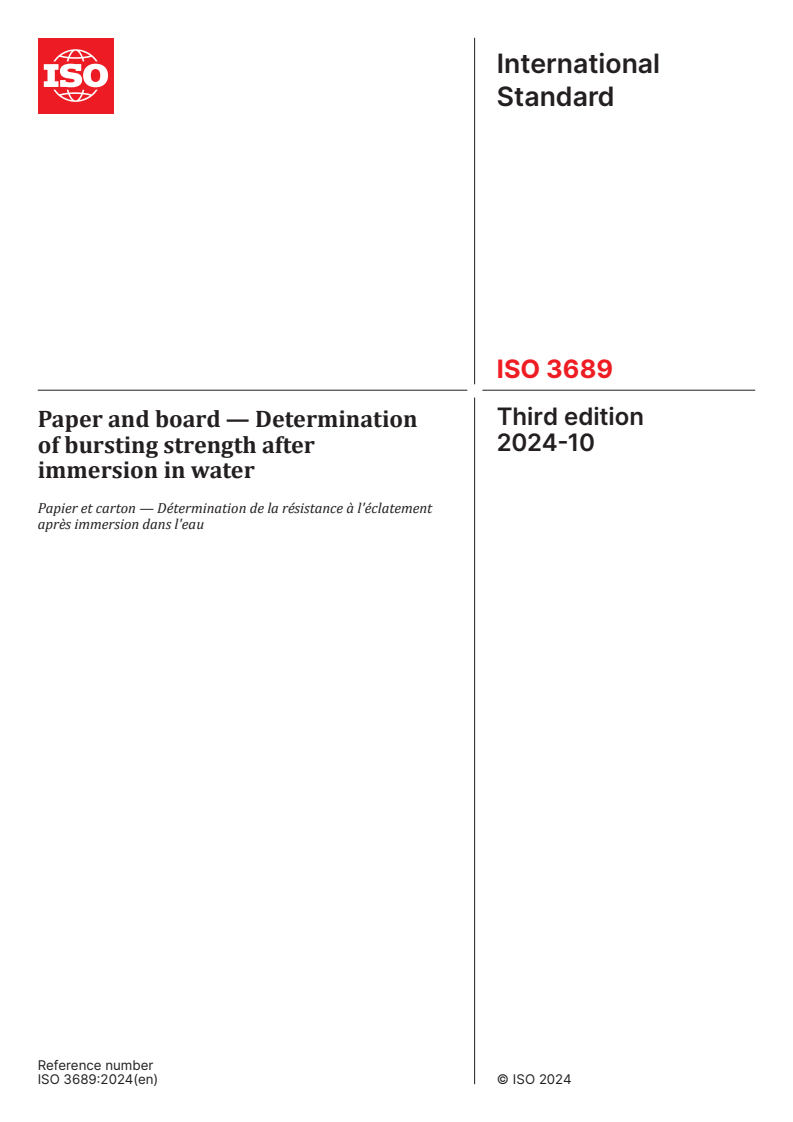
International
Standard
ISO 3689
Third edition
Paper and board — Determination
2024-10
of bursting strength after
immersion in water
Papier et carton — Détermination de la résistance à l'éclatement
après immersion dans l'eau
Reference number
© ISO 2024
All rights reserved. Unless otherwise specified, or required in the context of its implementation, no part of this publication may
be reproduced or utilized otherwise in any form or by any means, electronic or mechanical, including photocopying, or posting on
the internet or an intranet, without prior written permission. Permission can be requested from either ISO at the address below
or ISO’s member body in the country of the requester.
ISO copyright office
CP 401 • Ch. de Blandonnet 8
CH-1214 Vernier, Geneva
Phone: +41 22 749 01 11
Email: copyright@iso.org
Website: www.iso.org
Published in Switzerland
ii
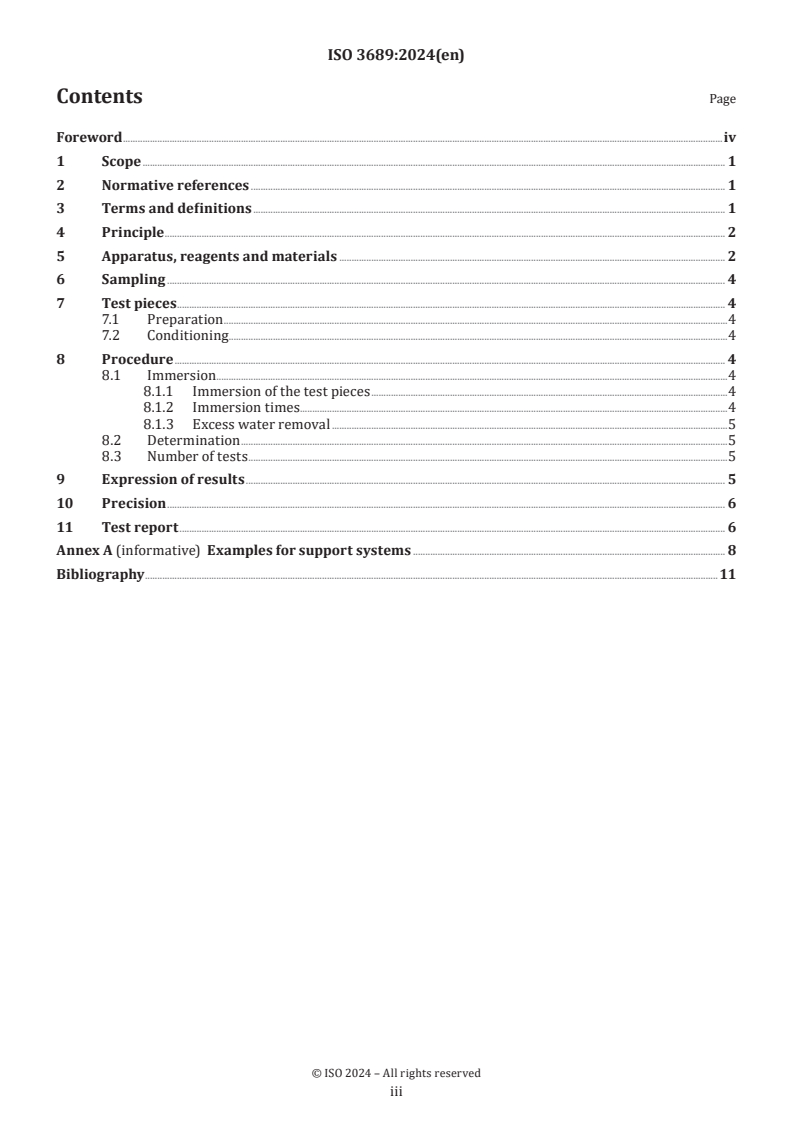
Contents Page
Foreword .iv
1 Scope . 1
2 Normative references . 1
3 Terms and definitions . 1
4 Principle . 2
5 Apparatus, reagents and materials . 2
6 Sampling . 4
7 Test pieces . 4
7.1 Preparation .4
7.2 Conditioning.4
8 Procedure . 4
8.1 Immersion .4
8.1.1 Immersion of the test pieces .4
8.1.2 Immersion times . .4
8.1.3 Excess water removal .5
8.2 Determination .5
8.3 Number of tests .5
9 Expression of results . 5
10 Precision . 6
11 Test report . 6
Annex A (informative) Examples for support systems . 8
Bibliography .11
iii
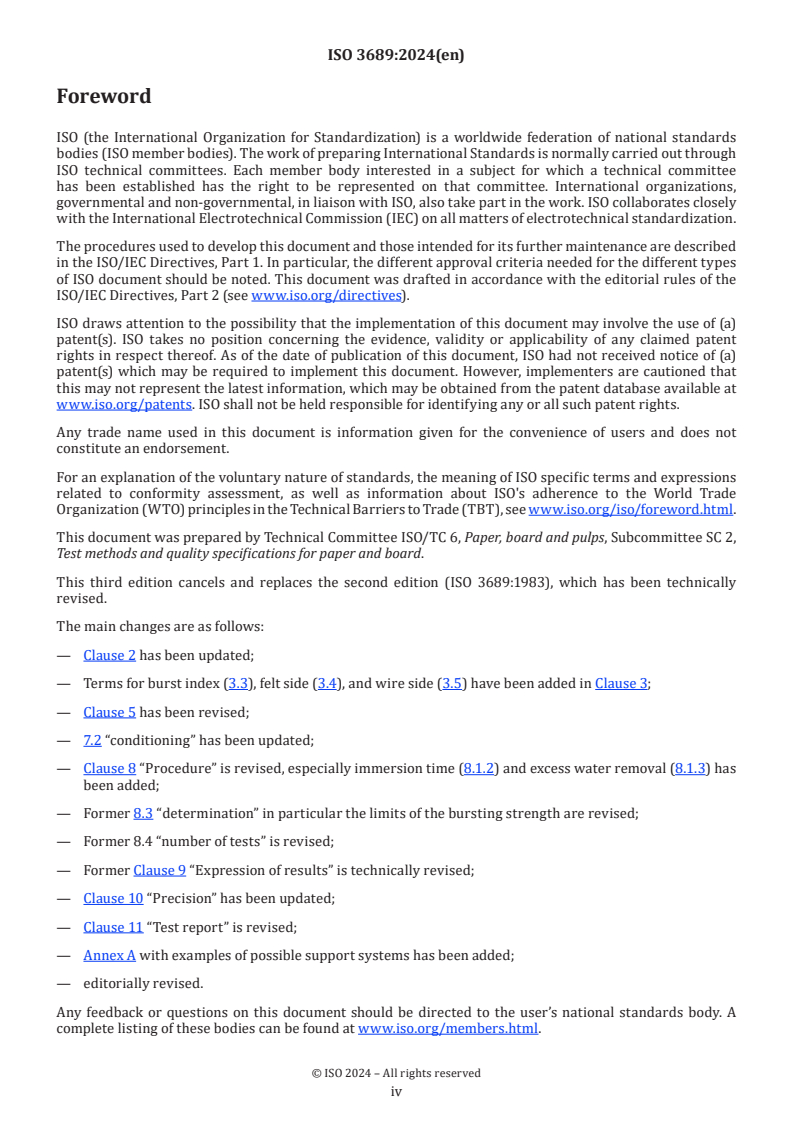
Foreword
ISO (the International Organization for Standardization) is a worldwide federation of national standards
bodies (ISO member bodies). The work of preparing International Standards is normally carried out through
ISO technical committees. Each member body interested in a subject for which a technical committee
has been established has the right to be represented on that committee. International organizations,
governmental and non-governmental, in liaison with ISO, also take part in the work. ISO collaborates closely
with the International Electrotechnical Commission (IEC) on all matters of electrotechnical standardization.
The procedures used to develop this document and those intended for its further maintenance are described
in the ISO/IEC Directives, Part 1. In particular, the different approval criteria needed for the different types
of ISO document should be noted. This document was drafted in accordance with the editorial rules of the
ISO/IEC Directives, Part 2 (see www.iso.org/directives).
ISO draws attention to the possibility that the implementation of this document may involve the use of (a)
patent(s). ISO takes no position concerning the evidence, validity or applicability of any claimed patent
rights in respect thereof. As of the date of publication of this document, ISO had not received notice of (a)
patent(s) which may be required to implement this document. However, implementers are cautioned that
this may not represent the latest information, which may be obtained from the patent database available at
www.iso.org/patents. ISO shall not be held responsible for identifying any or all such patent rights.
Any trade name used in this document is information given for the convenience of users and does not
constitute an endorsement.
For an explanation of the voluntary nature of standards, the meaning of ISO specific terms and expressions
related to conformity assessment, as well as information about ISO's adherence to the World Trade
Organization (WTO) principles in the Technical Barriers to Trade (TBT), see www.iso.org/iso/foreword.html.
This document was prepared by Technical Committee ISO/TC 6, Paper, board and pulps, Subcommittee SC 2,
Test methods and quality specifications for paper and board.
This third edition cancels and replaces the second edition (ISO 3689:1983), which has been technically
revised.
The main changes are as follows:
— Clause 2 has been updated;
— Terms for burst index (3.3), felt side (3.4), and wire side (3.5) have been added in Clause 3;
— Clause 5 has been revised;
— 7.2 “conditioning” has been updated;
— Clause 8 “Procedure” is revised, especially immersion time (8.1.2) and excess water removal (8.1.3) has
been added;
— Former 8.3 “determination” in particular the limits of the bursting strength are revised;
— Former 8.4 “number of tests” is revised;
— Former Clause 9 “Expression of results” is technically revised;
— Clause 10 “Precision” has been updated;
— Clause 11 “Test report” is revised;
— Annex A with examples of possible support systems has been added;
— editorially revised.
Any feedback or questions on this document should be directed to the user’s national standards body. A
complete listing of these bodies can be found at www.iso.org/members.html.
iv
International Standard ISO 3689:2024(en)
Paper and board — Determination of bursting strength after
immersion in water
1 Scope
This document specifies a method for the determination of the wet strength of paper and board by measuring
its bursting strength after it has been immersed in water for a specified period.
The method is applicable to most kinds of paper and board, provided that an appropriate immersion time is
agreed between the interested parties.
Different results can be found if the sample is re-tested after a period of time.
2 Normative references
The following documents are referred to in the text in such a way that some or all of their content constitutes
requirements of this document. For dated references, only the edition cited applies. For undated references,
the latest edition of the referenced document (including any amendments) applies.
ISO 186, Paper and board — Sampling to determine average quality
ISO 187, Paper, board and pulps — Standard atmosphere for conditioning and testing and procedure for
monitoring the atmosphere and conditioning of samples
ISO 536, Paper and board — Determination of grammage
ISO 2758, Paper — Determination of bursting strength
ISO 2759, Board — Determination of bursting strength
ISO 14487, Pulps — Standard water for physical testing
3 Terms and definitions
For the purposes of this document, the following terms and definitions apply.
ISO and IEC maintain terminological databases for use in standardization at the following addresses:
— ISO Online browsing platform: available at https:// www .iso .org/ obp
— IEC Electropedia: available at https:// www .electropedia .org/
3.1
bursting strength after immersion
limited resistance offered by a single sheet of paper or board, after immersion in water to a uniformly
distributed pressure applied at right angles to its surface up to the point at which it breaks, under the
specified conditions of test
3.2
bursting strength retention after immersion
percentage ratio of the bursting strength of a single sheet of paper or board after immersion in water to that
of the same paper or board in the dry state measured under the specified conditions of test
...
Questions, Comments and Discussion
Ask us and Technical Secretary will try to provide an answer. You can facilitate discussion about the standard in here.
Loading comments...