


ISO 8000-210:2024
(Main)Data quality — Part 210: Sensor data: Data quality characteristics
Data quality — Part 210: Sensor data: Data quality characteristics
This document specifies quality characteristics of data that are recorded by sensors as a stream of single, discrete digital values. The following are within the scope of this document: — quality characteristics of sensor data; — types of anomalies in sensor data; — relationships between quality characteristics of sensor data and anomalies in sensor data; — application of quality characteristics of sensor data. The following are outside the scope of this document: — analogue, image, video and audio data that are captured by sensors; — signal processing that converts or modifies analogue data to create digital data; — methods to measure and improve data quality.
Qualité des données — Partie 210: Données des capteurs: Caractéristiques de qualité des données
General Information
- Status
- Published
- Publication Date
- 05-Dec-2024
- Technical Committee
- ISO/TC 184/SC 4 - Industrial data
- Drafting Committee
- ISO/TC 184/SC 4 - Industrial data
- Current Stage
- 6060 - International Standard published
- Start Date
- 06-Dec-2024
- Due Date
- 31-Mar-2025
- Completion Date
- 06-Dec-2024
Overview
ISO 8000-210:2024 is an International Standard published by ISO, focusing on data quality for sensor data, specifically streams of single, discrete digital values. This standard defines essential data quality characteristics relevant to sensor data, catalogs common types of anomalies that may occur, and clarifies how these characteristics and anomalies are interrelated. It also guides how organizations can apply these features to assure data reliability for analysis, decision making, and operational insight in various industries.
This document is part of the broader ISO 8000 series, dedicated to information and data quality. ISO 8000-210:2024 addresses core needs stemming from the rapid growth in sensor deployments, such as in industrial IoT, smart infrastructure, and automation systems, where sensor-generated data is a foundational asset.
Key Topics
Sensor Data Quality Characteristics:
The standard specifies five primary characteristics by which organizations can assess the quality of their sensor data:- Accuracy: Measures how closely sensor data represents the true value in a particular context.
- Completeness: Describes whether all expected data values are captured within the dataset.
- Consistency: Evaluates compliance of sensor data with applicable rules and patterns-both for individual sensors and across sensor networks.
- Precision: Divided into representational (level of detail) and measurement (repeatability under consistent conditions).
- Timeliness: Determines if data is available within required time constraints for effective use.
Sensor Data Anomalies:
The document outlines typical anomalies that can impair sensor data quality, including:- Offset, Drift, Trim, Spike, Noise, Data loss, Lack of amount, Shift, Drop or rise, Stuck, Bound oscillation, Inconsistent frequency, Different resolution, Incorrect timestamp, and Latency. These anomalies can arise from sensor faults, network issues, environmental factors, or system errors.
Relationships Between Quality Characteristics and Anomalies:
The standard details how specific anomalies affect each data quality characteristic. This relationship supports root cause analysis when data quality issues are detected.Application Guidance:
ISO 8000-210:2024 offers direction for integrating these quality characteristics into organizational processes, helping to ensure sensor data is fit for purpose and supports reliable decision-making.
Applications
Organizations across multiple sectors benefit from the application of ISO 8000-210:2024, especially where sensor data quality influences outcomes:
- Industrial Automation and Smart Manufacturing:
Continuous monitoring of production lines with multiple sensors requires reliable, high-quality data for predictive maintenance and process optimization. - Smart Infrastructure and IoT Networks:
Data from sensor networks (e.g., for traffic management, environmental monitoring) must meet quality standards to support real-time analytics and reporting. - Healthcare and Medical Devices:
Accurate and timely sensor readings are vital for patient monitoring and diagnostics. - Asset Tracking and Supply Chain Management:
Quality sensor data assure traceability and regulatory compliance in logistics and inventory systems.
Implementing the guidelines set by this standard enables organizations to:
- Reduce the risk of incorrect analytics or decisions based on faulty data
- Ensure interoperability and data portability among systems and partners
- Foster evidence-based trust in data-driven operations
Related Standards
Organizations may reference the following related international standards to complement the application of ISO 8000-210:2024:
- ISO 8000-1: Overview, principles, and scope of the ISO 8000 series.
- ISO 8000-2: Common vocabulary for data quality management.
- ISO 8000-8: Approaches to measuring information and data quality.
- ISO/IEC 25012: Data quality model.
- ISO/IEC 30141: Reference architecture for Internet of Things (IoT).
- ISO 19157-1: Quality principles for geographic information.
- ISO 5725-1, ISO/IEC Guide 99: Guidelines for accuracy and precision in measurements.
ISO 8000-210:2024 is a vital resource for all organizations leveraging sensors, guiding them to maintain robust data quality as a foundation for digital transformation and reliable business intelligence.
Get Certified
Connect with accredited certification bodies for this standard

DVS-ZERT GmbH
German welding certification society.
CARES (UK Certification Authority for Reinforcing Steels)
UK certification for reinforcing steels and construction.
EWF/IIW (European/International Welding Federation)
International welding personnel certification.
Sponsored listings
Frequently Asked Questions
ISO 8000-210:2024 is a standard published by the International Organization for Standardization (ISO). Its full title is "Data quality — Part 210: Sensor data: Data quality characteristics". This standard covers: This document specifies quality characteristics of data that are recorded by sensors as a stream of single, discrete digital values. The following are within the scope of this document: — quality characteristics of sensor data; — types of anomalies in sensor data; — relationships between quality characteristics of sensor data and anomalies in sensor data; — application of quality characteristics of sensor data. The following are outside the scope of this document: — analogue, image, video and audio data that are captured by sensors; — signal processing that converts or modifies analogue data to create digital data; — methods to measure and improve data quality.
This document specifies quality characteristics of data that are recorded by sensors as a stream of single, discrete digital values. The following are within the scope of this document: — quality characteristics of sensor data; — types of anomalies in sensor data; — relationships between quality characteristics of sensor data and anomalies in sensor data; — application of quality characteristics of sensor data. The following are outside the scope of this document: — analogue, image, video and audio data that are captured by sensors; — signal processing that converts or modifies analogue data to create digital data; — methods to measure and improve data quality.
ISO 8000-210:2024 is classified under the following ICS (International Classification for Standards) categories: 25.040.40 - Industrial process measurement and control. The ICS classification helps identify the subject area and facilitates finding related standards.
ISO 8000-210:2024 is available in PDF format for immediate download after purchase. The document can be added to your cart and obtained through the secure checkout process. Digital delivery ensures instant access to the complete standard document.
Standards Content (Sample)
International
Standard
ISO 8000-210
First edition
Data quality —
2024-12
Part 210:
Sensor data: Data quality
characteristics
Qualité des données —
Partie 210: Données des capteurs: Caractéristiques de qualité des
données
Reference number
© ISO 2024
All rights reserved. Unless otherwise specified, or required in the context of its implementation, no part of this publication may
be reproduced or utilized otherwise in any form or by any means, electronic or mechanical, including photocopying, or posting on
the internet or an intranet, without prior written permission. Permission can be requested from either ISO at the address below
or ISO’s member body in the country of the requester.
ISO copyright office
CP 401 • Ch. de Blandonnet 8
CH-1214 Vernier, Geneva
Phone: +41 22 749 01 11
Email: copyright@iso.org
Website: www.iso.org
Published in Switzerland
ii
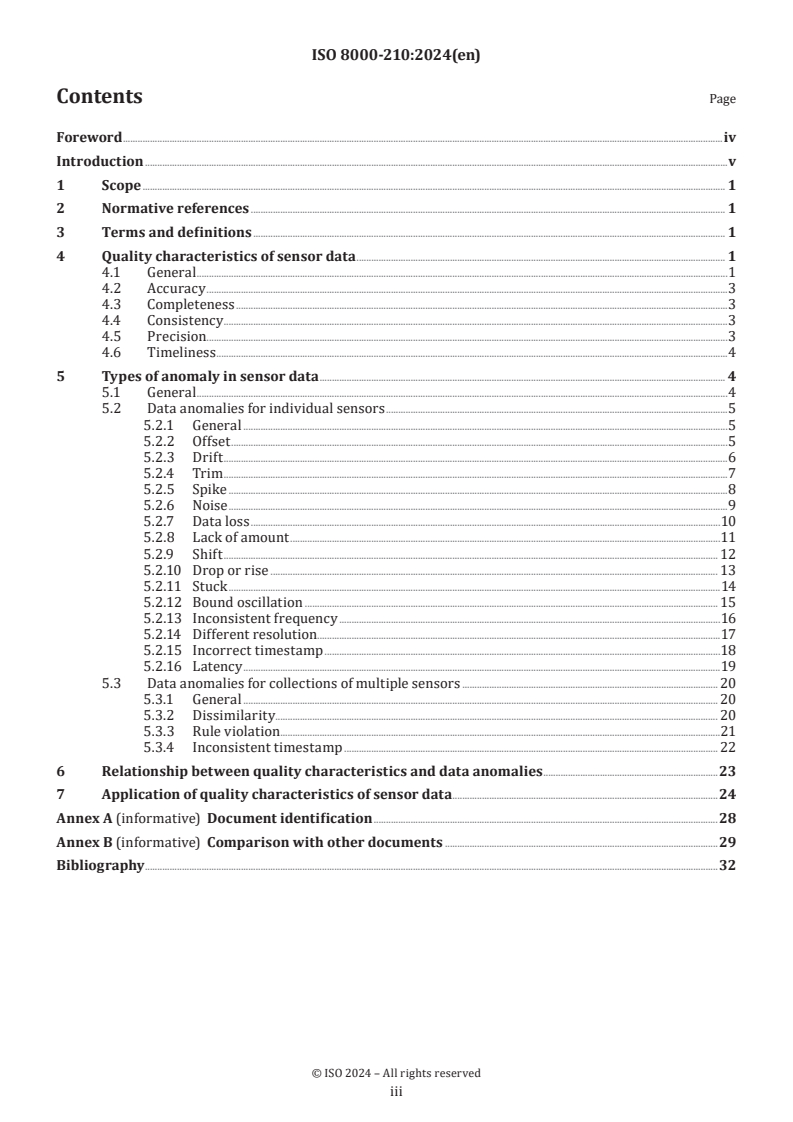
Contents Page
Foreword .iv
Introduction .v
1 Scope . 1
2 Normative references . 1
3 Terms and definitions . 1
4 Quality characteristics of sensor data . 1
4.1 General .1
4.2 Accuracy .3
4.3 Completeness .3
4.4 Consistency .3
4.5 Precision . . .3
4.6 Timeliness .4
5 Types of anomaly in sensor data . 4
5.1 General .4
5.2 Data anomalies for individual sensors .5
5.2.1 General .5
5.2.2 Offset .5
5.2.3 Drift .6
5.2.4 Trim .7
5.2.5 Spike .8
5.2.6 Noise .9
5.2.7 Data loss .10
5.2.8 Lack of amount .11
5.2.9 Shift . 12
5.2.10 Drop or rise . 13
5.2.11 Stuck .14
5.2.12 Bound oscillation . 15
5.2.13 Inconsistent frequency .16
5.2.14 Different resolution.17
5.2.15 Incorrect timestamp .18
5.2.16 Latency .19
5.3 Data anomalies for collections of multiple sensors . 20
5.3.1 General . 20
5.3.2 Dissimilarity . . 20
5.3.3 Rule violation .21
5.3.4 Inconsistent timestamp . 22
6 Relationship between quality characteristics and data anomalies .23
7 Application of quality characteristics of sensor data .24
Annex A (informative) Document identification .28
Annex B (informative) Comparison with other documents .29
Bibliography .32
iii
Foreword
ISO (the International Organization for Standardization) is a worldwide federation of national standards
bodies (ISO member bodies). The work of preparing International Standards is normally carried out through
ISO technical committees. Each member body interested in a subject for which a technical committee
has been established has the right to be represented on that committee. International organizations,
governmental and non-governmental, in liaison with ISO, also take part in the work. ISO collaborates closely
with the International Electrotechnical Commission (IEC) on all matters of electrotechnical standardization.
The procedures used to develop this document and those intended for its further maintenance are described
in the ISO/IEC Directives, Part 1. In particular, the different approval criteria needed for the different types
of ISO document should be noted. This document was drafted in accordance with the editorial rules of the
ISO/IEC Directives, Part 2 (see www.iso.org/directives).
ISO draws attention to the possibility that the implementation of this document may involve the use of (a)
patent(s). ISO takes no position concerning the evidence, validity or applicability of any claimed patent
rights in respect thereof. As of the date of publication of this document, ISO had not received notice of (a)
patent(s) which may be required to implement this document. However, implementers are cautioned that
this may not represent the latest information, which may be obtained from the patent database available at
www.iso.org/patents. ISO shall not be held responsible for identifying any or all such patent rights.
Any trade name used in this document is information given for the convenience of users and does not
constitute an endorsement.
For an explanation of the voluntary nature of standards, the meaning of ISO specific terms and expressions
related to conformity assessment, as well as information about ISO's adherence to the World Trade
Organization (WTO) principles in the Technical Barriers to Trade (TBT), see www.iso.org/iso/foreword.html.
This document was prepared by Technical Committee ISO/TC 184, Automation systems and integration,
Subcommittee SC 4, Industrial data.
A list of all parts in the ISO 8000 series can be found on the ISO website.
Any feedback or questions on this document should be directed to the user’s national standards body. A
complete listing of these bodies can be found at www.iso.org/members.html.
iv
Introduction
0.1 Foundations of the ISO 8000 series
Digital data deliver value by enhancing all aspects of organizational performance including:
— operational effectiveness and efficiency;
— safety and security;
— reputation with customers and the wider public;
— compliance with statutory regulations;
— innovation;
— consumer costs, revenues and stock prices.
In addition, many organizations are now addressing these considerations with reference to the United
1)
Nations Sustainable Development Goals .
2)
The influence on performance originates from data being the formalized representation of information .
This information enables organizations to make reliable decisions. This decision making can be performed
by human beings and also automated data processing, including artificial intelligence systems.
Organizations become dependent on digital data through widespread adoption of digital computing and
associated communication technologies. This dependency amplifies the negative consequences of the lack of
quality in these data, leading to the decrease of organizational performance.
The biggest impact of digital data comes from two key factors:
— the data having a structure that reflects the nature of the subject matter;
EXAMPLE 1 A research scientist writes a report using a software application for word processing. This report
includes a table that uses a clear, logical layout to show results from an experiment. These results indicate how
material properties vary with temperature. The report is read by a designer, who uses the results to create a
product that works in a range of different operating temperatures.
— the data being computer processable (machine readable) rather than just being for a person to read and
understand.
EXAMPLE 2 A research scientist uses a database system to store the results of experiments on a material. This
system controls the format of different values in the data set. The system generates an output file of digital data.
This file is processed by a software application for engineering analysis. The application determines the optimum
geometry when using the material to make a product.
ISO 9000 explains that quality is not an abstract concept of absolute perfection. Rather, quality is the
conformance of characteristics to requirements. This means that any item of data can be of high quality for
one purpose but not for a different purpose. The quality is different because the requirements are different
between the two purposes.
EXAMPLE 3 Time data are processed by calendar applications and also by control systems for propulsion units
on spacecraft. These data include start times for meetings in a calendar application and activation times in a control
system. These start times require less precision than the activation times.
1) https://sdgs.un.org/goals
2) ISO 8000-2 defines information as “knowledge concerning objects, such as facts, events, things, processes, or ideas,
including concepts, that within a certain context has a particular meaning”.
v
The nature of digital data is fundamental to establishing requirements that are relevant to the specific
decisions made by each organization.
EXAMPLE 4 ISO 8000-1 identifies that data have syntactic (format), semantic (meaning) and pragmatic (usefulness)
characteristics.
To support the delivery of high-quality data, the ISO 8000 series addresses:
— data governance, data quality management and maturity assessment;
EXAMPLE 5 ISO 8000-61 specifies a process reference model for data quality management.
— creating and applying requirements for data and information;
EXAMPLE 6 ISO 8000-110 specifies how to exchange characteristic data that are master data.
— monitoring and measuring information and data quality;
EXAMPLE 7 ISO 8000-8 specifies approaches to measuring information and data quality.
— improving data and, consequently, information quality;
EXAMPLE 8 ISO/TS 8000-81 specifies an approach to data profiling, which identifies opportunities to improve
data quality.
— issues that are specific to the type of content in a data set.
EXAMPLE 9 ISO/TS 8000-311 specifies how to address quality considerations for product shape data.
Data quality management covers all aspects of data processing, including creating, collecting, storing,
maintaining, transferring, exploiting and presenting data to deliver information.
Effective data quality management is systemic and systematic, requiring an understanding of the root
causes of data quality issues. This understanding is the basis for both correcting existing inconsistencies
and implementing solutions that prevent future reoccurrence of those nonconformities.
EXAMPLE 10 If a data set includes dates in multiple formats including “yyyy-mm-dd”, “mm-dd-yy” and “dd-mm-yy”,
then data cleansing can correct the consistency of the values. Such cleansing requires additional information, however,
to resolve ambiguous entries (such as, “04-05-20”). The cleansing also does not address any process issues and people
issues, including training, that have caused the inconsistency.
0.2 Understanding more about the ISO 8000 series
ISO 8000-1 provides a detailed explanation of the structure and scope of the whole ISO 8000 series.
ISO 8000-2 specifies the single, common vocabulary for the ISO 8000 series. This vocabulary supports
understanding the overall subject matter of data quality. ISO 8000-2 presents the vocabulary structured by
a series of topic areas (for example, terms relating to quality and terms relating to data and information).
3)
ISO has identified ISO 8000-1, ISO 8000-2 and ISO 8000-8 as horizontal deliverables .
0.3 Role of this document
As a contribution to the overall capability of the ISO 8000 series, this document describes quality
characteristics and related data anomalies of data produced by sensors. This document focuses, in
particular, on data that are a stream of individual, discrete digital values. The quality characteristics and
data anomalies can serve as the basis for quality criteria to measure and improve the quality of sensor data.
Such criteria are suitable when preparing data prior to data analysis or exploitation of the data.
Sensors are a fundamental enabler of digital transformation, which has resulted in the proliferation of sensor
networks and sensing devices connected to the Internet-of-Things (see ISO/IEC 30141). Such sensors capture
data about a wide range of aspects of the physical world. These data have significant volume, velocity and
3) Deliverable dealing with a subject relevant to a number of committees or sectors or of crucial importance to ensure
coherence across standardization deliverables.
vi
variety, making them an essential asset serving as the basis for insight and foresight that improves decision
making across organizations of all types.
While offering this potential, sensor data are also vulnerable to disruption from a wide range of sources,
including limited capacity of hardware (such as processors, memory and batteries), software, congested
wireless communications and impact from harsh operating environments. The data are, therefore, likely to
include data anomalies, which require detection and handling in order to improve the quality of sensor data.
The anomalies can affect various characteristics of the data, including the time-variant aspects of sensors.
The quality characteristics are appropriate for use when preparing sensor data for subsequent data analysis
and exploitation. This use involves measuring and improving the quality of the data. These characteristics
are relevant to any type of industrial application, including smart manufacturing, social infrastructure and
healthcare.
This document supports activities that affect:
— one or more information systems;
— data flows within the organization and with external organizations;
— any phase of the data life cycle.
Organizations can use this document individually or in conjunction with other parts in the ISO 8000 series.
Annex A contains an identifier that conforms to ISO/IEC 8824-1. The identifier unambiguously identifies this
document in an open information system.
0.4 Benefits of the ISO 8000 series
By implementing parts of the ISO 8000 series to improve organizational performance, an organization can
achieve the following benefits:
— objective validation of the foundations for digital transformation of the organization;
— a sustainable basis for data in digital form becoming a fundamental asset class that the organization
relies on to deliver value;
— securing evidence-based trust from other parties (including supply chain partners and regulators) about
the repeatability and reliability of data and information processing in the organization;
— portability of data with resulting protection against loss of intellectual property and reusability across
the organization and applications;
— effective and efficient interoperability between all parties in a supply chain to achieve traceability of
data back to original sources;
— readiness to acquire or supply services where the other party expects to work with common understanding
of explicit data requirements.
vii
International Standard ISO 8000-210:2024(en)
Data quality —
Part 210:
Sensor data: Data quality characteristics
1 Scope
This document specifies quality characteristics of data that are recorded by sensors as a stream of single,
discrete digital values.
The following are within the scope of this document:
— quality characteristics of sensor data;
— types of anomalies in sensor data;
— relationships between quality characteristics of sensor data and anomalies in sensor data;
— application of quality characteristics of sensor data.
The following are outside the scope of this document:
— analogue, image, video and audio data that are captured by sensors;
— signal processing that converts or modifies analogue data to create digital data;
— methods to measure and improve data quality.
2 Normative references
The following documents are referred to in the text in such a way that some or all of their content constitutes
requirements of this document. For dated references, only the edition cited applies. For undated references,
the latest edition of the referenced document (including any amendments) applies.
ISO 8000-2, Data quality — Part 2: Vocabulary
3 Terms and definitions
For the purposes of this document, the terms and definitions given in ISO 8000-2 apply.
ISO and IEC maintain terminology databases for use in standardization at the following addresses:
— ISO Online browsing platform: available at https:// www .iso .org/ obp
— IEC Electropedia: available at https:// www .electropedia .org/
4 Quality characteristics of sensor data
4.1 General
Quality characteristics are the foundation for being able to measure and improve data quality. Many
different quality characteristics are specified by documents such as ISO 8000-8, ISO/IEC 25012, ISO 19157-1
and ISO/TR 21707. These documents specify relevant characteristics according to the subject of interest or
the nature of the particular domain.
This document specifies quality characteristics for sensor data. These characteristics address the key
features of such data. These features are the time-ordered sequence of the values in the sensor data stream
and the variations in the patterns of those values over time. The characteristics are:
— accuracy (see 4.2);
— completeness (see 4.3);
— consistency (see 4.4);
— precision (see 4.5);
— timeliness (see 4.6).
NOTE See Annex B for a comparison of these characteristics with those specified by other documents.
Such quality characteristics are (see Figure 1):
— typically affected by anomalies in the sensor data (see Clause 5 and Clause 6);
— measured by appropriate quality measures (with examples provided by this clause).
By providing the above capabilities, the quality characteristics are relevant to the data generated by different
applications of sensors (see Clause 7).
NOTE See ISO/IEC 19505-1 for details on the notation in this diagram.
Figure 1 — Overview of sensor data quality
4.2 Accuracy
For sensor data, the data quality characteristic accuracy is the degree to which the sensor data, in a specific
context of use, correctly represent the true value of the intended property of a concept or event. See Table 1
for an example of a data quality measure to provide quantification of the data quality characteristic accuracy.
NOTE 1 Accuracy is the basis for quality criteria that include tolerances, which determine whether sensor data
values are accurate or inaccurate.
NOTE 2 ISO 8000-2 defines “data accuracy” as “quality of data in respect of the represented value agreeing with the
corresponding true value to a degree necessary for an intended purpose”.
NOTE 3 ISO/IEC Guide 99 defines “measurement accuracy” as “closeness of agreement between a measured quantity
values and a true quantity value of a measurand”. According to the guide, the concept “measurement accuracy” is not a
quantity and is not given a numerical quantity value.
Table 1 — Example data quality measure for the data quality characteristic accuracy
Measurement
Data quality measure Quality measure elements within the function
function
Accuracy of a data set A / B A = count of those evaluated data values being accurate
B = count of all evaluated data values
4.3 Completeness
For sensor data, the data quality characteristic completeness is the degree to which the sensor data, in a
specific context of use, consists of all values expected to be captured. See Table 2 for an example of a data
quality measure to provide quantification of the data quality characteristic completeness.
Table 2 — Example data quality measure for the data quality characteristic completeness
Measurement
Data quality measure Quality measure elements within the function
function
Completeness of a data set A / B A = count of those data values actually captured
B = count of all data values expected to be captured
4.4 Consistency
For sensor data, the data quality characteristic consistency is the degree to which sensor data comply with
rules imposed on the time-variant patterns or values produced by sensors. Such rules are derived from not
only data patterns of a single sensor but also relationships between multiple sensors. See Table 3 for an
example of a data quality measure to provide quantification of the data quality characteristic consistency.
Table 3 — Example data quality measure for the data quality characteristic consistency
Measurement
Data quality measure Quality measure elements within the function
function
Consistency of a data set A / B A = count of those measured data values conforming with applicable rules
B = count of all measured data values
4.5 Precision
For sensor data, there are two kinds of the data quality characteristic precision.
a) Representational precision is the degree to which sensor data have a value that is exact or that is
sufficient to provide discrimination in a specific context of use.
EXAMPLE A precision of five decimal places allows different functionalities rather than a precision of two
decimal places.
b) Measurement precision is the degree to which sensor data are within a specified confidence bound of
the random distribution based on the variance of a set of data values.
NOTE ISO/IEC Guide 99 and ISO 5725-1 do not recognize representational precision as being a kind of
precision. In ISO/IEC Guide 99, precision is defined as the closeness of agreement between measured quantity
values obtained by repeated measuring of the same or similar objects under specified conditions. This
characteristic is usually expressed numerically by measures of imprecision, such as standard deviation, variance
or coefficient of variation under the specified conditions of measurement.
See Table 4 for examples of data quality measures to provide quantification of the data quality characteristic
precision.
Table 4 — Example data quality measure for the data quality characteristic precision
Measurement
Data quality measure Quality measure elements within the function
function
Representational precision A / B A = count of those measured data values having the required representa-
of a data set tional precision
B = count of all measured data values
Measurement precision of A / B A = count of those measured data values within a specified confidence
a data set bound of the random distribution
B = count of all measured data values
4.6 Timeliness
For sensor data, the data quality characteristic timeliness is the degree to which sensor data are delivered
within acceptable time limits for a specific ti
...
Questions, Comments and Discussion
Ask us and Technical Secretary will try to provide an answer. You can facilitate discussion about the standard in here.
Loading comments...