


ISO 14002-3:2026
(Main)Environmental management systems — Guidelines for using ISO 14001 to address environmental aspects and conditions within an environmental topic area — Part 3: Climate
General Information
- Abstract
This document gives guidance to organizations on addressing climate-related environmental aspects, environmental conditions, and the associated risks and opportunities within an environmental management system (EMS) in accordance with ISO 14001 [26]. It addresses the environmental topic area of climate from both perspectives: mitigation and adaptation. This document is applicable to any organization, regardless of type, size or nature. It includes consideration of the organization’s activities, products and services that the organization determines it can either control or influence, taking a life cycle perspective.
- Status
- Published
- Publication Date
- 30-Aug-2026
- Technical Committee
- ISO/TC 207/SC 1 - Environmental management systems
- Drafting Committee
- ISO/TC 207/SC 1 - Environmental management systems
- Current Stage
- 6060 - International Standard published
- Start Date
- 31-Aug-2026
- Due Date
- 25-Jul-2026
- Completion Date
- 31-Aug-2026

Overview
ISO 14002-3:2026 is an international standard published by ISO, part of the ISO 14002 series, which provides specific guidance for organizations using ISO 14001 to address climate-related environmental aspects and conditions within their environmental management systems (EMS). This standard focuses on the climate topic area, supporting organizations in both climate change mitigation and adaptation. It is applicable to any organization, regardless of type, size, or sector, and considers the life cycle of activities, products, and services that an organization can control or influence.
Implementing ISO 14002-3:2026 enables organizations to integrate climate resilience, greenhouse gas (GHG) reduction strategies, and climate adaptation planning into their EMS, ultimately contributing to sustainable development and organizational risk management.
Key Topics
ISO 14002-3:2026 highlights several central issues and requirements related to environmental management and climate action:
- Climate Change Mitigation: Guidance on identifying and managing GHG emissions and other climate-related environmental impacts, according to ISO 14001.
- Climate Change Adaptation: Strategies to increase organizational resilience by preparing for and adjusting to actual or expected climate conditions.
- Risk and Opportunity Assessment: Processes to assess and address climate-related risks (e.g., acute weather events, regulatory changes) and opportunities (e.g., energy efficiencies, new markets).
- Life Cycle Perspective: Evaluation of environmental aspects and climate impacts throughout product and service life cycles, including supply chains.
- Environmental Performance & Objectives: Setting and monitoring of climate-related objectives, targets, and key performance indicators (KPIs) within an EMS.
- Stakeholder Engagement: Understanding and meeting the expectations and compliance obligations related to climate of relevant interested parties.
- Holistic Approach: Emphasis on avoiding unintended negative environmental effects by considering interrelations among climate, ecosystems, and other environmental media.
- Continuous Evaluation and Improvement: Following a structured Plan-Do-Check-Act (PDCA) approach for ongoing climate action effectiveness.
Applications
Organizations adopting ISO 14002-3:2026 can realize numerous practical benefits and applications:
- Compliance and Reporting: Demonstrate compliance with climate-related legislation, permits, and corporate social responsibility commitments.
- Strategic Integration: Align EMS with business strategy to support climate mitigation and adaptation goals.
- Resilient Operations: Enhance operational resilience against climate-related disruptions while minimizing climate-related risks and seizing opportunities.
- Supply Chain Management: Manage environmental aspects and climate impacts across the supply chain, strengthening overall resilience and sustainability.
- Stakeholder Trust: Improve relations with regulators, customers, investors, and local communities by showing leadership in climate action.
- Support for Global Goals: Contribute to broader sustainable development initiatives, including the UN Sustainable Development Goals (SDGs).
- Cost and Resource Efficiency: Achieve savings through efficient resource use, risk reduction, and prevention of climate-related incidents or damages.
ISO 14002-3:2026 is relevant for organizations in all sectors-public or private, large or small-seeking to either start or enhance their climate action planning through ISO 14001-based environmental management systems.
Related Standards
Organizations implementing ISO 14002-3:2026 will find value in understanding and integrating other closely related standards, including:
- ISO 14001: Environmental management systems - Requirements with guidance for use (core EMS framework).
- ISO 14090: Adaptation to climate change - Principles, requirements and guidelines.
- ISO 14091: Adaptation to climate change - Guidelines on vulnerability, impacts and risk assessment.
- ISO 14002-1: Environmental management systems - Guidelines for using ISO 14001 to address environmental aspects and conditions within an environmental topic area - Part 1 (General).
- ISO 14068: Greenhouse gas management and related activities - Carbon neutrality.
- ISO 14097: Framework including principles and requirements for assessing and reporting investments and financing activities related to climate change.
Adopting ISO 14002-3:2026 in conjunction with these frameworks facilitates comprehensive, credible, and future-ready environmental and climate management, helping organizations effectively respond to today’s urgent climate challenges.
Get Certified
Connect with accredited certification bodies for this standard

BSI Group
BSI (British Standards Institution) is the business standards company that helps organizations make excellence a habit.

Bureau Veritas
Bureau Veritas is a world leader in laboratory testing, inspection and certification services.

DNV
DNV is an independent assurance and risk management provider.
Sponsored listings
Frequently Asked Questions
ISO 14002-3:2026 is a standard published by the International Organization for Standardization (ISO). Its full title is "Environmental management systems — Guidelines for using ISO 14001 to address environmental aspects and conditions within an environmental topic area — Part 3: Climate". This standard covers: This document gives guidance to organizations on addressing climate-related environmental aspects, environmental conditions, and the associated risks and opportunities within an environmental management system (EMS) in accordance with ISO 14001 [26]. It addresses the environmental topic area of climate from both perspectives: mitigation and adaptation. This document is applicable to any organization, regardless of type, size or nature. It includes consideration of the organization’s activities, products and services that the organization determines it can either control or influence, taking a life cycle perspective.
This document gives guidance to organizations on addressing climate-related environmental aspects, environmental conditions, and the associated risks and opportunities within an environmental management system (EMS) in accordance with ISO 14001 [26]. It addresses the environmental topic area of climate from both perspectives: mitigation and adaptation. This document is applicable to any organization, regardless of type, size or nature. It includes consideration of the organization’s activities, products and services that the organization determines it can either control or influence, taking a life cycle perspective.
ISO 14002-3:2026 is classified under the following ICS (International Classification for Standards) categories: 03.100.70 - Management systems; 13.020.10 - Environmental management; 13.020.40 - Pollution, pollution control and conservation. The ICS classification helps identify the subject area and facilitates finding related standards.
ISO 14002-3:2026 is available in PDF format for immediate download after purchase. The document can be added to your cart and obtained through the secure checkout process. Digital delivery ensures instant access to the complete standard document.
Standards Content (Sample)
International
Standard
ISO 14002-3
First edition
Environmental management
2026-08
systems — Guidelines for using ISO
14001 to address environmental
aspects and conditions within an
environmental topic area —
Part 3:
Climate
Reference number
© ISO 2026
All rights reserved. Unless otherwise specified, or required in the context of its implementation, no part of this publication may
be reproduced or utilized otherwise in any form or by any means, electronic or mechanical, including photocopying, or posting on
the internet or an intranet, without prior written permission. Permission can be requested from either ISO at the address below
or ISO’s member body in the country of the requester.
ISO copyright office
CP 401 • Ch. de Blandonnet 8
CH-1214 Vernier, Geneva
Phone: +41 22 749 01 11
Email: copyright@iso.org
Website: www.iso.org
Published in Switzerland
ii
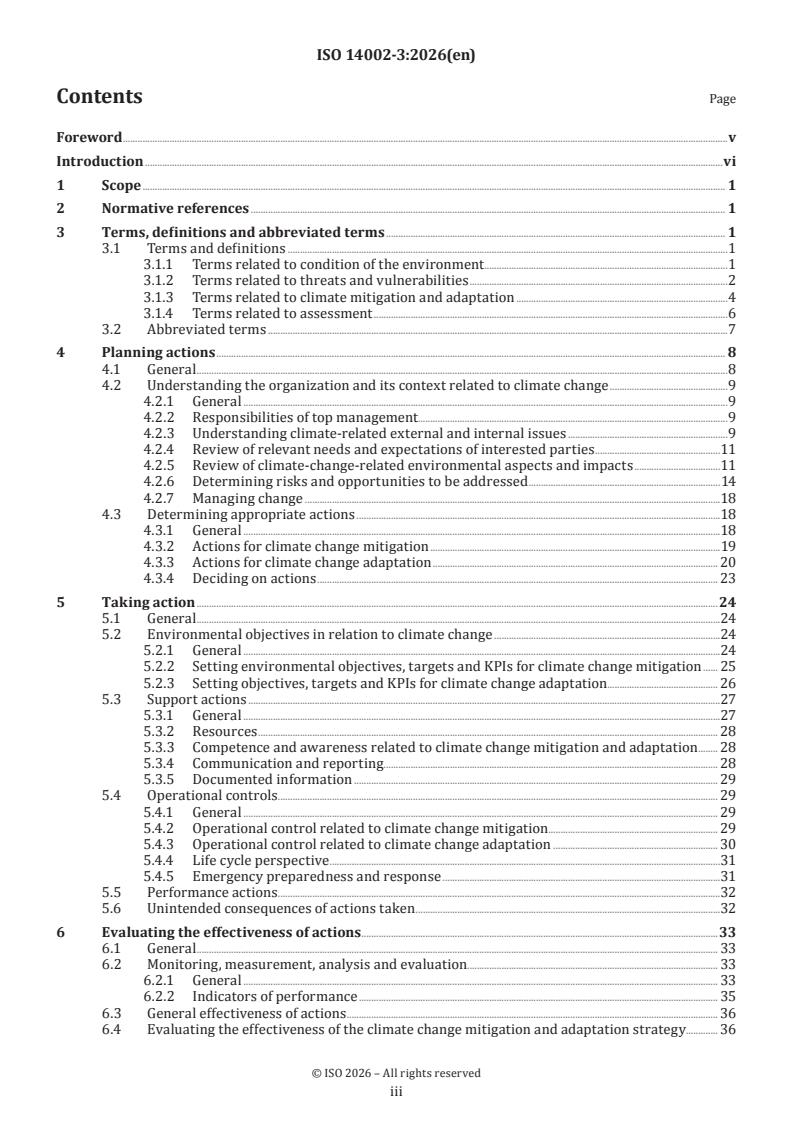
Contents Page
Foreword .v
Introduction .vi
1 Scope . 1
2 Normative references . 1
3 Terms, definitions and abbreviated terms . 1
3.1 Terms and definitions .1
3.1.1 Terms related to condition of the environment .1
3.1.2 Terms related to threats and vulnerabilities .2
3.1.3 Terms related to climate mitigation and adaptation .4
3.1.4 Terms related to assessment .6
3.2 Abbreviated terms .7
4 Planning actions . 8
4.1 General .8
4.2 Understanding the organization and its context related to climate change .9
4.2.1 General .9
4.2.2 Responsibilities of top management . .9
4.2.3 Understanding climate-related external and internal issues .9
4.2.4 Review of relevant needs and expectations of interested parties .11
4.2.5 Review of climate-change-related environmental aspects and impacts .11
4.2.6 Determining risks and opportunities to be addressed .14
4.2.7 Managing change .18
4.3 Determining appropriate actions .18
4.3.1 General .18
4.3.2 Actions for climate change mitigation .19
4.3.3 Actions for climate change adaptation . 20
4.3.4 Deciding on actions . 23
5 Taking action .24
5.1 General .24
5.2 Environmental objectives in relation to climate change .24
5.2.1 General .24
5.2.2 Setting environmental objectives, targets and KPIs for climate change mitigation . 25
5.2.3 Setting objectives, targets and KPIs for climate change adaptation . . 26
5.3 Support actions .27
5.3.1 General .27
5.3.2 Resources . 28
5.3.3 Competence and awareness related to climate change mitigation and adaptation . 28
5.3.4 Communication and reporting. 28
5.3.5 Documented information . 29
5.4 Operational controls . 29
5.4.1 General . 29
5.4.2 Operational control related to climate change mitigation . . 29
5.4.3 Operational control related to climate change adaptation . 30
5.4.4 Life cycle perspective .31
5.4.5 Emergency preparedness and response .31
5.5 Performance actions.32
5.6 Unintended consequences of actions taken .32
6 Evaluating the effectiveness of actions . .33
6.1 General . 33
6.2 Monitoring, measurement, analysis and evaluation . . 33
6.2.1 General . 33
6.2.2 Indicators of performance . 35
6.3 General effectiveness of actions . . 36
6.4 Evaluating the effectiveness of the climate change mitigation and adaptation strategy . 36
iii
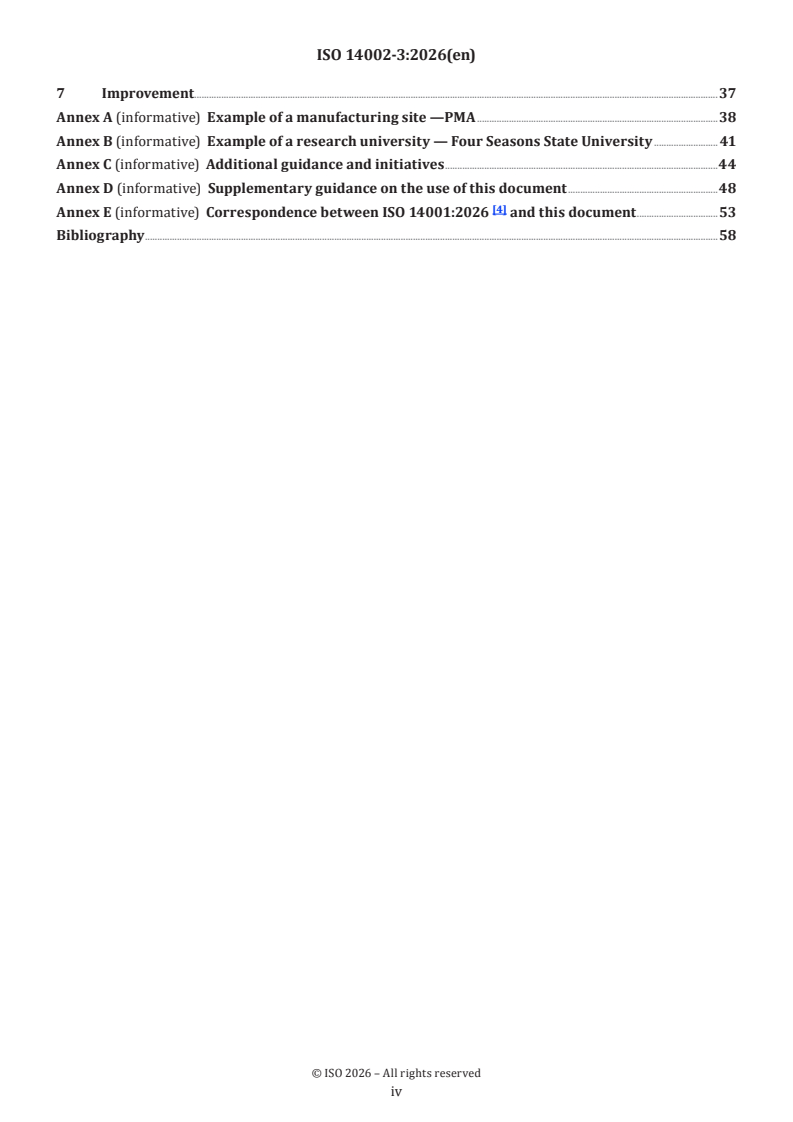
7 Improvement .37
Annex A (informative) Example of a manufacturing site —PMA .38
Annex B (informative) Example of a research university — Four Seasons State University . 41
Annex C (informative) Additional guidance and initiatives .44
Annex D (informative) Supplementary guidance on the use of this document .48
[4]
Annex E (informative) Correspondence between ISO 14001:2026 and this document .53
Bibliography .58
iv
Foreword
ISO (the International Organization for Standardization) is a worldwide federation of national standards
bodies (ISO member bodies). The work of preparing International Standards is normally carried out through
ISO technical committees. Each member body interested in a subject for which a technical committee
has been established has the right to be represented on that committee. International organizations,
governmental and non-governmental, in liaison with ISO, also take part in the work. ISO collaborates closely
with the International Electrotechnical Commission (IEC) on all matters of electrotechnical standardization.
The procedures used to develop this document and those intended for its further maintenance are described
in the ISO/IEC Directives, Part 1. In particular, the different approval criteria needed for the different types
of ISO document should be noted. This document was drafted in accordance with the editorial rules of the
ISO/IEC Directives, Part 2 (see www.iso.org/directives).
ISO draws attention to the possibility that the implementation of this document may involve the use of (a)
patent(s). ISO takes no position concerning the evidence, validity or applicability of any claimed patent
rights in respect thereof. As of the date of publication of this document, ISO had not received notice of (a)
patent(s) which may be required to implement this document. However, implementers are cautioned that
this may not represent the latest information, which may be obtained from the patent database available at
www.iso.org/patents. ISO shall not be held responsible for identifying any or all such patent rights.
Any trade name used in this document is information given for the convenience of users and does not
constitute an endorsement.
For an explanation of the voluntary nature of standards, the meaning of ISO specific terms and expressions
related to conformity assessment, as well as information about ISO’s adherence to the World Trade
Organization (WTO) principles in the Technical Barriers to Trade (TBT), see www.iso.org/iso/foreword.html.
This document was prepared by Technical Committee ISO/TC 207, Environmental management,
Subcommittee SC 1, Environmental management systems.
A list of all parts in the ISO 14002 series can be found on the ISO website.
Any feedback or questions on this document should be directed to the user’s national standards body. A
complete listing of these bodies can be found at www.iso.org/members.html.
v
Introduction
0.1 Background
The climate crisis is putting lives and livelihoods at risk across the globe, especially for the most vulnerable.
As the effects on people and nature will only intensify in the coming decades, this calls for fundamental
shifts in development, business practices and urgent, transformative actions. Generally, all economic activity
leads to a certain degree of direct or indirect contribution to global climate change.
The Intergovernmental Panel on Climate Change (IPCC) has indicated that stabilizing the climate will
require strong, rapid, and sustained reductions in greenhouse gas (GHG) emissions, and reaching net
zero CO emissions. In addition, the IPCC has stated that limiting other GHGs and air pollutants, especially
[1]
methane, can have benefits both for health and the climate.
Organizations affect global climate, and can in turn be affected by changing climate and environmental
conditions. Until recently, the climate change dialogue has been largely focused on mitigation issues relating
to the reduction in emissions of GHGs. However, adaptation is as urgent as mitigation. It is therefore prescient
to globally ramp up actions to become more resilient to the changing climate while continuing to reduce
GHG emissions.
The overall level of adaptation effort is dependent on the rate and scale of global GHG emission reductions.
However, for individual organizations, the level of adaptation is dependent on threats from cumulative global
emissions over several decades, rather than their own emissions and mitigation efforts. In addition, the
effects vary with geographic location, as some regions of the world are much more vulnerable than others.
This document provides guidance to organizations on becoming more climate resilient and preparing for
the inevitable effects of the climate crisis while simultaneously managing and reducing their GHG emissions.
Successful climate change mitigation and adaptation are integral to achieving sustainable development and
the United Nations (UN) Sustainable Development Goals (SDGs).
[2]
Many organizations apply the general ISO 14001 framework to manage their interactions with the
[2]
environment. This document provides guidance and examples focused on applying the ISO 14001
framework to address climate-related environmental aspects and impacts, as well as climate-related
environmental conditions, vulnerabilities and dependencies that can have an effect on the organization.
It supports organizations to plan action(s) where needed in relation to environmental impacts, risks and
opportunities at their site(s) and in the life cycle of their products and services.
This document is designed for compatibility with other standards related to climate change mitigation and
[2]
adaptation. It follows the same approach and order of elements as ISO 14001 but does not address every
subclause.
0.2 Risk-based approach
This document enables organizations to address:
— actual and potential adverse or beneficial climate-related environmental impacts originating from their
activities or their supply chains;
— actual and potential effects of climate change on the organization itself, including risks and opportunities
related to climate change.
Potential effects of climate change on the organization can include acute and chronic physical threats (e.g.
increasing frequency of extreme weather events) as well as transitional risks and opportunities related
to changes in regulations, technology and markets. The organization’s reputation and its opportunity to
contribute to sustainable development from a life cycle perspective can also be affected.
The magnitude of climate-related risks and opportunities can be influenced by various context-related
factors such as physical, social, economic and environmental factors that determine vulnerability to climate
change, including an organization’s geographic location, availability of natural resources, conditions of
existing infrastructure, characteristics of the built environment, sensitivity of the workforce and adaptive
capacity.
vi
0.3 Holistic approach to climate change mitigation and adaptation
[2]
An environmental management system (EMS) conforming to ISO 14001 requires an organization to
determine and address significant environmental aspects and impacts associated with its activities,
products and services, as well as environmentally related risks and opportunities for the organization that
need to be addressed in relation to its context. This process involves using a life cycle perspective as part
of a comprehensive evaluation of the influence the organization can have on the environment and how it
depends on it.
This document provides guidance on addressing climate-related environmental impacts, as well as the
effects of climate change on the organization, addressing both climate change mitigation and climate change
adaptation. The organization can control or reduce its climate-related environmental aspects such as GHG
emissions through climate change mitigation. In addition, the organization can consider its internal and
external context and how it is affected by climate change and take action to minimize potential adverse
effects or leverage beneficial effects through climate change adaptation.
An organization that intends to strengthen its environmental management efforts on climate change
mitigation and adaptation should recognize the interrelation of climate with other environmental media
and respective ecosystems. Actions taken for climate change mitigation and adaptation can potentially incur
adverse environmental impacts on media such as soil and water, or on terrestrial and aquatic ecosystems.
To avoid such unintended consequences, this document encourages the organization to take a holistic
[2]
approach when taking mitigation and adaptation action. Figure 1 shows how ISO 14001 and the parts of
[3]
the ISO 14002 series can be applied using a holistic approach. The correlation between the clauses in this
[4]
document and the corresponding clauses in ISO 14001:2026 are shown in Annex E.
[2] [3]
Figure 1 — Interaction between ISO 14001 and the ISO 14002 series
0.4 Using this document to address the environmental topic area of climate within an environmental
management system
An organization can use this document to help determine the most appropriate way to address and embed
climate change mitigation and climate change adaptation within its EMS. This can be related to, for example:
— specific commitment(s) in the organization’s environmental policy (e.g. reduction of GHG emissions,
enhancement of infrastructure resilience, improved energy efficiency, conservation of ecosystems and
related biodiversity);
— one or more of the organization’s significant environmental aspects or compliance obligations related to
climate, energy use or air pollution associated with GHGs;
vii
— compliance with applicable climate-related permits;
— commitments related to the organization’s social responsibility;
— specific risks and opportunities that need to be addressed for climate-related environmental conditions
or dependencies;
— management of environmental aspects across the life cycle of the organization’s products and services.
[2]
Climate change mitigation and adaptation can be implemented following the existing ISO 14001
framework, based on a Plan-Do-Check-Act (PDCA) cycle. Climate change mitigation fits directly into the
[2]
ISO 14001 PDCA framework in relation to environmental aspects. Climate change adaptation fits into
[2]
the ISO 14001 framework as a means to address risks and opportunities to the organization. Related
[5]
frameworks for climate change adaptation, such as ISO 14090 , follow a similar cycle and include additional
guidance, organized in different elements. Figure 2 illustrates climate change adaptation within the PDCA
framework and the clauses of this document.
Figure 2 — Adaptation cycle
[2]
NOTE Figure 2 is adapted from ISO 14001 and the European Environment Agency (EEA) Climate-ADAPT.
Climate change adaptation should start with preparing the ground for adaptation in a structured way, and
assessing climate-related environmental impact(s) and the organization’s climate risks and vulnerabilities
with consideration of current and future climate conditions, as well as transboundary issues to avoid
maladaptation. Identifying, assessing and prioritizing adaptation options are part of the planning process.
The adaptation options should be implemented, monitored and evaluated, consistent with the Do, Check and
Act phases in the PDCA cycle.
As shown in Figure 2, adaptation to climate change is not static. It is a continuous process that must be re-
evaluated and adjusted regularly in accordance with a changing climate and state of the art knowledge.
Table E.2 provides additional information regarding the climate adaptation process.
References to other standards and helpful guidance can be found in Annex C.
viii
0.5 Case studies
The guidance provided in this document includes three case studies of organizations applying the ISO 14001
[2]
framework to address climate-related environmental aspects and environmental impacts, the effects of
climate change on the organization, and the associated risks and opportunities that need to be addressed.
The organizations in these case studies are fictional and serve as illustrative examples in diverse contexts,
including different business and service sectors and different geographic locations and environmental
conditions.
These cases are provided to illustrate how this document can be applied, with examples from different
[2]
settings and perspectives, and are not intended as models or templates for applying ISO 14001 or this
document. The first of these cases represents a dairy company and is incorporated in the main body of the
document, with examples shown in each clause as appropriate. The other cases in Annex A and Annex B
represent a medium-sized polyurethane manufacturer and a large research university.
0.6 Benefits
The benefits of applying this document include:
— addressing compliance obligations related to climate change, energy use and air quality, as well as
supporting public socio-economic policies;
— enhancing environmental performance and fostering resilient ecosystems through the improved
management of climate-related environmental aspects;
— protecting the environment through prevention or mitigation of adverse climate-related environmental
impacts on natural resources and ecosystems;
— preventing and mitigating adverse climate-related effects on business and leveraging opportunities in
the organization’s operations and its supply chain, in response to changing environmental conditions;
— aligning the EMS with the organization’s strategic direction, to support specific environmental policy or
organizational commitments related to climate change mitigation and adaptation;
— supporting climate-related global goals for sustainable development (e.g. the UN SDGs);
— contributing to just transition principles, protecting workers and vulnerable communities;
— contributing to conformity with international agreements and conventions related to climate change;
— protecting infrastructure and built environment.
These benefits can also lead to cost reductions, security of supply and production, better relations with
relevant interested parties, improved public image, or the maintenance of a “social licence to operate”.
ix
International Standard ISO 14002-3:2026(en)
Environmental management systems — Guidelines for using
ISO 14001 to address environmental aspects and conditions
within an environmental topic area —
Part 3:
Climate
1 Scope
This document gives guidance to organizations on addressing climate-related environmental aspects,
environmental conditions, and the associated risks and opportunities within an environmental management
[2]
system (EMS) in accordance with ISO 14001 . It addresses the environmental topic area of climate from
both perspectives: mitigation and adaptation.
This document is applicable to any organization, regardless of type, size or nature. It includes consideration
of the organization’s activities, products and services that the organization determines it can either control
or influence, taking a life cycle perspective.
2 Normative references
The following documents are referred to in the text in such a way that some or all of their content constitutes
requirements of this document. For dated references, only the edition cited applies. For undated references,
the latest edition of the referenced document (including any amendments) applies.
ISO 14001, Environmental management systems — Requirements with guidance for use
3 Terms, definitions and abbreviated terms
For the purposes of this document, the terms and definitions given in ISO 14001 and the following apply.
ISO and IEC maintain terminology databases for use in standardization at the following addresses:
— ISO Online browsing platform: available at https:// www .iso .org/ obp
— IEC Electropedia: available at https:// www .electropedia .org/
3.1 Terms and definitions
3.1.1 Terms related to condition of the environment
3.1.1.1
environmental topic area
area of interest or concern for environmental management in an organization in relation to its surroundings
[6]
[SOURCE: ISO 14002-1:2019 , 3.1]
3.1.1.2
ecosystem
dynamic complex of plant, animal and microorganism communities, and their non-living environment
interacting as a functional entity
EXAMPLE Deserts, coral reefs, wetlands, rain forests, boreal forests, grasslands, urban parks, cultivated
farmlands.
Note 1 to entry: Ecosystems can be influenced by human activity.
[7]
[SOURCE: ISO 14008:2019 , 3.1.6]
3.1.1.3
climate
statistical description of weather in terms of the mean and variability of relevant quantities over a period of
time ranging from months to thousands or millions of years
Note 1 to entry: The classical period for averaging these variables is 30 years, as defined by the World Meteorological
Organization.
Note 2 to entry: The relevant quantities are most often near-surface variables such as temperature, precipitation and
wind.
[8]
[SOURCE: ISO 14090:2019 , 3.4]
3.1.1.4
climate change
change in climate (3.1.1.3) that persists for an extended period, typically decades or longer
Note 1 to entry: Climate change can be due to natural processes, internal to the climate system, or external forcings
such as modulations of the solar cycles, volcanic eruptions and persistent anthropogenic changes in the composition of
the atmosphere or in land, water or raw materials and natural resource use.
[8]
[SOURCE: ISO 14090:2019 , 3.5, modified — Note 1 to entry deleted. “land, water or raw materials and
natural resource use” replaced “land use” in Note 2 to entry.]
3.1.1.5
sensitivity
degree to which a system or species is affected, either adversely or beneficially, by climate (3.1.1.3)
Note 1 to entry: The effect can be direct (e.g. a change in crop yield in response to a change in the mean, range or
variability of temperature) or indirect (e.g. damages caused by an increase in the frequency of coastal flooding due to
sea level rise).
[9]
[SOURCE: ISO 14091:2021 , 3.10, modified — “variability or change” deleted in the definition.]
3.1.2 Terms related to threats and vulnerabilities
3.1.2.1
life cycle perspective
consideration of the environmental aspects relating to a product (or service) during its entire life cycle
Note 1 to entry: The life cycle stages include acquisition of raw materials, design, production, transportation/delivery,
use, end-of-life treatment and final disposal.
[10]
[SOURCE: ISO 14050:2020 , 3.6.33, modified — “life cycle thinking” deleted as the preferred term. “(or
service)” added to the definition. Note 1 to entry added.]
3.1.2.2
climate risk
potential adverse effects of climate change (3.1.1.4) that reflects the interaction among vulnerability (3.1.2.7),
exposure (3.1.2.3) and hazard (3.1.2.4)
Note 1 to entry: Climate risk can be reduced by enhancing adaptive capacity (3.1.3.9) and strengthening resilience
(3.1.3.11) of ecology, society and economy.
[11]
[SOURCE: ISO 14080:2018 , 3.1.3.3, modified — “adverse effects” replaced “negative impacts” in the
definition.]
3.1.2.3
exposure
presence of people, livelihoods, species or ecosystems (3.1.1.2), environmental functions, services, resources,
infrastructure, or economic, social or cultural assets in places and settings that can be affected
Note 1 to entry: Exposure can change over time, for example as a result of land use change.
[8]
[SOURCE: ISO 14090:2019 , 3.6]
3.1.2.4
hazard
potential source of harm
Note 1 to entry: The potential for harm can be in terms of loss of life, injury or other health effects, as well as damage
and loss of property, infrastructure, livelihoods, service provision, ecosystems (3.1.1.2) and environmental resources.
Note 2 to entry: Hazard comprises slow-onset developments (e.g. rising temperatures over the long term) as well as
rapidly developing climatic extremes (e.g. heatwave or a landslide) or increased variability.
[8]
[SOURCE: ISO 14090:2019 , 3.7, modified — Note 2 to entry deleted.]
3.1.2.5
physical risk
potential adverse effects resulting from event-driven (acute) or longer-term shifts (chronic) in climate
patterns associated with climate change (3.1.1.4)
Note 1 to entry: Physical risks can have financial implications for organizations, such as direct effect to assets and
indirect effects on supply chains owing to changes in water availability, sourcing and quality, food security, and
for organizations’ premises and operations, supply chain, transport needs and employee safety owing to extreme
temperature changes.
Note 2 to entry: Acute physical risks refer to potential adverse effects that are event-driven, including increased
severity of extreme weather events, such as cyclones, hurricanes or floods.
Note 3 to entry: Chronic physical risks refer to longer-term shifts in climate patterns (e.g. sustained higher
temperatures) that can cause, for example, sea-level rise or chronic heatwaves.
[12]
[SOURCE: ISO 14097:2021 , 3.26, modified — “potential adverse effects” used instead of “risk”, “impacts”
changed to “effects” in Note 1 to entry, “potential adverse effects” used instead of “those risks” in Note 2 to
entry, “such as” added in Note 3 to entry.]
3.1.2.6
transition risk
potential adverse effects related to the transition to a lower-carbon economy
Note 1 to entry: The transition risk is related to policy, legal, technology, and market changes to address mitigation
(3.1.3.3) and adaptation (3.1.3.8) requirements related to climate change (3.1.1.4).
Note 2 to entry: Transition risk results in varying levels of effect on the financial performance and reputation of the
organization.
[12]
[SOURCE: ISO 14097:2021 , 3.25, modified — Note 1 to entry changed, Note 3 to entry deleted, “reputation
of the financier” changed to “reputation of the organization” in Note 2 to entry.]
3.1.2.7
vulnerability
propensity or predisposition to be adversely affected
Note 1 to entry: Vulnerability encompasses a variety of concepts and elements including sensitivity (3.1.1.5) or
susceptibility to harm and lack of capacity to cope and adapt.
[8]
[SOURCE: ISO 14090:2019 , 3.15]
3.1.3 Terms related to climate mitigation and adaptation
3.1.3.1
climate action
initiative to achieve climate change (3.1.1.4) measures or goals based on mitigation (3.1.3.3) and/or
adaptation (3.1.3.8) priorities under climate change policies
Note 1 to entry: Climate action intends to:
a) reduce or prevent emissions or enhance GHG removals (3.1.3.5);
b) reduce vulnerability (3.1.2.7), maintain and increase the resilience (3.1.3.11), and increase adaptive capacity
(3.1.3.9) of human and ecological systems from adverse effects of climate change.
[11]
[SOURCE: ISO 14080:2018 , 3.1.1 - modified by deleting the article “any” in the beginning of the definition,
“GHG” added to Note 1 to entry and “impacts” changed to “effects” in Note 1 to entry.]
3.1.3.2
climate goals
long-term goals based on mitigation (3.1.3.3) and adaptation (3.1.3.8) priorities
Note 1 to entry: International climate goals (3.1.3.2) are defined in the Paris Agreement and include the principle
of common but differentiated responsibilities and respective capabilities (CBDR-RC), in light of different national
circumstances.
Note 2 to entry: The Paris Agreement defines the following mitigation (3.1.3.3) and adaptation (3.1.3.8) goals:
a) holding the increase in the global average temperature to well below 2 °C above pre-industrial levels pursuing
efforts to limit the temperature increase to 1,5 °C above pre-industrial levels, recognizing that this would
significantly reduce climate risk (3.1.2.2);
b) increasing the ability to adapt to the adverse effects of climate change (3.1.1.4) and foster climate resilience
(3.1.3.11) and low greenhouse gas emission development, in a manner which does not threaten food production;
c) making finance flows consistent with a pathway towards low greenhouse gas emissions and climate-resilient
development.
[12]
[SOURCE: ISO 14097:2021 , 3.1, modified — “international” deleted, “the principle of common but
differentiated responsibilities and respective capabilities (CBDR-RC), in light of different national
circumstances.” added to Note 1 to entry.]
3.1.3.3
mitigation
〈climate change〉 human intervention to reduce greenhouse gas (GHG) emissions or enhance GHG removals
(3.1.3.5)
[13]
[SOURCE: ISO 14068-1:2023 , 3.2.15, modified — “mitigation” replaced “climate change mitigation” as the
term. Subject field “climate change” added.]
3.1.3.4
indirect greenhouse gas emission
indirect GHG emission
GHG emission that is a consequence of, and within the boundary of, the subject, but that arises from GHG
sources that are not owned or controlled by the entity
[13]
[SOURCE: ISO 14068-1:2023 , 3.2.6, modified — Note 1 to entry deleted.]
3.1.3.5
greenhouse gas removal
GHG removal
withdrawal of a GHG from the atmosphere by a GHG sink
Note 1 to entry: Examples of ways in which GHG removals (3.1.3.5) can be achieved include reforestation, carbon
sequestration in soils, sustainable bioenergy with carbon capture and storage, and direct air carbon capture and
storage.
Note 2 to entry: In this document, the term “GHG removal” includes permanent storage of GHGs.
[13]
[SOURCE: ISO 14068-1:2023 , 3.2.7, modified — Note 2 to entry added.]
3.1.3.6
offsetting
counterbalancing of the carbon footprint, by retiring (a) carbon credit(s)
Note 1 to entry: The final step in the process of offsetting is to retire the carbon credits in a public registry by, or
on behalf of, the entity. Some registries use “to cancel” as synonymous with “to retire” and the terms are effectively
interchangeable. The two terms “retire” and “cancel” result in the same outcome of ensuring that the carbon credits
cannot be used again or be further traded.
[13]
[SOURCE: ISO 14068-1:2023 , 3.3.1]
3.1.3.7
carbon neutrality
condition in which anthropogenic carbon dioxide (CO ) emissions associated with a subject are balanced by
anthropogenic CO removals
[14]
[SOURCE: IPCC 2023, Glossary (Annex I) ]
3.1.3.8
adaptation
〈climate change〉 process of adjustment to actual or expected climate (3.1.1.3) and its effects
Note 1 to entry: In human systems, adaptation (3.1.3.8) seeks to moderate or avoid harm or exploit beneficial
opportunities.
Note 2 to entry: In some natural systems, human intervention can facilitate adjustment to expected climate and its
effects.
Note 3 to entry: An adaptation plan of action can contain priorities and planned activities for identifying and
addressing effects of climate change (3.1.1.4), including those associated with climate variability and extremes. It can
include a mix of policies, projects, programmes and measures which are updated periodically (see ISO/TS 14092:2020
[15]
, 3.14).
[8]
[SOURCE: ISO 14090:2019 , 3.1, modified — “adaptation” replaced “climate change adaptation”. Admitted
term deleted. Subject field “climate change” added. Note 3 to entry added.]
3.1.3.9
adaptive capacity
ability of systems, institutions, humans and other organisms to adjust to potential damage, to take advantage
of opportunities, or to respond to consequences
[8]
[SOURCE: ISO 14090:2019 , 3.2]
3.1.3.10
maladaptation
actions intended to contribute to climate change adaptation, but which can lead to increased climate risk
(3.1.2.2), increased vulnerability (3.1.2.7) to climate change (3.1.1.4), or diminished welfare, now or in the
future
Note 1 to entry: Maladaptation is a cause of increasing concern to adaptation planners, where intervention in one
location or sector can increase the vulnerability (3.1.2.7) of another location or sector, or increase the vulnerability
(3.1.2.7) of the target group to future climate change.
[16]
[SOURCE: ISO 14093:2022 , 3.1.3.9, modified — “climate risk” replaced “risk” and “of adverse climate-
related outcomes” deleted in the definition. Note 1 to entry added.]
3.1.3.11
resilience
adaptive capacity (3.1.3.9) of an organization in a complex and changing environment
Note 1 to entry: Intergovernmental Panel on Climate Change (IPCC) defines resilience as “capacity of social, economic,
and environmental systems to cope with a hazardous event or trend or disturbance, responding or reorganizing in
ways that maintain their essential function, identity and structure, while also maintaining the capacity for adaptation,
learning and transformation”.
[12]
[SOURCE: ISO 14097:2021 , 3.5]
3.1.4 Terms related to assessment
3.1.4.1
base year
specific, historical period identified for the purpose of comparing greenhouse gas (GHG) emissions or GHG
removals (3.1.3.5) or other GHG-related information over time
[17]
[SOURCE: ISO 14064-1:2018 , 3.2.10]
3.1.4.2
baseline
〈GHG〉 quantified greenhouse gas (GHG) emissions and GHG removals (3.1.3.5) of an organization at a
specified time against which assessment of progress to net zero can be performed
Note 1 to entry: Emissions and GHG removals are separate parts of the baseline and calculation of emissions reduction
only refers to the baseline emissions.
Note 2 to entry: The Greenhouse Gas Protocol (GHGP) provides further information on baselines, which it refers to as
“base year”.
3.1.4.3
climate projection
simulated response of a climate system to a scenario of future emission or concentration of greenhouse
gases and aerosols, generally derived using climate models
Note 1 to entry: Climate projections are distinguished from climate predictions in order to emphasize that climate
projections depend upon the emission/concentration/radiative forcing scenario used, which are based on assumptions
concerning, for example, future socioeconomic and technological developments that can be, but are not always,
realized.
[9]
[SOURCE: ISO 14091:2021 , 3.7, modified — “may or may not be” replaced with “can be, but are not always,”
in Note 1 to entry.]
3.1.4.4
climate scenario
plausible and often simplified representation of the future climate (3.1.1.3), based on an internally consistent
set of climatological relationships that has been constructed for explicit use in investigating the potential
consequences of anthropogenic climate change (3.1.1.4)
Note 1 to entry: Climate scenarios often serve as inputs to models for the potential effects of climate change.
3.1.4.5
indicator
quantitative, qualitative or binary variable that can be measured or described, representing the status of
operations, management, conditions or impact
Note 1 to entry: The term “impact” in this definition can include both environmental impact and potential effects of
climate change (3.1.1.4).
[18]
[SOURCE: ISO 14031:2021 , 3.4.1, modified — Note 1 to entry added.]
3.1.4.6
global warming potential
GWP
index, based on radiative properties of greenhouse gases (GHGs), measuring the radiative forcing following
a pulse emission of a unit mass of a given GHG in the present-day atmosphere integrated over a chosen time
horizon, relative to that of carbon dioxide (CO )
Note 1 to entry: The Intergovernmental Panel on Climate Change (IPCC) publishes and regularly updates GWP values
for various time horizons, including 20, 100 and 500 years.
Note 2 to entry: GWP100 is the internationally accepted standard for national emissions accounting, as agreed at
the United Nations level. GWP100 is commonly used for corporate emissions accounting and reporting programmes.
GWP100 can have limitations when making decisions around short-lived gases.
[13]
[SOURCE: ISO 14068-1:2023 , 3.2.11, modified — Note 2 to entry added.]
3.2 Abbreviated terms
CapEx Capital Expenditure
CCA climate change adaptation
CCM climate change mitigation
CCS carbon capture and storage
CCU carbon capture and utilization
CDR carbon dioxide removal
CFCs chlorofluo
...