


ISO 4226:2026
(Main)Air quality — General aspects — Quantities and associated units for reporting results of air quality measurements
General Information
- Abstract
This document establishes the terms and symbols used to report the results of air quality measurements. NOTE General guidance on the International System of Units is given in the ISO 80000 series.
- Status
- Published
- Publication Date
- 14-Sep-2026
- Technical Committee
- ISO/TC 146/SC 4 - General aspects
- Drafting Committee
- ISO/TC 146/SC 4 - General aspects
- Current Stage
- 6060 - International Standard published
- Start Date
- 15-Sep-2026
- Due Date
- 25-Sep-2026
- Completion Date
- 15-Sep-2026

Overview
ISO 4226:2026 - Air quality - General aspects - Quantities and associated units for reporting results of air quality measurements is an international standard developed by the International Organization for Standardization (ISO). This standard defines the essential terms, recommended symbols, and units for reporting the results of air quality measurements. By providing uniformity and clarity, ISO 4226:2026 ensures that air quality data can be consistently interpreted, compared, and exchanged worldwide across various applications such as environmental monitoring, workplace safety, and regulatory compliance.
Key Topics
- Standardized Terms and Symbols: Establishes consistent terminology and symbols for quantities relevant to air quality, encompassing general quantities such as mass, temperature, time, concentration, and pressure.
- Associated Units: Recommends units (e.g., gram, kelvin, pascal, cubic metre, microgram per cubic metre) for all reported results, following the guidelines of the International System of Units (SI).
- Application-Specific Quantities: Covers units and symbols for specialized areas of air quality assessment, including stationary source emissions, workplace atmospheres, ambient air quality, meteorological measurements, and indoor air.
- Prefixes for Multiples and Submultiples: Details the correct use of SI prefixes (e.g., kilo, micro, nano) to accurately report large and small measurement values.
- Statistical Parameters: Includes recommended units and terminology for expressing measurement uncertainty, confidence intervals, and related statistical quantifiers.
- Avoiding Ambiguity: Provides guidance for using indices and descriptors when identical symbols represent different quantities, and clarifies the importance of precise language in reporting air quality data.
Applications
- Environmental Monitoring: Essential for agencies and organizations conducting ambient air quality surveys, emissions assessments, and pollution source analysis. The standard’s uniform reporting facilitates trend evaluation and cross-regional data comparison.
- Regulatory Compliance: Supports regulatory bodies and industries in meeting national and international reporting requirements, ensuring consistent air quality data submission.
- Workplace Safety: Used by occupational health professionals to report results of workplace air measurements, ensuring worker exposure limits are accurately documented and enforced.
- Indoor Air Quality Assessment: Applied in building management and health studies to standardize reporting on ventilation rates, pollutant concentrations, and related metrics.
- Scientific Research: Provides a common groundwork for researchers to publish comparable air quality findings, enhancing reproducibility and data integrity across studies.
- Data Communication and Exchange: Enables interoperability between organizations, laboratories, and authorities by ensuring data is expressed using unambiguous, agreed-upon units and symbols.
Related Standards
- ISO 80000 Series - Quantities and Units: Comprehensive series that provides general guidance on the use of SI units and definitions of quantities, which underpin the unit recommendations in ISO 4226:2026.
- ISO 14644 Series - Cleanrooms and Associated Controlled Environments: Related to air cleanliness and measurement, often used alongside air quality reporting standards.
- IEC Electropedia and ISO Online Browsing Platform: Authoritative resources for standardized terminology in science and engineering.
- National Standards on Air Quality: Many countries base their regulations and guidelines for air quality reporting on the principles standardized in ISO 4226.
ISO 4226:2026 is fundamental for professionals engaged in air quality measurement, environmental assessment, and data reporting. By following its guidelines for terms, symbols, and units, stakeholders can ensure clarity, accuracy, and global compatibility in air quality results. This contributes to the advancement of science, the protection of public health, and the effectiveness of environmental policy and regulatory frameworks.
Relations
- Effective Date
- 28-Oct-2023
Get Certified
Connect with accredited certification bodies for this standard

CIS Institut d.o.o.
Personal Protective Equipment (PPE) certification body. Notified Body NB-2890 for EU Regulation 2016/425 PPE.

Kiwa BDA Testing
Building and construction product certification.
Kmetijski inštitut Slovenije
Agricultural Institute of Slovenia. Soil testing, plant health, agricultural product analysis.
Sponsored listings
Frequently Asked Questions
ISO 4226:2026 is a standard published by the International Organization for Standardization (ISO). Its full title is "Air quality — General aspects — Quantities and associated units for reporting results of air quality measurements". This standard covers: This document establishes the terms and symbols used to report the results of air quality measurements. NOTE General guidance on the International System of Units is given in the ISO 80000 series.
This document establishes the terms and symbols used to report the results of air quality measurements. NOTE General guidance on the International System of Units is given in the ISO 80000 series.
ISO 4226:2026 is classified under the following ICS (International Classification for Standards) categories: 01.060 - Quantities and units; 13.040.01 - Air quality in general. The ICS classification helps identify the subject area and facilitates finding related standards.
ISO 4226:2026 has the following relationships with other standards: It is inter standard links to ISO 4226:2007. Understanding these relationships helps ensure you are using the most current and applicable version of the standard.
ISO 4226:2026 is available in PDF format for immediate download after purchase. The document can be added to your cart and obtained through the secure checkout process. Digital delivery ensures instant access to the complete standard document.
Standards Content (Sample)
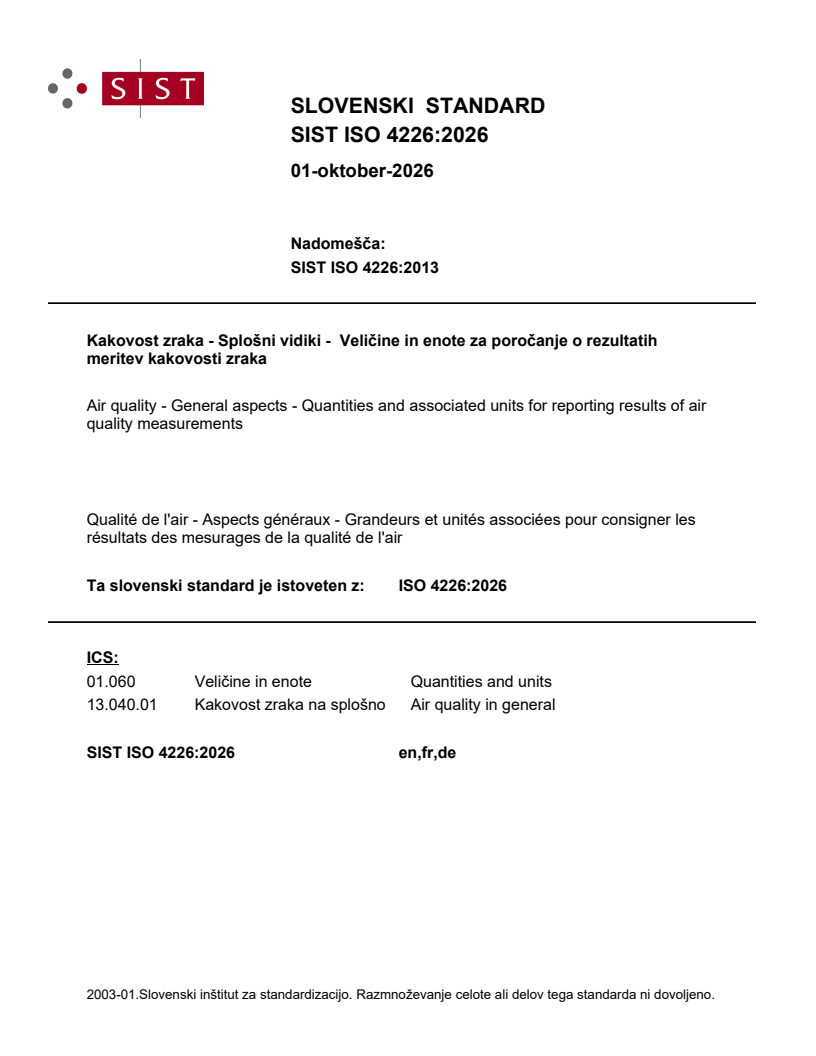
SLOVENSKI STANDARD
01-oktober-2026
Nadomešča:
SIST ISO 4226:2013
Kakovost zraka - Splošni vidiki - Veličine in enote za poročanje o rezultatih
meritev kakovosti zraka
Air quality - General aspects - Quantities and associated units for reporting results of air
quality measurements
Qualité de l'air - Aspects généraux - Grandeurs et unités associées pour consigner les
résultats des mesurages de la qualité de l'air
Ta slovenski standard je istoveten z: ISO 4226:2026
ICS:
01.060 Veličine in enote Quantities and units
13.040.01 Kakovost zraka na splošno Air quality in general
2003-01.Slovenski inštitut za standardizacijo. Razmnoževanje celote ali delov tega standarda ni dovoljeno.
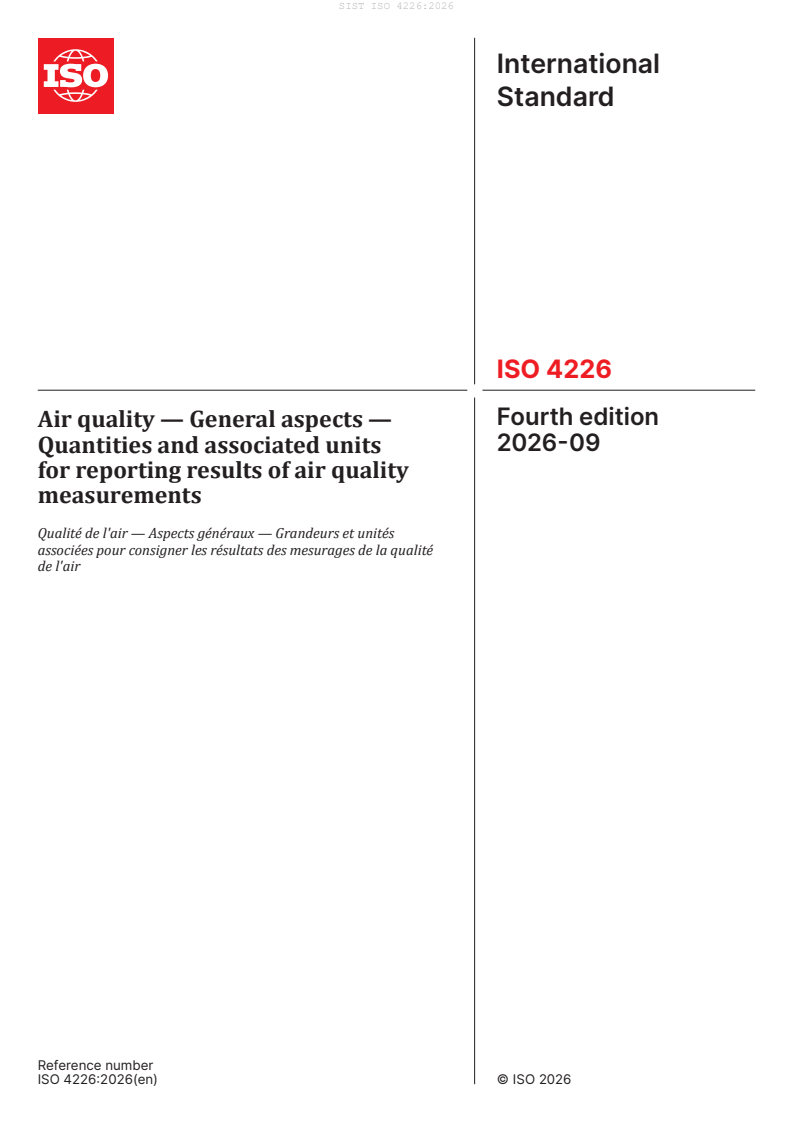
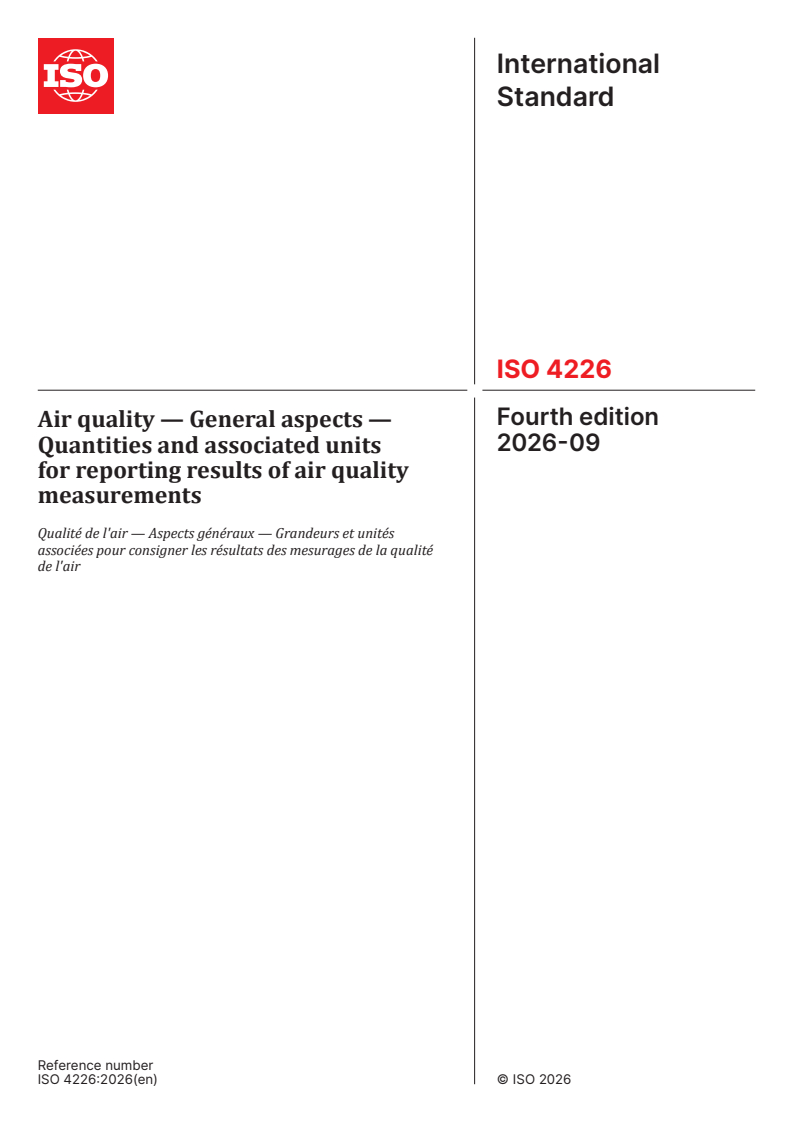
International
Standard
ISO 4226
Fourth edition
Air quality — General aspects —
2026-09
Quantities and associated units
for reporting results of air quality
measurements
Qualité de l'air — Aspects généraux — Grandeurs et unités
associées pour consigner les résultats des mesurages de la qualité
de l'air
Reference number
© ISO 2026
All rights reserved. Unless otherwise specified, or required in the context of its implementation, no part of this publication may
be reproduced or utilized otherwise in any form or by any means, electronic or mechanical, including photocopying, or posting on
the internet or an intranet, without prior written permission. Permission can be requested from either ISO at the address below
or ISO’s member body in the country of the requester.
ISO copyright office
CP 401 • Ch. de Blandonnet 8
CH-1214 Vernier, Geneva
Phone: +41 22 749 01 11
Email: copyright@iso.org
Website: www.iso.org
Published in Switzerland
ii
Contents Page
Foreword .iv
Introduction .v
1 Scope . 1
2 Normative references . 1
3 Terms and definitions . 1
4 Quantities and associated units . 1
4.1 General .1
4.2 Use of quantities and units .1
4.3 Use of prefixes .2
iii
Foreword
ISO (the International Organization for Standardization) is a worldwide federation of national standards
bodies (ISO member bodies). The work of preparing International Standards is normally carried out through
ISO technical committees. Each member body interested in a subject for which a technical committee
has been established has the right to be represented on that committee. International organizations,
governmental and non-governmental, in liaison with ISO, also take part in the work. ISO collaborates closely
with the International Electrotechnical Commission (IEC) on all matters of electrotechnical standardization.
The procedures used to develop this document and those intended for its further maintenance are described
in the ISO/IEC Directives, Part 1. In particular, the different approval criteria needed for the different types
of ISO document should be noted. This document was drafted in accordance with the editorial rules of the
ISO/IEC Directives, Part 2 (see www.iso.org/directives).
ISO draws attention to the possibility that the implementation of this document may involve the use of (a)
patent(s). ISO takes no position concerning the evidence, validity or applicability of any claimed patent
rights in respect thereof. As of the date of publication of this document, ISO had not received notice of (a)
patent(s) which may be required to implement this document. However, implementers are cautioned that
this may not represent the latest information, which may be obtained from the patent database available at
www.iso.org/patents. ISO shall not be held responsible for identifying any or all such patent rights.
Any trade name used in this document is information given for the convenience of users and does not
constitute an endorsement.
For an explanation of the voluntary nature of standards, the meaning of ISO specific terms and expressions
related to conformity assessment, as well as information about ISO's adherence to the World Trade
Organization (WTO) principles in the Technical Barriers to Trade (TBT), see www.iso.org/iso/foreword.html.
This document was prepared by Technical Committee ISO/TC 146, Air quality, Subcommittee SC 4, General
aspects.
This fourth edition cancels and replaces the third edition (ISO 4226:2007), which has been technically
revised.
The main changes are as follows:
— Clause 3 has been added;
— information regarding the use of quantities, units and prefixes has been added to Clause 4;
— Table 1 has been reorganized and symbols for quantities have been added;
— Table 2 on prefixes has been added.
Any feedback or questions on this document should be directed to the user’s national standards body. A
complete listing of these bodies can be found at www.iso.org/members.html.
iv
Introduction
The International Standards on the general aspects of air quality include the standardization of methods for
the measurement of gases, vapours and particles. In order to enable results to be compared either within or
between countries, it is reasonable to use only a minimal number of symbols and units that have been agreed
upon to report the results of measurements and other relevant information so that sound conclusions can be
drawn.
v
International St
...
International
Standard
ISO 4226
Fourth edition
Air quality — General aspects —
2026-09
Quantities and associated units
for reporting results of air quality
measurements
Qualité de l'air — Aspects généraux — Grandeurs et unités
associées pour consigner les résultats des mesurages de la qualité
de l'air
Reference number
© ISO 2026
All rights reserved. Unless otherwise specified, or required in the context of its implementation, no part of this publication may
be reproduced or utilized otherwise in any form or by any means, electronic or mechanical, including photocopying, or posting on
the internet or an intranet, without prior written permission. Permission can be requested from either ISO at the address below
or ISO’s member body in the country of the requester.
ISO copyright office
CP 401 • Ch. de Blandonnet 8
CH-1214 Vernier, Geneva
Phone: +41 22 749 01 11
Email: copyright@iso.org
Website: www.iso.org
Published in Switzerland
ii
Contents Page
Foreword .iv
Introduction .v
1 Scope . 1
2 Normative references . 1
3 Terms and definitions . 1
4 Quantities and associated units . 1
4.1 General .1
4.2 Use of quantities and units .1
4.3 Use of prefixes .2
iii
Foreword
ISO (the International Organization for Standardization) is a worldwide federation of national standards
bodies (ISO member bodies). The work of preparing International Standards is normally carried out through
ISO technical committees. Each member body interested in a subject for which a technical committee
has been established has the right to be represented on that committee. International organizations,
governmental and non-governmental, in liaison with ISO, also take part in the work. ISO collaborates closely
with the International Electrotechnical Commission (IEC) on all matters of electrotechnical standardization.
The procedures used to develop this document and those intended for its further maintenance are described
in the ISO/IEC Directives, Part 1. In particular, the different approval criteria needed for the different types
of ISO document should be noted. This document was drafted in accordance with the editorial rules of the
ISO/IEC Directives, Part 2 (see www.iso.org/directives).
ISO draws attention to the possibility that the implementation of this document may involve the use of (a)
patent(s). ISO takes no position concerning the evidence, validity or applicability of any claimed patent
rights in respect thereof. As of the date of publication of this document, ISO had not received notice of (a)
patent(s) which may be required to implement this document. However, implementers are cautioned that
this may not represent the latest information, which may be obtained from the patent database available at
www.iso.org/patents. ISO shall not be held responsible for identifying any or all such patent rights.
Any trade name used in this document is information given for the convenience of users and does not
constitute an endorsement.
For an explanation of the voluntary nature of standards, the meaning of ISO specific terms and expressions
related to conformity assessment, as well as information about ISO's adherence to the World Trade
Organization (WTO) principles in the Technical Barriers to Trade (TBT), see www.iso.org/iso/foreword.html.
This document was prepared by Technical Committee ISO/TC 146, Air quality, Subcommittee SC 4, General
aspects.
This fourth edition cancels and replaces the third edition (ISO 4226:2007), which has been technically
revised.
The main changes are as follows:
— Clause 3 has been added;
— information regarding the use of quantities, units and prefixes has been added to Clause 4;
— Table 1 has been reorganized and symbols for quantities have been added;
— Table 2 on prefixes has been added.
Any feedback or questions on this document should be directed to the user’s national standards body. A
complete listing of these bodies can be found at www.iso.org/members.html.
iv
Introduction
The International Standards on the general aspects of air quality include the standardization of methods for
the measurement of gases, vapours and particles. In order to enable results to be compared either within or
between countries, it is reasonable to use only a minimal number of symbols and units that have been agreed
upon to report the results of measurements and other relevant information so that sound conclusions can be
drawn.
v
International Standard ISO 4226:2026(en)
Air quality — General aspects — Quantities and associated
units for reporting results of air quality measurements
1 Scope
This document establishes the terms and symbols used to report the results of air quality measurements.
NOTE General guidance on the International System of Units is given in the ISO 80000 series.
2 Normative references
The following documents are referred to in the text in such a way that some or all of their content constitutes
requirements of this document. For dated references, only the edition cited applies. For unda
...