


ISO/IEC TR 24722:2024
(Main)Information technology — Biometrics — Multimodal and other multibiometric fusion
Information technology — Biometrics — Multimodal and other multibiometric fusion
This document provides descriptions and analyses of current practices on multimodal and other multibiometric fusion, including (as appropriate) references to more detailed descriptions. This document contains descriptions and explanations of high-level multibiometric concepts to aid in the explanation of multibiometric fusion approaches including: multi-characteristic-type, multi-instance, multi-sensorial, multialgorithmic, decision-level and score-level logic.
Technologies de l'information — Biométrie — Fusion multimodale et autre fusion multibiométrique
General Information
- Status
- Published
- Publication Date
- 04-Dec-2024
- Technical Committee
- ISO/IEC JTC 1/SC 37 - Biometrics
- Drafting Committee
- ISO/IEC JTC 1/SC 37 - Biometrics
- Current Stage
- 9092 - International Standard to be revised
- Start Date
- 13-Nov-2025
- Completion Date
- 12-Feb-2026
Relations
- Effective Date
- 06-Jun-2022
Overview
ISO/IEC TR 24722:2024 - a third‑edition Technical Report from ISO/IEC JTC 1/SC 37 - provides a comprehensive, application‑oriented description of current practices in multimodal and multibiometric fusion. Rather than prescribing mandatory requirements, the report documents high‑level concepts, fusion strategies and analytical guidance to help practitioners design, evaluate and compare systems that combine multiple biometric measurements (for example, face, fingerprint, iris, voice) to improve performance, resilience and usability.
Key topics and technical coverage
The report explains and analyzes core multibiometric concepts and approaches, including:
- Multibiometric categories: multi‑characteristic‑type, multi‑instance, multi‑sensorial, multialgorithmic and multipresentation.
- Presentation modes: simultaneous and sequential capture of biometric samples and their implications for fusion.
- Correlation considerations when combining dependent biometric sources.
- Levels of combination (fusion):
- Decision‑level fusion (simple and advanced) - combining final comparator decisions.
- Score‑level fusion - including rank‑level approaches, score normalization and common score fusion methods.
- Feature‑level (template) fusion - combining extracted features or templates prior to matching.
- Characterization data for multibiometric systems and how it supports normalization and fusion choices.
- Normative reference to ISO/IEC 2382‑37 for biometrics vocabulary to ensure consistent terminology.
Practical applications and benefits
ISO/IEC TR 24722:2024 is focused on practical value: it documents fusion techniques that have enabled large‑scale systems (for example, AFIS/ABIS) and guides the use of fusion to:
- Reduce false acceptance and false rejection rates.
- Improve enrolment robustness and lower failure‑to‑enrol (FTE) rates.
- Maintain decision capability when some biometric sources are unavailable.
- Balance usability, security and computational efficiency through multialgorithmic or multi‑sensor approaches.
Typical application areas:
- National identity and civil registration programs
- Border control and airport security checks
- Law enforcement and criminal identification (AFIS/ABIS)
- Video surveillance and access control systems
- Research and evaluation of biometric fusion algorithms
Who should use this Technical Report
- Biometric system architects and integrators
- Algorithm developers and researchers in multimodal biometrics
- Standards bodies and implementers developing biometric specifications
- Procurement specialists and policy makers evaluating multibiometric solutions
Related standards
- Normative reference: ISO/IEC 2382‑37 (biometrics vocabulary).
ISO/IEC TR 24722:2024 is a practical reference for understanding fusion approaches, selecting appropriate fusion levels (decision, score, feature) and applying multibiometric techniques to real‑world deployments.

Get Certified
Connect with accredited certification bodies for this standard

BSI Group
BSI (British Standards Institution) is the business standards company that helps organizations make excellence a habit.

NYCE
Mexican standards and certification body.
Sponsored listings
Frequently Asked Questions
ISO/IEC TR 24722:2024 is a technical report published by the International Organization for Standardization (ISO). Its full title is "Information technology — Biometrics — Multimodal and other multibiometric fusion". This standard covers: This document provides descriptions and analyses of current practices on multimodal and other multibiometric fusion, including (as appropriate) references to more detailed descriptions. This document contains descriptions and explanations of high-level multibiometric concepts to aid in the explanation of multibiometric fusion approaches including: multi-characteristic-type, multi-instance, multi-sensorial, multialgorithmic, decision-level and score-level logic.
This document provides descriptions and analyses of current practices on multimodal and other multibiometric fusion, including (as appropriate) references to more detailed descriptions. This document contains descriptions and explanations of high-level multibiometric concepts to aid in the explanation of multibiometric fusion approaches including: multi-characteristic-type, multi-instance, multi-sensorial, multialgorithmic, decision-level and score-level logic.
ISO/IEC TR 24722:2024 is classified under the following ICS (International Classification for Standards) categories: 35.240.15 - Identification cards. Chip cards. Biometrics. The ICS classification helps identify the subject area and facilitates finding related standards.
ISO/IEC TR 24722:2024 has the following relationships with other standards: It is inter standard links to ISO/IEC TR 24722:2015. Understanding these relationships helps ensure you are using the most current and applicable version of the standard.
ISO/IEC TR 24722:2024 is available in PDF format for immediate download after purchase. The document can be added to your cart and obtained through the secure checkout process. Digital delivery ensures instant access to the complete standard document.
Standards Content (Sample)
Technical
Report
ISO/IEC TR 24722
Third edition
Information technology —
2024-12
Biometrics — Multimodal and other
multibiometric fusion
Technologies de l'information — Biométrie — Fusion
multimodale et autre fusion multibiométrique
Reference number
© ISO/IEC 2024
All rights reserved. Unless otherwise specified, or required in the context of its implementation, no part of this publication may
be reproduced or utilized otherwise in any form or by any means, electronic or mechanical, including photocopying, or posting on
the internet or an intranet, without prior written permission. Permission can be requested from either ISO at the address below
or ISO’s member body in the country of the requester.
ISO copyright office
CP 401 • Ch. de Blandonnet 8
CH-1214 Vernier, Geneva
Phone: +41 22 749 01 11
Email: copyright@iso.org
Website: www.iso.org
Published in Switzerland
© ISO/IEC 2024 – All rights reserved
ii
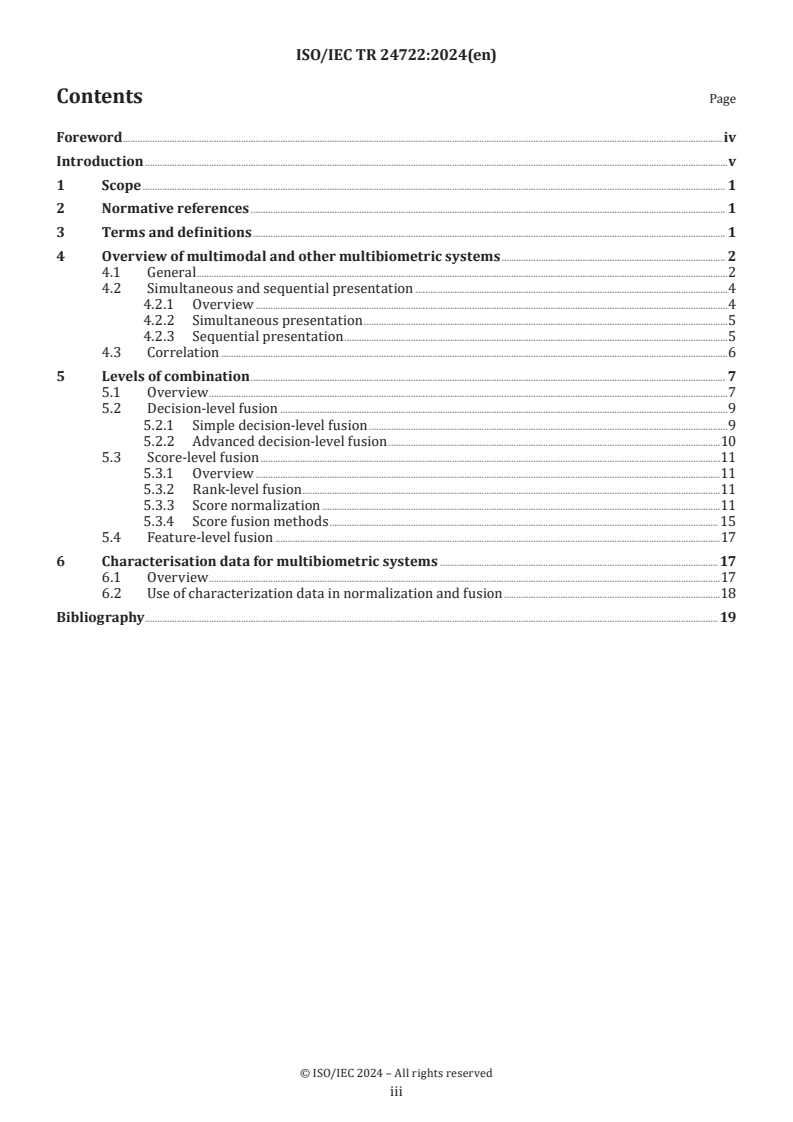
Contents Page
Foreword .iv
Introduction .v
1 Scope . 1
2 Normative references . 1
3 Terms and definitions . 1
4 Overview of multimodal and other multibiometric systems . 2
4.1 General .2
4.2 Simultaneous and sequential presentation .4
4.2.1 Overview .4
4.2.2 Simultaneous presentation .5
4.2.3 Sequential presentation .5
4.3 Correlation .6
5 Levels of combination . 7
5.1 Overview .7
5.2 Decision-level fusion .9
5.2.1 Simple decision-level fusion .9
5.2.2 Advanced decision-level fusion .10
5.3 Score-level fusion .11
5.3.1 Overview .11
5.3.2 Rank-level fusion .11
5.3.3 Score normalization .11
5.3.4 Score fusion methods . 15
5.4 Feature-level fusion .17
6 Characterisation data for multibiometric systems . 17
6.1 Overview .17
6.2 Use of characterization data in normalization and fusion .18
Bibliography . 19
© ISO/IEC 2024 – All rights reserved
iii
Foreword
ISO (the International Organization for Standardization) and IEC (the International Electrotechnical
Commission) form the specialized system for worldwide standardization. National bodies that are
members of ISO or IEC participate in the development of International Standards through technical
committees established by the respective organization to deal with particular fields of technical activity.
ISO and IEC technical committees collaborate in fields of mutual interest. Other international organizations,
governmental and non-governmental, in liaison with ISO and IEC, also take part in the work.
The procedures used to develop this document and those intended for its further maintenance are described
in the ISO/IEC Directives, Part 1. In particular, the different approval criteria needed for the different types
of document should be noted. This document was drafted in accordance with the editorial rules of the ISO/
IEC Directives, Part 2 (see www.iso.org/directives or www.iec.ch/members_experts/refdocs).
ISO and IEC draw attention to the possibility that the implementation of this document may involve the
use of (a) patent(s). ISO and IEC take no position concerning the evidence, validity or applicability of any
claimed patent rights in respect thereof. As of the date of publication of this document, ISO and IEC had not
received notice of (a) patent(s) which may be required to implement this document. However, implementers
are cautioned that this may not represent the latest information, which may be obtained from the patent
database available at www.iso.org/patents and https://patents.iec.ch. ISO and IEC shall not be held
responsible for identifying any or all such patent rights.
Any trade name used in this document is information given for the convenience of users and does not
constitute an endorsement.
For an explanation of the voluntary nature of standards, the meaning of ISO specific terms and expressions
related to conformity assessment, as well as information about ISO's adherence to the World Trade
Organization (WTO) principles in the Technical Barriers to Trade (TBT) see www.iso.org/iso/foreword.html.
In the IEC, see www.iec.ch/understanding-standards.
This document was prepared by Joint Technical Committee ISO/IEC JTC 1, Information technology,
Subcommittee SC 37, Biometrics.
This third edition cancels and replaces the second edition (ISO/IEC TR 24722:2015), which has been
technically revised.
The main changes are as follows:
— the content of Clause 3 has been removed and ISO/IEC 2382-37 has been listed as a normative reference;
— to enhance information accessibility, symbol descriptors have been paired with clear descriptions;
— the structure of the document has been updated, and various editorial modifications have been made, in
order to improve technical accuracy and bring the document in line with the most recent edition of the
ISO/IEC Directives Part 2.
Any feedback or questions on this document should be directed to the user’s national standards
body. A complete listing of these bodies can be found at www.iso.org/members.html and
www.iec.ch/national-committees.
© ISO/IEC 2024 – All rights reserved
iv
Introduction
Some applications of biometrics require a level of biometric performance that is difficult to obtain with a
single biometric measure. Such applications include the prevention of multiple applications for national
identity cards and security checks for air travel. In addition, provisions are needed for data subjects who are
unable to give a reliable biometric sample for some biometric characteristic types.
Use of multiple biometric measurements from substantially independent biometric sensors, algorithms
or characteristic types typically gives improved technical performance and reduces risk. This includes an
improved level of performance where not all biometric measurements are available, such that decisions can
be made from any number of biometric measurements within an overall policy on accept/reject thresholds.
Of the various forms of multibiometric systems, the potential for multimodal biometric systems, each using
[22],[45]
an independent measure, has been discussed in technical literature since at least 1974. Advanced
methods for combining measures at the score level have been discussed in References [15] and [16]. At
the current level of understanding, combining results at the score level typically requires knowledge of
both mated and non-mated score distributions. All of these measures are highly application-dependent
and generally unknown in any real system. Research on the methods not requiring previous knowledge
of the score distributions is continuing and research on fusion at both the image and feature levels is still
progressing.
Given the current state of research into these questions and the highly application-dependent and generally
unavailable data required for proper fusion at the score level, work on multibiometric fusion can in the
meantime be considered mature. By intention, this document is not issued as International Standard, in
order not to force industrial solutions to conform to the methodology described herein. Rather, the present
edition of this document provides a mature technical description for developments of multibiometric
systems. It also provides a reference on multibiometric fusion for developers of other biometric standards
and implementers.
© ISO/IEC 2024 – All rights reserved
v
Technical Report ISO/IEC TR 24722:2024(en)
Information technology — Biometrics — Multimodal and
other multibiometric fusion
1 Scope
This document provides descriptions and analyses of current practices on multimodal and other
multibiometric fusion, including (as appropriate) references to more detailed descriptions.
This document contains descriptions and explanations of high-level multibiometric concepts to aid in the
explanation of multibiometric fusion approaches including: multi-characteristic-type, multi-instance, multi-
sensorial, multialgorithmic, decision-level and score-level logic.
2 Normative references
The following documents are referred to in the text in such a way that some or all of their content constitutes
requirements of this document. For dated references, only the edition cited applies. For undated references,
the latest edition of the referenced document (including any amendments) applies.
ISO/IEC 2382-37, Information technology — Vocabulary — Part 37: Biometrics
3 Terms and definitions
For the purposes of this document, the terms and definitions given in ISO/IEC 2382-37 and the following apply.
ISO and IEC maintain terminology databases for use in standardization at the following addresses:
— ISO Online browsing platform: available at https:// www .iso .org/ obp
— IEC Electropedia: available at https:// www .electropedia .org/
3.1
multialgorithmic
using multiple algorithms for processing the same biometric sample
3.2
multibiometrics
automated recognition of individuals based on their biological or behavioural characteristic and involving
the use of biometric fusion
3.3
multi-characteristic-type
multi-type
using information from multiple types of biometric characteristic
EXAMPLE Biometric characteristic types include: face, voice, finger, iris, retina, hand geometry, signature/sign,
keystroke, lip movement, gait, scent, vein, DNA, ear, foot, etc.
3.4
multi-instance
requiring two or more instances of a biometric characteristic
EXAMPLE Iris (left) + Iris (right), Fingerprint (left index) + Fingerprint (right index).
© ISO/IEC 2024 – All rights reserved
Note 1 to entry: [SOURCE: ISO/IEC 2382-37:2022, 37.03.47, modified — Note 1 to entry has been removed and an
Example has been added.]
3.5
multipresentation
using either multiple presentation samples of one instance of a biometric characteristic or a single
presentation that results in the capture of multiple samples.
EXAMPLE Several frames from video camera capture of a face image (possibly but not necessarily consecutive).
Note 1 to entry: Multipresentation biometrics is considered a form of multibiometrics if fusion techniques are
employed. Many fusion and normalization techniques are appropriate to the integration of information from multiple
presentations of the same biometric instance.
3.6
sequential presentation
capturing biometric samples in separate capture events to be used for biometric fusion
3.7
simultaneous presentation
capturing biometrics samples in a single capture event to be used for biometric fusion
4 Overview of multimodal and other multibiometric systems
4.1 General
In general, the use of the terms multimodal or multibiometric indicates the presence and use of more
than one characteristic type, sensor, instance and/or algorithm in some form of combined use for making
a specific biometric identification or verification decision. The methods of combining multiple samples,
comparison scores or comparison decisions can be very simple or mathematically complex. For the purpose
of this document, any method of combination will be considered a form of “fusion”. Combination techniques
will be covered in Clause 5 of this document.
[22,45]
Multimodal biometrics were first proposed, implemented and tested in the 1970s. Combining measures
was seen as a necessary future requirement for biometric systems. It was widely thought that combining
multiple measures could increase either security by decreasing the false acceptance rate or data subject
convenience by decreasing the false rejection rate. These systems did not seem to advance into practical
applications.
The use of fusion and related methods has been a key tool in the successful implementation of largescale
automated fingerprint identification systems (AFISs), starting in the 1980s, and was further expanded upon
with the introduction of automated biometric identification systems (ABISs) in the 1990s. Most methods of
fusion discussed elsewhere in this document have been successfully implemented using fingerprints alone.
Some of the ways that fusion has been implemented in AFISs include:
— image fusion (also known as sample fusion), where a single “rolled” image is created from a series of
plain impressions on a livescan device;
— template fusion, where features extracted from several presentations are combined into a single
template;
— multi-instance fusion, which uses fingerprints from all ten fingers;
— multipresentation fusion, which uses rolled and slap (plain) fingerprints;
— algorithm fusion for the purpose of efficiency (cost, computational complexity, and throughput rate),
where comparators are generally used as a series of filters in order of increasing computational
complexity. These are generally implemented as a mix of decision and score-level fusion;
© ISO/IEC 2024 – All rights reserved
— algorithm fusion for the purpose of accuracy (decreasing false accept rate and/or false reject rate,
lessening sensitivity to poor-quality data), where comparators are used in parallel, with fusion of
resulting scores.
The use of fusion has made AFIS and ABIS possible because of fusion’s potential in improving both accuracy
and efficiency.
Most work to date on multibiometrics has focused only on improving false acceptance and false rejection
error rates. Some research work considers the use of multibiometrics to flexibly improve usability, security
[61]
or accuracy. Further, multibiometrics also aims at decreasing the overall failure-to-enrol rate (FTE)
especially in biometric systems where data subject cooperation is not expected (e.g. video surveillance
systems). Multibiometrics is an effort to produce a biometric decision even if only a subset of the expected
[63]
biometric characteristic were captured.
To further develop the understanding of the distinction among the multibiometric categories, Table 1
illustrates the basic distinctions among categories of multibiometric implementation. The key aspect of the
category that makes it multi-“something” is explained below the table.
Table 1 — Multibiometric categories illustrated by the simplest case of using 2 elements
Category Characteristic Algorithm Instance Sensor Presentation
type
Multi-characteris- 2 2 2 2 at least 1
b
tic-type
(always) (always) (always) (usually)
Multialgorithmic 1 2 1 1 at least 1
(always) (always) (always) (always)
Multi-instance 1 1 2 1 at least 1
c
(always) (always) (always) (usually)
Multi-sensorial 1 1 1 2 at least 1
a
(always) (usually) (always, (always)
and same
instance)
Multipresentation 1 1 1 1 at least 2
a
It is possible that two samples from separate sensors could be processed by separate “feature extraction” algorithms, and
then through a common comparison algorithm, making this “1.5 algorithms”, or two completely different algorithms.
b
An exception is a multi-characteristic-type system with a single sensor used to capture two different characteristic types.
For example, a high resolution image used to extract face and iris or face and skin texture.
c
An exception may be the use of two individual sensors to each capture one instance, for example possibly a two-finger
fingerprint sensor.
— Multi-characteristic-type biometric systems — these systems take input from single or multiple
sensors that capture two or more different types of biometric characteristic. For example, a single
system combining face and iris information for biometric recognition would be considered a “multi-
characteristic-type” system regardless of whether face and iris images were captured by different
imaging devices or the same device. It is not required that the various measures be combined in any
mathematically complex way. For example, a system with fingerprint and voice recognition would be
considered “multi-characteristic-type” even if the “OR” rule was being applied, allowing data subjects to
be verified using either of the characteristic types.
— Multialgorithmic biometric systems — these systems receive a single sample from a single sensor and
process that sample with two or more algorithms. This technique could be applied to any characteristic
type. Maximum benefit (theoretically) would be derived from algorithms that are based on distinctly
different and independent principles such as either features they extract from the biometric sample (e.g.
finger minutiae versus finger pattern) or approaches to comparison (e.g. different algorithms comparing
minutiae).
— Multi-instance biometric systems — these systems use one (or possibly multiple) sensor(s) to capture
samples of two or more different instances of the same biometric characteristic. For example, systems
© ISO/IEC 2024 – All rights reserved
capturing images from multiple fingers are considered to be multi-instance rather than multi-
characteristic-type. However, systems capturing, for example, sequential frames of facial or iris images
are considered to be multipresentation rather than multi-instance.
— Multi-sensorial biometric systems — these systems sample the same instance of a biometric characteristic
with two or more distinctly different sensors. Processing of the multiple samples can be done with one
algorithm, or some combination of multiple algorithms. For example, a face recognition application could
use both a visible light camera and an infrared camera coupled with a specific frequency (or several
frequencies) of infrared illumination.
— Multipresentation — the biometric system uses multiple samples of one instance of a biometric
characteristic.
For a specific application in an operational environment, there are numerous system design considerations
and trade-offs that would need to be made, among factors such as improved performance (e.g. identification
or verification accuracy, system speed and throughput, robustness and resource requirements), acceptability,
[40]
circumvention, ease of use, operational cost, environmental flexibility and population flexibility.
Especially for a large-scale human identification system, there are additional system design considerations,
such as operation and maintenance, reliability, system acquisition cost, life cycle cost, and planned system
response to identified susceptible means of attack, all of which will affect the overall deployability of the
[40]
system.
4.2 Simultaneous and sequential presentation
4.2.1 Overview
Dependent upon the system design, there are two methods of presenting a biometric characteristic for
capture by the system:
1) simultaneous; and
2) sequential.
© ISO/IEC 2024 – All rights reserved
NOTE The presentation (simultaneous or sequential) method generally induces different fusion processes. The
purpose of including this information is to illustrate considerations that can potentially influence multibiometric
system design.
Figure 1 — Classification of multibiometric systems by simultaneity of presenting biometric
characteristic
4.2.2 Simultaneous presentation
Simultaneous presentation (with successful capture) provides biometric sample(s) from multiple
characteristic types in a single event (e.g. a face and iris taken from the same camera). System designs
that utilize simultaneous acquisition would tend towards high throughput applications at the expense of
possibly adding complexity (to synchronize sample collection) or difficulty of use (dual sensor interaction,
data subject multi-tasking).
4.2.3 Sequential presentation
Sequential capture acquires biometric sample(s) from one or multiple characteristic types in separate
[65]
events. Sequential capture may be utilized in the three concepts discussed in the literature. The first
is multi-instance, which is the use of two or more instances within one characteristic type for a subject,
i.e. Fingerprint (left index) + Fingerprint (right index). In this example, one single digit fingerprint reader
is used twice in sequence. The second concept is multi-characteristic-type, which is the use of multiple
different biometric characteristic types captured from one or more sensors for a subject, i.e. Hand + Face in
sequence. The third concept is multi-sensorial, which is the use of two or more distinct sensors for capturing
the same biometric feature(s) (e.g. traits) for a subject, but not at the same time. To avoid confusion with
multi-characteristic-type, which can also capture biometric instance(s) from two or more distinct sensors,
multi-sensorial can be clarified as “uni-characteristic-type multi-sensorial”. Examples for face recognition
are: infrared spectrum, visible spectrum, 2-D image, and 3-D image; for fingerprint recognition: optical,
electrostatic and acoustic sensors.
© ISO/IEC 2024 – All rights reserved
4.3 Correlation
[53]
In multimodal biometric systems, the information being fused can be correlated at several different levels
as illustrated in the following examples.
— Correlation between characteristic types: this refers to biometric samples that are physically related
such as the speech and lip movement of a data subject.
— Correlation due to identical biometric samples: this is the case in multialgorithmic systems where the
same biometric sample (e.g. a fingerprint image) or sub-sets of the biometric sample (e.g. voice, where an
entire sample can be used by one algorithm and part of the sample by another) is subjected to different
feature extraction and comparison algorithms (e.g. a minutiae-based comparator and a texture-based
comparator).
— Correlation between feature values: a subset of feature values constituting the feature vectors of different
characteristic types can be correlated. For example, the area of a data subject’s palm (hand geometry)
can be correlated with the width of the face.
— Correlation among instances due to common operating procedures, e.g. common capture device and
operator training.
— Correlation among instances due to subject behaviour, e.g. coloured contact lenses on both eyes.
However, in order to determine the extent of correlation it is necessary to examine the comparison scores
(or the ACCEPT/REJECT decision) pertaining to the comparators involved in the fusion scheme. In the
multiple classifier system literature, it has been demonstrated that fusing uncorrelated classifiers leads to a
[53]
significant improvement in biometric performance.
For two classifiers of reasonable accuracy involved in a fusion scheme, score outputs from inputs that come
from the same subject can, but need not, be correlated. In the case of decision level fusion, it is appropriate to
[20]
consider the correlation of classifier errors as described by Goebel, Yan, and Cheetham. The correlation
ρ is given by Formula (1):
n
c
f
nN
c
ρ = (1)
n
c t f f
NN−−Nn+ N
c c c
where
n is the number of classifiers under test;
N is the total number of mulitbiometric information channels;
C is the threshold
f
is the number of mulitbiometric information channels where all classifiers have an incorrect output
N
c
at threshold C;
t
is the number of mulitbiometric information channels where all classifiers have a correct output
N
c
at a threshold C.
Assessing score level correlation is inherently more difficult as it will depend on the normalization used (see
5.3.3), but Formula (1), together with a relevant threshold on score can give a very rough first idea even in
those cases.
© ISO/IEC 2024 – All rights reserved
5 Levels of combination
5.1 Overview
As a basis for the definition of levels of combination in multibiometric systems, this document first introduces
the single-biometric process and its building blocks, using the example of an authentication system for
simplification without PAD mechanisms. Figure 2 shows the block diagram of a single-biometric process.
Figure 2 — Single biometric process (generic)
A biometric sample captured by a biometric sensor (e.g. a fingerprint image) is fed into the feature extraction
module. Using signal processing methods, the feature extraction module converts a sample into features
(e.g. fingerprint minutiae), which form a representation apt for comparison. Usually, multiple features are
collected into a feature vector. The comparison module takes the feature vector as input and compares it to a
biometric reference. The result is a comparison score, which is used by the decision module to decide (e.g. by
applying a threshold) whether the presented sample matches with the stored template. The outcome of this
decision is a binary match or non-match.
Generalizing the above process to multiple biometric information channels, there are several levels at which
fusion can take place. These include consolidating information at the (i) decision level, (ii) comparison score
level, (iii) feature level, and (iv) sample level. Fusion at levels (i) and (ii) occurs after the comparison module
is invoked, while levels (iii) and (iv) occur before the comparator. Although integration is possible at these
different levels, fusion at the feature set level, the comparison score level and the decision level are the most
[7], [41]
commonly used. Figure 3 illustrates the different levels of fusion for the case of a multimodal system.
a) Decision level: each individual biometric process outputs its own Boolean result. The fusion process
fuses them together by a combination algorithm such as AND and OR, possibly taking further parameters
such as sample quality scores as input.
b) Score level: each individual biometric process typically outputs a single comparison score but possibly
multiple scores. The fusion process fuses these into a single score or decision, which is then compared to
the system acceptance threshold.
c) Feature level: each individual biometric process outputs a collection of features. The fusion process
fuses these collections of features into a single feature set or vector.
d) Sample level: each individual biometric process outputs a collection of samples. The fusion process fuses
these collections of samples into a single sample.
© ISO/IEC 2024 – All rights reserved
a) Decision-level fusion
b) Score-level fusion
© ISO/IEC 2024 – All rights reserved
NOTE Sample 1 and Sample 2 can be the same sample.
c) Feature-level fusion
d) Sample-level fusion
Figure 3 — Different levels of fusion for the case of a multimodal system
For simultaneous or sequential biometric sample acquisition, features are extracted and are compared
against the template. How the comparison scores are determined is system-dependent and outside the
scope of this document. The comparison scores of P , P , and P are then sent to the fusion module for a final
1 2 3
result. In multibiometric systems the fusion can occur at the decision or score level.
5.2 Decision-level fusion
5.2.1 Simple decision-level fusion
Decision-level fusion occurs after a comparison decision has been made for each biometric information
channel. It is based on the binary result values match and non-match output by the decision modules [see
Figure 3 a), Decision-level fusion].
For biometric systems composed of a small number of information channels, it is convenient to assign logical
values to comparison outcomes so that fusion rules can be formulated as logical functions. The behaviour
of the two most widely used functions, AND and OR, are listed in Table 2, assuming a pair of decision-level
outputs.
Table 2 — AND & OR fusion of decisions for a case of two biometric characteristic types
Decision Decision AND-fused OR-fused
Biometric Biometric
decision decision
information information
channel 1 channel 2
X X X X
X • X •
• X X •
• • • •
Key
X Non-match
• Match
For biometric systems using many information channels, voting schemes have been established as fusion
rules, the most common of which is majority voting rule. The AND and OR are specific examples of voting
schemes.
© ISO/IEC 2024 – All rights reserved
5.2.2 Advanced decision-level fusion
5.2.2.1 General model
Decision-level fusion is based upon individual accept/reject decisions for each sample. The two sub-groups
of advanced decision-level fusion are 1) layered and 2) cascaded. A layered system features adjustable
thresholds computed by using individual biometric scores to determine the pass/fail thresholds for
other biometric data processes. A cascaded system features fixed thresholds as pass/fail thresholds of
characteristic type-specific biometric samples to determine if additional biometric samples from other
characteristic types are required to reach an overall system decision. Decision-level fusion for the two
subgroups is shown in Figure 4.
NOTE 1 The left side of the figure presents the layered system and the right side presents the cascaded system.
NOTE 2 The processes, P , representing the fused biometric information channels are denoted as P , P and P .
i 1 2 3
Figure 4 — Advanced decision-level fusion
5.2.2.2 Layered system
Independent of whether the presentation was simultaneous or sequential, the comparison score of P enters
the layered system. The system processes the score against the system defined threshold. If it passes the
criteria/threshold for characteristic type P , the output would adjust (raise or lower) the threshold needed
to pass for characteristic type P . If P fails to meet the criteria/threshold for characteristic type P , then
2 1 1
the output would most likely increase the threshold required for characteristic type P . Upon completion of
processing P and resetting the thresholds requirements for characteristic type P , the comparison score of
1 2
© ISO/IEC 2024 – All rights reserved
P enters the system. The process iterates as discussed above for P and P . Once the characteristic type P
2 2 3 3
process is completed, a final accept/reject decision is made.
5.2.2.3 Cascaded system
Independent of simultaneous or sequential presentation, cascaded systems rely on at least one biometric
sample. If the first sample does not meet the requirements, additional samples are compared. Using Figure 4
as the model for this discussion, comparison score P enters the system and is compared against the
threshold for sample P . If the score exceeds the criteria/threshold required for P , a subsequent decision
1 1
is made on the strength of the result (which could also include sample quality measures). If this strength
is sufficient, the subject is accepted. If the score of P fails the initial threshold test or passes the initial
threshold test, but fails the strength decision, cascaded systems require the use of the score of P . This
process is repeated for scores P and P . It is not necessary for cascaded systems to require P or P to be
2 3 2 3
captured if P passes the threshold and strength test.
5.3 Score-level fusion
5.3.1 Overview
In score-level fusion, each system provides comparison scores indicating the proximity of the feature
vector with the biometric reference vector. These scores can then be combined to improve the comparison
performance.
From a theoretical point of view, biometric processes can be combined reliably to give a guaranteed
improvement in comparison performance. Any number of suitably characterized biometric processes can
have their comparison scores combined in such a way that the multibiometric combination is guaranteed (on
average) to be no worse than the best of the individual biometric devices. The key is to correctly identify the
method which will combine these comparison scores reliably and maximize the improvement in comparison
performance.
The mechanism (for this sort of good combination of scores within a multibiometric system) will ideally
follow at least two guidelines. Firstly, each biometric process is expected to produce a score, rather than a
hard accept/reject decision, and make it available to the multibiometric combiner. Secondly, in advance of
operational use, each biometric process is expected to make available to the multibiometric combiner, its
technical performance (such as score distributions) in the appropriate form (and with sufficient accuracy of
characterization).
5.3.2 Rank-level fusion
Both verification (1:1) and identification (1:N) systems can support fusion at the comparison score level.
However, identification systems can also integrate information available at the rank level (which is a form
of score level with multiple scores or indices based on scores). In identification systems, a template from
a biometric sample is compared against templates from a subset of identities present in the database and,
[23]
therefore, a sequence of ordered comparison scores pertaining to these identities is available. Ho et al.
describe three methods for combining the ranks assigned by the different comparators. In the "highest rank"
method, each possible match is assigned the highest (minimum) rank as computed by different comparators.
Ties are broken randomly to arrive at a strict ranking order and the final decision is made based on the
combined ranks. The "Borda count" method uses the sum of the ranks assigned by the individual comparators
to calculate the combined ranks. The "logistic regression" method is a generalization of the Borda count
method where the weighted sum of the individual ranks is calculated and the weights are determined by
logistic regression.
5.3.3 Score normalization
Score normalization methods attempt to map the scores of each biometric process to a common domain.
Some approaches are based on the Neyman-Pearson lemma, with simplifying assumptions. For example,
mapping scores to likelihood ratios allows them to be combined by multiplying under an independence
© ISO/IEC 2024 – All rights reserved
assumption. Other approaches can be based on modifying other statistical measures of the comparison
score distributions.
The parameters used for normalization can be determined using a fixed training set or adaptively based on
the current feature vector.
NOTE 1 The computed characteristic can represent only “estimates” of the underlying population characteristic.
Score normalization is closely related to score-level fusion since it affects how scores are combined and
interpreted in terms of biometric performance. As discussed in Reference [32]:
a) The comparison scores at the output of the individual comparators need not be homogeneous. For
example, one comparator can output a distance (dissimilarity) measure while another can output a
similarity measure;
b) Further, the outputs of the individual comparators need not be on the same numerical scale (range).
c) Finally, the comparison scores at the output of the comparators are permitted to follow different
statistical distributions.
Due to these reasons, scores are generally normalized prior to fusion into a common domain. Figure 5 depicts
a score-level fusion framework for processing two biometric samples, taking normalization into account.
Figure 5 — A framework for score-level fusion
Table 4 lists, under the framework of Figure 5, several commonly used score normalization methods.
NOTE 2 Some fusion methods use probability density functions (PDFs) directly and do not require normalization
methods.
Table 3 defines the symbols used in Table 4. In some cases, PDFs are used to convert raw/native scores
directly into Probability of False Accept, and thus to a decision, without needing to have native scores
brought to a common reference range using normalization.
© ISO/IEC 2024 – All rights reserved
Table 3 — Symbols used for score normalization formulae
Characterization data
Statistical measures
Mated Non-mated Both mated and
non-mated distributions
distribution distribution
Minimum score S S S
Mm, in NM,min Bm, in
Maximum score
S S S
Mm, ax NM,max Bm, ax
Mean score
S S S
Mm, ean NM,mean Bm, ean
Median score S S S
Mm, ed NM,mean Bm, ean
Score standard deviation
S S S
MS, D NM,SD BS, D
C C C
Constant
Probability density function
PDF PDF
M NM
Centre of PDF crossover
S N.A.
centre
Width of PDF crossover S
width
Key
S similarity score
mated score
M
non-mated score
NM
both
B
S minimum of mated similarity score
Mm, in
S maximum of mated similarity score
Mm, ax
S mean of mated similarity score
Mm, ean
S median of mated similarity score
Mm, ed
S standard deviation of mated similarity score
MS, D
S minimum of non-mated similarity score
NM,min
S maximum of non-mated similarity score
NM,max
S mean of non-mated similarity score
NM,mean
S median of non-mated similarity score
NM,med
S standard deviation of non-mated similarity score
NM,SD
S minimum of both mated and non-mated similarity score
B,min
S maximum of both mated and non-mated similarity score
B,max
S mean of both mated and non-mated similarity score
B,mean
S median of both mated and non-mated similarity score
B,med
S standard deviation of both mated and non-mated similarity score
B,SD
PDF probability density function of mated distribution
M
PDF probability density function of non-mated distribution
NM
© ISO/IEC 2024 – All rights reserved
Table 4 — Examples of score normalization methods
Data
Method Formula Comment
elements
— Uses empirical data (or
theoretical limit or vendor
S
Bm, in
′ provided).
Min-max (MM) SS=− SS − S
() ()
Bm,,in Bmax Bm, in
S
Bm, ax
— No accounting for non-
linearity.
— Assumes normal distri-
bution.
S
— Symmetric about mean.
NM,mean
Z-score SS′=− SS
()
NM,,mean NMSD
S
— Assumes stability of
NM,SD
both distributions across
populations.
Median absolute — Assumes stability of
S
Bm, ed
SS′=−SC(|·median SS− ) both distributions across
()
deviation (MAD)
Bm,,ed Bmed
C
populations.
— Mean and variance of
transformed data distribu-
S
Mm, ean
Hyperbolic tangent tion.
′
SC=−05.(tanh SS S +1) S
()()
Mm,,ean MSD M,SD
(Tanh) — Assumes stability of
C
both distributions across
populations.
a
Adaptive (AD) — Assumes non-linearity.
nn, ≤c
MM MM
a) Two-quadrics (QQ) — 3 modelling methods.
n = c
AD
— Assumes stability of
cc+−()1 ()nc− ,otherwise
MM
both distributions across
populations.
n =
b) Logistic c
AD
−Bn·
MM
1+Ae· — n = adaptive
AD
w
normalization score;
Δ
1 w
nn, ≤−c
n = min-max normal-
MM MM
MM
w 2
A=− 1
c−
ized score;
Δ
2
c = centre of overlap of
lnA
c) Quadric-line-quadric
w w B=
mated and non-mated score
(QLQ)
n = nc, − <≤nc+
c
AD MM MM
distributions;
w = width of the overlap;
w w w
Δ = a small value (0.01 in
c+ +−1 c− nc−− ,
MM
2 22
Reference [59]).
otherwise
NM M M
Biometric gain against — Assumes stability of
PDFS()PDFS() PDF
ii
both distributions across
impostors (non-mated)
NM
PDF
populations.
(BGI)
NM
BioAPI SF′= AR — Assumes stability of
threshold=score PDF
non-mated distribution.
...
Questions, Comments and Discussion
Ask us and Technical Secretary will try to provide an answer. You can facilitate discussion about the standard in here.
Loading comments...