


ISO/TS 17137:2021
(Main)Cardiovascular implants and extracorporeal systems — Cardiovascular absorbable implants
Cardiovascular implants and extracorporeal systems — Cardiovascular absorbable implants
This document establishes design evaluation requirements and recommendations for absorbable cardiovascular implants used to treat vessels and/or the vascular space within the circulatory system, including the heart and all vasculature. This document is intended to supplement device-specific standards by providing guidelines specific for either absorbable implants or components, or both. This document is applicable to implants in direct contact with the cardiovascular system, where the intended action is upon the circulatory system. This document does not address the specific evaluation of issues associated with viable tissues, viable cells, and/or implants with non-viable biological materials and their derivatives. Additionally, procedures and devices used prior to and following the introduction of the absorbable cardiovascular implant (e.g. balloon angioplasty devices) are excluded from the scope of this document if they do not affect the absorption aspects of the implant. A cardiovascular absorbable implant can incorporate substance(s) which, if used separately, can be considered to be a medicinal product (drug product) but the action of the medicinal substance is ancillary to that of the implant and supports the primary mode of action of the implant. NOTE 1 Some aspects of absorbable components of cardiovascular device-drug combination products (e.g. coatings) in their connection with drug-related aspects of the device are addressed in ISO 12417-1. NOTE 2 An explanation of the nomenclature of absorb, degrade and related terms can be found in Annex A.
Implants cardiovasculaires et systèmes extracorporels — Implants cardiovasculaires absorbables
General Information
- Status
- Published
- Publication Date
- 14-Sep-2021
- Technical Committee
- ISO/TC 150/SC 2 - Cardiovascular implants and extracorporeal systems
- Drafting Committee
- ISO/TC 150/SC 2/WG 7 - Cardiovascular absorbable implants
- Current Stage
- 9092 - International Standard to be revised
- Start Date
- 20-Nov-2025
- Completion Date
- 12-Feb-2026
Relations
- Effective Date
- 06-Jul-2024
- Effective Date
- 23-Apr-2020
Overview
ISO/TS 17137:2021 - "Cardiovascular implants and extracorporeal systems - Cardiovascular absorbable implants" is a Technical Specification from ISO that provides design evaluation requirements and recommendations for absorbable cardiovascular implants (fully or partially degradable devices) used in the heart and vascular system. It supplements device‑specific standards by addressing time‑dependent aspects unique to absorbable materials - degradation, absorption, particulate generation and related safety/performance considerations. The third edition (2021) updates guidance on degradation‑induced fracture, labelling, and study design.
Key Topics
The standard covers practical and technical topics essential for safe development and regulatory submission of absorbable cardiovascular devices, including:
- Scope & classification - applicability to implants in direct contact with the cardiovascular system and exclusions (e.g., procedures/devices not affecting absorption; viable cell/tissue evaluations).
- Intended clinical performance and use - documenting clinical purpose and performance requirements.
- Materials - selection and characterization of absorbable polymers/metals and their degradation behaviour.
- Packaging, labelling and sterilization - requirements for packaging, instructions for use (IFU), and sterilization considerations that affect absorption.
- Shelf‑life and ageing - real‑time and accelerated ageing approaches for absorbable devices.
- Risk management - failure modes, risk mitigation, and specific risks from degradation (e.g., particulate generation).
- Design evaluation - in vitro procedural testing, in vitro degradation testing (mechanical, cyclic fatigue, physical/chemical), imaging compatibility.
- Biological evaluation - biocompatibility, particulate assessment, sterilization effects, and combination product considerations.
- In vivo preclinical & clinical evaluation - objectives, protocol guidance, data collection and clinical investigation planning.
- Post‑market surveillance - monitoring degradation‑related performance after market introduction.
- Nomenclature - Annex A explains terms like absorb, degrade and related definitions.
Applications
ISO/TS 17137:2021 is directly applicable for:
- Medical device manufacturers designing absorbable stents, scaffolds, coatings or other cardiovascular implants.
- Regulatory affairs and quality teams preparing technical files, design dossiers, and risk assessments.
- Design and materials engineers evaluating degradation, fatigue and particle generation.
- Preclinical and clinical researchers planning animal studies and clinical investigations.
- Notified bodies and regulators assessing safety/performance of absorbable cardiovascular devices.
Related Standards
- ISO 14630 (non‑active surgical implants)
- ISO 25539 series (endovascular devices)
- ISO 10993 (biological evaluation)
- ISO 12417‑1 (device‑drug combination aspects)
- ISO 14155 (clinical investigations)
- ISO 5840, ISO 11135 (referenced for cardiac valves, sterilization)
Using ISO/TS 17137:2021 helps ensure robust evaluation of degradation behavior and clinical safety for absorbable cardiovascular implants, supporting regulatory compliance and improved patient outcomes.
ISO/TS 17137:2021 - Cardiovascular implants and extracorporeal systems — Cardiovascular absorbable implants Released:9/15/2021
ISO/TS 17137:2021 - Cardiovascular implants and extracorporeal systems — Cardiovascular absorbable implants Released:9/15/2021
Get Certified
Connect with accredited certification bodies for this standard

BSI Group
BSI (British Standards Institution) is the business standards company that helps organizations make excellence a habit.

TÜV Rheinland
TÜV Rheinland is a leading international provider of technical services.

TÜV SÜD
TÜV SÜD is a trusted partner of choice for safety, security and sustainability solutions.
Sponsored listings
Frequently Asked Questions
ISO/TS 17137:2021 is a technical specification published by the International Organization for Standardization (ISO). Its full title is "Cardiovascular implants and extracorporeal systems — Cardiovascular absorbable implants". This standard covers: This document establishes design evaluation requirements and recommendations for absorbable cardiovascular implants used to treat vessels and/or the vascular space within the circulatory system, including the heart and all vasculature. This document is intended to supplement device-specific standards by providing guidelines specific for either absorbable implants or components, or both. This document is applicable to implants in direct contact with the cardiovascular system, where the intended action is upon the circulatory system. This document does not address the specific evaluation of issues associated with viable tissues, viable cells, and/or implants with non-viable biological materials and their derivatives. Additionally, procedures and devices used prior to and following the introduction of the absorbable cardiovascular implant (e.g. balloon angioplasty devices) are excluded from the scope of this document if they do not affect the absorption aspects of the implant. A cardiovascular absorbable implant can incorporate substance(s) which, if used separately, can be considered to be a medicinal product (drug product) but the action of the medicinal substance is ancillary to that of the implant and supports the primary mode of action of the implant. NOTE 1 Some aspects of absorbable components of cardiovascular device-drug combination products (e.g. coatings) in their connection with drug-related aspects of the device are addressed in ISO 12417-1. NOTE 2 An explanation of the nomenclature of absorb, degrade and related terms can be found in Annex A.
This document establishes design evaluation requirements and recommendations for absorbable cardiovascular implants used to treat vessels and/or the vascular space within the circulatory system, including the heart and all vasculature. This document is intended to supplement device-specific standards by providing guidelines specific for either absorbable implants or components, or both. This document is applicable to implants in direct contact with the cardiovascular system, where the intended action is upon the circulatory system. This document does not address the specific evaluation of issues associated with viable tissues, viable cells, and/or implants with non-viable biological materials and their derivatives. Additionally, procedures and devices used prior to and following the introduction of the absorbable cardiovascular implant (e.g. balloon angioplasty devices) are excluded from the scope of this document if they do not affect the absorption aspects of the implant. A cardiovascular absorbable implant can incorporate substance(s) which, if used separately, can be considered to be a medicinal product (drug product) but the action of the medicinal substance is ancillary to that of the implant and supports the primary mode of action of the implant. NOTE 1 Some aspects of absorbable components of cardiovascular device-drug combination products (e.g. coatings) in their connection with drug-related aspects of the device are addressed in ISO 12417-1. NOTE 2 An explanation of the nomenclature of absorb, degrade and related terms can be found in Annex A.
ISO/TS 17137:2021 is classified under the following ICS (International Classification for Standards) categories: 11.040.40 - Implants for surgery, prosthetics and orthotics. The ICS classification helps identify the subject area and facilitates finding related standards.
ISO/TS 17137:2021 has the following relationships with other standards: It is inter standard links to ISO 5210:2026, ISO/TS 17137:2019. Understanding these relationships helps ensure you are using the most current and applicable version of the standard.
ISO/TS 17137:2021 is available in PDF format for immediate download after purchase. The document can be added to your cart and obtained through the secure checkout process. Digital delivery ensures instant access to the complete standard document.
Standards Content (Sample)
TECHNICAL ISO/TS
SPECIFICATION 17137
Third edition
2021-09
Cardiovascular implants and
extracorporeal systems —
Cardiovascular absorbable implants
Implants cardiovasculaires et systèmes extracorporels — Implants
cardiovasculaires absorbables
Reference number
©
ISO 2021
© ISO 2021
All rights reserved. Unless otherwise specified, or required in the context of its implementation, no part of this publication may
be reproduced or utilized otherwise in any form or by any means, electronic or mechanical, including photocopying, or posting
on the internet or an intranet, without prior written permission. Permission can be requested from either ISO at the address
below or ISO’s member body in the country of the requester.
ISO copyright office
CP 401 • Ch. de Blandonnet 8
CH-1214 Vernier, Geneva
Phone: +41 22 749 01 11
Email: copyright@iso.org
Website: www.iso.org
Published in Switzerland
ii © ISO 2021 – All rights reserved
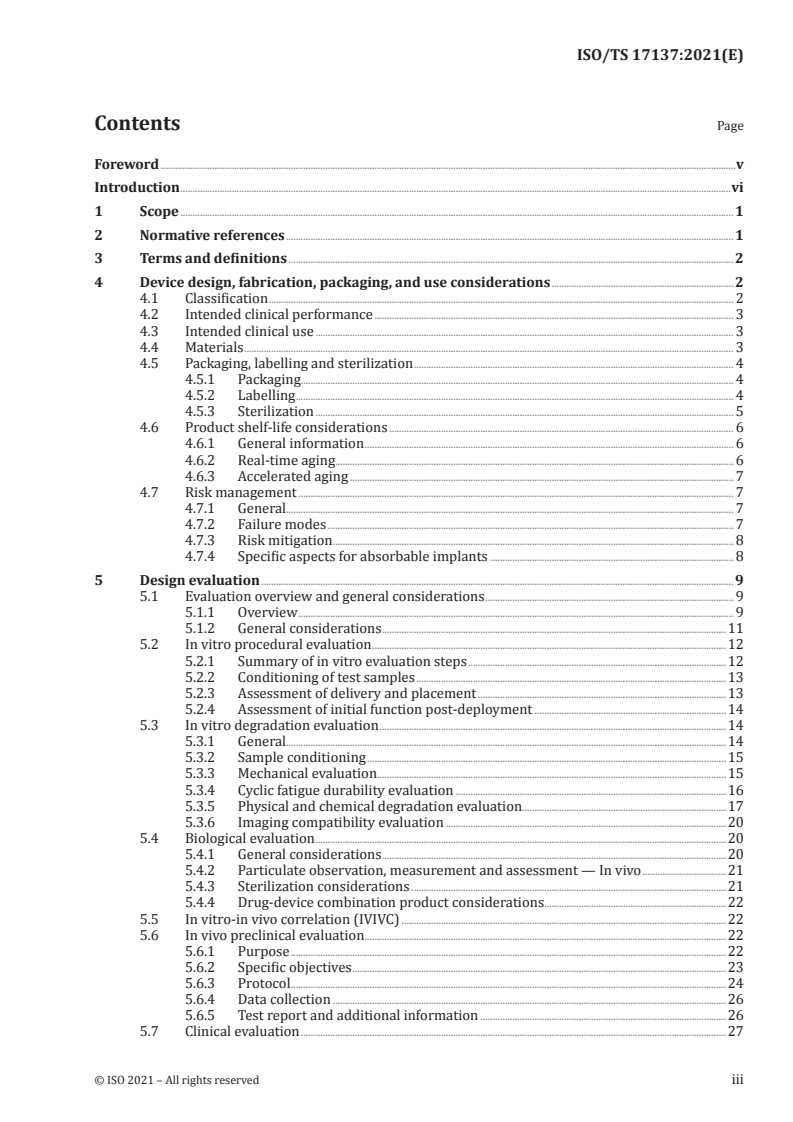
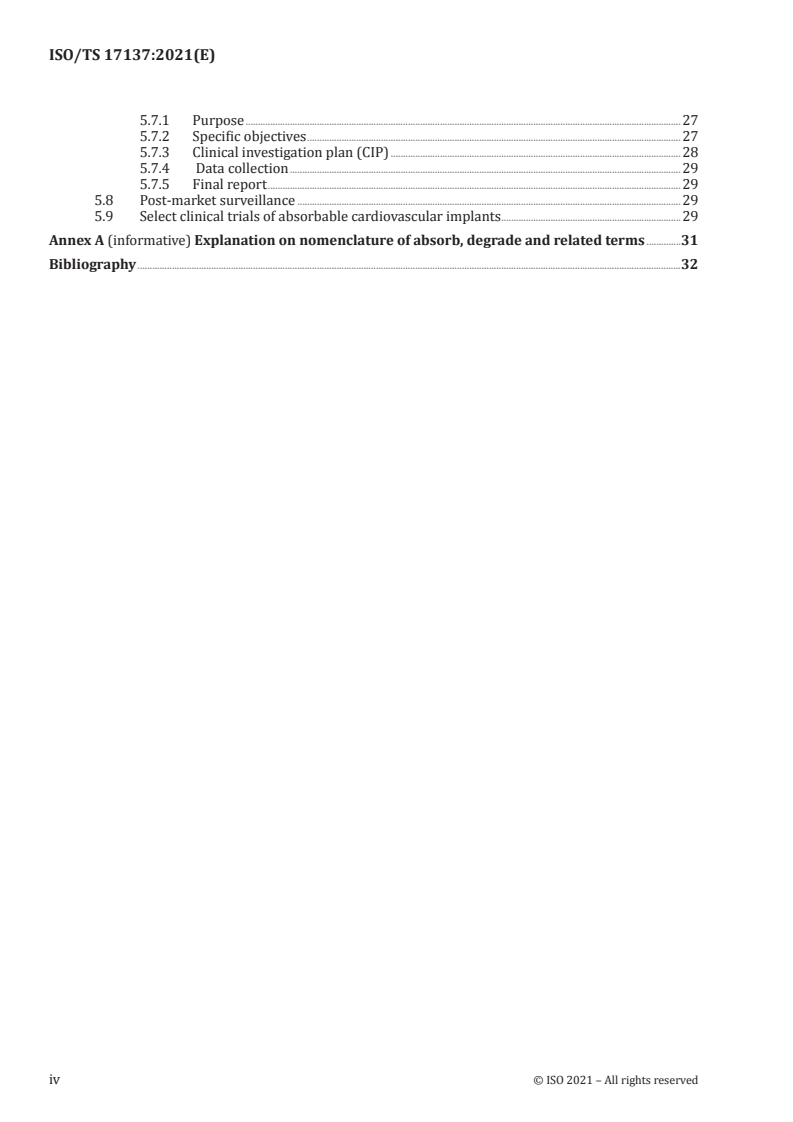
Contents Page
Foreword .v
Introduction .vi
1 Scope . 1
2 Normative references . 1
3 Terms and definitions . 2
4 Device design, fabrication, packaging, and use considerations . 2
4.1 Classification . 2
4.2 Intended clinical performance . 3
4.3 Intended clinical use . 3
4.4 Materials . 3
4.5 Packaging, labelling and sterilization . 4
4.5.1 Packaging. 4
4.5.2 Labelling . 4
4.5.3 Sterilization . 5
4.6 Product shelf-life considerations . 6
4.6.1 General information . 6
4.6.2 Real-time aging. 6
4.6.3 Accelerated aging . 7
4.7 Risk management . 7
4.7.1 General. 7
4.7.2 Failure modes . 7
4.7.3 Risk mitigation . . 8
4.7.4 Specific aspects for absorbable implants . 8
5 Design evaluation . 9
5.1 E valuation overview and general considerations . 9
5.1.1 Overview . 9
5.1.2 General considerations .11
5.2 In vitro procedural evaluation .12
5.2.1 Summary of in vitro evaluation steps .12
5.2.2 Conditioning of test samples .13
5.2.3 Assessment of delivery and placement .13
5.2.4 Assessment of initial function post-deployment .14
5.3 In vitro degradation evaluation .14
5.3.1 General.14
5.3.2 Sample conditioning .15
5.3.3 Mechanical evaluation.15
5.3.4 Cyclic fatigue durability evaluation .16
5.3.5 Physical and chemical degradation evaluation.17
5.3.6 Imaging compatibility evaluation .20
5.4 Biological evaluation .20
5.4.1 General considerations .20
5.4.2 Particulate observation, measurement and assessment — In vivo .21
5.4.3 Sterilization considerations .21
5.4.4 Drug-device combination product considerations .22
5.5 In vitro-in vivo correlation (IVIVC) .22
5.6 In vivo preclinical evaluation .22
5.6.1 Purpose .22
5.6.2 Specific objectives .23
5.6.3 Protocol .24
5.6.4 Data collection .26
5.6.5 Test report and additional information .26
5.7 Clinical evaluation .27
5.7.1 Purpose .27
5.7.2 Specific objectives .27
5.7.3 Clinical investigation plan (CIP) .28
5.7.4 Data collection .29
5.7.5 Final report .29
5.8 Post-market surveillance .29
5.9 Select clinical trials of absorbable cardiovascular implants .29
Annex A (informative) Explanation on nomenclature of absorb, degrade and related terms .31
Bibliography .32
iv © ISO 2021 – All rights reserved
Foreword
ISO (the International Organization for Standardization) is a worldwide federation of national standards
bodies (ISO member bodies). The work of preparing International Standards is normally carried out
through ISO technical committees. Each member body interested in a subject for which a technical
committee has been established has the right to be represented on that committee. International
organizations, governmental and non-governmental, in liaison with ISO, also take part in the work.
ISO collaborates closely with the International Electrotechnical Commission (IEC) on all matters of
electrotechnical standardization.
The procedures used to develop this document and those intended for its further maintenance are
described in the ISO/IEC Directives, Part 1. In particular, the different approval criteria needed for the
different types of ISO documents should be noted. This document was drafted in accordance with the
editorial rules of the ISO/IEC Directives, Part 2 (see www .iso .org/ directives).
Attention is drawn to the possibility that some of the elements of this document may be the subject of
patent rights. ISO shall not be held responsible for identifying any or all such patent rights. Details of
any patent rights identified during the development of the document will be in the Introduction and/or
on the ISO list of patent declarations received (see www .iso .org/ patents).
Any trade name used in this document is information given for the convenience of users and does not
constitute an endorsement.
For an explanation of the voluntary nature of standards, the meaning of ISO specific terms and
expressions related to conformity assessment, as well as information about ISO's adherence to the
World Trade Organization (WTO) principles in the Technical Barriers to Trade (TBT), see www .iso .org/
iso/ foreword .html.
This document was prepared by Technical Committee ISO/TC 150, Implants for surgery, Subcommittee
SC 2, Cardiovascular implants and extracorporeal systems.
This third edition cancels and replaces the second edition (ISO/TS 17137:2019), which has been
technically revised.
The main changes compared to the previous edition are as follows:
— considerations have been added to multiple clauses regarding degradation-induced device fracture
and the generation of absorbable particulate matter after mechanical attributes are lost;
— clauses about labelling and instructions for use (IFU) have been modified;
— Figure 2 has been modified to facilitate translation into multiple languages;
— standards with guidance for characterization of absorbable polymers and metals have been
elaborated.
— additional guidance regarding animal and clinical study design, limitations, and assessment has
been added.
Any feedback or questions on this document should be directed to the user’s national standards body. A
complete listing of these bodies can be found at www .iso .org/ members .html.
Introduction
Absorbable cardiovascular implants are medical devices with various clinical indications for use in
the human cardiovascular blood system. An absorbable cardiovascular implant, or at least a portion
thereof, is designed to intentionally degrade over time into degradation products that are absorbed by
the body through either metabolism, assimilation, or excretion (elimination), or all. Such implants can
be either surgically introduced or introduced through intervention to the site of treatment.
This document outlines requirements for intended performance, design attributes, materials, design
evaluation, manufacturing, sterilization, packaging, and information supplied by the manufacturer.
This document is intended to be a supplement to ISO 14630, which specifies general requirements for
the performance of non-active surgical implants. This document is intended to also be a supplement
to relevant device-specific standards such as the ISO 25539 series specifying requirements for
endovascular devices, which do not address degradation and other time dependent aspects of
absorbable implants and coatings. Additionally, this document should be considered in conjunction
with ISO 14155, which specifies proper practices in clinical investigations.
This document is not comprehensive with respect to the pharmacological evaluation of cardiovascular
absorbable implants. More detailed safety and performance requirements for pharmacological agents
included in the absorbable cardiovascular implant are described in ISO 12417-1.
Only issues related to degradation and absorption combined with the cardiovascular implant are
covered by this document. Due to the variations in the design of implants covered by this document
and in some cases due to the relatively recent development of some of these implants (e.g. absorbable
stents), acceptable standardized in vitro tests and clinical results are not always available. As further
scientific and clinical data become available, appropriate revision of this document will be necessary.
NOTE For issues related to the common mechanical function of the cardiovascular implant, it can be useful
to consider a number of other international standards that are given in the Bibliography.
vi © ISO 2021 – All rights reserved
TECHNICAL SPECIFICATION ISO/TS 17137:2021(E)
Cardiovascular implants and extracorporeal systems —
Cardiovascular absorbable implants
1 Scope
This document establishes design evaluation requirements and recommendations for absorbable
cardiovascular implants used to treat vessels and/or the vascular space within the circulatory system,
including the heart and all vasculature. This document is intended to supplement device-specific
standards by providing guidelines specific for either absorbable implants or components, or both.
This document is applicable to implants in direct contact with the cardiovascular system, where the
intended action is upon the circulatory system. This document does not address the specific evaluation
of issues associated with viable tissues, viable cells, and/or implants with non-viable biological materials
and their derivatives. Additionally, procedures and devices used prior to and following the introduction
of the absorbable cardiovascular implant (e.g. balloon angioplasty devices) are excluded from the scope
of this document if they do not affect the absorption aspects of the implant. A cardiovascular absorbable
implant can incorporate substance(s) which, if used separately, can be considered to be a medicinal
product (drug product) but the action of the medicinal substance is ancillary to that of the implant and
supports the primary mode of action of the implant.
NOTE 1 Some aspects of absorbable components of cardiovascular device-drug combination products (e.g.
coatings) in their connection with drug-related aspects of the device are addressed in ISO 12417-1.
NOTE 2 An explanation of the nomenclature of absorb, degrade and related terms can be found in Annex A.
2 Normative references
The following documents are referred to in the text in such a way that some or all of their content
constitutes requirements of this document. For undated references, the latest edition of the referenced
document (including any amendments) applies.
ISO 5840 (all parts), Cardiovascular implants — Cardiac valve prostheses
ISO 10993 (all parts), — Biological evaluation of medical devices
ISO 11135, Sterilization of health-care products — Ethylene oxide — Requirements for the development,
validation and routine control of a sterilization process for medical devices
ISO 11137-1, Sterilization of health care products — Radiation — Part 1: Requirements for development,
validation and routine control of a sterilization process for medical devices
ISO 11137-2, Sterilization of health care products — Radiation — Part 2: Establishing the sterilization dose
ISO 11137-3, Sterilization of health care products — Radiation — Part 3: Guidance on dosimetric aspects of
development, validation and routine control
ISO 11607-1, Packaging for terminally sterilized medical devices — Part 1: Requirements for materials,
sterile barrier systems and packaging systems
ISO 12417-1, Cardiovascular implants and extracorporeal systems — Vascular device-drug combination
products — Part 1: General requirements
ISO 14155, Clinical investigation of medical devices for human subjects — Good clinical practice
ISO 14630:2012, Non-active surgical implants — General requirements
ISO 14937, Sterilization of health care products — General requirements for characterization of a sterilizing
agent and the development, validation and routine control of a sterilization process for medical devices
ISO 14971, Medical devices — Application of risk management to medical devices
ISO 17665-1, Sterilization of health care products — Moist heat — Part 1: Requirements for the development,
validation and routine control of a sterilization process for medical devices
ISO 25539 (all parts), Cardiovascular implants — Endovascular devices
ISO/TS 37137-1, Biological evaluation of absorbable medical devices — Part 1: General requirements
3 Terms and definitions
For the purposes of this document, the following terms and definitions apply.
ISO and IEC maintain terminological databases for use in standardization at the following addresses:
— ISO Online browsing platform: available at https:// www .iso .org/ obp
— IEC Electropedia: available at https:// www .electropedia .org/
3.1
absorb
absorption
action of a non-endogenous (foreign) material or substance or its degradation products
passing through or being assimilated by either cells or tissue, or both over time
3.2
degradation product
intermediate or final result from the physical, metabolic, and/or chemical decomposition, of a material
or substance
3.3
degrade
physically, metabolically, and/or chemically decompose a material or substance
3.4
leachable
substance that can be released from a medical device or material during clinical use
Note 1 to entry: In absorbable devices, leachables can be substances released from the as-manufactured product
or substances generated and released as a consequence of its degradation (i.e. degradation products).
3.5
particulate
particle
particulate matter
mobile material (other than gas bubbles) that are either present on or arise from the presence or use of
the device
4 Device design, fabrication, packaging, and use considerations
4.1 Classification
A cardiovascular absorbable implant is a product that accomplishes its intended clinical use and
performance through primarily either physical or mechanical, or both, means over a defined time
period. An absorbable cardiovascular implant may also incorporate a medicinal substance. A
cardiovascular absorbable implant accomplishes its intended clinical use and is then fully or partially
absorbed by the body over a finite period of time. The implant’s temporary nature is provided by its
2 © ISO 2021 – All rights reserved
ability to degrade and the resulting degradation products’ ability to be metabolized, assimilated, and/
or excreted (eliminated) over time.
The manufacturer shall determine the acceptability of the product for clinical use at all stages of the
product life cycle.
4.2 Intended clinical performance
The intended performance of an absorbable implant shall be described and documented by addressing
at least the following, with particular regard to the patient’s safety:
a) intended purpose(s);
b) functional lifetime – duration of intended mechanical function;
c) in vivo longevity – approximate time to full absorption of the absorbable components; absence of
histological (physical) presence in tissue.
4.3 Intended clinical use
The intended clinical use shall, if applicable, be preferentially identified as one or more of the following:
a) abdominal aorta;
b) arterio-venous shunt for vascular access;
c) carotid artery;
d) coronary artery;
e) heart chambers;
f) femoral artery;
g) iliac artery;
h) popliteal artery;
i) intra-cerebral artery;
j) renal artery;
k) thoracic aorta;
l) thoraco-abdominal aorta;
m) tibial artery;
n) heart valve;
o) venous valve;
p) other heart, arterial, or venous anatomy to be specified as appropriate.
4.4 Materials
The requirements of ISO 14630:2012, Clause 6, shall apply.
Additional testing appropriate to specific material types (e.g. metals, polymers, drugs) shall be
performed to determine material acceptability for use in the design. For example, guidance for
[39] [42]
assessing absorbable polymeric implants can be found in ASTM F2902 , with ASTM F3160 useful
for absorbable metal materials testing. In a more specific example, absorbable materials dependent
on shape memory properties should be subjected to testing that assesses transformation properties.
For drug-eluting absorbable implants, the requirements of ISO 12417-1 should be addressed. Electro-
chemical potentials of differing metals (stents, guidewires, other accessory devices) can require
additional types of testing.
4.5 Packaging, labelling and sterilization
4.5.1 Packaging
4.5.1.1 General
The requirements of ISO 11607-1 and ISO 14630:2012, Clause 10 shall apply.
Each device shall be packaged in a unit container with a sterile barrier, or a combination of unit
container and an outer container. The unit container (within its outer container if applicable) may be
packaged in a shipping container during transit and storage.
The device packaging configuration should be designed to protect the implant during normal conditions
of handling, storage and transport such that device specifications are maintained. The sterile barrier
shall be maintained throughout its designated shelf-life to permit the contents to be presented for use
in an aseptic manner.
4.5.1.2 Considerations for absorbable product
For absorbable products, non-standard packaging attributes may be needed to mitigate or eliminate
the effects of environmental factors in order to maintain the physical, chemical and/or mechanical
specifications of the implant. Where the absorbable product is susceptible to hydrolytic or corrosive
degradation, consideration should be given toward the control and/or removal of moisture from the
package interior (e.g. through the use of moisture resistant packaging materials and/or desiccants).
In addition, absorbable products may also be susceptible to physical, chemical, and/or mechanical
degradation under extreme temperature conditions. For example, storage of polymeric products or
components at temperatures that approach or exceed a glass transition temperature (T ) can adversely
g
affect the physical and chemical state of the implant. Therefore, storage conditions should specify the
acceptable temperature range and limit the duration of packaged product exposure to elevated thermal
conditions.
4.5.2 Labelling
4.5.2.1 Label(s)
Each device shall be accompanied by one or more labels, one on each of the containers.
The requirements of ISO 14630:2012, Clause 11, and the requirements of relevant device-specific
standard (e.g. relevant parts of the ISO 25539 series) shall apply, with the following information to be
supplied as part of the label(s):
a) identification of the device;
b) expiration date (indication of shelf-life) and the recommended storage conditions;
c) indication of storage conditions to avoid (i.e. conditions that can have an impact on performance of
the absorbable device or components thereof).
4.5.2.2 Instructions for use (IFU)
The requirements of ISO 14630:2012, Clause 11, and the requirements of relevant device-specific
standard (e.g. relevant parts of the ISO 25539 series) shall apply together with the following information
to be included:
a) identification and description of the absorbable device or components thereof;
4 © ISO 2021 – All rights reserved
b) recommendations for storage conditions and ranges determined to be acceptable for the packaged
device, taking into consideration the absorbable properties of the implant or components thereof;
c) location of the absorbable part of the device, if only a portion of the implant is absorbable;
d) a general description of the principle of degradation along with both the expected time frame for
loss of mechanical function and absorption of the implant;
e) intended use or indications for use;
f) contraindications, warnings and precautions;
g) potential for interaction of the absorbable material with other materials used in the handling,
preparation and implantation of the implant, considering direct contact and the effect of procedural
fluids;
h) potential adverse events, including known adverse events associated with either implant (or
portion thereof) degradation or in vivo absorption process, or both;
i) known device-specific adverse events with potential for increased occurrence due to absorbable
material;
j) recommended methods for the aseptic presentation and preparation of the implant considering the
potential for interaction of the absorbable material with the environment or materials used;
k) recommended methods for preparation of the implantation site, if applicable;
l) recommendations for visualization, if applicable;
m) if the implant is metallic, electrically conductive, or contains metallic or electrically conductive
components, magnetic resonance imaging (MRI) safety information shall be provided, including
any potential impact that an accompanying radio frequency (RF)-induced temperature rise may
have on the absorbable properties of the implant or components thereof. Provided information
may also include a post-implantation time period after which safety MRI precautions are no longer
relevant or needed;
n) differences in methods of preparation and implantation of the device when compared to a non-
absorbable device of the same type, if applicable;
o) differences in post-implant considerations for the device when compared to a non-absorbable
device of the same type, if applicable.
NOTE These post-implant considerations include those during the implantation procedure (e.g.
post-implant dilatation of an absorbable vascular stent) or following the implantation procedure (e.g.
considerations during follow-up imaging).
p) date of or reference relating to the publication of the text, indicating if the text has been revised.
4.5.3 Sterilization
4.5.3.1 General
The sterilization requirements of ISO 14630 shall apply.
The entirety of the device and packaging shall be compatible with the chosen sterilization method. The
following provides a list of typical sterilization methods and a brief description of their applicability to
absorbable implants or components thereof.
4.5.3.2 Radiation sterilization
If devices are to be sterilized by gamma, electron beam or X-ray radiation sterilization, ISO 11137-1,
ISO 11137-2, ISO 11137-3 shall apply, including the provision (which can be found in ISO 11137-1) that
the product meet its performance specifications throughout its intended lifetime at its maximum
acceptable dose. Radiation sterilization processes in polymers can generate free radicals and a potential
for change in absorbable material properties that can impact product performance.
4.5.3.3 Ethylene oxide sterilization
If devices are to be sterilized by ethylene oxide, ISO 11135 shall apply, including the provision that
the product meets its performance specifications at the most challenging parameters. Ethylene oxide
sterilization processes involve exposure to heat and humidity parameters that may impact absorbable
material properties that can impact product performance.
4.5.3.4 Steam sterilization
If devices are to be sterilized by steam, ISO 17665-1 shall apply. Steam may not be a viable sterilization
option for hydrolysable polymers that are highly susceptible to uncontrollable damage under autoclave
conditions.
4.5.3.5 Alternative sterilization
If devices are to be sterilized by use of any other sterilization method, such as dry heat sterilization,
hydrogen peroxide sterilization, ozone or nitrogen dioxide sterilization, ISO 14937 shall apply.
4.6 Product shelf-life considerations
4.6.1 General information
Shelf-life is the amount of time that a packaged product can be expected to be stored under specified
conditions and meet critical performance properties. Establishment of shelf-life should directly or
indirectly assess the device’s ability to meet its specified functional requirements upon its removal
from its packaging after appropriate storage. For absorbable devices, storage conditions can be vitally
important (e.g. temperature and humidity) and deserve careful consideration. A detailed understanding
of implant susceptibility to degradation under expected storage conditions is paramount to a successful
shelf-life program.
Establishment of product shelf-life shall be through evaluation of one or more appropriate implant
performance tests conducted on the final product, with justification for the selection of tests provided.
[40]
Refer to ASTM F2914 for guidance in selecting appropriate tests for the determination of shelf-
life in endovascular devices. If different finished product manufacturing sites are used, generation
of appropriate batch release and stability data, including appropriate performance specifications to
ensure the consistency and equivalency of the finished product across manufacturing sites, should also
be considered.
ISO/IEC Guide 51, ISO/IEC Guide 63, ISO 10993-1, and ISO 11135 provide guidance regarding shelf-life
establishment. It is often unnecessary to assess every device attribute measured at time 0 (i.e. no aging)
[40]
and after appropriate storage conditions to establish shelf-life. ASTM F2914 provides guidance for
the determination of the appropriate attributes for testing as part of establishment of shelf-life for
endovascular devices. Accelerated aging can be appropriate to establish the shelf-life of an absorbable
[27]
device in a timely manner. AAMI TIR17 contains guidance regarding accelerated aging programs
[30]
and provides a brief discussion of aging theory. Also, ASTM F1980 provides guidance on accelerated
aging parameters and discusses humidity. Absorbable device shelf-life establishment requires special
[39]
consideration. ASTM F2902 provides guidance regarding the shelf-life of absorbable polymeric
implants.
4.6.2 Real-time aging
Shelf-life assessment of packaged and sterilized absorbable products should include real-time exposure
to temperature and humidity challenge conditions that, at minimum, are reflective of the expected
storage environment.
6 © ISO 2021 – All rights reserved
Guidance regarding transportation related risk management is provided in 4.7.2.
Real-time testing of the absorbable device’s critical attributes under conditions analogous to actual
storage conditions is the most definitive means for assessing the shelf-life of a packaged absorbable
device. Multiple time points (e.g. 6, 12, and 24 months) are recommended to mitigate risk associated
with a failure to meet the requirements at later time points.
4.6.3 Accelerated aging
Accelerated aging allows medical devices to be provided to health care professionals with specified
shelf-life in a timely manner. However accelerated aging can lead to an inaccurate assessment of the
shelf-life of a product, providing additional risk to the patient. Thus, when accelerated aging programs
are designed, conservatism is recommended. Real-time aging studies should be conducted in addition
to the accelerated aging studies to validate the shelf-life established by accelerated aging testing.
The testing plan to establish the shelf-life of an absorbable device using accelerated conditions should
consider the mechanism of degradation of the implant. The rationale for the accelerated aging factors
[27]
should be provided. Conservative aging factors should be chosen. AAMI TIR17 provides conservative
accelerated aging factors. However, these conservative factors might not be appropriate for absorbable
devices and should be used with caution.
Exposure to humidity, ultraviolet light, ozone, or other gases can also be used to establish the shelf-
life of an absorbable device if the aging process of the materials can be shown to correlate with these
environmental factors. It should be noted that aging can be further accelerated when multiple aging
processes are involved. One should carefully define the combined effect of aging processes when
establishing the test method for accelerated aging.
4.7 Risk management
4.7.1 General
The manufacturer shall define and implement a risk management system in accordance with ISO 14971.
The entire system shall provide intended users the ability to safely and effectively perform all required
preoperative, intra-operative, and post-operative procedural tasks and achieve all desired objectives.
This shall include all other tools and accessories that intended users will use to complete the procedure.
NOTE For guidance on how to determine and establish design attributes pertaining to the use of the system
[8]
to conduct the implant procedure, see IEC 62366-1.
4.7.2 Failure modes
There exist three major categories of failure modes. Examples of possible failure within each category
specific to absorbable cardiovascular implants include the following:
— Design related: One or more implant design deficiencies (e.g. materials, dimensions, construction)
can result in unintended functional failure (e.g. selection of an absorbable material that degrades
prematurely). In addition, implant design should provide a safety margin adequate to provide
appropriate temporal function in all indicated and reasonably anticipated clinical uses.
— Manufacturing related: Inappropriate manufacturing conditions (e.g. excess moisture), storage
(e.g. defective packaging) and/or transport (e.g. excess thermal exposure) can potentially result in
functional compromise or failure.
— Application or use related: Situations that can arise from unintended (abnormal) use errors
(e.g. over-expansion resulting in excessive particulate generation or fracture at implantation) as
[8]
described in IEC 62366-1 and/or from intended (correct) use errors (e.g. unable to deliver device
past tortuous anatomy that was not excluded in the IFU).
An example of a failure mode for a stent embodiment is the presence of a portion of the implant’s
structure in the lumen (e.g. strut dislocation or dismantling). Such an event may be design related –
resulting from a dimensional deficiency creating a weak portion of the structure that degrades more
quickly than the remainder of the implant or resulting from a material deficiency (e.g. impurities
or inclusions) leading to a change in degradation profile. Non-uniform degradation can also be
manufacturing related – driven, for example, by varying levels of molecular orientation within the
device or from different metal hardening processes (especially in corrosion mechanisms). This failure
mode can also be use related – either from incomplete deployment or apposition against the vessel wall
or from over-expansion resulting in dislocation.
Poor tissue coverage can also contribute to a clinical failure mode, which can range from poor healing
within a diseased patient population to improper deployment (placement) of the device that reduces
the probability of achieving predictable tissue coverage. For example, stent under-deployment, where
the device protrudes into the lumen due to poor sizing or radial expansion, can lead to degradation
outside the confines of the vessel wall. Conversely, over-dilatation or overloading of stents can induce
stress hardening or molecular orientation that carries potential to change the degradation rate of the
affected regions.
The clinician deploying the device may not be aware of these relatively subtle changes, which may even
include crack initiation or strut fracture, until the issue is revealed as degradation progresses. As a
result, the IFU should provide deployment procedural guidance (e.g. staged deployment for relaxation
times in polymeric stents) in order to ensure appropriate apposition and mechanical integrity of the
device. Vessel disease state considerations are also needed, such as the risk of inconsistent healing from
deployment near calcified tissue.
While the above examples are stent-focused, similar failure modes can potentially be found with other
cardiovascular implants, such as vascular closure devices. Regardless, all the factors that can affect the
degradation rate of a particular device, which include the environment in which it is placed, need to be
considered for their potential impact on the healing response and, in turn, the overall clinical outcome.
NOTE The ISO 25539 series and the ISO 5840 series contain lists of potential cardiovascular hazards that
can provide a basis for a risk analysis of an absorbable implant. Additional risk analysis guidance can be found in
ISO 10993-1, ISO/TS 37137-1 and ISO 14971.
4.7.3 Risk mitigation
These risks can be mitigated by the following three mechanisms derived from ISO/IEC Guide 63:2019,
7.3.7.2 (see supplemental discussion specific to medical devices found in ISO 14971:2019, A.2.7.1):
a) inherent safety by design;
b) protective measures in the medical device itself or in the manufacturing process;
c) information for safety.
4.7.4 Specific aspects for absorbable implants
Absorbable implants exhibit time-dependent sensitivities to temperature and moisture due to the
degradable or corrodible nature of these implant materials. Therefore, the whole life span of the implant
from the raw material up to the complete absorption of the implant should be analysed carefully to
identify the potential for risk related to premature degradation during processing, distribution, and
implantation (see Figure 1). Potential approaches for mitigating such risks are discussed throughout
this document.
8 © ISO 2021 – All rights reserved
Figure 1 — Life span of one single device or implant
5 Design evaluation
5.1 E valuation overview and general considerations
5.1.1 Overview
A general characterization of the implant’s composition, structural features, and degradation properties
needs to be included in a design verification or validation. The relevant material and mechanical
properties of the as-manufactured implant should be characterized at their initial pre-implanted state
and at select time points during degradation until measurement of the partially degraded implant
becomes impractical.
The implant should be characterized either in vitro or in vivo, or both, at multiple time points that
encompass the following time frames:
— procedural stage: time preceding implantation;
— intermediate stage: time after implantation and during active degradation with decreasing retention
of mechanical attribute;
— advanced stage: time after loss of mechanical attributes until final in vivo histological disappearance
of the absorbable implant or component.
An overview of the assessment guidance provided herein is as follows.
— Subclause 4.6 covers shelf-life and product aging considerations (covered previously).
— Subclause 5.1 summarizes the in vitro evaluation steps and describes general considerations and
relevant pre-test characterizations and treatments.
— Subclause 5.2 guides product assessment at time frames based on package opening through vessel
closure, which includes the delivery, placement, and initial function of the device (depicted as
procedural stage in
...
TECHNICAL ISO/TS
SPECIFICATION 17137
Third edition
2021-09
Cardiovascular implants and
extracorporeal systems —
Cardiovascular absorbable implants
Implants cardiovasculaires et systèmes extracorporels — Implants
cardiovasculaires absorbables
Reference number
©
ISO 2021
© ISO 2021
All rights reserved. Unless otherwise specified, or required in the context of its implementation, no part of this publication may
be reproduced or utilized otherwise in any form or by any means, electronic or mechanical, including photocopying, or posting
on the internet or an intranet, without prior written permission. Permission can be requested from either ISO at the address
below or ISO’s member body in the country of the requester.
ISO copyright office
CP 401 • Ch. de Blandonnet 8
CH-1214 Vernier, Geneva
Phone: +41 22 749 01 11
Email: copyright@iso.org
Website: www.iso.org
Published in Switzerland
ii © ISO 2021 – All rights reserved
Contents Page
Foreword .v
Introduction .vi
1 Scope . 1
2 Normative references . 1
3 Terms and definitions . 2
4 Device design, fabrication, packaging, and use considerations . 2
4.1 Classification . 2
4.2 Intended clinical performance . 3
4.3 Intended clinical use . 3
4.4 Materials . 3
4.5 Packaging, labelling and sterilization . 4
4.5.1 Packaging. 4
4.5.2 Labelling . 4
4.5.3 Sterilization . 5
4.6 Product shelf-life considerations . 6
4.6.1 General information . 6
4.6.2 Real-time aging. 6
4.6.3 Accelerated aging . 7
4.7 Risk management . 7
4.7.1 General. 7
4.7.2 Failure modes . 7
4.7.3 Risk mitigation . . 8
4.7.4 Specific aspects for absorbable implants . 8
5 Design evaluation . 9
5.1 E valuation overview and general considerations . 9
5.1.1 Overview . 9
5.1.2 General considerations .11
5.2 In vitro procedural evaluation .12
5.2.1 Summary of in vitro evaluation steps .12
5.2.2 Conditioning of test samples .13
5.2.3 Assessment of delivery and placement .13
5.2.4 Assessment of initial function post-deployment .14
5.3 In vitro degradation evaluation .14
5.3.1 General.14
5.3.2 Sample conditioning .15
5.3.3 Mechanical evaluation.15
5.3.4 Cyclic fatigue durability evaluation .16
5.3.5 Physical and chemical degradation evaluation.17
5.3.6 Imaging compatibility evaluation .20
5.4 Biological evaluation .20
5.4.1 General considerations .20
5.4.2 Particulate observation, measurement and assessment — In vivo .21
5.4.3 Sterilization considerations .21
5.4.4 Drug-device combination product considerations .22
5.5 In vitro-in vivo correlation (IVIVC) .22
5.6 In vivo preclinical evaluation .22
5.6.1 Purpose .22
5.6.2 Specific objectives .23
5.6.3 Protocol .24
5.6.4 Data collection .26
5.6.5 Test report and additional information .26
5.7 Clinical evaluation .27
5.7.1 Purpose .27
5.7.2 Specific objectives .27
5.7.3 Clinical investigation plan (CIP) .28
5.7.4 Data collection .29
5.7.5 Final report .29
5.8 Post-market surveillance .29
5.9 Select clinical trials of absorbable cardiovascular implants .29
Annex A (informative) Explanation on nomenclature of absorb, degrade and related terms .31
Bibliography .32
iv © ISO 2021 – All rights reserved
Foreword
ISO (the International Organization for Standardization) is a worldwide federation of national standards
bodies (ISO member bodies). The work of preparing International Standards is normally carried out
through ISO technical committees. Each member body interested in a subject for which a technical
committee has been established has the right to be represented on that committee. International
organizations, governmental and non-governmental, in liaison with ISO, also take part in the work.
ISO collaborates closely with the International Electrotechnical Commission (IEC) on all matters of
electrotechnical standardization.
The procedures used to develop this document and those intended for its further maintenance are
described in the ISO/IEC Directives, Part 1. In particular, the different approval criteria needed for the
different types of ISO documents should be noted. This document was drafted in accordance with the
editorial rules of the ISO/IEC Directives, Part 2 (see www .iso .org/ directives).
Attention is drawn to the possibility that some of the elements of this document may be the subject of
patent rights. ISO shall not be held responsible for identifying any or all such patent rights. Details of
any patent rights identified during the development of the document will be in the Introduction and/or
on the ISO list of patent declarations received (see www .iso .org/ patents).
Any trade name used in this document is information given for the convenience of users and does not
constitute an endorsement.
For an explanation of the voluntary nature of standards, the meaning of ISO specific terms and
expressions related to conformity assessment, as well as information about ISO's adherence to the
World Trade Organization (WTO) principles in the Technical Barriers to Trade (TBT), see www .iso .org/
iso/ foreword .html.
This document was prepared by Technical Committee ISO/TC 150, Implants for surgery, Subcommittee
SC 2, Cardiovascular implants and extracorporeal systems.
This third edition cancels and replaces the second edition (ISO/TS 17137:2019), which has been
technically revised.
The main changes compared to the previous edition are as follows:
— considerations have been added to multiple clauses regarding degradation-induced device fracture
and the generation of absorbable particulate matter after mechanical attributes are lost;
— clauses about labelling and instructions for use (IFU) have been modified;
— Figure 2 has been modified to facilitate translation into multiple languages;
— standards with guidance for characterization of absorbable polymers and metals have been
elaborated.
— additional guidance regarding animal and clinical study design, limitations, and assessment has
been added.
Any feedback or questions on this document should be directed to the user’s national standards body. A
complete listing of these bodies can be found at www .iso .org/ members .html.
Introduction
Absorbable cardiovascular implants are medical devices with various clinical indications for use in
the human cardiovascular blood system. An absorbable cardiovascular implant, or at least a portion
thereof, is designed to intentionally degrade over time into degradation products that are absorbed by
the body through either metabolism, assimilation, or excretion (elimination), or all. Such implants can
be either surgically introduced or introduced through intervention to the site of treatment.
This document outlines requirements for intended performance, design attributes, materials, design
evaluation, manufacturing, sterilization, packaging, and information supplied by the manufacturer.
This document is intended to be a supplement to ISO 14630, which specifies general requirements for
the performance of non-active surgical implants. This document is intended to also be a supplement
to relevant device-specific standards such as the ISO 25539 series specifying requirements for
endovascular devices, which do not address degradation and other time dependent aspects of
absorbable implants and coatings. Additionally, this document should be considered in conjunction
with ISO 14155, which specifies proper practices in clinical investigations.
This document is not comprehensive with respect to the pharmacological evaluation of cardiovascular
absorbable implants. More detailed safety and performance requirements for pharmacological agents
included in the absorbable cardiovascular implant are described in ISO 12417-1.
Only issues related to degradation and absorption combined with the cardiovascular implant are
covered by this document. Due to the variations in the design of implants covered by this document
and in some cases due to the relatively recent development of some of these implants (e.g. absorbable
stents), acceptable standardized in vitro tests and clinical results are not always available. As further
scientific and clinical data become available, appropriate revision of this document will be necessary.
NOTE For issues related to the common mechanical function of the cardiovascular implant, it can be useful
to consider a number of other international standards that are given in the Bibliography.
vi © ISO 2021 – All rights reserved
TECHNICAL SPECIFICATION ISO/TS 17137:2021(E)
Cardiovascular implants and extracorporeal systems —
Cardiovascular absorbable implants
1 Scope
This document establishes design evaluation requirements and recommendations for absorbable
cardiovascular implants used to treat vessels and/or the vascular space within the circulatory system,
including the heart and all vasculature. This document is intended to supplement device-specific
standards by providing guidelines specific for either absorbable implants or components, or both.
This document is applicable to implants in direct contact with the cardiovascular system, where the
intended action is upon the circulatory system. This document does not address the specific evaluation
of issues associated with viable tissues, viable cells, and/or implants with non-viable biological materials
and their derivatives. Additionally, procedures and devices used prior to and following the introduction
of the absorbable cardiovascular implant (e.g. balloon angioplasty devices) are excluded from the scope
of this document if they do not affect the absorption aspects of the implant. A cardiovascular absorbable
implant can incorporate substance(s) which, if used separately, can be considered to be a medicinal
product (drug product) but the action of the medicinal substance is ancillary to that of the implant and
supports the primary mode of action of the implant.
NOTE 1 Some aspects of absorbable components of cardiovascular device-drug combination products (e.g.
coatings) in their connection with drug-related aspects of the device are addressed in ISO 12417-1.
NOTE 2 An explanation of the nomenclature of absorb, degrade and related terms can be found in Annex A.
2 Normative references
The following documents are referred to in the text in such a way that some or all of their content
constitutes requirements of this document. For undated references, the latest edition of the referenced
document (including any amendments) applies.
ISO 5840 (all parts), Cardiovascular implants — Cardiac valve prostheses
ISO 10993 (all parts), — Biological evaluation of medical devices
ISO 11135, Sterilization of health-care products — Ethylene oxide — Requirements for the development,
validation and routine control of a sterilization process for medical devices
ISO 11137-1, Sterilization of health care products — Radiation — Part 1: Requirements for development,
validation and routine control of a sterilization process for medical devices
ISO 11137-2, Sterilization of health care products — Radiation — Part 2: Establishing the sterilization dose
ISO 11137-3, Sterilization of health care products — Radiation — Part 3: Guidance on dosimetric aspects of
development, validation and routine control
ISO 11607-1, Packaging for terminally sterilized medical devices — Part 1: Requirements for materials,
sterile barrier systems and packaging systems
ISO 12417-1, Cardiovascular implants and extracorporeal systems — Vascular device-drug combination
products — Part 1: General requirements
ISO 14155, Clinical investigation of medical devices for human subjects — Good clinical practice
ISO 14630:2012, Non-active surgical implants — General requirements
ISO 14937, Sterilization of health care products — General requirements for characterization of a sterilizing
agent and the development, validation and routine control of a sterilization process for medical devices
ISO 14971, Medical devices — Application of risk management to medical devices
ISO 17665-1, Sterilization of health care products — Moist heat — Part 1: Requirements for the development,
validation and routine control of a sterilization process for medical devices
ISO 25539 (all parts), Cardiovascular implants — Endovascular devices
ISO/TS 37137-1, Biological evaluation of absorbable medical devices — Part 1: General requirements
3 Terms and definitions
For the purposes of this document, the following terms and definitions apply.
ISO and IEC maintain terminological databases for use in standardization at the following addresses:
— ISO Online browsing platform: available at https:// www .iso .org/ obp
— IEC Electropedia: available at https:// www .electropedia .org/
3.1
absorb
absorption
action of a non-endogenous (foreign) material or substance or its degradation products
passing through or being assimilated by either cells or tissue, or both over time
3.2
degradation product
intermediate or final result from the physical, metabolic, and/or chemical decomposition, of a material
or substance
3.3
degrade
physically, metabolically, and/or chemically decompose a material or substance
3.4
leachable
substance that can be released from a medical device or material during clinical use
Note 1 to entry: In absorbable devices, leachables can be substances released from the as-manufactured product
or substances generated and released as a consequence of its degradation (i.e. degradation products).
3.5
particulate
particle
particulate matter
mobile material (other than gas bubbles) that are either present on or arise from the presence or use of
the device
4 Device design, fabrication, packaging, and use considerations
4.1 Classification
A cardiovascular absorbable implant is a product that accomplishes its intended clinical use and
performance through primarily either physical or mechanical, or both, means over a defined time
period. An absorbable cardiovascular implant may also incorporate a medicinal substance. A
cardiovascular absorbable implant accomplishes its intended clinical use and is then fully or partially
absorbed by the body over a finite period of time. The implant’s temporary nature is provided by its
2 © ISO 2021 – All rights reserved
ability to degrade and the resulting degradation products’ ability to be metabolized, assimilated, and/
or excreted (eliminated) over time.
The manufacturer shall determine the acceptability of the product for clinical use at all stages of the
product life cycle.
4.2 Intended clinical performance
The intended performance of an absorbable implant shall be described and documented by addressing
at least the following, with particular regard to the patient’s safety:
a) intended purpose(s);
b) functional lifetime – duration of intended mechanical function;
c) in vivo longevity – approximate time to full absorption of the absorbable components; absence of
histological (physical) presence in tissue.
4.3 Intended clinical use
The intended clinical use shall, if applicable, be preferentially identified as one or more of the following:
a) abdominal aorta;
b) arterio-venous shunt for vascular access;
c) carotid artery;
d) coronary artery;
e) heart chambers;
f) femoral artery;
g) iliac artery;
h) popliteal artery;
i) intra-cerebral artery;
j) renal artery;
k) thoracic aorta;
l) thoraco-abdominal aorta;
m) tibial artery;
n) heart valve;
o) venous valve;
p) other heart, arterial, or venous anatomy to be specified as appropriate.
4.4 Materials
The requirements of ISO 14630:2012, Clause 6, shall apply.
Additional testing appropriate to specific material types (e.g. metals, polymers, drugs) shall be
performed to determine material acceptability for use in the design. For example, guidance for
[39] [42]
assessing absorbable polymeric implants can be found in ASTM F2902 , with ASTM F3160 useful
for absorbable metal materials testing. In a more specific example, absorbable materials dependent
on shape memory properties should be subjected to testing that assesses transformation properties.
For drug-eluting absorbable implants, the requirements of ISO 12417-1 should be addressed. Electro-
chemical potentials of differing metals (stents, guidewires, other accessory devices) can require
additional types of testing.
4.5 Packaging, labelling and sterilization
4.5.1 Packaging
4.5.1.1 General
The requirements of ISO 11607-1 and ISO 14630:2012, Clause 10 shall apply.
Each device shall be packaged in a unit container with a sterile barrier, or a combination of unit
container and an outer container. The unit container (within its outer container if applicable) may be
packaged in a shipping container during transit and storage.
The device packaging configuration should be designed to protect the implant during normal conditions
of handling, storage and transport such that device specifications are maintained. The sterile barrier
shall be maintained throughout its designated shelf-life to permit the contents to be presented for use
in an aseptic manner.
4.5.1.2 Considerations for absorbable product
For absorbable products, non-standard packaging attributes may be needed to mitigate or eliminate
the effects of environmental factors in order to maintain the physical, chemical and/or mechanical
specifications of the implant. Where the absorbable product is susceptible to hydrolytic or corrosive
degradation, consideration should be given toward the control and/or removal of moisture from the
package interior (e.g. through the use of moisture resistant packaging materials and/or desiccants).
In addition, absorbable products may also be susceptible to physical, chemical, and/or mechanical
degradation under extreme temperature conditions. For example, storage of polymeric products or
components at temperatures that approach or exceed a glass transition temperature (T ) can adversely
g
affect the physical and chemical state of the implant. Therefore, storage conditions should specify the
acceptable temperature range and limit the duration of packaged product exposure to elevated thermal
conditions.
4.5.2 Labelling
4.5.2.1 Label(s)
Each device shall be accompanied by one or more labels, one on each of the containers.
The requirements of ISO 14630:2012, Clause 11, and the requirements of relevant device-specific
standard (e.g. relevant parts of the ISO 25539 series) shall apply, with the following information to be
supplied as part of the label(s):
a) identification of the device;
b) expiration date (indication of shelf-life) and the recommended storage conditions;
c) indication of storage conditions to avoid (i.e. conditions that can have an impact on performance of
the absorbable device or components thereof).
4.5.2.2 Instructions for use (IFU)
The requirements of ISO 14630:2012, Clause 11, and the requirements of relevant device-specific
standard (e.g. relevant parts of the ISO 25539 series) shall apply together with the following information
to be included:
a) identification and description of the absorbable device or components thereof;
4 © ISO 2021 – All rights reserved
b) recommendations for storage conditions and ranges determined to be acceptable for the packaged
device, taking into consideration the absorbable properties of the implant or components thereof;
c) location of the absorbable part of the device, if only a portion of the implant is absorbable;
d) a general description of the principle of degradation along with both the expected time frame for
loss of mechanical function and absorption of the implant;
e) intended use or indications for use;
f) contraindications, warnings and precautions;
g) potential for interaction of the absorbable material with other materials used in the handling,
preparation and implantation of the implant, considering direct contact and the effect of procedural
fluids;
h) potential adverse events, including known adverse events associated with either implant (or
portion thereof) degradation or in vivo absorption process, or both;
i) known device-specific adverse events with potential for increased occurrence due to absorbable
material;
j) recommended methods for the aseptic presentation and preparation of the implant considering the
potential for interaction of the absorbable material with the environment or materials used;
k) recommended methods for preparation of the implantation site, if applicable;
l) recommendations for visualization, if applicable;
m) if the implant is metallic, electrically conductive, or contains metallic or electrically conductive
components, magnetic resonance imaging (MRI) safety information shall be provided, including
any potential impact that an accompanying radio frequency (RF)-induced temperature rise may
have on the absorbable properties of the implant or components thereof. Provided information
may also include a post-implantation time period after which safety MRI precautions are no longer
relevant or needed;
n) differences in methods of preparation and implantation of the device when compared to a non-
absorbable device of the same type, if applicable;
o) differences in post-implant considerations for the device when compared to a non-absorbable
device of the same type, if applicable.
NOTE These post-implant considerations include those during the implantation procedure (e.g.
post-implant dilatation of an absorbable vascular stent) or following the implantation procedure (e.g.
considerations during follow-up imaging).
p) date of or reference relating to the publication of the text, indicating if the text has been revised.
4.5.3 Sterilization
4.5.3.1 General
The sterilization requirements of ISO 14630 shall apply.
The entirety of the device and packaging shall be compatible with the chosen sterilization method. The
following provides a list of typical sterilization methods and a brief description of their applicability to
absorbable implants or components thereof.
4.5.3.2 Radiation sterilization
If devices are to be sterilized by gamma, electron beam or X-ray radiation sterilization, ISO 11137-1,
ISO 11137-2, ISO 11137-3 shall apply, including the provision (which can be found in ISO 11137-1) that
the product meet its performance specifications throughout its intended lifetime at its maximum
acceptable dose. Radiation sterilization processes in polymers can generate free radicals and a potential
for change in absorbable material properties that can impact product performance.
4.5.3.3 Ethylene oxide sterilization
If devices are to be sterilized by ethylene oxide, ISO 11135 shall apply, including the provision that
the product meets its performance specifications at the most challenging parameters. Ethylene oxide
sterilization processes involve exposure to heat and humidity parameters that may impact absorbable
material properties that can impact product performance.
4.5.3.4 Steam sterilization
If devices are to be sterilized by steam, ISO 17665-1 shall apply. Steam may not be a viable sterilization
option for hydrolysable polymers that are highly susceptible to uncontrollable damage under autoclave
conditions.
4.5.3.5 Alternative sterilization
If devices are to be sterilized by use of any other sterilization method, such as dry heat sterilization,
hydrogen peroxide sterilization, ozone or nitrogen dioxide sterilization, ISO 14937 shall apply.
4.6 Product shelf-life considerations
4.6.1 General information
Shelf-life is the amount of time that a packaged product can be expected to be stored under specified
conditions and meet critical performance properties. Establishment of shelf-life should directly or
indirectly assess the device’s ability to meet its specified functional requirements upon its removal
from its packaging after appropriate storage. For absorbable devices, storage conditions can be vitally
important (e.g. temperature and humidity) and deserve careful consideration. A detailed understanding
of implant susceptibility to degradation under expected storage conditions is paramount to a successful
shelf-life program.
Establishment of product shelf-life shall be through evaluation of one or more appropriate implant
performance tests conducted on the final product, with justification for the selection of tests provided.
[40]
Refer to ASTM F2914 for guidance in selecting appropriate tests for the determination of shelf-
life in endovascular devices. If different finished product manufacturing sites are used, generation
of appropriate batch release and stability data, including appropriate performance specifications to
ensure the consistency and equivalency of the finished product across manufacturing sites, should also
be considered.
ISO/IEC Guide 51, ISO/IEC Guide 63, ISO 10993-1, and ISO 11135 provide guidance regarding shelf-life
establishment. It is often unnecessary to assess every device attribute measured at time 0 (i.e. no aging)
[40]
and after appropriate storage conditions to establish shelf-life. ASTM F2914 provides guidance for
the determination of the appropriate attributes for testing as part of establishment of shelf-life for
endovascular devices. Accelerated aging can be appropriate to establish the shelf-life of an absorbable
[27]
device in a timely manner. AAMI TIR17 contains guidance regarding accelerated aging programs
[30]
and provides a brief discussion of aging theory. Also, ASTM F1980 provides guidance on accelerated
aging parameters and discusses humidity. Absorbable device shelf-life establishment requires special
[39]
consideration. ASTM F2902 provides guidance regarding the shelf-life of absorbable polymeric
implants.
4.6.2 Real-time aging
Shelf-life assessment of packaged and sterilized absorbable products should include real-time exposure
to temperature and humidity challenge conditions that, at minimum, are reflective of the expected
storage environment.
6 © ISO 2021 – All rights reserved
Guidance regarding transportation related risk management is provided in 4.7.2.
Real-time testing of the absorbable device’s critical attributes under conditions analogous to actual
storage conditions is the most definitive means for assessing the shelf-life of a packaged absorbable
device. Multiple time points (e.g. 6, 12, and 24 months) are recommended to mitigate risk associated
with a failure to meet the requirements at later time points.
4.6.3 Accelerated aging
Accelerated aging allows medical devices to be provided to health care professionals with specified
shelf-life in a timely manner. However accelerated aging can lead to an inaccurate assessment of the
shelf-life of a product, providing additional risk to the patient. Thus, when accelerated aging programs
are designed, conservatism is recommended. Real-time aging studies should be conducted in addition
to the accelerated aging studies to validate the shelf-life established by accelerated aging testing.
The testing plan to establish the shelf-life of an absorbable device using accelerated conditions should
consider the mechanism of degradation of the implant. The rationale for the accelerated aging factors
[27]
should be provided. Conservative aging factors should be chosen. AAMI TIR17 provides conservative
accelerated aging factors. However, these conservative factors might not be appropriate for absorbable
devices and should be used with caution.
Exposure to humidity, ultraviolet light, ozone, or other gases can also be used to establish the shelf-
life of an absorbable device if the aging process of the materials can be shown to correlate with these
environmental factors. It should be noted that aging can be further accelerated when multiple aging
processes are involved. One should carefully define the combined effect of aging processes when
establishing the test method for accelerated aging.
4.7 Risk management
4.7.1 General
The manufacturer shall define and implement a risk management system in accordance with ISO 14971.
The entire system shall provide intended users the ability to safely and effectively perform all required
preoperative, intra-operative, and post-operative procedural tasks and achieve all desired objectives.
This shall include all other tools and accessories that intended users will use to complete the procedure.
NOTE For guidance on how to determine and establish design attributes pertaining to the use of the system
[8]
to conduct the implant procedure, see IEC 62366-1.
4.7.2 Failure modes
There exist three major categories of failure modes. Examples of possible failure within each category
specific to absorbable cardiovascular implants include the following:
— Design related: One or more implant design deficiencies (e.g. materials, dimensions, construction)
can result in unintended functional failure (e.g. selection of an absorbable material that degrades
prematurely). In addition, implant design should provide a safety margin adequate to provide
appropriate temporal function in all indicated and reasonably anticipated clinical uses.
— Manufacturing related: Inappropriate manufacturing conditions (e.g. excess moisture), storage
(e.g. defective packaging) and/or transport (e.g. excess thermal exposure) can potentially result in
functional compromise or failure.
— Application or use related: Situations that can arise from unintended (abnormal) use errors
(e.g. over-expansion resulting in excessive particulate generation or fracture at implantation) as
[8]
described in IEC 62366-1 and/or from intended (correct) use errors (e.g. unable to deliver device
past tortuous anatomy that was not excluded in the IFU).
An example of a failure mode for a stent embodiment is the presence of a portion of the implant’s
structure in the lumen (e.g. strut dislocation or dismantling). Such an event may be design related –
resulting from a dimensional deficiency creating a weak portion of the structure that degrades more
quickly than the remainder of the implant or resulting from a material deficiency (e.g. impurities
or inclusions) leading to a change in degradation profile. Non-uniform degradation can also be
manufacturing related – driven, for example, by varying levels of molecular orientation within the
device or from different metal hardening processes (especially in corrosion mechanisms). This failure
mode can also be use related – either from incomplete deployment or apposition against the vessel wall
or from over-expansion resulting in dislocation.
Poor tissue coverage can also contribute to a clinical failure mode, which can range from poor healing
within a diseased patient population to improper deployment (placement) of the device that reduces
the probability of achieving predictable tissue coverage. For example, stent under-deployment, where
the device protrudes into the lumen due to poor sizing or radial expansion, can lead to degradation
outside the confines of the vessel wall. Conversely, over-dilatation or overloading of stents can induce
stress hardening or molecular orientation that carries potential to change the degradation rate of the
affected regions.
The clinician deploying the device may not be aware of these relatively subtle changes, which may even
include crack initiation or strut fracture, until the issue is revealed as degradation progresses. As a
result, the IFU should provide deployment procedural guidance (e.g. staged deployment for relaxation
times in polymeric stents) in order to ensure appropriate apposition and mechanical integrity of the
device. Vessel disease state considerations are also needed, such as the risk of inconsistent healing from
deployment near calcified tissue.
While the above examples are stent-focused, similar failure modes can potentially be found with other
cardiovascular implants, such as vascular closure devices. Regardless, all the factors that can affect the
degradation rate of a particular device, which include the environment in which it is placed, need to be
considered for their potential impact on the healing response and, in turn, the overall clinical outcome.
NOTE The ISO 25539 series and the ISO 5840 series contain lists of potential cardiovascular hazards that
can provide a basis for a risk analysis of an absorbable implant. Additional risk analysis guidance can be found in
ISO 10993-1, ISO/TS 37137-1 and ISO 14971.
4.7.3 Risk mitigation
These risks can be mitigated by the following three mechanisms derived from ISO/IEC Guide 63:2019,
7.3.7.2 (see supplemental discussion specific to medical devices found in ISO 14971:2019, A.2.7.1):
a) inherent safety by design;
b) protective measures in the medical device itself or in the manufacturing process;
c) information for safety.
4.7.4 Specific aspects for absorbable implants
Absorbable implants exhibit time-dependent sensitivities to temperature and moisture due to the
degradable or corrodible nature of these implant materials. Therefore, the whole life span of the implant
from the raw material up to the complete absorption of the implant should be analysed carefully to
identify the potential for risk related to premature degradation during processing, distribution, and
implantation (see Figure 1). Potential approaches for mitigating such risks are discussed throughout
this document.
8 © ISO 2021 – All rights reserved
Figure 1 — Life span of one single device or implant
5 Design evaluation
5.1 E valuation overview and general considerations
5.1.1 Overview
A general characterization of the implant’s composition, structural features, and degradation properties
needs to be included in a design verification or validation. The relevant material and mechanical
properties of the as-manufactured implant should be characterized at their initial pre-implanted state
and at select time points during degradation until measurement of the partially degraded implant
becomes impractical.
The implant should be characterized either in vitro or in vivo, or both, at multiple time points that
encompass the following time frames:
— procedural stage: time preceding implantation;
— intermediate stage: time after implantation and during active degradation with decreasing retention
of mechanical attribute;
— advanced stage: time after loss of mechanical attributes until final in vivo histological disappearance
of the absorbable implant or component.
An overview of the assessment guidance provided herein is as follows.
— Subclause 4.6 covers shelf-life and product aging considerations (covered previously).
— Subclause 5.1 summarizes the in vitro evaluation steps and describes general considerations and
relevant pre-test characterizations and treatments.
— Subclause 5.2 guides product assessment at time frames based on package opening through vessel
closure, which includes the delivery, placement, and initial function of the device (depicted as
procedural stage in
...
Questions, Comments and Discussion
Ask us and Technical Secretary will try to provide an answer. You can facilitate discussion about the standard in here.
Loading comments...