


ISO 17650:2024
(Main)Low-alloyed steel — Determination of Mn, P, Cr, Ni, Mo, Co, Cu, V, Ti, As and Sn — Inductively coupled plasma optical emission spectrometric method
Low-alloyed steel — Determination of Mn, P, Cr, Ni, Mo, Co, Cu, V, Ti, As and Sn — Inductively coupled plasma optical emission spectrometric method
This document specifies a method for the determination of Mn, P, Cr, Ni, Mo, Co, Cu, V, Ti, As and Sn contents in low alloyed steel by inductively coupled plasma optical emission spectrometry (ICP-OES). The method is applicable to the determination of Mn, P, Cr, Ni, Mo, Co, Cu, V, Ti, As and Sn within the ranges given in Table 1.
Aciers faiblement alliés — Détermination de Mn, P, Cr, Ni, Mo, Co, Cu, V, Ti, As et Sn — Méthode par spectrométrie d'émission atomique à plasma induit
General Information
- Status
- Published
- Publication Date
- 17-Sep-2024
- Technical Committee
- ISO/TC 17/SC 1 - Methods of determination of chemical composition
- Drafting Committee
- ISO/TC 17/SC 1 - Methods of determination of chemical composition
- Current Stage
- 6060 - International Standard published
- Start Date
- 18-Sep-2024
- Due Date
- 23-Aug-2025
- Completion Date
- 18-Sep-2024
Overview
ISO 17650:2024 - "Low‑alloyed steel - Determination of Mn, P, Cr, Ni, Mo, Co, Cu, V, Ti, As and Sn - Inductively coupled plasma optical emission spectrometric method" - is the ISO first edition (2024) that specifies an analytical procedure using ICP‑OES for simultaneous determination of key alloying and trace elements in low‑alloyed steel. The standard defines applicable element ranges, required reagents and apparatus, sample preparation, calibration, measurement, calculation of results, precision data, and reporting requirements.
Key topics
- Scope and elements covered: Mn, P, Cr, Ni, Mo, Co, Cu, V, Ti, As and Sn with specified mass‑fraction ranges (e.g., Mn 0.002–2.0 %, P 0.005–0.1 %, Cr 0.003–3.0 %, Ni 0.005–4.0 %, Mo 0.003–1.0 %, etc.).
- Analytical principle: Dissolution of test portions in nitric and hydrochloric acids, filtration and ignition of acid‑insoluble residue, silica removal with hydrofluoric acid, fusion of residue with potassium hydrogen sulfate, preparation of a combined solution, and nebulization into an ICP‑OES for emission measurements using an internal standard.
- Sample preparation: Detailed procedures for dissolution, residue treatment and fusion to ensure representative test solutions suitable for ICP‑OES.
- Calibration and measurement: Preparation of single‑ and multi‑element standard solutions, use of internal standards (e.g., yttrium, cadmium, scandium), calibration curves, instrumental settings and measurement sequences.
- Reagents and standards: Specification of reagent grades (ISO 3696 water), preparation of 1 g/L and other standard solutions for each element, and use of pure iron for blanks/matrices.
- Quality and reporting: Sections on precision, instrumental criteria (Annex A), precision testing (Annex B), graphical precision data (Annex C), and required test report content.
Applications and who uses it
- Quality control and materials testing in steel production to verify chemical composition and ensure compliance with product specifications.
- Metallurgical laboratories and third‑party testing bodies performing elemental analysis of low‑alloy steels.
- R&D and alloy development, where accurate multi‑element quantification by ICP‑OES is needed.
- Regulatory and certification bodies that require standardized methods for traceability and conformity assessment.
Practical benefits include reliable multi‑element analysis, standardized sample preparation workflows, and documented precision that support consistent laboratory results for alloy composition control.
Related standards
Normative references cited in ISO 17650:2024 include:
- ISO 648 (single‑volume pipettes)
- ISO 1042 (one‑mark volumetric flasks)
- ISO 3696 (water for analytical laboratory use)
- ISO 14284 (sampling and preparation of samples for chemical composition of steel)
Keywords: ISO 17650:2024, low‑alloyed steel, ICP‑OES, elemental analysis, Mn P Cr Ni Mo Co Cu V Ti As Sn, sample preparation, steel testing, analytical standard.


Get Certified
Connect with accredited certification bodies for this standard

Element Materials Technology
Materials testing and product certification.

Inštitut za kovinske materiale in tehnologije
Institute of Metals and Technology. Materials testing, metallurgical analysis, NDT.
Sponsored listings
Frequently Asked Questions
ISO 17650:2024 is a standard published by the International Organization for Standardization (ISO). Its full title is "Low-alloyed steel — Determination of Mn, P, Cr, Ni, Mo, Co, Cu, V, Ti, As and Sn — Inductively coupled plasma optical emission spectrometric method". This standard covers: This document specifies a method for the determination of Mn, P, Cr, Ni, Mo, Co, Cu, V, Ti, As and Sn contents in low alloyed steel by inductively coupled plasma optical emission spectrometry (ICP-OES). The method is applicable to the determination of Mn, P, Cr, Ni, Mo, Co, Cu, V, Ti, As and Sn within the ranges given in Table 1.
This document specifies a method for the determination of Mn, P, Cr, Ni, Mo, Co, Cu, V, Ti, As and Sn contents in low alloyed steel by inductively coupled plasma optical emission spectrometry (ICP-OES). The method is applicable to the determination of Mn, P, Cr, Ni, Mo, Co, Cu, V, Ti, As and Sn within the ranges given in Table 1.
ISO 17650:2024 is classified under the following ICS (International Classification for Standards) categories: 77.140.20 - Stainless steels. The ICS classification helps identify the subject area and facilitates finding related standards.
ISO 17650:2024 is available in PDF format for immediate download after purchase. The document can be added to your cart and obtained through the secure checkout process. Digital delivery ensures instant access to the complete standard document.
Standards Content (Sample)
International
Standard
ISO 17650
First edition
Low-alloyed steel — Determination
2024-09
of Mn, P, Cr, Ni, Mo, Co, Cu, V,
Ti, As and Sn — Inductively
coupled plasma optical emission
spectrometric method
Reference number
© ISO 2024
All rights reserved. Unless otherwise specified, or required in the context of its implementation, no part of this publication may
be reproduced or utilized otherwise in any form or by any means, electronic or mechanical, including photocopying, or posting on
the internet or an intranet, without prior written permission. Permission can be requested from either ISO at the address below
or ISO’s member body in the country of the requester.
ISO copyright office
CP 401 • Ch. de Blandonnet 8
CH-1214 Vernier, Geneva
Phone: +41 22 749 01 11
Email: copyright@iso.org
Website: www.iso.org
Published in Switzerland
ii
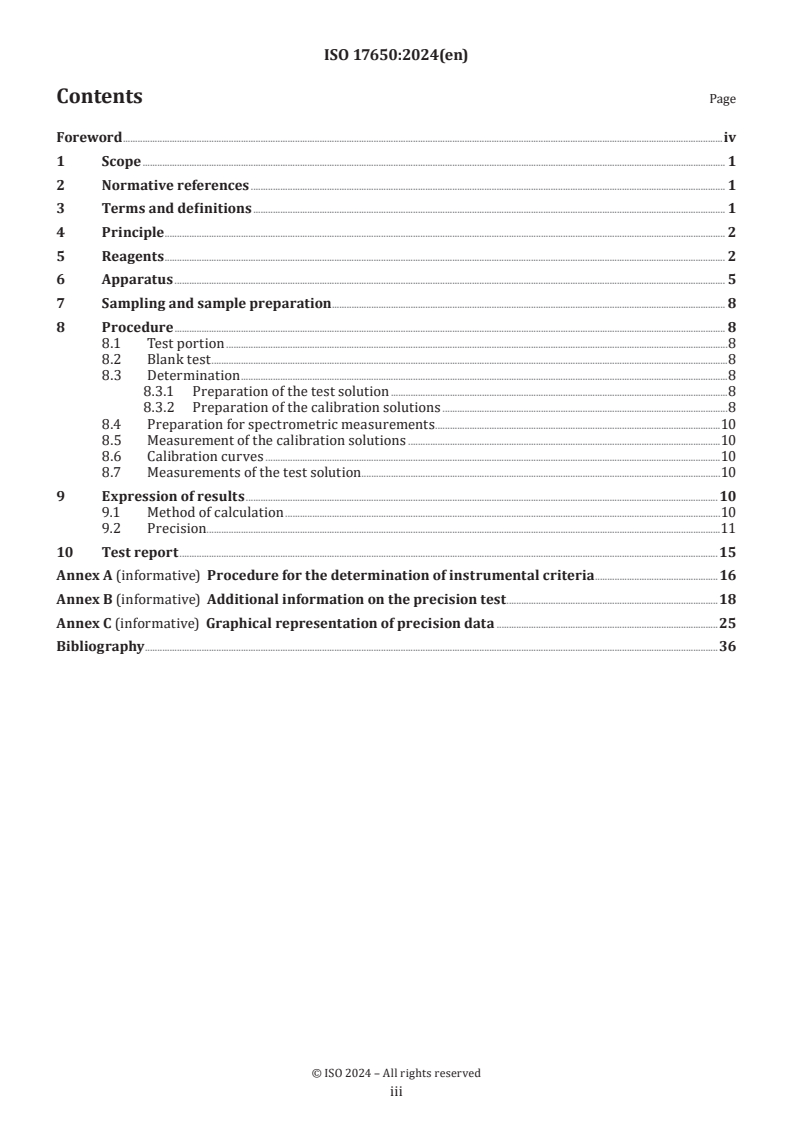
Contents Page
Foreword .iv
1 Scope . 1
2 Normative references . 1
3 Terms and definitions . 1
4 Principle . 2
5 Reagents . 2
6 Apparatus . 5
7 Sampling and sample preparation . 8
8 Procedure . 8
8.1 Test portion .8
8.2 Blank test .8
8.3 Determination .8
8.3.1 Preparation of the test solution .8
8.3.2 Preparation of the calibration solutions .8
8.4 Preparation for spectrometric measurements .10
8.5 Measurement of the calibration solutions .10
8.6 Calibration curves .10
8.7 Measurements of the test solution . .10
9 Expression of results . 10
9.1 Method of calculation .10
9.2 Precision . . .11
10 Test report .15
Annex A (informative) Procedure for the determination of instrumental criteria .16
Annex B (informative) Additional information on the precision test .18
Annex C (informative) Graphical representation of precision data .25
Bibliography .36
iii
Foreword
ISO (the International Organization for Standardization) is a worldwide federation of national standards
bodies (ISO member bodies). The work of preparing International Standards is normally carried out through
ISO technical committees. Each member body interested in a subject for which a technical committee
has been established has the right to be represented on that committee. International organizations,
governmental and non-governmental, in liaison with ISO, also take part in the work. ISO collaborates closely
with the International Electrotechnical Commission (IEC) on all matters of electrotechnical standardization.
The procedures used to develop this document and those intended for its further maintenance are described
in the ISO/IEC Directives, Part 1. In particular, the different approval criteria needed for the different types
of ISO documents should be noted. This document was drafted in accordance with the editorial rules of the
ISO/IEC Directives, Part 2 (see www.iso.org/directives).
ISO draws attention to the possibility that the implementation of this document may involve the use of (a)
patent(s). ISO takes no position concerning the evidence, validity or applicability of any claimed patent
rights in respect thereof. As of the date of publication of this document, ISO had not received notice of (a)
patent(s) which may be required to implement this document. However, implementers are cautioned that
this may not represent the latest information, which may be obtained from the patent database available at
www.iso.org/patents. ISO shall not be held responsible for identifying any or all such patent rights.
Any trade name used in this document is information given for the convenience of users and does not
constitute an endorsement.
For an explanation of the voluntary nature of standards, the meaning of ISO specific terms and expressions
related to conformity assessment, as well as information about ISO's adherence to the World Trade
Organization (WTO) principles in the Technical Barriers to Trade (TBT), see www.iso.org/iso/foreword.html.
This document was prepared by Technical Committee ISO/TC 17, Steel, Subcommittee SC 1, Methods of
determination of chemical composition.
Any feedback or questions on this document should be directed to the user’s national standards body. A
complete listing of these bodies can be found at www.iso.org/members.html.
iv
International Standard ISO 17650:2024(en)
Low-alloyed steel — Determination of Mn, P, Cr, Ni, Mo, Co,
Cu, V, Ti, As and Sn — Inductively coupled plasma optical
emission spectrometric method
1 Scope
This document specifies a method for the determination of Mn, P, Cr, Ni, Mo, Co, Cu, V, Ti, As and Sn contents
in low alloyed steel by inductively coupled plasma optical emission spectrometry (ICP-OES).
The method is applicable to the determination of Mn, P, Cr, Ni, Mo, Co, Cu, V, Ti, As and Sn within the ranges
given in Table 1.
Table 1 — Application ranges of the elements to be determined
Application range
Element
% (mass fraction)
Mn 0,002 to 2,0
P 0,005 to 0,1
Cr 0,003 to 3,0
Ni 0,005 to 4,0
Mo 0,003 to 1,0
Co 0,002 to 0,2
Cu 0,003 to 0,5
V 0,002 to 0,5
Ti 0,002 to 0,5
As 0,003 to 0,1
Sn 0,003 to 0,08
2 Normative references
The following documents are referred to in the text in such a way that some or all of their content constitutes
requirements of this document. For dated references, only the edition cited applies. For undated references,
the latest edition of the referenced document (including any amendments) applies.
ISO 648, Laboratory glassware — Single-volume pipettes
ISO 1042, Laboratory glassware — One-mark volumetric flasks
ISO 3696, Water for analytical laboratory use — Specification and test methods
ISO 14284, Steel and iron — Sampling and preparation of samples for the determination of chemical composition
3 Terms and definitions
No terms and definitions are listed in this document.
ISO and IEC maintain terminology databases for use in standardization at the following addresses:
— ISO Online browsing platform: available at https:// www .iso .org/ obp
— IEC Electropedia: available at https:// www .electropedia .org/
4 Principle
Dissolution of a test portion in nitric and hydrochloric acids. Filtration and ignition of the acid insoluble
residue. Removal of silica with hydrofluoric acid.
Fusion of the residue with potassium hydrogen sulfate, dissolution of the melt with acid and addition of this
solution to the reserved filtrate. If necessary, addition of an internal standard element and dilution of the
solution to a known volume.
Nebulization of the solution into an ICP-OES spectrometer and measurement of the intensity of the emitted
light from each element simultaneously with the intensity of the light emitted by the internal standard
element.
5 Reagents
During the analysis, unless otherwise stated, use only reagents of recognized analytical grade and only
grade 2 water as specified in ISO 3696.
5.1 Pure iron, containing at least ten times less than the lower limit of the scope of each element to be
determined.
5.2 Potassium hydrogen sulfate (KHSO ) or potassium disulfate (K S O ).
4 2 2 7
5.3 Hydrochloric acid, ρ about 1,19 g/ml.
5.4 Nitric acid, ρ about 1,42 g/ml.
5.5 Nitric acid solution, ρ about 1,42 g/ml, diluted 1 + 1.
5.6 Hydrofluoric acid, ρ about 1,15 g/ml.
5.7 Sulfuric acid, ρ about 1,84 g/ml.
5.8 Sulfuric acid solution, ρ about 1,84 g/ml, diluted 1 + 3.
5.9 Manganese standard solution, 1 g/l.
Transfer several grams of electrolytic manganese (purity > 99,9 %) into a 250 ml beaker containing about
150 ml of sulphuric acid solution (ρ about 1,84 g/ml, diluted 5+95). Stir, then allow the manganese to settle
for several minutes. Decant and eliminate the sulphuric acid solution and substituting water. Wash several
times with water and finally with acetone. Dry the metal for about 2 min at 100 °C and cool in a desiccator.
Weigh, to the nearest 1 mg, 1,000 g of manganese as mentioned above. Transfer into a 250 ml beaker, add
40 ml of hydrochloric acid (5.3) and cover with a watch-glass. Heat gently to complete dissolution. Cool,
transfer the solution quantitatively into a 1 000 ml one-mark volumetric flask, dilute to the mark with water
and mix.
1 ml of this standard solution contains 1 mg of manganese.
5.10 Phosphorus standard solution, 1 g/l.
Weigh, to the nearest 0,1 mg, 4,393 6 g of potassium dihydrogen phosphate (KH PO ) previously dried to
2 4
constant mass at 110 °C and cooled in a desiccator.
Transfer into a 1 000 ml one-mark volumetric flask, dilute to the mark with water and mix.
1 ml of this standard solution contains 1 mg of phosphorus.
5.11 Chromium standard solution, 1 g/l.
Prepare a 1 g/l chromium standard solution by using one of the procedures described in a) or b).
a) Weigh, to the nearest 1 mg, 1,000 g of chromium [purity ≥ 99,9 % (mass fraction)]. Transfer into a 250 ml
beaker, add 40 ml of hydrochloric acid (5.3) and cover with a watch-glass. Heat gently to complete
dissolution. Cool, transfer the solution quantitatively into a 1 000 ml one-mark volumetric flask, dilute
to the mark with water and mix.
b) Weigh 2,828 4 g of potassium dichromate (K Cr O ), previously dried at 140 °C and allowed to cool in
2 2 7
a desiccator. Place in a 400 ml beaker and dissolve in about 20 ml of water. Add 5 ml of the sulfuric acid
(5.7) and, while cooling, cautiously add the hydrogen peroxide solution (to be added), adding an excess
of about 2 ml after effervescence has ceased. Allow the solution to stand at ambient temperature until
the yellow colour has completely disappeared (several hours), then transfer into a 1 000 ml one-mark
volumetric flask. Dilute to the mark with water and mix well.
1 ml of this standard solution contains 1 mg of chromium.
5.12 Nickel standard solution, 1 g /l.
Weigh, to the nearest 1 mg, 1,000 g of nickel [purity ≥ 99,9 % (mass fraction)]. Transfer into a 250 ml beaker,
add 50 ml of nitric acid (5.5) and cover with a watch-glass. Heat gently to complete dissolution. Cool, transfer
the solution quantitatively into a 1 000 ml one-mark volumetric flask, dilute to the mark with water and mix.
1 ml of this standard solution contains 1 mg of nickel.
5.13 Molybdenum standard solution, 1 g /l.
Weigh, to the nearest 1 mg, 1,000 g of molybdenum [purity ≥ 99,9 % (mass fraction)]. Transfer into a 250 ml
beaker, add 50 ml of hydrochloric acid (5.3) and 50 ml of nitric acid (5.4) and cover with a watch-glass. Heat
gently to complete dissolution. Cool, transfer the solution quantitatively into a 1 000 ml one-mark volumetric
flask, dilute to the mark with water and mix.
1 ml of this standard solution contains 1 mg of molybdenum.
5.14 Cobalt standard solution, 1 g/l.
Weigh, to the nearest 1 mg, 1,000 g of cobalt [purity ≥ 99,9 % (mass fraction)]. Transfer into a 250 ml beaker,
add 50 ml of nitric acid solution (5.5) and cover with a watch-glass. Heat gently to complete dissolution. Cool,
transfer the solution quantitatively into a 1 000 ml one-mark volumetric flask, dilute to the mark with water
and mix.
1 ml of this standard solution contains 1 mg of cobalt.
5.15 Copper standard solution, 1 g/l.
Weigh, to the nearest 1 mg, 1,000 g of copper [purity ≥ 99,9 % (mass fraction)]. Transfer into a 250 ml beaker,
add 50 ml of nitric acid solution (5.5) and cover with a watch-glass. Heat gently to complete dissolution. Cool,
transfer the solution quantitatively into a 1 000 ml one-mark volumetric flask, dilute to the mark with water
and mix.
1 ml of this standard solution contains 1 mg of copper.
5.16 Vanadium standard solution, 1 g/l.
Weigh, to the nearest 1 mg, 1,000 g of vanadium [purity ≥ 99,9 % (mass fraction)]. Transfer into a 250 ml
beaker, add 30 ml of aqua regia [mix three volume of hydrochloric acid (5.3) with one volume of nitric
acid (5.4)] and cover with a watch-glass. Heat gently to complete dissolution. Cool, transfer the solution
quantitatively into a 1 000 ml one-mark volumetric flask, dilute to the mark with water and mix.
1 ml of this standard solution contains 1 mg of vanadium.
5.17 Titanium standard solution, 1 g/l.
Weigh, to the nearest 1 mg, 200 mg of titanium [purity ≥ 99,9 % (mass fraction)]. Transfer into a 250 ml
beaker, add 50 ml of hydrochloric acid (5.3), diluted 1 + 1 and 5 drops of hydrofluoric acid (5.6) and cover
with a watch-glass. Heat gently to complete dissolution. Cool, transfer the solution quantitatively into to a
200 ml one-mark volumetric flask, dilute to the mark with water and mix.
1 ml of this standard solution contains 1 mg of titanium.
5.18 Arsenic standard solution, 100 mg/l.
Prepare an arsenic standard solution by using one of the procedures described in a) or b).
a) Weigh, to the nearest 1 mg, 100 mg of arsenic [purity ≥ 99,9 % (mass fraction)]. Transfer into a 250 ml
beaker, add 20 ml of nitric acid solution (5.5) and cover with a watch-glass. Heat gently to complete
dissolution. Cool, transfer the solution quantitatively into a 1 000 ml one-mark volumetric flask, dilute
to the mark with water and mix.
b) Weigh, to the nearest 1 mg, 132 mg of arsenic trioxide. Transfer into a 250 ml beaker, add 6 ml of
potassium hydroxide solution (10 g/l) and dilute with water to 100 ml. Adjust the pH between 3 and
6 with hydrochloric acid (diluted 1+10). Transfer the solution quantitatively into 1 000 ml one-mark
volumetric flask, dilute to the mark with water and mix.
1 ml of this standard solution contains 0,1 mg of arsenic.
5.19 Tin standard solution, 500 mg/l.
Weigh, to the nearest 1 mg, 500 mg of tin [purity ≥ 99,9 % (mass fraction)]. Transfer into a 250 ml beaker,
add 20 ml of hydrochloric acid (5.3) and 5 ml of nitric acid (5.4) and cover with a watch-glass. Heat gently to
complete dissolution. Remove from the hot plate immediately and allow to cool. Transfer the solution into
a 1 000 ml one-mark volumetric flask containing 200 ml of hydrochloric acid (5.3). Dilute to the mark with
water and mix.
1 ml of this standard solution contains 0,5 mg of tin.
5.20 Yttrium internal standard solution, 100 mg/l.
Calcine several grams of yttrium oxide [purity ≥ 99,9 % (mass fraction)] in a muffle furnace at 850 °C ± 10 °C
for at least 40 min and then allow to cool in a desiccator. Weigh 0,127 0 g of the calcined product, transfer into
a 250 ml beaker, add 10 ml of hydrochloric acid (5.3) and cover with a watch-glass. Heat gently to complete
dissolution. Cool, transfer the solution into a 1 000 ml one-mark volumetric flask, dilute to the mark with
water and mix.
1 ml of this standard solution contains 0,1 mg of yttrium.
NOTE Elements as cadmium and scandium can also be used as internal standards.
5.21 Multi-elemental standard solutions for Mn, P, Cr, V and Ti
5.21.1 Multi-elemental standard solution for Mn, P, Cr, V and Ti, corresponding to 100 mg of each
element per litre.
Transfer 10,0 ml of each of the standard solutions (5.9), (5.10), (5.11), (5.16) and (5.17) into a 100 ml one-
mark volumetric flask. Add 5 ml hydrochloric acid (5.3), dilute to the mark with water and mix.
1 ml of this standard solution contains 100 μg of Mn, P, Cr, V and Ti.
5.21.2 Multi-elemental standard solution for Mn, P, Cr, V and Ti, corresponding to 10 mg of each element
per litre.
Transfer 10,0 ml of the multi-elemental standard solution (5.21.1) into a 100 ml one-mark volumetric flask,
dilute to the mark with water and mix.
1 ml of this standard solution contains 10,0 μg of Mn, P, Cr, V and Ti.
Prepare this solution immediately before use.
5.22 Multi-elemental standard solutions for Ni, Mo, Co, Cu, As and Sn.
5.22.1 Multi-elemental standard solution for Ni, Mo, Co, Cu and Sn, corresponding to 100 mg of each
element per litre.
Transfer 10,0 ml of each of the standard solutions (5.12), (5.13), (5.14) and (5.15) and 20,0 ml of tin standard
solution (5.19) into a 100 ml one-mark volumetric flask. Add 5 ml hydrochloric acid (5.3), dilute to the mark
with water and mix.
1 ml of this standard solution contains 100 μg of Ni, Mo, Co, Cu and Sn.
5.22.2 Multi-elemental standard solution for Ni, Mo, Co, Cu, As and Sn, corresponding to 10 mg of each
element per litre.
Transfer 10,0 ml of the multi-elemental standard solution (5.22.1) and 10,0 ml of arsenic standard solution
(5.18) into a 100 ml one-mark volumetric flask, dilute to the mark with water and mix.
1 ml of this standard solution contains 10,0 μg of Ni, Mo, Co, Cu, As and Sn.
Prepare this solution immediately before use.
NOTE Standard solutions whose preparations are described under items 5.9 to 5.20 can be replaced by
commercially available standard solutions, provided that they are supplied by a recognised producer and their
traceability fully documented.
6 Apparatus
All volumetric glassware shall be class A, in accordance with ISO 648 or ISO 1042 as appropriate.
Ordinary laboratory apparatus and the following shall be used.
6.1 Optical emission spectrometer, equipped with an inductively coupled plasma (ICP-OES).
The ICP-OES used will be satisfactory if, after optimizing according to 8.4, it meets the performance criteria
given in 6.1.2 to 6.1.5.
The spectrometer can be either simultaneous or sequential. If a sequential spectrometer can be equipped
with an extra arrangement for simultaneous measurement of the internal standard wavelength, it can
be used with the internal standard technique. If the sequential spectrometer is not equipped with this
arrangement, the internal standard cannot be used and an alternative technique without internal standard
shall be applied.
6.1.1 Wavelengths
This method does not specify any particular emission line. It is mandatory that each laboratory carefully
investigate the wavelengths available on its own equipment to find the most suitable one regarding
sensitivity and absence of interferences.
In Table 2, however, several suggestions are given together with possible interferences. These wavelengths
have been carefully investigated.
The wavelength of the internal standard element chosen shall not interfere with the analytical wavelengths,
nor should the internal element wavelength be interfered by elements present in the test solution. It is,
however, recommended to use Y 371,030 nm. This wavelength is free of interferences from the elements.
Table 2 — Wavelengths and interfering elements
Wavelength
Element Possible interferences
nm
257,610 —
Mn
260,569 Co, Fe, Cr
178,280 Mo, Cr, Mn
P
213,618 Mo, Cu
267,716 Mn
Cr
206,149 —
231,604 Co
Ni
221,647 —
202,030 Fe
Mo
281,615 Al, V
a)
Co 228,616 Cr, Ti, Ni
324,754 Mn, Mo
Cu
327,396 Mo
309,311 Fe
V
311,071 Ti, Mo
334,941 Cr
Ti
337,280 —
189,042 Cr
As
193,759 —
189,989 —
Sn
283,999 Cr
Y 371,030 None
a)
Check and correct, if necessary, for interference by Ni and Cr
Other element can be used as internal standard, but it shall not be present in the sample and interfere with
the analytical wavelengths, nor shall elements present in the test solution interfere with the internal element
wavelength. Moreover, the excitation conditions of the analytical lines and the internal standard element
line should match.
6.1.2 Minimum practical resolution of the spectrometer
Calculate the bandwidth, according to A.1, for the wavelength used including the wavelength of the internal
standard. The bandwidth shall be less than 0,030 nm.
6.1.3 Minimum short-term precision
Calculate the short-term precision according to A.2. The relative standard deviation (RSD) shall not exceed
0,5 % for concentrations 100 to 1 000 times above the LOD (6.1.5). For concentrations 10 to 100 times above
the LOD (6.1.5), the RSD shall not exceed 5 %.
6.1.4 Long-term stability
Calculate the standard deviation of seven mean values of three measurements of the absolute intensity or
intensity ratio of the emitted light of the most concentrated calibration solution for each element. Each mean
value should be determined every 30 min during a total time of 3 h. The relative standard deviation shall not
exceed 2 % for the absolute intensity technique or 1,5 % for the internal standard technique.
6.1.5 Limit of detection (LOD) and limit of quantification (LOQ)
Calculate the LOD and LOQ, according to the A.3, for the wavelength used. The values shall be below the
values in Table 3.
Table 3 — Limit of detection (LOD) and limit of quantification (LOQ)
Wavelength LOD LOQ
Element
nm mg/l mg/l
257,610 0,03 0,1
Mn
260,569 0,03 0,1
178,280 0,06 0,2
P
213,618 0,06 0,2
267,716 0,03 0,1
Cr
206,149 0,03 0,1
231,604 0,06 0,2
Ni
221,647 0,06 0,2
202,030 0,03 0,1
Mo
281,615 0,03 0,1
Co 228,616 0,03 0,1
324,754 0,03 0,1
Cu
327,396 0,03 0,1
309,311 0,03 0,1
V
311,071 0,03 0,1
334,941 0,03 0,1
Ti
337,280 0,03 0,1
189,042 0,03 0,1
As
193,759 0,03 0,1
189,989 0,03 0,1
Sn
283,999 0,03 0,1
6.1.6 Linearity of the calibration curves
The linearity of the calibration curves is checked by calculating the correlation coefficient. This coefficient
shall be higher than 0,999.
6.2 Platinum crucible, of capacity 30 ml.
7 Sampling and sample preparation
Sampling and sample preparation shall be carried out in accordance with ISO 14284 or with an appropriate
national standard for steels.
8 Procedure
8.1 Test portion
Weigh, to the nearest 0,001 g, 0,500 g of the test sample.
8.2 Blank test
In parallel with the determination of the content and following the same procedure, carry out a blank test
using the same quantities of all the reagents, including pure iron (5.1).
8.3 Determination
8.3.1 Preparation of the test solution
8.3.1.1 Dissolution of the test portion
Transfer the test portion (see 8.1) into a 250 ml beaker. Add 10 ml of nitric acid solution (5.5), cover the
beaker with a watch-glass and heat gently until the acid action ceases and then boil for 1 min. Add 5 ml of
hydrochloric acid (5.3) and continue the heating to boil for about 5 min.
Allow to cool, add about 15 ml of water, filter through a close texture filter paper and collect the filtrate
in a 100 ml one-mark volumetric flask. Wash the filter paper several times with hot water and collect the
washings in the volumetric flask. Reserve the filtrate as the main solution. Check the filter paper carefully
for residue. If there is no residue, skip the procedure described in 8.3.1.2.
8.3.1.2 Treatment of insoluble residue
Transfer the filter paper and residue into a platinum crucible (6.2), dry and ignite at a temperature as low as
possible until all carbonaceous matter is removed and finally at about 800 °C for at least 15 min. Cool, add
2 drops of sulfuric acid solution (5.8) and about 2 ml of hydrofluoric acid (5.6). Evaporate to dryness, heat
to about 800 °C and cool. Add 1 g of potassium hydrogen sulfate (5.2) and fuse carefully until a clear melt is
obtained.
For residues containing carbides, prolonged heating may be necessary for complete fusion. The potassium
hydrogen sulfate can be regenerated by allowing the melt to cool, adding 2 drops of sulfuric acid (5.7) and
repeating the fusion until the residue is dissolved.
After cooling, add 10 ml of water and 2 ml of hydrochloric acid (5.3) to the solidified melt in the crucible,
transfer the contents to a 250 ml beaker and heat gently until the fusion products are dissolved. Cool and
add this solution to the main solution (see 8.3.1.1).
8.3.1.3 Dilution of the test solution
If the internal standard technique is used, add 5,0 ml of the yttrium internal standard solution (5.20) (see
NOTE). Dilute to the mark with water and mix.
NOTE Elements as cadmium and scandium can also be used as internal standard.
8.3.2 Preparation of the calibration solutions
Transfer 0,48 g ± 0,005 g of pure iron (5.1) into each of a series of nine 250 ml beakers. Treat the pure iron
following the same procedure as the test portion (see 8.3.1.1). Procedure 8.3.1.2 is not necessary, provided
that the same amount of all the appropriate reagents are added. If the procedure 8.3.1.2 is skipped in
preparation of the test solutions, just follow the procedure of 8.3.1.1 to treat the pure iron.
Transfer the solution into each of a series of nine 100 ml one-mark volumetric flasks, rinsing the beakers
with a minimum quantity of water.
Add to the volumetric flasks the volumes of the standard solutions (see NOTE 1 and NOTE 2) given in Table 4.
Corresponding contents in the test portion are listed in Table 5. If the internal standard technique is used,
add 5,0 ml of yttrium internal standard solution (5.20) (see NOTE 3). Dilute to the mark with water and mix.
NOTE 1 The whole elements can also be added one by one to the calibration solutions if multi-elemental solutions
are not prepared.
NOTE 2 Calibration curves can be adapted according to the content range of test samples, but the calibration
solutions shall not be less than 5.
NOTE 3 Cadmium and scandium can also be used as internal standard.
Table 4 — Standard solutions volumes (ml)
Calibra- Multi-el- Manganese Chromium Multi-el- Nickel Molybde- Arsenic
tion solu- emental standard standard emental standard num stand- standard
tion No. standard solution solution standard solution ard solution solution
solution (5.9) (5.11) solution (5.12) (5.13) (5.18)
(5.21) (5.22)
1)
S 0 0 0 0 0 0 0
S 1,00 (5.21.2) 0 0 0 20,00 0 0
S 2,50 (5.21.2) 0
...
Questions, Comments and Discussion
Ask us and Technical Secretary will try to provide an answer. You can facilitate discussion about the standard in here.
Loading comments...