


ISO 11610:2023
(Main)Protective clothing — Vocabulary
Protective clothing — Vocabulary
This document contains a list of terms which are frequently used in the standardization of protective clothing (5.1.4) and protective equipment worn on the body, including hand and arm protection and lifejackets, and definitions of these terms. The definitions are intended to support an unambiguous use of the terms listed. This document is intended to serve as a reference document for the Working Groups of CEN/TC 162 and ISO/TC 94/SC 13 to ascertain what definitions already exist and may be used for setting up new standards and to provide guidance in the elaboration of new definitions. NOTE - In addition to text written in the official ISO languages (English, French), this document gives text in German. This text is published under the responsibility of the Member Body for Germany (DIN) and is given for information only. Only the text given in the official languages can be considered as ISO text.
Habillement de protection — Vocabulaire
Le présent document contient une liste de termes avec leurs définitions couramment utilisés dans la normalisation de l’habillement de protection (5.1.4) et des équipements de protection portés sur le corps humain, y compris la protection de la main et du bras et les gilets de sauvetage. Les définitions sont destinées à apporter un appui à une utilisation sans équivoque des termes donnés. Ce document est destiné à servir de document de référence pour les Groupes de travail du CEN/TC 162 et de l’ISO/TC 94/SC 13 afin de vérifier quelles définitions existent déjà et peuvent être utilisées pour établir de nouvelles normes et pour servir de guide dans l’élaboration de nouvelles définitions. NOTE - En complément du texte rédigé dans les langues officielles de l'ISO (anglais, français), le présent document contient du texte en allemand; ce texte est publié sous la responsabilité du Comité national allemand (DIN) et est donné uniquement pour information. Seul le texte rédigé dans les langues officielles peut être considéré comme étant un texte de l'ISO.
General Information
- Status
- Published
- Publication Date
- 14-May-2023
- Technical Committee
- ISO/TC 94/SC 13 - Protective clothing
- Drafting Committee
- ISO/TC 94/SC 13/WG 1 - General properties
- Current Stage
- 6060 - International Standard published
- Start Date
- 15-May-2023
- Due Date
- 03-Aug-2022
- Completion Date
- 15-May-2023
Relations
- Effective Date
- 12-Feb-2026
- Effective Date
- 06-Jun-2022
- Effective Date
- 23-Apr-2020
Overview
ISO 11610:2023 - Protective clothing - Vocabulary is an international standard that establishes a harmonized set of terms and definitions used in the standardization of protective clothing and body-worn protective equipment (including protective gloves and lifejackets). Published as the first edition in 2023, it replaces ISO/TR 11610:2004 and is designed as a reference vocabulary to ensure unambiguous terminology across PPE standards and technical work by ISO/TC 94/SC 13 and CEN/TC 162.
Key topics
- Comprehensive vocabulary covering textiles, clothing, ergonomics, components, materials, design, test methods and ageing.
- Hazard‑specific terminology for protection against heat and flame, chemical hazards, foul weather/cold, mechanical risks, infective agents, diving, visibility, electrostatic and electrical arc hazards.
- Structured clause layout: clauses are organized by domain (e.g., Clause 4: textile and clothing; Clause 6: heat and flame) with subclauses X.1–X.5 (general terms, product types, components, risks, test methods) to promote consistency.
- Multilingual support: official ISO texts in English and French, with German text provided for information by DIN (only English/French are ISO authoritative).
- Index and annexes: Annex A provides an index of term numbers with French and German translations; a bibliography and index are also included.
- Governance and copyright: prepared under ISO/TC 94 in collaboration with CEN/TC 162; copyright and use governed by ISO procedures.
Applications
ISO 11610:2023 is a practical tool for anyone involved in PPE standardization, specification, testing or procurement:
- Standards developers and working groups (ISO/TC 94/SC 13, CEN/TC 162) use it as the authoritative reference to avoid inconsistent redefinitions when drafting new standards or revising existing ones.
- Manufacturers and product designers apply consistent terminology in technical specifications, design documentation and conformity files.
- Test laboratories and conformity assessment bodies align test reports and methods with standardized definitions for clarity and comparability.
- Safety managers, specifiers and procurement teams ensure procurement documents and safety policies use unambiguous vocabulary.
- Regulators and certification bodies reference standardized terms when interpreting or enforcing PPE requirements.
Related standards
- Replaces ISO/TR 11610:2004 (technical report) as the authoritative vocabulary document for protective clothing.
- Intended to be used alongside domain standards developed by ISO/TC 94/SC 13 and CEN/TC 162 and in accordance with ISO/IEC Directives for harmonized standardization.
Keywords: ISO 11610, protective clothing vocabulary, PPE standards, protective equipment terminology, ISO/TC 94, CEN/TC 162, SUCAM, protective gloves, lifejackets.
ISO 11610:2023 - Protective clothing — Vocabulary Released:15. 05. 2023
ISO 11610:2023 - Protective clothing — Vocabulary Released:15. 05. 2023
ISO 11610:2023 - Habillement de protection — Vocabulaire Released:15. 05. 2023
ISO 11610:2023 - Protective clothing — Vocabulary Released:15. 05. 2023
Get Certified
Connect with accredited certification bodies for this standard

NSF International
Global independent organization facilitating standards development and certification.

CIS Institut d.o.o.
Personal Protective Equipment (PPE) certification body. Notified Body NB-2890 for EU Regulation 2016/425 PPE.

Kiwa BDA Testing
Building and construction product certification.
Sponsored listings
Frequently Asked Questions
ISO 11610:2023 is a standard published by the International Organization for Standardization (ISO). Its full title is "Protective clothing — Vocabulary". This standard covers: This document contains a list of terms which are frequently used in the standardization of protective clothing (5.1.4) and protective equipment worn on the body, including hand and arm protection and lifejackets, and definitions of these terms. The definitions are intended to support an unambiguous use of the terms listed. This document is intended to serve as a reference document for the Working Groups of CEN/TC 162 and ISO/TC 94/SC 13 to ascertain what definitions already exist and may be used for setting up new standards and to provide guidance in the elaboration of new definitions. NOTE - In addition to text written in the official ISO languages (English, French), this document gives text in German. This text is published under the responsibility of the Member Body for Germany (DIN) and is given for information only. Only the text given in the official languages can be considered as ISO text.
This document contains a list of terms which are frequently used in the standardization of protective clothing (5.1.4) and protective equipment worn on the body, including hand and arm protection and lifejackets, and definitions of these terms. The definitions are intended to support an unambiguous use of the terms listed. This document is intended to serve as a reference document for the Working Groups of CEN/TC 162 and ISO/TC 94/SC 13 to ascertain what definitions already exist and may be used for setting up new standards and to provide guidance in the elaboration of new definitions. NOTE - In addition to text written in the official ISO languages (English, French), this document gives text in German. This text is published under the responsibility of the Member Body for Germany (DIN) and is given for information only. Only the text given in the official languages can be considered as ISO text.
ISO 11610:2023 is classified under the following ICS (International Classification for Standards) categories: 01.040.13 - Environment. Health protection. Safety (Vocabularies); 13.340.10 - Protective clothing. The ICS classification helps identify the subject area and facilitates finding related standards.
ISO 11610:2023 has the following relationships with other standards: It is inter standard links to EN ISO 11610:2023, ISO 20437:2017, ISO/TR 11610:2004. Understanding these relationships helps ensure you are using the most current and applicable version of the standard.
ISO 11610:2023 is available in PDF format for immediate download after purchase. The document can be added to your cart and obtained through the secure checkout process. Digital delivery ensures instant access to the complete standard document.
Standards Content (Sample)
INTERNATIONAL ISO
STANDARD 11610
First edition
2023-05
Protective clothing — Vocabulary
Habillement de protection — Vocabulaire
Schutzkleidung — Begriffe
Reference number
© ISO 2023
All rights reserved. Unless otherwise specified, or required in the context of its implementation, no part of this publication may
be reproduced or utilized otherwise in any form or by any means, electronic or mechanical, including photocopying, or posting on
the internet or an intranet, without prior written permission. Permission can be requested from either ISO at the address below
or ISO’s member body in the country of the requester.
ISO copyright office
CP 401 • Ch. de Blandonnet 8
CH-1214 Vernier, Geneva
Phone: +41 22 749 01 11
Email: copyright@iso.org
Website: www.iso.org
Published in Switzerland
ii
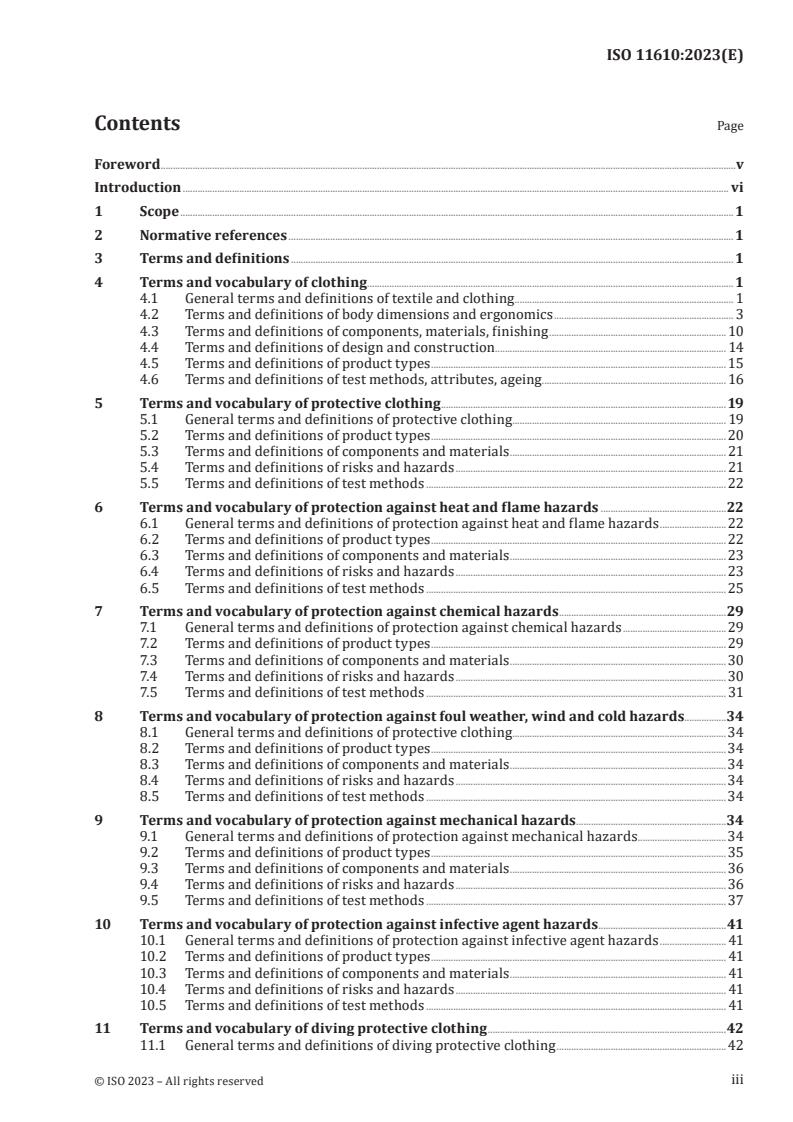
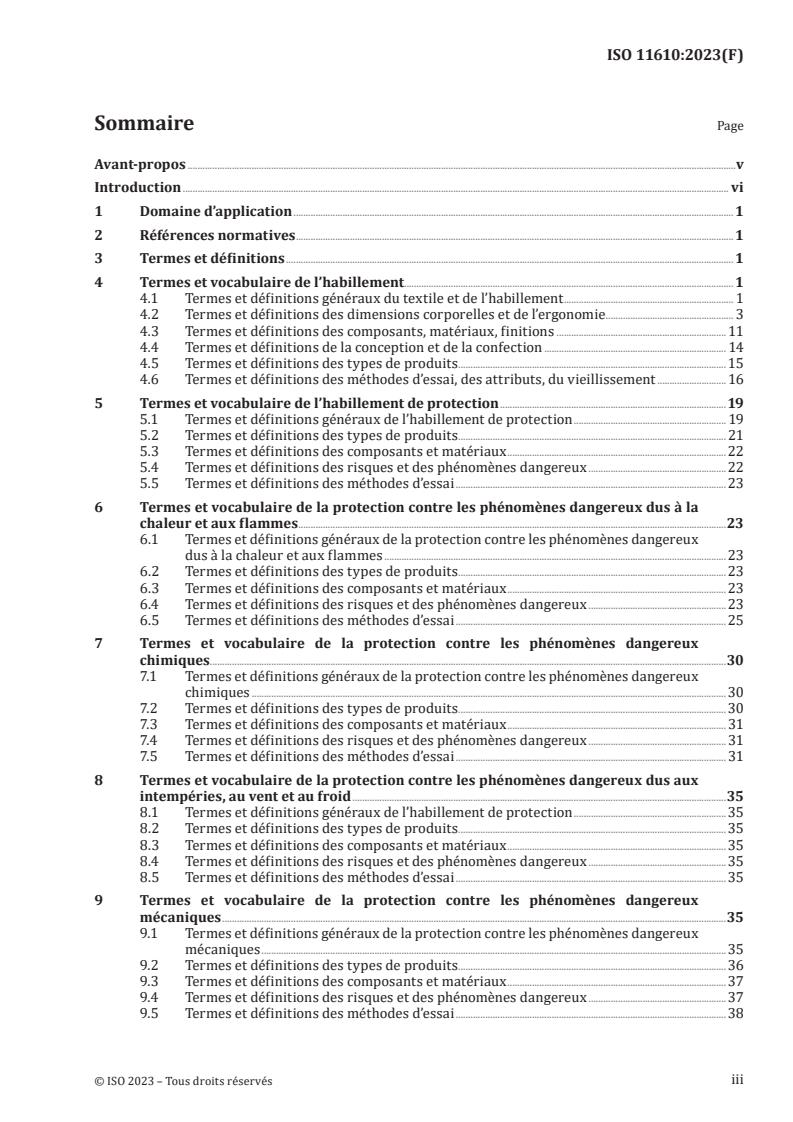
Contents Page
Foreword .v
Introduction . vi
1 Scope . 1
2 Normative references . 1
3 Terms and definitions . 1
4 Terms and vocabulary of clothing .1
4.1 General terms and definitions of textile and clothing . 1
4.2 Terms and definitions of body dimensions and ergonomics . 3
4.3 Terms and definitions of components, materials, finishing . 10
4.4 Terms and definitions of design and construction . 14
4.5 Terms and definitions of product types . 15
4.6 Terms and definitions of test methods, attributes, ageing . 16
5 Terms and vocabulary of protective clothing .19
5.1 General terms and definitions of protective clothing . 19
5.2 Terms and definitions of product types . 20
5.3 Terms and definitions of components and materials . 21
5.4 Terms and definitions of risks and hazards . 21
5.5 Terms and definitions of test methods . 22
6 Terms and vocabulary of protection against heat and flame hazards .22
6.1 General terms and definitions of protection against heat and flame hazards .22
6.2 Terms and definitions of product types . 22
6.3 Terms and definitions of components and materials . 23
6.4 Terms and definitions of risks and hazards . 23
6.5 Terms and definitions of test methods . 25
7 Terms and vocabulary of protection against chemical hazards .29
7.1 General terms and definitions of protection against chemical hazards .29
7.2 Terms and definitions of product types .29
7.3 Terms and definitions of components and materials .30
7.4 Terms and definitions of risks and hazards .30
7.5 Terms and definitions of test methods . 31
8 Terms and vocabulary of protection against foul weather, wind and cold hazards .34
8.1 General terms and definitions of protective clothing .34
8.2 Terms and definitions of product types .34
8.3 Terms and definitions of components and materials .34
8.4 Terms and definitions of risks and hazards .34
8.5 Terms and definitions of test methods .34
9 Terms and vocabulary of protection against mechanical hazards .34
9.1 General terms and definitions of protection against mechanical hazards . .34
9.2 Terms and definitions of product types . 35
9.3 Terms and definitions of components and materials .36
9.4 Terms and definitions of risks and hazards . 36
9.5 Terms and definitions of test methods . 37
10 Terms and vocabulary of protection against infective agent hazards .41
10.1 General terms and definitions of protection against infective agent hazards . 41
10.2 Terms and definitions of product types . 41
10.3 Terms and definitions of components and materials . 41
10.4 Terms and definitions of risks and hazards . 41
10.5 Terms and definitions of test methods . 41
11 Terms and vocabulary of diving protective clothing .42
11.1 General terms and definitions of diving protective clothing . 42
iii
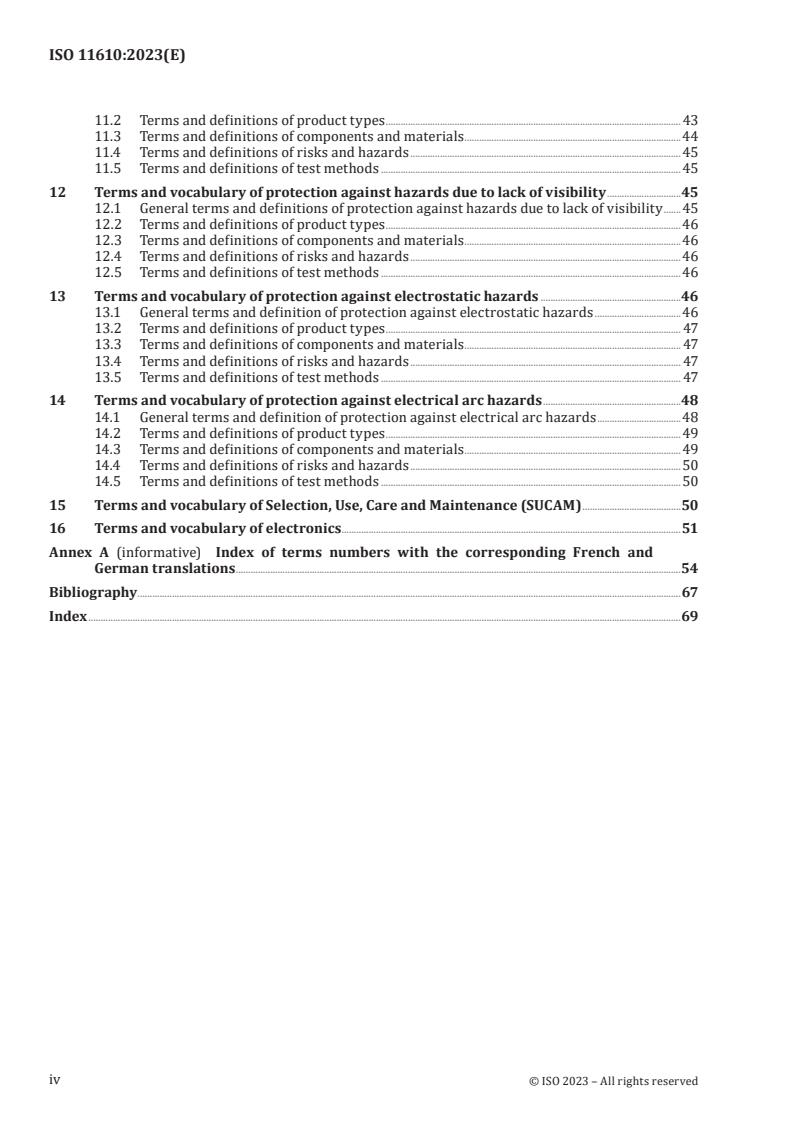
11.2 Terms and definitions of product types . 43
11.3 Terms and definitions of components and materials .44
11.4 Terms and definitions of risks and hazards . 45
11.5 Terms and definitions of test methods . 45
12 Terms and vocabulary of protection against hazards due to lack of visibility .45
12.1 General terms and definitions of protection against hazards due to lack of visibility . 45
12.2 Terms and definitions of product types .46
12.3 Terms and definitions of components and materials .46
12.4 Terms and definitions of risks and hazards .46
12.5 Terms and definitions of test methods .46
13 Terms and vocabulary of protection against electrostatic hazards .46
13.1 General terms and definition of protection against electrostatic hazards .46
13.2 Terms and definitions of product types . 47
13.3 Terms and definitions of components and materials . 47
13.4 Terms and definitions of risks and hazards . 47
13.5 Terms and definitions of test methods . 47
14 Terms and vocabulary of protection against electrical arc hazards .48
14.1 General terms and definition of protection against electrical arc hazards .48
14.2 Terms and definitions of product types .49
14.3 Terms and definitions of components and materials .49
14.4 Terms and definitions of risks and hazards .50
14.5 Terms and definitions of test methods .50
15 Terms and vocabulary of Selection, Use, Care and Maintenance (SUCAM) .50
16 Terms and vocabulary of electronics .51
Annex A (informative) Index of terms numbers with the corresponding French and
German translations .54
Bibliography .67
Index .69
iv
Foreword
ISO (the International Organization for Standardization) is a worldwide federation of national standards
bodies (ISO member bodies). The work of preparing International Standards is normally carried out
through ISO technical committees. Each member body interested in a subject for which a technical
committee has been established has the right to be represented on that committee. International
organizations, governmental and non-governmental, in liaison with ISO, also take part in the work.
ISO collaborates closely with the International Electrotechnical Commission (IEC) on all matters of
electrotechnical standardization.
The procedures used to develop this document and those intended for its further maintenance are
described in the ISO/IEC Directives, Part 1. In particular, the different approval criteria needed for the
different types of ISO documents should be noted. This document was drafted in accordance with the
editorial rules of the ISO/IEC Directives, Part 2 (see www.iso.org/directives).
Attention is drawn to the possibility that some of the elements of this document may be the subject of
patent rights. ISO shall not be held responsible for identifying any or all such patent rights. Details of
any patent rights identified during the development of the document will be in the Introduction and/or
on the ISO list of patent declarations received (see www.iso.org/patents).
Any trade name used in this document is information given for the convenience of users and does not
constitute an endorsement.
For an explanation of the voluntary nature of standards, the meaning of ISO specific terms and
expressions related to conformity assessment, as well as information about ISO's adherence to
the World Trade Organization (WTO) principles in the Technical Barriers to Trade (TBT), see
www.iso.org/iso/foreword.html.
This document was prepared by Technical Committee is ISO/TC 94, Personal safety — Personal
protective equipment, SC 13, Protective clothing, in collaboration with CEN/TC 162, Protective clothing
including hand and arm protection and lifejackets.
This first edition of ISO 11610:2023 cancels and replaces the first edition of ISO/TR 11610:2004, which
has been completely revised.
Any feedback or questions on this document should be directed to the user’s national standards body. A
complete listing of these bodies can be found at www.iso.org/members.html.
v
Introduction
The definitions compiled in this document are based on the technical report ISO/TR 11610:2004 and on
the standards and draft standards prepared by both ISO/TC 94/SC 13 and CEN/TC 162.
For this reason, the terms and definitions laid down in this document do not only cover protective
clothing and related terms but also terms from the areas of protective gloves and lifejackets which
come within the scope of CEN/TC 162.
The document is based on the compilation of terms and definitions existing in the area of standardization
of ISO/TC 94/SC 13 and CEN/TC 162 with the objective to establish a consistent terminology. Within
this purpose, the subject matter of the definitions taken from standards and draft standards have been
modified, in order to solve some inconsistencies in the existing wording of definitions, to simplify or
alter some wordings and to harmonise the definitions concerned.
The present document aims to facilitate the use of terms to serve as a reference for further definitions
when new standards are being developed or existing standards are being to be revised in the field of
protective clothing, protective equipment, protective gloves and lifejackets.
This document should be taken into account when terms need to be defined in the Working Groups of
ISO/TC 94/SC 13 and CEN/TC 162 and. Except in exceptional circumstances, terms included in clause of
this document shall not be re-defined with a different meaning in a standard prepared by ISO/TC 94/SC
13 or CEN/TC 162. If the particular use of a term requires a further definition to limit is meaning within
the definition in this document, this document shall be referred to and the term number given.
This document is structured with clauses and subclauses related to the different (technical) facets of
protective clothing and protective equipment worn on the body, including hand and arm protection and
lifejackets.
Terms and definitions are listed according to the hierarchy of the concepts.
Therefore, the vocabulary takes into consideration the more general ones to the particular ones, such
as
a) Vocabulary of textile and clothing (Clause 4);
b) Vocabulary of protective clothing (Clause 5);
c) Vocabulary of protection against heat and flame hazards (Clause 6);
d) Vocabulary of protection against chemical hazards (Clause 7);
e) Vocabulary of protection against foul weather, wind and cold hazards (Clause 8);
f) Vocabulary of protection against mechanical hazards (Clause 9);
g) Vocabulary of protection against infective agent hazards (Clause 10);
h) Vocabulary of diving protective clothing (Clause 11);
i) Vocabulary of protection against hazards due to lack of visibility (Clause 12);
j) Vocabulary of protection against electrostatic hazards (Clause 13);
k) Vocabulary of protection against electrical hazards (Clause 14);
l) Vocabulary of Selection, Use, Care and Maintenance - SUCAM (Clause 15);
m) Vocabulary of electronics (Clause 16).
Each clause (except Clause 4, Clause 15 and Clause 16) is
structured with the following sub-clauses:
vi
For Clause X:
X.1 General terms and definitions of … (domain related to Clause X);
X.2 Terms and definitions of product types;
X.3 Terms and definitions of components and materials
X.4 Terms and definitions of risks and hazards;
X.5 Terms and definitions of test methods
This subclause structure is applied to each clause (except Clause 4, Clause 15 and Clause 16) even if
there is no term and definition in a sub-clause. In such case, the following sentence is introduced:
"This subclause is empty of terms and definition but is kept for the structure consistency of this
document."
Annex A lists the French and German vocabulary in alphabetical order of the English vocabulary (index).
vii
INTERNATIONAL STANDARD ISO 11610:2023(E)
Protective clothing — Vocabulary
1 Scope
This document contains a list of terms which are frequently used in the standardization of protective
clothing (5.1.4) and protective equipment worn on the body, including hand and arm protection and
lifejackets, and definitions of these terms.
The definitions are intended to support an unambiguous use of the terms listed.
This document is intended to serve as a reference document for the Working Groups of CEN/TC 162
and ISO/TC 94/SC 13 to ascertain what definitions already exist and may be used for setting up new
standards and to provide guidance in the elaboration of new definitions.
2 Normative references
There are no normative references in this document.
3 Terms and definitions
For the purposes of this document, the following terms and definitions apply.
ISO and IEC maintain terminological databases for use in standardization at the following addresses:
— ISO Online browsing platform: available at https:// www .iso .org/ obp
— IEC Electropedia: available at https:// www .electropedia .org/
4 Terms and vocabulary of clothing
4.1 General terms and definitions of textile and clothing
4.1.1
clothing
general provisions from design to distribution intended for covering the body with everything except
the footwear
Note 1 to entry: The term "clothing" is intended for referring to the concept of clothing in opposition to the
clothing product.
Note 2 to entry: In English, the terms "clothing" and "garment" were used as synonym in the standards. The term
"clothing" may refer to either "clothing" (4.1.1) or "garment" (4.1.2). Only the context, in which the term is used,
will determine which one of the two is intended. Henceforth, definitions have been introduced in this document
to clearly distinguish their meaning.
4.1.2
garment
single article of clothing (4.1.1)
Note 1 to entry: The term "garment" is intended for referring to the product.
Note 2 to entry: The garment may consist of single or multiple layers.
EXAMPLE Trousers, jacket, coats, gloves (4.5.5), gaiters (4.5.11), socks, etc.
4.1.3
textile fibre
unit of matter characterized by its flexibility, fineness and high ratio of length to maximum transverse
dimension, which render it suitable for textile applications
[SOURCE: Regulation EU 1007/2011, Article 3, 1. (b), (i)]
4.1.4
textile product
any raw, semi-worked, worked, semi- manufactured, manufactured, semi-made-up or made-up product
which is exclusively composed of textile fibres (4.1.3), regardless of the mixing or assembly process
employed
[SOURCE: Regulation EU 1007/2011, Article 3, 1. (a)]
4.1.5
textile material
material made of textile fibres (4.1.3) and intended to be used, as such or in conjunction with other
textile or non-textile items, for the production of textile products (4.1.4)
Note 1 to entry: Textile material refers to linear textile materials (for example, fibres, yarns, threads) as well as
surface textile material (for example, knitted, woven and non-woven fabrics).
4.1.6
non-textile element
product which is not composed of textile fibres (4.1.3)
Note 1 to entry: Non-textile elements may contain, for example, active medical devices, radio and electrically
operated components, slide fastener, (press) buttons, membranes, non-textile patches.
4.1.7
advanced garment
garment (4.1.2) which shows enhanced functionality(ies)
Note 1 to entry: “protection” is one of the functions that a garment can provide.
4.1.8
functional textile material
textile material (4.1.5) to which a specific function is added by means of material, composition,
construction and/or finishing (applying additives, etc.)
[SOURCE: ISO/TR 23383:2020, 3.3, modified — "textile product" was replaced by "textile material".]
4.1.9
smart textile material
intelligent textile material
interactive textile material
functional textile material (4.1.8), which interacts reversible with its environment, i.e. it responds or
adapts to changes in the environment
Note 1 to entry: The term “smart textile” may refer to either a “smart textile material” (4.1.9) or a “smart textile
system” (4.1.11). Only the context, in which the term is used, will determine which one of the two is intended.
[SOURCE: ISO/TR 23383:2020, 3.4, modified — "textile product" was replaced by "textile material".]
4.1.10
textile system
assemblage of textile product(s) (4.1.4) and non-textile element(s) (4.1.6)
[SOURCE: ISO/TR 23383:2020, 3.7]
4.1.11
smart (intelligent, interactive) textile system
textile based system which exhibits an intended and exploitable response either to changes in its
surroundings/environment or to an external signal/input
[SOURCE: ISO/TR 23383:2020, 3.8, modified — "(intelligent, interactive)" was added in the term.]
4.2 Terms and definitions of body dimensions and ergonomics
4.2.1
torso
trunk
part of the body to which the head and limbs are attached
4.2.2
finger
one of the five digits of the hand (4.2.24)
Note 1 to entry: The digits of the hand are anatomically numbered 1 to 5, starting with the thumb.
4.2.3
back of the hand
posterior surface of the hand (4.2.24) between the wrist and the fingers (4.2.2)
4.2.4
wrist
region of the joint between the hand (4.2.24) and the forearm
4.2.5
wrist point
most prominent point of the bulge of the head of ulna
Note 1 to entry: See Figure 1.
Note 2 to entry: prominent bone at the little finger side of the wrist (4.2.4).
[SOURCE: ISO 8559-1:2017, 3.1.19, modified — "Figure 19" was replaced by "Figure 1" and the second
definition moved to Note 2 to entry.]
Figure 1 — Wrist point
4.2.6
wrist girth
girth of the wrist (4.2.4) at the level of wrist point (4.2.5)
Note 1 to entry: See Figure 2.
[SOURCE: ISO 8559-1:2017, 5.3.19, modified — "Figure 75" was replaced by "Figure 2".]
Figure 2 — Wrist girth
4.2.7
waist level
midway between the lowest rib point and the highest point of the hip bone at the side of the body
Note 1 to entry: See Figure 3.
[SOURCE: ISO 8559-1:2017, 3.1.22, modified — "Figure 22" was replaced by "Figure 3".]
Figure 3 — Waist level
4.2.8
bust point
most anterior point of the bust when wearing a bra
Note 1 to entry: See Figure 4.
[SOURCE: ISO 8559-1:2017, 3.1.11, modified — "Figure 11" was replaced by "Figure 4" and Note 2 to
entry was deleted.]
Figure 4 — Bust point
4.2.9
bust girth
horizontal girth measured at bust point level
Note 1 to entry: See Figure 5.
[SOURCE: ISO 8559-1:2017, 5.3.4, modified — "Figure 60" was replaced by "Figure 5".]
Figure 5 — Bust girth
4.2.10
chest girth
horizontal girth of torso (4.2.1) measured at axilla
Note 1 to entry: See Figure 6.
[SOURCE: ISO 8559-1:2017, 5.3.6, modified — "Figure 62" was replaced by "Figure 6".]
Figure 6 — Chest girth at axilla
4.2.11
under bust girth
horizontal girth of the body at the under bust level
Note 1 to entry: See Figure 7.
[SOURCE: ISO 8559-1:2017, 5.3.8, modified — "Figure 64" was replaced by "Figure 7".]
Figure 7 — Under bust girth
4.2.12
waist girth
horizontal girth of the body measured at the waist level
Note 1 to entry: See Figure 8.
[SOURCE: ISO 8559-1:2017, 5.3.10, modified — "Figure 66" was replaced by "Figure 8".]
Figure 8 — Waist girth
4.2.13
back neck point to waist level
distance from back neck point (4.2.14) along the neck base line to the side neck point (4.2.16), over the
bust point, then straight to the waist level
Note 1 to entry: See Figure 9.
[SOURCE: ISO 8559-1:2017, 5.4.13, modified — "Figure 97" was replaced by "Figure 9".]
Figure 9 — Back neck point to waist level
4.2.14
back neck point
tip of the prominent bone at the base of the back of the neck (spinous process of the seventh cervical
vertebra) in the mid-sagittal plane, and projected posteriorly to the surface of the skin
Note 1 to entry: See Figure 10.
[SOURCE: ISO 8559-1:2017, 3.1.6, modified — "Figure 6" was replaced by "Figure 10".]
Figure 10 — Back neck point
4.2.15
neck base line
line at the neck base defined using a chainette that passes by the back neck point (4.2.14) and the front
neck point (4.2.17)
Note 1 to entry: See Figure 11.
[SOURCE: ISO 8559-1:2017, 3.2.1, modified — "Figure 27" was replaced by "Figure 11".]
Figure 11 — Neck base line
4.2.16
side neck point
crossing point of the neck base line (4.2.15) and the anterior border of the trapezius muscle
Note 1 to entry: See Figure 12.
[SOURCE: ISO 8559-1:2017, 3.1.7, modified — "Figure 7" was replaced by "Figure 12".]
Figure 12 — side neck point
4.2.17
front neck point
crossing point of the line connecting the medial superior boarders of the left and right clavicles and the
front median line
Note 1 to entry: See Figure 13.
[SOURCE: ISO 8559-1:2017, 3.1.8, modified — "Figure 8" was replaced by "Figure 13".]
Figure 13 — Front neck point
4.2.18
ergonomics
human factors
scientific discipline concerned with the understanding of interactions among human and other elements
of a system, and the profession that applies theory, principles, data and methods to design in order to
optimize human well-being and overall system performance
[SOURCE: ISO 9241-11:2018, 3.2.5]
4.2.19
anthropometry
study and measurement of the physical dimensions and mass of the human body and its constituent
(external) parts
Note 1 to entry: Taken from the Greek word anthropos (human being or Man) and metron, to measure.
[SOURCE: ISO 15535:2012, 3.6]
4.2.20
biometrics
automated recognition of individuals based on their behavioural and biological characteristics
[SOURCE: ISO/IEC 24713-1:2008, 3.5]
4.2.21
interactive system
combination of hardware and/or software and/or services and/or people that users interact with in
order to achieve specific goals
Note 1 to entry: This includes, where appropriate, packaging, user documentation, online and human help,
support and training.
[SOURCE: ISO 9241-11:2018, 3.1.5]
4.2.22
human-centred design
HCD
approach to system design and development that aims to make interactive systems (4.2.21) more usable
by focusing on the use of the system; applying human factors (4.2.18), ergonomics (4.2.18) and usability
knowledge and techniques
Note 1 to entry: The term “human-centred design” is used rather than “user-centred design” in order to emphasize
that this document also addresses impacts on a number of stakeholders, not just those typically considered as
users. However, in practice, these terms are often used synonymously.
Note 2 to entry: Usable systems can provide a number of benefits including improved productivity, enhanced
user well-being, avoidance of stress, increased accessibility, and reduced risk of harm (5.4.1).
[SOURCE: ISO 9241-11:2018, 3.2.6]
4.2.23
human system interface
HSI
the boundary that represents the point of physical interaction between a human being and the
application platform
Note 1 to entry: Also referred to as human/computer interface, HCI (deprecated).
Note 2 to entry: In the field of machine tools, the user interface often is referred to as man machine interface,
MMI (for BACS deprecated).
[SOURCE: ISO 16484-2:2004, 3.95, modified — Note 3 to entry was deleted.]
4.2.24
hand
end part of the upper limb beyond the wrist (4.2.4)
Note 1 to entry: Hand includes the palm, the back of the hand (4.2.3) and the fingers (4.2.2).
4.3 Terms and definitions of components, materials, finishing
4.3.1
fabric
item showing a spread surface in regard to its thickness, formed by entanglement of any textile materials
(4.1.5), having a cohesion given by any textile process
Note 1 to entry: Textile processes include weaving, knitting, braiding, lacing, tufting, and nonwoven bonding.
4.3.2
nonwovens
engineered fibrous assembly, primarily planar, which has been given a designed level of structural
integrity by physical and/or chemical means, excluding weaving, knitting or papermaking
Note 1 to entry: Film and paper structures are not considered as nonwovens.
[SOURCE: ISO 9092:2019, 3.1.1]
4.3.3
coated fabric
textile fabric (4.3.1) with an adherent layer or layers of rubber- and/or plastics-based material on one or
both surfaces, resulting in a flexible product
[SOURCE: ISO 1382:2020, 3.95]
4.3.4
exterior fabric
outer fabric of a garment (4.1.2), either in the form of a single or composite fabric (4.3.1)
4.3.5
material
substances, excluding hardware (4.3.26) and labels, of which a garment (4.1.2) is made
4.3.6
multilayer material
material (4.3.5) consisting of different layers intimately combined prior to the garment manufacturing
stage
Note 1 to entry: Garment manufacturing stages are, for example, weaving, quilting, coating, gluing.
4.3.7
lining
innermost lining
innermost layer of fabric (4.3.1) or other material (4.3.5) inserted in a garment (4.1.2) which is intended
to be nearest to the wearer's body
Note 1 to entry: Where the lining (4.3.7) forms part of a quilted assembly, the quilted assembly shall be regarded
as the innermost lining (4.3.7).
4.3.8
interlining
layer between the outermost layer and the innermost lining (4.3.7) in a multilayer garment
4.3.9
liner
removable lining (4.3.7)
Note 1 to entry: A liner (4.3.9) can be an inner garment designed to be attached or to be worn separately under an
outer garment (4.3.16).
Note 2 to entry: A liner (4.3.9) is generally used to provide specific properties such as thermal insulation,
watertightness.
4.3.10
thermal lining
lining (4.3.7) providing thermal insulation
4.3.11
thermal liner
liner (4.3.9) providing thermal insulation
4.3.12
moisture barrier
fabric (4.3.1) or membrane used in the garment assembly (4.3.30) designed to prevent the passage of
water through the garment (4.1.2)
Note 1 to entry: Moisture barriers can be permeable to water vapor. Moisture barriers do not prevent the passage
of some chemical, biological or radiological agents.
4.3.13
anti-wicking barrier
material (4.3.5) used to prevent the transfer of liquid from outside the garment (4.1.2) to inside the
garment (4.1.2), usually in addition to or replacing part of the moisture barrier (4.3.12) at the edge(s)
4.3.14
drain mesh material
material (4.3.5) to allow drainage of liquid
4.3.15
under garment
underwear
garment (4.1.2) worn under other garments
4.3.16
outer garment
garment (4.1.2) worn over other garments
4.3.17
cuff
portion of a garment (4.1.2) (including glove) which covers the wrist (4.2.4)
4.3.18
closure
fastener
any of various devices for holding together two parts sometimes required to be separate, as two edges
or flaps of a piece of garment (4.1.2)
EXAMPLE Button, slide fastener (also called "zip"), press fastener (also called "snap"), touch and close
fastener (also called "hook and loop"), toggle button.
4.3.19
closure system
method of fastening openings in the garment (4.1.2) including combinations of more than one method of
achieving a secure closure (4.3.18)
Note 1 to entry: This term does not cover seams (4.4.1).
4.3.20
fastening point
part of the garment (4.1.2) to which a fastener (4.3.18) can be attached
4.3.21
connection
assemblage (4.3.22) or joint (4.3.23)
4.3.22
assemblage
permanent fastening between two or more different garments (4.1.2), or between garment and
accessories (4.3.25) or hardware (4.3.26)
4.3.23
joint
join
non-permanent fastening between two different garments (4.1.2), or between garment and accessories
(4.3.25)
4.3.24
wristlet
part of a garment (4.1.2) that encircles the wrists (4.2.4) or ankles
4.3.25
accessory
subordinate or supplementary part, object, or the like of a garment (4.1.2) used mainly for convenience,
safety, etc.
Note 1 to entry: Accessory (4.3.25) may be permanently attached or removable.
4.3.26
hardware
non-fabric integral part, object, or the like of a garment (4.1.2)
Note 1 to entry: Hardware (4.3.26) includes those made of metal or plastic, e.g. fasteners (4.3.18), rank markings.
4.3.27
outer material
outermost material (4.3.5) of which the garment (4.1.2) is made
4.3.28
material assembly
component assembly
combination of all materials (4.3.5) of a multi-layer garment (including hardware (4.3.26)) presented
exactly as the finished garment construction
4.3.29
material combination
material (4.3.5) produced from a series of separate layers, fixed together during the garment
manufacturing stage
4.3.30
garment assembly
series of garments (4.1.2) arranged in the order as worn
Note 1 to entry: It may contain multilayer materials (4.3.6), material combinations (4.3.29) or a series of separate
garments in single or multiple layers
4.3.31
aluminised fabric
fabric (4.3.1) with an aluminised layer on its surface(s)
Note 1 to entry: The aluminised layer can be obtained by metallisation or using a film.
4.3.32
integrated element
element which is incorporated into or onto a product
4.3.33
integrated smart textile
integrated element (4.3.32) for which the element is a smart textile system (4.1.11)
4.3.34
integrated non-textile element
integrated element (4.3.32) for which the element is a non-textile element (4.1.6)
4.4 Terms and definitions of design and construction
4.4.1
seam
permanent fastening between two or more pieces of material (4.3.5) by sewing and/or any other
methods
Note 1 to entry: The other methods can be welding, taping, etc.
4.4.2
structural seam
seam (4.4.1) that is necessary for the integrity of the garment (4.1.2)
4.4.3
side seam
seam (4.4.1) that runs laterally along the worn garment (4.1.2)
4.4.4
overlapping seam
seam (4.4.1) where all or part of one or more layers of material (4.3.5) covers the other layer or layers
causing a ridge
4.4.5
glove length
perpendicular line joining the seam (4.4.1) of the cuff (4.3.17) (or equivalent position if no seam is
present) with the tip of the middle finger (or equivalent position in a mitt (4.5.7) or one-finger mitt
(4.5.8))
4.4.6
interface area
area where openings interrupt the continuity of material(s) (4.3.5) or garments (4.1.2)
4.4.7
yoke
interface area (4.4.6) in the neck
4.4.8
model
model name
manufacturer’s unique code or name that identifies a product having a design common to all examples
of the series
Note 1 to entry: A model (4.4.8) of garment may be available in a range of sizes (4.4.9) and styles (4.4.10).
4.4.9
size
size of model
manufacturer’s designation of the product indicating the dimensions and, if necessary, the gender of
the user the product should fit
4.4.10
style
style of model
manufacturer’s designation that identifies a particular combination of features of versions of a model
(4.4.8) that define its appearance, but do not alter its performance level (5.1.8) of type
4.4.11
glove back
part of the glove which covers the back of the hand from the wrist (4.2.4) to the base of the fingers (4.2.2)
4.4.12
glove palm
part of the glove which covers the front of the hand from the wrist (4.2.4) to the base of the fingers
(4.2.2)
4.4.13
glove series
single glove style (4.4.10) or glove type with the same palm material up to the wrist line where the only
variants are size (4.4.9), left/right hand (4.2.24), colour or sewing pattern
4.5 Terms and definitions of product types
4.5.1
garment ensemble
group of garments (4.1.2) worn together on the body at the same time
4.5.2
apron
garment (4.1.2) covering the front of the body
4.5.3
divided apron
apron (4.5.2) which is vertically divided in the thigh region and restrained to each leg
4.5.4
apron support
means by which the apron (4.5.2) is supported on the body while the apron (4.5.2) is in use
4.5.5
glove
garment (4.1.2) covering the hand (4.2.24) to the wrist (4.2.4) and, optionally, covering part of the
forearm and arm
4.5.6
five-finger glove
glove (4.5.5) having separate individual fingers and thumb
4.5.7
mitt
mitten
glove (4.5.5) having a separate thumb and a common covering for the other fingers (4.2.2)
4.5.8
one-finger mitt
glove (4.5.5) having a separate thumb and a separate forefinger and a common covering for the
remaining fingers (4.2.2)
4.5.9
long-cuff glove
DEPRECATED: gauntlet
glove (4.5.5) with a permanently attached stiff but flexible cuff (4.3.17) covering the forearm
Note 1 to entry: The term "gauntlet" is an inexact synonym of "long-cuff glove" and is therefore deprecated.
4.5.10
short-cuff glove
glove (4.5.5) of length proximal to the wrist (4.2.4)
4.5.11
gaiter
removable covering of the part of the leg below the knee which can also cover the upper surface of shoes
4.5.12
balaclava hood
one-piece garment (4.1.2) designed to fit closely over the entire head and to extend downwards to cover
the neck
4.5.13
suit
garment combination made of the same exterior fabric (4.3.4) worn together
4.6 Terms and definitions of test methods, attributes, ageing
4.6.1
adhesion strength
force required to cause separation at the interface of the bonded components of a test piece or product
Note 1 to entry: The adhesion strength is related to the coating of a coated fabric (4.3.3).
[SOURCE: ISO 1382:2020, 3.13, modified — Note 1 to entry was added.]
4.6.2
elasticity
property of a material (4.3.5) by which it tends to recover its original size and shape immediately after
the removal of the force causing deformation
[SOURCE: ISO 20932-1:2018, 3.2, modified — definition slightly changed.]
4.6.3
shrinkage
decrease in one or more dimensions of an object or material (4.3.5)
4.6.4
degradation
deleterious change in one or more physical properties of a material (4.3.5)
EXAMPLE Flaking, swelling, disintegration, embrittlement (6.5.6), colour change, dimensional change,
appearance change, hardening, softening.
4.6.5
dexterity
manipulative ability to perform a task
Note 1 to entry: Dexterity is related to the thickness of glove material, its elasticity (4.6.2) and its deformability,
amongst others.
4.6.6
thermal insulation
resistance to dry heat transfer via conduction, convection, and radiation
4.6.7
thermal resistance
R
ct
temperature difference between the two faces of a material (4.3.5) divided by the resultant heat flux
per unit area in the direction of the gradient
Note 1 to entry: It is a quantity specific to textile materials (4.1.5) or composites which determines the dry heat
flux across a given area in response to a steady applied temperature gradient. The dry heat flux may consist of
one or more conductive, convective and radiant components.
Note 2 to entry: Thermal resistance is expressed in square metres kelvin per watt.
[SOURCE: ISO 11092:2014, 2.1]
4.6.8
total thermal insulation
total thermal resistance (4.6.7) to dry heat loss from the test subject, which includes the resistance
provided by the garment (4.1.2) and the air layer around the dressed test subject
4.6.9
water penetration resistance
W
p
property of a material (4.3.5) to support the hydrostatic pressure based on the opposition to the passage
of water through the material (4.3.5)
4.6.10
water-vapour resistance
R
et
water-vapour pressure difference between the two faces of a material (4.3.5) divided by the resultant
evaporative heat flux per unit area in the direction of the gradient
Note 1 to entry: It is a quantity specific to textile materials (4.1.5) or composites which determines the “latent”
evaporative heat flux across a given area in response to a steady applied water-vapour pressure gradient. The
evaporative heat flux may consist of both diffusive and convective comp
...
INTERNATIONALE ISO
NORM 11610
Erste edition
2023-05
Schutzkleidung — Begriffe
Protective clothing — Vocabulary
Habillement de protection — Vocabulaire
Referenz Nummer
URHEBERRECHTLICH GESCHÜTZTES DOKUMENT
© ISO 2023
Die Vervielfältigung der Begriffe, welche in dieser Internationalen Norm enthalten sind, sind ausschließlich in Unterrichtsbüchern,
Betriebsanleitungen, Fachpublikationen und Fachzeitschriften für Bildungs- oder Implementierungszwecke gestattet. Die
Bedingungen für eine solche Vervielfältigung sind: dass keine Änderungen an den Begriffen vorgenommen werden; dass eine
solche Vervielfältigung für Wörterbücher oder ähnliche Veröffentlichungen, die zum Verkauf angeboten werden, nicht gestattet
ist; und dass auf diese Internationale Norm als Ausgangsdokument verwiesen wird.
Von den oben genannten Ausnahmen abgesehen, darf kein anderer Teil dieser Veröffentlichung ohne vorherige schriftliche
Genehmigung vervielfältigt oder anderweitig verwendet werden, weder elektronisch noch mechanisch, einschließlich
Fotokopieren, oder als Veröffentlichung im Internet oder einem Intranet. Genehmigungen können entweder direkt bei ISO an die
untenstehende Adresse oder beim ISO-Mitglied im Land des Antragstellers beantragt werden.
ISO copyright office
CP 401 • Ch. de Blandonnet 8
CH-1214 Vernier, Geneva
Phone: + 41 22 749 01 11
E-mail: copyright@iso.org
Website: www.iso.org
In der Schweiz veröffentlicht
ii
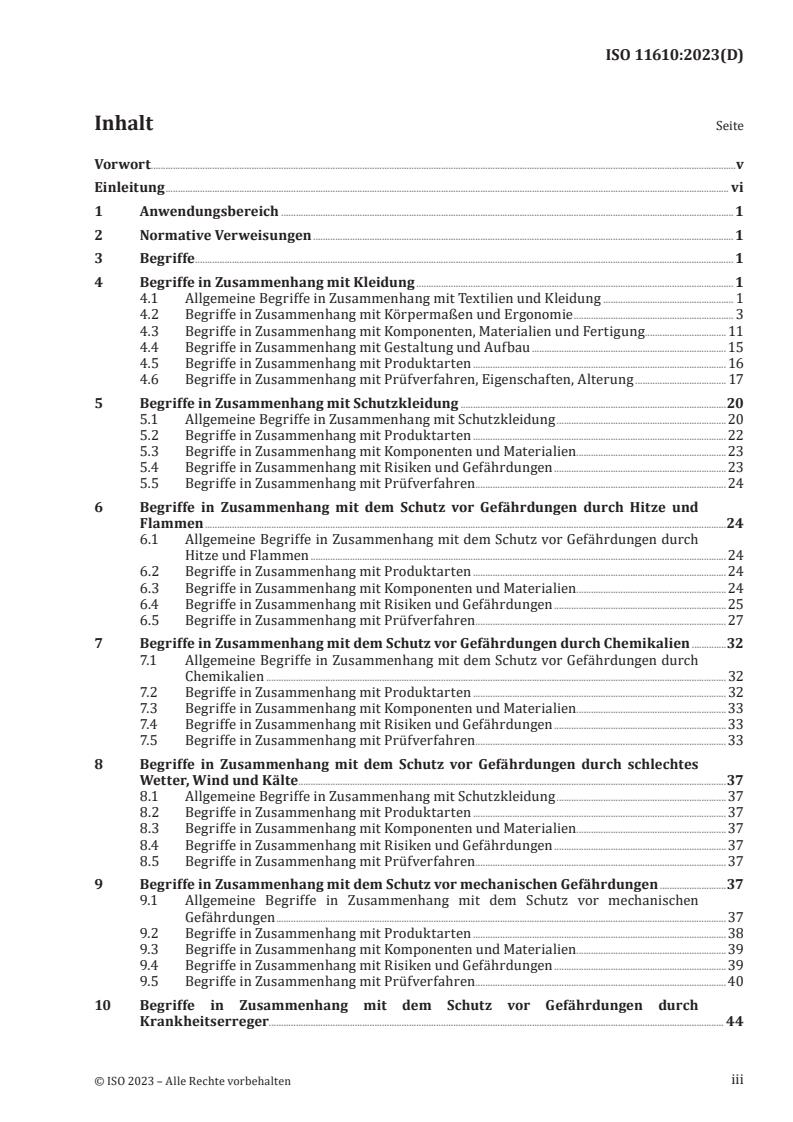
Inhalt Seite
Vorwort . .v
Einleitung . vi
1 Anwendungsbereich .1
2 Normative Verweisungen . 1
3 Begriffe . 1
4 Begriffe in Zusammenhang mit Kleidung . 1
4.1 Allgemeine Begriffe in Zusammenhang mit Textilien und Kleidung . 1
4.2 Begriffe in Zusammenhang mit Körpermaßen und Ergonomie . 3
4.3 Begriffe in Zusammenhang mit Komponenten, Materialien und Fertigung . 11
4.4 Begriffe in Zusammenhang mit Gestaltung und Aufbau . 15
4.5 Begriffe in Zusammenhang mit Produktarten . 16
4.6 Begriffe in Zusammenhang mit Prüfverfahren, Eigenschaften, Alterung . 17
5 Begriffe in Zusammenhang mit Schutzkleidung .20
5.1 Allgemeine Begriffe in Zusammenhang mit Schutzkleidung . 20
5.2 Begriffe in Zusammenhang mit Produktarten . 22
5.3 Begriffe in Zusammenhang mit Komponenten und Materialien.23
5.4 Begriffe in Zusammenhang mit Risiken und Gefährdungen . 23
5.5 Begriffe in Zusammenhang mit Prüfverfahren . 24
6 Begriffe in Zusammenhang mit dem Schutz vor Gefährdungen durch Hitze und
Flammen .24
6.1 Allgemeine Begriffe in Zusammenhang mit dem Schutz vor Gefährdungen durch
Hitze und Flammen . 24
6.2 Begriffe in Zusammenhang mit Produktarten . 24
6.3 Begriffe in Zusammenhang mit Komponenten und Materialien. 24
6.4 Begriffe in Zusammenhang mit Risiken und Gefährdungen . 25
6.5 Begriffe in Zusammenhang mit Prüfverfahren . 27
7 Begriffe in Zusammenhang mit dem Schutz vor Gefährdungen durch Chemikalien .32
7.1 Allgemeine Begriffe in Zusammenhang mit dem Schutz vor Gefährdungen durch
Chemikalien . 32
7.2 Begriffe in Zusammenhang mit Produktarten . 32
7.3 Begriffe in Zusammenhang mit Komponenten und Materialien. 33
7.4 Begriffe in Zusammenhang mit Risiken und Gefährdungen . 33
7.5 Begriffe in Zusammenhang mit Prüfverfahren . 33
8 Begriffe in Zusammenhang mit dem Schutz vor Gefährdungen durch schlechtes
Wetter, Wind und Kälte . .37
8.1 Allgemeine Begriffe in Zusammenhang mit Schutzkleidung . 37
8.2 Begriffe in Zusammenhang mit Produktarten . 37
8.3 Begriffe in Zusammenhang mit Komponenten und Materialien. 37
8.4 Begriffe in Zusammenhang mit Risiken und Gefährdungen . 37
8.5 Begriffe in Zusammenhang mit Prüfverfahren . 37
9 Begriffe in Zusammenhang mit dem Schutz vor mechanischen Gefährdungen .37
9.1 Allgemeine Begriffe in Zusammenhang mit dem Schutz vor mechanischen
Gefährdungen . 37
9.2 Begriffe in Zusammenhang mit Produktarten .38
9.3 Begriffe in Zusammenhang mit Komponenten und Materialien.39
9.4 Begriffe in Zusammenhang mit Risiken und Gefährdungen .39
9.5 Begriffe in Zusammenhang mit Prüfverfahren .40
10 Begriffe in Zusammenhang mit dem Schutz vor Gefährdungen durch
Krankheitserreger . . 44
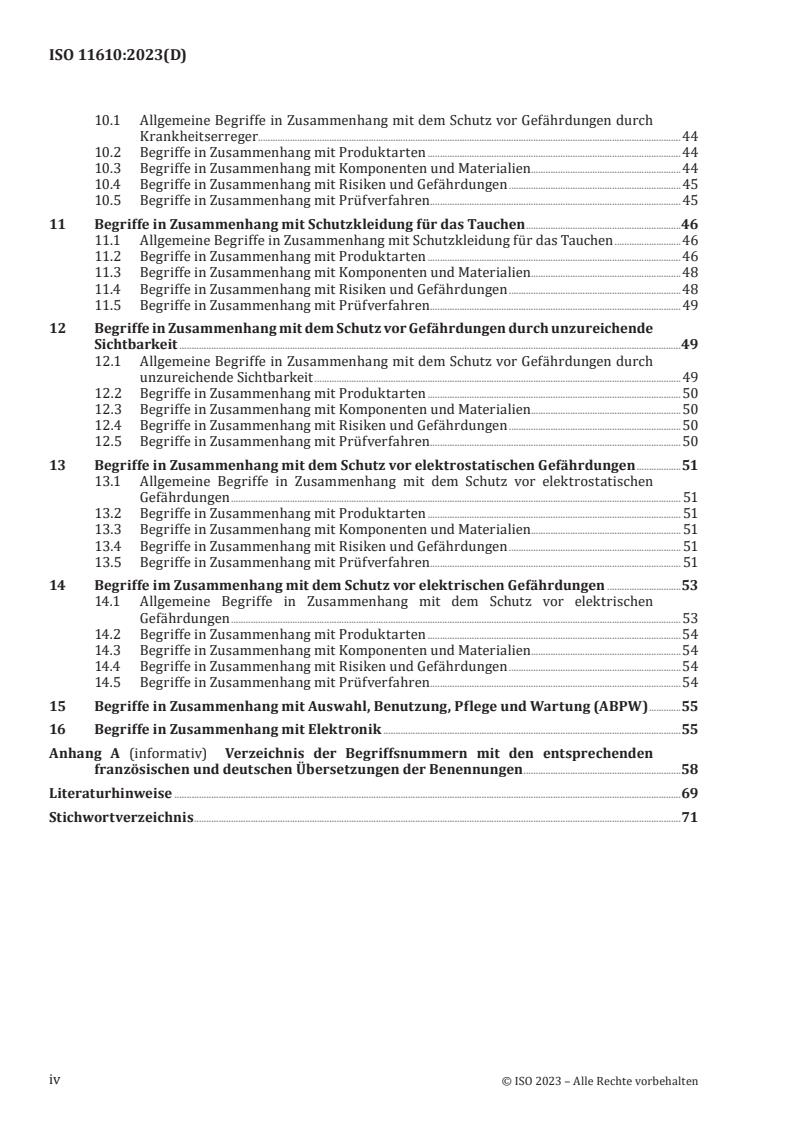
iii
10.1 Allgemeine Begriffe in Zusammenhang mit dem Schutz vor Gefährdungen durch
Krankheitserreger.44
10.2 Begriffe in Zusammenhang mit Produktarten .44
10.3 Begriffe in Zusammenhang mit Komponenten und Materialien.44
10.4 Begriffe in Zusammenhang mit Risiken und Gefährdungen . 45
10.5 Begriffe in Zusammenhang mit Prüfverfahren . 45
11 Begriffe in Zusammenhang mit Schutzkleidung für das Tauchen .46
11.1 Allgemeine Begriffe in Zusammenhang mit Schutzkleidung für das Tauchen .46
11.2 Begriffe in Zusammenhang mit Produktarten .46
11.3 Begriffe in Zusammenhang mit Komponenten und Materialien.48
11.4 Begriffe in Zusammenhang mit Risiken und Gefährdungen .48
11.5 Begriffe in Zusammenhang mit Prüfverfahren .49
12 Begriffe in Zusammenhang mit dem Schutz vor Gefährdungen durch unzureichende
Sichtbarkeit .49
12.1 Allgemeine Begriffe in Zusammenhang mit dem Schutz vor Gefährdungen durch
unzureichende Sichtbarkeit .49
12.2 Begriffe in Zusammenhang mit Produktarten .50
12.3 Begriffe in Zusammenhang mit Komponenten und Materialien.50
12.4 Begriffe in Zusammenhang mit Risiken und Gefährdungen .50
12.5 Begriffe in Zusammenhang mit Prüfverfahren .50
13 Begriffe in Zusammenhang mit dem Schutz vor elektrostatischen Gefährdungen .51
13.1 Allgemeine Begriffe in Zusammenhang mit dem Schutz vor elektrostatischen
Gefährdungen . 51
13.2 Begriffe in Zusammenhang mit Produktarten . 51
13.3 Begriffe in Zusammenhang mit Komponenten und Materialien. 51
13.4 Begriffe in Zusammenhang mit Risiken und Gefährdungen . 51
13.5 Begriffe in Zusammenhang mit Prüfverfahren . 51
14 Begriffe im Zusammenhang mit dem Schutz vor elektrischen Gefährdungen .53
14.1 Allgemeine Begriffe in Zusammenhang mit dem Schutz vor elektrischen
Gefährdungen . 53
14.2 Begriffe in Zusammenhang mit Produktarten .54
14.3 Begriffe in Zusammenhang mit Komponenten und Materialien.54
14.4 Begriffe in Zusammenhang mit Risiken und Gefährdungen .54
14.5 Begriffe in Zusammenhang mit Prüfverfahren .54
15 Begriffe in Zusammenhang mit Auswahl, Benutzung, Pflege und Wartung (ABPW) .55
16 Begriffe in Zusammenhang mit Elektronik .55
Anhang A (informativ) Verzeichnis der Begriffsnummern mit den entsprechenden
französischen und deutschen Übersetzungen der Benennungen .58
Literaturhinweise .69
Stichwortverzeichnis .71
iv
Vorwort
ISO (die Internationale Organisation für Normung) ist eine weltweite Vereinigung nationaler Normungs-
institute (ISO-Mitgliedsorganisationen). Die Erstellung von Internationalen Normen wird üblicherweise
von Technischen Komitees von ISO durchgeführt. Jede Mitgliedsorganisation, die Interesse an
einem Thema hat, für welches ein Technisches Komitee gegründet wurde, hat das Recht, in diesem
Komitee vertreten zu sein. Internationale staatliche und nichtstaatliche Organisationen, die in engem
Kontakt mit ISO stehen, nehmen ebenfalls an der Arbeit teil. ISO arbeitet bei allen elektrotechnischen
Normungsthemen eng mit der Internationalen Elektrotechnischen Kommission (IEC) zusammen.
Die Verfahren, die bei der Entwicklung dieses Dokuments angewendet wurden und die für die weitere
Pflege vorgesehen sind, werden in den ISO/IEC‑Direktiven, Teil 1 beschrieben. Es sollten insbesondere
die unterschiedlichen Annahmekriterien für die verschiedenen ISO-Dokumentenarten beachtet werden.
Dieses Dokument wurde in Übereinstimmung mit den Gestaltungsregeln der ISO/IEC‑Direktiven, Teil 2
erarbeitet (siehe www.iso.org/directives).
Es wird auf die Möglichkeit hingewiesen, dass einige Elemente dieses Dokuments Patentrechte
berühren können. ISO ist nicht dafür verantwortlich, einige oder alle diesbezüglichen Patentrechte zu
identifizieren. Details zu allen während der Entwicklung des Dokuments identifizierten Patentrechten
finden sich in der Einleitung und/oder in der ISO‑Liste der erhaltenen Patenterklärungen (siehe
www.iso.org/patents).
Jeder in diesem Dokument verwendete Handelsname dient nur zur Unterrichtung der Anwender und
bedeutet keine Anerkennung.
Für eine Erläuterung des freiwilligen Charakters von Normen, der Bedeutung ISO‑spezifischer
Begriffe und Ausdrücke in Bezug auf Konformitätsbewertungen sowie Informationen darüber, wie
ISO die Grundsätze der Welthandelsorganisation (WTO, en: World Trade Organization) hinsichtlich
technischer Handelshemmnisse (TBT, en: Technical Barriers to Trade) berücksichtigt, siehe
www.iso.org/iso/foreword.html.
Das für dieses Dokument verantwortliche Komitee ist ISO/TC 94, Personal safety — Personal protective
equipment, SC 13, Protective clothing in Zusammenarbeit mit CEN/TC 162, Schutzkleidung einschließlich
Hand‑ und Armschutz und Rettungswesten.
Diese erste Ausgabe von ISO 11610:2023 ersetzt die erste Ausgabe (ISO/TR 11610:2004), die technisch
überarbeitet wurde.
Rückmeldungen oder Fragen zu diesem Dokument sollten an das jeweilige nationale Normungsinstitut
des Anwenders gerichtet werden. Eine vollständige Auflistung dieser Institute ist unter
www.iso.org/members.html zu finden.
v
Einleitung
Die Grundlage für die Erarbeitung der in diesem Dokument zusammengestellten Definitionen bilden
der Technische Bericht ISO/TR 11610:2004 und die von ISO/TC 94/SC 13 und CEN/TC 162 erarbeiteten
Normen und Norm-Entwürfe.
Aus diesem Grund beziehen sich die in diesem Dokument festgelegten Begriffe nicht nur auf
Schutzkleidung und hiermit in Zusammenhang stehende Begriffe, sondern auch auf Begriffe aus den
Bereichen Schutzhand schuhe und Rettungswesten, die jeweils im Anwendungsbereich von CEN/TC 162
liegen.
Das Dokument wurde auf der Grundlage der Zusammenstellung von Begriffen erstellt, die im Bereich
der Normung des ISO/TC 94/SC 13 und CEN/TC 162 vorliegen, mit der Absicht, eine konsistente
Terminologie zu erarbeiten. Der Inhalt der Definitionen aus den Normen und Norm‑Entwürfen wurde
für diese Zwecke modifiziert, um einige Widersprüche in den Formulierungen bestehender Definitionen
zu beseitigen, um einige Formulierungen verständlicher zu machen oder zu verbessern und um die
vorliegenden Definitionen miteinander in Einklang zu bringen.
Das vorliegende Dokument ist dafür vorgesehen, bei der Erarbeitung neuer Normen oder bei
der Überarbeitung bestehender Normen im Bereich der Schutzkleidung, Schutzausrüstung,
Schutzhandschuhe und Rettungswesten Hilfestellung bei der Verwendung von Begriffen zu bieten und
ein Referenzwerk für weitere Begriffsbestimmungen zu bilden.
Dieses Dokument sollte berücksichtigt werden, wenn innerhalb der Arbeitsgruppen von ISO/TC 94/SC 13
und CEN/TC 162 Benennungen definiert werden müssen. Nur unter bestimmten Voraussetzungen
dürfen Benennungen im Abschnitt dieses Dokuments in einer von ISO/TC 94/SC 13 oder CEN/TC 162
erarbeiteten Norm mit geänderter Bedeutung neu definiert werden. Wenn die spezifische Verwendung
einer Benennung eine weitere Definition erfordert, um deren Bedeutung innerhalb der Definition
in diesem Dokument einzugrenzen, muss auf dieses Dokument verwiesen und die entsprechende
Begriffsnummer angegeben werden.
Dieses Dokument ist in Abschnitte und Unterabschnitte gegliedert, die sich auf die verschiedenen
(technischen) Aspekte von am Körper getragener Schutzkleidung und Schutzausrüstung beziehen,
einschließlich Hand- und Armschutz sowie Rettungswesten.
Die Begriffe sind entsprechend der Begriffshierarchie aufgelistet.
Somit werden in der Begriffssammlung allgemeinere bis hin zu spezifischen Begriffen berücksichtigt,
wie zum Beispiel:
a) Begriffe in Zusammenhang mit Textilien und Kleidung (Abschnitt 4);
b) Begriffe in Zusammenhang mit Schutzkleidung (Abschnitt 5);
c) Begriffe in Zusammenhang mit dem Schutz vor Gefährdungen durch Hitze und Flammen
(Abschnitt 6);
d) Begriffe in Zusammenhang mit dem Schutz vor Gefährdungen durch Chemikalien (Abschnitt 7);
e) Begriffe in Zusammenhang mit dem Schutz vor Gefährdungen durch schlechtes Wetter, Wind und
Kälte (Abschnitt 8);
f) Begriffe in Zusammenhang mit dem Schutz vor mechanischen Gefährdungen (Abschnitt 9);
g) Begriffe in Zusammenhang mit dem Schutz vor Gefährdungen durch Krankheitserreger
(Abschnitt 10);
h) Begriffe in Zusammenhang mit Schutzkleidung für das Tauchen (Abschnitt 11);
i) Begriffe in Zusammenhang mit dem Schutz vor Gefährdungen durch unzureichende Sichtbarkeit
(Abschnitt 12);
vi
j) Begriffe in Zusammenhang mit dem Schutz vor elektrostatischen Gefährdungen (Abschnitt 13);
k) Begriffe in Zusammenhang mit dem Schutz vor elektrischen Gefährdungen (Abschnitt 14);
l) Begriffe in Zusammenhang mit Auswahl, Benutzung, Pflege und Wartung — ABPW (Abschnitt 15);
m) Begriffe in Zusammenhang mit Elektronik (Abschnitt 16).
Jeder Abschnitt (außer Abschnitt 4, Abschnitt 15 und Abschnitt 16) ist in die folgenden Unterabschnitte
gegliedert:
Für Abschnitt X gilt:
X.1 Allgemeine Begriffe in Zusammenhang mit … ( für Abschnitt X relevanter Definitionsbereich);
X.2 Begriffe in Zusammenhang mit Produktarten;
X.3 Begriffe in Zusammenhang mit Komponenten und Materialien;
X.4 Begriffe in Zusammenhang mit Risiken und Gefährdungen;
X.5 Begriffe in Zusammenhang mit Prüfverfahren.
Die Gliederung in diese Unterabschnitte erfolgt für jeden Abschnitt (außer Abschnitt 4, Abschnitt 15
und Abschnitt 16), selbst dann, wenn in einem solchen Unterabschnitt keine Begriffe festgelegt wurden.
In solchen Fällen wird der folgende Satz eingefügt:
„Dieser Unterabschnitt enthält keine Begriffe und wird nur eingefügt, um die Gliederung dieses
Dokuments beizubehalten.“
In Anhang A sind die französischen and deutschen Begriffe in alphabetischer Reihenfolge aufgelistet.
vii
INTERNATIONALE NORM ISO 11610:2023(D)
Schutzkleidung — Begriffe
1 Anwendungsbereich
Dieses Dokument enthält eine Liste gebräuchlicher Benennungen im Bereich der Normung von Schutz-
kleidung (5.1.4) und Schutzausrüstung, die am Körper getragen wird, einschließlich Hand- und
Armschutz und auch Rettungswesten, sowie die Definitionen dieser Benennungen.
Die Definitionen sind dafür vorgesehen, die eindeutige Verwendung der aufgelisteten Benennungen zu
unterstützen.
Dieses Dokument ist dafür vorgesehen, als Referenzdokument für die Arbeitsgruppen von CEN/TC 162
und ISO/TC 94/SC 13 zu dienen, um festzustellen, welche Definitionen bereits existieren, und darf für
die Erstellung neuer Normen und zur Hilfestellung bei der Erarbeitung neuer Definitionen angewendet
werden.
2 Normative Verweisungen
Es gibt keine normativen Verweisungen in diesem Dokument.
3 Begriffe
Für die Anwendung dieses Dokuments gelten die folgenden Begriffe.
ISO und IEC stellen terminologische Datenbanken für die Verwendung in der Normung unter den
folgenden Adressen bereit:
— ISO Online Browsing Platform: verfügbar unter https:// www .iso .org/ obp
— IEC Electropedia: verfügbar unter https:// www .electropedia .org/
4 Begriffe in Zusammenhang mit Kleidung
4.1 Allgemeine Begriffe in Zusammenhang mit Textilien und Kleidung
4.1.1
Bekleidung
generelle Maßnahmen, von der Gestaltung bis zum Vertrieb, die darauf abzielen, den Körper mit allem
außer dem Schuhwerk zu bedecken
Anmerkung 1 zum Begriff: Die Benennung „Bekleidung“ ist dafür vorgesehen, das Konzept von Bekleidung im
Gegensatz zu Bekleidungserzeugnis zu bezeichnen.
Anmerkung 2 zum Begriff: In englischsprachigen Normen werden die Benennungen „clothing“ und „garment“
synonym verwendet. Die Benennung „clothing“ kann sich entweder auf „Bekleidung“ (4.1.1) oder auf
„Kleidungsstück“ (4.1.2) beziehen. Ausschließlich der Kontext, in dem die Benennung verwendet wird, bestimmt
dabei den gemeinten Begriff. Hierfür wurden in diesem Dokument Definitionen festgelegt, um ihre Bedeutung
klar zu differenzieren.
4.1.2
Kleidungsstück
einzelner Artikel der Kleidung (4.1.1)
Anmerkung 1 zum Begriff: Die Benennung „Kleidungsstück“ ist dafür vorgesehen, das Produkt zu bezeichnen.
Anmerkung 2 zum Begriff: Das Kleidungsstück kann ein- oder mehrlagig sein.
BEISPIEL Hose, Jacke, Mäntel, Handschuhe (4.5.5), Gamaschen (4.5.11), Socken usw.
4.1.3
Textilfaser
Erzeugnis, das durch seine Flexibilität, seine Feinheit und seine große Länge im Verhältnis zum
Höchstquerschnitt gekennzeichnet ist und sich somit zur Herstellung von Textilerzeugnissen eignet
[QUELLE: Verordnung (EU) 1007/2011, Artikel 3, 1. (b), (i)]
4.1.4
Textilerzeugnis
Erzeugnis, das im rohen, halbbearbeiteten, bearbeiteten, halbverarbeiteten, verarbeiteten, halbkonfek-
tionierten oder konfektionierten Zustand ausschließlich Textilfasern (4.1.3) enthält, unabhängig von
dem zur Mischung oder Verbindung angewandten Verfahren
[QUELLE: Verordnung (EU) 1007/2011, Artikel 3, 1. (a)]
4.1.5
textiles Material
aus Textilfasern (4.1.3) gefertigtes Material, das dazu bestimmt ist, allein oder zusammen mit anderen
textilen oder textilfremden Artikeln für die Herstellung von Textilerzeugnissen (4.1.4) verwendet zu
werden
Anmerkung 1 zum Begriff: Textiles Material bezieht sich auf lineare textile Materialien (zum Beispiel Fasern,
Garne, Fäden) sowie auf flaches textiles Material (zum Beispiel Maschenware, Webware und Vliesstoff).
4.1.6
nicht‑textiles Element
Produkt, das nicht aus Textilfasern (4.1.3) besteht
Anmerkung 1 zum Begriff: Nicht-textile Elemente können zum Beispiel aktive medizinische Geräte, funk- und
elektrisch betriebene Bestandteile, Reißverschlüsse, (Druck-)Knöpfe, Membranen oder nicht-textile Aufnäher
enthalten.
4.1.7
Kleidungsstück mit erweitertem Funktionsumfang
Kleidungsstück (4.1.2), das (eine) erweiterte Funktionalität(en) aufweist
Anmerkung 1 zum Begriff: „Schutz“ ist eine der Funktionen, die ein Kleidungsstück bieten kann.
4.1.8
funktionelles textiles Material
textiles Material (4.1.5), dem eine bestimmte Funktion durch ein Material, die Zusammensetzung, den
Aufbau und/oder die Ausrüstung (Auftragen von Additiven usw.) verliehen wird
[QUELLE: ISO/TR 23383:2020, 3.3, modifiziert — „Textilprodukt“ wurde durch „textiles Material“
ersetzt.]
4.1.9
smartes textiles Material
intelligentes textiles Material
interaktives textiles Material
funktionelles textiles Material (4.1.8), das mit seiner Umgebung reversibel wechselwirkt, d. h. es reagiert
auf Veränderungen in der Umgebung oder passt sich an diese an
Anmerkung 1 zum Begriff: Die Benennung „smartes Textil“ kann sich entweder auf ein „smartes textiles Material“
(4.1.9) oder ein „smartes Textilsystem“ (4.1.11) beziehen. Ausschließlich der Zusammenhang, in dem diese
Benennung verwendet wird, entscheidet darüber, welche der beiden Benennungen beabsichtigt ist.
[QUELLE: ISO/TR 23383:2020, 3.4, modifiziert — „Textilprodukt“ wurde durch „textiles Material“
ersetzt.]
4.1.10
Textilsystem
Zusammenfügung von (einem) Textilerzeugnis(sen) (4.1.4) und (einem) nicht‑textilen Element(en) (4.1.6)
[QUELLE: ISO/TR 23383:2020, 3.7]
4.1.11
smartes (intelligentes, interaktives) Textilsystem
auf Textilien beruhendes System, das eine beabsichtigte und verwertbare Antwort als eine Reaktion,
entweder auf Veränderungen in der Umgebung/im Umfeld oder auf ein Signal/eine Eingabe von außen
zeigt
[QUELLE: ISO/TR 23383:2020, 3.8, modifiziert — „(intelligentes, interaktives)“ wurde in der Benennung
ergänzt.]
4.2 Begriffe in Zusammenhang mit Körpermaßen und Ergonomie
4.2.1
Torso
Rumpf
Oberkörper
Teil des Körpers, an den sich Kopf und Gliedmaßen anschließen
4.2.2
Finger
einer der fünf Finger der Hand (4.2.24)
Anmerkung 1 zum Begriff: Die Finger der Hand werden in der Anatomie mit 1 bis 5 benummert, wobei mit dem
Dau men begonnen wird.
4.2.3
Handrücken
Oberseite der Hand (4.2.24) zwischen dem Handgelenk und den Fingern (4.2.2)
4.2.4
Handgelenk
Bereich des Gelenks zwischen der Hand (4.2.24) und dem Unterarm
4.2.5
Handgelenkspunkt
am meisten vorstehender Punkt des Ellenkopfes
Anmerkung 1 zum Begriff: Siehe Bild 1.
Anmerkung 2 zum Begriff: Hervorstehender Knochen auf der Seite des Handgelenks (4.2.4), an der sich der kleine
Finger befindet).
[QUELLE: ISO 8559‑1:2017, 3.1.19, modifiziert — „Bild 19“ wurde durch „Bild 1“ ersetzt, und der zweite
Teil der Definition wurde zur Anmerkung 2 zum Begriff.]
Bild 1 — Handgelenkspunkt
4.2.6
Handgelenksumfang
Umfang des Handgelenks (4.2.4) in Höhe des Handgelenkspunktes (4.2.5)
Anmerkung 1 zum Begriff: Siehe Bild 2.
[QUELLE: ISO 8559‑1:2017, 5.3.19, modifiziert — „Bild 75“ wurde durch „Bild 2“ ersetzt.]
Bild 2 — Handgelenksumfang
4.2.7
Taillenhöhe
Mitte zwischen dem tiefsten Punkt der Rippe und dem höchsten Punkt des Hüftknochens an der Seite
des Körpers
Anmerkung 1 zum Begriff: Siehe Bild 3.
[QUELLE: ISO 8559‑1:2017, 3.1.22, modifiziert — „Bild 22“ wurde durch „Bild 3“ ersetzt.]
Bild 3 — Taillenhöhe
4.2.8
Brustpunkt
am weitesten vorspringender Punkt der Brust, wenn ein Büstenhalter getragen wird
Anmerkung 1 zum Begriff: Siehe Bild 4.
[QUELLE: ISO 8559‑1:2017, 3.1.11, modifiziert — „Bild 11“ wurde durch „Bild 4“ ersetzt und Anmerkung 2
zum Begriff wurde gestrichen.]
Bild 4 — Brustpunkt
4.2.9
Brustumfang
horizontaler Umfang, gemessen in Brustpunkthöhe
Anmerkung 1 zum Begriff: Siehe Bild 5.
[QUELLE: ISO 8559‑1:2017, 5.3.4, modifiziert — „Bild 60“ wurde durch „Bild 5“ ersetzt.]
Bild 5 — Brustumfang
4.2.10
Brustumfang
horizontaler Umfang des Oberkörpers (4.2.1), gemessen an der Achselhöhle
Anmerkung 1 zum Begriff: Siehe Bild 6.
[QUELLE: ISO 8559‑1:2017, 5.3, modifiziert — „Bild 62“ wurde durch „Bild 6“ ersetzt.]
Bild 6 — Brustumfang an der Achselhöhle
4.2.11
Unterbrustumfang
horizontaler Umfang des Körpers in Unterbrusthöhe
Anmerkung 1 zum Begriff: Siehe Bild 7.
[QUELLE: ISO 8559‑1:2017, 5.3.8, modifiziert — „Bild 64“ wurde durch „Bild 7“ ersetzt.]
Bild 7 — Unterbrustumfang
4.2.12
Taillenumfang
horizontaler Umfang des Körpers, gemessen in Taillenhöhe
Anmerkung 1 zum Begriff: Siehe Bild 8.
[QUELLE: ISO 8559‑1:2017, 5.3.10, modifiziert — „Bild 66“ wurde durch „Bild 8“ ersetzt.]
Bild 8 — Taillenumfang
4.2.13
hinterer Halsbasispunkt bis zur Taillenhöhe
Abstand vom hinteren Halsbasispunkt (4.2.14) entlang der Halsansatzlinie bis zum seitlichen
Halsbasispunkt (4.2.16), über den Brustpunkt, danach direkt bis zur Taillenhöhe
Anmerkung 1 zum Begriff: Siehe Bild 9.
[QUELLE: ISO 8559‑1:2017, 5.4.13, modifiziert — „Bild 97“ wurde durch „Bild 9“ ersetzt.]
Bild 9 — Hinterer Halsbasispunkt bis zur Taillenhöhe
4.2.14
hinterer Halsbasispunkt
dorsalster Knochenpunkt hinten am Halsansatz (die Spitze des Dornfortsatzes des siebten Halswirbels)
in der Mediansagittalebene und posterior auf die Hautoberfläche projiziert
Anmerkung 1 zum Begriff: Siehe Bild 10.
[QUELLE: ISO 8559‑1:2017, 3.1.6, modifiziert — „Bild 6“ wurde durch „Bild 10“ ersetzt.]
Bild 10 — Hinterer Halsbasispunkt
4.2.15
Halsansatzlinie
Linie am Halsansatz, die über dem hinteren Halsbasispunkt (4.2.14) und dem vorderen Halsbasispunkt
(4.2.17) verläuft und mithilfe einer Kette bestimmt wurde
Anmerkung 1 zum Begriff: Siehe Bild 11.
[QUELLE: ISO 8559‑1:2017, 3.2.1, modifiziert — „Bild 27“ wurde durch „Bild 11“ ersetzt.]
Bild 11 — Halsansatzlinie
4.2.16
seitlicher Halsbasispunkt
Kreuzungspunkt der Halsansatzlinie (4.2.15) und des vorderen Randes des Trapezmuskels (siehe
Bild 12)
Anmerkung 1 zum Begriff: Siehe Bild 12.
[QUELLE: ISO 8559‑1:2017, 3.1.7, modifiziert — „Bild 7“ wurde durch „Bild 12“ ersetzt.]
Bild 12 — Seitlicher Halsbasispunkt
4.2.17
vorderer Halsbasispunkt
Kreuzungspunkt der Linie, die die medialen oberen Grenzen des linken und rechten Schlüsselbeins und
die vordere Mittellinie verbindet
Anmerkung 1 zum Begriff: Siehe Bild 13.
[QUELLE: ISO 8559‑1:2017, 3.1.8, modifiziert — „Bild 8“ wurde durch „Bild 13“ ersetzt.]
Bild 13 — Vorderer Halsbasispunkt
4.2.18
Ergonomie
Arbeitswissenschaft
wissenschaftliche Disziplin, die sich mit dem Verständnis der Wechselwirkungen zwischen Menschen
und anderen Elementen eines Systems befasst, und der Berufszweig, der Theorie, Grundsätze, Daten
und Verfahren auf die Gestaltung von Arbeitssystemen anwendet mit dem Ziel, das Wohlbefinden des
Menschen und die Leistung des Gesamtsystems zu optimieren
[QUELLE: ISO 9241‑11:2018, 3.2.5]
4.2.19
Anthropometrie
Untersuchung und Messung der physischen Maße und der Masse des menschlichen Körpers und seiner
(äu ß e r en) Tei le
Anmerkung 1 zum Begriff: Abgeleitet von den griechischen Wörtern anthropos (Mensch) und metron (messen).
[QUELLE: ISO 15535:2012, 3.6]
4.2.20
Biometrie
automatisierte Erkennung von Individuen anhand ihrer verhaltensbezogenen und biologischen Charak-
teristika
[QUELLE: ISO/IEC 24713‑1:2008, 3.5]
4.2.21
interaktives System
Kombination aus Hardware und/oder Software und/oder Dienstleistungen und/oder Menschen, mit
denen Benutzer zur Erreichung bestimmter Ziele interagieren
Anmerkung 1 zum Begriff: Dazu gehören gegebenenfalls Verpackung, Benutzerdokumentation, Online-Hilfe und
menschliche Hilfe, Unterstützung und Schulung.
[QUELLE: ISO 9241‑11:2018, 3.1.5]
4.2.22
menschzentrierte Gestaltung
HCD, en: human-centred design
Herangehensweise bei der Gestaltung und Entwicklung von Systemen, die darauf abzielt, interaktive
Systeme (4.2.21) gebrauchstauglicher zu machen, indem sie sich auf die Verwendung des Systems
konzentriert und Kenntnisse und Techniken aus den Bereichen der Arbeitswissenschaft (4.2.18),
Ergonomie (4.2.18) und der Gebrauchstauglichkeit anwendet
Anmerkung 1 zum Begriff: Es ist eher der Begriff „menschzentrierte Gestaltung“ zu verwenden als
„benutzerzentrierte Gestaltung“, um zu betonen, dass dieses Dokument auch Auswirkungen auf eine Reihe von
Stakeholdern berücksichtigt, die normalerweise nicht als Benutzer betrachtet werden. In der Praxis werden
diese Begriffe jedoch häufig synonym verwendet.
Anmerkung 2 zum Begriff: Gebrauchstaugliche Systeme können eine Reihe von Vorteilen bieten. Dazu
zählen verbesserte Produktivität, gesteigertes Wohlbefinden der Benutzer, Vermeidung von Stress, erhöhte
Barrierefreiheit und ein vermindertes Risiko von Schäden (5.4.1).
[QUELLE: ISO 9241‑11:2018, 3.2.6]
4.2.23
Mensch‑System‑Schnittstelle
HSI, en: human system interface
die Grenze, die den Punkt der physikalischen Interaktion zwischen einer Person und der Anwendungs-
plattform darstellt
Anmerkung 1 zum Begriff: Auch als Mensch/Computer‑Schnittstelle bezeichnet (abgelehnt).
Anmerkung 2 zum Begriff: In der Prozess- und Maschinenindustrie wird die Benutzerschnittstelle oft auch
Mensch-Maschine-Schnittstelle, MMS genannt (für GA-Systeme abgelehnt).
[QUELLE: ISO 16484‑2:2004, 3.95, modifiziert — Anmerkung 3 zum Begriff wurde gestrichen.]
4.2.24
Hand
Endteil der oberen Gliedmaße jenseits des Handgelenks (4.2.4)
Anmerkung 1 zum Begriff: Hand schließt die Handinnenfläche, den Handrücken (4.2.3) und die Finger (4.2.2) ein.
4.3 Begriffe in Zusammenhang mit Komponenten, Materialien und Fertigung
4.3.1
textiles Flächengebilde
Stoff
Element, das eine ausgedehnte Oberfläche im Verhältnis zu seiner Dicke aufweist, die durch Verknüpfen
von beliebigen textilen Materialien (4.1.5) gebildet wird und einen Zusammenhalt aufweist, der durch
einen beliebigen Textilverarbeitungsprozess erzielt wird
Anmerkung 1 zum Begriff: Textilverarbeitungsprozesse schließen Weben, Stricken, Flechten, Schnüren, Tufting
und Vliesstoff-Verfestigung ein.
4.3.2
Vliesstoffe
technisch hergestelltes, vorrangig flächiges Gebilde aus Fasern, dem durch physikalische und/oder
chemische Mittel ein festgelegter Grad an Festigkeit verliehen wurde; mit Ausnahme von Weben,
Stricken oder Papierherstellung
Anmerkung 1 zum Begriff: Film- und Papierstrukturen werden nicht als Vliesstoffe angesehen.
[QUELLE: ISO 9092:2019, 3.3.1]
4.3.3
beschichtetes textiles Flächengebilde
textiles Flächengebilde (4.3.1) mit einer oder mehreren anhaftenden Schichten aus einem Material auf
Gummi‑ und/oder Kunststoffbasis auf einer oder beiden Oberflächen, wodurch ein flexibles Erzeugnis
entsteht
[QUELLE: ISO 1382:2020, 3.95]
4.3.4
Außenstoff
außenliegender Stoff eines Kleidungsstücks (4.1.2), entweder in Form eines einfachen oder eines
Verbunds toffes (4.3.1)
4.3.5
Material
Ausgangsstoffe, abgesehen von Hardware (4.3.26) und Etiketten, aus denen das Kleidungsstück (4.1.2)
hergestellt ist
4.3.6
mehrlagiges Material
Material (4.3.5), das aus verschiedenen Lagen besteht, die vor der Konfektionierung des Kleidungsstücks
un trennbar miteinander verbunden werden
Anmerkung 1 zum Begriff: Konfektionierungsphasen von Kleidungsstücken sind zum Beispiel Weben, Steppen,
B e s c h ic ht en , K le b en .
4.3.7
Futter
Innenfutter
innerste Lage aus Stoff (4.3.1) oder anderem Material (4.3.5), die in ein Kleidungsstück (4.1.2) eingefügt
wird und dafür vorgesehen ist, dem Körper des Trägers am nächsten zu sein
Anmerkung 1 zum Begriff: Bildet das Futter (4.3.7) einen gesteppten Aufbau, so ist der gesteppte Aufbau als das
Innenfutter (4.3.7) anzusehen.
4.3.8
Zwischenfutter
Materiallage, die sich bei einem mehrlagigen Kleidungsstück zwischen der Außenlage und dem
Innenfutter (4.3.7) befindet
4.3.9
Liner
herausnehmbares Futter (4.3.7)
Anmerkung 1 zum Begriff: Ein Liner (4.3.9) kann ein innenliegendes Kleidungsstück sein, das dafür vorgesehen
wurde, an einem Oberbekleidungsstück (4.3.16) befestigt oder separat unter einem Oberbekleidungsstück
getragen zu werden.
Anmerkung 2 zum Begriff: Ein Liner (4.3.9) wird im Allgemeinen verwendet, um bestimmte Eigenschaften wie
Wärmei solation und Wasserdichtigkeit bereitzustellen.
4.3.10
Thermofutter
Futter (4.3.7), das eine Wärmeisolation bereitstellt
4.3.11
Thermoliner
Liner (4.3.9), der eine Wärmeisolation bereitstellt
4.3.12
Feuchtigkeitssperre
textiles Flächengebilde (4.3.1) oder Membran, die in der Kleidungskombination (4.3.30) verwendet wird,
und das/die dafür vorgesehen ist, das Eindringen von Wasser in das Kleidungsstück (4.1.2) zu verhindern
Anmerkung 1 zum Begriff: Feuchtigkeitssperren können wasserdampfdurchlässig sein. Feuchtigkeitssperren
verhind ern nicht das Eindringen bestimmter chemischer, biologischer oder radioaktiver Stoffe.
4.3.13
Saugsperre
Material (4.3.5), das verwendet wird, um die Übertragung von Flüssigkeit von der Außenseite des
K leidungs s t ücke s (4.1.2) ins Innere des Kleidungsstückes (4.1.2) zu verhindern, gewöhnlich zusätzlich zu
oder anstelle der Feuchtigkeitssperre (4.3.12) am Rand/an den Rändern
4.3.14
Ablaufnetz
Material (4.3.5), das das Ablaufen von Flüssigkeit ermöglicht
4.3.15
Unterbekleidungsstück
Unterbekleidung
Kleidungsstück (4.1.2), das unter anderen Kleidungsstücken getragen wird
4.3.16
Oberbekleidungsstück
Kleidungsstück (4.1.2), das über anderen Kleidungsstücken getragen wird
4.3.17
Stulpe
Teil eines Kleidungsstücks (4.1.2) (auch von Handschuhen), der das Handgelenk (4.2.4) bedeckt
4.3.18
Verschluss
Befestigung
eine von zahlreichen Vorrichtungen für das Zusammenhalten von zwei Teilen, die manchmal
voneinander getrennt werden müssen, d. h. von zwei Rändern oder Bändern eines Kleidungsstücks
(4.1.2)
BEISPIEL Knopf, Reißverschluss, Druckknopf, Klettverschluss, Knebelknopf.
4.3.19
Verschlusssystem
Methode zum Verschließen von Öffnungen im Kleidungsstück (4.1.2), einschließlich Kombinationen von
mehr als einer Methode zum Erreichen eines sicheren Verschlusses (4.3.18)
Anmerkung 1 zum Begriff: Dieser Begriff umfasst keine Nähte (4.4.1).
4.3.20
Befestigungspunkt
Teil des Kleidungsstücks (4.1.2), an dem eine Befestigung (4.3.18) angebracht werden kann
4.3.21
Zusammenschluss
Verbund (4.3.22) oder Verbindung (4.3.23)
4.3.22
Verbund
dauerhafte Befestigung von zwei oder mehr verschiedenen Kleidungsstücken (4.1.2) oder von einem
Kleidungsstück und Zubehörteilen (4.3.25) oder Hardware (4.3.26)
4.3.23
Verbindung
nicht dauerhafte Befestigung von zwei verschiedenen Kleidungsstücken (4.1.2) oder von einem
Kleidungsstück und Zubehörteilen (4.3.25)
4.3.24
Bündchen
Teil eines Kleidungsstücks (4.1.2), der die Handgelenke (4.2.4) oder Knöchel umschließt
4.3.25
Zubehörteil
untergeordnetes oder ergänzendes Teil, Objekt oder dergleichen eines Kleidungsstücks (4.1.2), das
hauptsächlich aus Gründen der Bequemlichkeit, Sicherheit usw. verwendet wird
Anmerkung 1 zum Begriff: Ein Zubehörteil (4.3.25) kann dauerhaft befestigt oder abnehmbar sein.
4.3.26
Hardware
nicht aus textilem Flächengebilde bestehende feste Bestandteile, Objekte oder dergleichen eines
Kleidungsstücks (4.1.2)
Anmerkung 1 zum Begriff: Hardware (4.3.26) umfassen solche Teile, die aus Metall oder Kunststoff bestehen,
z. B. Verschlüsse (4.3.18), Dienstgradabzeichen.
4.3.27
Außenmaterial
äußerstes Material (4.3.5), aus dem das Kleidungsstück (4.1.2) hergestellt ist
4.3.28
Materialaufbau
Bekleidungszusammenstellung
Kombination aller Materialien (4.3.5) eines mehrlagigen Kleidungsstücks [einschließlich der Hardware
(4.3.26)], die exakt der Zusammensetzung des endgefertigten Kleidungsstücks entspricht
4.3.29
Materialkombination
Material (4.3.5), bestehend aus mehreren Einzellagen, die bei der Herstellung des Kleidungsstücks
miteinander verbunden werden
4.3.30
Kleidungskombination
Lagen von Kleidungsstücken (4.1.2), angeordnet in der Reihenfolge, wie sie angezogen werden
Anmerkung 1 zum Begriff: Diese kann mehrlagige Materialien (4.3.6), Materialkombinationen (4.3.29) oder
mehrere separate ein- oder mehrlagige Kleidungsstücke enthalten.
4.3.31
Aluminiumgewebe
textiles Flächengebilde (4.3.1) mit einer Aluminiumlage auf seiner/seinen Oberfläche(n)
Anmerkung 1 zum Begriff: Die Aluminiumlage kann durch Metallbeschichtung oder durch Folieren erhalten
werden.
4.3.32
integriertes Element
Element, das in einem oder auf einem Produkt enthalten ist
4.3.33
integrierte smarte Textilie
integriertes Element (4.3.32), bei dem das Element ein smartes textiles System (4.1.11) ist
4.3.34
integriertes nicht‑textiles Element
integriertes Element (4.3.32), bei dem das Element ein nicht‑textiles Element ist (4.1.6)
4.4 Begriffe in Zusammenhang mit Gestaltung und Aufbau
4.4.1
Naht
dauerhafte Befestigung zweier oder mehrerer Materialteile (4.3.5) durch Nähen und/oder andere
Methoden
Anmerkung 1 zum Begriff: Die anderen Methoden können Schweißen und Kleben usw. sein.
4.4.2
Strukturnaht
für die Stabilität des Kleidungsstücks (4.1.2) notwendige Naht (4.4.1)
4.4.3
Seitennaht
Naht (4.4.1), die in Längsrichtung des getragenen Kleidungsstückes (4.1.2) verläuft
4.4.4
Überlappnaht
Naht (4.4.1), bei der alle Materiallagen (4.3.5) oder Teile einer oder mehrerer Materiallagen eine andere
MatValidierungeriallage oder -lagen überdecken und dabei eine Überlappung wie bei Dachziegeln bilden
4.4.5
Handschuhlänge
senkrechte Linie zwischen der Stulpen‑ (4.3.17) ‑naht (4.4.1) (oder einer entsprechenden Position, falls
keine Naht vorhanden ist) und der Spitze des Mittelfingers [oder einer entsprechenden Position bei
einem Fäustling (4.5.7) oder einem Drei‑Finger‑Fäustling (4.5.8)]
4.4.6
Übergangsbereich
Bereich, in dem Öffnungen den Verlauf von Material(ien) (4.3.5) oder Kleidungsstücken (4.1.2)
unterbrechen
4.4.7
Koller
Übergangsbereich (4.4.6) im Bereic
...
NORME ISO
INTERNATIONALE 11610
Première édition
2023-05
Habillement de protection —
Vocabulaire
Protective clothing — Vocabulary
Schutzkleidung — Begriffe
Numéro de référence
DOCUMENT PROTÉGÉ PAR COPYRIGHT
© ISO 2023
Tous droits réservés. Sauf prescription différente ou nécessité dans le contexte de sa mise en œuvre, aucune partie de cette
publication ne peut être reproduite ni utilisée sous quelque forme que ce soit et par aucun procédé, électronique ou mécanique,
y compris la photocopie, ou la diffusion sur l’internet ou sur un intranet, sans autorisation écrite préalable. Une autorisation peut
être demandée à l’ISO à l’adresse ci-après ou au comité membre de l’ISO dans le pays du demandeur.
ISO copyright office
Case postale 401 • Ch. de Blandonnet 8
CH-1214 Vernier, Genève
Tél.: +41 22 749 01 11
E-mail: copyright@iso.org
Web: www.iso.org
Publié en Suisse
ii
Sommaire Page
Avant-propos .v
Introduction . vi
1 Domaine d’application . 1
2 Références normatives .1
3 Termes et définitions . 1
4 Termes et vocabulaire de l’habillement. 1
4.1 Termes et définitions généraux du textile et de l’habillement . 1
4.2 Termes et définitions des dimensions corporelles et de l’ergonomie . 3
4.3 Termes et définitions des composants, matériaux, finitions . 11
4.4 Termes et définitions de la conception et de la confection . 14
4.5 Termes et définitions des types de produits . . 15
4.6 Termes et définitions des méthodes d’essai, des attributs, du vieillissement . 16
5 Termes et vocabulaire de l’habillement de protection .19
5.1 Termes et définitions généraux de l’habillement de protection . 19
5.2 Termes et définitions des types de produits . . 21
5.3 Termes et définitions des composants et matériaux . 22
5.4 Termes et définitions des risques et des phénomènes dangereux .22
5.5 Termes et définitions des méthodes d’essai . 23
6 Termes et vocabulaire de la protection contre les phénomènes dangereux dus à la
chaleur et aux flammes .23
6.1 Termes et définitions généraux de la protection contre les phénomènes dangereux
dus à la chaleur et aux flammes .23
6.2 Termes et définitions des types de produits . . 23
6.3 Termes et définitions des composants et matériaux . 23
6.4 Termes et définitions des risques et des phénomènes dangereux .23
6.5 Termes et définitions des méthodes d’essai . 25
7 Termes et vocabulaire de la protection contre les phénomènes dangereux
chimiques.30
7.1 Termes et définitions généraux de la protection contre les phénomènes dangereux
chimiques . 30
7.2 Termes et définitions des types de produits . .30
7.3 Termes et définitions des composants et matériaux . 31
7.4 Termes et définitions des risques et des phénomènes dangereux . 31
7.5 Termes et définitions des méthodes d’essai . 31
8 Termes et vocabulaire de la protection contre les phénomènes dangereux dus aux
intempéries, au vent et au froid .35
8.1 Termes et définitions généraux de l’habillement de protection . 35
8.2 Termes et définitions des types de produits . . 35
8.3 Termes et définitions des composants et matériaux . 35
8.4 Termes et définitions des risques et des phénomènes dangereux . 35
8.5 Termes et définitions des méthodes d’essai . 35
9 Termes et vocabulaire de la protection contre les phénomènes dangereux
mécaniques .35
9.1 Termes et définitions généraux de la protection contre les phénomènes dangereux
mécaniques . 35
9.2 Termes et définitions des types de produits . .36
9.3 Termes et définitions des composants et matériaux . 37
9.4 Termes et définitions des risques et des phénomènes dangereux . 37
9.5 Termes et définitions des méthodes d’essai .38
iii
10 Termes et vocabulaire de la protection contre les phénomènes dangereux dus
aux agents infectieux .42
10.1 Termes et définitions généraux de la protection contre les phénomènes dangereux
dus aux agents infectieux . 42
10.2 Termes et définitions des types de produits . . 42
10.3 Termes et définitions des composants et matériaux . 42
10.4 Termes et définitions des risques et des phénomènes dangereux . 42
10.5 Termes et définitions des méthodes d’essai . 43
11 Termes et vocabulaire de l’habillement de protection pour la plongée . 44
11.1 Termes et définitions généraux de l’habillement de protection pour la plongée .44
11.2 Termes et définitions des types de produits . .44
11.3 Termes et définitions des composants et matériaux .46
11.4 Termes et définitions des risques et des phénomènes dangereux .46
11.5 Termes et définitions des méthodes d’essai .46
12 Termes et vocabulaire de la protection contre les phénomènes dangereux dus
au manque de visibilité .47
12.1 Termes et définitions généraux de la protection contre les phénomènes dangereux
dus au manque de visibilité . 47
12.2 Termes et définitions des types de produits . . 47
12.3 Termes et définitions des composants et matériaux . 47
12.4 Termes et définitions des risques et des phénomènes dangereux .48
12.5 Termes et définitions des méthodes d’essai .48
13 Termes et vocabulaire de la protection contre les phénomènes dangereux
électrostatiques .48
13.1 Termes et définitions généraux de la protection contre les phénomènes dangereux
électrostatiques .48
13.2 Termes et définitions des types de produits . .48
13.3 Termes et définitions des composants et matériaux .48
13.4 Termes et définitions des risques et des phénomènes dangereux .49
13.5 Termes et définitions des méthodes d’essai .49
14 Termes et vocabulaire de la protection contre les phénomènes dangereux
électriques .50
14.1 Termes et définitions généraux de la protection contre les phénomènes dangereux
électriques . 50
14.2 Termes et définitions des types de produits . . 51
14.3 Termes et définitions des composants et matériaux . 51
14.4 Termes et définitions des risques et des phénomènes dangereux . 51
14.5 Termes et définitions des méthodes d’essai . 52
15 Termes et vocabulaire de la sélection, de l’utilisation, de l’entretien et de
la maintenance (SUCAM) . .52
16 Termes et vocabulaire de l’électronique .53
Annexe A (informative) Index des numéros de termes avec les traductions françaises et
allemandes correspondantes .55
Bibliographie .66
Index .68
iv
Avant-propos
L’ISO (Organisation internationale de normalisation) est une fédération mondiale d’organismes
nationaux de normalisation (comités membres de l’ISO). L’élaboration des Normes internationales est
en général confiée aux comités techniques de l’ISO. Chaque comité membre intéressé par une étude
a le droit de faire partie du comité technique créé à cet effet. Les organisations internationales,
gouvernementales et non gouvernementales, en liaison avec l’ISO participent également aux travaux.
L’ISO collabore étroitement avec la Commission électrotechnique internationale (IEC) en ce qui
concerne la normalisation électrotechnique.
Les procédures utilisées pour élaborer le présent document et celles destinées à sa mise à jour sont
décrites dans les Directives ISO/IEC, Partie 1. Il convient en particulier de prendre note des différents
critères d’approbation requis pour les différents types de documents ISO. Le présent document
a été rédigé conformément aux règles de rédaction données dans les Directives ISO/IEC, Partie 2
(voir www.iso.org/directives).
L’attention est attirée sur le fait que certains des éléments du présent document peuvent faire l’objet
de droits de propriété intellectuelle ou de droits analogues. L’ISO ne saurait être tenue pour responsable
de ne pas avoir identifié de tels droits de propriété et averti de leur existence. Les détails concernant
les références aux droits de propriété intellectuelle ou autres droits analogues identifiés lors de
l’élaboration du document sont indiqués dans l’Introduction et/ou dans la liste des déclarations de
brevets reçues par l’ISO (voir www.iso.org/brevets).
Les appellations commerciales éventuellement mentionnées dans le présent document sont données
pour information, par souci de commodité, à l’intention des utilisateurs et ne sauraient constituer un
engagement.
Pour une explication de la nature volontaire des normes, la signification des termes et expressions
spécifiques de l’ISO liés à l’évaluation de la conformité, ou pour toute information au sujet de l’adhésion
de l’ISO aux principes de l’Organisation mondiale du commerce (OMC) concernant les obstacles
techniques au commerce (OTC), voir le lien suivant: www.iso.org/iso/fr/avant-propos.
Le comité chargé de l’élaboration du présent document est l’ISO/TC 94, Sécurité individuelle —
Équipement de protection individuelle, SC 13, Vêtements de protection, en collaboration avec le CEN/
TC 162, Vêtements de protection, y compris la protection de la main et du bras et y compris les gilets de
sauvetage.
Cette première édition de l'ISO 11610:2023 annule et remplace la première édition (ISO/TR 11610:2004),
qui a fait l’objet d’une révision technique.
Il convient que l’utilisateur adresse tout retour d’information ou toute question concernant le présent
document à l’organisme national de normalisation de son pays. Une liste exhaustive desdits organismes
se trouve à l’adresse www.iso.org/fr/members.html.
v
Introduction
Les définitions réunies dans le présent document sont fondées sur le rapport technique
ISO/TR 11610:2004 et sur les normes et projets de normes élaborés par l’ISO/TC 94/SC 13 et le CEN/
TC 162.
Pour cette raison, les termes et définitions arrêtés dans ce document couvrent non seulement des
vêtements de protection et des termes associés mais concernent également les domaines des gants
de protection et des gilets de sauvetage qui entrent dans le domaine de compétences du CEN/TC 162.
Ce document est fondé sur la compilation des termes et définitions existant dans le domaine de
normalisation de l’ISO/TC 94/SC 13 et du CEN/TC 162 avec pour objectif d’établir une terminologie
cohérente. Dans ce but, l’objet des définitions extraites des normes et projets de normes a été modifié,
afin de résoudre certaines incohérences dans la formulation actuelle des définitions, de simplifier
ou changer quelques formulations et d’harmoniser les définitions concernées.
Le présent document a pour but de faciliter l’utilisation des termes afin de servir de référence pour
les nouvelles définitions quand de nouvelles normes sont développées ou des normes existantes sont
révisées dans le domaine des vêtements, équipements et gants de protection et des gilets de sauvetage.
Il convient que le présent document soit pris en compte par les Groupes de travail de l’ISO/TC 94/SC 13
et du CEN/TC 162 lors de la définition de termes. Sauf dans des circonstances exceptionnelles, les termes
inclus dans l’article du présent document ne doivent pas être redéfinis avec un sens différent dans
une norme préparée par l’ISO/TC 94/SC 13 ou le CEN/TC 162. Si l’utilisation particulière d’un terme
demande une nouvelle définition pour limiter le sens donné dans la définition du présent document,
le présent document doit être mentionné ainsi que le numéro affecté au terme.
Le présent document est divisé en articles et en paragraphes relatifs aux différentes facettes (techniques)
de l’habillement de protection et des équipements de protection portés sur le corps humain, y compris
la protection de la main et du bras et les gilets de sauvetage.
Les termes et définitions sont classés selon la hiérarchie des concepts.
Par conséquent, le vocabulaire les prend en considération des plus généraux aux plus particuliers,
par exemple:
a) vocabulaire du textile et de l’habillement (Article 4);
b) vocabulaire de l’habillement de protection (Article 5);
c) vocabulaire de la protection contre les phénomènes dangereux dus à la chaleur et aux flammes
(Article 6);
d) vocabulaire de la protection contre les phénomènes dangereux chimiques (Article 7);
e) vocabulaire de la protection contre les phénomènes dangereux dus aux intempéries, au vent et
au froid (Article 8);
f) vocabulaire de la protection contre les phénomènes dangereux mécaniques (Article 9);
g) vocabulaire de la protection contre les phénomènes dangereux dus aux agents infectieux
(Article 10);
h) vocabulaire de l’habillement de protection pour la plongée (Article 11);
i) vocabulaire de la protection contre les phénomènes dangereux dus au manque de visibilité
(Article 12);
j) vocabulaire de la protection contre les phénomènes dangereux électrostatiques (Article 13);
k) vocabulaire de la protection contre les phénomènes dangereux électriques (Article 14);
vi
l) vocabulaire de la sélection, de l’utilisation, de l’entretien et de la maintenance - SUCAM
(acronyme issu de l’anglais «Selection, Use, Care and Maintenance» qui signifie «Sélection, Utilisation,
Entretien et Maintenance») (Article 15);
m) vocabulaire de l’électronique (Article 16).
Chaque article (sauf l’Article 4, l’Article 15 et l’Article 16) est structuré selon les paragraphes suivants:
Pour l’Article X:
X.1 Termes et définitions généraux de … (domaine lié à l’Article X);
X.2 Termes et définitions des types de produits;
X.3 Termes et définitions des composants et matériaux;
X.4 Termes et définitions des risques et des phénomènes dangereux;
X.5 Termes et définitions des méthodes d’essai.
Cette structure de paragraphes s’applique à chaque article (sauf l’Article 4, l’Article 15 et l’Article 16)
même si un paragraphe ne comporte aucun terme ni définition. Dans ce cas, la phrase suivante est
insérée:
«Ce paragraphe ne comporte aucun terme ni définition, mais il est conservé pour assurer la cohérence
de la structure du présent document.»
L’Annexe A donne la liste du vocabulaire français et allemand par ordre alphabétique.
vii
NORME INTERNATIONALE ISO 11610:2023(F)
Habillement de protection — Vocabulaire
1 Domaine d’application
Le présent document contient une liste de termes avec leurs définitions couramment utilisés dans
la normalisation de l’habillement de protection (5.1.4) et des équipements de protection portés sur
le corps humain, y compris la protection de la main et du bras et les gilets de sauvetage.
Les définitions sont destinées à apporter un appui à une utilisation sans équivoque des termes donnés.
Ce document est destiné à servir de document de référence pour les Groupes de travail du CEN/TC 162
et de l’ISO/TC 94/SC 13 afin de vérifier quelles définitions existent déjà et peuvent être utilisées pour
établir de nouvelles normes et pour servir de guide dans l’élaboration de nouvelles définitions.
2 Références normatives
Le présent document ne contient aucune référence normative.
3 Termes et définitions
Pour les besoins du présent document, les termes et définitions suivants s’appliquent.
L’ISO et l’IEC tiennent à jour des bases de données terminologiques destinées à être utilisées
en normalisation, consultables aux adresses suivantes:
— ISO Online browsing platform: disponible à l’adresse https:// www .iso .org/ obp;
— IEC Electropedia: disponible à l’adresse https:// www .electropedia .org/ .
4 Termes et vocabulaire de l’habillement
4.1 Termes et définitions généraux du textile et de l’habillement
4.1.1
habillement
dispositions générales, de la conception à la distribution, destinées à recouvrir le corps avec tout, sauf
les chaussures
Note 1 à l'article: Le terme «habillement» est destiné à désigner le concept d’habillement par opposition au
produit vestimentaire.
Note 2 à l'article: En anglais, les termes «clothing» et «garment» étaient utilisés comme synonymes dans les
normes. Le terme «clothing» peut désigner soit «habillement» (4.1.1), soit «vêtement» (4.1.2). Seul le contexte dans
lequel le terme est utilisé déterminera lequel des deux équivalents est visé. Dorénavant, des définitions ont été
introduites dans le présent document afin d’en distinguer clairement le sens.
4.1.2
vêtement
article individuel d’habillement (4.1.1)
Note 1 à l'article: Le terme «vêtement» est destiné à désigner le produit.
Note 2 à l'article: Le vêtement peut être composé d’une ou plusieurs couches.
EXEMPLE Pantalon, veste, manteaux, gants (4.5.5), guêtres (4.5.11), chaussettes, etc.
4.1.3
fibre textile
élément caractérisé par sa flexibilité, sa finesse et sa grande longueur par rapport à la dimension
transversale maximale, qui le rendent apte à des applications textiles
[SOURCE: Règlement UE 1007/2011, Article 3, 1. (b), (i)]
4.1.4
produit textile
tout produit qui, à l’état brut, semi-ouvré, ouvré, semi-manufacturé, manufacturé, semi-confectionné
ou confectionné, est exclusivement composé de fibres textiles (4.1.3), quel que soit le procédé de mélange
ou d’assemblage mis en œuvre
[SOURCE: Règlement UE 1007/2011, Article 3, 1. (a)]
4.1.5
matière textile
matériau constitué de fibres textiles (4.1.3) et destiné à être utilisé seul ou avec d’autres articles textiles
ou non textiles, pour la production de produits textiles (4.1.4)
Note 1 à l'article: La matière textile désigne les matières textiles linéaires (par exemple, les fibres, les fils) ainsi
que les matières textiles de surface (par exemple, les étoffes tricotées, tissées et non tissées).
4.1.6
élément non textile
produit qui n’est pas composé de fibres textiles (4.1.3)
Note 1 à l'article: Les éléments non textiles peuvent contenir, par exemple, des dispositifs médicaux actifs,
des composants radio et électriques, des fermetures à glissière, des boutons (à pression), des membranes, des
pièces non textiles.
4.1.7
vêtement avancé
vêtement (4.1.2) qui présente une ou plusieurs fonctionnalités améliorées
Note 1 à l'article: La «protection» est l’une des fonctions qu’un vêtement peut présenter.
4.1.8
matière textile fonctionnelle
matière textile (4.1.5) à laquelle une fonction spécifique est ajoutée par le biais du matériau, de sa
composition, de sa construction et/ou de sa finition (en appliquant des additifs, etc.)
[SOURCE: ISO/TR 23383:2020, 3.3, modifiée — «produit textile» a été remplacé par «matière textile».]
4.1.9
matière textile intelligente
matière textile interactive
matière textile fonctionnelle (4.1.8) qui interagit de manière réversible avec son environnement, c’est-à-
dire qui répond ou qui s’adapte à des changements survenant dans l’environnement
Note 1 à l'article: Le terme «textile intelligent» peut faire référence soit à une «matière textile intelligente»
(4.1.9), soit à un «système textile intelligent» (4.1.11). Seul le contexte dans lequel le terme est employé détermine
à laquelle de ces deux notions il est fait référence.
[SOURCE: ISO/TR 23383:2020, 3.4, modifiée — «produit textile» a été remplacé par «matière textile».]
4.1.10
système textile
assemblage de produit(s) textile(s) (4.1.4) et d’élément(s) non textiles(s) (4.1.6)
[SOURCE: ISO/TR 23383:2020, 3.7]
4.1.11
système textile intelligent (interactif)
système à base de textiles qui présente une réponse prévue et exploitable soit à des changements de
son voisinage/environnement, soit à un signal/une entrée externe
[SOURCE: ISO/TR 23383:2020, 3.8, modifiée — «(interactif)» a été ajouté dans le terme.]
4.2 Termes et définitions des dimensions corporelles et de l’ergonomie
4.2.1
torse
tronc
partie du corps à laquelle sont attachés la tête et les membres
4.2.2
doigt
un des cinq doigts de la main (4.2.24)
Note 1 à l'article: Les doigts de la main sont numérotés anatomiquement de 1 à 5, en commençant par le pouce.
4.2.3
dos de la main
surface postérieure de la main (4.2.24) entre le poignet et les doigts (4.2.2)
4.2.4
poignet
région de l’articulation située entre la main (4.2.24) et l’avant-bras
4.2.5
point du poignet
point le plus protubérant de la saillie de la tête de l’ulna
Note 1 à l'article: Voir la Figure 1.
Note 2 à l'article: Protubérance osseuse du poignet (4.2.4) située du côté de l’auriculaire.
[SOURCE: ISO 8559-1:2017, 3.1.19, modifiée — «Figure 19» a été remplacé par «Figure 1» et la deuxième
définition a été déplacée à la Note 2 à l’article.]
Figure 1 — Point du poignet
4.2.6
tour de poignet
périmètre du poignet (4.2.4) au niveau du point du poignet (4.2.5)
Note 1 à l'article: Voir la Figure 2.
[SOURCE: ISO 8559-1:2017, 5.3.19, modifiée — «Figure 75» a été remplacé par «Figure 2».]
Figure 2 — Tour de poignet
4.2.7
niveau de la taille
niveau situé à mi-distance entre le point thoracique le plus bas et le point le plus haut de l’os iliaque sur
le côté du corps
Note 1 à l'article: Voir la Figure 3.
[SOURCE: ISO 8559-1:2017, 3.1.22, modifiée — «Figure 22» a été remplacé par «Figure 3».]
Figure 3 — Niveau de la taille
4.2.8
point de la poitrine
point de la poitrine le plus antérieur, le sujet portant un soutien-gorge
Note 1 à l'article: Voir la Figure 4.
[SOURCE: ISO 8559-1:2017, 3.1.11, modifiée — «Figure 11» a été remplacé par «Figure 4» et la Note 2 à
l’article a été supprimée.]
Figure 4 — Point de la poitrine
4.2.9
tour de poitrine (femme)
périmètre horizontal mesuré au niveau du point de la poitrine
Note 1 à l'article: Voir la Figure 5.
[SOURCE: ISO 8559-1:2017, 5.3.4, modifiée — «Figure 60» a été remplacé par «Figure 5».]
Figure 5 — Tour de poitrine (femme)
4.2.10
tour de poitrine (homme)
périmètre horizontal du torse (4.2.1) mesuré au niveau des aisselles
Note 1 à l'article: Voir la Figure 6.
[SOURCE: ISO 8559-1:2017, 5.3.6, modifiée — «Figure 62» a été remplacé par «Figure 6».]
Figure 6 — Tour de poitrine au niveau des aisselles
4.2.11
tour de dessous de poitrine
périmètre horizontal du corps au niveau du dessous de poitrine
Note 1 à l'article: Voir la Figure 7.
[SOURCE: ISO 8559-1:2017, 5.3.8, modifiée — «Figure 64» a été remplacé par «Figure 7».]
Figure 7 — Tour de dessous de poitrine
4.2.12
tour de taille
périmètre horizontal du corps mesuré au niveau de la taille
Note 1 à l'article: Voir la Figure 8.
[SOURCE: ISO 8559-1:2017, 5.3.10, modifiée — «Figure 66» a été remplacé par «Figure 8».]
Figure 8 — Tour de taille
4.2.13
longueur entre le point cervical et le niveau de la taille
distance comprise entre le point cervical (4.2.14) et le niveau de la taille, mesurée en suivant la ligne de
la base du cou jusqu’au point d’encolure latéral (4.2.16), en passant par le point de la poitrine, puis en
descendant tout droit jusqu’au niveau de la taille
Note 1 à l'article: Voir la Figure 9.
[SOURCE: ISO 8559-1:2017, 5.4.13, modifiée — «Figure 97» a été remplacé par «Figure 9».]
Figure 9 — Longueur entre le point cervical et le niveau de la taille
4.2.14
point cervical
protubérance osseuse à la base de l’arrière du cou (apophyse épineuse de la septième vertèbre cervicale)
dans le plan sagittal médian, et projetée postérieurement sur la surface de la peau
Note 1 à l'article: Voir la Figure 10.
[SOURCE: ISO 8559-1:2017, 3.1.6, modifiée — «Figure 6» a été remplacé par «Figure 10».]
Figure 10 — Point cervical
4.2.15
ligne de la base du cou
ligne située à la base du cou définie à l’aide d’une chaînette passant par le point cervical (4.2.14) et le
point d’encolure antérieur (4.2.17)
Note 1 à l'article: Voir la Figure 11.
[SOURCE: ISO 8559-1:2017, 3.2.1, modifiée — «Figure 27» a été remplacé par «Figure 11».]
Figure 11 — Ligne de la base du cou
4.2.16
point d’encolure latéral
point d’intersection entre la ligne de la base du cou (4.2.15) et le bord antérieur du muscle trapèze
Note 1 à l'article: Voir la Figure 12.
[SOURCE: ISO 8559-1:2017, 3.1.7, modifiée — «Figure 7» a été remplacé par «Figure 12».]
Figure 12 — Point d’encolure latéral
4.2.17
point d’encolure antérieur
point d’intersection entre la ligne reliant les bords médiaux supérieurs des clavicules droite et gauche
et la ligne médiane antérieure
Note 1 à l'article: Voir la Figure 13.
[SOURCE: ISO 8559-1:2017, 3.1.8, modifiée — «Figure 8» a été remplacé par «Figure 13».]
Figure 13 — Point d’encolure antérieur
4.2.18
ergonomie
facteurs humains
discipline scientifique qui vise la compréhension fondamentale des interactions entre les humains et
les autres composants d’un système, et la profession qui applique principes théoriques, données et
méthodes en vue d’optimiser le bien-être des personnes et la performance globale des systèmes
[SOURCE: ISO 9241-11:2018, 3.2.5]
4.2.19
anthropométrie
étude et mesure des dimensions physiques et de la masse du corps humain et de ses parties constitutives
(externes)
Note 1 à l'article: Le mot anthropométrie provient du grec anthropos (être humain ou homme) et metron
(mesurer).
[SOURCE: ISO 15535:2012, 3.6]
4.2.20
biométrie
reconnaissance automatique d’une personne à partir de ses caractéristiques biologiques et
comportementales
[SOURCE: ISO/IEC 24713-1:2008, 3.5]
4.2.21
système interactif
combinaison de matériels et/ou de logiciels et/ou de services et/ou de personnes avec laquelle
interagissent des utilisateurs afin d’atteindre des objectifs spécifiques
Note 1 à l'article: Cela inclut, le cas échéant, le conditionnement, la documentation de l’utilisateur, l’aide en ligne
ou humaine, l’assistance et la formation.
[SOURCE: ISO 9241-11:2018, 3.1.5]
4.2.22
conception centrée sur l’opérateur humain
HCD
approche de conception et de développement de systèmes ayant pour objectif d’améliorer l’utilisabilité
des systèmes interactifs (4.2.21) en se concentrant sur l’utilisation du système concerné, et en appliquant
les connaissances et techniques existantes en matière de facteurs humains (4.2.18), d’ergonomie (4.2.18)
et d’utilisabilité
Note 1 à l'article: Le terme «conception centrée sur l’opérateur humain» est employé de préférence au terme
«conception centrée sur l’utilisateur» afin de souligner que le présent document couvre également les effets
sur un grand nombre de parties prenantes, et non simplement les individus considérés généralement comme
utilisateurs. Toutefois, dans la pratique, ces termes sont souvent utilisés comme synonymes.
Note 2 à l'article: Les systèmes utilisables peuvent présenter plusieurs avantages, y compris une meilleure
productivité, l’amélioration du bien-être de l’utilisateur, la prévention du stress, une meilleure accessibilité et
un risque de dommage (5.4.1) réduit.
[SOURCE: ISO 9241-11:2018, 3.2.6]
4.2.23
interface utilisateur
IHM
frontière au travers de laquelle a lieu l’interaction physique entre une personne et la plate-forme
d’application
Note 1 à l'article: Également connue sous le nom d’interface homme/machine (terme déconseillé).
Note 2 à l'article: Dans le domaine des machines-outils, l’interface utilisateur est souvent désignée sous le terme
de «terminal opérateur» (terme déconseillé).
[SOURCE: ISO 16484-2:2004, 3.95, modifiée — La Note 3 à l’article a été supprimée.]
4.2.24
main
partie terminale du membre supérieur au-delà du poignet (4.2.4)
Note 1 à l'article: La main comprend la paume, le dos de la main (4.2.3) et les doigts (4.2.2).
4.3 Termes et définitions des composants, matériaux, finitions
4.3.1
étoffe
élément présentant une surface étendue par rapport à son épaisseur, formée par l’entrelacement
de matières textiles (4.1.5), ayant une cohésion donnée par n’importe quel procédé textile
Note 1 à l'article: Les procédés textiles comprennent le tissage, le tricotage, le tressage, le laçage, le touffetage et
la liaison de nontissé.
4.3.2
nontissé
assemblage fibreux préconçu, essentiellement plan, possédant un niveau nominal d’intégrité structurale
conférée au moyen de procédés physiques et/ou chimiques, à l’exclusion du tissage, du tricotage ou de la
fabrication du papier
Note 1 à l'article: Les structures film et papier ne sont pas considérées comme du nontissé.
[SOURCE: ISO 9092:2019, 3.1.1]
4.3.3
support textile revêtu
étoffe (4.3.1) textile ayant une ou plusieurs couches adhérentes de matériau à base de caoutchouc et/ou
de plastique sur une ou deux faces
[SOURCE: ISO 1382:2020, 3.95, modifiée — «tissu enduit» a été remplacé par «support textile revêtu».]
4.3.4
étoffe extérieure
étoffe située du côté extérieur d’un vêtement (4.1.2); il peut s’agir d’une étoffe(4.3.1) simple ou composite
4.3.5
matériau
substances, à l’exclusion des matériels (4.3.26) et des étiquettes, dont est constitué un vêtement (4.1.2)
4.3.6
matériau multicouche
matériau (4.3.5) constitué de différentes couches intimement assemblées avant l’étape de confection
du vêtement
Note 1 à l'article: Les étapes de confection des vêtements sont, par exemple, le tissage, le matelassage, l’enduction,
le collage.
4.3.7
doublure
doublure la plus intérieure
couche la plus intérieure d’étoffe (4.3.1) ou d’un autre matériau (4.3.5) insérée dans un vêtement (4.1.2)
et destinée à être la plus proche du corps du porteur
Note 1 à l'article: Lorsque la doublure (4.3.7) fait partie d’un assemblage matelassé, cet assemblage doit être
considéré comme la doublure la plus intérieure (4.3.7).
4.3.8
doublure intercalaire
couche située entre la couche la plus externe et la doublure la plus intérieure (4.3.7) d’un vêtement
multicouche
4.3.9
insert
doublure (4.3.7) amovible
Note 1 à l'article: Un insert (4.3.9) peut être un vêtement interne conçu pour être attaché à un vêtement de dessus
(4.3.16) ou pour être porté séparément sous ce dernier.
Note 2 à l'article: Un insert (4.3.9) est généralement utilisé pour fournir des propriétés spécifiques telles que
l’isolation thermique, l’étanchéité à l’eau.
4.3.10
doublure thermique
doublure (4.3.7) fournissant une isolation thermique
4.3.11
insert thermique
insert (4.3.9) fournissant une isolation thermique
4.3.12
barrière d’étanchéité
étoffe (4.3.1) ou membrane utilisée dans l’assemblage d’un vêtement (4.3.30) et conçue pour empêcher
la pénétration de l’eau dans le vêtement (4.1.2)
Note 1 à l'article: Les barrières d’étanchéité peuvent être perméables à la vapeur d’eau. Les barrières d’étanchéité
n’empêchent pas le passage de certains agents chimiques, biologiques ou radiologiques.
4.3.13
barrière anti-mèche
matériau (4.3.5) utilisé pour empêcher le transfert de liquide de l’extérieur du vêtement (4.1.2) vers
l’intérieur de celui-ci, généralement en plus de la barrière d’étanchéité (4.3.12) ou en remplacement
d’une partie de celle-ci sur le ou les bords
4.3.14
matériau à maillage ouvert
matériau (4.3.5) permettant le drainage du liquide
4.3.15
sous-vêtement
vêtement (4.1.2) porté sous d’autres vêtements
4.3.16
vêtement de dessus
vêtement (4.1.2) porté par-dessus d’autres vêtements
4.3.17
manchette
partie d’un vêtement (4.1.2) (gant compris) qui couvre le poignet (4.2.4)
4.3.18
fermeture
attache
l’un quelconque des divers dispositifs permettant de maintenir ensemble deux parties dont la séparation
est parfois nécessaire, comme deux bords ou rabats d’un vêtement (4.1.2)
EXEMPLE Bouton, fermeture à glissière (aussi appelée «fermeture éclair»), fermeture à pression (aussi
appelée «bouton-pression»), fermeture auto-agrippante (aussi appelée «fermeture crochet-boucle»), bouton de
type «duffel-coat».
4.3.19
système de fermeture
méthode d’attache des ouvertures du vêtement (4.1.2) y compris les combinaisons de plusieurs méthodes
procurant une fermeture (4.3.18) sûre
Note 1 à l'article: Ce terme ne couvre pas les coutures (4.4.1).
4.3.20
point de fixation
partie du vêtement (4.1.2) à laquelle une attache (4.3.18) peut être fixée
4.3.21
connexion
assemblage (4.3.22) ou jonction (4.3.23)
4.3.22
assemblage
liaison permanente entre deux ou plusieurs vêtements (4.1.2) différents ou entre un vêtement et des
accessoires (4.3.25)
4.3.23
jonction
liaison non permanente entre deux vêtements (4.1.2) différents ou entre un vêtement et des accessoires
(4.3.25)
4.3.24
manchette serrée
partie d’un vêtement (4.1.2) qui entoure les poignets (4.2.4) ou les chevilles
4.3.25
accessoire
partie, objet ou autre élément similaire, secondaire ou supplémentaire d’un vêtement (4.1.2),
utilisé principalement pour des raisons de commodité, de sécurité, etc
Note 1 à l'article: Un accessoire (4.3.25) peut être fixé de façon permanente ou être amovible.
4.3.26
matériel
partie, objet ou autre élément similaire, constitué d’un autre matériau qu’une étoffe, faisant partie
intégrante d’un vêtement (4.1.2)
Note 1 à l'article: Un matériel (4.3.26) peut être en métal ou en matière plastique, par exemple: attaches (4.3.18),
insignes de grade.
4.3.27
matériau extérieur
matériau (4.3.5) constitutif du vêtement (4.1.2) situé le plus à l’extérieur
4.3.28
assemblage de matériaux
assemblage de composants
combinaison de l’ensemble des matériaux (4.3.5) d’un vêtement multicouche (matériels (4.3.26)
compris), disposés exactement dans l’ordre de fabrication du vêtement fini
4.3.29
combinaison de matériaux
matériau (4.3.5) formé d’une série de couches séparées, fixées ensemble au cours de l’étape de confection
du vêtement
4.3.30
assemblage de vêtements
série de vêtements (4.1.2) disposés dans l’ordre où ils sont portés
Note 1 à l'article: Un assemblage de vêtements peut comprendre des matériaux multicouches (4.3.6), des
combinaisons de matériaux (4.3.29) ou une série de vêtements séparés, constitués d’une ou plusieurs couches.
4.3.31
étoffe aluminisée
étoffe (4.3.1) comprenant une couche aluminisée sur sa ou ses surfaces
Note 1 à l'article: La couche aluminisée peut être obtenue par métallisation ou à l’aide d’un film.
4.3.32
élément intégré
élément qui est intégré dans ou sur un produit
4.3.33
textile intelligent intégré
élément intégré (4.3.32) pour lequel l’élément est un système textile intelligent (4.1.11)
4.3.34
élément non textile intégré
élément intégré (4.3.32) pour lequel l’élément est un élément non textile (4.1.6)
4.4 Termes et définitions de la conception et de la confection
4.4.1
couture
liaison permanente entre deux ou plusieurs pièces de matériau (4.3.5) obtenue par couture et/ou
par toute autre méthode
Note 1 à l'article: Les autres méthodes peuvent être le soudage, le rubanage, etc.
4.4.2
couture de structure
couture (4.4.1) nécessaire à l’intégrité du vêtement (4.1.2)
4.4.3
couture côté
couture (4.4.1) réalisée le long du côté du vêtement (4.1.2) porté
4.4.4
couture rabattue
couture (4.4.1) où tout ou partie d’une ou de plusieurs couches de matériau (4.3.5) recouvre la
...
INTERNATIONAL ISO
STANDARD 11610
First edition
NORME Première édition
2023-05
INTERNATIONALE
Protective clothing — Vocabulary
Habillement de protection —
Vocabulaire
Schutzkleidung — Begriffe
Reference number
Numéro de référence
DOCUMENT PROTÉGÉ PAR COPYRIGHT
© ISO 2023
All rights reserved. Unless otherwise specified, or required in the context of its implementation, no part of this publication may
be reproduced or utilized otherwise in any form or by any means, electronic or mechanical, including photocopying, or posting on
the internet or an intranet, without prior written permission. Permission can be requested from either ISO at the address below
or ISO’s member body in the country of the requester.
Tous droits réservés. Sauf prescription différente ou nécessité dans le contexte de sa mise en œuvre, aucune partie de cette
publication ne peut être reproduite ni utilisée sous quelque forme que ce soit et par aucun procédé, électronique ou mécanique,
y compris la photocopie, ou la diffusion sur l’internet ou sur un intranet, sans autorisation écrite préalable. Une autorisation peut
être demandée à l’ISO à l’adresse ci-après ou au comité membre de l’ISO dans le pays du demandeur.
ISO copyright office
CP 401 • Ch. de Blandonnet 8
CH-1214 Vernier, Geneva
Phone: +41 22 749 01 11
Email: copyright@iso.org
Website: www.iso.org
Published in Switzerland
Publié en Suisse
ii
INTERNATIONAL ISO
STANDARD 11610
First edition
2023-05
Protective clothing — Vocabulary
Habillement de protection — Vocabulaire
Schutzkleidung — Begriffe
Reference number
© ISO 2023
All rights reserved. Unless otherwise specified, or required in the context of its implementation, no part of this publication may
be reproduced or utilized otherwise in any form or by any means, electronic or mechanical, including photocopying, or posting on
the internet or an intranet, without prior written permission. Permission can be requested from either ISO at the address below
or ISO’s member body in the country of the requester.
ISO copyright office
CP 401 • Ch. de Blandonnet 8
CH-1214 Vernier, Geneva
Phone: +41 22 749 01 11
Email: copyright@iso.org
Website: www.iso.org
Published in Switzerland
ii
Contents Page
Foreword .v
Introduction . vi
1 Scope . 1
2 Normative references . 1
3 Terms and definitions . 1
4 Terms and vocabulary of clothing .1
4.1 General terms and definitions of textile and clothing . 1
4.2 Terms and definitions of body dimensions and ergonomics . 3
4.3 Terms and definitions of components, materials, finishing . 10
4.4 Terms and definitions of design and construction . 14
4.5 Terms and definitions of product types . 15
4.6 Terms and definitions of test methods, attributes, ageing . 16
5 Terms and vocabulary of protective clothing .19
5.1 General terms and definitions of protective clothing . 19
5.2 Terms and definitions of product types . 20
5.3 Terms and definitions of components and materials . 21
5.4 Terms and definitions of risks and hazards . 21
5.5 Terms and definitions of test methods . 22
6 Terms and vocabulary of protection against heat and flame hazards .22
6.1 General terms and definitions of protection against heat and flame hazards .22
6.2 Terms and definitions of product types . 22
6.3 Terms and definitions of components and materials . 23
6.4 Terms and definitions of risks and hazards . 23
6.5 Terms and definitions of test methods . 25
7 Terms and vocabulary of protection against chemical hazards .29
7.1 General terms and definitions of protection against chemical hazards .29
7.2 Terms and definitions of product types .29
7.3 Terms and definitions of components and materials .30
7.4 Terms and definitions of risks and hazards .30
7.5 Terms and definitions of test methods . 31
8 Terms and vocabulary of protection against foul weather, wind and cold hazards .34
8.1 General terms and definitions of protective clothing .34
8.2 Terms and definitions of product types .34
8.3 Terms and definitions of components and materials .34
8.4 Terms and definitions of risks and hazards .34
8.5 Terms and definitions of test methods .34
9 Terms and vocabulary of protection against mechanical hazards .34
9.1 General terms and definitions of protection against mechanical hazards . .34
9.2 Terms and definitions of product types . 35
9.3 Terms and definitions of components and materials .36
9.4 Terms and definitions of risks and hazards . 36
9.5 Terms and definitions of test methods . 37
10 Terms and vocabulary of protection against infective agent hazards .41
10.1 General terms and definitions of protection against infective agent hazards . 41
10.2 Terms and definitions of product types . 41
10.3 Terms and definitions of components and materials . 41
10.4 Terms and definitions of risks and hazards . 41
10.5 Terms and definitions of test methods . 41
11 Terms and vocabulary of diving protective clothing .42
11.1 General terms and definitions of diving protective clothing . 42
iii
11.2 Terms and definitions of product types . 43
11.3 Terms and definitions of components and materials .44
11.4 Terms and definitions of risks and hazards . 45
11.5 Terms and definitions of test methods . 45
12 Terms and vocabulary of protection against hazards due to lack of visibility .45
12.1 General terms and definitions of protection against hazards due to lack of visibility . 45
12.2 Terms and definitions of product types .46
12.3 Terms and definitions of components and materials .46
12.4 Terms and definitions of risks and hazards .46
12.5 Terms and definitions of test methods .46
13 Terms and vocabulary of protection against electrostatic hazards .46
13.1 General terms and definition of protection against electrostatic hazards .46
13.2 Terms and definitions of product types . 47
13.3 Terms and definitions of components and materials . 47
13.4 Terms and definitions of risks and hazards . 47
13.5 Terms and definitions of test methods . 47
14 Terms and vocabulary of protection against electrical arc hazards .48
14.1 General terms and definition of protection against electrical arc hazards .48
14.2 Terms and definitions of product types .49
14.3 Terms and definitions of components and materials .49
14.4 Terms and definitions of risks and hazards .50
14.5 Terms and definitions of test methods .50
15 Terms and vocabulary of Selection, Use, Care and Maintenance (SUCAM) .50
16 Terms and vocabulary of electronics .51
Annex A (informative) Index of terms numbers with the corresponding French and
German translations .54
Bibliography .67
Index .69
iv
Foreword
ISO (the International Organization for Standardization) is a worldwide federation of national standards
bodies (ISO member bodies). The work of preparing International Standards is normally carried out
through ISO technical committees. Each member body interested in a subject for which a technical
committee has been established has the right to be represented on that committee. International
organizations, governmental and non-governmental, in liaison with ISO, also take part in the work.
ISO collaborates closely with the International Electrotechnical Commission (IEC) on all matters of
electrotechnical standardization.
The procedures used to develop this document and those intended for its further maintenance are
described in the ISO/IEC Directives, Part 1. In particular, the different approval criteria needed for the
different types of ISO documents should be noted. This document was drafted in accordance with the
editorial rules of the ISO/IEC Directives, Part 2 (see www.iso.org/directives).
Attention is drawn to the possibility that some of the elements of this document may be the subject of
patent rights. ISO shall not be held responsible for identifying any or all such patent rights. Details of
any patent rights identified during the development of the document will be in the Introduction and/or
on the ISO list of patent declarations received (see www.iso.org/patents).
Any trade name used in this document is information given for the convenience of users and does not
constitute an endorsement.
For an explanation of the voluntary nature of standards, the meaning of ISO specific terms and
expressions related to conformity assessment, as well as information about ISO's adherence to
the World Trade Organization (WTO) principles in the Technical Barriers to Trade (TBT), see
www.iso.org/iso/foreword.html.
This document was prepared by Technical Committee is ISO/TC 94, Personal safety — Personal
protective equipment, SC 13, Protective clothing, in collaboration with CEN/TC 162, Protective clothing
including hand and arm protection and lifejackets.
This first edition of ISO 11610:2023 cancels and replaces the first edition of ISO/TR 11610:2004, which
has been completely revised.
Any feedback or questions on this document should be directed to the user’s national standards body. A
complete listing of these bodies can be found at www.iso.org/members.html.
v
Introduction
The definitions compiled in this document are based on the technical report ISO/TR 11610:2004 and on
the standards and draft standards prepared by both ISO/TC 94/SC 13 and CEN/TC 162.
For this reason, the terms and definitions laid down in this document do not only cover protective
clothing and related terms but also terms from the areas of protective gloves and lifejackets which
come within the scope of CEN/TC 162.
The document is based on the compilation of terms and definitions existing in the area of standardization
of ISO/TC 94/SC 13 and CEN/TC 162 with the objective to establish a consistent terminology. Within
this purpose, the subject matter of the definitions taken from standards and draft standards have been
modified, in order to solve some inconsistencies in the existing wording of definitions, to simplify or
alter some wordings and to harmonise the definitions concerned.
The present document aims to facilitate the use of terms to serve as a reference for further definitions
when new standards are being developed or existing standards are being to be revised in the field of
protective clothing, protective equipment, protective gloves and lifejackets.
This document should be taken into account when terms need to be defined in the Working Groups of
ISO/TC 94/SC 13 and CEN/TC 162 and. Except in exceptional circumstances, terms included in clause of
this document shall not be re-defined with a different meaning in a standard prepared by ISO/TC 94/SC
13 or CEN/TC 162. If the particular use of a term requires a further definition to limit is meaning within
the definition in this document, this document shall be referred to and the term number given.
This document is structured with clauses and subclauses related to the different (technical) facets of
protective clothing and protective equipment worn on the body, including hand and arm protection and
lifejackets.
Terms and definitions are listed according to the hierarchy of the concepts.
Therefore, the vocabulary takes into consideration the more general ones to the particular ones, such
as
a) Vocabulary of textile and clothing (Clause 4);
b) Vocabulary of protective clothing (Clause 5);
c) Vocabulary of protection against heat and flame hazards (Clause 6);
d) Vocabulary of protection against chemical hazards (Clause 7);
e) Vocabulary of protection against foul weather, wind and cold hazards (Clause 8);
f) Vocabulary of protection against mechanical hazards (Clause 9);
g) Vocabulary of protection against infective agent hazards (Clause 10);
h) Vocabulary of diving protective clothing (Clause 11);
i) Vocabulary of protection against hazards due to lack of visibility (Clause 12);
j) Vocabulary of protection against electrostatic hazards (Clause 13);
k) Vocabulary of protection against electrical hazards (Clause 14);
l) Vocabulary of Selection, Use, Care and Maintenance - SUCAM (Clause 15);
m) Vocabulary of electronics (Clause 16).
Each clause (except Clause 4, Clause 15 and Clause 16) is
structured with the following sub-clauses:
vi
For Clause X:
X.1 General terms and definitions of … (domain related to Clause X);
X.2 Terms and definitions of product types;
X.3 Terms and definitions of components and materials
X.4 Terms and definitions of risks and hazards;
X.5 Terms and definitions of test methods
This subclause structure is applied to each clause (except Clause 4, Clause 15 and Clause 16) even if
there is no term and definition in a sub-clause. In such case, the following sentence is introduced:
"This subclause is empty of terms and definition but is kept for the structure consistency of this
document."
Annex A lists the French and German vocabulary in alphabetical order of the English vocabulary (index).
vii
INTERNATIONAL STANDARD ISO 11610:2023(E)
Protective clothing — Vocabulary
1 Scope
This document contains a list of terms which are frequently used in the standardization of protective
clothing (5.1.4) and protective equipment worn on the body, including hand and arm protection and
lifejackets, and definitions of these terms.
The definitions are intended to support an unambiguous use of the terms listed.
This document is intended to serve as a reference document for the Working Groups of CEN/TC 162
and ISO/TC 94/SC 13 to ascertain what definitions already exist and may be used for setting up new
standards and to provide guidance in the elaboration of new definitions.
2 Normative references
There are no normative references in this document.
3 Terms and definitions
For the purposes of this document, the following terms and definitions apply.
ISO and IEC maintain terminological databases for use in standardization at the following addresses:
— ISO Online browsing platform: available at https:// www .iso .org/ obp
— IEC Electropedia: available at https:// www .electropedia .org/
4 Terms and vocabulary of clothing
4.1 General terms and definitions of textile and clothing
4.1.1
clothing
general provisions from design to distribution intended for covering the body with everything except
the footwear
Note 1 to entry: The term "clothing" is intended for referring to the concept of clothing in opposition to the
clothing product.
Note 2 to entry: In English, the terms "clothing" and "garment" were used as synonym in the standards. The term
"clothing" may refer to either "clothing" (4.1.1) or "garment" (4.1.2). Only the context, in which the term is used,
will determine which one of the two is intended. Henceforth, definitions have been introduced in this document
to clearly distinguish their meaning.
4.1.2
garment
single article of clothing (4.1.1)
Note 1 to entry: The term "garment" is intended for referring to the product.
Note 2 to entry: The garment may consist of single or multiple layers.
EXAMPLE Trousers, jacket, coats, gloves (4.5.5), gaiters (4.5.11), socks, etc.
4.1.3
textile fibre
unit of matter characterized by its flexibility, fineness and high ratio of length to maximum transverse
dimension, which render it suitable for textile applications
[SOURCE: Regulation EU 1007/2011, Article 3, 1. (b), (i)]
4.1.4
textile product
any raw, semi-worked, worked, semi- manufactured, manufactured, semi-made-up or made-up product
which is exclusively composed of textile fibres (4.1.3), regardless of the mixing or assembly process
employed
[SOURCE: Regulation EU 1007/2011, Article 3, 1. (a)]
4.1.5
textile material
material made of textile fibres (4.1.3) and intended to be used, as such or in conjunction with other
textile or non-textile items, for the production of textile products (4.1.4)
Note 1 to entry: Textile material refers to linear textile materials (for example, fibres, yarns, threads) as well as
surface textile material (for example, knitted, woven and non-woven fabrics).
4.1.6
non-textile element
product which is not composed of textile fibres (4.1.3)
Note 1 to entry: Non-textile elements may contain, for example, active medical devices, radio and electrically
operated components, slide fastener, (press) buttons, membranes, non-textile patches.
4.1.7
advanced garment
garment (4.1.2) which shows enhanced functionality(ies)
Note 1 to entry: “protection” is one of the functions that a garment can provide.
4.1.8
functional textile material
textile material (4.1.5) to which a specific function is added by means of material, composition,
construction and/or finishing (applying additives, etc.)
[SOURCE: ISO/TR 23383:2020, 3.3, modified — "textile product" was replaced by "textile material".]
4.1.9
smart textile material
intelligent textile material
interactive textile material
functional textile material (4.1.8), which interacts reversible with its environment, i.e. it responds or
adapts to changes in the environment
Note 1 to entry: The term “smart textile” may refer to either a “smart textile material” (4.1.9) or a “smart textile
system” (4.1.11). Only the context, in which the term is used, will determine which one of the two is intended.
[SOURCE: ISO/TR 23383:2020, 3.4, modified — "textile product" was replaced by "textile material".]
4.1.10
textile system
assemblage of textile product(s) (4.1.4) and non-textile element(s) (4.1.6)
[SOURCE: ISO/TR 23383:2020, 3.7]
4.1.11
smart (intelligent, interactive) textile system
textile based system which exhibits an intended and exploitable response either to changes in its
surroundings/environment or to an external signal/input
[SOURCE: ISO/TR 23383:2020, 3.8, modified — "(intelligent, interactive)" was added in the term.]
4.2 Terms and definitions of body dimensions and ergonomics
4.2.1
torso
trunk
part of the body to which the head and limbs are attached
4.2.2
finger
one of the five digits of the hand (4.2.24)
Note 1 to entry: The digits of the hand are anatomically numbered 1 to 5, starting with the thumb.
4.2.3
back of the hand
posterior surface of the hand (4.2.24) between the wrist and the fingers (4.2.2)
4.2.4
wrist
region of the joint between the hand (4.2.24) and the forearm
4.2.5
wrist point
most prominent point of the bulge of the head of ulna
Note 1 to entry: See Figure 1.
Note 2 to entry: prominent bone at the little finger side of the wrist (4.2.4).
[SOURCE: ISO 8559-1:2017, 3.1.19, modified — "Figure 19" was replaced by "Figure 1" and the second
definition moved to Note 2 to entry.]
Figure 1 — Wrist point
4.2.6
wrist girth
girth of the wrist (4.2.4) at the level of wrist point (4.2.5)
Note 1 to entry: See Figure 2.
[SOURCE: ISO 8559-1:2017, 5.3.19, modified — "Figure 75" was replaced by "Figure 2".]
Figure 2 — Wrist girth
4.2.7
waist level
midway between the lowest rib point and the highest point of the hip bone at the side of the body
Note 1 to entry: See Figure 3.
[SOURCE: ISO 8559-1:2017, 3.1.22, modified — "Figure 22" was replaced by "Figure 3".]
Figure 3 — Waist level
4.2.8
bust point
most anterior point of the bust when wearing a bra
Note 1 to entry: See Figure 4.
[SOURCE: ISO 8559-1:2017, 3.1.11, modified — "Figure 11" was replaced by "Figure 4" and Note 2 to
entry was deleted.]
Figure 4 — Bust point
4.2.9
bust girth
horizontal girth measured at bust point level
Note 1 to entry: See Figure 5.
[SOURCE: ISO 8559-1:2017, 5.3.4, modified — "Figure 60" was replaced by "Figure 5".]
Figure 5 — Bust girth
4.2.10
chest girth
horizontal girth of torso (4.2.1) measured at axilla
Note 1 to entry: See Figure 6.
[SOURCE: ISO 8559-1:2017, 5.3.6, modified — "Figure 62" was replaced by "Figure 6".]
Figure 6 — Chest girth at axilla
4.2.11
under bust girth
horizontal girth of the body at the under bust level
Note 1 to entry: See Figure 7.
[SOURCE: ISO 8559-1:2017, 5.3.8, modified — "Figure 64" was replaced by "Figure 7".]
Figure 7 — Under bust girth
4.2.12
waist girth
horizontal girth of the body measured at the waist level
Note 1 to entry: See Figure 8.
[SOURCE: ISO 8559-1:2017, 5.3.10, modified — "Figure 66" was replaced by "Figure 8".]
Figure 8 — Waist girth
4.2.13
back neck point to waist level
distance from back neck point (4.2.14) along the neck base line to the side neck point (4.2.16), over the
bust point, then straight to the waist level
Note 1 to entry: See Figure 9.
[SOURCE: ISO 8559-1:2017, 5.4.13, modified — "Figure 97" was replaced by "Figure 9".]
Figure 9 — Back neck point to waist level
4.2.14
back neck point
tip of the prominent bone at the base of the back of the neck (spinous process of the seventh cervical
vertebra) in the mid-sagittal plane, and projected posteriorly to the surface of the skin
Note 1 to entry: See Figure 10.
[SOURCE: ISO 8559-1:2017, 3.1.6, modified — "Figure 6" was replaced by "Figure 10".]
Figure 10 — Back neck point
4.2.15
neck base line
line at the neck base defined using a chainette that passes by the back neck point (4.2.14) and the front
neck point (4.2.17)
Note 1 to entry: See Figure 11.
[SOURCE: ISO 8559-1:2017, 3.2.1, modified — "Figure 27" was replaced by "Figure 11".]
Figure 11 — Neck base line
4.2.16
side neck point
crossing point of the neck base line (4.2.15) and the anterior border of the trapezius muscle
Note 1 to entry: See Figure 12.
[SOURCE: ISO 8559-1:2017, 3.1.7, modified — "Figure 7" was replaced by "Figure 12".]
Figure 12 — side neck point
4.2.17
front neck point
crossing point of the line connecting the medial superior boarders of the left and right clavicles and the
front median line
Note 1 to entry: See Figure 13.
[SOURCE: ISO 8559-1:2017, 3.1.8, modified — "Figure 8" was replaced by "Figure 13".]
Figure 13 — Front neck point
4.2.18
ergonomics
human factors
scientific discipline concerned with the understanding of interactions among human and other elements
of a system, and the profession that applies theory, principles, data and methods to design in order to
optimize human well-being and overall system performance
[SOURCE: ISO 9241-11:2018, 3.2.5]
4.2.19
anthropometry
study and measurement of the physical dimensions and mass of the human body and its constituent
(external) parts
Note 1 to entry: Taken from the Greek word anthropos (human being or Man) and metron, to measure.
[SOURCE: ISO 15535:2012, 3.6]
4.2.20
biometrics
automated recognition of individuals based on their behavioural and biological characteristics
[SOURCE: ISO/IEC 24713-1:2008, 3.5]
4.2.21
interactive system
combination of hardware and/or software and/or services and/or people that users interact with in
order to achieve specific goals
Note 1 to entry: This includes, where appropriate, packaging, user documentation, online and human help,
support and training.
[SOURCE: ISO 9241-11:2018, 3.1.5]
4.2.22
human-centred design
HCD
approach to system design and development that aims to make interactive systems (4.2.21) more usable
by focusing on the use of the system; applying human factors (4.2.18), ergonomics (4.2.18) and usability
knowledge and techniques
Note 1 to entry: The term “human-centred design” is used rather than “user-centred design” in order to emphasize
that this document also addresses impacts on a number of stakeholders, not just those typically considered as
users. However, in practice, these terms are often used synonymously.
Note 2 to entry: Usable systems can provide a number of benefits including improved productivity, enhanced
user well-being, avoidance of stress, increased accessibility, and reduced risk of harm (5.4.1).
[SOURCE: ISO 9241-11:2018, 3.2.6]
4.2.23
human system interface
HSI
the boundary that represents the point of physical interaction between a human being and the
application platform
Note 1 to entry: Also referred to as human/computer interface, HCI (deprecated).
Note 2 to entry: In the field of machine tools, the user interface often is referred to as man machine interface,
MMI (for BACS deprecated).
[SOURCE: ISO 16484-2:2004, 3.95, modified — Note 3 to entry was deleted.]
4.2.24
hand
end part of the upper limb beyond the wrist (4.2.4)
Note 1 to entry: Hand includes the palm, the back of the hand (4.2.3) and the fingers (4.2.2).
4.3 Terms and definitions of components, materials, finishing
4.3.1
fabric
item showing a spread surface in regard to its thickness, formed by entanglement of any textile materials
(4.1.5), having a cohesion given by any textile process
Note 1 to entry: Textile processes include weaving, knitting, braiding, lacing, tufting, and nonwoven bonding.
4.3.2
nonwovens
engineered fibrous assembly, primarily planar, which has been given a designed level of structural
integrity by physical and/or chemical means, excluding weaving, knitting or papermaking
Note 1 to entry: Film and paper structures are not considered as nonwovens.
[SOURCE: ISO 9092:2019, 3.1.1]
4.3.3
coated fabric
textile fabric (4.3.1) with an adherent layer or layers of rubber- and/or plastics-based material on one or
both surfaces, resulting in a flexible product
[SOURCE: ISO 1382:2020, 3.95]
4.3.4
exterior fabric
outer fabric of a garment (4.1.2), either in the form of a single or composite fabric (4.3.1)
4.3.5
material
substances, excluding hardware (4.3.26) and labels, of which a garment (4.1.2) is made
4.3.6
multilayer material
material (4.3.5) consisting of different layers intimately combined prior to the garment manufacturing
stage
Note 1 to entry: Garment manufacturing stages are, for example, weaving, quilting, coating, gluing.
4.3.7
lining
innermost lining
innermost layer of fabric (4.3.1) or other material (4.3.5) inserted in a garment (4.1.2) which is intended
to be nearest to the wearer's body
Note 1 to entry: Where the lining (4.3.7) forms part of a quilted assembly, the quilted assembly shall be regarded
as the innermost lining (4.3.7).
4.3.8
interlining
layer between the outermost layer and the innermost lining (4.3.7) in a multilayer garment
4.3.9
liner
removable lining (4.3.7)
Note 1 to entry: A liner (4.3.9) can be an inner garment designed to be attached or to be worn separately under an
outer garment (4.3.16).
Note 2 to entry: A liner (4.3.9) is generally used to provide specific properties such as thermal insulation,
watertightness.
4.3.10
thermal lining
lining (4.3.7) providing thermal insulation
4.3.11
thermal liner
liner (4.3.9) providing thermal insulation
4.3.12
moisture barrier
fabric (4.3.1) or membrane used in the garment assembly (4.3.30) designed to prevent the passage of
water through the garment (4.1.2)
Note 1 to entry: Moisture barriers can be permeable to water vapor. Moisture barriers do not prevent the passage
of some chemical, biological or radiological agents.
4.3.13
anti-wicking barrier
material (4.3.5) used to prevent the transfer of liquid from outside the garment (4.1.2) to inside the
garment (4.1.2), usually in addition to or replacing part of the moisture barrier (4.3.12) at the edge(s)
4.3.14
drain mesh material
material (4.3.5) to allow drainage of liquid
4.3.15
under garment
underwear
garment (4.1.2) worn under other garments
4.3.16
outer garment
garment (4.1.2) worn over other garments
4.3.17
cuff
portion of a garment (4.1.2) (including glove) which covers the wrist (4.2.4)
4.3.18
closure
fastener
any of various devices for holding together two parts sometimes required to be separate, as two edges
or flaps of a piece of garment (4.1.2)
EXAMPLE Button, slide fastener (also called "zip"), press fastener (also called "snap"), touch and close
fastener (also called "hook and loop"), toggle button.
4.3.19
closure system
method of fastening openings in the garment (4.1.2) including combinations of more than one method of
achieving a secure closure (4.3.18)
Note 1 to entry: This term does not cover seams (4.4.1).
4.3.20
fastening point
part of the garment (4.1.2) to which a fastener (4.3.18) can be attached
4.3.21
connection
assemblage (4.3.22) or joint (4.3.23)
4.3.22
assemblage
permanent fastening between two or more different garments (4.1.2), or between garment and
accessories (4.3.25) or hardware (4.3.26)
4.3.23
joint
join
non-permanent fastening between two different garments (4.1.2), or between garment and accessories
(4.3.25)
4.3.24
wristlet
part of a garment (4.1.2) that encircles the wrists (4.2.4) or ankles
4.3.25
accessory
subordinate or supplementary part, object, or the like of a garment (4.1.2) used mainly for convenience,
safety, etc.
Note 1 to entry: Accessory (4.3.25) may be permanently attached or removable.
4.3.26
hardware
non-fabric integral part, object, or the like of a garment (4.1.2)
Note 1 to entry: Hardware (4.3.26) includes those made of metal or plastic, e.g. fasteners (4.3.18), rank markings.
4.3.27
outer material
outermost material (4.3.5) of which the garment (4.1.2) is made
4.3.28
material assembly
component assembly
combination of all materials (4.3.5) of a multi-layer garment (including hardware (4.3.26)) presented
exactly as the finished garment construction
4.3.29
material combination
material (4.3.5) produced from a series of separate layers, fixed together during the garment
manufacturing stage
4.3.30
garment assembly
series of garments (4.1.2) arranged in the order as worn
Note 1 to entry: It may contain multilayer materials (4.3.6), material combinations (4.3.29) or a series of separate
garments in single or multiple layers
4.3.31
aluminised fabric
fabric (4.3.1) with an aluminised layer on its surface(s)
Note 1 to entry: The aluminised layer can be obtained by metallisation or using a film.
4.3.32
integrated element
element which is incorporated into or onto a product
4.3.33
integrated smart textile
integrated element (4.3.32) for which the element is a smart textile system (4.1.11)
4.3.34
integrated non-textile element
integrated element (4.3.32) for which the element is a non-textile element (4.1.6)
4.4 Terms and definitions of design and construction
4.4.1
seam
permanent fastening between two or more pieces of material (4.3.5) by sewing and/or any other
methods
Note 1 to entry: The other methods can be welding, taping, etc.
4.4.2
structural seam
seam (4.4.1) that is necessary for the integrity of the garment (4.1.2)
4.4.3
side seam
seam (4.4.1) that runs laterally along the worn garment (4.1.2)
4.4.4
overlapping seam
seam (4.4.1) where all or part of one or more layers of material (4.3.5) covers the other layer or layers
causing a ridge
4.4.5
glove length
perpendicular line joining the seam (4.4.1) of the cuff (4.3.17) (or equivalent position if no seam is
present) with the tip of the middle finger (or equivalent position in a mitt (4.5.7) or one-finger mitt
(4.5.8))
4.4.6
interface area
area where openings interrupt the continuity of material(s) (4.3.5) or garments (4.1.2)
4.4.7
yoke
interface area (4.4.6) in the neck
4.4.8
model
model name
manufacturer’s unique code or name that identifies a product having a design common to all examples
of the series
Note 1 to entry: A model (4.4.8) of garment may be available in a range of sizes (4.4.9) and styles (4.4.10).
4.4.9
size
size of model
manufacturer’s designation of the product indicating the dimensions and, if necessary, the gender of
the user the product should fit
4.4.10
style
style of model
manufacturer’s designation that identifies a particular combination of features of versions of a model
(4.4.8) that define its appearance, but do not alter its performance level (5.1.8) of type
4.4.11
glove back
part of the glove which covers the back of the hand from the wrist (4.2.4) to the base of the fingers (4.2.2)
4.4.12
glove palm
part of the glove which covers the front of the hand from the wrist (4.2.4) to the base of the fingers
(4.2.2)
4.4.13
glove series
single glove style (4.4.10) or glove type with the same palm material up to the wrist line where the only
variants are size (4.4.9), left/right hand (4.2.24), colour or sewing pattern
4.5 Terms and definitions of product types
4.5.1
garment ensemble
group of garments (4.1.2) worn together on the body at the same time
4.5.2
apron
garment (4.1.2) covering the front of the body
4.5.3
divided apron
apron (4.5.2) which is vertically divided in the thigh region and restrained to each leg
4.5.4
apron support
means by which the apron (4.5.2) is supported on the body while the apron (4.5.2) is in use
4.5.5
glove
garment (4.1.2) covering the hand (4.2.24) to the wrist (4.2.4) and, optionally, covering part of the
forearm and arm
4.5.6
five-finger glove
glove (4.5.5) having separate individual fingers and thumb
4.5.7
mitt
mitten
glove (4.5.5) having a separate thumb and a common covering for the other fingers (4.2.2)
4.5.8
one-finger mitt
glove (4.5.5) having a separate thumb and a separate forefinger and a common covering for the
remaining fingers (4.2.2)
4.5.9
long-cuff glove
DEPRECATED: gauntlet
glove (4.5.5) with a permanently attached stiff but flexible cuff (4.3.17) covering the forearm
Note 1 to entry: The term "gauntlet" is an inexact synonym of "long-cuff glove" and is therefore deprecated.
4.5.10
short-cuff glove
glove (4.5.5) of length proximal to the wrist (4.2.4)
4.5.11
gaiter
removable covering of the part of the leg below the knee which can also cover the upper surface of shoes
4.5.12
balaclava hood
one-piece garment (4.1.2) designed to fit closely over the entire head and to extend downwards to cover
the neck
4.5.13
suit
garment combination made of the same exterior fabric (4.3.4) worn together
4.6 Terms and definitions of test methods, attributes, ageing
4.6.1
adhesion strength
force required to cause separation at the interface of the bonded components of a test piece or product
Note 1 to entry: The adhesion strength is related to the coating of a coated fabric (4.3.3).
[SOURCE: ISO 1382:2020, 3.13, modified — Note 1 to entry was added.]
4.6.2
elasticity
property of a material (4.3.5) by which it tends to recover its original size and shape immediately after
the removal of the force causing deformation
[SOURCE: ISO 20932-1:2018, 3.2, modified — definition slightly changed.]
4.6.3
shrinkage
decrease in one or more dimensions of an object or material (4.3.5)
4.6.4
degradation
deleterious change in one or more physical properties of a material (4.3.5)
EXAMPLE Flaking, swelling, disintegration, embrittlement (6.5.6), colour change, dimensional change,
appearance change, hardening, softening.
4.6.5
dexterity
manipulative ability to perform a task
Note 1 to entry: Dexterity is related to the thickness of glove material, its elasticity (4.6.2) and its deformability,
amongst others.
4.6.6
thermal insulation
resistance to dry hea
...
Questions, Comments and Discussion
Ask us and Technical Secretary will try to provide an answer. You can facilitate discussion about the standard in here.
Loading comments...