


ISO 12224-1:2024
(Main)Solder wire, solid and flux-cored — Specification and test methods — Part 1: Classification and performance requirements
Solder wire, solid and flux-cored — Specification and test methods — Part 1: Classification and performance requirements
This document specifies a coding system for the classification and designation of solid and flux-cored solder wire, and the performance requirements to be met by flux-cored wire and its constituents. Requirements for sampling, labelling and packaging are also specified.
Fils d'apport de brasage tendre, pleins et à flux incorporé — Spécifications et méthodes d'essai — Partie 1: Classification et exigences de performance
Le présent documentspécifie un système de codification pour la classification et la désignation des fils d'apport de brasage tendre pleins et à flux incorporé destinés, ainsi que les exigences de performance à satisfaire pour les fils à flux incorporé et leurs constituants. Des exigences relatives à l’échantillonnage, à l’étiquetage et à l’emballage sont également spécifiées.
General Information
- Status
- Published
- Publication Date
- 02-May-2024
- Technical Committee
- ISO/TC 44/SC 12 - Soldering materials
- Drafting Committee
- ISO/TC 44/SC 12 - Soldering materials
- Current Stage
- 6060 - International Standard published
- Start Date
- 03-May-2024
- Due Date
- 15-Sep-2024
- Completion Date
- 03-May-2024
Relations
- Effective Date
- 12-Feb-2026
- Effective Date
- 06-Jun-2022
- Effective Date
- 06-Jun-2022
Overview - ISO 12224-1:2024 (solder wire, solid and flux-cored)
ISO 12224-1:2024 specifies a coding system, performance requirements and test methods for solid and flux‑cored solder wire. The standard defines how to classify and designate solder alloys and flux types, sets requirements for solder and flux composition, flux content, dimensions and tolerances, and prescribes sampling, labelling and packaging rules. It also includes a normative solvent‑extraction method for obtaining flux test solutions.
Key topics and technical requirements
- Classification & designation
- Solder alloys designated per ISO 9453; fluxes classified per ISO 9454‑1.
- Designation format: ISO 12224-1 / [alloy designation] / [flux classification] (examples provided in the standard).
- Solder and flux composition
- Solder alloy composition must conform to ISO 9453.
- Flux composition (after solvent extraction using Annex A) must meet ISO 9454‑1 requirements.
- Flux content
- Recommended nominal flux contents listed (e.g., 0.3% to 6.5% mass) with permitted ranges based on tolerances: ±0.15% for nominal ≤ 1.0% and ±0.3% for nominal > 1.0%.
- Flux cores must be continuous and uniform along the wire length.
- Dimensions & tolerances
- Mean diameter tolerances when measured per Annex B: <0.5 mm ±0.03 mm; 0.5–2.5 mm ±0.05 mm; >2.5 mm ±0.1 mm.
- Performance tests
- Copper corrosion (ISO 9455‑15): specified exposure periods without evidence of corrosion, depending on flux type.
- Influence of flux vapours on insulation resistance (ISO 9455‑17): insulation resistance must not drop by more than one decade for specified flux types.
- Sampling & analysis
- Recommended chemical analysis: ICP (other acceptable methods include spark‑OES, AAS).
- Minimum sample for alloy analysis: 20 g of flux‑cored wire; flux separated by melting and solvent cleaning.
- Marking, labelling & packaging
- Labels must include supplier ID, designation, flux content, nominal diameter, net mass, batch/date of manufacture and any required safety warnings.
Applications - who uses this standard
- Manufacturers and suppliers of solder wire for electronics and general soldering
- Procurement and quality managers specifying material acceptance criteria
- Test laboratories performing flux and alloy analysis and corrosion/insulation testing
- PCB assemblers and electronics manufacturers requiring traceable labelling and consistent flux content
- Regulatory and conformity assessment stakeholders ensuring materials meet recognized international requirements
Related standards
- ISO 9453 - Soft solder alloys: compositions and forms
- ISO 9454‑1 - Soft soldering fluxes: classification, labelling and packaging
- ISO 9455‑15 / ISO 9455‑17 - Flux test methods (copper corrosion; insulation resistance)
- ISO 12224‑2 - Determination of flux content
Keywords: ISO 12224-1, solder wire, flux-cored solder, solid solder wire, flux content, solder classification, test methods, sampling, labelling, copper corrosion.
ISO 12224-1:2024 - Solder wire, solid and flux-cored — Specification and test methods — Part 1: Classification and performance requirements Released:3. 05. 2024
ISO 12224-1:2024 - Fils d'apport de brasage tendre, pleins et a flux incorporé — Spécifications et méthodes d'essai — Partie 1: Classification et exigences de performance Released:3. 05. 2024
Get Certified
Connect with accredited certification bodies for this standard

National Aerospace and Defense Contractors Accreditation Program (NADCAP)
Global cooperative program for special process quality in aerospace.
CARES (UK Certification Authority for Reinforcing Steels)
UK certification for reinforcing steels and construction.
DVS-ZERT GmbH
German welding certification society.
Sponsored listings
Frequently Asked Questions
ISO 12224-1:2024 is a standard published by the International Organization for Standardization (ISO). Its full title is "Solder wire, solid and flux-cored — Specification and test methods — Part 1: Classification and performance requirements". This standard covers: This document specifies a coding system for the classification and designation of solid and flux-cored solder wire, and the performance requirements to be met by flux-cored wire and its constituents. Requirements for sampling, labelling and packaging are also specified.
This document specifies a coding system for the classification and designation of solid and flux-cored solder wire, and the performance requirements to be met by flux-cored wire and its constituents. Requirements for sampling, labelling and packaging are also specified.
ISO 12224-1:2024 is classified under the following ICS (International Classification for Standards) categories: 25.160.50 - Brazing and soldering. The ICS classification helps identify the subject area and facilitates finding related standards.
ISO 12224-1:2024 has the following relationships with other standards: It is inter standard links to EN ISO 12224-1:2024, ISO 18451-2:2018, ISO 12224-1:1997. Understanding these relationships helps ensure you are using the most current and applicable version of the standard.
ISO 12224-1:2024 is available in PDF format for immediate download after purchase. The document can be added to your cart and obtained through the secure checkout process. Digital delivery ensures instant access to the complete standard document.
Standards Content (Sample)
International
Standard
ISO 12224-1
Second edition
Solder wire, solid and flux-cored —
2024-05
Specification and test methods —
Part 1:
Classification and performance
requirements
Fils d'apport de brasage tendre, pleins et à flux incorporé —
Spécifications et méthodes d'essai —
Partie 1: Classification et exigences de performance
Reference number
© ISO 2024
All rights reserved. Unless otherwise specified, or required in the context of its implementation, no part of this publication may
be reproduced or utilized otherwise in any form or by any means, electronic or mechanical, including photocopying, or posting on
the internet or an intranet, without prior written permission. Permission can be requested from either ISO at the address below
or ISO’s member body in the country of the requester.
ISO copyright office
CP 401 • Ch. de Blandonnet 8
CH-1214 Vernier, Geneva
Phone: +41 22 749 01 11
Email: copyright@iso.org
Website: www.iso.org
Published in Switzerland
ii
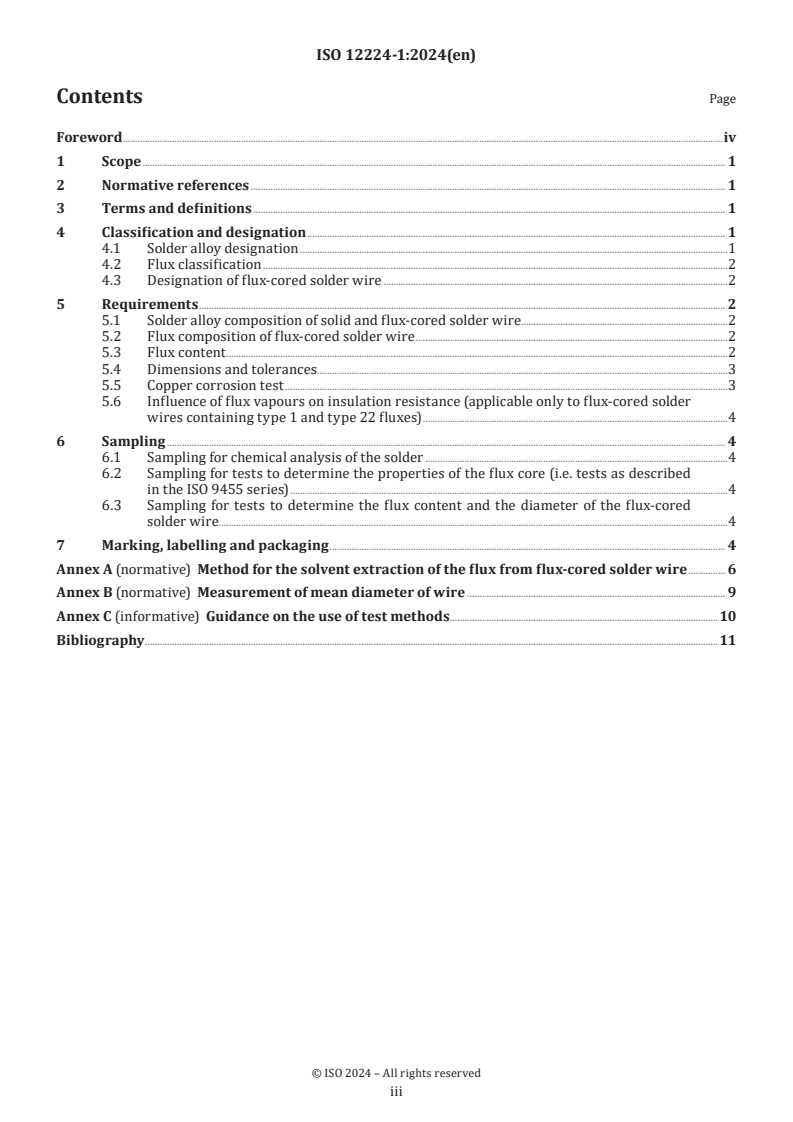
Contents Page
Foreword .iv
1 Scope . 1
2 Normative references . 1
3 Terms and definitions . 1
4 Classification and designation . 1
4.1 Solder alloy designation .1
4.2 Flux classification .2
4.3 Designation of flux-cored solder wire .2
5 Requirements . 2
5.1 Solder alloy composition of solid and flux-cored solder wire .2
5.2 Flux composition of flux-cored solder wire .2
5.3 Flux content .2
5.4 Dimensions and tolerances . . .3
5.5 Copper corrosion test .3
5.6 Influence of flux vapours on insulation resistance (applicable only to flux-cored solder
wires containing type 1 and type 22 fluxes) .4
6 Sampling . 4
6.1 Sampling for chemical analysis of the solder .4
6.2 Sampling for tests to determine the properties of the flux core (i.e. tests as described
in the ISO 9455 series) .4
6.3 Sampling for tests to determine the flux content and the diameter of the flux-cored
solder wire.4
7 Marking, labelling and packaging . 4
Annex A (normative) Method for the solvent extraction of the flux from flux-cored solder wire . 6
Annex B (normative) Measurement of mean diameter of wire . 9
Annex C (informative) Guidance on the use of test methods .10
Bibliography .11
iii
Foreword
ISO (the International Organization for Standardization) is a worldwide federation of national standards
bodies (ISO member bodies). The work of preparing International Standards is normally carried out through
ISO technical committees. Each member body interested in a subject for which a technical committee
has been established has the right to be represented on that committee. International organizations,
governmental and non-governmental, in liaison with ISO, also take part in the work. ISO collaborates closely
with the International Electrotechnical Commission (IEC) on all matters of electrotechnical standardization.
The procedures used to develop this document and those intended for its further maintenance are described
in the ISO/IEC Directives, Part 1. In particular, the different approval criteria needed for the different types
of ISO document should be noted. This document was drafted in accordance with the editorial rules of the
ISO/IEC Directives, Part 2 (see www.iso.org/directives).
ISO draws attention to the possibility that the implementation of this document may involve the use of (a)
patent(s). ISO takes no position concerning the evidence, validity or applicability of any claimed patent
rights in respect thereof. As of the date of publication of this document, ISO had not received notice of (a)
patent(s) which may be required to implement this document. However, implementers are cautioned that
this may not represent the latest information, which may be obtained from the patent database available at
www.iso.org/patents. ISO shall not be held responsible for identifying any or all such patent rights.
Any trade name used in this document is information given for the convenience of users and does not
constitute an endorsement.
For an explanation of the voluntary nature of standards, the meaning of ISO specific terms and expressions
related to conformity assessment, as well as information about ISO's adherence to the World Trade
Organization (WTO) principles in the Technical Barriers to Trade (TBT), see www.iso.org/iso/foreword.html.
This document was prepared by Technical Committee ISO/TC 44, Welding and allied processes, Subcommittee
SC 12, Soldering materials, in collaboration with the European Committee for Standardization (CEN)
Technical Committee CEN/TC 121, Welding and allied processes, in accordance with the Agreement on
technical cooperation between ISO and CEN (Vienna Agreement).
This second edition cancels and replaces the first edition (ISO 12224-1:1997), which has been technically
revised.
The main changes are as follows:
— Table 1: greater nominal contents added;
— former 5.5 and Table 3 deleted because the spread test is not commonly used;
— former 5.6.1 deleted because the test method was withdrawn;
— 6.1: reference to ISO 10564, which has been withdrawn, replaced by a recommended method;
— in Table A.1 the column for method D was deleted;
— in Table C.1 withdrawn standards were deleted and flux types were grouped;
— designations aligned with ISO 9454-1.
A list of all parts in the ISO 12224 series can be found on the ISO website.
Any feedback or questions on this document should be directed to the user’s
national standards body. A complete listing of these bodies can be found at
www.iso.org/members.html. Official interpretations of ISO/TC 44 documents, where they exist, are
available from this page: https://committee.iso.org/sites/tc44/home/interpretation.html.
iv
International Standard ISO 12224-1:2024(en)
Solder wire, solid and flux-cored — Specification and test
methods —
Part 1:
Classification and performance requirements
1 Scope
This document specifies a coding system for the classification and designation of solid and flux-cored solder
wire, and the performance requirements to be met by flux-cored wire and its constituents. Requirements
for sampling, labelling and packaging are also specified.
2 Normative references
The following documents are referred to in the text in such a way that some or all of their content constitutes
requirements of this document. For dated references, only the edition cited applies. For undated references,
the latest edition of the referenced document (including any amendments) applies.
ISO 9453, Soft solder alloys — Chemical compositions and forms
ISO 9454-1, Soft soldering fluxes — Classification and requirements — Part 1: Classification, labelling and
packaging
ISO 9455-15, Soft soldering fluxes — Test methods — Part 15: Copper corrosion test
ISO 9455-17, Soft soldering fluxes — Test methods — Part 17: Surface insulation resistance comb test and
electrochemical migration test of flux residues
ISO 12224-2, Solder wire, solid and flux-cored — Specification and test methods — Part 2: Determination of
flux content
3 Terms and definitions
No terms and definitions are listed in this document.
ISO and IEC maintain terminology databases for use in standardization at the following addresses:
— ISO Online browsing platform: available at https:// www .iso .org/ obp
— IEC Electropedia: available at https:// www .electropedia .org/
4 Classification and designation
4.1 Solder alloy designation
The solder alloy used for solid wire, and for the solder component of flux-cored solder wire, shall be
designated in accordance with the solder alloy designations given in ISO 9453.
4.2 Flux classification
The flux component of flux-cored solder wire shall be classified in accordance with the system, based on the
main fluxing ingredients, given in ISO 9454-1.
Annex C gives guidance on the test methods appropriate for the flux types incorporated in flux-cored
solder wire.
4.3 Designation of flux-cored solder wire
The designations for solid and flux-cored solder wire shall consist of the following parts:
a) reference to this document (i.e. ISO 12224-1);
b) the appropriate soft solder alloy designation in accordance with ISO 9453;
c) in the case of flux-cored solder wire, the appropriate flux classification in accordance with ISO 9454-1.
The three parts of the designation shall be separated by an oblique stroke (/).
EXAMPLE 1 A solid solder wire, which corresponds to ISO 12224-1, made of 99,3/0,7 tin-copper soft solder, is
designated as follows:
...
Norme
internationale
ISO 12224-1
Deuxième édition
Fils d'apport de brasage tendre,
2024-05
pleins et à flux incorporé —
Spécifications et méthodes
d'essai —
Partie 1:
Classification et exigences de
performance
Solder wire, solid and flux-cored — Specification and test
methods —
Part 1: Classification and performance requirements
Numéro de référence
DOCUMENT PROTÉGÉ PAR COPYRIGHT
© ISO 2024
Tous droits réservés. Sauf prescription différente ou nécessité dans le contexte de sa mise en œuvre, aucune partie de cette
publication ne peut être reproduite ni utilisée sous quelque forme que ce soit et par aucun procédé, électronique ou mécanique,
y compris la photocopie, ou la diffusion sur l’internet ou sur un intranet, sans autorisation écrite préalable. Une autorisation peut
être demandée à l’ISO à l’adresse ci-après ou au comité membre de l’ISO dans le pays du demandeur.
ISO copyright office
Case postale 401 • Ch. de Blandonnet 8
CH-1214 Vernier, Genève
Tél.: +41 22 749 01 11
E-mail: copyright@iso.org
Web: www.iso.org
Publié en Suisse
ii
Sommaire Page
Avant-propos .iv
1 Domaine d’application . 1
2 Références normatives . 1
3 Termes et définitions . 1
4 Classification et désignation . 1
4.1 Désignation des alliages de brasage tendre .1
4.2 Classification des flux.2
4.3 Désignation des fils d’apport de brasage tendre à flux incorporé .2
5 Exigences . 2
5.1 Composition des alliages utilisés pour les fils d’apport de brasage tendre, pleins et à
flux incorporé .2
5.2 Composition des flux utilisés dans les fils d’apport de brasage tendre à flux incorporé .2
5.3 Teneur en flux .2
5.4 Dimensions et tolérances .3
5.5 Essai de corrosion sur cuivre .3
5.6 Influence des vapeurs de flux sur la résistance d’isolement (applicable uniquement aux
fils d’apport à flux incorporé contenant des flux de type 1 et de type 22) .4
6 Échantillonnage . 4
6.1 Échantillonnage pour analyse chimique du métal d’apport de brasage tendre .4
6.2 Échantillonnage pour essais en vue de déterminer les propriétés du garnissage de flux
(c’est-à-dire essais tels que décrits dans la série ISO 9455) .4
6.3 Échantillonnage pour essais en vue de déterminer la teneur en flux et le diamètre du fil
d’apport de brasage tendre à flux incorporé .4
7 Marquage, étiquetage et emballage. 4
Annexe A (normative) Méthode d’extraction par solvant du flux contenu dans un fil d’apport de
brasage tendre à flux incorporé . 6
Annexe B (normative) Mesurage du diamètre moyen du fil . 9
Annexe C (informative) Recommandations pour l’utilisation des méthodes d’essai .10
Bibliographie .11
iii
Avant-propos
L'ISO (Organisation internationale de normalisation) est une fédération mondiale d'organismes nationaux
de normalisation (comités membres de l'ISO). L'élaboration des Normes internationales est en général
confiée aux comités techniques de l'ISO. Chaque comité membre intéressé par une étude a le droit de faire
partie du comité technique créé à cet effet. Les organisations internationales, gouvernementales et non
gouvernementales, en liaison avec l'ISO participent également aux travaux. L'ISO collabore étroitement avec
la Commission électrotechnique internationale (IEC) en ce qui concerne la normalisation électrotechnique.
Les procédures utilisées pour élaborer le présent document et celles destinées à sa mise à jour sont
décrites dans les Directives ISO/IEC, Partie 1. Il convient, en particulier, de prendre note des différents
critères d'approbation requis pour les différents types de documents ISO. Le présent document a
été rédigé conformément aux règles de rédaction données dans les Directives ISO/IEC, Partie 2 (voir
www.iso.org/directives).
L’ISO attire l’attention sur le fait que la mise en application du présent document peut entraîner l’utilisation
d’un ou de plusieurs brevets. L’ISO ne prend pas position quant à la preuve, à la validité et à l’applicabilité de
tout droit de propriété revendiqué à cet égard. À la date de publication du présent document, l’ISO n'avait pas
reçu notification qu’un ou plusieurs brevets pouvaient être nécessaires à sa mise en application. Toutefois,
il y a lieu d’avertir les responsables de la mise en application du présent document que des informations
plus récentes sont susceptibles de figurer dans la base de données de brevets, disponible à l'adresse
www.iso.org/brevets. L’ISO ne saurait être tenue pour responsable de ne pas avoir identifié tout ou partie de
tels droits de propriété.
Les appellations commerciales éventuellement mentionnées dans le présent document sont données pour
information, par souci de commodité, à l’intention des utilisateurs et ne sauraient constituer un engagement.
Pour une explication de la nature volontaire des normes, la signification des termes et expressions
spécifiques de l'ISO liés à l'évaluation de la conformité, ou pour toute information au sujet de l'adhésion de
l'ISO aux principes de l’Organisation mondiale du commerce (OMC) concernant les obstacles techniques au
commerce (OTC), voir www.iso.org/avant-propos.
Le présent document a été élaboré par le comité technique ISO/TC 44, Soudage et techniques connexes, sous-
comité SC 12, Produits de brasage tendre, en collaboration avec le comité technique CEN/TC 121, Soudage et
techniques connexes, du Comité européen de normalisation (CEN) conformément à l’Accord de coopération
technique entre l’ISO et le CEN (Accord de Vienne).
Cette deuxième édition annule et remplace la première édition (ISO 12224-1:1997), qui a fait l’objet d’une
révision technique.
Les principales modifications sont les suivantes:
— Tableau 1: ajout des teneurs nominales plus élevées;
— suppression des anciens 5.5 et Tableau 3, car l’essai d’étalement n’est pas couramment utilisé;
— suppression de l'ancien 5.6.1, car la méthode d’essai a été retirée;
— 6.1: remplacement de la référence à l’ISO 10564, qui a été annulée, par une méthode recommandée;
— dans le Table A.1 la colonne pour la méthode D a été supprimée;
— dans le Table C.1 les normes annulées ont été retirées et les types de flux ont été groupés;
— alignement des désignations avec l’ISO 9454-1.
Une liste de toutes les parties de la série ISO 12224 se trouve sur le site web de l’ISO.
Il convient que l’utilisateur adresse tout retour d’information ou toute question concernant le
présent document à l’organisme national de normalisation de son pays. Une liste exhaustive desdits
organismes se trouve à l’adresse www.iso.org/fr/members.html. Les demandes d’interprétations
iv
officielles des documents de l'ISO/TC 44, lorsqu'elles existent, sont disponibles à l’adresse
https://committee.iso.org/sites/tc44/home/interpretation.html.
v
Norme internationale ISO 12224-1:2024(fr)
Fils d'apport de brasage tendre, pleins et à flux incorporé —
Spécifications et méthodes d'essai —
Partie 1:
Classification et exigences de performance
1 Domaine d’application
Le présent documentspécifie un système de codification pour la classification et la désignation des fils
d'apport de brasage tendre pleins et à flux incorporé destinés, ainsi que les exigences de performance à
satisfaire pour les fils à flux incorporé et leurs constituants. Des exigences relatives à l’échantillonnage, à
l’étiquetage et à l’emballage sont également spécifiées.
2 Références normatives
Les documents suivants sont cités dans le texte de sorte qu’ils constituent, pour tout ou partie de leur
contenu, des exigences du présent document. Pour les références datées, seule l’édition citée s’applique. Pour
les références non datées, la dernière édition du document de référence s'applique (y compris les éventuels
amendements).
ISO 9453, Alliages de brasage tendre — Compositions chimiques et formes
ISO 9454-1, Flux de brasage tendre — Classification et exigences — Partie 1: Classification, marquage et
emballage
ISO 9455-15, Flux de brasage tendre — Méthodes d'essai — Partie 15: Essai de corrosion du cuivre
ISO 9455-17, Flux de brasage tendre — Méthodes d'essai — Partie 17: Essai au peigne et essai de migration
électrochimique de résistance d'isolement de surface des résidus de flux
ISO 12224-2, Fils d’apport de brasage, pleins et à flux incorporé — Spécifications et méthodes d’essai — Partie 2:
Détermination de la teneur en flux
3 Termes et définitions
Aucun terme n’est défini dans le présent document.
L’ISO et l’IEC tiennent à jour des bases de données terminologiques destinées à être utilisées en normalisation,
consultables aux adresses suivantes:
— ISO Online browsing platform: disponible à l’adresse https:// www .iso .org/ obp
— IEC Electropedia: disponible à l’adresse https:// www .electropedia .org/
4 Classification et désignation
4.1 Désignation des alliages de brasage tendre
Les alliages de brasage tendre utilisés pour les fils pleins et pour le composant de brasage tendre des fils
d’apport à flux incorporé doivent être désignés conformément aux désignations des alliages de brasage
tendre indiquées dans l’ISO 9453.
4.2 Classification des flux
Les flux entrant dans la composition des fils d’apport de brasage tendre à flux incorporé doivent être classés
conformément au système décrit dans l’ISO 9454-1, basé sur leurs ingrédients principaux.
L’Annexe C donne des recommandations sur les méthodes d’essai adaptées aux types de flux utilisés dans les
fils d’apport de brasage tendre à flux incorporé.
4.3 Désignation des fils d’apport de brasage tendre à flux incorporé
Les désignations des fils d’apport de brasage tendre, pleins et à flux incorporé, doivent comporter les parties
suivantes:
a) une référence au présent document(c’est-à-dire l’ISO 12224-1);
b) la désignation correspondante de l’alliage de brasage tendre conformément à l’ISO 9453;
c) en ce qui concerne les fils d’apport de brasage tendre à flux incorporé, la classification appropriée du
flux conformément à l’ISO 9454-1.
Les trois parties de la désignation doivent être séparées par une barre oblique (/).
EXEMPLE 1 Un fil d'apport plein destiné au brasage tendre, répondant à l’ISO 12224-1, fabriqué à partir d’un
produit d’apport de brasage tendre contenant 99,3/0,7 d’étain et de cuivre, est désigné comme suit:
ISO 12224-1/Sn99,3Cu0,7
EXEMPLE 2 Un fil d’apport de brasage tendre à flux incorporé, répondant à l’ISO 12224-1, fabriqué à partir d’un
produit d’apport de brasage tendre contenant 99,3/0,7 d’étain et de cuivre, contenant une colophane activée par
halogènes, est désigné comme suit:
...
Questions, Comments and Discussion
Ask us and Technical Secretary will try to provide an answer. You can facilitate discussion about the standard in here.
Loading comments...