


ISO 9348:2026
(Main)Textiles — Determination of the anti-contamination propensity of fabrics to particulate matter — Digital measurement method
Textiles — Determination of the anti-contamination propensity of fabrics to particulate matter — Digital measurement method
This document specifies the digital measurement method for the determination of the anti-contamination of fabrics. This method is applicable to woven fabrics which have or have not been given an anti-contamination to particulate matter finish. It is especially suitable for measuring apparel fabrics. It is not intended for use in fabrics that react to UV light or allow particulate matter to penetrate into the structure of the fabric. It is not applied to fabrics for personal protective equipment. NOTE 1 Particulate matter (PM) is solid particles suspended in ambient air defined in ISO 16890-1. NOTE 2 In woven fabrics, particulate matter (PM) adheres to the fabric surface due to electrostatic or surface properties. In knitted and nonwoven fabrics, PM penetrates into the fabric structure, following a different mechanism. The conditions and procedures outlined in this test method are designed to ensure reproducibility and precision specifically when applied to woven fabrics.
Textiles — Détermination de la propension des étoffes à la décontamination par les particules — Méthode de mesurage numérique
General Information
- Status
- Published
- Publication Date
- 21-May-2026
- Current Stage
- 6060 - International Standard published
- Start Date
- 22-May-2026
- Due Date
- 16-Mar-2026
- Completion Date
- 22-May-2026
Overview
ISO 9348:2026 defines a standard digital measurement method for assessing the anti-contamination propensity of textiles to particulate matter (PM). Developed by the International Organization for Standardization (ISO), this methodology is specifically tailored for woven fabrics, including those treated or untreated with anti-contamination finishes. It is particularly relevant for testing apparel textiles but is not suitable for fabrics that interact with UV light, allow PM penetration into fiber structure, or are designed for personal protective equipment.
Accurate measurement of how well fabrics resist particulate contamination is crucial for ensuring the cleanliness, durability, and comfort of textile products, especially in environments with high concentrations of ambient particulates.
Key Topics
- Particulate Matter Definition: Follows ISO 16890-1 for PM, focusing on solid airborne particles that adhere to fabric surfaces mainly due to electrostatic or surface interactions.
- Digital Measurement Method: Utilizes digital imaging under UV light and image analysis software to determine the area of particle adhesion, ensuring precise and reproducible results.
- Scope and Limitations:
- Suitable for woven fabrics intended for apparel
- Not suitable for UV-reactive fabrics, fabrics with significant PM penetration, or PPE textiles
- Sample Preparation and Test Procedure:
- Involves conditioning both test particles and textiles, using a rotary testing box and specimen canisters
- After exposure, specimen surfaces are imaged for analysis
- Result Expression: The proportion of surface area covered by PM is calculated and reported as a performance percentage, providing a quantitative assessment of anti-contamination effectiveness.
Applications
Implementation of ISO 9348:2026 enables:
- Quality Control in Textile Manufacturing: Textile producers and apparel brands can objectively evaluate and compare the anti-contamination performance of different fabric types and finishes.
- R&D for Advanced Textile Finishes: Research teams can assess the efficiency of new fabric treatments intended to minimize particulate adhesion.
- Compliance and Certification: Testing laboratories can use this standard to certify fabrics for specific requirements related to cleanliness and particulate resistance.
- Product Development for Apparel: Designers and manufacturers of garments for sensitive applications (e.g., medical, laboratory, or cleanroom environments) can ensure their fabrics meet rigorous standards for limiting particulate contamination.
- Environmental Impact Assessment: Organizations can monitor how textiles interact with airborne particulates, supporting sustainability initiatives and improved indoor air quality.
Related Standards
Several ISO standards complement and support ISO 9348:2026 in the field of textile testing and particulate analysis:
- ISO 139 - Textiles - Standard atmospheres for conditioning and testing: Outlines environmental conditions for reliable textile testing.
- ISO 16890-1 - Air filters for general ventilation - Technical specifications related to particulate matter.
- ISO 12945-1 - Fabric propensity for pilling tests, sharing apparatus similarities.
- ISO 13320 - Particle size analysis - Laser diffraction methods, relevant for PM characterization.
- IEC 62321-3-1 - Screening for substances in electrotechnical products via X-ray fluorescence, applicable in test particle composition analysis.
These related standards create a comprehensive framework for textile testing, conditioning, and particulate measurement, supporting quality, compliance, and innovation across the textile industry.
ISO 9348:2026 delivers a standardized, reproducible method for evaluating textile cleanliness with digital precision, making it an essential tool for manufacturers, laboratories, and researchers concerned with particulate contamination in woven fabrics.
Get Certified
Connect with accredited certification bodies for this standard

Control Union Certifications
Global certification for agriculture and sustainability.

Hohenstein Institut
Textile testing and certification.

Bureau Veritas Bangladesh
Bureau Veritas certification services in Bangladesh.
Sponsored listings
Frequently Asked Questions
ISO 9348:2026 is a standard published by the International Organization for Standardization (ISO). Its full title is "Textiles — Determination of the anti-contamination propensity of fabrics to particulate matter — Digital measurement method". This standard covers: This document specifies the digital measurement method for the determination of the anti-contamination of fabrics. This method is applicable to woven fabrics which have or have not been given an anti-contamination to particulate matter finish. It is especially suitable for measuring apparel fabrics. It is not intended for use in fabrics that react to UV light or allow particulate matter to penetrate into the structure of the fabric. It is not applied to fabrics for personal protective equipment. NOTE 1 Particulate matter (PM) is solid particles suspended in ambient air defined in ISO 16890-1. NOTE 2 In woven fabrics, particulate matter (PM) adheres to the fabric surface due to electrostatic or surface properties. In knitted and nonwoven fabrics, PM penetrates into the fabric structure, following a different mechanism. The conditions and procedures outlined in this test method are designed to ensure reproducibility and precision specifically when applied to woven fabrics.
This document specifies the digital measurement method for the determination of the anti-contamination of fabrics. This method is applicable to woven fabrics which have or have not been given an anti-contamination to particulate matter finish. It is especially suitable for measuring apparel fabrics. It is not intended for use in fabrics that react to UV light or allow particulate matter to penetrate into the structure of the fabric. It is not applied to fabrics for personal protective equipment. NOTE 1 Particulate matter (PM) is solid particles suspended in ambient air defined in ISO 16890-1. NOTE 2 In woven fabrics, particulate matter (PM) adheres to the fabric surface due to electrostatic or surface properties. In knitted and nonwoven fabrics, PM penetrates into the fabric structure, following a different mechanism. The conditions and procedures outlined in this test method are designed to ensure reproducibility and precision specifically when applied to woven fabrics.
ISO 9348:2026 is classified under the following ICS (International Classification for Standards) categories: 59.060.01 - Textile fibres in general; 61.020 - Clothes. The ICS classification helps identify the subject area and facilitates finding related standards.
ISO 9348:2026 is available in PDF format for immediate download after purchase. The document can be added to your cart and obtained through the secure checkout process. Digital delivery ensures instant access to the complete standard document.
Standards Content (Sample)
International
Standard
ISO 9348
First edition
Textiles — Determination of the
2026-05
anti-contamination propensity of
fabrics to particulate matter —
Digital measurement method
Textiles — Détermination de la propension des étoffes à la
décontamination par les particules — Méthode de mesurage
numérique
Reference number
© ISO 2026
All rights reserved. Unless otherwise specified, or required in the context of its implementation, no part of this publication may
be reproduced or utilized otherwise in any form or by any means, electronic or mechanical, including photocopying, or posting on
the internet or an intranet, without prior written permission. Permission can be requested from either ISO at the address below
or ISO’s member body in the country of the requester.
ISO copyright office
CP 401 • Ch. de Blandonnet 8
CH-1214 Vernier, Geneva
Phone: +41 22 749 01 11
Email: copyright@iso.org
Website: www.iso.org
Published in Switzerland
ii
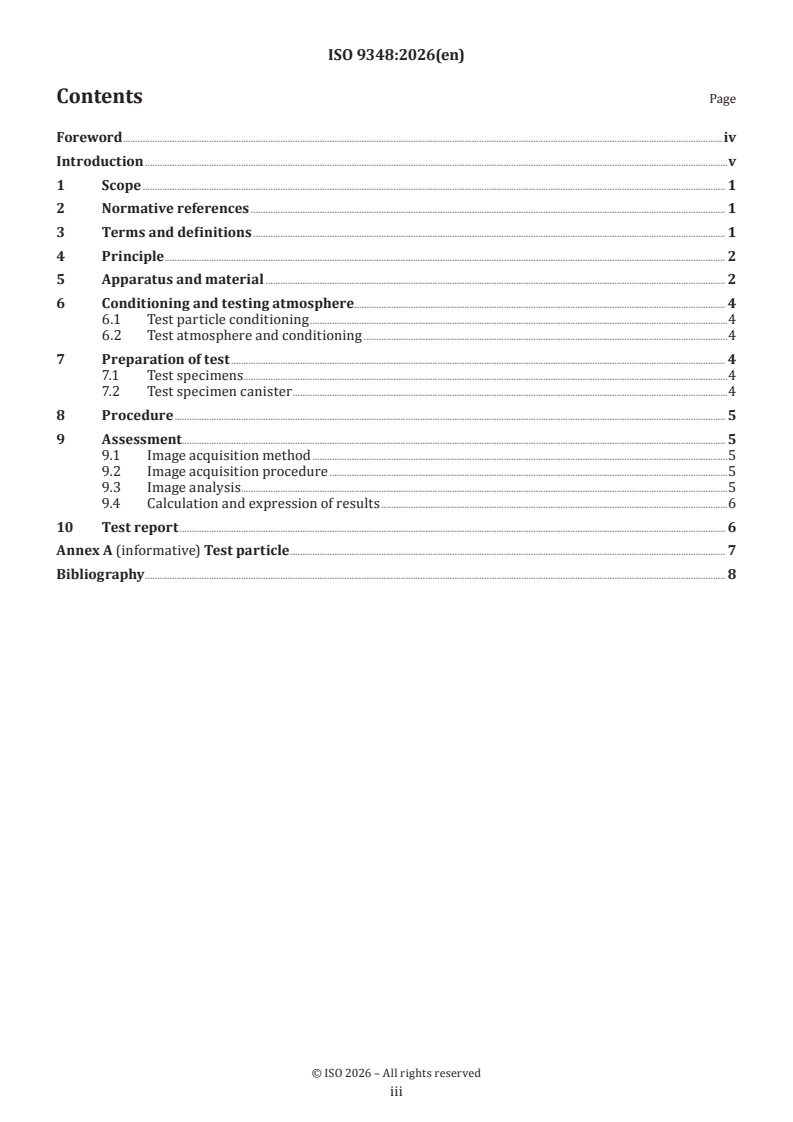
Contents Page
Foreword .iv
Introduction .v
1 Scope . 1
2 Normative references . 1
3 Terms and definitions . 1
4 Principle . 2
5 Apparatus and material . 2
6 Conditioning and testing atmosphere. 4
6.1 Test particle conditioning .4
6.2 Test atmosphere and conditioning .4
7 Preparation of test . 4
7.1 Test specimens.4
7.2 Test specimen canister .4
8 Procedure . 5
9 Assessment . . 5
9.1 Image acquisition method .5
9.2 Image acquisition procedure .5
9.3 Image analysis.5
9.4 Calculation and expression of results .6
10 Test report . 6
Annex A (informative) Test particle . 7
Bibliography . 8
iii
Foreword
ISO (the International Organization for Standardization) is a worldwide federation of national standards
bodies (ISO member bodies). The work of preparing International Standards is normally carried out through
ISO technical committees. Each member body interested in a subject for which a technical committee
has been established has the right to be represented on that committee. International organizations,
governmental and non-governmental, in liaison with ISO, also take part in the work. ISO collaborates closely
with the International Electrotechnical Commission (IEC) on all matters of electrotechnical standardization.
The procedures used to develop this document and those intended for its further maintenance are described
in the ISO/IEC Directives, Part 1. In particular, the different approval criteria needed for the different types
of ISO document should be noted. This document was drafted in accordance with the editorial rules of the
ISO/IEC Directives, Part 2 (see www.iso.org/directives).
ISO draws attention to the possibility that the implementation of this document may involve the use of (a)
patent(s). ISO takes no position concerning the evidence, validity or applicability of any claimed patent
rights in respect thereof. As of the date of publication of this document, ISO had not received notice of (a)
patent(s) which may be required to implement this document. However, implementers are cautioned that
this may not represent the latest information, which may be obtained from the patent database available at
www.iso.org/patents. ISO shall not be held responsible for identifying any or all such patent rights.
Any trade name used in this document is information given for the convenience of users and does not
constitute an endorsement.
For an explanation of the voluntary nature of standards, the meaning of ISO specific terms and expressions
related to conformity assessment, as well as information about ISO's adherence to the World Trade
Organization (WTO) principles in the Technical Barriers to Trade (TBT), see www.iso.org/iso/foreword.html.
This document was prepared by Technical Committee ISO/TC 38, Textiles, Subcommittee SC 24, Conditioning
atmospheres and physical tests for textile fabrics.
Any feedback or questions on this document should be directed to the user’s national standards body. A
complete listing of these bodies can be found at www.iso.org/members.html.
iv
Introduction
In woven fabrics, particulate matter (PM) adheres to the fabric surface due to electrostatic or surface
properties. In knitted and nonwoven fabrics, PM penetrates into the fabric structure, following a
different mechanism. The conditions and procedures outlined in this test method are designed to ensure
reproducibility and precision specifically when applied to woven fabrics.
v
International Standard ISO 9348:2026(en)
Textiles — Determination of the anti-contamination
propensity of fabrics to particulate matter — Digital
measurement method
1 Scope
This document specifies the digital measurement method for the determination of the anti-contamination
of fabrics.
This method is applicable to woven fabrics which have or have not been given an anti-contamination to
particulate matter finish. It is especially suitable for measuring apparel fabrics. It is not intended for use in
fabrics that react to UV light or allow particulate matter to penetrate into the structure of the fabric. It is not
applied to fabrics for personal protective equipment.
NOTE 1 Particulate matter (PM) is solid particles suspended in ambient air defined in ISO 16890-1.
NOTE 2 In woven fabrics, particulate matter (PM) adheres to the fabric surface due to electrostatic or surface
properties. In knitted and nonwoven fabrics, PM penetrates into the fabric structure, following a different mechanism.
The conditions and procedures outlined in this test method are designed to ensure reproducibility and precision
specifically when applied to woven fabrics.
2 Normative references
The following documents are referred to in the text in such a way that some or all of their content constitutes
requirements of this document. For dated references, only the edition cited applies. For undated references,
the latest edition of the referenced document (including any amendments) applies.
ISO 139, Textiles — Standard atmospheres for conditioning and testing
3 Terms and de
...