


ISO/IEC 20582:2025
(Main)Software and systems engineering — Capabilities of build and deployment tools
Software and systems engineering — Capabilities of build and deployment tools
This document defines the requirements for capabilities of build and deployment tools to support and automate building, packaging, and deploying work. This document is intended for use in evaluating and selecting build and deployment tools according to the procedures defined in ISO/IEC 20741. This document is applicable to different development methodologies and approaches (e.g. Waterfall, Agile, or DevOps).
Ingénierie du logiciel et des systèmes — Capacités des outils de construction et de déploiement
General Information
- Status
- Published
- Publication Date
- 20-May-2025
- Technical Committee
- ISO/IEC JTC 1/SC 7 - Software and systems engineering
- Drafting Committee
- ISO/IEC JTC 1/SC 7 - Software and systems engineering
- Current Stage
- 6060 - International Standard published
- Start Date
- 21-May-2025
- Due Date
- 06-Apr-2026
- Completion Date
- 21-May-2025
Overview
ISO/IEC 20582:2025 - Software and systems engineering - Capabilities of build and deployment tools - specifies the requirements for capabilities that build, packaging, and deployment tools should provide to support and automate software delivery. Designed to be used with ISO/IEC 20741 for tool evaluation and selection, the standard applies across development approaches (Waterfall, Agile, DevOps) and focuses on the integrated lifecycle of build, deployment and CI/CD automation. It deliberately excludes change management and configuration management to concentrate on transformation and operationalization of artifacts.
Key Topics
- Object model and use cases: A structured model describing resource and control entities used by build and deployment tools, with practical use-case scenarios for system lifecycles and CI/CD.
- Entities for automation: Definitions and roles for BuildEntities, DeploymentEntities, and CI/CDEntities (e.g., BuildStep, DeploymentStep, CI/CDStep, Procedures, Dependencies, Links to libraries/data/tools).
- Capabilities requirements: Clear capability categories and actions including:
- Register build, deployment, and CI/CD procedures
- Execute procedures (build, deploy, CI/CD)
- Confirm results of procedures (success/failure, outputs)
- Dependency space: Guidance on handling dependencies across building, deployment, and CI/CD workflows.
- Informative annexes: Annex A on using this document with ISO/IEC 20741 and Annex B on the approach and rationale.
Applications
ISO/IEC 20582:2025 is practical for organizations that need to evaluate, select, or benchmark build and deployment tools and CI/CD platforms. Typical uses:
- Tool procurement and vendor selection teams using ISO/IEC 20741 procedures
- DevOps and release engineering teams defining required automation capabilities
- Software architects and platform engineers comparing build systems, package managers, installers, and CI/CD orchestration
- QA and release managers establishing objective criteria for pipeline automation and traceability
Benefits include improved consistency in tool evaluation, better alignment of tool features with organizational build/deploy processes, and clearer specification of automation needs for continuous delivery.
Related Standards
- ISO/IEC 20741 - Guideline for the evaluation and selection of software engineering tools (intended to be used together with ISO/IEC 20582:2025).
Keywords: ISO/IEC 20582:2025, build and deployment tools, CI/CD, software engineering, tool evaluation, automation, build procedure, deployment procedure, packaging, ISO/IEC 20741.


Get Certified
Connect with accredited certification bodies for this standard

BSI Group
BSI (British Standards Institution) is the business standards company that helps organizations make excellence a habit.

BSCIC Certifications Pvt. Ltd.
Established 2006, accredited by NABCB, JAS-ANZ, EIAC, IAS. CDSCO Notified Body.

Intertek India Pvt. Ltd.
Delivers Assurance, Testing, Inspection & Certification since 1993 with 26 labs and 32 offices.
Sponsored listings
Frequently Asked Questions
ISO/IEC 20582:2025 is a standard published by the International Organization for Standardization (ISO). Its full title is "Software and systems engineering — Capabilities of build and deployment tools". This standard covers: This document defines the requirements for capabilities of build and deployment tools to support and automate building, packaging, and deploying work. This document is intended for use in evaluating and selecting build and deployment tools according to the procedures defined in ISO/IEC 20741. This document is applicable to different development methodologies and approaches (e.g. Waterfall, Agile, or DevOps).
This document defines the requirements for capabilities of build and deployment tools to support and automate building, packaging, and deploying work. This document is intended for use in evaluating and selecting build and deployment tools according to the procedures defined in ISO/IEC 20741. This document is applicable to different development methodologies and approaches (e.g. Waterfall, Agile, or DevOps).
ISO/IEC 20582:2025 is classified under the following ICS (International Classification for Standards) categories: 35.080 - Software. The ICS classification helps identify the subject area and facilitates finding related standards.
ISO/IEC 20582:2025 is available in PDF format for immediate download after purchase. The document can be added to your cart and obtained through the secure checkout process. Digital delivery ensures instant access to the complete standard document.
Standards Content (Sample)
International
Standard
ISO/IEC 20582
First edition
Software and systems
2025-05
engineering — Capabilities of build
and deployment tools
Ingénierie du logiciel et des systèmes — Capacités des outils de
construction et de déploiement
Reference number
© ISO/IEC 2025
All rights reserved. Unless otherwise specified, or required in the context of its implementation, no part of this publication may
be reproduced or utilized otherwise in any form or by any means, electronic or mechanical, including photocopying, or posting on
the internet or an intranet, without prior written permission. Permission can be requested from either ISO at the address below
or ISO’s member body in the country of the requester.
ISO copyright office
CP 401 • Ch. de Blandonnet 8
CH-1214 Vernier, Geneva
Phone: +41 22 749 01 11
Email: copyright@iso.org
Website: www.iso.org
Published in Switzerland
© ISO/IEC 2025 – All rights reserved
ii
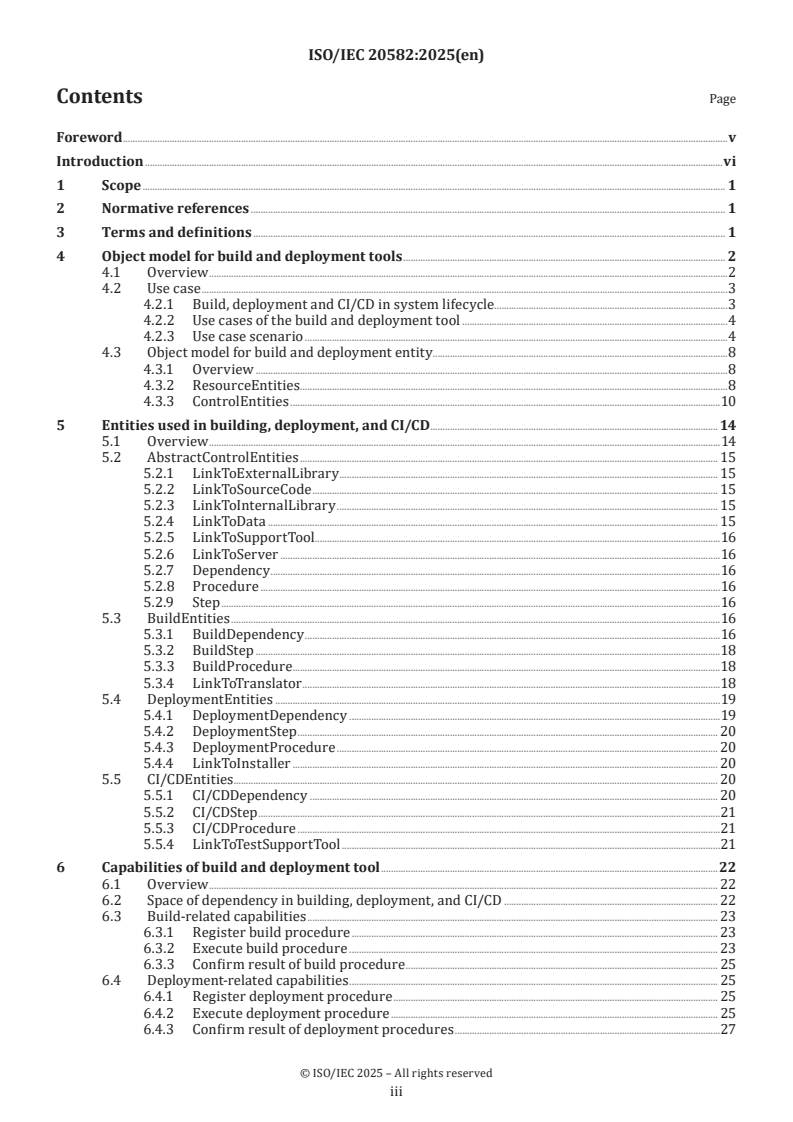
Contents Page
Foreword .v
Introduction .vi
1 Scope . 1
2 Normative references . 1
3 Terms and definitions . 1
4 Object model for build and deployment tools . 2
4.1 Overview .2
4.2 Use case .3
4.2.1 Build, deployment and CI/CD in system lifecycle . .3
4.2.2 Use cases of the build and deployment tool .4
4.2.3 Use case scenario .4
4.3 Object model for build and deployment entity.8
4.3.1 Overview .8
4.3.2 ResourceEntities.8
4.3.3 ControlEntities .10
5 Entities used in building, deployment, and CI/CD . 14
5.1 Overview .14
5.2 AbstractControlEntities . 15
5.2.1 LinkToExternalLibrary . . 15
5.2.2 LinkToSourceCode . 15
5.2.3 LinkToInternalLibrary . 15
5.2.4 LinkToData . 15
5.2.5 LinkToSupportTool.16
5.2.6 LinkToServer .16
5.2.7 Dependency .16
5.2.8 Procedure .16
5.2.9 Step .16
5.3 BuildEntities .16
5.3.1 BuildDependency .16
5.3.2 BuildStep .18
5.3.3 BuildProcedure . .18
5.3.4 LinkToTranslator .18
5.4 DeploymentEntities .19
5.4.1 DeploymentDependency .19
5.4.2 DeploymentStep . 20
5.4.3 DeploymentProcedure . 20
5.4.4 LinkToInstaller . 20
5.5 CI/CDEntities . 20
5.5.1 CI/CDDependency . 20
5.5.2 CI/CDStep .21
5.5.3 CI/CDProcedure .21
5.5.4 LinkToTestSupportTool .21
6 Capabilities of build and deployment tool .22
6.1 Overview . 22
6.2 Space of dependency in building, deployment, and CI/CD . 22
6.3 Build-related capabilities . 23
6.3.1 Register build procedure . 23
6.3.2 Execute build procedure . 23
6.3.3 Confirm result of build procedure . 25
6.4 Deployment-related capabilities . 25
6.4.1 Register deployment procedure . 25
6.4.2 Execute deployment procedure . 25
6.4.3 Confirm result of deployment procedures .27
© ISO/IEC 2025 – All rights reserved
iii
6.5 CI/CD-related capabilities .27
6.5.1 Register CI/CD procedure .27
6.5.2 Execute CI/CD procedure .27
6.5.3 Confirm result of CI/CD procedure . 28
Annex A (informative) How to use this document with ISO/IEC 20741 .29
Annex B (informative) Overview of the approach for this document .30
Bibliography .32
© ISO/IEC 2025 – All rights reserved
iv
Foreword
ISO (the International Organization for Standardization) and IEC (the International Electrotechnical
Commission) form the specialized system for worldwide standardization. National bodies that are
members of ISO or IEC participate in the development of International Standards through technical
committees established by the respective organization to deal with particular fields of technical activity.
ISO and IEC technical committees collaborate in fields of mutual interest. Other international organizations,
governmental and non-governmental, in liaison with ISO and IEC, also take part in the work.
The procedures used to develop this document and those intended for its further maintenance are described
in the ISO/IEC Directives, Part 1. In particular, the different approval criteria needed for the different types
of document should be noted. This document was drafted in accordance with the editorial rules of the ISO/
IEC Directives, Part 2 (see www.iso.org/directives or www.iec.ch/members_experts/refdocs).
ISO and IEC draw attention to the possibility that the implementation of this document may involve the
use of (a) patent(s). ISO and IEC take no position concerning the evidence, validity or applicability of any
claimed patent rights in respect thereof. As of the date of publication of this document, ISO and IEC had not
received notice of (a) patent(s) which may be required to implement this document. However, implementers
are cautioned that this may not represent the latest information, which may be obtained from the patent
database available at www.iso.org/patents and https://patents.iec.ch. ISO and IEC shall not be held
responsible for identifying any or all such patent rights.
Any trade name used in this document is information given for the convenience of users and does not
constitute an endorsement.
For an explanation of the voluntary nature of standards, the meaning of ISO specific terms and expressions
related to conformity assessment, as well as information about ISO's adherence to the World Trade
Organization (WTO) principles in the Technical Barriers to Trade (TBT) see www.iso.org/iso/foreword.html.
In the IEC, see www.iec.ch/understanding-standards.
This document was prepared by Joint Technical Committee ISO/IEC JTC 1, Information technology,
Subcommittee SC 7, Software and systems engineering.
Any feedback or questions on this document should be directed to the user’s national standards
body. A complete listing of these bodies can be found at www.iso.org/members.html and
www.iec.ch/national-committees.
© ISO/IEC 2025 – All rights reserved
v
Introduction
Build and deployment tools and methods have long been central to software engineering, and the importance
of their role continues to increase. Traditionally, build and deployment tools were simple mechanisms used
to create executable code from the source code written in a programming language, typically comprising a
compiler and a linker bundled with the operating system. Over time, these mechanisms have become much
more complex, where application software is built using the source code and libraries distributed across
multiple servers. Furthermore, the testing and operation of a system often requires deployment to a large
number of servers. Increasing sophistication in software development environments is another factor in the
increasing the importance of advanced build and deployment tools and methods.
Many modern build and deployment tools are now available on the market, independent of the vendor
providing the operating system. These tools can be configured as independent automation on top of
compilers and linkers bundled with individual operating systems, as well as repositories that manage assets.
Therefore, there are multiple options available, and it is essential to choose the appropriate one for each
different software engineering context. This document provides guidance in the selection of commercially
available tools from different vendors as well as tools provided as open source.
This document treats tasks and tools related to change management and configuration management as
out of scope. Build and deployment processes are typically initiated by modifications to the source code,
indicating they are closely related to change management and configuration management. However, while
change management and configuration management primarily deal with source code, build and deployment
involves the transformation of source code into sophisticated operational representations and structures.
Therefore, change management and configuration management are excluded to enable focus on the single
build and deployment concern.
From a user's perspective, it is important to choose the right tools from the variety of available build and
deployment tools, especially in large organizations. It is imperative that tool evaluation and selection be
done in accordance with fair and public standards. To this end, ISO/IEC 20741 was published in 2017 as
a guideline to evaluate and select software engineering tools. However, ISO/IEC 20741 does not identify
the standard capabilities specific to build and deployment tools since it is generalized without regard to a
specific tool category.
This document defines the requirements for capabilities of build and deployment tools and is intended to be
used in conjunction with ISO/IEC 20741 to select the appropriate tool (see Annex A). The document provides
a list of capabilities in build and deployment tools. The capabilities described in this document are gathered
from existing tools (see Annex B).
Build, deploy, and CI/CD tools are separate and independent tools, which can logically be treated in separate
standards. However, in most software engineering environments, they are applied in highly integrated,
interdependent, and continuous workflows. Evaluation and selection are best conducted from this integrated
viewpoint and this document functions as a single standard for this integrated collection tools.
© ISO/IEC 2025 – All rights reserved
vi
International Standard ISO/IEC 20582:2025(en)
Software and systems engineering — Capabilities of build and
deployment tools
1 Scope
This document defines the requirements for capabilities of build and deployment tools to support and
automate building, packaging, and deploying work.
This document is intended for use in evaluating and selecting build and deployment tools according to the
procedures defined in ISO/IEC 20741.
This document is applicable to different development methodologies and approaches (e.g. Waterfall, Agile,
or DevOps).
2 Normative references
There are no normative references in this document.
3 Terms and definitions
For the purposes of this document, the following terms and definitions apply.
ISO and IEC maintain terminology databases for use in standardization at the following addresses:
— ISO Online browsing platform: available at https:// www .iso .org/ obp
— IEC Electropedia: available at https:// www .electropedia .org/
3.1
build
process of generating an executable and testable system from source versions or baselines
[SOURCE: ISO/IEC/IEEE 32675:2022]
3.2
continuous integration
CI
technique that continually merges artefacts, including source code updates from all developers on a team,
into a shared mainline to build and test the developed system
[SOURCE: ISO/IEC/IEEE 32675:2022, modified — The abbreviated term "CI" has been added.]
3.3
continuous delivery
CD
software engineering practices that allow for frequent releases of new systems (including software) to
staging or various test environments through the use of automated tools
[SOURCE: ISO/IEC/IEEE 32675:2022, modified — The abbreviated term "CD" has been added.]
© ISO/IEC 2025 – All rights reserved
3.4
continuous deployment
CD
automated process of deploying changes to production by verifying intended features and validations to
reduce risk
[SOURCE: ISO/IEC/IEEE 32675:2022, modified — The abbreviated term "CD" has been added.]
3.5
deployment
stages of a life cycle in which a system is put into operation and transition issues are resolved
[SOURCE: ISO/IEC/IEEE 32675:2022]
3.6
package
combine related components into a single, deployable item
Note 1 to entry: A package is used to group elements and provides a namespace for the grouped elements. See
ISO/IEC 19505-2.
[SOURCE: ISO/IEC/IEEE 32675:2022, modified — Note 1 to entry has been added.]
4 Object model for build and deployment tools
4.1 Overview
Generally, tools reduce manual effort by automatically generating entities to be created during the software
development process.
The tools, the entities, and the process are expressed as three views:
— process view;
— entity view;
— tool view.
The model of build and deployment can be expressed as a package that represents three views as shown in
Figure 1. Here, the use case model corresponds to the process view.
Key
dependency
package
Figure 1 — Object model for build and deployment
© ISO/IEC 2025 – All rights reserved
The rest of this clause is based on Figure 1, with 4.2 defining use cases and 4.3 defining the structure of
entities related to build and deployment. Clause 5 defines entities in more detail, based on which Clause 6
specifies tool capabilities.
The object model diagrams, Figure 1, Figure 3 to Figure 8, and Figure 10 to Figure 12 are constructed using
Unified Modelling Language (UML) 2 (ISO/IEC 19505-2).
4.2 Use case
4.2.1 Build, deployment and CI/CD in system lifecycle
Figure 2 illustrates the scope of build and deployment in the latter part of the system development
process. Building involves transforming the source code created during coding into an executable package.
Deployment involves setting the package, created during the build process, to operate in either the test
environment or the production environment.
Key
task flow
Figure 2 — Build, deployment and CI/CD in the system lifecycle
The details of each task described in Figure 2 are shown below. In CI/CD, tasks b), c), d), and e) are
continuously and repeatedly performed by automation.
a) Programming
Developers create or modify source code or libraries according to application specifications or change
orders. To achieve this, both change management tools and configuration management tools are typically
used. Developers obtain the source code as a personal version from the configuration management tools
and apply changes to the original version.
This task serves as a trigger for the build process but is outside the scope of this document.
b) Building (include packaging)
The source code is converted into an executable package.
c) Deploying for Test
The servers and the package are configured to run in the test environment.
d) Testing
Dynamic testing is performed on the package deployed in the test environment.
e) Deploying for release
The servers and the package are configured to run in the production environment.
© ISO/IEC 2025 – All rights reserved
f) Operation
The package is operated in the production environment.
4.2.2 Use cases of the build and deployment tool
The build and deployment tool is used in the following use cases (building, deployment, and CI/CD). The
following actors appear in the use cases, as shown in Figure 3.
a) Developer
Members of the project who write the source code, build the source code, and create the package, by
using the build and deployment tool.
b) Deployer
Members of the project who deploy the package by using Build and deployment tool to each environment.
c) Repository
Storages for resources such as source code and manage versions of resources.
d) Environment
Servers providing the hardware and software necessary for executing the package.
Figure 3 — Use case diagram of the build and deployment tool
4.2.3 Use case scenario
4.2.3.1 Use case scenario of building
The use case scenario of building is defined by using the activity diagram shown in Figure 4.
The information items described in the swim lane "Repository" in Figure 4 are the following three types:
— SourceRepository stores source code;
— ExternalLibraryRepository stores libraries created outside the project applying the build and
deployment tools;
— PackageRepository stores libraries, executable packages, and data created in the project.
Building is executed in the following procedure according to Figure 4.
a) The developer requests the build and deployment tool to build.
b) The build and deployment tool gets the source code from SourceRepository. At the same time,
ExternalLibrary having a calling relationship is copied from ExternalLibraryRepository, and
InternalLibrary is copied from PackageRepository.
© ISO/IEC 2025 – All rights reserved
c) The build and deployment tool invokes the translator to generate the package from the source code.
Then the build and deployment tool register the package in PackageRepository.
d) The build and deployment tool notifies the developer of the results of c).
Figure 4 — Activity diagram of building
4.2.3.2 Use case scenario of deployment
The use case scenario of deployment is defined by using the activity diagram shown in Figure 5.
The information items described in the swim lane "Repository" in Figure 5 are the following two types:
— ExternalLibrary stores libraries created outside the project applying the build and deployment tools;
— PackageRepository stores libraries and executable packages created in the project.
The information items described in the swim lane "Environment" in Figure 5 are the following two types:
— TestEnviroment is the environment in which the package is executed for the tester to test the system;
— ProductionEnvironment is the environment in which the package is executed for the user of the system.
Deployment is executed in the following procedure according to Figure 5.
a) The deployer requests deployment to the build and deployment tool.
b) The build and deployment tool gets the package from PackageRepository and gets the external library
that has a calling relationship from ExternalLibraryRepository.
c) The build and deployment tool invokes the installer and puts ExternalLibrary and the package to
TestEnvironment or ProductionEnvironment.
d) The build and deployment tool notifies the deployer of the results of c).
© ISO/IEC 2025 – All rights reserved
Figure 5 — Activity diagram of deployment
4.2.3.3 Use case scenario of CI/CD
The use case scenario of CI/CD is defined by using the activity diagram shown in Figure 6.
The information items described in the swim lane "Repository" in Figure 6 are the following two types:
— ExternalLibrary stores libraries created outside the project applying the build and deployment tools;
— PackageRepository stores libraries and executable packages created in the project.
The information items described in the swim lane "Environment" in Figure 6 are the following two types:
— TestEnviroment is the environment in which the package is executed for the tester to test the system;
— ProductionEnvironment is the environment in which the package is executed for the user of the system.
CI/CD is executed in the following procedure according to Figure 6.
a) The developer requests the build and deployment tool to execute CI/CD.
b) The build and deployment tool executes building in the same way as in the use case scenario of building
(4.2.3.1).
c) The build and deployment tool executes deployment to TestEnvironment in the same way as in the use
case scenario of deployment (4.2.3.2).
d) The build and deployment tool invokes the test support tools to test the package deployed in
TestEnvironment.
e) The build and deployment tool notifies the developer or the deployer of the results of d).
f) The build and deployment tool executes deployment to ProductionEnvironment in the same way as in
the use case scenario of deployment (4.2.3.2).
© ISO/IEC 2025 – All rights reserved
NOTE Continuous deployment refers to a process where both delivery and deployment are performed fully
automatically. In contrast, when deployment decisions are made after delivery to the target environment, delivery and
deployment are considered separate processes.
Figure 6 — Activity diagram of CI/CD
© ISO/IEC 2025 – All rights reserved
...
Questions, Comments and Discussion
Ask us and Technical Secretary will try to provide an answer. You can facilitate discussion about the standard in here.
Loading comments...