


ISO/IEC 9798-4:1999
(Main)Information technology — Security techniques — Entity authentication — Part 4: Mechanisms using a cryptographic check function
Information technology — Security techniques — Entity authentication — Part 4: Mechanisms using a cryptographic check function
This part of ISO/IEC 9798 specifies entity authentication mechanisms using a cryptographic check function. Two mechanisms are concerned with the authentication of a single entity (unilateral authentication), while the remaining are mechanisms for mutual authentication of two entities. The mechanisms specified in this part of ISO/IEC 9798 use time variant parameters such as time stamps, sequence numbers, or random numbers, to prevent valid authentication information from being accepted at a later time or more than once. If a time stamp or sequence number is used, one pass is needed for unilateral authentication, while two passes are needed to achieve mutual authentication. If a challenge and response method employing random numbers is used, two passes are needed for unilateral authentication, while three passes are required to achieve mutual authentication. Examples of cryptographic check functions are given in ISO/IEC 9797.
Technologies de l'information — Techniques de sécurité — Authentification d'entité — Partie 4: Mécanismes utilisant une fonction cryptographique de vérification
General Information
- Status
- Published
- Publication Date
- 15-Dec-1999
- Drafting Committee
- ISO/IEC JTC 1/SC 27/WG 2 - Cryptography and security mechanisms
- Current Stage
- 9093 - International Standard confirmed
- Start Date
- 15-Nov-2021
- Completion Date
- 12-Feb-2026
Relations
- Effective Date
- 26-Nov-2021
- Effective Date
- 15-Apr-2008
Overview
ISO/IEC 9798-4:1999 - "Information technology - Security techniques - Entity authentication - Part 4: Mechanisms using a cryptographic check function" specifies standardized mechanisms for proving the identity of an entity by computing a cryptographic check value (e.g., a MAC) over selected data with a shared secret key. The part covers both unilateral and mutual authentication and requires use of time‑variant parameters (time stamps, sequence numbers, or random numbers) to prevent replay and reuse of valid authentication tokens.
Key topics and requirements
- Authentication types
- Unilateral authentication: one entity (claimant) authenticated to a verifier.
- With time stamps/sequence numbers: one pass.
- With challenge/response (random numbers): two passes.
- Mutual authentication: both entities authenticate each other.
- With time stamps/sequence numbers: two passes.
- With challenge/response: three passes.
- Unilateral authentication: one entity (claimant) authenticated to a verifier.
- Cryptographic check function
- The claimant demonstrates knowledge of a secret authentication key by producing a check value f(X) using that key. Examples of check functions are referenced in ISO/IEC 9797 (Message Authentication Codes).
- Time‑variant parameters
- Use of time stamps, sequence numbers, or random nonces ensures timeliness/uniqueness and prevents replay attacks; selection depends on environment and device capabilities.
- Security requirements
- Shared secret key must be established before authentication; key distribution is out of scope.
- Key secrecy and appropriate key length, check‑value length, and function choice determine strength.
- Optional elements
- Text fields and distinguishing identifiers (A/B) can be included to bind messages and mitigate reflection/replay attacks; their use depends on application needs.
Applications and who uses it
- Useful for protocol designers, security architects, and implementers of authentication systems in:
- Banking and payment systems (card-to-terminal authentication)
- Network authentication (VPNs, secure sessions)
- Smart cards and embedded devices (IoT device authentication)
- Telecom authentication and subscriber verification
- Applies where lightweight symmetric-key verification (MAC-style check functions) is preferred over digital signatures, and where protection against replay/reflection is required.
Related standards
- ISO/IEC 9797 - Message Authentication Codes (MACs) - examples of suitable cryptographic check functions.
- ISO/IEC 9798-1 - Entity authentication - General (definitions and notation).
- Other parts of ISO/IEC 9798 (Parts 2, 3, 5) describe alternative mechanisms (symmetric encipherment, digital signatures, zero-knowledge).
ISO/IEC 9798-4:1999 is a practical specification for secure, time‑aware symmetric authentication mechanisms and is commonly referenced when designing protocols that require efficient, replay-resistant entity authentication.
Get Certified
Connect with accredited certification bodies for this standard

BSI Group
BSI (British Standards Institution) is the business standards company that helps organizations make excellence a habit.

Bureau Veritas
Bureau Veritas is a world leader in laboratory testing, inspection and certification services.

DNV
DNV is an independent assurance and risk management provider.
Sponsored listings
Frequently Asked Questions
ISO/IEC 9798-4:1999 is a standard published by the International Organization for Standardization (ISO). Its full title is "Information technology — Security techniques — Entity authentication — Part 4: Mechanisms using a cryptographic check function". This standard covers: This part of ISO/IEC 9798 specifies entity authentication mechanisms using a cryptographic check function. Two mechanisms are concerned with the authentication of a single entity (unilateral authentication), while the remaining are mechanisms for mutual authentication of two entities. The mechanisms specified in this part of ISO/IEC 9798 use time variant parameters such as time stamps, sequence numbers, or random numbers, to prevent valid authentication information from being accepted at a later time or more than once. If a time stamp or sequence number is used, one pass is needed for unilateral authentication, while two passes are needed to achieve mutual authentication. If a challenge and response method employing random numbers is used, two passes are needed for unilateral authentication, while three passes are required to achieve mutual authentication. Examples of cryptographic check functions are given in ISO/IEC 9797.
This part of ISO/IEC 9798 specifies entity authentication mechanisms using a cryptographic check function. Two mechanisms are concerned with the authentication of a single entity (unilateral authentication), while the remaining are mechanisms for mutual authentication of two entities. The mechanisms specified in this part of ISO/IEC 9798 use time variant parameters such as time stamps, sequence numbers, or random numbers, to prevent valid authentication information from being accepted at a later time or more than once. If a time stamp or sequence number is used, one pass is needed for unilateral authentication, while two passes are needed to achieve mutual authentication. If a challenge and response method employing random numbers is used, two passes are needed for unilateral authentication, while three passes are required to achieve mutual authentication. Examples of cryptographic check functions are given in ISO/IEC 9797.
ISO/IEC 9798-4:1999 is classified under the following ICS (International Classification for Standards) categories: 35.030 - IT Security; 35.040 - Information coding. The ICS classification helps identify the subject area and facilitates finding related standards.
ISO/IEC 9798-4:1999 has the following relationships with other standards: It is inter standard links to ISO/IEC 9798-4:1999/Cor 2:2012, ISO/IEC 9798-4:1995. Understanding these relationships helps ensure you are using the most current and applicable version of the standard.
ISO/IEC 9798-4:1999 is available in PDF format for immediate download after purchase. The document can be added to your cart and obtained through the secure checkout process. Digital delivery ensures instant access to the complete standard document.
Standards Content (Sample)
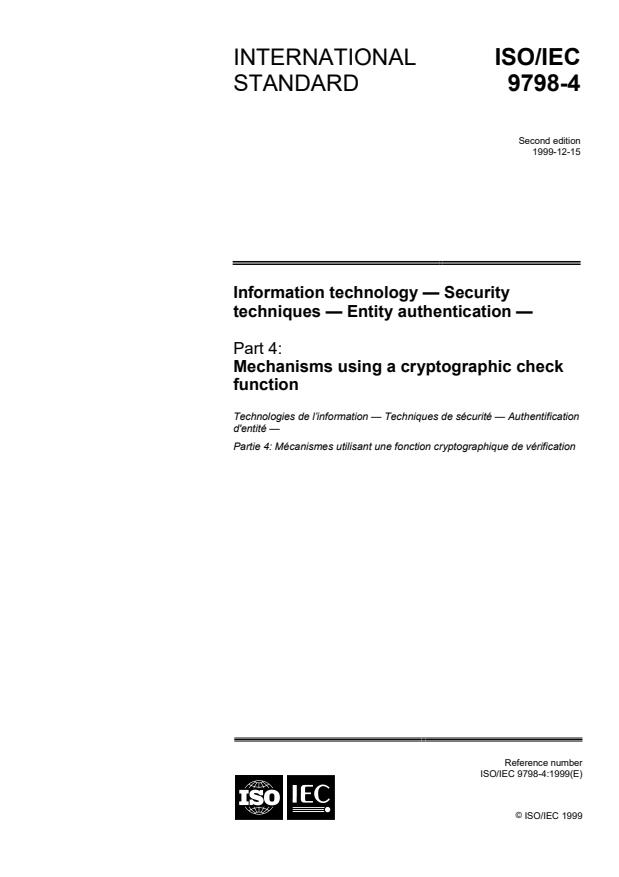
INTERNATIONAL ISO/IEC
STANDARD 9798-4
Second edition
1999-12-15
Information technology — Security
techniques — Entity authentication —
Part 4:
Mechanisms using a cryptographic check
function
Technologies de l’information — Techniques de sécurité — Authentification
d'entité —
Partie 4: Mécanismes utilisant une fonction cryptographique de vérification
Reference number
©
ISO/IEC 1999
PDF disclaimer
This PDF file may contain embedded typefaces. In accordance with Adobe’s licensing policy, this file may be printed or viewed but shall not
be edited unless the typefaces which are embedded are licensed to and installed on the computer performing the editing. In downloading this
file, parties accept therein the responsibility of not infringing Adobe’s licensing policy. The ISO Central Secretariat accepts no liability in this
area.
Adobe is a trademark of Adobe Systems Incorporated.
Details of the software products used to create this PDF file can be found in the General Info relative to the file; the PDF-creation parameters
were optimized for printing. Every care has been taken to ensure that the file is suitable for use by ISO member bodies. In the unlikely event
that a problem relating to it is found, please inform the Central Secretariat at the address given below.
© ISO/IEC 1999
All rights reserved. Unless otherwise specified, no part of this publication may be reproduced or utilized in any form or by any means, electronic
or mechanical, including photocopying and microfilm, without permission in writing from either ISO at the address below or ISO's member body
in the country of the requester.
ISO copyright office
Case postale 56 CH-1211 Geneva 20
Tel. + 41 22 749 01 11
Fax + 41 22 734 10 79
E-mail copyright@iso.ch
Web www.iso.ch
Printed in Switzerland
ii © ISO/IEC 1999 – All rights reserved
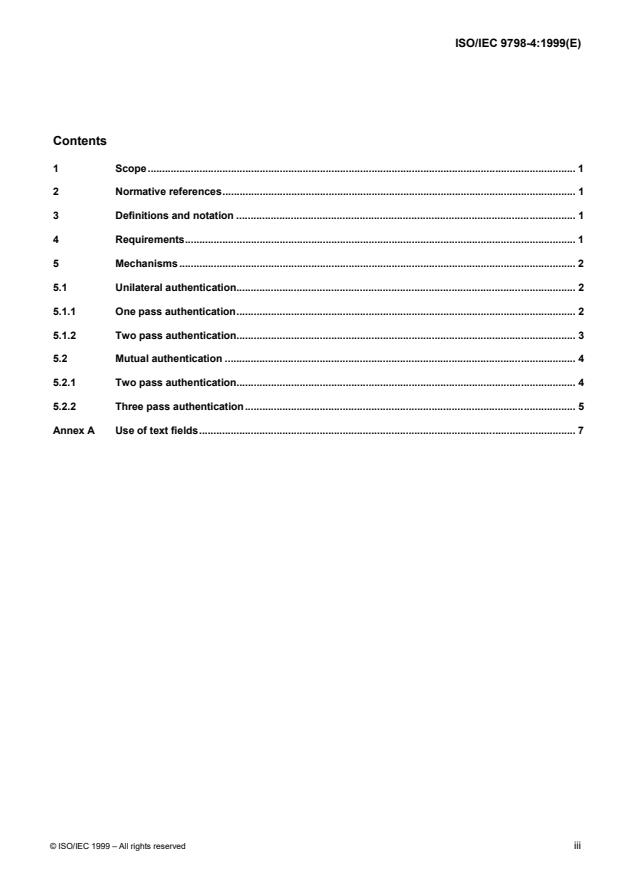
Contents
1 Scope. 1
2 Normative references. 1
3 Definitions and notation . 1
4 Requirements. 1
5 Mechanisms . 2
5.1 Unilateral authentication. 2
5.1.1 One pass authentication. 2
5.1.2 Two pass authentication. 3
5.2 Mutual authentication . 4
5.2.1 Two pass authentication. 4
5.2.2 Three pass authentication. 5
Annex A Use of text fields. 7
© ISO/IEC 1999 – All rights reserved iii
Foreword
ISO (the International Organization for Standardization) and IEC (the International Electrotechnical Commission)
form the specialized system for worldwide standardization. National bodies that are members of ISO or IEC
participate in the development of International Standards through technical committees established by the
respective organization to deal with particular fields of technical activity. ISO and IEC technical committees
collaborate in fields of mutual interest. Other international organizations, governmental and non-governmental, in
liaison with ISO and IEC, also take part in the work.
International Standards are drafted in accordance with the rules given in the ISO/IEC Directives, Part 3.
In the field of information technology, ISO and IEC have established a joint technical committee, ISO/IEC JTC 1.
Draft International Standards adopted by the joint technical committee are circulated to national bodies for voting.
Publication as an International Standard requires approval by at least 75 % of the national bodies casting a vote.
Attention is drawn to the possibility that some of the elements of this part of ISO/IEC 9798 may be the subject of
patent rights. ISO and IEC shall not be held responsible for identifying any or all such patent rights.
International Standard ISO/IEC 9798-4 was prepared by Joint Technical Committee ISO/IEC JTC 1, Information
technology, Subcommittee SC 27, IT Security techniques.
This second edition cancels and replaces the first edition (ISO/IEC 9798-4:1995), which has been technically
revised. Note, however, that implementations which comply with ISO/IEC 9798-4 (1st edition) will be compliant
with ISO/IEC 9798-4 (2nd edition).
ISO/IEC 9798 consists of the following parts, under the general title Information technology ⎯ Security techniques
⎯ Entity authentication:
⎯ Part 1: General
⎯ Part 2: Mechanisms using symmetric encipherment algorithms
⎯ Part 3: Mechanisms using digital signature techniques
⎯ Part 4: Mechanisms using a cryptographic check function
⎯ Part 5: Mechanisms using zero knowledge techniques
Further parts may follow.
Annex A of this part of ISO/IEC 9798 is for information only.
iv © ISO/IEC 1999 – All rights reserved
INTERNATIONAL STANDARD ISO/IEC 9798-4:1999(E)
Information technology — Security techniques — Entity
authentication — Part 4: Mechanisms using a cryptographic check
function
1 Scope
This part of ISO/IEC 9798 specifies entity authentication mechanisms using a cryptographic check function. Two
mechanisms are concerned with the authentication of a single entity (unilateral authentication), while the remaining
are mechanisms for mutual authentication of two entities.
The mechanisms specified in this part of ISO/IEC 9798 use time variant parameters such as time stamps,
sequence numbers, or random numbers, to prevent valid authentication information from being accepted at a later
time or more than once.
If a time stamp or sequence number is used, one pass is needed for unilateral authentication, while two passes are
needed to achieve mutual authentication. If a challenge and response method employing random numbers is
used, two passes are needed for unilateral authentication, while three passes are required to achieve mutual
authentication.
Examples of cryptographic check functions are given in ISO/IEC 9797.
2 Normativereferences
The following normative documents contain provisions which, through reference in this text, constitute provisions of
this part of ISO/IEC 9798. For dated references, subsequent amendments to, or revisions of, any of these
publications do not apply. However, parties to agreements based on this part of ISO/IEC 9798 are encouraged to
investigate the possibility of applying the most recent editions of the normative documents indicated below. For
undated references, the latest edition of the normative document referred to applies. Members of ISO and IEC
maintain registers of currently valid International Standards.
ISO/IEC 9797 (all parts), Information technology ⎯ Security techniques ⎯ Message Authentication Codes (MACs).
ISO/IEC 9798-1:1997, Information technology ⎯ Security techniques ⎯ Entity authentication — Part 1: General.
3 Definitions and notation
For the purposes of this part of ISO/IEC 9798, the definitions and notation described in ISO/IEC 9798-1 apply.
4 Requirements
In the authentication mechanisms specified in this part of ISO/IEC 9798 an entity to be authenticated corroborates
its identity by demonstrating its knowledge of a secret authentication key. This is achieved by the entity using its
secret key with a cryptographic check function applied to specific data to obtain a cryptographic check value. The
cryptographic check value can be checked by anyone sharing the entity’s secret authentication key, who can re-
calculate the cryptographic check value and compare it with the value received.
© ISO/IEC 1999 – All rights reserved 1
The authentication mechanisms have the following requirements. If any one of these is not met then the
authentication process may be compromised or it cannot be implemented.
a) A claimant authenticating itself to a verifier shares a common secret authentication key with that verifier. This
key shall be known to the involved parties prior to the commencement of any particular run of an authentication
mechanism. The method by which the key is distributed to the entities is beyond the scope of this part of
ISO/IEC 9798.
b) The secret authentication key shared by a claimant and a verifier shall be known only to those two entities and,
possibly, to other parties they both trust.
c) The strength of the mechanisms is dependent on the length and the secrecy of the key, on the nature of the
cryptographic check functions, and on the length of the check value. These parameters shall be chosen to
meet the required security level, as may be specified by the security policy.
5 Mechanisms
In these authentication mechanisms the entities A and B shall share a common secret authentication key K or two
AB
unidirectional secret keys K and K prior to the commencement of any particular run of the authentication
AB BA
mechanisms. In the latter case, the unidirectional keys K a
...
Questions, Comments and Discussion
Ask us and Technical Secretary will try to provide an answer. You can facilitate discussion about the standard in here.
Loading comments...