


ISO 18629-44:2006
(Main)Industrial automation systems and integration — Process specification language — Part 44: Definitional extension: Resource extensions
Industrial automation systems and integration — Process specification language — Part 44: Definitional extension: Resource extensions
ISO 18629-44:2006 provides definitions written in the language of ISO 18629 for concepts related to activity extensions in the process specification language. The process specification language is aimed at structuring the semantic concepts intrinsic to the capture and exchange of process information related to discrete manufacturing.
Systèmes d'automatisation industrielle et intégration — Langage de spécification de procédé — Partie 44: Extension de définition: Extensions de ressource
General Information
Relations
Standards Content (Sample)
INTERNATIONAL ISO
STANDARD 18629-44
First edition
2006-08-15
Industrial automation systems and
integration — Process specification
language —
Part 44:
Definitional extension: Resource
extensions
Systèmes d'automatisation industrielle et intégration — Langage de
spécification de procédé —
Partie 44: Extension de définition: Extensions de ressource
Reference number
©
ISO 2006
PDF disclaimer
This PDF file may contain embedded typefaces. In accordance with Adobe's licensing policy, this file may be printed or viewed but
shall not be edited unless the typefaces which are embedded are licensed to and installed on the computer performing the editing. In
downloading this file, parties accept therein the responsibility of not infringing Adobe's licensing policy. The ISO Central Secretariat
accepts no liability in this area.
Adobe is a trademark of Adobe Systems Incorporated.
Details of the software products used to create this PDF file can be found in the General Info relative to the file; the PDF-creation
parameters were optimized for printing. Every care has been taken to ensure that the file is suitable for use by ISO member bodies. In
the unlikely event that a problem relating to it is found, please inform the Central Secretariat at the address given below.
© ISO 2006
All rights reserved. Unless otherwise specified, no part of this publication may be reproduced or utilized in any form or by any means,
electronic or mechanical, including photocopying and microfilm, without permission in writing from either ISO at the address below or
ISO's member body in the country of the requester.
ISO copyright office
Case postale 56 • CH-1211 Geneva 20
Tel. + 41 22 749 01 11
Fax + 41 22 749 09 47
E-mail copyright@iso.org
Web www.iso.org
Published in Switzerland
ii © ISO 2006 – All rights reserved
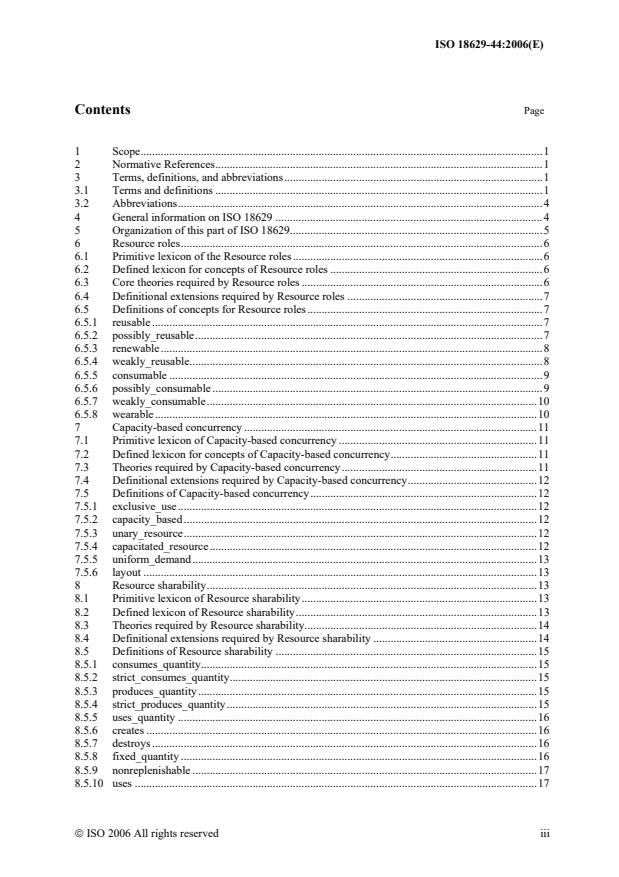
Contents Page
1 Scope.1
2 Normative References.1
3 Terms, definitions, and abbreviations.1
3.1 Terms and definitions .1
3.2 Abbreviations.4
4 General information on ISO 18629 .4
5 Organization of this part of ISO 18629.5
6 Resource roles.6
6.1 Primitive lexicon of the Resource roles .6
6.2 Defined lexicon for concepts of Resource roles .6
6.3 Core theories required by Resource roles .6
6.4 Definitional extensions required by Resource roles .7
6.5 Definitions of concepts for Resource roles.7
6.5.1 reusable .7
6.5.2 possibly_reusable.7
6.5.3 renewable .8
6.5.4 weakly_reusable.8
6.5.5 consumable .9
6.5.6 possibly_consumable .9
6.5.7 weakly_consumable.10
6.5.8 wearable.10
7 Capacity-based concurrency .11
7.1 Primitive lexicon of Capacity-based concurrency .11
7.2 Defined lexicon for concepts of Capacity-based concurrency.11
7.3 Theories required by Capacity-based concurrency.11
7.4 Definitional extensions required by Capacity-based concurrency.12
7.5 Definitions of Capacity-based concurrency.12
7.5.1 exclusive_use .12
7.5.2 capacity_based .12
7.5.3 unary_resource.12
7.5.4 capacitated_resource.12
7.5.5 uniform_demand.13
7.5.6 layout .13
8 Resource sharability.13
8.1 Primitive lexicon of Resource sharability.13
8.2 Defined lexicon of Resource sharability.13
8.3 Theories required by Resource sharability.14
8.4 Definitional extensions required by Resource sharability .14
8.5 Definitions of Resource sharability .15
8.5.1 consumes_quantity.15
8.5.2 strict_consumes_quantity.15
8.5.3 produces_quantity.15
8.5.4 strict_produces_quantity.15
8.5.5 uses_quantity .16
8.5.6 creates .16
8.5.7 destroys .16
8.5.8 fixed_quantity .16
8.5.9 nonreplenishable .17
8.5.10 uses .17
8.5.11 consumes.17
8.5.12 strict_consumes.17
8.5.13 produces.17
8.5.14 strict_produces .18
8.5.15 provides_quantity.18
8.5.16 provides.18
9 Resource set-based activities .18
9.1 Primitive lexicon of Resource set-based activities .18
9.2 Defined lexicon of Resource set-based activities .18
9.3 Theories required by Resource set-based activities .19
9.4 Definitional extensions required by Resource set-based activities.19
9.5 Definitions of Resource set-based activities .19
9.5.1 nondet_select .19
9.5.2 nondet_set_select .20
9.5.3 nondet_quantity_select .20
9.5.4 requires_set .20
9.5.5 requires_full_set.21
9.5.6 nondet_res_activity.21
10 Substitutable resources.21
10.1 Primitive lexicon of Substitutable resources.21
10.2 Defined lexicon of Substitutable resources.21
10.3 Theories required by Substitutable resources .22
10.4 Definitional extensions required by Substitutable resources .22
10.5 Definitions of Substitutable resources .22
10.5.1 superpose_select .22
10.5.2 homogeneous_set.23
10.5.3 set_contention .23
11 Homogeneous sets .23
11.1 Primitive lexicon of Homogeneous sets.23
11.2 Defined relations of Homogeneous sets.23
11.3 Core theories required by Homogeneous sets.24
11.4 Definitional extensions required by Homogeneous sets .24
11.5 Definitions of Homogeneous sets .24
11.5.1 pile .24
11.5.2 stock.24
11.5.3 pool .25
11.5.4 pool_demand.25
11.5.5 uses_pile.25
11.5.6 consumes_pile.26
11.5.7 produces_pile .26
12 Resource pools.26
12.1 Primitive lexicon of Resource pools .26
12.2 Defined lexicon of Resource pools .26
12.3 Theories required by Resource pools.26
12.4 Definitional extensions required by Resource pools.27
12.5 Definitions of Resource pools.27
12.5.1 resource_pool.27
12.5.2 conservative_pool .27
12.5.3 material_pool .28
13 Inventory resource sets .28
13.1 Primitive lexicon of Inventory resource sets.28
13.2 Defined lexicon of Inventory resource sets.28
13.3 Theories required by Inventory resource sets .28
13.4 Definitional extensions required by Inventory resource sets .29
13.5 Definitions of Inventory resource sets .29
iv
13.5.1 inventory_resource.29
13.5.2 inventory_pool .29
13.5.3 inventory_contains.30
14 Processor activities.30
14.1 Primitive lexicon of Processor activities.30
14.2 Defined lexicon of Processor activities.30
14.3 Theories required by Processor activities .31
14.4 Definitional extensions required by Processor activities .31
14.5 Definitions of Processor activities .31
14.5.1 processor_activity .31
14.5.2 processor_resource.32
14.5.3 input_material .32
14.5.4 output_material .32
15 Resource paths .32
15.1 Primitive lexicon of Resource paths .32
15.2 Defined lexicon of Resource paths .32
15.3 Theories required by Resource paths.33
15.4 Definitional extensions required by Resource paths.33
15.5 Definitions of Resource paths.33
15.5.1 next_processor_path .33
15.5.2 pro_precedes .34
15.5.3 resource_path .34
15.5.4 initial_resource_path.34
15.5.5 final_resource_path.35
Annex A (normative) ASN.1 Identifier of ISO 18629-44 .36
Annex B (informative) Example of process description using ISO 18629-44 .37
Bibliography .47
Index.……….….……………………………………………………………………………………….48
Figures
Figure B1: TOP level process for manufacturing a GT350 [4] .38
Figure B.2: PROCESS for manufacturing the 350–Engine [4] .40
Figure B.3: PROCESS for manufacturing the 350–Block [4] .43
Figure B.4: PROCESS for manufacturing the 350–Harness [4].45
v
Foreword
The International Organisation for Standardisation (ISO) is a worldwide federation of national
standards bodies (ISO member bodies). The work of preparing International Standards is normally
carried out through ISO technical committees. Each member body interested in a subject for which a
technical committee has been established has the right to be represented on that committee.
International organisations, governmental and non-governmental, in liaison with ISO, also take part in
the work. ISO collaborates closely with the International Electrotechnical Commission (IEC) on all
matters of electrotechnical standardization.
International Standards are drafted in accordance with the rules given in the ISO/IEC Directives,
Part 2.
The main task of technical committees is to prepare International Standards. Draft International
Standards adopted by technical committees are circulated to the member bodies for voting.
Publication as an International Standard requires approval by at least 75% of the member bodies
casting a vote.
Attention is drawn to the possibility that some of the elements of this document may be the subject
of patent rights. ISO shall not be held responsible for identifying any or all such patent rights.
ISO 18629-44 was prepared by Technical Committee ISO/TC 184, Industrial automation systems and
integration, Subcommittee SC4, Industrial data.
A complete list of parts of ISO 18629 is available from the Internet :
http://www.tc184-sc4.org/titles
vi
Introduction
ISO 18629 is an International Standard for the computer-interpretable exchange of information related
to manufacturing processes. Taken together, all the parts contained in the ISO 18629 Standard provide
a generic language for describing a manufacturing process throughout the entire production process
within the same industrial company or across several industrial sectors or companies, independently
from any particular representation model. The nature of this language makes it suitable for sharing
process specifications and properties related to manufacturing during all the stages of a production
process.
This part of ISO 18629 provides a description of the definitional extensions of the language
related to activity extensions defined within ISO 18629.
All parts of ISO 18629 are independent of any specific process representation model used in a given
application. Collectively, they provide a structural framework for improving the interoperability of
these applications.
vii
INTERNATIONAL STANDARD ISO 18629-44:2006(E)
Industrial automation systems and integration — Process
specification language —
Part 44:
Definitional extension: Resource extensions
1 Scope
This part of ISO 18629 provides a specification of non-primitive concepts of the language, using a set
of definitions written in the language of ISO 18629. These definitions provide an axiomatization of
the semantics for terminology in this part of ISO 18629.
The following is within the scope of this part of ISO 18629:
⎯ definitions of concepts specified in ISO 18629-11, ISO 18629-12 and ISO 18629-14 that are
related to resources and resource sets and relations between resources and activities;
⎯ definitions of concepts specified in ISO 18629-11, ISO 18629-12 and ISO 18629-14 that
characterize relations between resources and activities.
2 Normative References
The following referenced documents are indispensable for the application of this document. For dated
references, only the edition cited applies. For undated references, the latest edition of the referenced
document (including any amendments) applies.
ISO/IEC 8824-1, Information technology - Abstract Syntax Notation One (ASN.1) - Part 1:
Specification of basic notation
ISO 15531-1, Industrial automation systems and integration - Industrial manufacturing management
data - Part 1: General overview
ISO 18629-1: 2004, Industrial automation systems and integration – Process specification language
– Part 1 : Overview and basic principles
ISO 18629-11: 2005, Industrial automation systems and integration – Process specification language
– Part 11: PSL core
ISO 18629-12, Industrial automation systems and integration – Process specification language –
Part 12: Outer core
ISO 18629-14, Industrial automation systems and integration – Process specification language –
Part 14: Resource theories
3 Terms, definitions, and abbreviations
3.1 Terms and definitions
For the purpose of this document, the following terms and definitions apply:
3.1.1
axiom
well-formed formula in a formal language that provides constraints on the interpretation of symbols in
the lexicon of a language
[ISO 18629-1]
3.1.2
defined lexicon
set of symbols in the non-logical lexicon which denote defined concepts
NOTE Defined lexicon is divided into constant, function and relation symbols.
EXAMPLE terms with conservative definitions.
[ISO 18629-1]
3.1.3
definitional extension
extension of PSL-Core that introduces new linguistic items which can be completely defined in terms
of the PSL-Core
NOTE: Definitional extensions add no new expressive power to PSL-Core but are used to specify the semantics
and terminology in the domain application.
[ISO 18629-1]
3.1.4
extension
augmentation of PSL-Core containing additional axioms
NOTE 1 The PSL-Core is a relatively simple set of axioms that is adequate for expressing a wide range of
basic processes. However, more complex processes require expressive resources that exceed those of the PSL-
Core. Rather than clutter the PSL-Core itself with every conceivable concept that might prove useful in
describing one process or another, a variety of separate, modular extensions need to be developed and added to
the PSL-Core as necessary. In this way a user can tailor the language precisely to suit his or her expressive
needs.
NOTE 2 All extensions are core theories or definitional extensions.
[ISO 18629-1]
3.1.5
grammar
specification of how logical symbols and lexical terms can be combined to make well-formed
formulae
[ISO 18629-1]
3.1.6
language
combination of a lexicon and a grammar
[ISO 18629-1]
3.1.7
lexicon
set of symbols and terms
NOTE The lexicon consists of logical symbols (such as Boolean connectives and quantifiers) and non-logical
symbols. For ISO 18629, the non logical part of the lexicon consists of expressions (constants, function symbols,
and relation symbols) chosen to represent the basic concepts of the ontology.
[ISO 18629-1]
3.1.8
manufacturing
function or act of converting or transforming material from raw material or semi-finished state to a
state of further completion
[ISO 15531-1]
3.1.9
manufacturing process
structured set of activities or operations performed upon material to convert it from the raw material
or a semifinished state to a state of further completion
NOTE Manufacturing processes may be arranged in process layout, product layout, cellular layout or fixed
position layout. Manufacturing processes may be planned to support make-to-stock, make-to-order, assemble-
to-order, etc., based on strategic use and placements of inventories.
[ISO 15531-1]
3.1.10
primitive concept
lexical term that has no conservative definition
[ISO 18629-1]
3.1.11
primitive lexicon
set of symbols in the non-logical lexicon which denote primitive concepts
NOTE Primitive lexicon is divided into constant, function and relation symbols.
[ISO 18629-1]
3.1.12
process
structured set of activities involving various enterprise entities, that is designed and organised for a
given purpose
NOTE The definition provided here is very close to that given in ISO 10303-49. Nevertheless ISO 15531 needs
the notion of structured set of activities, without any predefined reference to the time or steps. In addition, from
the point of view of flow management, some empty processes may be needed for a synchronisation purpose
although they are not actually doing anything (ghost task).
[ISO 15531-1]
3.1.13
resource
any device, tool and means at the disposal of the enterprise to produce goods or services
NOTE 1 Adapted from ISO 15531-1. The concept of resource as defined in ISO 15531-1 includes an
assumption seeing that resources except raw material, products and components that are considered from a
system theory point of view as parts of the environment of the system and then do not belong to the system
itself. That is not the case here. Furthermore ISO 15531-1 definition encompasses ISO 10303-49 definition but
is included in the definition that applies for this part of ISO 18629 (In addition to ISO 15531 resources of this
part of ISO 18629 resources include raw materials and consumables as well as in ISO 18629-14).
NOTE 2 Resources as they are defined here include human resources considered as specific means with a
given capability and a given capacity. Those means are considered as being able to be involved in the
manufacturing process through assigned tasks. That does not include any modelling of an individual or common
behaviour of human resource excepted in their capability to perform a given task in the manufacturing process
(e.g.: transformation of raw material or component, provision of logistic services). That means that human
resources are only considered, as the other, from the point of view of their functions, their capabilities and their
status (e.g.: idle, busy). That excludes any modelling or representation of any aspect of individual or common
«social» behaviour.
[ISO 15531-1]
3.1.14
theory
set of axioms and definitions that pertain to a given concept or set of concepts
NOTE this definition reflects the approach of artificial intelligence in which a theory is the set of assumptions
on which the meaning of the related concept is based.
[ISO 18629-1]
3.2 Abbreviations
⎯ KIF Knowledge Interchange Format.
4 General information on ISO 18629
Part 41 to 49 of ISO 18629 specify definitional extensions needed to give precise definitions and the
axiomatization of non-primitive concepts of ISO 18629. Definitional extensions are extensions of ISO
18629-11 and ISO 18629-12 that introduce new items for the lexicon. The items found in definitional
extensions can be completely defined using theories of ISO 18629-11 and ISO18629-12. The
definitional extensions provide precise semantic definitions for elements used in the specification of
individual applications or types of applications for the purpose of interoperability. Definitional
extensions exist in the following categories:
⎯ Activity Extensions;
⎯ Temporal and State Extensions;
⎯ Activity Ordering and Duration Extensions;
⎯ Resource Roles;
⎯ Resource Sets;
Certain parts are under development
⎯ Processor Activity Extensions.
Individual users or groups of users of ISO 18629 may need to extend ISO 18629 for specifying
concepts that are currently absent in parts 41 to 49 of ISO 18629. They shall use the elements
presented in ISO 18629 for doing so. User-defined extensions and their definitions constitute
definitional extensions but shall not become part of parts 41 to 49 of ISO 18629.
Note: User-defined extensions must conform to ISO 18629 as defined in ISO 18629-1:2004, 5.1 and 5.2.
Parts 41 to 49 of ISO 18629 provide:
⎯ the semantic definitions, using concepts in ISO 18629-11and ISO 18629-12, of elements that are
specific to the six concepts outlined above;
⎯ a set of axioms for constraining the use of elements in definitional extensions.
They do not address:
⎯ definitions and axioms for concepts that are part of ISO 18629-11 and ISO 18629-12;
⎯ elements that are not defined using the elements in ISO 18629-11 and ISO 18629-12;
⎯ user-defined extensions.
5 Organization of this part of ISO 18629
The definitional extensions that constitute this part of ISO 18629 are:
⎯ Resource Roles;
⎯ Capacity-based Concurrency;
⎯ Resource Sharability;
⎯ Resource Set-based Activities;
⎯ Substitutable Resources;
⎯ Homogeneous Sets;
⎯ Inventory Resource Sets;
⎯ Resource Pools;
⎯ Processor Activities;
⎯ Resource Paths.
All theories in this part of ISO 18629 are extensions of ISO 18629-14, itself an extension of ISO
18629-12 and ISO 18629-11.
6 Resource roles
This clause characterizes all definitions pertaining to Resource Roles.
In the context of ISO 18629 an object is a resource only with respect to some activity that requires the
resource. Therefore no axiomatization of any other properties of resources, such as the issue of
discrete vs continuous resources, is provided . Resource roles are one way of formalizing the way in
which an activity requires the resource. The intuition behind the axiomatization of resource roles is
the classification of interactions among activities with respect to the resources that they share. In
particular, the set of resource roles defined in this clause are a classification of interfering actions, i.e.,
the effects of one action falsify the preconditions of another action.
NOTE : In the context of the system theory that supports standards such as ISO 15531 the resources are the
means at the disposal of the system to transform input into output. Therefore they can not be considered as input
or output of the system. They appear as a subset of the resources as they are defined here. Accordingly, in
standards such as ISO 15531 they are not associated a priori to a given activity. A resource may be idle,
associated to an activity A in the process 1 or to activity B in process 2. That is obvious for human resources,
but it is also true for a lathe (for example) that may be associated to the activity “manufacture a cylinder” in
process 1 or to the activity “drill a hole” in process 2. Anyway all definitions of this part of ISO 18629 apply to
this type of resources also.
6.1 Primitive lexicon of the Resource roles
No primitive relations are introduced by the lexicon of Resource roles.
6.2 Defined lexicon for concepts of Resource roles
The following relations are defined in this clause:
⎯ (reusable ?r ?a);
⎯ (possibly_reusable ?r ?a);
⎯ (renewable ?r ?a);
⎯ (weakly_reusable ?r ?a);
⎯ (consumable ?a);
⎯ (possibly_consumable ?r ?a);
⎯ (weakly_consumable ?r ?a);
⎯ (wearable ?r ?a).
Each concept is described by informal semantics and a KIF axiom.
6.3 Core theories required by Resource roles
This extension requires
⎯ additive.th;
⎯ requires.th;
⎯ act_occ.th;
⎯ complex.th;
⎯ subactivity.th;
⎯ occtree.th;
⎯ disc_state.th;
⎯ psl_core.th.
6.4 Definitional extensions required by Resource roles
No definitional extensions are required by the Resource roles.
6.5 Definitions of concepts for Resource roles
The following concepts are defined for Resource roles.
6.5.1 reusable
A resource ?r is reusable by an activity ?a if any other activity that also requires ?r is still possible to
perform after ?a completes its occurrence, in every possible future.
EXAMPLE: A reusable resource is a machine that does not require setup between activities. As soon as one
activity occurs, it is always possible to perform the next activity.
(forall (r ?a1 ?a2 ?a ?occ1 ?occ2) (iff (reusable ?r ?a1)
(implies (and (common ?a1 ?a2 ?r)
(subactivity ?a1 ?a)
(subactivity ?a2 ?a)
(occurrence_of ?occ2 ?a1))
(forall (?b)
(implies (forall (?occ3)
(implies (and (subactivity_occurrence ?occ3 ?b)
(occurrence_of ?b ?a)
(precedes ?occ2 ?occ3))
(poss ?a2 ?occ3)))))))
6.5.2 possibly_reusable
A resource ?r is possibly reusable by an activity ?a iff for any other activity that also requires ?r is still
possible to perform after ?a completes its occurrence, in some possible future situation.
EXAMPLE: A possibly reusable is a machine that requires some setup between different activities. After the
first activity occurs, it is possible for the other activity, but only if the setup activity occurs first.
(forall (?r ?a1) (iff (possibly_reusable ?r ?a1)
(forall (?a2 ?occ1 ?occ2)
(implies (and (common ?a1 ?a2 ?r)
(subactivity ?a1 ?a)
(subactivity ?a2 ?a)
(occurrence_of ?occ2 ?a1))
(exists (?b)
(and (exists (?occ3)
(and (subactivity_occurrence ?occ3 ?b)
(occurrence_of ?b ?a)
(precedes ?occ2 ?occ3))
(poss ?a2 ?occ3)))))))
6.5.3 renewable
A resource ?r is renewable with respect to an activity ?a iff for any other activity that also requires ?r
is still possible to perform after ?a completes its occurrence, in every possible future situation unless it
is prevented.
EXAMPLE: A renewable resource is a solar-charged battery. Once it is depleted, there will always exist a future
situation where the sun recharges the battery so that it can be used again.
(forall (?r ?a1) (iff (renewable ?r ?a1)
(forall (?a2 ?occ1 ?occ2)
(implies (and (common ?a1 ?a2 ?r)
(subactivity ?a1 ?a)
(subactivity ?a2 ?a)
(occurrence_of ?occ2 ?a1))
(forall (?b)
(implies (exists (?occ3)
(and (subactivity_occurrence ?occ3 ?b)
(occurrence_of ?b ?a)
(precedes ?occ2 ?occ3))
(poss ?a2 ?occ3))))))
6.5.4 weakly_reusable
A resource ?r is weakly reusable by an activity ?a iff for any other activity that also requires ?r is still
possible to perform after ?a completes its occurrence, in every possible future situation unless it is
prevented.
EXAMPLE: A weakly reusable resource is one where the renewing of the resource can be prevented. For
example, a paintbrush is reusable only if it is put into a solvent after use; otherwise, it is not reusable.
(forall (?r ?a1) (iff (weakly_reusable ?r ?a1)
(forall (?a2 ?occ1 ?occ2)
(implies (and (common ?a1 ?a2 ?r)
(subactivity ?a1 ?a)
(subactivity ?a2 ?a)
(occurrence_of ?occ2 ?a1))
(exists (?b)
(and (forall (?occ3)
(implies (and (subactivity_occurrence ?occ3 ?b)
(occurrence_of ?b ?a)
(precedes ?occ2 ?occ3))
(poss ?a2 ?occ3))))))
6.5.5 consumable
A resource ?r is consumable by an activity ?a if any other activity that also requires ?r is not possible
to perform after ?a completes its occurrence.
EXAMPLE: A consumable resource is wood in a fire, or raw materials in a manufacturing production process.
(forall (?r ?a1) (iff (consumable ?r ?a1)
(forall (?a2 ?occ1 ?occ2)
(implies (and (common ?a1 ?a2 ?r)
(subactivity ?a1 ?a)
(subactivity ?a2 ?a)
(occurrence_of ?occ2 ?a1))
(forall (?b)
(implies (forall (?occ3)
(implies (and (subactivity_occurrence ?occ3 ?b)
(occurrence_of ?b ?a)
(precedes ?occ2 ?occ3))
(not (poss ?a2 ?occ3))))))))
6.5.6 possibly_consumable
A resource ?r is possibly consumable with respect to an activity ?a1 iff after the occurrence of ?a1,
there exists a future situation in which any activity that requires ?r is no longer possible.
(forall (?r ?a1) (iff (possibly_consumable ?r ?a1)
(forall (?a2 ?occ1 ?occ2)
(implies (and (common ?a1 ?a2 ?r)
(subactivity ?a1 ?a)
(subactivity ?a2 ?a)
(occurrence_of ?occ2 ?a1))
(exists (?b)
(and (exists (?occ3)
(and (subactivity_occurrence ?occ3 ?b)
(occurrence_of ?b ?a)
(precedes ?occ2 ?occ3))
(not (poss ?a2 ?occ3)))))))
6.5.7 weakly_consumable
A resource ?r is weakly consumable with respect to an activity ?a1 iff after the occurrence of ?a1,
there always exists a possible future along which any other activity that requires ?r will never be
possible.
EXAMPLE: A weakly consumable resource is a paintbrush; if we do put it into solvent after using it, then any
...
Questions, Comments and Discussion
Ask us and Technical Secretary will try to provide an answer. You can facilitate discussion about the standard in here.