


ISO/FDIS 21809-3
(Main)Oil and gas industries including lower carbon energy — External coatings for buried or submerged pipelines used in pipeline transportation systems — Part 3: Field joint coatings
General Information
- Abstract
ISO 21809-3:2016 specifies requirements for field joint coating of seamless or welded steel pipes for buried and submerged sections of pipeline transportation systems used in the petroleum, petrochemical and natural gas industries as defined in ISO 13623. This part of ISO 21809 specifies the qualification, application and testing of the corrosion protection coatings applied to steel surfaces left bare after the joining of pipes and fittings (components) by welding. ISO 21809-3:2016 defines and codifies in Table 1 the different types of field joint coatings for pipelines. ISO 21809-3:2016 does not address requirements for additional mechanical protection, for thermal insulation or for joint infills of concrete weight-coated pipes. NOTE Field joints of pipes and fittings coated in accordance with this part of ISO 21809 are considered suitable for further protection by means of cathodic protection.
- Status
- Not Published
- Technical Committee
- ISO/TC 67/SC 2 - Pipeline transportation systems
- Drafting Committee
- ISO/TC 67/SC 2/WG 14 - External pipeline protective coatings
- Current Stage
- 5000 - FDIS registered for formal approval
- Start Date
- 22-Jun-2026
- Completion Date
- 17-Feb-2026
Buy Documents

ISO/FDIS 21809-3 - Oil and gas industries including lower carbon energy — External coatings for buried or submerged pipelines used in pipeline transportation systems — Part 3: Field joint coatings
REDLINE ISO/FDIS 21809-3 - Oil and gas industries including lower carbon energy — External coatings for buried or submerged pipelines used in pipeline transportation systems — Part 3: Field joint coatings
Overview
ISO/FDIS 21809-3:2026 is an international standard developed by ISO that specifies requirements for field joint coatings of seamless or welded steel pipes used in buried or submerged pipeline transportation systems in the oil, gas, petrochemical, and natural gas industries. This standard addresses the crucial aspect of corrosion protection for pipeline field joints, which are vulnerable areas that arise when pipes or fittings are welded together during construction or maintenance operations. The standard is essential for ensuring the integrity, safety, and longevity of pipeline systems, supporting both traditional oil and gas operations and the transition towards lower carbon energy systems.
Key Topics
Scope and Purpose
ISO/FDIS 21809-3 applies specifically to the external field joint coating of welded and seamless steel pipes in buried or submerged service. It outlines:- Qualification and application methods for coatings
- Requirements for testing corrosion protection performance
- Suitability for further protection via cathodic protection
Field Joint Coating Types
The standard categorizes field joint coatings, including but not limited to:- Hot-applied bituminous tapes and wax coatings
- Cold-applied polymeric tapes
- Heat-shrinkable materials
- Fusion-bonded epoxy (FBE) powder coatings
- Elastomeric and liquid-applied coatings
- Thermal spray aluminium (TSA) coatings Each type has defined requirements for identification, application, and testing.
Qualification and Quality Assurance
ISO 21809-3 introduces a qualification scheme for both coating materials and application personnel. This includes:- Procedure Qualification Trials (PQT)
- Pre-Production Trials (PPT)
- Ongoing inspection and testing of coated field joints
Surface Preparation and Application
Detailed requirements are provided for:- Surface cleaning and pretreatment of the steel substrate
- Preparation of adjacent plant coatings
- Methods of coating application to ensure full and effective protection
Testing and Inspection
Comprehensive testing protocols are specified, such as:- Adhesion tests
- Porosity detection (holiday tests)
- Cathodic disbondment
- Impact, flexibility, and ageing resistance
- Electrical insulation resistance
Applications
Oil and Gas Pipeline Construction
Essential for pipeline contractors and operators ensuring robust pipeline integrity and corrosion resistance at weld joints during construction or repairs.Lower Carbon Energy Infrastructure
As the industry shifts towards sustainable and renewable sources integrated into pipeline networks, the standard supports best practices for reliable, long-life infrastructure.Pipeline Maintenance
Used by maintenance teams for assessing and restoring the protection of existing field joints, particularly in aging pipeline systems.Compliance and Regulatory Alignment
By following ISO/FDIS 21809-3, organizations align with international best practices and regulatory expectations, reducing risk and enhancing safety.
Related Standards
- ISO 13623: Pipeline transportation systems for petroleum and natural gas industries
- ISO 3183: Steel pipe for pipeline transportation systems
- ISO 8501, ISO 8502, and ISO 8504 series: Preparation of steel substrates before coating
- ISO 10474 / EN 10204: Inspection documents for steel products
- ISO/IEC 17025: General competence requirements for testing and calibration laboratories
Practical Value
Implementing ISO/FDIS 21809-3 ensures that pipeline field joints, the most vulnerable points in any transportation system, achieve consistent and effective corrosion protection. This safeguards environmental compliance, minimizes maintenance costs, and prolongs infrastructure lifespan. It also assists in mitigating risks associated with product loss or environmental incidents, which are critical concerns in the oil and gas domain and emerging lower carbon energy pipelines.
For further information and a full list of related standards, visit ISO’s official website.
Relations
- Effective Date
- 12-Feb-2026
- Effective Date
- 26-Apr-2025
- Effective Date
- 26-Apr-2025
Buy Documents
ISO/FDIS 21809-3 - Oil and gas industries including lower carbon energy — External coatings for buried or submerged pipelines used in pipeline transportation systems — Part 3: Field joint coatings
REDLINE ISO/FDIS 21809-3 - Oil and gas industries including lower carbon energy — External coatings for buried or submerged pipelines used in pipeline transportation systems — Part 3: Field joint coatings
Get Certified
Connect with accredited certification bodies for this standard

Element Materials Technology
Materials testing and product certification.

ABS Group Brazil
ABS Group certification services in Brazil.

ABS Quality Evaluations Inc.
American Bureau of Shipping quality certification.
Sponsored listings
Frequently Asked Questions
ISO/FDIS 21809-3 is a draft published by the International Organization for Standardization (ISO). Its full title is "Oil and gas industries including lower carbon energy — External coatings for buried or submerged pipelines used in pipeline transportation systems — Part 3: Field joint coatings". This standard covers: ISO 21809-3:2016 specifies requirements for field joint coating of seamless or welded steel pipes for buried and submerged sections of pipeline transportation systems used in the petroleum, petrochemical and natural gas industries as defined in ISO 13623. This part of ISO 21809 specifies the qualification, application and testing of the corrosion protection coatings applied to steel surfaces left bare after the joining of pipes and fittings (components) by welding. ISO 21809-3:2016 defines and codifies in Table 1 the different types of field joint coatings for pipelines. ISO 21809-3:2016 does not address requirements for additional mechanical protection, for thermal insulation or for joint infills of concrete weight-coated pipes. NOTE Field joints of pipes and fittings coated in accordance with this part of ISO 21809 are considered suitable for further protection by means of cathodic protection.
ISO 21809-3:2016 specifies requirements for field joint coating of seamless or welded steel pipes for buried and submerged sections of pipeline transportation systems used in the petroleum, petrochemical and natural gas industries as defined in ISO 13623. This part of ISO 21809 specifies the qualification, application and testing of the corrosion protection coatings applied to steel surfaces left bare after the joining of pipes and fittings (components) by welding. ISO 21809-3:2016 defines and codifies in Table 1 the different types of field joint coatings for pipelines. ISO 21809-3:2016 does not address requirements for additional mechanical protection, for thermal insulation or for joint infills of concrete weight-coated pipes. NOTE Field joints of pipes and fittings coated in accordance with this part of ISO 21809 are considered suitable for further protection by means of cathodic protection.
ISO/FDIS 21809-3 is classified under the following ICS (International Classification for Standards) categories: 75.200 - Petroleum products and natural gas handling equipment. The ICS classification helps identify the subject area and facilitates finding related standards.
ISO/FDIS 21809-3 has the following relationships with other standards: It is inter standard links to prEN ISO 21809-3, ISO 21809-3:2016/Amd 1:2020, ISO 21809-3:2016. Understanding these relationships helps ensure you are using the most current and applicable version of the standard.
ISO/FDIS 21809-3 is available in PDF format for immediate download after purchase. The document can be added to your cart and obtained through the secure checkout process. Digital delivery ensures instant access to the complete standard document.
Standards Content (Sample)
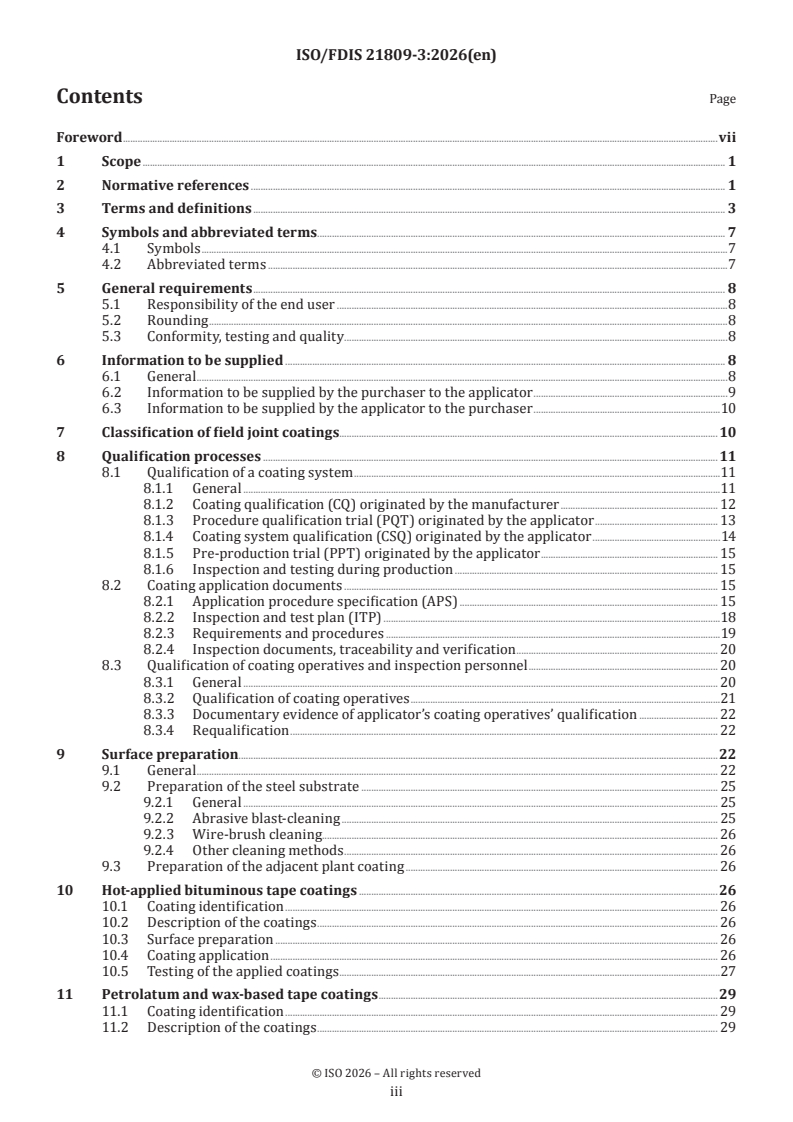
FINAL DRAFT
International
Standard
ISO/TC 67/SC 2
Oil and gas industries including
Secretariat: UNI
lower carbon energy — External
Voting begins on:
coatings for buried or submerged
2026-09-21
pipelines used in pipeline
Voting terminates on:
transportation systems —
2026-11-16
Part 3:
Field joint coatings
Industries du pétrole et du gaz, y compris les énergies à faible
teneur en carbone — Revêtements externes des conduites
enterrées ou immergées utilisées dans les systèmes de transport
par conduites —
Partie 3: Revêtements des joints réalisés sur site
RECIPIENTS OF THIS DRAFT ARE INVITED TO SUBMIT,
WITH THEIR COMMENTS, NOTIFICATION OF ANY
RELEVANT PATENT RIGHTS OF WHICH THEY ARE AWARE
AND TO PROVIDE SUPPOR TING DOCUMENTATION.
IN ADDITION TO THEIR EVALUATION AS
BEING ACCEPTABLE FOR INDUSTRIAL, TECHNO-
ISO/CEN PARALLEL PROCESSING LOGICAL, COMMERCIAL AND USER PURPOSES, DRAFT
INTERNATIONAL STANDARDS MAY ON OCCASION HAVE
TO BE CONSIDERED IN THE LIGHT OF THEIR POTENTIAL
TO BECOME STAN DARDS TO WHICH REFERENCE MAY BE
MADE IN NATIONAL REGULATIONS.
Reference number
FINAL DRAFT
International
Standard
ISO/TC 67/SC 2
Oil and gas industries including
Secretariat: UNI
lower carbon energy — External
Voting begins on:
coatings for buried or submerged
pipelines used in pipeline
Voting terminates on:
transportation systems —
Part 3:
Field joint coatings
Industries du pétrole et du gaz, y compris les énergies à faible
teneur en carbone — Revêtements externes des conduites
enterrées ou immergées utilisées dans les systèmes de transport
par conduites —
Partie 3: Revêtements des joints réalisés sur site
RECIPIENTS OF THIS DRAFT ARE INVITED TO SUBMIT,
WITH THEIR COMMENTS, NOTIFICATION OF ANY
RELEVANT PATENT RIGHTS OF WHICH THEY ARE AWARE
AND TO PROVIDE SUPPOR TING DOCUMENTATION.
© ISO 2026
IN ADDITION TO THEIR EVALUATION AS
All rights reserved. Unless otherwise specified, or required in the context of its implementation, no part of this publication may
BEING ACCEPTABLE FOR INDUSTRIAL, TECHNO-
ISO/CEN PARALLEL PROCESSING
LOGICAL, COMMERCIAL AND USER PURPOSES, DRAFT
be reproduced or utilized otherwise in any form or by any means, electronic or mechanical, including photocopying, or posting on
INTERNATIONAL STANDARDS MAY ON OCCASION HAVE
the internet or an intranet, without prior written permission. Permission can be requested from either ISO at the address below
TO BE CONSIDERED IN THE LIGHT OF THEIR POTENTIAL
or ISO’s member body in the country of the requester.
TO BECOME STAN DARDS TO WHICH REFERENCE MAY BE
MADE IN NATIONAL REGULATIONS.
ISO copyright office
CP 401 • Ch. de Blandonnet 8
CH-1214 Vernier, Geneva
Phone: +41 22 749 01 11
Email: copyright@iso.org
Website: www.iso.org
Published in Switzerland Reference number
ii
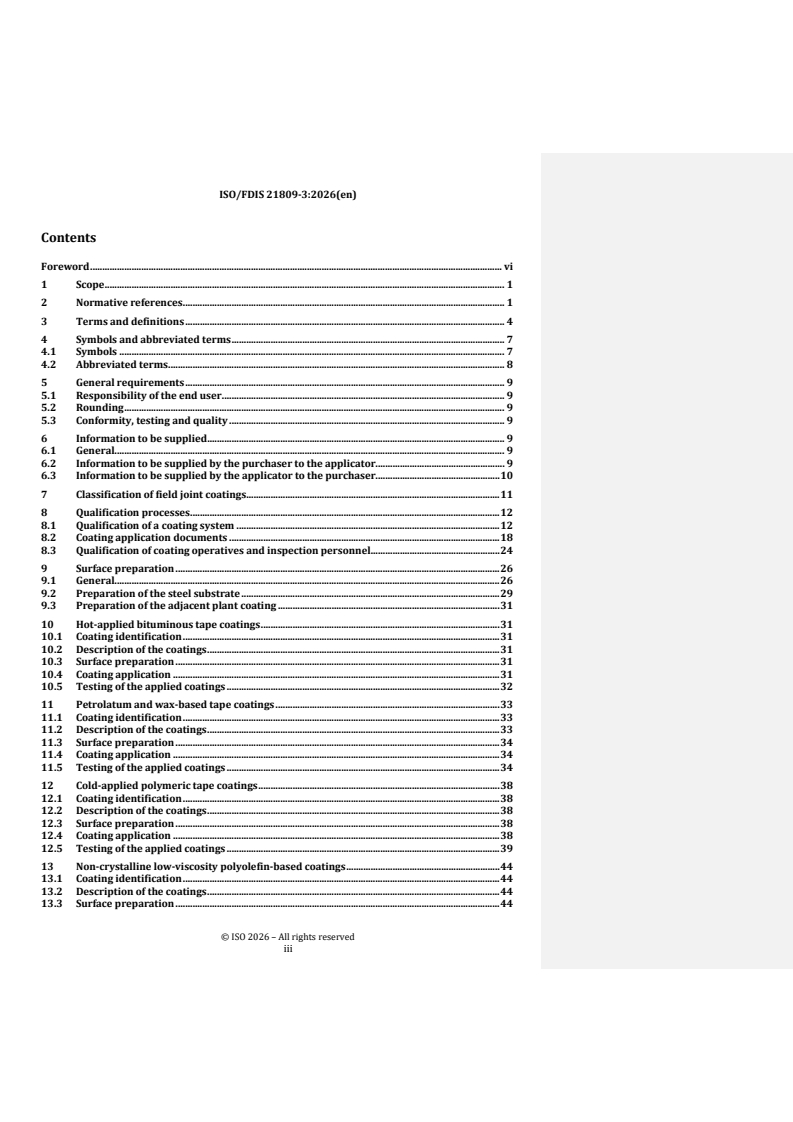
Contents Page
Foreword .vii
1 Scope . 1
2 Normative references . 1
3 Terms and definitions . 3
4 Symbols and abbreviated terms. 7
4.1 Symbols .7
4.2 Abbreviated terms .7
5 General requirements . 8
5.1 Responsibility of the end user .8
5.2 Rounding .8
5.3 Conformity, testing and quality . . .8
6 Information to be supplied . 8
6.1 General .8
6.2 Information to be supplied by the purchaser to the applicator .9
6.3 Information to be supplied by the applicator to the purchaser .10
7 Classification of field joint coatings. 10
8 Qualification processes .11
8.1 Qualification of a coating system .11
8.1.1 General .11
8.1.2 Coating qualification (CQ) originated by the manufacturer . 12
8.1.3 Procedure qualification trial (PQT) originated by the applicator . 13
8.1.4 Coating system qualification (CSQ) originated by the applicator .14
8.1.5 Pre-production trial (PPT) originated by the applicator . 15
8.1.6 Inspection and testing during production . 15
8.2 Coating application documents . 15
8.2.1 Application procedure specification (APS) . 15
8.2.2 Inspection and test plan (ITP) .18
8.2.3 Requirements and procedures .19
8.2.4 Inspection documents, traceability and verification . 20
8.3 Qualification of coating operatives and inspection personnel . 20
8.3.1 General . 20
8.3.2 Qualification of coating operatives .21
8.3.3 Documentary evidence of applicator’s coating operatives’ qualification . 22
8.3.4 Requalification . 22
9 Surface preparation.22
9.1 General . 22
9.2 Preparation of the steel substrate . 25
9.2.1 General . 25
9.2.2 Abrasive blast-cleaning . 25
9.2.3 Wire-brush cleaning. 26
9.2.4 Other cleaning methods . 26
9.3 Preparation of the adjacent plant coating . 26
10 Hot-applied bituminous tape coatings .26
10.1 Coating identification . 26
10.2 Description of the coatings . 26
10.3 Surface preparation . 26
10.4 Coating application . 26
10.5 Testing of the applied coatings .27
11 Petrolatum and wax-based tape coatings .29
11.1 Coating identification . 29
11.2 Description of the coatings . 29
iii
11.2.1 Petrolatum tapes (Type 11A) . 29
11.2.2 Wax-based tapes (Type 11B) . 29
11.3 Surface preparation . 30
11.4 Coating application . 30
11.5 Testing of the applied coatings . . 30
12 Cold-applied polymeric tape coatings .33
12.1 Coating identification . 33
12.2 Description of the coatings . 33
12.2.1 Cold-applied tape coatings with a polymeric continuous backing (Type 12A) . 33
12.2.2 Cold-applied tape coatings with a polymeric mesh backing (Type 12B) . 33
12.3 Surface preparation . 33
12.4 Coating application . 33
12.5 Testing of the applied coatings . 34
13 Non-crystalline low-viscosity polyolefin-based coatings .38
13.1 Coating identification . 38
13.2 Description of the coatings . 38
13.3 Surface preparation . 38
13.4 Coating application . 38
13.5 Testing of the applied coatings . . 39
13.5.1 General . 39
13.5.2 Pre-application check of compound containing reinforcement . 39
14 Coatings based on heat-shrinkable materials .43
14.1 Coating identification .43
14.2 Description of the coatings .43
14.2.1 General .43
14.2.2 Type 14A .43
14.2.3 Types 14B, 14C and 14D .43
14.3 Surface preparation . 44
14.4 Coating application . 44
14.5 Testing of the applied coatings . 44
15 Hot-applied microcrystalline wax coatings . 51
15.1 Coating identification .51
15.2 Description of the coatings .51
15.3 Surface preparation .51
15.4 Coating application .51
15.5 Testing of the applied coatings .51
16 Elastomeric coatings .53
16.1 Coating identification . 53
16.2 Description of the coatings . 53
16.3 Surface preparation . 53
16.4 Coating application . 53
16.4.1 General . 53
16.4.2 In situ vulcanization method . 53
16.5 Testing of the applied coatings . 54
16.5.1 General . 54
16.5.2 Rheometer curve — Oscillating disc .57
16.5.3 Electrical volume resistivity.57
17 Fusion-bonded epoxy (FBE) powder coatings .57
17.1 Coating identification .57
17.2 Description of the coatings .57
17.3 Surface preparation .57
17.4 Coating application .57
17.4.1 General .57
17.4.2 Transport and storage of epoxy powder . 58
17.4.3 Heating . 58
17.4.4 Application of epoxy powder . 58
iv
17.5 Testing of the applied coatings . 58
17.5.1 General . 58
17.5.2 Thickness . 58
18 Liquid-applied coatings . 61
18.1 Coating identification .61
18.2 Description of the coatings .61
18.2.1 Liquid epoxy — 18A .61
18.2.2 Liquid polyurethane — 18B .61
18.2.3 Fibre reinforced epoxy — 18C .61
18.2.4 Fibre reinforced vinylester — 18D .61
18.2.5 Fibre reinforced polyurethane — 18E .61
18.2.6 Polyolefin enclosure with polyurethane filling — 18F .61
18.3 Surface preparation .61
18.4 Coating application .61
18.4.1 General .61
18.4.2 Heating .62
18.4.3 Liquid coating application . .62
18.4.4 General guideline .62
18.5 Testing of the applied coatings . .62
19 Hot-applied polyolefin-based and polyurethane coatings .66
19.1 Coating identification . 66
19.2 Description of the coatings . 66
19.2.1 Coatings based on flame-sprayed polypropylene powder applied over an epoxy
layer— Type 19A . 66
19.2.2 Coatings based on polypropylene tapes/sheets / extruded hot-applied over an
epoxy layer— Type 19B. 66
19.2.3 Coatings based on injection-moulded polypropylene over an epoxy layer—
Type 19C . 66
19.2.4 Coatings based on flame-sprayed polyethylene powder applied over an epoxy
layer — Type 19D . 66
19.2.5 Coatings based on polyethylene tapes/sheets / extruded hot-applied over an
epoxy layer — Type 19E . . . .67
19.2.6 Coatings based on injection-moulded polyethylene over an epoxy layer —
Type 19F .67
19.2.7 Coatings based on injection-moulded polyurethane over an epoxy or a
polyurethane primer layer — Type 19G.67
19.3 Surface preparation .67
19.4 Coating application .67
19.4.1 General .67
19.4.2 Heating . 68
19.4.3 Application of the primer . 68
19.4.4 Application of the chemically modified PP or PE . . 68
19.4.5 Application of the top coat . 68
19.5 Testing of the applied coatings . 69
20 Thermal spray aluminium (TSA) coatings . 74
20.1 Coating identification .74
20.2 Description of the coatings .74
20.3 Surface preparation .74
20.4 Coating application .74
20.4.1 General .74
20.4.2 Aluminium .74
20.4.3 Sealer .74
20.5 Testing of the applied coatings . 75
Annex A (normative) Reporting of results .77
Annex B (normative) Inspection of thickness .81
Annex C (normative) Holiday detection test .83
v
Annex D (normative) Impact test .85
Annex E (normative) Indentation test .93
Annex F (normative) Specific electrical insulation resistance test .96
Annex G (normative) Cathodic disbondment test .107
Annex H (normative) Adhesion test (peel, lift and pull off) .120
Annex I (normative) Hot water immersion test . .131
Annex J (normative) Lap shear test . 134
Annex K (normative) Drip resistance test .137
Annex L (normative) Peel strength between layers .138
Annex M (normative) Thermal ageing resistance .141
Annex N (normative) Coating porosity test . .146
Annex O (normative) Bursting strength of reinforced backing .148
Annex P (normative) Thermal analysis of epoxy powder and cured coating film (FBE) .149
Annex Q (normative) Adhesion test (X cut) — Resistance to removal .156
Annex R (normative) Coating flexibility test . 158
Bibliography .165
vi
Foreword
ISO (the International Organization for Standardization) is a worldwide federation of national standards
bodies (ISO member bodies). The work of preparing International Standards is normally carried out through
ISO technical committees. Each member body interested in a subject for which a technical committee
has been established has the right to be represented on that committee. International organizations,
governmental and non-governmental, in liaison with ISO, also take part in the work. ISO collaborates closely
with the International Electrotechnical Commission (IEC) on all matters of electrotechnical standardization.
The procedures used to develop this document and those intended for its further maintenance are described
in the ISO/IEC Directives, Part 1. In particular, the different approval criteria needed for the different types
of ISO document should be noted. This document was drafted in accordance with the editorial rules of the
ISO/IEC Directives, Part 2 (see www.iso.org/directives).
ISO draws attention to the possibility that the implementation of this document may involve the use of (a)
patent(s). ISO takes no position concerning the evidence, validity or applicability of any claimed patent
rights in respect thereof. As of the date of publication of this document, ISO had not received notice of (a)
patent(s) which may be required to implement this document. However, implementers are cautioned that
this may not represent the latest information, which may be obtained from the patent database available at
www.iso.org/patents. ISO shall not be held responsible for identifying any or all such patent rights.
Any trade name used in this document is information given for the convenience of users and does not
constitute an endorsement.
For an explanation of the voluntary nature of standards, the meaning of ISO specific terms and expressions
related to conformity assessment, as well as information about ISO's adherence to the World Trade
Organization (WTO) principles in the Technical Barriers to Trade (TBT), see www.iso.org/iso/foreword.html.
This document was prepared by Technical Committee ISO/TC 67, Oil and gas industries including lower
carbon energy, Subcommittee SC 2, Pipeline transportation systems, in collaboration with the European
Committee for Standardization (CEN) Technical Committee CEN/TC 12, Oil and gas industries including lower
carbon energy, in accordance with the Agreement on technical cooperation between ISO and CEN (Vienna
Agreement).
This third edition cancels and replaces the second edition (ISO 21809-3:2016), which has been technically
revised. It also incorporates the Amendment ISO 21809-3:2016/Amd 1:2020.
The main changes are as follows:
— inclusion of a qualification scheme;
— inclusion of new FJC types;
— changes in various FJC clauses;
— inclusion of new annexes;
— changes in various annexes.
A list of all parts in the ISO 21809 series can be found on the ISO website.
Any feedback or questions on this document should be directed to the user’s national standards body. A
complete listing of these bodies can be found at www.iso.org/members.html.
vii
FINAL DRAFT International Standard ISO/FDIS 21809-3:2026(en)
Oil and gas industries including lower carbon energy —
External coatings for buried or submerged pipelines used in
pipeline transportation systems —
Part 3:
Field joint coatings
1 Scope
This document specifies requirements for field joint coatings of seamless or welded steel pipes for buried
and submerged sections of pipeline transportation systems used in the petroleum, petrochemical and
natural gas industries as defined in ISO 13623. This document specifies the qualification, application and
testing of the corrosion protection coatings applied to steel surfaces left bare after the joining of pipes and
fittings (components) by welding.
This document defines and codifies in Table 1 the different types of field joint coatings for pipelines.
This document does not address requirements for additional mechanical protection, for thermal insulation
or for joint infills of concrete weight-coated pipes.
NOTE Field joints of pipes and fittings coated in accordance with this document are considered suitable for
further protection by means of cathodic protection.
2 Normative references
The following documents are referred to in the text in such a way that some or all of their content constitutes
requirements of this document. For dated references, only the edition cited applies. For undated references,
the latest edition of the referenced document (including any amendments) applies.
ISO 34-1, Rubber, vulcanized or thermoplastic — Determination of tear strength — Part 1: Trouser, angle and
crescent test pieces
ISO 37, Rubber, vulcanized or thermoplastic — Determination of tensile stress-strain properties
ISO 48-4, Rubber, vulcanized or thermoplastic — Determination of hardness — Part 4: Indentation hardness by
durometer method (Shore hardness)
ISO 188, Rubber, vulcanized or thermoplastic — Accelerated ageing and heat resistance tests
ISO 527-1, Plastics — Determination of tensile properties — Part 1: General principles
ISO 527-2, Plastics — Determination of tensile properties — Part 2: Test conditions for moulding and extrusion
plastics
ISO 527-3, Plastics — Determination of tensile properties — Part 3: Test conditions for films and sheets
ISO 868, Plastics and ebonite — Determination of indentation hardness by means of a durometer (Shore
hardness)
ISO 1431-1, Rubber, vulcanized or thermoplastic — Resistance to ozone cracking — Part 1: Static and dynamic
strain testing
ISO 1817, Rubber, vulcanized or thermoplastic — Determination of the effect of liquids
ISO 2178, Non-magnetic coatings on magnetic substrates — Measurement of coating thickness — Magnetic
method
ISO 2808, Paints and varnishes — Determination of film thickness
ISO 3303-1, Rubber- or plastics-coated fabrics — Determination of bursting strength — Part 1: Steel-ball method
ISO 4624, Paints and varnishes — Pull-off test for adhesion
ISO 6502-2, Rubber — Measurement of vulcanization characteristics using curemeters — Part 2: Oscillating
disc curemeter
ISO 5893, Rubber and plastics test equipment — Tensile, flexural and compression types (constant rate of
traverse) — Specification
ISO 8501-1, Preparation of steel substrates before application of paints and related products — Visual
assessment of surface cleanliness — Part 1: Rust grades and preparation grades of uncoated steel substrates and
of steel substrates after overall removal of previous coatings
ISO 8501-3, Preparation of steel substrates before application of paints and related products — Visual
assessment of surface cleanliness — Part 3: Preparation grades of welds, edges and other areas with surface
imperfections
ISO 8502-3, Preparation of steel substrates before application of paints and related products — Tests for the
assessment of surface cleanliness — Part 3: Assessment of dust on steel surfaces prepared for painting (pressure-
sensitive tape method)
ISO 8502-6, Preparation of steel substrates before application of paints and related products — Tests for
the assessment of surface cleanliness — Part 6: Extraction of water soluble contaminants for analysis (Bresle
method)
ISO 8502-9, Preparation of steel substrates before application of paints and related products — Tests for the
assessment of sur
...
ISO/TC 67/SC 2
Secretariat: UNI
Date: 2026-06-0908-24
Oil and gas industries including lower carbon energy — External
coatings for buried or submerged pipelines used in pipeline
transportation systems — —
Part 3:
Field joint coatings
Industries du pétrole et du gaz, y compris les énergies à faible teneur en carbone — Revêtements externes des
conduites enterrées ou immergées utilisées dans les systèmes de transport par conduites —
Partie 3: Revêtements des joints réalisés sur site
FDIS stage
TTTTTThhhhhhiiiiiissssss d d d d d drrrrrraftaftaftaftaftaft i i i i i issssss s s s s s suuuuuubbbbbbmmmmmmiiiiiittttttttttttedededededed t t t t t toooooo a pa pa pa pa pa pararararararallel vallel vallel vallel vallel vallel vooooootttttte e e e e e iiiiiinnnnnn I I I I I ISSSSSSOOOOOO,,,,,, C C C C C CEEEEEENNNNNN.
All rights reserved. Unless otherwise specified, or required in the context of its implementation, no part of this publication
may be reproduced or utilized otherwise in any form or by any means, electronic or mechanical, including photocopying,
or posting on the internet or an intranet, without prior written permission. Permission can be requested from either ISO
at the address below or ISO’s member body in the country of the requester.
ISO copyright office
CP 401 • Ch. de Blandonnet 8
CH-1214 Vernier, Geneva
Phone: + 41 22 749 01 11
EmailE-mail: copyright@iso.org
Website: www.iso.org
Published in Switzerland
ii
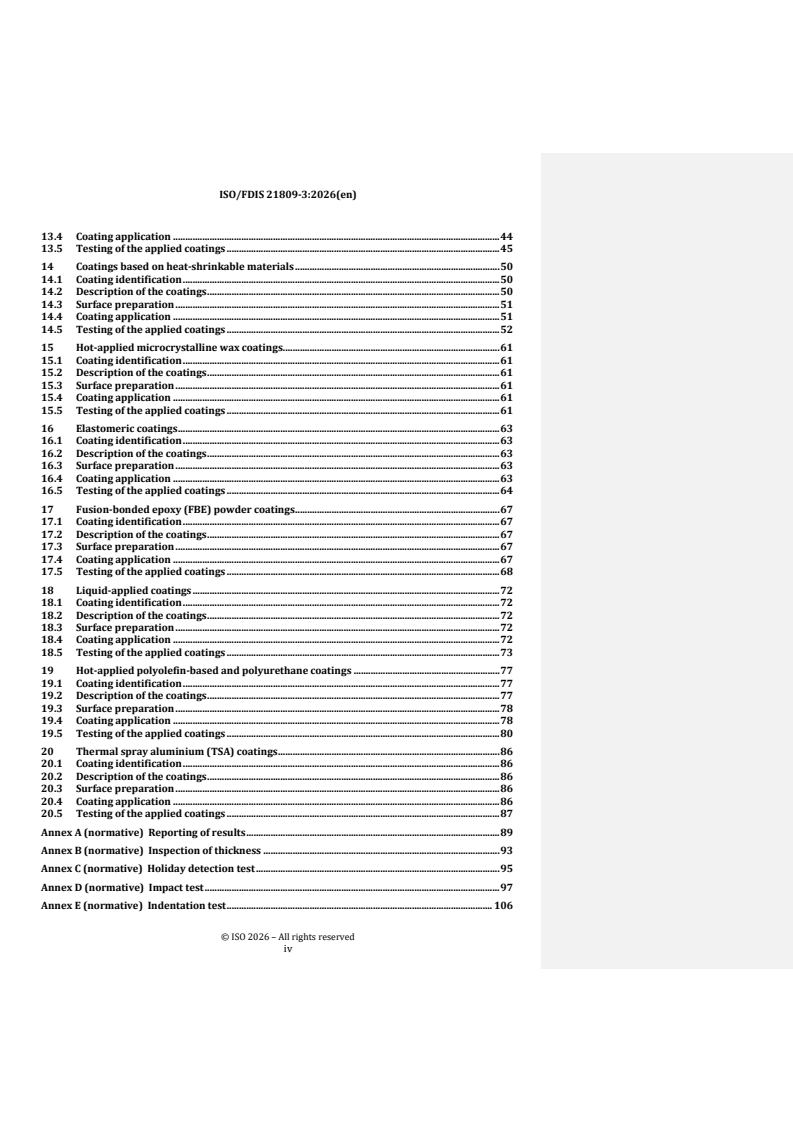
Contents
Foreword . vi
1 Scope . 1
2 Normative references . 1
3 Terms and definitions . 4
4 Symbols and abbreviated terms . 7
4.1 Symbols . 7
4.2 Abbreviated terms . 8
5 General requirements . 9
5.1 Responsibility of the end user . 9
5.2 Rounding . 9
5.3 Conformity, testing and quality . 9
6 Information to be supplied . 9
6.1 General. 9
6.2 Information to be supplied by the purchaser to the applicator. 9
6.3 Information to be supplied by the applicator to the purchaser. 10
7 Classification of field joint coatings. 11
8 Qualification processes . 12
8.1 Qualification of a coating system . 12
8.2 Coating application documents . 18
8.3 Qualification of coating operatives and inspection personnel . 24
9 Surface preparation . 26
9.1 General. 26
9.2 Preparation of the steel substrate . 29
9.3 Preparation of the adjacent plant coating . 31
10 Hot-applied bituminous tape coatings . 31
10.1 Coating identification . 31
10.2 Description of the coatings . 31
10.3 Surface preparation . 31
10.4 Coating application . 31
10.5 Testing of the applied coatings . 32
11 Petrolatum and wax-based tape coatings . 33
11.1 Coating identification . 33
11.2 Description of the coatings . 33
11.3 Surface preparation . 34
11.4 Coating application . 34
11.5 Testing of the applied coatings . 34
12 Cold-applied polymeric tape coatings . 38
12.1 Coating identification . 38
12.2 Description of the coatings . 38
12.3 Surface preparation . 38
12.4 Coating application . 38
12.5 Testing of the applied coatings . 39
13 Non-crystalline low-viscosity polyolefin-based coatings . 44
13.1 Coating identification . 44
13.2 Description of the coatings . 44
13.3 Surface preparation . 44
iii
13.4 Coating application . 44
13.5 Testing of the applied coatings . 45
14 Coatings based on heat-shrinkable materials . 50
14.1 Coating identification . 50
14.2 Description of the coatings . 50
14.3 Surface preparation . 51
14.4 Coating application . 51
14.5 Testing of the applied coatings . 52
15 Hot-applied microcrystalline wax coatings . 61
15.1 Coating identification . 61
15.2 Description of the coatings . 61
15.3 Surface preparation . 61
15.4 Coating application . 61
15.5 Testing of the applied coatings . 61
16 Elastomeric coatings . 63
16.1 Coating identification . 63
16.2 Description of the coatings . 63
16.3 Surface preparation . 63
16.4 Coating application . 63
16.5 Testing of the applied coatings . 64
17 Fusion-bonded epoxy (FBE) powder coatings . 67
17.1 Coating identification . 67
17.2 Description of the coatings . 67
17.3 Surface preparation . 67
17.4 Coating application . 67
17.5 Testing of the applied coatings . 68
18 Liquid-applied coatings . 72
18.1 Coating identification . 72
18.2 Description of the coatings . 72
18.3 Surface preparation . 72
18.4 Coating application . 72
18.5 Testing of the applied coatings . 73
19 Hot-applied polyolefin-based and polyurethane coatings . 77
19.1 Coating identification . 77
19.2 Description of the coatings . 77
19.3 Surface preparation . 78
19.4 Coating application . 78
19.5 Testing of the applied coatings . 80
20 Thermal spray aluminium (TSA) coatings . 86
20.1 Coating identification . 86
20.2 Description of the coatings . 86
20.3 Surface preparation . 86
20.4 Coating application . 86
20.5 Testing of the applied coatings . 87
Annex A (normative) Reporting of results . 89
Annex B (normative) Inspection of thickness . 93
Annex C (normative) Holiday detection test . 95
Annex D (normative) Impact test . 97
Annex E (normative) Indentation test . 106
iv
Annex F (normative) Specific electrical insulation resistance test . 109
Annex G (normative) Cathodic disbondment test . 121
Annex H (normative) Adhesion test (peel, lift and pull off). 140
Annex I (normative) Hot water immersion test . 155
Annex J (normative) Lap shear test . 158
Annex K (normative) Drip resistance test . 162
Annex L (normative) Peel strength between layers . 163
Annex M (normative) Thermal ageing resistance . 167
Annex N (normative) Coating porosity test . 172
Annex O (normative) Bursting strength of reinforced backing . 175
Annex P (normative) Thermal analysis of epoxy powder and cured coating film (FBE) . 176
Annex Q (normative) Adhesion test (X cut) — Resistance to removal . 185
Annex R (normative) Coating flexibility test . 188
Bibliography . 197
v
Foreword
ISO (the International Organization for Standardization) is a worldwide federation of national standards
bodies (ISO member bodies). The work of preparing International Standards is normally carried out through
ISO technical committees. Each member body interested in a subject for which a technical committee has been
established has the right to be represented on that committee. International organizations, governmental and
non-governmental, in liaison with ISO, also take part in the work. ISO collaborates closely with the
International Electrotechnical Commission (IEC) on all matters of electrotechnical standardization.
The procedures used to develop this document and those intended for its further maintenance are described
in the ISO/IEC Directives, Part 1. In particular, the different approval criteria needed for the different types of
ISO documentsdocument should be noted. This document was drafted in accordance with the editorial rules
of the ISO/IEC Directives, Part 2 (see www.iso.org/directives).
ISO draws attention to the possibility that the implementation of this document may involve the use of (a)
patent(s). ISO takes no position concerning the evidence, validity or applicability of any claimed patent rights
in respect thereof. As of the date of publication of this document, ISO had not received notice of (a) patent(s)
which may be required to implement this document. However, implementers are cautioned that this may not
represent the latest information, which may be obtained from the patent database available at
www.iso.org/patents. ISO shall not be held responsible for identifying any or all such patent rights.
Any trade name used in this document is information given for the convenience of users and does not
constitute an endorsement.
For an explanation of the voluntary nature of standards, the meaning of ISO specific terms and expressions
related to conformity assessment, as well as information about ISO's adherence to the World Trade
Organization (WTO) principles in the Technical Barriers to Trade (TBT), see www.iso.org/iso/foreword.html.
This document was prepared by Technical Committee ISO/TC 67, Oil and gas industries including lower carbon
energy, Subcommittee SC 2, Pipeline transportation systems., in collaboration with the European Committee
for Standardization (CEN) Technical Committee CEN/TC 12, Oil and gas industries including lower carbon
energy, in accordance with the Agreement on technical cooperation between ISO and CEN (Vienna
Agreement).
This third edition cancels and replaces the second edition (ISO 21809-3:2016), which has been technically
revised. It also incorporates the Amendment ISO 21809--3:2016/Amd 1:2020.
The main changes are as follows:
— inclusion of a qualification scheme;
— inclusion of new FJC types;
— changes in various FJC clauses;
— inclusion of new annexes;
— changes in various annexes.
A list of all parts in the ISO 21809 series can be found on the ISO website.
Any feedback or questions on this document should be directed to the user’s national standards body. A
complete listing of these bodies can be found at www.iso.org/members.html.
vi
Oil and gas industries including lower carbon energy — External
coatings for buried or submerged pipelines used in pipeline
transportation systems — —
Part 3:
Field joint coatings
1 Scope
This document specifies requirements for field joint coatings of seamless or welded steel pipes for buried and
submerged sections of pipeline transportation systems used in the petroleum, petrochemical and natural gas
industries as defined in ISO 13623. This document specifies the qualification, application and testing of the
corrosion protection coatings applied to steel surfaces left bare after the joining of pipes and fittings
(components) by welding.
This document defines and codifies in Table 1Table 1 the different types of field joint coatings for pipelines.
This document does not address requirements for additional mechanical protection, for thermal insulation or
for joint infills of concrete weight-coated pipes.
NOTE Field joints of pipes and fittings coated in accordance with this document are considered suitable for further
protection by means of cathodic protection.
2 Normative references
The following documents are referred to in the text in such a way that some or all of their content constitutes
requirements of this document. For dated references, only the edition cited applies. For undated references,
the latest edition of the referenced document (including any amendments) applies.
ISO 34--1, Rubber, vulcanized or thermoplastic — Determination of tear strength — Part 1: Trouser, angle and
crescent test pieces
ISO 37, Rubber, vulcanized or thermoplastic — Determination of tensile stress-strain properties
ISO 48-4, Rubber, vulcanized or thermoplastic — Determination of hardness — Part 4: Indentation hardness by
durometer method (Shore hardness)
ISO 188, Rubber, vulcanized or thermoplastic — Accelerated ageing and heat resistance tests
ISO 527--1, Plastics — Determination of tensile properties — Part 1: General principles
ISO 527--2, Plastics — Determination of tensile properties — Part 2: Test conditions for moulding and extrusion
plastics
ISO 527--3, Plastics — Determination of tensile properties — Part 3: Test conditions for films and sheets
ISO 868, Plastics and ebonite — Determination of indentation hardness by means of a durometer (Shore
hardness)
ISO 1431--1, Rubber, vulcanized or thermoplastic — Resistance to ozone cracking — Part 1: Static and dynamic
strain testing
ISO 1817, Rubber, vulcanized or thermoplastic — Determination of the effect of liquids
ISO 2178, Non-magnetic coatings on magnetic substrates — Measurement of coating thickness — Magnetic
method
ISO 2808, Paints and varnishes — Determination of film thickness
ISO 3183, Petroleum and natural gas industries — Steel pipe for pipeline transportation systems
ISO 3303--1, Rubber- or plastics-coated fabrics — Determination of bursting strength — Part 1: Steel-ball
method
ISO 3417, Rubber — Measurement of vulcanization characteristics with the oscillating disc curemeter
ISO 4624, Paints and varnishes — Pull-off test for adhesion
ISO 6502-2, Rubber — Measurement of vulcanization characteristics using curemeters — Part 2: Oscillating disc
curemeter
ISO 5893, Rubber and plastics test equipment — Tensile, flexural and compression types (constant rate of
traverse) — Specification
ISO 7619-1, Rubber, vulcanized or thermoplastic — Determination of indentation hardness — Part 1:
Durometer method (Shore hardness)
ISO 8501--1, Preparation of steel substrates before application of paints and related products — Visual
assessment of surface cleanliness — Part 1: Rust grades and preparation grades of uncoated steel substrates and
of steel substrates after overall removal of previous coatings
ISO 8501--3, Preparation of steel substrates before application of paints and related products — Visual
assessment of surface cleanliness — Part 3: Preparation grades of welds, edges and other areas with surface
imperfections
ISO 8502--3, Preparation of steel substrates before application of paints and related products — Tests for the
assessment of surface cleanliness — Part 3: Assessment of dust on steel surfaces prepared for painting (pressure-
sensitive tape method)
ISO 8502--6, Preparation of steel substrates before application of paints and related products — Tests for the
assessment of surface cleanliness — Part 6: Extraction of water soluble contaminants for analysis (Bresle
method)
ISO 8502--9, Preparation of steel substrates before application of paints and related products — Tests for the
assessment of surface cleanliness — Part 9: Field method for the conductometric determination of water-soluble
salts
ISO 8503--4, Preparation of steel substrates before application of paints and related products — Surface
roughness characteristics of blast-cleaned steel substrates — Part 4: Method for the calibration of ISO surface
profile comparators and for the determination of surface profile — Stylus instrument procedure
ISO 8503--5, Preparation of steel substrates before application of paints and related products — Surface
roughness characteristics of blast-cleaned steel substrates — Part 5: Replica tape method for the determination
of the surface profile
ISO 8504--2, Preparation of steel substrates before application of paints and related products — Surface
preparation methods — Part 2: Abrasive blast-cleaning
ISO 8504--3, Preparation of steel substrates before application of paints and related products — Surface
preparation methods — Part 3: Hand- and power-tool cleaning
ISO 10474, Steel and steel products — Inspection documents
ISO 11124 (all parts), Preparation of steel substrates before application of paints and related products —
Specifications for metallic blast-cleaning abrasives
ISO 11125 (all parts), Preparation of steel substrates before application of paints and related products — Test
methods for metallic blast-cleaning abrasives
ISO 11126 (all parts), Preparation of steel substrates before application of paints and related products —
Specifications for non-metallic blast-cleaning abrasives
ISO 11127 (all parts), Preparation of steel substrates before application of paints and related products — Test
methods for non-metallic blast-cleaning abrasives
ISO 11357--1, Plastics — Differential scanning calorimetry (DSC) — Part 1: General principles
ISO 11357--2, Plastics — Differential scanning calorimetry (DSC) — Part 2: Determination of glass transition
temperature and step height
ISO 11357--3, Plastics — Differential scanning calorimetry (DSC) — Part 3: Determination of temperature and
enthalpy of melting and crystallization
ISO 11357--6, Plastics — Differential scanning calorimetry (DSC) — Part 6: Determination of oxidation
induction time (isothermal OIT) and oxidation induction temperature (dynamic OIT)
ISO 13623, Petroleum and natural gas industries — Pipeline transportation systems
ISO/IEC 17025, General requirements for the competence of testing and calibration laboratories
ISO 80000--1:2022, Quantities and units — Part 1: General
EN 10204, Metallic products — Types of inspection documents
1)
ASTM D70, , Standard Test Method for Density of Semi-Solid Bituminous Materials (Pycnometer Method)
ASTM D92, Standard Test Method for Flash and Fire Points by Cleveland Open Cup Tester
ASTM D127, Standard Test Method for Drop Melting Point of Petroleum Wax, Including Petrolatum
ASTM D149, Standard Test Method for Dielectric Breakdown Voltage and Dielectric Strength of Solid Electrical
Insulating Materials at Commercial Power Frequencies
ASTM D1141, Standard Practice for the Preparation of Substitute Ocean Water
ASTM D1321, Standard Test Method for Needle Penetration of Petroleum Waxes
ASTM D2084, Standard Test Method for Rubber Property — Vulcanization Using Oscillating Disk Cure Meter
ASTM D4285, Standard Test Method for Indicating Oil or Water in Compressed Air
1)
American Society for Testing and Materials, 100 Harbour Drive, West Conshohocken, PA 19428-2959, USA.
ASTM D4940, Standard Test Method for Conductimetric Analysis of Water Soluble Ionic Contamination of Blast
Cleaning Abrasives
2)
AWS C2.25/C2.25M, , Specification for Thermal Spray Feedstock Solid and Composite Wire and Ceramic Rods
3)
SSPC-SP1, , Surface preparation specification (NACE No.1) — Solvent cleaning
SSPC Guide 15, Field Methods for Extraction and Analysis of Soluble Salts on Steel and Other Nonporous
Substrates
SSPC CS 23.00, Specification for the Application of Thermal Spray Coatings (Metallizing) of Aluminium, Zinc and
Their Alloys and Composites for the Corrosion Protection of Steel
3 Terms and definitions
For the purposes of this document, the following terms and definitions apply.
ISO and IEC maintain terminology databases for use in standardization at the following addresses:
— — ISO Online browsing platform: available at https://www.iso.org/obp
— — IEC Electropedia: available at https://www.electropedia.org/
3.1 3.1
additional mechanical protection
various materials to either enhance impact and indentation resistance or isolate movements between field
joint coating and surrounding soil, or both
Note 1 to entry: This includes additional layer(s) partially or not bonded over the specified anti-corrosion system
qualified by this standard. The additional mechanical layer(s) shall be compatible with cathodic protection so as to not
prevent current reaching and protecting the pipe. The properties, components, and application methods of those
additional layers are not covered by this standard.
3.2 3.2
application procedure specification
APS
document describing procedures, methods, equipment and tools used for field joint coating application
3.3 3.3
applicator
company that undertakes the coating application in accordance with the provisions of this document
Note 1 to entry: If the compounding of the top layer is done prior or during the application process by the applicator,
then the applicator is regarded as the manufacturer (3.19(3.19).).
3.4 3.4
batch
quantity of material produced in a continuous manufacturing operation using raw materials of the same
source and grade
2)
America Welding Society, 550 N.W. Le Jeune Road, Miami, Florida 33126, USA.
3) th th
The Society for Protective Coatings, 40 24 Street, 6 Floor, Pittsburgh, PA 15222-4656, USA.
3.5 3.5
batch certificate
certificate of analysis (3.9(3.9)) issued by the manufacturer (3.19(3.19)) for a given batch (3.4(3.4)) of each
coating system component
3.6 3.6
bonding agent
material applied as a film to the primed substrate in order to ensure adhesion of the subsequent protective
coating
3.7 3.7
coating operative
individual undertaking coating activity on the work site, including surface preparation
3.8 3.8
coating system
single or multiple layers of coating material applied to a metal surface for protection against corrosion by
preventing contact between the electrolyte and the metal surface
3.9 3.9
certificate of analysis
document provided by the manufacturer (3.19(3.19)) which indicates results of specific tests or analysis,
including test methodology, performed on a defined lot of the manufacturer’s product and corresponding
conformity ranges
3.10 3.10
cutback
length of pipe left uncoated at each end for joining purposes (e.g. welding)
3.11 3.11
design temperature range
temperature range, including maximum and minimum temperatures, likely to be reached during transport,
storage, handling, installation and operation
Note 1 to entry: The design temperature range of the field joint coating can be narrower than that specified for the steel
pipe material or the pipeline system (3.25(3.25),), or both.
3.12 3.12
end user
company that owns or operates the pipeline system (3.25(3.25),), or both
3.13 3.13
field joint area
uncoated area that results when two pipe sections or a pipe section and a fitting with coating cutbacks
(3.10(3.10)) are assembled by welding in the field
3.14 3.14
holiday
coating discontinuity that exhibits electrical conductivity when exposed to a specific voltage
3.15 3.15
inspection document
document stating conformity with the requirements given in the purchase order
Note 1 to entry: The inspection document shall be issued in accordance with ISO 10474 (or EN 10204).
3.16 3.16
inspection and testing plan
ITP
document providing an overview of the sequence of inspections and tests, including resources and procedures
references
3.17 3.17
inspector
representative responsible for one or more of the inspections specified in this document
3.18 3.18
layer of tape
single wrap of tape without overlap
Note 1 to entry: Wrapping of a tape with 50 % overlap constitutes a two-layer tape coating.
3.19 3.19
manufacturer
company responsible for the manufacture of coating material(s)
3.20 3.20
maximum service temperature
T
max
maximum continuous temperature that the field joint coating can resist
3.21 3.21
nominal thickness
numerical designation of the thickness exclusive of tolerances, allowances etc. of supplied materials
3.22 3.22
operating temperature
temperature that can be endured by a pipeline (component) or pipeline system (3.25(3.26)) during operation,
within the design temperature range (3.11(3.11),), or both
3.23 3.23
party
stakeholder ([end user, purchaser (3.29(3.29),), applicator (3.3(3.3),), manufacturer (3.19(3.19),), etc.).] with
a vested interest in the decision-making
3.24 3.24
pipeline
facilities through which fluids are conveyed, including pipe, pig traps, components and appurtenances, up to
and including the isolating valves
[SOURCE: ISO 13623:2017, 3.1.1615]
3.25 3.25
pipeline system
pipelines (3.24(3.25),), stations, supervisory control and data acquisition system (SCADA), safety systems,
corrosion protection systems, and any other equipment, facility or building used in the transportation of fluids
[SOURCE: ISO 13623:2017, 3.1.16]
3.26 3.26
pre-production trial
PPT
application of coating and inspection or testing of its properties immediately prior to start of production, to
confirm that field joint coatings produced in accordance with the APS (3.2(3.2)) and ITP (3.16(3.16)) are
acceptable within the specified properties
3.27 3.27
primer
material applied as a film on substrate to ensure adhesion of the subsequent protective coating
3.28 3.28
procedure qualification trial
PQT
application of a field joint coating and subsequent inspection or testing of its properties, to confirm that field
joint coatings produced in accordance with the APS (3.2(3.2)) and ITP (3.16(3.16)) are acceptable within the
specified properties, carried out at the premises of the applicator (3.3(3.3)) or any other agreed location
3.29 3.29
purchaser
company responsible for providing the purchase order requirements.
3.30 3.30
shift
time period during which a crew of workers is at work
3.31 3.31
test sample
sample from a batch (3.4(3.4)) of raw material or field joint coating that represents the properties of the
complete batch
3.32 3.32
test specimen
object prepared for the purpose of testing specific properties
Note 1 to entry: The test specimens can be as follows: the coating material; a simulated field joint, flat panel
or similar prepared specifically for testing; a coupon, ring or similar that has been cut from a field joint; a field
joint that has been coated in production or otherwise, in laboratory or field conditions.
3.33 3.33
wrap-around sleeve
sleeve wrapped circumferentially around the steel pipe area being coated
4 Symbols and abbreviated terms
4.1 Symbols
B bursting strength after thermal ageing for 70 days
B100 bursting strength after thermal ageing for 100 days
C percentage of conversion of FBE coating
ΔH exothermic heat of reaction
ΔTg variation of glass transition temperature between two or more successive thermal analysis scans
E0 elongation at break without thermal ageing
E elongation at break after thermal ageing for 14 days
E elongation at break after thermal ageing for 70 days
E elongation at break after thermal ageing for 100 days
P28 peel strength to pipe surface after thermal ageing or hot water immersion for 28 days
P peel strength to pipe surface after thermal ageing for 70 days
P peel strength to pipe surface after thermal ageing or hot water immersion for 100 days
Pt Minimum peel strength to surface or plant coating as specified in the table of FJC requirements
P′ peel strength between layers after thermal ageing or hot water immersion for 70 days
P′ peel strength between layers after thermal ageing or hot water immersion for 100 days
P’ Minimum peel strength between layers as specified in the table of FJC requirements
t
RS specific electrical insulation resistance of a coating
R specific electrical insulation resistance after 70 days
S70
R specific electrical insulation resistance after 100 days
S100
T glass transition temperature
g
4.2 Abbreviated terms
CQ coating qualification
CSQ coating system qualification
DFT dry film thickness
DSC differential scanning calorimetry
EP epoxy
EPDM ethylene propylene diene monomer
FBE fusion-bonded epoxy
FJC field joint coating
HSS heat-shrink sleeve
SDS safety data sheet
PE polyethylene
PDS product data sheet
PP polypropylene
PU polyurethane
PVC polyvinylchloride
TSA thermal spray aluminium
2LPE two-layer polyethylene coating
3LPE three-layer polyethylene coating
3LPP three-layer polypropylene coating
5 General requirements
5.1 Responsibility of the end user
The end user shall be responsible for making or approving the appropriate selection of the FJC in accordance
with the specified service, coating application and installation conditions. The end user shall validate the
information to be supplied by the purchaser as listed in Clause 6Clause 6.
5.2 Rounding
Unless otherwise stated in this document, to determine conformity with the specified requirements, observed
or calculated values shall be rounded to the nearest unit in the last right-hand place of figures used in
expressing the limiting value, in accordance with ISO 80000--1:2022, Annex B, Rule B.
NOTE For the purposes of this provision, the rounding method of ASTM E29 is equivalent to ISO 80000--1:2022,
Annex B, Rule B.
5.3 Conformity, testing and quality
Systems for quality and environmental management, and good laboratory practices, should be applied to
assist conformity with the requirements of this document.
Test reports shall be in accordance with Annex A, unless otherwise specified.
NOTE 1 ISO 29001 gives sector-specific guidance on quality management systems.
NOTE 2 ISO 14001 gives guidance on the selection and use of an environmental management system.
6 Information to be supplied
6.1 General
CQ, CSQ, PQT, PPT, APS and ITP are described in Clause 8Clause 8.
6.2 Information to be supplied by the purchaser to the applicator
The purchaser shall provide the following information:
— — designation of this document to the relevant field joint coating system in accordance with
Table 1Table 1;;
— — CSQ requirements;
— — project requirements:
— — brand and type of FJC system (if applicable);
— — applicable project specifications;
— — PQT and / or PPT requirements (if applicable);
— — pipe material or grade (e.g. ISO 3183);
— — pipe nominal outer diameter and wall thickness;
— — design temperature range and operating temperature of the pipeline (if relevant);
— — minimum and maximum thickness of the field joint coating (if applicable);
— — chamfer or cutback design (size, length or geometry of the field joint being coated), including
tolerances for both ends of pipe or fittings (if relevant), or both;
— — plant coating system including minimum or maximum thickness;
— — overlap on the parent (i.e. “plant-applied”) coating or detailed drawing of the field joint coating
with dimensional tolerances (if relevant);
— — maximum permissible preheating temperature;
— — expected environmental temperature range during field joint coating application;
— — water depth (if applicable);
— — soil properties (if applicable);
— — expected temperature range during pipeline installation;
— — method of installation of the pipeline;
— — number of field joints to be coated;
— — permissible number and size of field joint and plant coating repairs;
— — time constraints for application and number and dimensions of working stations, if relevant;
— — restrictions in field joint coating application caused by the design of fittings (if applicable);
— — restrictions in accessibility, available space, environmental conditions and other at coating
application location (if applicable);
— — special requirements for handling and storage procedures (if applicable);
— — required qualification of the applicator's personnel performing surface preparation or coating
application, or both and personnel performing inspection of surface preparation or coating application, or
both;
— — requested schedule of delivery of coating systems;
— — requested documentation and schedule for supply of documentation;
— — requirements on test reports and (daily) log;
— — type and frequency of inspection document in accordance with ISO 10474 or EN 10204 (see
8.2.38.2.3););
— — requirements for traceability of field joint coating systems or repair systems and marking.
6.3 Information to be supplied by the applicator to the purchaser
The applicator shall provide the following information, if relevant, based on information from the coating
(materi
...