


ISO 4582:2025
(Main)Plastics — Determination of changes in colour and variations in properties after exposure to glass-filtered solar radiation, natural weathering or laboratory radiation sources
Plastics — Determination of changes in colour and variations in properties after exposure to glass-filtered solar radiation, natural weathering or laboratory radiation sources
This document specifies methods for determining changes in colour and other appearance properties, and variations in mechanical or other properties, of plastics that have been exposed to glass-filtered solar radiation, to natural weathering or to simulated solar radiation from a laboratory source. The procedure used to analyse data depends on whether the test used to characterize the materials being exposed is destructive or non-destructive. The exposures are conducted under conditions specified in specific exposure standards (e.g. the ISO 877 series and the ISO 4892 series).
Plastiques — Détermination des changements de coloration et des variations de propriétés après exposition au rayonnement solaire derrière une vitre en verre, au vieillissement naturel ou aux sources de rayonnement de laboratoire
General Information
- Status
- Published
- Publication Date
- 01-Sep-2025
- Technical Committee
- ISO/TC 61/SC 6 - Ageing, chemical and environmental resistance
- Drafting Committee
- ISO/TC 61/SC 6 - Ageing, chemical and environmental resistance
- Current Stage
- 6060 - International Standard published
- Start Date
- 02-Sep-2025
- Due Date
- 20-Sep-2025
- Completion Date
- 02-Sep-2025
Relations
- Effective Date
- 05-Nov-2022
Overview - ISO 4582:2025 (Plastics, Colour and Property Changes after Weathering)
ISO 4582:2025 specifies standardized methods for determining changes in colour, appearance and variations in mechanical or other properties of plastics after exposure to glass‑filtered solar radiation, natural weathering or simulated solar radiation from laboratory sources. The fifth edition (2025) updates procedures for measurement, data analysis and reporting so results from different exposure regimes (outdoor or accelerated) can be compared when appropriate.
Keywords: ISO 4582, plastics weathering, colour change, accelerated ageing, solar radiation, natural weathering, mechanical properties.
Key topics and technical requirements
- Scope and purpose: Methods to quantify changes in colour and other appearance attributes and to detect variations in mechanical/functional properties after exposure.
- Exposure context: Exposures are performed under the conditions defined in specific exposure standards (for example ISO 877 series and ISO 4892 series).
- Colour measurement:
- Instrumental methods (e.g., colourimetric measurements) and visual assessment procedures are described for assessing change in colour and appearance.
- Test specimen preparation, apparatus and procedures for repeatable colour evaluation are specified.
- Mechanical and other properties:
- Procedures differ depending on whether the test method is destructive or non‑destructive.
- Requirements for initial property determination, storage of file specimens, and post‑exposure testing are included.
- Data handling and statistics:
- Guidance on expression of results, precision and statistical analysis (referencing ISO 2602) is provided, including methods to determine times to specified loss of property.
- Quality, reporting and precision:
- Required elements for the test report and precision expectations are set out to support reproducible lab-to-lab comparisons.
- Supplementary guidance:
- Annexes cover statistical formulae, effects of surface cleaning on assessment, and measurements of changes in mechanical properties.
Practical applications and users
Who uses ISO 4582:
- Materials scientists and polymer formulators assessing UV‑stability or colourfastness.
- Third‑party test laboratories performing accelerated ageing and outdoor weathering tests.
- Quality engineers and product developers validating durability and appearance retention.
- Specifiers, procurement and regulatory bodies writing performance requirements for plastic products used outdoors (automotive trims, building materials, consumer goods, coatings). Practical benefits:
- Enables objective, repeatable comparison of colour and property changes across formulations, coatings and products.
- Supports accelerated testing strategies by aligning measurement and reporting with natural weathering reference data.
Related standards
- ISO 877 series (weathering exposures)
- ISO 4892 series (artificial weathering devices)
- ISO/CIE 11664 (colorimetry)
- ISO 10640 (chemical change measurements)
- ISO 2602 (statistical interpretation)
- ISO 291 (conditioning atmospheres)
Use ISO 4582 when you need standardized, reproducible assessment of how solar radiation and weathering affect the appearance and functional properties of plastic materials.


Get Certified
Connect with accredited certification bodies for this standard

Smithers Quality Assessments
US management systems and product certification.

DIN CERTCO
DIN Group product certification.
Sponsored listings
Frequently Asked Questions
ISO 4582:2025 is a standard published by the International Organization for Standardization (ISO). Its full title is "Plastics — Determination of changes in colour and variations in properties after exposure to glass-filtered solar radiation, natural weathering or laboratory radiation sources". This standard covers: This document specifies methods for determining changes in colour and other appearance properties, and variations in mechanical or other properties, of plastics that have been exposed to glass-filtered solar radiation, to natural weathering or to simulated solar radiation from a laboratory source. The procedure used to analyse data depends on whether the test used to characterize the materials being exposed is destructive or non-destructive. The exposures are conducted under conditions specified in specific exposure standards (e.g. the ISO 877 series and the ISO 4892 series).
This document specifies methods for determining changes in colour and other appearance properties, and variations in mechanical or other properties, of plastics that have been exposed to glass-filtered solar radiation, to natural weathering or to simulated solar radiation from a laboratory source. The procedure used to analyse data depends on whether the test used to characterize the materials being exposed is destructive or non-destructive. The exposures are conducted under conditions specified in specific exposure standards (e.g. the ISO 877 series and the ISO 4892 series).
ISO 4582:2025 is classified under the following ICS (International Classification for Standards) categories: 83.080.01 - Plastics in general. The ICS classification helps identify the subject area and facilitates finding related standards.
ISO 4582:2025 has the following relationships with other standards: It is inter standard links to ISO 4582:2017. Understanding these relationships helps ensure you are using the most current and applicable version of the standard.
ISO 4582:2025 is available in PDF format for immediate download after purchase. The document can be added to your cart and obtained through the secure checkout process. Digital delivery ensures instant access to the complete standard document.
Standards Content (Sample)
International
Standard
ISO 4582
Fifth edition
Plastics — Determination of changes
2025-09
in colour and variations in properties
after exposure to glass-filtered solar
radiation, natural weathering or
laboratory radiation sources
Plastiques — Détermination des changements de coloration et
des variations de propriétés après exposition au rayonnement
solaire derrière une vitre en verre, au vieillissement naturel ou
aux sources de rayonnement de laboratoire
Reference number
© ISO 2025
All rights reserved. Unless otherwise specified, or required in the context of its implementation, no part of this publication may
be reproduced or utilized otherwise in any form or by any means, electronic or mechanical, including photocopying, or posting on
the internet or an intranet, without prior written permission. Permission can be requested from either ISO at the address below
or ISO’s member body in the country of the requester.
ISO copyright office
CP 401 • Ch. de Blandonnet 8
CH-1214 Vernier, Geneva
Phone: +41 22 749 01 11
Email: copyright@iso.org
Website: www.iso.org
Published in Switzerland
ii
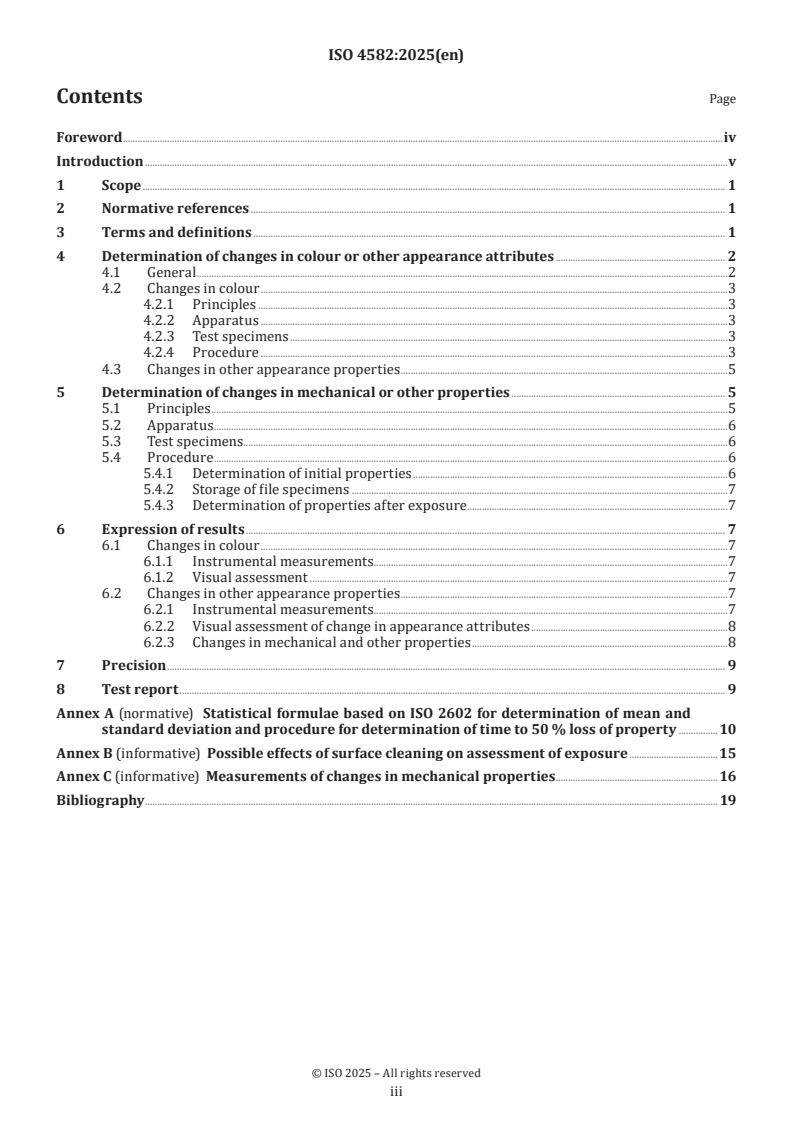
Contents Page
Foreword .iv
Introduction .v
1 Scope . 1
2 Normative references . 1
3 Terms and definitions . 1
4 Determination of changes in colour or other appearance attributes . 2
4.1 General .2
4.2 Changes in colour .3
4.2.1 Principles .3
4.2.2 Apparatus .3
4.2.3 Test specimens .3
4.2.4 Procedure .3
4.3 Changes in other appearance properties .5
5 Determination of changes in mechanical or other properties . 5
5.1 Principles .5
5.2 Apparatus .6
5.3 Test specimens.6
5.4 Procedure .6
5.4.1 Determination of initial properties .6
5.4.2 Storage of file specimens .7
5.4.3 Determination of properties after exposure .7
6 Expression of results . 7
6.1 Changes in colour .7
6.1.1 Instrumental measurements.7
6.1.2 Visual assessment .7
6.2 Changes in other appearance properties .7
6.2.1 Instrumental measurements.7
6.2.2 Visual assessment of change in appearance attributes .8
6.2.3 Changes in mechanical and other properties .8
7 Precision . 9
8 Test report . 9
Annex A (normative) Statistical formulae based on ISO 2602 for determination of mean and
standard deviation and procedure for determination of time to 50 % loss of property .10
Annex B (informative) Possible effects of surface cleaning on assessment of exposure .15
Annex C (informative) Measurements of changes in mechanical properties .16
Bibliography . 19
iii
Foreword
ISO (the International Organization for Standardization) is a worldwide federation of national standards
bodies (ISO member bodies). The work of preparing International Standards is normally carried out through
ISO technical committees. Each member body interested in a subject for which a technical committee
has been established has the right to be represented on that committee. International organizations,
governmental and non-governmental, in liaison with ISO, also take part in the work. ISO collaborates closely
with the International Electrotechnical Commission (IEC) on all matters of electrotechnical standardization.
The procedures used to develop this document and those intended for its further maintenance are described
in the ISO/IEC Directives, Part 1. In particular, the different approval criteria needed for the different types
of ISO documents should be noted. This document was drafted in accordance with the editorial rules of the
ISO/IEC Directives, Part 2 (see www.iso.org/directives).
ISO draws attention to the possibility that the implementation of this document may involve the use of (a)
patent(s). ISO takes no position concerning the evidence, validity or applicability of any claimed patent
rights in respect thereof. As of the date of publication of this document, ISO had not received notice of (a)
patent(s) which may be required to implement this document. However, implementers are cautioned that
this may not represent the latest information, which may be obtained from the patent database available at
www.iso.org/patents. ISO shall not be held responsible for identifying any or all such patent rights.
Any trade name used in this document is information given for the convenience of users and does not
constitute an endorsement.
For an explanation of the voluntary nature of standards, the meaning of ISO specific terms and expressions
related to conformity assessment, as well as information about ISO's adherence to the World Trade
Organization (WTO) principles in the Technical Barriers to Trade (TBT) see www.iso.org/iso/foreword.html
This document was prepared by Technical Committee ISO/TC 61, Plastics, Subcommittee SC 6, Ageing,
chemical and environmental resistance.
This fifth edition cancels and replaces the fourth edition (ISO 4582:2017), which has been technically
revised.
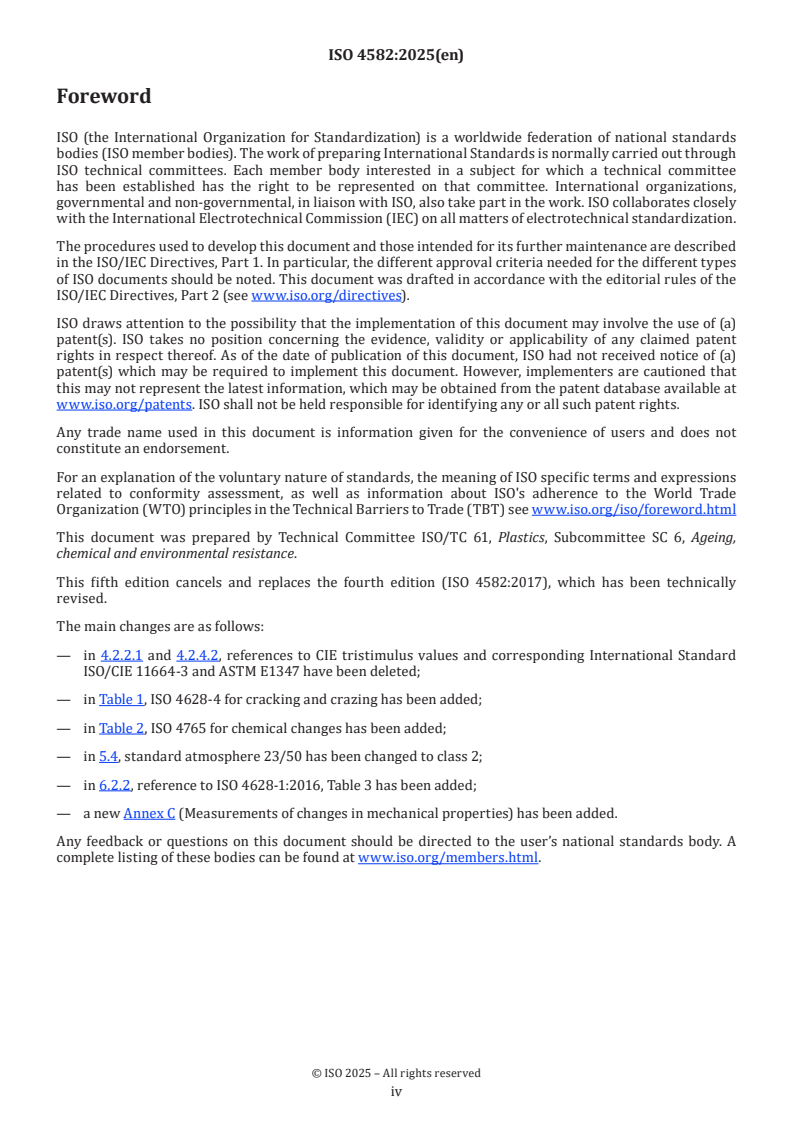
The main changes are as follows:
— in 4.2.2.1 and 4.2.4.2, references to CIE tristimulus values and corresponding International Standard
ISO/CIE 11664-3 and ASTM E1347 have been deleted;
— in Table 1, ISO 4628-4 for cracking and crazing has been added;
— in Table 2, ISO 4765 for chemical changes has been added;
— in 5.4, standard atmosphere 23/50 has been changed to class 2;
— in 6.2.2, reference to ISO 4628-1:2016, Table 3 has been added;
— a new Annex C (Measurements of changes in mechanical properties) has been added.
Any feedback or questions on this document should be directed to the user’s national standards body. A
complete listing of these bodies can be found at www.iso.org/members.html.
iv
Introduction
A number of different exposure techniques can be used to provide information on the effects of environmental
stresses such as simulated solar radiation, heat and water on plastics (see the ISO 877 series and the ISO 4892
series). Each exposure test has its own particular application and relevance. When determining changes in a
particular property or attribute of a material subjected to different exposures, the same evaluation methods
should be used after all exposures to ensure meaningful results.
Results for plastics subjected to exposure tests are strongly dependent on the type of exposure conditions
used, the type of plastic being tested and the property being evaluated. A result obtained for one property
might not be the same as that for a different property of the same material, even if the same exposure test
is used. This document is not intended to establish a fixed procedure for conducting the exposure test, but
is intended to provide a set of specific procedures used to express the results for change in a characteristic
property of the material after it has been exposed. It is up to the user to determine which exposure conditions
are most relevant to the specific material and the service conditions being used.
Test methods should be selected to determine changes in appearance and properties of the exposed material
with its proposed application in mind. The exposure test used should be devised to discriminate among
materials based on such changes. This document suggests typical properties that can be used to determine
changes in plastics which have been subjected to exposure tests.
NOTE Because of large differences in the spectral distribution of the radiation sources used, there can be large
differences in results for the same plastics exposed in the various devices described in the ISO 4892 series. Therefore,
comparisons between plastics are intended to be made only based on results from exposures in the same type of
device and under the same conditions. For optimum comparisons, plastics are expected to be exposed at the same
time in the same device.
v
International Standard ISO 4582:2025(en)
Plastics — Determination of changes in colour and variations
in properties after exposure to glass-filtered solar radiation,
natural weathering or laboratory radiation sources
1 Scope
This document specifies methods for determining changes in colour and other appearance properties,
and variations in mechanical or other properties, of plastics that have been exposed to glass-filtered solar
radiation, to natural weathering or to simulated solar radiation from a laboratory source.
The procedure used to analyse data depends on whether the test used to characterize the materials being
exposed is destructive or non-destructive. The exposures are conducted under conditions specified in
specific exposure standards (e.g. the ISO 877 series and the ISO 4892 series).
2 Normative references
The following documents are referred to in the text in such a way that some or all of their content constitutes
requirements of this document. For dated references, only the edition cited applies. For undated references,
the latest edition of the referenced document (including any amendments) applies.
ISO 105-A01, Textiles — Tests for colour fastness — Part A01: General principles of testing
ISO 105-A02, Textiles — Tests for colour fastness — Part A02: Grey scale for assessing change in colour
ISO 105-A03, Textiles — Tests for colour fastness — Part A03: Grey scale for assessing staining
ISO 291, Plastics — Standard atmospheres for conditioning and testing
ISO 2602, Statistical interpretation of test results — Estimation of the mean — Confidence interval
ISO 4628-1:2016, Paints and varnishes — Evaluation of degradation of coatings — Designation of quantity and size
of defects, and of intensity of uniform changes in appearance — Part 1: General introduction and designation system
ISO/CIE 11664-1, Colorimetry — Part 1: CIE standard colorimetric observers
ISO/CIE 11664-2, Colorimetry — Part 2: CIE standard illuminants
ISO/CIE 11664-4, Colorimetry — Part 4: CIE 1976 L*a*b* colour space
th
CIE 015, Colorimetry 4 ed
3 Terms and definitions
For the purposes of this document, the following terms and definitions apply.
ISO and IEC maintain terminology databases for use in standardization at the following addresses:
— ISO Online browsing platform: available at https:// www .iso .org/ obp
— IEC Electropedia: available at https:// www .electropedia .org/
3.1
control material
material which is of similar composition and construction to the test material and
which is exposed at the same time for comparison with the test material
Note 1 to entry: An example of the use of a control material would be when a formulation different from one currently
being used is being evaluated. In that case, the control material would be the plastic made with the original formulation.
Note 2 to entry: A control material is sometimes referred to as a “control."
3.2
file specimen
portion of the material to be tested which is stored under conditions in which it is stable, and is used for
comparison between the exposed and the original state
3.3
test specimen
specific portion of the material upon which the testing is to be performed
3.4
replicate specimen
identical pieces of the test material being evaluated which are all exposed, conditioned and tested at the
same time
4 Determination of changes in colour or other appearance attributes
4.1 General
When a polymeric material is exposed to UV radiation and other moderate environmental stresses, the
change in most physical properties is attributable to chemical ageing, and the extent of the chemical changes
can be related to the duration of the exposure under natural outdoor weathering or artificial weathering
exposure.
Chemical changes control the degradation of mechanical properties and contribute to changes in the visual
appearance of polymer materials during photoageing. These chemical changes are analysed primarily by IR
spectroscopy, with additional analyses using UV/visible spectroscopy during the photoageing of polymers.
The analysis at this earliest stage of degradation allows the identification of the critical oxidation products,
allows the stoichiometry of reactions to be checked and, in some cases, indicates weak points in the polymer
material (e.g. a weakness in the specific structure of the polymer, such as a double bond, an ether group or a
urethane group, unstable colorant, lack of UV stabilizers, or migration of low-molecular-mass components of
formulations to the surface and their accumulation there).
The relevance of artificial ageing can be determined by comparing the chemical changes that occur in
the accelerated test to those that occur in natural weathering. It should be pointed out that, in some
cases, oxidation products can be partially eliminated by hydrolysis, or erosion caused by water under
humid climates (e.g. southern Florida) or by wind under very dry climates (e.g. Arizona). Kinetic analysis
is recommended to determine the rate of degradation under different conditions of ageing in order to
rank different formulations or to determine the range of acceleration possible for an artificial ageing test
compared to a given natural outdoor weathering exposure (without distortion of the photodegradation
mechanism of the polymer). In addition, these analyses can be used as a tool for developing improvements in
polymers and polymeric products.
Methodologies to measure chemical changes in plastics after exposure to glass-filtered solar radiation,
natural weathering or laboratory radiation sources are expressed in ISO 10640.
4.2 Changes in colour
4.2.1 Principles
Changes in colour of plastic test specimens exposed in accordance with the specific exposure standard (see
Introduction) are determined by one of the following methods:
a) an instrumental method;
b) visual assessment using a scale.
4.2.2 Apparatus
4.2.2.1 Instruments for measuring colour or changes in colour, conforming to the following
requirements:
— CIE 1964 standard colorimetric observer (10° observer), as specified in ISO/CIE 11664-1;
— CIE standard illuminant D65 (recommended) or CIE standard illuminant A (for metamerism index), as
specified in ISO/CIE 11664-2;
— CIE 1976 L*a*b* Colour space, as specified in ISO/CIE 11664-4.
For light-transmitting specimens, instruments shall conform to the requirements of CIE 015.
4.2.2.2 Grey scale for assessing change in colour, in accordance with ISO 105-A02 or ISO 105-A03. In
this scale, grade 1 corresponds to the strongest contrast, and grade 5 to zero contrast (two samples with
identical colour).
NOTE The dark grey scale of ISO 105-A02 is well suited to assessing the extent of fading of relatively strong
colours or deep shades. The use of the near-white grey scale of ISO 105-A03 can be found preferable for assessing the
discolouration, e.g. yellowing, of white or near-white specimens.
4.2.3 Test specimens
Specimens of test and control materials shall conform to the requirements of the appropriate International
Standard dealing with the specific exposure method used, for example, International Standards in the
ISO 877 series or ISO 4892 series. It is recommended that a control material of known weathering properties
be included in the exposure experiment. Unless otherwise specified, at least three replicate specimens of
each material being exposed shall be used.
4.2.4 Procedure
4.2.4.1 General
The specific procedure used for assessment of colour changes and any surface cleaning shall be agreed upon
by all interested parties and shall be included in the test report.
Typically, colour changes are determined at a series of exposure stages in order to evaluate the rate of colour
change caused by exposure. In some cases, colour change is determined after a predetermined or specified
exposure increment. Measurement or visual assessment of colour should be made as soon as possible after
specimens are removed from exposure in order to minimize the effect of dark reactions; although in some
cases it is preferable to condition the specimens for, for example, 24 h after removal from exposure, as
appearance properties assessed just after removal from exposure can vary depending whether the specimen
was removed at the end of a wet exposure period or at the end of a dry exposure period.
Because of variability in exposure results, it is recommended to perform comparison of colour changes of
different materials when the materials are simultaneously exposed in a single exposure device or at the
same exterior location.
4.2.4.2 Instrumental assessment
When determining colour change by instrumental assessment, measure colour on all specimens before
exposure and after each exposure stage. If required, measure colour on file specimens of each material when
measuring colour on exposed specimens.
For opaque specimens, both colour and gloss can change due to ageing. When measuring the colour and
determining the colour change of opaque specimens with instruments, use one of the following measuring
conditions:
— to get colour values independent of surface changes, use di:8° or 8°:di, according to CIE 015 (often used
for smooth specimens);
— to get best correlation to visual perception, use de:8°, 8°:de, or 45°:0°, according to CIE 015 (often used
for rough or matt specimens).
NOTE 1 Colour values measured by excluding the specular reflexion will typically change for all cases where the
specimen gloss changes. This is a consequence of the change in the diffuse part of the surface reflexion.
NOTE 2 Colour values measured by including the specular reflexion will typically only change if a visually-
perceptible colour change is observed. They will typically not change in cases where the specimen gloss changes but
the colour change is visually imperceptible, which is sometimes the result of weathering.
NOTE 3 ISO 18314-1 applies to paint films but gives useful hints on the measuring procedure.
For light-transmitting specimens, follow the procedures described in CIE 015.
4.2.4.3 Visual assessment
When determining colour change by visual assessment, follow the procedure specified in ISO 105-A01. Use
a grey scale meeting the requirements of ISO 105-A02 or ISO 105-A03. Compare the contrast rating of the
exposed specimen and file specimens using the grey scale. The rating of colour change is the grade on the
grey scale which shows the same contrast as between the exposed test specimen and an unexposed file
specimen of the same material.
NOTE Current information about suppliers of grey scales can be obtained from the secretariat of ISO/TC 38/SC 1.
If the contrast observed lies between two ratings on the grey scale, it can be characterized by an intermediate
rating. For example, a 3-4 rating signifies that, at the given exposure stage, the contrast between the exposed
test specimen and the unexposed file specimen is greater than that of rating 4 on the grey scale, but less
than that of rating 3.
Report the nature of the colour change in terms of the rating on the grey scale. In addition, the type of
colour change shall also be determined and reported. Use the following terms to describe changes in hue,
saturation, lightness or combinations of these changes:
a) for hue changes: more blue or less blue
more green or less green
more red or less red
more yellow or less yellow
b) for saturation changes: less intense
more intense
c) for changes in lightness: lighter
darker
d) for grey scale: type used
A typical report of colour change by visual assessment would be as follows: “more yellow, less intense,
lighter, ISO 105-A02/ISO 105-A03 grey scale 2-3”.
4.3 Changes in other appearance properties
In addition to colour change, other appearance properties of plastics can change as a result of exposure.
Determine changes in these appearance properties in accordance with the relevant International Standards
– for examples, see Table 1. If the method used to assess the property change is not specified in an
International Standard, include a description of the method used when reporting results. Examples of tests
used to determine change in typical appearance properties are shown in Table 1.
Table 1 — Methods used to measure change in typical appearance properties
Property assessed ISO standard Quantitative data
a
Gloss retention ISO 2813 yes
Light transmission ISO 13468-1 yes
Haze ISO 14782 yes
b
Cracking or crazing ISO 4628-4 scale
a b
Chalking ISO 4628-6 scale
Mass — yes
Dimensions — yes
b
Delamination — scale
b
Warping — scale
b
Growth of microorganisms — scale
b
Migration of components to surface — scale
a
Methods for paints applicable to opaque plastics.
b
See 6.2.2 for recommended descriptive scale.
5 Determination of changes in mechanical or other properties
5.1 Principles
Surface properties of a plastic can be much more sensitive to changes caused by weathering than bulk
properties. Measurement of surface properties, or material properties greatly affected by surface properties,
can be more informative in evaluating rigid plastics. The mechanical or other properties measured using
destructive tests are determined on several sets of specimens:
a) on specimens selected as representative of the material prior to exposure (initial property
determination);
b) on test specimens exposed for a chosen period in accordance with an appropriate International Standard
for the specific exposure used;
c) (if required) on file specimens stored in the dark for the same period for which the corresponding test
specimens have been exposed.
It is very important that all tests be conducted using exactly the same test procedure and the same specimen-
conditioning environment.
Examples of mechanical-property tests which may be used to assess the effect of exposure are shown in
Table 2. Such tests yield quantitative data but are destructive so that, if it is required to follow changes
through the course of the exposure, an adequate number of replicate test pieces are needed for each
exposure increment.
NOTE Further information on measuring changes in mechanical properties is given in Annex C.
If a property is measured with a non-destructive test, it is recommended that the property be measured on
each test specimen prior to exposure and after each exposure increment. Typical properties measured using
non-destructive tests include mass, dimensions, surface gloss, transmittance and haze.
Table 2 — Typical mechanical-property tests used to assess the effect of exposure on plastics
Property assessed ISO standard
Tensile properties, particularly extension at break ISO 527
Flexural properties ISO 178
Impact strength —
Charpy impact strength ISO 179 (all parts)
Izod impact strength ISO 180
Non-instrumented puncture test ISO 6603-1
Instrumented puncture test ISO 6603-2
Tensile impact test ISO 8256
Vicat softening temperature ISO 306
Temperature of deflection under load ISO 75-1 and ISO 75-2
Dynamic mechanical thermal analysis ISO 6721-1, ISO 6721-3 and ISO 6721-5
Chemical changes [for example using chemically-induced
ISO 4765
ultra-weak photon emission (UPE)]
5.2 Apparatus
The apparatus shall conform to the appropriate International Standard for the determination of the property
being measured; examples are given in Table 2.
5.3 Test specimens
For measurement of the property of interest, test specimens shall conform to the appropriate International
Standard dealing with the property measurement method; examples are given in Table 2. Unless otherwise
specified, use at least three replicate specimens of each material being evaluated when non-destructive
tests are performed. Use at least five replicates of each material being evaluated when destructive tests are
performed.
NOTE For properties measured with destructive tests, exposed specimens can be in the form of a sheet from
which the specimens f
...
Questions, Comments and Discussion
Ask us and Technical Secretary will try to provide an answer. You can facilitate discussion about the standard in here.
Loading comments...