


ISO/TR 21190:2018
(Main)Electronic fee collection — Investigation of charging policies and technologies for future standardization
Electronic fee collection — Investigation of charging policies and technologies for future standardization
This document investigates the stemming from requirements of charging policies and corresponding charging technologies in order to propose future standardization theme candidates. This document reports the findings of the investigation of charging policies and technologies in order to: — Classify the conventional charging policies and the new charging policies and their functional requirements. — Classify the existing technologies and the emerging technologies to be used for EFC services or other intelligent transport system (ITS) services. — Conduct a gap analysis between the needs of the new charging policies and the existing standardized technologies for EFC. — Recommend development of emerging standards or amendments for existing EFC standards according to the results of the gap analysis.
Perception du télépéage — Examen sur les politiques et technologies de tarification pour la future normalisation
General Information
- Status
- Published
- Publication Date
- 18-Dec-2018
- Technical Committee
- ISO/TC 204 - Intelligent transport systems
- Drafting Committee
- ISO/TC 204/WG 5 - Fee and toll collection
- Current Stage
- 6060 - International Standard published
- Start Date
- 19-Dec-2018
- Due Date
- 17-May-2020
- Completion Date
- 17-May-2020
Overview
ISO/TR 21190:2018 is a technical report that investigates electronic fee collection (EFC) charging policies and the charging technologies needed for future standardization. The report classifies conventional and new charging policies, maps their functional requirements to existing and emerging technologies, conducts a gap analysis, and recommends where new standards or amendments to existing EFC standards may be required. The document also includes informative annexes with technology applications, tariff examples, communications comparisons, and sample legislation.
Key topics and technical requirements
- Charging policies
- Conventional policies (e.g., funding for road construction and maintenance, congestion reduction, internalizing external costs)
- New and integrated policies (e.g., low-cost device solutions, alternatives to fuel taxes, route/lane provisioning, fair-rate mechanisms)
- EFC functional requirements
- Core EFC functions: charging, enforcement, information provision, payment
- Functional models and mappings between policy requirements and EFC functions
- Technologies for EFC
- Existing technologies: DSRC, autonomous positioning systems (GNSS/CN), ANPR
- Emerging technologies: probe data, odometer-based methods, passive RFID, WAVE, WIM, and other candidate technologies
- Consideration of mutual applicability of technologies to both conventional and new charging policies
- Gap analysis and recommendations
- Evaluation criteria for technology suitability
- Recommendations for developing emerging standards or amending current EFC standards based on identified gaps
- Supporting material
- Annexes covering technology application to EFC systems, tariff examples, communications comparison, and legislative examples
Practical applications
- Designing and specifying interoperable tolling and road charging systems
- Selecting appropriate technologies (GNSS, DSRC, ANPR, RFID, odometer, WAVE, WIM) for distance-, time-, weight- or location-based charging
- Developing enforcement, payment and information-provision workflows for ITS deployments
- Performing technical gap analyses to inform standard development or procurement decisions
- Informing policymakers on viable charging policy-technology pairings (e.g., alternatives to fuel tax, congestion charging)
Who should use this standard
- Road and transport authorities planning toll or road-pricing schemes
- Toll operators and ITS system integrators
- Technology vendors (GNSS, RFID, ANPR, WAVE, WIM suppliers)
- Standards developers and technical committees
- Policy makers and researchers assessing charging policy impacts and technology readiness
Related standards and context
- Prepared in accordance with ISO/IEC Directives; it supports harmonization with existing EFC-related standards and informs potential amendments or new standards where gaps are identified. The report is intended to guide future ISO standardization work in electronic fee collection and intelligent transport systems (ITS).

Get Certified
Connect with accredited certification bodies for this standard

BSI Group
BSI (British Standards Institution) is the business standards company that helps organizations make excellence a habit.

Great Wall Tianjin Quality Assurance Center
Established 1993, first batch to receive national accreditation with IAF recognition.
Hong Kong Quality Assurance Agency (HKQAA)
Hong Kong's leading certification body.
Sponsored listings
Frequently Asked Questions
ISO/TR 21190:2018 is a technical report published by the International Organization for Standardization (ISO). Its full title is "Electronic fee collection — Investigation of charging policies and technologies for future standardization". This standard covers: This document investigates the stemming from requirements of charging policies and corresponding charging technologies in order to propose future standardization theme candidates. This document reports the findings of the investigation of charging policies and technologies in order to: — Classify the conventional charging policies and the new charging policies and their functional requirements. — Classify the existing technologies and the emerging technologies to be used for EFC services or other intelligent transport system (ITS) services. — Conduct a gap analysis between the needs of the new charging policies and the existing standardized technologies for EFC. — Recommend development of emerging standards or amendments for existing EFC standards according to the results of the gap analysis.
This document investigates the stemming from requirements of charging policies and corresponding charging technologies in order to propose future standardization theme candidates. This document reports the findings of the investigation of charging policies and technologies in order to: — Classify the conventional charging policies and the new charging policies and their functional requirements. — Classify the existing technologies and the emerging technologies to be used for EFC services or other intelligent transport system (ITS) services. — Conduct a gap analysis between the needs of the new charging policies and the existing standardized technologies for EFC. — Recommend development of emerging standards or amendments for existing EFC standards according to the results of the gap analysis.
ISO/TR 21190:2018 is classified under the following ICS (International Classification for Standards) categories: 03.220.20 - Road transport; 35.240.60 - IT applications in transport. The ICS classification helps identify the subject area and facilitates finding related standards.
ISO/TR 21190:2018 is available in PDF format for immediate download after purchase. The document can be added to your cart and obtained through the secure checkout process. Digital delivery ensures instant access to the complete standard document.
Standards Content (Sample)
TECHNICAL ISO/TR
REPORT 21190
First edition
2018-12
Electronic fee collection —
Investigation of charging policies
and technologies for future
standardization
Perception du télépéage — Examen sur les politiques et technologies
de tarification pour la future normalisation
Reference number
©
ISO 2018
© ISO 2018
All rights reserved. Unless otherwise specified, or required in the context of its implementation, no part of this publication may
be reproduced or utilized otherwise in any form or by any means, electronic or mechanical, including photocopying, or posting
on the internet or an intranet, without prior written permission. Permission can be requested from either ISO at the address
below or ISO’s member body in the country of the requester.
ISO copyright office
CP 401 • Ch. de Blandonnet 8
CH-1214 Vernier, Geneva
Phone: +41 22 749 01 11
Fax: +41 22 749 09 47
Email: copyright@iso.org
Website: www.iso.org
Published in Switzerland
ii © ISO 2018 – All rights reserved
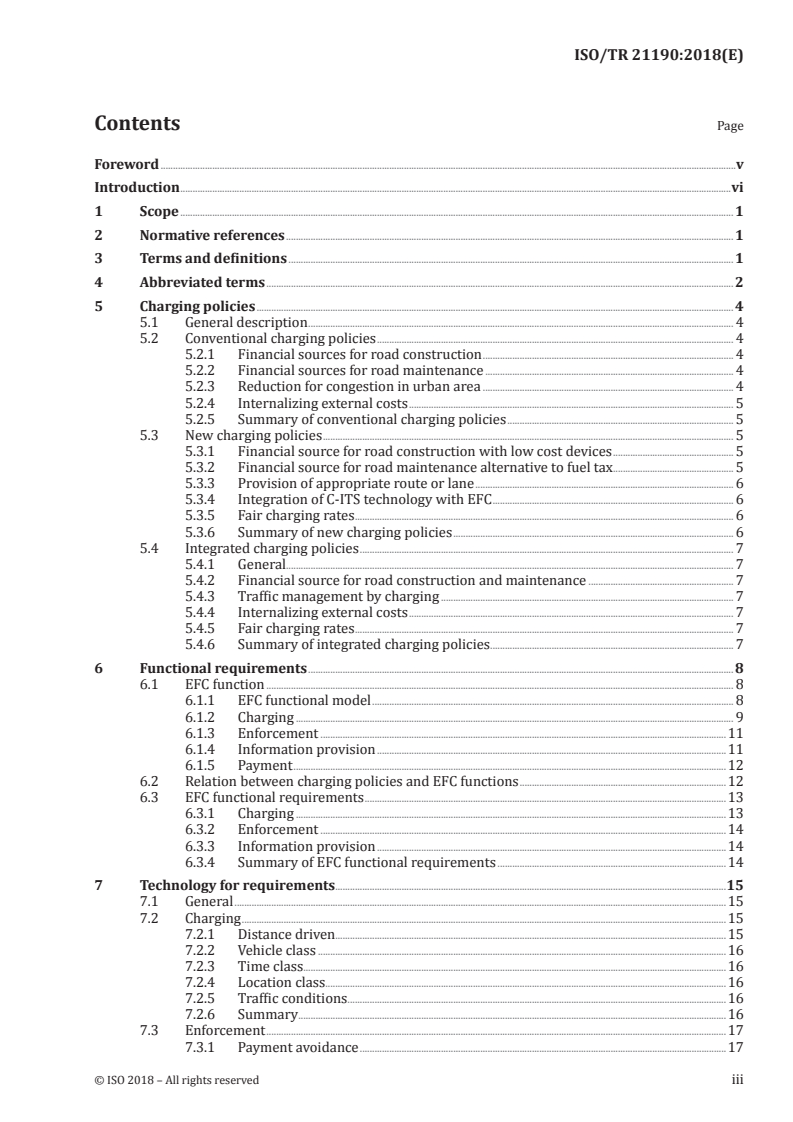
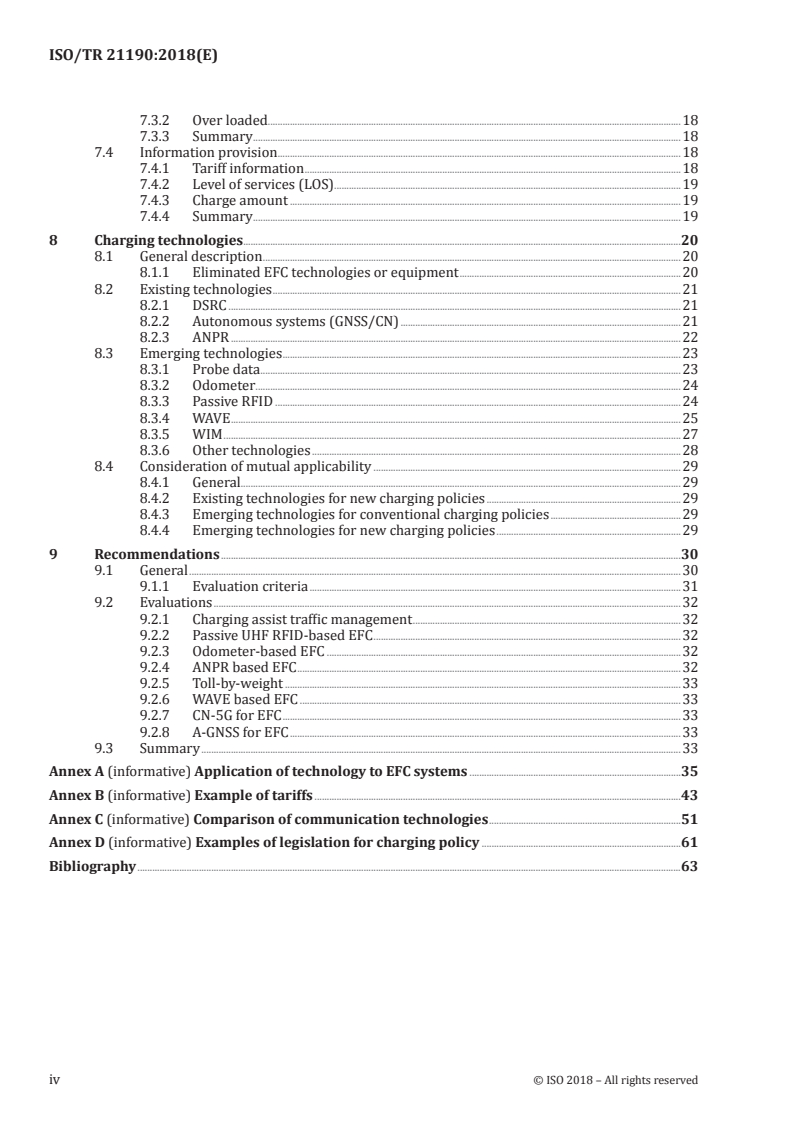
Contents Page
Foreword .v
Introduction .vi
1 Scope . 1
2 Normative references . 1
3 Terms and definitions . 1
4 Abbreviated terms . 2
5 Charging policies . 4
5.1 General description . 4
5.2 Conventional charging policies . 4
5.2.1 Financial sources for road construction . 4
5.2.2 Financial sources for road maintenance . 4
5.2.3 Reduction for congestion in urban area . 4
5.2.4 Internalizing external costs . 5
5.2.5 Summary of conventional charging policies . 5
5.3 New charging policies . 5
5.3.1 Financial source for road construction with low cost devices . 5
5.3.2 Financial source for road maintenance alternative to fuel tax . 5
5.3.3 Provision of appropriate route or lane . 6
5.3.4 Integration of C-ITS technology with EFC . 6
5.3.5 Fair charging rates . 6
5.3.6 Summary of new charging policies . 6
5.4 Integrated charging policies . 7
5.4.1 General. 7
5.4.2 Financial source for road construction and maintenance . 7
5.4.3 Traffic management by charging . 7
5.4.4 Internalizing external costs . 7
5.4.5 Fair charging rates . 7
5.4.6 Summary of integrated charging policies . . 7
6 Functional requirements . 8
6.1 EFC function . 8
6.1.1 EFC functional model . 8
6.1.2 Charging . 9
6.1.3 Enforcement .11
6.1.4 Information provision .11
6.1.5 Payment .12
6.2 Relation between charging policies and EFC functions .12
6.3 EFC functional requirements .13
6.3.1 Charging .13
6.3.2 Enforcement .14
6.3.3 Information provision .14
6.3.4 Summary of EFC functional requirements .14
7 Technology for requirements.15
7.1 General .15
7.2 Charging .15
7.2.1 Distance driven.15
7.2.2 Vehicle class .16
7.2.3 Time class.16
7.2.4 Location class.16
7.2.5 Traffic conditions . .16
7.2.6 Summary .16
7.3 Enforcement .17
7.3.1 Payment avoidance .17
7.3.2 Over loaded.18
7.3.3 Summary .18
7.4 Information provision .18
7.4.1 Tariff information .18
7.4.2 Level of services (LOS) . .19
7.4.3 Charge amount .19
7.4.4 Summary .19
8 Charging technologies .20
8.1 General description .20
8.1.1 Eliminated EFC technologies or equipment .20
8.2 Existing technologies .21
8.2.1 DSRC .21
8.2.2 Autonomous systems (GNSS/CN) .21
8.2.3 ANPR .22
8.3 Emerging technologies .23
8.3.1 Probe data .23
8.3.2 Odometer .24
8.3.3 Passive RFID .24
8.3.4 WAVE .25
8.3.5 WIM .27
8.3.6 Other technologies .28
8.4 Consideration of mutual applicability .29
8.4.1 General.29
8.4.2 Existing technologies for new charging policies .29
8.4.3 Emerging technologies for conventional charging policies .29
8.4.4 Emerging technologies for new charging policies .29
9 Recommendations .30
9.1 General .30
9.1.1 Evaluation criteria .31
9.2 Evaluations .32
9.2.1 Charging assist traffic management .32
9.2.2 Passive UHF RFID-based EFC .32
9.2.3 Odometer-based EFC .32
9.2.4 ANPR based EFC .32
9.2.5 Toll-by-weight .33
9.2.6 WAVE based EFC .33
9.2.7 CN-5G for EFC .33
9.2.8 A-GNSS for EFC .33
9.3 Summary .33
Annex A (informative) Application of technology to EFC systems .35
Annex B (informative) Example of tariffs .43
Annex C (informative) Comparison of communication technologies .51
Annex D (informative) Examples of legislation for charging policy .61
Bibliography .63
iv © ISO 2018 – All rights reserved
Foreword
ISO (the International Organization for Standardization) is a worldwide federation of national standards
bodies (ISO member bodies). The work of preparing International Standards is normally carried out
through ISO technical committees. Each member body interested in a subject for which a technical
committee has been established has the right to be represented on that committee. International
organizations, governmental and non-governmental, in liaison with ISO, also take part in the work.
ISO collaborates closely with the International Electrotechnical Commission (IEC) on all matters of
electrotechnical standardization.
The procedures used to develop this document and those intended for its further maintenance are
described in the ISO/IEC Directives, Part 1. In particular, the different approval criteria needed for the
different types of ISO documents should be noted. This document was drafted in accordance with the
editorial rules of the ISO/IEC Directives, Part 2 (see www .iso .org/directives).
Attention is drawn to the possibility that some of the elements of this document may be the subject of
patent rights. ISO shall not be held responsible for identifying any or all such patent rights. Details of
any patent rights identified during the development of the document will be in the Introduction and/or
on the ISO list of patent declarations received (see www .iso .org/patents).
Any trade name used in this document is information given for the convenience of users and does not
constitute an endorsement.
For an explanation of the voluntary nature of standards, the meaning of ISO specific terms and
expressions related to conformity assessment, as well as information about ISO's adherence to the
World Trade Organization (WTO) principles in the Technical Barriers to Trade (TBT) see www .iso
.org/iso/foreword .html.
This document was prepared by Technical Committee ISO/TC 204, Intelligent transport systems.
Any feedback or questions on this document should be directed to the user’s national standards body. A
complete listing of these bodies can be found at www .iso .org/members .html.
Introduction
An electronic fee collection (EFC) system, introduced in many countries around the world, is used for
collecting road construction funds or repaying loans for construction of toll roads. Toll roads have
enabled large-capacity and high-speed movement of people and goods, and contributed greatly to
social and economic development in the introduced countries. As an internalization of external costs
for road pavement damage by heavy goods vehicles (HGV), HGV charging has been introduced in
member countries widely under the support of the European Commission. EFC is also effectively used
for mitigating congestion in urban area as a traffic management measure.
The EFC technology that realizes these charging policies is classified as dedicated short-range
communication (DSRC)-based system and autonomous system, and EFC systems developed based
on these major standards have been introduced in countries all over the world. In addition to the
above charging policies and technologies, several important new charging policies realized by new
technologies are planned and trial operations are being carried out.
In Tokyo metropolitan area, road users can use smart route selection from among several optional
routes according to their judgment of whether a priority given to reduction of travel time or priority
to charge amount. As another new policy, several pilot operations of road usage charging have been
introduced in the United States to raise funds for road maintenance as an alternative for the current
fuel tax.
These new charging policies can make road users more convenient or road maintenance sustainable in
accordance with evolution of technologies. As an another example of new charging policy, there is the
managed lane such as high occupancy tolling/high occupancy vehicle (HOT/HOV) lane which is already
operated in the United States, where it can be used for free with a certain number of crew members,
but paying the fee with existing charging technology enable road users to use it even under a certain
number of crew members.
In this document, the relationship between charging policies and EFC technologies are investigated in
order to propose future standardization themes.
Table 1 shows the major charging systems realized from charge policy and EFC technology.
Table 1 — Major charging systems realized from charging policy and EFC technology
Charging policies
Conventional charging policy New charging policy
EFC technologies
— Toll road charging (ETC)
Existing technology — HGV charging — Managed lane (HOT/HOV)
— Congestion charging
— Smart route selection
(Applicable to the above charging
Emerging technology
systems)
— Road usage charging (RUC)
vi © ISO 2018 – All rights reserved
TECHNICAL REPORT ISO/TR 21190:2018(E)
Electronic fee collection — Investigation of charging
policies and technologies for future standardization
1 Scope
This document investigates the stemming from requirements of charging policies and corresponding
charging technologies in order to propose future standardization theme candidates.
This document reports the findings of the investigation of charging policies and technologies in order to:
— Classify the conventional charging policies and the new charging policies and their functional
requirements.
— Classify the existing technologies and the emerging technologies to be used for EFC services or
other intelligent transport system (ITS) services.
— Conduct a gap analysis between the needs of the new charging policies and the existing standardized
technologies for EFC.
— Recommend development of emerging standards or amendments for existing EFC standards
according to the results of the gap analysis.
Figure 1 shows the process for preparing this document and the scope.
Figure 1 — Scope and process flow of this document
2 Normative references
There are no normative references in this document.
3 Terms and definitions
For the purposes of this document, the following terms and definitions apply.
ISO and IEC maintain terminological databases for use in standardization at the following addresses:
— ISO Online browsing platform: available at https: //www .iso .org/obp
— IEC Electropedia: available at http: //www .electropedia .org/
3.1
level of service
LOS
rating of the quality of transportation facilities and services from the user’s perspective, which refers
to the speed, convenience and comfort to evaluate problems and potential solutions
3.2
open payment
system that uses open interfaces for validating payment
3.3
passive RFID
RFID system, where the OBU is a passive-backscattering device
3.4
passive ultra high frequency RFID
passive UHF RFID
passive RFID, operating in the 860 MHz to 960 MHz frequency range
Note 1 to entry: Note 1 to entry: Passive UHF RFID as defined in ISO/IEC 18000-63 unless otherwise
specifically stated.
3.5
transport performance requirement
needed level of service related to a set of operational goals and performance measures, e.g. speed, travel
time, freedom to manoeuvre, traffic interruptions, comfort or convenience
3.6
radio frequency identification
RFID
wireless non-contact system that uses radio-frequency electromagnetic fields to transfer data from an
OBU attached to an object, for the purposes of automatic identification and tracking
Note 1 to entry: Adapted from ISO/TS 16791:2014, 3.1.24.
4 Abbreviated terms
For the purposes of this document, the following abbreviated terms apply.
A-GNSS Authenticated GNSS
AES Advanced Encryption Standard
AET All Electronic Tolling
ANPR Automatic Number Plate Recognition
ASTM American Society for Testing and Materials
CCC Compliance check communication for autonomous systems (ISO 12813)
C-ITS Cooperative – ITS
CN Cellular Network
2 © ISO 2018 – All rights reserved
rd
CN-3G Cellular Network 3 Generation
th
CN-4G Cellular Network 4 Generation
th
CN-5G Cellular Network 5 Generation
COST European Cooperation in Science and Technology
DOT Department of Transportation
DSRC Dedicated Short-Range Communication (ISO 14906)
EPC Electronic Product Code
FETC Far Eastern Electronic toll Collection
GNSS Global Navigation Satellite System
HGV Heavy Goods Vehicle
HMI Human Machine Interface
HOT High Occupancy Tolling
HOV High Occupancy Vehicle
IAG Inter-Agency Group
IMT International Mobile Telecommunication
ITU International Telecommunication Union
KEC Korean Expressway Coporation
LAC Localisation augmentation communication (ISO 13141)
LEZ Low Emission Zone
LOS Level Of Services
MLIT Ministry of Land Infrastructure and Transport
OBD On-Board Diagnostics
PCU Passenger Car Unit equivalent
RFID Radio Frequency Identification
RUC Road Usage Charging
TANFB Taiwan Area National Freeway Bureau
UHF Ultra High Frequency
WAVE Wireless Access in Vehicular Environments
WIM Weigh-In-Motion
5 Charging policies
5.1 General description
Road networks are the most important infrastructure of land transportation to support social economic
activities such as, among others, freight transportation, human mobility and emergency transportation
activities in disaster relief. While road charging has been applied as a means of raising funds for the
construction, the maintenance and the operation for those road networks, it has been also applied to
reduce congestion in urban areas as a means of traffic management.
On the other hand, vehicles using the road networks generate external costs such as air pollution
caused by running exhaust gas and deterioration of the living environment due to noise. For this
reason, policies are being studied to make these external costs associated with road transport be borne
by those who cause these factors. For charging to HGV especially in Europe, the policy was enacted by
European Directive (2011/76/EU) to allow the charge amount to include external costs in addition to
road network construction and maintenance fees.
The legal systems concerning road charging have already been enacted in each country where they are
introduced to realize charging policies, and examples of legislation in major regions and countries are
shown in Annex D.
It has to be noted that, although in general a policy is technology agnostic, in some cases a policy
addresses one specific technology for reasons that are not of an engineering nature, as for example
when technology is mandated due to economic reasons. This is reflected in some cases later on.
5.2 Conventional charging policies
5.2.1 Financial sources for road construction
Construction of road networks requires a great deal of funds, therefore road operators construct them
by borrowing funds from financial institutions that should be repaid by collecting tolls from the road
users during a predetermined fixed period of time. Even if the loan repayment is completed, the toll
charging will be continued in order to pay for road maintenance and facility management in some cases.
The so called “shadow tolling”, i.e. using general tax revenues to repay for road construction and
maintenance with no explicit road toll collected road users, is outside the scope of this document.
5.2.2 Financial sources for road maintenance
HGVs registered in other countries drive on the highways or the general roads of the home country,
so that the road damage caused by these HGVs has caused serious problems in European countries.
These situations made it possible to charge even for the vehicle of other nationalities that carry out the
international road transport by European Directive (1999/62/EC).
Based on this European Directive, HGV charging aiming for environmental protection started in
Switzerland in 2001. Since then, HGV charging operations started in Austria in 2004, in Germany in
2005, and in the Czech Republic in 2007. Fee revenues in these countries using mainly the financial
resources for road maintenance, have been also been used for some rail network maintenance and
waterway maintenance.
5.2.3 Reduction for congestion in urban area
Economic losses caused by traffic congestion in urban areas is a serious problem, therefore it has been
shown theoretically that the traffic volume can be reduced by introducing charging in the selected
areas. The theory has been demonstrated in an actual operation in Singapore since 1998, followed by
London in 2003, and Stockholm in 2006, where environmental improvements were reported along with
reduction in traffic volume. The fee revenues are used for both road construction and improvement of
public transportation.
4 © ISO 2018 – All rights reserved
In Singapore, traffic volume has been controlled by varying the charging rates to keep traveling speed
within the pre-defined range based on the measurement of the traffic situation every three months.
5.2.4 Internalizing external costs
Internalisation of external costs is based on the principle that the users of the road network pay the
costs that each road user imposes on the society and the other road users. These costs are related to
accidents, congestion, noise, environment and road wear. In a theoretically correct road use charging
system, any road user should pay the costs imposed on the society. This is difficult to implement
completely and some simplified variants have been implemented for many years.
The above mentioned congestion charging and some part of HGV charging may be included in this
item theoretically, but this clause describes from the viewpoint of environmental protection. Low
emission zones (LEZ) focus on the environment and the main objective of LEZ is to reduce the pollution
caused by vehicles using fossil energy by means of EFC where the tariffs reflect the vehicle pollution
characteristics.
LEZ has been introduced in many cities in Europe and its effects have been confirmed. Taking into
account the impact on citizens’ health from the traffic noise, comprehensive countermeasures are
considered by European Directive (2002/49/EC) such as Q-Zone in the city centres where only electric
vehicles will be allowed to circulate.
The environmental impact caused in Switzerland by truck traffic between Germany and Italy was
determined as a serious problem, therefore a toll schema for HGV weighing 3,5 t or more was introduced
in 2001. The charge revenue was used to the construction funds for a new tunnel that enables goods
transportation to be diverted from trucks to railways.
5.2.5 Summary of conventional charging policies
The charging policies discussed above are categorized based on their objectives as shown in Table 2.
Table 2 — Conventional charging policies
Charging policy Method
1. Financial source for road To charge for all vehicles with tolls depending on the
construction impact of vehicles on the road.
2. Financial source for road To raise funds for road maintenance or reconstruc-
maintenance tion by charging for HGV in use.
3. Reduction for congestion in To charge for all vehicles circulating in the area.
urban areas
4. Internalizing external costs To charge for all vehicles with tolls depending on the
impact of vehicles on the environment.
5.3 New charging policies
5.3.1 Financial source for road construction with low cost devices
In developing countries, the need for repayment of road construction costs by EFC is hindered by the
cost of EFC equipment, especially the OBE. A new charging policy is to charge all vehicles using low-cost,
high-performance devices such as passive (UHF) RFID, which have been developing in recent years.
5.3.2 Financial source for road maintenance alternative to fuel tax
While many countries have been reliant on the fuel tax to finance road maintenance, fuel tax revenues
are in a downward trend due to the recent spread of high fuel efficiency cars and electric vehicles. In the
USA road usage charging to substitute the fuel tax has been studied for the past 10 years, and the field
operation test of road usage charging to use odometer and other methods has been carried out since
July 2016. A new policy is to replace the fuel tax by road usage charging based on the travelled distance.
5.3.3 Provision of appropriate route or lane
In Tokyo metropolitan area, while construction of a road network composed of plural radial roads
and plural ring roads has been progressed, a dynamic charging scheme depending on the degree of
congestion has been studied for selecting an appropriate route to destination for avoiding traffic jams
in the central Tokyo area. As for measurement of traffic flow, probe data from the global navigation
satellite system (GNSS) receiver equipped in-vehicle unit is expected to carry out vehicle tracking in
addition to the conventional vehicle detectors.
In the United States as a return of charging to a specific lane of the inter-urban roads, a minimum
traveling speed and travelling time to destination are guaranteed to some extent. For this reason,
charging rate is determined based on the traffic volume measured by every predetermined time
interval (for example, 5 min). This specific lane is called a managed lane or HOT lane and also serves as
an HOV lane where cars with a certain number or more of occupants are allowed to pass through free of
charge. A new policy is thus to manage traffic flows by modulating tolls.
5.3.4 Integration of C-ITS technology with EFC
C-ITS stations have been introduced in vehicles for safety applications, but could also be used for tolling
applications. While this has not be done so far, in the near future a new policy that requires using the
same communication media for all vehicle applications including tolling can be expected.
5.3.5 Fair charging rates
As vehicle caused damage to road pavement is said to be proportional to the fourth or fifth power of
the axle load, the charging rates adopted for toll roads in the world are generally proportional to the
number of vehicle axles. While it could be acceptable for full loaded vehicles to be charged based on the
number of axles, a fairness problem arises in the case of empty vehicles which are charged at the same
charge rate as when they are full loaded.
A new policy that regulates the toll rate based on the actual gross vehicle weight would overcome this
problem of fairness.
5.3.6 Summary of new charging policies
New charging policies are categorized based on their objectives, as shown in Table 3.
Table 3 — New charging policies
Charging policy Method
1. Financial source for road To repay the road construction and the maintenance costs by charging
construction with low cost devices all vehicles with low cost devices.
2. Financial source for road To charge for all vehicles using public roads based on vehicle miles
maintenance alternative to fuel travelled as an alternative to the fuel tax.
tax
3. Provision of appropriate route or To induce the appropriate route in metropolitan areas or appropriate
lane lane in inter-urban roads by varying toll tariffs based on the road traf-
fic and notifying the road user.
4. Integration of C-ITS technology To bring all in-vehicle applications including road charging, to use the
with EFC same hardware and communication media.
5. Fair charging rates To define charge rate based on the gross vehicle weight.
6 © ISO 2018 – All rights reserved
5.4 Integrated charging policies
5.4.1 General
The same charging policy can be achieved by different charging methods, and the same charging
methods could achieve different charging policies. Table 4 at the end of this clause shows an integration
of the conventional charging policies and the new charging policies. In the following clauses the
charging policies and how they can be achieved by different charging methods are described.
5.4.2 Financial source for road construction and maintenance
There are three different policies to reach this objective. Each of them is based on raising funds by
charging every vehicle, however they may lead to different technological choices. The first policy is to
use conventional equipment (OBE on board of vehicles), the second one dictates the use of low cost
equipment such as to impose specific low cost technologies such as passive RFID, while the last policy
imposes using the same hardware and communication equipment for all ITS applications, including
tolling. A further differentiation lies in applying a toll to all roads to ensure their maintenance, or to
special roads that offer a higher level of service.
5.4.3 Traffic management by charging
There are three kinds of policies to reach this policy objective. The first one is to apply charging to
reduce congestion in urban roads. The second one is to differentiate routes in a metropolitan area by
dynamic charging. The last one is to differentiate lanes in inter-urban roads by dynamic charging.
5.4.4 Internalizing external costs
A full internalisation of the external costs is not feasible today but could become feasible in the future
when data collection and data management enable it. In the meantime, several policies are implemented
to achieve internalisation of parts of all the parameters covering the external costs such as road wear,
pollution and congestion.
For implementing such policies a coordinated usage of charging and enforcement technologies is
necessary, e.g. based on passive UHF RFID and ANPR technologies.
5.4.5 Fair charging rates
From a road maintenance viewpoint, a charging policy of toll-by-weight is the best solution in that
charging rate is dependent on a degree of road damage caused by the weight of vehicles. However, a
technology to effectively adopt such a policy has not yet been deployed widely.
On the other hand in urban congestion charging, it has to be noted that a fair charging rate should be
proportional to the vehicle occupancy to the road. This means that fairness can be reached through
different policies and different technologies according to the type of charging objectives.
5.4.6 Summary of integrated charging policies
Table 4 integrates all policies described so far in terms of the policy objectives that have been described.
Table 4 — Integrated charging policies (new charging policies indicated by shaded cells)
Charging policy Method
1. Financial To charge all vehicles with conventional equipment for using toll
source for road roads.
construction and/
To charge all vehicles with low cost equipment for using toll roads.
or maintenance
To charge all vehicles using available C-ITS equipment for using
toll roads.
To charge only HGVs for using the roads (HGV charging).
To charge all vehicles based on the actual distance travelled for
using the roads (Road usage charging).
2. Traffic To charge all vehicles in urban roads to mitigate congestion (Con-
management by gestion charging).
charging
Induce the route selection in metropolitan areas by dynamic charg-
ing (Smart route selection).
Induce lane selection in inter-urban roads by dynamic charging
(Managed lane).
3. Internalizing To charge all vehicles based on the accidents, delays, noise, pol-
external costs lution and road wear each vehicle imposes on society and other
vehicles.
4. Fair charge rate To define charge rate based on the gross vehicle weight.
6 Functional requirements
6.1 EFC function
6.1.1 EFC functional model
EFC functions to realize each charging policy are composed of charging, payment, information provision
and enforcement. Communications including DSRC, CN and other ground communications are not a
function of EFC but media to combine each function that is performed by front-end equipment such
as RSE or OBE, or back-end equipment so as to achieve functionality of EFC. Securities are applied for
protection of information being communicated through media.
As a counter function to charging, payment is an essential function of EFC in which users have to pay
a claimed charge amount determined by charging. Two payment modes are already established and
categorized as on-board account and central account where necessary themes have already been
standardized. Though there is open payment as a new policy for a payment system, they should be out
of scope because they have already been studied for standardization in other work items.
Figure 2 shows an image of EFC functions and their relations.
8 © ISO 2018 – All rights reserved
Figure 2 — EFC functional model
6.1.2 Charging
Charging is the most important function of EFC that determines an amount road users are charged.
The main factor of charging is the distance driven and the distance unit price, and a charge amount
is then multiplied by these two items. The distance unit price is also called tariff information, and is
determined by a combination of vehicle class, user class, time class, location class, etc., based on the
charging policy.
6.1.2.1 Distance driven
There are two methods to measure distance driven, one is a direct measurement performed by a
vehicle sensor, and the other is an indirect measurement performed by cooperating GNSS positioning
data and the road map database. Other methods, e.g. route ticket or self-declaration, are
...
Questions, Comments and Discussion
Ask us and Technical Secretary will try to provide an answer. You can facilitate discussion about the standard in here.
Loading comments...