


ISO 7765-2:2025
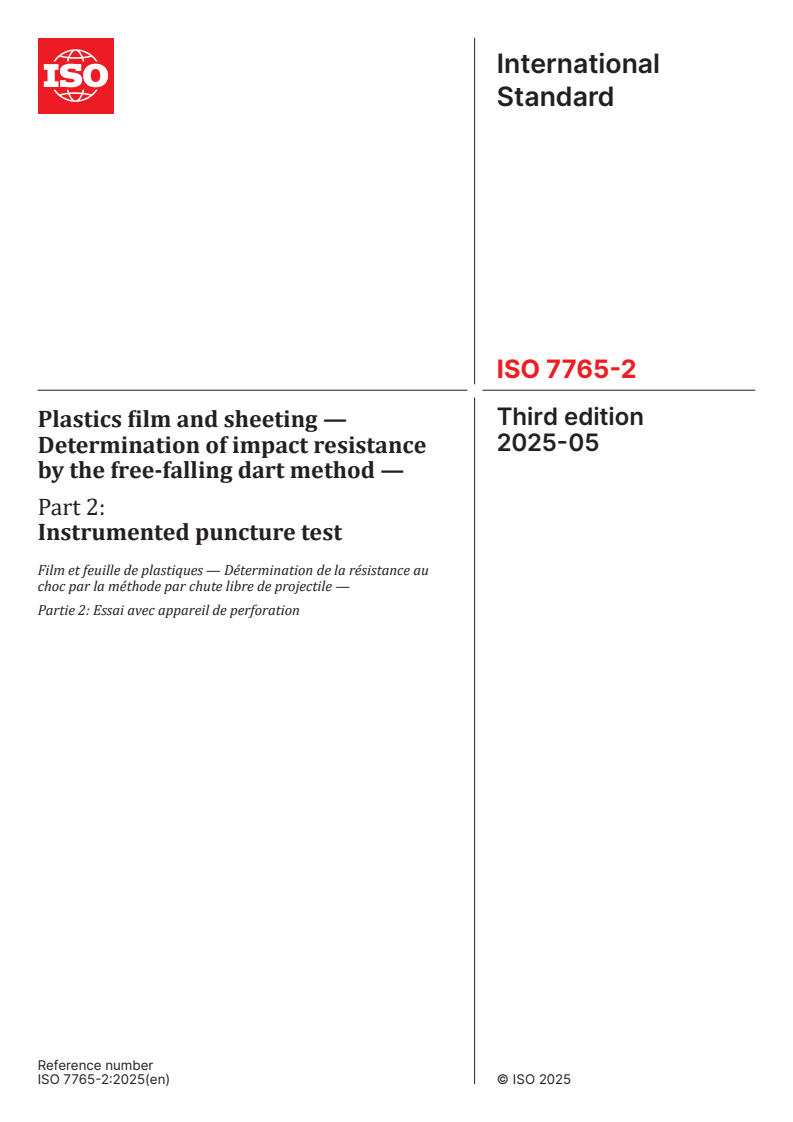
(Main)Plastics film and sheeting — Determination of impact resistance by the free-falling dart method — Part 2: Instrumented puncture test
Plastics film and sheeting — Determination of impact resistance by the free-falling dart method — Part 2: Instrumented puncture test
This document specifies a test method for the determination of puncture impact properties of a plastic film using instruments for measuring force and deflection. It is applicable if a force-deflection or force-time diagram, recorded at nominally constant striker velocity, is required for detailed characterization of the impact behaviour. This test method is also used when a small number of test specimens are available, and the staircase method described in the ISO 7765-1 cannot be applied. The test method is applicable to films of up to 1 mm thickness and makes it possible to compare impact-penetration forces, biaxial deformabilities and energy-absorption capacities of films. Also, the transition region between brittle and tough behaviour of the film under the conditions of testing can be determined by varying the temperature or the penetration velocity or the relative humidity.[ REF Reference_ref_7 \r \h 4 08D0C9EA79F9BACE118C8200AA004BA90B0200000008000000100000005200650066006500720065006E00630065005F007200650066005F0037000000 ]
Film et feuille de plastiques — Détermination de la résistance au choc par la méthode par chute libre de projectile — Partie 2: Essai avec appareil de perforation
General Information
- Status
- Published
- Publication Date
- 28-May-2025
- Technical Committee
- ISO/TC 61/SC 11 - Products
- Drafting Committee
- ISO/TC 61/SC 11/WG 3 - Plastics films and sheeting
- Current Stage
- 6060 - International Standard published
- Start Date
- 29-May-2025
- Due Date
- 27-Sep-2025
- Completion Date
- 29-May-2025
Relations
- Effective Date
- 21-Oct-2023
Overview
ISO 7765-2:2025 - Plastics film and sheeting - Determination of impact resistance by the free-falling dart method - Part 2: Instrumented puncture test specifies an instrumented puncture test for measuring puncture impact properties of plastic films. The method records force–deflection or force–time diagrams at a nominally constant striker velocity and is applicable to films up to 1 mm thickness. It is intended where detailed characterization of impact behaviour is required or when only a small number of specimens are available (i.e., the staircase method of ISO 7765-1 is not suitable).
Key topics and technical requirements
- Test principle: Free-falling striker (dart) impacts a clamped film while instruments record force and deflection at near-constant striker velocity.
- Measured outputs: Force–deflection and force–time diagrams, peak penetration forces, energy-absorption capacities and biaxial deformability.
- Apparatus components:
- Test device and energy carrier
- Striker (dart)
- Clamping device for specimens
- Instruments for force measurement and deflection measurement
- Thickness gauge and conditioning equipment
- Specimen handling: Sampling, preparation, conditioning and a specified test atmosphere are defined to ensure comparable results.
- Result reporting and calculations: Procedures for expressing impact-penetration forces, absorbed energy and transition behaviour between brittle and tough failure modes.
- Scope for variable conditions: Allows determination of the brittle–tough transition region by varying temperature, penetration velocity or relative humidity.
- Precision and test report: Sections on reproducibility/precision and the required elements of the test report are included.
Practical applications and users
- Who uses it:
- Materials and packaging manufacturers for product development and QC
- Independent test laboratories and certification bodies
- R&D teams evaluating polymer formulations, additives or multilayer constructions
- Industries where film puncture performance is critical (packaging, medical films, automotive interior films, agricultural films, protective covers)
- Why use it:
- To obtain detailed dynamic response data (force–deflection/force–time) beyond a single failure energy value
- To compare energy absorption and deformability across materials and thicknesses (≤1 mm)
- To assess environmental effects (temperature, humidity) and impact speed on puncture resistance
- To test limited numbers of specimens where staircase methods are impractical
Related standards
- ISO 7765-1 - Plastics film and sheeting - Determination of impact resistance by the free-falling dart method - Part 1: (staircase method) - for single-value failure-energy testing.
- Other parts of the ISO 7765 series for complementary impact-resistance testing and reporting.
Keywords: ISO 7765-2:2025, plastics film, impact resistance, free-falling dart, instrumented puncture test, puncture impact properties, force–deflection, energy absorption.
Get Certified
Connect with accredited certification bodies for this standard

Smithers Quality Assessments
US management systems and product certification.

DIN CERTCO
DIN Group product certification.
Sponsored listings
Frequently Asked Questions
ISO 7765-2:2025 is a standard published by the International Organization for Standardization (ISO). Its full title is "Plastics film and sheeting — Determination of impact resistance by the free-falling dart method — Part 2: Instrumented puncture test". This standard covers: This document specifies a test method for the determination of puncture impact properties of a plastic film using instruments for measuring force and deflection. It is applicable if a force-deflection or force-time diagram, recorded at nominally constant striker velocity, is required for detailed characterization of the impact behaviour. This test method is also used when a small number of test specimens are available, and the staircase method described in the ISO 7765-1 cannot be applied. The test method is applicable to films of up to 1 mm thickness and makes it possible to compare impact-penetration forces, biaxial deformabilities and energy-absorption capacities of films. Also, the transition region between brittle and tough behaviour of the film under the conditions of testing can be determined by varying the temperature or the penetration velocity or the relative humidity.[ REF Reference_ref_7 \r \h 4 08D0C9EA79F9BACE118C8200AA004BA90B0200000008000000100000005200650066006500720065006E00630065005F007200650066005F0037000000 ]
This document specifies a test method for the determination of puncture impact properties of a plastic film using instruments for measuring force and deflection. It is applicable if a force-deflection or force-time diagram, recorded at nominally constant striker velocity, is required for detailed characterization of the impact behaviour. This test method is also used when a small number of test specimens are available, and the staircase method described in the ISO 7765-1 cannot be applied. The test method is applicable to films of up to 1 mm thickness and makes it possible to compare impact-penetration forces, biaxial deformabilities and energy-absorption capacities of films. Also, the transition region between brittle and tough behaviour of the film under the conditions of testing can be determined by varying the temperature or the penetration velocity or the relative humidity.[ REF Reference_ref_7 \r \h 4 08D0C9EA79F9BACE118C8200AA004BA90B0200000008000000100000005200650066006500720065006E00630065005F007200650066005F0037000000 ]
ISO 7765-2:2025 is classified under the following ICS (International Classification for Standards) categories: 83.140.10 - Films and sheets. The ICS classification helps identify the subject area and facilitates finding related standards.
ISO 7765-2:2025 has the following relationships with other standards: It is inter standard links to ISO 7765-2:2022. Understanding these relationships helps ensure you are using the most current and applicable version of the standard.
ISO 7765-2:2025 is available in PDF format for immediate download after purchase. The document can be added to your cart and obtained through the secure checkout process. Digital delivery ensures instant access to the complete standard document.
Standards Content (Sample)
International
Standard
ISO 7765-2
Third edition
Plastics film and sheeting —
2025-05
Determination of impact resistance
by the free-falling dart method —
Part 2:
Instrumented puncture test
Film et feuille de plastiques — Détermination de la résistance au
choc par la méthode par chute libre de projectile —
Partie 2: Essai avec appareil de perforation
Reference number
All rights reserved.
ISO publications, in their entirety or in fragments, are owned by ISO. They are licensed, not sold, and are subject to the
terms and conditions set forth in the ISO End Customer License Agreement, the License Agreement of the relevant ISO
member body, or those of authorized third-party distributors.
Unless otherwise specified or required for its implementation, no part of this ISO publication may be reproduced,
distributed, modified, or used in any form or by any means, electronic or mechanical, including photocopying, scanning,
recording, or posting on any intranet, internet, or other digital platforms, without the prior written permission of ISO,
the relevant ISO member body or an authorized third-party distributor.
This publication shall not be disclosed to third parties, and its use is strictly limited to the license type and purpose
specified in the applicable license grant. Unauthorized reproduction, distribution, or use beyond the granted license is
prohibited and may result in legal action.
ISO copyright office
CP 401 • Ch. de Blandonnet 8
CH-1214 Vernier, Geneva
Phone: +41 22 749 01 11
Email: copyright@iso.org
Website: www.iso.org
Published in Switzerland
Licensing and use terms
As stated above, ISO documents, as well as any updates and/or corrections, and any intellectual property or
other rights pertaining thereto, are owned by ISO. ISO documents are licensed, not sold. This document does
not in any way operate to assign or transfer any intellectual property rights from ISO to the user. ISO
documents are protected by copyright law, database law, trademark law, unfair competition law, trade secrecy
law, and any other applicable law. Users acknowledge and agree to respect ISO’s intellectual property rights
in the ISO documents.
The use of ISO documents is subject to the terms and conditions of the applicable licence agreement.
ISO documents are provided under different licensing agreement types (“Licence Type”) allowing a non-
exclusive, non-transferable, limited, revocable right to use/access the ISO documents for one or more of the
purposes described below (“Purpose”), which may be internal or external in scope. The applicable Purpose(s)
must be agreed in the purchase order and/or in the applicable licence agreement.
a) Licence Type:
1) Single registered end-user licence (watermarked in the user’s name) for the specified Purpose. Under
this license, the user cannot share the ISO document with a third party, including on a network.
2) Network licence for the specified Purpose. The network licence can be assigned to either unnamed
concurrent end-users or named concurrent end-users within the same organization.
ii
b) Purpose:
1) Internal Purpose. Internal use only within the user’s organization, including but not limited to own
implementation (“Internal Purpose”).
The scope of permitted internal use is specified at the time of purchase or through subsequent
agreement with ISO, the ISO member body in the user’s country, any other ISO member body or an
authorized third-party distributor, including any applicable internal use rights (such as for internal
meetings, internal training programmes, preparation of certification services, for integration or
illustration in internal manuals, internal training materials, and internal guidance documents). Each
internal use must be explicitly specified in the purchase order and/or in the applicable licence
agreement, and specific fees and requirements apply to each permitted use.
2) External Purpose. External use, including but not limited to:
— testing services;
— inspection services;
— certification services;
— auditing services;
— consulting services;
— conformity assessment scheme development and implementation;
— training services;
— education;
— research;
— software development and other digital platform or software-enabled digital services;
— any other services or activities conducted by the user or the user’s organization to third parties,
whether for commercial or non-commercial purposes (“External Purpose”).
The scope of permitted external use is specified at the time of purchase or through subsequent
agreement with ISO, the ISO member body in the user’s country, any other ISO member body or an
authorized third-party distributor, including any applicable external use rights (e.g. in publications,
products, or services marketed and sold by the user/the user’s organization). Each external use must
be explicitly specified in the purchase order and/or in the applicable licence agreement, and specific
fees and requirements apply to each permitted use.
Unless users have been granted use rights according to the above provisions, they are not granted the right to
share or sublicense ISO documents inside or outside their organization for either Purpose. If users wish to
obtain additional use rights for ISO documents or their content, users can contact ISO or the ISO member body
in their country to explore possible options.
If the user or the user’s organization is granted a licence for the External Purpose of providing any of the
following services to third parties:
— testing services;
— inspection services;
ii(bis)
— certification services;
— auditing services;
— consulting services,
and if any of these five (5) services reference, rely upon, incorporate, or otherwise make use of any aspect,
requirement, provision, or any other information of any ISO document, the user or the user’s organization
agrees to verify that the third party receiving such services has obtained from the ISO member body in their
country, any other ISO member body, ISO or an authorized third-party distributor, a valid licence for its own
implementation of such ISO document or other use related to such services. This verification obligation must
be included in the applicable licence agreement obtained by the user or the user’s organization.
ISO documents must not be disclosed to third parties, and users must use them solely for the purpose specified
in the purchase order and/or applicable licensing agreement. Unauthorized disclosure or use of ISO
documents beyond the licensed purpose is prohibited and can result in legal action.
Use restrictions
Except as provided for in the applicable licence agreement and subject to a separate licence by ISO, the ISO
member body in the user’s country, any other ISO member body or an authorized third-party distributor, users
are not granted the right to:
— use ISO documents for any purpose other than the Purpose;
— grant use or access rights to ISO documents beyond the Licence Type;
— disclose ISO documents beyond the intended Purpose and/or Licence Type;
— sell, lend, lease, reproduce, distribute, import/export or otherwise commercially exploit ISO documents.
In the case of documents that are joint publications (such as ISO/IEC documents), this clause applies to
the respective joint copyright ownership;
— assign or otherwise transfer ownership of ISO documents, in whole or in part, to any third party.
Regardless of the Licence Type or Purpose for which users are granted access and use rights for ISO
documents, users are not permitted to access or use any ISO documents, in whole or in part, for any machine
learning and/or artificial intelligence and/or similar purposes, including but not limited to accessing or using
them
a) as training data for large language or similar models, or
b) for prompting or otherwise enabling artificial intelligence or similar tools to generate responses.
Such use is only permitted if expressly authorized through a specific licence agreement by the ISO member
body in the requester’s country, another ISO member body, or ISO. Requests for such authorization are
considered on a case-by-case basis to ensure compliance with intellectual property rights. Specifically, it is not
possible to claim the benefit of copyright exception of Article 4 of the Directive (EU) 2019/790 of the European
Parliament and of the Council of 17 April 2019 on copyright and related rights in the Digital Single Market, for
the purpose of text and data mining on ISO documents, as ISO hereby opts out of this exception.
If ISO, or the ISO member body in the user’s country, has reasonable doubt that users are not compliant with
these terms, it can request in writing to perform an audit, or have an audit performed by a third-party auditor,
during business hours at the user’s premises or via remote access.
ii(ter)
Contents Page
Foreword .iv
Introduction .v
1 Scope . 1
2 Normative references . 1
3 Terms and definitions . 1
4 Principle . 4
5 Apparatus . 5
5.1 General .5
5.2 Test device .5
5.2.1 General .5
5.2.2 Energy carrier .6
5.2.3 Striker .7
5.2.4 Clamping device .7
5.3 Instrument for measuring force and deflection .9
5.3.1 General .9
5.3.2 Force measurement sensor .9
5.3.3 Deflection measurement system .9
5.4 Thickness gauge .9
6 Test specimens . 9
6.1 Sampling and preparation of test specimens .9
6.2 Number of test specimens .10
6.3 Conditioning of test specimens .10
7 Procedure .10
7.1 Test atmosphere .10
7.2 Measuring the thickness .10
7.3 Clamping the test specimen .10
7.4 Impact-penetration test .10
8 Calculation and expression of results .11
9 Precision .12
10 Test report .12
Annex A (informative) General remarks . 14
Bibliography .15
iii
Foreword
ISO (the International Organization for Standardization) is a worldwide federation of national standards
bodies (ISO member bodies). The work of preparing International Standards is normally carried out through
ISO technical committees. Each member body interested in a subject for which a technical committee
has been established has the right to be represented on that committee. International organizations,
governmental and non-governmental, in liaison with ISO, also take part in the work. ISO collaborates closely
with the International Electrotechnical Commission (IEC) on all matters of electrotechnical standardization.
The procedures used to develop this document and those intended for its further maintenance are described
in the ISO/IEC Directives, Part 1. In particular, the different approval criteria needed for the different types
of ISO document should be noted. This document was drafted in accordance with the editorial rules of the
ISO/IEC Directives, Part 2 (see www.iso.org/directives).
ISO draws attention to the possibility that the implementation of this document may involve the use of (a)
patent(s). ISO takes no position concerning the evidence, validity or applicability of any claimed patent
rights in respect thereof. As of the date of publication of this document, ISO had not received notice of (a)
patent(s) which may be required to implement this document. However, implementers are cautioned that
this may not represent the latest information, which may be obtained from the patent database available at
www.iso.org/patents. ISO shall not be held responsible for identifying any or all such patent rights.
Any trade name used in this document is information given for the convenience of users and does not
constitute an endorsement.
For an explanation of the voluntary nature of standards, the meaning of ISO specific terms and expressions
related to conformity assessment, as well as information about ISO's adherence to the World Trade
Organization (WTO) principles in the Technical Barriers to Trade (TBT), see www.iso.org/iso/foreword.html.
This document was prepared by Technical Committee ISO/TC 61, Plastics, Subcommittee SC 11, Products.
The third edition cancels and replaces the second edition (ISO 7765-2:2022), which has been technically
revised.
The main changes were as follows:
— the normative references have been updated;
— corrections of the following errors:
— the total penetration energy definition (see 3.4);
— minimum sample frequency value (see 5.3.2).
A list of all parts in the ISO 7765 series can be found on the ISO website.
Any feedback or questions on this document should be directed to the user’s national standards body. A
complete listing of these bodies can be found at www.iso.org/members.html.
iv
Introduction
The impact-penetration test described in the ISO 7765 series is used for the assessment of plastic films and
thin sheets (hereinafter referred to as films) under an impact stress applied at right angles to the plane of
the film.
ISO 7765-1 can be used if it is sufficient to characterize the impact behaviour of the film by an impact
failure energy. This document is used if a force-deformation or a force-time diagram, recorded at practically
constant velocity of the striker, is necessary for characterization of the impact behaviour.
Annex A gives general remarks and is for information only.
v
International Standard ISO 7765-2:2025(en)
Plastics film and sheeting — Determination of impact
resistance by the free-falling dart method —
Part 2:
Instrumented puncture test
1 Scope
This document specifies a test method for the determination of puncture impact properties of a plastic film
using instruments for measuring force and deflection. It is applicable if a force-deflection or force-time
diagram, recorded at nominally constant striker velocity, is required for detailed characterization of the
impact behaviour. This test method is also used when a small number of test specimens are available, and
the staircase method described in the ISO 7765-1 cannot be applied.
The test method is applicable to films of up to 1 mm thickness and makes it possible to compare impact-
penetration forces, biaxial deformabilities and energy-absorption capacities of films. Also, the transition
region between brittle and tough behaviour of the film under the conditions of testing can be determined by
[4]
varying the temperature or the penetration velocity or the relative humidity.
2 Normative references
The following documents are referred to in the text in such a way that some or all of their content constitutes
requirements of this document. For dated references, only the edition cited applies. For undated references,
the latest edition of the referenced document (including any amendments) applies.
ISO 291, Plastics — Standard atmospheres for conditioning and testing
ISO 4593, Plastics — Film and sheeting — Determination of thickness by mechanical scanning
ISO 7765-1, Plastics film and sheeting — Determination of impact resistance by the free-falling dart method —
Part 1: Staircase methods
3 Terms and definitions
For the purposes of this document, the terms and definitions given in ISO 7765-1 and the following apply.
ISO and IEC maintain terminology databases for use in standardization at the following addresses:
— ISO Online browsing platform: available at https:// www .iso .org/ obp
— IEC Electropedia: available at https:// www .electropedia .org/
3.1
peak force
F
M
maximum force exerted by the striker in the direction of impact during the test
Note 1 to entry: See Figures 1 to 3.
3.2
deformation at peak force
s
M
deformation in the direction of impact at the centre of the test specimen corresponding to the peak force (3.1)
Note 1 to entry: For materials exhibiting a peak-force plateau, the deformation is taken at the centre of the plateau (see
Figure 1).
3.3
energy to peak force
W
M
area under the force-deformation curve bounded by the origin, the peak force and the deformation at peak
force (3.2)
Note 1 to entry: See Figures 1 to 3.
3.4
total penetration energy
W
T
area under the whole force-deformation curve
Note 1 to entry: Energy spent puncturing the test specimen. See Figures 1 to 3.
Note 2 to entry: If the force-deformation diagram as measured during the test is influenced strongly by dynamic
resonance effects, a mean curve may be used to obtain the values of the parameters defined in 3.1 to 3.4. This, however,
is seldom the case when plastic film is tested.
Note 3 to entry: In contrast to the instrumented puncture test applied to test specimens made of brittle plastic (see
ISO 6603-2), the force-deformation diagram of this test applied to film and sheeting frequently shows a clear point of
first failure (failure point) indicated by a sharp drop in the force. If this is the case, and if the interested parties agree
to use this point as a characteristic criterion, the following additional definitions may be used.
3.5
failure force
F
F
force exerted by the striker in the direction of impact, measured at the failure point
Note 1 to entry: See Figures 1 and 2.
3.6
failure deformation
s
F
deformation in the di
...
Questions, Comments and Discussion
Ask us and Technical Secretary will try to provide an answer. You can facilitate discussion about the standard in here.
Loading comments...