


ISO 14900:2023
(Main)Plastics — Polyols for use in the production of polyurethanes — Determination of hydroxyl number
Plastics — Polyols for use in the production of polyurethanes — Determination of hydroxyl number
This document specifies two methods for the measurement of the hydroxyl number of polyols used as polyurethane raw materials. The hydroxyl content of polyols are determined to properly formulate polyurethane systems. Method A is primarily applicable to readily esterified polyether polyols. It is also intended for polyols which have significant steric hindrance, such as those based on sugars. Method B is intended for polyether polyols, polymer polyols and amine-initiated polyols, but can give low results for sterically hindered polyols. Other polyols can be analysed by these methods if precautions are taken to verify applicability. These methods can be used for research and for quality control and specification purposes.
Plastiques — Polyols pour la production de polyuréthanne — Détermination de l'indice d'hydroxyle
General Information
- Status
- Published
- Publication Date
- 11-Dec-2023
- Technical Committee
- ISO/TC 61/SC 12 - Thermosetting materials
- Drafting Committee
- ISO/TC 61/SC 12 - Thermosetting materials
- Current Stage
- 6060 - International Standard published
- Start Date
- 12-Dec-2023
- Due Date
- 14-Sep-2024
- Completion Date
- 12-Dec-2023
Relations
- Effective Date
- 17-Sep-2022
Overview
ISO 14900:2023 - Plastics - Polyols for use in the production of polyurethanes - Determination of hydroxyl number - specifies two laboratory methods to measure the hydroxyl number (hydroxyl value) of polyols used as polyurethane raw materials. The hydroxyl number is defined as the milligrams of potassium hydroxide equivalent to the hydroxyl content of 1 g of sample. Accurate hydroxyl-number measurement is essential to formulate polyurethane systems and for product specification, quality control and research.
Key topics and technical requirements
- Two validated methods
- Method A (Acetylation): Esterification with acetic anhydride in pyridine, catalyzed by imidazole; excess reagent hydrolyzed and resulting acetic acid titrated. Suited for readily esterified polyether polyols and sterically hindered polyols (e.g., sugar-based).
- Method B (Phthalation): Esterification with phthalic anhydride in pyridine, catalyzed by imidazole; excess anhydride hydrolyzed and resulting phthalic acid titrated. Applicable to polyether, polymer and amine‑initiated polyols but can under-report for sterically hindered polyols.
- Analytical principle: Esterify hydroxyl groups → hydrolyse excess reagent → titrate acid formed with standardized NaOH; hydroxyl number calculated from titration difference between sample and blank.
- Reagents and equipment: reagent‑grade acetic or phthalic anhydride, pyridine (specified water limits), imidazole catalyst, standardized 0.5 mol/L NaOH, phenolphthalein or potentiometric titration, hotplate/oil bath, condenser, syringes and precision balance.
- Interferences and controls
- Samples with >0.2% water must be dried before analysis.
- Primary/secondary amines and long‑chain fatty acids react with reagents and are included in results.
- Temperature and reagent concentration corrections (e.g., thermal expansion of titrant) are required for accurate calculation.
- Safety: acetic anhydride and pyridine are toxic, corrosive and flammable - use appropriate ventilation and PPE.
Applications and users
- Quality control laboratories in polyurethane manufacturers and raw‑material suppliers - to confirm polyol hydroxyl content for consistent product performance.
- Formulation chemists and polymer researchers - to determine reactive functionality and molecular characteristics for PU system design.
- Third‑party testing labs and certification bodies - for specification testing and contractual compliance.
- Uses: research, QC, specification compliance, troubleshooting formulation issues (e.g., incorrect stoichiometry, unexpected crosslinking).
Related standards
- ISO 760 (Karl Fischer water determination) - for sample water content control.
- ISO standards on hydroxyl/related values: ISO 2554, ISO 4326, ISO 4327, ISO 4629, ISO 6796.
- Comparable methods: ASTM D4274 (similar imidazole‑catalyzed procedures).
Keywords: ISO 14900:2023, hydroxyl number, polyols, polyurethanes, acetylation, phthalation, Method A, Method B, titration, quality control, laboratory procedure.

Get Certified
Connect with accredited certification bodies for this standard

Smithers Quality Assessments
US management systems and product certification.

DIN CERTCO
DIN Group product certification.
Sponsored listings
Frequently Asked Questions
ISO 14900:2023 is a standard published by the International Organization for Standardization (ISO). Its full title is "Plastics — Polyols for use in the production of polyurethanes — Determination of hydroxyl number". This standard covers: This document specifies two methods for the measurement of the hydroxyl number of polyols used as polyurethane raw materials. The hydroxyl content of polyols are determined to properly formulate polyurethane systems. Method A is primarily applicable to readily esterified polyether polyols. It is also intended for polyols which have significant steric hindrance, such as those based on sugars. Method B is intended for polyether polyols, polymer polyols and amine-initiated polyols, but can give low results for sterically hindered polyols. Other polyols can be analysed by these methods if precautions are taken to verify applicability. These methods can be used for research and for quality control and specification purposes.
This document specifies two methods for the measurement of the hydroxyl number of polyols used as polyurethane raw materials. The hydroxyl content of polyols are determined to properly formulate polyurethane systems. Method A is primarily applicable to readily esterified polyether polyols. It is also intended for polyols which have significant steric hindrance, such as those based on sugars. Method B is intended for polyether polyols, polymer polyols and amine-initiated polyols, but can give low results for sterically hindered polyols. Other polyols can be analysed by these methods if precautions are taken to verify applicability. These methods can be used for research and for quality control and specification purposes.
ISO 14900:2023 is classified under the following ICS (International Classification for Standards) categories: 83.080.10 - Thermosetting materials. The ICS classification helps identify the subject area and facilitates finding related standards.
ISO 14900:2023 has the following relationships with other standards: It is inter standard links to ISO 14900:2017. Understanding these relationships helps ensure you are using the most current and applicable version of the standard.
ISO 14900:2023 is available in PDF format for immediate download after purchase. The document can be added to your cart and obtained through the secure checkout process. Digital delivery ensures instant access to the complete standard document.
Standards Content (Sample)
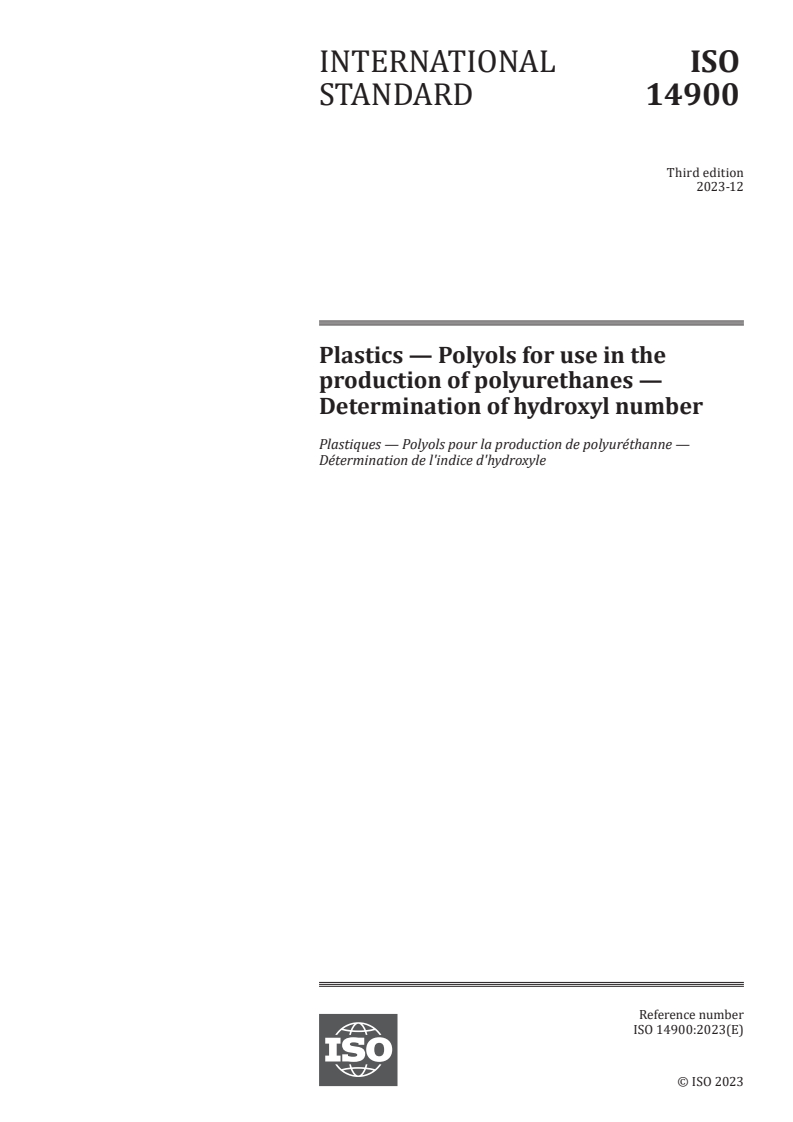
INTERNATIONAL ISO
STANDARD 14900
Third edition
2023-12
Plastics — Polyols for use in the
production of polyurethanes —
Determination of hydroxyl number
Plastiques — Polyols pour la production de polyuréthanne —
Détermination de l'indice d'hydroxyle
Reference number
© ISO 2023
All rights reserved. Unless otherwise specified, or required in the context of its implementation, no part of this publication may
be reproduced or utilized otherwise in any form or by any means, electronic or mechanical, including photocopying, or posting on
the internet or an intranet, without prior written permission. Permission can be requested from either ISO at the address below
or ISO’s member body in the country of the requester.
ISO copyright office
CP 401 • Ch. de Blandonnet 8
CH-1214 Vernier, Geneva
Phone: +41 22 749 01 11
Email: copyright@iso.org
Website: www.iso.org
Published in Switzerland
ii
Contents Page
Foreword .iv
Introduction .v
1 Scope . 1
2 Normative references . 1
3 Terms and definitions . 1
4 Principle . 2
5 Interferences . 2
6 Reagents . 2
7 Apparatus . 4
8 Method A — Acetylation . 5
8.1 Procedure . 5
8.2 Expression of results . . 7
8.3 Precision and bias . 8
8.4 Test report . 8
9 Method B — Phthalation . 9
9.1 Procedure . 9
9.2 Expression of results . . 10
9.3 Precision and bias . 10
9.4 Test report . 11
Bibliography .12
iii
Foreword
ISO (the International Organization for Standardization) is a worldwide federation of national standards
bodies (ISO member bodies). The work of preparing International Standards is normally carried out
through ISO technical committees. Each member body interested in a subject for which a technical
committee has been established has the right to be represented on that committee. International
organizations, governmental and non-governmental, in liaison with ISO, also take part in the work.
ISO collaborates closely with the International Electrotechnical Commission (IEC) on all matters of
electrotechnical standardization.
The procedures used to develop this document and those intended for its further maintenance are
described in the ISO/IEC Directives, Part 1. In particular, the different approval criteria needed for the
different types of ISO document should be noted. This document was drafted in accordance with the
editorial rules of the ISO/IEC Directives, Part 2 (see www.iso.org/directives).
ISO draws attention to the possibility that the implementation of this document may involve the use
of (a) patent(s). ISO takes no position concerning the evidence, validity or applicability of any claimed
patent rights in respect thereof. As of the date of publication of this document, ISO had not received
notice of (a) patent(s) which may be required to implement this document. However, implementers are
cautioned that this may not represent the latest information, which may be obtained from the patent
database available at www.iso.org/patents. ISO shall not be held responsible for identifying any or all
such patent rights.
Any trade name used in this document is information given for the convenience of users and does not
constitute an endorsement.
For an explanation of the voluntary nature of standards, the meaning of ISO specific terms and
expressions related to conformity assessment, as well as information about ISO's adherence to
the World Trade Organization (WTO) principles in the Technical Barriers to Trade (TBT), see
www.iso.org/iso/foreword.html.
This document was prepared by Technical Committee ISO/TC 61, Plastics, Subcommittee SC 12,
Thermosetting materials.
This third edition cancels and replaces the second edition (ISO 14900:2017), which has been technically
revised.
The main changes are as follows:
— the title has been changed to plural form to read: "Plastics — Polyols for use in the production of
polyurethanes — Determination of hydroxyl number";
— in 7.13, hotplate has been added as heating device;
— in 8.1.3, an oil bath has been added, in addition to a hot plate, as a heating device;
— in 8.3.1 and 9.3.1, precision and bias information have been updated;
— in 9.1.3, the information on hydrolysis of excess phthalic anhydride, and the water addition process
have been added.
Any feedback or questions on this document should be directed to the user’s national standards body. A
complete listing of these bodies can be found at www.iso.org/members.html.
iv
Introduction
International Standards which deal with the determination of hydroxyl values of unsaturated-
polyester resins (ISO 2554), non-ionic surface active agents (ISO 4326, ISO 4327), binders for paints
and varnishes [ISO 4629 (all parts)] and industrial polyglycols (ISO 6796) have been published. The
two methods in this document are improved versions of imidazole-catalyzed procedures specifically
tailored to the determination of the hydroxyl number of many types of polyol, including those used in
the production of polyurethanes. Method A is especially suited to the determination of the hydroxyl
number of polyether polyols that may have steric hindrance, or are otherwise difficult to determine
by phthalation. Method B is a general method based on phthalation and is applicable to a wide range of
polyol types. Both of these methods are similar to procedures found in ASTM D4274.
v
INTERNATIONAL STANDARD ISO 14900:2023(E)
Plastics — Polyols for use in the production of
polyurethanes — Determination of hydroxyl number
WARNING — Persons using this document should be familiar with normal laboratory practice.
This document does not purport to address all of the safety problems, if any, associated with its
use. It is the responsibility of the user to establish appropriate safety and health practices and to
determine any national regulatory conditions prior to use.
1 Scope
This document specifies two methods for the measurement of the hydroxyl number of polyols used as
polyurethane raw materials.
The hydroxyl content of polyols are determined to properly formulate polyurethane systems. Method A
is primarily applicable to readily esterified polyether polyols. It is also intended for polyols which have
significant steric hindrance, such as those based on sugars. Method B is intended for polyether polyols,
polymer polyols and amine-initiated polyols, but can give low results for sterically hindered polyols.
Other polyols can be analysed by these methods if precautions are taken to verify applicability. These
methods can be used for research and for quality control and specification purposes.
2 Normative references
The following documents are referred to in the text in such a way that some or all of their content
constitutes requirements of this document. For dated references, only the edition cited applies. For
undated references, the latest edition of the referenced document (including any amendments) applies.
ISO 385, Laboratory glassware — Burettes
ISO 648, Laboratory glassware — Single-volume pipettes
ISO 760, Determination of water — Karl Fischer method (General method)
ISO 835, Laboratory glassware — Graduated pipettes
ISO 3696, Water for analytical laboratory use — Specification and test methods
ISO 4788, Laboratory glassware — Graduated measuring cylinders
ISO 6353-1, Reagents for chemical analysis — Part 1: General test methods
ISO 6353-2, Reagents for chemical analysis — Part 2: Specifications — First series
ISO 6353-3, Reagents for chemical analysis — Part 3: Specifications — Second series
3 Terms and definitions
For the purposes of this document, the following terms and definitions apply.
ISO and IEC maintain terminology databases for use in standardization at the following addresses:
— ISO Online browsing platform: available at https:// www .iso .org/ obp
— IEC Electropedia: available at https:// www .electropedia .org/
3.1
polyurethane
polymer prepared by the reaction of an organic di- or polyisocyanate with compounds containing two
or more hydroxyl groups
3.2
hydroxyl number
hydroxyl value
number of milligrams of potassium hydroxide equivalent to the hydroxyl content of 1 g of a test portion
4 Principle
4.1 Method A (Acetylation): A test portion is refluxed in a solution of acetic anhydride in pyridine
to acetylate the hydroxyl groups present; the reaction is catalyzed by imidazole. The excess reagent is
hydrolyzed with water and the resulting acetic acid is titrated with standardized sodium hydroxide
solution. The hydroxyl content is calculated from the difference in titration of the test portion and a
blank solution.
CAUTION — Acetic anhydride and pyridine are toxic and flammable. In addition, acetic anhydride
is corrosive. Take proper precautions when handling these reagents.
4.2 Method B (Phthalation): The hydroxyl groups in a test portion are esterified by refluxing with a
solution of phthalic anhydride in pyridine; the reaction is catalyzed by imidazole. The excess anhydride
is hydrolyzed with water and the phthalic acid formed is titrated with standardized sodium hydroxide
solution. The hydroxyl content is calculated from the difference in titration of the test portion and a
blank solution.
5 Interferences
5.1 Excess water will interfere by destroying part of the esterification reagent. If the sample contains
more than 0,2 % water, dry the sample with a reagent that will not add acidity or basicity to the sample.
5.2 Primary and secondary amines and long-chain fatty acids react with the reagent to form stable
compounds that will be included in the result.
6 Reagents
Reagent-grade chemicals shall be used in all determinations. Unless otherwise indicated, all reagents
shall conform to the specifications of ISO 6353-1, ISO 6353-2 and ISO 6353-3, although other grades
may be used provided that it is first determined that the reagent is of sufficiently high purity to permit
its use without lessening the accuracy of the determination.
Unless otherwise indicated, references to water shall be understood to mean grade 2 reagent water as
defined by ISO 3696.
6.1 Acetylation reagent (for method A).
6.1.1 Mix 127 ml of acetic anhydride with 1 000 ml of dry pyridine (6.7). Add 16 g of imidazole (6.3)
and swirl carefully to dissolve. Prepare the reagent fresh daily and keep it in a dark bottle. Do not use it
if it is darker than pale yellow.
6.1.2 Some laboratories have reported that dark, resinous solids have formed when the mixture
of pyridine and esterification reagent is heated. In that event, it has been found that preparing the
acetylation reagent with the addition of 0,4 % water in the pyridine (6.8) will correct the problem.
However, care should be taken that sufficient reagent is present to complete the reaction quantitatively.
See also 8.1.2.
CAUTION — Acetic anhydride and pyridine are eye, skin and respiratory irritants. Avoid bodily
contact with these reagents and use only in a well-ventilated area.
6.2 Phthalation reagent (for method B).
Weigh 116 g of phthalic anhydride into a 1 l brown bottle. Add 700 ml of pyridine (6.7) and shake
vigorously until dissolved. Add 16 g of imidazole and swirl carefully to dissolve. The reagent shall stand
overnight before use. Avoid prolonged exposure of the reagent to moisture in the air. Discard reagent
that develops a colour. In the blank titration as described in the procedure for method B, exactly 25 ml
of this reagent shall consume between 95 ml and 100 ml of 0,500 mol/l sodium hydroxide.
6.3 Imidazole, reagent grade or equivalent.
6.4 Hydrochloric acid, standard solution, 0,1 mol/l.
Prepare and standardize to four significant figures in accordance with good practice, using potassium
acid phthalate (6.6) as a primary standard. Determine and record the temperature at which the
standardization was performed. The concentration of the solution shall be corrected to the temperature
at which the determination is performed, as described in 6.9. This solution is required only if a
correction is to be applied for the presence of strong base in the sample being analysed.
6.5 Phenolphthalein indicator solution, 10 g/l.
Prepare a solution of 1 g of phenolphthalein in 100 ml of pyridine (6.7).
6.6 Potassium acid phthalate.
Use a certified primary standard.
6.7 Pyridine, reagent grade, containing less than 0,1 % water.
If purification is required, distil from phthalic anhydride, discarding the fraction boiling below 114 °C
to 115 °C.
6.8 Pyridine, containing from 0,30 % to 0,45 % water (used for special cases: see 6.1.2).
Determine the water content of the pyridine using ISO 760. Add the required amount of water. The
required volume of water to add per litre of pyridine may be calculated using Formula (1):
W = 4,0 − 9A (1)
where
W is the water to add, in ml;
A is the percent water already in the pyridine, in mass %.
6.9 Sodium hydroxide, standard solution, 0,5 mol/l.
Prepare and standardize to four significant figures in accordance with good practice. Determine and
record the temperature at which the standardization was performed. The factor for thermal expansion
of this solution is 0,000 14. For calculation of the hydroxyl content, the concentration of the solution
shall be corrected to the temperature at which the determination was calculated using Formula (2):
C = C + F (θ − θ) (2)
θ2
...
Questions, Comments and Discussion
Ask us and Technical Secretary will try to provide an answer. You can facilitate discussion about the standard in here.
Loading comments...