


ISO 18615-1:2026
(Main)Traditional Chinese medicine — Electric radial pulse tonometric devices — Part 1: General requirements
General Information
- Abstract
This document specifies the general requirements for basic safety and essential performance of electric radial pulse tonometric devices. This document does not apply to the accuracy of differential diagnosis or interpretation of the diagnostic data obtained from the use of such devices. This document applies to pressure-based radial pulse tonometric devices.
- Status
- Published
- Publication Date
- 17-Sep-2026
- Technical Committee
- ISO/TC 249 - Traditional Chinese medicine
- Drafting Committee
- ISO/TC 249 - Traditional Chinese medicine
- Current Stage
- 6060 - International Standard published
- Start Date
- 18-Sep-2026
- Due Date
- 12-Jun-2026
- Completion Date
- 18-Sep-2026

Overview
ISO 18615-1:2026: Traditional Chinese medicine - Electric radial pulse tonometric devices - Part 1: General requirements specifies the basic safety and essential performance requirements for electric radial pulse tonometric devices used in Traditional Chinese Medicine (TCM). These devices are non-invasive, pressure-based medical electrical equipment designed to measure the radial pulse at the wrist. The standard focuses on general safety and performance but does not cover the clinical diagnostic interpretation of pulse measurement results. Its requirements are intended to support the safe design, manufacture, and operation of electric radial pulse tonometric devices in clinical and research environments.
Key Topics
Device Definition and Scope
- Applies to electric radial pulse tonometric devices using pressure transducers to assess pulse signals at the wrist.
- Relevant for both automatic and non-automatic actuators.
Basic Safety and Essential Performance
- Outlines requirements for electrical and mechanical safety, including protection against electrical, mechanical, temperature, and radiation hazards.
- Details on actuator pressure limits (maximum applied pressure and safety limit requirements for both system types).
- Safety measures for transducer faults and drop resistance.
Accuracy and Performance Specifications
- Sets minimum ranges and accuracy thresholds for applied pressure, pulse pressure, pulse rate measurement, and measurement geometry (e.g., length, width, area, and position accuracy).
- Emphasizes stability of actuator movement to minimize signal noise.
Marking and Identification
- Requirements for visible marking of pulse positions on transducer modules or wristbands to prevent measurement errors.
- Distinction between markings for one-finger and three-finger measurement methods.
Instructions for Use (IFU)
- Specifies the essential information to be included in IFUs, such as intended use, device compatibility, connection and positioning guidance, cleaning protocols, safety precautions, performance specifications, and troubleshooting.
System Messages and Fault Detection
- Devices must visibly display system, error, and fault messages to enable operator awareness and safe response to issues.
Equipment Construction and Reliability
- Clarifies construction quality, transducer lifespan disclosure, and requirements for reliability testing when declared by the manufacturer.
Applications
Clinical Practice in Traditional Chinese Medicine
- Enhances the safety and reliability of electric devices used for pulse diagnosis-a core element in TCM.
- Supports practitioners and healthcare facilities adopting modern, standardized equipment for objective pulse assessment.
Device Manufacturing and Quality Control
- Guides manufacturers in designing and producing compliant, safe, and reliable radial pulse tonometric devices, ensuring they meet internationally recognized safety and performance benchmarks.
Regulatory Compliance
- Serves as a reference for regulatory agencies assessing conformity and market access of electric pulse tonometric devices.
- Facilitates harmonized requirements for global trade and acceptance of TCM diagnostics technology.
Education and Training
- Assists technical trainers and users in understanding correct device usage, maintenance, and interpretation of operational messages for enhanced patient safety.
Related Standards
- IEC 60601-1: Medical electric equipment - General requirements for basic safety and essential performance. Fundamental safety standard referenced throughout ISO 18615-1.
- IEC 60601-1-2: Medical electric equipment - Electromagnetic compatibility requirements.
- ISO 20417: Medical devices - Information to be supplied by the manufacturer.
- WHO International Standard Terminologies on Traditional Medicine in the Western Pacific Region: Provides standardized terminology for TCM practice.
This standard promotes international best practices for medical device safety, ensuring that electric radial pulse tonometric devices operate reliably and safely in TCM diagnostics worldwide. Adherence to ISO 18615-1:2026 enhances user trust, patient safety, and supports regulatory approvals across markets.
Relations
- Effective Date
- 17-Jun-2023
Get Certified
Connect with accredited certification bodies for this standard

BSI Group
BSI (British Standards Institution) is the business standards company that helps organizations make excellence a habit.

TÜV Rheinland
TÜV Rheinland is a leading international provider of technical services.

TÜV SÜD
TÜV SÜD is a trusted partner of choice for safety, security and sustainability solutions.
Sponsored listings
Frequently Asked Questions
ISO 18615-1:2026 is a standard published by the International Organization for Standardization (ISO). Its full title is "Traditional Chinese medicine — Electric radial pulse tonometric devices — Part 1: General requirements". This standard covers: This document specifies the general requirements for basic safety and essential performance of electric radial pulse tonometric devices. This document does not apply to the accuracy of differential diagnosis or interpretation of the diagnostic data obtained from the use of such devices. This document applies to pressure-based radial pulse tonometric devices.
This document specifies the general requirements for basic safety and essential performance of electric radial pulse tonometric devices. This document does not apply to the accuracy of differential diagnosis or interpretation of the diagnostic data obtained from the use of such devices. This document applies to pressure-based radial pulse tonometric devices.
ISO 18615-1:2026 is classified under the following ICS (International Classification for Standards) categories: 11.040.55 - Diagnostic equipment. The ICS classification helps identify the subject area and facilitates finding related standards.
ISO 18615-1:2026 has the following relationships with other standards: It is inter standard links to ISO 18615:2020. Understanding these relationships helps ensure you are using the most current and applicable version of the standard.
ISO 18615-1:2026 is available in PDF format for immediate download after purchase. The document can be added to your cart and obtained through the secure checkout process. Digital delivery ensures instant access to the complete standard document.
Standards Content (Sample)
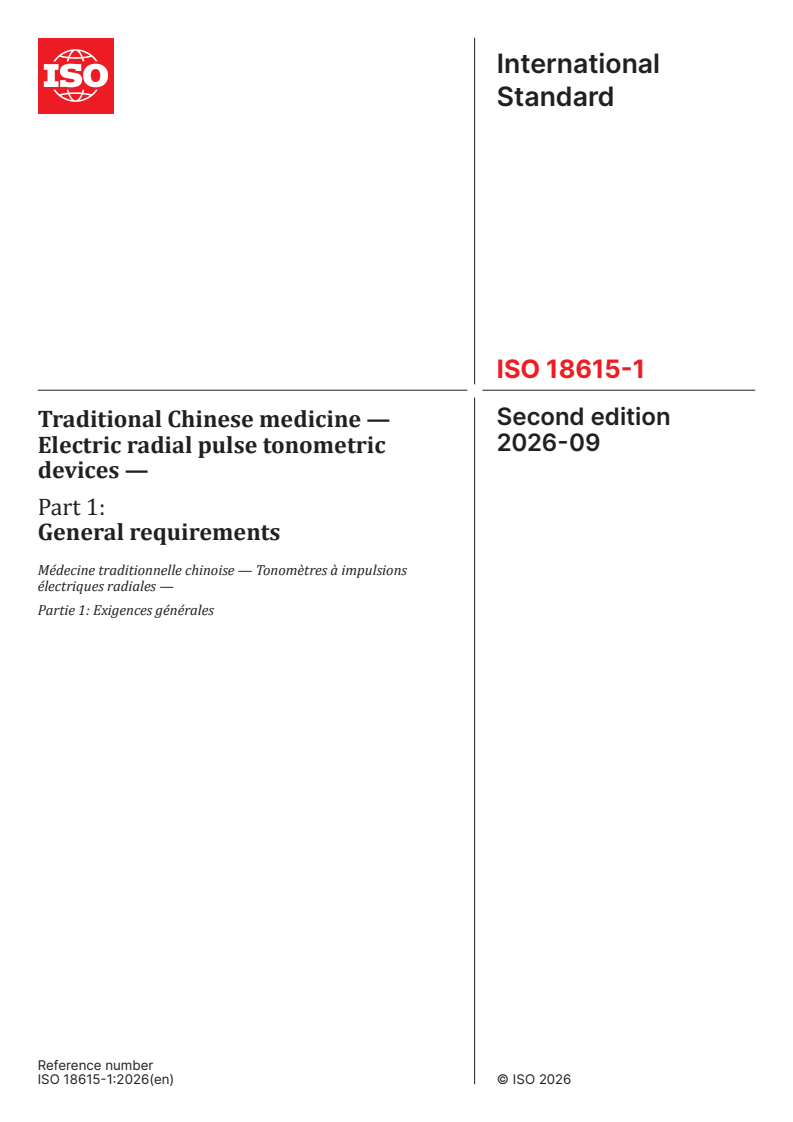
International
Standard
ISO 18615-1
Second edition
Traditional Chinese medicine —
2026-09
Electric radial pulse tonometric
devices —
Part 1:
General requirements
Médecine traditionnelle chinoise — Tonomètres à impulsions
électriques radiales —
Partie 1: Exigences générales
Reference number
© ISO 2026
All rights reserved. Unless otherwise specified, or required in the context of its implementation, no part of this publication may
be reproduced or utilized otherwise in any form or by any means, electronic or mechanical, including photocopying, or posting on
the internet or an intranet, without prior written permission. Permission can be requested from either ISO at the address below
or ISO’s member body in the country of the requester.
ISO copyright office
CP 401 • Ch. de Blandonnet 8
CH-1214 Vernier, Geneva
Phone: +41 22 749 01 11
Email: copyright@iso.org
Website: www.iso.org
Published in Switzerland
ii
Contents Page
Foreword .iv
1 Scope . 1
2 Normative references . 1
3 Terms and definitions . 1
4 General requirements . 3
5 General requirements for testing of equipment . 3
6 Classification of equipment and systems . 3
7 Equipment identification, marking and documents . 3
7.1 General .3
7.2 Marking on the transducer module or wristband .3
7.3 Instructions for use .4
7.4 Messages .4
8 Protection against electrical hazards from equipment . 4
9 Protection against mechanical hazards of equipment and systems . 4
9.1 General .4
9.2 Safety pressure range of actuator .5
9.3 Stability of actuator movement .5
10 Protection against unwanted and excessive radiation hazards . 5
11 Protection against excessive temperatures and other hazards . 5
12 Accuracy of controls and instruments and protection against hazardous outputs . 5
12.1 General .5
12.2 Accuracy of controls and instruments .5
12.2.1 Accuracy of applied pressure measurement .5
12.2.2 Accuracy of pulse pressure measurements .5
12.2.3 Accuracy of pulse rate measurements .6
12.2.4 Requirements of geometric measurements .6
12.2.5 Accuracy of measurement position .6
13 Hazardous situations and fault conditions . 6
14 Programmable electrical medical systems (PEMS) . 6
15 Construction of equipment . 7
15.1 General .7
15.2 Drop test .7
15.3 Detection of pressure transducer and pressure transducer cable fault .7
16 Systems . 7
17 Electromagnetic compatibility of equipment and systems . 7
18 Requirements of transducer and transducer module of equipment . 7
18.1 Lifespan of transducer .7
18.2 Reliability of transducer .7
Annex A (informative) Radial pulse waveform and pulse parameter . 8
Bibliography . 9
iii
Foreword
ISO (the International Organization for Standardization) is a worldwide federation of national standards
bodies (ISO member bodies). The work of preparing International Standards is normally carried out through
ISO technical committees. Each member body interested in a subject for which a technical committee
has been established has the right to be represented on that committee. International organizations,
governmental and non-governmental, in liaison with ISO, also take part in the work. ISO collaborates closely
with the International Electrotechnical Commission (IEC) on all matters of electrotechnical standardization.
The procedures used to develop this document and those intended for its further maintenance are described
in the ISO/IEC Directives, Part 1. In particular, the different approval criteria needed for the different types
of ISO document should be noted. This document was drafted in accordance with the editorial rules of the
ISO/IEC Directives, Part 2 (see www.iso.org/directives).
ISO draws attention to the possibility that the implementation of this document may involve the use of (a)
patent(s). ISO takes no position concerning the evidence, validity or applicability of any claimed patent
rights in respect thereof. As of the date of publication of this document, ISO had not received notice of (a)
patent(s) which may be required to implement this document. However, implementers are cautioned that
this may not represent the latest information, which may be obtained from the patent database available at
www.iso.org/patents. ISO shall not be held responsible for identifying any or all such patent rights.
Any trade name used in this document is information given for the convenience of users and does not
constitute an endorsement.
For an explanation of the voluntary nature of standards, the meaning of ISO specific terms and expressions
related to conformity assessment, as well as information about ISO's adherence to the World Trade
Organization (WTO) principles in the Technical Barriers to Trade (TBT), see www.iso.org/iso/foreword.html.
This document was prepared by Technical Committee ISO/TC 249, Traditional medicine, Subcommittee SC1,
Traditional Chinese medicine.
This second edition of ISO 18615-1, cancels and replaces the first edition of ISO 18615:2020, which has been
technically revised.
The main changes are as follows:
— The document has been split into a series and renumbered accordingly.
— Performance test methods have been separated from this document and are intended to be specified in
a future part of ISO 18615.
A list of all parts in the ISO 18615 series can be found on the ISO website.
Any feedback or questions on this document should be directed to the user’s national standards body. A
complete listing of these bodies can be found at www.iso.org/members.html.
iv
International Standard ISO 18615-1:2026(en)
Traditional Chinese medicine — Electric radial pulse
tonometric devices —
Part 1:
General requirements
1 Scope
This document specifies the general requirements for basic safety and essential performance of electric
radial pulse tonometric devices.
This document does not apply to the accuracy of differential diagnosis or interpretation of the diagnostic
data obtained from the use of such devices.
This document applies to pressure-based radial pulse tonometric devices.
2 Normative references
The following documents are referred to in the text in such a way that some or all of their content constitutes
requirements of this document. For dated references, only the edition cited applies. For undated references,
the latest edition of the referenced document (including any amendments) applies.
IEC 60601-1:2005/AMD1: 2012, Medical electric equipment — Part 1: General requirements for basic safety and
essential performance
3 Terms and definitions
For the purposes of this document, the following terms and definitions apply.
ISO and IEC maintain terminological databases for use in standardization at the following addresses:
— ISO Online browsing platform: available at https:// www .iso .org/ obp
— IEC Electropedia: available at https:// www .electropedia .org/
3.1
electric radial pulse tonometric device
non-invasive medical electrical (ME) equipment that incorporates a transducer to measure the radial pulse
(3.5) while pressure is applied to the skin and radial artery using a rigid flat surface
Note 1 to entry: ME equipment includes all applied parts and accessories.
3.2
pulse diagnosis
examination of the pulse for diagnostic purposes
[SOURCE: WHO Guidelines, 2007, p. 101[2] modified — "for making diagnosis" has been revised to "for
diagnostic purposes"]
3.3
position
location on the wrist for pulse measurement
...