


ISO/TR 13154:2017
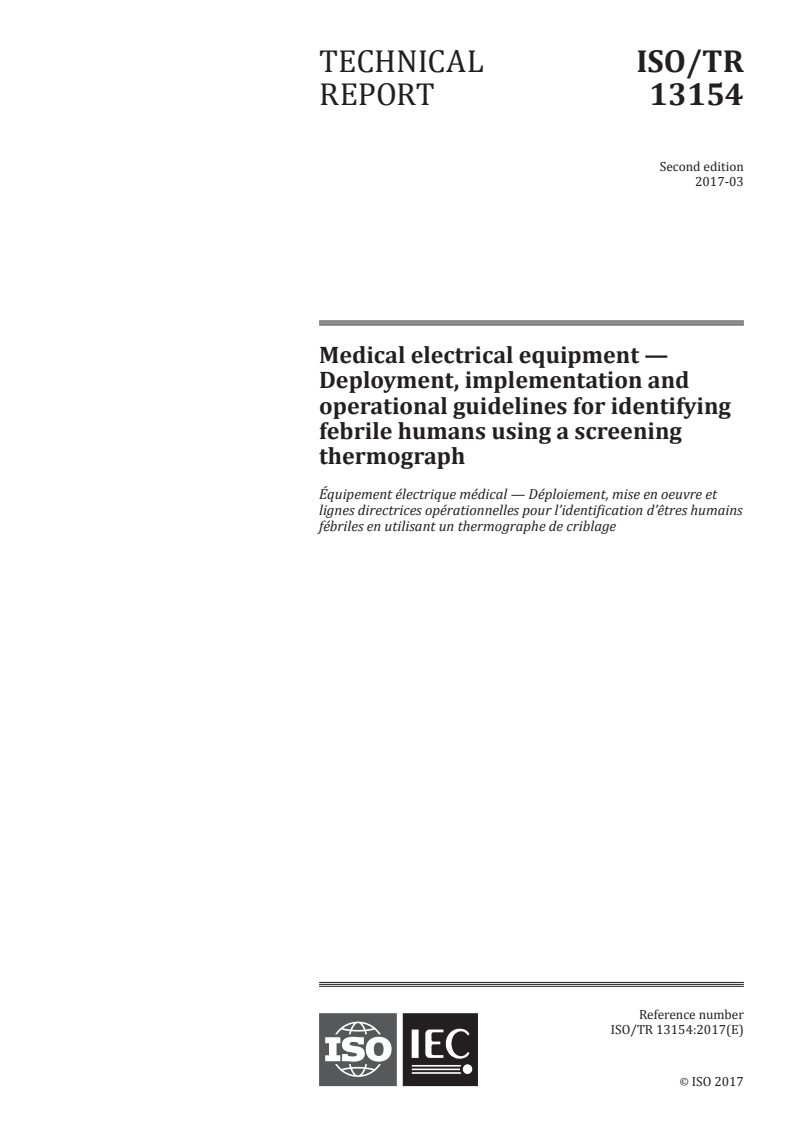
(Main)Medical electrical equipment — Deployment, implementation and operational guidelines for identifying febrile humans using a screening thermograph
Medical electrical equipment — Deployment, implementation and operational guidelines for identifying febrile humans using a screening thermograph
ISO/TR 13154:2017 provides general guidelines for the deployment, implementation and operation of a screening thermograph intended to be used for non-invasive febrile temperature screening of individuals under indoor environmental conditions to prevent the spread of infection. NOTE The equipment standard for screening thermographs is found in IEC 80601?2-59.
Équipement électrique médical — Déploiement, mise en oeuvre et lignes directrices opérationnelles pour l'identification d'êtres humains fébriles en utilisant un thermographe de criblage
General Information
Relations
Standards Content (Sample)
TECHNICAL ISO/TR
REPORT 13154
Second edition
2017-03
Medical electrical equipment —
Deployment, implementation and
operational guidelines for identifying
febrile humans using a screening
thermograph
Équipement électrique médical — Déploiement, mise en oeuvre et
lignes directrices opérationnelles pour l’identification d’êtres humains
fébriles en utilisant un thermographe de criblage
Reference number
©
ISO 2017
© ISO 2017, Published in Switzerland
All rights reserved. Unless otherwise specified, no part of this publication may be reproduced or utilized otherwise in any form
or by any means, electronic or mechanical, including photocopying, or posting on the internet or an intranet, without prior
written permission. Permission can be requested from either ISO at the address below or ISO’s member body in the country of
the requester.
ISO copyright office
Ch. de Blandonnet 8 • CP 401
CH-1214 Vernier, Geneva, Switzerland
Tel. +41 22 749 01 11
Fax +41 22 749 09 47
copyright@iso.org
www.iso.org
ii © ISO 2017 – All rights reserved
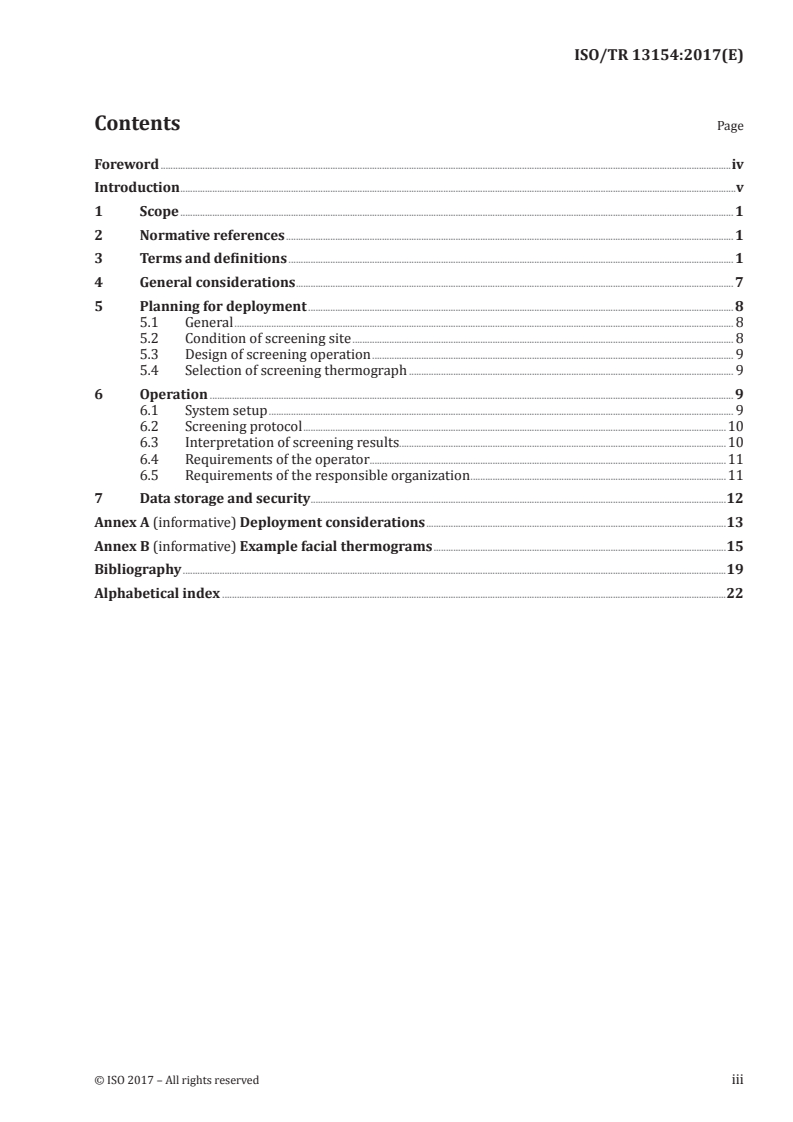
Contents Page
Foreword .iv
Introduction .v
1 Scope . 1
2 Normative references . 1
3 Terms and definitions . 1
4 General considerations . 7
5 Planning for deployment . 8
5.1 General . 8
5.2 Condition of screening site . 8
5.3 Design of screening operation . 9
5.4 Selection of screening thermograph . 9
6 Operation . 9
6.1 System setup . 9
6.2 Screening protocol .10
6.3 Interpretation of screening results.10
6.4 Requirements of the operator .11
6.5 Requirements of the responsible organization .11
7 Data storage and security.12
Annex A (informative) Deployment considerations .13
Annex B (informative) Example facial thermograms .15
Bibliography .19
Alphabetical index .22
Foreword
ISO (the International Organization for Standardization) is a worldwide federation of national standards
bodies (ISO member bodies). The work of preparing International Standards is normally carried out
through ISO technical committees. Each member body interested in a subject for which a technical
committee has been established has the right to be represented on that committee. International
organizations, governmental and non-governmental, in liaison with ISO, also take part in the work.
ISO collaborates closely with the International Electrotechnical Commission (IEC) on all matters of
electrotechnical standardization.
The procedures used to develop this document and those intended for its further maintenance are
described in the ISO/IEC Directives, Part 1. In particular the different approval criteria needed for the
different types of ISO documents should be noted. This document was drafted in accordance with the
editorial rules of the ISO/IEC Directives, Part 2 (see www .iso .org/ directives).
Attention is drawn to the possibility that some of the elements of this document may be the subject of
patent rights. ISO shall not be held responsible for identifying any or all such patent rights. Details of
any patent rights identified during the development of the document will be in the Introduction and/or
on the ISO list of patent declarations received (see www .iso .org/ patents).
Any trade name used in this document is information given for the convenience of users and does not
constitute an endorsement.
For an explanation on the voluntary nature of standards, the meaning of ISO specific terms and
expressions related to conformity assessment, as well as information about ISO’s adherence to the
World Trade Organization (WTO) principles in the Technical Barriers to Trade (TBT) see the following
URL: w w w . i s o .org/ iso/ foreword .html.
This document was prepared by ISO/TC 121, Anaesthetic and respiratory equipment, Subcommittee
SC 3, Lung ventilators and related equipment, and Technical Committee IEC/TC 62, Electrical equipment
in medical practice, Subcommittee SC D, Electromedical equipment.
This second edition cancels and replaces the first edition (ISO/TR 13154:2009), which has been
technically revised.
iv © ISO 2017 – All rights reserved
Introduction
[1]
The purpose of this document is to provide guidance on the implementation of IEC 80601-2-59 to
minimize the spread of infectious diseases. The first edition of this document was derived, in part,
[2]
from SPRING Technical Reference 15. The SPRING Technical Reference was created as result of
[3][4][5][6][7]
the Singapore experiences during the SARS epidemic. The scale of the global problem has
increased in recent years, with emergence of infectious disease with pandemic potential as a threat
to public health. Pandemics of infectious diseases (e.g. influenza) have swept the world from time to
time throughout history and have caused widespread illness, large numbers of deaths, notably among
children and young adults, and huge societal disruption. New pandemic sources emerge with serious
[5][8]
consequences, with potential to affect a quarter of the world population over one or more cycles.
The prime objectives of pandemic planning are to save lives, reduce the health impact of a pandemic
and minimize disruption to health and other essential services, while maintaining business continuity
as far as is possible and reducing the general disruption to society that is likely to ensue, serious though
this will be. Strong leadership, organization and co-ordination, and clear lines of accountability and
[9][10][11][12]
communication are key to preparing for and responding to a pandemic.
The ability to limit the spread of a pandemic disease, direct public health interventions, and limit the
unintended consequences of these actions is greatly enhanced by the widespread availability of cost-
[13][14]
effective screening methods for infectious diseases such as rapid diagnostic tests. Early outbreak
detection with continued surveillance of travellers and the institution of appropriate measures,
including social distancing, isolation of infected individuals, isolation/quarantine of suspected cases
or treatment with appropriate medication, can help delay or limit the spread of a disease once a case
has been identified. Well-coordinated international implementation of entry and exit restrictions is
an important component of an effective global response to contain cases and prevent a pandemic. All
countries should prepare to implement steps to limit the spread, including local, regional and national
entry and exit restrictions based on veterinary and health monitoring, screening and surveillance for
[15][16][17]
humans, animals, and animal products , and information sharing and cooperation to manage
[9][10]
borders.
[9][11][18][19][20] [5]
Pandemic disease includes, but is not limited to, such infections as influenza , SARS
[6][7] [21] [22][23][24][25][26]
, tuberculosis , Middle East Respiratory Syndrome (MERS) , haemorrhagic
[13][27][28][29][30] [31][32][33]
fevers (e.g. Ebola) and other biological or bacterial agents. Table 1 contains
examples of infectious diseases characterized by fever for which thermographic fever screening can
be useful. On the other hand, pandemic diseases such as Zika virus are not necessarily accompanied
[34][35]
by high fever and are therefore not suitable for thermographic fever screening. The sources of
such diseases can be naturally occurring, accidental releases or the result of subversive activities or
terrorism.
Individual screening of all persons entering a country, for infectious illness and exposure factors for
[27][36]
infection with a pandemic strain, helps minimize the likelihood of transmission. However, such
screening is challenged by a lack of sensitivity (e.g. asymptomatic infected individuals might not be
detected) and specificity (e.g. many individuals exhibiting symptoms might not be infected with a
pandemic strain). For example, the typical incubation period for influenza is two days, and infected
persons with influenza can be contagious for 24 h prior to the onset of symptoms. Other possible
[37][38]
pandemic diseases have varying periods of latency or incubation. Since some asymptomatic
travellers who are incubating a disease can become symptomatic en route, overall screening
effectiveness can be improved by adopting layered pre-departure, en route and arrival screening
measures. The policy of layered screening measures should apply to all in-bound travellers from
affected areas, but the characteristics of the outbreak, including the rapidity of spread, can make it
necessary to implement this screening at all international airports from which passengers originate. In
addition, development of rapid diagnostic tests can dramatically change our ability to screen effectively.
[9][13][14][38]
Table 1 — Examples of infectious diseases characterized by fever, identifiable
by thermographic fever screening
Infectious disease Pathogen Transmission mode References
Ebola virus disease Ebola virus Blood, body fluids [12][28][29][30][37][39][40]
(EVD)
Influenza Influenza viruses Airborne or contact [9][10][11][14][16][18][19][41][42]
with infected humans,
birds or animals, or
their remains
Middle East MERS coronavirus Contact with virally [22][23][24][25][26]
Respiratory (CoV) contaminated surfaces
Syndrome-
coronavirus (MERS)
Severe acute SARS virus Airborne [5][6][7]
respiratory syndrome (coronavirus)
(SARS)
Tuberculosis Myobacterium Airborne; multiple [21]
tuberculosis
During the outbreaks of pandemics, internationally agreed measures designed to restrict the movement
of possibly infected people were instituted and were assessed by WHO to have greatly contributed to
bringing the disease under control.
Possible measures to delay or slow the transmission of infectious diseases include:
— providing travel advice on travel to and from affected countries;
— providing health information for exiting and returning travellers;
[11][12][18][20][27][28][29][30][31][32][37][40][41][42]
— providing health screening at ports of entry and exit.
[43][44][45]
In a severe pandemic, absenteeism attributable to illness, the need to care for ill family members and
fear of infection can reach 40 % during the peak weeks of a community outbreak, with lower rates
of absenteeism during the weeks before and after the peak. Certain public health measures (closing
schools, quarantining household contacts of infected individuals) are likely to increase rates of absence
from the workplace. Actions that reduce the likelihood of disease exposure and limit transmission,
assure the public of the ability to maintain domestic safety and security, advise the public to curtail
non-essential travel and communal activities while preparing for implementation of community disease
[9][10][11]
containment measures as the epidemic spreads, are important public policy objectives. To
support the objective of pandemic prevention, a screening thermograph with appropriate follow-up
of febrile persons can be useful to separate potentially infectious individuals from others in locations
[20]
such as:
— entrances to hospitals and clinics, including emergency rooms;
— entrances to critical infrastructure facilities;
— entrances to workplaces;
— entrances to schools;
— entrances to government buildings, including police and fire stations;
— entrances to other communal locations;
— public transportation.
A screening thermograph should be an element of the layered screening process for those diseases
specifically associated with elevated fever. It can also play an important epidemiological role in defining
vi © ISO 2017 – All rights reserved
the geographical boundaries of an outbreak. A screening thermograph complying with IEC 80601-2-
59 is a non-contact, accurate and repeatable means of quickly screening individuals for fever when
proper procedures are followed.
International experience has demonstrated numerous instances of noncompliance with the
International Standard and the recommendations of the first edition of this document, as well as
Internet postings documenting inappropriate use of radiometry and infrared cameras. It should
emphasized that the efficacy and utility of this technology is contingent on the use of both equipment
[45]
and protocols meeting the recommendations of these committees.
NOTE The requirements for a screening thermograph are found in IEC 80601–2-59.
In this document, the following print types are used:
— Text and definitions: roman type.
— Informative material appearing outside of tables, such as notes, examples and references: in smaller
type. Normative text of tables is also in a smaller type.
— Terms defined in clause 3 or as noted: small capitals.
In this document, the conjunctive “or” is used as an “inclusive or” so a statement is true if any
combination of the conditions is true.
TECHNICAL REPORT ISO/TR 13154:2017(E)
Medical electrical equipment — Deployment,
implementation and operational guidelines for identifying
febrile humans using a screening thermograph
1 Scope
This document provides general guidelines for the deployment, implementation and operation of
a screening thermograph intended to be used for non-invasive febrile temperature screening of
individuals under indoor environmental conditions to prevent the spread of infection.
NOTE The equipment standard for screening thermographs is found in IEC 80601–2-59.
2 Normative references
There are no normative references in this document.
3 Terms and definitions
For the purposes of this document, the following terms and definitions apply.
ISO and IEC maintain terminological databases for use in standardization at the following addresses:
— IEC Electropedia: available at http:// www .electropedia .org/
— ISO Online browsing platform: available at http:// www .iso .org/ obp
NOTE For convenience, an alphabetized index of defined terms used in this document is given in Annex C.
3.1
accessory
additional part for use with equipment in order to
— achieve the intended use;
— adapt it to some special use;
— facilitate its use;
— enhance its performance;
— enable its functions to be integrated with those of other equipment.
[SOURCE: IEC 60601-1:2005, 3.3]
3.2
accompanying document
document accompanying me equipment, an me system, equipment or an accessory and containing
information for the responsible organization or operator, particularly regarding basic safety and
essential performance
[SOURCE: IEC 60601-1:2005, 3.4]
3.3
applied part
part of me equipment that in normal use necessarily comes into physical contact with the patient for
me equipment or an me system to perform its function
[SOURCE: IEC 60601-1:2005, 3.8, modified - deleted Notes 1, 2 and 3]
3.4
basic safety
freedom from unacceptable risk directly caused by physical hazards when me equipment is used
under normal condition and single fault condition
[SOURCE: IEC 60601-1:2005, 3.10]
3.5
calibration
set of operations that establish, under specified conditions, the relationship between values of
quantities indicated by a measuring instrument or measuring system, or values represented by a
material measure or a reference material and the corresponding values realized by standards
[SOURCE: IEC 80601-2-59:—, 201.3.201]
3.6
clinical thermometer
me equipment used for measuring at the measuring site and indicating the temperature at the
reference body site
Note 1 to entry: The measuring site can be the same as the reference body site.
[SOURCE: ISO 80601-2-56:—, 201.3.207]
3.7
emissivity
ratio of the emitted thermal rate of propagation of electromagnetic energy emitted by an object as a
consequence of its temperature propagated in a given direction, per unit solid angle about that direction
and per unit area projected normal to the direction of a surface to that of an ideal blackbody at the same
temperature and under the same spectral conditions
[47][48]
Note 1 to entry: The emissivity of wet or dry human skin is accepted to be 0,98.
Note 2 to entry: An ideal blackbody is described in Planck’s Law.
[SOURCE: IEC 80601-2-59:—, 201.3.204]
3.8
essential performance
performance of a clinical function, other than that related to basic safety, where loss or degradation
beyond the limits specified by the manufacturer results in an unacceptable risk
Note 1 to entry: Essential performance is most easily understood by considering whether its absence or
degradation would result in an unacceptable risk.
[SOURCE: IEC 60601-1:2005 + AMD1: 2012, 3.27]
3.9
external temperature reference source
part of the screening thermograph that is used to ensure accurate operation between calibrations
using an infrared radiation source of known temperature and emissivity
Note 1 to entry: The external temperature reference source is normally imaged in each thermogram of the
face or prior to each thermogram of the FACE.
[SOURCE: IEC 80601-2-59:—, 201.3.205]
2 © ISO 2017 – All rights reserved
3.10
face
anterior cranial face of the patient being measured
[SOURCE: IEC 80601-2-59:—, 201.3.206]
3.11
fixed
term meaning fastened or otherwise secured at a specific location either permanently or so that it can
only be detached by means of a tool
[SOURCE: IEC 60601-1:2005 + AMD1: 2012, 3.30, modified - deleted Note 1 and the examples]
3.12
functional connection
connection, electrical or otherwise, including those intended to transfer signals, data, power or
substances
Note 1 to entry: Connection to a fixed supply mains socket-outlet, whether single or multiple, is not considered
to result in a functional connection.
Note 2 to entry: A network/data coupling is a functional connection.
[SOURCE: IEC 60601-1:2005, 3.33, modified - added Note 2]
3.13
harm
physical injury or damage to the health of people or animals, or damage to property or the environment
[SOURCE: IEC 60601-1:2005 + AMD1: 2012, 3.38]
3.14
hazard
potential source of harm
[SOURCE: IEC 60601-1:2005 + AMD1: 2012, 3.39]
3.15
intended use
use for which a product, process or service is intended according to the specifications, instructions and
information provided by the manufacturer
Note 1 to entry: Intended use should not be confused with normal use. While both include the concept of use as
intended by the manufacturer, intended use focuses on the medical purpose while normal use incorporates
not only the medical purpose, but also maintenance, transport, etc.
[SOURCE: IEC 60601-1:2005 + AMD1: 2012, 3.44]
3.16
manufacturer
natural or legal person with responsibility for the design, manufacture, packaging, or labelling of
me equipment, assembling an me system, or adapting me equipment or an me system, regardless of
whether these operations are performed by that person or on that person’s behalf by a third party
[49]
Note 1 to entry: ISO 13485 defines “labelling” as written, printed or graphic matter:
— affixed to a medical device or any of its containers or wrappers, or
— accompanying a medical device,
related to identification, technical description, and use of the medical device, but excluding shipping documents.
In this document, that material is described as markings and accompanying documents.
Note 2 to entry: “Adapting” includes making substantial modifications to me equipment or an me system
already in use.
Note 3 to entry: In some jurisdictions, the responsible organization can be considered a manufacturer when
involved in the activities described.
[50]
Note 4 to entry: Adapted from ISO 14971:2007, 2.8 .
[SOURCE: IEC 60601-1:2005 + AMD1: 2012, 3.55, modified - replaced “standard” with “document” in
Note 1]
3.17
measuring site
part of a patient where the temperature is measured
EXAMPLE Pulmonary artery, distal oesophagus, sublingual space in the mouth, rectum, ear canal, axilla
(armpit), forehead skin.
Note 1 to entry: This definition refers to sites measured by the thermometry.
[SOURCE: ISO 80601-2-56:—, 201.3.213, modified - added Note 1]
3.18
medical electrical equipment
me equipment
electrical equipment having an applied part or transferring energy to or from the patient or detecting
such energy transfer to or from the patient and which is:
a) provided with not more than one connection to a particular supply mains; and
b) intended by its manufacturer to be used:
1) in the diagnosis, treatment or monitoring of a patient or
2) for compensation or alleviation of disease, injury or disability
Note 1 to entry: Me equipment includes those accessories, as defined by the manufacturer, which are
necessary to enable the normal use of the me equipment.
Note 2 to entry: Not all electrical equipment used in medical practice falls within this definition (e.g. some in
vitro diagnostic equipment).
Note 3 to entry: The implantable parts of active implantable medical devices can fall within this definition, but
they are excluded from the scope of this document by appropriate wording in Clause 1.
[SOURCE: IEC 60601-1:2005 + AMD1: 2012, 3.63, modified - replaced “standard” by “document” in
Note 3 and deleted Notes 4 and 5]
3.19
medical electrical system
me system
combination, as specified by its manufacturer, of items of equipment, at least one of which is
me equipment to be inter-connected by a functional connection or by use of a multiple socket-
outlet
Note 1 to entry: Equipment, when mentioned in this document, includes me equipment.
[SOURCE: IEC 60601-1:2005 + AMD1: 2012, 3.64, modified - replaced “standard” by “document” in Note 1]
4 © ISO 2017 – All rights reserved
3.20
multiple socket-outlet
one or more socket-outlets intended to be connected to, or integral with, flexible cables, cords or
me equipment providing supply mains or equivalent voltage
Note 1 to entry: A multiple socket-outlet can be a separate item or an integral part of the equipment.
[SOURCE: IEC 60601-1:2005 + AMD1: 2012, 3.67]
3.21
network/data coupling
any means to transmit or receive information to or from other equipment in accordance with the
manufacturer’s specifications
Note 1 to entry: A network/data coupling is a functional connection.
[SOURCE: IEC 60601-1:2005, 3.68, modified - added Note 1]
3.22
normal condition
condition in which all means provided for protection against hazards are intact
[SOURCE: IEC 60601-1:2005, 3.70]
3.23
normal use
operation, including routine inspection and adjustments by any operator, and stand-by, according to
the instructions for use
Note 1 to entry: normal use should not be confused with intended use. While both include the concept of use as
intended by the manufacturer, intended use focuses on the medical purpose while normal use incorporates
not only the medical purpose, but maintenance, transport, etc.
[SOURCE: IEC 60601-1:2005 + AMD1: 2012, 3.71]
3.24
operator
person handling equipment
[SOURCE: IEC 60601-1:2005 + AMD1: 2012, 3.73, modified - deleted note]
3.25
output temperature
temperature indicated by a thermometer
Note 1 to entry: Methods of indication can include printed, spoken, displayed and displayed remotely.
[SOURCE: ISO 80601-2-56:—, 201.3.216]
3.26
patient
living being (person or animal) undergoing a medical, surgical or dental procedure
[SOURCE: IEC 60601-1:2005 + AMD1: 2012, 3.76, modifed - deleted note]
3.27
record
document stating results achieved or providing evidence of activities performed
[SOURCE: IEC 60601-1:2005 + AMD1: 2012, 3.98]
3.28
reference body site
part of a patient to which the output temperature refers
EXAMPLE Pulmonary artery, distal oesophagus, sublingual space in the mouth, rectum, ear canal, axilla
(armpit), forehead skin
[SOURCE: ISO 80601-2-56:—, 201.3.220]
3.29
responsible organization
entity accountable for the use and maintenance of an me equipment or an me system
Note 1 to entry: The accountable entity can be, for example, a hospital, an individual clinician or a layperson. In
home use applications; the patient, operator and responsible organization can be one and the same person.
Note 2 to entry: Education and training is included in “use”.
[SOURCE: IEC 60601-1:2005, 3.101]
3.30
risk
combination of the probability of occurrence of harm and the severity of that harm
[SOURCE: IEC 60601-1:2005 + AMD1: 2012, 3.102]
3.31
screening thermograph
me equipment or me system that:
— detects infrared radiation emitted from the face, from which a thermogram is obtained from
the target;
— detects infrared radiation emitted from an external temperature reference source;
— displays a radiometric thermal image;
— obtains a temperature reading from the target;
— compares that temperature reading to the threshold temperature to determine if the patient
is febrile
Note 1 to entry: A screening thermograph is a non-contact, non-invasive, non-ionizing temperature screening
me equipment used to measure the face temperature and indicate the screened region with a different colour
if the temperature is above the threshold temperature setting. Such a device is commonly referred to as an
infrared camera.
Note 2 to entry: A screening thermograph has to identify the target from the thermogram to obtain the
target temperature reading.
[SOURCE: IEC 80601-2-59:—, 201.3.209]
3.32
severity
measure of the possible consequences of a hazard
[SOURCE: IEC 60601-1:2005 + AMD1: 2012, 3.114]
3.33
single fault condition
condition of me equipment in which a single means for reducing a risk is defective or a single abnormal
condition is present
[SOURCE: IEC 60601-1:2005 + AMD1: 2012, 3.116, modified - deleted Note]
6 © ISO 2017 – All rights reserved
3.34
skin temperature
skin surface temperature as measured from the workable target plane of a screening
thermograph, with an appropriate adjustment for skin emissivity
[47][48]
Note 1 to entry: The emissivity of wet or dry human skin is accepted to be 0,98.
[SOURCE: IEC 80601-2-59:—, 201.3.211]
3.35
supply mains
source of electrical energy not forming part of me equipment or me system
Note 1 to entry: This also includes battery systems and converter systems in ambulances and the like.
[SOURCE: IEC 60601-1:2005, 3.120]
3.36
target
region of the face selected for threshold temperature comparison
[SOURCE: IEC 80601-2-59:—, 201.3.212]
3.37
target plane
in-focus plane perpendicular to the central axis of the field of view of the infrared camera of a screening
thermograph
[SOURCE: IEC 80601-2-59:—, 201.3.213]
3.38
tool
extra-corporeal object that can be used to secure or release fasteners or to make adjustments
Note 1 to entry: Coins and keys are considered tools within the context of this document.
[SOURCE: IEC 60601-1:2005, 3.127 — modified: replaced “standard” by “document” in Note 1]
3.39
threshold temperature
temperature setting, above which the screening thermograph indicates that the target is
potentially febrile
Note 1 to entry: This is typically indicated in degrees Celsius.
[SOURCE: IEC 80601-2-59:—, 201.3.214]
3.40
workable target plane
region of the target plane which meets the specified performance requirements
Note 1 to entry: The workable target plane can be the whole or a part of the target plane.
[SOURCE: IEC 80601-2-59:—, 201.3.215]
4 General considerations
This document is concerned with the aspects of the practical use of screening thermographs used to
detect a febrile condition in various cohorts of humans, the intended use of a screening thermograph.
Deployment provides guidelines on the appropriate physical positioning and use of screening
thermographs in:
— international and national points-of-entry and points-of-exit;
— hospital and clinic entrances;
— points-of-entry to buildings designated by an authority with jurisdiction;
— points-of-entry to buildings used by the general public;
— points-of-entry to and points-of-exit from workplaces.
Implementation requirements should consider the information that can be obtained by such screening
and its further value in maintaining appropriate public health standards.
The operational demands of a screening thermograph are influenced by environmental conditions for
the long-term operation and function of the equipment as well as the training needed for the operator,
protocols of use, and the need for secondary screening.
This document is based upon the assumption that any screening thermograph used for non-invasive
febrile temperature screening of individuals under indoor environmental conditions complies with
IEC 80601-2-59.
5 Planning for deployment
5.1 General
Each implementation of temperature screening requires careful consideration and examination of
the proposed installation site and the deployment conditions. Problems with and restrictions of the
site can affect the sensitivity and specificity of the temperature screening process. The deployment,
implementation, operational setup and appropriate selection of the screening thermograph achieve
the best results when such problems are considered by the responsible organization.
5.2 Condition of screening site
A screening thermograph measures skin temperatures by the detection of infrared radiation
emitted from the face and provides the operator with an image of the skin temperature distribution
of the face. As a result, the environment can affect both the screening thermograph and the individual
being screened. Therefore, these factors need to be considered by the responsible organization in
the planning for deployment.
The operating area where the individual being screened is located should be free from significant
natural and forced convective airflow. Forced convective airflow, e.g. from air conditioning ducts, should
be baffled or diffused to prevent the airflow from blowing directly onto the individual being screened
and the camera and external temperature reference source of the screening thermograph.
The area chosen for screening should have a non-reflective background and minimal reflected infrared
radiation from the surroundings. Reflective background such as glass panels should be avoided or
covered with opaque materials. Unwanted sources of infrared radiation such as sunlight, heaters,
electrical sources, and strong lighting (e.g. incandescent, halogen, quartz tungsten halogen) should
be avoided at the screening area, particularly within the field of view of the camera of the screening
thermograph.
The environment in which the individual is being screened can affect the skin temperatures. The
temperatures measured by a screening thermograph can be influenced when the individual being
screened is sweating. Sweating thresholds can vary according to a person’s fitness level, environment of
residence, length of adaptation and the relative humidity (see References [3], [51], [52], [53] and [54]).
When humidity is controlled, these effects are minimized. To produce consistent and reliable results of
the temperature screening process, it is imperative that the screening thermograph be situated in a
8 © ISO 2017 – All rights reserved
stable indoor environment with a temperature range of 20 °C to 24 °C and relative humidity range from
10 % to 50 %.
These conditions can best be achieved by creating a local, controlled environment.
EXAMPLE A walk-through booth.
5.3 Design of screening operation
The number of individuals and their rate of presentation need to be considered by the responsible
organization when selecting and designing the placement of the screening thermograph.
The cost-effective design of a screening process should be based on the number and rate at which
individuals need to be screened. In very high volume situations, multiple screening thermographs
can be required. Because each individual being screened has to pause, one at a time, in a position in
front of the camera of the screening thermograph, a disruption to the flow of moving people occurs.
To minimize disruption in high volume situations, the response time and throughput of the screening
thermograph should be capable of operating in near real time for rapid and effective screening. This
can necessitate that the screening thermograph be highly automated.
Alternatively, when the response time and throughput is not as demanding, the temperature screening
operation can require the individual to stand still at a set location in front of the camera of the
screening thermograph while the temperature is being screened. This could permit the screening
thermograph to utilize a skilled operator to perform more of the operations.
The design of the screening process and the selection of the screening thermograph affect the
installation cost and the operational cost of the temperature screening operation.
5.4 Selection of screening thermograph
The choice of screening thermograph requires careful examination of the proposed installation site
and properly taking into consideration the intended deployment situation.
IEC 80601-2-59 provides the set of basic safety and essential performance requirements and
test methods which both manufacturers and responsible organizations can apply to screening
thermographs for the intended application. These requirements for a screening thermograph
are intended for general temperature screening operations for the individual non-invasive febrile
temperature screening of humans under indoor environmental conditions. IEC 80601-2-59 provides
recommendations on the types of temperature screening operations and relevant performance
[55][56][57][58][59]
requirements for responsible organizations to adopt for their intended operation.
[60][61]
Since the screening thermograph is a medical device for screening (i.e. potentially identifying) febrile
individuals, the responsible organization needs to consult homeland security agencies, biomedical
engineers, infectious disease experts and other authorities with jurisdiction for additional guidance
in the proper selection of a screening thermograph for the particular application. The inappropriate
selection and operation of a screening thermograph could lead to a failure to control a wider spread
or larger outbreak of serious infectious diseases.
The most suitable type of thermographic camera for continuous imaging is one using an uncooled
detector system, which can be used in conjunction with an external temperature reference source.
6 Operation
6.1 System setup
Manufacturers should provide specific recommendations in the accompanying document for
the responsible organization to ensure that the performance of their products meets the stated
specification. The responsible organization should consult their medical advisor on the setting of
the threshold temperature. Therefore, it is important that the responsible organization be
fully aware of these operation requirements, restrictions and special features prior to operating the
screening thermograph.
NOTE 1 The screening thermograph measures the skin temperature of the region medially adjacent to
the inner canthus and not a body core temperature; there is a small difference in temperature between these two
[62]
sites. This difference should be accounted for in the selection of the threshold temperature.
NOTE 2 The critical setting for the screening thermograph is the threshold temperature setting.
NOTE 3 Where automated passport recognition systems are in use, there is the possibility of integration with
the screening thermograph.
6.2 Screening protocol
The individuals to be screened are channelled into single file and caused to stop or pause so that the
screening thermograph can capture the region medially adjacent to the inner canthi temperature
distribution one individual at a time. Measuring individuals one at a time facilitates the capture
of a reliable thermogram and allows the determination of potentially febrile individuals requiring
secondary screening.
The field of view of the screening thermograph has to be adjusted such that both the external
temperature reference source and the face of the individual being screened can be captured
by the screening thermograph. The setup also has to be arranged to ensure that the external
temperature reference source is not obstructed from the field of view of the infrared camera of
the screening thermograph during screening. For example, this can be done by barricading the path
between the screening thermograph and the external temperature reference source. The
distance between the camera of the screening thermograph and both the external temperature
reference source and the face of the individual being screened has to be controlled as indicated in
the accompanying document. Failure to ensure that either the external temperature reference
source or the face of the individual being screened adequately fills the workable target plane can
cause inaccurate temperature measurement.
To facilitate an effective screening operation, trained operators are stationed near the screening
[63]
thermograph’s display monitor to observe the thermogram of the individual being screened. The
screening thermograph is intended to detect a human face with elevated skin temperature. A
raised temperature should confirmed by temperature measurement using a clinical thermometer
compliant with ISO 80601-2-56. Any confirmed case of raised temperature should be handled according
to established medical protocols.
The workflow has to be designed in a manner that allows ease of extraction of suspected febrile individuals
for further temperature measurements so that they do not obstruct the mainstream traffic flow.
In some events and functions, when the screening thermograph is to be used together with other
screening equipment such as a metal detection equipment, it is worthwhile to consider these screening
systems in totality when managing the workflow and space constraints. It is important to recognise
areas of bottlenecks and deploy this equipment appropriately.
6.3 Interpretation of screening results
Obtaining meaningful temperature measures for the human body requires identifying a body site that
provides reliable data across a large cross-section of the population. It is important to understand that
skin temperature does not solely depend on body-core temperature and can be affected by other
physiological and environmental factors. The region medially adjacent to the inner canthus of the
eye has been demonstrated to be a robust measurement site and is supplied by the internal carotid
artery (see References [3], [52], [53], [59], [60], [64] and [65]). It is for this reason that a screening
thermograph utilizes the region medially adjacent to the inner canthus for determining the body
temperature.
10 © ISO 2017 – All rights reserved
Annex B shows examples illustrating the facial temperature distributions of individuals (as detected
by a screening thermograph) with different body temperatures ranging from normal to elevated
body temperatures. It is advisable to send individuals being screened whose temperature profiles are
indeterminable for more definitive body temperature measurements.
6.4 Requirements of the operator
Operators play a key role in the determination as to whether an individual is febrile. Hence, it is
[63]
important that they are sufficiently trained in the following areas.
a) Operators should be proficient in recognising the proper alignment and positioning of a person in
the thermogram.
b) Operators should be able to operate the screening thermograph. They need to be able
to recognize common system problems or faults and know when to alert the responsible
organization.
c) Operators should be familiar with the workflow, safety issues and protocol of the responsible
organization.
d) Operators should respond in an appropriate manner (follow
...
Questions, Comments and Discussion
Ask us and Technical Secretary will try to provide an answer. You can facilitate discussion about the standard in here.
Loading comments...