


ISO/IEC 9594-6:2020
(Main)Information technology — Open systems interconnection — Part 6: The Directory: Selected attribute types
Information technology — Open systems interconnection — Part 6: The Directory: Selected attribute types
This document defines a number of attribute types and matching rules which may be found useful across a range of applications of the Directory. Attribute types and matching rules fall into three categories, as described below. Some attribute types and matching rules are used by a wide variety of applications or are understood and/or used by the Directory itself. NOTE 1 ? It is recommended that an attribute type or matching rule defined in this Recommendation | International Standard be used, in preference to the generation of a new one, whenever it is appropriate for the application. NOTE 2 ? The attribute and context types definitions by this Recommendation | International Standard have some associated semantics. Such specifications should not be used in situations where these semantics do not apply. Some attribute types and matching rules are internationally standardized, but are application‑specific. These are defined in the standards associated with the application concerned. Any administrative authority can define its own attribute types and matching rules for any purpose. These are not internationally standardized, and are available to others beyond the administrative authority which created them only through bilateral agreement.
Technologies de l'information — Interconnexion de systèmes ouverts (OSI) — Partie 6: Titre manque
General Information
- Status
- Published
- Publication Date
- 30-Nov-2020
- Drafting Committee
- ISO/IEC JTC 1/SC 6/WG 10 - Directory, ASN.1 and Registration
- Current Stage
- 9093 - International Standard confirmed
- Start Date
- 12-Mar-2026
- Completion Date
- 14-Mar-2026
Relations
- Effective Date
- 23-Dec-2023
- Effective Date
- 23-Apr-2020
Overview
ISO/IEC 9594-6:2020 - titled Information technology - Open systems interconnection - Part 6: The Directory: Selected attribute types - standardizes a core set of Directory attribute types, syntaxes and matching rules used when building and querying directory services. Prepared in conjunction with ITU‑T (as X.520) and forming part of the ISO/IEC 9594 series, this ninth edition defines attribute categories, string preparation rules, matching behaviour and an ASN.1 module (Annex A) for interoperable Directory implementations and profiles.
Key topics and technical requirements
This standard focuses on practical directory semantics and interoperability. Major technical topics include:
- Selected attribute types across many categories: system, labelling, geographical, organizational, postal addressing, telecommunications, preferences, OSI application, relational, domain, hierarchical, and more.
- Matching rules for comparing attribute values: string matching, syntax‑based, time, first component, word, approximate, zonal, identity and password‑policy related matching.
- Syntaxes and string preparation: rules for transcode, map, normalize, prohibit, bidirectional checks and insignificant character removal to ensure consistent comparisons.
- Contexts and options: language, temporal, locale contexts and LDAP attribute option contexts to support localized and context‑sensitive behaviour.
- Security and authentication attributes: simple authentication attributes, password policy attributes and notification attributes.
- ASN.1 module and mappings: complete ASN.1 notation in Annex A and examples for name mapping (Object Identifiers, URNs) in Annexes F–G.
Important recommendations:
- Prefer using the standardized attribute types and matching rules defined here rather than inventing new ones.
- Administrative authorities may define local attribute types, but these are not internationally standardized and require bilateral agreements for external use.
Practical applications and who uses it
ISO/IEC 9594-6:2020 is essential for:
- Directory implementers and vendors (LDAP/Directory servers) ensuring interoperability and correct attribute comparisons.
- Identity and access management (IAM) architects defining attribute schemas and password policies.
- Enterprise architects and network engineers building federated directories or cross‑organizational directory integrations.
- Standards bodies and industry forums creating domain‑specific directory profiles based on this foundational framework.
Practical benefits include consistent search and matching behaviour, reduced schema fragmentation, and a clear base for building application‑specific directory profiles.
Related standards
- ITU‑T X.520 (equivalent text) and other parts of the ISO/IEC 9594 series (e.g., X.521 / ISO/IEC 9594-7 for object classes and naming).
- LDAP and related IETF directory specifications for deployment contexts.
Keywords: ISO/IEC 9594-6, Directory attribute types, matching rules, DIB, LDAP, ASN.1, Open Systems Interconnection, directory syntaxes, string preparation.
Buy Documents



ISO/IEC 9594-6:2020 - Information technology -- Open systems interconnection

ISO/IEC 9594-6:2020 - Information technology — Open systems interconnection — Part 6: The Directory: Selected attribute types/1/2020
Get Certified
Connect with accredited certification bodies for this standard

BSI Group
BSI (British Standards Institution) is the business standards company that helps organizations make excellence a habit.

NYCE
Mexican standards and certification body.
Sponsored listings
Frequently Asked Questions
ISO/IEC 9594-6:2020 is a standard published by the International Organization for Standardization (ISO). Its full title is "Information technology — Open systems interconnection — Part 6: The Directory: Selected attribute types". This standard covers: This document defines a number of attribute types and matching rules which may be found useful across a range of applications of the Directory. Attribute types and matching rules fall into three categories, as described below. Some attribute types and matching rules are used by a wide variety of applications or are understood and/or used by the Directory itself. NOTE 1 ? It is recommended that an attribute type or matching rule defined in this Recommendation | International Standard be used, in preference to the generation of a new one, whenever it is appropriate for the application. NOTE 2 ? The attribute and context types definitions by this Recommendation | International Standard have some associated semantics. Such specifications should not be used in situations where these semantics do not apply. Some attribute types and matching rules are internationally standardized, but are application‑specific. These are defined in the standards associated with the application concerned. Any administrative authority can define its own attribute types and matching rules for any purpose. These are not internationally standardized, and are available to others beyond the administrative authority which created them only through bilateral agreement.
This document defines a number of attribute types and matching rules which may be found useful across a range of applications of the Directory. Attribute types and matching rules fall into three categories, as described below. Some attribute types and matching rules are used by a wide variety of applications or are understood and/or used by the Directory itself. NOTE 1 ? It is recommended that an attribute type or matching rule defined in this Recommendation | International Standard be used, in preference to the generation of a new one, whenever it is appropriate for the application. NOTE 2 ? The attribute and context types definitions by this Recommendation | International Standard have some associated semantics. Such specifications should not be used in situations where these semantics do not apply. Some attribute types and matching rules are internationally standardized, but are application‑specific. These are defined in the standards associated with the application concerned. Any administrative authority can define its own attribute types and matching rules for any purpose. These are not internationally standardized, and are available to others beyond the administrative authority which created them only through bilateral agreement.
ISO/IEC 9594-6:2020 is classified under the following ICS (International Classification for Standards) categories: 35.100.70 - Application layer. The ICS classification helps identify the subject area and facilitates finding related standards.
ISO/IEC 9594-6:2020 has the following relationships with other standards: It is inter standard links to ISO/IEC 9594-6:2020/Amd 1:2025, ISO/IEC 9594-6:2017. Understanding these relationships helps ensure you are using the most current and applicable version of the standard.
ISO/IEC 9594-6:2020 is available in PDF format for immediate download after purchase. The document can be added to your cart and obtained through the secure checkout process. Digital delivery ensures instant access to the complete standard document.
Standards Content (Sample)
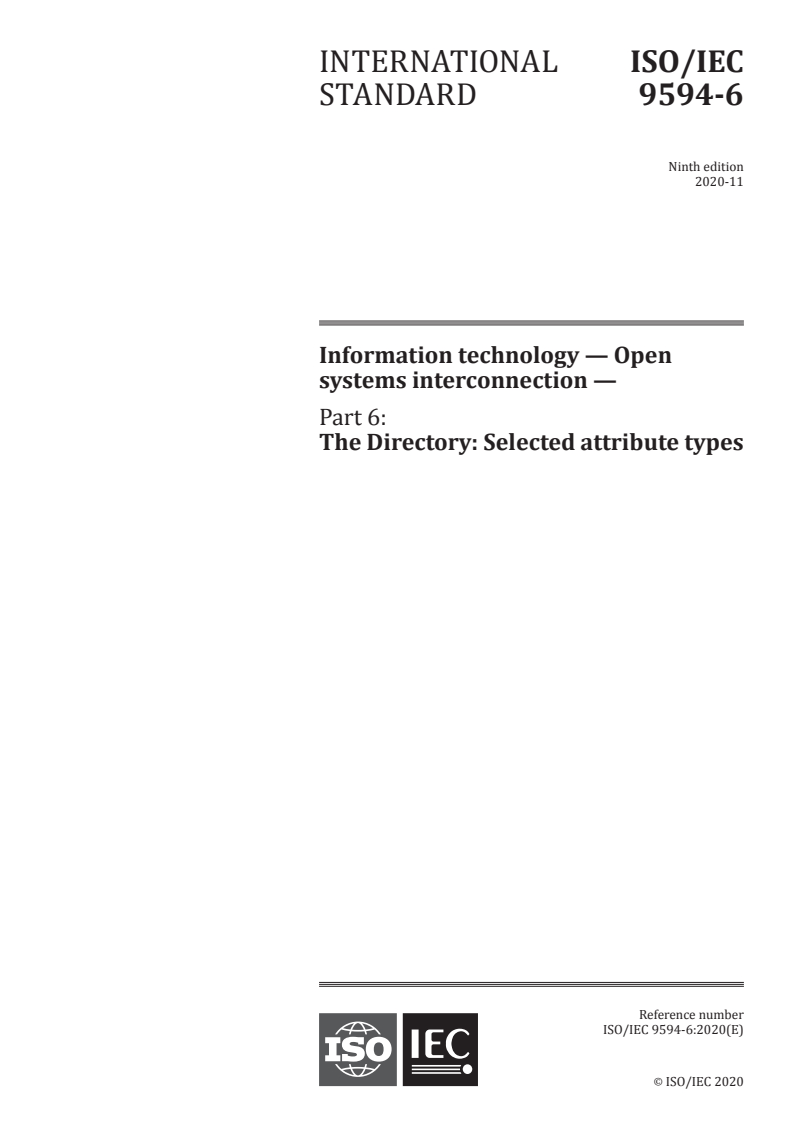
INTERNATIONAL ISO/IEC
STANDARD 9594-6
Ninth edition
2020-11
Information technology — Open
systems interconnection —
Part 6:
The Directory: Selected attribute types
Reference number
©
ISO/IEC 2020
© ISO/IEC 2020
All rights reserved. Unless otherwise specified, or required in the context of its implementation, no part of this publication may
be reproduced or utilized otherwise in any form or by any means, electronic or mechanical, including photocopying, or posting
on the internet or an intranet, without prior written permission. Permission can be requested from either ISO at the address
below or ISO’s member body in the country of the requester.
ISO copyright office
CP 401 • Ch. de Blandonnet 8
CH-1214 Vernier, Geneva
Phone: +41 22 749 01 11
Email: copyright@iso.org
Website: www.iso.org
Published in Switzerland
ii © ISO/IEC 2020 – All rights reserved
Foreword
ISO (the International Organization for Standardization) and IEC (the International Electrotechnical
Commission) form the specialized system for worldwide standardization. National bodies that are
members of ISO or IEC participate in the development of International Standards through technical
committees established by the respective organization to deal with particular fields of technical activity.
ISO and IEC technical committees collaborate in fields of mutual interest. Other international
organizations, governmental and non-governmental, in liaison with ISO and IEC, also take part in the
work.
The procedures used to develop this document and those intended for its further maintenance are
described in the ISO/IEC Directives, Part 1. In particular, the different approval criteria needed for the
different types of document should be noted (see www.iso.org/directives).
Attention is drawn to the possibility that some of the elements of this document may be the subject of
patent rights. ISO and IEC shall not be held responsible for identifying any or all such patent rights. Details
of any patent rights identified during the development of the document will be in the Introduction and/or
on the ISO list of patent declarations received (see www.iso.org/patents) or the IEC list of patent
declarations received (see http://patents.iec.ch).
Any trade name used in this document is information given for the convenience of users and does not
constitute an endorsement.
For an explanation of the voluntary nature of standards, the meaning of ISO specific terms and
expressions related to conformity assessment, as well as information about ISO's adherence to the World
Trade Organization (WTO) principles in the Technical Barriers to Trade (TBT),
see www.iso.org/iso/foreword.html.
This document was prepared by ITU-T as ITU-T X.520 (10/2019) and drafted in accordance with
its editorial rules, in collaboration with Joint Technical Committee ISO/IEC JTC 1, Information
technology, Subcommittee SC 6, Telecommunications and information exchange between systems.
This ninth edition cancels and replaces the eighth edition (ISO/IEC 9594-6:2017), which has been
technically revised.
A list of all parts in the ISO/IEC 9594 series can be found on the ISO website.
Any feedback or questions on this document should be directed to the user’s national standards body.
A complete listing of these bodies can be found at www.iso.org/members.html.
© ISO/IEC 2020 – All rights reserved iii
CONTENTS
Page
1 Scope . 1
2 Normative references. 1
2.1 Identical Recommendations | International Standards . 1
2.2 Other references . 2
2.3 ISO/IEC Standards . 3
3 Definitions . 3
4 Abbreviations . 3
5 Conventions . 4
6 Definition of selected attribute types . 5
6.1 System attribute types . 5
6.2 Labelling attribute types . 5
6.3 Geographical attribute types . 10
6.4 Organizational attribute types . 12
6.5 Explanatory attribute types . 13
6.6 Postal addressing attribute types . 15
6.7 Telecommunications addressing attribute types . 17
6.8 Preferences attribute types . 20
6.9 OSI application attribute types . 21
6.10 Relational attribute types . 22
6.11 Domain attribute types . 23
6.12 Hierarchical attribute types . 23
6.13 Attributes for applications using tag-based identification . 24
6.14 Simple Authentication attributes held by object entries . 28
6.15 Password policy attributes . 30
6.16 Notification attributes . 34
6.17 LDAP defined attribute types . 39
7 String preparation . 40
7.1 Transcode . 40
7.2 Map . 40
7.3 Normalize . 40
7.4 Prohibit . 40
7.5 Check bidi . 41
7.6 Insignificant Character Removal . 41
8 Definition of matching rules . 41
8.1 String matching rules . 41
8.2 Syntax-based matching rules . 44
8.3 Time matching rules . 47
8.4 First component matching rules . 49
8.5 Word matching rules . 49
8.6 Approximate Matching Rules . 52
8.7 Special Matching Rules . 52
8.8 Zonal Match . 53
8.9 Identity matching rules . 56
8.10 Password policy matching rules . 57
8.11 LDAP defined matching rules . 58
9 Definition of syntaxes. 59
9.1 Directory syntaxes . 59
9.2 IETF syntaxes. 60
10 Definition of Context Types . 66
10.1 Language Context . 66
10.2 Temporal Context . 66
© ISO/IEC 2020 – All rights reserved
Rec. ITU-T X.520 (10/2019) v
Page
10.3 Locale Context . 70
10.4 LDAP Attribute Option Context . 70
Annex A – Selected attribute types in ASN.1 . 72
Annex B – Attribute types for password policy in ASN.1 . 103
Annex C – Upper bounds . 109
Annex D – Alphabetical index of attributes, matching rules and contexts . 110
Annex E – Examples for zonal match matching rules . 113
Annex F – Mapping Object Identifiers and Uniform Resource Names into Distinguished Names . 116
F.1 Scope of this annex . 116
F.2 Object identifier resolution . 116
F.3 Uniform Resource Name (URN) resolution . 117
Annex G – Object identifier based Directory names . 120
G.1 Scope of this annex . 120
G.2 Transformation of object identifiers into Directory names . 120
G.3 The use of object-identifier-based Directory names . 120
Annex H – Amendments and corrigenda . 122
© ISO/IEC 2020 – All rights reserved
vi Rec. ITU-T X.520 (10/2019)
Introduction
This Recommendation | International Standard, together with other Recommendations | International Standards, has been
produced to facilitate the interconnection of information processing systems to provide directory services. A set of such
systems, together with the directory information that they hold, can be viewed as an integrated whole, called the Directory.
The information held by the Directory, collectively known as the Directory Information Base (DIB), is typically used to
facilitate communication between, with or about objects such as application entities, people, terminals, and distribution
lists.
The Directory plays a significant role in Open Systems Interconnection, whose aim is to allow, with a minimum of
technical agreement outside of the interconnection standards themselves, the interconnection of information processing
systems:
– from different manufacturers;
– under different managements;
– of different levels of complexity; and
– of different ages.
This Recommendation | International Standard defines a number of attribute types which may be found useful across a
range of applications of the Directory, as well as a number of standard attribute syntaxes and matching rules. One
particular use for many of the attributes defined herein is in the formation of names, particularly for the classes of objects
defined in Rec. ITU-T X.521 | ISO/IEC 9594-7.
This Recommendation | International Standard provides the foundation frameworks upon which industry profiles can be
defined by other standards groups and industry forums. Many of the features defined as optional in these frameworks may
be mandated for use in certain environments through profiles. This ninth edition technically revises and enhances the
eighth edition of this Recommendation | International Standard.
This ninth edition specifies versions 1 and 2 of the Directory protocols.
Annex A, which is an integral part of this Recommendation | International Standard, provides the ASN.1 notation for the
complete module which defines the attributes, attribute syntaxes and matching rules.
Annex C, which is not an integral part of this Recommendation | International Standard, provides a table of attribute types,
for easy reference.
Annex D, which is not an integral part of this Recommendation | International Standard, provides an example of upper
bounds value constraints. These constraints are not reflected in these Directory Specifications, but are provided as a
reference for those implementations applying these constraints.
Annex E, which is not an integral part of this Recommendation | International Standard, lists alphabetically the attributes
and matching rules defined in this Directory Specification.
Annex F, which is not an integral part of this Recommendation | International Standard, gives examples relevant to the
definition of zonal matching.
Annex G, which is not an integral part of this Recommendation | International Standard, describes how a directory
distinguished name may be based on object identifiers and on Uniform Resource Names (URNs).
Annex H, which is not an integral part of this Recommendation | International Standard, describes an alternative way of
generating directory distinguished based on object identifiers. It contains information retrieved from Rec. ITU-T X.660 |
ISO/IEC 9834-1.
Annex I, which is not an integral part of this Recommendation | International Standard, lists the amendments and defect
reports that have been incorporated to form this edition of this Recommendation | International Standard.
© ISO/IEC 2020 – All rights reserved
Rec. ITU-T X.520 (10/2019) vii
INTERNATIONAL STANDARD
RECOMMENDATION ITU-T
Information technology – Open Systems Interconnection –
The Directory: Selected attribute types
SECTION 1 – GENERAL
1 Scope
This Recommendation | International Standard defines a number of attribute types and matching rules which may be
found useful across a range of applications of the Directory.
Attribute types and matching rules fall into three categories, as described below.
Some attribute types and matching rules are used by a wide variety of applications or are understood and/or used by the
Directory itself.
NOTE 1 – It is recommended that an attribute type or matching rule defined in this Recommendation | International Standard be
used, in preference to the generation of a new one, whenever it is appropriate for the application.
NOTE 2 – The attribute and context types definitions by this Recommendation | International Standard have some associated
semantics. Such specifications should not be used in situations where these semantics do not apply.
Some attribute types and matching rules are internationally standardized, but are application-specific. These are defined
in the standards associated with the application concerned.
Any administrative authority can define its own attribute types and matching rules for any purpose. These are not
internationally standardized, and are available to others beyond the administrative authority which created them only
through bilateral agreement.
2 Normative references
The following Recommendations and International Standards contain provisions which, through reference in this text,
constitute provisions of this Recommendation | International Standard. At the time of publication, the editions indicated
were valid. All Recommendations and Standards are subject to revision, and parties to agreements based on this
Recommendation | International Standard are encouraged to investigate the possibility of applying the most recent edition
of the Recommendations and Standards listed below. Members of IEC and ISO maintain registers of currently valid
International Standards. The Telecommunication Standardization Bureau of the ITU maintains a list of currently valid
ITU-T Recommendations.
2.1 Identical Recommendations | International Standards
– Recommendation ITU-T X.500 (2019) | ISO/IEC 9594-1:2020, Information technology – Open Systems
Interconnection – The Directory: Overview of concepts, models and services.
– Recommendation ITU-T X.501 (2019) | ISO/IEC 9594-2:2020, Information technology – Open Systems
Interconnection – The Directory: Models.
– Recommendation ITU-T X.509 (2019) | ISO/IEC 9594-8:2020, Information technology – Open Systems
Interconnection – The Directory: Public-key and attribute certificate frameworks.
– Recommendation ITU-T X.511 (2019) | ISO/IEC 9594-3:2020, Information technology – Open Systems
Interconnection – The Directory: Abstract service definition.
– Recommendation ITU-T X.518 (2019) | ISO/IEC 9594-4:2020, Information technology – Open Systems
Interconnection – The Directory: Procedures for distributed operation.
– Recommendation ITU-T X.519 (2019) | ISO/IEC 9594-5:2020, Information technology – Open Systems
Interconnection – The Directory: Protocol specifications.
– Recommendation ITU-T X.521 (2019) | ISO/IEC 9594-7:2020, Information technology – Open Systems
Interconnection – The Directory: Selected object classes.
– Recommendation ITU-T X.525 (2019) | ISO/IEC 9594-9:2020, Information technology – Open Systems
Interconnection – The Directory: Replication.
© ISO/IEC 2020 – All rights reserved
Rec. ITU-T X.520 (10/2019) 1
– Recommendation ITU-T X.660 (2011) | ISO/IEC 9834-1:2012, Information technology –Procedures for
the operation of object identifier registration authorities: General procedures and top arcs of the
international object identifier tree.
– Recommendation ITU-T X.667 (2012) | ISO/IEC 9834-8:2014, Information technology –Procedures for
the operation of object identifier registration authorities: Generation of universally unique identifiers and
their use in object identifiers.
– Recommendation ITU-T X.668 (2008) | ISO/IEC 9834-9:2008, Information technology – Open Systems
Interconnection – Procedures for the operation of OSI Registration Authorities: Registration of object
identifier arcs for applications and services using tag-based identification.
– Recommendation ITU-T X.680 (2015) | ISO/IEC 8824-1:2015, Information technology – Abstract Syntax
Notation One (ASN.1): Specification of basic notation.
– Recommendation ITU-T X.681 (2015) | ISO/IEC 8824-2:2015, Information technology – Abstract Syntax
Notation One (ASN.1): Information object specification.
– Recommendation ITU-T X.682 (2015) | ISO/IEC 8824-3:2015, Information technology – Abstract Syntax
Notation One (ASN.1): Constraint specification.
– Recommendation ITU-T X.683 (2015) | ISO/IEC 8824-4:2015, Information technology – Abstract Syntax
Notation One (ASN.1): Parameterization of ASN.1 specifications.
– Recommendation ITU-T X.690 (2015) | ISO/IEC 8825-1:2015, Information technology – ASN.1 encoding
rules: Specification of Basic Encoding Rules (BER), Canonical Encoding Rules (CER) and Distinguished
Encoding Rules (DER).
2.2 Other references
– Recommendation ITU-T E.123 (2001), Notation for national and international telephone numbers, e-mail
addresses and web addresses.
– Recommendation ITU-T E.164 (2010), The international public telecommunication numbering plan.
– Recommendation ITU-T F.1 (1998), Operational provisions for the international public telegram service.
– Recommendation ITU-T F.31 (1988), Telegram retransmission system.
– Recommendation ITU-T F.401 (1992), Message handling services: Naming and addressing for public
message handling services.
– Recommendation ITU-T T.30 (2005), Procedures for document facsimile transmission in the general
switched telephone network.
– Recommendation ITU-T T.51 (1992), Latin based coded character sets for telematic services.
– Recommendation ITU-T T.62 (1993), Control procedures for teletex and Group 4 facsimile services.
– Recommendation ITU-T X.121 (2000), International numbering plan for public data networks.
– ISO 3166-1:2013, Codes for the representation of names of countries and their subdivisions – Part 1:
Country codes.
– ISO 3166-3:2013, Codes for the representation of names of countries and their subdivisions – Part 3:
Code for formerly used names of countries.
– ISO 639-2:1998, Codes for the representation of names of languages – Part 2: Alpha-3 code.
– ISO/IEC/IEEE 9945:2009, Information technology – Portable Operating System Interface (POSIX) – Base
Specifications, Issue 7.
– ISO/IEC 15897:2011, Information technology – User interfaces – Procedures for the registration of
cultural elements.
– IETF RFC 3406 (2002), Uniform Resource Names (URN) Namespace Definition Mechanisms.
– IETF RFC 3454 (2002), Preparation of Internationalized Strings ("stringprep").
– IETF RFC 3492 (2003), Punycode: A Bootstring encoding of Unicode for Internationalized Domain
Names in Applications (IDNA).
– IETF RFC 3641 (2003), Generic String Encoding Rules (GSER) for ASN.1 Types.
– IETF RFC 3642 (2003), Common Elements of Generic String Encoding Rules (GSER) Encodings.
– IETF RFC 3672 (2003), Subentries in the Lightweight Directory Access Protocol (LDAP).
– IETF RFC 3986 (2005), Uniform Resource Identifier (URI): Generic Syntax.
© ISO/IEC 2020 – All rights reserved
2 Rec. ITU-T X.520 (10/2019)
– IETF RFC 4512 (2006), Lightweight Directory Access Protocol (LDAP): Directory Information Models.
– IETF RFC 4514 (2006); Lightweight Directory Access Protocol (LDAP): String Representation of
Distinguished Names.
– IETF RFC 4517 (2006), Lightweight Directory Access Protocol (LDAP): Syntaxes and Matching Rules.
– IETF RFC 4520 (2006), Internet Assigned Numbers Authority (IANA) Considerations for the Lightweight
Directory Access Protocol (LDAP).
– IETF RFC 4792 (2007), Encoding Instructions for the Generic String Encoding Rules (GSER).
– IETF RFC 5890 (2010), Internationalized Domain Names for Applications (IDNA): Definitions and
Document Framework.
– IETF RFC 5892 (2010), The Unicode Code Points and Internationalized Domain Names for Applications
(IDNA).
– National Imagery and Mapping Agency (NIMA): TR 8350.2 (1984), Department of Defense World
Geodetic System, third edition.
– The Unicode Consortium. The Unicode Standard, Version 4.0.0, defined by: The Unicode Standard,
Version 4.0 (Reading, MA: Addison-Wesley, 2003. ISBN 0-321-18578-1).
– Unicode Standard Annex #15: Unicode Normalization Forms, by Mark Davis and Martin Dürst. An integral
part of The Unicode Standard, Version 4.0.
2.3 ISO/IEC Standards
– ISO/IEC 10646:2017, Information technology – Universal Coded Character Set (UCS).
3 Definitions
For the purposes of this Recommendation | International Standard, the following definitions apply:
The following terms are defined in Rec. ITU-T X.501 | ISO/IEC 9594-2:
a) attribute type;
b) context;
c) matching rule;
d) object class.
4 Abbreviations
For the purposes of this Recommendation | International Standard, the following abbreviations apply:
AFI Application Family Identifier
EPC Electronic Product Code
FQDN Fully-Qualified Domain Name
GSER Generic String Encoding Rules
IDN Internationalized Domain Name
LDAP Lightweight Directory Access Protocol
LDH Letters, Digits, Hyphen
RFID Radio Frequency Identification
RDN Relative Distinguished Name
UII Unique Item Identifier
URL Uniform Resource Locator
URN Uniform Resource Name
UTM Universal Transverse Mercator
UUID Universally Unique Identifier
© ISO/IEC 2020 – All rights reserved
Rec. ITU-T X.520 (10/2019) 3
5 Conventions
The term "Directory Specification" (as in "this Directory Specification") shall be taken to mean Rec. ITU-T X.520 |
ISO/IEC 9594-6. The term "Directory Specifications" shall be taken to mean the Rec. ITU-T X.500 | ISO/IEC 9594-1,
Rec. ITU-T X.501 | ISO/IEC 9594-2, Rec. ITU-T X.511 | ISO/IEC 9594-3, Rec. ITU-T X.518 | ISO/IEC 9594-4, Rec.
ITU-T X.519 | ISO/IEC 9594-5, Rec. ITU-T X.520 | ISO/IEC 9594-6, Rec ITU-T X.521 | ISO/IEC 9594-7 and Rec.
ITU-T X.525 | ISO/IEC 9594-9.
If an International Standard or ITU-T Recommendation is referenced within normal text without an indication of the
edition, the edition shall be taken to be the latest one as specified in the normative references clause.
Prior to year 2020, the parts making up the Directory Specifications progressed together and can therefore collectively be
identified as the Directory Specifications of a specific edition using the format: Rec. ITU-T X.5** (yyyy) | ISO/IEC 9594-
*:yyyy (e.g.; Rec ITU-T X.5** (1993) | ISO/IEC 9594-*:1995).
This Directory Specification makes extensive use of Abstract Syntax Notation One (ASN.1) for the formal specification
of data types and values, as it is specified in Rec. ITU-T X.680 | ISO/IEC 8824-1, ITU-T X.681 | ISO/IEC 8824-2, ITU-
T X.682 | ISO/IEC 8824-3, ITU-T X.683 | ISO/IEC 8824-4 and Rec. ITU-T X.690 | ISO/IEC 8825-1.
This Directory Specification presents ASN.1 notation in the bold Courier New typeface. When ASN.1 types and values
are referenced in normal text, they are differentiated from normal text by presenting them in the bold Courier New
typeface. The names of procedures, typically referenced when specifying the semantics of processing, are differentiated
from normal text by displaying them in bold Times New Roman. Access control permissions are presented in italicized
Times New Roman.
If the items in a list are numbered (as opposed to using "–" or letters), then the items shall be considered steps in a
procedure.
Attribute types, matching rules and context types are defined in this Recommendation | International Standard by use of
the ATTRIBUTE, MATCHING-RULE and CONTEXT information object classes defined in Rec. ITU-T X.501 |
ISO/IEC 9594-2.
Examples of the use of the attribute types are described using an informal notation, where attribute type and value pairs
are represented by an acronym for the attribute type, followed by an equals sign ("="), followed by the example value for
the attribute.
© ISO/IEC 2020 – All rights reserved
4 Rec. ITU-T X.520 (10/2019)
SECTION 2 – SELECTED ATTRIBUTE TYPES
6 Definition of selected attribute types
This Directory Specification defines a number of attribute types which may be found useful across a range of applications
of the Directory.
Many of the attribute types defined in this Directory Specification are based on a common ASN.1 syntax:
UnboundedDirectoryString ::= CHOICE {
teletexString TeletexString(SIZE (1.MAX)),
printableString PrintableString(SIZE (1.MAX)),
bmpString BMPString(SIZE (1.MAX)),
universalString UniversalString(SIZE (1.MAX)),
uTF8String UTF8String(SIZE (1.MAX)) }
A few attribute types are based on the following data type:
DirectoryString{INTEGER:maxSize} ::= CHOICE {
teletexString TeletexString(SIZE (1.maxSize,.)),
printableString PrintableString(SIZE (1.maxSize,.)),
bmpString BMPString(SIZE (1.maxSize,.)),
universalString UniversalString(SIZE (1.maxSize,.)),
uTF8String UTF8String(SIZE (1.maxSize,.)) }
NOTE 1 – The above syntaxes are also used in other parts of these Directory Specifications.
NOTE 2 – The use of TeletexString is deprecated.
6.1 System attribute types
6.1.1 Knowledge information
A value of the knowledgeInformation attribute type holds a human readable accumulated description of knowledge
mastered by a specific DSA.
NOTE – This attribute is now obsolete.
knowledgeInformation ATTRIBUTE ::= {
WITH SYNTAX UnboundedDirectoryString
EQUALITY MATCHING RULE caseIgnoreMatch
OBSOLETE TRUE
ID id-at-knowledgeInformation }
6.2 Labelling attribute types
These attributes type are concerned with information about objects which has been explicitly associated with the objects
by a labelling process.
6.2.1 Name
The name attribute type is the attribute supertype from which string attribute types typically used for naming may be
formed.
name ATTRIBUTE ::= {
WITH SYNTAX UnboundedDirectoryString
EQUALITY MATCHING RULE caseIgnoreMatch
SUBSTRINGS MATCHING RULE caseIgnoreSubstringsMatch
LDAP-SYNTAX directoryString.&id
LDAP-NAME {"name"}
ID id-at-name }
6.2.2 Common name
A value of the commonName attribute type holds an identification of an object. A common name is not a directory name
in itself; it is a (possibly ambiguous) name by which the object is commonly known in some limited scope (such as an
organization) and conforms to the naming conventions of the country or culture with which it is associated.
© ISO/IEC 2020 – All rights reserved
Rec. ITU-T X.520 (10/2019) 5
An attribute value for Common Name is a string chosen by either the person or organization it describes or the
organization responsible for the object it describes for devices and application entities. For example, a typical name of a
person in an English-speaking country comprises a personal title (e.g., Mr., Ms., Rd, Professor, Sir, Lord), a first name,
middle name(s), last name, generation qualifier (if any, e.g., Jr.) and decorations and awards (if any, e.g., QC).
Examples
CN = "Mr. Robin Lachlan McLeod BSc(Hons) CEng MIEE";
CN = "Divisional Coordination Committee";
CN = "High Speed Modem".
Any variants should be associated with the named object as separate and alternative attribute values.
Other common variants should also be admitted, e.g., use of a middle name as a preferred first name; use of "Bill" in
place of "William", etc.
commonName ATTRIBUTE ::= {
SUBTYPE OF name
WITH SYNTAX UnboundedDirectoryString
LDAP-SYNTAX directoryString.&id
LDAP-NAME {"cn","commonName"}
ID id-at-commonName }
6.2.3 Surname
An attribute of the type surname specifies the linguistic construct which normally is inherited by an individual from the
individual's parent or assumed by marriage, and by which the individual is commonly known.
An attribute value for Surname is a string, e.g., "McLeod".
surname ATTRIBUTE ::= {
SUBTYPE OF name
WITH SYNTAX UnboundedDirectoryString
LDAP-SYNTAX directoryString.&id
LDAP-NAME {"sn"}
ID id-at-surname }
6.2.4 Given Name
The Given Name attribute type specifies the linguistic construct which is normally given to an individual by the
individual's parent, or is chosen by the individual, or by which the individual is commonly known.
An attribute value for Given Name is a string, e.g., "David" or "Jean-Paul".
givenName ATTRIBUTE ::= {
SUBTYPE OF name
WITH SYNTAX UnboundedDirectoryString
LDAP-SYNTAX directoryString.&id
LDAP-NAME {"givenName"}
ID id-at-givenName }
6.2.5 Initials
The Initials attribute type contains the initials of some or all of an individual's names, but not the surname(s).
An attribute value for Initials is a string, e.g., "D" or "D." or "J.P.".
initials ATTRIBUTE ::= {
SUBTYPE OF name
WITH SYNTAX UnboundedDirectoryString
LDAP-SYNTAX directoryString.&id
LDAP-NAME {"initials"}
ID id-at-initials }
6.2.6 Generation Qualifier
The Generation Qualifier attribute type contains a string which is used to provide generation information to qualify an
individual's name.
© ISO/IEC 2020 – All rights reserved
6 Rec. ITU-T X.520 (10/2019)
An attribute value for Generation Qualifier is a string, e.g., "Jr." or "II".
generationQualifier ATTRIBUTE ::= {
SUBTYPE OF name
WITH SYNTAX UnboundedDirectoryString
LDAP-SYNTAX directoryString.&id
LDAP-NAME {"generationQualifier"}
ID id-at-generationQualifier }
6.2.7 Unique Identifier
The Unique Identifier attribute type specifies an identifier which may be used to distinguish between object references
when a distinguished name has been reused. It may be, for example, an encoded object identifier, certificate, date,
timestamp, or some other form of certification on the validity of the distinguished name.
An attribute value for Unique Identifier is a bit string.
uniqueIdentifier ATTRIBUTE ::= {
WITH SYNTAX UniqueIdentifier
EQUALITY MATCHING RULE bitStringMatch
LDAP-SYNTAX bitString.&id
LDAP-NAME {"x500UniqueIdentifier"}
ID id-at-uniqueIdentifier }
UniqueIdentifier ::= BIT STRING
6.2.8 DN Qualifier
The DN Qualifier attribute type specifies disambiguating information to add to the relative distinguished name of an
entry. It is intended to be used for entries held in multiple DSAs which would otherwise have the same name, and that its
value be the same in a given DSA for all entries to which this information has been added.
dnQualifier ATTRIBUTE ::= {
WITH SYNTAX PrintableString
EQUALITY MATCHING RULE caseIgnoreMatch
ORDERING MATCHING RULE caseIgnoreOrderingMatch
SUBSTRINGS MATCHING RULE caseIgnoreSubstringsMatch
LDAP-SYNTAX printableString.&id
LDAP-NAME {"dnQualifier"}
ID id-at-dnQualifier }
6.2.9 Serial Number
The Serial Number attribute type specifies an identifier or the serial number of an object.
An attribute value for Serial Number is a printable string.
serialNumber ATTRIBUTE ::= {
WITH SYNTAX PrintableString(SIZE (1.MAX))
EQUALITY MATCHING RULE caseIgnoreMatch
SUBSTRINGS MATCHING RULE caseIgnoreSubstringsMatch
LDAP-SYNTAX printableString.&id
LDAP-NAME {"serialNumber"}
ID id-at-serialNumber }
6.2.10 Pseudonym
The Pseudonym attribute type specifies a pseudonym for an object. It is used for naming an object when it is to be made
clear that its name is a pseudonym.
pseudonym ATTRIBUTE ::= {
SUBTYPE OF name
WITH SYNTAX UnboundedDirectoryString
ID id-at-pseudonym }
6.2.11 Universal Unique Identifier Pair
The Universal Unique Identifier Pair attribute type specifies a pair of Universal Unique Identifiers (UUID), as specified
in Rec. ITU-T X.667 | ISO/IEC 9834-8. The pair collectively represents an issuer/subject relationship, the nature of which
is outside the scope of this Directory Specification. The initial UUID in the pair represents the issuer, and the trailing
© ISO/IEC 2020 – All rights reserved
Rec. ITU-T X.520 (10/2019) 7
UUID in the pair represents the subject of the issuer/subject relationship. An example of such a relationship is a user
account.
uUIDPair ATTRIBUTE ::= {
WITH SYNTAX UUIDPair
EQUALITY MATCHING RULE uUIDPairMatch
ID id-
at-uuidpair }
UUIDPair ::= SEQUENCE {
issuerUUID UUID,
subjectUUID UUID,
... }
UUID ::= OCTET STRING(SIZE (16)) -- UUID format only
6.2.12 URI
A value of attribute type uri holds a uniform resource identifier (URI) as defined in IETF RFC 3986.
uri ATTRIBUTE ::= {
WITH SYNTAX URI
EQUALITY MATCHING RULE uriMatch
LDAP-SYNTAX directoryString.&id
LDAP-NAME {"uri"}
ID id-at-uri }
URI ::= UTF8String
6.2.13 URN
A value of attribute type urn holds a uniform resource name (URN) as defined in IETF RFC 3406.
urn ATTRIBUTE ::= {
SUBTYPE OF uri
LDAP-SYNTAX directoryString.&id
LDAP-NAME {"urn"}
ID id-at-urn }
6.2.14 URL
A value of attribute type url holds a uniform resource locator (URL).
url ATTRIBUTE ::= {
SUBTYPE OF uri
LDAP-SYNTAX directoryString.&id
LDAP-NAME {"url"}
ID id-at-url }
6.2.15 Domain name
A value of attribute type dnsName is used for holding a DNS domain name, which may be an internationalized domain
name (IDN).
dnsName ATTRIBUTE ::= {
WITH SYNTAX DomainName
EQUALITY MATCHING RULE dnsNameMatch
LDAP-SYNTAX dnsString.&id
LDAP-NAME {"DNS name"}
ID id-at-dnsName }
DomainName ::= UTF8String (CONSTRAINED BY { -- Conforms to the format of a
(internationalized) domain name. -- })
A value of the DomainName data type shall be in the syntax, as specified by section 2.3.1 of IETF RFC 5890 meaning
that a domain name is a sequence of labels in the letters, digits, hyphen (LDH) format separated by dots.
A label may be in three formats:
© ISO/IEC 2020 – All rights reserved
8 Rec. ITU-T X.520 (10/2019)
a) All characters in the label are from the Basic Latin collection as defined by ISO/IEC 10646 (i.e., having
code points in the ranges 002D, 0030-0039, 0041-005A and 0061-007A) and it does not start with "xn--".
The maximum length is 63 octets.
b) It is an A-label as defined in IETF RFC 5890, i.e., it starts with the "xn--" and is a U-label converted to
valid ASCII characters as in item a) using the Punycode algorithm defined by IETF RFC 3492. The
converted string shall be maximum 59 octets. To be valid, it shall be possible for an A-label to be converted
to a valid U-label.
NOTE 1 – An A-label is normally not human readable.
c) It is a U-label as defined in IETF RFC 5890, i.e., it contains characters outside the Basic Latin collection.
A valid U-label shall not include any characters that are not included in the restricted Unicode repertoire
as defined by IETF RFC 5892 and it shall be convertible to a valid A-label as defined in item b). A valid
U-label may be more than 63 octets.
NOTE 2 – In a constraint environment, it is recommended to use a domain name whenever possible, according to item a).
NOTE 3 – When used as a naming attribute, a unique distinguished name may be constructed using only this attribute type.
An attribute of type dnsName to be used as a distinguished name in a public-key certificate or in an attribute certificate
shall be a fully-qualified domain name (FQDN), i.e., it shall identify a particular entity. An FQDN may have an asterisk
('*') as an additional leftmost label, which is a substitute (wildcard) for all labels at the next levels of subdomains of the
domain identified by the FQDN without the asterisk. An attribute of type dnsName holding an FQDN with a wildcard
label may in some cases be used in the subject component of an end-entity public-key certificate.
6.2.16 Internationalized email address attribute type
A value of attribute type intEmail is used for holding an internationalized email address.
intEmail ATTRIBUTE ::= {
WITH SYNTAX IntEmail
EQUALITY MATCHING RULE intEmailMatch
SINGLE VALUE TRUE
LDAP-SYNTAX intMailString.&id
LDAP-NAME {"Internationalized Email"}
ID id-at-intEmail }
IntEmail ::= UTF8String (CONSTRAINED BY { -- Conforms to the format of an
(internationalized) email address. -- })
The requirements of the labels of the domain part of an internationalized email address are as specified for domain names
(see clause 6.2.15), except that an asterisk ('*') shall not be used as label.
If neither the local part nor the domain part both holds non-ASCII characters, then the mail attribute type specified in
clause 6.17.3 should be used.
If only the local part uses ASCII cgaracters, the A-label should be used for the domain name allowing the mail attribute
type to be used.
6.2.17 Jabber identifier attribute type
A value of attribute type jid is used for holding a jabber identifier as specified in IETF RFC 7633.
jid ATTRIBUTE ::= {
WITH SYNTAX Jid
EQUALITY MATCHING RULE jidMatch
SINGLE VALUE TRUE
LDAP-SYNTAX jidString.&id
LDAP-NAME {"Jabb
...
INTERNATIONAL ISO/IEC
STANDARD 9594-6
Ninth edition
2020-11
Information technology — Open
systems interconnection —
Part 6:
The Directory: Selected attribute types
Reference number
©
ISO/IEC 2020
© ISO/IEC 2020
All rights reserved. Unless otherwise specified, or required in the context of its implementation, no part of this publication may
be reproduced or utilized otherwise in any form or by any means, electronic or mechanical, including photocopying, or posting
on the internet or an intranet, without prior written permission. Permission can be requested from either ISO at the address
below or ISO’s member body in the country of the requester.
ISO copyright office
CP 401 • Ch. de Blandonnet 8
CH-1214 Vernier, Geneva
Phone: +41 22 749 01 11
Email: copyright@iso.org
Website: www.iso.org
Published in Switzerland
ii © ISO/IEC 2020 – All rights reserved
Foreword
ISO (the International Organization for Standardization) and IEC (the International Electrotechnical
Commission) form the specialized system for worldwide standardization. National bodies that are
members of ISO or IEC participate in the development of International Standards through technical
committees established by the respective organization to deal with particular fields of technical activity.
ISO and IEC technical committees collaborate in fields of mutual interest. Other international
organizations, governmental and non-governmental, in liaison with ISO and IEC, also take part in the
work.
The procedures used to develop this document and those intended for its further maintenance are
described in the ISO/IEC Directives, Part 1. In particular, the different approval criteria needed for the
different types of document should be noted (see www.iso.org/directives).
Attention is drawn to the possibility that some of the elements of this document may be the subject of
patent rights. ISO and IEC shall not be held responsible for identifying any or all such patent rights. Details
of any patent rights identified during the development of the document will be in the Introduction and/or
on the ISO list of patent declarations received (see www.iso.org/patents) or the IEC list of patent
declarations received (see http://patents.iec.ch).
Any trade name used in this document is information given for the convenience of users and does not
constitute an endorsement.
For an explanation of the voluntary nature of standards, the meaning of ISO specific terms and
expressions related to conformity assessment, as well as information about ISO's adherence to the World
Trade Organization (WTO) principles in the Technical Barriers to Trade (TBT),
see www.iso.org/iso/foreword.html.
This document was prepared by ITU-T as ITU-T X.520 (10/2019) and drafted in accordance with
its editorial rules, in collaboration with Joint Technical Committee ISO/IEC JTC 1, Information
technology, Subcommittee SC 6, Telecommunications and information exchange between systems.
This ninth edition cancels and replaces the eighth edition (ISO/IEC 9594-6:2017), which has been
technically revised.
A list of all parts in the ISO/IEC 9594 series can be found on the ISO website.
Any feedback or questions on this document should be directed to the user’s national standards body.
A complete listing of these bodies can be found at www.iso.org/members.html.
© ISO/IEC 2020 – All rights reserved iii
CONTENTS
Page
1 Scope . 1
2 Normative references. 1
2.1 Identical Recommendations | International Standards . 1
2.2 Other references . 2
2.3 ISO/IEC Standards . 3
3 Definitions . 3
4 Abbreviations . 3
5 Conventions . 4
6 Definition of selected attribute types . 5
6.1 System attribute types . 5
6.2 Labelling attribute types . 5
6.3 Geographical attribute types . 10
6.4 Organizational attribute types . 12
6.5 Explanatory attribute types . 13
6.6 Postal addressing attribute types . 15
6.7 Telecommunications addressing attribute types . 17
6.8 Preferences attribute types . 20
6.9 OSI application attribute types . 21
6.10 Relational attribute types . 22
6.11 Domain attribute types . 23
6.12 Hierarchical attribute types . 23
6.13 Attributes for applications using tag-based identification . 24
6.14 Simple Authentication attributes held by object entries . 28
6.15 Password policy attributes . 30
6.16 Notification attributes . 34
6.17 LDAP defined attribute types . 39
7 String preparation . 40
7.1 Transcode . 40
7.2 Map . 40
7.3 Normalize . 40
7.4 Prohibit . 40
7.5 Check bidi . 41
7.6 Insignificant Character Removal . 41
8 Definition of matching rules . 41
8.1 String matching rules . 41
8.2 Syntax-based matching rules . 44
8.3 Time matching rules . 47
8.4 First component matching rules . 49
8.5 Word matching rules . 49
8.6 Approximate Matching Rules . 52
8.7 Special Matching Rules . 52
8.8 Zonal Match . 53
8.9 Identity matching rules . 56
8.10 Password policy matching rules . 57
8.11 LDAP defined matching rules . 58
9 Definition of syntaxes. 59
9.1 Directory syntaxes . 59
9.2 IETF syntaxes. 60
10 Definition of Context Types . 66
10.1 Language Context . 66
10.2 Temporal Context . 66
© ISO/IEC 2020 – All rights reserved
Rec. ITU-T X.520 (10/2019) v
Page
10.3 Locale Context . 70
10.4 LDAP Attribute Option Context . 70
Annex A – Selected attribute types in ASN.1 . 72
Annex B – Attribute types for password policy in ASN.1 . 103
Annex C – Upper bounds . 109
Annex D – Alphabetical index of attributes, matching rules and contexts . 110
Annex E – Examples for zonal match matching rules . 113
Annex F – Mapping Object Identifiers and Uniform Resource Names into Distinguished Names . 116
F.1 Scope of this annex . 116
F.2 Object identifier resolution . 116
F.3 Uniform Resource Name (URN) resolution . 117
Annex G – Object identifier based Directory names . 120
G.1 Scope of this annex . 120
G.2 Transformation of object identifiers into Directory names . 120
G.3 The use of object-identifier-based Directory names . 120
Annex H – Amendments and corrigenda . 122
© ISO/IEC 2020 – All rights reserved
vi Rec. ITU-T X.520 (10/2019)
Introduction
This Recommendation | International Standard, together with other Recommendations | International Standards, has been
produced to facilitate the interconnection of information processing systems to provide directory services. A set of such
systems, together with the directory information that they hold, can be viewed as an integrated whole, called the Directory.
The information held by the Directory, collectively known as the Directory Information Base (DIB), is typically used to
facilitate communication between, with or about objects such as application entities, people, terminals, and distribution
lists.
The Directory plays a significant role in Open Systems Interconnection, whose aim is to allow, with a minimum of
technical agreement outside of the interconnection standards themselves, the interconnection of information processing
systems:
– from different manufacturers;
– under different managements;
– of different levels of complexity; and
– of different ages.
This Recommendation | International Standard defines a number of attribute types which may be found useful across a
range of applications of the Directory, as well as a number of standard attribute syntaxes and matching rules. One
particular use for many of the attributes defined herein is in the formation of names, particularly for the classes of objects
defined in Rec. ITU-T X.521 | ISO/IEC 9594-7.
This Recommendation | International Standard provides the foundation frameworks upon which industry profiles can be
defined by other standards groups and industry forums. Many of the features defined as optional in these frameworks may
be mandated for use in certain environments through profiles. This ninth edition technically revises and enhances the
eighth edition of this Recommendation | International Standard.
This ninth edition specifies versions 1 and 2 of the Directory protocols.
Annex A, which is an integral part of this Recommendation | International Standard, provides the ASN.1 notation for the
complete module which defines the attributes, attribute syntaxes and matching rules.
Annex C, which is not an integral part of this Recommendation | International Standard, provides a table of attribute types,
for easy reference.
Annex D, which is not an integral part of this Recommendation | International Standard, provides an example of upper
bounds value constraints. These constraints are not reflected in these Directory Specifications, but are provided as a
reference for those implementations applying these constraints.
Annex E, which is not an integral part of this Recommendation | International Standard, lists alphabetically the attributes
and matching rules defined in this Directory Specification.
Annex F, which is not an integral part of this Recommendation | International Standard, gives examples relevant to the
definition of zonal matching.
Annex G, which is not an integral part of this Recommendation | International Standard, describes how a directory
distinguished name may be based on object identifiers and on Uniform Resource Names (URNs).
Annex H, which is not an integral part of this Recommendation | International Standard, describes an alternative way of
generating directory distinguished based on object identifiers. It contains information retrieved from Rec. ITU-T X.660 |
ISO/IEC 9834-1.
Annex I, which is not an integral part of this Recommendation | International Standard, lists the amendments and defect
reports that have been incorporated to form this edition of this Recommendation | International Standard.
© ISO/IEC 2020 – All rights reserved
Rec. ITU-T X.520 (10/2019) vii
INTERNATIONAL STANDARD
RECOMMENDATION ITU-T
Information technology – Open Systems Interconnection –
The Directory: Selected attribute types
SECTION 1 – GENERAL
1 Scope
This Recommendation | International Standard defines a number of attribute types and matching rules which may be
found useful across a range of applications of the Directory.
Attribute types and matching rules fall into three categories, as described below.
Some attribute types and matching rules are used by a wide variety of applications or are understood and/or used by the
Directory itself.
NOTE 1 – It is recommended that an attribute type or matching rule defined in this Recommendation | International Standard be
used, in preference to the generation of a new one, whenever it is appropriate for the application.
NOTE 2 – The attribute and context types definitions by this Recommendation | International Standard have some associated
semantics. Such specifications should not be used in situations where these semantics do not apply.
Some attribute types and matching rules are internationally standardized, but are application-specific. These are defined
in the standards associated with the application concerned.
Any administrative authority can define its own attribute types and matching rules for any purpose. These are not
internationally standardized, and are available to others beyond the administrative authority which created them only
through bilateral agreement.
2 Normative references
The following Recommendations and International Standards contain provisions which, through reference in this text,
constitute provisions of this Recommendation | International Standard. At the time of publication, the editions indicated
were valid. All Recommendations and Standards are subject to revision, and parties to agreements based on this
Recommendation | International Standard are encouraged to investigate the possibility of applying the most recent edition
of the Recommendations and Standards listed below. Members of IEC and ISO maintain registers of currently valid
International Standards. The Telecommunication Standardization Bureau of the ITU maintains a list of currently valid
ITU-T Recommendations.
2.1 Identical Recommendations | International Standards
– Recommendation ITU-T X.500 (2019) | ISO/IEC 9594-1:2020, Information technology – Open Systems
Interconnection – The Directory: Overview of concepts, models and services.
– Recommendation ITU-T X.501 (2019) | ISO/IEC 9594-2:2020, Information technology – Open Systems
Interconnection – The Directory: Models.
– Recommendation ITU-T X.509 (2019) | ISO/IEC 9594-8:2020, Information technology – Open Systems
Interconnection – The Directory: Public-key and attribute certificate frameworks.
– Recommendation ITU-T X.511 (2019) | ISO/IEC 9594-3:2020, Information technology – Open Systems
Interconnection – The Directory: Abstract service definition.
– Recommendation ITU-T X.518 (2019) | ISO/IEC 9594-4:2020, Information technology – Open Systems
Interconnection – The Directory: Procedures for distributed operation.
– Recommendation ITU-T X.519 (2019) | ISO/IEC 9594-5:2020, Information technology – Open Systems
Interconnection – The Directory: Protocol specifications.
– Recommendation ITU-T X.521 (2019) | ISO/IEC 9594-7:2020, Information technology – Open Systems
Interconnection – The Directory: Selected object classes.
– Recommendation ITU-T X.525 (2019) | ISO/IEC 9594-9:2020, Information technology – Open Systems
Interconnection – The Directory: Replication.
© ISO/IEC 2020 – All rights reserved
Rec. ITU-T X.520 (10/2019) 1
– Recommendation ITU-T X.660 (2011) | ISO/IEC 9834-1:2012, Information technology –Procedures for
the operation of object identifier registration authorities: General procedures and top arcs of the
international object identifier tree.
– Recommendation ITU-T X.667 (2012) | ISO/IEC 9834-8:2014, Information technology –Procedures for
the operation of object identifier registration authorities: Generation of universally unique identifiers and
their use in object identifiers.
– Recommendation ITU-T X.668 (2008) | ISO/IEC 9834-9:2008, Information technology – Open Systems
Interconnection – Procedures for the operation of OSI Registration Authorities: Registration of object
identifier arcs for applications and services using tag-based identification.
– Recommendation ITU-T X.680 (2015) | ISO/IEC 8824-1:2015, Information technology – Abstract Syntax
Notation One (ASN.1): Specification of basic notation.
– Recommendation ITU-T X.681 (2015) | ISO/IEC 8824-2:2015, Information technology – Abstract Syntax
Notation One (ASN.1): Information object specification.
– Recommendation ITU-T X.682 (2015) | ISO/IEC 8824-3:2015, Information technology – Abstract Syntax
Notation One (ASN.1): Constraint specification.
– Recommendation ITU-T X.683 (2015) | ISO/IEC 8824-4:2015, Information technology – Abstract Syntax
Notation One (ASN.1): Parameterization of ASN.1 specifications.
– Recommendation ITU-T X.690 (2015) | ISO/IEC 8825-1:2015, Information technology – ASN.1 encoding
rules: Specification of Basic Encoding Rules (BER), Canonical Encoding Rules (CER) and Distinguished
Encoding Rules (DER).
2.2 Other references
– Recommendation ITU-T E.123 (2001), Notation for national and international telephone numbers, e-mail
addresses and web addresses.
– Recommendation ITU-T E.164 (2010), The international public telecommunication numbering plan.
– Recommendation ITU-T F.1 (1998), Operational provisions for the international public telegram service.
– Recommendation ITU-T F.31 (1988), Telegram retransmission system.
– Recommendation ITU-T F.401 (1992), Message handling services: Naming and addressing for public
message handling services.
– Recommendation ITU-T T.30 (2005), Procedures for document facsimile transmission in the general
switched telephone network.
– Recommendation ITU-T T.51 (1992), Latin based coded character sets for telematic services.
– Recommendation ITU-T T.62 (1993), Control procedures for teletex and Group 4 facsimile services.
– Recommendation ITU-T X.121 (2000), International numbering plan for public data networks.
– ISO 3166-1:2013, Codes for the representation of names of countries and their subdivisions – Part 1:
Country codes.
– ISO 3166-3:2013, Codes for the representation of names of countries and their subdivisions – Part 3:
Code for formerly used names of countries.
– ISO 639-2:1998, Codes for the representation of names of languages – Part 2: Alpha-3 code.
– ISO/IEC/IEEE 9945:2009, Information technology – Portable Operating System Interface (POSIX) – Base
Specifications, Issue 7.
– ISO/IEC 15897:2011, Information technology – User interfaces – Procedures for the registration of
cultural elements.
– IETF RFC 3406 (2002), Uniform Resource Names (URN) Namespace Definition Mechanisms.
– IETF RFC 3454 (2002), Preparation of Internationalized Strings ("stringprep").
– IETF RFC 3492 (2003), Punycode: A Bootstring encoding of Unicode for Internationalized Domain
Names in Applications (IDNA).
– IETF RFC 3641 (2003), Generic String Encoding Rules (GSER) for ASN.1 Types.
– IETF RFC 3642 (2003), Common Elements of Generic String Encoding Rules (GSER) Encodings.
– IETF RFC 3672 (2003), Subentries in the Lightweight Directory Access Protocol (LDAP).
– IETF RFC 3986 (2005), Uniform Resource Identifier (URI): Generic Syntax.
© ISO/IEC 2020 – All rights reserved
2 Rec. ITU-T X.520 (10/2019)
– IETF RFC 4512 (2006), Lightweight Directory Access Protocol (LDAP): Directory Information Models.
– IETF RFC 4514 (2006); Lightweight Directory Access Protocol (LDAP): String Representation of
Distinguished Names.
– IETF RFC 4517 (2006), Lightweight Directory Access Protocol (LDAP): Syntaxes and Matching Rules.
– IETF RFC 4520 (2006), Internet Assigned Numbers Authority (IANA) Considerations for the Lightweight
Directory Access Protocol (LDAP).
– IETF RFC 4792 (2007), Encoding Instructions for the Generic String Encoding Rules (GSER).
– IETF RFC 5890 (2010), Internationalized Domain Names for Applications (IDNA): Definitions and
Document Framework.
– IETF RFC 5892 (2010), The Unicode Code Points and Internationalized Domain Names for Applications
(IDNA).
– National Imagery and Mapping Agency (NIMA): TR 8350.2 (1984), Department of Defense World
Geodetic System, third edition.
– The Unicode Consortium. The Unicode Standard, Version 4.0.0, defined by: The Unicode Standard,
Version 4.0 (Reading, MA: Addison-Wesley, 2003. ISBN 0-321-18578-1).
– Unicode Standard Annex #15: Unicode Normalization Forms, by Mark Davis and Martin Dürst. An integral
part of The Unicode Standard, Version 4.0.
2.3 ISO/IEC Standards
– ISO/IEC 10646:2017, Information technology – Universal Coded Character Set (UCS).
3 Definitions
For the purposes of this Recommendation | International Standard, the following definitions apply:
The following terms are defined in Rec. ITU-T X.501 | ISO/IEC 9594-2:
a) attribute type;
b) context;
c) matching rule;
d) object class.
4 Abbreviations
For the purposes of this Recommendation | International Standard, the following abbreviations apply:
AFI Application Family Identifier
EPC Electronic Product Code
FQDN Fully-Qualified Domain Name
GSER Generic String Encoding Rules
IDN Internationalized Domain Name
LDAP Lightweight Directory Access Protocol
LDH Letters, Digits, Hyphen
RFID Radio Frequency Identification
RDN Relative Distinguished Name
UII Unique Item Identifier
URL Uniform Resource Locator
URN Uniform Resource Name
UTM Universal Transverse Mercator
UUID Universally Unique Identifier
© ISO/IEC 2020 – All rights reserved
Rec. ITU-T X.520 (10/2019) 3
5 Conventions
The term "Directory Specification" (as in "this Directory Specification") shall be taken to mean Rec. ITU-T X.520 |
ISO/IEC 9594-6. The term "Directory Specifications" shall be taken to mean the Rec. ITU-T X.500 | ISO/IEC 9594-1,
Rec. ITU-T X.501 | ISO/IEC 9594-2, Rec. ITU-T X.511 | ISO/IEC 9594-3, Rec. ITU-T X.518 | ISO/IEC 9594-4, Rec.
ITU-T X.519 | ISO/IEC 9594-5, Rec. ITU-T X.520 | ISO/IEC 9594-6, Rec ITU-T X.521 | ISO/IEC 9594-7 and Rec.
ITU-T X.525 | ISO/IEC 9594-9.
If an International Standard or ITU-T Recommendation is referenced within normal text without an indication of the
edition, the edition shall be taken to be the latest one as specified in the normative references clause.
Prior to year 2020, the parts making up the Directory Specifications progressed together and can therefore collectively be
identified as the Directory Specifications of a specific edition using the format: Rec. ITU-T X.5** (yyyy) | ISO/IEC 9594-
*:yyyy (e.g.; Rec ITU-T X.5** (1993) | ISO/IEC 9594-*:1995).
This Directory Specification makes extensive use of Abstract Syntax Notation One (ASN.1) for the formal specification
of data types and values, as it is specified in Rec. ITU-T X.680 | ISO/IEC 8824-1, ITU-T X.681 | ISO/IEC 8824-2, ITU-
T X.682 | ISO/IEC 8824-3, ITU-T X.683 | ISO/IEC 8824-4 and Rec. ITU-T X.690 | ISO/IEC 8825-1.
This Directory Specification presents ASN.1 notation in the bold Courier New typeface. When ASN.1 types and values
are referenced in normal text, they are differentiated from normal text by presenting them in the bold Courier New
typeface. The names of procedures, typically referenced when specifying the semantics of processing, are differentiated
from normal text by displaying them in bold Times New Roman. Access control permissions are presented in italicized
Times New Roman.
If the items in a list are numbered (as opposed to using "–" or letters), then the items shall be considered steps in a
procedure.
Attribute types, matching rules and context types are defined in this Recommendation | International Standard by use of
the ATTRIBUTE, MATCHING-RULE and CONTEXT information object classes defined in Rec. ITU-T X.501 |
ISO/IEC 9594-2.
Examples of the use of the attribute types are described using an informal notation, where attribute type and value pairs
are represented by an acronym for the attribute type, followed by an equals sign ("="), followed by the example value for
the attribute.
© ISO/IEC 2020 – All rights reserved
4 Rec. ITU-T X.520 (10/2019)
SECTION 2 – SELECTED ATTRIBUTE TYPES
6 Definition of selected attribute types
This Directory Specification defines a number of attribute types which may be found useful across a range of applications
of the Directory.
Many of the attribute types defined in this Directory Specification are based on a common ASN.1 syntax:
UnboundedDirectoryString ::= CHOICE {
teletexString TeletexString(SIZE (1.MAX)),
printableString PrintableString(SIZE (1.MAX)),
bmpString BMPString(SIZE (1.MAX)),
universalString UniversalString(SIZE (1.MAX)),
uTF8String UTF8String(SIZE (1.MAX)) }
A few attribute types are based on the following data type:
DirectoryString{INTEGER:maxSize} ::= CHOICE {
teletexString TeletexString(SIZE (1.maxSize,.)),
printableString PrintableString(SIZE (1.maxSize,.)),
bmpString BMPString(SIZE (1.maxSize,.)),
universalString UniversalString(SIZE (1.maxSize,.)),
uTF8String UTF8String(SIZE (1.maxSize,.)) }
NOTE 1 – The above syntaxes are also used in other parts of these Directory Specifications.
NOTE 2 – The use of TeletexString is deprecated.
6.1 System attribute types
6.1.1 Knowledge information
A value of the knowledgeInformation attribute type holds a human readable accumulated description of knowledge
mastered by a specific DSA.
NOTE – This attribute is now obsolete.
knowledgeInformation ATTRIBUTE ::= {
WITH SYNTAX UnboundedDirectoryString
EQUALITY MATCHING RULE caseIgnoreMatch
OBSOLETE TRUE
ID id-at-knowledgeInformation }
6.2 Labelling attribute types
These attributes type are concerned with information about objects which has been explicitly associated with the objects
by a labelling process.
6.2.1 Name
The name attribute type is the attribute supertype from which string attribute types typically used for naming may be
formed.
name ATTRIBUTE ::= {
WITH SYNTAX UnboundedDirectoryString
EQUALITY MATCHING RULE caseIgnoreMatch
SUBSTRINGS MATCHING RULE caseIgnoreSubstringsMatch
LDAP-SYNTAX directoryString.&id
LDAP-NAME {"name"}
ID id-at-name }
6.2.2 Common name
A value of the commonName attribute type holds an identification of an object. A common name is not a directory name
in itself; it is a (possibly ambiguous) name by which the object is commonly known in some limited scope (such as an
organization) and conforms to the naming conventions of the country or culture with which it is associated.
© ISO/IEC 2020 – All rights reserved
Rec. ITU-T X.520 (10/2019) 5
An attribute value for Common Name is a string chosen by either the person or organization it describes or the
organization responsible for the object it describes for devices and application entities. For example, a typical name of a
person in an English-speaking country comprises a personal title (e.g., Mr., Ms., Rd, Professor, Sir, Lord), a first name,
middle name(s), last name, generation qualifier (if any, e.g., Jr.) and decorations and awards (if any, e.g., QC).
Examples
CN = "Mr. Robin Lachlan McLeod BSc(Hons) CEng MIEE";
CN = "Divisional Coordination Committee";
CN = "High Speed Modem".
Any variants should be associated with the named object as separate and alternative attribute values.
Other common variants should also be admitted, e.g., use of a middle name as a preferred first name; use of "Bill" in
place of "William", etc.
commonName ATTRIBUTE ::= {
SUBTYPE OF name
WITH SYNTAX UnboundedDirectoryString
LDAP-SYNTAX directoryString.&id
LDAP-NAME {"cn","commonName"}
ID id-at-commonName }
6.2.3 Surname
An attribute of the type surname specifies the linguistic construct which normally is inherited by an individual from the
individual's parent or assumed by marriage, and by which the individual is commonly known.
An attribute value for Surname is a string, e.g., "McLeod".
surname ATTRIBUTE ::= {
SUBTYPE OF name
WITH SYNTAX UnboundedDirectoryString
LDAP-SYNTAX directoryString.&id
LDAP-NAME {"sn"}
ID id-at-surname }
6.2.4 Given Name
The Given Name attribute type specifies the linguistic construct which is normally given to an individual by the
individual's parent, or is chosen by the individual, or by which the individual is commonly known.
An attribute value for Given Name is a string, e.g., "David" or "Jean-Paul".
givenName ATTRIBUTE ::= {
SUBTYPE OF name
WITH SYNTAX UnboundedDirectoryString
LDAP-SYNTAX directoryString.&id
LDAP-NAME {"givenName"}
ID id-at-givenName }
6.2.5 Initials
The Initials attribute type contains the initials of some or all of an individual's names, but not the surname(s).
An attribute value for Initials is a string, e.g., "D" or "D." or "J.P.".
initials ATTRIBUTE ::= {
SUBTYPE OF name
WITH SYNTAX UnboundedDirectoryString
LDAP-SYNTAX directoryString.&id
LDAP-NAME {"initials"}
ID id-at-initials }
6.2.6 Generation Qualifier
The Generation Qualifier attribute type contains a string which is used to provide generation information to qualify an
individual's name.
© ISO/IEC 2020 – All rights reserved
6 Rec. ITU-T X.520 (10/2019)
An attribute value for Generation Qualifier is a string, e.g., "Jr." or "II".
generationQualifier ATTRIBUTE ::= {
SUBTYPE OF name
WITH SYNTAX UnboundedDirectoryString
LDAP-SYNTAX directoryString.&id
LDAP-NAME {"generationQualifier"}
ID id-at-generationQualifier }
6.2.7 Unique Identifier
The Unique Identifier attribute type specifies an identifier which may be used to distinguish between object references
when a distinguished name has been reused. It may be, for example, an encoded object identifier, certificate, date,
timestamp, or some other form of certification on the validity of the distinguished name.
An attribute value for Unique Identifier is a bit string.
uniqueIdentifier ATTRIBUTE ::= {
WITH SYNTAX UniqueIdentifier
EQUALITY MATCHING RULE bitStringMatch
LDAP-SYNTAX bitString.&id
LDAP-NAME {"x500UniqueIdentifier"}
ID id-at-uniqueIdentifier }
UniqueIdentifier ::= BIT STRING
6.2.8 DN Qualifier
The DN Qualifier attribute type specifies disambiguating information to add to the relative distinguished name of an
entry. It is intended to be used for entries held in multiple DSAs which would otherwise have the same name, and that its
value be the same in a given DSA for all entries to which this information has been added.
dnQualifier ATTRIBUTE ::= {
WITH SYNTAX PrintableString
EQUALITY MATCHING RULE caseIgnoreMatch
ORDERING MATCHING RULE caseIgnoreOrderingMatch
SUBSTRINGS MATCHING RULE caseIgnoreSubstringsMatch
LDAP-SYNTAX printableString.&id
LDAP-NAME {"dnQualifier"}
ID id-at-dnQualifier }
6.2.9 Serial Number
The Serial Number attribute type specifies an identifier or the serial number of an object.
An attribute value for Serial Number is a printable string.
serialNumber ATTRIBUTE ::= {
WITH SYNTAX PrintableString(SIZE (1.MAX))
EQUALITY MATCHING RULE caseIgnoreMatch
SUBSTRINGS MATCHING RULE caseIgnoreSubstringsMatch
LDAP-SYNTAX printableString.&id
LDAP-NAME {"serialNumber"}
ID id-at-serialNumber }
6.2.10 Pseudonym
The Pseudonym attribute type specifies a pseudonym for an object. It is used for naming an object when it is to be made
clear that its name is a pseudonym.
pseudonym ATTRIBUTE ::= {
SUBTYPE OF name
WITH SYNTAX UnboundedDirectoryString
ID id-at-pseudonym }
6.2.11 Universal Unique Identifier Pair
The Universal Unique Identifier Pair attribute type specifies a pair of Universal Unique Identifiers (UUID), as specified
in Rec. ITU-T X.667 | ISO/IEC 9834-8. The pair collectively represents an issuer/subject relationship, the nature of which
is outside the scope of this Directory Specification. The initial UUID in the pair represents the issuer, and the trailing
© ISO/IEC 2020 – All rights reserved
Rec. ITU-T X.520 (10/2019) 7
UUID in the pair represents the subject of the issuer/subject relationship. An example of such a relationship is a user
account.
uUIDPair ATTRIBUTE ::= {
WITH SYNTAX UUIDPair
EQUALITY MATCHING RULE uUIDPairMatch
ID id-
at-uuidpair }
UUIDPair ::= SEQUENCE {
issuerUUID UUID,
subjectUUID UUID,
... }
UUID ::= OCTET STRING(SIZE (16)) -- UUID format only
6.2.12 URI
A value of attribute type uri holds a uniform resource identifier (URI) as defined in IETF RFC 3986.
uri ATTRIBUTE ::= {
WITH SYNTAX URI
EQUALITY MATCHING RULE uriMatch
LDAP-SYNTAX directoryString.&id
LDAP-NAME {"uri"}
ID id-at-uri }
URI ::= UTF8String
6.2.13 URN
A value of attribute type urn holds a uniform resource name (URN) as defined in IETF RFC 3406.
urn ATTRIBUTE ::= {
SUBTYPE OF uri
LDAP-SYNTAX directoryString.&id
LDAP-NAME {"urn"}
ID id-at-urn }
6.2.14 URL
A value of attribute type url holds a uniform resource locator (URL).
url ATTRIBUTE ::= {
SUBTYPE OF uri
LDAP-SYNTAX directoryString.&id
LDAP-NAME {"url"}
ID id-at-url }
6.2.15 Domain name
A value of attribute type dnsName is used for holding a DNS domain name, which may be an internationalized domain
name (IDN).
dnsName ATTRIBUTE ::= {
WITH SYNTAX DomainName
EQUALITY MATCHING RULE dnsNameMatch
LDAP-SYNTAX dnsString.&id
LDAP-NAME {"DNS name"}
ID id-at-dnsName }
DomainName ::= UTF8String (CONSTRAINED BY { -- Conforms to the format of a
(internationalized) domain name. -- })
A value of the DomainName data type shall be in the syntax, as specified by section 2.3.1 of IETF RFC 5890 meaning
that a domain name is a sequence of labels in the letters, digits, hyphen (LDH) format separated by dots.
A label may be in three formats:
© ISO/IEC 2020 – All rights reserved
8 Rec. ITU-T X.520 (10/2019)
a) All characters in the label are from the Basic Latin collection as defined by ISO/IEC 10646 (i.e., having
code points in the ranges 002D, 0030-0039, 0041-005A and 0061-007A) and it does not start with "xn--".
The maximum length is 63 octets.
b) It is an A-label as defined in IETF RFC 5890, i.e., it starts with the "xn--" and is a U-label converted to
valid ASCII characters as in item a) using the Punycode algorithm defined by IETF RFC 3492. The
converted string shall be maximum 59 octets. To be valid, it shall be possible for an A-label to be converted
to a valid U-label.
NOTE 1 – An A-label is normally not human readable.
c) It is a U-label as defined in IETF RFC 5890, i.e., it contains characters outside the Basic Latin collection.
A valid U-label shall not include any characters that are not included in the restricted Unicode repertoire
as defined by IETF RFC 5892 and it shall be convertible to a valid A-label as defined in item b). A valid
U-label may be more than 63 octets.
NOTE 2 – In a constraint environment, it is recommended to use a domain name whenever possible, according to item a).
NOTE 3 – When used as a naming attribute, a unique distinguished name may be constructed using only this attribute type.
An attribute of type dnsName to be used as a distinguished name in a public-key certificate or in an attribute certificate
shall be a fully-qualified domain name (FQDN), i.e., it shall identify a particular entity. An FQDN may have an asterisk
('*') as an additional leftmost label, which is a substitute (wildcard) for all labels at the next levels of subdomains of the
domain identified by the FQDN without the asterisk. An attribute of type dnsName holding an FQDN with a wildcard
label may in some cases be used in the subject component of an end-entity public-key certificate.
6.2.16 Internationalized email address attribute type
A value of attribute type intEmail is used for holding an internationalized email address.
intEmail ATTRIBUTE ::= {
WITH SYNTAX IntEmail
EQUALITY MATCHING RULE intEmailMatch
SINGLE VALUE TRUE
LDAP-SYNTAX intMailString.&id
LDAP-NAME {"Internationalized Email"}
ID id-at-intEmail }
IntEmail ::= UTF8String (CONSTRAINED BY { -- Conforms to the format of an
(internationalized) email address. -- })
The requirements of the labels of the domain part of an internationalized email address are as specified for domain names
(see clause 6.2.15), except that an asterisk ('*') shall not be used as label.
If neither the local part nor the domain part both holds non-ASCII characters, then the mail attribute type specified in
clause 6.17.3 should be used.
If only the local part uses ASCII cgaracters, the A-label should be used for the domain name allowing the mail attribute
type to be used.
6.2.17 Jabber identifier attribute type
A value of attribute type jid is used for holding a jabber identifier as specified in IETF RFC 7633.
jid ATTRIBUTE ::= {
WITH SYNTAX Jid
EQUALITY MATCHING RULE jidMatch
SINGLE VALUE TRUE
LDAP-SYNTAX jidString.&id
LDAP-NAME {"Jabb
...
Questions, Comments and Discussion
Ask us and Technical Secretary will try to provide an answer. You can facilitate discussion about the standard in here.
Loading comments...