


ISO/IEC 27035-3:2020
(Main)Information technology — Information security incident management — Part 3: Guidelines for ICT incident response operations
Information technology — Information security incident management — Part 3: Guidelines for ICT incident response operations
This document gives guidelines for information security incident response in ICT security operations. This document does this by firstly covering the operational aspects in ICT security operations from a people, processes and technology perspective. It then further focuses on information security incident response in ICT security operations including information security incident detection, reporting, triage, analysis, response, containment, eradication, recovery and conclusion. This document is not concerned with non-ICT incident response operations such as loss of paper-based documents. This document is based on the "Detection and reporting" phase, the "Assessment and decision" phase and the "Responses" phase of the "Information security incident management phases" model presented in ISO/IEC 27035‑1:2016. The principles given in this document are generic and intended to be applicable to all organizations, regardless of type, size or nature. Organizations can adjust the provisions given in this document according to their type, size and nature of business in relation to the information security risk situation. This document is also applicable to external organizations providing information security incident management services.
Technologies de l'information — Gestion des incidents de sécurité de l'information — Partie 3: Lignes directrices relatives aux opérations de réponse aux incidents TIC
General Information
- Status
- Published
- Publication Date
- 15-Sep-2020
- Drafting Committee
- ISO/IEC JTC 1/SC 27/WG 4 - Security controls and services
- Current Stage
- 9060 - Close of review
- Completion Date
- 04-Mar-2031
Overview - ISO/IEC 27035-3:2020 (Guidelines for ICT incident response operations)
ISO/IEC 27035-3:2020 is part of the ISO/IEC 27035 series on information security incident management. It provides practical guidelines for information security incident response in ICT security operations, focusing on operational aspects across people, processes and technology. The standard addresses ICT-related incident lifecycle activities including detection, reporting, triage, analysis, response, containment, eradication, recovery and conclusion, and is aligned with the incident-management phases described in ISO/IEC 27035‑1:2016. It does not cover non‑ICT incidents (for example, loss of paper-based documents).
Key topics and technical focus
- Incident lifecycle coverage: Detection and reporting; assessment and decision; response (containment, eradication, recovery, conclusion).
- Operational perspective: Roles and responsibilities for staff (e.g., CSIRT), points of contact, escalation and communication pathways.
- Detection operations: Monitoring, validation of external data, proactive and reactive detection methods, use of public sources.
- Notification and reporting: Incident reporting forms, critical report contents, methods to receive reports, escalation considerations and storage of reports/knowledge.
- Triage and analysis: Triage processes, intra-incident and inter-incident analysis, analysis tools and evidence storage.
- Response strategies: Containment goals and strategies, eradication approaches, recovery planning and related issues.
- Applicability and scalability: Principles are generic and intended for all organizations; guidance can be adapted by size, sector or outsourcing model.
- Support for other frameworks: Designed to support controls in ISO/IEC 27001:2013 (Annex A) and to be compatible with the ISO/IEC 27035 series.
Practical applications - who should use it
- Security leaders (CISO, security managers) who design incident response capabilities.
- Computer Security Incident Response Teams (CSIRTs) and SOCs responsible for monitoring, analysis and response.
- IT/ICT operations teams implementing detection, containment and recovery procedures.
- External providers offering information security incident management services to customers.
- Small and medium organizations that need a scalable, standardized approach to ICT incident handling or that manage outsourced IT suppliers.
Benefits and real-world value
- Establishes consistent, repeatable incident response operations that improve detection-to-resolution timelines.
- Helps define roles, notification paths and reporting requirements to reduce confusion during incidents.
- Provides a basis for aligning incident operations with ISO/IEC 27001 compliance and vendor/service agreements.
Related standards
- ISO/IEC 27035‑1:2016 - Incident management phases and principles (basis for this part).
- ISO/IEC 27035 series - Broader guidance on information security incident management.
- ISO/IEC 27001:2013 - Information security management system controls (Annex A) supported by these guidelines.
Keywords: ISO/IEC 27035-3:2020, information security incident management, ICT incident response operations, incident detection, containment, eradication, recovery, CSIRT, incident reporting.



Get Certified
Connect with accredited certification bodies for this standard

BSI Group
BSI (British Standards Institution) is the business standards company that helps organizations make excellence a habit.

Bureau Veritas
Bureau Veritas is a world leader in laboratory testing, inspection and certification services.

DNV
DNV is an independent assurance and risk management provider.
Sponsored listings
Frequently Asked Questions
ISO/IEC 27035-3:2020 is a standard published by the International Organization for Standardization (ISO). Its full title is "Information technology — Information security incident management — Part 3: Guidelines for ICT incident response operations". This standard covers: This document gives guidelines for information security incident response in ICT security operations. This document does this by firstly covering the operational aspects in ICT security operations from a people, processes and technology perspective. It then further focuses on information security incident response in ICT security operations including information security incident detection, reporting, triage, analysis, response, containment, eradication, recovery and conclusion. This document is not concerned with non-ICT incident response operations such as loss of paper-based documents. This document is based on the "Detection and reporting" phase, the "Assessment and decision" phase and the "Responses" phase of the "Information security incident management phases" model presented in ISO/IEC 27035‑1:2016. The principles given in this document are generic and intended to be applicable to all organizations, regardless of type, size or nature. Organizations can adjust the provisions given in this document according to their type, size and nature of business in relation to the information security risk situation. This document is also applicable to external organizations providing information security incident management services.
This document gives guidelines for information security incident response in ICT security operations. This document does this by firstly covering the operational aspects in ICT security operations from a people, processes and technology perspective. It then further focuses on information security incident response in ICT security operations including information security incident detection, reporting, triage, analysis, response, containment, eradication, recovery and conclusion. This document is not concerned with non-ICT incident response operations such as loss of paper-based documents. This document is based on the "Detection and reporting" phase, the "Assessment and decision" phase and the "Responses" phase of the "Information security incident management phases" model presented in ISO/IEC 27035‑1:2016. The principles given in this document are generic and intended to be applicable to all organizations, regardless of type, size or nature. Organizations can adjust the provisions given in this document according to their type, size and nature of business in relation to the information security risk situation. This document is also applicable to external organizations providing information security incident management services.
ISO/IEC 27035-3:2020 is classified under the following ICS (International Classification for Standards) categories: 35.030 - IT Security. The ICS classification helps identify the subject area and facilitates finding related standards.
ISO/IEC 27035-3:2020 is available in PDF format for immediate download after purchase. The document can be added to your cart and obtained through the secure checkout process. Digital delivery ensures instant access to the complete standard document.
Standards Content (Sample)
INTERNATIONAL ISO/IEC
STANDARD 27035-3
First edition
2020-09
Information technology —
Information security incident
management —
Part 3:
Guidelines for ICT incident response
operations
Technologies de l'information — Gestion des incidents de sécurité de
l'information —
Partie 3: Lignes directrices relatives aux opérations de réponse aux
incidents TIC
Reference number
©
ISO/IEC 2020
© ISO/IEC 2020
All rights reserved. Unless otherwise specified, or required in the context of its implementation, no part of this publication may
be reproduced or utilized otherwise in any form or by any means, electronic or mechanical, including photocopying, or posting
on the internet or an intranet, without prior written permission. Permission can be requested from either ISO at the address
below or ISO’s member body in the country of the requester.
ISO copyright office
CP 401 • Ch. de Blandonnet 8
CH-1214 Vernier, Geneva
Phone: +41 22 749 01 11
Email: copyright@iso.org
Website: www.iso.org
Published in Switzerland
ii © ISO/IEC 2020 – All rights reserved
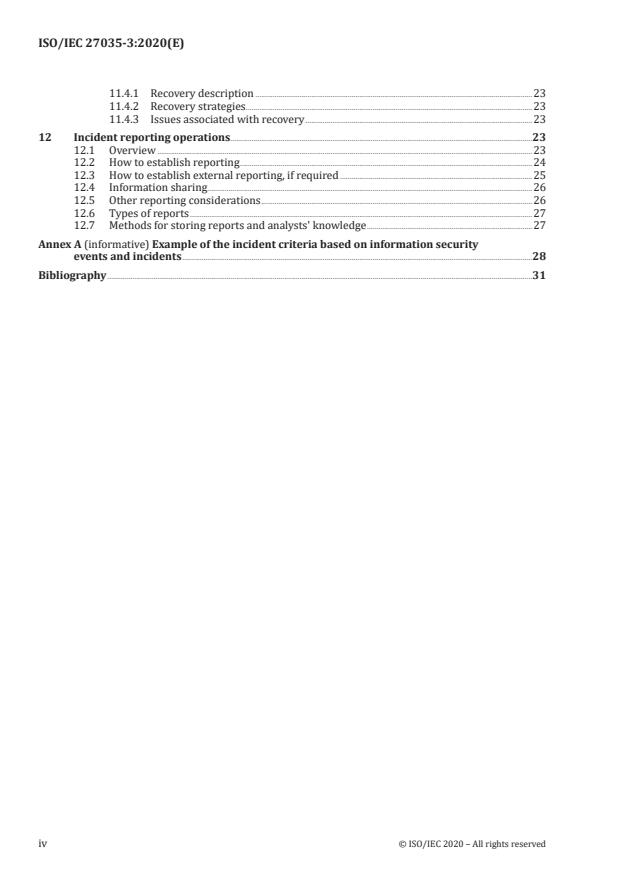
Contents Page
Foreword .v
Introduction .vi
1 Scope . 1
2 Normative references . 1
3 Terms and definitions . 1
4 Abbreviated terms . 2
5 Overview . 3
5.1 General . 3
5.2 Structure of this document . 3
6 Common types of attacks . 5
7 Incident detection operations . 6
7.1 Point of contact . 6
7.2 Monitoring and detection . 7
7.3 Common ways detection is performed . 8
7.3.1 Monitoring public sources to look for potential reports (and threats) . 8
7.3.2 Validation of external source data . 9
7.3.3 Proactive detection .10
7.3.4 Reactive methods .10
8 Incident notification operations .11
8.1 Overview .11
8.2 Immediate incident notification .12
8.2.1 Incident reporting forms .12
8.2.2 Critical information that incident reports should (ideally) contain .12
8.2.3 Methods to receive reports .12
8.2.4 Considerations for escalation .13
8.3 PoC structure .13
8.3.1 Incident response operation notification if a single PoC exists .13
8.3.2 Incident response operation notification if multiple PoCs exist.14
9 Incident triage operations .14
9.1 Overview .14
9.2 How triage is conducted .14
10 Incident analysis operations .15
10.1 Overview .15
10.2 Purpose of analysis .17
10.3 Intra-incident analysis .18
10.4 Inter-incident analysis .19
10.5 Analysis tools .20
10.6 Storing evidence and analysis results .20
11 Incident containment, eradication and recovery operations .21
11.1 Overview .21
11.2 Conducting the response for containment, eradication and recovery .21
11.2.1 Containment description .21
11.2.2 Containment goals .21
11.2.3 Common containment strategies .21
11.2.4 Issues associated with containment .22
11.3 Eradication .22
11.3.1 Eradication description.22
11.3.2 Eradication strategies .22
11.3.3 Issues associated with eradication .23
11.4 Recovery .23
© ISO/IEC 2020 – All rights reserved iii
11.4.1 Recovery description .23
11.4.2 Recovery strategies . .23
11.4.3 Issues associated with recovery .23
12 Incident reporting operations .23
12.1 Overview .23
12.2 How to establish reporting .24
12.3 How to establish external reporting, if required .25
12.4 Information sharing .26
12.5 Other reporting considerations .26
12.6 Types of reports .27
12.7 Methods for storing reports and analysts' knowledge .27
Annex A (informative) Example of the incident criteria based on information security
events and incidents .28
Bibliography .31
iv © ISO/IEC 2020 – All rights reserved
Foreword
ISO (the International Organization for Standardization) and IEC (the International Electrotechnical
Commission) form the specialized system for worldwide standardization. National bodies that
are members of ISO or IEC participate in the development of International Standards through
technical committees established by the respective organization to deal with particular fields of
technical activity. ISO and IEC technical committees collaborate in fields of mutual interest. Other
international organizations, governmental and non-governmental, in liaison with ISO and IEC, also
take part in the work.
The procedures used to develop this document and those intended for its further maintenance are
described in the ISO/IEC Directives, Part 1. In particular, the different approval criteria needed for
the different types of document should be noted. This document was drafted in accordance with the
editorial rules of the ISO/IEC Directives, Part 2 (see www .iso .org/ directives).
Attention is drawn to the possibility that some of the elements of this document may be the subject
of patent rights. ISO and IEC shall not be held responsible for identifying any or all such patent
rights. Details of any patent rights identified during the development of the document will be in the
Introduction and/or on the ISO list of patent declarations received (see www .iso .org/ patents) or the IEC
list of patent declarations received (see http:// patents .iec .ch).
Any trade name used in this document is information given for the convenience of users and does not
constitute an endorsement.
For an explanation of the voluntary nature of standards, the meaning of ISO specific terms and
expressions related to conformity assessment, as well as information about ISO's adherence to the
World Trade Organization (WTO) principles in the Technical Barriers to Trade (TBT), see www .iso .org/
iso/ foreword .html.
This document was prepared by Joint Technical Committee ISO/IEC JTC 1, Information technology,
Subcommittee SC 27, Information security, cybersecurity and privacy protection.
A list of all parts in the ISO 27035 series can be found on the ISO website.
Any feedback or questions on this document should be directed to the user’s national standards body. A
complete listing of these bodies can be found at www .iso .org/ members .html.
© ISO/IEC 2020 – All rights reserved v
Introduction
An information security incident can involve ICT or not. For example, information that spreads
unintentionally through the loss of paper documents can very well be a serious information security
incident, which requires incident reporting, investigation, containment, corrective actions and
management involvement. This type of incident management is often carried out, for example, by the
Chief Information Security Officer (CISO) within the organization. Guidance on the management of
such information security incidents can be found in ISO/IEC 27035-1. This document, however, only
considers incident response operations for ICT-related incidents, and not for information security
incidents related to paper documents or any other non-ICT incidents. Whenever the term "information
security" is used in this document, it is done so in the context of ICT-related information security.
The organizational structures for information security vary depending on the size and business field of
organizations. As various and numerous incidents occur and are increasing (such as network incidents,
e.g. intrusions, data breaches and hacking), higher concerns about information security have been
raised by organizations. A secure ICT environment set up to withstand various types of attacks (such
as DoS, worms and viruses) with network security equipment such as firewalls, intrusion detection
systems (IDSs) and intrusion prevention systems (IPSs) should be complemented with clear operating
procedures for incident handling, along with well-defined reporting structures within the organization.
To ensure confidentiality, integrity and availability of information and to handle incidents efficiently,
capabilities to conduct incident response operations is required. For this purpose, a computer security
incident response team (CSIRT) should be established to perform tasks such as monitoring, detection,
analysis and response activities for collected data or security events. These tasks may be assisted by
artificial intelligence tools and techniques.
This document supports the controls of ISO/IEC 27001:2013, Annex A, related to incident management.
Not all steps in this document are applicable since it depends on the particular incident. For example, a
smaller organization may not use all guidance in this document but can find it useful for organization
of their ICT-related incident operations especially if operating their own ICT environment. It can also
be useful for smaller organizations that have outsourced their IT operations to better understand the
requirements and execution of incident operations that they should expect from their ICT supplier(s).
This document is particularly useful to organizations providing ICT services that involve interactions
between organizations of incident operations in order to follow the same processes and terms.
This document also provides a better understanding on how incident operations relates to the users/
customers in order to define when and how such interaction needs to take place, even if this is not
specified.
vi © ISO/IEC 2020 – All rights reserved
INTERNATIONAL STANDARD ISO/IEC 27035-3:2020(E)
Information technology — Information security incident
management —
Part 3:
Guidelines for ICT incident response operations
1 Scope
This document gives guidelines for information security incident response in ICT security operations.
This document does this by firstly covering the operational aspects in ICT security operations from a
people, processes and technology perspective. It then further focuses on information security incident
response in ICT security operations including information security incident detection, reporting, triage,
analysis, response, containment, eradication, recovery and conclusion.
This document is not concerned with non-ICT incident response operations such as loss of paper-based
documents.
This document is based on the “Detection and reporting” phase, the “Assessment and decision” phase
and the “Responses” phase of the “Information security incident management phases” model presented
in ISO/IEC 27035-1:2016.
The principles given in this document are generic and intended to be applicable to all organizations,
regardless of type, size or nature. Organizations can adjust the provisions given in this document
according to their type, size and nature of business in relation to the information security risk situation.
This document is also applicable to external organizations providing information security incident
management services.
2 Normative references
The following documents are referred to in the text in such a way that some or all of their content
constitutes requirements of this document. For dated references, only the edition cited applies. For
undated references, the latest edition of the referenced document (including any amendments) applies.
ISO/IEC 27000, Information technology — Security techniques — Information security management
systems — Overview and vocabulary
ISO/IEC 27035-1, Information technology — Security techniques — Information security incident
management — Part 1: Principles of incident management
ISO/IEC 27035-2, Information technology — Security techniques — Information security incident
management — Part 2: Guidelines to plan and prepare for incident response
ISO/IEC 27037, Information technology — Security techniques — Guidelines for identification, collection,
acquisition and preservation of digital evidence
ISO/IEC 27043, Information technology — Security techniques — Incident investigation principles and
processes
3 Terms and definitions
For the purposes of this document, the terms and definitions given in ISO/IEC 27000, ISO/IEC 27037,
ISO/IEC 27035-1, ISO/IEC 27035-2, ISO/IEC 27043 and the following apply.
© ISO/IEC 2020 – All rights reserved 1
ISO and IEC maintain terminological databases for use in standardization at the following addresses:
— ISO Online browsing platform: available at https:// www .iso .org/ obp
— IEC Electropedia: available at http:// www .electropedia .org/
3.1
asset
anything that has value to an individual, an organization or a government
[SOURCE: ISO/IEC 27032:2012, 4.6]
3.2
computer security incident response team
CSIRT
team of security experts to support the handling of information security incidents
[SOURCE: ISO/IEC 27019:2017, 3.2]
3.3
investigation
systematic or formal process of inquiring into or researching, and examining facts or materials
associated with a matter
Note 1 to entry: A similar definition can be found in ISO/IEC 27042:2015, 3.10.
[SOURCE: ISO/IEC 27050:2017, 3.17, modified — Note 1 to entry has been added.]
3.1.4
response
incident response
action taken to protect and restore the normal operational conditions of information systems and the
information stored in it when an attack or intrusion occurs
[SOURCE: ISO/IEC 27039:2015, 2.24]
4 Abbreviated terms
ASCII American standard code for information interchange
CPU central processing unit
DNS domain name system or domain name service
DDoS distributed denial of service
DoS denial of service
ENISA European Union agency for network and information security
FAT file allocation table file system
FAT32 32-bit file allocation table file system
FIRST forum of incident response and security teams
HPFS high performance file system
HR human resources
ICT information and communication technology
2 © ISO/IEC 2020 – All rights reserved
IDS intrusion detection system
IoC indicators of compromise
IP internet protocol
IPS intrusion prevention system
ISP internet service provider
IT information technology
MD5 message digest 5 algorithm
NIST national institute for standards and technology
NTFS windows networking technology file system
OS operating system
PoC point of contact
SHA secure hashing algorithm
SIEM security information and event management system
URL universal resource locator
WAF web application firewall
XML extended mark-up language
5 Overview
5.1 General
ISO/IEC 27035-1 covers the following five main phases for information security incident management:
— Plan and prepare;
— Detection and reporting;
— Assessment and decision;
— Responses;
— Lessons learnt.
ISO/IEC 27035-2 covers two of these five phases in detail, i.e. "Plan and prepare" and "Lessons learnt".
This document covers the remaining three phases in detail. These three remaining phases are
collectively referred to as incident response operations, which are the focus in this document.
5.2 Structure of this document
The provisions in this document are based on the "Detection and reporting", "Assessment and decision"
and "Responses" phases of the “Information security incident management phases” model presented in
ISO/IEC 27035-1. Collectively, these phases are known as the incident response operation process.
© ISO/IEC 2020 – All rights reserved 3
The phases within the incident response operation process (which are "Detection and reporting",
"Assessment and decision" and "Responses" as stipulated in ISO/IEC 27035-1) include the following:
— operations for incident identification;
— operations for incident assessment and qualification;
— operations for threat intelligence gathering;
— operations for incident containment, eradication and recovery;
— operations for incident analysis;
— operations for incident reporting.
The scope for incident response is defined in ISO/IEC 27035-1. Incident response operations should
be seen as a business process that enables an organization to remain in business. Specifically, an
incident response operation process is a collection of procedures aimed at identifying, responding to
and investigating potential security incidents in a way that minimizes their impact and support rapid
recovery.
ISO/IEC 27035-1 shows the five phases of information security incident management as Plan and
prepare, Detection and reporting, Assessment and decision, Responses and Lessons learnt. As
mentioned before, this document focuses on an incident response operation process. This process can
be characterized by a lifecycle of incident response operations which is represented by the inner phases
(detection, notification, triage, analysis, response, and reporting). These are represented in more detail
in Figure 1.
Figure 1 — Lifecycle of incident response operations
The lifecycle of incident response operations (detection, notification, triage, analysis, response,
and reporting) can be mapped to the five phases of information security incident management of
4 © ISO/IEC 2020 – All rights reserved
ISO/IEC 27035-1 (Plan and prepare, Detection and reporting, Assessment and decision, Responses and
Lessons learnt) as shown in Table 1.
Table 1 — Mapping of the five phases of information security incident management in
ISO/IEC 27035-1 to the lifecycle of incident response operations in this document
Five phases of information security incident Lifecycle of ICT incident response operations in this
management in ISO/IEC 27035-1 document
Plan and prepare (None – covered in detail by ISO/IEC 27035–2)
Detection and reporting — Detection (presented in Clause 7, which links to ISO/
IEC 27035-1:2016, 5.3)
— Notification (presented in Clause 8, which links to ISO/
IEC 27035-1:2016, 5.3)
Assessment and decision — Triage (presented in Clause 9, which links to ISO/
IEC 27035-1:2016, 5.4)
— Analysis (presented in Clause 10, which links to ISO/
IEC 27035-1:2016, 5.4)
Responses — Response (presented in Clause 11, which links to ISO/
IEC 27035-1:2016, 5.5)
— Reporting (presented in Clause 12, which links to ISO/
IEC 27035-1:2016, 5.3)
Lessons learnt (None – covered in detail by ISO/IEC 27035-2)
NOTE The notion of reporting appears only once in ISO/IEC 27035-1:2016, 5.3. However, during the entire
lifecycle of incident response operations (as portrayed in this document), the notion of reporting appears twice:
once in Clause 7 and once in Clause 11. However, both instances of reporting map to ISO/IEC 27035-1:2016, 5.3.
To clarify, there are two distinct instances (occurrences) of reporting that take place during the entire lifecycle
of incident response operations as portrayed in this document. The first occurrence of reporting involves
the recording or registration of the fact that an incident has indeed occurred (as presented in Clause 7). The
second occurrence of reporting involves the recording of the outcome of the entire lifecycle of incident response
operations (as presented in Clause 11). In summary, the first occurrence reports to (notifies) a PoC that an
incident has indeed occurred, while the second occurrence reports on the outcome of the entire lifecycle of
incident response operations.
6 Common types of attacks
Incidents can happen in various ways and it is not practical to define all the incidents and prepare the
response manual for each type of incident. However, there are common attack types/sources that an
organization often encounter and should therefore be prepared to handle, such attacks efficiently.
Criteria should be set for security incidents according to the importance (priority) of information and
information systems, impact of each incident, damage scale, alarm ranking and its severity. See Annex A
for examples of such criteria.
The following is a non-exhaustive list of common attack types/sources that can be used as the basis for
defining incident handling procedures:
— external/removable media: an attack executed from removable media (e.g. flash drive, CD) or a
peripheral device;
— attrition: an attack that employs brute force methods to compromise, degrade, or destroy systems,
networks, or services (e.g. a DDoS intended to impair or deny access to a service or application; a
brute force attack against an authentication mechanism, such as passwords, CAPTCHAS, or digital
signatures);
— web: an attack executed from a website or web-based application (e.g. a cross-site scripting attack
used to steal credentials or a redirect to a site that exploits a browser vulnerability and installs
malware);
© ISO/IEC 2020 – All rights reserved 5
— e-mail: an attack executed via an email message or attachment (e.g. exploit code disguised as an
attached document or a link to a malicious website in the body of an email message);
— supply chain interdiction: an antagonistic attack on hardware or software assets utilizing physical
implants, Trojans or backdoors, by intercepting and modifying an asset in transit from the vendor
or retailer;
— impersonation: an attack involving replacement of something benign with something malicious (e.g.
spoofing, man in the middle attacks, rogue wireless access points, and SQL injection attacks all
involve impersonation);
— improper usage: any incident resulting from violation of an organization’s acceptable usage policies
by an authorized user, excluding the above categories (e.g. a user installs file sharing software,
leading to the loss of sensitive data; or a user performs illegal activities on a system);
— loss or theft of equipment: the loss or theft of a computing device or media used by the organization,
such as a laptop, smartphone, or authentication token;
— other: an attack that does not fit into any of these categories.
1)
NOTE See the NIST Computer Security Incident Handling Guide for more incident classification guidelines
and attack vectors.
An incident comprises one or multiple related information security events that can harm an
organization's assets or compromise its operations, where an information security event comprise one
or multiple occurrences indicating a possible breach or failure of information security controls.
7 Incident detection operations
7.1 Point of contact
Incident detection operations require that there be a point of contact (PoC) to receive information, an
established methodology for the team to detect information security events. Detection is important
because it starts the incident response operations.
The PoC is the organizational function or role serving as the coordinator or focal point of incident
operation activities. An information security event is reported by the “User/Source” in some way, as
shown in ISO/IEC 27035-1:2016, Figure 4. The main purpose of the PoC is to ensure that an event is
reported as soon as possible to the organization so that the event can be handled efficiently. A critical
success factor is that the PoC possesses the skills to determine whether an event indeed is an ICT-
related event and that the PoC is able to describe the event.
An event should then be further handled by a PoC and then transferred into incident response
operations. The organization of a PoC can be different depending on the size and structure of the
organization as well as the nature of the business. This can affect how incident operations are informed
of the event.
There are three different main scenarios for the PoC:
a) no formal PoC exists;
b) single PoC for all types of events irrespective of the number of geographic locations;
c) multiple PoCs depending on the nature of the event and geographic locations.
1) This information is given for the convenience of users of this document and does not constitute an endorsement
by ISO of the product named. Equivalent products can be used if they are applicable.
6 © ISO/IEC 2020 – All rights reserved
Regardless of which of the above PoC situation exists, the incidents have specific operations which are
covered in this document.
NOTE Information security events that exist, which are determined as incidents according to
ISO/IEC 27035-1, can either be ICT-related or non–ICT-related. Examples of non–ICT-related information security
events include lost paper document(s), a physical break-in to the organization's premises resulting in the theft of
physical document(s), breach of policy or security rules, etc. This document focuses only on ICT-related incidents.
Examples of incidents or events that the PoC receives can be found in Annex A.
7.2 Monitoring and detection
Information security events can be detected internally by a person or by information security
technologies such as an IDS, or can be reported from external sources of information. Information
security events can be detected by various means and can be categorized into the following three means:
— technical:
a) intrusion detection and prevention systems (IDPSs);
b) endpoint security tools such as anti-virus software;
c) security log analyzer tools or security information and event management systems (SIEMs);
— people: internal or external users, including non-IT or security-related staff, or customers;
— organizational:
a) IT department, including network operations centre and security operations centre, IT help desk;
b) managed service providers (including ISPs, telecommunication service providers, and
suppliers);
c) CSIRTs;
d) other units and staff that may detect anomalies during their daily work;
e) mass media (newspaper, television, etc.); and
f) websites (public security information websites, websites by security researchers, defacement
archive websites, etc.).
As the first step, the organization:
— monitors the security events in order to detect incidents; and/or
— receives a list of the security events from the monitoring site (or domain) of the organization
and/or PoC.
As soon as the event is registered through detection and/or notification, the monitoring team verifies
whether the case is a potential incident using the collected information. After verifying that the security
event(s) is/are real, the monitoring team makes a decision on incident occurrence, and its initial
severity such as incident type, the importance of the damaged system, alarm level, etc. (see Annex A). It
performs the following tasks in order to monitor and detect an event:
a) monitoring:
1) monitoring security events from the target organization continuously;
2) monitoring by the console (e.g. security device does not support inter-operation);
3) monitor public information for indicators of compromise and threat intelligence;
© ISO/IEC 2020 – All rights reserved 7
4) reinforce and/or alter rules set of the monitoring system while any intrusion is in progress;
b) detecting:
1) identify security events by collecting, analysing and qualifying the events;
2) performing incident correlation (also known as retrospective analysis) and adequate triage
on the events mentioned above. initiate and perform case management. incident response
playbooks may also be utilized.
7.3 Common ways detection is performed
7.3.1 Monitoring public sources to look for potential reports (and threats)
Monitoring public sources includes gathering information from public sources that is relevant to
the organization or CSIRT work. This information is used to keep up to date with ongoing security-
related activities, to provide information on new vulnerabilities, attack types, mitigation strategies
and security tools, and to provide insight, perspective and context for ongoing activity. These services
involve looking at available security resources such as mailing lists, web sites, articles or news reports
that are available publicly for free or from a commercial service for a fee.
Staff performing technology watch functions can include actual CSIRT staff, network operations staff,
other systems and network administrators, or even outsourced contractors. Information sought and
passed on can include new vulnerabilities, new attack types and threats, new recommendations and
solutions for preventing incidents, or general political, social or sector-related information that can
have relevance to any ongoing or potential malicious activity.
The following are examples of proactive detection of network security incidents:
— client side honeypot (both high and low interaction);
— server side honeypot (both high and low interaction);
— sandbox;
— intrusion detection system (IDS)/intrusion prevention system (IPS):
— netflow;
— darknet (no interaction);
— passive DNS monitoring;
— antivirus;
— spamtrap;
— firewall;
— web application firewall (WAF);
— application logs.
Different threat feeds tend not to overlap so it is important to acquire one that is targeted to the
[1]
business needs and type of ICT process being protected or informed by the threat feed . The following
are examples of thread feeds that organizations can subscribe to:
— DNS-BH Malware domain blocklist;
— MalwareURL;
— DShield;
8 © ISO/IEC 2020 – All rights reserved
— Google safe browsing alerts;
— Team Cymru;
— Shadowserver.
NOTE Also see the ENISA document on detection and the FIRST CSIRT Services Framework for more examples
2)
of proactive detection of network security incidents and thread feeds that organizations can subscribe to .
7.3.2 Validation of external source data
The following process steps are used to implement situational awareness.
— Identify the trust levels or trustworthiness of data sources. Ensure that data sourced is trusted.
— Identify information requirements. Requirements development.
— Determine criteria for monitoring related to severity, relevancy and priority.
— The trust levels or trustworthiness of data sources should be identified first and ensure that
data sourced is trusted.
— Train the public monitors and data collectors.
— Establish PoC list of who to contact with different types of information.
— Determine sensors to be deployed and data to be collected or monitored.
— Indicators of compromise (IoC) (i.e. IP addresses, email subject lines, etc.).
— Techniques, tactics and procedures (TTPs) of attackers. Examples include methods of social
engineering, malicious document execution (i.e. PDFs and GIFs).
— Open source threat intelligence.
— Subscription service threat intelligence.
— Network performance data.
— Bandwidth usage of network(s).
— Flow records collection.
— Full packet capture.
— Host data (i.e. disk usage, software inventory/patch-level, event logs).
— Application data (i.e. email spam filtered, DNS resolutions).
— Actively monitor key sensors.
— Actively monitor threat feeds.
— Actively monitor for reported vulnerabilities.
— Subscribe to vendor and security related mailing lists.
— Maintain a list of vendor advisory sites to be periodically reviewed.
2) This information is given for the convenience of users of this document and does not constitute an endorsement
by ISO of the product named. Equivalent products can be used if they are applicable.
© ISO/IEC 2020 – All rights reserved 9
— Proactively search for additional sites to monitor.
— Actively monitor for ongoing security incidents or suspicious activity, this feeds situational
awareness.
— Identify news, political, government, economic sites for review.
— Identify security and incident response sites or team sites for review or subscriptions.
— Create procedures for notifying key personnel of information that is relevant.
— Vulnerability reports that can have a high impact.
— Widespread incidents.
— Current events that may provide insight into ongoing events.
— Develop a knowledge management system to store information and allow it to be searchable.
7.3.3 Proactive detection
Proactive detection refers to devices, people and/or mechanisms that are actively searching for
vulnerabilities that can potentially be security events. This may include searching for indicators of
threat activity seen by others. Examples of proactive detection methods include, but are not limited to,
the following:
— vulnerability scanning;
— proactive activities of hunting teams actively searching for events;
— log correlation;
— penetration testing;
— proactive network monitoring, which can include alerting, trend reporting and providing proactive
updates to software/firmware;
— proactive detection using software systems like intrusion prevention systems.
7.3.4 Reactive methods
Reactive detection refers to devices, people and/or mechanisms that are not actively searching for
incidents but that, in the course of their daily duties/responsibilities/tasks, produce some signal of a
possible incident that should be reported to the CSIRT. Sources of reactive detection include, but are not
limited to, the following:
— reports or alerts from users;
— rule-based alerts which are triggered by software systems such as intrusion detection systems, file
integrity monitoring systems;
— reactive network monitoring using data mining utilities;
— complaints or suggestions from users of the products or applications, which can include the business
logic vulnerabilities, the hijacking of the network traffic of a specific website, and other security
scenarios that are hard to be identified by the CSIRT.
10 © ISO/IEC 2020 – All rights reserved
8 Incident notification operations
8.1 Overview
Incident reporting is used for all types of events for the purpose of incident communication. Figure 2
shows that incident reporting consists of three phases that can be described as:
1) incident notification operation: the detected ICT security event, that is a potential incident, is
reported (event reporting) from the source (people, external organization notice or system alert)
to the PoC;
2) internal incident reporting: depending on the characteristics of the incident, various types of
internal reporting take place as part of the incident reporting (see Clause 12);
3) external incident reporting: the organization can need to report certain types of incidents to
external parties outside the organization (such as for regulatory purposes), to authorities or to
other identified parties (such as suppliers, customers etc.). This can form part of the incident
operation but can also be separated depending on how the incident management is structured and
the characteristics of the incident (see Clause 12).
Reporting within incident operations is focused on handling the incident and determining the kind
of reporting that is needed – including escalation – as necessary. However, it should also consider the
reporting that is to be made in order to report it as part of the ICT security procedures. Depending
on the categorization and classification of the incident, preparation of external reporting can also be
necessary as part of the incident operation. The initi
...
Questions, Comments and Discussion
Ask us and Technical Secretary will try to provide an answer. You can facilitate discussion about the standard in here.
Loading comments...