


ISO 16187:2025
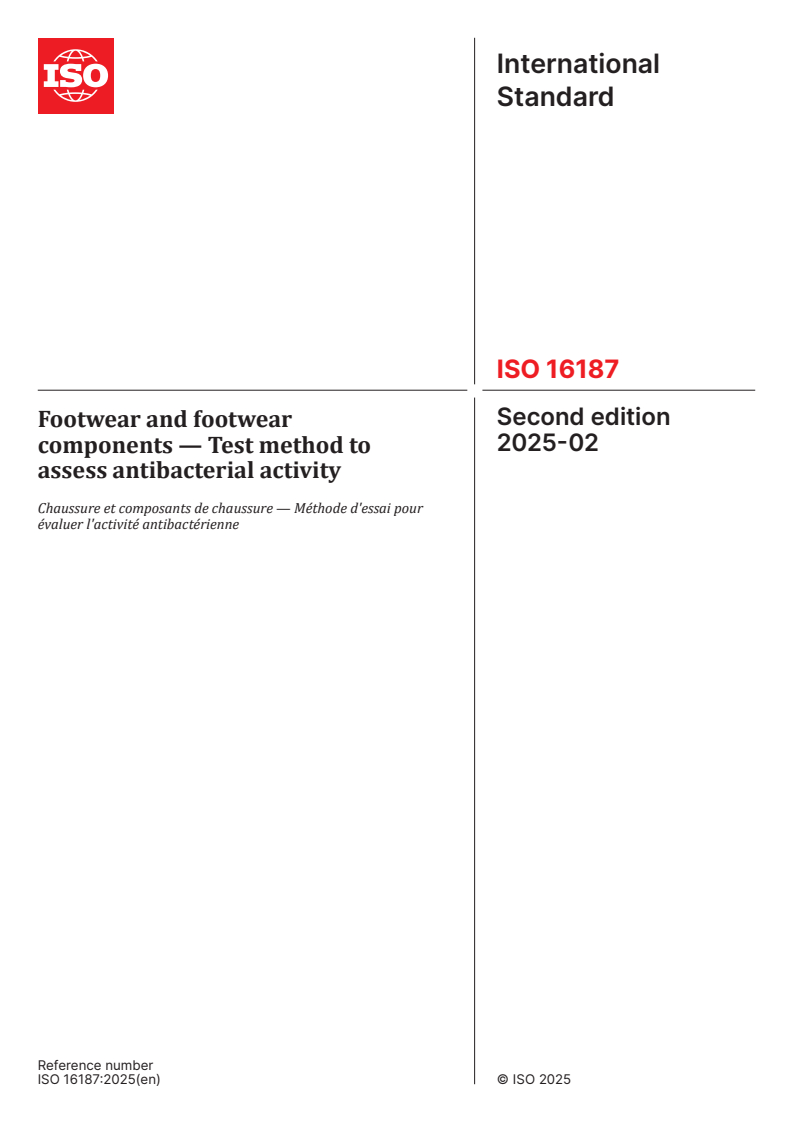
(Main)Footwear and footwear components — Test method to assess antibacterial activity
Footwear and footwear components — Test method to assess antibacterial activity
This document specifies quantitative test methods to evaluate the antibacterial activity of footwear and footwear components. This document is applicable to all types of footwear and footwear components employing non-diffusing antibacterial treatments.
Chaussure et composants de chaussure — Méthode d'essai pour évaluer l'activité antibactérienne
Le présent document spécifie des méthodes d’essai quantitatives permettant d’évaluer l’activité antibactérienne de chaussures et de leurs composants. Le présent document s’applique à tous les types de chaussures et de composants de chaussure faisant l’objet de traitements antibactériens non migrants.
General Information
- Status
- Published
- Publication Date
- 20-Feb-2025
- Technical Committee
- ISO/TC 216 - Footwear
- Drafting Committee
- ISO/TC 216 - Footwear
- Current Stage
- 6060 - International Standard published
- Start Date
- 21-Feb-2025
- Due Date
- 28-Mar-2025
- Completion Date
- 21-Feb-2025
Relations
- Effective Date
- 12-Feb-2026
- Consolidates
ISO 11010-1:2022 - Passenger cars — Simulation model classification — Part 1: Vehicle dynamics - Effective Date
- 06-Jun-2022
- Revises
ISO 16187:2013 - Footwear and footwear components — Test method to assess antibacterial activity - Effective Date
- 06-Jun-2022
Overview
ISO 16187:2025 - Footwear and footwear components - Test method to assess antibacterial activity specifies quantitative laboratory methods to evaluate the antibacterial performance of footwear and footwear components that use non-diffusing antibacterial treatments. The standard describes how to inoculate test and control specimens with selected bacterial strains (one Gram‑positive and one Gram‑negative), recover viable cells, and calculate an antibacterial activity ratio to express efficacy. It replaces the 2013 edition and includes technical updates (for example, the addition of a defined neutralizer and updated culture media options).
Key topics and requirements
- Scope and applicability: Applicable to all types of footwear and footwear components using non-diffusing antibacterial treatments.
- Test principle: Quantitative challenge tests under static or dynamic conditions; results based on viable cell counts and antibacterial activity ratios.
- Three test methods (normative annexes):
- Annex A - Static challenge test
- Annex B - Film contact method
- Annex C - Dynamic challenge test
- Microorganisms and inoculum: Use of specified Gram‑positive and Gram‑negative test strains; storage and preparation guidance provided.
- Culture media and reagents: Details and preparation for Nutrient Broth/Agar (NB/NA), Tryptic Soy Broth/Agar (TSB/TSA) as alternatives, SCDLP neutralizing medium, and physiological saline.
- Apparatus and environmental controls: Recommendations include biological safety cabinet, incubator (37 ± 2 °C), autoclave, humidity chamber (37 ± 2 °C, 85 ± 5 % RH), UV lamp (light intensity specified), film cover (0.05–0.10 mm), shakers and vortex mixers.
- Safety and containment: Tests involve handling live bacteria and must be carried out in appropriate containment facilities by trained personnel.
- Result expression: Procedures for calculating viable counts, judging effectiveness, and deriving antibacterial activity ratios are specified.
Applications and users
ISO 16187:2025 is intended for:
- Footwear manufacturers and component suppliers validating antibacterial finishes and treatments
- Independent testing laboratories conducting performance and quality control testing
- R&D teams developing antimicrobial materials for insoles, linings, and components
- Regulatory and certification bodies assessing product claims of antibacterial efficacy
Practical benefits include standardized, reproducible evaluation methods for marketing claims, product development decisions, and quality assurance of antibacterial footwear solutions.
Related standards
- ISO 7218 - Microbiology of the food chain: general laboratory requirements (normative reference in ISO 16187)
- ISO 19952 - Footwear vocabulary (terms and definitions)
- Additional guidance referenced: ISO 11133 (microbial culture preparation) and ISO 3696 (water quality for laboratory use)
Keywords: ISO 16187:2025, footwear antibacterial test, antibacterial activity ratio, non-diffusing antibacterial treatments, static challenge test, dynamic challenge test, film contact method, microbiological testing.
ISO 16187:2025 - Footwear and footwear components — Test method to assess antibacterial activity Released:21. 02. 2025
ISO 16187:2025 - Chaussure et composants de chaussure — Méthode d'essai pour évaluer l'activité antibactérienne Released:21. 02. 2025
Frequently Asked Questions
ISO 16187:2025 is a standard published by the International Organization for Standardization (ISO). Its full title is "Footwear and footwear components — Test method to assess antibacterial activity". This standard covers: This document specifies quantitative test methods to evaluate the antibacterial activity of footwear and footwear components. This document is applicable to all types of footwear and footwear components employing non-diffusing antibacterial treatments.
This document specifies quantitative test methods to evaluate the antibacterial activity of footwear and footwear components. This document is applicable to all types of footwear and footwear components employing non-diffusing antibacterial treatments.
ISO 16187:2025 is classified under the following ICS (International Classification for Standards) categories: 61.060 - Footwear. The ICS classification helps identify the subject area and facilitates finding related standards.
ISO 16187:2025 has the following relationships with other standards: It is inter standard links to EN ISO 16187:2025, ISO 11010-1:2022, ISO 16187:2013. Understanding these relationships helps ensure you are using the most current and applicable version of the standard.
ISO 16187:2025 is available in PDF format for immediate download after purchase. The document can be added to your cart and obtained through the secure checkout process. Digital delivery ensures instant access to the complete standard document.
Standards Content (Sample)
International
Standard
ISO 16187
Second edition
Footwear and footwear
2025-02
components — Test method to
assess antibacterial activity
Chaussure et composants de chaussure — Méthode d'essai pour
évaluer l'activité antibactérienne
Reference number
© ISO 2025
All rights reserved. Unless otherwise specified, or required in the context of its implementation, no part of this publication may
be reproduced or utilized otherwise in any form or by any means, electronic or mechanical, including photocopying, or posting on
the internet or an intranet, without prior written permission. Permission can be requested from either ISO at the address below
or ISO’s member body in the country of the requester.
ISO copyright office
CP 401 • Ch. de Blandonnet 8
CH-1214 Vernier, Geneva
Phone: +41 22 749 01 11
Email: copyright@iso.org
Website: www.iso.org
Published in Switzerland
ii
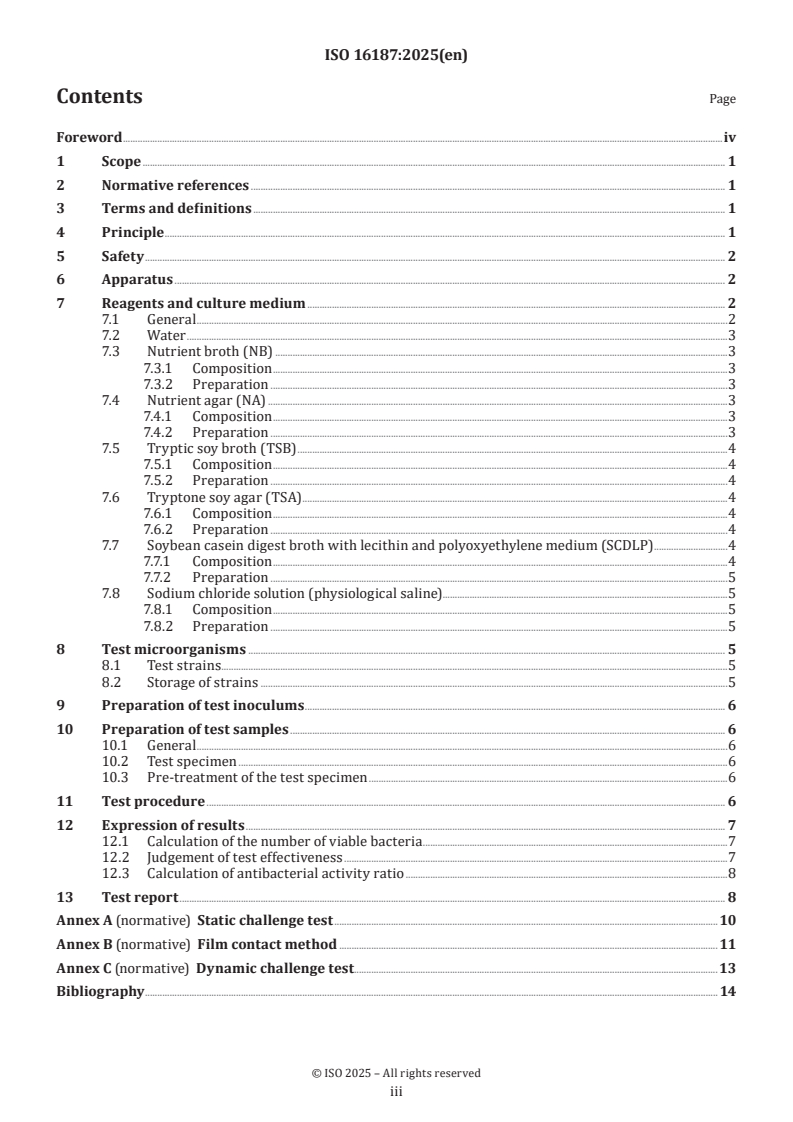
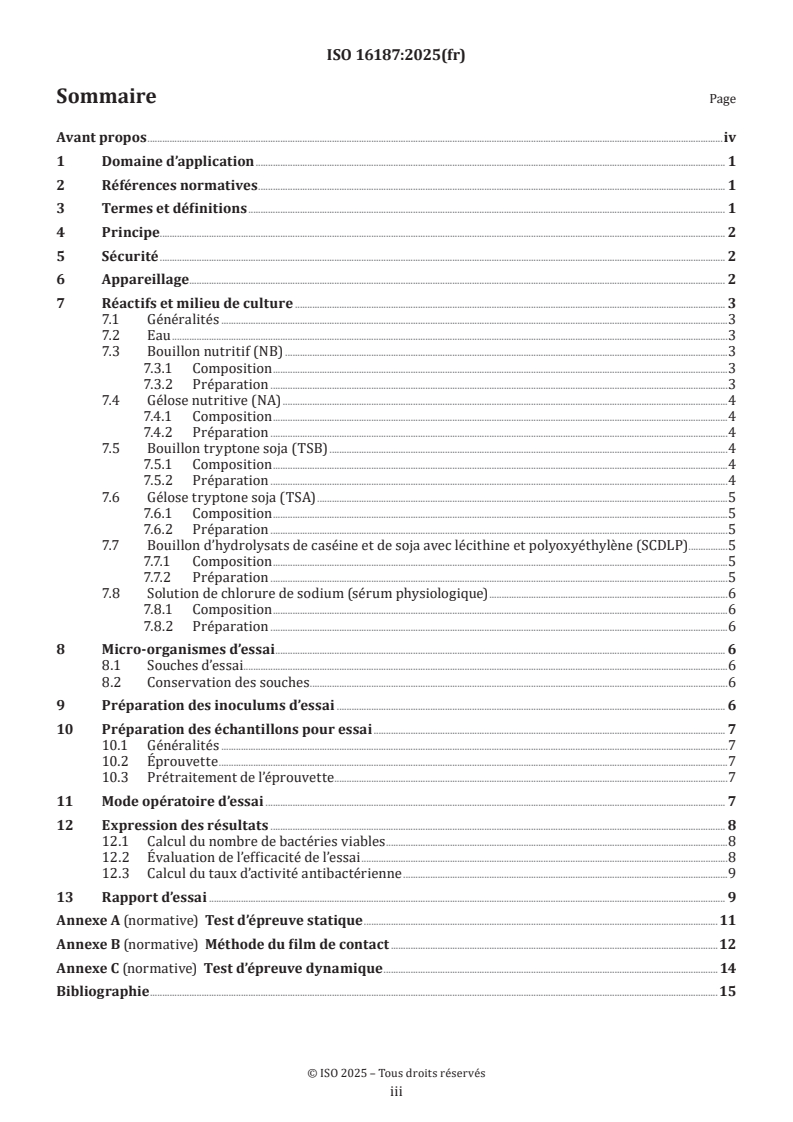
Contents Page
Foreword .iv
1 Scope . 1
2 Normative references . 1
3 Terms and definitions . 1
4 Principle . 1
5 Safety . 2
6 Apparatus . 2
7 Reagents and culture medium . 2
7.1 General .2
7.2 Water .3
7.3 Nutrient broth (NB) .3
7.3.1 Composition .3
7.3.2 Preparation .3
7.4 Nutrient agar (NA) .3
7.4.1 Composition .3
7.4.2 Preparation .3
7.5 Tryptic soy broth (TSB) .4
7.5.1 Composition .4
7.5.2 Preparation .4
7.6 Tryptone soy agar (TSA) .4
7.6.1 Composition .4
7.6.2 Preparation .4
7.7 Soybean casein digest broth with lecithin and polyoxyethylene medium (SCDLP) .4
7.7.1 Composition .4
7.7.2 Preparation .5
7.8 Sodium chloride solution (physiological saline).5
7.8.1 Composition .5
7.8.2 Preparation .5
8 Test microorganisms . 5
8.1 Test strains.5
8.2 Storage of strains .5
9 Preparation of test inoculums . 6
10 Preparation of test samples . 6
10.1 General .6
10.2 Test specimen .6
10.3 Pre-treatment of the test specimen .6
11 Test procedure . 6
12 Expression of results . 7
12.1 Calculation of the number of viable bacteria .7
12.2 Judgement of test effectiveness .7
12.3 Calculation of antibacterial activity ratio .8
13 Test report . 8
Annex A (normative) Static challenge test .10
Annex B (normative) Film contact method .11
Annex C (normative) Dynamic challenge test.13
Bibliography . 14
iii
Foreword
ISO (the International Organization for Standardization) is a worldwide federation of national standards
bodies (ISO member bodies). The work of preparing International Standards is normally carried out through
ISO technical committees. Each member body interested in a subject for which a technical committee
has been established has the right to be represented on that committee. International organizations,
governmental and non-governmental, in liaison with ISO, also take part in the work. ISO collaborates closely
with the International Electrotechnical Commission (IEC) on all matters of electrotechnical standardization.
The procedures used to develop this document and those intended for its further maintenance are described
in the ISO/IEC Directives, Part 1. In particular, the different approval criteria needed for the different types
of ISO document should be noted. This document was drafted in accordance with the editorial rules of the
ISO/IEC Directives, Part 2 (see www.iso.org/directives).
ISO draws attention to the possibility that the implementation of this document may involve the use of (a)
patent(s). ISO takes no position concerning the evidence, validity or applicability of any claimed patent
rights in respect thereof. As of the date of publication of this document, ISO had not received notice of (a)
patent(s) which may be required to implement this document. However, implementers are cautioned that
this may not represent the latest information, which may be obtained from the patent database available at
www.iso.org/patents. ISO shall not be held responsible for identifying any or all such patent rights.
Any trade name used in this document is information given for the convenience of users and does not
constitute an endorsement.
For an explanation of the voluntary nature of standards, the meaning of ISO specific terms and expressions
related to conformity assessment, as well as information about ISO's adherence to the World Trade
Organization (WTO) principles in the Technical Barriers to Trade (TBT), see www.iso.org/iso/foreword.html.
This document was prepared by Technical Committee ISO/TC 216, Footwear, in collaboration with the
European Committee for Standardization (CEN) Technical Committee CEN/TC 309, Footwear, in accordance
with the Agreement on technical cooperation between ISO and CEN (Vienna Agreement).
This second edition cancels and replaces the first edition (ISO 16187:2013), which has been technically
revised.
The main changes are as follows:
— a new term “neutralizer” and its definition have been added;
— a new Clause 4 has been added;
— AS No. has been revised to CGMCC No.;
— the light intensity of UV lamp has been added;
— the normative references and bibliography have been revised and updated;
— TSA and TSB have been added as alternative culture medium if NA and NB are not available;
— Annex D has been deleted.
Any feedback or questions on this document should be directed to the user’s national standards body. A
complete listing of these bodies can be found at www.iso.org/members.html.
iv
International Standard ISO 16187:2025(en)
Footwear and footwear components — Test method to assess
antibacterial activity
CAUTION — Test methods specified in this document require the use of bacteria. These tests shall
only be carried out in facilities with containment techniques for handling microorganisms and by
persons with training and experience in the use of microbiological techniques.
1 Scope
This document specifies quantitative test methods to evaluate the antibacterial activity of footwear and
footwear components.
This document is applicable to all types of footwear and footwear components employing non-diffusing
antibacterial treatments.
2 Normative references
The following documents are referred to in the text in such a way that some or all of their content constitutes
requirements of this document. For dated references, only the edition cited applies. For undated references,
the latest edition of the referenced document (including any amendments) applies.
ISO 7218, Microbiology of the food chain — General requirements and guidance for microbiological examinations
ISO 19952, Footwear — Vocabulary
3 Terms and definitions
For the purposes of this document, the terms and definitions given in ISO 19952 and the following apply.
ISO and IEC maintain terminology databases for use in standardization at the following addresses:
— ISO Online browsing platform: available at https:// www .iso .org/ obp
— IEC Electropedia: available at https:// www .electropedia .org/
3.1
antibacterial activity
efficacy of a material or finish used to prevent or mitigate the growth of bacteria, to reduce the number of
bacteria or to kill bacteria
3.2
control sample
material identical to the test material but without antibacterial treatment
3.3
neutralizer
chemical agent used to inactivate, neutralize, or quench the antibacterial properties of antibacterial agents
4 Principle
The test specimens and control specimens are inoculated with a bacterial suspension of a selected test
strain specified or claimed in independent tests with one Gram-positive and one Gram-negative bacterial
test organism.
Three test methods are available to assess antibacterial activity in a challenge test procedure under static
or under dynamic conditions.
Antibacterial performance is quantitatively determined by counting the number of viable cells and
calculating the antibacterial activity ratio.
5 Safety
Handling of microorganisms which are potentially hazardous requires a high degree of technical competence
and can be subject to current national legislation and regulations. Only personnel trained in microbiological
techniques should carry out such tests.
NOTE Refer to country-specific codes of practice for personal hygiene, disinfection and sterilization.
Persons who perform the test should consult IEC 60068-2-10:2005/AMD1:2018, Annex A, and ISO 7218.
6 Apparatus
Disposable apparatus is an acceptable alternative to re-usable glassware and plastic if it has the suitable
specifications.
Apparatus includes usual microbiological laboratory equipment in accordance with ISO 7218 and, in
particular, the following.
6.1 Biological safety cabinet.
6.2 Incubator, capable of maintaining a temperature of (37 ± 2) °C.
6.3 Autoclave, capable of maintaining a temperature of (121 ± 2) °C and a pressure of (103 ± 5) kPa, for
wet sterilization, used in accordance with ISO 7218.
6.4 Humidity chamber, capable of maintaining a temperature of (37 ± 2) °C and a relative humidity of
(85 ± 5) %.
6.5 Ultraviolet lamp, capable of emitting light intensity of 100 000 μWs/cm .
6.6 Wide mouth jars, with cap, 100 ml, capable of being used with an autoclave (6.3).
6.7 Cover film, that does not affect bacterial growth or absorb water, which can be made of either
polyethylene, polypropylene or polyester [poly (ethylene terephthalate)]. Film that is 0,05 mm to 0,10 mm
thick should be used. For example, disposal bag suitable for use with an autoclave (6.3).
6.8 Vortex mixer.
6.9 Dimensional shaker, two dimensional or three dimensional, capable of adjusting to 50 r/min.
6.10 Shaking incubator, capable of maintaining a temperature of (37 ± 2) °C and a rotational frequency of
(120 ± 10) r/min.
7 Reagents and culture medium
7.1 General
The preparation and test shall be freshly prepared in order to ensure the culture quality.
This can be done according to ISO 11133, or according to national standards, in case no national
regulations apply.
Dehydrated products available on the commercial market can be used for preparing the culture media. The
manufacture user’s instructions for the preparation of these products should be strictly followed.
Reagents used in tests shall be of analytical grade and/or suited for microbiological purposes.
7.2 Water
Water used in tests shall be free from all toxic or microorganism inhibitory substances and be analytical-
grade water for microbiological media preparation, which is freshly distilled and/or ion-exchanged and/or
ultra-filtered and/or filtered with reverse osmosis (RO).
NOTE Water grade 3 according to ISO 3696 can be used.
7.3 Nutrient broth (NB)
7.3.1 Composition
Beef extract 3,0 g
Peptone 5,0 g
Sodium chloride, NaCl 5,0 g
Water 1 000 ml
7.3.2 Preparation
Stir and adjust pH to (7,2 ± 0,2) (at room temperature). Heat with stirring on a hotplate or in a boiling-water
bath until the components are completely dissolved. Sterilize with autoclave (6.3) at (121 ± 2) °C for 15 min.
7.4 Nutrient agar (NA)
7.4.1 Composition
Beef extract 5,0 g
Peptone 10,0 g
Sodium chloride, NaCl 5,0 g
Agar 15,0 g
Water 1 000 ml
NOTE If solidification is insufficient, 15 g to 18 g of agar can be used.
7.4.2 Preparation
Stir and adjust pH to (7,2 ± 0,2) (at room temperature). Heat with stirring on a hotplate or in a boiling-water
bath until the components are completely dissolved. Sterilize with autoclave (6.3) at (121 ± 2) °C for 15 min.
Cool and shake solution well, then pour into the Petri dishes.
7.5 Tryptic soy broth (TSB)
7.5.1 Composition
Tryptone, pancreatic digest of casein 17,0 g
Soya peptone, papain digest of soya 3,0 g
Sodium chloride, NaCl 5,0 g
Glucose 2,5 g
Dipotassium hydrogen phosphate, K HPO 2,5 g
2 4
Water 1 000 ml
7.5.2 Preparation
Stir and
...
Norme
internationale
ISO 16187
Deuxième édition
Chaussure et composants de
2025-02
chaussure — Méthode d'essai pour
évaluer l'activité antibactérienne
Footwear and footwear components — Test method to assess
antibacterial activity
Numéro de référence
DOCUMENT PROTÉGÉ PAR COPYRIGHT
© ISO 2025
Tous droits réservés. Sauf prescription différente ou nécessité dans le contexte de sa mise en œuvre, aucune partie de cette
publication ne peut être reproduite ni utilisée sous quelque forme que ce soit et par aucun procédé, électronique ou mécanique,
y compris la photocopie, ou la diffusion sur l’internet ou sur un intranet, sans autorisation écrite préalable. Une autorisation peut
être demandée à l’ISO à l’adresse ci-après ou au comité membre de l’ISO dans le pays du demandeur.
ISO copyright office
Case postale 401 • Ch. de Blandonnet 8
CH-1214 Vernier, Genève
Tél.: +41 22 749 01 11
E-mail: copyright@iso.org
Web: www.iso.org
Publié en Suisse
ii
Sommaire Page
Avant propos .iv
1 Domaine d’application . 1
2 Références normatives . 1
3 Termes et définitions . 1
4 Principe. 2
5 Sécurité . 2
6 Appareillage . 2
7 Réactifs et milieu de culture . 3
7.1 Généralités .3
7.2 Eau .3
7.3 Bouillon nutritif (NB) .3
7.3.1 Composition .3
7.3.2 Préparation .3
7.4 Gélose nutritive (NA) .4
7.4.1 Composition .4
7.4.2 Préparation .4
7.5 Bouillon tryptone soja (TSB) .4
7.5.1 Composition .4
7.5.2 Préparation .4
7.6 Gélose tryptone soja (TSA) .5
7.6.1 Composition .5
7.6.2 Préparation .5
7.7 Bouillon d’hydrolysats de caséine et de soja avec lécithine et polyoxyéthylène (SCDLP) .5
7.7.1 Composition .5
7.7.2 Préparation .5
7.8 Solution de chlorure de sodium (sérum physiologique) .6
7.8.1 Composition .6
7.8.2 Préparation .6
8 Micro-organismes d’essai . 6
8.1 Souches d’essai.6
8.2 Conservation des souches . .6
9 Préparation des inoculums d’essai . 6
10 Préparation des échantillons pour essai . 7
10.1 Généralités .7
10.2 Éprouvette .7
10.3 Prétraitement de l’éprouvette . .7
11 Mode opératoire d’essai . 7
12 Expression des résultats . 8
12.1 Calcul du nombre de bactéries viables .8
12.2 Évaluation de l’efficacité de l’essai .8
12.3 Calcul du taux d’activité antibactérienne .9
13 Rapport d’essai . 9
Annexe A (normative) Test d’épreuve statique .11
Annexe B (normative) Méthode du film de contact .12
Annexe C (normative) Test d’épreuve dynamique . 14
Bibliographie .15
iii
Avant propos
L’ISO (Organisation internationale de normalisation) est une fédération mondiale d’organismes nationaux
de normalisation (comités membres de l’ISO). L’élaboration des Normes internationales est en général
confiée aux comités techniques de l’ISO. Chaque comité membre intéressé par une étude a le droit de faire
partie du comité technique créé à cet effet. Les organisations internationales, gouvernementales et non
gouvernementales, en liaison avec l’ISO participent également aux travaux. L’ISO collabore étroitement avec
la Commission électrotechnique internationale (IEC) en ce qui concerne la normalisation électrotechnique.
Les procédures utilisées pour élaborer le présent document et celles destinées à sa mise à jour sont
décrites dans les Directives ISO/IEC, Partie 1. Il convient, en particulier, de prendre note des différents
critères d’approbation requis pour les différents types de documents ISO. Le présent document
a été rédigé conformément aux règles de rédaction données dans les Directives ISO/IEC, Partie 2
(voir www.iso.org/directives).
L’ISO attire l’attention sur le fait que la mise en application du présent document peut entraîner l’utilisation
d’un ou de plusieurs brevets. L’ISO ne prend pas position quant à la preuve, à la validité et à l’applicabilité
de tout droit de brevet revendiqué à cet égard. À la date de publication du présent document, l’ISO n’avait
pas reçu notification qu’un ou plusieurs brevets pouvaient être nécessaires à sa mise en application.
Toutefois, il y a lieu d’avertir les responsables de la mise en application du présent document que des
informations plus récentes sont susceptibles de figurer dans la base de données de brevets, disponible à
l’adresse www.iso.org/brevets. L’ISO ne saurait être tenue pour responsable de ne pas avoir identifié tout ou
partie de tels droits de brevet.
Les appellations commerciales éventuellement mentionnées dans le présent document sont données pour
information, par souci de commodité, à l’intention des utilisateurs et ne sauraient constituer un engagement.
Pour une explication de la nature volontaire des normes, la signification des termes et expressions
spécifiques de l’ISO liés à l’évaluation de la conformité, ou pour toute information au sujet de l’adhésion de
l’ISO aux principes de l’Organisation mondiale du commerce (OMC) concernant les obstacles techniques au
commerce (OTC), voir www.iso.org/iso/fr/avant-propos.html.
Le présent document a été élaboré par le comité technique ISO/TC 216, Chaussure, en collaboration avec
le comité technique CEN/TC 309, Chaussure, du Comité européen de normalisation (CEN), conformément à
l’Accord de coopération technique entre l’ISO et le CEN (Accord de Vienne).
Cette deuxième édition annule et remplace la première édition (ISO 16187:2013), qui a fait l’objet d’une
révision technique.
Les principales modifications sont les suivantes:
— ajout d’un nouveau terme, «neutralisant», et de sa définition;
— ajout d’un nouvel Article 4;
— remplacement de la référence AS par la référence CGMCC;
— ajout de l’intensité lumineuse d’une lampe à rayons UV;
— révision et mise à jour des références normatives et de la bibliographie;
— ajout d’autres milieux de culture, la gélose tryptone soja (TSA) et le bouillon tryptone soja (TSB), à utiliser
en cas d’indisponibilité de la gélose nutritive (NA) et du bouillon nutritif (NB);
— suppression de l’Annexe D.
Il convient que l’utilisateur adresse tout retour d’information ou toute question concernant le présent
document à l’organisme national de normalisation de son pays. Une liste exhaustive desdits organismes se
trouve à l’adresse www.iso.org/fr/members.html.
iv
Norme internationale ISO 16187:2025(fr)
Chaussure et composants de chaussure — Méthode d'essai
pour évaluer l'activité antibactérienne
ATTENTION — Les méthodes d’essai spécifiées dans le présent document nécessitent l’utilisation
de bactéries. Ces essais doivent être réalisés exclusivement dans des installations comportant des
dispositifs de confinement adaptés à la manipulation des micro-organismes et par des personnes
formées et expérimentées dans la mise en œuvre des techniques microbiologiques.
1 Domaine d’application
Le présent document spécifie des méthodes d’essai quantitatives permettant d’évaluer l’activité
antibactérienne de chaussures et de leurs composants.
Le présent document s’applique à tous les types de chaussures et de composants de chaussure faisant l’objet
de traitements antibactériens non migrants.
2 Références normatives
Les documents suivants sont cités dans le texte de sorte qu’ils constituent, pour tout ou partie de leur
contenu, des exigences du présent document. Pour les références datées, seule l’édition citée s’applique. Pour
les références non datées, la dernière édition du document de référence s'applique (y compris les éventuels
amendements).
ISO 7218, Microbiologie de la chaîne alimentaire — Exigences générales et recommandations pour les examens
microbiologiques
ISO 19952, Chaussures — Vocabulaire
3 Termes et définitions
Pour les besoins du présent document, les termes et les définitions de l’ISO 19952 ainsi que les suivants
s’appliquent.
L’ISO et l’IEC tiennent à jour des bases de données terminologiques destinées à être utilisées en normalisation,
consultables aux adresses suivantes:
— ISO Online browsing platform: disponible à l’adresse https:// www .iso .org/ obp
— IEC Electropedia: disponible à l’adresse https:// www .electropedia .org/
3.1
activité antibactérienne
efficacité d’un matériau ou d’un apprêt dont l’utilisation vise à empêcher ou à atténuer la croissance des
bactéries, à réduire leur nombre ou à les tuer
3.2
échantillon témoin
matériau identique au matériau d’essai mais n’ayant pas subi de traitement antibactérien
3.3
neutralisant
agent chimique servant à désactiver, neutraliser ou stopper les propriétés antibactériennes des agents
antibactériens
4 Principe
Les éprouvettes et les éprouvettes témoins sont ensemencées avec une suspension bactérienne d’une souche
d’essai choisie, spécifiée ou revendiquée dans des essais indépendants, contenant un organisme bactérien
d’essai gram-positif et un organisme bactérien d’essai gram-négatif.
Il existe trois méthodes d’essai pour évaluer l’activité antibactérienne dans le cadre d’un mode opératoire de
test d’épreuve dans des conditions statiques ou dynamiques.
Les performances antibactériennes sont déterminées quantitativement en dénombrant les cellules viables
et en calculant le taux d’activité antibactérienne.
5 Sécurité
La manipulation de micro-organismes qui sont potentiellement dangereux nécessite un haut degré de
compétence technique et peut être soumise à la législation et aux réglementations nationales en vigueur. Il
convient que seul le personnel formé aux techniques microbiologiques puisse effectuer de tels essais.
NOTE Se reporter aux codes de bonnes pratiques d’hygiène personnelle, de désinfection et de stérilisation du
pays concerné.
Il convient que les personnes effectuant l’essai consultent l’Annexe A de l’IEC 60068-2-10:2005/AMD1:2018
ainsi que l’ISO 7218.
6 Appareillage
Un appareillage jetable répondant aux spécifications appropriées est une alternative acceptable à la verrerie
et au plastique réutilisables.
L’appareillage comprend du matériel courant de laboratoire microbiologique conforme à l’ISO 7218 et, en
particulier, ce qui suit.
6.1 Poste de sécurité biologique.
6.2 Incubateur, permettant de maintenir une température de (37 ± 2) °C.
6.3 Autoclave de stérilisation à la vapeur, permettant de maintenir une température de (121 ± 2) °C et
une pression de (103 ± 5) kPa, à utiliser conformément à l’ISO 7218.
6.4 Chambre en atmosphère humide, permettant de maintenir une température de (37 ± 2) °C et une
humidité relative de (85 ± 5) %.
6.5 Lampe à rayons ultraviolets, pouvant émettre une intensité lumineuse de 100 000 μWs/cm .
6.6 Récipients à large ouverture, d’une contenance de 100 ml, munis d’un bouchon, pouvant être utilisés
en autoclave (6.3).
6.7 Film de protection, qui n’influe pas sur la croissance des bactéries et n’absorbe pas l’eau (en
polyéthylène, polypropylène ou polyester [poly(éthylène téréphtalate)]). Il convient d’utiliser un film
d’épaisseur comprise entre 0,05 mm et 0,10 mm. Utiliser, par exemple, des sachets jetables adaptés à un
usage en autoclave (6.3).
6.8 Agitateur vortex.
6.9 Agitateur, bidimensionnel ou tridimensionnel, pouvant être réglé à 50 r/min.
6.10 Bain-marie à agitation pour cultures, permettant de maintenir une température de (37 ± 2) °C et
une fréquence de rotation de (120 ± 10) r/min.
7 Réactifs et milieu de culture
7.1 Généralités
Le milieu de culture doit être fraîchement préparé avant l’essai de manière à garantir la qualité de la mise en
culture.
Cette préparation peut être effectuée conformément à l’ISO 11133 ou à des normes nationales si aucune
réglementation nationale ne s’applique.
Il est possible d’utiliser des produits déshydratés disponibles dans le commerce pour préparer les milieux de
culture. Il convient que les instructions d’utilisation du fabricant relatives à la préparation de ces produits
soient strictement suivies.
Les réactifs utilisés lors des essais doivent être de qualité analytique et/ou adaptés à des fins
microbiologiques.
7.2 Eau
L’eau utilisée dans les essais doit être exempte de toute substance toxique ou inhibitrice de micro-organismes
et doit être de qualité analytique pour la préparation des milieux microbiologiques; cette eau est fraîchement
distillée et/ou permutée et/ou ultrafiltrée et/ou filtrée par osmose inverse.
NOTE L’eau de qualité 3 selon l’ISO 3696 peut être utilisée.
7.3 Bouillon nutritif (NB)
7.3.1 Composition
Extrait de bœuf 3,0 g
Peptone 5,0 g
Chlorure de sodium, NaCl 5,0 g
Eau 1 000 ml
7.3.2 Préparation
Agiter et ajuster le pH à (7,2 ± 0,2) (à température ambiante). Tout en agitant, chauffer sur une plaque
chauffante ou dans un bain-marie à ébullition jusqu’à dissolution complète des composants. Stériliser à
l’autoclave (6.3) à (121 ± 2) °C pendant 15 min.
7.4 Gélose nutritive (NA)
7.4.1 Composition
Extrait de bœuf 5,0 g
Peptone 10,0 g
Chlorure de sodium, NaCl 5,0 g
Gélose 15,0 g
Eau 1 000 ml
NOTE En cas de solidification insuffisante, il est possible d’utiliser 15 g à 18 g de gélose.
7.4.2 Préparation
Agiter et ajuster le pH à (7,2 ± 0,2) (à température ambiante). Tout en agitant, chauffer sur une plaque
chauffante ou dans un bain-marie à ébullition jusqu’à dissolution complète des composants. Stériliser à
l’autoclave (6.3) à (121 ± 2) °C pendant 15 min. Faire refroidir, bien agiter la solution et la verser dans les
boîtes de Petri.
7.5 Bouillon tryptone soja (TSB)
7.5.1 Composition
Tryptone, hydrolysat pancréatique de caséine 17,0 g
Peptone de soja, hydrolysat papaïnique de soja 3,0 g
Chlorure de sodium, NaCl 5,0 g
Glucose 2,5 g
Hydrogénophosphate dipotassique, K HPO 2,5 g
2 4
Eau 1 000 ml
7.5.2 Préparation
Agiter et ajuster le pH à (7,2 ± 0,2) (à température ambiante). Tout en agitant, chauffer sur une plaque
chauffante ou dans un bain-marie à ébullition jusqu’à dissolution complète des composants. Stériliser à
l’autoclave (6.3) à (121 ± 2) °C pendant 15 min.
NOTE En cas d’indisponibilité du NB, le TSB peut être choisi comme milieu de culture.
7.6 Gélose tryptone soja (TSA)
7.6.1 Composition
Tryptone, hydrolysat pancréatique de caséine 15,0 g
Peptone de soja, hydrolysat papaïnique de soja 5,0 g
Chlorure de sodium, NaCl 5,0 g
Gélose 15,0 g
Eau 1 000 ml
7.6.2 Préparation
Agiter et ajuster le pH à (7,2 ± 0,2) (à température ambiante). Tout en agitant, chauffer sur une plaque
chauffante ou dans un bain-marie à ébullition jusqu’à dissolution complète des composants. Stériliser à
l’autoclave (6.3) à (121 ± 2) °C pendant 15 min. Faire refroidir, bien agiter la solution et la verser dans les
boîtes de Petri.
NOTE En cas d’indisponibilité de la NA, la TSA peut être choisie comme milieu de culture.
7.7 Bouillon d’hydrolysats de caséine et de soja avec lécithine et polyoxyéthylène (SCDLP)
7.7.1
...
Questions, Comments and Discussion
Ask us and Technical Secretary will try to provide an answer. You can facilitate discussion about the standard in here.
Loading comments...