


ISO 20949:2018
(Main)Aircraft — Smart contactor — General requirements
Aircraft — Smart contactor — General requirements
This document specifies the definitions, titles of design and general requirements and test methods to determine the performance of smart contactors for use in aircraft electrical power systems. The smart contactor consists of a switching driving circuit and a power switch for protection, action on control signals, and providing status information.
Aéronefs — Contacteurs intelligents — Exigences générales
General Information
Standards Content (Sample)
INTERNATIONAL ISO
STANDARD 20949
First edition
2018-11
Aircraft — Smart contactor — General
requirements
Aéronefs — Contacteurs intelligents — Exigences générales
Reference number
©
ISO 2018
© ISO 2018
All rights reserved. Unless otherwise specified, or required in the context of its implementation, no part of this publication may
be reproduced or utilized otherwise in any form or by any means, electronic or mechanical, including photocopying, or posting
on the internet or an intranet, without prior written permission. Permission can be requested from either ISO at the address
below or ISO’s member body in the country of the requester.
ISO copyright office
CP 401 • Ch. de Blandonnet 8
CH-1214 Vernier, Geneva
Phone: +41 22 749 01 11
Fax: +41 22 749 09 47
Email: copyright@iso.org
Website: www.iso.org
Published in Switzerland
ii © ISO 2018 – All rights reserved
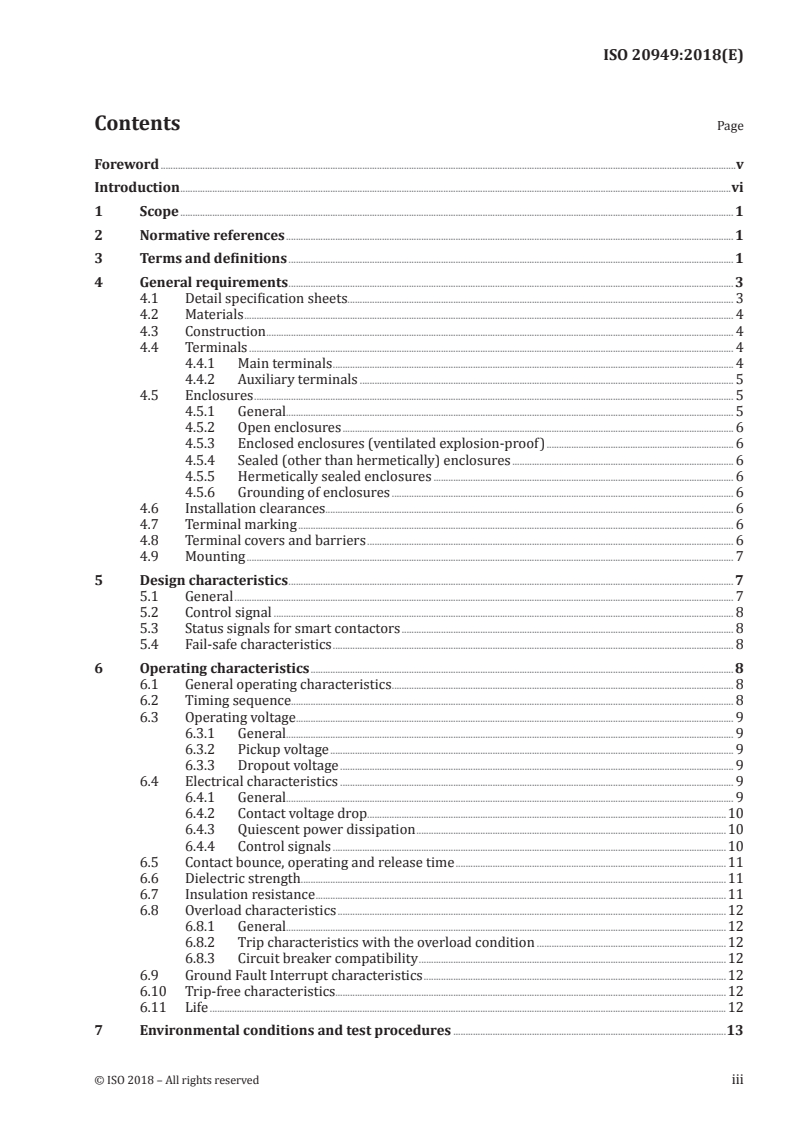
Contents Page
Foreword .v
Introduction .vi
1 Scope . 1
2 Normative references . 1
3 Terms and definitions . 1
4 General requirements . 3
4.1 Detail specification sheets. 3
4.2 Materials . 4
4.3 Construction . 4
4.4 Terminals . 4
4.4.1 Main terminals . 4
4.4.2 Auxiliary terminals . 5
4.5 Enclosures . 5
4.5.1 General. 5
4.5.2 Open enclosures . 6
4.5.3 Enclosed enclosures (ventilated explosion-proof) . 6
4.5.4 Sealed (other than hermetically) enclosures . 6
4.5.5 Hermetically sealed enclosures . 6
4.5.6 Grounding of enclosures . 6
4.6 Installation clearances . 6
4.7 Terminal marking . 6
4.8 Terminal covers and barriers . 6
4.9 Mounting . 7
5 Design characteristics . 7
5.1 General . 7
5.2 Control signal . 8
5.3 Status signals for smart contactors . 8
5.4 Fail-safe characteristics . 8
6 Operating characteristics . 8
6.1 General operating characteristics . 8
6.2 Timing sequence. 8
6.3 Operating voltage . 9
6.3.1 General. 9
6.3.2 Pickup voltage . 9
6.3.3 Dropout voltage . 9
6.4 Electrical characteristics . 9
6.4.1 General. 9
6.4.2 Contact voltage drop.10
6.4.3 Quiescent power dissipation .10
6.4.4 Control signals .10
6.5 Contact bounce, operating and release time .11
6.6 Dielectric strength.11
6.7 Insulation resistance .11
6.8 Overload characteristics .12
6.8.1 General.12
6.8.2 Trip characteristics with the overload condition .12
6.8.3 Circuit breaker compatibility .12
6.9 Ground Fault Interrupt characteristics .12
6.10 Trip-free characteristics.12
6.11 Life .12
7 Environmental conditions and test procedures .13
8 Qualification Tests .13
8.1 General .13
8.2 Visual and mechanical examination .14
8.3 Timing sequence.15
8.3.1 Turn-off time .15
8.3.2 Turn-on time .15
8.4 Operating voltage .16
8.4.1 General.16
8.4.2 Pickup voltage .16
8.4.3 Dropout voltage .16
8.5 Electrical characteristics .16
8.5.1 General.16
8.5.2 Contact voltage drop.17
8.5.3 Quiescent power dissipation .17
8.5.4 Control signals .17
8.6 Contact bounce, operating and release times .19
8.7 Dielectric withstanding voltage .21
8.8 Insulation resistance .21
8.9 Overloads .21
8.9.1 Trip characteristics with the overload condition .21
8.9.2 Circuit breaker compatibility .22
8.10 Ground Fault Interrupt characteristics .22
8.11 Trip-free characteristics.22
8.12 Life .22
8.13 Terminal strength .22
8.14 Seal .23
Bibliography .24
iv © ISO 2018 – All rights reserved
Foreword
ISO (the International Organization for Standardization) is a worldwide federation of national standards
bodies (ISO member bodies). The work of preparing International Standards is normally carried out
through ISO technical committees. Each member body interested in a subject for which a technical
committee has been established has the right to be represented on that committee. International
organizations, governmental and non-governmental, in liaison with ISO, also take part in the work.
ISO collaborates closely with the International Electrotechnical Commission (IEC) on all matters of
electrotechnical standardization.
The procedures used to develop this document and those intended for its further maintenance are
described in the ISO/IEC Directives, Part 1. In particular, the different approval criteria needed for the
different types of ISO documents should be noted. This document was drafted in accordance with the
editorial rules of the ISO/IEC Directives, Part 2 (see www .iso .org/directives).
Attention is drawn to the possibility that some of the elements of this document may be the subject of
patent rights. ISO shall not be held responsible for identifying any or all such patent rights. Details of
any patent rights identified during the development of the document will be in the Introduction and/or
on the ISO list of patent declarations received (see www .iso .org/patents).
Any trade name used in this document is information given for the convenience of users and does not
constitute an endorsement.
For an explanation of the voluntary nature of standards, the meaning of ISO specific terms and
expressions related to conformity assessment, as well as information about ISO's adherence to the
World Trade Organization (WTO) principles in the Technical Barriers to Trade (TBT) see www .iso
.org/iso/foreword .html.
This document was prepared by Technical Committee ISO/TC 20, Aircraft and space vehicles,
Subcommittee SC 1, Aerospace electrical requirements.
Any feedback or questions on this document should be directed to the user’s national standards body. A
complete listing of these bodies can be found at www .iso .org/members .html.
A list of all parts in the ISO 20949 series can be found on the ISO website.
Introduction
This document provides general requirements of the smart contactor for aircraft.
Smart Contactor based power distribution systems are emerging among advanced aircraft applications,
especially among More Electric Aircraft and All Electric Aircraft. Standardization is increasingly
needed for Smart Contactors in aircraft power systems based on intelligent high current switching
and protecting technology. Those systems have the potential for higher reliability and longer operating
life, with higher capability for status sensing, over-current protection, lower maintenance costs, higher
flexibility of designing power switching as well as protecting performance compared with conventional
contactor switched systems.
The purpose of this document, the definitions of smart contactor and the contents of the document are
as follows:
a) The purpose of this document:
1) To standardize the requirements for smart contactors that are physically and environmentally
diversified.
2) To provide the applicable document for various smart contactors.
b) The definitions of smart contactor:
1) Consists of an intelligent circuit and a power switch.
2) Turns on/off the power output by receiving the control signal.
3) Detects the over current in the load which results in shutting down for this current.
4) Indicates the on/off status of the power output.
5) Reports the status of smart contactor.
c) The contents of this document:
1) Definitions of the technical terms.
2) Electrical requirements.
3) Test methods.
In order to satisfy the purpose of this document, requirements such as physical, environmental and
individual items are specified in accordance with the detail requirements that are issued individually.
vi © ISO 2018 – All rights reserved
INTERNATIONAL STANDARD ISO 20949:2018(E)
Aircraft — Smart contactor — General requirements
1 Scope
This document specifies the definitions, titles of design and general requirements and test methods to
determine the performance of smart contactors for use in aircraft electrical power systems. The smart
contactor consists of a switching driving circuit and a power switch for protection, action on control
signals, and providing status information.
2 Normative references
The following documents are referred to in the text in such a way that some or all of their content
constitutes requirements of this document. For dated references, only the edition cited applies. For
undated references, the latest edition of the referenced document (including any amendments) applies.
ISO 1540, Aerospace — Characteristics of aircraft electrical systems
ISO 2678:1985,Environmental tests for aircraft equipment — Insulation resistance and high voltage tests
for electrical equipment
ISO 7137:1995,Aircraft — Environmental conditions and test procedures for airborne equipment
3 Terms and definitions
For the purposes of this document, the following terms and definitions apply.
ISO and IEC maintain terminological databases for use in standardization at the following addresses:
— IEC Electropedia: available at http: //www .electropedia .org/
— ISO Online browsing platform: available at https: //www .iso .org/obp
3.1
bounce time
for a contact which is closing (opening) its circuit, the time interval between the instant when the
contact circuit first closes (opens) and the instant when the circuit is finally closed (opened)
3.2
contact bounce
intermittent opening of contacts after initial closure due to contact impact
3.3
control signals
signals including control or status which is specified for operation of the smart contactor, i.e. voltage
supply, control signals including turn on/off, switch status, and/or communication signals, or other
3.4
load voltage
voltage between the power output terminal of the smart contactor and the power ground
3.5
off state
condition which, with the turn-off signal applied, the device prevents power from being passed to the load
3.6
on state
condition which, with the turn-on signal applied, the device allows power to be passed to the load
3.7
peak let-through current
peak value of the current at maximum system voltage that the smart contactor will conduct for a
specified time interval without damage
3.8
power dissipation
power dissipation which includes all power dissipated in the power switching circuit, power losses due
to internal leakage currents, and power supplies
Note 1 to entry: When the smart contactor is OFF, the power dissipation includes only dissipation due to leakage
currents and internal power supplies.
3.9
reset
restoration of the tripped smart contactor to a state from which it can be turned ON
3.10
rupture current
maximum current the power circuit is capable of interrupting at maximum system voltage without
damage
3.11
short circuit
circuit with the impedance of less than 1 mΩ applied between the output terminal and ground
3.12
short-circuit current
maximum current that the power circuit will pass without damage for a specified maximum time under
the most adverse combination of electrical and environmental conditions
3.13
smart contactor
device consisting of an intelligent circuit and a power switch
Note 1 to entry: The contactor provides a power switch for high current from its power supply to its load terminal
when in the ON state and a high impedance in the OFF state. The intelligent circuit consists of a driving circuit
to drive the contactor, a detecting circuit sensing the current in the load and intelligent core circuit with but not
limited to programmable signal processing, programmable protection characteristics, commutating capability
that can trip, report device status, provide command to driving circuit in accordance with the control signal and
the on/off status.
Note 2 to entry: The state of the power switch normally conforms to that represented by the last command signal
applied to the smart contactor.
— The smart contactor reverts to the OFF state on detection of an electrical overload or other specified
condition. A resetting operation is required to terminate the trip state. Trip-free action prevents the ON state
being held in the presence of an overload trip condition.
— The state of the power switch is represented by an indication signal supplied by the smart contactor.
3.14
supply voltage
voltage applied between the power input terminal of the smart contactor and the power ground
3.15
switch status
indication showing the actual state of the smart contactor (ON state or OFF state)
2 © ISO 2018 – All rights reserved
3.16
trip
automatic reversion to the OFF state of the smart contactor output caused by an overload condition
3.17
trip curve
curve which sets the minimum and maximum trip points of the smart contactor and is plotted as
current versus time
3.18
trip free
feature which will prevent subsequent re-closing unless preceded by a reset signal, when the smart
contactor has tripped due to an over current condition
3.19
trip time
time interval between the application of an over current condition and the 10 % value of rated
output current
Note 1 to entry: In general, the higher is the over current condition the shorter is the trip time.
3.20
turn-off signal
control signal level at which the smart contactor is turned OFF.
3.21
turn-off time
time interval between initiation of turn-off signal and the time when the output reach 10 % of its
steady-state ON value
3.22
turn-on signal
control signal level at which the smart contactor is turned ON
3.23
turn-on time
time interval between initiation of turn-on signal and the time when the output reach 90 % of its
steady-state ON value
3.24
unwanted trip
tripping function in response to a condition that is not an over-current protection but a condition that
occurs as part of the normal or anticipated operation of circuit components
Note 1 to entry: Nuisance trip is synonymous with unwanted trip.
3.25
voltage drop
voltage across input and output terminals of the smart contactor in the ON state at the specified load
4 General requirements
4.1 Detail specification sheets
The device manufacturer shall prepare an individual specification sheet for each type of device
produced. The individual specification sheet shall define the value for parameters.
4.2 Materials
Materials shall be used which will enable the smart contactors to meet the performance requirements
of this document.
Materials used shall not support combustion, give off noxious gases in harmful quantities, give off gases
in quantities sufficient to cause explosion of sealed enclosures, cause functional contamination of any
part of the smart contactor, or form unintended current-carrying tracks when subjected to any of the
tests specified herein.
4.3 Construction
Smart contactors shall be of design, construction, minimum mass and physical dimensions compatible
with requirements. Smart contactors shall be designed so as to ensure proper operation when mounted
in any attitude.
The construction of the smart contactors shall preclude mechanical damage, flaking of finish, loosing of
terminals, or deterioration of marking when subjected to the test methods of this document.
4.4 Terminals
4.4.1 Main terminals
4.4.1.1 General
There are two acceptable types of terminal as follows.
4.4.1.2 Stud terminals (threaded)
These terminals shall accept connections using aircraft-approved crimped-type lugs. A flat washer
having a diameter at least equal to that of the base of the terminal, and a standard nut with suitable
locking washer shall be used on each terminal. Suitable insulation barriers shall be placed between the
terminals in order to prevent an accidental short circuit. The height and extent of these barriers shall
be sufficient to prevent the short-circuiting of any adjacent terminals through the presence over these
partitions of a flat conducting part.
No rotation or other loosening of a terminal, or any fixed portion of a terminal, shall be caused by
material flow or shrinkage, or any mechanical force (specified in Tables 1 and 2) involved in connection
or disconnection, throughout the life of the smart contactor.
The equivalent metric threads given in Table 2 may be used.
Each terminal shall have a terminal seat that shall provide the normal current-conduction path. The
diameter of the seat shall not be less than the area necessary to assure that the current density does not
exceed l,55 A/mm . The seat does not include the cross-sectional area of the stud.
Stud terminals shall be capable of accommodating two crimped-type lugs, with hardware as specified.
A minimum of one and a half threads shall remain above the nut, with all parts tightened in place.
4.4.1.3 Plug-in terminals
Plug-in terminals, where applicable, shall conform to the dimensions and requirements necessary for
proper mating with the associated sockets.
Units shall have the electrical and environmental tests performed with the associated socket or
connector assembled to the unit.
4 © ISO 2018 – All rights reserved
Table 1 — Strength of threaded terminals (Static value of pull and torque)
Force Installation torque Design torque
Thread designation
N lbf N·m lbf-in N·m lbf-in
No. 4-40 UNC 22,2 5 0,3 2,4 0,5 4,4
No. 6-32 UNC 133,4 30 0,5 4,5 1,1 10
No. 8-32 UNC 155,7 35 1 9 2,3 20
No. 10-32 UNF 177,9 40 1,7 14,5 3,7 32
No. 10-24 UNC 177,9 40 1,8 16 4 35
1/4-28 UNF 222,4 50 3,9 34 8,6 75
5/16-24 UNF 311,4 70 5,2 45 11,5 100
3/8-24 UNF 444,8 100 7,8 68 17,3 150
7/16-20 UNF 444,8 100 7,8 68 17,3 150
1/2-20 UNF 444,8 100 7,8 68 17,3 150
1) See Reference [ ].
Table 2 — Strength of threaded terminals — Metric units (Static value of pull and torque)
Force Installation torque Design torque
Thread designation
N lbf N-m lbf-in N·m lbf-in
M2,5 22,2 5 0,3 2,4 0,5 4,4
M3 133,4 30 0,5 4,5 1,1 10
M4 155,7 35 1 9 2,3 20
M5 177,9 40 1,8 16 4 35
M8 311,4 70 5,2 45 11,5 100
M10 444,8 100 7,8 68 17,3 150
M12×1,25 444,8 100 7,8 68 17,3 150
M14×1,25 444,8 100 7,8 68 17,3 150
NOTE There is no direct metric equivalent to the thread size l/4-28 UNF. M7 would correspond but is not used.
4.4.2 Auxiliary terminals
The auxiliary circuits and control/status connections may be connected by stud, plug-in or connector
terminals to the appropriate specification.
4.5 Enclosures
4.5.1 General
The enclosure design is identified by a single digit, in accordance with Table 3.
Table 3 — Enclosure design
Type Enclosure
1 Open
2 Enclosed (ventilated, explosion-proof)
3 Sealed (other than hermetically)
4 Hermetically sealed
4.5.2 Open enclosures
Type 1 smart contactors shall be uniformly coated on all surfaces with the exception of the mounting
and terminals.
4.5.3 Enclosed enclosures (ventilated explosion-proof)
Unsealed units shall be totally enclosed for mechanical and dust protection and shall be explosion-proof.
4.5.4 Sealed (other than hermetically) enclosures
Environmentally sealed enclosures shall be constructed by any means other than that defined under
hermetically sealed enclosures to achieve the degree of seal specified. Environmentally sealed units
shall be purged and filled with a suitable gas of such characteristics that the leakage rate may be
determined by conventional means. The units shall be designed to ensure that the essential electrical
performance is not jeopardized in the event of a failure of the environmental seal in service.
4.5.5 Hermetically sealed enclosures
Hermetically sealed enclosures shall be constructed as gas-tight enclosures which have been completely
sealed by fusion of glass or ceramic to metal, or by welding, brazing or soldering of metal to metal.
Hermetically sealed units shall be purged and filled with a suitable inert gas of such characteristics that
the leakage rate may be determined by conventional means.
4.5.6 Grounding of enclosures
The enclosures for type 2, 3 and 4 smart contactors shall be electrically isolated and provide means for
grounding where appropriate.
The mountings shall provide an effective electrical contact to ground when the unit is mounted as
specified. Alternatively, the enclosures shall be provided with a grounding connection such as a
terminal or lug.
The covers shall be rugged in design, constructed of high-impact materials and securely mounted to the
unit. Metal covers shall be provided with a means of grounding.
4.6 Installation clearances
Adequate clearance shall be provided for the installation of terminals mounting hardware. Clearance for
socket wrenches shall be provided, where appropriate. Special installation tools shall not be required.
4.7 Terminal marking
Stud terminal identification shall be durable and legibly marked.
4.8 Terminal covers and barriers
The unit shall be provided with adequate covering or separation of terminal parts to provide protection
against inadvertent shorting, grounding, or contact by personnel. Barriers may be removable or may be
integral with removable covers.
Terminal covers and barriers shall be designed to meet performance requirements applicable to the
unit. The enclosure(s) shall be so designed that when the cover is removed, the smart contactor shall be
capable or operating without adjustment.
The cover design shall be such that pressure differentials cannot exist between the inside and outside.
6 © ISO 2018 – All rights reserved
4.9 Mounting
No rotation or other loosening of a stud, or any fixed portion of a stud, shall be caused by material flow
or shrinkage, or by any mechanical forces (as specified in Table 4) involved in mounting or demounting,
throughout the life of the smart contactors.
Table 4 — Strength of threaded mounting studs (Static value pull and torque)
Force Torque
Thread size designation
N Ibf N·m Ibf·in
No. 4-40 UNC 31,1 7 1,1 10
No. 6-32 UNC 111,2 25 2 18
Mo. 8-32 UNC 155,7 35 4,2 37
No. 10-32 UNF 222,4 50 6,8 60
1/4-28 UNF 266,9 60 11,3 100
5/16-24 UNF 355,9 80 18,1 160
3/8-24 UNF 511,5 115 31,1 275
7/16-20 UNF 622,8 140 53,7 475
5 Design characteristics
5.1 General
5.1.1 Smart contactors provide both control and protection functions (as well as status feedback
information).
5.1.2 The smart contactor shall incorporate a current-sensing means to measure output current
flow and to detect specified over-currents. The smart contactor should incorporate specified trip-time
characteristics.
5.1.3 Up to a specified fault-current level, the device shall follow a defined trip characteristic. Above
this level, the device shall current-limit or provide a near instantaneous trip.
5.1.4 After the smart contactor has tripped on overcurrent, it shall exhibit a trip-free characteristic
remaining in the OFF state (and providing trip status information) until reset.
5.1.5 Reset is accomplished by cycling the control input from ON to OFF and then back to ON, or
employing a dedicated RESET (auxiliary) input.
5.1.6 In the event of repeated attempts to switch into a fault, the smart contactor shall not be damaged.
In order to prevent damage to associated wiring, as well as the overheating of the smart contactor, a
working pattern for switching into various overload conditions shall be specified.
5.1.7 The smart contactor shall meet the specified stabilization times after power-up, after a
momentary power outage and during a supply voltage drop due to a fault, until the smart contactor
opens, clearing the fault and allowing supply voltage recovery.
5.1.8 The smart contactor shall incorporate BIT means to determine the important part including
intelligent circuit, power switch and transducer normal or abnormal.
5.2 Control signal
Each smart contactor shall be designed to operate from one of the following types of input signal.
a) Nominal voltage 28 V d.c.
b) Grounded smart contactor input to switch smart contactor ON; in the ON state the impedance seen
by the input control shall not exceed 600 Ω.
c) Logic level signal for interfacing to a control bus (TTL or CMOS).
d) 10 mA source at 1 V to 12 V to switch smart contactor ON. This allows compatibility with existing
circuit breakers.
5.3 Status signals for smart contactors
As a minimum, one status signal shall be provided. The preferred status signals are switch status and/
or current-flow status.
5.4 Fail-safe characteristics
When a fail-safe feature is incorporated, its characteristics shall be specified. When tested, the fail-safe
element shall open the circuit at specified currents and times.
6 Operating characteristics
6.1 General operating characteristics
When tested as specified in Clause 8, the smart contactor shall operate with supply voltage variations
in accordance with ISO 1540 or the detail requirements, and the smart contactor shall be capable of
controlling all type of loads as required by the detail requirements.
All smart contactors shall function satisfactorily over the full specified range of applied electrical and
mechanical steady-state and transient conditions.
6.2 Timing sequence
The timing sequence shall be as specified in Figure 1.
8 © ISO 2018 – All rights reserved
Figure 1 — Timing sequence diagram
6.3 Operating voltage
6.3.1 General
The operating voltage of Smart Contactor shall guarantee Smart Contactor turn on or turn off reliably
in specified working range.
6.3.2 Pickup voltage
When smart contactors are tested in accordance with 8.4.2, each set of contacts shall make positive
contact or open, as applicable, in the energized position when a potential voltage not in excess of the
specified pickup voltage is applied to the contactor coil. All normally open switching circuits shall close
with positive contact and all normally closed circuits, if applicable, shall open. Once the device has
picked up, the contacts shall not change state (break and remake) when the coil voltage is increased
from the point of pickup to the maximum coil voltage, excluding normal contact bounce. For qualification
inspection, the pickup voltage shall fall within the maximum specified when the contactor is mounted
in each of three mutually perpendicular planes.
6.3.3 Dropout voltage
When smart contactors are tested in accordance with 8.4.3, each set of normally open contacts shall
open, and each set of normally closed contacts shall close as applicable, when the applied coil voltage is
in the specified dropout voltage range. Excluding normal contact bounce, once the device has dropped
out, the contacts shall not change state when the voltage is reduced from the point of dropout to 0 V.
For qualification inspection, the dropout voltage shall be measured with the device in each of three
mutually perpendicular planes.
6.4 Electrical characteristics
6.4.1 General
Smart contactors shall be capable of making, carrying and breaking all values of load current up to the
rated short-circuit fault level.
Smart contactors shall be self-protecting with respect to fault-current level and incorporate suppression
for operating coil voltage spikes. Semiconductor devices shall be adequately protected from smart
contactors-generated and external transients.
Smart contactors shall, as a minimum requirement, protect their associated connecting cables from
damage.
6.4.2 Contact voltage drop
When smart contactors are tested in accordance with 8.5.2, the voltage drop values measured at the
appropriate terminal with rated resistive current shall not exceed the values given in Table 5.
Table 5 — Contact voltage drop
Voltage drop, mV
Terminals Rated current strength
Initial After endurance tests
Main contacts Same rating as contactor 150 175
Auxiliary Contacts 5A (or as rated) 100 180
When a connector is used for connecting the auxiliary circuits, the voltage drop value shall be increased
by amount permitted for the connector.
6.4.3 Quiescent power dissipation
The smart contactor power dissipation in the OFF-state for a normally open device, or in the ON-state
for a normally closed device, shall be a minimum.
6.4.4 Control signals
6.4.4.1 General
The control signals of smart contactor shall be in accordance with ISO 1540 and with specified detail
specification.
6.4.4.2 Control power supply current
When tested as specified in 8.5.4.1, the control power supply current shall be as specified in the detail
requirements.
6.4.4.3 Transient voltage
When tested as specified in 8.5.4.2, the transient voltage shall be as specified in the detail requirements.
6.4.4.4 Status turn-off time
When tested as specified in 8.5.4.3, the status turn-off time shall be as specified in the detail
requirements.
6.4.4.5 Status turn-on time
When tested as specified in 8.5.4.4, the status turn-on time shall be as specified in the detail
requirements.
6.4.4.6 Turn-off voltage
When tested as specified in 8.5.4.5, the turn-off voltage shall be as specified in the detail requirements.
10 © ISO 2018 – All rights reserved
6.4.4.7 Turn-on voltage
When tested as specified in 8.5.4.6, the turn-on voltage shall be as specified in the detail requirements.
6.4.4.8 Control current
When tested as specified in 8.5.4.7, the control current shall be as specified in the detail requirements.
6.5 Contact bounce, operating and release time
Photographic records of contact operating and release times, and contact bounce at nominal coil voltage
shall be taken for qualification test approval.
When smart contactors are tested in accordance with 8.6, the contact bounce operating and release
times shall be within limits specified in the detail specification (see 4.1). The operating and release
times shall not include the contact bounce time. The operating time and release time of each pole of
a multiple relay shall be within 1 ms of each other pole of that relay for relays with contact ratings of
15 A or less, and within 2 ms for smart contactors with contact ratings greater than 15 A. Synchronized
switching control parameters for auxiliary contacts relative to main and each other shall be specified
in the detail specification. Unless make-before-break action is specified in the detail specification.
Double-throw smart contactors shall show no evidence of any normally open contacts closing before all
normally closed contacts open; any normally closed contacts shall not make before all normally open
contacts break. Contact break bounce on release of normally open contacts when specified in the detail
specification shall be less than 100 μs.
6.6 Dielectric strength
Unless otherwise specified, tests shall be carried out in accordance with ISO 2678:1985, 4.1. The
insulation of the devices shall be capable of withstanding without damage. The test voltage shall be in
accordance with ISO 2678:1985, 4.1.
All restrictions arising from the semiconductors shall be declared.
Table 6 — Minimum values for high voltage tests
Rated voltage Test voltage Duration
28 V a.c. 500 V, 50 Hz to 60 Hz 1 min
115/200 V a.c. 1 000 V, 50 Hz to 60 Hz 1 min
28 V a.c 600 V, 50 Hz to 60 Hz 5 s to 10 s
115/200 V a.c 1 500 V, 50 Hz to 60 Hz 5 s to 10 s
6.7 Insulation resistance
The requirements for an adequate insulation resistance shall be detailed in the relevant equipment
specification. They shall be deemed to be met when the minimum values of Table 7 are obtained in
accordance with ISO 2678.
Table 7 — Minimum values for insulation resistance
Insulati
...
Questions, Comments and Discussion
Ask us and Technical Secretary will try to provide an answer. You can facilitate discussion about the standard in here.
Loading comments...