


ISO 1083:2018
(Main)Spheroidal graphite cast irons — Classification
Spheroidal graphite cast irons — Classification
This document defines the grades and the corresponding requirements for spheroidal graphite cast irons. This document specifies two groups of spheroidal graphite cast iron grades by a classification based on mechanical properties measured on machined test pieces prepared from cast samples. The first group deals mainly with ferritic to pearlitic grades. The second group deals with solid-solution strengthened ferritic grades. This document also gives an informative classification as a function of hardness. This document does not apply to the following: — spheroidal graphite cast irons used for pipes, fittings and accessories which are specified in accordance with ISO 2531 and ISO 7186; — highly alloyed (austenitic) spheroidal cast irons which are specified in accordance with ISO 2892; — ausferritic cast irons which are specified in accordance with ISO 17804.
Fontes à graphite sphéroïdal — Classification
General Information
- Status
- Published
- Publication Date
- 02-May-2018
- Technical Committee
- ISO/TC 25 - Cast irons and pig irons
- Drafting Committee
- ISO/TC 25 - Cast irons and pig irons
- Current Stage
- 9093 - International Standard confirmed
- Start Date
- 13-Sep-2023
- Completion Date
- 12-Feb-2026
Relations
- Effective Date
- 10-Feb-2026
- Consolidated By
ISO 10863:2020 - Non-destructive testing of welds — Ultrasonic testing — Use of time-of-flight diffraction technique (TOFD) - Effective Date
- 06-Jun-2022
- Effective Date
- 24-May-2014
Overview - What ISO 1083:2018 covers
ISO 1083:2018 defines the classification and grade requirements for spheroidal graphite cast irons (also known as ductile or nodular iron). The standard classifies grades by mechanical properties measured on machined test pieces prepared from cast samples and provides an informative hardness-based classification. It covers two main groups:
- Ferritic to pearlitic spheroidal graphite cast irons (matrix containing ferrite, pearlite, or both)
- Solid-solution strengthened ferritic spheroidal graphite cast irons (ferritic matrix strengthened by increased silicon)
The document specifies sampling routes, test-piece preparation, and reference test methods, and excludes certain specialized irons (pipes/fittings per ISO 2531/ISO 7186, austenitic SG iron per ISO 2892, and ausferritic cast irons per ISO 17804).
Key technical topics and requirements
- Grade designation and order information - how to specify material grades and relevant ordering data.
- Mechanical-property-based classification - grades defined by tensile, elongation and other mechanical measurements taken from machined test pieces.
- Sampling methods - permitted representative sample types: separately cast samples, side-by-side cast samples, cast-on samples, and samples cut from production castings.
- Manufacture and test-piece preparation - requirements for producing cast samples and machining test specimens.
- Testing and normative references - links to standard test methods such as:
- ISO 6892-1 (tensile testing)
- ISO 148-1 (Charpy impact)
- ISO 6506-1 (Brinell hardness)
- ISO 945-1 (graphite classification)
- Graphite and matrix structure requirements - nodularity, matrix phase expectations and examination procedures.
- Informative annexes - additional guidance on hardness classification, nodularity, fracture mechanics, sampling sectioning and property guidance for castings.
Practical applications and users
ISO 1083:2018 is used by:
- Foundries and metallurgists for production control and material grading of ductile iron castings.
- Quality and inspection engineers to establish sampling plans and acceptance criteria.
- Design and mechanical engineers specifying material grades for components where ductility, strength and hardness matter (including some pressure applications).
- Procurement and standards teams to write clear purchase specifications and ensure traceable compliance.
- Testing laboratories implementing tensile, impact and hardness testing on representative cast samples.
Related standards
- ISO 2531, ISO 7186 (pipe/fittings exclusions)
- ISO 2892 (austenitic spheroidal cast irons)
- ISO 17804 (ausferritic cast irons)
- ISO 6892-1, ISO 148-1, ISO 6506-1, ISO 945-1 (test methods and microstructure)
For implementation, consult the full ISO 1083:2018 document from ISO or your national standards body for precise procedural and numerical requirements.
Get Certified
Connect with accredited certification bodies for this standard

Element Materials Technology
Materials testing and product certification.

Inštitut za kovinske materiale in tehnologije
Institute of Metals and Technology. Materials testing, metallurgical analysis, NDT.
Sponsored listings
Frequently Asked Questions
ISO 1083:2018 is a standard published by the International Organization for Standardization (ISO). Its full title is "Spheroidal graphite cast irons — Classification". This standard covers: This document defines the grades and the corresponding requirements for spheroidal graphite cast irons. This document specifies two groups of spheroidal graphite cast iron grades by a classification based on mechanical properties measured on machined test pieces prepared from cast samples. The first group deals mainly with ferritic to pearlitic grades. The second group deals with solid-solution strengthened ferritic grades. This document also gives an informative classification as a function of hardness. This document does not apply to the following: — spheroidal graphite cast irons used for pipes, fittings and accessories which are specified in accordance with ISO 2531 and ISO 7186; — highly alloyed (austenitic) spheroidal cast irons which are specified in accordance with ISO 2892; — ausferritic cast irons which are specified in accordance with ISO 17804.
This document defines the grades and the corresponding requirements for spheroidal graphite cast irons. This document specifies two groups of spheroidal graphite cast iron grades by a classification based on mechanical properties measured on machined test pieces prepared from cast samples. The first group deals mainly with ferritic to pearlitic grades. The second group deals with solid-solution strengthened ferritic grades. This document also gives an informative classification as a function of hardness. This document does not apply to the following: — spheroidal graphite cast irons used for pipes, fittings and accessories which are specified in accordance with ISO 2531 and ISO 7186; — highly alloyed (austenitic) spheroidal cast irons which are specified in accordance with ISO 2892; — ausferritic cast irons which are specified in accordance with ISO 17804.
ISO 1083:2018 is classified under the following ICS (International Classification for Standards) categories: 77.080.10 - Irons. The ICS classification helps identify the subject area and facilitates finding related standards.
ISO 1083:2018 has the following relationships with other standards: It is inter standard links to EN IEC 61400-8:2024, ISO 10863:2020, ISO 1083:2004. Understanding these relationships helps ensure you are using the most current and applicable version of the standard.
ISO 1083:2018 is available in PDF format for immediate download after purchase. The document can be added to your cart and obtained through the secure checkout process. Digital delivery ensures instant access to the complete standard document.
Standards Content (Sample)
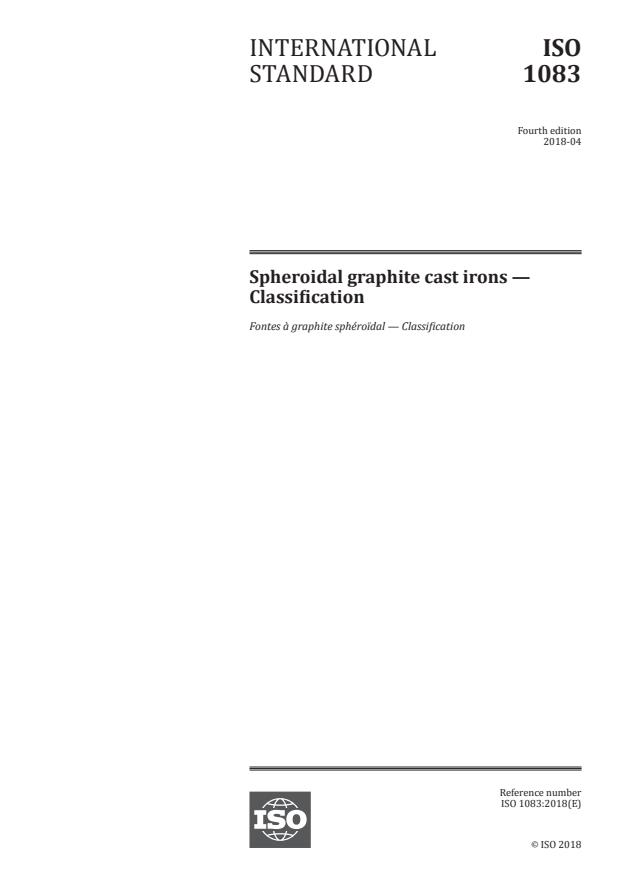
INTERNATIONAL ISO
STANDARD 1083
Fourth edition
2018-04
Spheroidal graphite cast irons —
Classification
Fontes à graphite sphéroïdal — Classification
Reference number
©
ISO 2018
© ISO 2018
All rights reserved. Unless otherwise specified, or required in the context of its implementation, no part of this publication may
be reproduced or utilized otherwise in any form or by any means, electronic or mechanical, including photocopying, or posting
on the internet or an intranet, without prior written permission. Permission can be requested from either ISO at the address
below or ISO’s member body in the country of the requester.
ISO copyright office
CP 401 • Ch. de Blandonnet 8
CH-1214 Vernier, Geneva
Phone: +41 22 749 01 11
Fax: +41 22 749 09 47
Email: copyright@iso.org
Website: www.iso.org
Published in Switzerland
ii © ISO 2018 – All rights reserved
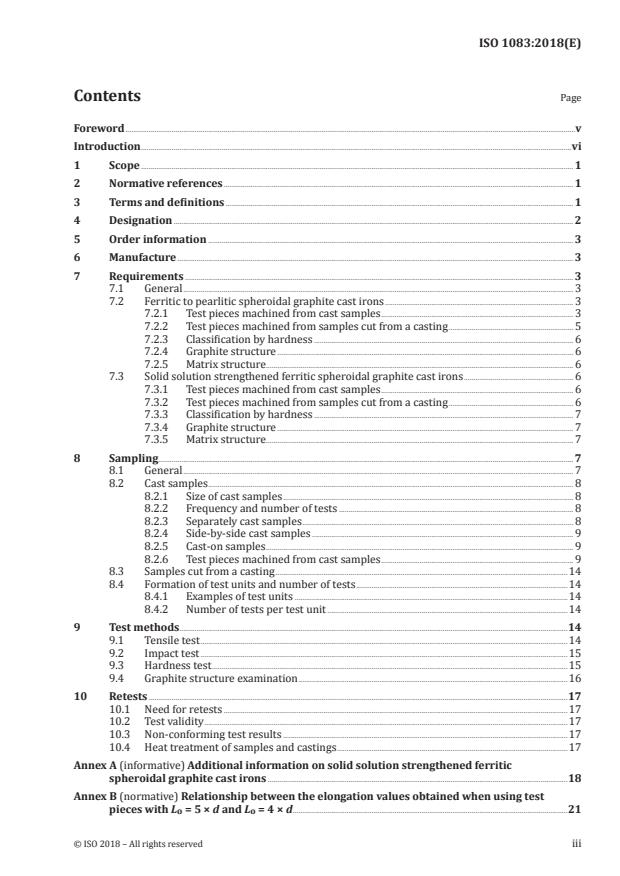
Contents Page
Foreword .v
Introduction .vi
1 Scope . 1
2 Normative references . 1
3 Terms and definitions . 1
4 Designation . 2
5 Order information . 3
6 Manufacture . 3
7 Requirements . 3
7.1 General . 3
7.2 Ferritic to pearlitic spheroidal graphite cast irons . 3
7.2.1 Test pieces machined from cast samples . 3
7.2.2 Test pieces machined from samples cut from a casting . 5
7.2.3 Classification by hardness . 6
7.2.4 Graphite structure . 6
7.2.5 Matrix structure. 6
7.3 Solid solution strengthened ferritic spheroidal graphite cast irons . 6
7.3.1 Test pieces machined from cast samples . 6
7.3.2 Test pieces machined from samples cut from a casting . 6
7.3.3 Classification by hardness . 7
7.3.4 Graphite structure . 7
7.3.5 Matrix structure. 7
8 Sampling . 7
8.1 General . 7
8.2 Cast samples . 8
8.2.1 Size of cast samples . 8
8.2.2 Frequency and number of tests . 8
8.2.3 Separately cast samples . 8
8.2.4 Side-by-side cast samples . 9
8.2.5 Cast-on samples . 9
8.2.6 Test pieces machined from cast samples . 9
8.3 Samples cut from a casting .14
8.4 Formation of test units and number of tests .14
8.4.1 Examples of test units .14
8.4.2 Number of tests per test unit .14
9 Test methods .14
9.1 Tensile test .14
9.2 Impact test .15
9.3 Hardness test .15
9.4 Graphite structure examination .16
10 Retests .17
10.1 Need for retests .17
10.2 Test validity .17
10.3 Non-conforming test results .17
10.4 Heat treatment of samples and castings .17
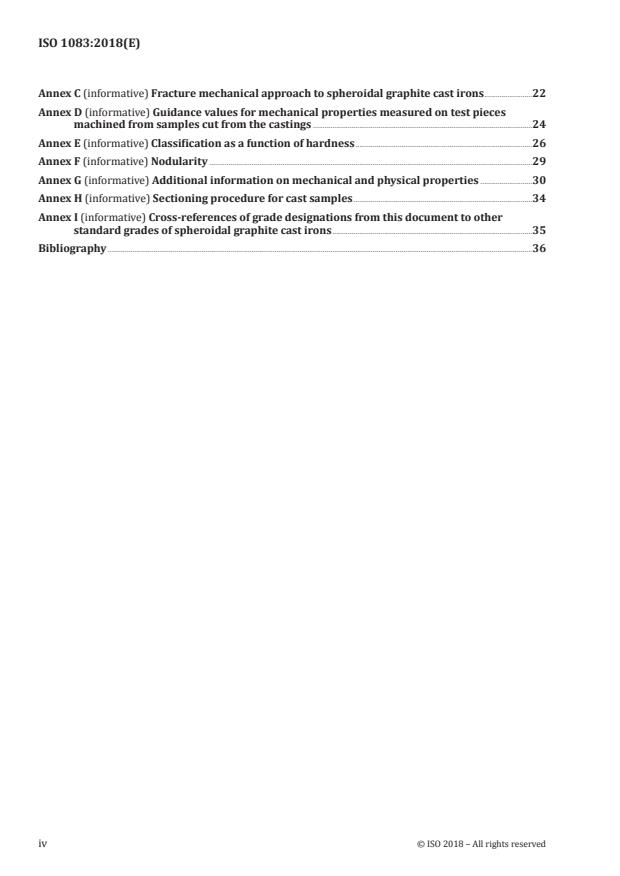
Annex A (informative) Additional information on solid solution strengthened ferritic
spheroidal graphite cast irons .18
Annex B (normative) Relationship between the elongation values obtained when using test
pieces with L = 5 × d and L = 4 × d .21
o o
Annex C (informative) Fracture mechanical approach to spheroidal graphite cast irons .22
Annex D (informative) Guidance values for mechanical properties measured on test pieces
machined from samples cut from the castings .24
Annex E (informative) Classification as a function of hardness .26
Annex F (informative) Nodularity .29
Annex G (informative) Additional information on mechanical and physical properties .30
Annex H (informative) Sectioning procedure for cast samples .34
Annex I (informative) Cross-references of grade designations from this document to other
standard grades of spheroidal graphite cast irons .35
Bibliography .36
iv © ISO 2018 – All rights reserved
Foreword
ISO (the International Organization for Standardization) is a worldwide federation of national standards
bodies (ISO member bodies). The work of preparing International Standards is normally carried out
through ISO technical committees. Each member body interested in a subject for which a technical
committee has been established has the right to be represented on that committee. International
organizations, governmental and non-governmental, in liaison with ISO, also take part in the work.
ISO collaborates closely with the International Electrotechnical Commission (IEC) on all matters of
electrotechnical standardization.
The procedures used to develop this document and those intended for its further maintenance are
described in the ISO/IEC Directives, Part 1. In particular the different approval criteria needed for the
different types of ISO documents should be noted. This document was drafted in accordance with the
editorial rules of the ISO/IEC Directives, Part 2 (see www .iso .org/directives).
Attention is drawn to the possibility that some of the elements of this document may be the subject of
patent rights. ISO shall not be held responsible for identifying any or all such patent rights. Details of
any patent rights identified during the development of the document will be in the Introduction and/or
on the ISO list of patent declarations received (see www .iso .org/patents).
Any trade name used in this document is information given for the convenience of users and does not
constitute an endorsement.
For an explanation on the voluntary nature of standards, the meaning of ISO specific terms and
expressions related to conformity assessment, as well as information about ISO's adherence to the
World Trade Organization (WTO) principles in the Technical Barriers to Trade (TBT) see the following
URL: www .iso .org/iso/foreword .html.
This document was prepared by Technical Committee ISO/TC 25, Cast irons and pig irons.
This fourth edition cancels and replaces the third edition (ISO 1083:2004), which has been technically
revised with the following changes:
— solid-solution strengthened ferritic spheroidal graphite cast irons grades have been added;
— side-by-side cast samples have been added;
— several definitions have been added;
— the relation between mechanical properties and wall thickness has been added;
— figures for separately cast or side-by-side cast samples have been updated;
— the tensile test piece figure has been updated and the Charpy V-notched impact test piece figure has
been removed;
— Annex A has been partially reworded;
— Annex C has been entirely reworded;
— Annex D has been developed;
— Annex E has become informative;
— Annex G has been developed;
— Annex H has been added.
Introduction
The properties of spheroidal graphite cast irons depend on their structure.
Spheroidal graphite cast irons covered by this document are divided into two groups:
a) ferritic to pearlitic spheroidal graphite cast irons;
b) solid-solution strengthened ferritic spheroidal graphite cast irons.
The mechanical properties of the material can be evaluated on machined test pieces prepared from the
following:
— separately cast samples;
— side-by-side cast samples;
— cast-on samples;
— samples cut from a casting.
The material grade is defined by mechanical properties measured on machined test pieces prepared
from cast samples.
If hardness is a requirement of the purchaser as being important for the application, then Annex E
provides means for its determination.
It is well known that tensile properties and hardness of spheroidal graphite cast irons are interrelated.
When considered by the purchaser as being important for the application, both tensile and hardness
properties may be specified.
Some material grades can be suitable for pressure applications.
Further technical data on spheroidal graphite cast irons is given in Annexes C and G.
vi © ISO 2018 – All rights reserved
INTERNATIONAL STANDARD ISO 1083:2018(E)
Spheroidal graphite cast irons — Classification
1 Scope
This document defines the grades and the corresponding requirements for spheroidal graphite cast irons.
This document specifies two groups of spheroidal graphite cast iron grades by a classification based on
mechanical properties measured on machined test pieces prepared from cast samples. The first group
deals mainly with ferritic to pearlitic grades. The second group deals with solid-solution strengthened
ferritic grades.
This document also gives an informative classification as a function of hardness.
This document does not apply to the following:
— spheroidal graphite cast irons used for pipes, fittings and accessories which are specified in
accordance with ISO 2531 and ISO 7186;
— highly alloyed (austenitic) spheroidal cast irons which are specified in accordance with ISO 2892;
— ausferritic cast irons which are specified in accordance with ISO 17804.
2 Normative references
The following documents are referred to in the text in such a way that some or all of their content
constitutes requirements of this document. For dated references, only the edition cited applies. For
undated references, the latest edition of the referenced document (including any amendments) applies.
ISO 148-1, Metallic materials — Charpy pendulum impact test — Part 1: Test method
ISO 945-1, Microstructure of cast irons — Part 1: Graphite classification by visual analysis
ISO 6506-1, Metallic materials — Brinell hardness test — Part 1: Test method
ISO 6892-1, Metallic materials — Tensile testing — Part 1: Method of test at room temperature
ISO/TR 15931, Designation system for cast irons and pig irons
3 Terms and definitions
For the purposes of this document, the following terms and definitions apply.
ISO and IEC maintain terminological databases for use in standardization at the following addresses:
— IEC Electropedia: available at http: //www .electropedia .org/
— ISO Online browsing platform: available at http: //www .iso .org/obp
3.1
spheroidal graphite cast iron
cast material, iron, carbon and silicon-based, the carbon being present mainly in the form of spheroidal
graphite particles
Note 1 to entry: Spheroidal graphite cast iron is also known as ductile iron, and less commonly as nodular iron.
3.2
ferritic to pearlitic spheroidal graphite cast iron
spheroidal graphite cast iron (3.1) with a matrix containing ferrite or pearlite or a combination of both
Note 1 to entry: Pearlite can be partially or totally replaced by quenched microstructures in grades having higher
strength.
3.3
solid-solution strengthened ferritic spheroidal graphite cast iron
spheroidal graphite cast iron (3.1) with a matrix mainly consisting of ferrite, solution strengthened by
increasing the amount of silicon compared to ferritic to pearlitic spheroidal graphite cast iron (3.2)
3.4
graphite spheroidizing treatment
process that brings the liquid iron into contact with a substance to produce graphite in the
predominantly spheroidal (nodular) form during solidification
Note 1 to entry: This process is often followed by a second process called inoculation.
3.5
cast sample
quantity of material cast to represent the cast material, including separately cast sample (3.6), side-by-
side cast sample (3.7) and cast-on sample (3.8)
3.6
separately cast sample
sample cast in a separate sand mould under representative manufacturing conditions and material grade
3.7
side-by-side cast sample
sample cast in the mould alongside the casting, with a joint running system
3.8
cast-on sample
sample attached directly to the casting
3.9
sample cut from a casting
sample obtained directly from the casting
3.10
relevant wall thickness
section of the casting, agreed between the manufacturer and the purchaser, to which the determined
mechanical properties shall apply
3.11
test unit
number of pieces or the tonnage of castings to be accepted or rejected together, on the basis of the tests
carried out on test pieces in accordance with the requirements of the relevant specification, material
standard or order
Note 1 to entry: This term is sometimes referred to as “inspection lot” or “test batch”.
[SOURCE: EN 1559-1:2011, 3.12]
4 Designation
The material shall be designated in accordance with ISO/TR 15931. The relevant designations are given
in Tables 1 to 3.
NOTE Further information on designation is given in Annex I.
2 © ISO 2018 – All rights reserved
5 Order information
The following information shall be supplied by the purchaser:
a) the complete designation of the material;
b) any special requirements (including the relevant wall thickness, where necessary) that shall be
agreed upon between the manufacturer and the purchaser by the time of acceptance of the order;
c) the number of this document, i.e. ISO 1083.
6 Manufacture
The method of producing spheroidal graphite cast irons and their chemical composition shall be left to
the discretion of the manufacturer who shall ensure that the requirements of this document are met for
the material grade specified in the order.
For ferritic to pearlitic cast iron grades, the level of the mechanical properties is determined by the
ferrite to pearlite ratio. The ferrite to pearlite ratio is normally adjusted by alloying or, less commonly,
by heat treatment.
For solid-solution strengthened cast iron grades, the level of the mechanical properties is determined
by the extent of solid solution strengthening of the ferritic matrix. Solid-solution strengthening is
normally governed by the silicon content.
For spheroidal graphite cast irons to be used in special applications, the chemical composition and heat
treatment may be the subject of an agreement between the manufacturer and the purchaser.
All agreements between the manufacturer and the purchaser shall be made by the time of the
acceptance of the order.
7 Requirements
7.1 General
The property values apply to spheroidal graphite cast irons cast in sand moulds or moulds of comparable
thermal behaviour. Subject to amendments to be agreed upon in the order, they can apply to castings
obtained by alternative methods.
The material designation is based on the minimum mechanical properties obtained in cast samples
with a thickness or diameter of 25 mm. The designation is irrespective of the type of cast sample.
Mechanical properties are wall thickness dependant as shown in Tables 1, 2 and 3.
For relevant wall thicknesses greater than 200 mm, the manufacturer and the purchaser shall agree
on the minimum mechanical properties, the type and size of the cast sample, and microstructure
requirements.
NOTE Tensile testing requires sound test pieces in order to guarantee pure uni-axial stress during the test.
7.2 Ferritic to pearlitic spheroidal graphite cast irons
7.2.1 Test pieces machined from cast samples
7.2.1.1 Tensile properties
The mechanical properties of ferritic to pearlitic spheroidal graphite cast iron test pieces shall be as
specified in Table 1.
Table 1 — Mechanical properties measured on test pieces machined from cast samples for
ferritic to pearlitic grades
Material designation Relevant wall 0,2 % proof strength Tensile strength Elongation after
thickness R fracture
p0,2
t MPa R A
m
mm min. MPa %
min. min.
t ≤ 30 220 350 22
a
ISO1083/JS/350-22-LT 30 < t ≤ 60 210 330 18
60 < t ≤ 200 200 320 15
t ≤ 30 220 350 22
b
ISO1083/JS/350-22-RT 30 < t ≤ 60 220 330 18
60 < t ≤ 200 210 320 15
t ≤ 30 220 350 22
ISO1083/JS/350-22 30 < t ≤ 60 220 330 18
60 < t ≤ 200 210 320 15
t ≤ 30 240 400 18
a
ISO1083/JS/400-18-LT 30 < t ≤ 60 230 380 15
60 < t ≤200 220 360 12
t ≤ 30 250 400 18
b
ISO1083/JS/400-18-RT 30 < t ≤ 60 250 390 15
60 < t ≤ 200 240 370 12
t ≤ 30 250 400 18
ISO1083/JS/400-18 30 < t ≤ 60 250 390 15
60 < t ≤ 200 240 370 12
t ≤ 30 250 400 15
ISO1083/JS/400-15 30 < t ≤ 60 250 390 14
60 < t ≤ 200 240 370 11
t ≤ 30 310 450 10
ISO1083/JS/450-10 30 < t ≤ 60
to be agreed upon between the manufacturer and the purchaser
60 < t ≤ 200
t ≤ 30 320 500 7
ISO1083/JS/500-7 30 < t ≤ 60 300 450 7
60 < t ≤ 200 290 420 5
t ≤ 30 350 550 5
ISO1083/JS/550-5 30 < t ≤ 60 330 520 4
60 < t ≤ 200 320 500 3
t ≤ 30 370 600 3
ISO1083/JS/600-3 30 < t ≤ 60 360 600 2
60 < t ≤ 200 340 550 1
t ≤ 30 420 700 2
ISO1083/JS/700-2 30 < t ≤ 60 400 700 2
60 < t ≤ 200 380 650 1
t ≤ 30 480 800 2
ISO1083/JS/800-2 30 < t ≤ 60
to be agreed upon between the manufacturer and the purchaser
60 < t ≤200
t ≤ 30 600 900 2
ISO1083/JS/900-2 30 < t ≤ 60
to be agreed upon between the manufacturer and the purchaser
60 < t ≤ 200
NOTE 1 Elongation values are determined from L = 5 d. For other gauge lengths, see 9.1 and Annex B.
NOTE 2 The mechanical properties of test pieces machined from cast samples do not necessary reflect exactly
the properties of the casting itself. Values for tensile properties of the casting are given in Annex D for guidance.
NOTE 3 The data apply to separately cast samples, cast on samples and side-by-side cast samples; therefore
the suffix “S” is not included.
a b
LT for low temperature. RT for room temperature.
4 © ISO 2018 – All rights reserved
7.2.1.2 Impact energy
The impact energy values given in Table 2 for room temperature (RT) and low temperature (LT)
applications, if applicable, shall only be determined if specified by the purchaser by the time of
acceptance of the order.
The mean value of the three Charpy impact tests and the individual values shall meet the specified
requirements in Table 2.
NOTE The relevance of the use of impact energy as a measure of resistance to brittle fracture in castings,
subjected to application loads, is currently being reassessed. Annex C gives information about a fracture
mechanical approach to spheroidal graphite cast irons.
Table 2 — Minimum impact energy values measured on V-notched test pieces machined from
cast samples for ferritic grades of the ferritic to pearlitic group
Minimum impact energy values
J
Relevant wall
Material designation
thickness
Room temperature Low temperature Low temperature
(23 ± 5) °C (−20 ± 2) °C (−40 ± 2) °C
Mean Mean Mean
T Individu- Individu- Individu-
value value value
mm al value al value al value
(3 tests) (3 tests) (3 tests)
t ≤ 30 — — — — 12 9
a
ISO1083/JS/350-22-LT 30 < t ≤ 60 — — — — 12 9
60 < t ≤ 200 — — — — 10 7
t ≤ 30 17 14 — — — —
b
ISO1083/JS/350-22-RT 30 < t ≤ 60 17 14 — — — —
60 < t ≤ 200 15 12 — — — —
t ≤ 30 — — 12 9 — —
a
ISO1083/JS/400-18-LT 30 < t ≤ 60 — — 12 9 — —
60 < t ≤ 200 — — 10 7 — —
t ≤ 30 14 11 — — — —
b
ISO1083/JS/400-18-RT 30 < t ≤ 60 14 11 — — — —
60 < t ≤ 200 12 9 — — — —
NOTE 1 These material grades can be suitable for some pressure vessel applications. (For fracture toughness, see Annex C.)
NOTE 2 The mechanical properties of test pieces machined from cast samples do not necessarily reflect exactly the
properties of the casting itself.
NOTE 3 The data apply to separately cast samples, cast on samples and side-by-side cast samples; therefore the suffix “S”
is not included.
a
LT for low temperature.
b
RT for room temperature.
7.2.2 Test pieces machined from samples cut from a casting
If applicable, the manufacturer and the purchaser shall agree on the following:
— the locations on a casting where the samples shall be taken;
— the mechanical properties that shall be measured;
— the minimum values or allowable range of values, for these mechanical properties (for information,
see Annex D).
NOTE 1 The properties of castings are often not uniform, because casting properties depend on the complexity
of the casting and variation in section thickness.
NOTE 2 Mechanical properties for test pieces cut from a casting are affected not only by material properties
(covered by this document) but also by the local casting soundness (not covered by this document).
7.2.3 Classification by hardness
The classification by Brinell hardness shall only be specified when agreed between the manufacturer
and the purchaser (see Annex E).
7.2.4 Graphite structure
The graphite structure shall be mainly of form VI and form V in accordance with ISO 945-1. A more
precise definition of graphite structure may be agreed between the manufacturer and the purchaser.
This structure shall be confirmed either by metallographic examination or by non-destructive methods.
In case of dispute, the result of the metallographic examination shall prevail.
NOTE Annex F gives more information on nodularity.
7.2.5 Matrix structure
Information on matrix structure is given in Table G.1 and ISO/TR 945-3.
7.3 Solid solution strengthened ferritic spheroidal graphite cast irons
7.3.1 Test pieces machined from cast samples
The mechanical properties of solid solution strengthened ferritic spheroidal graphite cast iron test
pieces shall be as specified in Table 3.
Table 3 — Mechanical properties measured on test pieces machined from cast samples for solid
solution strengthened ferritic grades
Relevant wall Elongation after
0,2 % proof strength Tensile strength
thickness fracture
Material designation
t R R A
p0,2 m
mm MPa MPa %
min. min. min.
t ≤ 30 350 450 18
30 ≤ t ≤ 60 340 430 14
ISO1083/JS/450-18
t > 60
to be agreed upon between the manufacturer and the purchaser
t ≤ 30 400 500 14
30 ≤ t ≤ 60 390 480 12
ISO1083/JS/500-14
t > 60
to be agreed upon between the manufacturer and the purchaser
t ≤ 30 470 600 10
30 ≤ t ≤ 60 450 580 8
ISO1083/JS/600-10
t > 60
to be agreed upon between the manufacturer and the purchaser
NOTE 1 The mechanical properties of test pieces machined from cast samples do not necessarily reflect exactly the
properties of the casting itself. Values for tensile properties of the casting are given in Annex D for guidance.
NOTE 2 The data apply to separately cast samples, cast on samples and side-by-side cast samples; therefore the suffix “S”
is not included.
7.3.2 Test pieces machined from samples cut from a casting
If applicable, the manufacturer and the purchaser shall agree on the following:
— the locations on a casting where the samples shall be taken;
6 © ISO 2018 – All rights reserved
— the mechanical properties that shall be measured;
— the minimum values or allowable range of values, for these mechanical properties (for information,
see Annex D).
NOTE 1 The properties of castings are often not uniform, because casting properties depend on the complexity
of the casting and variation in their section thickness.
NOTE 2 Mechanical properties for test pieces cut from a casting are affected not only by material properties
(covered by this document) but also by the local casting soundness (not covered by this document).
7.3.3 Classification by hardness
The classification by Brinell hardness shall only be specified when agreed between the manufacturer
and the purchaser (see Annex E).
7.3.4 Graphite structure
The graphite structure shall be mainly of form VI and form V in accordance with ISO 945-1. A more
precise definition of graphite structure may be agreed between the manufacturer and the purchaser.
This structure shall be confirmed either by metallographic examination or by non-destructive methods.
In case of dispute, the result of the metallographic examination shall prevail.
NOTE 1 A.2.3 gives more information on graphite structure.
NOTE 2 Annex F gives more information on nodularity.
7.3.5 Matrix structure
Information on matrix structure is given in A.2.2, Table G.1 and ISO/TR 945-3.
8 Sampling
8.1 General
Samples shall be provided to represent the castings produced.
Samples shall be made from the same material as that used to produce the castings which they represent
(see 8.4).
Several types of sample (separately cast samples, cast-on samples, side-by-side cast samples, samples
cut from a casting) can be used, depending on the mass and wall thickness of the casting.
When appropriate the type of sample should be agreed between the manufacturer and the purchaser.
Unless otherwise agreed the choice of the option is left to the discretion of the manufacturer.
When the mass of the casting exceeds 2 000 kg and its relevant wall thickness exceeds 60 mm, cast-
on samples or side-by-side cast samples should be preferably used; representative dimensions and
the location of the sample shall be agreed between the manufacturer and the purchaser by the time of
acceptance of the order.
If the spheroidizing treatment is carried out in the mould (in-mould process), the separately cast sample
should be avoided.
All samples shall be adequately marked to guarantee full traceability to the castings which they
represent.
The samples shall be subject to the same heat treatment, as that of the castings they represent, if any.
Tensile and impact test pieces shall be finally machined from the samples after the heat treatment.
8.2 Cast samples
8.2.1 Size of cast samples
The size of the sample shall be in correspondence with the relevant wall thickness of the casting as
shown in Table 4.
If other sizes are used, this shall be agreed between the manufacturer and purchaser.
Table 4 — Types and sizes of cast samples and sizes of tensile test pieces in relation to relevant
wall thickness of the casting
Type of sample
Option 1 Option 2 Option 3 Cast-on sample
Relevant wall Preferred diameter
a
thickness of tensile test piece
U-shaped Y-shaped Round bar (see Figure 4)
t d
mm (see Figure 1) (see Figure 2) (see Figure 3) mm
— I Types b, c A 7
t ≤ 12,5
(Option 3: 14 mm)
12,5 < t ≤ 30 — II Types a, b, c B 14
b
30 < t ≤ 60 III — C 14
60 < t ≤ 200 — IV — D 14
a
Other diameters, in accordance with Figure 5, may be agreed between the manufacturer and the purchaser.
b
The cooling rate of this cast sample corresponds to that of a 40 mm wall thickness.
8.2.2 Frequency and number of tests
Samples representative of the material shall be produced at a frequency in accordance with the process
quality assurance procedures adopted by the manufacturer or as agreed with the purchaser.
In the absence of a process quality assurance procedure or any other agreement between the
manufacturer and the purchaser, a minimum of one cast sample for the tensile test shall be produced to
confirm the material grade, at a frequency to be agreed between the manufacturer and the purchaser.
When impact tests are required, samples shall be produced at a frequency to be agreed between the
manufacturer and the purchaser.
8.2.3 Separately cast samples
The samples shall be cast separately in sand moulds at the same time as the castings and under
representative manufacturing conditions. The moulds used to cast the separately cast samples shall
have comparable thermal behaviour to the moulding material used to cast the castings.
It is an option of the manufacturer to use an adequate running system which reproduces conditions
similar to those of the castings.
The samples shall meet the requirements of either Figures 1, 2 or 3.
The samples shall be removed from the mould at a temperature similar to that of the castings.
If the graphite spheroidizing treatment is carried out in the mould (in-mould method), the samples
shall be
— either cast alongside with the castings, with a joint running system, or
— cast separately using a similar treatment method in the sample mould as the method used to produce
the castings.
8 © ISO 2018 – All rights reserved
The samples shall be given the same heat treatment, if any, as the castings which they represent.
8.2.4 Side-by-side cast samples
Side-by-side cast samples are representative of the castings concurrently cast and also of all other
castings of a similar relevant wall thickness from the same test unit.
When mechanical properties are required for a series of castings belonging to the same test unit, the
side-by-side cast samples shall be produced in the last moulds poured.
The samples shall meet the requirements of either Figures 1, 2 or 3.
8.2.5 Cast-on samples
Cast-on samples are representative of the castings to which they are attached and also of all other
castings of a similar relevant wall thickness from the same test unit.
When mechanical properties are required for a series of castings belonging to the same test unit, the
cast-on samples shall be produced in the last moulds poured.
The location of cast-on samples shall be agreed between the manufacturer and the purchaser by the
time of acceptance of the order, taking into account the shape of the casting and the running system, in
order to avoid any unfavourable effect on the properties of the adjacent material.
The samples shall have a general shape as indicated in Figure 4 and the dimensions shown therein.
Unless otherwise agreed between the manufacturer and the purchaser, when castings are to be heat
treated, the cast-on samples shall not be separated from the castings until after the heat treatment.
8.2.6 Test pieces machined from cast samples
The tensile test piece shown in Figure 5 and, if applicable, the test piece for the impact test shall be
machined from a sample shown in Figure 3 or from the hatched part of Figures 1, 2 or 4.
The sectioning procedure for cast samples should be in accordance with Annex H.
Unless otherwise agreed, the preferred diameter (see Figure 5) for the test piece shall be used.
Dimensions in millimetres
Key
a
For information only.
b
The length z shall be chosen to allow a test piece of dimensions shown in Figure 5 to be machined from the sample.
The thickness of the sand mould surrounding the samples shall be at least 40 mm.
For the manufacture of thin-walled castings or castings in metal moulds, the tensile properties may, by agreement
between the manufacturer and the purchaser, be determined on test pieces taken from samples of thickness, less
than 12,5 mm.
Figure 1 — Separately cast or side-by-side cast samples — Option 1: U-shaped sample
10 © ISO 2018 – All rights reserved
Dimensions in millimetres
Key
Dimension Type
I II III IV
u 12,5 25 50 75
v 40 55 100 125
x 25 40 50 65
a
y 135 140 150 175
b
z A function of the test piece length
a
For information only.
b
z shall be chosen to allow a test piece of dimensions shown in Figure 5 to be machined from the sample.
The thickness of the sand mould surrounding the samples shall be:
— 40 mm minimum for types I and II;
— 80 mm minimum for types III and IV.
For the manufacture of thin-walled castings or castings in metal moulds, the tensile properties may, by agreement
between the manufacturer and the purchaser, be determined on test pieces taken from samples of thickness, less
than 12,5 mm.
Figure 2 — Separately cast or side-by-side cast samples — Option 2: Y-shaped sample
Dimensions in millimetres
a) Type a
b) Type b
c) Type c
Key
Type A B D H H L L L W
b f n t
a 4,5 5,5 25 50 — L + 20 L – 50 100
t t
a
b 4,5 5,5 25 50 — L + 20 L – 50 50
t t
c 4,0 5,0 25 35 15 L + 20 L – 50 50
t t
a
L shall be chosen to allow a test piece of dimensions shown in Figure 5 to be machined from the
t
cast sample.
The thickness of the sand mould surrounding the samples shall be at least 40 mm.
Figure 3 — Separately cast or side-by-side cast samples — Option 3: Round bar-shaped sample
12 © ISO 2018 – All rights reserved
Dimensions in millimetres
Key
1 casting
Relevant wall
thickness of a b c h L
t
Type
the casting
t max. min.
A t ≤ 12,5 15 11 7,5 20 to 30
B 12,5 < t ≤ 30 25 19 12,5 30 to 40
a
C 30 < t ≤ 60 40 30 20 40 to 65
D 60 < t ≤ 200 70 52,5 35 65 to 105
a
L shall be chosen to allow a test piece of dimensions show in Figure 5 to be machined from the sample.
t
The thickness of the sand mould surrounding the samples shall be at least:
— 40 mm for types A and B;
— 80 mm for types C and D.
If smaller dimensions are agreed upon between the manufacturer and the purchaser, the following re-
lationships apply:
b = 0,75 × a
c = 0,5 × a
Figure 4 — Cast-on sample
8.3 Samples cut from a casting
In addition to the requirements of the material, the manufacturer and the purchaser may agree on the
properties required (for information see Annex D) at stated locations in the casting. These properties
shall be determined by testing test pieces machined from samples cut from the casting at these stated
locations.
The manufacturer and the purchaser shall agree on the dimensions of these test pieces.
In the absence of any direction by the purchaser, the manufacturer may select locations from which to
cut the samples and the dimensions of the test pieces.
The centreline of the test piece should be located at a point half way between the surface and the centre.
NOTE When the zone of last solidification of the casting is included in the test piece diameter, the minimum
elongation after fracture guidance value is not necessarily obtained.
For cases of large individual castings, trepanned samples may be taken at agreed positions in the
casting which shall be stated.
8.4 Formation of test units and number of tests
8.4.1 Examples of test units
Examples of test units are as follows:
— castings poured from the same ladle: up to 2 000 kg of fettled castings; this may vary, where
practicable, by agreement between the manufacturer and the purchaser;
— a single casting, if its mass equals or exceeds 200 kg;
— for continuous pouring of large tonnages of spheroidal graphite cast iron, the maximum size of test
unit shall be restricted to the castings produced in a two hour period of pouring;
— when the graphite spheroidizing treatment is carried out on less than 2 000 kg, the test unit to be
taken shall be the number of castings produced from that quantity of treated metal.
NOTE After heat treatment, a test unit remains the same unless different heat treatments have been applied
to distinct parts of the test unit. In such cases, these distinct parts become separate test units.
8.4.2 Number of tests per test unit
Sampling and testing shall be carried out in accordance with Clauses 8, 9 and 10. Sampling and testing
shall be carried out on each test unit unless the in-process quality assurance system makes provision
for amalgamation of lots. When the graphite spheroidizing treatment has been carried out in the mould,
the formation of test units and the number of tests shall be agreed between the manufacturer and the
purchaser by the time of acceptance of the order.
9 Test methods
9.1 Tensile test
The tensile test shall be carried out in accordance with ISO 6892-1. The preferred test piece diameter is
14 mm but, either for technical reasons or for test pieces machined from samples cut from the casting,
14 © ISO 2018 – All rights reserved
it is permitted to use a test piece of different diameter (see Figure 5). For either of these exceptions the
original gauge length of the test piece shall conform to Formula (1):
LS=×5,65 =×5 d (1)
oo
where
L is the original gauge length;
o
S is the original cross-section area of the test piece;
o
d is the diameter of the test piece along the gauge length.
If the above formula for L is not applicable, then an agreement shall be made between the manufacturer
o
and the purchaser on the dimensions of the test piece to be made.
A test piece with a different gauge length may be agreed upon between the manufacturer and the
purchaser.
For tensile test pieces with a gauge length L = 4 × d, Table B.1 shall be used to convert the elongation
o
value to that for L = 5 × d.
o
9.2 Impact test
The impact test shall be carried out on three standard Charpy V-notched impact test pieces in
accordance with ISO 148-1.
Test equipment with an appropriate energy shall be used to determine the properties correctly.
The 2 mm radius striker shall be used.
9.3 Hardness test
If agreed between the manufacturer and th
...
Questions, Comments and Discussion
Ask us and Technical Secretary will try to provide an answer. You can facilitate discussion about the standard in here.
Loading comments...