


ISO 23070:2020
(Main)Water Reuse in Urban Areas — Guidelines for reclaimed water treatment: Design principles of a RO treatment system of municipal wastewater
Water Reuse in Urban Areas — Guidelines for reclaimed water treatment: Design principles of a RO treatment system of municipal wastewater
This document provides guidelines for the planning and design of a reverse osmosis (RO) treatment system of municipal wastewater. This document is applicable to practitioners and authorities who intend to implement principles and decisions on RO treatment of municipal wastewater in a safe, reliable and sustainable manner. This document addresses RO treatment systems of municipal wastewater in their entirety and is applicable to any RO treatment system component. This document provides: — standard terms and definitions; — a description of the system components of an RO treatment system of municipal wastewater; — design principles of an RO treatment system of municipal wastewater; — statements on the feed water quality and technical requirements of an RO treatment system; — guidance for operation and maintenance of an RO treatment system; — specific aspects for consideration and emergency response. Design parameters and regulatory values of an RO treatment system of municipal wastewater are out of the scope of this document.
Titre manque
General Information
Standards Content (Sample)
INTERNATIONAL ISO
STANDARD 23070
First edition
2020-12
Water Reuse in Urban Areas —
Guidelines for reclaimed water
treatment: Design principles of a
RO treatment system of municipal
wastewater
Reference number
©
ISO 2020
© ISO 2020
All rights reserved. Unless otherwise specified, or required in the context of its implementation, no part of this publication may
be reproduced or utilized otherwise in any form or by any means, electronic or mechanical, including photocopying, or posting
on the internet or an intranet, without prior written permission. Permission can be requested from either ISO at the address
below or ISO’s member body in the country of the requester.
ISO copyright office
CP 401 • Ch. de Blandonnet 8
CH-1214 Vernier, Geneva
Phone: +41 22 749 01 11
Email: copyright@iso.org
Website: www.iso.org
Published in Switzerland
ii © ISO 2020 – All rights reserved
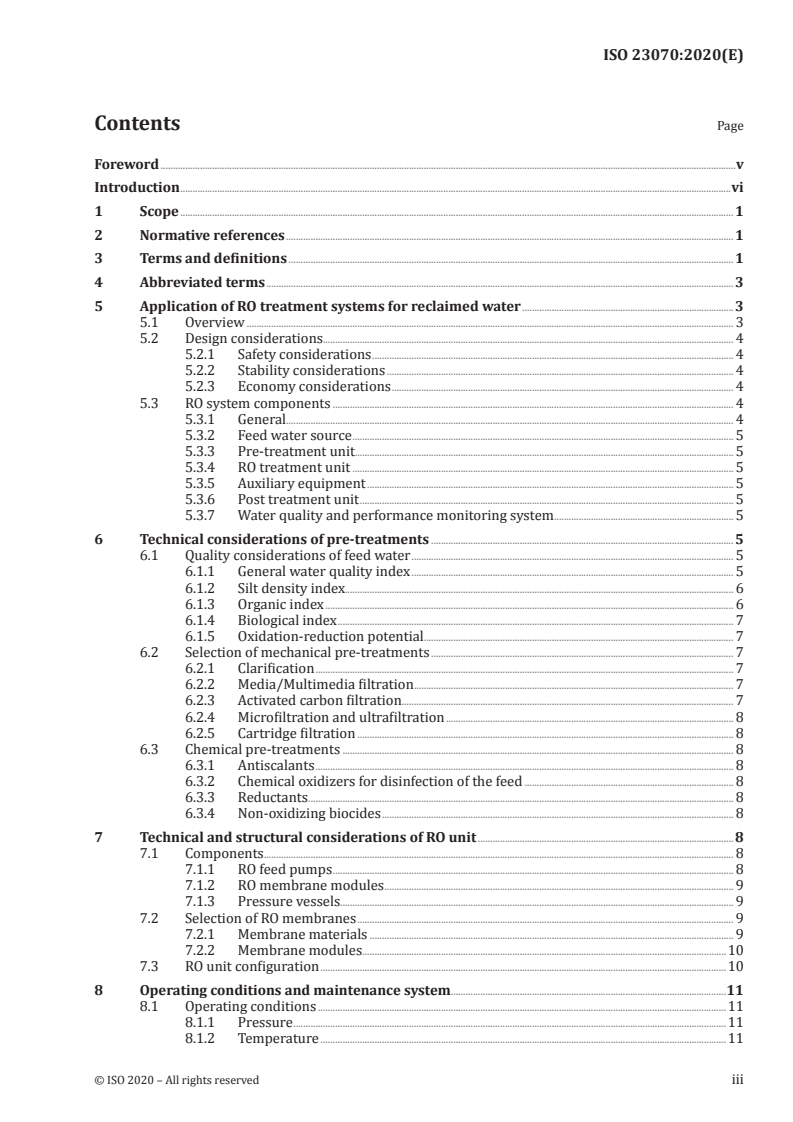
Contents Page
Foreword .v
Introduction .vi
1 Scope . 1
2 Normative references . 1
3 Terms and definitions . 1
4 Abbreviated terms . 3
5 Application of RO treatment systems for reclaimed water . 3
5.1 Overview . 3
5.2 Design considerations. 4
5.2.1 Safety considerations . 4
5.2.2 Stability considerations . 4
5.2.3 Economy considerations . 4
5.3 RO system components . 4
5.3.1 General. 4
5.3.2 Feed water source . 5
5.3.3 Pre-treatment unit. 5
5.3.4 RO treatment unit . 5
5.3.5 Auxiliary equipment . 5
5.3.6 Post treatment unit . 5
5.3.7 Water quality and performance monitoring system . 5
6 Technical considerations of pre-treatments . 5
6.1 Quality considerations of feed water . 5
6.1.1 General water quality index . 5
6.1.2 Silt density index. 6
6.1.3 Organic index . 6
6.1.4 Biological index . 7
6.1.5 Oxidation-reduction potential. 7
6.2 Selection of mechanical pre-treatments . 7
6.2.1 Clarification . 7
6.2.2 Media/Multimedia filtration . 7
6.2.3 Activated carbon filtration. 7
6.2.4 Microfiltration and ultrafiltration . 8
6.2.5 Cartridge filtration . 8
6.3 Chemical pre-treatments . 8
6.3.1 Antiscalants . 8
6.3.2 Chemical oxidizers for disinfection of the feed . 8
6.3.3 Reductants . 8
6.3.4 Non-oxidizing biocides . 8
7 Technical and structural considerations of RO unit . 8
7.1 Components . 8
7.1.1 RO feed pumps . 8
7.1.2 RO membrane modules . 9
7.1.3 Pressure vessels. 9
7.2 Selection of RO membranes . 9
7.2.1 Membrane materials . 9
7.2.2 Membrane modules . .10
7.3 RO unit configuration .10
8 Operating conditions and maintenance system.11
8.1 Operating conditions .11
8.1.1 Pressure .11
8.1.2 Temperature .11
8.1.3 Feed water flow and permeate flux .11
8.1.4 Concentrate flow .11
8.1.5 pH .12
8.2 RO performance parameters . .12
8.2.1 Permeate flow rate .12
8.2.2 Salt rejection .13
8.2.3 Pressure drop .13
8.3 Automatic chemical dosing system .13
8.3.1 Dosing point .13
8.3.2 Dosing method .13
8.4 Control and monitor system of RO performance .13
8.4.1 Instrumentation .13
8.4.2 Control system .14
8.4.3 Monitoring system.14
8.5 Cleaning system .14
8.5.1 Physical cleaning .14
8.5.2 Chemical cleaning .14
8.6 Integrity testing of RO systems .15
8.7 System failure .16
9 Post-treatment unit .17
10 RO concentrate management .17
11 Emergency response plan .17
Annex A (informative) Example of an RO treatment system for reclaimed water .19
Annex B (informative) Information of chlorine disinfection for the influent of an RO system .20
Annex C (informative) Maturity level of technologies applied to RO concentrate treatment .21
Bibliography .22
iv © ISO 2020 – All rights reserved
Foreword
ISO (the International Organization for Standardization) is a worldwide federation of national standards
bodies (ISO member bodies). The work of preparing International Standards is normally carried out
through ISO technical committees. Each member body interested in a subject for which a technical
committee has been established has the right to be represented on that committee. International
organizations, governmental and non-governmental, in liaison with ISO, also take part in the work.
ISO collaborates closely with the International Electrotechnical Commission (IEC) on all matters of
electrotechnical standardization.
The procedures used to develop this document and those intended for its further maintenance are
described in the ISO/IEC Directives, Part 1. In particular the different approval criteria needed for the
different types of ISO documents should be noted. This document was drafted in accordance with the
editorial rules of the ISO/IEC Directives, Part 2. www .iso .org/ directives
Attention is drawn to the possibility that some of the elements of this document may be the subject of
patent rights. ISO shall not be held responsible for identifying any or all such patent rights. Details of
any patent rights identified during the development of the document will be in the Introduction and/or
on the ISO list of patent declarations received. www .iso .org/ patents
Any trade name used in this document is information given for the convenience of users and does not
constitute an endorsement.
For an explanation on the meaning of ISO specific terms and expressions related to conformity
assessment, as well as information about ISO's adherence to the WTO principles in the Technical
Barriers to Trade (TBT) see the following URL: Foreword - Supplementary information
This document was prepared by Technical Committee ISO/TC 282, Water reuse, Subcommittee SC 2,
Water reuse in urban areas.
Any feedback or questions on this document should be directed to the user’s national standards body. A
complete listing of these bodies can be found at www .iso .org/ members .html.
Introduction
Over the past decade, with an increasing demand of high-quality reclaimed water, reverse osmosis
(RO) has been widely applied as an important option for municipal wastewater reclamation. RO is a
water purification technology that uses a semipermeable membrane to remove ions and dissolved
organic micropollutants from feed water. In reverse osmosis, an applied pressure is used to overcome
osmotic pressure, a colligative property that is driven by chemical potential differences of the solvent,
a thermodynamic parameter. The automatic operation, small footprint and consistent high permeate
quality are the advantages of an RO process, which make it widely recognized. The reclaimed water
produced by an RO system could be used as boiler replenishing water, water for industrial production
and so on.
Compared with seawater and industrial wastewater, municipal wastewater has its distinctive
features. The total dissolved solid (TDS) concentration in seawater is mainly in the range of 30,000
[1]
to 45,000 mg/l , while the TDS concentration in secondary effluent of municipal wastewater ranges
[2]
from 100 to 3,000 mg/l . Thus, the RO system of municipal wastewater could achieve higher recovery
efficiency with much lower operational pressure compared with that of seawater. However, the
dissolved organic matter (DOM) concentration in secondary effluent is in the range of 5 to 20 mg/l as
[2] [1]
dissolve organic carbon (DOC) , which is much higher than that in seawater (<2 mg/l) . Furthermore,
the components of the DOM in secondary effluent are much more complicated than those in seawater.
Long-term operation of the RO system for municipal wastewater reclamation could lead to serious
organic and biological fouling. Therefore, in order to provide the stable operation, the distinctive
features of municipal wastewater should be taken into consideration in the design of the RO unit as
well as the pre-treatment unit. The design experience of the RO system for other water sources (e.g.,
seawater and industrial wastewater) could not be applied directly to municipal wastewater.
This document provides guidelines for the planning and design of an RO treatment system for water
reuse applications in urban areas. This document is applicable to practitioners and regulatory
authorities who intend to implement principles and decisions on water reuse in a safe, reliable and
sustainable manner.
This document addresses an RO treatment system in its entirety (e.g. reclaimed water sources, pre-
treatment process, RO treatment process, post treatment process, performance of RO system, operation
and maintenance and monitoring, usage of reclaimed water).
vi © ISO 2020 – All rights reserved
INTERNATIONAL STANDARD ISO 23070:2020(E)
Water Reuse in Urban Areas — Guidelines for reclaimed
water treatment: Design principles of a RO treatment
system of municipal wastewater
1 Scope
This document provides guidelines for the planning and design of a reverse osmosis (RO) treatment
system of municipal wastewater. This document is applicable to practitioners and authorities who
intend to implement principles and decisions on RO treatment of municipal wastewater in a safe, reliable
and sustainable manner. This document addresses RO treatment systems of municipal wastewater in
their entirety and is applicable to any RO treatment system component.
This document provides:
— standard terms and definitions;
— a description of the system components of an RO treatment system of municipal wastewater;
— design principles of an RO treatment system of municipal wastewater;
— statements on the feed water quality and technical requirements of an RO treatment system;
— guidance for operation and maintenance of an RO treatment system;
— specific aspects for consideration and emergency response.
Design parameters and regulatory values of an RO treatment system of municipal wastewater are out
of the scope of this document.
2 Normative references
The following documents, in whole or in part, are normatively referenced in this document and are
indispensable for its application. For dated references, only the edition cited applies. For undated
references, the latest edition of the referenced document (including any amendments) applies.
ISO 20670:2018, Water reuse — Vocabulary
3 Terms and definitions
For the purpose of this document, the terms and definitions given in ISO 20670 and the following apply.
ISO and IEC maintain terminological databases for use in standardization at the following addresses:
— ISO Online browsing platform: available at https:// www .iso .org/ obp
— IEC Electropedia: available at https:// www .electropedia .org/
3.1
assimilable organic carbon (AOC)
organic carbon which can be used by microorganisms for assimilation
3.2
biodegradable dissolved organic carbon (BDOC)
organic carbon which can be used by microorganisms for assimilation as well as catabolism
3.3
concentrate
rejected stream exiting a membrane module under a cross-flow mode
Note 1 to entry: Concentrate stream contains increased concentrations of constituents over the feed stream due
to the accumulation of rejected constituents by membranes in the feed stream.
[3]
[SOURCE: ASTM D6161-19 , modified — Note 1 to entry added.]
3.4
feed
input solution entering the inlet of a membrane module or system
[3]
[SOURCE: ASTM D6161-19 ]
3.5
ion exchange
process by which certain anions or cations in water are replaced by other ions by passage through a
bed of ion-exchange material
[4]
[SOURCE: ISO 6107-1:2004, 46 ]
3.6
membrane rejection rate
relative measure of how much of the target constituent that was initially in the feed water is separated
from the liquid by the membrane
Note 1 to entry: Rejection is generally expressed by 1 - C2/C1, where C1 is feed concentration and C2 is permeate
concentration. To make the guideline simple, the word “membrane” is frequently omitted depending on the
context.
3.7
microfiltration
pressure driven membrane-based separation process designed to remove particles and macromolecules
in the approximate range of 0,05 to 2 μm
[3]
[SOURCE: ASTM D6161-10 ]
3.8
permeate
portion of the feed stream which passes through a membrane
[3]
[SOURCE: ASTM D6161-10 ]
3.9
pressure drop
pressure change of the influent after the treatment by an RO system
3.10
recovery rate
ratio of the permeate volume to the feed volume
3.11
reverse osmosis
separation process where one component of a solution is removed from another component by flowing
the feed stream under pressure across a semipermeable membrane that causes selective movement of
solvent against its osmotic pressure difference
[3]
[SOURCE: ASTM D6161-10 ]
Note 1 to entry: Reverse Osmosis (RO) removes ions based on electrochemical forces, colloids, and organics down
to 150 molecular weight. May also be called hyperfiltration.
2 © ISO 2020 – All rights reserved
3.12
silt density index (SDI)
index for the fouling capacity of water in reverse osmosis systems, measuring the rate at which a
[5]
0,45-micrometre filter is plugged when subjected to a constant water pressure of 206,8 kPa (30 psi)
[5]
[SOURCE: ASTM D4189-07 (2014) ]
3.13
ultrafiltration
pressure driven process employing semipermeable membrane under hydraulic pressure gradient for
the separation of components in a solution
[3]
[SOURCE: ASTM D6161-10 ]
Note 1 to entry: The pores of the membrane are of a size smaller than 0.1 μm, which allows passage of the
solvent(s) but will retain non-ionic solutes based primarily on physical size, not chemical potential.
4 Abbreviated terms
AOC assimilable organic carbon
BDOC biodegradable dissolved organic carbon
BOD biochemical oxygen demand
CA cellulose acetate
COD chemical oxygen demand
DOC dissolved organic carbon
DOM dissolved organic matter
MF microfiltration
NPF normalized permeate flow
ORP oxidation-reduction potential
RO reverse osmosis
SDI silt density index
TOC total organic carbon
TSS total suspended solids
UF ultrafiltration
5 Application of RO treatment systems for reclaimed water
5.1 Overview
Over the past decade, with an increasing demand for high-quality reclaimed water, reverse osmosis (RO)
among other technologies has been widely applied as an important option for municipal wastewater
reclamation. RO technology can achieve high removal efficiency of microbes, colloidal matter, dissolved
solids, organics and inorganics from feed water. The advantages of an RO process are automatic
[6-8]
operation and high stability of RO permeate and this makes the RO process widely accepted .
5.2 Design considerations
Generally, permeate flow rate and permeate quality are used to characterize an RO treatment system
under certain feed water quality, recovery rate and operational pressure. Therefore, the main
objective of designing an RO treatment system is to meet the specific consideration of permeate
flow rate and quality with minimal operational pressure and the considerations about the costs of
system components. Furthermore, the cleaning process and maintenance should also be taken into
consideration to maintain the stable operation of the system.
5.2.1 Safety considerations
In theory, the reverse osmosis process is driven by pressure. In practice, the pressure is provided by
the feed pump of the RO process, and a pressure vessel is used to hold the membrane modules and
the pressurized feed water. Therefore, the design and operation of a nRO system shall meet the safety
consideration for a pressurized system.
5.2.2 Stability considerations
Stability represents the ability of an RO system to provide stable permeate flow rate and water quality
under certain operational conditions. In practice, because of membrane fouling, scaling or other factors
which could increase the resistance, in order to maintain a stable rate of permeate flow, the operational
pressure keeps increasing. When the operational pressure is too high, it is necessary to clean the RO
membranes. As for permeate quality, it might deteriorate because of membrane damage, membrane
degradation and membrane fouling. Therefore, the permeate quality shall be diligently monitored.
In order to enhance the stability of an RO system, provision for equalization of feed water flow prior to
the pre-treatment stage and/or the RO unit may also be considered. The resultant reduced variability
in influent flow rate would also allow for more consistent dosing of chemicals such as antiscalants,
reductants and non-oxidizing biocides.
5.2.3 Economy considerations
As for the infrastructure cost of an RO system, it is necessary to meet the considerations of permeate
flow rate and quality with a minimal cost of system components. As for the operational cost, it is
necessary to maintain the operational stability of the whole system with reasonable operational
pressure, cleaning and maintenance.
5.3 RO system components
5.3.1 General
An RO system generally consists of six essential components (see Figure 1):
— feed water source;
— pre-treatment;
— RO treatment;
— auxiliary equipment;
— post treatment (optional depending of the reclaimed water usage and quality criteria); and
— monitor.
Each part of the system should be characterized and managed with appropriate strategies. See Annex A
for the example of a typical RO treatment system for reclaimed water.
4 © ISO 2020 – All rights reserved
Figure 1 — The essential components of an RO treatment system for reclaimed water
5.3.2 Feed water source
Secondary or tertiary treated municipal wastewater is generally the water source to the RO process
stage of the water reclamation plant.
5.3.3 Pre-treatment unit
The pre-treatment unit may include one or more treatment stages such as physico-chemical treatment,
oxidation (e.g. ozone/AOPs), media filtration, UF/MF membrane filtration, disinfection.
5.3.4 RO treatment unit
The RO treatment unit generally includes a safety filter, a high-pressure pump, RO equipment and a
storage tank for the effluent of RO. It is the key component of the whole RO system.
5.3.5 Auxiliary equipment
The auxiliary equipment may include the dosing and cleaning units. Several kinds of chemicals may
be added, including chlorine, cleaning chemicals, antiscalants, reductants and non-oxidizing biocides
(Figure 1 and Figure A.1).
5.3.6 Post treatment unit
According to the specific consideration of the end user, one or more stages shall be needed to attain
the desired rejection (e.g. secondary RO, ion exchange, electrodialysis reversal). RO concentrate may
require treatment. The post treatment unit will be elaborated on in Clause 9.
5.3.7 Water quality and performance monitoring system
In order to maintain the operational stability and safety of the whole system, monitoring equipment
should be installed, including temperature meter, pressure gauge, pH meter, flowmeter, conductivity
meter, ORP meter and so on.
6 Technical considerations of pre-treatments
6.1 Quality considerations of feed water
6.1.1 General water quality index
General water quality indices of the feed water for an RO system are listed in Table 1.
Table 1 — General water quality for the feed water of an RO system
Category of water quality index Detailed water quality index
Inorganic index Metal cations (calcium, magnesium, iron, aluminum, etc.); Silica; Free
chlorine residual; Anions (nitrate, phosphate, etc.)
Organic index COD, BOD, TOC
Other index to be considered pH, Silt density index (SDI), Turbidity, Oxidation-reduction potential
Metal ions and silica could be of concern for scaling.
Free chlorine residual is of concern for RO membrane oxidizing damage.
The nutrient availability, such as nitrate and phosphate, could be important factors affecting the
biofouling of membranes.
Organic index is related to organic fouling and biofouling, which may become the main fouling problems
when secondary or tertiary treated municipal wastewater is used as feed water. These indices are
elaborated on in 6.1.3.
SDI and turbidity are related to membrane fouling caused by small particles.
6.1.2 Silt density index
Silt density index (SDI) gives the percent drop per minute in the flow rate of the water through the
filter, averaged over a period of time such as 15 minutes.
[5]
The measurement procedure of silt density index is as follow referring to ASTM D4189-07 (2014) :
The water sample is filtered through a 0.45 μm membrane with a diameter of 47 mm under a constant
pressure of 206.8 kPa (30 psi). At the beginning, the time needed to obtain 500 mL filtrate is t . After
time T (generally, 15 min), the time needed to obtain 500 mL filtrate become t . The SDI of the water
sample could be calculated with Formula 1:
t
1− %
t
%P
SDI= = (1)
t t
ff
where
t is the total testing time;
f
t is the time needed to obtain 500 ml filtrate at the very beginning;
t is the time needed to obtain 500 ml filtrate after the testing time T (generally, 15 min);
%P is plugging rate if %P is over 75 %, testing time T should be change to 10, 5 or 2 min.
Feed water with an SDI below 3, is generally considered as adequate feed water.
Other methods or indicators may be used if necessary.
6.1.3 Organic index
Generally, organic indices for an RO system include:
— Total organic carbon (TOC);
— Biochemical oxygen demand (BOD); and
— Chemical oxygen demand (COD).
6 © ISO 2020 – All rights reserved
Compared with seawater, a distinguishing feature of secondary treated municipal wastewater is that
the TOC concentration is usually much higher, and therefore close attention should be paid to the
membrane fouling caused by the organic matter in the RO process influent for wastewater reclamation.
Besides the TOC concentration, the organic constituents in the secondary treated municipal wastewater
are also different from those of seawater. The organic matter might be used by different microorganisms
leading to serious membrane fouling. Therefore, the concept of biostability of the feed water should be
taken into consideration. The assessment of biostability is generally based on the assimilable organic
[9]
carbon (AOC) or biodegradable dissolved organic carbon (BDOC) .
AOC is the fraction of DOC that is consumed by microorganisms, resulting in microbial growth and
represented by the maximum growth of a pure test microorganism(s) or indigenous bacteria that is
correlated with the DOC. BDOC is the consumption of DOC to catabolize organic carbon to CO and new
[9]
biomass, and represented by the difference between initial DOC and final DOC .
6.1.4 Biological index
Biological index, mainly the bacterial cell number in the feed water, could be used to evaluate the
biofouling potential. Besides the amount of microorganisms, the microbial community structure could
[10]
also show significant effect on the development of biofouling .
6.1.5 Oxidation-reduction potential
Oxidation-reduction potential (ORP) represents the content of oxidizing and reducing substances in
water. The oxidizing substances in municipal wastewater usually include free and combined chlorine,
ozone and so on. Some RO membrane materials, such as polyamide, are sensitive to these oxidizing
substances, and thus pre-treatment units, such as carbon filtration and adding reductants, are used to
remove the oxidizing substances.
6.2 Selection of mechanical pre-treatments
Municipal wastewater should be pre-treated before being fed into the RO treatment devices to meet
the water quality considerations. The selection of pre-treatment unit(s) should take into account the
quality of feed water, influent quality considerations of RO treatment unit(s), technical features, cost
and so on. Besides, experimental data or similar engineering experience should also be referred to.
Generally, pre-treatment unit(s) consists of processes such as clarification, media filtration, multimedia
filtration, microfiltration, ultrafiltration and cartridge filtration. The detailed design of pre-treatment
is not included in this document.
6.2.1 Clarification
Clarification is the integration of coagulation, precipitation and sedimentation, and is mainly used
to remove total suspended solid (TSS), colloids, organic matter and phosphorus in the feed water.
Aluminium and ferric salts can be used as coagulant.
6.2.2 Media/Multimedia filtration
Media/multimedia filtration is mainly used to remove total suspended solid in the feed water. For
example, a dual media filter may use anthracite and either quartz sand or silica sand as filtration media.
6.2.3 Activated carbon filtration
Activated carbon filtration can be used to remove colour, odour, residual chlorine and dissolved organic
constituents with low molecular weight in the feed water. Single layer filter tank or homogenous media
filter tank can be chosen with the use of activated carbon as the media. Activated carbon should be
replaced and regenerated periodically.
6.2.4 Microfiltration and ultrafiltration
Microfiltration (MF) and ultrafiltration (UF) can remove, depending on the membrane pore size, several
kinds of pollutants in the feed water, including viruses, bacteria, protozoa, TSS, colloids, organics with
high molecular weight, etc. Hollow fibre MF/UF membrane is usually used in the pre-treatment unit of
an RO treatment system.
6.2.5 Cartridge filtration
Cartridge filtration can mainly remove TSS in the feed water and is usually used as a prefilter prior to
the RO device.
6.3 Chemical pre-treatments
6.3.1 Antiscalants
Antiscalants are a series of chemicals that are used to prevent the scaling of the membrane surface.
Most of the antiscalants are organic polymers with a molecular weight in the range from 2 000 to
10 000 Da, such as polyacrylicacid, organophosphates, phosphonates, polymaleic acid and so on.
The dosing system should be designed so that the antiscalants are thoroughly mixed before they enter
the components of an RO system. The selected antiscalants for an RO system should be compatible with
the RO membrane, otherwise damage to the membrane may occur.
6.3.2 Chemical oxidizers for disinfection of the feed
Chemical oxidizers including chlorine, hypochlorite and peracetic acid could be used for disinfection in
feed water or at the wastewater treatment plant or both locations. Chlorine is the most commonly used
chemical oxidizer to inactivate microorganism in municipal wastewater. Residual chlorine in the feed
could inhibit microbial growth significantly. However, under some circumstance chlorine may also fail
[10]
to control biofouling .
6.3.3 Reductants
The chemical oxidizers used for disinfection could damage the RO membrane made of certain materials,
such as polyamide and aromatic polyamide. Therefore, reductants are usually added to remove these
oxidizers before the RO unit. The most commonly used reductant in an RO system is sodium bisulphite.
6.3.4 Non-oxidizing biocides
Non-oxidizing biocides will not damage the RO membrane and may be added before the RO system
to prevent the biological fouling of the RO membrane. The dose should be tracked in order to prevent
excessive biocide use.
7 Technical and structural considerations of RO unit
7.1 Components
7.1.1 RO feed pumps
RO feed pumps are sized using the required flow rate and operating pressure. Pump curves are
then generated to determine the number of stages, impeller diameter, horsepower required, and the
efficiency of the pump. An RO feed pump requires a minimum pressure at the pump suction to prevent
pump cavitation.
8 © ISO 2020 – All rights reserved
7.1.2 RO membrane modules
RO membranes for industrial-scale applications are typically modularized using configurations that
pack a large surface area of membranes into a relatively small volume. This makes the RO system more
economical to use in that the system requires a smaller footprint, and membranes can be replaced in
smaller modules rather than system wide.
7.1.3 Pressure vessels
A pressure vessel is the pressure housing for the membrane modules and contains the pressurized
feed water. Pressure vessels are made to specially accommodate the diameter of membrane module
being used. The length of the pressure vessel can be as short as one membrane module and up to seven
membrane modules in series.
Proper installation of membrane modules into a pressure vessel is critical. The membrane modules are
guided into the pressure vessel in series. Membranes should be loaded into or removed from pressure
vessel in the direction of flow. Therefore, the first module into the vessel, which is the last one in the
series, is the first module out.
7.2 Selection of RO membranes
7.2.1 Membrane materials
The performance of an RO unit is directly dependent on the properties of the membrane material. More
specifically, the chemical nature of the membrane polymer and the structure of the membrane are what
determines the rejection and flux properties of the RO system. Ideally, RO membranes should offer high
flux and high rejection rate, as well as high strength and durability. However, in practice, high rejection
rate and high flux have been two mutually exclusive goals. Although the last few years has seen an
increase in flux rates with no decrease in rejection, most membranes today represent a compromise
between high rejection rate and high flux.
The most commonly-used material for RO membranes, based on the type of polymer backbone, is
[11]
polyamide .
Basically, there are two types of polyamide membranes:
— linear aromatic polyamide membranes
— composite polyamide membranes.
Linear aromatic polyamide membranes were originally fabricated into hollow fibre membranes and
used primarily for seawater and brackish water desalination.
Composite membranes are essentially a composite of two polymers cast upon a fabric support.
Currently, cross-lined, fully aromatic polyamide membranes are the most popular RO membranes in use.
[12]
Table 2 lists the predominant characteristics of composite polyamide membranes .
Table 2 — The characteristics of polyamide composite RO membranes
Property Value for polyamide composite membranes
Membrane type Homogeneous asymmetric, thin-film composite
Salt rejection (%) >98 @ 25 °C
Silica rejection (%) >96 @ 25 °C
pH range 2-11
Feed pressure 145-400 psi
Temperature tolerance Up to 45 °C
Table 2 (continued)
Property Value for polyamide composite membranes
Surface charge Negative (anionic)
Chlorine tolerance <0,02 ppm
Fouling tolerance Fair
Surface roughness Rough
Besides polyamide membranes, cellulose acetate (CA) and polyether urea (PEU) are other types of
materials for RO membrane. CA membranes were commercially viable because of their relatively high
flux due to the extreme thinness of the membrane. However, the high operating pressure and relatively
low salt rejection of CA membranes were holding back this material from becoming more commercially
acceptable. PEU membranes differ from polyamide membranes in the surface charge and morphology.
PEU membranes have a slightly positive charge to them. Furthermore, the surface of a PEU membrane
is smooth, similar to a CA membrane, thereby minimizing the potential for fouling.
7.2.2 Membrane modules
There are four basic forms for RO membrane modules: plate-and-frame, tubular, spiral wound and
[12]
hollow fibre. These four configurations are summarized in Table 3 .
Table 3 — Brief comparison of four basic RO membrane modules
Property Plate-and-frame Tubular Spiral wound Hollow fibre
Packing density, ft / 45-150 (148-492) 6-120 (20-374) 150-380 (492-1247) 150-1500 (492-4924)
3 2 3
ft (m /m )
Potential for fouling Moderate Low High Very high
Ease of cleaning Good Excellent Poor Poor
Relative manufactur- High High Moderate Low
ing cost
Plate-and-frame RO modules are typically used for specialty, high suspended solids applications and are
not generally found in water purification facilities. Tubular modules are also used for specialty, high-
solids applications typically found in food and biological processing industries. Spiral wound membrane
modules are the most common type of module used for RO today due to the fairly high packing density.
Some manufacturers also developed hollow fibre RO modules with very high packing density. But these
modules are currently vulnerable to fouling and relatively difficult to clean.
7.3 RO unit configuration
The number of the RO membrane modules used in a certain system is rel
...
Questions, Comments and Discussion
Ask us and Technical Secretary will try to provide an answer. You can facilitate discussion about the standard in here.