


ISO 16422-5:2024
(Main)Pipes and joints made of oriented unplasticized poly(vinyl chloride) (PVC-O) for the conveyance of water under pressure — Part 5: Fitness for purpose of the system
Pipes and joints made of oriented unplasticized poly(vinyl chloride) (PVC-O) for the conveyance of water under pressure — Part 5: Fitness for purpose of the system
This document specifies the characteristics of the fitness for purpose of oriented unplasticized poly(vinyl chloride) (PVC-O) solid wall piping intended to be used underground or above-ground where protected from direct sunlight, for water supply, buried drainage, sewerage, treated wastewater and irrigation under pressure. It also specifies the test parameters for the test methods referred to in this document. This document is not intended for on-site testing of pipe systems. In conjunction with ISO 16422-1, ISO 16422-2, ISO/TS 16422-3 and ISO 1452-3, this document is applicable to PVC-O pipes and PVC-O fittings, as well as to their joints and to joints with components of other plastics and non-plastics materials intended to be used for the following: a) water mains and services lines; b) conveyance of water for both outside and inside buildings; c) drainage, sewerage and treated wastewater under pressure; d) irrigation under pressure. This document is applicable to piping systems intended for the supply of water under pressure up to and including 25 °C (cold water), intended for human consumption and for general purposes as well as for wastewater under pressure. This document is also applicable to components for the conveyance of water and wastewater up to and including 45 °C. For temperatures between 25 °C and 45 °C, see ISO 16422-2:2023, Figure C.1. The piping system according to this document is intended for the conveyance of cold water up to pressures of 25 bar[1] and especially in those applications where special performance requirements are needed, such as impact loads and pressure fluctuations, up to pressure of 25 bar. [1] 1 bar= 0,1 MPa = 105 Pa; 1 MPa= 1 N/mm2
Tubes et assemblages en poly(chlorure de vinyle) non plastifié orienté (PVC-O) pour le transport de l'eau sous pression — Partie 5: Aptitude à l'emploi du système
General Information
- Status
- Published
- Publication Date
- 31-Jan-2024
- Technical Committee
- ISO/TC 138/SC 2 - Plastics pipes and fittings for water supplies
- Drafting Committee
- ISO/TC 138/SC 2 - Plastics pipes and fittings for water supplies
- Current Stage
- 6060 - International Standard published
- Start Date
- 01-Feb-2024
- Due Date
- 28-Sep-2023
- Completion Date
- 01-Feb-2024
Relations
- Effective Date
- 28-Oct-2023
Overview
ISO 16422-5:2024 - "Pipes and joints made of oriented unplasticized poly(vinyl chloride) (PVC-O) for the conveyance of water under pressure - Part 5: Fitness for purpose of the system" specifies how PVC-O piping systems and their joints must perform to be considered fit for purpose. It covers solid-wall PVC-O pipes, fittings and joints used underground or above ground (when protected from direct sunlight) for water supply, buried drainage, sewerage, treated wastewater and irrigation under pressure. The standard applies to systems for cold water (up to and including 25 °C) and to components up to 45 °C, and to system pressures up to 25 bar.
Key topics and technical requirements
- Scope and applicability: PVC-O pipes, PVC-O/PVC-U fittings, joints with other plastics, metals or GRP for water mains, service lines, building water supply, pressurised drainage, sewerage and irrigation.
- Temperature and pressure limits: Intended for cold water up to 25 °C and system pressures up to 25 bar; components may be used up to 45 °C (see ISO 16422-2 for intermediate temperature guidance).
- Fitness-for-purpose criteria: Defines required performance of joints and full piping assemblies rather than on-site testing procedures.
- Joint classifications:
- Non-end-load-bearing joints (e.g., elastomeric-sealing-ring sockets) - specific leaktightness and long-term pressure tests apply.
- End-load-bearing joints (e.g., flanged assemblies, special couplings) - additional mechanical load and bending tests apply.
- Test methods referenced or specified:
- Short-term leaktightness under internal pressure with angular deflection (based on ISO 13845)
- Short-term leaktightness under negative pressure with angular deflection and deformation (based on ISO 13844)
- Long-term leaktightness under internal water pressure (ISO 13846)
- Short-term positive/negative pressure tests with bending for certain joint types
- Assembly types covered: Integrally socketed pipe-to-pipe, PVC-O/PVC-U fittings, metal/GRP adaptors, valves, tapping saddles and mechanical couplings assembled with corresponding PN-rated pipes.
Practical applications and users
ISO 16422-5:2024 is designed for:
- Pipe manufacturers and compound formulators validating PVC-O product families
- System designers and civil/water engineers specifying pressurised water and wastewater piping
- Water utilities and contractors assessing fitness for purpose, pressure fluctuation and impact resistance
- Testing laboratories performing leaktightness and long-term pressure testing of assemblies
- Regulators and procurement teams referencing accepted standards for infrastructure projects
This part is best used in conjunction with ISO 16422-1, ISO 16422-2, ISO/TS 16422-3 and ISO 1452-3 to create a complete compliance and specification package for PVC-O pressure piping systems.
Related standards
- ISO 16422-1 (General)
- ISO 16422-2 (Pipes)
- ISO/TS 16422-3 (Fittings)
- ISO 1452-3 / ISO 1452-4 (PVC-U fittings and valves)
- ISO 13844, ISO 13845, ISO 13846 (test methods referenced)
Get Certified
Connect with accredited certification bodies for this standard

ICC Evaluation Service
Building products evaluation and certification.

QAI Laboratories
Building and construction product testing and certification.

Aboma Certification B.V.
Specialized in construction, metal, and transport sectors.
Sponsored listings
Frequently Asked Questions
ISO 16422-5:2024 is a standard published by the International Organization for Standardization (ISO). Its full title is "Pipes and joints made of oriented unplasticized poly(vinyl chloride) (PVC-O) for the conveyance of water under pressure — Part 5: Fitness for purpose of the system". This standard covers: This document specifies the characteristics of the fitness for purpose of oriented unplasticized poly(vinyl chloride) (PVC-O) solid wall piping intended to be used underground or above-ground where protected from direct sunlight, for water supply, buried drainage, sewerage, treated wastewater and irrigation under pressure. It also specifies the test parameters for the test methods referred to in this document. This document is not intended for on-site testing of pipe systems. In conjunction with ISO 16422-1, ISO 16422-2, ISO/TS 16422-3 and ISO 1452-3, this document is applicable to PVC-O pipes and PVC-O fittings, as well as to their joints and to joints with components of other plastics and non-plastics materials intended to be used for the following: a) water mains and services lines; b) conveyance of water for both outside and inside buildings; c) drainage, sewerage and treated wastewater under pressure; d) irrigation under pressure. This document is applicable to piping systems intended for the supply of water under pressure up to and including 25 °C (cold water), intended for human consumption and for general purposes as well as for wastewater under pressure. This document is also applicable to components for the conveyance of water and wastewater up to and including 45 °C. For temperatures between 25 °C and 45 °C, see ISO 16422-2:2023, Figure C.1. The piping system according to this document is intended for the conveyance of cold water up to pressures of 25 bar[1] and especially in those applications where special performance requirements are needed, such as impact loads and pressure fluctuations, up to pressure of 25 bar. [1] 1 bar= 0,1 MPa = 105 Pa; 1 MPa= 1 N/mm2
This document specifies the characteristics of the fitness for purpose of oriented unplasticized poly(vinyl chloride) (PVC-O) solid wall piping intended to be used underground or above-ground where protected from direct sunlight, for water supply, buried drainage, sewerage, treated wastewater and irrigation under pressure. It also specifies the test parameters for the test methods referred to in this document. This document is not intended for on-site testing of pipe systems. In conjunction with ISO 16422-1, ISO 16422-2, ISO/TS 16422-3 and ISO 1452-3, this document is applicable to PVC-O pipes and PVC-O fittings, as well as to their joints and to joints with components of other plastics and non-plastics materials intended to be used for the following: a) water mains and services lines; b) conveyance of water for both outside and inside buildings; c) drainage, sewerage and treated wastewater under pressure; d) irrigation under pressure. This document is applicable to piping systems intended for the supply of water under pressure up to and including 25 °C (cold water), intended for human consumption and for general purposes as well as for wastewater under pressure. This document is also applicable to components for the conveyance of water and wastewater up to and including 45 °C. For temperatures between 25 °C and 45 °C, see ISO 16422-2:2023, Figure C.1. The piping system according to this document is intended for the conveyance of cold water up to pressures of 25 bar[1] and especially in those applications where special performance requirements are needed, such as impact loads and pressure fluctuations, up to pressure of 25 bar. [1] 1 bar= 0,1 MPa = 105 Pa; 1 MPa= 1 N/mm2
ISO 16422-5:2024 is classified under the following ICS (International Classification for Standards) categories: 23.040.20 - Plastics pipes; 23.040.45 - Plastics fittings; 91.140.60 - Water supply systems. The ICS classification helps identify the subject area and facilitates finding related standards.
ISO 16422-5:2024 has the following relationships with other standards: It is inter standard links to ISO 16422:2014. Understanding these relationships helps ensure you are using the most current and applicable version of the standard.
ISO 16422-5:2024 is available in PDF format for immediate download after purchase. The document can be added to your cart and obtained through the secure checkout process. Digital delivery ensures instant access to the complete standard document.
Standards Content (Sample)
International
Standard
ISO 16422-5
First edition
Pipes and joints made of oriented
2024-02
unplasticized poly(vinyl chloride)
(PVC-O) for the conveyance of water
under pressure —
Part 5:
Fitness for purpose of the system
Tubes et assemblages en poly(chlorure de vinyle) non plastifié
orienté (PVC-O) pour le transport de l'eau sous pression —
Partie 5: Aptitude à l'emploi du système
Reference number
© ISO 2024
All rights reserved. Unless otherwise specified, or required in the context of its implementation, no part of this publication may
be reproduced or utilized otherwise in any form or by any means, electronic or mechanical, including photocopying, or posting on
the internet or an intranet, without prior written permission. Permission can be requested from either ISO at the address below
or ISO’s member body in the country of the requester.
ISO copyright office
CP 401 • Ch. de Blandonnet 8
CH-1214 Vernier, Geneva
Phone: +41 22 749 01 11
Email: copyright@iso.org
Website: www.iso.org
Published in Switzerland
ii
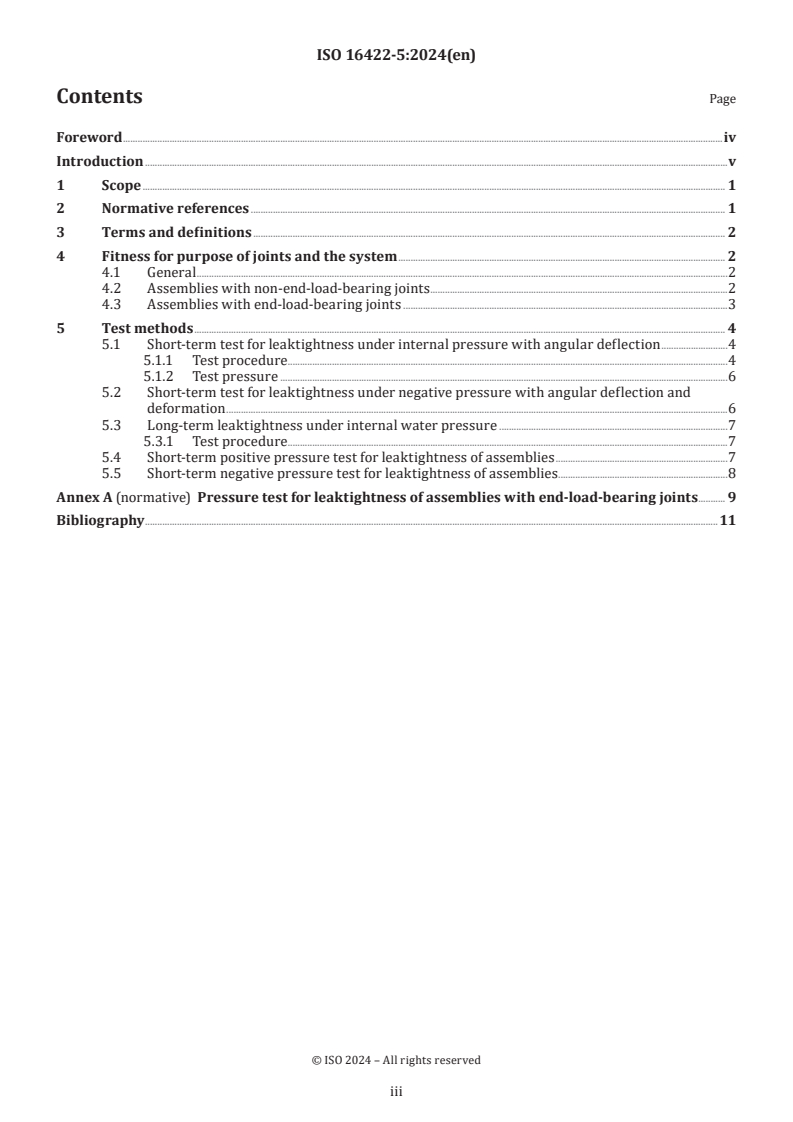
Contents Page
Foreword .iv
Introduction .v
1 Scope . 1
2 Normative references . 1
3 Terms and definitions . 2
4 Fitness for purpose of joints and the system . 2
4.1 General .2
4.2 Assemblies with non-end-load-bearing joints .2
4.3 Assemblies with end-load-bearing joints .3
5 Test methods . 4
5.1 Short-term test for leaktightness under internal pressure with angular deflection .4
5.1.1 Test procedure.4
5.1.2 Test pressure .6
5.2 Short-term test for leaktightness under negative pressure with angular deflection and
deformation .6
5.3 Long-term leaktightness under internal water pressure .7
5.3.1 Test procedure.7
5.4 Short-term positive pressure test for leaktightness of assemblies .7
5.5 Short-term negative pressure test for leaktightness of assemblies .8
Annex A (normative) Pressure test for leaktightness of assemblies with end-load-bearing joints . 9
Bibliography .11
iii
Foreword
ISO (the International Organization for Standardization) is a worldwide federation of national standards
bodies (ISO member bodies). The work of preparing International Standards is normally carried out through
ISO technical committees. Each member body interested in a subject for which a technical committee
has been established has the right to be represented on that committee. International organizations,
governmental and non-governmental, in liaison with ISO, also take part in the work. ISO collaborates closely
with the International Electrotechnical Commission (IEC) on all matters of electrotechnical standardization.
The procedures used to develop this document and those intended for its further maintenance are described
in the ISO/IEC Directives, Part 1. In particular, the different approval criteria needed for the different types
of ISO document should be noted. This document was drafted in accordance with the editorial rules of the
ISO/IEC Directives, Part 2 (see www.iso.org/directives).
ISO draws attention to the possibility that the implementation of this document may involve the use of (a)
patent(s). ISO takes no position concerning the evidence, validity or applicability of any claimed patent
rights in respect thereof. As of the date of publication of this document, ISO had not received notice of (a)
patent(s) which may be required to implement this document. However, implementers are cautioned that
this may not represent the latest information, which may be obtained from the patent database available at
www.iso.org/patents. ISO shall not be held responsible for identifying any or all such patent rights.
Any trade name used in this document is information given for the convenience of users and does not
constitute an endorsement.
For an explanation of the voluntary nature of standards, the meaning of ISO specific terms and expressions
related to conformity assessment, as well as information about ISO's adherence to the World Trade
Organization (WTO) principles in the Technical Barriers to Trade (TBT), see www.iso.org/iso/foreword.html.
This document was prepared by Technical Committee ISO/TC 138, Plastics pipes, fittings and valves for the
transport of fluids, Subcommittee SC 2, Plastics pipes and fittings for water supplies.
This first edition of ISO 16422-5, together with ISO 16422-1 and ISO 16422-2, cancels and replaces the second
edition of ISO 16422:2014, which has been technically revised.
The main changes are as follows:
— ISO 16422:2014 has been split into several parts, under the general title “Pipes and joints made of oriented
unplasticized poly(vinyl chloride) (PVC-O) for the conveyance of water under pressure”. The information
previously included in ISO 16422:2014 has been divided into ISO 16422-1, ISO 16422-2 and ISO 16422-5
(this document), with the following addition to ISO 16422-5:
— new pressure tests for leaktightness of assemblies have been introduced in place of those from
ISO 13783.
A list of all parts in the ISO 16422 series can be found on the ISO website.
Any feedback or questions on this document should be directed to the user’s national standards body. A
complete listing of these bodies can be found at www.iso.org/members.html.
iv
Introduction
Molecular orientation of thermoplastics results in the improvement of physical and mechanical properties.
Orientation is carried out at temperatures well above the glass transition temperature.
Orientation of PVC-U pipe-material can be induced by different processes.
In general, the following production process is common.
— A thick-wall tube is extruded (feedstock) and conditioned at the desired temperature.
— The orientation process is activated primarily in circumferential direction under controlled conditions.
Axial orientation can also be activated in the product.
— After the orientation process, the pipe is cooled down quickly to ambient temperature.
The orientation of the molecules creates a laminar structure in the material of the pipe wall. This structure
gives the ability to withstand brittle failure emanating from minor flaws in the material matrix or from
scratches at the surface of the pipe wall.
Improved hoop strength allows reduced wall thickness with material and energy savings. It also results in
improved resistance to impact and fatigue.
The classification of the pipe depends on material compound/formulation and stretch ratios used. Therefore,
with the classification, these characteristics may be specified or determined.
Regarding potential adverse effects on the quality of water intended for human consumption caused by
the products covered by this document, this document provides no information as to whether or not the
products can be used without restriction.
v
International Standard ISO 16422-5:2024(en)
Pipes and joints made of oriented unplasticized poly(vinyl
chloride) (PVC-O) for the conveyance of water under
pressure —
Part 5:
Fitness for purpose of the system
1 Scope
This document specifies the characteristics of the fitness for purpose of oriented unplasticized poly(vinyl
chloride) (PVC-O) solid wall piping intended to be used underground or above-ground where protected
from direct sunlight, for water supply, buried drainage, sewerage, treated wastewater and irrigation under
pressure. It also specifies the test parameters for the test methods referred to in this document.
This document is not intended for on-site testing of pipe systems.
In conjunction with ISO 16422-1, ISO 16422-2, ISO/TS 16422-3 and ISO 1452-3, this document is applicable
to PVC-O pipes and PVC-O fittings, as well as to their joints and to joints with components of other plastics
and non-plastics materials intended to be used for the following:
a) water mains and services lines;
b) conveyance of water for both outside and inside buildings;
c) drainage, sewerage and treated wastewater under pressure;
d) irrigation under pressure.
This document is applicable to piping systems intended for the supply of water under pressure up to and
including 25 °C (cold water), intended for human consumption and for general purposes as well as for
wastewater under pressure.
This document is also applicable to components for the conveyance of water and wastewater up to and
including 45 °C. For temperatures between 25 °C and 45 °C, see ISO 16422-2:2023, Figure C.1.
The piping system according to this document is intended for the conveyance of cold water up to pressures
1)
of 25 bar and especially in those applications where special performance requirements are needed, such as
impact loads and pressure fluctuations, up to pressure of 25 bar.
2 Normative references
The following documents are referred to in the text in such a way that some or all of their content constitutes
requirements of this document. For dated references, only the edition cited applies. For undated references,
the latest edition of the referenced document (including any amendments) applies.
ISO 16422-1, Pipes and joints made of oriented unplasticized poly(vinyl chloride) (PVC-O) — Part 1: General
ISO 16422-2, Pipes and joints made of oriented unplasticized poly(vinyl chloride) (PVC-O) — Part 2: Pipes
ISO/TS 16422-3, Pipes and joints made of oriented unplasticized poly(vinyl chloride) (PVC-O) for the conveyance
of water under pressure — Part 3: Fittings
5 2
1) 1 bar= 0,1 MPa = 10 Pa; 1 MPa= 1 N/mm
ISO 472, Plastics — Vocabulary
ISO 1043-1, Plastics — Symbols and abbreviated terms — Part 1: Basic polymers and their special characteristics
ISO 1452-3, Plastics piping systems for water supply and for buried and above-ground drainage and sewerage
under pressure — Unplasticized poly(vinyl chloride) (PVC-U) — Part 3: Fittings
ISO 1452-4, Plastics piping systems for water supply and for buried and above-ground drainage and sewerage
under pressure — Unplasticized poly(vinyl chloride) (PVC-U) —
...
Questions, Comments and Discussion
Ask us and Technical Secretary will try to provide an answer. You can facilitate discussion about the standard in here.
Loading comments...